Chapter 12 — Area and Perimeter of Composite Figures
Standard: 8.MG.5 — The student will solve area and perimeter problems involving composite plane figures, including those in context.
By the end of this chapter you will be able to:
- Subdivide a plane figure into triangles, rectangles, squares, trapezoids, parallelograms, circles, and semicircles, find the area of each piece, and add them to get the area of the whole (8.MG.5a)
- Find the same area a second way — a different subdivision, or a large figure with a piece removed — and use the agreement as a check (8.MG.5a)
- Subdivide a plane figure into triangles, rectangles, squares, trapezoids, parallelograms, and semicircles, and use the attributes of those pieces to determine the perimeter of the whole figure (8.MG.5b)
- Explain why the perimeter of a composite figure is not the sum of the perimeters of its pieces, and why the diameter of an attached semicircle is not part of the boundary (8.MG.5b)
- Apply perimeter, circumference, and area formulas to contextual problems: flooring, fencing, trim, turf, glass, and cost (8.MG.5c)
Lessons: 12.1 Subdividing a Figure and Adding the Pieces · 12.2 Circles, Semicircles, and Pieces Removed · 12.3 The Perimeter of a Composite Figure · 12.4 Composite Figures in Context
Pi. Every answer that contains is given twice: first exactly, written in terms of , and then approximately, using . So an area of cm is reported as " cm, or about cm." Because is itself an approximation, every decimal answer in this chapter is an approximation, which is why the word about belongs in front of it.
Numbering note. Item numbers run straight through the chapter, from 1 in Lesson 12.1 to 104 at the end of the review. They do not restart at each lesson.
Lesson 12.1 — Subdividing a Figure and Adding the Pieces
What a composite figure is
A composite figure is a plane figure built from simpler figures joined together. Almost every real shape is one: a room with a bay window, a running track, a patio with a corner cut out, a garden bed with a rounded end.
You already know the area of every simple piece Grade 8 allows. The whole chapter rests on that list:
The standard names exactly these pieces for area: triangles, rectangles, squares, trapezoids, parallelograms, circles, and semicircles. Nothing else is needed.
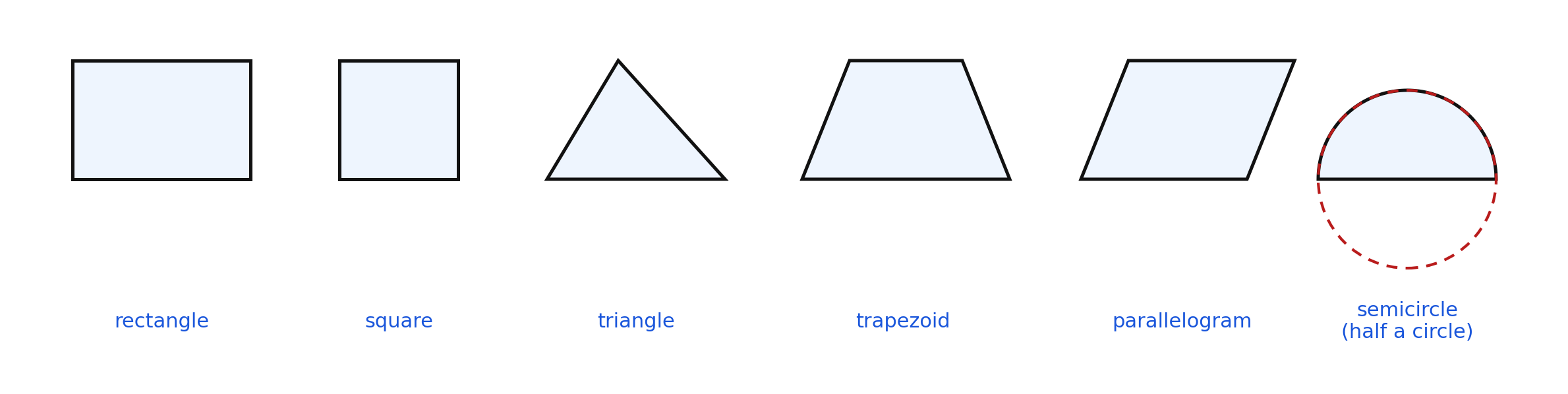
To subdivide a figure — also called decomposing it — is to cut it, on paper, into pieces from that list whose areas you can find. The cuts are imaginary. They are drawn dashed in every figure in this chapter, and they matter enormously in Lesson 12.3, where you will see that a dashed cut adds nothing to the perimeter.
One figure, two subdivisions, one area
Here is an L-shaped figure. It can be cut across or cut down.
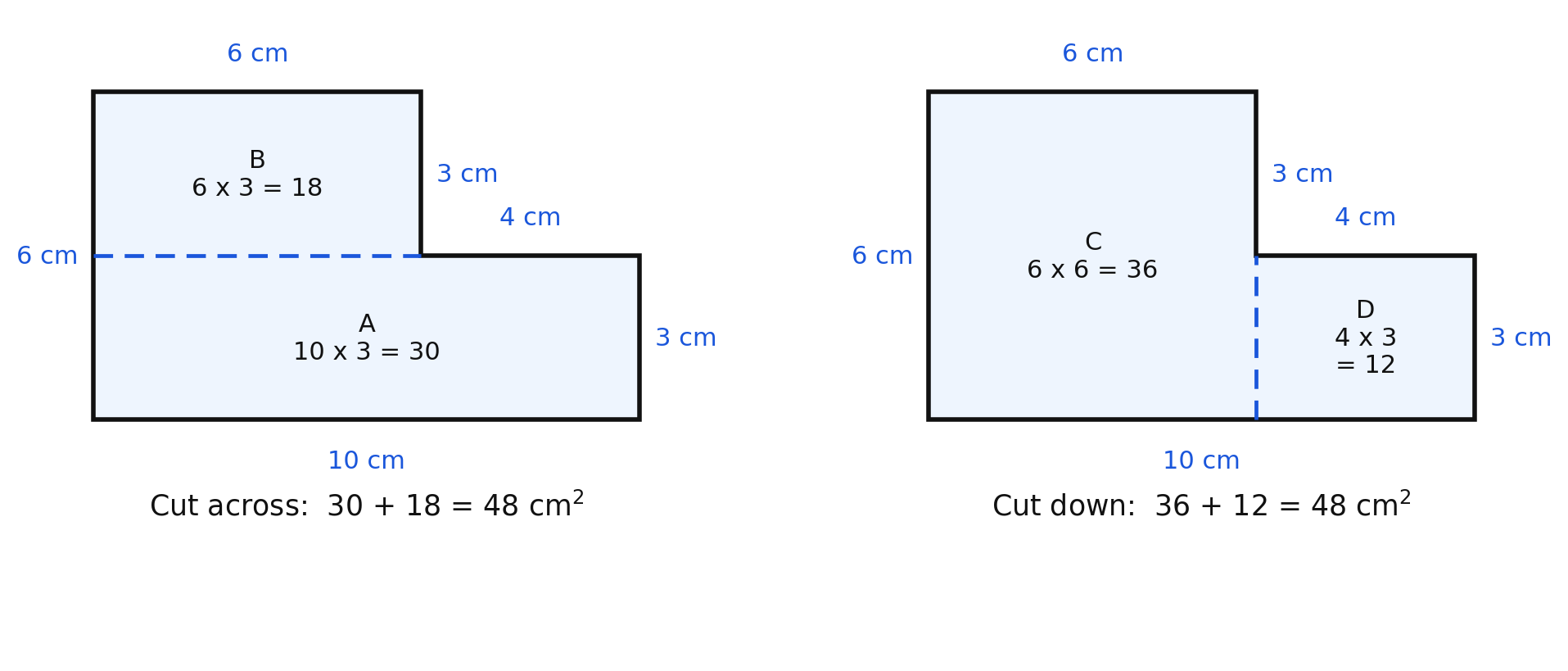
Cut across. The bottom piece is cm by cm; the top piece is cm by cm.
Cut down. The left piece is cm by cm; the right piece is cm by cm.
Same figure, same cm. That is not luck. Area measures how much surface is there, and where you draw an imaginary cut cannot change how much surface is there. Subdividing a second way is the single best check you have, and this chapter will ask you for it again and again.
Notice how the missing side lengths were found. The figure never labels the piece heights directly; you read them off the labeled sides. The left side is cm and the far right side is cm, so the top piece is cm tall.
Subtraction: a big figure with a piece removed
There is a third way to see the same L, and often it is the fastest. Fill in the notch to make a full rectangle, then take the notch back out.
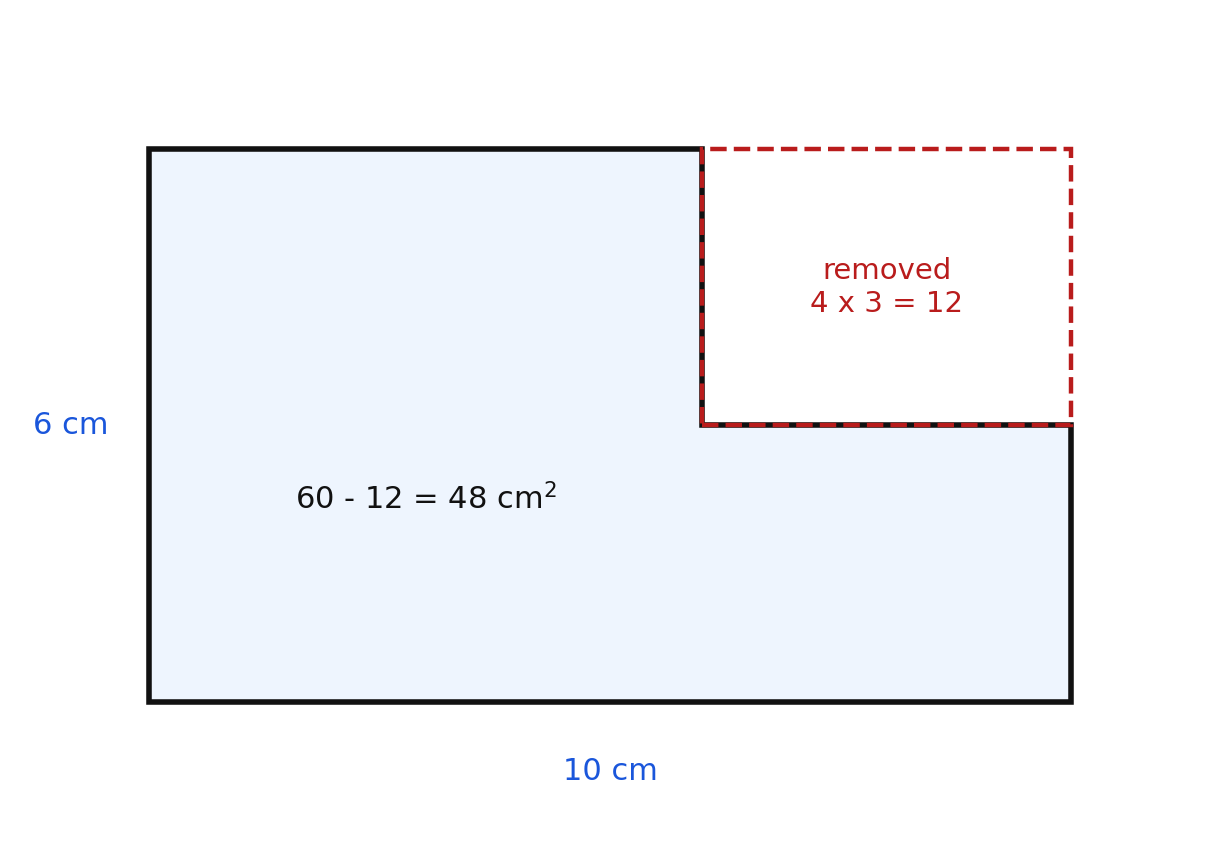
Subtraction is part of composite area, not a trick outside it. Any figure with a hole or a bite taken out of it — a lawn with a pond, a countertop with a cutout — is handled this way: area of the whole minus area of the removed piece.
Triangles, trapezoids, and parallelograms in the mix
The pieces do not have to be rectangles. Below, a rectangle carries a triangle.
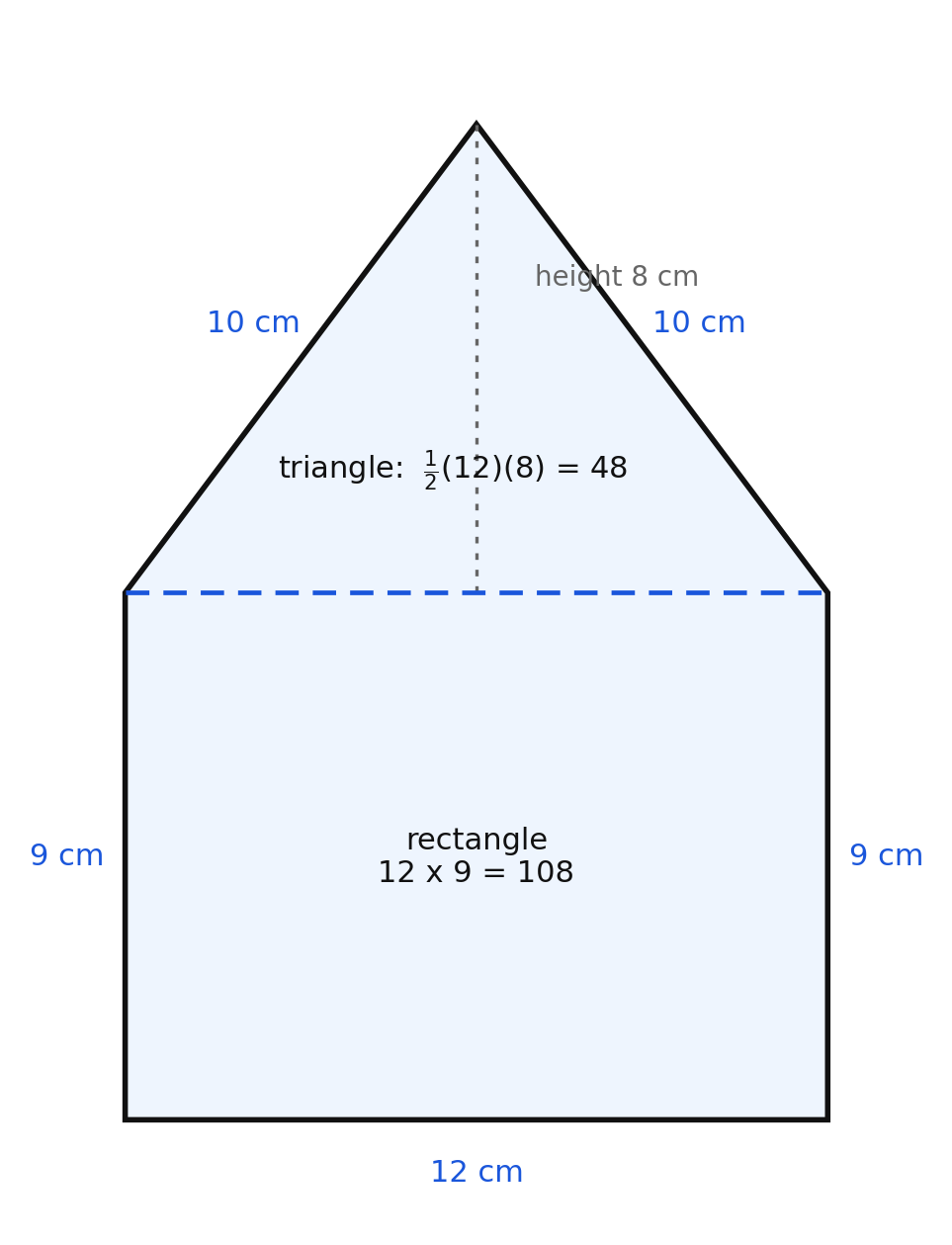
Use the triangle's own height, not the height of the whole figure. The figure is cm tall and the triangle is only cm tall. Reaching for the wrong height is the most common error in this lesson, and the fix is to mark the triangle's height on the drawing before you compute anything.
A trapezoid works the same way once you find its two parallel sides.
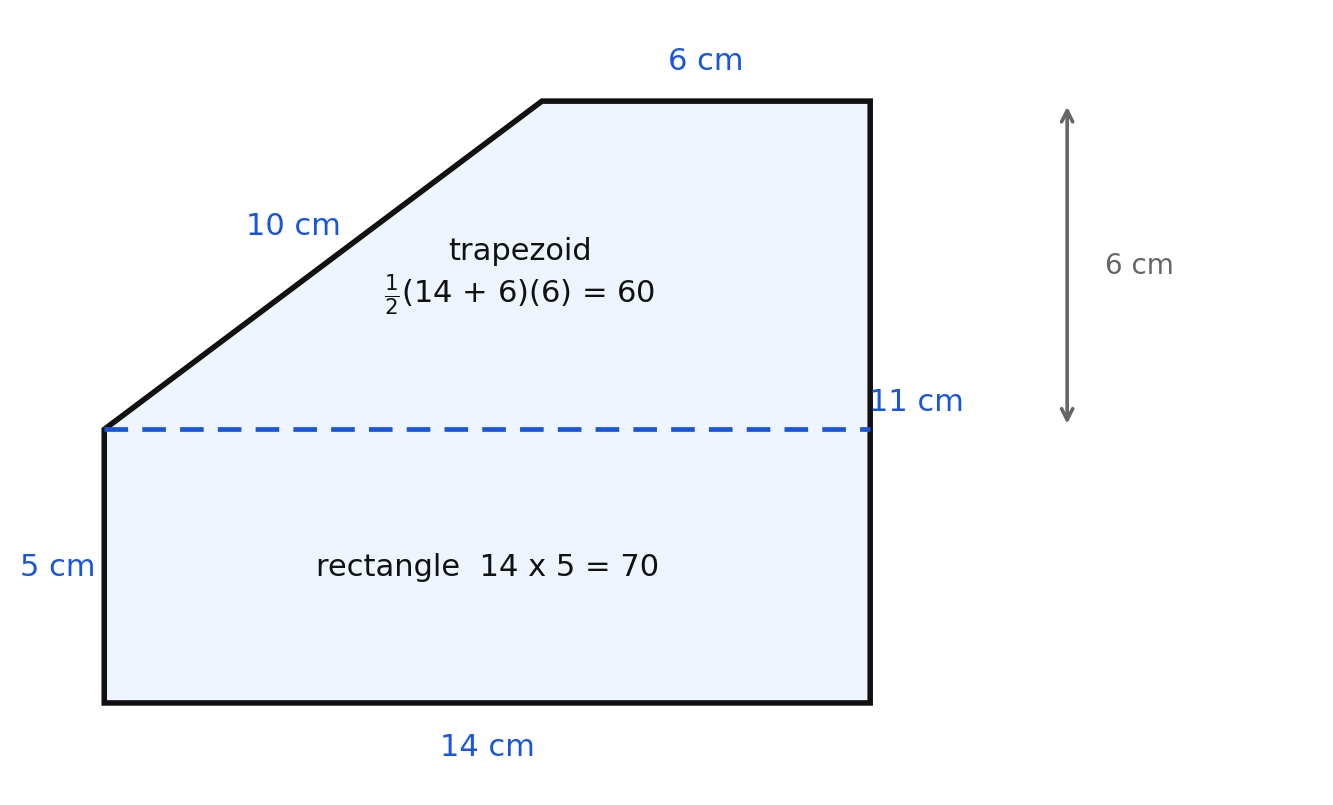
Check it a second way. Cut the trapezoid into a by rectangle and a triangle with base and height :
And a parallelogram, whose area is base times perpendicular height, never times the slanted side:
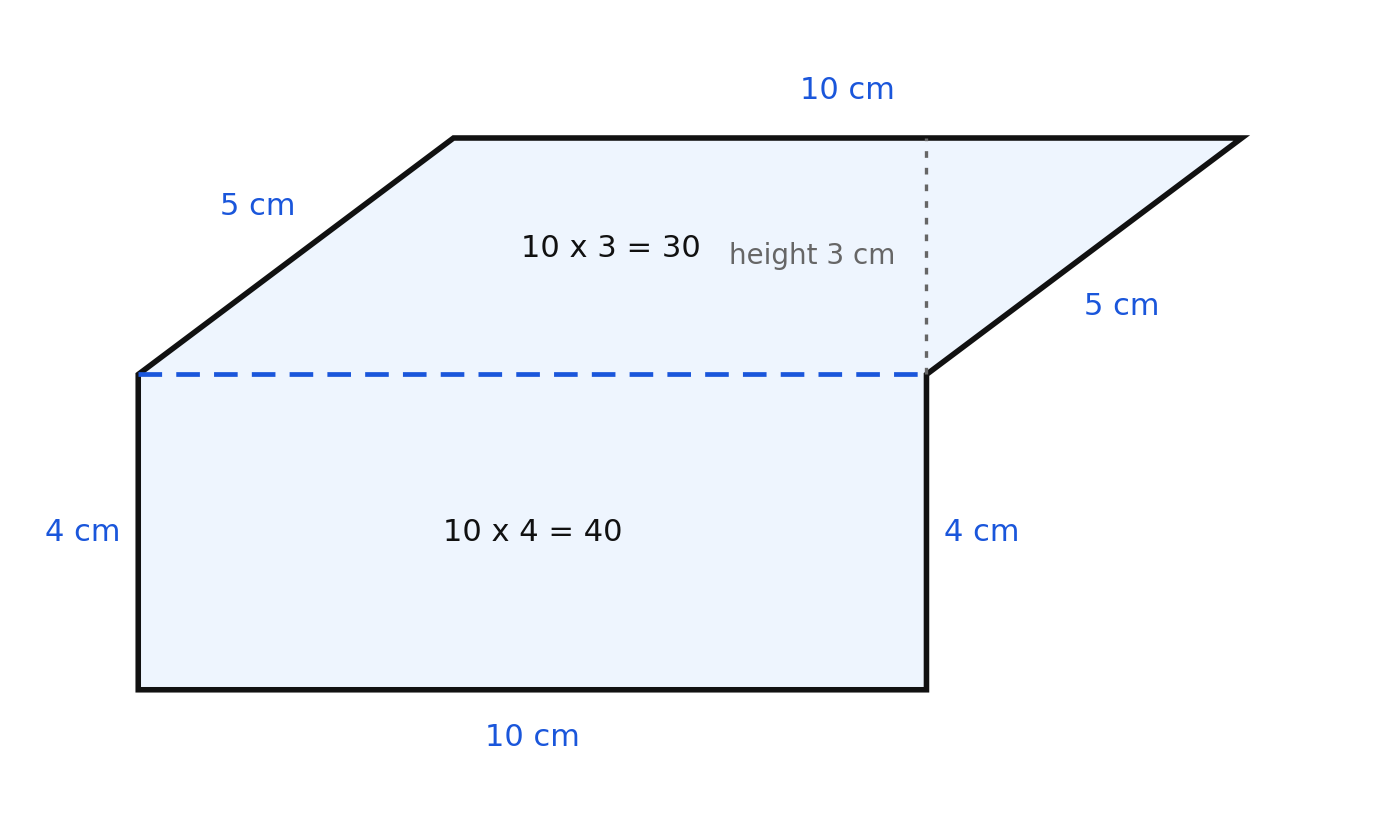
The slanted sides are cm long, and appears nowhere in the area calculation. It will appear in Lesson 12.3, where perimeter needs it.
Worked examples
Example 1 — An L-shape, two ways
Find the area of the L-shaped figure in Figure 1 by cutting it down instead of across, and confirm it matches.
Left piece: cm by cm. Right piece: cm by cm.
Answer: cm, matching the cut-across total.
Example 2 — Subtraction
Find the area of the same figure as a rectangle with a corner removed.
Answer: cm
Example 3 — A rectangle and a triangle
Find the area of the figure in Figure 3.
The rectangle is by . The triangle has base and height — the cm sides are slant lengths, not the height.
Answer: cm
Example 4 — A trapezoid on a rectangle, checked twice
Find the area of the figure in Figure 4 two different ways.
Trapezoid formula: .
Rectangle-plus-triangle: .
Answer: cm, both ways.
Example 5 — Finding an unlabeled length
In Figure 1 the left side is cm and the right side is cm. How tall is the upper piece, and why?
The left side runs the full height of the figure, and the right side runs only the height of the bottom piece. The upper piece is the difference.
Answer: cm, because the full height minus the bottom piece's height is what is left.
Guided practice
- Copy and complete for the L-shape in Figure 1, cut across: cm.
- Copy and complete for the same figure, cut down: cm.
- Copy and complete for the same figure by subtraction: cm.
- Find the area of the figure in Figure 3. Name the two pieces and the dimensions you used for each.
- Find the area of the figure in Figure 4 using the trapezoid formula for the upper piece.
- Find the area of the figure in Figure 5. State the base and the height of the parallelogram.
Independent practice
Use the practice figures below for items 7–10.
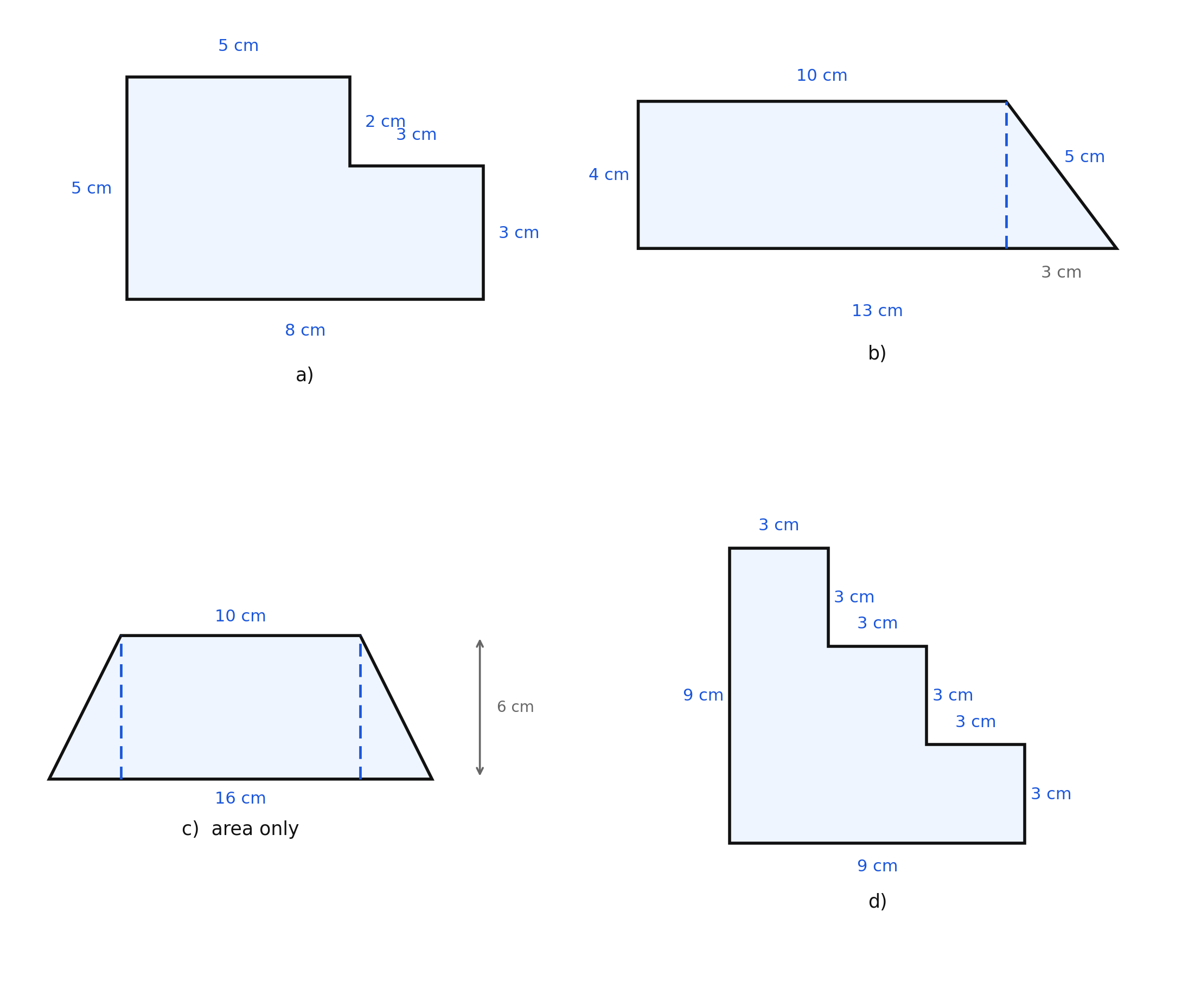
- Figure 13a. Find the area two different ways and show that both give the same result.
- Figure 13b. Find the area. Name the two pieces you used.
- Figure 13c. Find the area with the trapezoid formula, then again as a rectangle plus two triangles.
- Figure 13d. Find the area using vertical strips, then again using horizontal strips.
- Reasoning. Explain why cutting Figure 1 across and cutting it down must give the same area, in terms of what area measures.
- Reasoning. For Figure 2, explain when the subtraction method is faster than adding pieces, and give one figure from this lesson where adding is the better choice.
- Error analysis. To find the area of Figure 3, a student wrote for the triangle. Identify the error and give the correct area of the whole figure.
- Error analysis. To find the area of Figure 4, a student wrote for the trapezoid. Identify the error and give the correct total area.
- Application. The floor plan of a reading nook has the shape of Figure 13a, with measurements in feet instead of centimeters. Tile costs $6 per square foot. Find the area of the floor and the cost to tile it.
- Reasoning. A classmate says a dashed subdivision line "adds a little area where the two pieces meet." Explain why that is not so.
Exit ticket 12.1
- Find the area of the figure in Figure 3.
- Find the area of the figure in Figure 4.
- Give the two subdivisions of Figure 1 and the total each one produces.
- In one sentence, say what it means to subdivide a plane figure, and why we bother.
Lesson 12.2 — Circles, Semicircles, and Pieces Removed
Half a circle is a piece too
The standard adds two curved pieces to the area list: circles and semicircles. A semicircle is exactly half a circle, so its area is half the circle's area:
The straight edge of a semicircle is a diameter, and the curved edge is an arc. Keep those two words apart; Lesson 12.3 depends on the difference.
The one thing to watch is the radius. When a semicircle sits on top of a rectangle, its diameter is the side of the rectangle, so the radius is half that side.
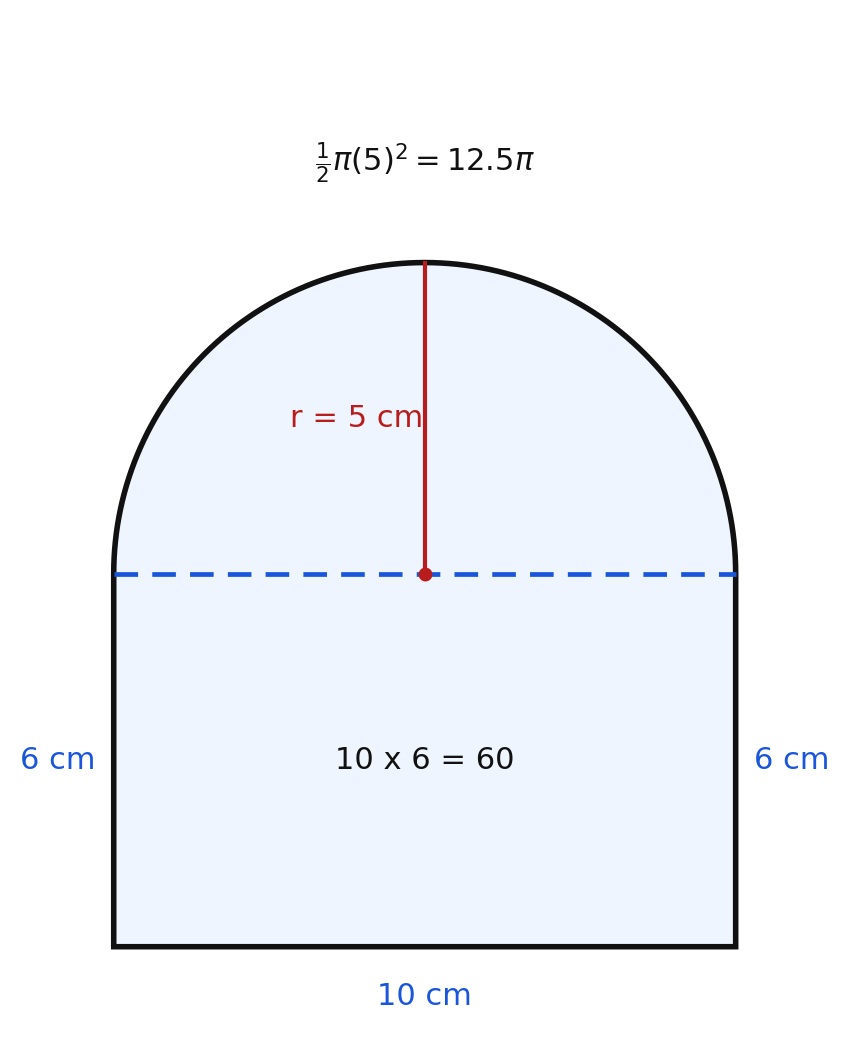
The rectangle is cm wide, so the semicircle's diameter is cm and its radius is cm.
Answer: cm, or about cm.
Leaving the answer as first is not laziness. It is the exact value; the decimal is rounded the moment you write .
Removing a piece
When a region has something taken out of it, the area is the whole minus the hole. Here a rectangular field has a circular pond in it.
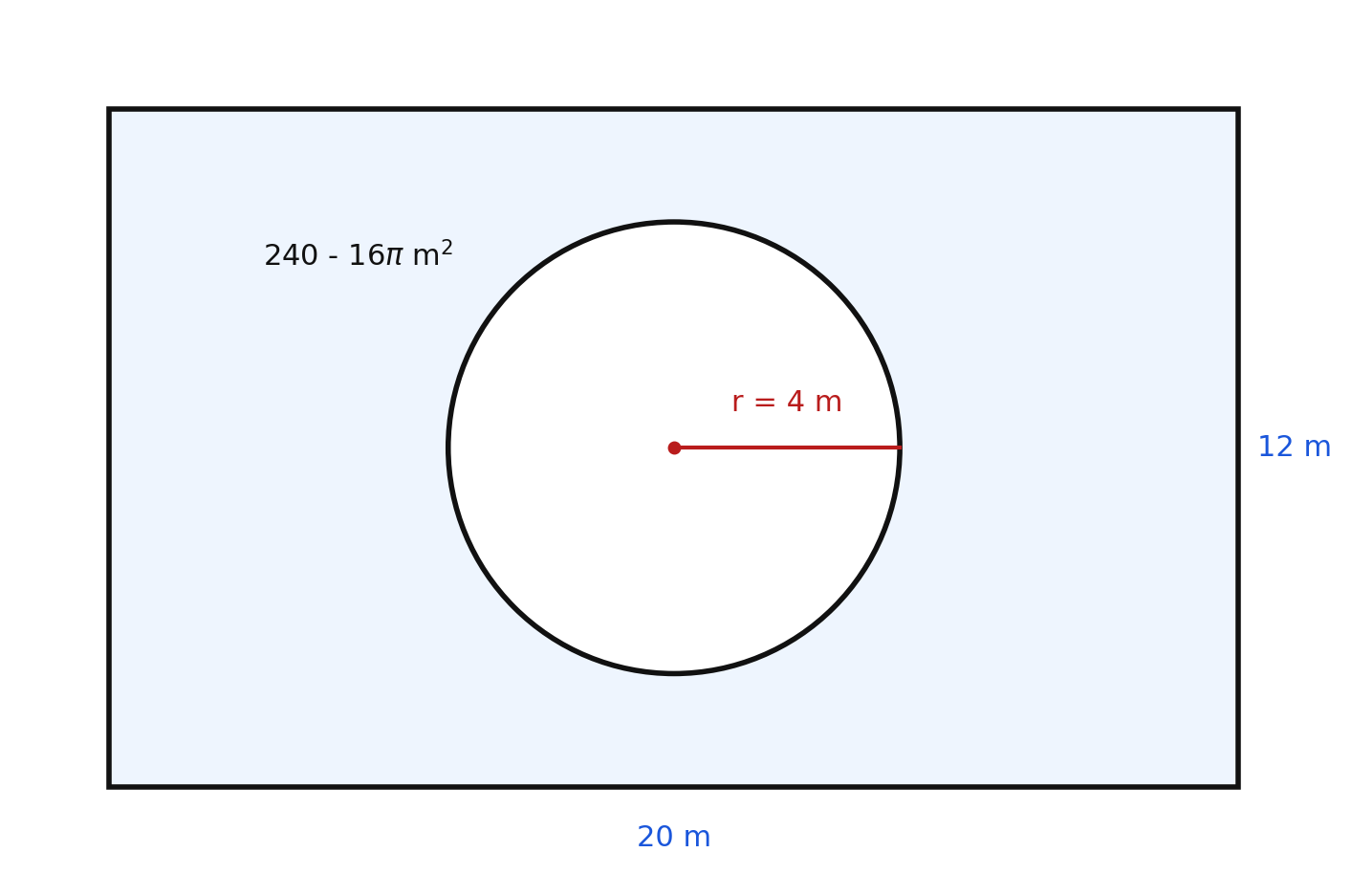
Answer: m, or about m of grass.
The removed piece can be a semicircle as well — a bite out of an edge.
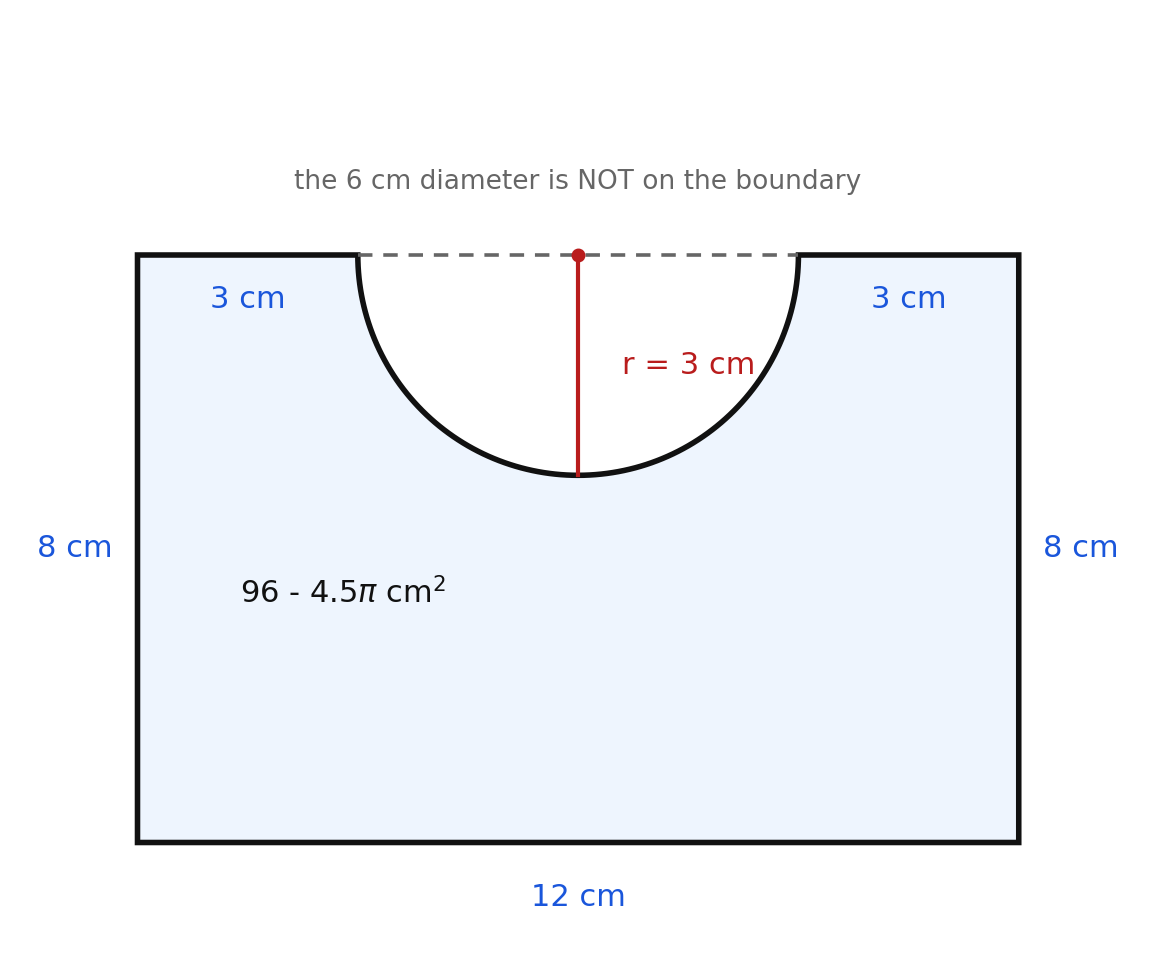
Answer: cm, or about cm.
Two semicircles make a circle
A figure with a semicircular cap on each end — a track, a tabletop, a stadium shape — can be handled two ways, and they agree.
Add the two halves: . Or notice that the two halves are congruent and combine into one whole circle: . Use whichever you find clearer, and use the other as your check.
Worked examples
Example 1 — Area of a semicircle
Find the area of a semicircle with radius cm, exactly and approximately.
Answer: cm, or about cm
Example 2 — Reading the radius off the figure
In Figure 6 the rectangle is cm wide. Why is the semicircle's radius cm and not cm?
The flat side of the semicircle lies along the top of the rectangle, so that side is the semicircle's diameter, not its radius. The radius is half the diameter.
Answer: cm
Example 3 — Rectangle plus semicircle
Find the area of the figure in Figure 6.
Answer: cm, or about cm
Example 4 — A circle removed
Find the area of grass in Figure 7.
Answer: m, or about m
Example 5 — A semicircle removed
Find the area of the figure in Figure 9.
Answer: cm, or about cm
Example 6 — Squaring the radius first
A student computes the area of a circle of radius as . What went wrong?
In the exponent attaches to alone. Square the radius first, then multiply by .
Answer: , about square units — not .
Guided practice
Give every answer exactly in terms of and then approximately, using .
- Find the area of a circle with radius cm.
- Find the area of a semicircle with radius cm.
- For Figure 6, find the area of the rectangle, the area of the semicircle, and the total.
- Find the area of the grass in Figure 7.
- Find the area of the figure in Figure 9.
- The rectangle in Figure 6 is cm wide. Explain in one sentence why the semicircle's radius is cm.
Independent practice
Use the practice figures below for items 27–30. Give exact and approximate answers.
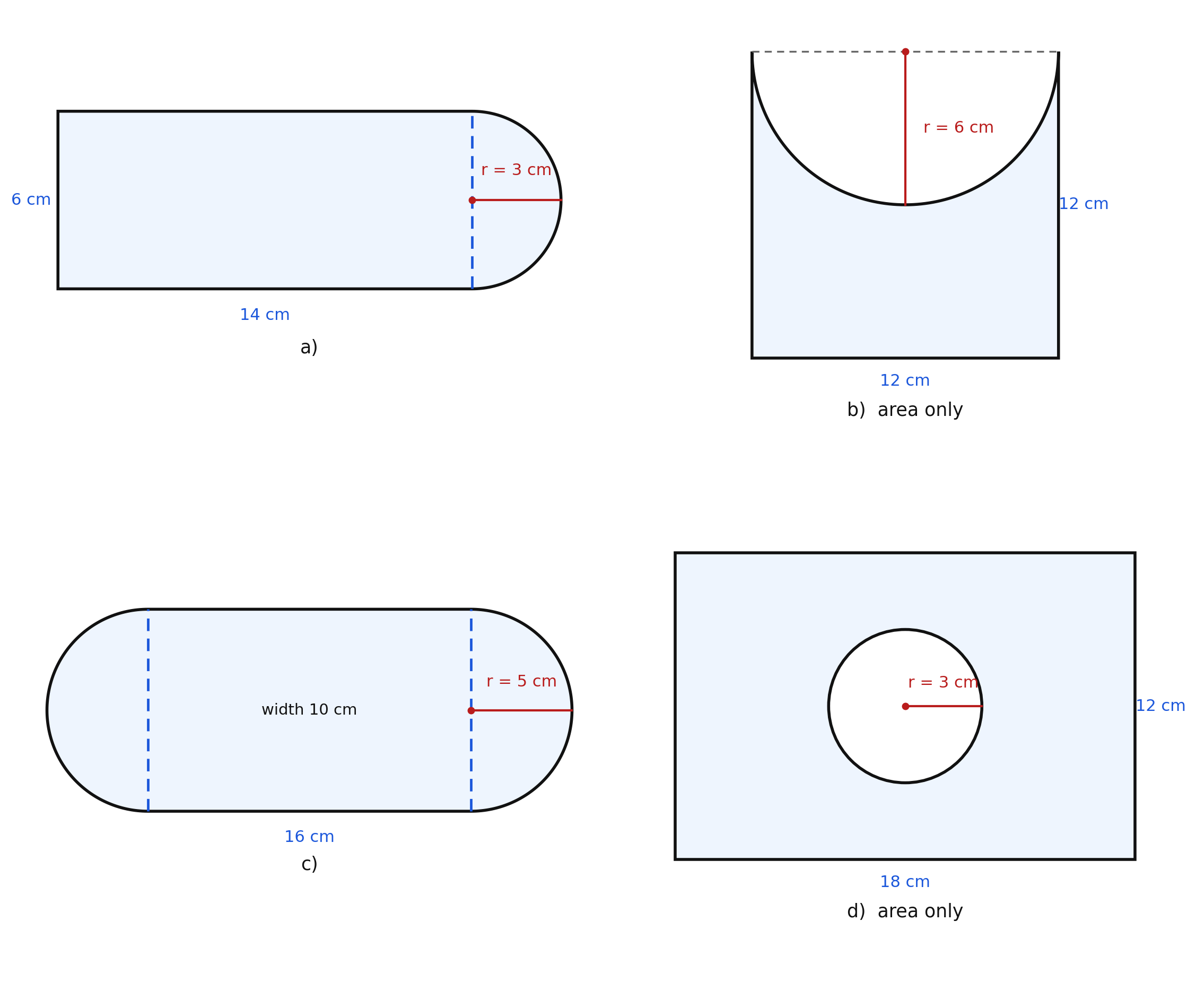
- Figure 14a. Find the area.
- Figure 14b. Find the area.
- Figure 14c. Find the area.
- Figure 14d. Find the area.
- Reasoning. Find the area of Figure 14c a second way by combining the two semicircles into one circle. Show that the two methods agree.
- Error analysis. For Figure 14a, a student wrote for the semicircle. Identify the error and give the correct total area.
- Error analysis. For Figure 14d, a student wrote . Identify the error and give the correct area.
- Application. The window in Figure 11 is made of glass. Find the area of the glass, exactly and to the nearest hundredth of a square foot.
- Application. The countertop in Figure 14b is cut from a in by in slab, with the semicircular notch removed so it fits around a post. The material costs $0.40 per square inch. Find the area of the countertop and its cost to the nearest cent.
- Reasoning. Explain why an answer written as is more accurate than the same answer written as .
Exit ticket 12.2
Give exact and approximate answers.
- Find the area of the figure in Figure 9.
- Find the area of the figure in Figure 6.
- Find the area of the figure in Figure 14d.
- Explain the difference, for area, between attaching a semicircle to a figure and removing one from it.
Lesson 12.3 — The Perimeter of a Composite Figure
The perimeter is the boundary, and only the boundary
The perimeter of a figure is the total distance around its boundary — the outside edge you would walk along, or lay fencing on, or run trim around.
That definition contains the whole lesson, and it contains the chapter's biggest hazard:
The perimeter of a composite figure is NOT the sum of the perimeters of its pieces.
When two pieces are joined, the edge where they meet stops being an outside edge. It is now an interior edge, inside the figure, and it belongs to no part of the boundary. But each piece's own perimeter counted it once, so adding the pieces' perimeters counts that shared edge twice when it should be counted zero times.
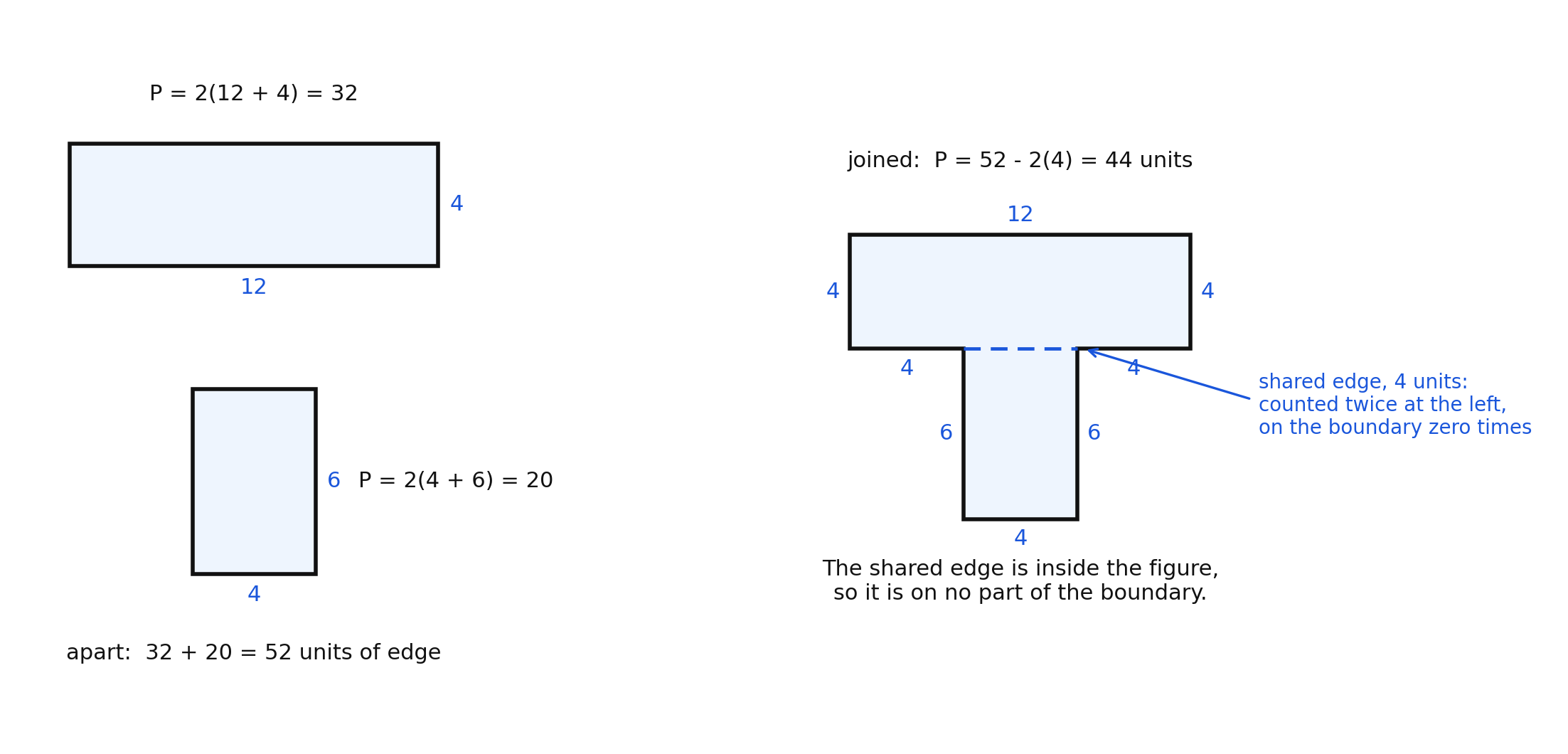
Apart, the two rectangles have and units of edge, for in total. Joined into a T, the shared edge — the -unit segment where the stem meets the bar — is on the inside.
Trace the boundary instead and you get the same without any subtraction:
Tracing is the method to trust. Put your finger on one corner, walk all the way around the outside, and add each segment as you cross it. If your finger ever leaves the outside edge and cuts through the middle, you are on a subdivision line, and subdivision lines are never part of the perimeter.
Tracing an L-shape
Start at the bottom-left corner of Figure 1 and walk counterclockwise:
Compare that with the pieces. Cut across, the two rectangles have perimeters and , totaling . The shared edge is cm long, and . The two routes agree, which is exactly the check to run when a perimeter answer feels uncertain.
Finding unlabeled sides
A figure often leaves a side unlabeled, expecting you to reconstruct it. On an L-shape the rule is simple: the two horizontal pieces of the top must add to the bottom, and the two vertical pieces of one side must add to the other side. In Figure 12, the top is ft and the step is ft, and together they equal the ft bottom. The right side is ft and the step down is ft, and together they equal the ft left side.
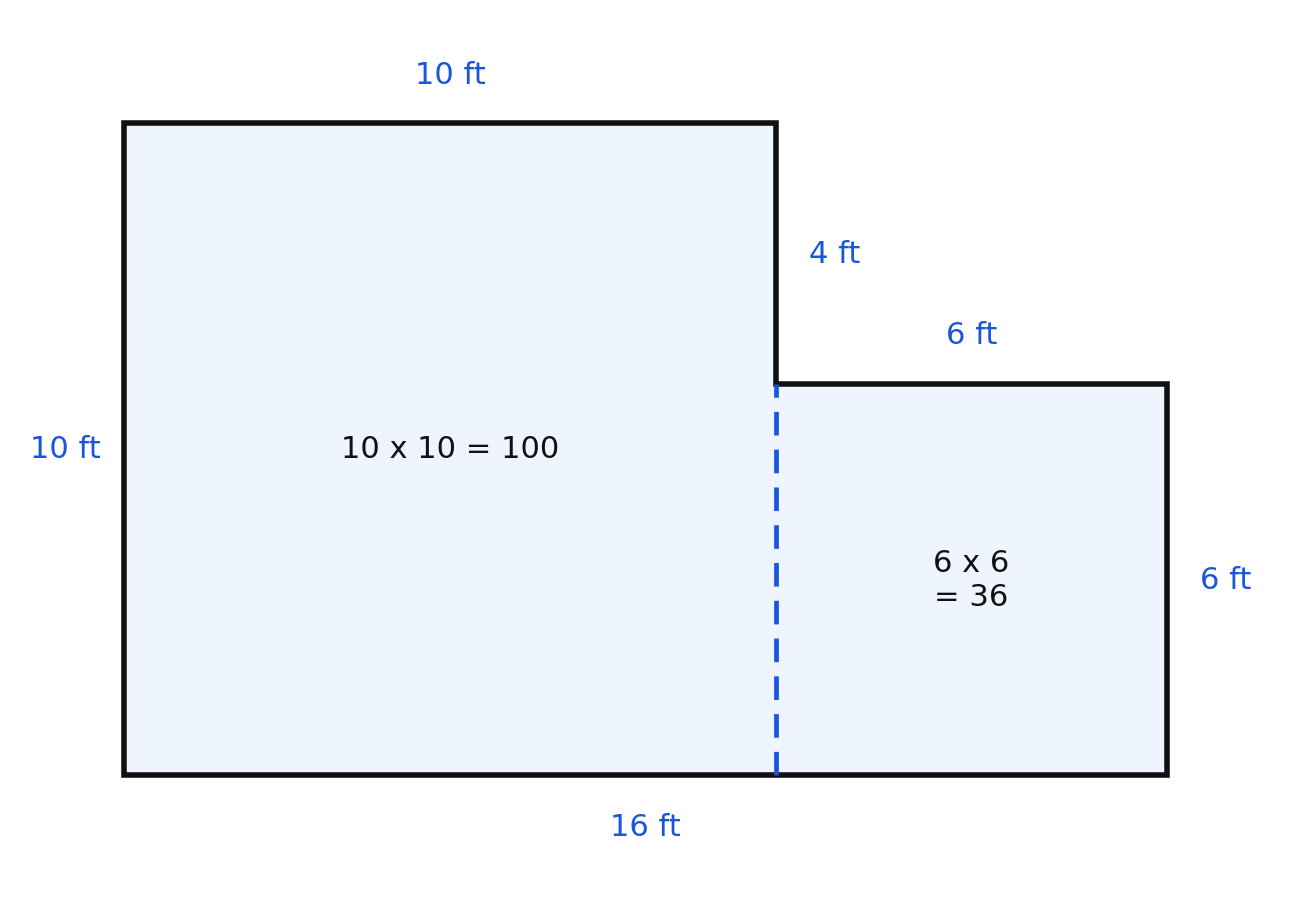
Here is a result worth noticing: cutting a rectangular notch out of a corner changes the area but not the perimeter. The full by rectangle also has perimeter ft. The two removed segments are replaced by two segments of exactly the same lengths, moved inward.
Semicircles: the arc counts, the diameter does not
When a semicircle is attached to a figure, its arc is on the outside and its diameter is the seam where it joined — an interior edge. So:
and the diameter contributes nothing.
Look again at Figure 6, the rectangle with the semicircular top. Walk the boundary: the cm bottom, the cm right side, the arc, and the cm left side. The dashed cm seam is never walked.
Answer: cm, or about cm.
A removed semicircle behaves the same way, and the result surprises people: cutting a bite out of an edge makes the perimeter longer. In Figure 9 the top edge lost its middle cm and gained an arc of length cm.
Note that the removed piece's straight diameter is gone from the boundary — the arc replaced it.
Note. For perimeter, the standard's list of subdivisions is triangles, rectangles, squares, trapezoids, parallelograms, and semicircles — full circles are not on it. That makes sense: a whole circle sitting inside a figure, like the pond in Figure 7, is a hole. Its circumference is not part of the figure's outside boundary at all.
The slant sides finally matter
Area used perpendicular heights. Perimeter uses the actual sides you walk on, slants included. In Figure 3 the roof's height of cm never appears; the two cm slants do.
Worked examples
Example 1 — Apart, then joined
Find the perimeter of each rectangle in Figure 8 separately, then the perimeter of the joined T.
Apart: and , so units of edge.
Joined: the shared edge is units and it is now interior, so it comes off twice.
Answer: and apart; joined.
Example 2 — Tracing an L
Find the perimeter of the L-shape in Figure 1.
Answer: cm
Example 3 — An attached semicircle
Find the perimeter of the figure in Figure 6.
Boundary: bottom , right , arc , left . The cm diameter is a seam, not a boundary.
Answer: cm, or about cm
Example 4 — A removed semicircle
Find the perimeter of the figure in Figure 9.
Answer: cm, or about cm
Example 5 — Slanted sides
Find the perimeter of the figure in Figure 4.
Boundary: . The cm trapezoid height is interior information and is not walked.
Answer: cm
Example 6 — A notch does not change the perimeter
Show that the patio in Figure 12 has the same perimeter as the full ft by ft rectangle.
Patio: ft. Rectangle: ft.
The ft and ft segments of the notch replace the ft and ft that were removed from the top and the right side, so the total distance is unchanged. The area, of course, is not: ft became ft.
Answer: Both are ft.
Guided practice
- In Figure 8, find the perimeter of the by rectangle and of the by rectangle separately, then add them.
- In Figure 8, find the perimeter of the joined T-shape by tracing the boundary. Explain why it is not the sum from item 41.
- Trace the boundary of Figure 1 and find its perimeter.
- Find the perimeter of Figure 6. State which segment you left out and why.
- Find the perimeter of Figure 9.
- Find the perimeter of Figure 12.
Independent practice
Use the practice figures below for items 47–49. Give exact and approximate answers where appears.
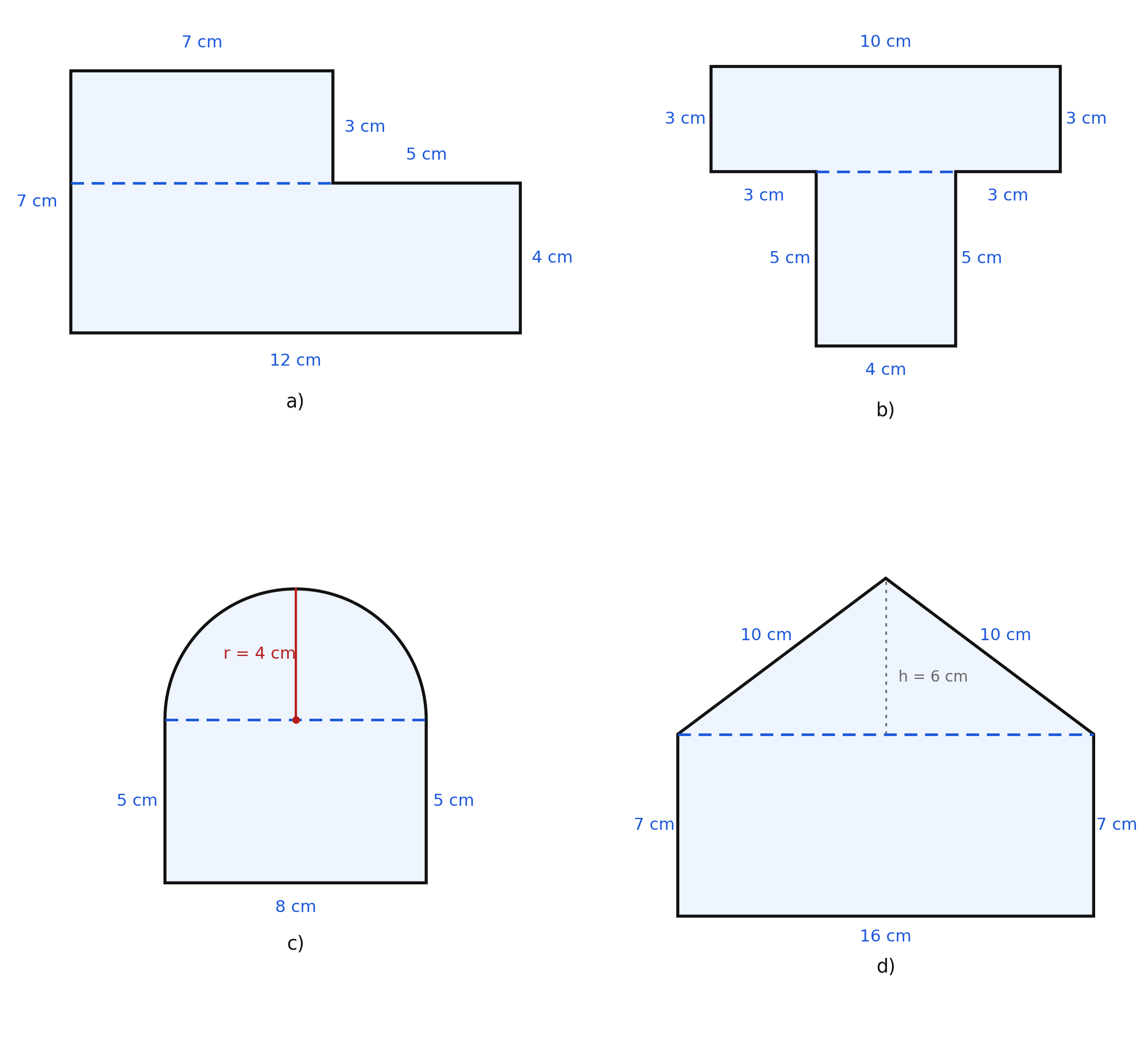
- Figure 15a. Find the perimeter.
- Figure 15b. Find the perimeter by tracing. Then add the perimeters of the two rectangles separately and show that the difference is twice the shared edge.
- Figure 15c. Find the perimeter.
- Find the perimeter of the figure in Figure 3.
- Find the perimeter of the figure in Figure 4.
- Find the perimeter of the figure in Figure 5.
- Error analysis. For Figure 15b, a student answered cm. Identify the error and give the correct perimeter.
- Error analysis. For Figure 15c, a student answered . Identify the error and give the correct perimeter.
- Reasoning. Explain why the sum of two pieces' perimeters always exceeds the perimeter of the joined figure by exactly twice the length of the shared edge.
- Reasoning. The L-shape in Figure 1 has area cm and perimeter cm. A cm by cm rectangle also has area cm. Find its perimeter and explain what this shows about area and perimeter.
Exit ticket 12.3
- Figure 15d. Find the perimeter.
- Find the length of trim needed to go all the way around the window in Figure 11, exactly and to the nearest hundredth of a foot.
- Find the distance around the track in Figure 10, exactly and approximately.
- In one sentence, explain why an interior subdivision line is never part of a perimeter.
Lesson 12.4 — Composite Figures in Context
Choosing the formula the situation asks for
Contextual problems rarely say "find the area" or "find the perimeter." They say carpet, fence, paint, trim, sod, edging, glass, sealer. Your first decision is which measure the situation needs, and the units settle it.
| The situation asks about | You need | Units |
|---|---|---|
| covering a surface: tile, sod, paint, glass, mulch, sealer | area | square units |
| going around an edge: fence, trim, edging, ribbon, walking or running | perimeter (with circumference for curved parts) | linear units |
Money problems then attach a rate: dollars per square foot multiplies an area; dollars per foot multiplies a perimeter. If your units do not match the rate's units, you have chosen the wrong measure.
A worked context: the patio
The patio above is to be paved at $9 per square foot and edged with brick at $5 per foot.
Paving is area. Subdivide, or subtract:
Edging is perimeter. Trace:
A worked context: the running track
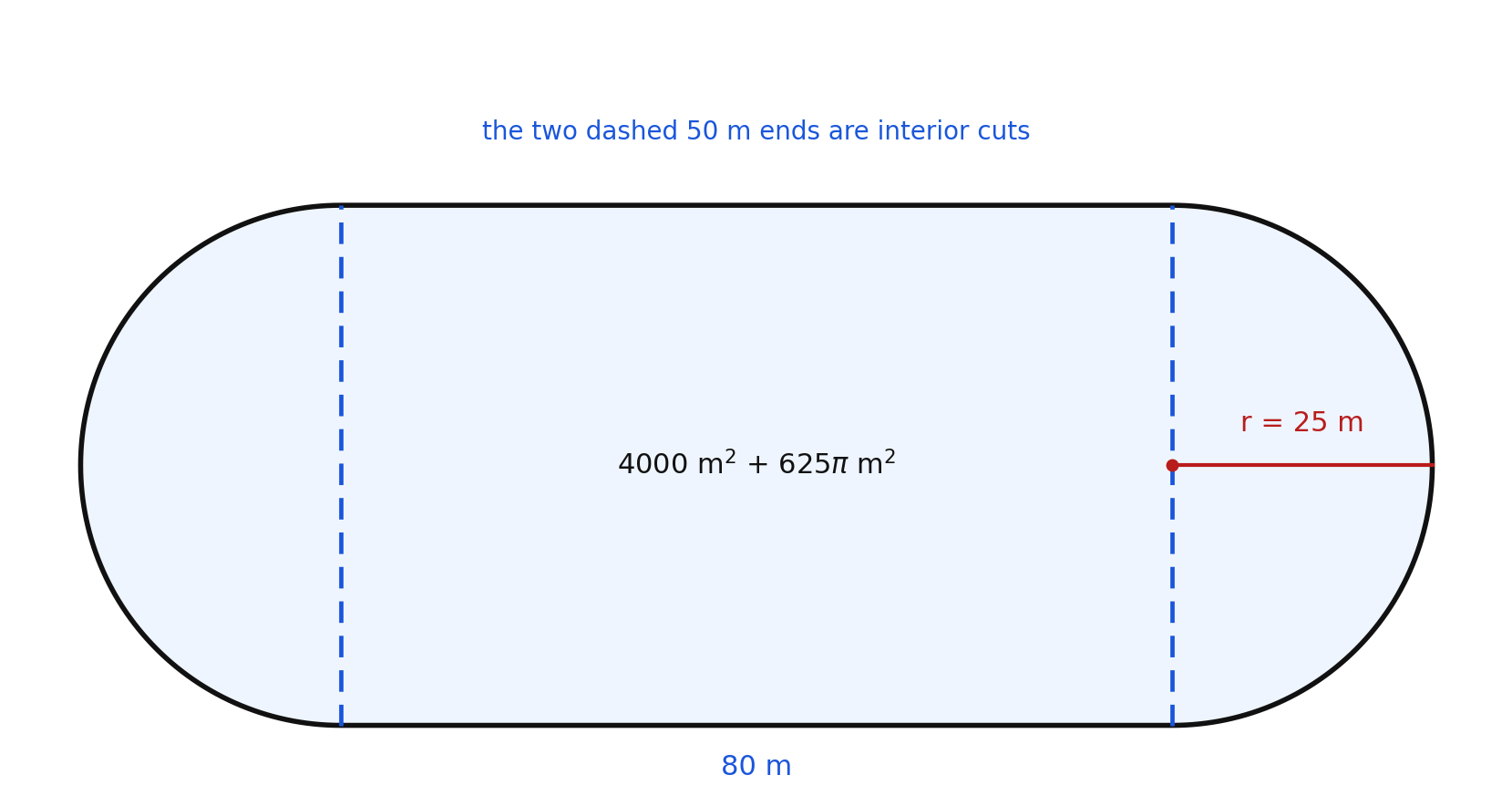
Distance around is a perimeter, and the two curved ends are semicircles that together make one full circle of radius m. The two m ends of the rectangle are seams — interior cuts — so they are not walked.
Turf is an area, and the two semicircles again combine into one circle:
A worked context: the window
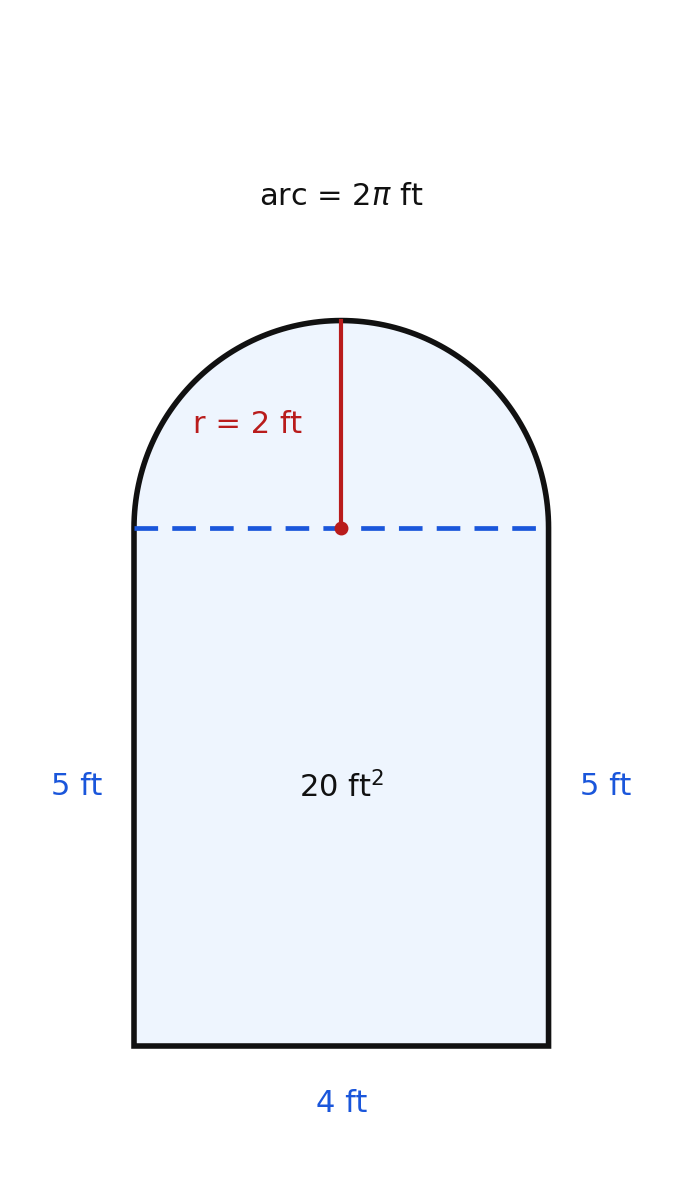
Glass is area; trim is perimeter.
The ft seam between the rectangle and the semicircle is inside the glass, so it gets no trim.
Rounding in context
Round only at the end, and round the way the situation demands. Trim sold by the foot must be rounded up — ft of trim means buying ft, because ft leaves a gap. Money is rounded to the nearest cent. Say what you rounded and why.
Worked examples
Example 1 — Area and cost
The patio in Figure 12 is sealed at $0.75 per square foot. Find the cost.
Answer: $102.00
Example 2 — Perimeter and cost
Brick edging for the same patio costs $5 per foot. Find the cost.
Answer: $260
Example 3 — Laps on the track
How far does a runner travel in laps of the track in Figure 10?
Answer: about m
Example 4 — Turf
Turf for the track's enclosed field costs $8 per square meter. Find the area and the cost.
Answer: about m and about $47,700
Example 5 — Choosing the measure
A gardener wants to know how much soil covers a bed and how much edging surrounds it. Which measure is which?
Soil covers a surface, so it is area, in square feet. Edging goes around the outside, so it is perimeter, in feet.
Answer: soil — area; edging — perimeter
Example 6 — Grass around a pond
The field in Figure 7 is seeded except for the pond. Seed costs $2 per square meter. Find the cost.
Answer: about $379.52
Guided practice
- The patio in Figure 12 is paved at $9 per square foot. Find the area and the cost.
- Trim for the window in Figure 11 costs $3 per foot, and it is sold only in whole feet. Find the perimeter, the number of feet to buy, and the cost.
- Find the distance around the track in Figure 10, then the distance a runner covers in laps.
- Find the area enclosed by the track in Figure 10, exactly and approximately.
- The field in Figure 7 is seeded except for the pond. Find the seeded area, exactly and approximately.
Independent practice
Use the context figures below for items 66–69.
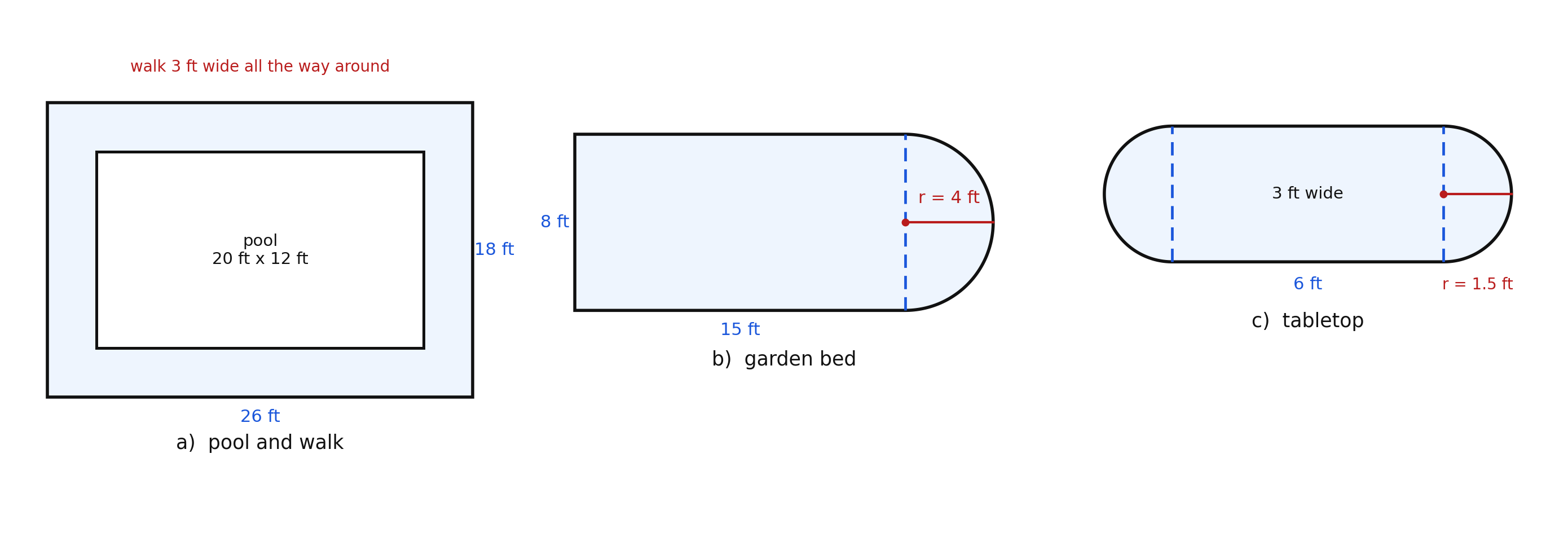
- Figure 16a. A ft by ft pool is surrounded by a walk ft wide, so the outside of the walk measures ft by ft. Find the area of the walk only, then its cost at $8 per square foot.
- Figure 16a. A railing runs around the outside edge of the walk at $6 per foot. Find the length of the railing and its cost.
- Figure 16b. The garden bed is a ft by ft rectangle with a semicircular end of radius ft. Find the area of soil needed and the length of edging that goes around the bed, each exactly and approximately.
- Figure 16c. The tabletop is a ft by ft rectangle with a semicircular end of radius ft at each end. Find the area of glass and the length of edge trim, each exactly and approximately.
- Error analysis. For Figure 16a, a student found the walk's area as ft. Identify the error and give the correct area.
- Error analysis. For Figure 16b, a student included the ft side where the semicircle attaches in the edging total. Identify the error and give the correct length.
- Reasoning. For Figure 16c, say which measure you would use to buy glass and which to buy trim, and give the units of each.
- Application. For the garden bed in Figure 16b, soil costs $4 per square foot and edging costs $3 per foot. Find the total cost to the nearest cent.
- Reasoning. Explain how the units in a rate — dollars per foot versus dollars per square foot — tell you whether the problem wants a perimeter or an area.
Exit ticket 12.4
- The patio in Figure 12 is sealed at $0.75 per square foot. Find the cost.
- Find the distance a runner covers in laps of the track in Figure 10.
- Find the length of edge trim for the tabletop in Figure 16c, exactly and approximately.
- In one sentence, explain why fencing is measured in feet but sod is measured in square feet.
Chapter 12 Review
Vocabulary. composite figure · subdivide (decompose) · boundary · interior edge · subdivision line · semicircle · diameter · arc · circumference · perimeter · area · exact value · approximation
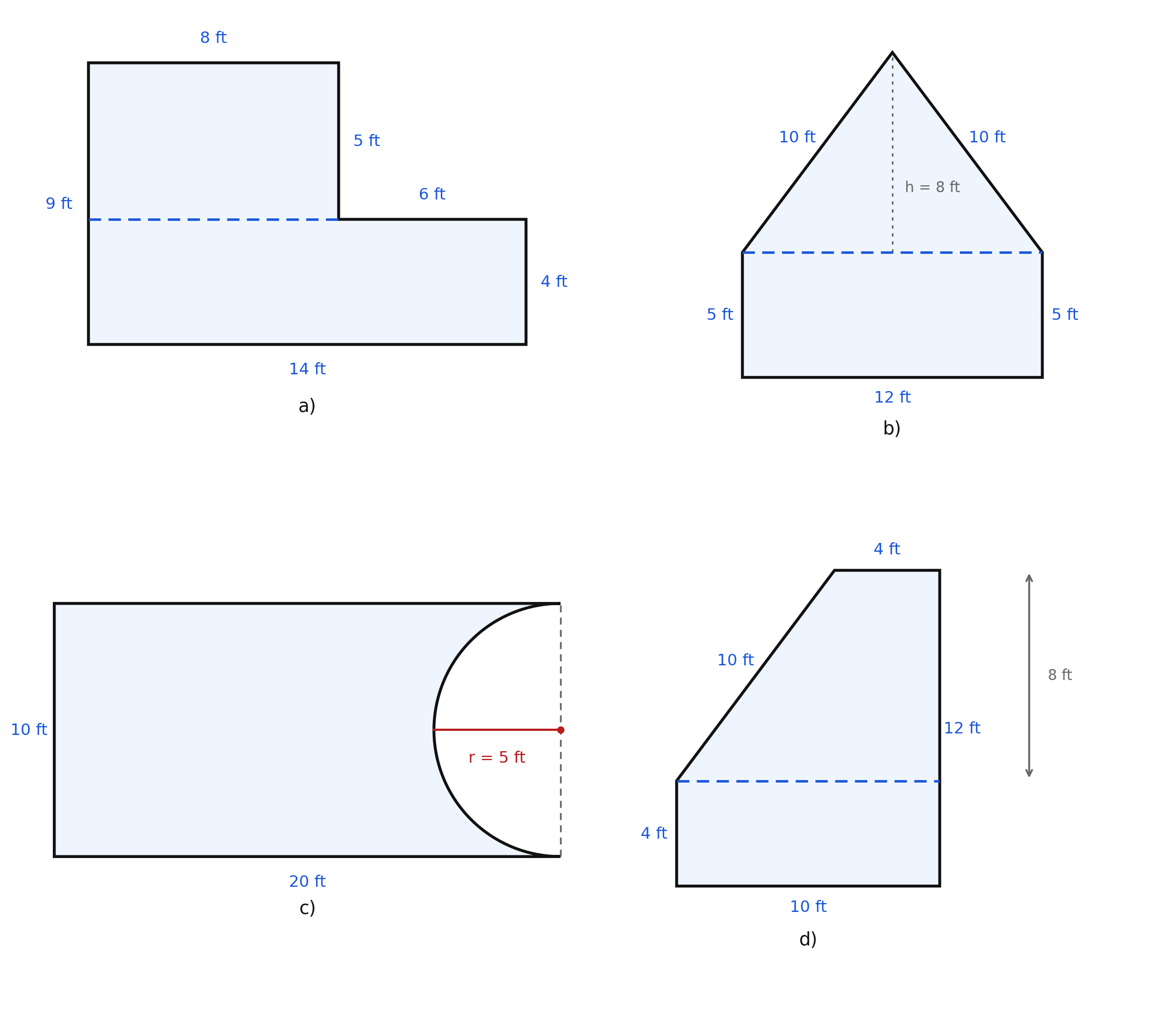
Use the review figures below for items 79–82, 89–92, and 97–101. All measurements are in feet.
Part A — Subdividing and finding area (8.MG.5a)
- Figure 17a. Find the area two different ways and show that both give the same result.
- Figure 17b. Find the area. State the triangle's base and height.
- Figure 17c. Find the area, exactly and approximately.
- Figure 17d. Find the area using the trapezoid formula, then again as a rectangle plus a triangle.
- Find the area of the L-shape in Figure 1 by subtraction.
- Find the area of the figure in Figure 6, exactly and approximately.
- Find the area of the grass in Figure 7, exactly and approximately.
- Find the area of the figure in Figure 9, exactly and approximately.
- Reasoning. Explain why two different subdivisions of the same figure must give the same area.
- Error analysis. For Figure 17b, a student used ft as the triangle's height. Identify the error and give the correct area.
Part B — Using the subdivisions to find perimeter (8.MG.5b)
- Figure 17a. Find the perimeter.
- Figure 17b. Find the perimeter.
- Figure 17c. Find the perimeter, exactly and approximately.
- Figure 17d. Find the perimeter.
- Find the perimeter of the T-shape in Figure 8 two ways: by tracing, and by adding the two rectangles' perimeters and correcting for the shared edge.
- Find the perimeter of the window in Figure 11, exactly and approximately.
- Error analysis. For Figure 17a, a student added the perimeters of a by rectangle and an by rectangle to get ft. Identify the error and give the correct perimeter.
- Reasoning. For a figure with an attached semicircle, explain why the arc is part of the perimeter but the diameter is not.
Part C — Contextual problems (8.MG.5c)
- Application. The figure in Figure 17a is a patio. Paving costs $7 per square foot. Find the area and the cost.
- Application. Edging for that same patio costs $2.50 per foot. Find the perimeter and the cost.
- Application. The figure in Figure 17b is the canvas end of a tent. One pint of waterproofing covers ft. Find the area and the number of whole pints needed.
- Application. The figure in Figure 17c is a countertop. Sealer costs $1.20 per square foot. Find the area and the cost to the nearest cent.
- Application. The figure in Figure 17d is a sign. Find its area, and the length of aluminum trim needed to frame its outside edge.
- Application. The track in Figure 10 is resurfaced inside the boundary at $8 per square meter, and a rope is run once around the outside at $1.50 per meter. Find both costs, using .
- Reasoning. A hardware store sells fencing by the foot and sod by the square foot. Explain which measurement of a yard you would take to buy each, and why the two answers are different kinds of numbers.
- Error analysis. A student computing the cost of trim for the window in Figure 11 used the area ft and multiplied by $3 per foot. Identify the two errors and give the correct cost, buying trim in whole feet.
Standards coverage check — Chapter 12
| Knowledge and Skill | Where it is taught | Where it is practiced |
|---|---|---|
| 8.MG.5a — subdivide a plane figure into triangles, rectangles, squares, trapezoids, parallelograms, circles, and semicircles; determine the area of the subdivisions and combine to determine the area of the composite plane figure | 12.1 (polygon subdivisions, and subtraction of a removed piece); 12.2 (circles and semicircles, and pieces removed) | Items 1–20 and 21–40; Review Part A, items 79–88; and inside the contextual items 61, 64, 65, 66, 68, 69, 73, 97, 99, 100, 101, 102 |
| 8.MG.5b — subdivide a plane figure into triangles, rectangles, squares, trapezoids, parallelograms, and semicircles; use the attributes of the subdivisions to determine the perimeter of the composite plane figure | 12.3 (tracing the boundary; interior edges; arc yes, diameter no) | Items 41–60; Review Part B, items 89–96; and inside the contextual items 62, 63, 67, 68, 69, 73, 76, 77, 98, 101, 102 |
| 8.MG.5c — apply perimeter, circumference, and area formulas to solve contextual problems involving composite plane figures | 12.4 (choosing the measure from the situation, rates and cost, rounding); previewed by the applications in 12.1 and 12.2 | Items 61–78; Review Part C, items 97–104; and items 15, 34, 35 |
All three Knowledge and Skill bullets are covered. The chapter is built so that (b) leans on (a): the same subdivision that produced the area is the one whose attributes supply the side lengths for the perimeter — with the one crucial correction, taught in Lesson 12.3, that the shared edges from the subdivision are dropped from the boundary.
Answer keys for every set in this chapter are in Appendix A.