Chapter 11 — Surface Area and Volume: Pyramids and Cones
Standard: 8.MG.2 — The student will investigate and determine the surface area of square-based pyramids and the volume of cones and square-based pyramids.
By the end of this chapter you will be able to:
- Name the parts of a square-based pyramid and of a cone, and tell the height apart from the slant height (8.MG.2a)
- Unfold a square-based pyramid into a net and use the net to build the surface area formula (8.MG.2a)
- Find the slant height from the base edge and the height with the Pythagorean Theorem, and find the height from the slant height (8.MG.2a)
- Find the volume of a square-based pyramid with and the volume of a cone with (8.MG.2b)
- Explain why a cone holds one third of the cylinder with the same base and the same height, and why a square-based pyramid holds one third of the prism with the same base and the same height (8.MG.2c)
- Decide whether a problem in context is asking for volume or for surface area, and solve it (8.MG.2d)
Lessons: 11.1 Pyramids, Cones, and Two Different Heights · 11.2 Surface Area of a Square-Based Pyramid · 11.3 Why One Third? Cones and Cylinders, Pyramids and Prisms · 11.4 Volume of Square-Based Pyramids and Cones · 11.5 Problems in Context
What this chapter covers, and what it deliberately does not. Every pyramid in this chapter has a square base. There are no triangular or pentagonal pyramids here. And surface area is found for square-based pyramids only — for cones this chapter finds volume and nothing else. If a problem hands you a cone and asks how much material covers it, that problem is outside this standard.
Two conventions for the whole chapter, stated once and followed everywhere.
Pi. Every answer that contains is given twice: first exactly, written in terms of , and then approximately, using . So a volume of cm is reported as " cm, or about cm." Do not use a calculator's stored in this chapter; the answer keys were computed with , and the two disagree in the last decimal place. Because is itself an approximation, every decimal answer here is approximate, which is why the word about belongs in front of it.
Units. Volume is always reported in cubic units (cm, in, ft, m) and surface area in square units (cm, in, ft, m). A number without its unit is not an answer.
Numbering note. Item numbers run straight through the chapter, from 1 in Lesson 11.1 to 150 at the end of the review. They do not restart at each lesson.
Lesson 11.1 — Pyramids, Cones, and Two Different Heights
The parts of a square-based pyramid
A square-based pyramid is a solid with one square face, called the base, and four triangular faces that meet at a single point. That point is the apex. The four triangles are the lateral faces — "lateral" means on the side.
Because the base is a square, all four base edges have the same length. We call that length , the base edge. And because the apex sits directly above the center of the square, all four lateral faces are congruent isosceles triangles.
Counting up: a square-based pyramid has faces (one square and four triangles), edges (four around the base and four rising to the apex), and vertices (four corners of the base and the apex).
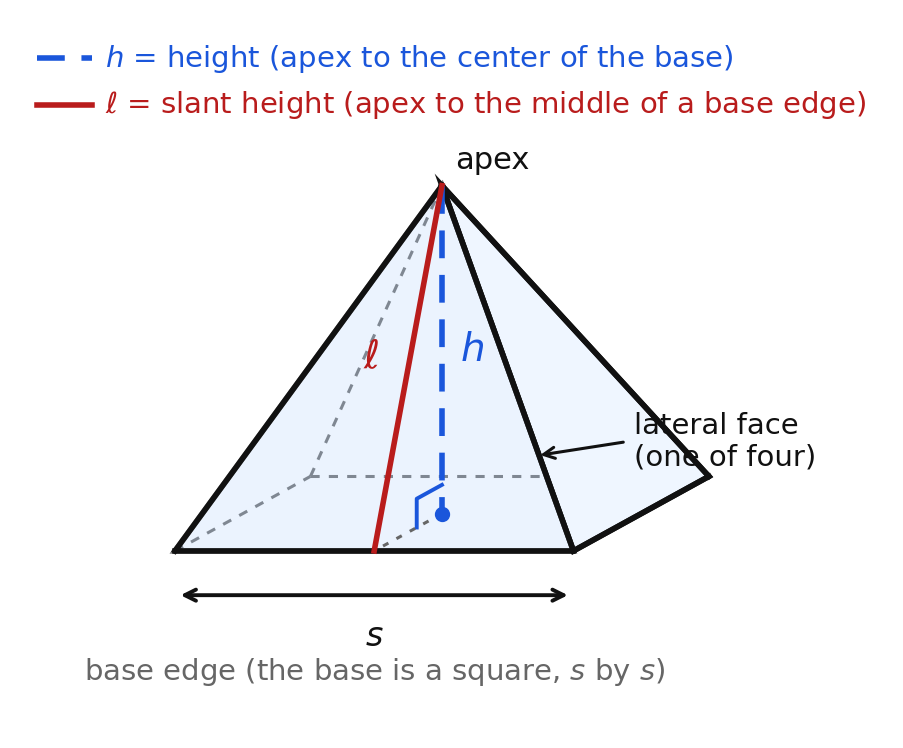
Two heights, and why confusing them is the mistake of this chapter
Look hard at that figure, because it contains two different measurements that both get called "height" in ordinary speech.
The height runs from the apex straight down to the center of the base. It is drawn dashed because it is inside the solid, and it meets the base at a right angle. Height answers the question how tall is this thing?
The slant height runs from the apex down the middle of a lateral face to the midpoint of a base edge. It lies on the surface of the pyramid, not inside it. Slant height answers the question how far is it up the slope?
These are never the same segment and never the same number. Walking up a hill, the height is how much you climbed and the slant height is how far you walked. The walk is always longer.
Here is the rule that follows, and it is worth memorizing as a sentence: volume uses the height; surface area uses the slant height.
The net: unfolding the pyramid
Cut along some edges of a square-based pyramid and flatten it, and you get a net — a flat pattern that folds back into the solid. The net of a square-based pyramid is one square with a triangle attached to each of its four edges.
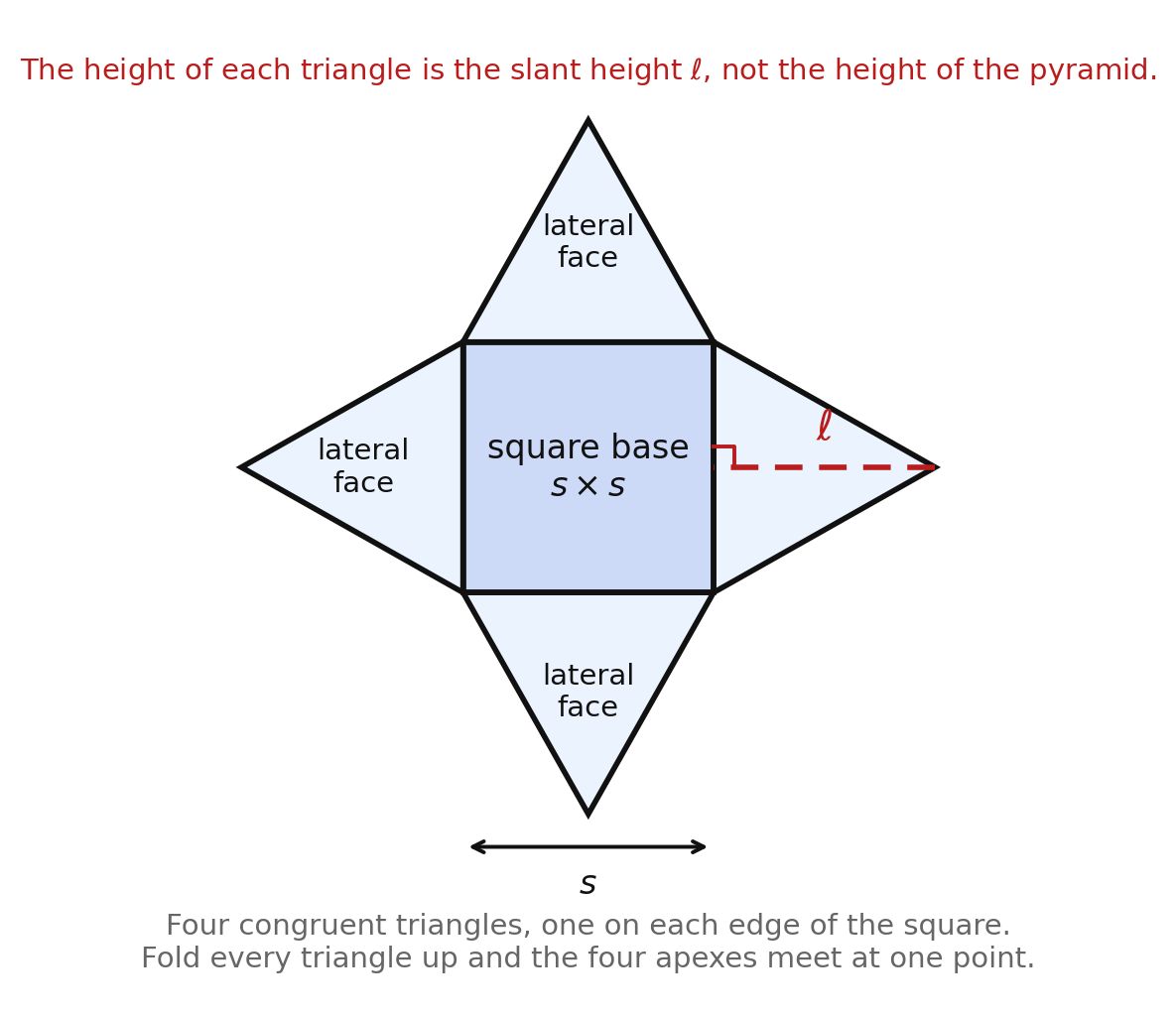
Two things in that picture matter later.
- There are exactly four triangles, all congruent, each with base .
- The height of each triangle in the net is the slant height , not the height of the pyramid. This is why surface area needs : the net is what you are finding the area of, and is the length you can actually measure on it.
Fold all four triangles up and their four apexes meet at one point. If the triangles were shorter than half the base edge they could not reach each other, so every real pyramid has .
The parts of a cone
A cone here means a right circular cone: a solid with a circular base and a single apex, positioned so the apex is directly above the center of the base. An ice cream cone, a traffic cone, and a pile of sand are all cones.
The radius is the radius of the circular base, and the height runs straight up from the center of the base to the apex, meeting the base at a right angle — exactly the same definition of height as for the pyramid.
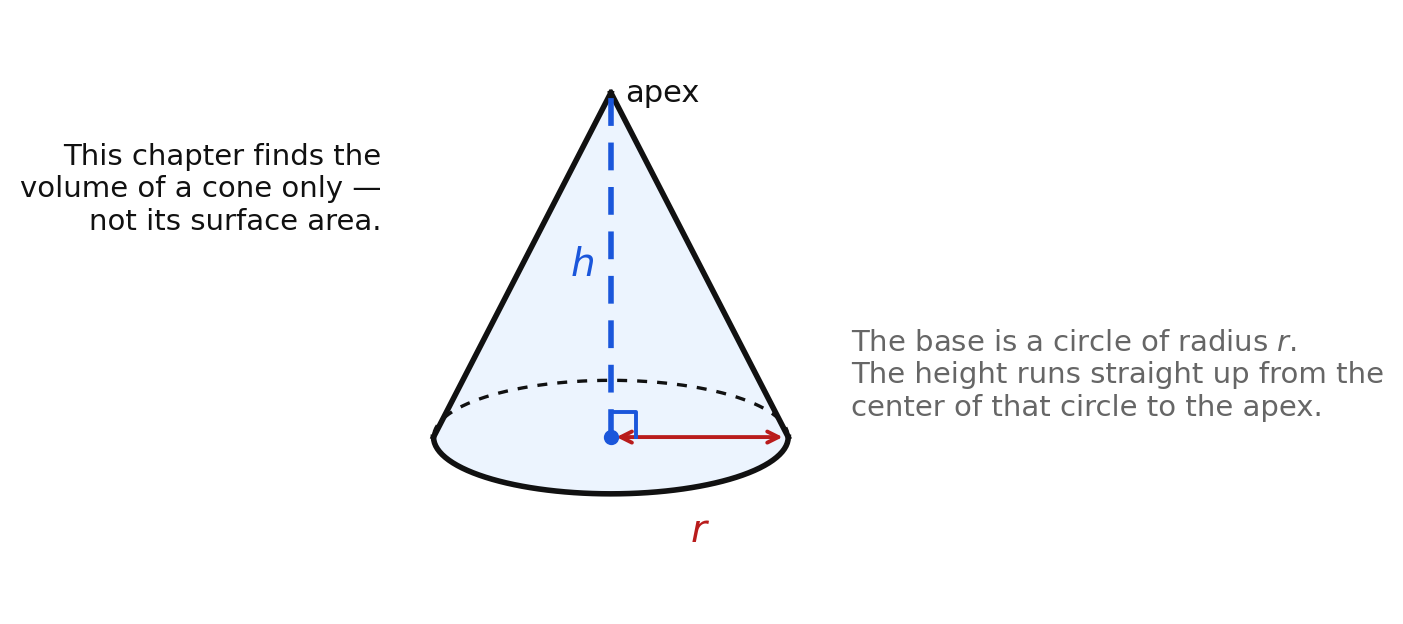
If a problem gives you the diameter of a cone's base, halve it first: . Using the diameter as the radius makes a volume four times too large.
A cone has a slant height too, but this chapter never uses it, because 8.MG.2 asks only for the volume of a cone. You will not compute the surface area of a cone here.
Finding the slant height with the Pythagorean Theorem
Most problems hand you and and want surface area, which needs . So you have to produce yourself, and Chapter 10 already gave you the tool.
Slice the pyramid straight down through the apex, cutting through the midpoints of two opposite base edges. The cut exposes a right triangle whose three sides are:
- one leg: the height , from the apex down to the center of the base
- one leg: half the base edge, , from the center of the base out to the midpoint of an edge
- the hypotenuse: the slant height
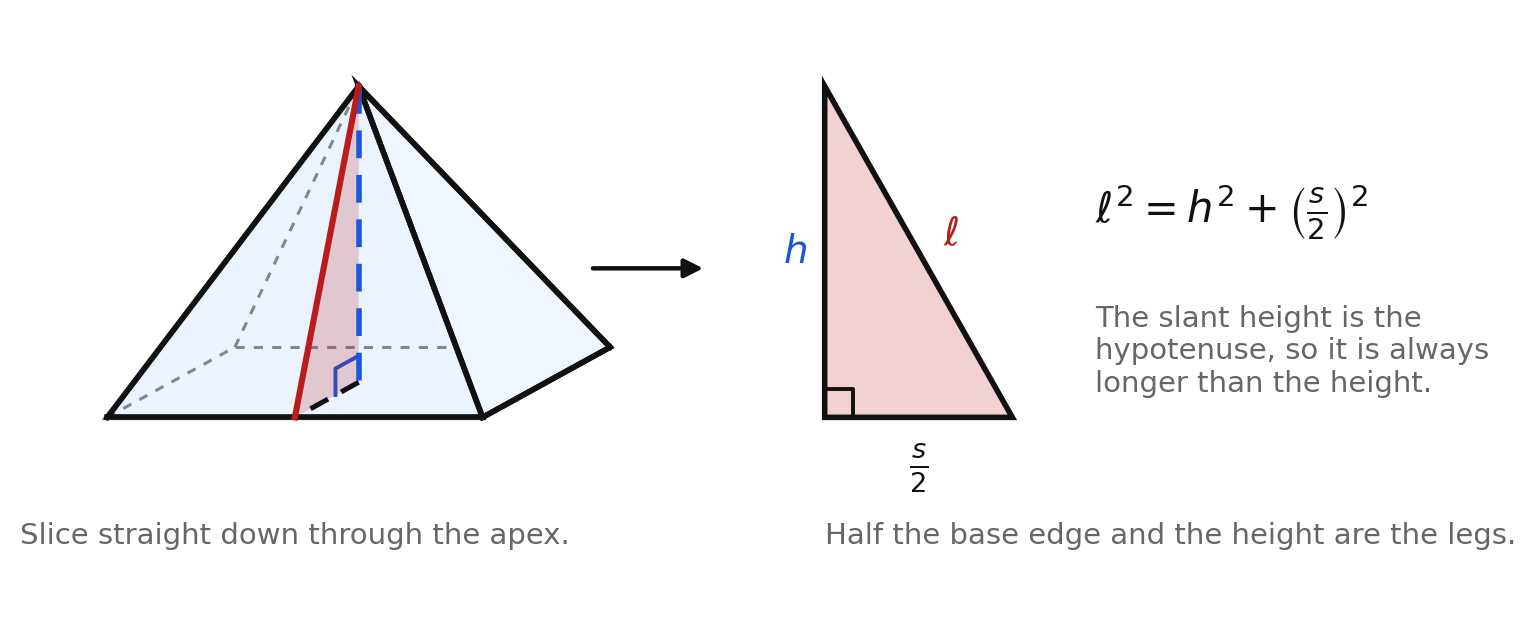
The Pythagorean Theorem then says
Half the base edge, not the whole base edge. That is the error to guard against. The center of a square is only half a side away from the middle of an edge.
Because is the hypotenuse, is always the longest of the three, which is the algebra behind "the walk is longer than the climb."
The same equation runs backwards. Given and , solve for :
Worked examples
Example 1 — Naming the parts
A square-based pyramid has base edge cm. How many faces does it have, what shape is each, and how long is each base edge?
One square base and four triangular lateral faces, so five faces in all. Since the base is a square, all four base edges are cm.
Answer: faces — one square and four congruent triangles; every base edge is cm
Example 2 — Reading the net
In the net of a square-based pyramid, how many triangles are there, and what does the height of each triangle measure?
The square has four edges, and each carries one triangle.
Answer: Four congruent triangles; the height of each one is the slant height of the pyramid
Example 3 — Slant height from base edge and height
A square-based pyramid has base edge in and height in. Find the slant height.
Half the base edge is in.
Answer: in
Example 4 — A larger pair of legs
A square-based pyramid has base edge m and height m. Find the slant height.
Notice is longer than , as it must be.
Answer: m
Example 5 — Height from base edge and slant height
A square-based pyramid has base edge ft and slant height ft. Find its height.
Half the base edge is ft, and this time the slant height is the known hypotenuse.
Answer: ft
Example 6 — Why the slant height is always longer
Explain why a square-based pyramid can never have .
In the right triangle, is the hypotenuse and is a leg, and . Since , the quantity is positive, so is strictly greater than .
Answer: The slant height is the hypotenuse of a right triangle with as a leg, so always.
Guided practice
- Name the shape of the base and the shape of each lateral face of a square-based pyramid.
- How many faces, edges, and vertices does a square-based pyramid have?
- In the pyramid figure at the start of this lesson, which labeled segment runs from the apex to the center of the base, and which runs from the apex to the midpoint of a base edge?
- In the net of a square-based pyramid, how many squares are there and how many triangles?
- Copy and complete for a square-based pyramid with base edge cm and height cm: , so cm.
- A square-based pyramid has base edge in and height in. Find the slant height.
- Explain why the slant height of a pyramid can never be equal to its height.
Independent practice
- Find the slant height of each square-based pyramid. a) base edge cm, height cm b) base edge m, height m c) base edge ft, height ft
- A square-based pyramid has base edge in and height in. Find the slant height.
- A square-based pyramid has base edge cm and slant height cm. Find its height.
- A square-based pyramid has base edge m and slant height m. Find its height.
- A square-based pyramid has base edge ft and slant height ft. Find its height.
- A cone has a base diameter of cm and a height of cm. What is its radius, and which of the two given numbers is the height?
- Describe the net of a square-based pyramid in words, and say what the height of each triangle in the net represents.
- Error analysis. To find the slant height of a square-based pyramid with base edge cm and height cm, a student wrote , so cm. Identify the error and give the correct slant height.
- Application. A glass paperweight is a square-based pyramid with base edge mm and height mm. Find its slant height.
- Reasoning. Explain why all four lateral faces of a square-based pyramid are congruent isosceles triangles. Use the position of the apex in your explanation.
Exit ticket 11.1
- A square-based pyramid has base edge cm and height cm. Find the slant height.
- A square-based pyramid has base edge in and slant height in. Find its height.
- In a net of a square-based pyramid, what is the height of each triangular face called?
- Explain, in one or two sentences, the difference between the height and the slant height of a square-based pyramid, and say which one is longer.
Lesson 11.2 — Surface Area of a Square-Based Pyramid
Surface area is the area of the net
Surface area is the total area of every face of a solid — the amount of material needed to cover the outside with no gaps and no overlaps. Since it is a sum of areas, surface area is measured in square units.
The net makes the sum easy to organize, because the net has exactly two kinds of pieces.
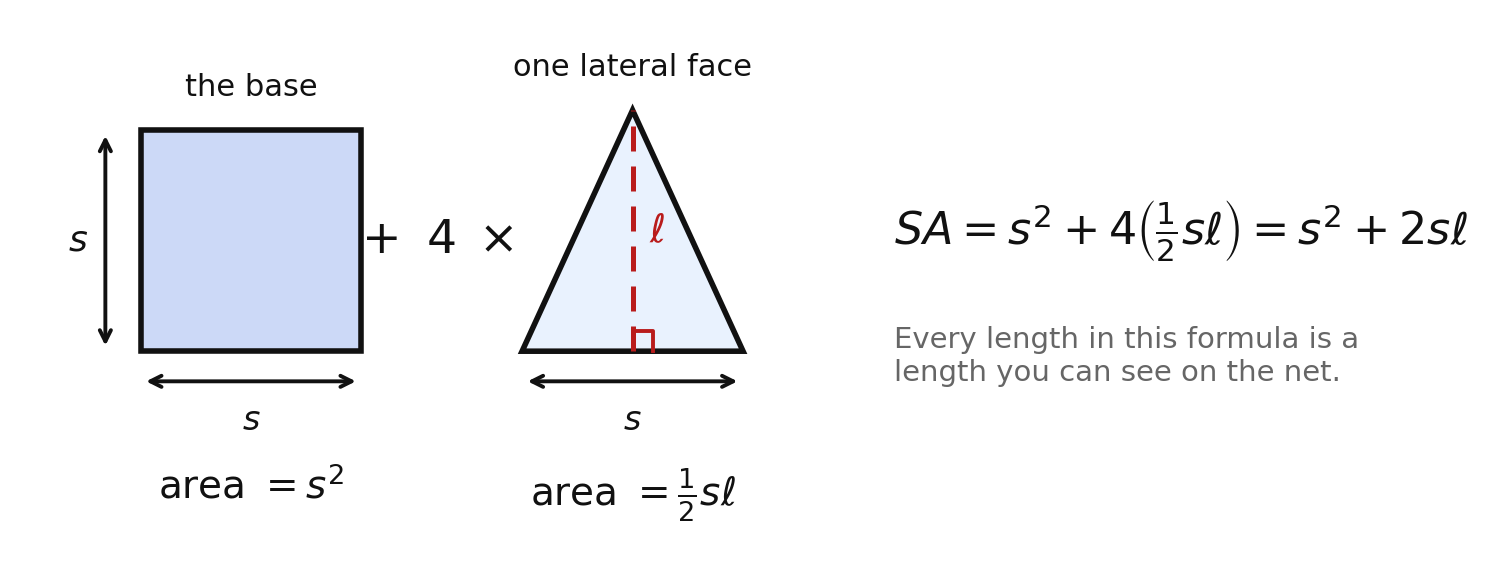
- The base is a square with side , so its area is .
- Each lateral face is a triangle with base and height , so its area is . There are four of them.
Adding the base and all four triangles:
Now simplify the second piece. Four halves make two, so :
The surface area of a square-based pyramid is the base edge squared plus twice the base edge times the slant height.
The in surprises students who expect a , since there are four faces. The is still there — it got multiplied by the from the triangle area formula. If you prefer, keep the longer form ; it gives the same number and shows the four faces plainly.
Lateral area: when the base is not covered
The four triangles alone are the lateral area:
Lateral area is what a problem wants when the base is not part of the covering — the walls of a tent with no floor, shingles on a pyramid roof, paint on the four sloped sides of a monument. Read the context and decide whether the square base is included before you compute anything.
When the problem gives you the height
Every length in is a length on the net, and the pyramid's height is not on the net at all. So the height can never be substituted into the surface area formula.
If a problem gives and and asks for surface area, it is a two-step problem:
- Find with .
- Substitute and into .
Skipping step 1 and using where belongs is the single most common error in this chapter. It always gives an answer that is too small, because .
Worked examples
Example 1 — Surface area from the base edge and slant height
Find the surface area of a square-based pyramid with base edge cm and slant height cm.
Answer: cm
Example 2 — Larger numbers
Find the surface area of a square-based pyramid with base edge in and slant height in.
Answer: in
Example 3 — Lateral area only
A square-based pyramid has base edge ft and slant height ft. Find the area of just the four lateral faces.
Answer: ft
Example 4 — The height is given, so find the slant height first
Find the surface area of a square-based pyramid with base edge m and height m.
Step 1, the slant height. Half the base edge is m.
Step 2, the surface area.
Had we wrongly used in place of , we would have gotten m — too small, because the slanted faces are longer than the pyramid is tall.
Answer: m
Example 5 — A two-step problem with bigger numbers
Find the surface area of a square-based pyramid with base edge m and height m.
Half the base edge is m.
Answer: m
Example 6 — Working backward to the slant height
A square-based pyramid has base edge cm and surface area cm. Find its slant height.
Substitute and solve the resulting equation.
Answer: cm
Guided practice
- Copy and complete: .
- Find the surface area of a square-based pyramid with base edge cm and slant height cm.
- Find the surface area of a square-based pyramid with base edge in and slant height in.
- Find the surface area of a square-based pyramid with base edge m and slant height m.
- Find the surface area of a square-based pyramid with base edge ft and slant height ft.
- Find the lateral area of a square-based pyramid with base edge cm and slant height cm.
- A square-based pyramid has base edge m and height m. Find the slant height first, then the surface area.
- Find the surface area of a square-based pyramid with base edge in and slant height in.
Independent practice
- Find the surface area of each square-based pyramid. a) base edge cm, slant height cm b) base edge m, slant height m c) base edge in, slant height in
- Find the surface area of a square-based pyramid with base edge ft and slant height ft.
- Find the surface area of a square-based pyramid with base edge cm and slant height cm.
- Find the lateral area of a square-based pyramid with base edge m and slant height m.
- A square-based pyramid has base edge in and height in. Find its surface area.
- A square-based pyramid has base edge cm and height cm. Find its surface area.
- A square-based pyramid has base edge ft and height ft. Find its surface area.
- A square-based pyramid has base edge m and surface area m. Find its slant height.
- Application. A tent is shaped like a square-based pyramid with base edge ft and slant height ft. The tent has four fabric walls and no floor. How much fabric does it take?
- Application. A gift box is a square-based pyramid with base edge cm and height cm. How much paper is needed to cover the entire outside, including the base?
- Error analysis. To find the surface area of a square-based pyramid with base edge cm and height cm, a student wrote cm. Identify the error, explain why the student's answer must be too small, and give the correct surface area.
- Reasoning. Explain why the surface area formula contains and not , even though the pyramid has four lateral faces.
Exit ticket 11.2
- Find the surface area of a square-based pyramid with base edge cm and slant height cm.
- Find the surface area of a square-based pyramid with base edge m and slant height m.
- A square-based pyramid has base edge in and height in. Find its surface area.
- Find the lateral area of a square-based pyramid with base edge ft and slant height ft.
- Explain why the pyramid's height cannot be substituted into the surface area formula, and say what you must do when a problem gives you the height instead of the slant height.
Lesson 11.3 — Why One Third? Cones and Cylinders, Pyramids and Prisms
The two solids you already know
Grade 7 gave you two volume formulas, and both said the same sentence: cover the bottom, then stack that covering all the way up.
where is the area of the base. For a rectangular prism whose base is a square of side , that is , so . For a right cylinder, , so .
A pyramid and a cone do not stack that way. They taper. So overcounts, and the question of this lesson is by how much.
The experiment
Take a cone and a cylinder with the same circular base and the same height. Fill the cone with water and pour it into the cylinder. Do it again. Do it a third time. The cylinder is now exactly full — and one more drop would overflow it.
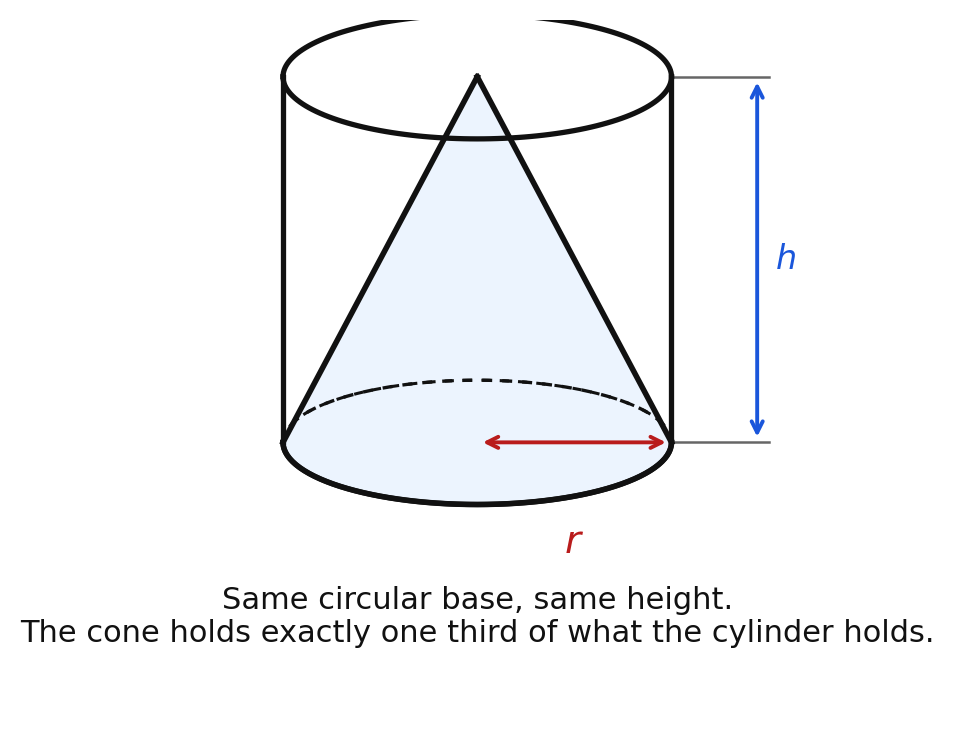
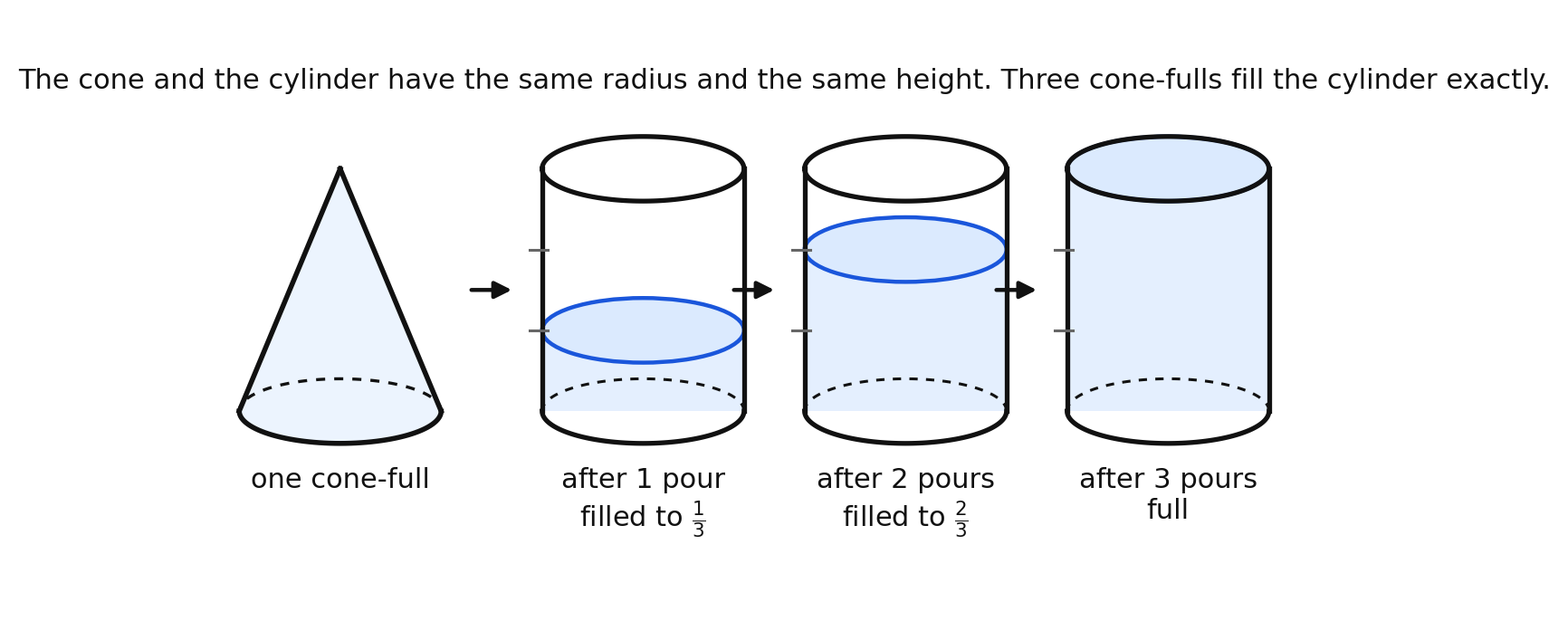
Three cone-fulls fill the cylinder. So the cone holds one third of what the cylinder holds:
Now do the same experiment with a square-based pyramid and a prism that has the same square base and the same height. Three pyramid-fulls fill the prism.
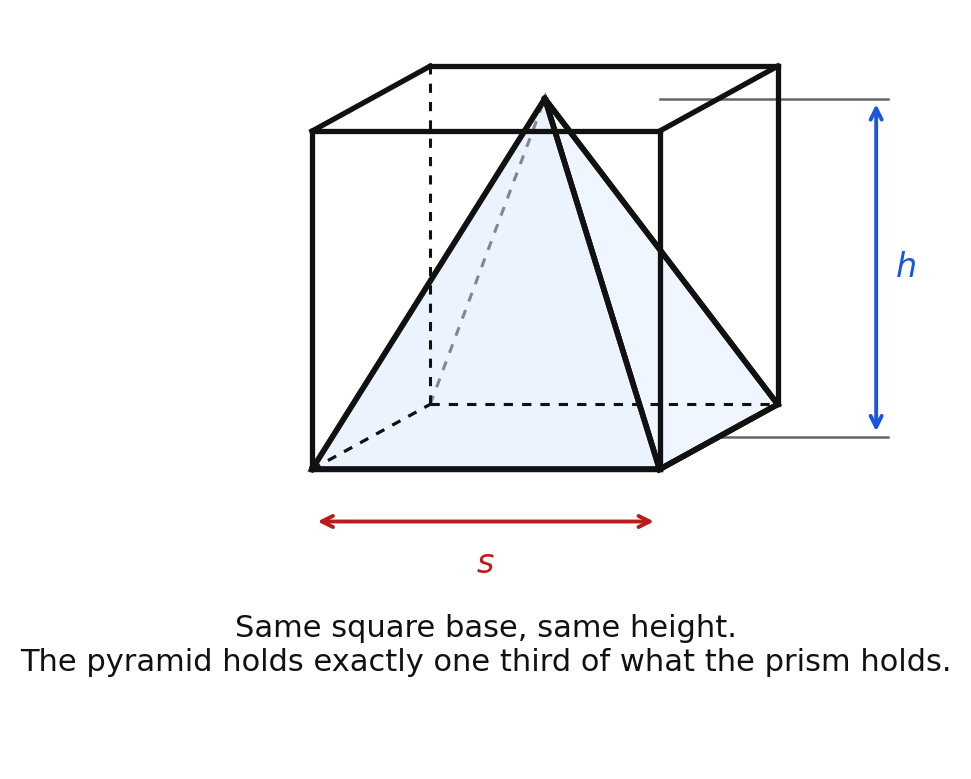
Both results are the same statement:
with for the cone and for the square-based pyramid.
Both conditions matter, and neither is optional
The one-third relationship holds only when the two solids share the same base and the same height. It is not a fact about cones and cylinders in general.
Here is a counterexample worth keeping. A cone with and has volume . A cylinder with and has volume . The cone is larger than the cylinder. Nothing was wrong with the formulas; the two solids simply did not have the same base.
So say the whole sentence every time: a cone is one third of the cylinder with the same base and the same height.
Why one third and not one half
Students reliably guess one half, and the guess comes from a real piece of knowledge: a triangle is half of a rectangle with the same base and height. So why doesn't the solid version give one half?
Because a solid has one more direction to shrink in. Slice the cylinder and the cone at the same level with a horizontal plane. The cylinder's cross-section is the full base circle at every level. The cone's cross-section is a circle that shrinks as you go up — and it shrinks in two dimensions at once, so its area shrinks faster than its radius does. Halfway up, the cone's cross-section has half the radius, which is one quarter of the area, not one half.
Averaging that shrinking area over the whole height gives one third, not one half. The same argument works for the pyramid: halfway up, its square cross-section has half the side length and one quarter of the area.
A cube cut into three pyramids
For the square-based pyramid there is an argument you can do with your hands, and it settles the one third exactly.
Take a cube with edge and pick one vertex. Join that vertex to the four corners of each of the three faces it does not touch. This cuts the cube into three pieces, and each piece is a square-based pyramid: its base is one face of the cube, so the base is by , and its height is , the distance from that face across to the chosen vertex.
Three congruent pyramids, no material left over, so each is exactly one third of the cube:
which is the formula, with and . Check it on a cube of edge cm: the cube holds cm, each pyramid holds cm, and cm. They agree.
Worked examples
Example 1 — From cylinder to cone
A cylinder has radius cm and height cm. Find its volume, then find the volume of the cone with the same base and the same height.
Approximating the cone: .
Answer: cylinder cm; cone cm, or about cm
Example 2 — From prism to pyramid
A prism has a square base with side in and height in. Find its volume, then the volume of the square-based pyramid with the same base and the same height.
Answer: prism in; pyramid in
Example 3 — Reasoning up from the cone
A cone holds cm. How much does the cylinder with the same base and the same height hold?
The cone is one third of the cylinder, so the cylinder is three times the cone.
Answer: cm
Example 4 — Reasoning down from the prism
A prism holds in. How much does the square-based pyramid with the same base and the same height hold?
Answer: in
Example 5 — Why not one half
A classmate reasons: "A triangle is half of a rectangle with the same base and height, so a cone should be half of its cylinder." Explain the flaw.
The triangle fact is about two dimensions. Going up a cone, the cross-section shrinks in two directions at once, so the area of the cross-section falls off faster than a length does — halfway up, the cone's cross-section has half the radius but only one quarter of the area. Averaged over the height, that faster shrinking produces one third, not one half.
Answer: The flaw is treating a three-dimensional taper like a two-dimensional one; the cross-sectional area shrinks in two directions at once, and the result is one third.
Example 6 — When the relationship does not apply
A cone has radius and height . A cylinder has radius and height . Is the cone one third of the cylinder?
The cone is bigger than the cylinder.
Answer: No. The heights match but the bases do not, and the one-third relationship requires the same base and the same height.
Guided practice
- Fill in the blank: a cone holds one third of a cylinder when the two solids have the same and the same .
- A cylinder holds cm. How much does the cone with the same base and the same height hold?
- A cone holds in. How much does the cylinder with the same base and the same height hold?
- A prism holds ft. How much does the square-based pyramid with the same base and the same height hold?
- A square-based pyramid holds m. How much does the prism with the same base and the same height hold?
- How many cone-fulls does it take to fill a cylinder with the same base and the same height?
- Explain what "the same base and the same height" means for a cone and a cylinder. Name the two measurements that have to match.
- In the pouring figure in this lesson, what fraction of the cylinder is filled after two pours from the cone?
Independent practice
- A cylinder has radius cm and height cm. Find its volume exactly, then find the volume of the cone with the same base and the same height, exactly and approximately.
- A cylinder has radius in and height in. Find its volume exactly, then find the volume of the cone with the same base and the same height, exactly and approximately.
- A prism has a square base with side m and height m. Find its volume, then the volume of the square-based pyramid with the same base and the same height.
- A prism has a square base with side ft and height ft. Find its volume, then the volume of the square-based pyramid with the same base and the same height.
- A cone holds cm. How much does the cylinder with the same base and the same height hold? Give the answer exactly and approximately.
- A square-based pyramid holds in. How much does the prism with the same base and the same height hold?
- Reasoning. A cube with edge cm can be cut into three congruent square-based pyramids, each with one face of the cube as its base and height cm. Find the volume of the cube and the volume of one pyramid, then show that gives the same pyramid volume.
- Reasoning. Explain why a cone holds less than half of the cylinder with the same base and the same height. Use horizontal cross-sections in your explanation.
- Reasoning. A cone and a cylinder have the same height, but the cone's radius is twice the cylinder's radius. Is the cone's volume one third of the cylinder's volume? Support your answer with algebra, using for the cylinder's radius.
- Application. A cylindrical container holds mL of juice. A cone-shaped container has the same base and the same height. How much does the cone hold?
- Error analysis. A student says a square-based pyramid must be half of the prism with the same base and height, "because a triangle is half of a rectangle." Explain why the two-dimensional fact does not carry over, and give the correct fraction.
- Reasoning. Explain why the single formula works for both a cone and a square-based pyramid, and say what stands for in each case.
Exit ticket 11.3
- A cylinder holds m. How much does the cone with the same base and the same height hold? Give the answer exactly and approximately.
- A square-based pyramid holds cm. How much does the prism with the same base and the same height hold?
- How many pyramid-fulls does it take to fill a prism with the same square base and the same height?
- Explain in your own words why a cone holds exactly one third of its cylinder. Your explanation must use both the words "same base" and the words "same height."
Lesson 11.4 — Volume of Square-Based Pyramids and Cones
The two formulas
Lesson 11.3 built both of these from . Here they are in the form you will use.
The in both formulas is the height, never the slant height. Volume measures how much the solid holds, and how much it holds depends on how tall it is, not on how far it is up the slope.
Habits that prevent almost every error
- Square first, then multiply. In the exponent belongs only to . For , square to get before anything else.
- Do not lose the . Forgetting it gives an answer three times too big. If your cone volume looks like a cylinder volume, that is what happened.
- Halve a diameter before using it. If , then .
- Multiply by last, or divide by at the end — whichever keeps the numbers whole. Every exercise in this lesson is arranged so that the final division by comes out exactly.
- Write cubic units.
For a cone, keep symbolic all the way to the end and approximate only once, at the last step:
Volume when the slant height is given instead
Sometimes a problem gives and and asks for volume. The slant height cannot go into the volume formula, so this is the mirror image of the two-step problem in Lesson 11.2:
- Find with .
- Substitute and into .
Keep the two directions straight by asking which length the formula needs, then checking which one you were handed:
| The question asks for | The formula needs | If you were given the other one |
|---|---|---|
| surface area of a pyramid | slant height | |
| volume of a pyramid | height |
Worked examples
Example 1 — Volume of a square-based pyramid
Find the volume of a square-based pyramid with base edge cm and height cm.
Answer: cm
Example 2 — A wide, short pyramid
Find the volume of a square-based pyramid with base edge in and height in.
Answer: in
Example 3 — Volume of a cone
Find the volume of a cone with radius cm and height cm.
Approximating: .
Answer: cm, or about cm
Example 4 — A cone given by its diameter
A cone has base diameter in and height in. Find its volume.
Halve the diameter first: in.
Approximating: .
Answer: in, or about in
Example 5 — Working backward to a height
A square-based pyramid has base edge ft and volume ft. Find its height.
Answer: ft
Example 6 — Volume when the slant height is given
A square-based pyramid has base edge m and slant height m. Find its volume.
The volume formula needs the height, so find it first. Half the base edge is m.
Using in place of would have given m — too large, because the slant height overstates how tall the pyramid is.
Answer: m
Guided practice
Give every cone volume exactly in terms of and then approximately, using .
- Copy and complete for a square-based pyramid with base edge cm and height cm: cm.
- Find the volume of a square-based pyramid with base edge in and height in.
- Find the volume of a square-based pyramid with base edge m and height m.
- Find the volume of a square-based pyramid with base edge ft and height ft.
- Find the volume of a cone with radius cm and height cm.
- Find the volume of a cone with radius in and height in.
- Find the volume of a cone with radius m and height m.
- Find the volume of a cone with base diameter ft and height ft.
Independent practice
Give every cone volume exactly in terms of and then approximately, using .
- Find the volume of each square-based pyramid. a) base edge cm, height cm b) base edge in, height in c) base edge m, height m
- Find the volume of a square-based pyramid with base edge ft and height ft.
- Find the volume of a square-based pyramid with base edge cm and height cm.
- Find the volume of a cone with radius cm and height cm.
- Find the volume of a cone with base diameter in and height in.
- Find the volume of a cone with radius m and height m.
- Find the volume of a cone with radius ft and height ft.
- A square-based pyramid has base edge ft and volume ft. Find its height.
- A cone has radius in and volume in. Find its height. (The answer is exact; no approximation is needed.)
- A square-based pyramid has base edge m and slant height m. Find its volume.
- A cone has base area cm and height cm. Use to find its volume.
- Application. A cone-shaped paper cup has radius cm and height cm. How much water does it hold when full?
- Application. A candle mold is a square-based pyramid with base edge cm and height cm. How much wax does it hold?
- Error analysis. To find the volume of a cone with radius cm and height cm, a student wrote cm. Identify the error and give the correct volume, exactly and approximately.
Exit ticket 11.4
- Find the volume of a square-based pyramid with base edge cm and height cm.
- Find the volume of a square-based pyramid with base edge m and height m.
- Find the volume of a cone with radius in and height in.
- Find the volume of a cone with base diameter ft and height ft.
- Explain where the in both volume formulas comes from, and why the height and not the slant height belongs in them.
Lesson 11.5 — Problems in Context
Deciding what the problem is asking
Almost every real problem about these solids is one of two questions in disguise, and the words give it away.
Volume — the problem is about what goes inside: filling, holding, pouring, capacity, how much sand, how much water, how much wax, how much grain. The answer is in cubic units.
Surface area — the problem is about what goes on the outside: covering, wrapping, painting, tiling, how much fabric, how much paper, how much glass. The answer is in square units.
Then ask a second question, and only for surface area problems: is the base included?
- Wrapping a closed box, glazing a display case that stands on a glass base, painting a solid model on all sides → include the base, use .
- A tent with no floor, shingles on a roof, paint on the four sloped sides of a monument → four faces only, use .
Finally, check which length you were handed. A pyramid problem that gives the height and asks for surface area needs first; one that gives the slant height and asks for volume needs first.
A worked path through a context problem
Every problem below follows the same four moves, and it is worth naming them because they are what you should write down before touching a number.
- Decide: volume or surface area? (And if surface area, is the base included?)
- Collect the measurements, converting a diameter to a radius and finding or if the problem gave you the other one.
- Substitute into the right formula.
- Report with the correct unit — cubic for volume, square for surface area — and, for a cone, exactly and then approximately.
Worked examples
Example 1 — Deciding, without computing
For each, say whether you need volume or surface area. a) how much sand fills a pyramid-shaped container b) how much foil covers the outside of a pyramid-shaped ornament c) how much water a cone-shaped cup holds d) how much fabric makes the four walls of a pyramid-shaped tent
Filling and holding are inside questions; covering and making walls are outside questions.
Answer: a) volume b) surface area c) volume d) surface area (lateral only — a tent has no floor)
Example 2 — Filling a pyramid
A planter is a square-based pyramid with base edge cm and height cm. How much soil does it hold?
Holding soil is volume.
Answer: cm
Example 3 — Wrapping a pyramid, height given
A gift box is a square-based pyramid with base edge cm and height cm. How much paper covers the whole outside?
Covering is surface area, the base is part of a closed box, and the problem gave the height, so find first.
Answer: cm
Example 4 — A cone in context
A snow cone cup has radius cm and height cm. How much shaved ice fills it?
Answer: cm, or about cm
Example 5 — Comparing two containers
Which holds more: a cone with radius cm and height cm, or a square-based pyramid with base edge cm and height cm?
The cone's volume must be approximated before the two can be compared, since one answer contains and the other does not.
Answer: The cone, by about cm
Example 6 — Two steps: volume, then a rate
A cone-shaped funnel has radius cm and height cm. It drains at cm per second. About how long does a full funnel take to empty?
Answer: about seconds
Guided practice
- For each, say whether the problem asks for volume or surface area. a) painting the four sloped sides of a pyramid-shaped monument b) filling a cone with popcorn c) gift wrap for a closed pyramid-shaped box d) water in a cone-shaped paper cup
- A sandbox is a square-based pyramid with base edge cm and height cm. How much sand fills it?
- A pyramid-shaped ornament has base edge cm and height cm. How much foil covers all five faces?
- A snow cone cup has radius cm and height cm. How much shaved ice fills it?
- A paperweight is a square-based pyramid with base edge cm and slant height cm. A label covers the four lateral faces only. How much label material is needed?
- A cone-shaped cup has radius in and height in. How much does it hold?
Independent practice
- Application. A roof is a square-based pyramid with base edge ft and slant height ft. Shingles cover the four sloped faces only. How many square feet of shingles are needed?
- Application. A pile of gravel is a cone with radius ft and height ft. How much gravel is in the pile?
- Application. A display case is a square-based pyramid with base edge in and height in, made of glass on all five faces. How much glass does it take?
- Application. A cone-shaped paper filter has base diameter cm and height cm. How much liquid does it hold when full?
- Application. A candle is a square-based pyramid with base edge cm and height cm. The wax has a mass of grams per cubic centimeter. Find the volume of the candle and then its mass.
- Application. Which holds more, a cone with radius cm and height cm, or a square-based pyramid with base edge cm and height cm? Show both volumes and say by about how much.
- Application. A cone-shaped funnel has radius cm and height cm and drains at cm per second. Find its volume and then about how long a full funnel takes to empty.
- Application. A tent is a square-based pyramid with base edge ft and height ft. The tent has four fabric walls and no floor. How much fabric does it take?
- Application. A cone-shaped hole has radius ft and depth ft. Mulch to fill it costs $3 per cubic foot. Find the volume and the cost, using .
- Reasoning. A problem gives a square-based pyramid's base edge and slant height and asks for its volume. What must you find first, and why can the slant height not be used directly?
- Error analysis. To find the wrapping paper needed for a closed pyramid-shaped box with base edge in and height in, a student wrote in. Identify the error and give the correct surface area.
- Reasoning. Explain how the unit on an answer tells you whether the problem you solved was a volume problem or a surface area problem.
Exit ticket 11.5
- A cone-shaped cup has radius cm and height cm. How much does it hold?
- A square-based pyramid has base edge in and height in. How much sand fills it?
- A square-based pyramid has base edge cm and slant height cm. How much paper covers all five faces?
- How much cardboard makes a closed pyramid-shaped box with base edge cm and slant height cm?
- Explain, in one or two sentences, how you decide whether a problem in context is asking for volume or for surface area.
Chapter 11 Review
Vocabulary. square-based pyramid · base · apex · lateral face · base edge · height · slant height · net · surface area · lateral area · cone · radius · diameter · volume · cubic units · square units · base area
Part A — Surface area of square-based pyramids, from nets, diagrams, and formulas (8.MG.2a)
- Describe the net of a square-based pyramid: how many pieces of each shape, and what the height of each triangle in the net represents.
- A square-based pyramid has base edge cm and height cm. Find its slant height.
- Find the surface area of each square-based pyramid. a) base edge cm, slant height cm b) base edge m, slant height m
- A square-based pyramid has base edge ft and height ft. Find its surface area.
- Find the lateral area of a square-based pyramid with base edge in and slant height in.
- A square-based pyramid has base edge in and surface area in. Find its slant height.
- Error analysis. To find the surface area of a square-based pyramid with base edge cm and slant height cm, a student wrote cm. Identify the error and give the correct surface area.
- Reasoning. Explain how the net of a square-based pyramid shows that . Account for every piece of the net and for where the comes from.
Part B — Volume of cones and square-based pyramids (8.MG.2b)
Give every cone volume exactly in terms of and then approximately, using .
- Find the volume of each square-based pyramid. a) base edge cm, height cm b) base edge in, height in c) base edge m, height m
- Find the volume of a square-based pyramid with base edge ft and height ft.
- Find the volume of each cone. a) radius cm, height cm b) radius in, height in
- Find the volume of a cone with base diameter m and height m.
- Find the volume of a cone with radius ft and height ft.
- A square-based pyramid has base edge m and volume m. Find its height.
- A cone has height cm and volume cm. Find its radius.
- A square-based pyramid has base edge cm and slant height cm. Find its volume.
Part C — Explaining the volume relationships (8.MG.2c)
- A cylinder has radius cm and height cm. Find its volume exactly, then the volume of the cone with the same base and the same height, exactly and approximately.
- A prism has a square base with side in and height in. Find its volume, then the volume of the square-based pyramid with the same base and the same height.
- A cone holds ft. How much does the cylinder with the same base and the same height hold?
- Reasoning. Explain, using the dissection of a cube into three congruent square-based pyramids, why a square-based pyramid holds one third of the prism with the same base and the same height.
- Reasoning. Describe the pouring experiment with a cone and a cylinder and say exactly what it shows. Then explain why both "same base" and "same height" are required for the result to hold.
- Reasoning. A classmate writes, "A cone is one third of any cylinder." Correct the statement and give a specific counterexample with numbers.
Part D — Problems in context (8.MG.2d)
Give every cone volume exactly in terms of and then approximately, using .
- Application. A cone-shaped water cup has radius cm and height cm. How much does it hold?
- Application. A gift box is a square-based pyramid with base edge cm and height cm. How much paper covers the whole outside?
- Application. A pile of sand is a cone with base diameter ft and height ft. How much sand is in the pile?
- Application. A monument is a square-based pyramid with base edge m and slant height m. Paint covers the four sloped faces only. How many square meters must be painted?
- Application. A cone-shaped funnel has radius cm and height cm. Find its volume, then find how many full cm jars one full funnel can fill.
- Application. A planter is a square-based pyramid with base edge in and height in. a) How much soil does it hold? b) A liner covers the four lateral faces only. How much liner material is needed?
- Reasoning. A square-based pyramid has base edge cm and height cm. Find its volume and its surface area, then explain why the two answers carry different units even though both describe the same solid.
- Reasoning. Write a context problem of your own about a cone that must be solved with volume, and one about a square-based pyramid that must be solved with surface area. Then solve both of your problems.
Standards coverage check — Chapter 11
| Knowledge and Skill | Where it is taught | Where it is practiced |
|---|---|---|
| 8.MG.2a — determine the surface area of square-based pyramids by using concrete objects, nets, diagrams, and formulas | 11.1 (parts, the net, the two heights, slant height by the Pythagorean Theorem); 11.2 (the net becomes ; lateral area; two-step problems from the height) | Items 1–46; Review Part A, items 121–128 |
| 8.MG.2b — determine the volume of cones and square-based pyramids, using concrete objects, diagrams, and formulas | 11.3 (the pouring experiment gives ); 11.4 ( and , including working backward and volume from a given slant height) | Items 55–60; 67–68; 71–97; Review Part B, items 129–136 |
| 8.MG.2c — examine and explain the relationship between the volume of cones and cylinders, and the volume of rectangular prisms and square-based pyramids | 11.3 in full: the cone-in-cylinder and pyramid-in-prism figures, the three-pour experiment, the cross-section argument for why the factor is one third and not one half, the dissection of a cube into three congruent pyramids, and the counterexample showing both conditions are required | Items 47–70; Review Part C, items 137–142 |
| 8.MG.2d — solve problems in context involving volume of cones and square-based pyramids and the surface area of square-based pyramids | 11.5 (deciding volume against surface area, deciding whether the base is included, and the four-move path through a context problem); applications also appear in 11.2 and 11.4 | Items 38–39; 64; 90–91; 98–120; Review Part D, items 143–149 |
Two notes on how the bullets are braided. Bullet (c) is a reasoning bullet — it asks students to examine and explain — so Lesson 11.3 comes before the computation lesson, and the one-third factor in 11.4 is a result students have already justified rather than a number handed to them. And bullet (a) is kept honest about the slant height: because the surface area formula is read off the net, and only the slant height appears on the net, every surface area item that supplies the height instead forces the Pythagorean Theorem step from Chapter 10.
Answer keys for every set in this chapter are in Appendix A.