Chapter 10 — The Pythagorean Theorem
Standard: 8.MG.4 — The student will apply the Pythagorean Theorem to solve problems involving right triangles, including those in context.
By the end of this chapter you will be able to:
- Verify the Pythagorean Theorem for yourself, using diagrams, cut-out squares, grid paper, and a ruler (8.MG.4a)
- Decide whether a triangle is a right triangle when all you are given is its three side lengths (8.MG.4b)
- Name the hypotenuse and the two legs of a right triangle drawn in any orientation, even upside down or tilted (8.MG.4c)
- Find the length of a missing side when the other two are known, whether the missing side is the hypotenuse or a leg (8.MG.4d)
- Apply the theorem, and its converse, to ladders, ramps, screens, fields, and distances on a coordinate grid (8.MG.4e)
Lessons: 10.1 The Parts of a Right Triangle · 10.2 Verifying the Pythagorean Theorem · 10.3 Finding a Missing Side · 10.4 The Converse: Is It a Right Triangle? · 10.5 Applying the Theorem in Context
Square-root note. This chapter is where the square roots of Chapter 2 start paying rent. Many of the sides you find here are irrational, and the convention from Chapter 2 holds: give the exact value in radical form, such as , and then give a rational approximation to the nearest hundredth, such as . Use , not , the moment you round.
Numbering note. Item numbers run straight through the chapter, from 1 in Lesson 10.1 to 132 at the end of the review. They do not restart at each lesson.
Lesson 10.1 — The Parts of a Right Triangle
One right angle, two legs, one hypotenuse
A right triangle is a triangle with one right angle — an angle measuring exactly . A triangle can have at most one right angle, so a right triangle has exactly one, and everything in this chapter is organized around it.
The two sides that form the right angle are the legs. The third side, the one opposite the right angle, is the hypotenuse.
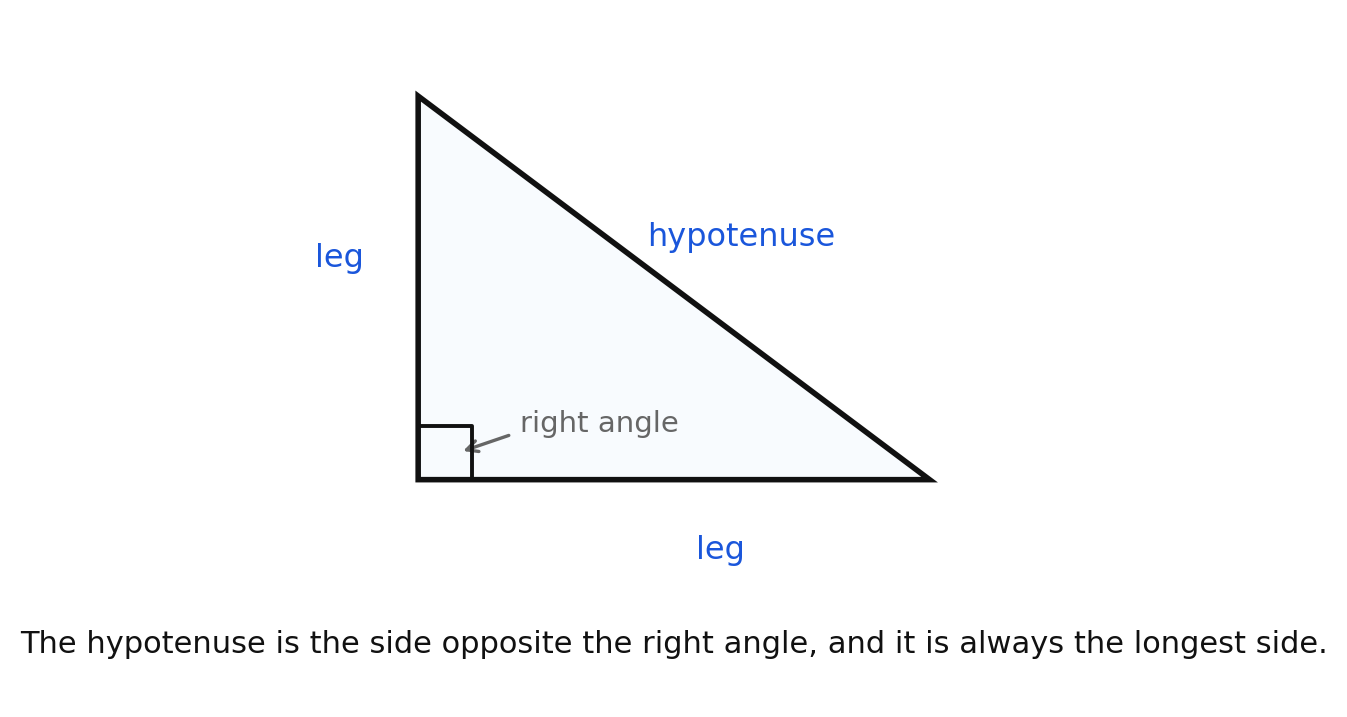
Two facts about the hypotenuse are worth memorizing together, because each explains the other.
The hypotenuse is the side opposite the right angle. This is the definition, and it is the test you should actually use. Find the little square that marks the right angle, then look straight across from it.
The hypotenuse is the longest side. In any triangle, the longest side is opposite the largest angle. The right angle is , and the other two angles must add to , so neither of them can reach on its own. The right angle is therefore the largest angle in the triangle, and the side across from it is the longest side.
Naming sides with letters
Two naming systems appear in this chapter, and you should be fluent in both.
By vertex letters. A side can be named by its two endpoints. In right triangle with the right angle at , the legs are and , because those are the two sides that meet at . The hypotenuse is , the side that does not touch at all. Notice the shortcut hiding there: the hypotenuse is the only side that does not touch the right-angle vertex.
By the letters , , and . When we write the theorem, the two legs are called and and the hypotenuse is called . It does not matter which leg you call and which you call . It matters enormously that is the hypotenuse.
Orientation is a picture, not a fact
Textbook drawings often put the right angle at the bottom left, which quietly teaches a false rule: that the hypotenuse is the slanted side going up to the right. It is not. Rotating a triangle on the page changes nothing about the triangle.
Here is one right triangle in four orientations. In every picture the right angle is at , so in every picture the legs are and and the hypotenuse is .
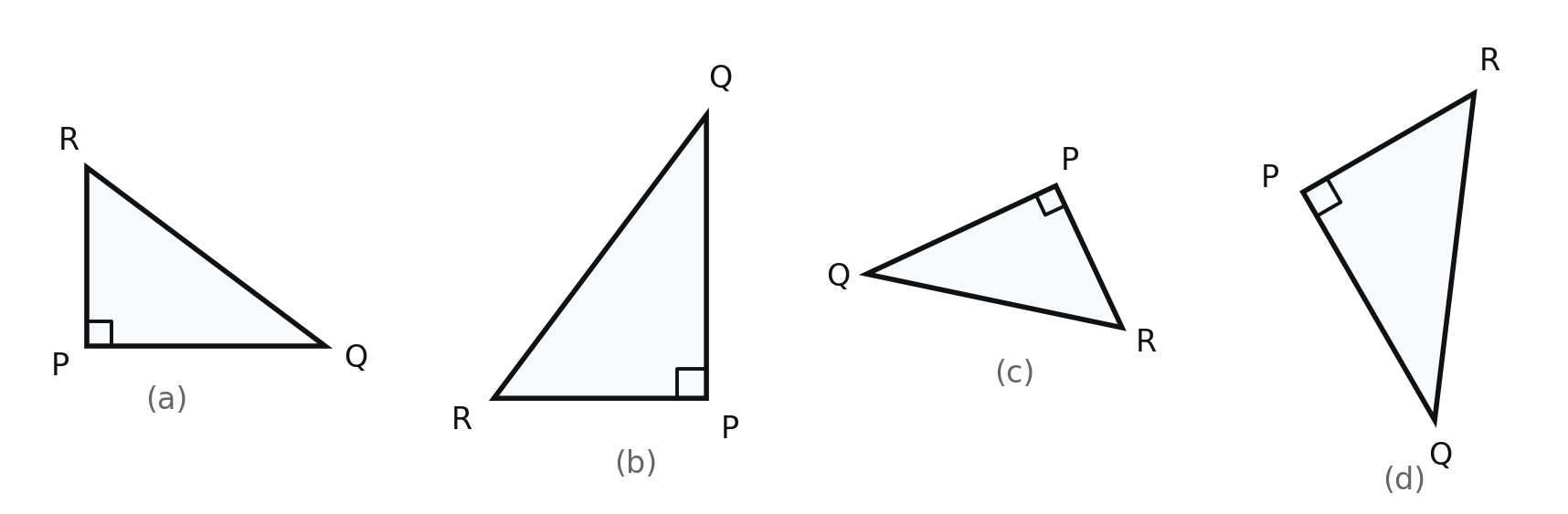
So build the habit that survives rotation:
- First, find the right-angle mark.
- Then, the two sides meeting there are the legs.
- Finally, the remaining side is the hypotenuse.
That procedure never mentions up, down, left, right, horizontal, or vertical — which is exactly why it always works.
Worked examples
Example 1 — Naming parts from a vertex letter
In right triangle , the right angle is at . Name the legs and the hypotenuse.
The sides that meet at are and , so those are the legs. The remaining side, , does not touch .
Answer: legs and ; hypotenuse
Example 2 — Naming parts from three lengths
A right triangle has sides , , and centimeters. Which is the hypotenuse?
The hypotenuse is the longest side, and .
Answer: the -centimeter side
Example 3 — A tilted figure
In figure (c) of the four orientations above, the right angle is marked at and the triangle is tipped so no side is horizontal. Name the hypotenuse.
The two sides meeting at are legs, so the hypotenuse is the third side, . Tipping the page changed the drawing, not the triangle.
Answer:
Example 4 — An impossible description
Can a right triangle have a hypotenuse of inches and a leg of inches?
No. The hypotenuse must be the longest side, so a leg can never be longer than the hypotenuse.
Answer: No — a leg cannot exceed the hypotenuse.
Example 5 — Parts in a real object
A wheelchair ramp rises straight up from the sidewalk to a doorway. Which part of the right triangle is the sloped surface you roll on?
The vertical rise and the horizontal run meet at the sidewalk in a right angle, so those two are the legs. The sloped surface joins their far ends, opposite the right angle.
Answer: the sloped surface is the hypotenuse; the rise and the run are the legs
Guided practice
- A right triangle has legs cm and cm and a third side of cm. Which side is opposite the right angle?
- In figure (a) of the four orientations above, the right angle is at . Name the hypotenuse.
- In figure (b) of the four orientations above, name the two legs.
- In figure (c) of the four orientations above, name the hypotenuse, and explain how you knew without measuring anything.
- In figure (d) of the four orientations above, name the legs and the hypotenuse.
- True or false: the hypotenuse is always the side drawn at the bottom of the picture. Explain.
Independent practice
- In right triangle the right angle is at . a) Name the legs. b) Name the hypotenuse.
- A right triangle has sides , , and inches. Which side is the hypotenuse, and how do you know?
- In right triangle the right angle is at , with , , and . Name the legs, name the hypotenuse, and name the longest side.
- Name the hypotenuse of each triangle. a) with the right angle at b) with the right angle at c) with the right angle at
- Reasoning. Could a right triangle have a hypotenuse of feet and a leg of feet? Explain.
- Reasoning. Explain why the hypotenuse must be the longest side of a right triangle. Use the fact that the two non-right angles add to .
- Application. A ladder leans against a wall. Which part of the right triangle formed by the ladder, the wall, and the ground is the hypotenuse? Which parts are the legs?
- Error analysis. A right triangle is drawn tilted, with one side vertical. A student says, "The vertical side has to be a leg, because legs are the straight up-and-down sides." Explain what is wrong and give the rule that always works.
Exit ticket 10.1
- In right triangle the right angle is at . Name the hypotenuse.
- A right triangle has sides , , and meters. Which is the hypotenuse?
- In figure (c) of the four orientations in this lesson, name the two legs.
- Write, in one sentence, a procedure for finding the hypotenuse in a figure drawn in any orientation.
Lesson 10.2 — Verifying the Pythagorean Theorem
The statement
The Pythagorean Theorem. In a right triangle with legs of length and and hypotenuse of length ,
Read it out loud as a sentence about squares: the square of one leg plus the square of the other leg equals the square of the hypotenuse. It is not a statement about the side lengths added together. For the -- triangle, , which has nothing to do with . But , exactly.
Verifying with area
The theorem is easiest to believe when you stop thinking of as " times " and start thinking of it as the area of a square built on side . Build a square on each of the three sides of a right triangle and the theorem says: the two smaller squares, together, have exactly as much area as the big one.
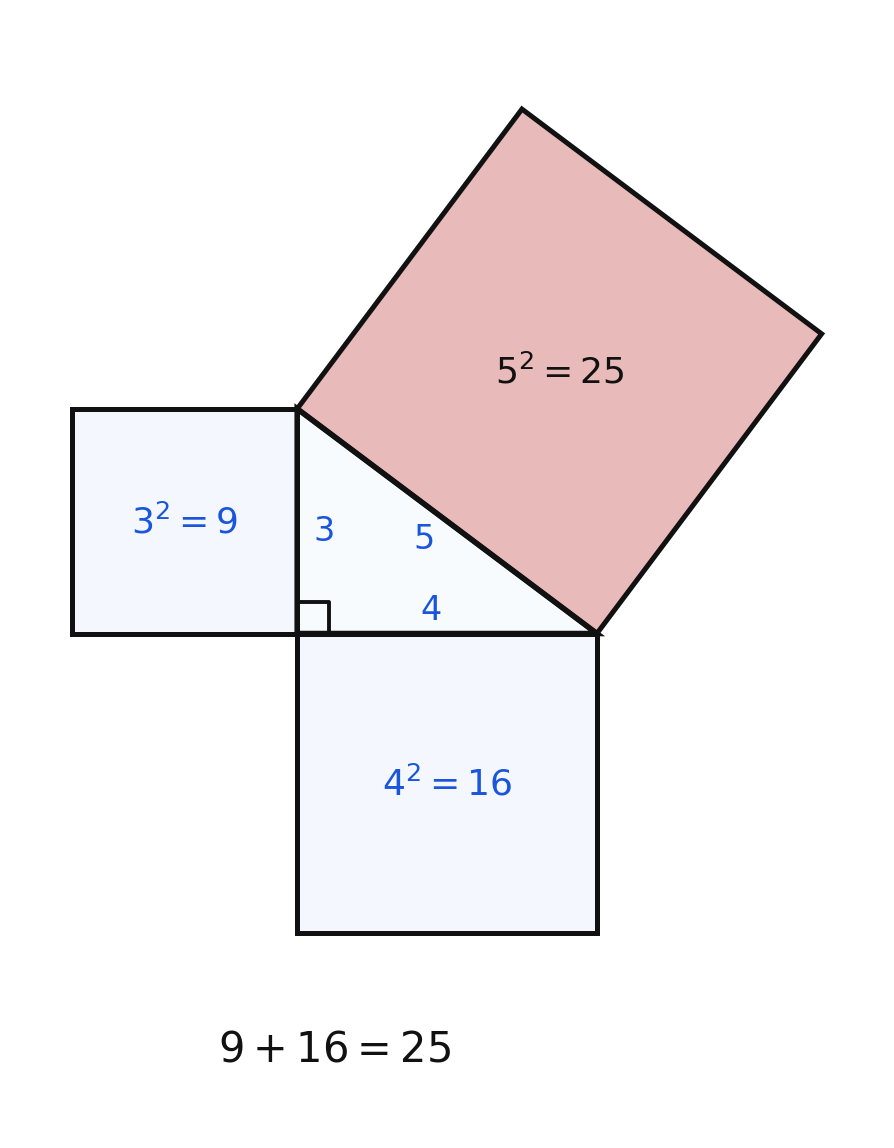
You can check that claim by counting rather than by trusting arithmetic. Rule each square into unit squares and count them.
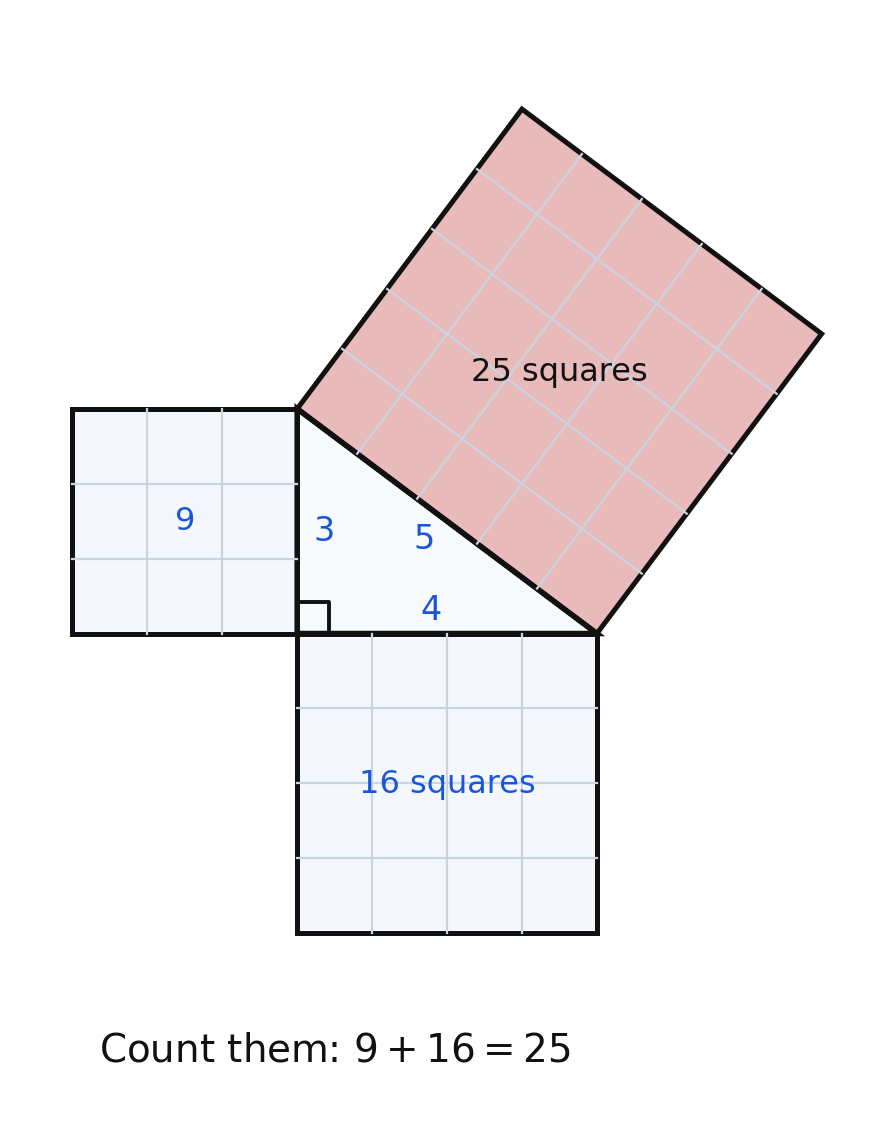
Nine unit squares and sixteen unit squares are twenty-five unit squares. With concrete materials you can do this physically: cut out the nine small squares and the sixteen from grid paper and watch them fill the twenty-five exactly, with nothing left over and no gaps.
Verifying with measurement
Diagrams and cut paper are one kind of evidence. A ruler is another. Draw a right angle, measure centimeters up one side and centimeters along the other, and connect the ends.
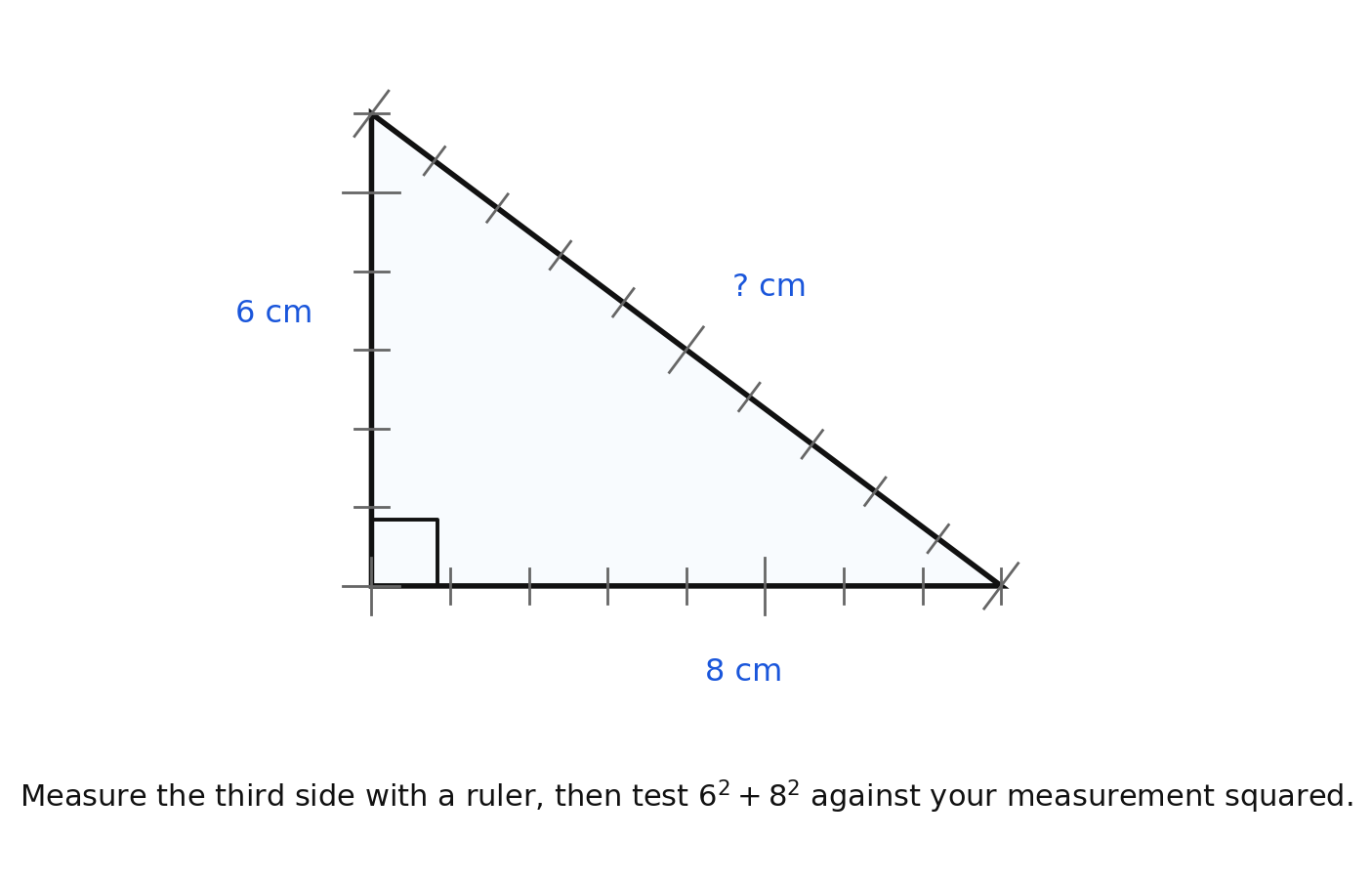
Measure the third side and you will get centimeters. Now test the theorem on your measurements:
The two sides of the equation agree, so this triangle verifies the theorem.
What verifying does and does not settle
Be precise about what you have shown. Measuring and counting on particular triangles verifies the theorem: each triangle you check is one more case where the relationship holds, and after a few cases you have good reason to believe it. That is not the same as a proof, which would establish the relationship for every right triangle at once, including the infinitely many nobody will ever draw. The area picture is the beginning of a proof, and you will meet full proofs in high school geometry.
Measurement also has its own limit: a ruler reads to the nearest millimeter at best, so a measured check can only ever come out close. If your measured hypotenuse is centimeters and while , that gap is about your pencil and your ruler, not about the theorem.
Verification has content — the equation can fail
A check is only meaningful if it could have come out the other way. Take a triangle whose sides measure , , and — a perfectly good triangle, but with no right angle in it.
Here , so the equation fails. That failure is the whole reason the theorem is worth stating: is a property of right triangles specifically. Lesson 10.4 turns that observation into a test.
Worked examples
Example 1 — Verifying by counting unit squares
A right triangle has legs and units. Give the area of the square on each side and verify the theorem.
The squares on the legs have areas and . The square on the hypotenuse has area .
Answer: Verified: the two smaller squares together have the same area, square units, as the largest square.
Example 2 — Verifying a measured triangle
A drawn right triangle has legs measuring cm and cm and a hypotenuse measuring cm. Verify the theorem.
Answer: Verified, since .
Example 3 — Verifying by computation alone
Verify the theorem for a right triangle with legs and and hypotenuse .
Answer: Verified, since .
Example 4 — An area check with a tilted square
On grid paper, a right triangle has legs and units along the grid lines. What is the area of the square built on the hypotenuse, and how long is the hypotenuse?
The squares on the legs have areas and , so the square on the hypotenuse has area square units — a square drawn tilted on the grid, but still a square of area . Its side length is the number whose square is .
Answer: area square units; hypotenuse units
Example 5 — Showing the equation can fail
A triangle has sides , , and . Does it verify the theorem?
Answer: No: , so this triangle is not a right triangle and the relationship does not hold for it.
Example 6 — Verifying with a loop of string
Describe how to use a loop of string with evenly spaced knots to build a triangle that verifies the theorem.
Hold the loop at three knots so the sides contain , , and knot-spaces, and pull it taut. Check the largest corner against the square corner of a sheet of paper: it fits exactly. Then verify with the counts: .
Answer: the -- loop makes a right triangle, and verifies the theorem
Guided practice
- For the -- triangle in the squares-on-the-sides figure above, give the area of the square on each leg, then add those two areas.
- In the unit-square figure above, how many unit squares are in each of the two smaller squares, and how many are in the largest? Write the equation your counts give.
- Verify the theorem for a right triangle with legs and and hypotenuse .
- Verify the theorem for a right triangle with legs and and hypotenuse .
- In the measured triangle above, the legs measure cm and cm. Measure the third side with a ruler, then verify the theorem with your measurement.
- Explain why can be read as the area of a square rather than as a multiplication.
Independent practice
- Verify the theorem for each right triangle by computing and separately. a) legs and , hypotenuse b) legs and , hypotenuse c) legs and , hypotenuse d) legs and , hypotenuse
- A right triangle has legs and and hypotenuse . Give the area of the square built on each of the three sides, then write the equation those three areas satisfy.
- On grid paper a right triangle has legs and units along the grid lines. Give the areas of the squares on the two legs, the area of the square on the hypotenuse, and the exact and approximate length of the hypotenuse.
- Draw a right triangle with legs cm and cm, measure the hypotenuse, and verify the theorem. Then explain why a measured check can only ever come out approximately equal.
- A triangle has sides , , and centimeters. Show that fails for it, and explain what that tells you about the triangle.
- Reasoning. Describe how to use a loop of string with evenly spaced knots and the square corner of a sheet of paper to verify the theorem for the -- triangle.
- Application. A carpenter squares up a deck corner by measuring feet along one edge and feet along the other, then measuring the distance between those two marks. What distance should she find, and what does it tell her if she finds feet inches instead?
- Error analysis. A student "tests" the theorem on the -- triangle by writing and , and concludes the theorem is false. Explain the error and show the correct test.
Exit ticket 10.2
- Verify the theorem for a right triangle with legs and and hypotenuse .
- Give the areas of the squares built on the three sides of a right triangle with legs and and hypotenuse , and write the equation they satisfy.
- On grid paper a right triangle has legs and units. Give the area of the square on the hypotenuse and the hypotenuse's exact and approximate length.
- Explain the difference between verifying the theorem with measurement and proving it.
Lesson 10.3 — Finding a Missing Side
Two cases, one equation
Every missing-side problem starts the same way, with and the reminder that is the hypotenuse. What changes is which letter you are missing, and that changes the arithmetic completely.
Case 1 — the hypotenuse is missing. You know both legs. Square them, add, then take the square root.
Case 2 — a leg is missing. You know one leg and the hypotenuse. Square them, subtract the leg's square from the hypotenuse's square, then take the square root.
Case 2 is where errors live. If you add when the hypotenuse is already known, you get an answer larger than the hypotenuse, which is impossible. That sanity check catches the mistake every time: a leg must come out shorter than the hypotenuse.
Case 1 — finding the hypotenuse
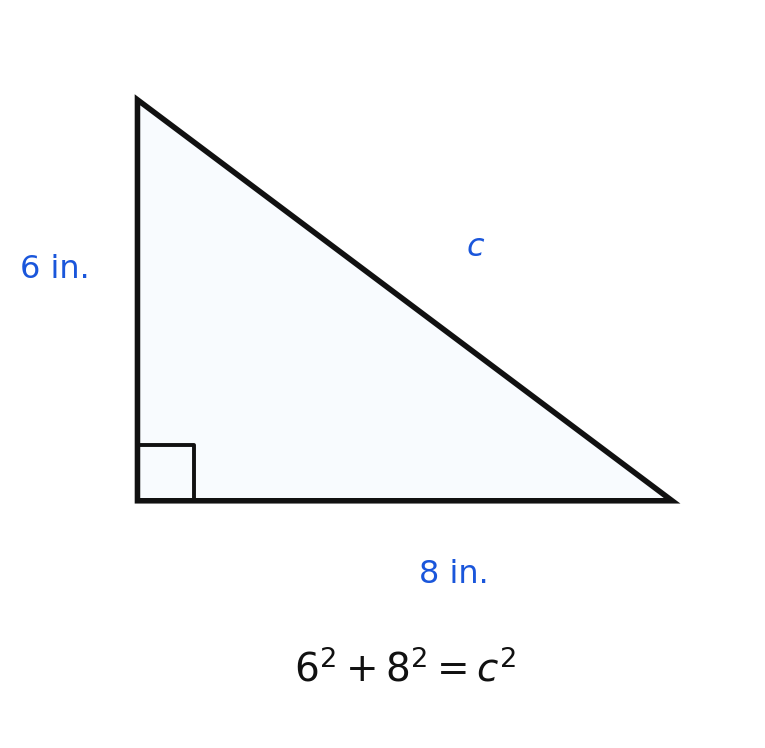
The hypotenuse is inches.
One note about that last step. The equation has two solutions, and , but is a length. Lengths are positive, so we keep only the positive square root and discard the negative one. That happens in every problem in this chapter, so we will stop mentioning it.
Case 2 — finding a leg
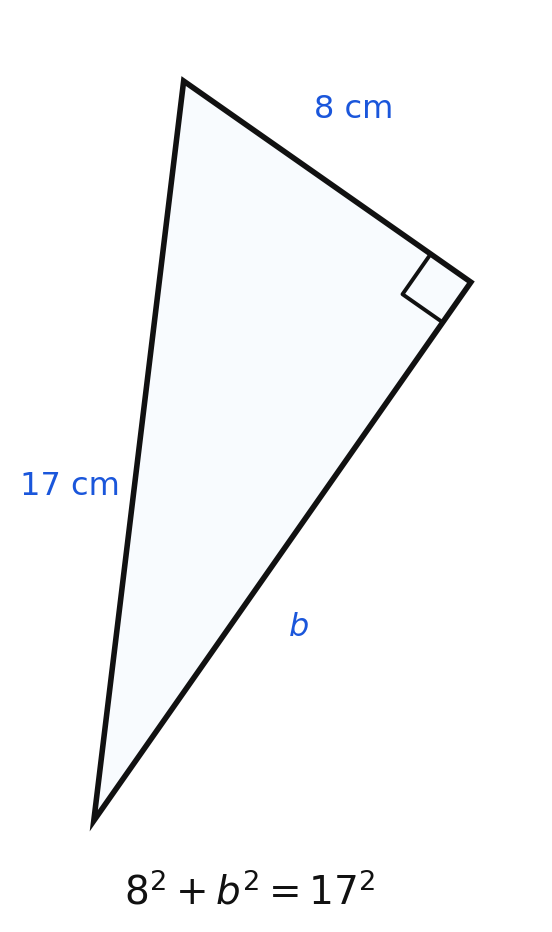
The hypotenuse is , so goes in for — not for or , no matter where the side is drawn on the page.
The missing leg is centimeters. Check it against the sanity rule: . Good.
When the answer is irrational
Nothing guarantees that is a perfect square. Usually it is not, and then the exact answer is a radical. Follow the Chapter 2 convention: give the exact radical, then a rational approximation to the nearest hundredth.
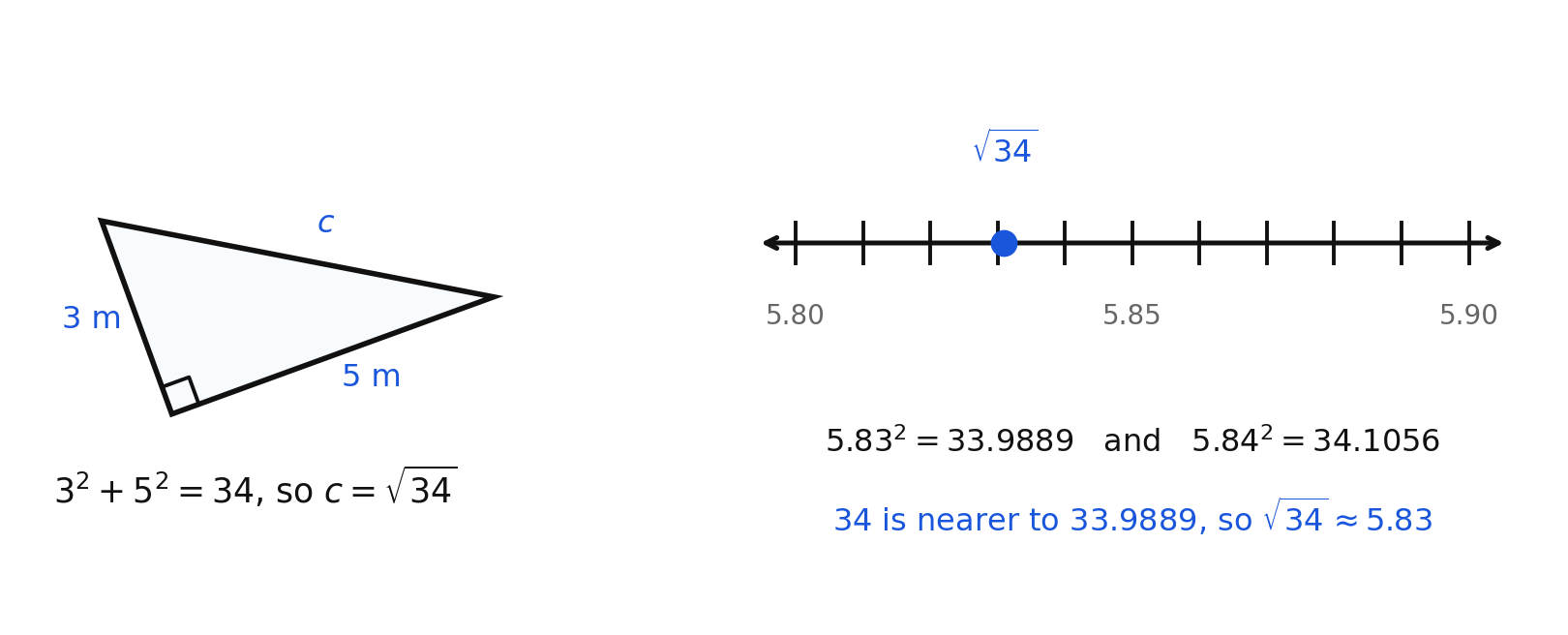
To place , square nearby hundredths the way you did in Chapter 2. Since and , the number falls between them, and it is nearer to .
Write when you want the exact value and when you want a number you can measure with. The symbol is what keeps the second statement honest.
Worked examples
Example 1 — Finding a hypotenuse
The legs of a right triangle are and . Find the hypotenuse.
Answer:
Example 2 — Finding a leg
A right triangle has hypotenuse and one leg . Find the other leg.
Since , the answer passes the sanity check.
Answer:
Example 3 — An irrational hypotenuse
The legs of a right triangle are and centimeters. Find the hypotenuse exactly and to the nearest hundredth.
Squaring hundredths: and . Since and , the value is nearer to .
Answer: centimeters
Example 4 — An irrational leg
A right triangle has hypotenuse and one leg . Find the other leg exactly and to the nearest hundredth.
Squaring hundredths: and . Since and , the value is nearer to .
Answer: , and as a leg must be
Example 5 — Two equal legs
Both legs of a right triangle measure inches. Find the hypotenuse.
Squaring hundredths: and . The value is nearer to .
Answer: inches
Example 6 — Catching the wrong operation
A right triangle has hypotenuse and one leg . A student computes and answers about . What went wrong?
The student added when the hypotenuse was already known. The answer is longer than the hypotenuse , which is impossible for a leg. Subtract instead:
Answer: the missing leg is ; adding is only for the case where the hypotenuse is the unknown
Guided practice
- The legs of a right triangle are and . Find the hypotenuse.
- The legs of a right triangle are and . Find the hypotenuse.
- The legs of a right triangle are and . Find the hypotenuse.
- A right triangle has hypotenuse and one leg . Find the other leg.
- A right triangle has hypotenuse and one leg . Find the other leg.
- The legs of a right triangle are and . Find the hypotenuse exactly and to the nearest hundredth.
- A right triangle has hypotenuse and one leg . Find the other leg exactly and to the nearest hundredth.
- A right triangle has hypotenuse and one leg . Find the other leg.
Independent practice
- Find the hypotenuse of each right triangle. a) legs and b) legs and c) legs and d) legs and
- Find the missing leg of each right triangle. a) hypotenuse , leg b) hypotenuse , leg c) hypotenuse , leg d) hypotenuse , leg
- Both legs of a right triangle measure meters. Find the hypotenuse exactly and to the nearest hundredth.
- The legs of a right triangle are and feet. Find the hypotenuse exactly and to the nearest hundredth.
- The legs of a right triangle are and inches. Find the hypotenuse exactly and to the nearest hundredth.
- A right triangle has hypotenuse and one leg . Find the other leg exactly and to the nearest hundredth.
- A right triangle has hypotenuse and one leg . Find the other leg exactly and to the nearest hundredth.
- A right triangle has hypotenuse and one leg . Find the other leg exactly and to the nearest hundredth.
- The legs of a right triangle are and . Find the hypotenuse exactly, name the two consecutive whole numbers it lies between, and then approximate it to the nearest hundredth.
- Reasoning. Explain why the leg case subtracts while the hypotenuse case adds. Refer to which letter in is unknown.
- Error analysis. Given a hypotenuse of and a leg of , a student computes and answers . Identify the error, explain the one-second check that catches it, and give the correct answer.
- Error analysis. Given legs of and , a student answers . Identify the error, and use the -- triangle to show why adding side lengths cannot work.
Exit ticket 10.3
- The legs of a right triangle are and . Find the hypotenuse.
- A right triangle has hypotenuse and one leg . Find the other leg exactly and to the nearest hundredth.
- The legs of a right triangle are and . Find the hypotenuse exactly and to the nearest hundredth.
- Explain how you decide whether a problem calls for adding two squares or subtracting one square from another.
Lesson 10.4 — The Converse: Is It a Right Triangle?
Running the theorem backwards
The Pythagorean Theorem starts from a right triangle and concludes something about its sides. The converse of a statement swaps what you are given for what you conclude, and for this theorem the converse is also true.
Converse of the Pythagorean Theorem. If the three side lengths of a triangle satisfy , where is the longest side, then the triangle is a right triangle, and the right angle is opposite the longest side.
This is genuinely a new tool. The theorem lets you compute a length in a triangle you already know is right. The converse lets you decide whether a triangle is right using nothing but a tape measure — no protractor required.
The test, in three steps
- Step 1 — identify the longest side. That one, and only that one, is .
- Step 2 — compute and separately.
- Step 3 — compare. Equal means right triangle. Unequal means not a right triangle.
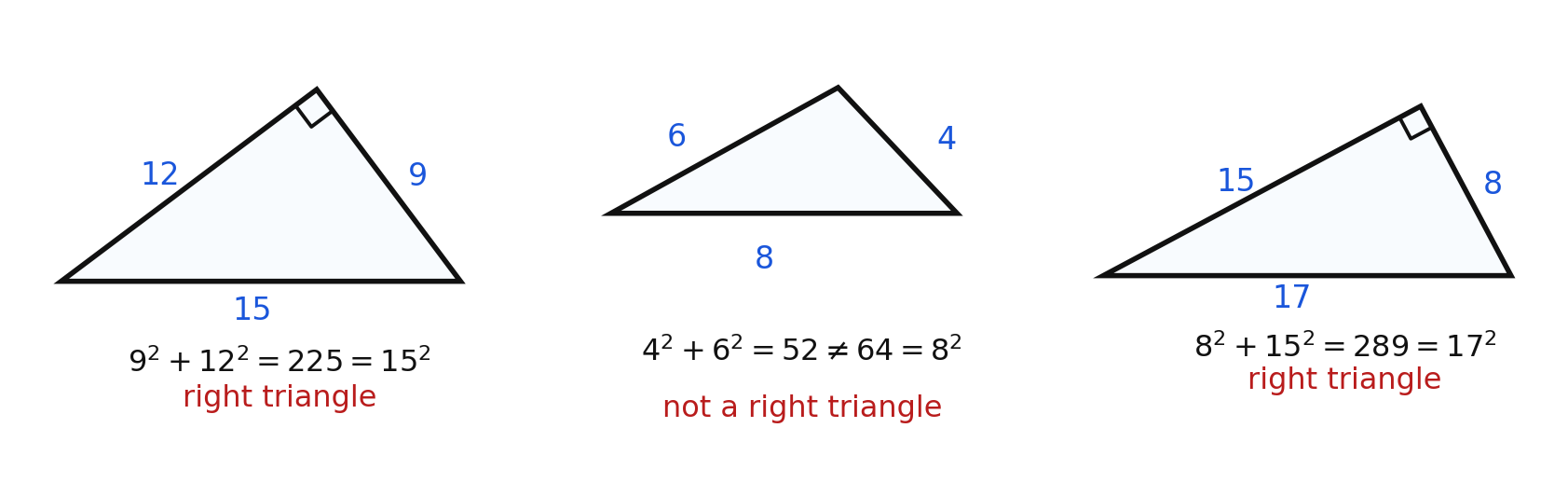
For sides , , : the longest side is , and . Right triangle.
For sides , , : the longest side is , and , while . Since , this is not a right triangle.
For sides , , : the longest side is , and . Right triangle.
Step 1 is where people fall
Problems rarely list the sides in order. If the sides are given as , , and you take the last number for out of habit, you compute against , find them unequal, and declare a genuine right triangle to be not right. Nothing was wrong with your arithmetic; you assigned to a leg.
So before you square anything, circle the largest number. That habit costs a second and prevents the single most common error in this lesson.
What an unequal comparison is telling you
You are only asked to answer right or not right, but the direction of the failure is meaningful, and it is a good way to check that your answer is reasonable. When comes out less than , the longest side is too long to close up a right corner, so the angle across from it is wider than . When comes out greater than , that angle is narrower than . For , , we found , and sure enough the widest corner of that triangle looks blunt.
Worked examples
Example 1 — A right triangle
Is a triangle with sides , , and a right triangle?
Longest side: , so .
Answer: Yes. The right angle is opposite the side.
Example 2 — Not a right triangle
Is a triangle with sides , , and a right triangle?
Answer: No.
Example 3 — Sides listed out of order
Is a triangle with sides , , and a right triangle?
The longest side is , so and the legs are and .
Answer: Yes, with the right angle opposite the side.
Example 4 — A near miss
Is a triangle with sides , , and a right triangle?
Being close is not being equal. Had the longest side measured , the answer would be yes.
Answer: No.
Example 5 — Repairing the classic error
A student tests sides , , by computing against , and answers "not a right triangle." Correct the work.
The longest side is , not , so and the legs are and .
Answer: It is a right triangle; the student assigned to a leg.
Example 6 — The converse in context
A gardener lays out a triangular bed with sides , , and feet and wants to know whether one corner is square.
Longest side , so .
Answer: No corner is square. Since , the corner opposite the -foot side is wider than .
Guided practice
For items 61 through 66, decide whether the triangle with the given side lengths is a right triangle. Show the comparison you used.
- , ,
- , ,
- , ,
- , ,
- , ,
- , ,
Independent practice
- Decide whether each is a right triangle. a) , , b) , , c) , , d) , ,
- Is a triangle with sides , , and a right triangle?
- Is a triangle with sides , , and a right triangle?
- Is a triangle with sides , , and a right triangle?
- Is a triangle with sides , , and a right triangle? Say which side you used as and why.
- Is a triangle with sides , , and a right triangle? Say which side you used as and why.
- Is a triangle with sides , , and a right triangle?
- Reasoning. Explain why must be the longest side in the test. Then show what goes wrong for the sides , , if you use as .
- Application. A gardener marks a triangular bed with sides , , and feet. Is any corner of the bed square? What does the direction of the inequality tell you about the largest corner?
- Error analysis. A student tests the sides , , by writing and , then answers "not a right triangle." Identify the error and give the correct conclusion.
Exit ticket 10.4
- Is a triangle with sides , , and a right triangle?
- Is a triangle with sides , , and a right triangle?
- Is a triangle with sides , , and a right triangle?
- State the converse of the Pythagorean Theorem in your own words, and explain why the first step is finding the longest side.
Lesson 10.5 — Applying the Theorem in Context
A routine that works on every word problem
- Sketch the situation and find the right angle. Walls meet floors at right angles, trees stand up at right angles to level ground, and the sides of a rectangle meet at right angles — those are the usual sources.
- Label the two legs and the hypotenuse. The hypotenuse is the slanted distance: a ladder, a wire, a ramp surface, a diagonal, a straight-line shortcut.
- Decide which side is unknown, so you know whether to add or to subtract.
- Solve, keeping the exact radical.
- Round to the nearest hundredth if the exact value is irrational, and write the unit.
A ladder against a wall
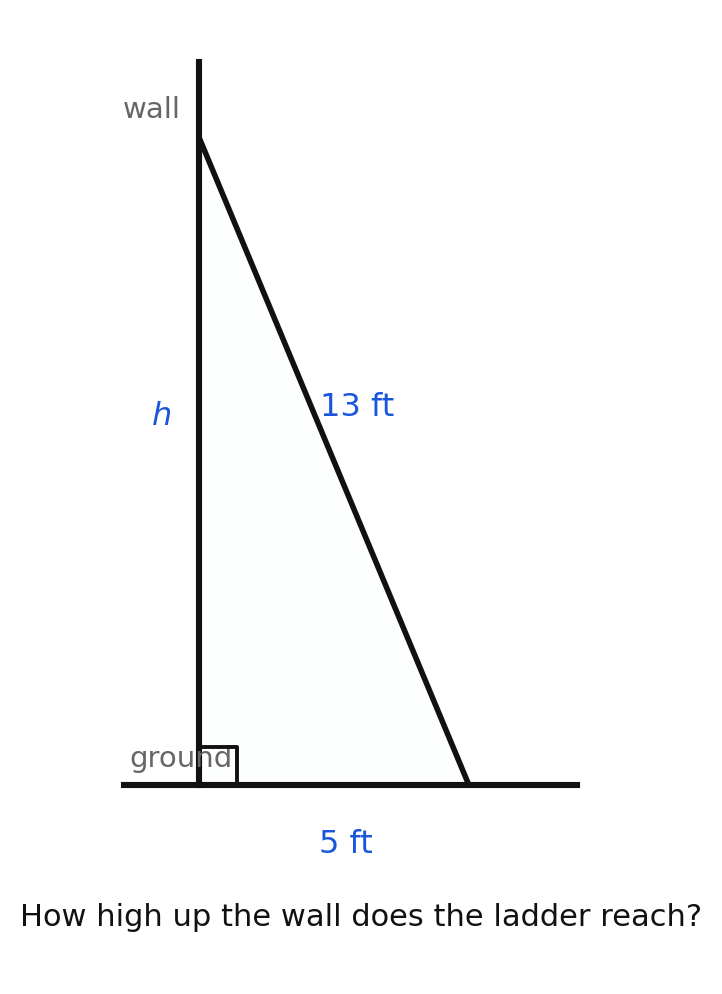
The wall and the ground meet at a right angle, so they are the legs, and the ladder — the slanted side — is the hypotenuse. The unknown here is a leg, so subtract.
The ladder reaches feet up the wall. Check: , as any leg must be.
The diagonal of a rectangle
Every rectangle hands you two right triangles for free, because its sides meet at right angles and its diagonal is the hypotenuse of both.
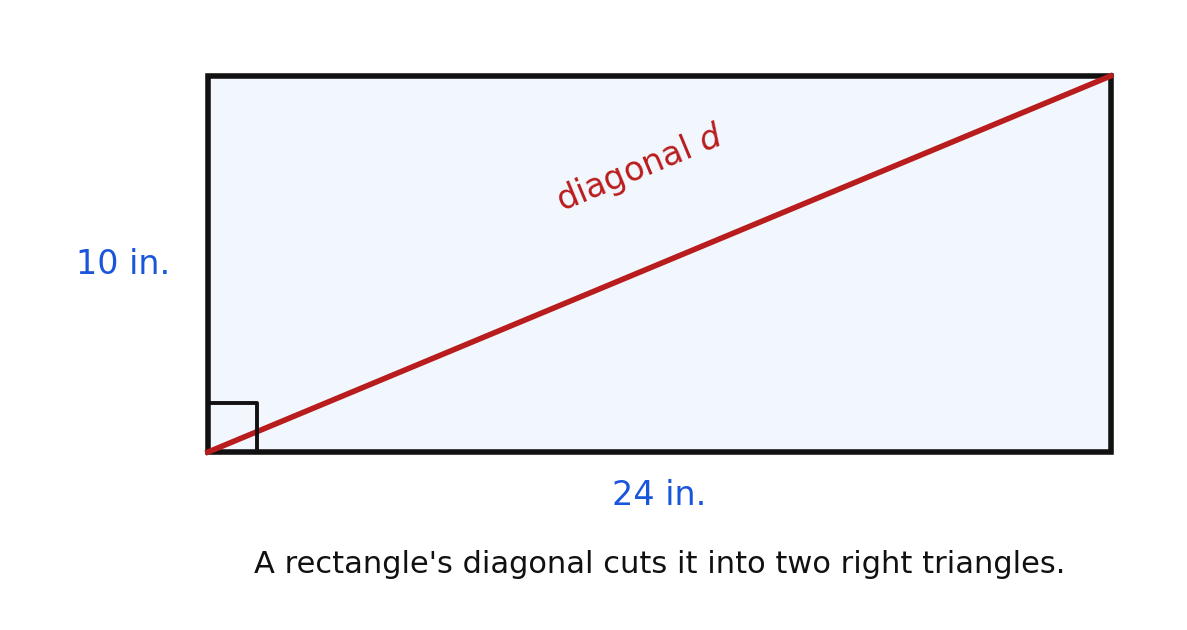
The diagonal is inches. This is exactly how screen sizes work: a "26-inch television" names the diagonal, not the width.
Distance between two points on a grid
Two points that are not on the same horizontal or vertical line still determine a right triangle: travel across, then up.
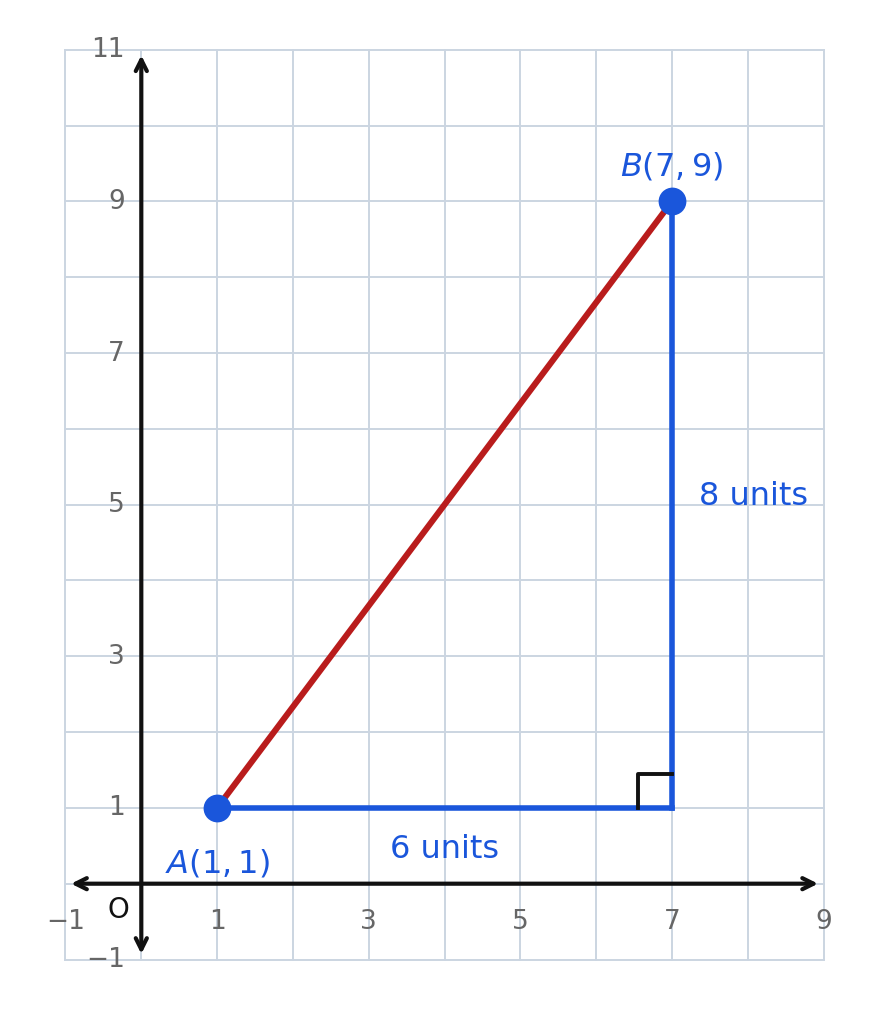
From to , the horizontal change is units and the vertical change is units. Those are the legs, and the direct distance is the hypotenuse.
The converse in context
Some problems do not ask for a length at all. They give you three measured distances and ask whether a corner is square — whether a wall is plumb, a foundation is true, a frame is not racked. That is the converse, and the answer is yes or no rather than a number.
A frame measuring inches by inches should have a diagonal of inches, since . If the carpenter measures the diagonal and gets inches, the corners are square. If the diagonal comes out inches, they are not, and the frame needs to be pushed back into shape.
Worked examples
Example 1 — A ladder
A -foot ladder rests with its foot feet from a wall. How high up the wall does it reach?
The ladder is the hypotenuse, so the unknown height is a leg.
Answer: feet
Example 2 — A screen diagonal
A television screen is inches wide and inches tall. What is its diagonal?
Answer: inches
Example 3 — A straight-line shortcut with an irrational answer
You walk blocks east and then blocks north. How far are you from where you started, in a straight line?
The two walks are the legs, and the straight-line distance is the hypotenuse.
Squaring hundredths: and . Since and , the value is nearer to .
Answer: blocks
Example 4 — A square garden's diagonal
A square garden is meters on each side. How long is a path along its diagonal?
Answer: meters
Example 5 — A guy wire, finding a leg
A wire runs from the top of a -foot pole to a stake in the ground. The wire is feet long. How far is the stake from the base of the pole?
The wire is the hypotenuse; the pole and the ground are the legs.
Answer: feet
Example 6 — The converse in context
A carpenter builds a gate feet wide and feet tall and measures the diagonal brace at feet. Are the corners square?
Longest measurement: , so .
Answer: Yes, the corners are square, by the converse of the Pythagorean Theorem.
Guided practice
- A -foot ladder has its foot feet from a wall, as in the ladder figure above. How high up the wall does it reach?
- A screen is inches by inches, as in the rectangle figure above. Find the diagonal.
- Find the distance from to , as in the coordinate-grid figure above.
- A ramp rises feet over a horizontal run of feet. How long is the sloped surface?
- A square garden is meters on a side. Find the length of a diagonal path exactly and to the nearest hundredth.
- A picture frame measures inches by inches, and its diagonal measures inches. Are its corners square? Explain which theorem you used.
Independent practice
- A wire runs from the top of a -foot flagpole to a stake feet from the base. How long is the wire?
- A driver goes miles north and then miles east. How far is she from her starting point in a straight line?
- A rectangular tabletop is inches by inches. Find the length of its diagonal.
- A kite is on a -meter string, and the person holding it stands meters horizontally from the point directly below the kite. How high is the kite above the person's hands?
- You walk blocks east and blocks north. Find your straight-line distance from the start exactly and to the nearest hundredth.
- A rectangular field is meters by meters. Find the diagonal exactly and to the nearest hundredth.
- A groundskeeper measures the three sides of a corner of a field as , , and feet, and the three sides of another corner as , , and feet. Which corner is square? Show both tests.
- A -foot ladder must reach a window feet above the ground. How far from the wall should its foot be placed?
- A shelf bracket has a horizontal arm of inches and a vertical arm of inches, joined at a right angle by a straight diagonal brace. Find the length of the brace exactly and to the nearest hundredth.
- Error analysis. Asked how high a -foot ladder reaches when its foot is feet from the wall, a student answers feet. Identify the error, explain why the answer is impossible for this situation, and give the correct height.
Exit ticket 10.5
- A gate is feet wide and feet tall. How long is a diagonal brace across it?
- A ramp rises feet over a run of feet. Find the length of the sloped surface exactly and to the nearest hundredth.
- A triangular sail has sides , , and feet. Does it have a square corner?
- Explain how you tell, from the wording of a problem, whether you need the Pythagorean Theorem or its converse.
Chapter 10 Review
Vocabulary. right triangle · right angle · leg · hypotenuse · opposite · Pythagorean Theorem · square of a number · perfect square · square root · irrational number · rational approximation · converse · Pythagorean triple
Part A — Verifying the theorem with diagrams, materials, and measurement (8.MG.4a)
- A right triangle has legs and units. Give the area of the square built on each of the three sides and write the equation those areas satisfy.
- On grid paper a right triangle has legs and units along the grid lines. Give the area of the square on each leg, the area of the square on the hypotenuse, and the hypotenuse's exact and approximate length.
- Verify the theorem for a right triangle with legs and and hypotenuse .
- Describe, step by step, how to verify the theorem by drawing a right triangle with legs cm and cm and measuring. Say what measurement you expect and what comparison you will make.
- Show that a triangle with sides , , and does not satisfy , and explain why that failure makes the theorem worth stating.
- Reasoning. Explain the difference between verifying the theorem on several triangles and proving it for all right triangles.
Part B — Identifying the hypotenuse and the legs in any orientation (8.MG.4c)
- In figure (b) of the four-orientations figure in Lesson 10.1, name the two legs and the hypotenuse.
- In figure (d) of the four-orientations figure in Lesson 10.1, name the two legs and the hypotenuse.
- In right triangle the right angle is at . Name the hypotenuse and explain how you knew.
- A right triangle has sides , , and . Which is the hypotenuse?
- Reasoning. A right triangle is drawn with its hypotenuse horizontal along the bottom of the page. Explain how that is possible, and give the procedure that identifies the hypotenuse in any orientation.
- Error analysis. Looking at a tilted right triangle, a student names the side drawn along the bottom of the picture as the hypotenuse. Explain the error and describe what the student should look for instead.
Part C — Finding the measure of a missing side (8.MG.4d)
- The legs of a right triangle are and . Find the hypotenuse.
- The legs of a right triangle are and . Find the hypotenuse.
- A right triangle has hypotenuse and one leg . Find the other leg.
- A right triangle has hypotenuse and one leg . Find the other leg.
- The legs of a right triangle are and . Find the hypotenuse exactly and to the nearest hundredth.
- The legs of a right triangle are and . Find the hypotenuse exactly and to the nearest hundredth.
- A right triangle has hypotenuse and one leg . Find the other leg exactly and to the nearest hundredth.
- A right triangle has hypotenuse and one leg . Find the other leg exactly and to the nearest hundredth.
Part D — Deciding whether a triangle is right from three side lengths (8.MG.4b)
- Is a triangle with sides , , and a right triangle?
- Is a triangle with sides , , and a right triangle?
- Is a triangle with sides , , and a right triangle?
- Is a triangle with sides , , and a right triangle?
- Is a triangle with sides , , and a right triangle? Name the side you used as and say why.
- Reasoning. Explain what goes wrong if you run the test with assigned to a side that is not the longest. Use the sides , , as your example.
Part E — Applying the theorem and its converse in context (8.MG.4e)
- A -foot ladder has its foot feet from a wall. How high up the wall does it reach?
- A rectangular screen is inches by inches. Find its diagonal.
- Find the distance between the points and on a coordinate grid. Describe the right triangle you used.
- A square patio is feet on a side. Find the length of a diagonal walkway exactly and to the nearest hundredth.
- A builder measures a foundation corner and finds sides of , , and feet. Is the corner square? Which theorem did you use?
- A rectangular garden is meters by meters. A path runs along the diagonal. How much shorter is walking the diagonal than walking along the two sides?
Standards coverage check — Chapter 10
| Knowledge and Skill | Where it is taught | Where it is practiced |
|---|---|---|
| 8.MG.4a — verify the Pythagorean Theorem using diagrams, concrete materials, and measurement | 10.2, using the squares-on-the-sides diagram, unit-square counting, cut grid paper, a knotted string loop, and ruler measurement; the area reading is reused in 10.3 | Items 19–36; Review Part A, items 101–106 |
| 8.MG.4b — determine whether a triangle is a right triangle given the measures of its three sides | 10.4, including the requirement that be the longest side; applied in 10.5 | Items 61–80; 86; 93; 99; Review Part D, items 121–126, and item 131 |
| 8.MG.4c — identify the parts of a right triangle (the hypotenuse and the legs) given figures in various orientations | 10.1, with one triangle drawn in four orientations and a rotation-proof procedure; reinforced by the tilted figure in 10.3 | Items 1–18; Review Part B, items 107–112 |
| 8.MG.4d — determine the measure of a side of a right triangle, given the measures of the other two sides | 10.3, treating the hypotenuse case and the leg case separately, with exact radicals and hundredth approximations | Items 37–60; Review Part C, items 113–120 |
| 8.MG.4e — apply the Pythagorean Theorem, and its converse, to solve problems involving right triangles in context | 10.5, with ladders, ramps, screens, guy wires, fields, grid distances, and square-corner checks | Items 81–100; 31; Review Part E, items 127–132 |
Bullets (a) and (d) are deliberately braided: the area picture from Lesson 10.2 is the reason the missing-side procedure in Lesson 10.3 squares and unsquares rather than adding lengths. Bullets (b) and (e) meet in the square-corner problems, where the converse is the only tool that answers the question asked.
Answer keys for every set in this chapter are in Appendix A.