Chapter 9 — Angle Pair Relationships
Standard: 8.MG.1 — The student will use the relationships among pairs of angles that are vertical angles, adjacent angles, supplementary angles, and complementary angles to determine the measure of unknown angles.
By the end of this chapter you will be able to:
- Name an angle, its vertex, and its sides, and classify it as acute, right, obtuse, or straight (8.MG.1a)
- Identify and describe adjacent angles, and explain the two conditions an adjacent pair must meet (8.MG.1a)
- Identify and describe complementary angles (sum ) and supplementary angles (sum ), whether or not the two angles are drawn touching (8.MG.1a)
- Identify vertical angles at the intersection of two lines, and explain why they must be equal (8.MG.1a)
- Use any of the four relationships to find an unknown angle measure from a diagram (8.MG.1b)
- Write and solve an equation for an unknown angle measure, including problems set in context (8.MG.1b)
Lessons: 9.1 Angles, Adjacent Angles, and Adding Measures · 9.2 Complementary and Supplementary Angles · 9.3 Vertical Angles · 9.4 Solving for Unknown Angle Measures
Numbering note. Item numbers run straight through the chapter, from 1 in Lesson 9.1 to 116 at the end of the review. They do not restart at each lesson.
What this chapter does not include. Every relationship here lives at a single point: two angles sharing a vertex, or two angles that happen to add to or . Angles formed when a third line crosses two parallel lines — corresponding angles, alternate interior angles — are a high school Geometry topic and are deliberately absent. If a problem in this chapter ever seems to need parallel lines, look again for a straight angle, a right angle, or an intersection.
Lesson 9.1 — Angles, Adjacent Angles, and Adding Measures
The parts of an angle, and three ways to name it
An angle is the figure formed by two rays that share an endpoint. The shared endpoint is the vertex, and the two rays are the sides of the angle.
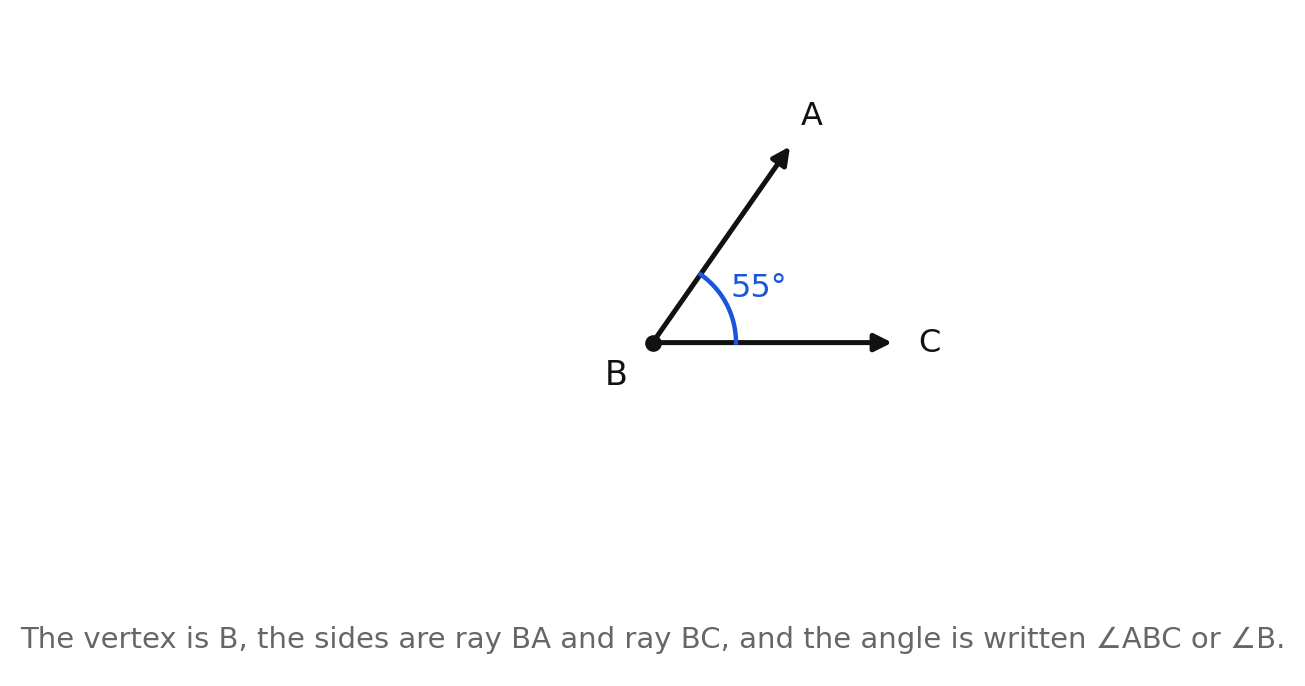
There are three ways to write this angle, and each is useful somewhere:
- Three letters, vertex in the middle: or . This is always unambiguous, so use it whenever more than one angle sits at the same vertex.
- One letter, the vertex alone: . Only legal when exactly one angle has vertex .
- A number written inside the angle: . Handy in a crowded diagram.
The size of an angle is its measure, written with an in front: . Measure is how far one side is rotated from the other, in degrees, and it has nothing to do with how long the rays are drawn. A angle with short sides and a angle with long sides are the same angle.
Four names sort angles by measure:
| Name | Measure |
|---|---|
| acute | greater than and less than |
| right | exactly |
| obtuse | greater than and less than |
| straight | exactly |
A right angle is marked with a small square at the vertex, and a straight angle is exactly what a straight line makes at any point on it.
Adjacent angles
Adjacent angles are two angles that meet both of these conditions:
- First condition. They share a vertex and share a side.
- Second condition. Their interiors do not overlap — neither angle lies inside the other.
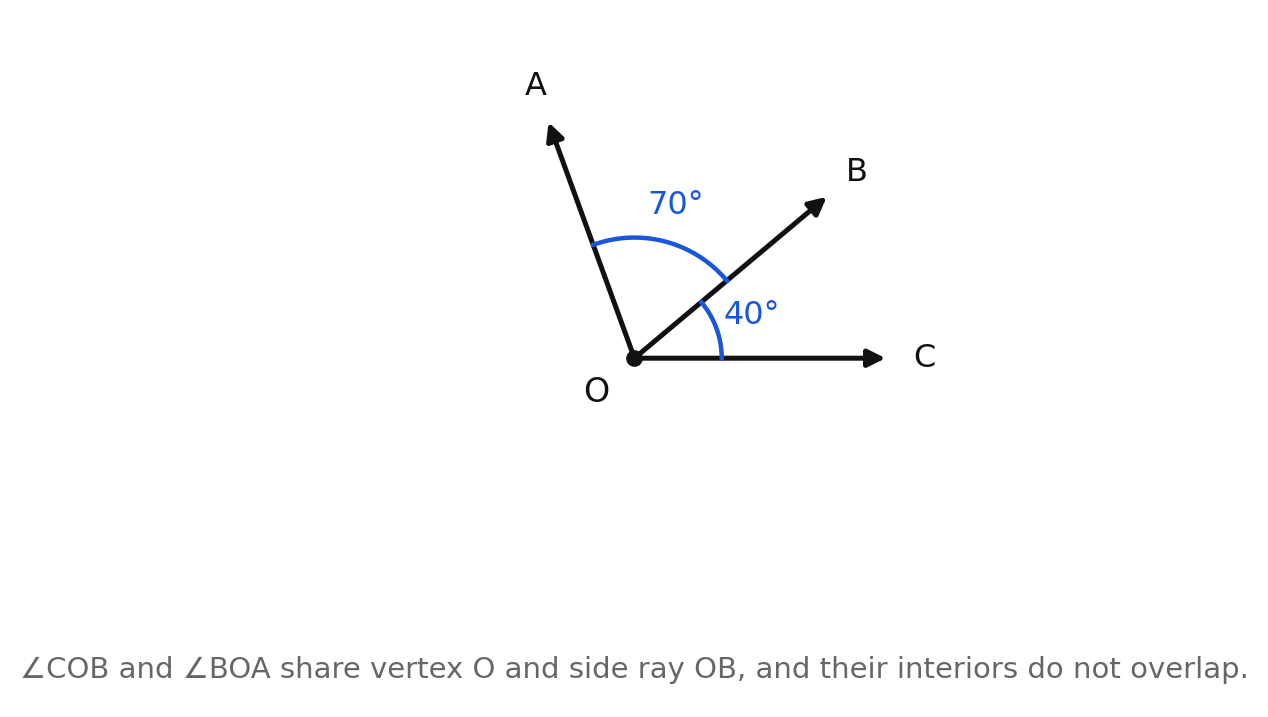
Here and are adjacent. They share vertex , they share side , and acts as a wall between them so no part of one is inside the other. "Adjacent" means next to, and that is all it means. It says nothing about the two measures.
Both conditions matter, and the second is the one students drop.
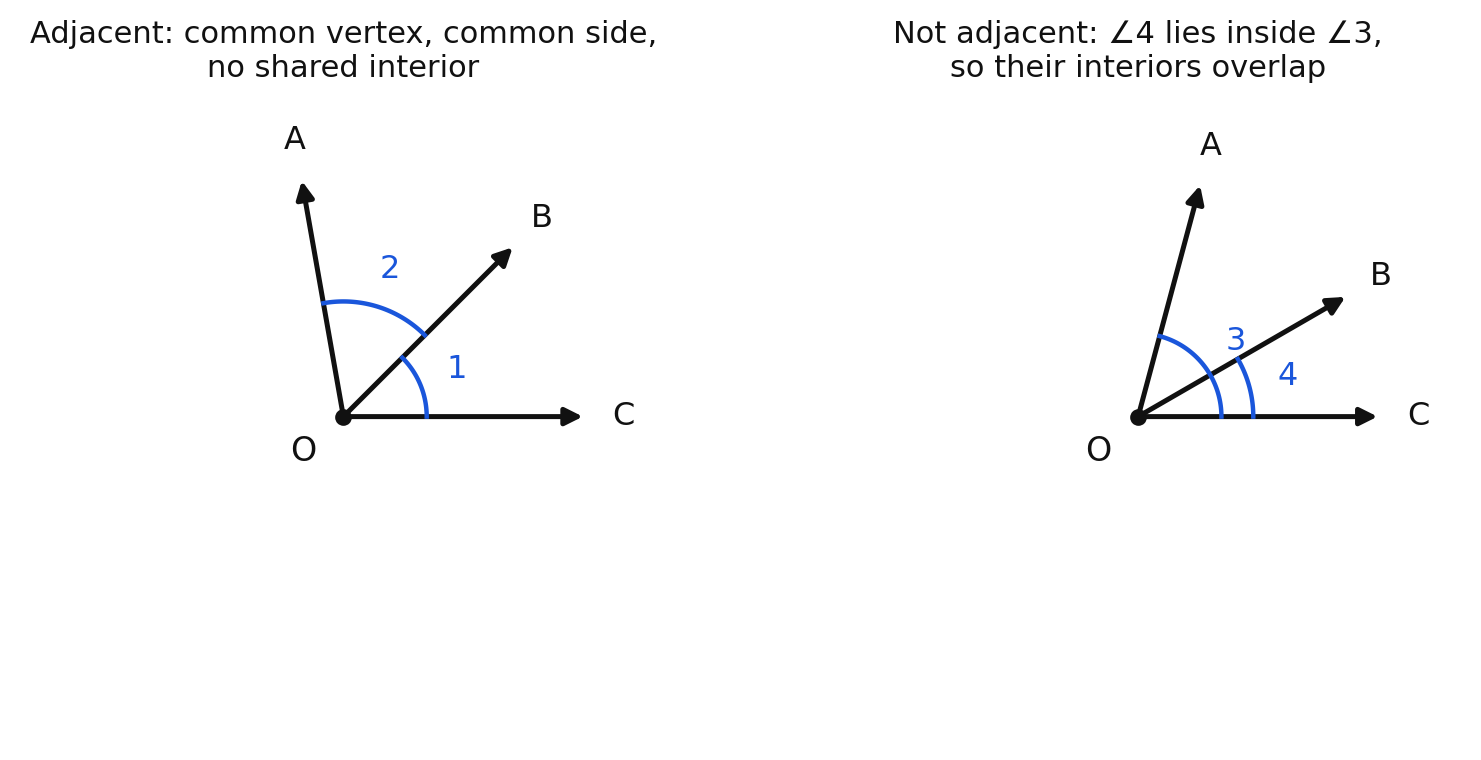
In the right-hand diagram, and share vertex and share side — but sits inside , so their interiors overlap and they are not adjacent. Two angles that share only a vertex, with no common side, are also not adjacent.
Adjacent measures add
When two angles are adjacent, the angle formed by their two outer sides has a measure equal to the sum of theirs. In the diagram above,
Read that equation in reverse and it becomes a subtraction tool. If a ray splits a known angle and one piece is known, the other piece is the difference. That single idea — a big angle split into adjacent pieces — is behind almost every problem in this chapter.
Worked examples
Example 1 — Naming an angle
An angle has vertex and sides and . Write every legal name for it.
The vertex letter goes in the middle of a three-letter name. If is the vertex of only this one angle, the one-letter name is legal too.
Answer: , , and
Example 2 — Classifying by measure
Classify , , , and .
Answer: acute, right, obtuse, straight
Example 3 — Adding adjacent measures
and are adjacent, with and . Find .
The two angles share side , so their measures add.
Answer:
Example 4 — Subtracting to find a piece
lies in the interior of , with and . Find .
The ray splits the angle into two adjacent pieces whose measures add to .
Answer:
Example 5 — Deciding whether a pair is adjacent
lies in the interior of . Are and adjacent?
They share vertex and side , so the first condition holds. But is inside , which puts all of inside , so their interiors overlap.
Answer: No. They fail the non-overlapping condition.
Guided practice
Use the figures in this lesson where a figure is named.
- Name the angle in the first figure of this lesson in three different ways, and give its measure.
- In that same figure, name the vertex and both sides.
- In the second figure, name the two adjacent angles and the side they share.
- In the second figure, find .
- In the third figure, explain why and are not adjacent.
- Classify each measure as acute, right, obtuse, or straight: , , , .
Independent practice
- Classify each angle. a) b) c) d) e)
- , and is the vertex of no other angle in the diagram. Write two other names for this angle.
- and are adjacent, with and . Find .
- lies in the interior of , with and . Find .
- lies in the interior of , with and . Find .
- Explain why and cannot be adjacent when lies in the interior of .
- Two angles share a vertex but share no side. Are they adjacent? Explain.
- Application. A laptop lid makes a angle with the base. A stylus lies on the base, pointing away from the hinge inside that angle, making a angle with the base. What is the angle between the stylus and the lid?
- Reasoning. Can two adjacent angles both be obtuse? Give an example or explain why not.
- Error analysis. A student looks at the left-hand panel of the third figure and says and are not adjacent because they have different measures. Explain the mistake.
Exit ticket 9.1
- Name the vertex and both sides of .
- and are adjacent, with and . Find .
- State the two conditions two angles must meet to be adjacent.
- Classify an angle of , and explain how you know.
Lesson 9.2 — Complementary and Supplementary Angles
Two sums worth memorizing
The two relationships in this lesson are defined by a sum, not by position.
Two angles are complementary when their measures add to . Each angle is called the complement of the other.
Two angles are supplementary when their measures add to . Each angle is called the supplement of the other.
To find a complement, subtract from ; to find a supplement, subtract from . The complement of is . The supplement of is .
Two words that are easy to swap, and one way to keep them straight: c comes before s in the alphabet, and comes before .
What the sums force to be true
These definitions rule things out, and noticing that saves work later.
- A complementary pair is made of two acute angles. Neither can be or more, because the other would have to be or negative. So an obtuse angle has no complement.
- In a supplementary pair, at most one angle is obtuse, and if one is right the other is right too.
- Equal complementary angles are each; equal supplementary angles are each.
Complementary angles that are adjacent
When a complementary pair happens to be adjacent, the two outer sides form a right angle — and the figure gives away the relationship at a glance.
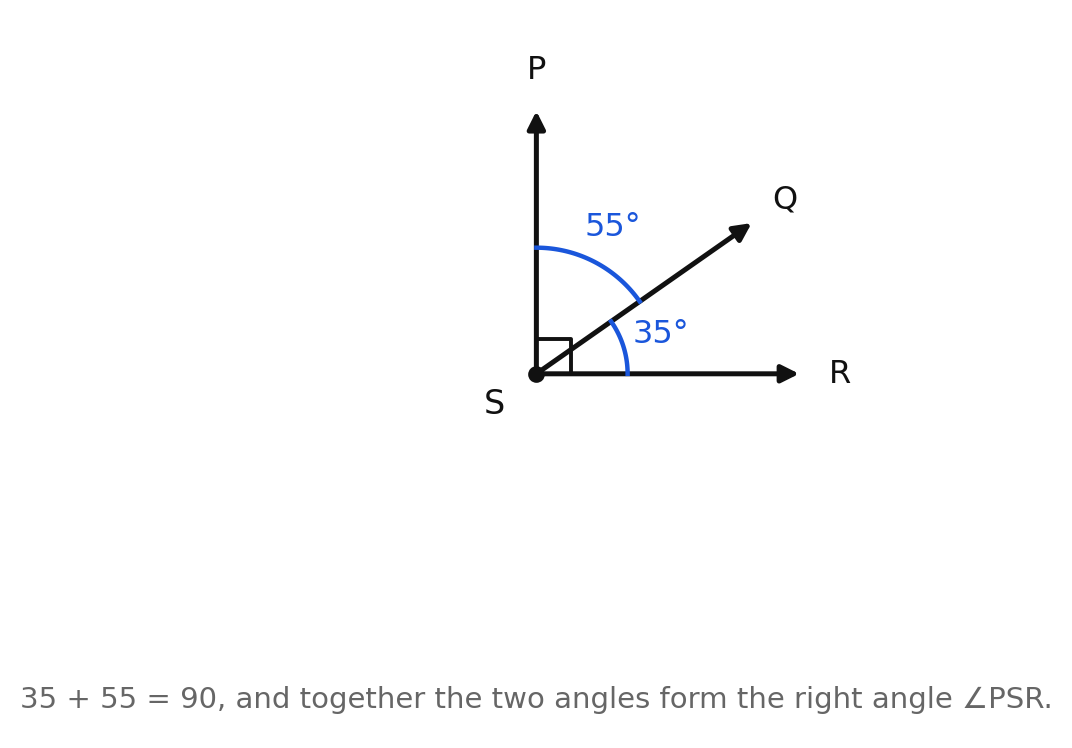
Here and . They are adjacent, sharing side , and their measures add to :
So is a right angle, marked with the small square. Turned around: whenever a ray splits a right angle into two pieces, those two pieces are complementary.
Supplementary angles that are adjacent: the linear pair
The same thing happens along a straight line, and this is the single most useful figure in the chapter.
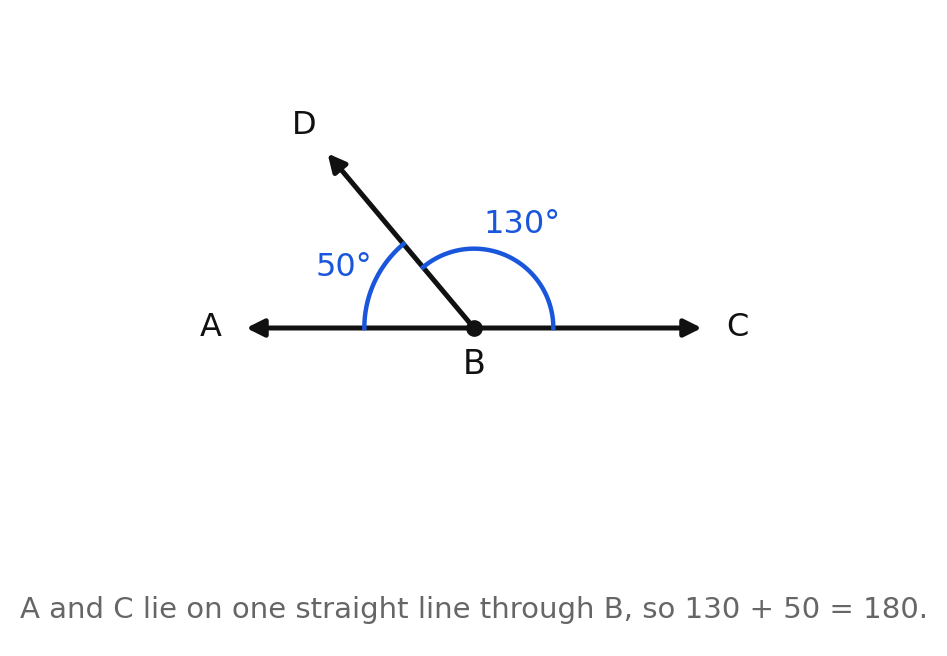
Points , , and lie on one straight line, so is a straight angle of . Ray splits it into two adjacent angles:
Two adjacent angles whose outer sides form a straight line are called a linear pair, and every linear pair is supplementary. A straight line in a diagram is therefore an equation waiting to be written.
Touching is optional
Here is the distinction that separates this lesson from the last one. Adjacent is about position. Complementary and supplementary are about sum. Two angles drawn on opposite sides of the page, sharing nothing at all, are still complementary if their measures add to .
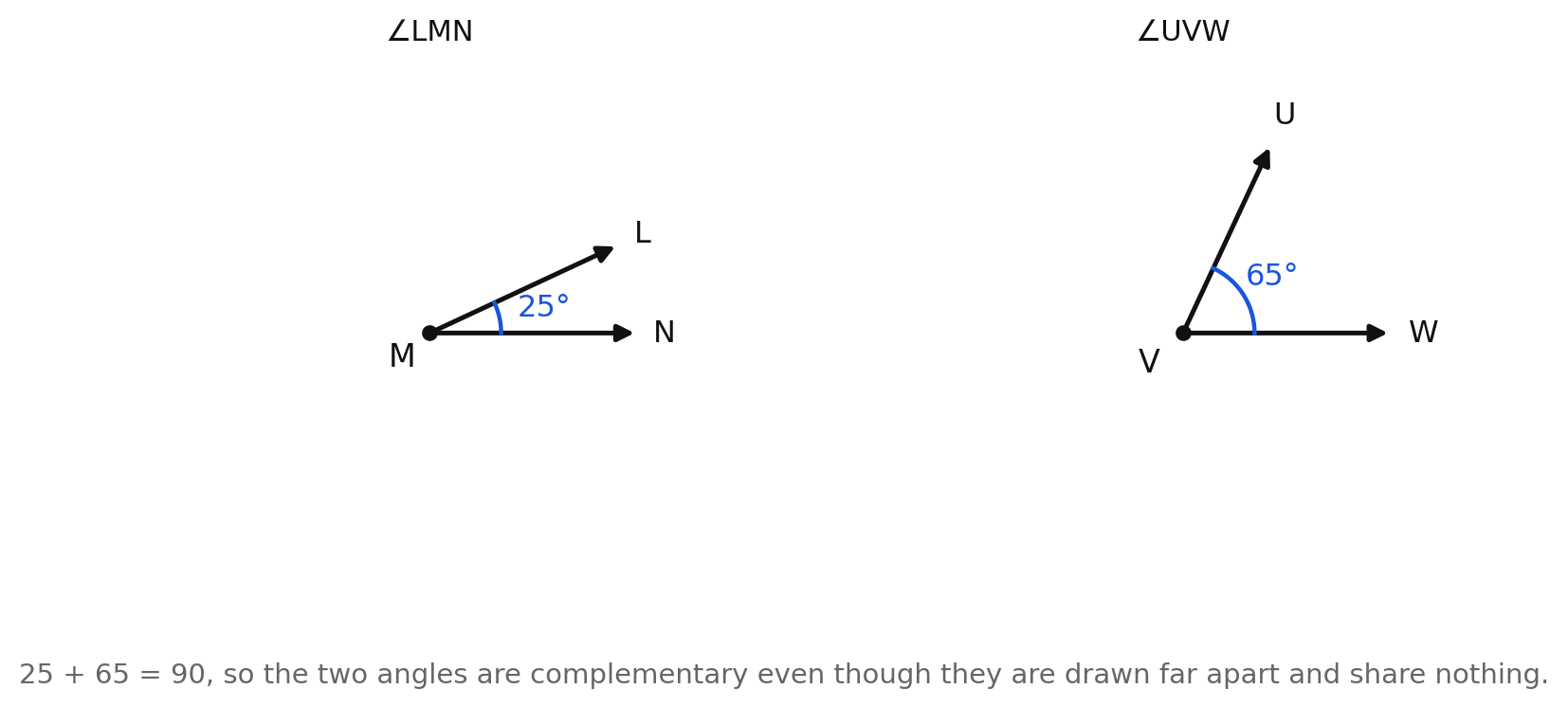
and have different vertices and no common side, so they are certainly not adjacent. But , so they are complementary.
The reverse also fails: adjacent angles need not be complementary or supplementary. Two adjacent angles of and add to , which is neither.
Worked examples
Example 1 — Finding a complement and a supplement
Find the complement and the supplement of .
Answer: complement ; supplement
Example 2 — A decimal measure
Find the complement of .
Answer:
Example 3 — Classifying a pair
Is each pair complementary, supplementary, or neither? a) and b) and c) and
Add each pair: , , and .
Answer: a) complementary b) supplementary c) neither
Example 4 — One angle described in terms of the other
Two complementary angles are such that one is three times the other. Find both.
Let the smaller measure be degrees, so the larger is degrees.
The angles are and . Check: .
Answer: and
Example 5 — A supplementary pair in the same style
Two supplementary angles are such that one is five times the other. Find both.
Check: .
Answer: and
Example 6 — Why an obtuse angle has no complement
Does a angle have a complement? A supplement?
A complement would have to satisfy , giving , and an angle cannot have a negative measure. A supplement is fine: .
Answer: No complement; supplement
Guided practice
- Find the complement of .
- Find the supplement of .
- Find the complement of .
- Find the supplement of .
- In the right-angle figure of this lesson, name the two complementary angles and the right angle they form together.
- In the straight-line figure of this lesson, name the supplementary pair and explain in one sentence why they must be supplementary.
- Are and complementary? Are they adjacent? Explain both answers.
- Can an obtuse angle have a complement? Explain.
Independent practice
- Find the complement of each. a) b) c) d)
- Find the supplement of each. a) b) c) d)
- Two complementary angles are such that one is three times the other. Find both measures.
- Two supplementary angles are such that one is five times the other. Find both measures.
- and are complementary and . Find .
- and are supplementary and . Find .
- Decide whether each pair is complementary, supplementary, or neither. a) and b) and c) and d) and
- Two complementary angles have equal measures. Find each measure.
- Reasoning. Explain why two right angles are always supplementary but can never be complementary.
- Application. A kite string makes a angle with level ground. A flagpole stands straight up beside it. What angle does the string make with the flagpole?
- Application. A staircase handrail meets a vertical post at a angle. What angle does the handrail make with the horizontal floor?
- Error analysis. A student says the supplement of is . Name the error and give the correct supplement.
Exit ticket 9.2
- Find the complement of .
- Find the supplement of .
- Two supplementary angles have equal measures. Find each measure, and classify them.
- Explain why every obtuse angle has a supplement but no complement.
Lesson 9.3 — Vertical Angles
Four angles from two lines
When two lines cross, they form four angles at the point of intersection.
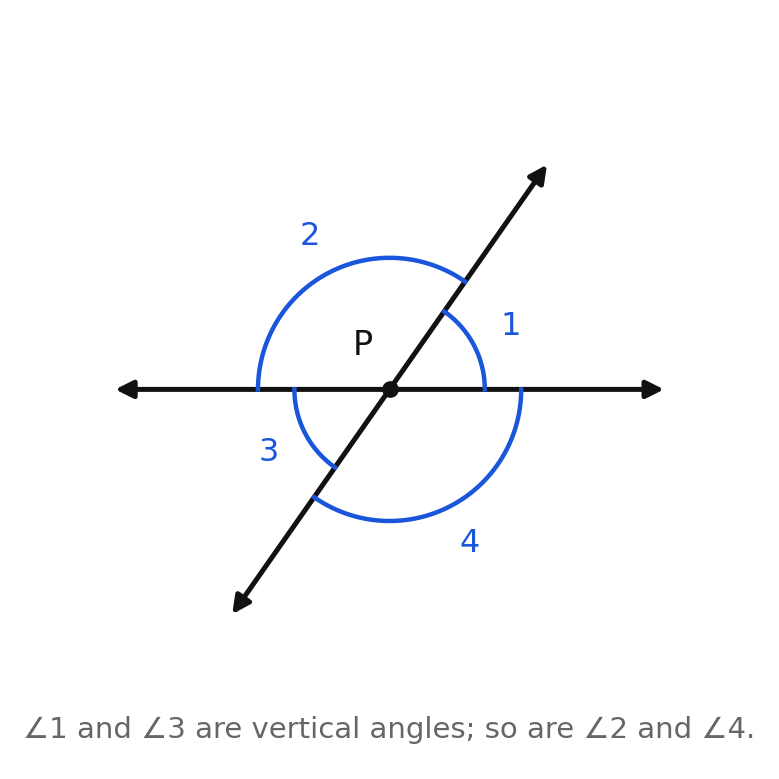
Vertical angles are the two angles in such a figure that are opposite each other — they share only the vertex, and each side of one is the opposite ray of a side of the other. In the diagram there are exactly two pairs of vertical angles:
The name has nothing to do with up and down. It comes from vertex, and a pair of vertical angles is sometimes described as sitting across the vertex from each other, tip to tip.
Notice what vertical angles are not: they are never adjacent. Adjacent angles must share a side, and vertical angles share only the vertex. The pairs that are adjacent here are the neighboring ones — and , and , and , and — and each of those four pairs is a linear pair, so each adds to .
Vertical angles are equal — and here is why
Vertical angles always have equal measures. This is not a coincidence of the drawing; it follows from the linear pairs.
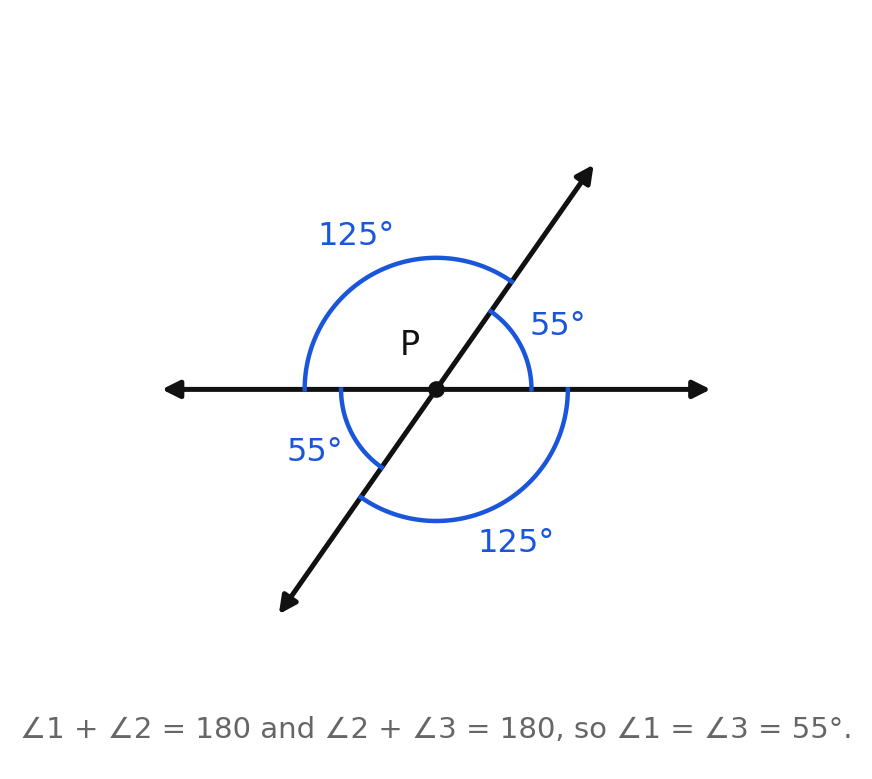
Suppose . Then:
- and form a linear pair, so .
- and also form a linear pair, so .
So . Nothing about was special. In general, both and are supplements of the same angle , and two angles supplementary to the same angle must be equal:
The same argument on the other diagonal gives .
That is the whole toolkit for an intersection. One measure determines all four. Given any one angle, its vertical partner is equal to it, and the two neighbors are its supplement.
Perpendicular lines are the special case
If one of the four angles is , its vertical partner is and each neighbor is . All four angles are right angles, and the lines are perpendicular. This is also the only way a pair of vertical angles can be supplementary: equal angles adding to must each be .
Worked examples
Example 1 — All four angles from one
Two lines intersect and one of the four angles measures . Find the other three.
The vertical partner equals it, and each neighbor is its supplement.
Answer: , , and
Example 2 — Naming the pairs
In the four-angle figure above, name every pair of vertical angles and every linear pair.
Answer: Vertical: and ; and . Linear pairs: and ; and ; and ; and .
Example 3 — A vertical pair with a variable
Vertical angles measure and . Find .
Vertical angles are equal, so set the expressions equal.
Check: .
Answer:
Example 4 — Two expressions, one equation
Vertical angles measure and . Find and both measures.
Both measures: and .
Answer: ; each angle is
Example 5 — Using the sum of a vertical pair
and are vertical angles and . Find each measure.
Vertical angles are equal, so each is half the total.
Answer: each
Example 6 — Counting acute angles
Two lines intersect, and one of the four angles is acute. How many of the four angles are acute?
The acute angle's vertical partner is equal, so it is acute too. Each neighbor is the supplement of an angle less than , so each neighbor is greater than .
Answer: Exactly two.
Guided practice
- Using the four-angle figure in this lesson, name both pairs of vertical angles.
- Using the same figure, name all four linear pairs.
- In the measured figure, . Give , , and .
- If at an intersection, what are the other three measures, and what are the two lines called?
- Explain, using linear pairs, why and must have equal measures.
- Are vertical angles ever adjacent? Explain.
Independent practice
- Two lines intersect and one angle measures . Find the other three measures.
- Two lines intersect and one angle measures . Find the other three measures.
- Vertical angles measure and . Find .
- Vertical angles measure and . Find and both measures.
- Two lines intersect so that all four angles are equal. Find each measure and name the relationship between the lines.
- and are vertical angles and . Find each measure.
- Reasoning. Explain why a pair of vertical angles can be supplementary only when both measure .
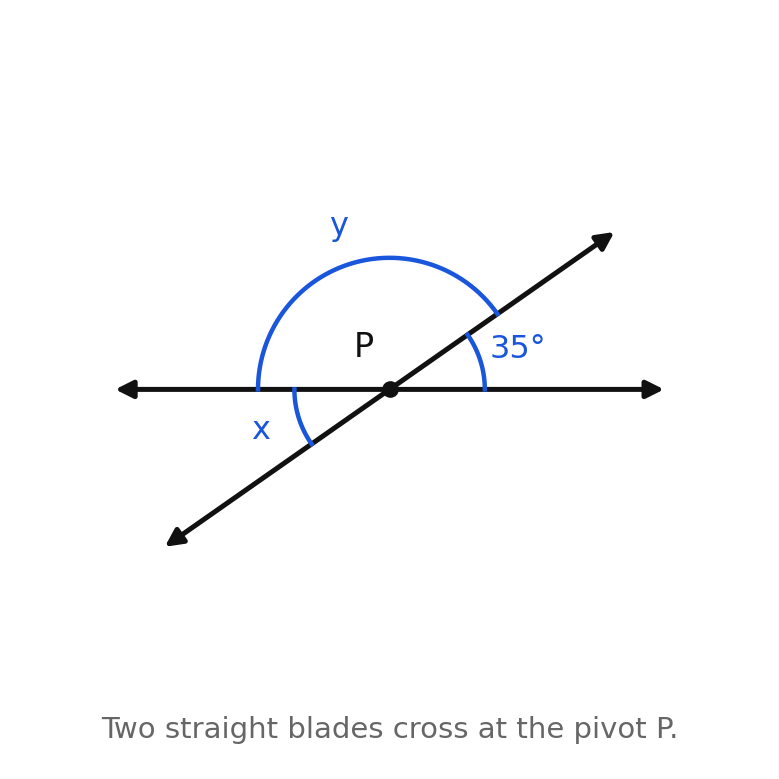
- Application. Two straight scissor blades cross at the pivot, as shown below. One angle at the pivot measures . Find and , and name the relationship you used for each.
- Reasoning. Two intersecting lines form one obtuse angle. How many of the four angles are obtuse? Justify your answer.
- Error analysis. A student writes " and are vertical angles, so ." Explain what the student confused, and give a counterexample.
Exit ticket 9.3
- Two lines intersect and one angle measures . Find the other three measures.
- Vertical angles measure and . Find .
- In one or two sentences, state the difference between vertical angles and adjacent angles.
- Explain why a pair of vertical angles can never be an adjacent pair.
Lesson 9.4 — Solving for Unknown Angle Measures
From a diagram to an equation
Everything in the first three lessons turns into the same three-step routine.
- Step one — find the relationship. Look for a straight line (supplementary), a right angle (complementary), or two lines crossing (vertical).
- Step two — write the equation the relationship gives you: sum , sum , or the two expressions equal.
- Step three — solve, then substitute back and check that the measures satisfy the relationship and are all positive.
That last step is not optional. Solving for is halfway to the answer — the question almost always asks for a measure, and is rarely a measure by itself.
Because these equations are linear with the variable on one or both sides, the solving methods are exactly the ones from Chapter 5.
A supplementary pair
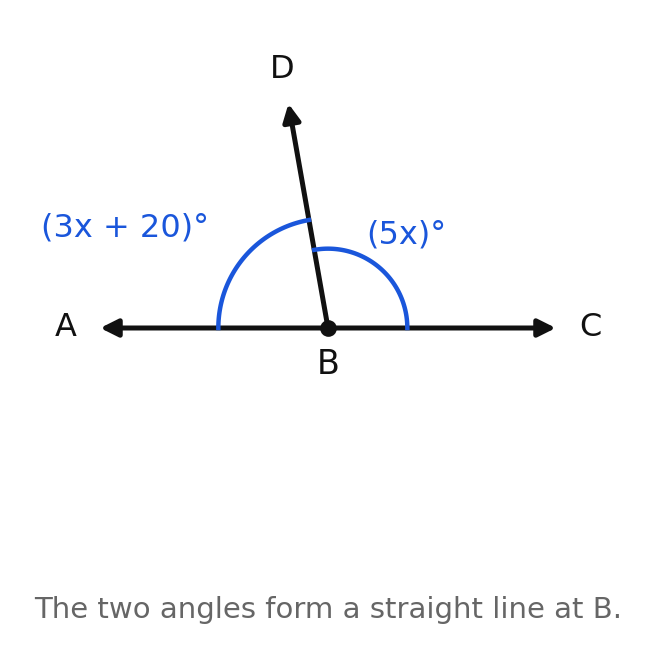
Points , , and lie on a line, so the two angles form a linear pair and are supplementary.
Now substitute back for the measures: and . Check the relationship: . Both measures are positive, and is the obtuse one in the picture, which matches the drawing.
A complementary pair
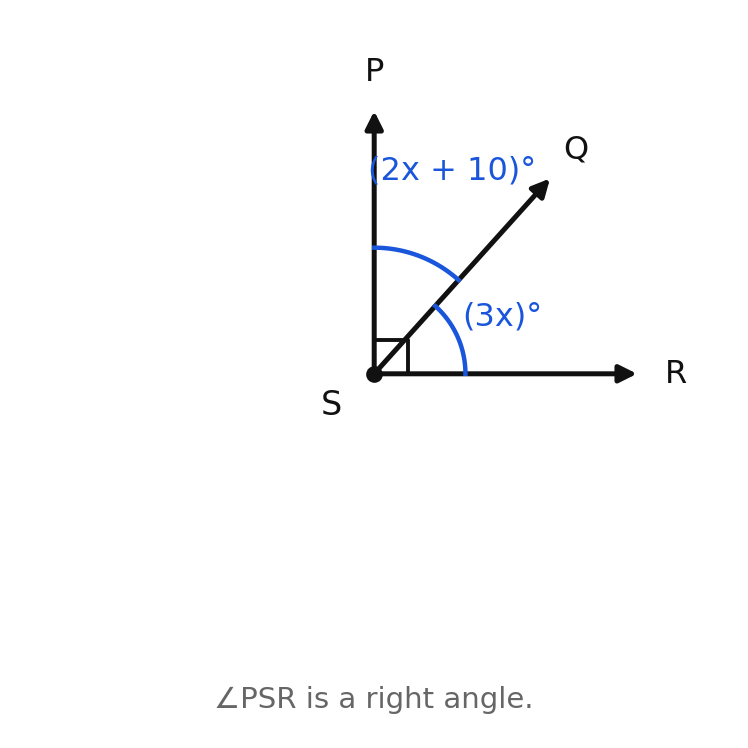
The small square says is a right angle, so ray splits into two complementary pieces.
Substituting back: and . Check: .
A vertical pair
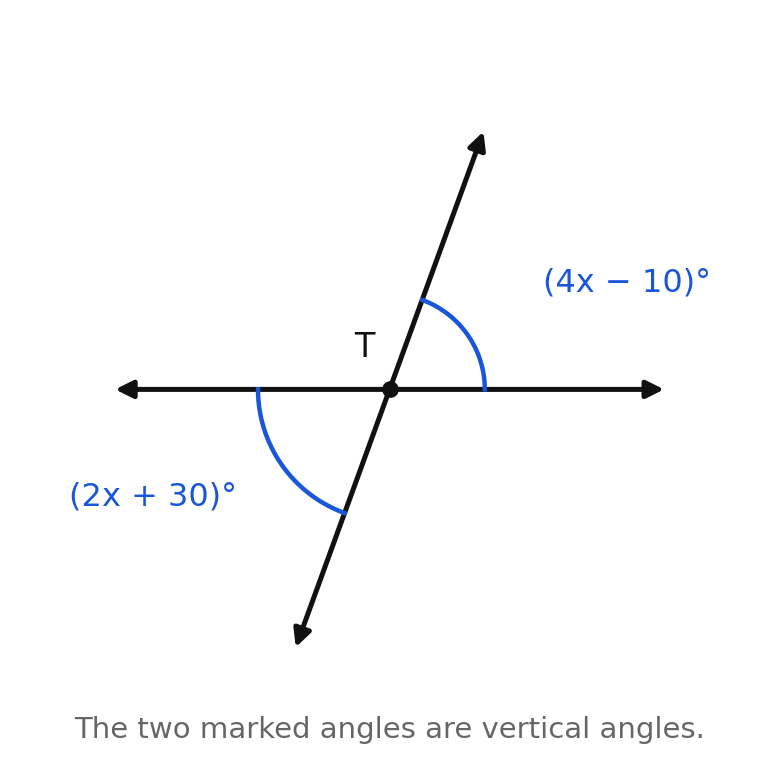
The two marked angles are vertical, so they are equal — this is the one case where the equation is not a sum.
Substituting back: and . Equal, as required. The other two angles at are each .
More than two angles at a point
A straight angle can be split into as many adjacent pieces as you like. The pieces still add to .
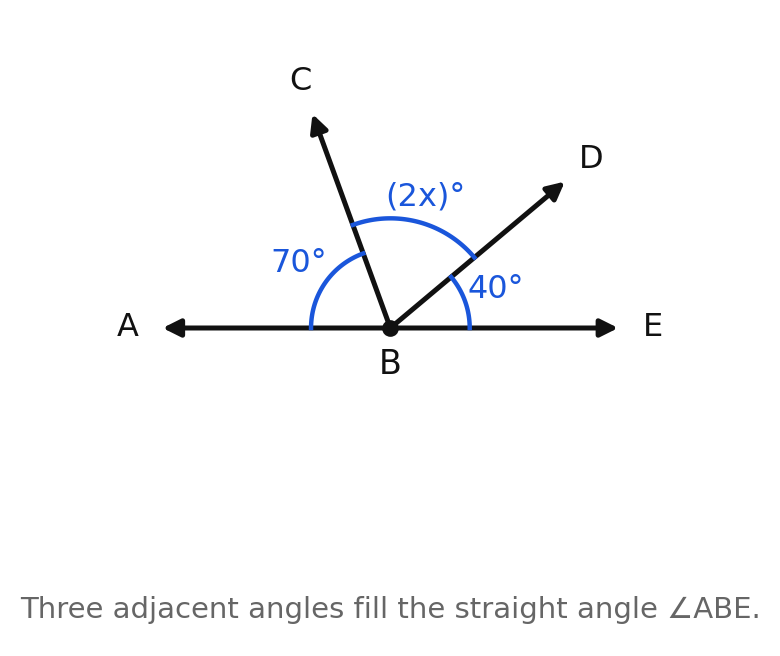
The middle angle measures , and the check is .
Problems in context
The standard asks for unknown angles "including those in context," and context problems are the same three steps with one extra job at the front: decide which relationship the situation describes. Two clues carry most of the work.
- Something vertical meeting something level — a post on the ground, a flagpole, a wall and a floor — makes a right angle, so the angles inside it are complementary.
- Something straight being crossed or split — a road, a shelf, a taut string, a hinge lying flat — makes a straight angle, so the angles along it are supplementary. Two straight things crossing add vertical angles.
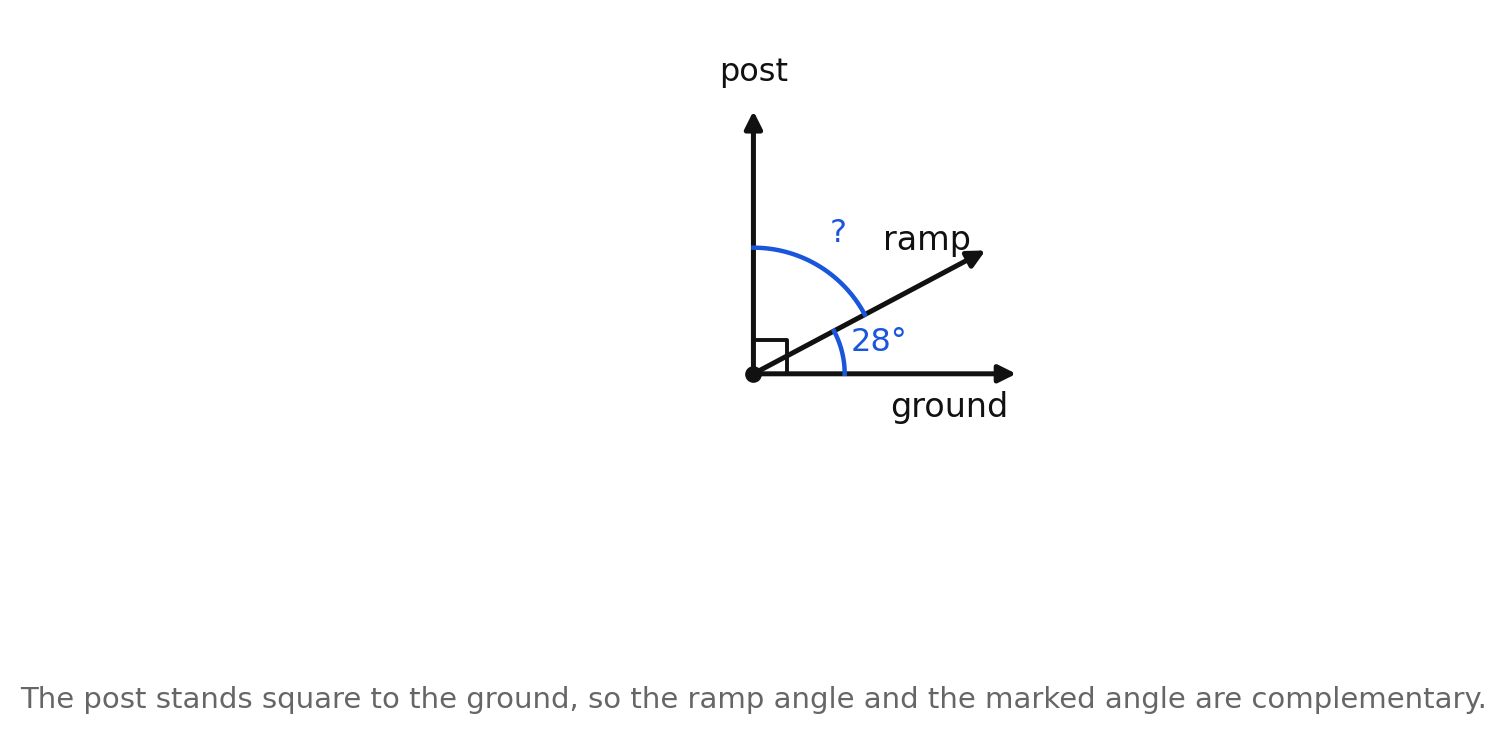
A skate ramp rises from the ground at . A support post is set square to the ground. What angle does the ramp make with the post?
The post is square to the ground, so the ramp angle and the marked angle together fill a right angle. They are complementary.
Answer: , and the check is .
Worked examples
Example 1 — Supplementary, with the variable in both terms
Two supplementary angles measure and . Find and both measures.
Measures: and . Check: .
Answer: ; the angles are and
Example 2 — Complementary, with the variable in both terms
Two complementary angles measure and . Find both measures.
Measures: and . Check: .
Answer: and
Example 3 — Vertical, two expressions
Vertical angles measure and . Find and the measure of each.
Measures: and .
Answer: ; each angle is
Example 4 — A described pair with no diagram
One of two complementary angles is more than the other. Find both.
Let the smaller be degrees; the larger is degrees.
Measures: and . Check: .
Answer: and
Example 5 — A relationship between complement and supplement
The supplement of an angle is four times its complement. Find the angle.
Let the angle measure degrees. Its supplement is and its complement is .
Check: the supplement is , the complement is , and .
Answer:
Example 6 — Context: two streets crossing
Two straight streets cross. The acute angle at the crossing measures , and the obtuse angle beside it measures . Find and all four angles.
The two angles named are neighbors at the crossing, so they form a linear pair.
Measures: and . Check: . The vertical partners repeat those measures.
Answer: ; the four angles are , , , and
Guided practice
- Use the supplementary-pair figure in this lesson. Write the equation, solve for , and give both angle measures.
- Use the complementary-pair figure. Write the equation, solve for , and give both angle measures.
- Use the vertical-pair figure. Write the equation, solve for , and give the measure of each marked angle.
- Use the three-angles-on-a-line figure. Write the equation, solve for , and give the measure of the middle angle.
- Use the ramp figure. Name the relationship and find the marked angle.
- Two supplementary angles measure and . Find and both measures.
- Two complementary angles measure and . Find both measures.
- Vertical angles measure and . Find and each measure.
Independent practice
- Two supplementary angles measure and . Find and both measures.
- Two complementary angles measure and . Find and both measures.
- Vertical angles measure and . Find and each measure.
- Three adjacent angles along a straight line measure , , and . Find and the middle angle.
- One of two complementary angles is more than the other. Find both measures.
- One of two supplementary angles is less than three times the other. Find both measures.
- Reasoning. The supplement of an angle is four times its complement. Find the angle, and show the check.
- Application. A skateboard ramp rises from level ground at . A vertical support post runs from the ground to the underside of the ramp. What angle does the ramp make with the post?
- Application. Two straight streets cross. The acute angle at the crossing measures and the obtuse angle beside it measures . Find and all four angles.
- Application. A tile design places three adjacent angles along one straight edge, measuring , , and . Find and all three angle measures.
- Error analysis. A student is told that and are complementary and writes , giving . Identify the error and solve the problem correctly.
- Reasoning. Explain why a straight line drawn in a diagram lets you write an equation, even when no angle measure is marked on the line itself.
Exit ticket 9.4
- Two supplementary angles measure and . Find and both measures.
- Two complementary angles measure and . Find and both measures.
- Vertical angles measure and . Find and each measure.
- For each of the three relationships — complementary, supplementary, vertical — state in one sentence what you would set your equation equal to.
Chapter 9 Review
Vocabulary. angle · vertex · side · degree · measure · acute · right · obtuse · straight · adjacent angles · linear pair · complementary · complement · supplementary · supplement · vertical angles · perpendicular
Part A — Identifying and describing angle pair relationships (8.MG.1a)
- Describe each relationship in your own words, in one sentence each: vertical, adjacent, supplementary, complementary.
- Use the figure below. Name a pair of adjacent angles, a complementary pair, and a supplementary pair.
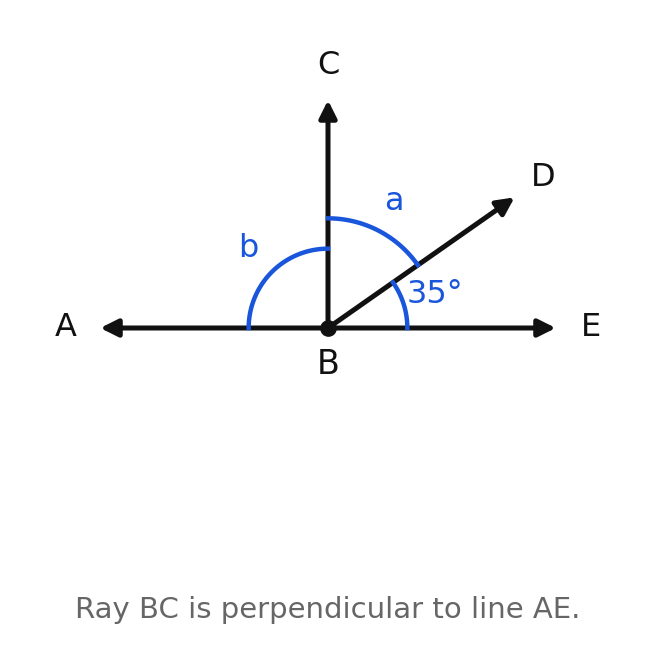
- In that same figure, find and , and say which relationship you used for each.
- Use the intersection figure below. Name both pairs of vertical angles.
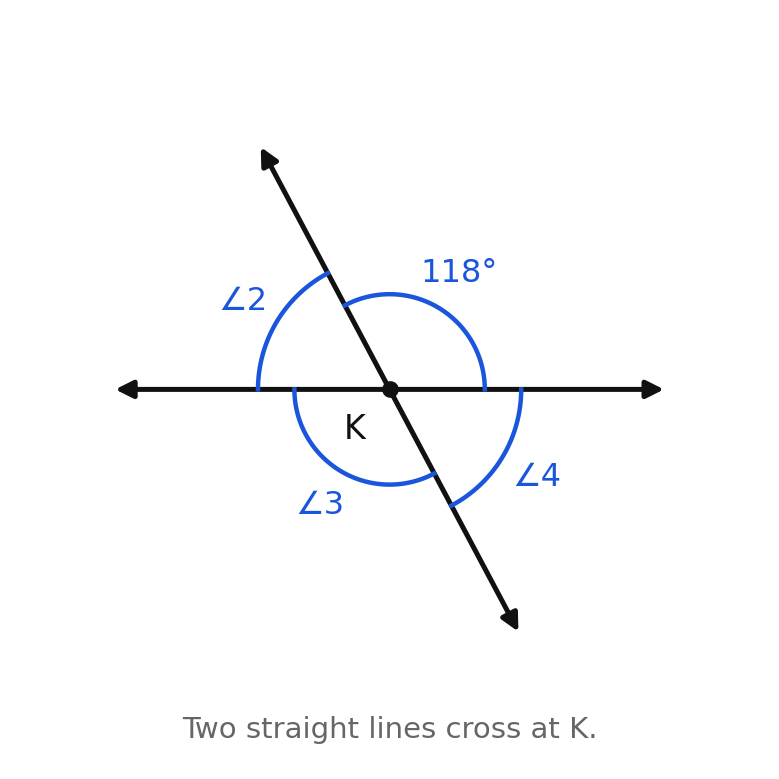
- In that same figure, find , , and .
- In the four-angle figure from Lesson 9.3, which numbered angles are adjacent to ?
- For each relationship — vertical, supplementary, complementary — say whether the pair is always, sometimes, or never also adjacent.
- True or false, with a reason: every supplementary pair is adjacent.
- Explain how two angles can be adjacent without being either complementary or supplementary, and give an example.
- Look again at the two-panel figure from Lesson 9.1. In one sentence, say which panel shows adjacent angles and why the other does not.
Part B — Solving for unknown angle measures (8.MG.1b)
- Find both the complement and the supplement of .
- Find the supplement of .
- Two supplementary angles measure and . Find and both measures.
- Two complementary angles measure and . Find and both measures.
- Vertical angles measure and . Find and each measure.
- Three adjacent angles along a straight line measure , , and . Find and all three measures.
- Two lines intersect and one angle measures . Find the other three measures.
- Two complementary angles have measures in the ratio . Find both measures.
- Two supplementary angles differ by . Find both measures.
- An angle is three times its own supplement. Find the angle and its supplement.
- Four adjacent angles along a straight line measure , , , and . Find and the unknown angle.
- Vertical angles measure and . Find and each measure.
Part C — Mixed application and reasoning
- Application. In the ramp figure from Lesson 9.4, suppose the ramp were rebuilt to rise at instead of . What would the marked angle become, and what relationship did you use?
- Application. In the scissors figure from Lesson 9.3, suppose the marked angle at the pivot opens to . Find and .
- Application. A traffic engineer measures one angle where two straight roads cross as and the angle vertical to it as . Find and all four angles at the crossing.
- Reasoning. The supplement of an angle is three times its complement. Find the angle, and show the check.
- Error analysis. A student writes " and are vertical angles, so ." Explain the error, name the relationship the student was thinking of, and give a correct statement.
- Reasoning. Describe how you decide which equation to write when a diagram shows an unknown angle. Name the feature of the diagram you look for in each of the three cases.
Standards coverage check — Chapter 9
| Knowledge and Skill | Where it is taught | Where it is practiced |
|---|---|---|
| 8.MG.1a — identify and describe the relationship between pairs of angles that are vertical, adjacent, supplementary, and complementary | 9.1 (adjacent), 9.2 (complementary and supplementary, adjacent or not), 9.3 (vertical, and why they are equal) | Items 1–8, 12, 13, 15, 16, 17, 19, 20; 25–28, 37, 44; 45, 46, 48–50, 55, 57, 59, 60, 63, 64; Review Part A, items 89–98 |
| 8.MG.1b — use the relationships among supplementary, complementary, vertical, and adjacent angles to solve problems, including those in context, involving the measure of unknown angles | 9.1 (adding and subtracting adjacent measures), 9.2 (complement and supplement arithmetic), 9.3 (one measure determines all four), 9.4 (writing and solving the equation, including context) | Items 9–11, 14, 18; 21–24, 29–36, 38–43; 47, 51–54, 56, 58, 61, 62; 65–88; Review Part B, items 99–110, and Part C, items 111–114 |
All four named relationships — vertical, adjacent, supplementary, complementary — are defined and practiced by name, and each appears in the review. The two bullets are braided on purpose: Lesson 9.4 never asks for a measure without first asking which relationship the diagram shows, because a correct equation is just bullet (a) written down.
Answer keys for every set in this chapter are in Appendix A.