Chapter 13 — Translations in the Coordinate Plane
Standard: 8.MG.3 (a, d) — The student will apply translations and reflections to polygons in the coordinate plane.
By the end of this chapter you will be able to:
- Name the preimage and the image of a transformation, and write image points with prime notation
- Read a translation rule such as and say in words how far and which way the figure slides
- Turn "left, right, up, down" into the correct signs inside a rule, and turn a rule back into words
- Given a preimage in the coordinate plane, identify the coordinates of the image of a polygon that has been translated vertically, horizontally, or a combination of both (8.MG.3a)
- Sketch the image of a polygon that has been translated vertically, horizontally, or a combination of both (8.MG.3d)
- Explain why a translated image is congruent to its preimage, with the same size, the same shape, and the same orientation
Lessons: 13.1 What a Translation Does · 13.2 Coordinates of a Translated Polygon · 13.3 Sketching a Translated Image
What this chapter covers, and what it does not. Standard 8.MG.3 has seven Knowledge and Skills bullets covering two different transformations and their combination. This chapter takes the two translation bullets, (a) and (d). Reflections over the - or -axis, and any combination of a translation with a reflection, are Chapter 14. Everything here is a slide and only a slide.
Two bounds hold everywhere in this chapter, because the standard sets them. Every translation is vertical, horizontal, or a combination of both — never a turn, never a flip. And every coordinate is an integer, both in the preimage and in the image, so you will never have to plot a point between two grid lines.
Numbering note. Item numbers run straight through the chapter, from 1 in Lesson 13.1 to 88 at the end of the review. They do not restart at each lesson.
Lesson 13.1 — What a Translation Does
A slide, and the words for it
A transformation is a rule that moves every point of a figure to a new location. In Grade 7 you met the transformation that resizes a figure, the dilation. This chapter is about the transformation that only slides.
A translation slides every point of a figure the same distance in the same direction. Nothing turns, nothing flips, nothing stretches. If you could lay a sheet of tracing paper over the figure, push the paper across the desk without rotating it, and lift it away, you would have performed a translation.
The vocabulary is the same vocabulary you used for dilations.
- The preimage is the figure you start with.
- The image is the figure you end with.
- Image points are named with prime marks. The image of point is , read " prime," and the image of is .
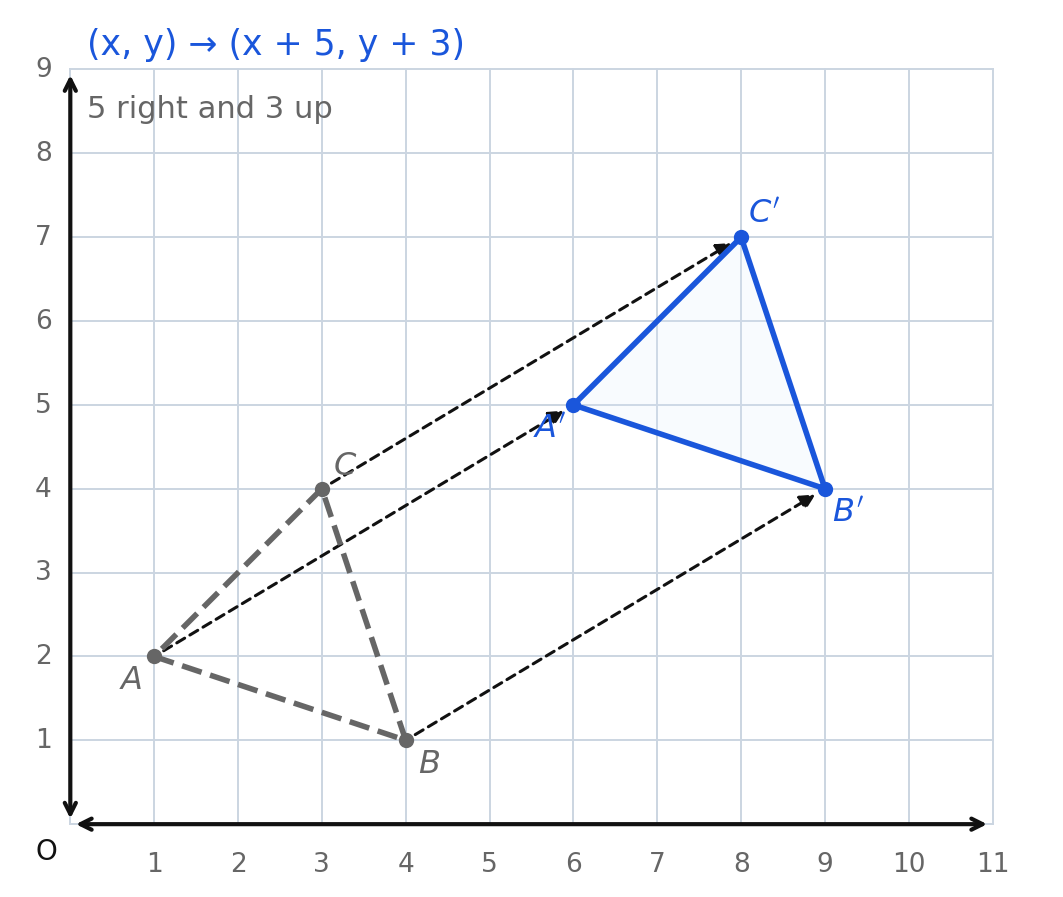
Throughout this chapter, the preimage is drawn dashed and the image is drawn solid, so you can always tell at a glance which figure came first.
Look at the three arrows in the figure above. Each one starts at a vertex of the preimage and ends at the matching vertex of the image, and all three arrows are the same length and point the same way. That is what "the same distance in the same direction" looks like on a grid: every vertex made the identical trip, units right and units up.
The rule, and where the signs come from
A translation is written as a rule that tells you what to do to a general point :
Read it as an instruction. "Add to the -coordinate; subtract from the -coordinate." Because counts how far right you are and counts how far up you are, the two numbers in the rule are exactly the horizontal and vertical parts of the slide:
| Direction | What it does to the coordinate | Sign |
|---|---|---|
| right | increases | |
| left | decreases | |
| up | increases | |
| down | decreases |
So the rule describes a slide of units right and units down. In the other direction, " units left and units up" becomes .
Sign errors are the single biggest hazard in this chapter. Left and down are the negative directions. Say the direction out loud, decide the sign, then write the rule.
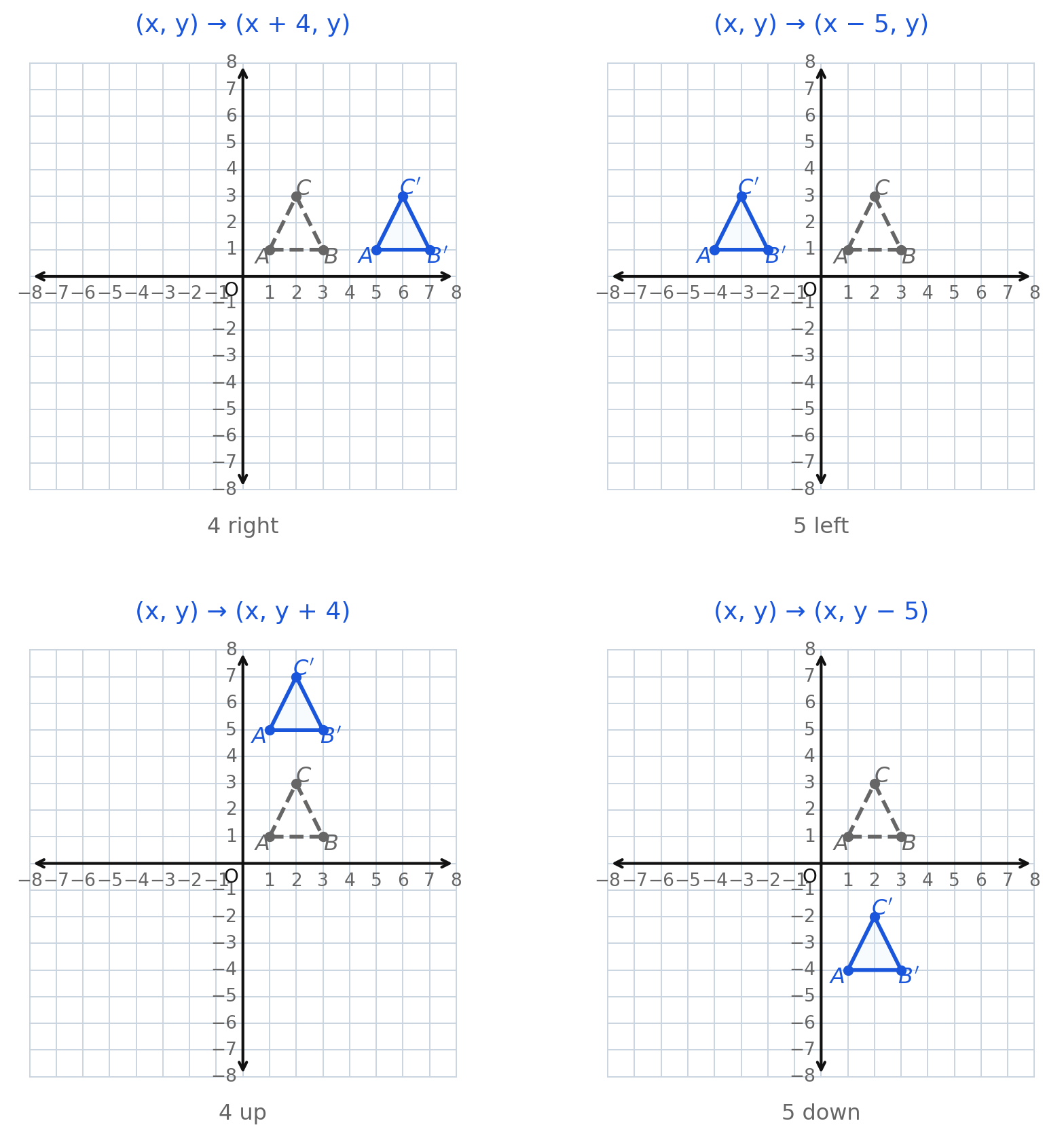
A horizontal translation changes only , so its rule has standing alone: . A vertical translation changes only , so its rule has standing alone: . A combination changes both. Those three cases are the entire menu the standard allows.
What a translation preserves
A translation is the gentlest transformation there is. Every vertex takes the same trip, so the vertices keep their positions relative to one another, and almost everything about the figure survives.
Preserved:
- Side lengths. Every side of the image is the same length as the matching side of the preimage.
- Angle measures. Every angle of the image equals the matching angle of the preimage.
- Size and shape. The image is congruent to the preimage: .
- Orientation. Reading the vertices goes around the preimage the same way as goes around the image — clockwise stays clockwise, counterclockwise stays counterclockwise.
Changed:
- Position only. The figure sits somewhere else on the grid.
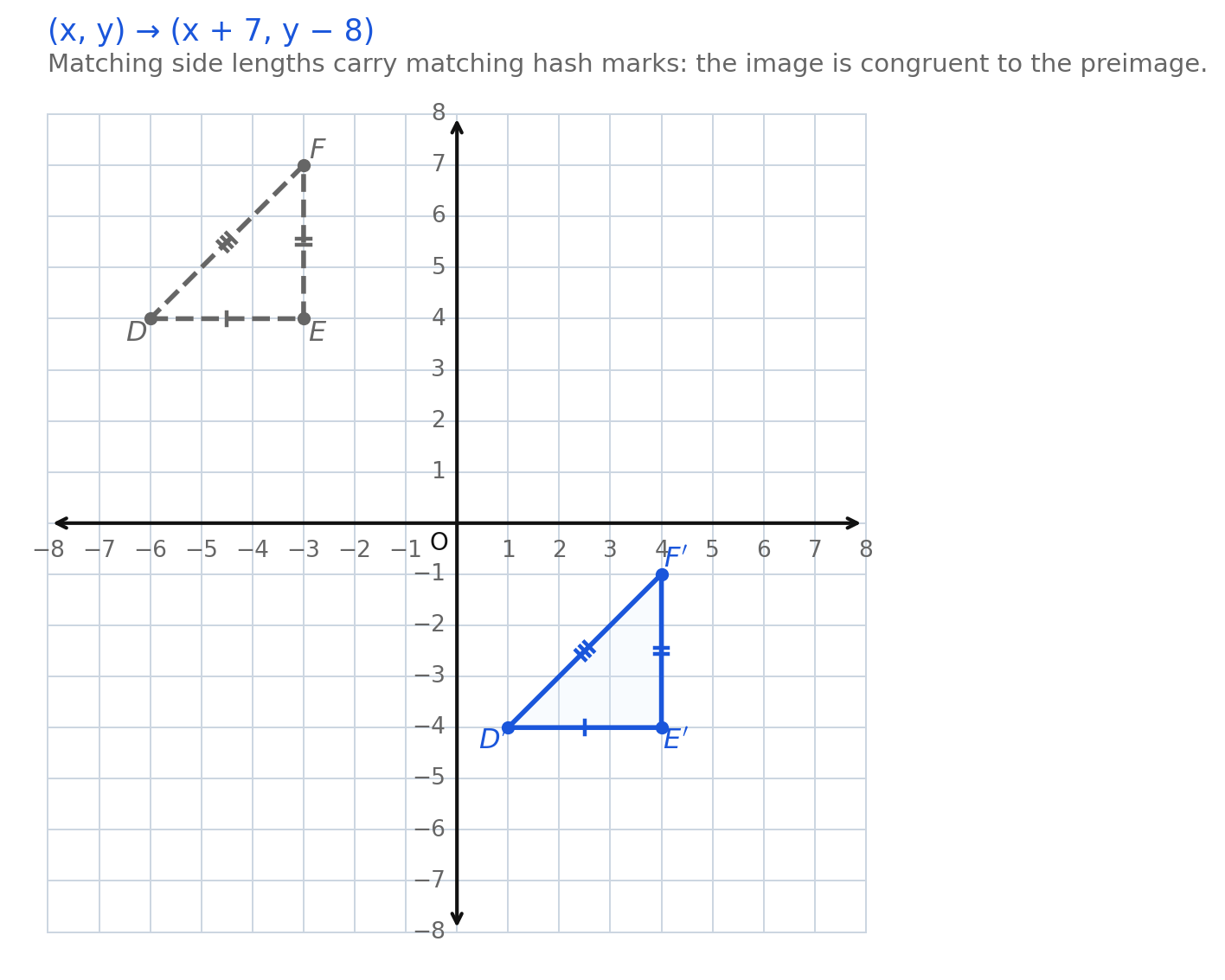
The hash marks in that figure are the whole argument in one picture: the side with one mark on the preimage has one mark on the image, and the two are the same length. Congruent figures, moved.
Compare this with the dilation of Grade 7, where side lengths were multiplied by a scale factor and only the angles survived. A translation has no scale factor. Nothing is multiplied; something is added.
Worked examples
Example 1 — A rule from words
Write the rule for a translation units right and units down.
Right increases , so the first entry is . Down decreases , so the second entry is .
Answer:
Example 2 — Words from a rule
Describe the translation in words.
Subtracting from moves the figure left. Adding to moves it up.
Answer: units left and units up
Example 3 — A translation with only one part
Describe in words, and say whether it is horizontal, vertical, or a combination.
The -coordinate is untouched, so nothing moves sideways. The -coordinate drops by .
Answer: units down; a vertical translation
Example 4 — Reading the slide off a graph
In the figure at the start of this lesson, has image . What rule was used?
From to is an increase of , so the horizontal part is . From to is an increase of , so the vertical part is . Checking a second vertex confirms it: , again right and up .
Answer:
Example 5 — What survives the slide
has centimeters and . It is translated units left. Find and .
A translation preserves side lengths and angle measures, so neither number changes.
Answer: centimeters and
Guided practice
- In the statement " is translated to ," which triangle is the preimage and which is the image?
- Write the rule for a translation units right.
- Write the rule for a translation units down.
- Describe in words.
- Describe in words.
- True or false: a translation makes the image larger than the preimage. Explain.
Independent practice
- Write the rule for each translation. a) units left b) units up c) units right and units down d) units left and units up
- Describe each rule in words. a) b) c) d)
- For each rule in item 8, say whether the translation is horizontal, vertical, or a combination of both.
- Quadrilateral is translated units up. If units and , find and . Explain how you know without doing any arithmetic.
- Use the figure of and at the start of this lesson. Write the rule that was used, and say how far and in which directions vertex traveled.
- Reasoning. Explain why every vertex of a polygon must move the same distance in the same direction for the motion to be a translation. What would happen to the figure if one vertex moved farther than the others?
- Application. A designer builds a board game on a coordinate grid. A game piece sits at , and the rules of the game let a player move a piece squares right and square up. Write the move as a rule, then give the piece's new location.
- Error analysis. A student says that translating a figure units left is written . Identify the error and write the correct rule.
Exit ticket 13.1
- Write the rule for a translation units right and units down.
- Describe in words.
- Name two things a translation preserves and one thing it changes.
- Explain the difference between a preimage and an image, and say why we write instead of for one of them.
Lesson 13.2 — Coordinates of a Translated Polygon
One rule, applied one vertex at a time
This is the computational heart of the chapter, and it is short. To find the coordinates of a translated image:
Apply the rule to every vertex of the preimage, one vertex at a time.
That is all. A polygon is determined by its vertices, so once you have the image vertices you have the image. Because both the preimage coordinates and the translation amounts are integers here, every image coordinate is an integer too.
Take with , , and , and translate it by .
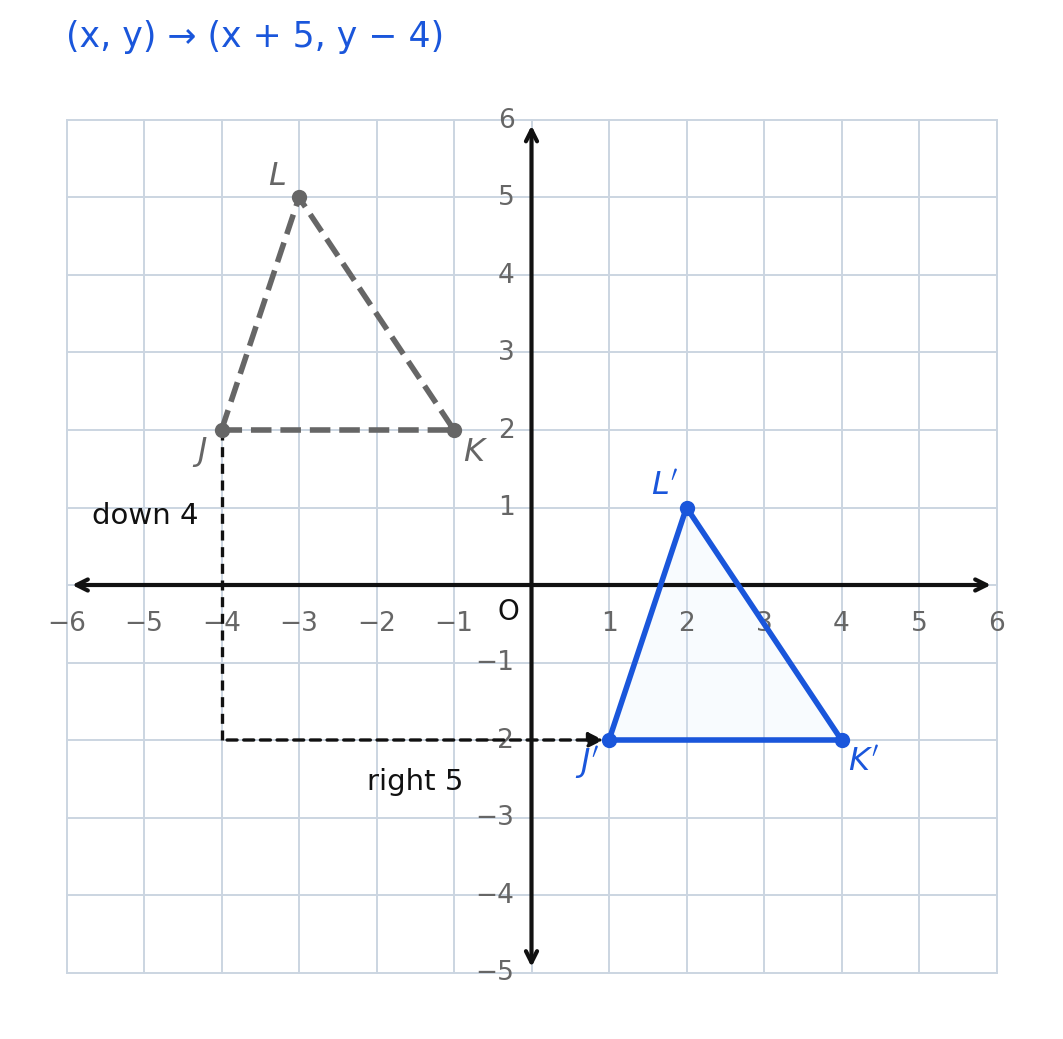
The dashed staircase from to is the arithmetic drawn as a path: down , then right . You could just as well go right first and then down; the destination is the same, because addition does not care about order.
Keep the negatives in front of you. Adding to a negative moves right toward zero, which is still "adding." At , : the vertex crossed the -axis and landed in a different quadrant, and nothing about the rule changed to make that happen.
Crossing quadrants is normal
There is nothing special about a figure that moves from one quadrant to another. The rule does not know where the axes are.
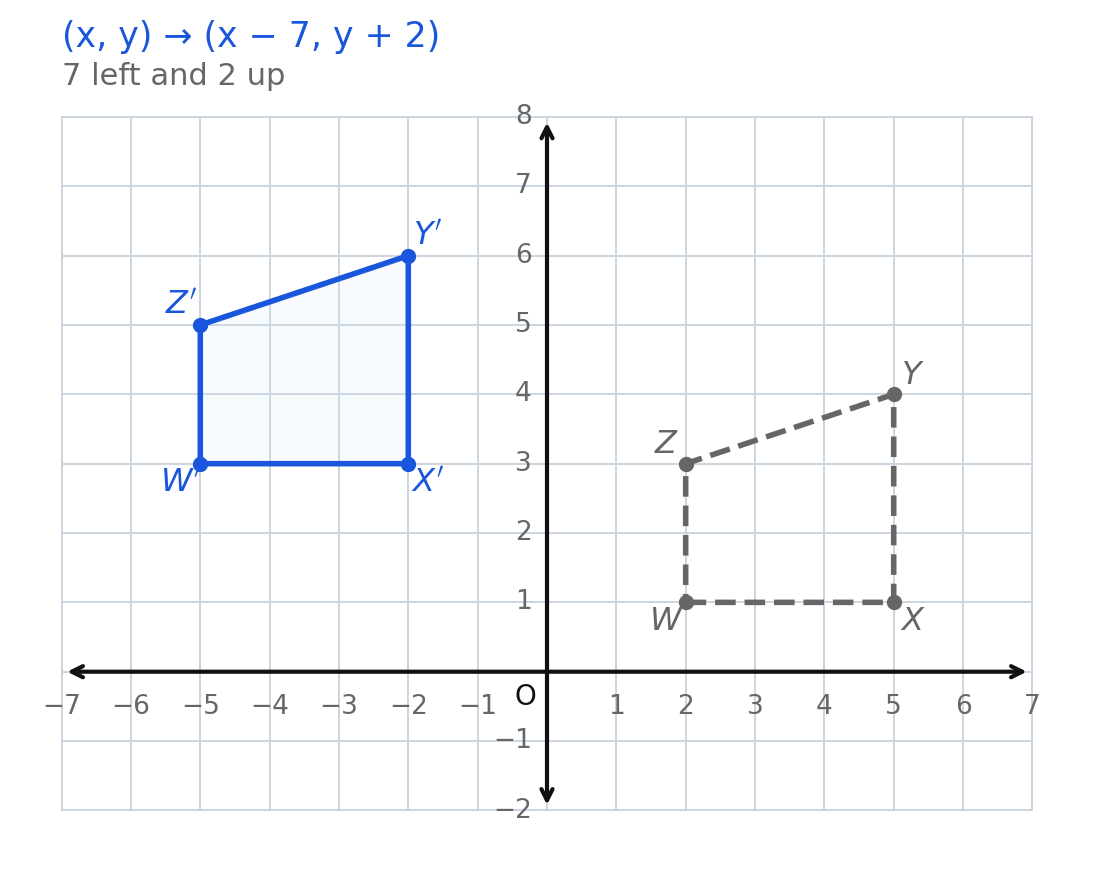
Quadrilateral above has , , , and . Under :
Every -coordinate dropped by and every -coordinate rose by . The figure left Quadrant I and arrived in Quadrant II, still the same size and shape.
Working backwards: finding the rule from a pair of points
If you are given a preimage vertex and its image, subtract to recover the rule. The horizontal part is the change in and the vertical part is the change in :
If has image , then and . The rule is , a horizontal translation units left.
One pair of corresponding points is enough to find the rule, because every vertex makes the same trip. But checking a second pair is a cheap way to catch an arithmetic slip, and it is worth doing every time.
Two checks that catch almost every error
- Same trip check. Compute and for each vertex. All the -changes must be equal, and all the -changes must be equal. If one vertex disagrees, that vertex is wrong.
- Congruence check. A horizontal side of the preimage must have the same length as the matching side of the image. In above, runs from to , a length of ; runs from to , also .
Worked examples
Example 1 — One point, a combination rule
Find the image of under .
Answer:
Example 2 — A whole triangle
Find the vertices of the image of with , , and under .
Same trip check: every dropped by , every rose by .
Answer: , ,
Example 3 — A translation given in words
Triangle has , , and . Translate it units left and units down.
First write the rule: .
Answer: , , — note that the vertex at the origin moved like every other vertex. Unlike a dilation, a translation leaves no point fixed unless it moves nothing at all.
Example 4 — Recovering the rule from a pair of triangles
has , , , and its image has , , . Write the rule and describe it in words.
Use and : and . Check with : and . Agreed.
Answer: , a translation units left and units down
Example 5 — One vertex tells you about all of them
Under some translation, has image . Where does land?
The rule is and , so . Apply it to : .
Answer:
Example 6 — Undoing a translation
The image of a vertex under is . Find the preimage vertex.
Reverse each operation: add back the you subtracted, and subtract the you added.
Check forward: .
Answer:
Guided practice
- Find the image of under .
- Find the image of under .
- Find the image of under .
- Triangle has , , and . Find the vertices of its image under .
- Quadrilateral has , , , and . Find the vertices of its image under .
- Triangle has , , and . Find the vertices of its image after a translation units left and units down.
- Point has image . Write the rule.
- Point has image . Write the rule.
Independent practice
- Find the image of each point under . a) b) c) d)
- Triangle has , , and . Find the vertices of its image under .
- Quadrilateral has , , , and . Find the vertices of its image after a translation units right.
- Pentagon has , , , , and . Find the vertices of its image under .
- Triangle has , , and . Its image has , , and . Write the rule and describe it in words.
- Under some translation, has image . Find the image of under the same translation, and explain how one pair of points was enough.
- Reasoning. A vertex of a preimage sits at the origin, and its image also sits at the origin. What translation was applied? Explain why a translation, unlike a dilation centered at the origin, cannot hold one point still while moving the others.
- Reasoning. Explain why the -coordinate of every vertex is unchanged by a horizontal translation. Use the rule, not a picture, in your explanation.
- Application. A park is drawn on a coordinate grid, with a swing at , a slide at , and a bench at . The city rebuilds the park units east and units south of where it was drawn. Write the translation rule and give the new coordinates of all three features.
- Error analysis. A student applies to the point and writes . Identify both errors and give the correct image.
Exit ticket 13.2
- Find the image of under .
- Triangle has , , and . Find the vertices of its image under .
- Point has image . Write the rule.
- Explain the "same trip check": what do you compute for each vertex, and what must be true of the results?
Lesson 13.3 — Sketching a Translated Image
Two steps, in this order
Lesson 13.2 found image coordinates. This lesson draws them. The method has exactly two steps.
Step 1. Apply the rule to every vertex and plot the image vertices, labeling each with a prime. Step 2. Connect the image vertices in the same order as the preimage vertices are connected.
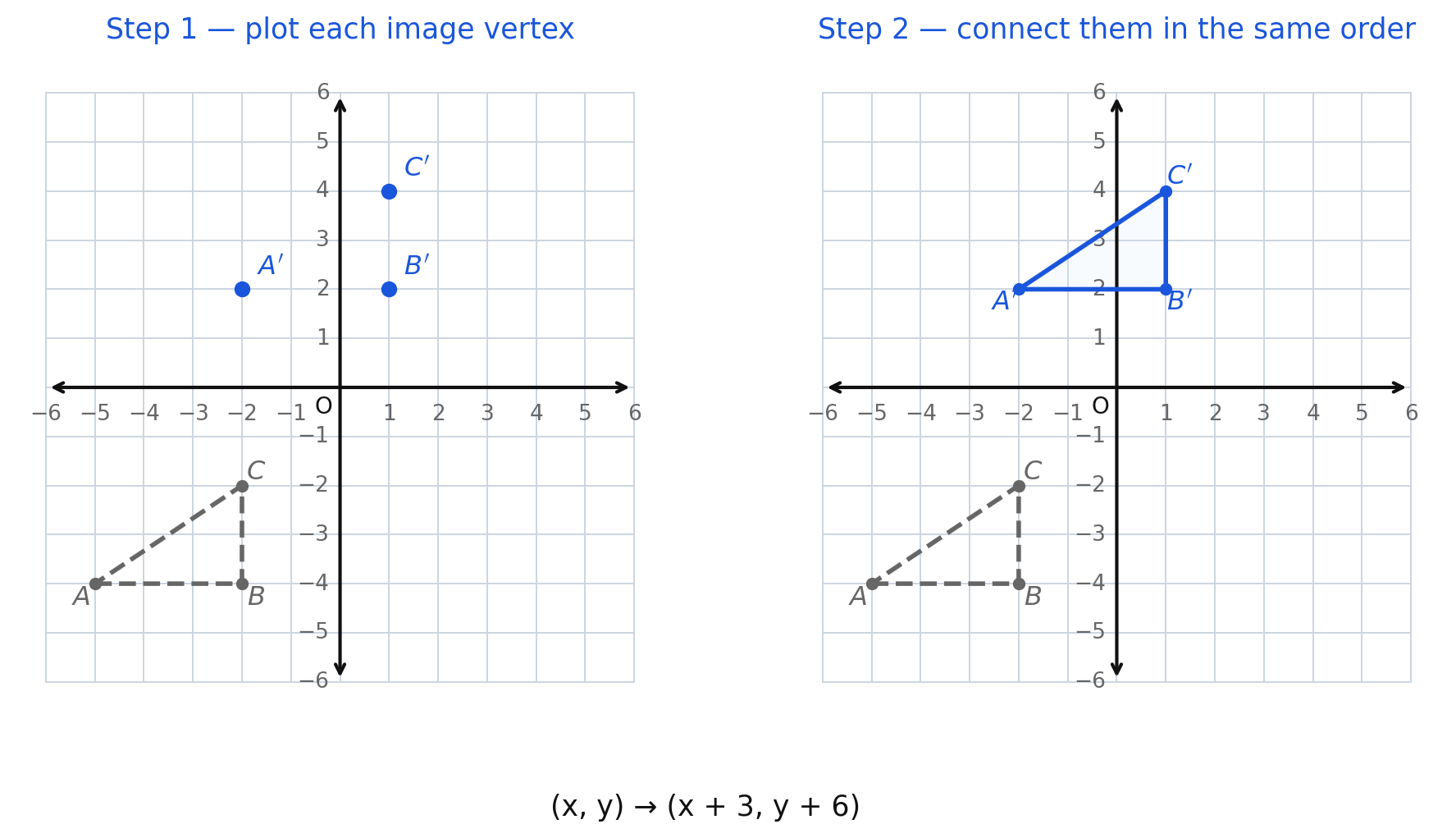
Step 2 is where the order matters. In the sides are , , and , so the image sides must be , , and . Connecting the points in a different order would produce a different polygon — one that is not congruent to the preimage and is not the image of anything.
That ordering is also what keeps the orientation the same, which is the deepest difference between this chapter and Chapter 14. A slide never reverses the way the vertices run around the figure.
A steadier way to draw it: count, do not measure
There is a second way to place the image, and on a grid it is often faster and less error-prone than arithmetic. Put your pencil on a preimage vertex and count grid squares: for , count squares right and squares down, and mark the point. Repeat from every vertex.
The two methods must agree, and that is exactly why doing both is a good check. Compute the coordinates with the rule, then count squares on the grid; if the mark and the computed point differ, one of them has a sign error.
Checking a finished sketch
Before you call a sketch done, run these three checks.
- Count the vertices. The image must have exactly as many vertices as the preimage.
- Compare a horizontal and a vertical side. They must be the same length in the image as in the preimage, because a translation preserves length. If your image looks stretched or squashed, one vertex moved by the wrong amount.
- Check the connecting segments. The segments joining to , to , and to should all be the same length and all point the same way — the arrows of the very first figure in this chapter. If one leans differently, that vertex is misplaced.
Reading a rule off a finished picture
The reverse task appears often: you are handed a preimage and its image and asked for the rule. Pick any vertex, count from it to its image, and write the horizontal count with a right/left sign and the vertical count with an up/down sign. Then confirm with a second vertex.
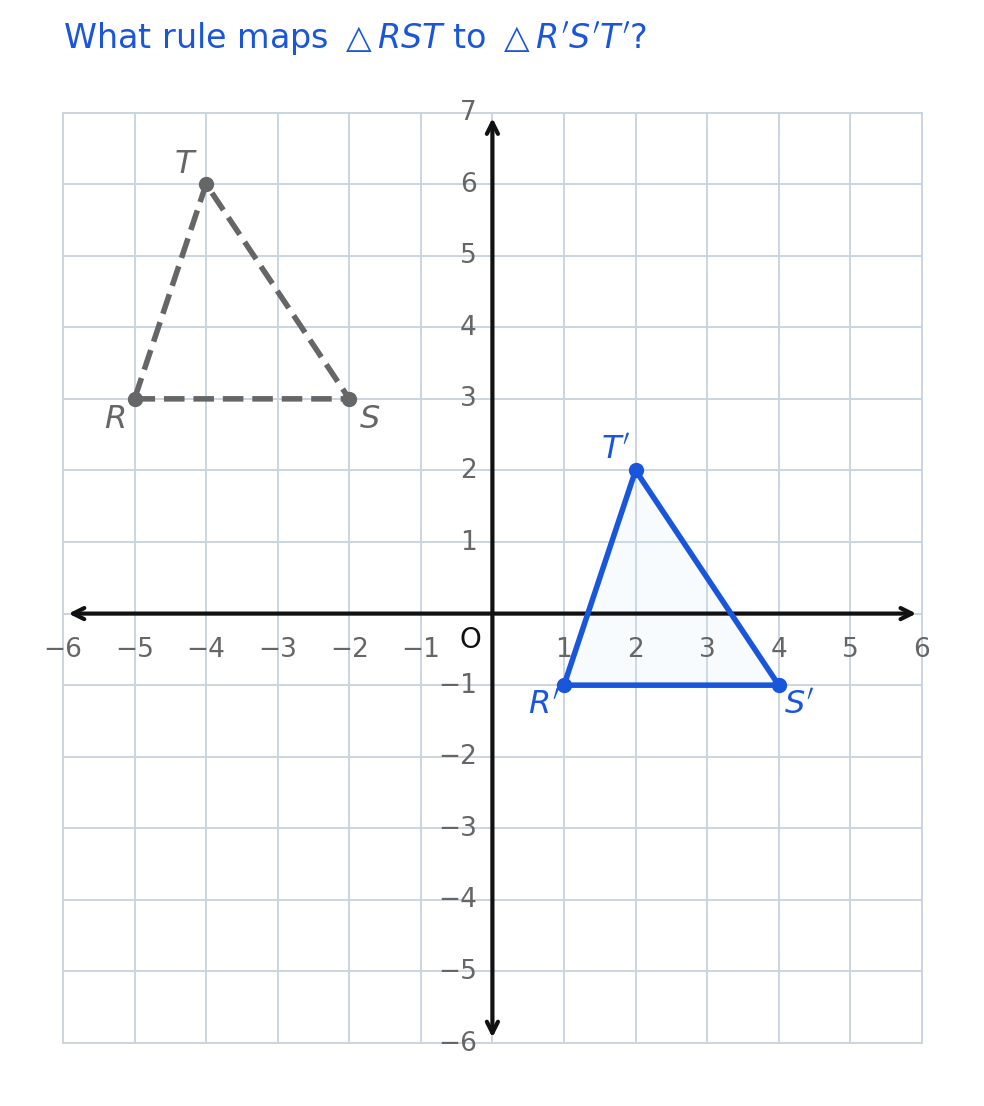
From to is squares right and squares down, so the rule is . Confirm with : right , down . Agreed.
Worked examples
Example 1 — Sketching from a rule
Sketch the image of with , , under .
Step 1, compute and plot:
Step 2, connect to , to , and to .
Answer: A triangle congruent to with vertices , , . Check: is units long and so is .
Example 2 — A four-sided figure, combination rule
Sketch the image of quadrilateral with , , , under .
Connect , , , and .
Answer: , , ,
Example 3 — A vertical translation only
Sketch the image of trapezoid with , , , after a translation units up.
The rule is , so every stays put and each gains . Plotting is a matter of counting squares straight up from each vertex.
Answer: A congruent trapezoid directly above the original, with those four vertices.
Example 4 — Counting instead of computing
Sketch the image of the square with vertices , , , after a translation units down.
From each vertex, count squares straight down.
The image is a square with side , exactly like the preimage, sitting below the -axis. Two of its vertices ended up with negative -coordinates and two did not, which is fine; the axis is not a wall.
Answer: , , ,
Example 5 — A sketch that has gone wrong
A student sketches the image of under by moving right and down but leaving and where they were, then connecting the three points. What is wrong with the result?
The figure drawn is not congruent to : one vertex moved and two did not, so two of the three sides changed length. A translation moves every point of the figure by the same amount. The fix is to apply the rule to and as well.
Answer: Only one vertex was translated, so the drawn figure is not the image of anything; all three vertices must move right and down .
Guided practice
Items 41–43 use the three preimages below.
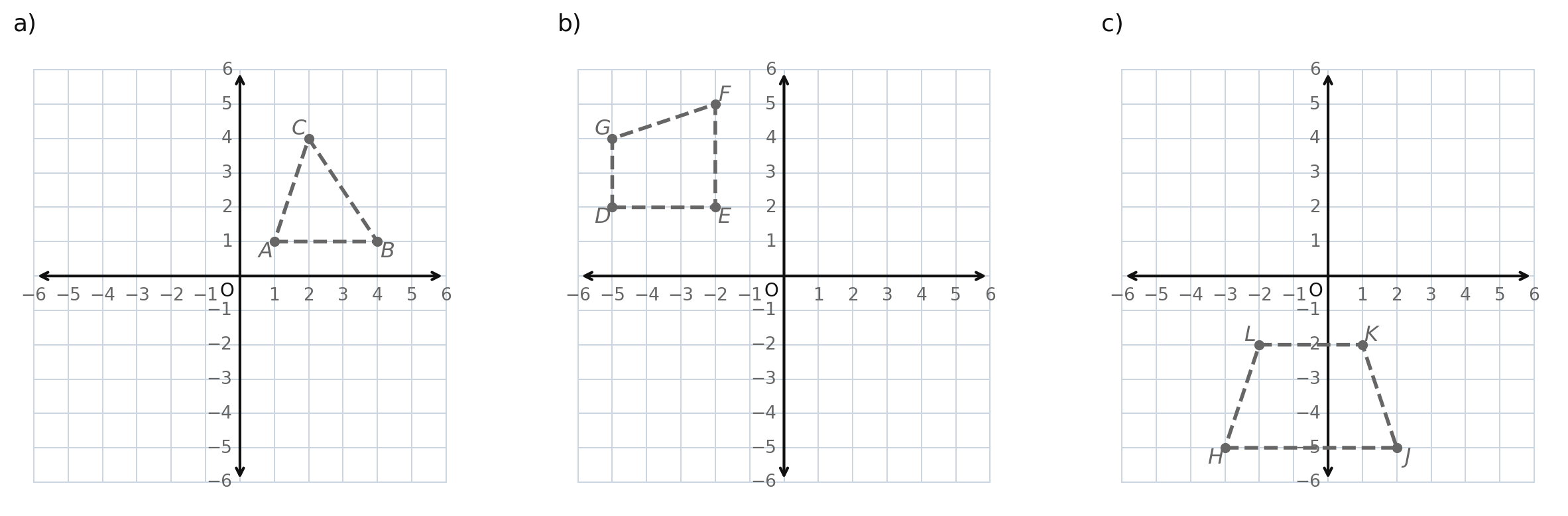
- Sketch the image of from grid a) under , and list the image coordinates.
- Sketch the image of quadrilateral from grid b) under , and list the image coordinates.
- Sketch the image of trapezoid from grid c) after a translation units up, and list the image coordinates.
- After you have plotted every image vertex, what is the next step, and why does the order in which you connect the points matter?
- Sketch the image of with , , after a translation units left.
- Sketch the image of the square with vertices , , , after a translation units down.
- Use the figure of and above. Write the rule that maps the preimage to the image, and name the two vertices you used to confirm it.
- Name the three checks you can run on a finished sketch, and say what error each one catches.
Independent practice
- Triangle has , , and . Sketch the image and list its coordinates for each translation. a) units right b) units down c) units right and units down
- Sketch the image of quadrilateral with , , , under , and list the image coordinates.
- Sketch the image of pentagon with , , , , under , and list the image coordinates.
- Sketch the image of with , , under , and list the image coordinates.
- Sketch the image of the quadrilateral with vertices , , , after a translation units left and units up, and list the image coordinates.
- Reasoning. After sketching any image in this lesson, explain how the finished picture shows that the image is congruent to the preimage. Name one measurement you would compare.
- Reasoning. Which step of the sketching method guarantees that the orientation is preserved? Explain what could go wrong if that step were done carelessly.
- Application. A quilt block is a square with corners at , , , and on a design grid. The quilter repeats the block by sliding it units right. Write the rule, sketch the second block, and list its corners.
- Application. A stage plan drawn on a coordinate grid shows a rectangular riser with corners , , , and . The director asks for the riser to be moved feet stage-left and feet downstage, which on this plan is units left and units down. Write the rule, sketch the new position, and list its corners.
- Error analysis. A student sketches the image of a triangle under by moving only vertex and connecting the new to the original and . Explain why the drawing cannot be the image, and describe the correct procedure.
Exit ticket 13.3
- Sketch the image of with , , under , and list the image coordinates.
- Sketch the image of the square with vertices , , , after a translation units right and units down, and list the image coordinates.
- While sketching an image, you find that vertex has image . Write the rule you would use to place the rest of the image vertices.
- Describe the two-step method for sketching a translated image in your own words, in two sentences.
Chapter 13 Review
Vocabulary. transformation · translation · preimage · image · prime notation · translation rule · horizontal translation · vertical translation · congruent · orientation
Items 74 and 84 use the two grids below.
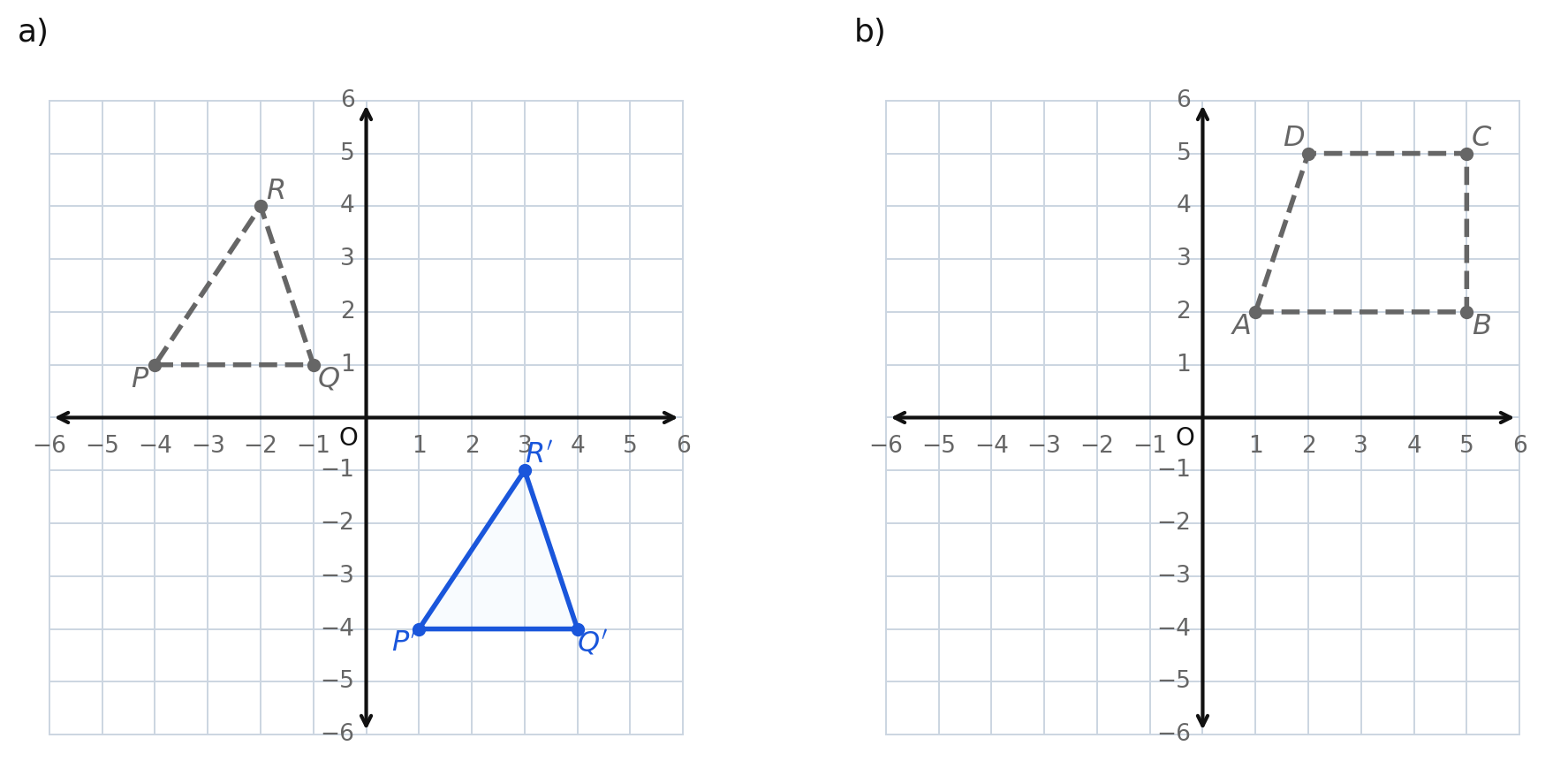
Part A — Identifying the coordinates of a translated image (8.MG.3a)
- Find the image of each point under . a) b) c)
- Triangle has , , and . Find the vertices of its image under .
- Quadrilateral has , , , and . Find the vertices of its image under .
- Find the image of after a translation units left.
- Point has image . Write the rule and describe it in words.
- Point has image . What translation was applied? Explain.
- Under , a vertex has image . Find the preimage vertex, and check your answer by applying the rule forward.
- Pentagon has , , , , and . Find the vertices of its image under .
- Quadrilateral is translated. Which vertex of the image corresponds to ? If units, what is , and which property of translations tells you so?
- Reasoning. Explain why the image of a polygon with integer vertices must also have integer vertices whenever the translation amounts are integers. Refer to the rule in your explanation.
Part B — Sketching a translated image (8.MG.3d)
- Sketch the image of with , , under , and list the image coordinates.
- Use grid b) above. Sketch the image of quadrilateral under and list the image coordinates.
- Sketch the image of the trapezoid with vertices , , , under , and list the image coordinates.
- Sketch the image of with , , after a translation units up, and list the image coordinates.
- Sketch the image of the square with vertices , , , under , and list the image coordinates.
- Sketch the image of the quadrilateral with vertices , , , under , and list the image coordinates.
- Sketch the image of with , , under , and list the image coordinates.
- Sketch the image of with , , under . Then compare with and explain what the comparison shows.
- Application. A muralist sketches a triangular design with corners , , and on a grid of one-foot squares, then decides to move the whole design feet right and feet up. Write the rule, sketch the new design, and list its corners.
- Error analysis. Asked to sketch the image of a quadrilateral under , a student plots all four image vertices correctly but connects them in the order , , , . Explain why the drawing is not the image, and state the rule for connecting image vertices.
Part C — Mixed practice and reasoning
- Triangle has , , and , and it is translated units right and units up. Write the rule, list the image coordinates, and sketch both figures on one grid.
- Use grid a) above. Write the rule that maps to , describe it in words, and name a second pair of corresponding vertices that confirms your rule.
- Application. On a warehouse floor plan, a rectangular pallet has corners , , , and . A forklift moves the pallet so that the corner at ends up at . Write the rule for the move, then give the coordinates of the other three corners after the move.
- Error analysis. A student translates by " units left and units down" and writes . Identify both sign errors and give the correct image.
- Reasoning. Explain why the segments joining each preimage vertex to its image are all the same length and all point in the same direction. What would a figure look like if that were not true?
- Choose your own triangle with integer vertices and your own translation rule that has both a horizontal and a vertical part. List the image coordinates, sketch both triangles, and show a check that confirms the image is congruent to the preimage.
Standards coverage check — Chapter 13
| Knowledge and Skill | Where it is taught | Where it is practiced |
|---|---|---|
| 8.MG.3a — given a preimage in the coordinate plane, identify the coordinates of the image of a polygon that has been translated vertically, horizontally, or a combination of both | 13.2, using the vertex-by-vertex rule; set up in 13.1 (rule notation and the signs) and reused in 13.3, where every sketch also reports its coordinates | Items 1–40; the coordinate lists in 41–43, 45–47, 49–53, 56–57, 59–61; Review Part A, items 63–72; Review Part C, items 83–86, 88 |
| 8.MG.3d — sketch the image of a polygon that has been translated vertically, horizontally, or a combination of both | 13.3, using the two-step plot-then-connect method and the count-the-squares alternative | Items 41–43, 45–46, 49–62; Review Part B, items 73–82; Review Part C, items 83, 85, 88 |
Both bullets are braided on purpose: every sketching item in Lesson 13.3 asks for the image coordinates as well, because the coordinates are how a student checks that the drawing is right, and the drawing is how a student notices a sign error in the coordinates.
Not in this chapter. Bullets (b), (c), (e), (f), and (g) of 8.MG.3 — reflections over the - or -axis, combinations of a translation and a reflection, and identifying and describing transformations in context — are covered in Chapter 14. The application items here use real-world settings to practice bullets (a) and (d); naming and describing a transformation from a context is Chapter 14's work.
Answer keys for every set in this chapter are in Appendix A.