Chapter 14 — Reflections and Composite Transformations
Standard: 8.MG.3 (b, c, e, f, g) — The student will apply translations and reflections to polygons in the coordinate plane.
By the end of this chapter you will be able to:
- Given a preimage in the coordinate plane, identify the coordinates of the image of a polygon reflected over the x- or y-axis (8.MG.3b)
- Given a preimage, identify the coordinates of the image of a polygon that has been translated and then reflected over an axis, or reflected over an axis and then translated (8.MG.3c)
- Sketch the image of a polygon reflected over the x- or y-axis (8.MG.3e)
- Sketch the image of a polygon under a translation followed by a reflection, or a reflection followed by a translation (8.MG.3f)
- Identify and describe transformations in context — name what happened to a logo, a tile pattern, or a screen graphic, and write the rule for it (8.MG.3g)
Lessons: 14.1 Reflecting over the x- and y-Axis · 14.2 Sketching a Reflection · 14.3 Composite Transformations and the Order of the Moves · 14.4 Sketching Compositions and Describing Transformations in Context
This chapter runs on Chapter 13. Chapter 13 taught translations: a slide that moves every point of a figure the same distance in the same direction, written . This chapter assumes you can already apply a translation and read one off a graph. What is new here is the reflection, and what happens when a translation and a reflection are performed one after the other.
Three bounds hold everywhere in this chapter, because the standard sets them. Reflections are over the x-axis or the y-axis only — never over a slanted line such as , which is high-school Geometry content. A composition contains exactly one translation and one reflection, in one order or the other; two reflections are never composed. Every coordinate you meet or write is an integer.
Numbering note. Item numbers run straight through the chapter, from 1 in Lesson 14.1 to 128 at the end of the review. They do not restart at each lesson.
Lesson 14.1 — Reflecting over the x- and y-Axis
What a reflection is
A transformation is a rule that sends every point of a figure to a new location. The figure you start with is the preimage; the figure you end up with is the image. Image points are named with prime marks: the image of is , read "A prime." When a second transformation is applied, its output gets a double prime: , read "A double prime."
A reflection is the transformation that flips a figure across a line, called the line of reflection. Think of the line as a mirror, or as a fold line in a sheet of paper: fold along the line and the preimage lands exactly on top of the image.
In Grade 8 the line of reflection is always one of the two axes.
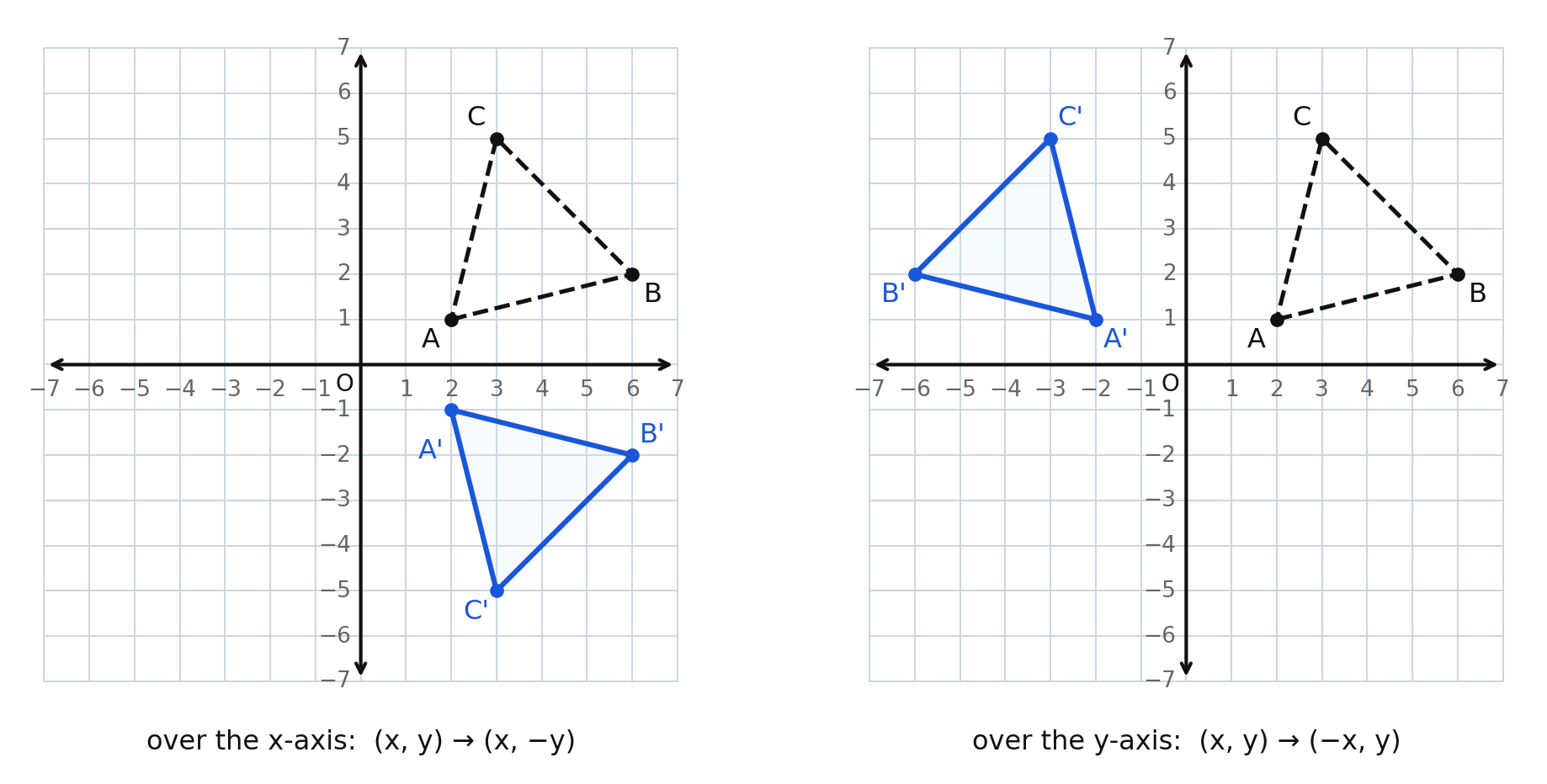
Throughout this chapter the preimage is drawn dashed in black and the image is drawn solid in blue, so you can always tell which figure is which.
The two rules
Everything computational in this lesson is contained in two short rules.
Reflection over the x-axis:
Reflection over the y-axis:
Mixing these two up is the single most common error in this chapter, so it is worth saying out loud what each one does and why.
Reflecting over the x-axis flips the figure up and down. A point three units above the x-axis must land three units below it, and it must not drift sideways. Staying in the same vertical line means the -coordinate cannot change; switching sides of the horizontal axis means the -coordinate changes sign. Hence .
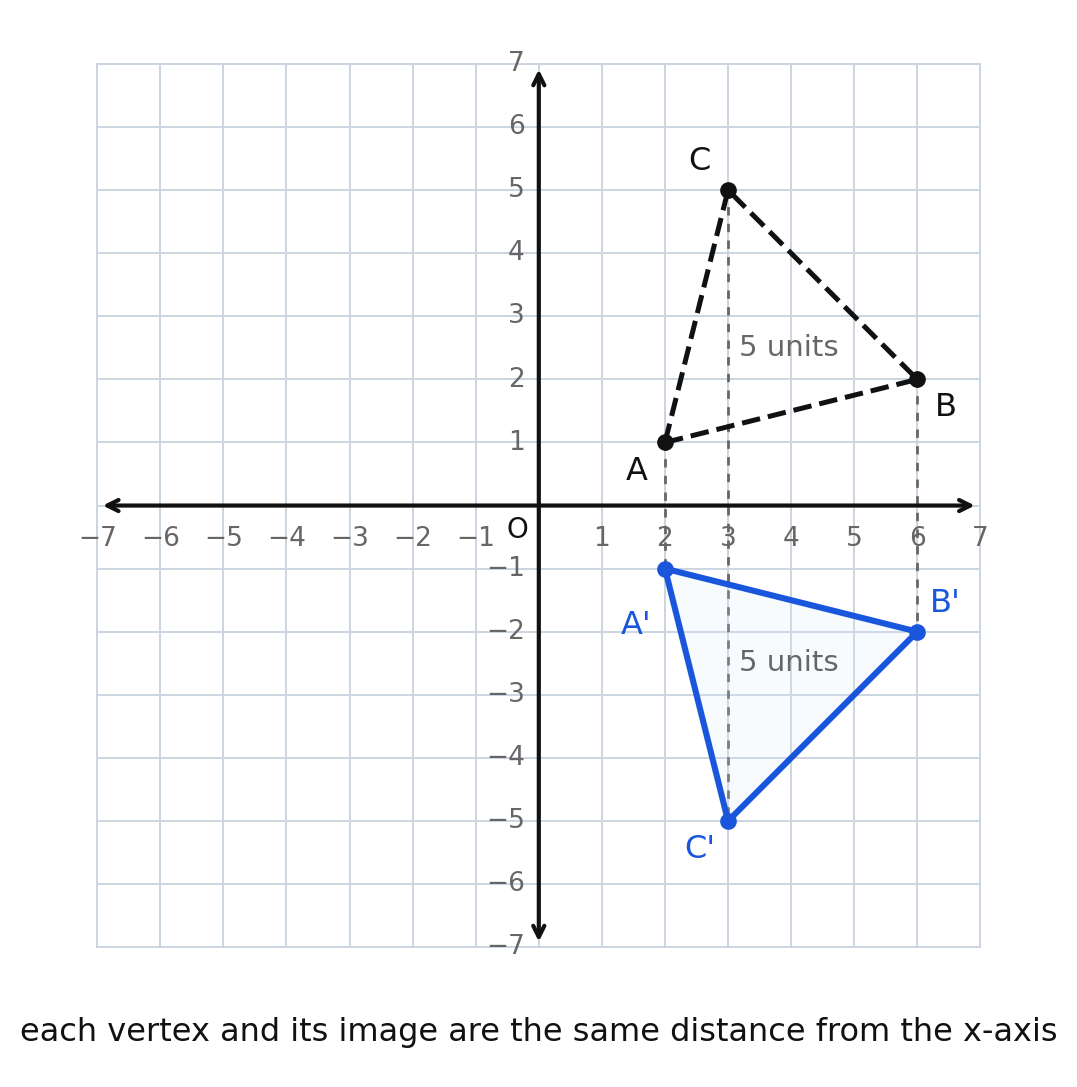
In the figure, sits units above the x-axis, so sits units below it, in the same vertical line. The dashed segment joining a vertex to its image is perpendicular to the mirror line and is cut in half by it. That is the geometric definition of a reflection, and the coordinate rule is just that definition written in symbols.
Reflecting over the y-axis flips the figure left and right. The -coordinate stays put and the -coordinate changes sign.
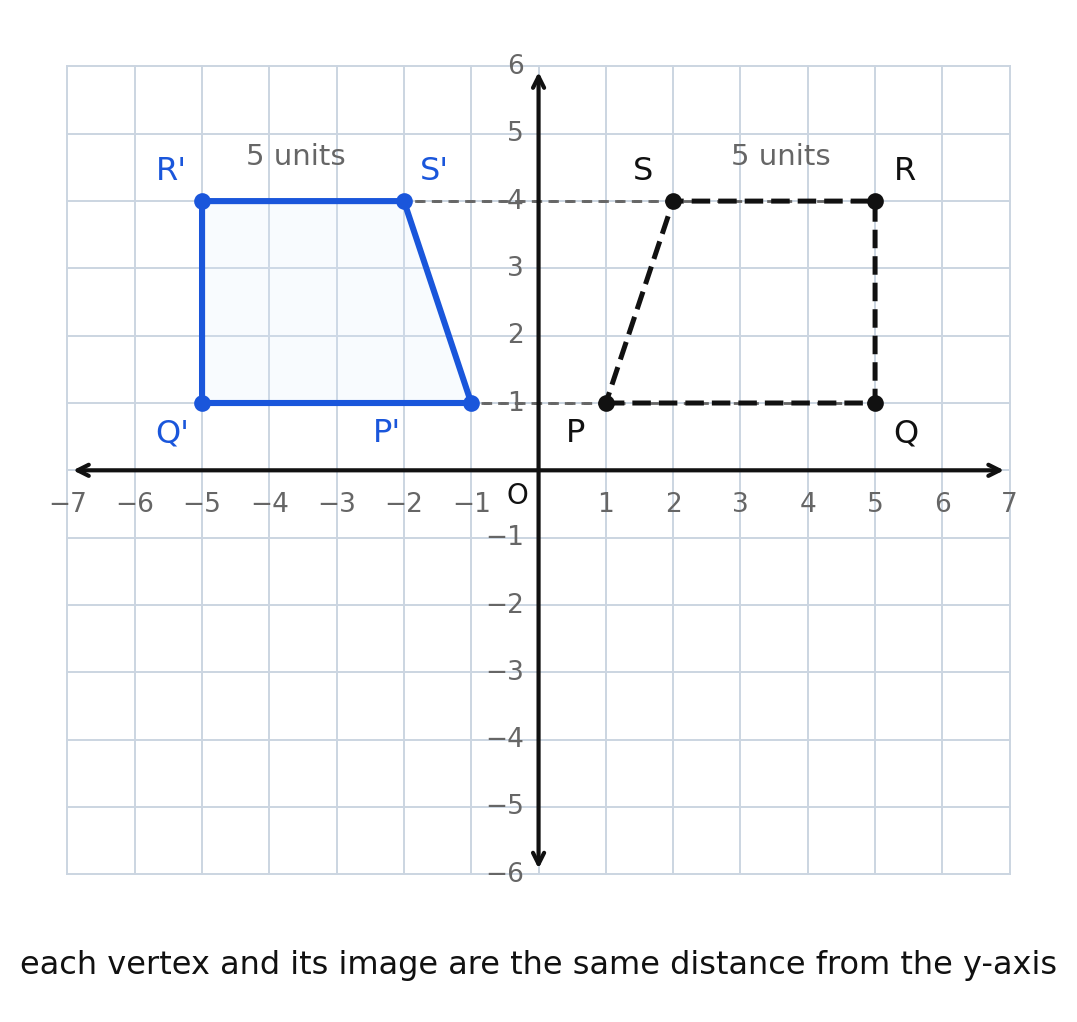
Here is units to the right of the y-axis, so is units to the left of it, in the same horizontal line.
A one-sentence memory hook, if you want one: you negate the coordinate that measures distance from the mirror. The -coordinate measures how far you are from the x-axis, so an x-axis reflection negates . The -coordinate measures how far you are from the y-axis, so a y-axis reflection negates .
Points that do not move
A point on the mirror line is its own image. Substituting into the rules shows why.
- reflected over the x-axis is . It never left.
- reflected over the y-axis is . It never left.
So a polygon with a vertex on the axis keeps that vertex exactly where it is, and the image is hinged to the preimage at that point. This is a useful accuracy check when you sketch.
What a reflection preserves, and the one thing it reverses
Preserved: side lengths, angle measures, area, and perimeter. The image is congruent to the preimage — same size, same shape.
Reversed: orientation. This is the property that separates reflections from translations, and it is worth seeing rather than memorizing.
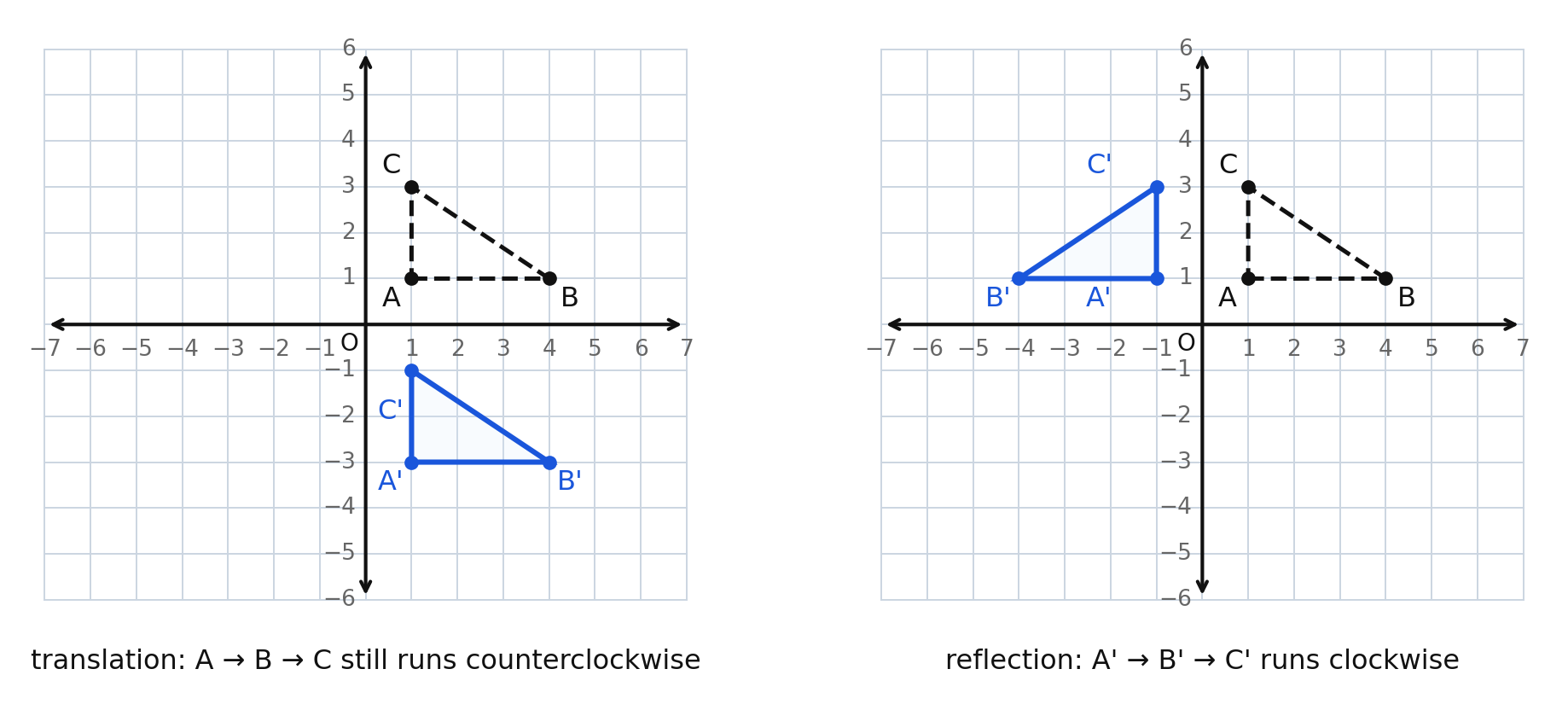
In the left panel the triangle slides down units. Reading the vertices traces a counterclockwise path, and reading on the image traces a counterclockwise path too. A translation carries the figure along without turning it over.
In the right panel the triangle is reflected over the y-axis. Reading still runs counterclockwise, but now runs clockwise. The figure has been flipped over, the way the word AMBULANCE is flipped on the front of the vehicle so that it reads correctly in a rear-view mirror.
That is the practical test. If you are shown a preimage and an image and asked which transformation happened, check the orientation first: reversed orientation means a reflection was involved; preserved orientation means it was not.
Reading a reflection off a graph
Given a preimage and an image, you can name the axis by comparing coordinates.
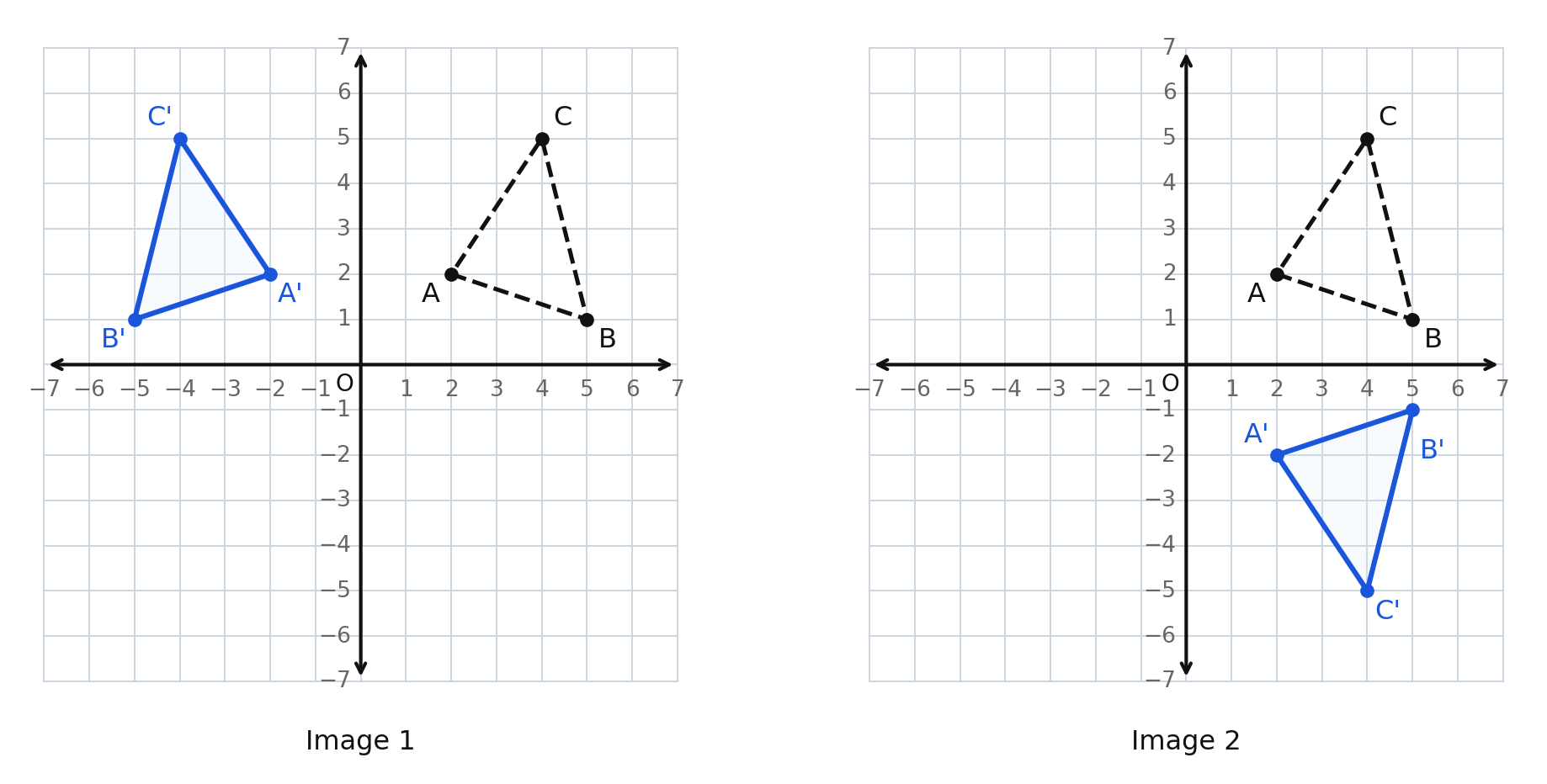
In Image 1, became : the -coordinates match and the -coordinates are opposites, so the mirror was the y-axis. In Image 2, became : the -coordinates match and the -coordinates are opposites, so the mirror was the x-axis.
Worked examples
Example 1 — One point over the x-axis
Find the image of reflected over the x-axis.
The rule is . Keep ; negate .
Answer:
Example 2 — One point over the y-axis
Find the image of reflected over the y-axis.
The rule is . Negate to get ; keep .
Answer:
Example 3 — A whole triangle over the x-axis
Triangle has , , and . Find the coordinates of the image after a reflection over the x-axis.
Apply to each vertex in turn.
Answer: , ,
Example 4 — The same triangle over the y-axis
Find the coordinates of the image of the same after a reflection over the y-axis.
Apply to each vertex.
Answer: , ,
Example 5 — A vertex on the mirror line
Quadrilateral has , , , and . Reflect it over the y-axis.
Negate every -coordinate. The first vertex has , and , so it does not move.
Answer: , , , — the image is hinged to the preimage at .
Example 6 — Naming the axis from a pair of points
A preimage vertex has image . Which axis was the mirror?
The -coordinates are identical and the -coordinates are opposites, which is the signature of .
Answer: the y-axis
Example 7 — Which quadrant does the image land in?
A triangle lies entirely in Quadrant II. Name the quadrant of its image after a reflection over the x-axis, and after a reflection over the y-axis.
In Quadrant II, is negative and is positive. Reflecting over the x-axis negates , giving negative and negative : Quadrant III. Reflecting over the y-axis negates , giving positive and positive : Quadrant I.
Answer: Quadrant III over the x-axis; Quadrant I over the y-axis
Guided practice
- Find the image of after a reflection over the x-axis.
- Find the image of after a reflection over the y-axis.
- Find the image of after a reflection over the x-axis.
- Find the image of after a reflection over the y-axis.
- Triangle has , , and . Give the coordinates of the image after a reflection over the x-axis.
- Give the coordinates of the image of the same after a reflection over the y-axis.
- Point is reflected over the x-axis. Give the image and explain in one sentence why it lands where it does.
- A preimage vertex has image . Which axis was the line of reflection?
Independent practice
Give the image of each point. a) reflected over the x-axis b) reflected over the y-axis c) reflected over the x-axis d) reflected over the y-axis
Quadrilateral has , , , and . Give the coordinates of the image after a reflection over the y-axis.
Triangle has , , and . Give the coordinates of the image after a reflection over the x-axis.
A pentagon has vertices , , , , and . Give the coordinates of the image after a reflection over the x-axis.
Use the figure below. Name the axis used for Image 1 and the axis used for Image 2, and give the coordinates of in each.
A polygon lies entirely in Quadrant III. Name the quadrant its image lands in after a reflection over the x-axis, and after a reflection over the y-axis.
Point is reflected over the y-axis, and then a second copy of is reflected over the x-axis. Give both images, and say which reflection left the point fixed.
A preimage vertex has image . Which axis was the line of reflection? Explain how you can tell without graphing.
Triangle has , , and . Give the coordinates of the image after a reflection over the x-axis, and state which coordinate of each vertex changed.
Reasoning. Explain why a reflection over the x-axis leaves every -coordinate alone. Refer to the distance from a point to the mirror line in your explanation.
Application. A video-game designer draws a spaceship as the polygon , , , pointing to the right. To make the enemy ship, she reflects it over the y-axis so it points to the left. Give the coordinates of the enemy ship, and state whether the two ships are congruent.
Error analysis. Asked to reflect over the x-axis, a student writes . Identify the error, name the rule the student actually used, and give the correct image.
Exit ticket 14.1
- Find the image of after a reflection over the x-axis.
- Find the image of after a reflection over the y-axis.
- Triangle has , , and . Give the coordinates of the image after a reflection over the y-axis.
- In one sentence, explain how to decide which coordinate changes sign.
Lesson 14.2 — Sketching a Reflection
From coordinates to a drawing
Lesson 14.1 asked for coordinates. This lesson asks for a picture, which is bullet (e) of the standard. The arithmetic is identical; what is added is the discipline of plotting accurately and labeling correctly.
Use the same three steps every time.
Step 1. Plot and label the preimage, in order, and draw its sides. Step 2. Apply the rule to one vertex at a time, and plot each image point. Do not try to eyeball the whole polygon at once. Step 3. Connect the image vertices in the same order as the preimage, and label them , , , matching each to its own preimage vertex.
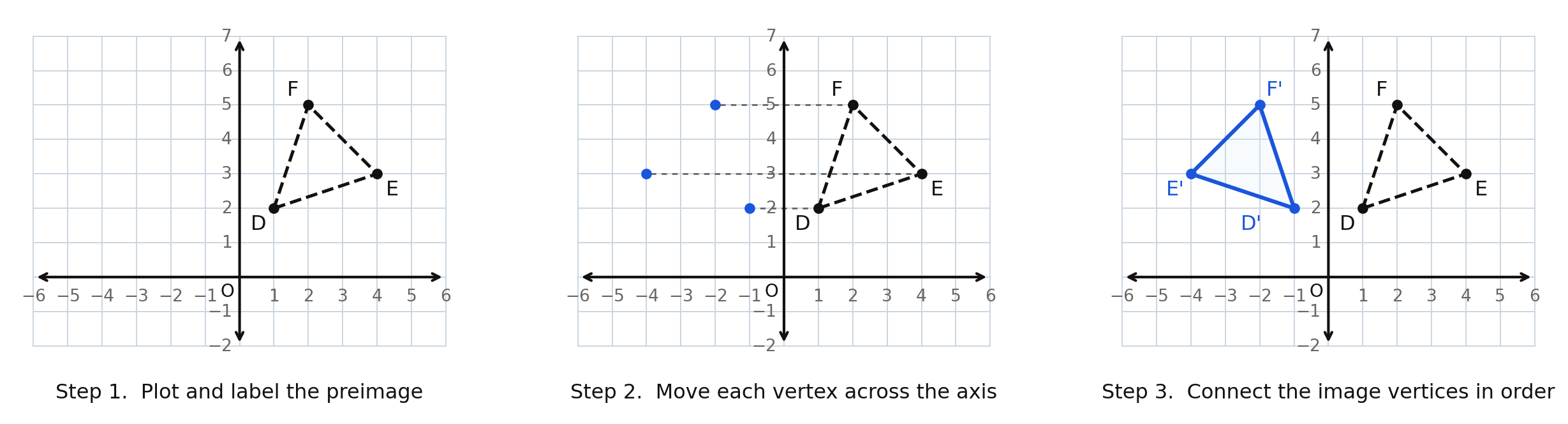
Step 3 is where sketches go wrong. If you connect the image points in a different order from the preimage, you get a polygon that is not the image at all — usually one with crossed sides. Match to , to , to , and travel around the image the same way you travelled around the preimage.
Two checks that catch almost every mistake
The distance check. Every image vertex must be exactly as far from the mirror as its preimage vertex, on the opposite side. If is units right of the y-axis, must be units left of it, at the same height. Count squares; do not estimate.
The fold check. Imagine folding the paper along the axis. The image should land exactly on the preimage. If the two halves would miss each other, something is misplaced.
A third check is available whenever the figure is not symmetric: the orientation should be reversed. If your image looks like the preimage merely slid to a new spot, you have drawn a translation, not a reflection.
When the preimage crosses the axis
Nothing changes. Apply the rule vertex by vertex, and accept that part of the image may overlap the preimage. For a triangle with vertices , , and , a reflection over the y-axis gives , , and : the vertex that was on the left is now on the right, and the two triangles share the region near the axis. Trust the rule over your intuition about where the image "should" sit.
Worked examples
Example 1 — Sketching a reflection over the x-axis
Sketch the image of with , , after a reflection over the x-axis, and give the coordinates.
Apply vertex by vertex, plot, then connect .
Check: is above the axis and is below it, in the same vertical line.
Answer: , ,
Example 2 — The same triangle over the y-axis
Sketch the image of the same triangle after a reflection over the y-axis.
Apply .
Answer: , ,
Example 3 — A rectangle
Sketch the image of the rectangle with vertices , , , after a reflection over the y-axis.
Negate each -coordinate, in order around the figure.
Answer: , , , — still a rectangle, by , now to the left of the y-axis
Example 4 — A figure below and left of the origin
Sketch the image of the triangle with vertices , , after a reflection over the x-axis.
Negate each -coordinate. Negative -values become positive.
Answer: , , — the image sits in Quadrant II
Example 5 — A vertex on the mirror
Sketch the image of the triangle with vertices , , after a reflection over the y-axis.
Negating leaves , so does not move.
Answer: , , — the two triangles meet at
Example 6 — A symmetric figure
Sketch the image of the triangle with vertices , , after a reflection over the y-axis, and describe what you see.
Negating the -coordinates gives , , — the same three points, in a different order.
Answer: The image lands exactly on the preimage. The figure is symmetric about the y-axis, so the reflection maps it onto itself.
Guided practice
Sketch each image on a coordinate grid and label the image vertices with prime notation. Blank grids are available for this work.
- Sketch the image of with , , after a reflection over the x-axis, and list the image coordinates.
- Sketch the image of the same after a reflection over the y-axis, and list the image coordinates.
- Sketch the image of the rectangle , , , after a reflection over the y-axis.
- Sketch the image of the quadrilateral , , , after a reflection over the x-axis.
- Sketch the image of the triangle , , after a reflection over the y-axis. Which vertex did not move, and why?
- Use the distance check on your sketch for item 29: for each vertex, state how many units it sits from the y-axis and confirm its image sits the same number of units on the other side.
Independent practice
- Sketch the image of the pentagon , , , , after a reflection over the x-axis, and list the image coordinates.
- Sketch the image of the same pentagon after a reflection over the y-axis, and list the image coordinates.
- Sketch the image of the triangle , , after a reflection over the x-axis. Which quadrant does the image lie in?
- Sketch the image of the trapezoid , , , after a reflection over the y-axis.
- Sketch the image of the triangle , , after a reflection over the y-axis. Describe what happens near the axis.
- Sketch the image of the triangle , , after a reflection over the x-axis. Reading around the preimage runs counterclockwise; which way does run around the image?
- Sketch the image of the quadrilateral , , , after a reflection over the x-axis, and list the image coordinates.
- Reasoning. Explain how the fold check works and why a correct sketch must pass it.
- A figure lies entirely in Quadrant I. Which reflection puts its image in Quadrant IV? Which one puts it in Quadrant II? Explain using the signs of the coordinates.
- Application. A designer draws half a butterfly with vertices , , , , and reflects it over the y-axis to complete the insect. Sketch the whole butterfly and list the coordinates of the second wing.
- Error analysis. Asked to reflect the triangle , , over the x-axis, a student sketches a triangle at , , . Identify the transformation the student actually drew, explain how the orientation check exposes the error, and give the correct image.
- Reasoning. Sketch a triangle whose image under a reflection over the y-axis is the triangle itself, and explain what is special about it.
Exit ticket 14.2
- Sketch the image of the triangle , , after a reflection over the x-axis, and list the image coordinates.
- Sketch the image of the same triangle after a reflection over the y-axis, and list the image coordinates.
- A polygon has a vertex at . After a reflection over the y-axis, where is that vertex? Explain.
- Describe the fold check in one sentence, and say what it would show if you had reflected over the wrong axis.
Lesson 14.3 — Composite Transformations and the Order of the Moves
Two moves, one after the other
A composite transformation — also called a composition — is two transformations performed in sequence, with the second one applied to the output of the first.
The standard allows exactly two kinds here:
- translate, then reflect over the x- or y-axis
- reflect over the x- or y-axis, then translate
The notation does the bookkeeping. The preimage vertex is . After the first transformation it is . After the second it is . Every composition problem therefore has three sets of coordinates, and writing the middle one down is what keeps you honest.
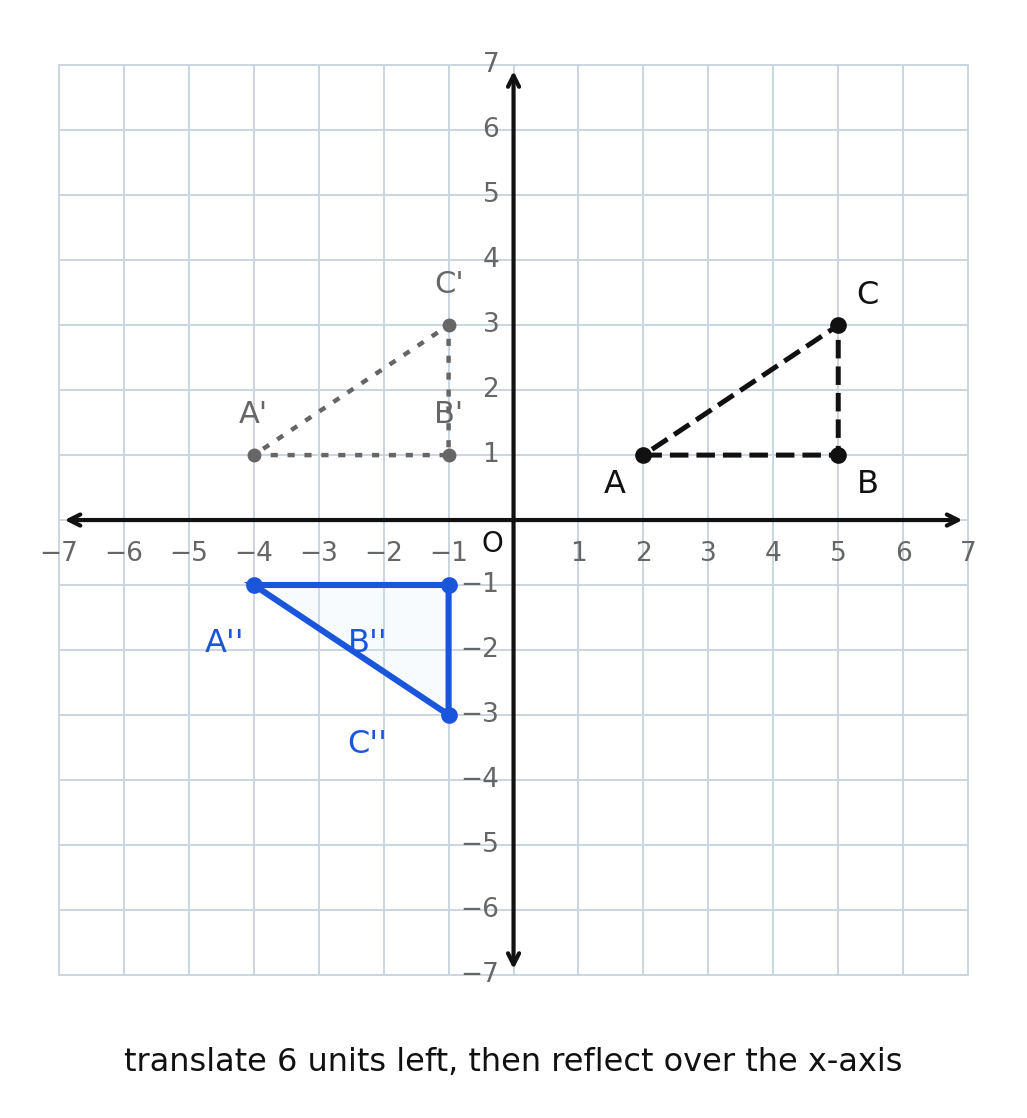
In the figure, has , , . The composition is translate units left, then reflect over the x-axis.
First the translation, :
Then the reflection over the x-axis, applied to those points, :
The dotted gray triangle in the middle is the intermediate figure . It is not the answer; it is the stepping stone.
The rule you must not break
Apply the second transformation to the image of the first, never to the original.
If you reflect instead of , you get , which is nowhere near the correct . Working from the original is the most common error in this lesson, and the fix is mechanical: write the intermediate coordinates down in their own row before you start the second move.
Order matters
Reversing the order of the two transformations usually produces a different final image. Here is a worked counterexample, drawn to scale.
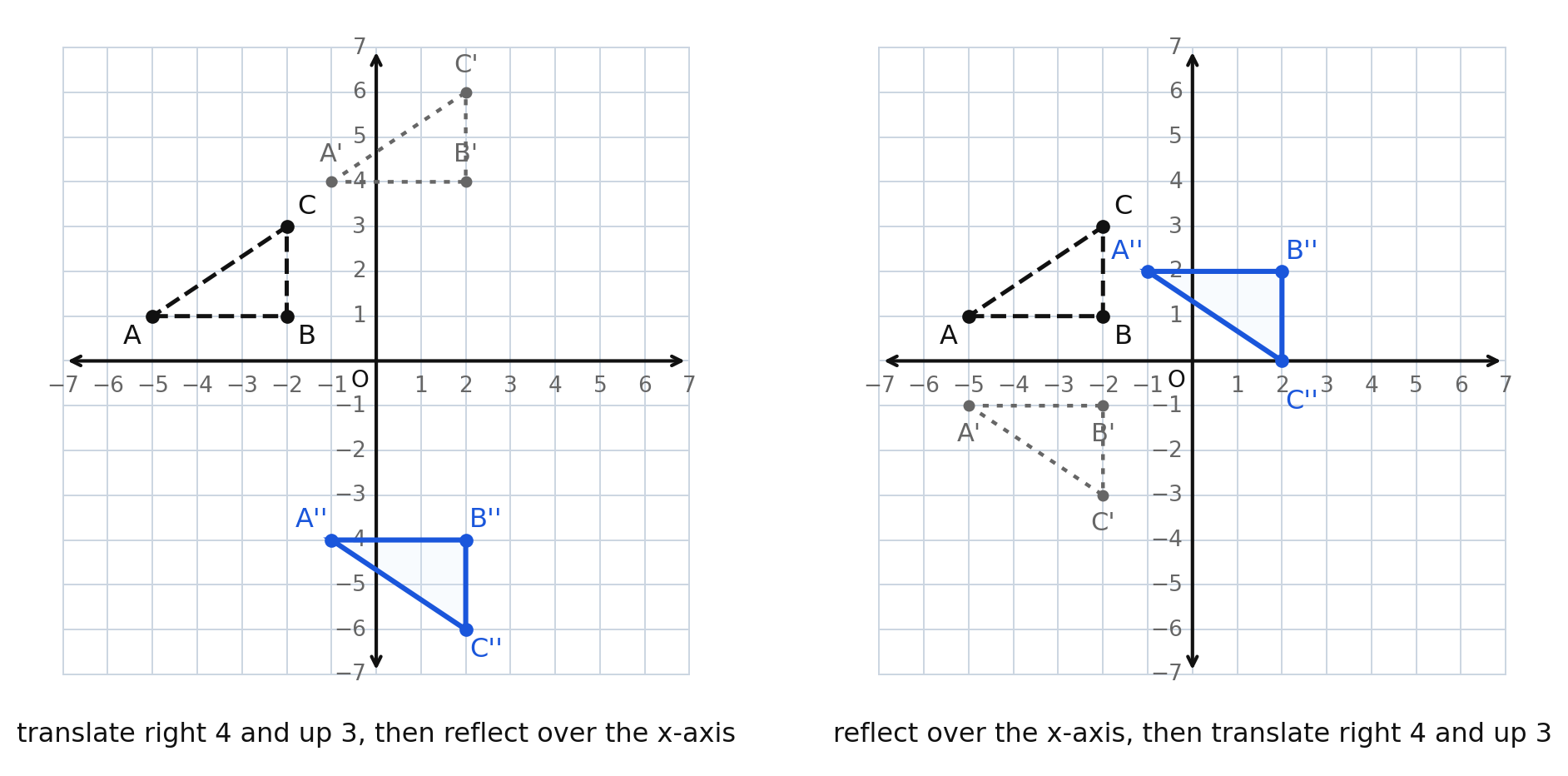
Take with , , , the translation "right and up ," and the reflection over the x-axis.
Route 1 — translate, then reflect.
Route 2 — reflect, then translate.
The two final images are not the same figure: Route 1 lands below the x-axis, Route 2 lands above it. Every -coordinate agrees, and every -coordinate is off by .
That is not a coincidence, and it is the whole explanation. The translation moves the figure up . In Route 1 that upward move happens first and is then flipped by the mirror, turning it into a downward move; in Route 2 it happens after the mirror and stays upward. Reversing a -unit rise into a -unit drop accounts for a gap of .
When the order does not matter
The same reasoning tells you exactly when the two routes agree: the order can be swapped only when the translation moves the figure parallel to the mirror line, so that the reflection has nothing to reverse.
- With a reflection over the x-axis, a purely horizontal translation commutes. Left and right are unaffected by an up-down flip.
- With a reflection over the y-axis, a purely vertical translation commutes. Up and down are unaffected by a left-right flip.
- Any translation with a component perpendicular to the mirror — a vertical component with an x-axis reflection, or a horizontal component with a y-axis reflection — makes the order matter.
You are never required to predict this in advance. Computing both routes is always safe. But it explains why some pairs of problems in this lesson give matching answers and others do not, and it should stop you from concluding that order "never" matters after seeing one pair agree.
Working backwards
If you are given the final image and the composition, undo the moves in reverse order, using the opposite of each.
Suppose is the result of translating unit right, then reflecting over the x-axis. Undo the reflection first: reflecting over the x-axis gives , so . Then undo the translation by moving unit left: .
Check forwards: . It matches.
Worked examples
Example 1 — Translate then reflect, one point
is translated units left and then reflected over the x-axis. Find and .
Translation: . Reflection over the x-axis: .
Answer: ,
Example 2 — The same two moves, reversed
is reflected over the x-axis and then translated units left. Find and .
Reflection: . Translation: .
Answer: , — the same final point as Example 1, because a horizontal translation is parallel to the x-axis and the mirror has nothing to reverse.
Example 3 — An order that does matter
is translated up and then reflected over the x-axis. Then start over: reflect over the x-axis and then translate up . Compare.
Route 1: . Route 2: .
Answer: and — different, because the translation is perpendicular to the mirror line. The gap of is twice the -unit rise.
Example 4 — A triangle, translate then reflect
has , , . Translate right and down , then reflect over the y-axis.
Translation :
Reflection over the y-axis, , applied to those:
Answer: , ,
Example 5 — The same triangle, reflect then translate
Reflect the same over the y-axis, then translate right and down .
Reflection: , , . Translation: , , .
Answer: , , — different from Example 4, because the translation has a horizontal component and the mirror is the y-axis.
Example 6 — Working backwards
A point ends at after being reflected over the y-axis and then translated up . Find the original point.
Undo the translation: move down , giving . Undo the reflection over the y-axis: negate the -coordinate, giving .
Check forwards: .
Answer:
Guided practice
- is translated units left, then reflected over the x-axis. Give and .
- is reflected over the x-axis, then translated units left. Give and , and compare with item 47.
- is translated up , then reflected over the y-axis. Give and .
- is reflected over the y-axis, then translated up . Give and , and compare with item 49.
- is translated up , then reflected over the x-axis. Give and .
- is reflected over the x-axis, then translated up . Give and , and compare with item 51.
- has , , . Translate right and down , then reflect over the y-axis. Give all three sets of coordinates.
- Using the same , reflect over the y-axis, then translate right and down . Give all three sets of coordinates.
Independent practice
- is reflected over the y-axis, then translated down . Give and .
- is translated down , then reflected over the y-axis. Give and .
- is translated right and up , then reflected over the x-axis. Give and .
- is reflected over the x-axis, then translated right and up . Give and .
- has , , . Reflect over the x-axis, then translate right . Give all three sets of coordinates.
- Quadrilateral has , , , . Translate up , then reflect over the x-axis. Give all three sets of coordinates.
- Using the same quadrilateral , reflect over the x-axis, then translate up . Give all three sets of coordinates.
- Reasoning. Compare your answers to items 60 and 61. State how the two final images differ, and explain the difference in terms of what the mirror does to the translation.
- A point is translated units left and then reflected over the x-axis, ending at . Give the intermediate point .
- A point ends at after being translated unit right and then reflected over the x-axis. Find the original point , and check your answer by applying the composition forwards.
- Application. On a factory floor mapped with a coordinate grid, a robot arm carries a bracket whose corners are at , , and . The conveyor moves the bracket units left, and then a flipping station turns it over the x-axis. Give the corner coordinates after each stage.
- Error analysis. Asked to translate up and then reflect over the x-axis, a student writes and . Identify the error and give the correct .
Exit ticket 14.3
- is translated down , then reflected over the y-axis. Give and .
- A triangle has vertices , , . Translate up , then reflect over the x-axis. Give all three sets of coordinates.
- Using the same triangle, reflect over the x-axis, then translate up . Give all three sets of coordinates.
- Explain in one or two sentences when reversing the order of a translation and a reflection changes the final image, and when it does not.
Lesson 14.4 — Sketching Compositions and Describing Transformations in Context
Sketching a composition
Bullet (f) asks for the picture of a composition. The procedure extends Lesson 14.2 by one step.
Step 1. Plot and label the preimage. Step 2. Apply the first transformation to every vertex; plot and label the intermediate figure lightly. Do not skip it — drawing it is what stops you from applying the second move to the original. Step 3. Apply the second transformation to the intermediate vertices; plot, connect in the same order, and label . Step 4. Check. All three figures are congruent, so if the final image is a different size or shape from the preimage, a coordinate is wrong.
One more check is specific to compositions: exactly one reflection is involved, so the final image must have reversed orientation relative to the preimage. If your runs the same way around as , look for a lost sign.
Describing a transformation you are shown
Bullet (g) runs in the opposite direction: instead of being given a rule and asked for a picture, you are given the picture — or a situation in words — and asked to name and describe what happened.
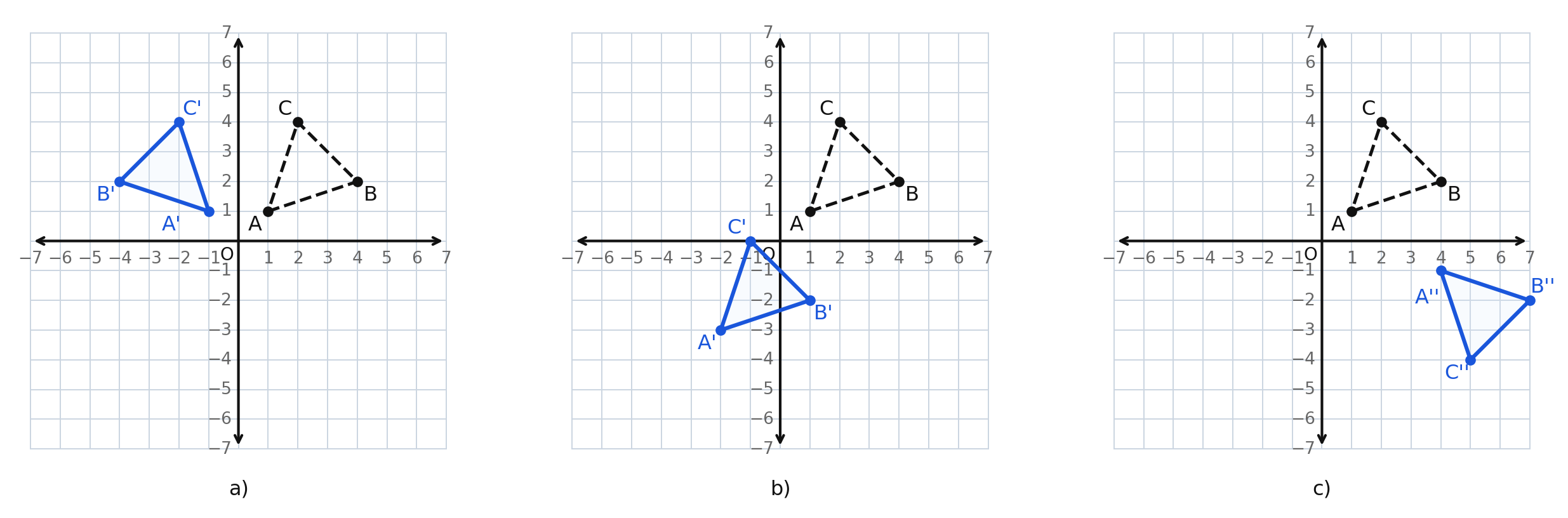
Work through the description in a fixed order.
- Check the orientation. Same way around means no reflection — the figure was translated. Reversed means a reflection is part of the answer.
- If the orientation reversed, find the mirror. Matching -coordinates with opposite -coordinates means the y-axis; matching -coordinates with opposite -coordinates means the x-axis. If neither holds exactly, a translation happened as well.
- Account for what is left over. Reflect the preimage over the axis you suspect, compare that result with the actual image, and read off the translation that closes the gap.
- State the answer in words and as a rule. "Reflected over the x-axis, then translated units right," together with .
For panel c, the preimage , , has image , , . The orientation is reversed, so there is a reflection. Every -coordinate is exactly negated, which points to the x-axis; every -coordinate is larger, which is a translation of units right. So the composition is a reflection over the x-axis together with a translation units right — and because that translation is parallel to the mirror, either order describes it correctly.
Transformations in the world
Reflections and translations are not classroom-only ideas, and the standard asks you to recognize them in context.
- Logo and pattern design. A designer draws half a symmetric mark and reflects it over a vertical center line to finish it. Doing it as a reflection rather than by hand guarantees the two halves match exactly.
- Wallpaper, tile, and quilt borders. A single motif repeated by translation gives a striped border; alternating the motif with its reflection gives a mirrored border.
- Screen graphics and games. A sprite that must face the other direction is reflected, not redrawn. A sprite that moves across the screen is translated. A character that walks left and then turns around has been translated and then reflected.
- Mirrors and still water. Your reflection in a mirror, or a mountain's reflection in a lake, is a genuine reflection across a line — which is why text appears reversed and why "AMBULANCE" is printed backwards on the front of the vehicle.
- Choreography and marching bands. A formation that slides down the field is translated; a formation that mirrors itself across the fifty-yard line is reflected.
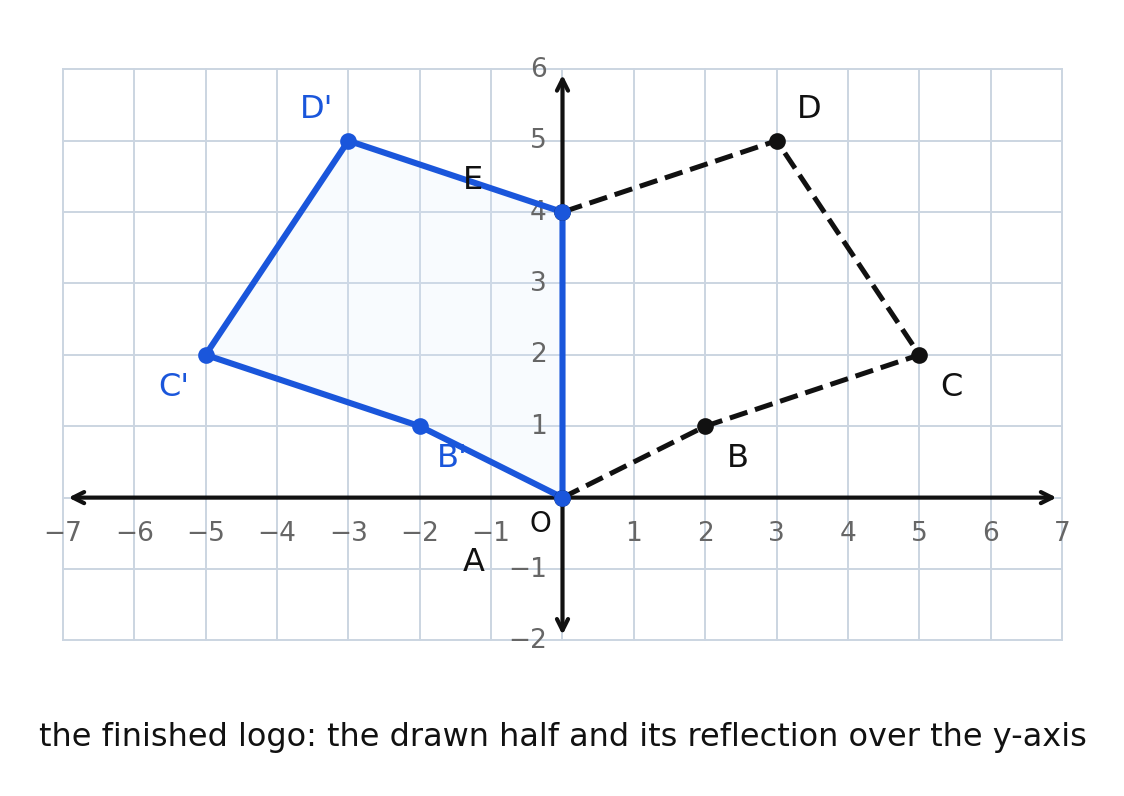
The half-logo above has vertices , , , , . Reflecting over the y-axis gives , , , and leaves and fixed, since both sit on the mirror line. The finished mark is symmetric about the y-axis.
When you describe a transformation in context, say three things: which transformation (translation, reflection, or a composition of the two), the specifics (which axis, how many units in which direction), and what stayed the same (size and shape are always preserved; orientation is preserved by a translation and reversed by a reflection).
Worked examples
Example 1 — Sketching a translate-then-reflect composition
Sketch the image of with , , under a translation units left followed by a reflection over the x-axis.
Translation: , , . Reflection: , , .
Answer: , ,
Example 2 — Sketching a composition where the order matters
Sketch the image of the quadrilateral , , , under a translation up followed by a reflection over the x-axis. Then sketch the other order.
Translate first: , , , ; reflect: , , , . Reflect first: , , , ; translate: , , , .
Answer: The two images differ. Every -coordinate differs by , which is twice the -unit vertical translation.
Example 3 — Naming a transformation from a graph
A dashed triangle has vertices , , ; the solid image has vertices , , . Describe the transformation.
Each -coordinate is unchanged and each -coordinate is negated, and the orientation is reversed.
Answer: a reflection over the y-axis,
Example 4 — Naming a composition from a graph
A dashed triangle has vertices , , ; the solid image has vertices , , . Describe the transformation.
The -coordinates are negated, so the mirror is the x-axis. Reflecting alone would give , , , and the actual image is units farther right.
Answer: a reflection over the x-axis together with a translation units right, . Because the translation is parallel to the mirror, either order gives this image.
Example 5 — Describing a transformation in context
A graphic designer draws a fish facing right on the right half of a screen, then makes a second fish facing left on the left half, the same size, the same height. Name the transformation and give the rule, taking the center line of the screen as the y-axis.
The size and shape are unchanged and the direction the fish faces is reversed, so this is a reflection, and the mirror is the vertical center line.
Answer: a reflection over the y-axis,
Example 6 — Describing a composition in context
On an assembly line, a conveyor moves a metal plate units to the right, and then a machine flips the plate over the horizontal center line of the table. Describe the composite transformation and write the rule, taking the center line as the x-axis.
The slide is a translation right ; the flip is a reflection over the x-axis.
Answer: a translation units right followed by a reflection over the x-axis, . Here the two moves could be done in either order, because the translation is parallel to the mirror.
Guided practice
- Sketch the image of with , , under a translation units left followed by a reflection over the x-axis. Label the intermediate and final figures.
- Sketch the image of the same under a reflection over the x-axis followed by a translation units left. Compare with item 71 and explain what you find.
- Sketch the image of the quadrilateral , , , under a translation up followed by a reflection over the x-axis.
- Sketch the image of the same quadrilateral under a reflection over the x-axis followed by a translation up . Compare with item 73.
- Describe the transformation shown in panel a of the figure in this lesson, and write its rule.
- A rubber stamp is pressed onto an ink pad and then onto paper, so the paper shows the mirror image of the design. Name the transformation and state what is preserved and what is reversed.
Independent practice
- Sketch the image of the triangle , , under a reflection over the y-axis followed by a translation down . Give all three sets of coordinates.
- Sketch the image of the quadrilateral , , , under a translation right and down followed by a reflection over the y-axis. Give all three sets of coordinates.
- Sketch the image of the triangle , , under a reflection over the x-axis followed by a translation left and up . Give all three sets of coordinates.
- Sketch the image of the same triangle under a translation left and up followed by a reflection over the x-axis. Compare with item 79 and explain the difference.
- Describe the transformation shown in panel c of the figure in this lesson, in words and as a rule.
- Describe the transformation shown in panel b of the figure in this lesson, in words and as a rule.
- Application. A dance studio has a mirrored wall along the y-axis. A dancer stands at and her reflection appears in the mirror. Give the coordinates of the reflection, and explain why the reflection appears to raise its left hand when the dancer raises her right.
- Application. On an assembly line the conveyor moves a plate units right, and then a machine flips it over the horizontal center line of the table. Taking that center line as the x-axis, write the rule for the composite transformation and find the image of the corner at .
- Application. A quilt border repeats one triangular patch across a strip. In the first border the patch is copied units to the right each time; in the second border every other copy is also flipped over the horizontal center line of the strip. Name the transformation used in each border.
- Reasoning. You are shown a preimage and an image and told only that one transformation from this chapter was used. Explain how the orientation alone tells you whether a reflection was involved, and why the size of the figure tells you nothing useful here.
- Reasoning. A classmate says that any composition of a translation and a reflection can be described as "a reflection over an axis, then a slide." Explain when that description is safe to use and when it would give the wrong image.
- Error analysis. A student looks at a preimage and its image, notices the image is the same size and shape, and concludes the transformation must have been a translation. Explain why that conclusion is not justified, and describe the check the student skipped.
Exit ticket 14.4
- Sketch the image of the triangle , , under a translation down followed by a reflection over the y-axis. Give all three sets of coordinates.
- Sketch the image of the same triangle under a reflection over the y-axis followed by a translation down . Compare with item 89 and explain the result.
- A logo is reflected over the y-axis and then moved up units. Write the rule for the composite transformation, and apply it to the point .
- Explain how orientation tells you that a reflection was part of a transformation.
Chapter 14 Review
Vocabulary. transformation · preimage · image · prime notation · reflection · line of reflection · x-axis · y-axis · orientation · congruent · translation · composite transformation (composition) · intermediate image
Part A — Coordinates of a reflection over the x- or y-axis (8.MG.3b)
- Give the image of after a reflection over the x-axis.
- Give the image of after a reflection over the y-axis.
- Triangle has , , . Give the image coordinates after a reflection over the y-axis.
- Quadrilateral has , , , . Give the image coordinates after a reflection over the x-axis.
- A preimage vertex has image . Which axis was the line of reflection, and how can you tell?
- Give the image of after a reflection over the y-axis, and explain the result.
- Reflect over each axis in turn. Give both images and name the quadrant each lands in.
Part B — Coordinates of a composition (8.MG.3c)
- is translated right , then reflected over the y-axis. Give the intermediate point and the final point.
- is reflected over the y-axis, then translated right . Give the intermediate point and the final point.
- Triangle has , , . Translate up , then reflect over the x-axis. Give all three sets of coordinates.
- Using the same , reflect over the x-axis, then translate up . Give all three sets of coordinates.
- Reasoning. Compare items 102 and 103. By how much does each final -coordinate differ, and why is that number twice the translation distance?
- A point ends at after being reflected over the y-axis and then translated up . Find the original point and check by applying the composition forwards.
- A point is translated right and then reflected over the x-axis. Give the intermediate point and the final point.
Part C — Sketching a reflection (8.MG.3e)
- Sketch the image of the triangle , , after a reflection over the x-axis, and list the image coordinates.
- Sketch the image of the quadrilateral , , , after a reflection over the y-axis, and list the image coordinates.
- Sketch the image of the triangle , , after a reflection over the x-axis, and name the quadrant the image lies in.
- Sketch the image of the triangle , , after a reflection over the y-axis, and name the vertex that did not move.
- Reasoning. For your sketch in item 107, state the distance from each preimage vertex to the x-axis and confirm that each image vertex is the same distance on the other side.
Part D — Sketching a composition (8.MG.3f)
- Sketch the image of the triangle , , under a translation down followed by a reflection over the y-axis. Give all three sets of coordinates.
- Sketch the image of the same triangle under a reflection over the y-axis followed by a translation down . Compare with item 112 and explain the result.
- Sketch the image of the quadrilateral , , , under a translation up followed by a reflection over the x-axis. Give all three sets of coordinates.
- Sketch the image of the same quadrilateral under a reflection over the x-axis followed by a translation up . Compare with item 114 and explain the difference.
- Sketch the image of the triangle , , under a reflection over the y-axis followed by a translation right and down . Give all three sets of coordinates.
Part E — Identifying and describing transformations in context (8.MG.3g)
Describe the transformation shown in panel a of the figure below, in words and as a rule.
Describe the transformation shown in panel b of the same figure, in words and as a rule.
Describe the transformation shown in panel c of the same figure, in words and as a rule.
Application. A phone app shows an arrow icon pointing right at , , . When the user taps "reverse," the icon points left at , , . Name the transformation the app applied, write its rule, and state what stayed the same.
Application. A marching band forms a shape on the right half of the field, then repeats the identical shape on the left half so that the two shapes mirror each other across the fifty-yard line. Taking that line as the y-axis, name the transformation and explain how a spectator could tell it was not a slide.
Sort each situation as a translation, a reflection, or a composition of the two: (a) a tile pattern in which one motif is copied inches to the right again and again; (b) the word AMBULANCE printed backwards on the front of a vehicle; (c) a video-game sprite that walks units right and then turns to face the other way; (d) an elevator rising two floors; (e) half a butterfly completed by mirroring it across its body line.
Part F — Mixed reasoning and application
- Reasoning. Explain why a reflection reverses orientation while a translation does not. Use a triangle whose vertices are labeled in order in your explanation.
- Error analysis. Asked to reflect over the y-axis, a student writes . Identify the error, name the rule the student used instead, and give the correct image.
- Error analysis. Asked to translate up and then reflect over the x-axis, a student reflects the original point instead of the intermediate point and writes . Explain the error and give the correct final point.
- Reasoning. For which translations does the order of a translation and a reflection over the x-axis not matter? Answer for the y-axis as well, and explain both answers in terms of the direction of the slide relative to the mirror.
- Application. A designer draws half a logo with vertices , , , , and reflects it over the y-axis to complete the mark. She then slides the whole finished mark up units to center it on a poster. Give the coordinates of the reflected half, and then of that half after the slide.
- Write your own composition problem: choose a triangle with integer coordinates, choose a translation and a reflection over one axis, and state the problem, the intermediate coordinates, and the final coordinates. Then say whether reversing the order would change your answer, and why.
Standards coverage check — Chapter 14
| Knowledge and Skill | Where it is taught | Where it is practiced |
|---|---|---|
| 8.MG.3b — given a preimage in the coordinate plane, identify the coordinates of the image of a polygon that has been reflected over the x- or y-axis | 14.1 | Items 1–24; revisited in 47–70 as the reflection step of a composition; Review Part A, items 93–99; item 124 |
| 8.MG.3c — given a preimage, identify the coordinates of the image of a polygon that has been translated and reflected over the x- or y-axis, or reflected over the x- or y-axis and then translated | 14.3 | Items 47–70; Review Part B, items 100–106; items 125, 126 |
| 8.MG.3e — sketch the image of a polygon that has been reflected over the x- or y-axis | 14.2 | Items 25–46; Review Part C, items 107–111 |
| 8.MG.3f — sketch the image of a polygon that has been translated and reflected over the x- or y-axis, or reflected over the x- or y-axis and then translated | 14.4 | Items 71–74, 77–80, 89–90; Review Part D, items 112–116; item 127 |
| 8.MG.3g — identify and describe transformations in context | 14.1 (reading a reflection off a graph), 14.4 (a full procedure for describing what you are shown, plus contexts) | Items 8, 13, 16, 19, 40, 65; items 75–76, 81–88, 91–92; Review Part E, items 117–122; items 123, 128 |
Bullets (a) and (d) of 8.MG.3 — the translation bullets — are covered in Chapter 13, and are used but not re-taught here.
Every reflection in this chapter is over the x-axis or the y-axis, and every composition pairs exactly one translation with exactly one reflection, as the standard requires.
Answer keys for every set in this chapter are in Appendix A.