Chapter 15 — Probability of Independent and Dependent Events
Standard: 8.PS.1 — The student will use statistical investigation to determine the probability of independent and dependent events, including those in context.
By the end of this chapter you will be able to:
- Decide whether two events are independent or dependent, and explain how replacement changes the probability (8.PS.1a)
- Compare and contrast the probability of independent events with the probability of dependent events (8.PS.1b)
- Find the probability of two independent events (8.PS.1c)
- Find the probability of two dependent events (8.PS.1d)
Lessons: 15.1 Independent or Dependent: What Replacement Changes · 15.2 The Probability of Two Independent Events · 15.3 The Probability of Two Dependent Events · 15.4 Comparing and Contrasting the Two Cases
Numbering note. Item numbers run straight through the chapter, from 1 in Lesson 15.1 to 130 at the end of the review. They do not restart at each lesson.
In Grade 7 you found the probability of one event: one roll, one spin, one draw from a bag. This chapter asks about two events happening one after the other, and it turns on a single question that sounds almost too small to matter.
After the first draw, is the bag the same as it was?
If the marble goes back in, the bag is the same and the second draw does not care what happened first. If the marble stays out, the bag has changed, and the second probability changes with it. That is the whole chapter. Everything else is multiplication.
What this chapter does not include. Every problem here has exactly two events. Three-stage problems — draw three cards, flip three coins — are a later topic, and so are conditional-probability formulas written with vertical bars. The tools you need are a tree diagram, careful counting, and one multiplication.
Lesson 15.1 — Independent or Dependent: What Replacement Changes
A quick review of the one-event formula
For a single experiment whose outcomes are all equally likely,
and every probability satisfies . Nothing in this chapter replaces that formula. You will simply use it twice — once for the first event, once for the second — and the interesting part is what the total has become by the time you get to the second one.
Two events, one after the other
A compound event is two or more events considered together. In this chapter the two events are always in an order: something happens first, then something happens second. We write the probability that both happen as
read "the probability of and then ."
Independent and dependent
Two events are independent when the outcome of the first does not change the probability of the second.
Two events are dependent when the outcome of the first does change the probability of the second.
Notice what the definitions do not say. They say nothing about whether the two events look alike, use the same colors, or happen at the same table. They ask one question only: did the first event change the situation the second event lives in?
Some pairs are independent because the two events have nothing physically to do with each other. A coin cannot reach over and change a die. A spinner does not remember a card. Flip a coin and then roll a die, and the die's six faces are still six equally likely faces no matter which way the coin landed.
Replacement is the switch
The interesting case is when both events come out of the same collection — the same bag, the same deck, the same drawer. Then one word in the problem decides everything.
- With replacement means the first item is put back before the second is taken. The collection is restored, so the second draw faces exactly what the first one faced. The events are independent.
- Without replacement means the first item is kept out. The collection is now smaller, and the count of whatever was taken is one lower. The events are dependent.
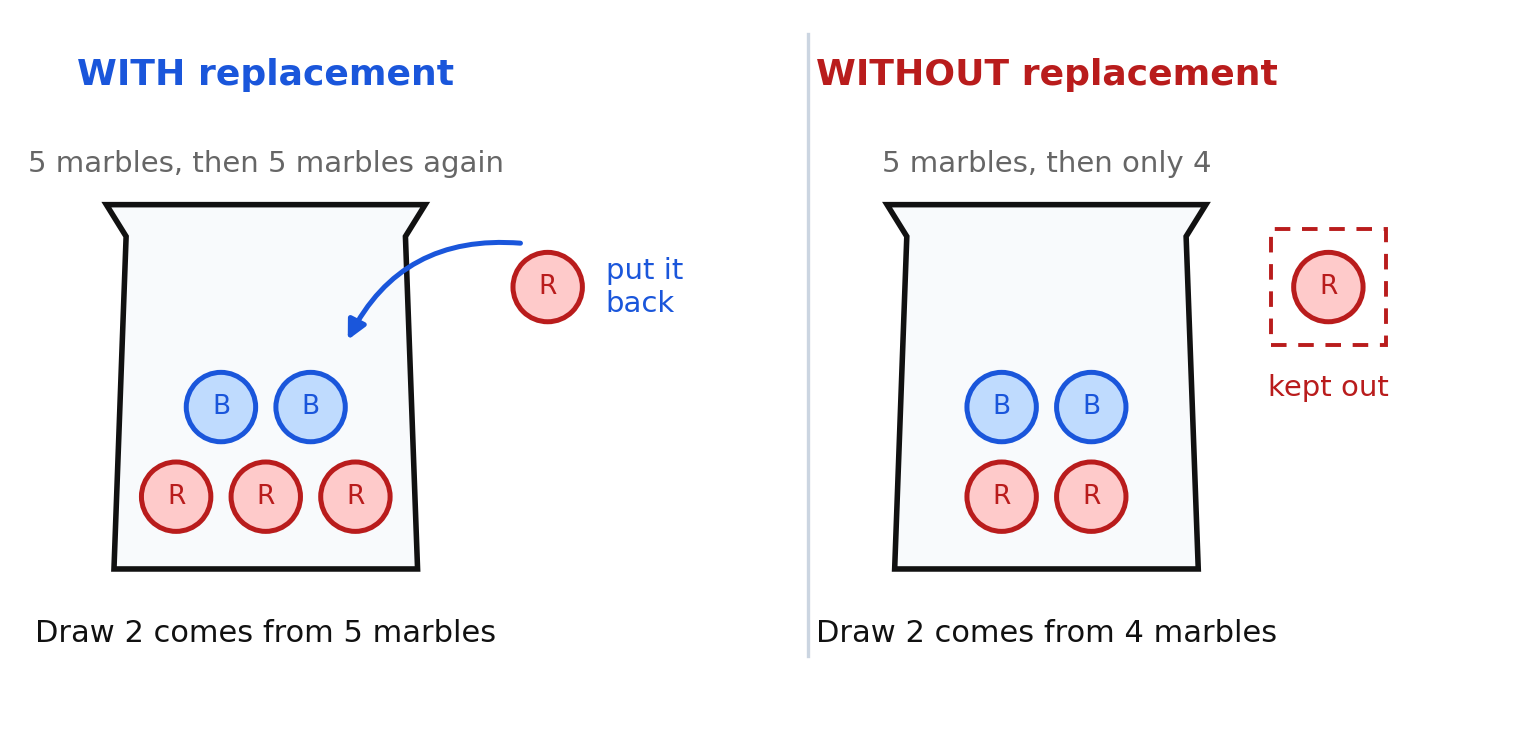
Look carefully at the right-hand panel, because it shows two changes, not one. A red marble was drawn and kept out, so for the second draw:
- the total dropped from to , and
- the count of red dropped from to , while blue stayed at .
Both the numerator and the denominator of the second probability can change. Missing the numerator change is the single most common error in this chapter, and it is worth saying out loud every time: what is left, and how many of them are the color I want?
Reading the wording
Problems announce replacement in several ways. Train your eye on these phrases.
| Wording | Meaning | The two events are |
|---|---|---|
| "with replacement" / "puts it back" / "records the color and returns it" | collection restored | independent |
| "without replacement" / "keeps it" / "does not return it" / "eats it" | collection reduced | dependent |
| "draws two marbles at the same time" / "grabs a handful of two" | two different items, so neither can be the other | dependent |
| two different experiments (coin and die, two spinners, two separate machines) | nothing is drawn at all | independent |
That third row surprises students. Drawing two marbles simultaneously is treated exactly like drawing without replacement, because the second marble still cannot be the first one.
Worked examples
Example 1 — Classifying from the wording
A bag holds red and blue marbles. Ana draws one marble, records the color, puts it back, and draws again. Are the two draws independent or dependent?
The marble goes back, so the bag is red and blue for both draws.
Answer: Independent.
Example 2 — Classifying the other way
Ben draws one marble from the same bag, keeps it, and draws again. Independent or dependent?
The bag has marbles for the second draw instead of , so the second probability is not what it was.
Answer: Dependent.
Example 3 — Describing the second collection exactly
From a bag of green and yellow counters, one counter is drawn and kept out. Describe the bag for the second draw in each case.
If the drawn counter was green: green and yellow, in all. If it was yellow: green and yellow, in all.
Answer: The total is either way, but which count dropped depends on the first result.
Example 4 — Two separate experiments
A coin is flipped and a die is rolled. Independent or dependent?
Nothing is drawn from anything, and the coin cannot affect the die's faces.
Answer: Independent.
Example 5 — Same numbers, different answers
A jar holds red and green marbles. One marble is drawn and kept out. What is the probability the second is red?
There is no single answer, and that is the point. If the first was red, of the remaining are red, so . If the first was green, of the remaining are red, so .
Answer: or , depending on the first draw — which is exactly what "dependent" means.
Guided practice
Use the bag of red and blue marbles from the figure in this lesson for items 1–5.
- How many marbles are in the bag before the first draw?
- A marble is drawn with replacement. How many marbles does the second draw come from?
- A marble is drawn without replacement. How many marbles does the second draw come from?
- Without replacement, the first marble drawn is red. How many red and how many blue remain, and what is the new total?
- Without replacement, the first marble drawn is blue. How many red and how many blue remain, and what is the new total?
- Independent or dependent: a coin is flipped, then a die is rolled.
- Independent or dependent: a marble is drawn and kept, then a second marble is drawn.
- In one sentence, state what replacement does to the collection the second event draws from.
Independent practice
- Classify each pair of events as independent or dependent. a) A spinner is spun twice. b) Two cards are dealt from a deck, and the first is not returned. c) A die is rolled, then a coin is flipped. d) A name is drawn from a hat, returned to the hat, and a name is drawn again. e) Two socks are pulled from a drawer and both are kept out.
- A bag holds white and black tiles. A white tile is drawn and replaced. Give the exact contents and the total for the second draw.
- Same bag. A white tile is drawn and kept out. Give the exact contents and the total for the second draw.
- Same bag. A black tile is drawn and kept out. Give the exact contents and the total for the second draw.
- A bag holds lettered tiles. Two are drawn without replacement. What is the denominator of the first probability? Of the second?
- Two cards are drawn from a standard deck of . Give both denominators when the draw is with replacement, and both when it is without replacement.
- Explain why putting the first item back makes the two events independent.
- A jar holds red and green marbles. One is drawn and kept out. Find the probability that the second is red if the first was red, and if the first was green. Which is larger, and why does that make the events dependent?
- Application. A box holds buttons: striped and solid. A student draws one, drops it on the floor, and does not put it back before drawing again. Are the two draws independent or dependent? Explain.
- Application. At a carnival you spin a red spinner and then a separate blue spinner. Are the two spins independent or dependent? Explain what makes them so.
- Reasoning. Can two events be dependent when nothing is drawn from a bag? Describe a situation and explain.
- Error analysis. A student says, "The two draws are independent because both marbles are the same color." Explain what the student is confusing, and give the correct test for independence.
Exit ticket 15.1
- Define independent events in your own words, without using the word "independent."
- A bag holds yellow and purple marbles. How many marbles does the second draw come from, with replacement and without?
- Same bag. The first marble drawn is yellow and is kept out. Give the exact contents for the second draw.
- A game says, "Draw a chip, record its color, put it back, and draw again." Are the draws independent or dependent, and how do you know?
Lesson 15.2 — The Probability of Two Independent Events
Counting the outcomes first
Before any rule, look at what two events actually produce. A coin has outcomes and a die has , so flipping and then rolling produces equally likely pairs. All twelve fit in a table.
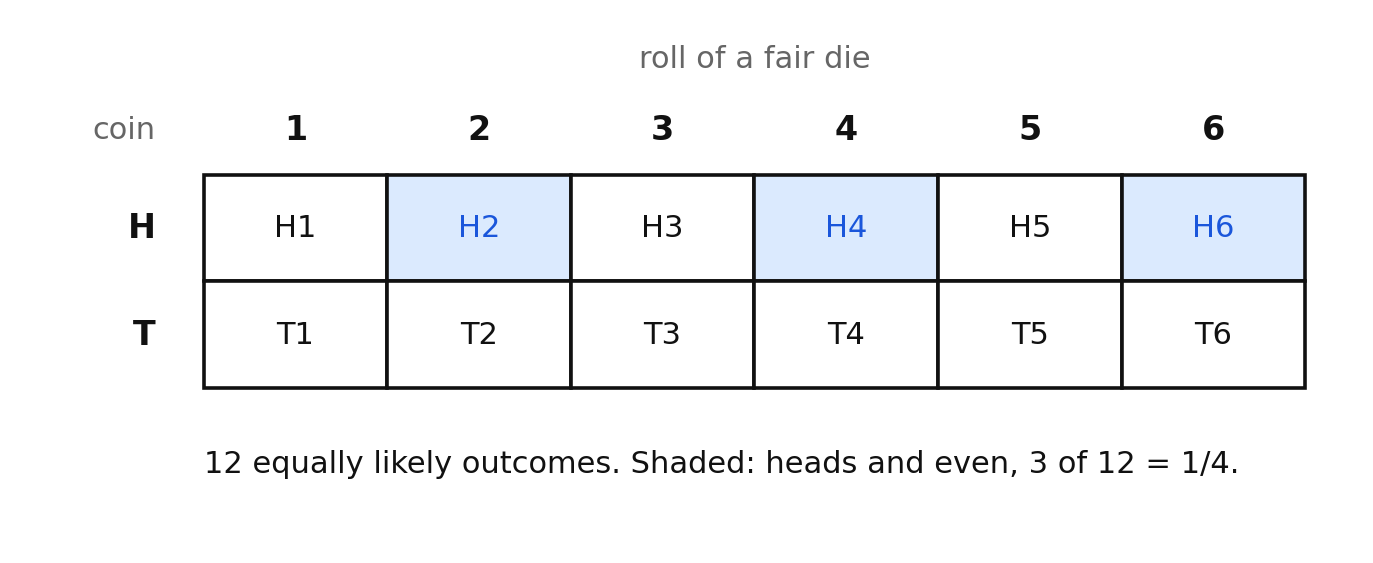
The event "heads and an even number" is the shaded set: , , . Counting straight from the table,
Now notice where that answer could have come from without a table. Half of the twelve rows are heads, and half of those six are even:
The multiplication rule for independent events
When and are independent,
Multiply, do not add. Adding is for "or" questions about a single event, which is not what this chapter asks. And multiplying two proper fractions always gives something smaller than either one, which matches common sense: demanding that two things both happen is harder than demanding just one.
An area model shows why multiplying is the right move. Draw the whole square as . Cut it left to right by the first draw and top to bottom by the second.
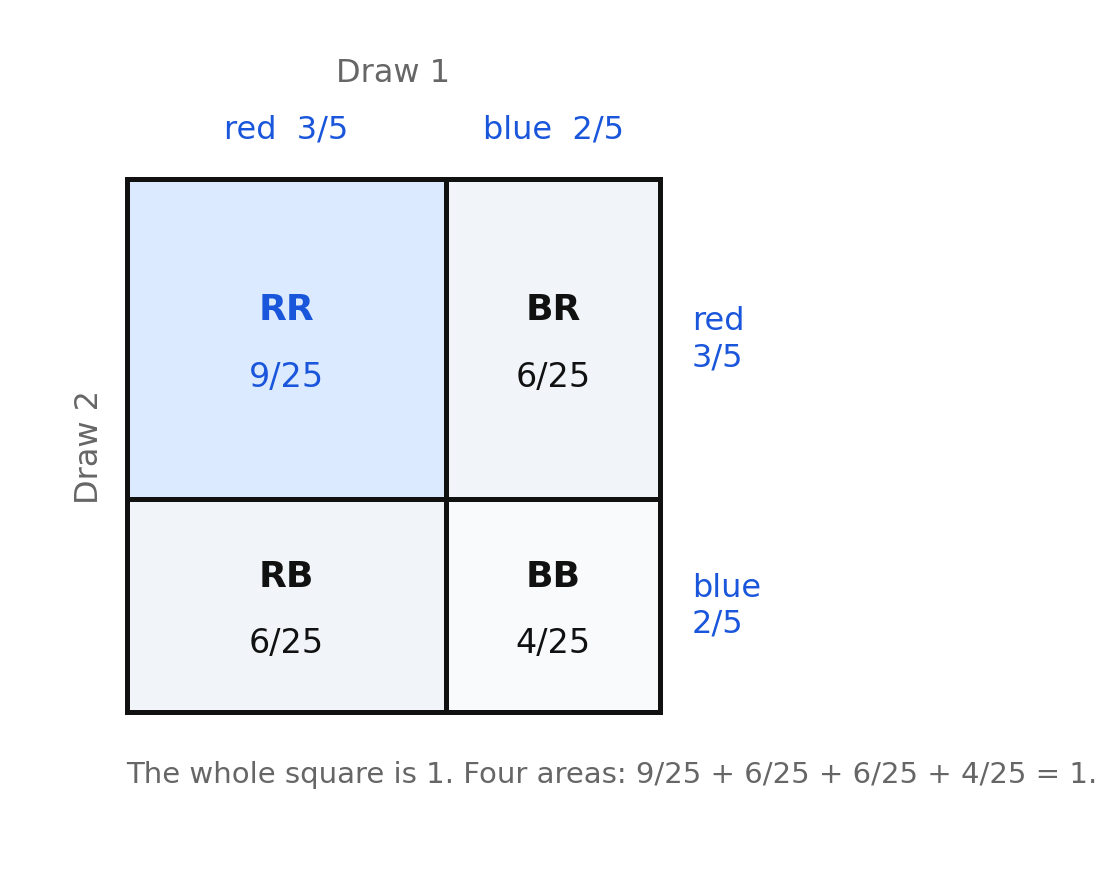
The bag here is red and blue, drawn twice with replacement, so both cuts are in the same place: and . The region is of of the square, which is an area of — and "a fraction of a fraction" is multiplication. The four regions fill the square exactly:
The tree diagram
The tool you will use most is the tree diagram. Each stage of the experiment gets a set of branches, each branch carries the probability of that step, and you multiply along a path to get the probability of that outcome.
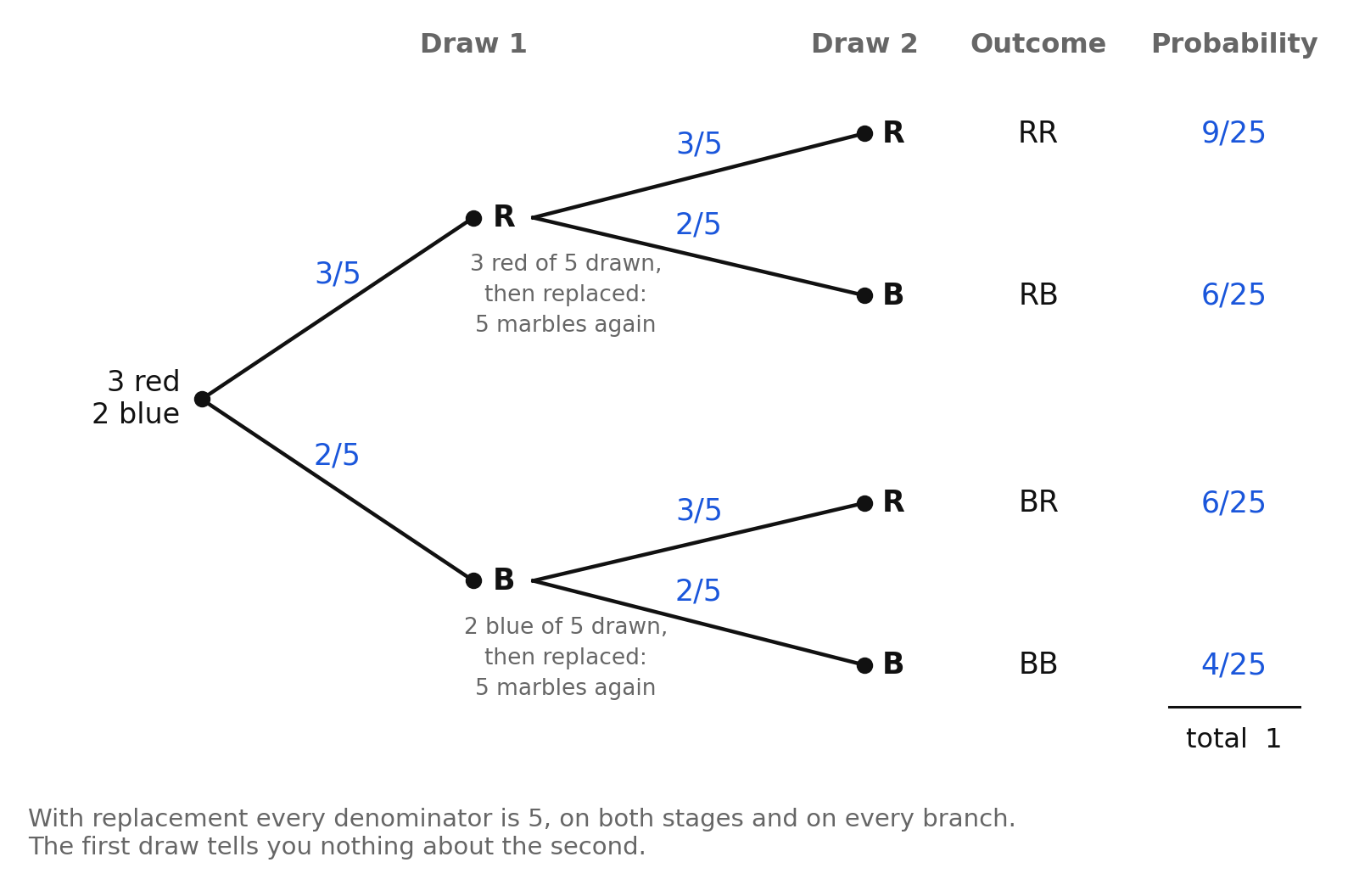
Three habits make a tree trustworthy.
- Label every branch with a probability, not just a color.
- Check that sibling branches sum to . Here at every node, because something must happen.
- Check that the outcome column sums to . Here . If your column does not total , a branch is wrong — find it before you answer anything.
Read the tree as four sentences. . . . .
Every denominator on that tree is . That is the visible signature of independence, and it is what you will compare against in the next lesson.
Two different experiments
Independence does not require replacement — it only requires that the first event leave the second alone. Two different experiments qualify automatically.
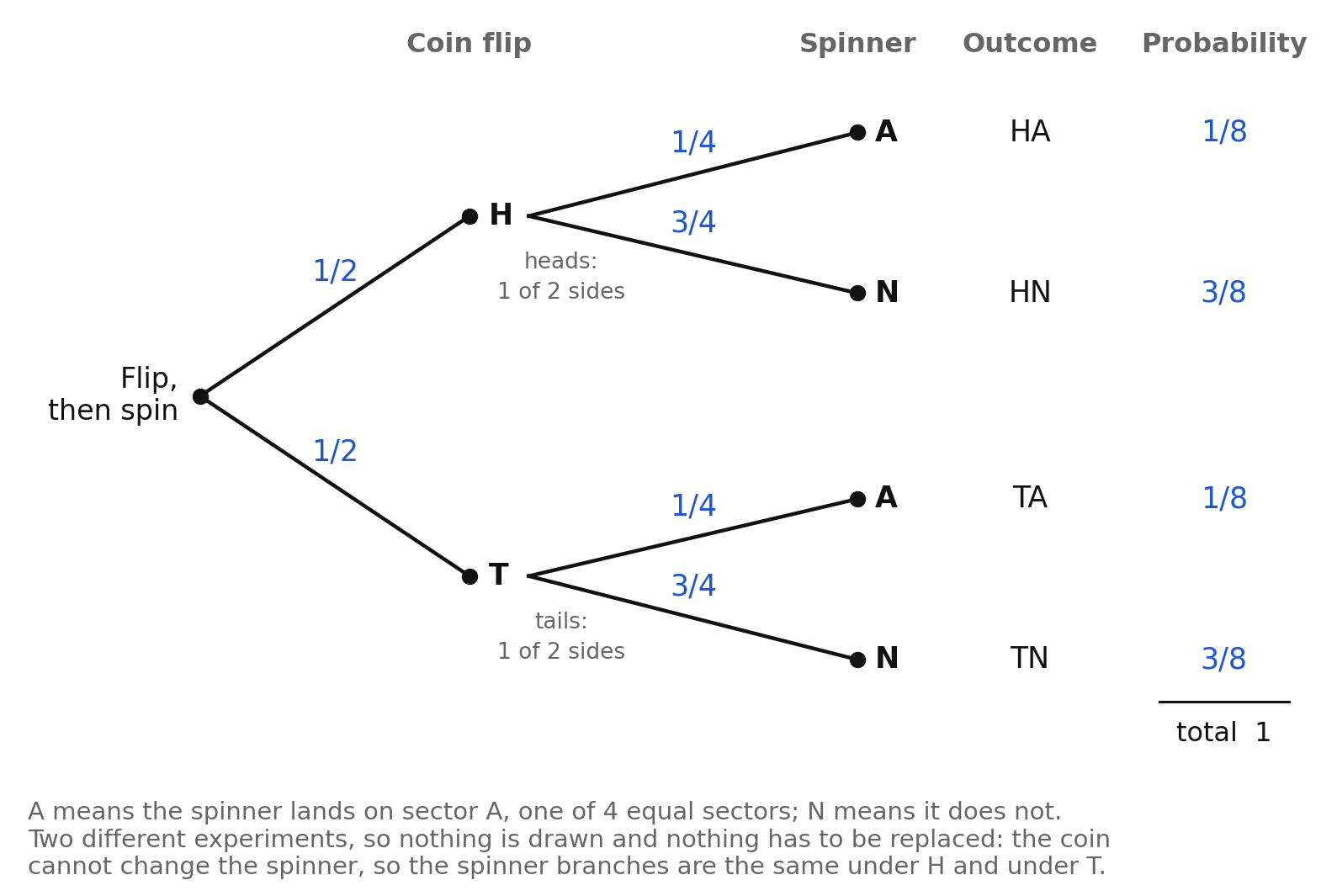
A coin is flipped, then a spinner with equal sectors is spun. Let mean the spinner lands on sector and mean it does not. The spinner branches are and under heads, and and under tails — identical, because the coin cannot touch the spinner. So
When the two sets of second-stage branches are copies of each other, the events are independent. When they differ, they are dependent. You can see independence in a tree before you compute anything.
Fractions, decimals, and percents
Give the fraction in lowest terms first, since it keeps the counting visible, and add a decimal or a percent when the question asks you to compare or to interpret. For example — a little better than one chance in three.
Worked examples
Example 1 — Coin and die
Find for one flip and one roll.
The events are independent, so multiply.
Answer:
Example 2 — Two rolls of a die
Find the probability of rolling two s in a row.
A die has no memory, so the rolls are independent.
Answer:
Example 3 — With replacement, from a bag
A bag holds green and yellow counters. One is drawn, replaced, and another is drawn. Find .
Replacement makes the draws independent, and each probability uses the full counters.
As a decimal, .
Answer:
Example 4 — Two events described in words
A spinner has equal sectors numbered through . It is spun once and a coin is flipped. Find the probability of an even number and tails.
The even sectors are and , so .
Answer:
Example 5 — An application, and a check by counting
A vending machine's prize slot pays out on of purchases, and two friends buy from two different machines set the same way. Find the probability that both win.
Two separate machines, so independent.
The check: there are equally likely pairs of results, and exactly one of them is win-win.
Answer:
Guided practice
- One coin flip and one roll of a die. Find .
- One coin flip and one roll of a die. Find .
- Use the twelve-outcome table in this lesson. Count the outcomes that are heads and even, and write the probability. Does it match the multiplication rule?
- Use the with-replacement tree. Find .
- Use the with-replacement tree. Find .
- Use the with-replacement tree. Find .
- Add all four probabilities in the with-replacement tree. What must the total be, and why?
- Use the coin-and-spinner tree. Find the probability of heads and sector .
Independent practice
- Two fair coins are flipped. Find .
- Two dice are rolled. Find the probability that both show .
- Two dice are rolled. Find the probability that both show an odd number.
- A spinner with equal sectors numbered – is spun twice. Find .
- The same spinner is spun once and a coin is flipped. Find the probability of an even sector and tails.
- A bag holds red and blue marbles. Two are drawn with replacement. Find .
- A bag holds green and yellow counters, drawn twice with replacement. Find .
- Same bag, same replacement. Find , and write it as a decimal.
- A die is rolled and a spinner with equal sectors – is spun. Find the probability of a prime number and sector .
- A coin is flipped twice. Find the probability of at least one head, by first finding the probability of no heads.
- Application. A cereal company puts a prize in of its boxes, mixed at random through a huge shipment. A shopper buys two boxes. Find the probability that both contain a prize.
- Application. Two traffic lights on separate roads are each green of the time, and they are not synchronized. Find the probability that a driver finds both green.
- Reasoning. Events and are independent, with and . Find , and explain why the answer must be smaller than both and .
- Error analysis. Asked for with one flip and one roll, a student writes . Explain the error and give the correct probability.
Exit ticket 15.2
- One coin flip and one roll of a die. Find .
- A spinner with equal sectors is spun twice. Find the probability of sector both times.
- A bag holds red and blue marbles, drawn twice with replacement. Find as a fraction, a decimal, and a percent.
- Write the rule for the probability of two independent events, using and .
Lesson 15.3 — The Probability of Two Dependent Events
The same rule, with an adjusted second factor
For dependent events the rule barely changes:
You still multiply. The only new work is the second factor, and it is honest work rather than a formula: rebuild the collection in your head, then count again.
Two questions, in this order, every single time.
- How many are left in all? One fewer than before.
- How many of the kind I want are left? One fewer only if that kind was the one taken.
The two trees side by side
Here is the same bag as Lesson 15.2 — red, blue — drawn twice without replacement.
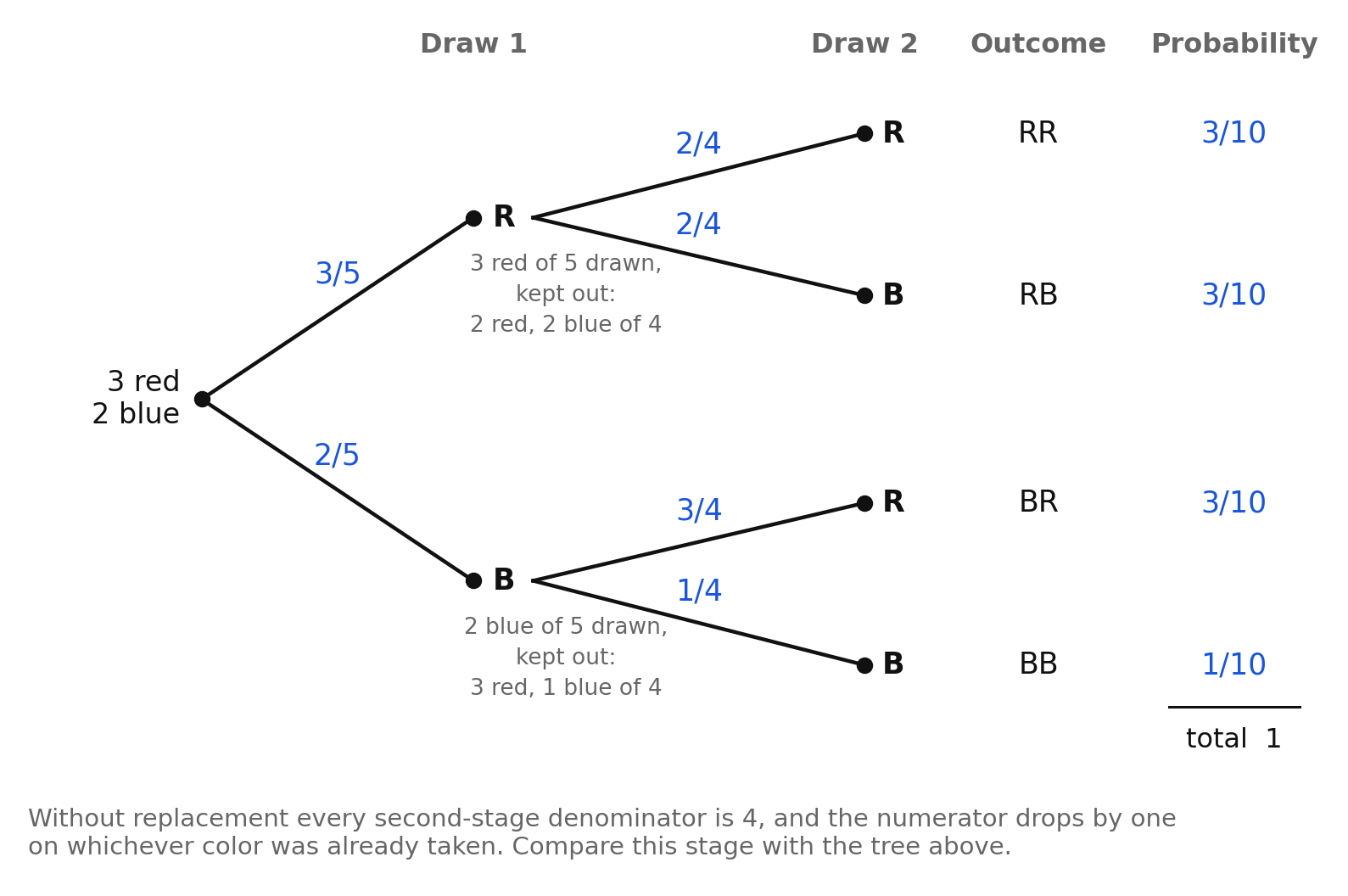
Compare it branch by branch with the with-replacement tree. The first stage is identical: and , because nothing has happened yet. Every second-stage denominator has dropped from to . And the numerators tell you which marble left:
- After a red is taken, red and blue remain: and .
- After a blue is taken, red and blue remain: and .
The two sets of second-stage branches are different, and that difference is the dependence. Multiplying along the four paths:
Total: . The tree checks out.
The defining error of this topic. Students reduce the denominator and forget the numerator, writing for . But a red marble is gone; only red are left. Say the sentence "two red out of four marbles" before you write the fraction, and the numerator takes care of itself.
A larger bag
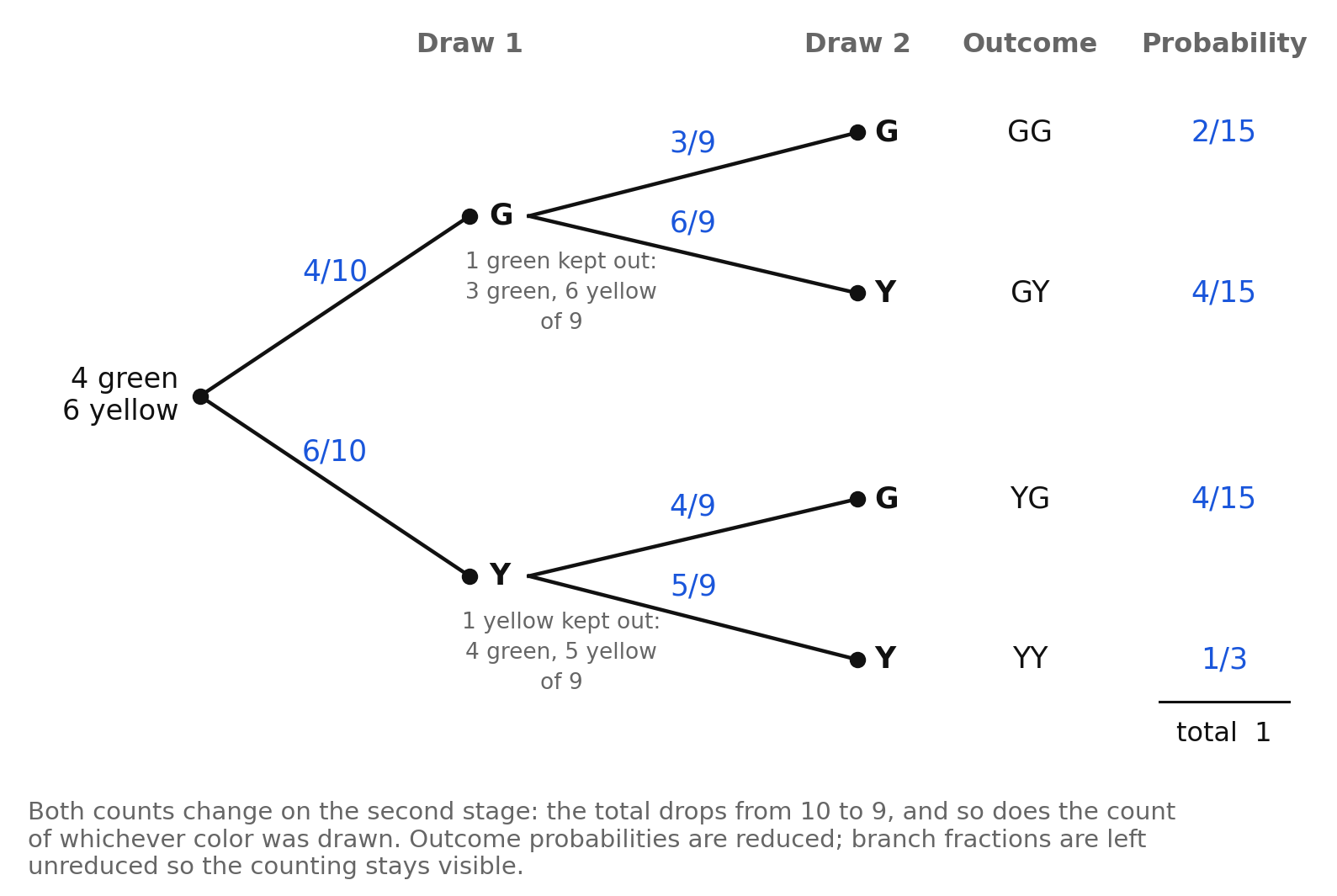
With green and yellow, the first stage is and , and every second-stage denominator is .
Check the total using a common denominator of : .
Two notes on form. Leave the branch fractions unreduced while you work, because says "three green left out of nine counters left" and hides that. Reduce only the final answer.
"At the same time" means without replacement
If two items are drawn simultaneously, the second item still cannot be the first item, so the counts behave exactly as they do without replacement. Draw two marbles at once from a bag of red and blue, and .
Worked examples
Example 1 — Both the same color
A bag holds red and white marbles. Two are drawn without replacement. Find .
First draw: red of . Then one red is gone, leaving red of .
Answer:
Example 2 — Two different colors
Same bag. Find .
A red leaves, so white is untouched: still white, but of marbles.
Answer:
Example 3 — Cards
Two cards are dealt from a standard deck of without replacement. Find .
There are aces. After one is dealt, aces remain among cards.
Answer: , or about
Example 4 — An application with two ways to win
A drawer holds black socks and blue socks. Two socks are taken out without looking. Find the probability of a matching pair.
Matching means both black or both blue, so compute each and add those two results.
Answer: , a little under half
Example 5 — People instead of marbles
A club has girls and boys. Two different members are chosen at random, one as secretary and one as treasurer. Find the probability that both are boys.
No one can hold both jobs, so this is a draw without replacement.
Answer:
Guided practice
Use the without-replacement tree ( red, blue) for items 51–54, and the ten-counter tree ( green, yellow) for items 55–58.
- Find .
- Find .
- Find .
- Add all four outcome probabilities. What is the total, and what does that tell you?
- Find .
- Find .
- Find .
- Add all four outcome probabilities and show that the total is .
Independent practice
A bag holds red and white marbles. Two marbles are drawn without replacement. Use this bag for items 59–63.
- Find .
- Find .
- Find .
- Find .
- Add the four probabilities from items 59–62 and show that the total is exactly .
- Two cards are dealt from a deck of without replacement. Find the probability that both are aces.
- Two cards are dealt from a deck of without replacement. Find the probability that both are hearts. (A deck holds hearts.)
- A drawer holds black and blue socks. Two are taken without replacement. Find .
- Same drawer. Find .
- Same drawer. Find the probability of a matching pair.
- A class has girls and boys. Two different students are chosen at random for two jobs. Find the probability that both are boys.
- Application. A hat holds raffle tickets, of which win a prize. You draw two tickets and keep both. Find the probability that both win.
- Application. A bowl holds apples and oranges. Two pieces of fruit are taken and eaten. Find the probability of an apple first and then an orange.
- Error analysis. For the bag of red and white, a student computes . Identify the error and give the correct probability.
Exit ticket 15.3
A jar holds blue and red chips. Two chips are drawn without replacement.
- Find .
- Find .
- Find .
- In one sentence, explain what changes in the second factor when there is no replacement.
Lesson 15.4 — Comparing and Contrasting the Two Cases
One table to hold the whole chapter
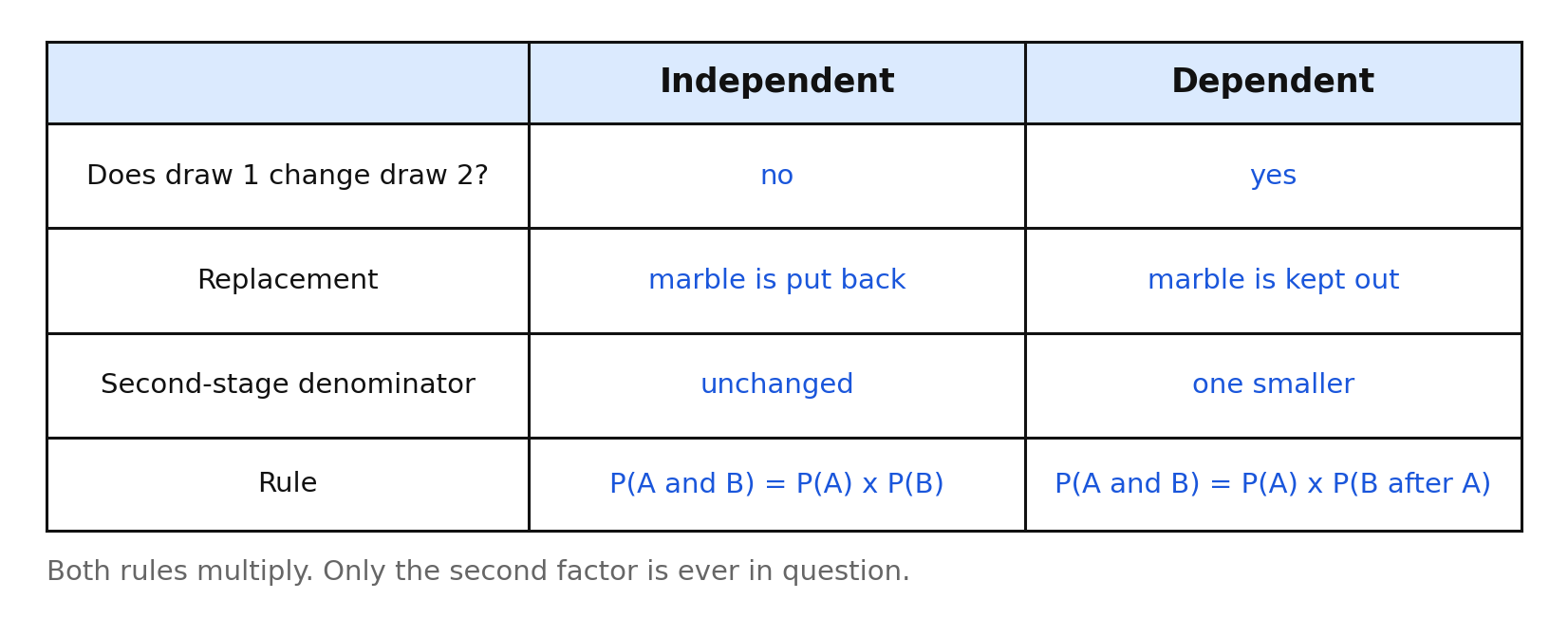
The two rules are more alike than different. Both multiply two probabilities. Both use the same first factor. The only thing ever in question is the second factor.
The same bag, computed both ways
Take red and blue, and put the two trees' answers next to each other.
| Outcome | With replacement (independent) | Without replacement (dependent) |
|---|---|---|
| both red | ||
| red then blue | ||
| blue then red | ||
| both blue | ||
| total |
Read the pattern down the column, because it is not random.
- Matching pairs get less likely without replacement. Both red drops from to , both blue from to . Taking a red marble out leaves fewer red marbles behind, so repeating a color is harder.
- Mixed pairs get more likely without replacement. Red-then-blue rises from to . Removing a red marble makes blue a larger share of what is left.
- Both columns still total . Nothing about replacement changes the fact that some outcome must occur.
That gives you a prediction you can make before computing: without replacement, sameness is punished and difference is rewarded. If your two answers move the other way, check the numerator of the second factor.
When the two answers are nearly equal
A bag of marbles, of them red, drawn twice for two reds:
Removing one marble from a thousand barely changes anything. The gap between independent and dependent shrinks as the collection grows, which is why polling a few hundred people out of millions is treated as independent. In a small bag, though, one marble is a large share of the whole, and the gap is real.
Worked examples
Example 1 — Which way is better?
A bag holds red and blue. A carnival game lets you draw two marbles either with or without replacement, and you win if both are red. Which should you choose?
Answer: With replacement, since . Winning needs the same color twice, and replacement is what keeps that color's share from shrinking.
Example 2 — The same game, a different prize
Same bag and same choice, but now you win with one marble of each color, in either order.
Answer: Without replacement, since . Wanting a difference makes the shrinking count work in your favor.
Example 3 — Comparing in a larger bag
A bag holds green and yellow. Compare both ways.
Answer: With replacement is larger, matching the rule that matching pairs are punished by removal.
Example 4 — Cards both ways
Find the probability that two cards are both spades, first with replacement and then without.
Answer: with replacement and without, and as predicted.
Example 5 — Naming the difference in words
State one way the two rules are alike and one way they differ.
Answer: Alike: both find by multiplying two probabilities, and both use the same . Different: the independent rule uses the original collection for the second factor, while the dependent rule recounts a collection that is one item smaller.
Guided practice
Use the bag of red and blue marbles for items 77–83.
- Find with replacement and without. Which is larger?
- Find both ways. Which is larger?
- Find both ways. Which is larger?
- Explain why drawing the same color twice is less likely without replacement.
- Explain why drawing two different colors is more likely without replacement.
- Which factor of the product is the same in both computations, and why?
- Copy and complete: with replacement, the second denominator is ; without replacement, it is .
Independent practice
A bag holds green and yellow counters. Use it for items 84–86, computing each probability both with and without replacement and saying which is larger.
- A bag holds red and white marbles. Find with replacement and without, and give both as decimals rounded to the nearest thousandth.
- For each situation, say whether the events are independent or dependent, then find the probability. a) A coin is flipped twice; both are heads. b) Two of raffle tickets are drawn and kept, and of the win; both drawn tickets win.
- Application. A game lets you draw two marbles from a bag of red and blue, with or without replacement, and you win if both are red. Which choice gives the better chance, and by how much as a decimal?
- Application. Same game and same bag, but you win with one marble of each color in either order. Which choice is better now, and why does the answer flip?
- Reasoning. A bag holds marbles, of them red. Compute with replacement and estimate it without replacement. Explain why the two are so close when the same comparison in a five-marble bag was not.
- Application. Two cards are chosen from a deck of . Find the probability that both are spades, with replacement and without, and say which is greater.
- Application. A teacher has name cards, of which are starred. Two cards are chosen. Find the probability that both are starred, with replacement and without.
- Error analysis. A student writes, "Independent and dependent probabilities use different operations: one multiplies and one adds." Correct the statement and say what actually differs.
- Reasoning. Describe a two-draw situation in which the with-replacement and without-replacement answers are exactly equal, and explain why.
Exit ticket 15.4
- A drawer holds black and blue socks. Find with replacement and without, and say which is larger.
- State one similarity and one difference between the two multiplication rules.
- A problem says two marbles are drawn "at the same time." Are the events independent or dependent, and why?
- Explain how you decide what the second denominator should be.
Chapter 15 Review
Vocabulary. outcome · sample space · event · compound event · independent events · dependent events · with replacement · without replacement · tree diagram · multiplication rule
Part A — Independent or dependent, and the role of replacement (8.PS.1a)
- Classify each as independent or dependent. a) Two spins of the same spinner. b) Two marbles drawn from a bag, the first kept out. c) A die rolled and then a coin flipped. d) Two names drawn from a hat, the first returned before the second draw. e) Two cards dealt from a deck, both kept.
- A bag holds red, green, and white marble. A green marble is drawn and replaced. Give the exact contents and total for the second draw.
- Same bag. A green marble is drawn and kept out. Give the exact contents and total for the second draw.
- In two sentences, explain how replacement impacts the probability of the second event. Mention both the numerator and the denominator.
- Two cards are dealt from a deck of without replacement. What is the denominator of the second probability?
- Two dice are rolled. Are the events independent? Explain what makes them so.
- Two marbles are drawn from a bag at the same time. Which case does this match, with replacement or without? Explain.
- Error analysis. A student says, "Putting the marble back makes the draws dependent, because now you might draw the very same marble twice." Explain what is wrong with the reasoning and classify the draws correctly.
Part B — Comparing and contrasting the two cases (8.PS.1b)
- Copy the comparison table from Lesson 15.4 and fill in, for each case, whether the first draw changes the second, what happens to the second denominator, and the rule.
- For a bag of red and blue, find both ways and say which is greater.
- Why is the first factor of the product the same whether or not there is replacement?
- For that same bag, find the probability of one marble of each color in either order, both ways. Which case is greater, and why?
- A bag holds red and white. Find both ways, and compare as decimals rounded to the nearest thousandth.
- Reasoning. Explain why the with- and without-replacement answers get closer together as the collection gets larger.
Part C — The probability of two independent events (8.PS.1c)
- One coin flip and one roll of a die. Find .
- Two dice are rolled. Find the probability that both show .
- A spinner with equal sectors numbered – is spun twice. Find .
- A bag holds green and yellow counters, drawn twice with replacement. Find .
- Two independent traffic signals are each green of the time. Find the probability that both are green.
- Application. A player makes of her free throws, and two attempts are treated as independent. Find the probability that she makes both, as a fraction and as a percent.
Part D — The probability of two dependent events (8.PS.1d)
- A bag holds red and white marbles, drawn twice without replacement. Find .
- Two cards are dealt from a deck of without replacement. Find the probability that both are kings.
- A jar holds blue and red chips, drawn twice without replacement. Find .
- A case holds blue and black pens. Two are taken without replacement. Find .
- A drawer holds black and blue socks. Two are taken without replacement. Find the probability of a matching pair.
- Application. A hat holds raffle tickets, of which win. Two tickets are drawn and kept. Find the probability that both win.
Part E — Mixed application and reasoning
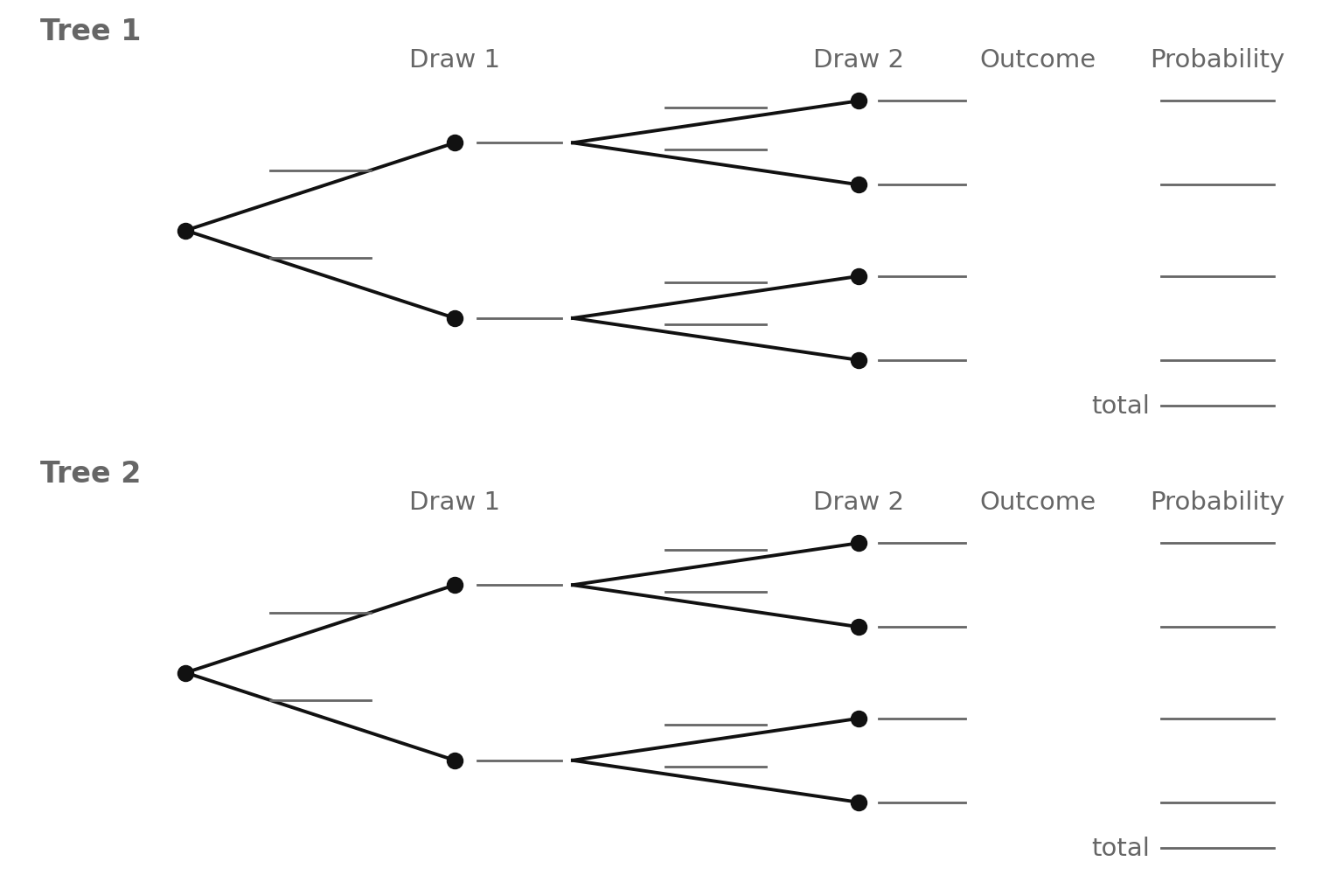
- Use the two blank tree templates above for a bag of red and blue marbles. Fill in Tree 1 for two draws with replacement and Tree 2 for two draws without replacement. Label every branch, compute all four products, and check that each total is .
- Application. A bowl holds apples and oranges. Two pieces of fruit are taken and eaten. Find the probability that both are apples.
- Application. Suppose instead the first piece of fruit in item 127 is put back before the second is taken. Find the probability that both are apples, and compare with your answer to item 127.
- Error analysis. Asked for the probability that two cards dealt without replacement are both aces, a student writes . Explain the error and give the correct probability.
- Reasoning. Using one bag of your own design, write one problem about two independent events and one about two dependent events. Solve both, and say which probability is larger and why.
Standards coverage check — Chapter 15
| Knowledge and Skill | Where it is taught | Where it is practiced |
|---|---|---|
| 8.PS.1a — determine whether two events are independent or dependent and explain how replacement impacts the probability | 15.1 (definitions, the replacement switch, reading the wording, rebuilding the second collection); reinforced in 15.3 (recounting both numerator and denominator) and 15.4 | Items 1–24; 76; 98, 99; Review Part A, items 100–107 |
| 8.PS.1b — compare and contrast the probability of independent and dependent events | 15.4 (the comparison table, the same bag computed both ways, why sameness is punished and difference rewarded, why the gap shrinks in a large collection) | Items 77–99; Review Part B, items 108–113; items 128, 130 |
| 8.PS.1c — determine the probability of two independent events | 15.2 (sample-space table, area model, multiplication rule, trees with replacement and with two different experiments) | Items 25–50; 77–79, 84–93, 96; Review Part C, items 114–119; items 126, 128 |
| 8.PS.1d — determine the probability of two dependent events | 15.3 (the adjusted second factor, the two trees compared, larger bags, two ways to win, people instead of marbles) | Items 51–76; 77–79, 84–93, 96; Review Part D, items 120–125; items 126, 127, 129 |
Every problem in this chapter involves exactly two events, as the standard requires. Probabilities are given as fractions in lowest terms, with decimals or percents added wherever a comparison or an interpretation is asked for. Branch fractions inside a tree are deliberately left unreduced, since records the count that hides. Bullets (a) and (b) are braided into the computational lessons on purpose: deciding which second factor to write is bullet (a) doing its work, and every comparison in Lesson 15.4 reuses a probability the student already computed in Lesson 15.2 or 15.3.
Answer keys for every set in this chapter are in Appendix A.