Chapter 3 — Percent Applications: Discounts, Markups, Tax, and Tip
Standard: 8.CE.1 — The student will estimate and apply proportional reasoning and computational procedures to solve contextual problems.
By the end of this chapter you will be able to:
- Estimate a percent of a price using benchmark percentages, and judge whether the estimate is high or low (8.CE.1a, b, c)
- Compute one discount and the resulting sale price (8.CE.1a)
- Compute one markup and the resulting selling price (8.CE.1a)
- Compute sales tax and the resulting total (8.CE.1b)
- Compute a tip and the resulting total (8.CE.1b)
- Compute a percent increase or a percent decrease from an original amount and a new amount (8.CE.1c)
Lessons: 3.1 Estimating and Finding a Percent of a Price · 3.2 Discounts and Sale Prices · 3.3 Markups and Selling Prices · 3.4 Sales Tax and the Total · 3.5 Tip and the Total · 3.6 Percent Increase and Percent Decrease
In Grade 7 you learned to find a percent of a number, and you practiced it on tips, tax, and discounts. This chapter does not re-teach that skill — it assumes it. What is new here is the second step. A percent of a price is almost never the answer to a real question. Nobody wants to know that the discount is $12.00; they want to know what the jacket costs. Nobody wants to know that the tax is $2.12; they want to know what to hand the cashier. Every problem in this chapter has two moves: find the percent of the price, then do something with it.
Money note. Every dollar amount in this chapter is rounded to the nearest cent, rounding a half cent up. So $8.965 becomes $8.97 and $0.954 becomes $0.95. Round once, at the end, and say what you rounded.
Numbering note. Item numbers run straight through the chapter, from 1 in Lesson 3.1 to 132 at the end of the review. They do not restart at each lesson.
Lesson 3.1 — Estimating and Finding a Percent of a Price
The one skill everything else is built on
A percent is a ratio out of 100, so of an amount means of that amount. To find it, write the percent as a decimal and multiply:
So of is , or $9.00.
The picture worth carrying in your head is a bar cut into ten equal blocks. Each block is of the price.
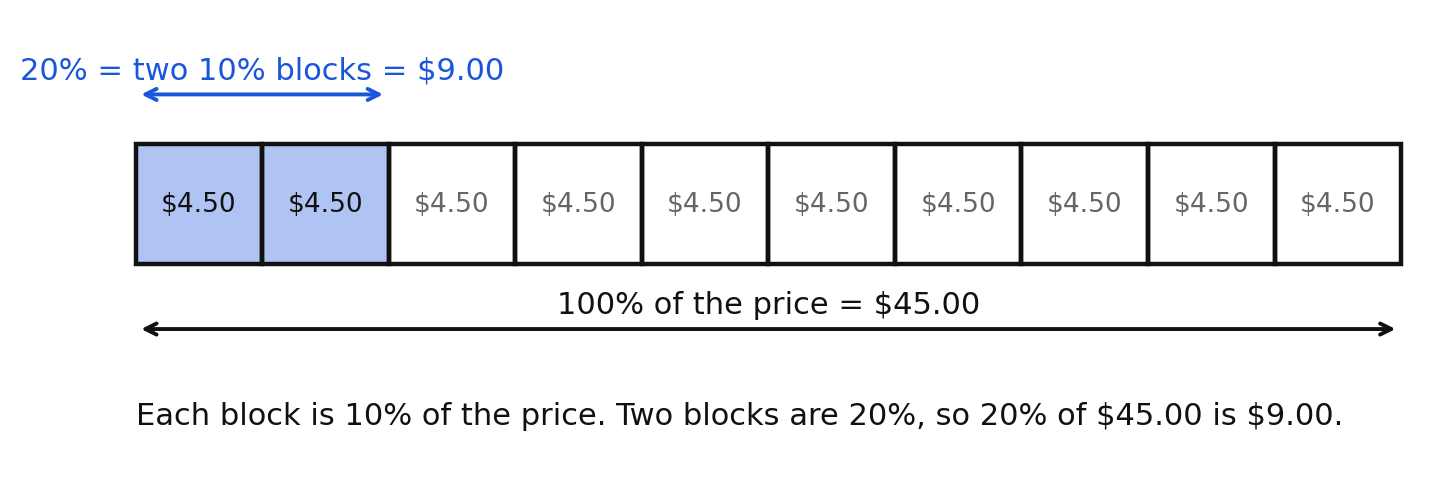
Two blocks are , and each block is worth $4.50, so is worth $9.00. The bar and the multiplication agree, as they must.
Benchmarks are for your head, not your paper
A benchmark percentage is one you can find mentally. These four do almost all the work in this chapter:
| Benchmark | How to find it | Example |
|---|---|---|
| move the decimal point one place left | of is | |
| find , then halve it | of is | |
| move the decimal point two places left | of is | |
| divide by 4, or halve twice | of is |
Other percents are built by combining benchmarks:
So of is , which you can check against .
The decimal point that moves belongs to the price. To find of , move the point in , not in the . This is the most common slip in mental percent work.
Estimate first, then compute
The standard asks you to estimate as well as solve, and estimating is not busywork. An estimate is a cheap check on an expensive computation. Round the price to a friendly number, use a benchmark, and keep the arithmetic in your head.
To estimate of : round to . Then is $8.00 and is $4.00, so the estimate is about $12.00. The exact value is , or $11.91. The estimate landed 9 cents high, because we rounded the price up.
That last sentence is the habit to build. If you round the price up, your estimate comes out high; if you round the price down, your estimate comes out low. Knowing the direction turns an estimate into a real check.
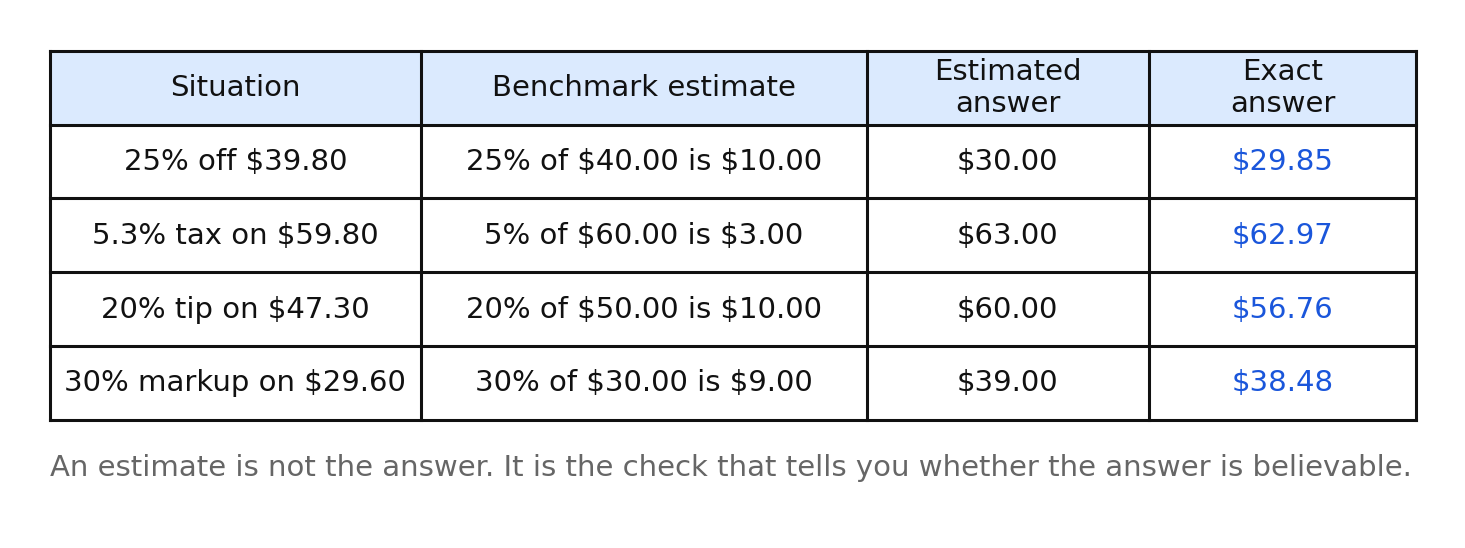
Notice how far the tip row is from its estimate: rounding up to moved the price by $2.70, and of a price that is too big is a tip that is too big. An estimate tells you the neighborhood, not the address.
Rounding money
A percent of a price often produces more than two decimal places. Sales tax of on is dollars, which is 95.4 cents. There is no such coin, so round to the nearest cent: $0.95.
The rule used everywhere in this chapter: look at the third decimal place. If it is 5 or more, round the cents up; otherwise leave the cents alone. And round once, at the very end of the problem — rounding partway through and then continuing can throw the final answer off by a cent.
Worked examples
Example 1 — A benchmark in your head
Find and of .
Move the decimal point one place left for , then halve that for .
Answer: $6.20 and $3.10
Example 2 — Combining benchmarks
Find of .
of is $2.45, and is three of those.
Check by multiplying: .
Answer: $7.35
Example 3 — A percent with a decimal in it
Find of .
Write the percent as a decimal. Since ,
Answer: $2.12
Example 4 — Rounding to the nearest cent
Find of .
This one comes out exact, with no third decimal place to round. Compare it with of , which is and must be rounded to $3.60.
Answer: $11.43
Example 5 — Estimate, then compute, then compare
Estimate of , then find it exactly, and say whether the estimate was high or low.
Round down to . Then is $4.00, so is about $8.00.
The price was rounded down, so the estimate is low — by 24 cents.
Answer: estimate $8.00; exact $8.24; the estimate is low
Guided practice
- Find of .
- Find of .
- Find of .
- Find of .
- Estimate of by rounding the price to .
- Find of exactly.
Independent practice
- Find each amount. a) of b) of c) of d) of
- Find of .
- Find of .
- Round each to the nearest cent. a) b) c)
- Estimate of using a benchmark, then compute it exactly and say how far off the estimate was.
- Reasoning. Explain why of a price can be found by moving the decimal point two places to the left.
- Application. A jacket is priced at . Find of that price.
- Error analysis. To find of , a student computes and writes $360.00. Explain the error and give the correct amount.
Exit ticket 3.1
- Find of .
- Find of .
- Find of .
- Estimate of , then say whether your estimate is high or low and why.
Lesson 3.2 — Discounts and Sale Prices
What a discount is
A discount is an amount subtracted from a price. It is usually announced as a percent of the original price: " off." The percent by itself is not the discount; the discount amount is the dollars you save, and the sale price is what you actually pay.
Read the question carefully before you answer. "How much do you save?" wants the discount amount. "What does it cost?" wants the sale price. Handing back the discount amount when the sale price was asked for is the single most common mistake in this lesson.
Two routes to the sale price
There is a second route that skips the subtraction. If comes off, then stays on, and of the price is the sale price.
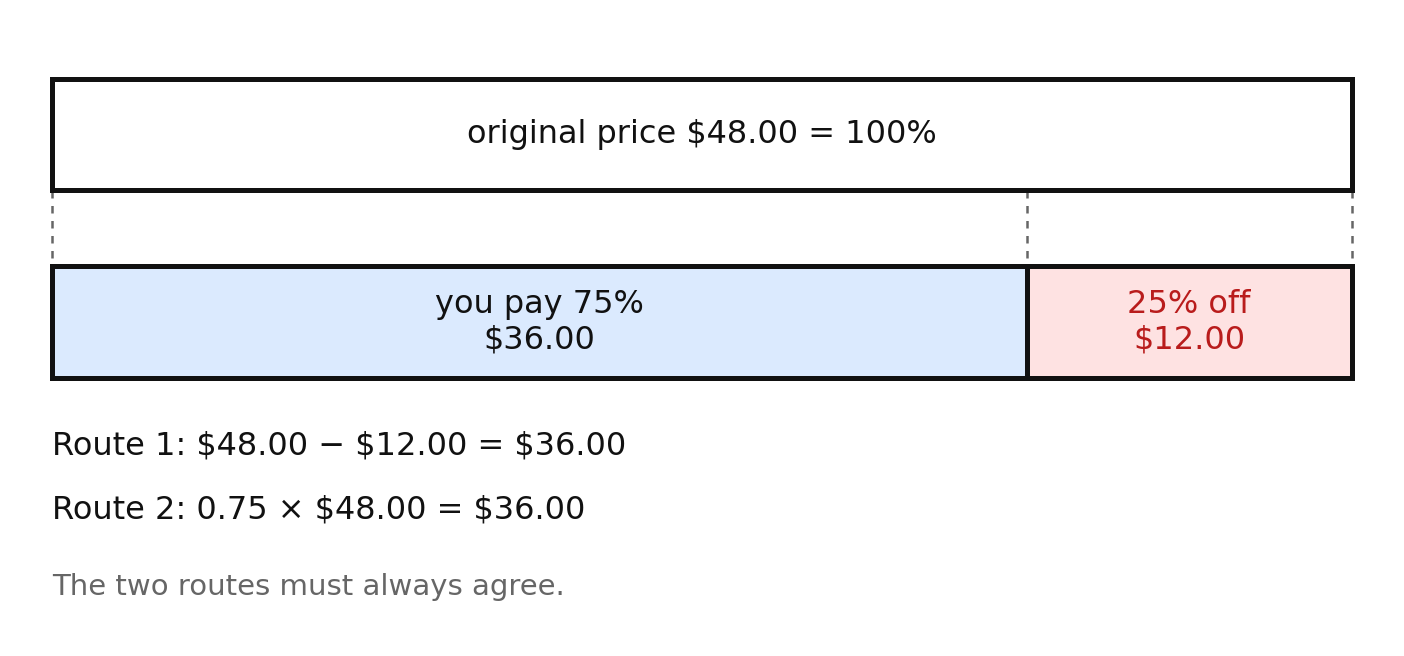
Both routes on a item at off:
The number is the complement multiplier for a discount. For any discount rate , the sale price is
Route 2 is faster and gives fewer chances to slip, but Route 1 is the one that answers "how much did I save?" Know both.
One discount per problem. Grade 8 problems apply exactly one discount to a price. You will never be asked to take off and then another off the result, and you will never combine a discount with a markup on the same item. If a problem seems to ask for two, re-read it.
Estimating a sale price
Round the price, take the benchmark, subtract. A lamp at off: round to , take to get $10.00, and the sale price is about $30.00. The exact discount is , so the exact sale price is $29.85 — a nickel below the estimate, because the price was rounded up.
When the cents get awkward
A tent at off has a discount of dollars, which rounds to $60.00. Subtracting gives . Check with the complement route: , which also rounds to $89.99. The two routes agree, which is the point of checking.
Worked examples
Example 1 — Discount amount and sale price
A backpack is off. Find the discount amount and the sale price.
Answer: discount $12.00; sale price $48.00
Example 2 — Using the complement multiplier
A game is off. Find the sale price without finding the discount.
Since ,
Answer: $24.00
Example 3 — A rate that is not a benchmark
A tent is off. Find the discount amount and the sale price.
Check: .
Answer: discount $8.46; sale price $47.94
Example 4 — Rounding inside a discount
A chair is off. Find the sale price.
Answer: $54.45
Example 5 — Estimate, then compute
A sweater is off. Estimate the sale price, then find it exactly.
Round to : of that is $12.00, so the sale price is about $48.00.
The price was rounded down, so the estimate is low.
Answer: estimate about $48.00; exact sale price $49.40
Guided practice
- A backpack is off. Find the discount amount.
- Find the sale price of that same backpack.
- A pair of shoes is off. Find the sale price.
- A game is off. Find the sale price using the complement multiplier.
- A bike is off. Find the discount amount and the sale price.
- Estimate the sale price of a lamp at off by rounding the price to .
Independent practice
- Find the discount amount and the sale price. a) at off b) at off c) at off d) at off
- A coat is off. Find the sale price.
- A tent is off. Find the discount amount and the sale price.
- A chair is off. Find the sale price.
- Reasoning. Explain why multiplying the original price by gives the sale price directly when an item is off.
- Application. A store advertises off a coat. How much does a shopper save, and what does the coat cost?
- Error analysis. Asked for the sale price of a item at off, a student answers $14.40. Explain what the student found and give the sale price.
- Estimate, then check. A sweater is off. Estimate the sale price, then compute it exactly, and say whether the estimate was high or low.
Exit ticket 3.2
- A item is off. Find the sale price.
- A item is off. Find the discount amount.
- A item is off. Find the sale price.
- Explain why subtracting the discount and multiplying by the complement give the same sale price.
Lesson 3.3 — Markups and Selling Prices
What a markup is
A store buys an item at some cost and sells it for more. The extra is a markup, and it pays for rent, wages, and profit. Like a discount, it is announced as a percent — but of the cost, and it is added instead of subtracted.
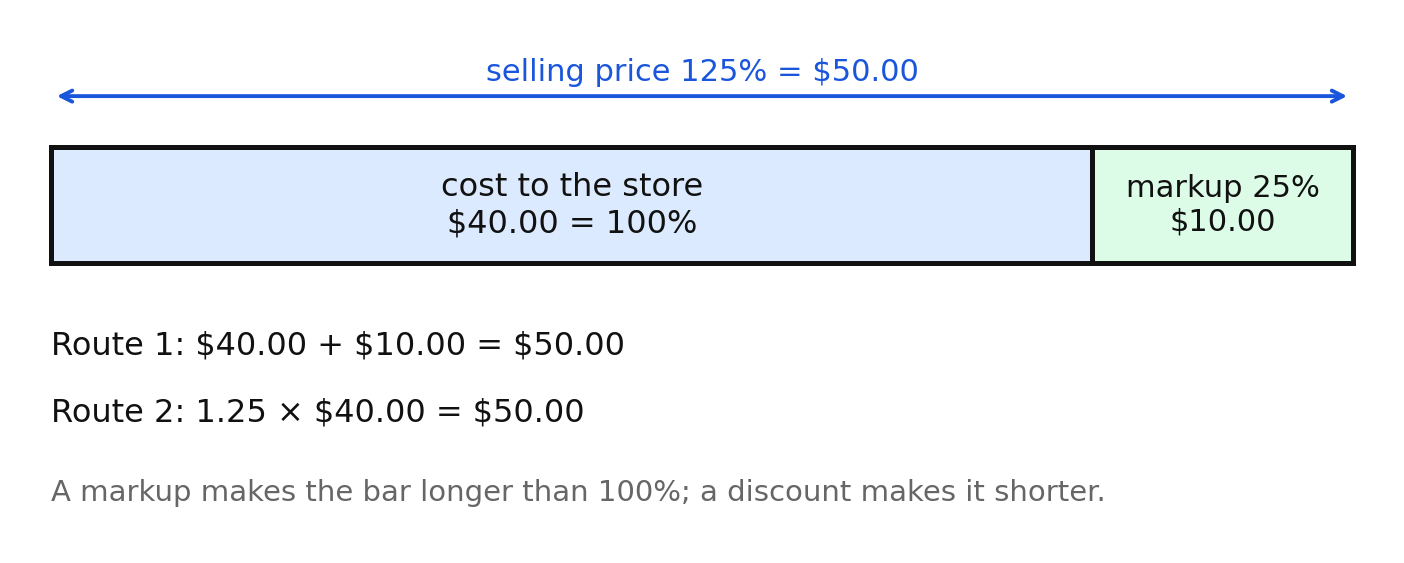
The bar for a markup is longer than the original, because a markup pushes past . That single picture is the difference between this lesson and the last one.
The multiplier for a markup
If is added on, the selling price is of the cost:
In general, for a markup rate ,
Compare the two multipliers side by side and the pattern is hard to forget: a discount multiplies by , and a markup multiplies by . A discount multiplier is always less than 1; a markup multiplier is always greater than 1. If you ever compute a sale price larger than the original, or a selling price smaller than the cost, you have used the wrong one.
Markups can be bigger than 100%
Nothing stops a markup rate from exceeding , and in food service it usually does. A cake with of ingredients marked up has a markup amount of dollars and sells for , or $18.90. Equivalently, . A markup over means the markup amount is larger than the cost itself — which is exactly what "more than doubling the price" means.
One markup per problem. As with discounts, Grade 8 problems apply exactly one markup. No stacking a second markup on a marked-up price, and no mixing a markup and a discount on the same item.
Worked examples
Example 1 — Markup amount and selling price
An item costs the store and is marked up . Find both.
Answer: markup $10.00; selling price $50.00
Example 2 — Using the multiplier
An item costs and is marked up . Find the selling price.
Answer: $68.20
Example 3 — Cents in the markup
An item costs and is marked up . Find the markup amount and the selling price.
Answer: markup $12.88; selling price $49.68
Example 4 — Rounding to the nearest cent
An item costs and is marked up . Find the selling price.
The exact product is , so no rounding is needed here.
Answer: $22.63
Example 5 — Estimate, then compute
An item costs and is marked up . Estimate the selling price, then find it exactly.
Round to : of that is $20.00, so the price is about $100.00.
Answer: estimate about $100.00; exact selling price $98.00
Guided practice
- An item costs and is marked up . Find the markup amount.
- Find the selling price of that same item.
- An item costs and is marked up . Find the selling price.
- An item costs and is marked up . Find the selling price.
- An item costs and is marked up . Find the markup amount and the selling price.
- Estimate the selling price of an item costing with a markup, by rounding the cost to .
Independent practice
- Find the markup amount and the selling price. a) cost , markup b) cost , markup c) cost , markup d) cost , markup
- An item costs and is marked up . Find the selling price.
- An item costs and is marked up . Find the markup amount and the selling price.
- A shop marks up a item by . Find the selling price.
- Reasoning. Explain why the multiplier for a markup is , and why a markup multiplier is always greater than 1.
- Application. A bakery spends on ingredients for one cake and marks it up . Find the selling price.
- Error analysis. Asked for the selling price of a item with a markup, a student answers $15.00. Explain what the student found and give the selling price.
- Estimate, then check. An item costs and is marked up . Estimate the selling price, then compute it exactly.
Exit ticket 3.3
- An item costs and is marked up . Find the selling price.
- An item costs and is marked up . Find the markup amount.
- An item costs and is marked up . Find the selling price.
- In one or two sentences, explain the difference between a discount and a markup, and what it does to the multiplier.
Lesson 3.4 — Sales Tax and the Total
Tax is added, and the question is always the total
Sales tax is a percent of a purchase price collected by the government. You do not get to choose it, and the store adds it at the register. In Virginia the combined state and local rate is in most places, higher in some regions, and there is a reduced rate of on most groceries.
Sales tax works exactly like a markup, arithmetically:
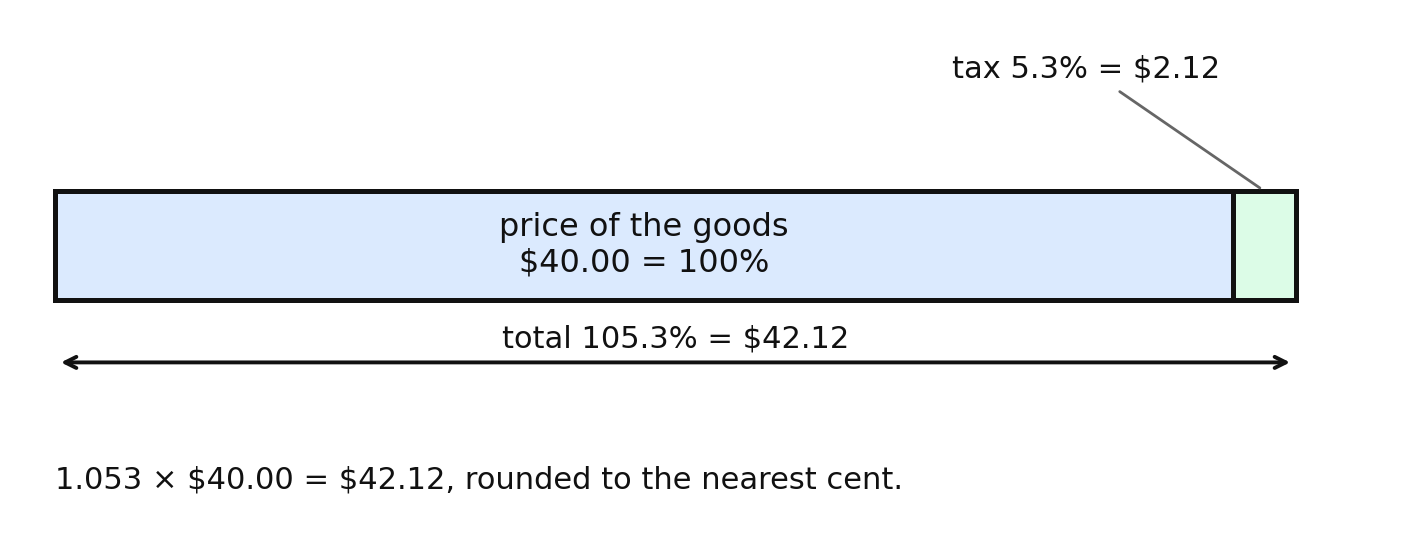
A tax problem asks for the total. The tax amount is a step on the way, not the answer. If a problem says "find the total cost," an answer of $2.12 is not a small error — it is an answer to a different question.
The 105.3% shortcut
Since the total is the price plus of the price, the total is of the price:
On a purchase, , or $42.12. The two-step route gives and . Same answer.
The shortcut is worth using because it rounds only once. Watch what happens on an purchase:
and by the two-step route, , then . They agree here, and on nearly every problem you will meet — but the one-step route is the one that cannot drift.
Estimating a total with tax
Virginia's is close to the benchmark , and is easy: find and halve it. So to estimate the total on a purchase, round to , take to get $3.00, and estimate about $63.00. The exact tax is , or $3.17, and the exact total is $62.97.
Because is less than , estimating tax with always understates the tax a little. Whether the whole estimate lands high or low also depends on how you rounded the price.
Tax on more than one item
Tax is charged on the subtotal, so add up the goods first, then tax once. Two tickets at each with tax:
Taxing each ticket separately and adding would give the same answer here, but it is slower and it invites two roundings where one will do.
Worked examples
Example 1 — Tax and total
Find the tax and the total on a purchase at a rate.
Answer: tax $2.12; total $42.12
Example 2 — Using the one-step multiplier
Find the total on a purchase at a rate.
Answer: $79.50
Example 3 — Rounding the tax up
Find the tax and the total on an purchase at a rate.
The third decimal place is a 5, so the cents round up.
Check: .
Answer: tax $0.53; total $9.28
Example 4 — The reduced grocery rate
Find the total on of groceries at the rate.
of is $0.63, so the total is .
Answer: $63.63
Example 5 — Estimate, then compute
Estimate the total on a purchase at , then compute it exactly.
Round to and use : is $8.00, so is $4.00, and the total is about $84.00.
Answer: estimate about $84.00; exact total $83.82
Guided practice
- Find of .
- A purchase is and the tax rate is . Find the total.
- A purchase is and the tax rate is . Find the tax and the total.
- A purchase is and the tax rate is . Find the total.
- A grocery order is and the reduced rate is . Find the total.
- Estimate the total on a purchase at by rounding the price to and the rate to .
Independent practice
- Find the tax and the total. a) at b) at c) at d) at
- A purchase is and the tax rate is . Find the total.
- A purchase is and the tax rate is . Find the tax and the total.
- A purchase is and the tax rate is . Find the total.
- Reasoning. Explain why the total on a purchase taxed at is of the price.
- Application. Two concert tickets cost each and the tax rate is . Find the subtotal, the tax, and the total.
- Error analysis. Asked for the total cost of a purchase at tax, a student answers $2.12. Explain what the student found and give the total.
- Estimate, then check. Estimate the total on a purchase at , then compute it exactly and compare.
Exit ticket 3.4
- A purchase is and the tax rate is . Find the tax and the total.
- A purchase is and the tax rate is . Find the total.
- A purchase is and the tax rate is . Find the total.
- Explain why estimating Virginia's tax with is close, and whether the estimated tax comes out high or low.
Lesson 3.5 — Tip and the Total
A tip is a percent you choose
A tip, or gratuity, is money added to a bill for service. Unlike tax, the rate is yours to pick — , , and are the common choices. The arithmetic is the same as tax:
And as with tax, the question asks for the total. Leaving the tip amount as your final answer answers a question nobody asked.
Doing it at the table
Tips get computed in restaurants without paper, so the benchmark route matters more here than anywhere else in the chapter. Everything is built off .
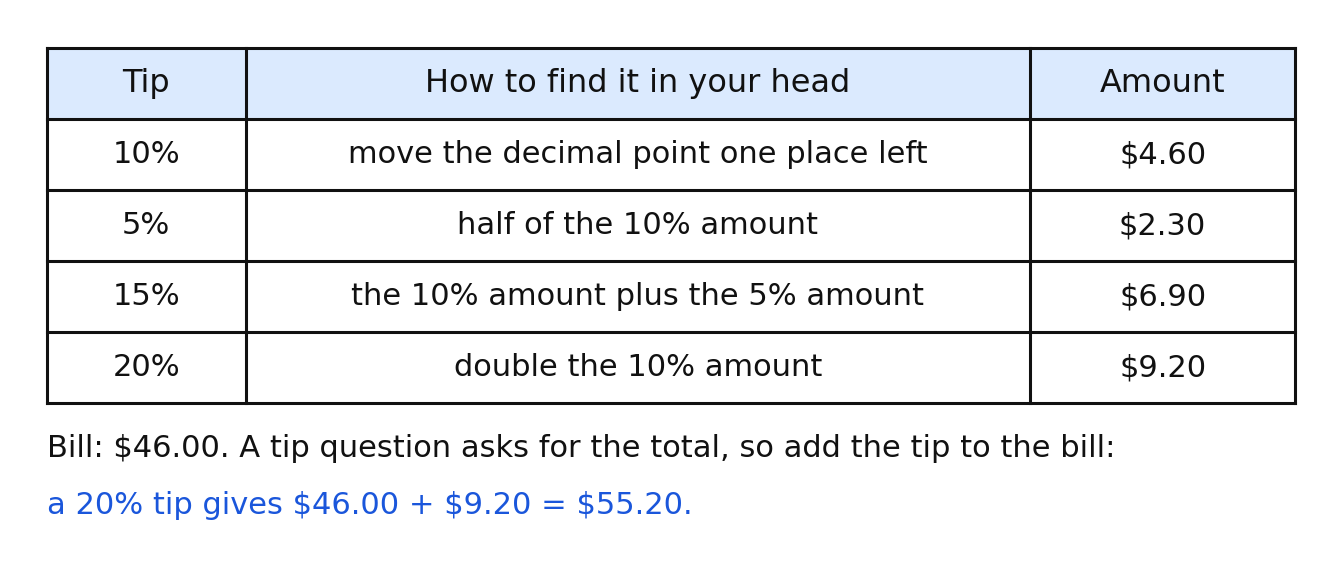
On a bill: is $4.60. Halve it for : $2.30. Add those for : $6.90. Double the first for : $9.20. A tip makes the total , or $55.20.
For , the cleanest mental route is minus , or just multiply: on a bill.
The multiplier again
The same shortcut works, and for the same reason. A tip makes the total of the bill:
On a bill, , or $87.36. By the two-step route, the tip is and the total is .
Tip and tax in the same meal
A restaurant bill can carry both, and this is the one place in the chapter where two percents appear in one problem. That is allowed — the standard names tax and tip together — and it is not the forbidden case, which is chaining two discounts or mixing a discount with a markup.
The convention used in this book: the tip is computed on the pre-tax bill. On a meal with tax and a tip,
Notice that both percents are taken of the same . Neither one is applied to the other's result.
Worked examples
Example 1 — A benchmark tip
Find a tip on a bill and the total.
is $4.00 and is $2.00, so the tip is $6.00.
Answer: tip $6.00; total $46.00
Example 2 — A 20% tip with the multiplier
Find the total on a bill with a tip.
Answer: $29.52
Example 3 — An 18% tip that needs rounding
Find the tip and the total on a bill with an tip.
Answer: tip $3.60; total $23.59
Example 4 — Tax and tip together
A meal costs . Tax is and the tip is of the pre-tax bill. Find the total.
Answer: $80.64
Example 5 — Estimate, then compute
Estimate the total on a bill with a tip, then compute it exactly.
Round to : is $10.00, so the total is about $60.00.
The price was rounded up by $2.70, so the estimate came out high by more than $3.
Answer: estimate about $60.00; exact total $56.76
Guided practice
- Find a tip on a bill and the total.
- Find a tip on a bill and the total.
- Find an tip on a bill and the total.
- Find a tip on a bill and the total.
- Find a tip on a bill and the total.
- Estimate a tip on a bill by rounding the bill to .
Independent practice
- Find the tip and the total. a) bill, tip b) bill, tip c) bill, tip d) bill, tip
- A bill is and the tip is . Find the total.
- A bill is and the tip is . Find the tip and the total.
- A group's bill is and the tip is . Find the total.
- Reasoning. Explain the "find , then add half of it" method for a tip, and why it works.
- Application. A meal costs . Tax is and the tip is of the pre-tax bill. Find the tax, the tip, and the total.
- Error analysis. A diner computes a tip on a bill as $9.00 and leaves $9.00 on the table as payment for the whole meal. Explain the error and give the amount that should be paid.
- Estimate, then check. Estimate the total on a bill with a tip, then compute it exactly and say how far off the estimate was.
Exit ticket 3.5
- Find a tip on a bill and the total.
- Find a tip on a bill and the total.
- Find an tip on a bill and the total.
- Explain why a bill-plus-tip total is always more than of the bill.
Lesson 3.6 — Percent Increase and Percent Decrease
A different question
The first five lessons all gave you a percent and asked for an amount. This lesson runs the other way: you are given two amounts and asked for the percent.
If a price moves from an original amount to a new amount, the change is a percent increase when the price went up and a percent decrease when it went down. Either way:
where the amount of change is the positive difference between the two amounts.
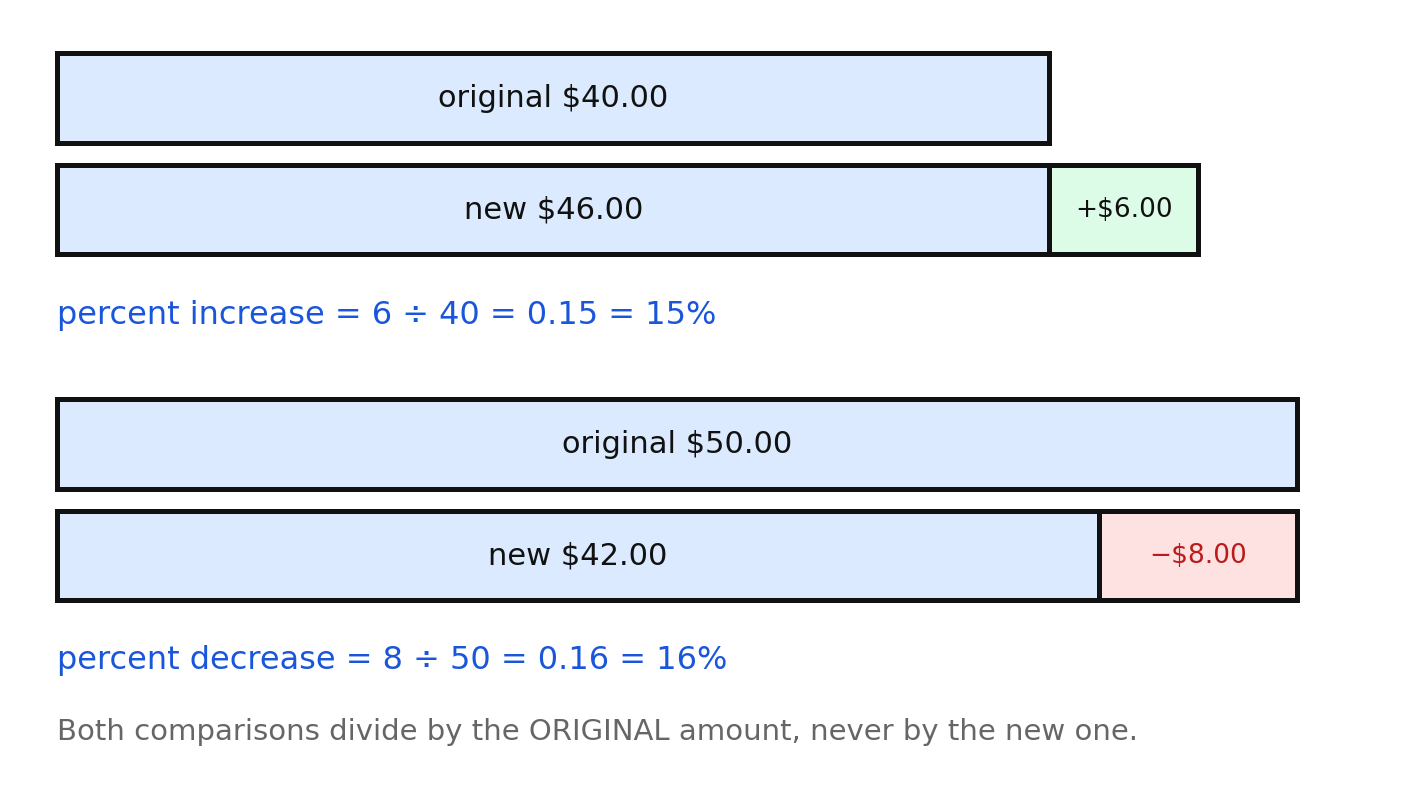
A price that goes from to increased by $6.00, and
A price that goes from to decreased by $8.00, and
The denominator is always the original
This is the whole lesson in one sentence, and it is where nearly every error lives. A percent change compares the change to where it started, not to where it ended.
Take rising to . The change is $10.00, and dividing by the original gives . Divide by the new amount instead and you get — a different number, and the wrong answer to the question asked.
Both of those percents mean something, which is why the mistake is easy to make. is how much the price went up from $40.00. is how much of the new price the raise accounts for. Only the first is the percent increase.
Here is a consequence worth sitting with. A price going from $40.00 to $50.00 is a increase, but going from $50.00 to $40.00 is a decrease. Same $10.00 of movement, different percents, because the original amount is different each time. Percent increase and percent decrease are not mirror images.
Three steps, in order
- Find the amount of change: subtract the smaller amount from the larger.
- Divide by the original amount.
- Write the quotient as a percent, and name it an increase or a decrease.
On a rent that rises from to :
so that is a increase.
Rounding percents. Most problems in this chapter come out to an exact percent or an exact tenth of a percent. When a quotient does not terminate, round the percent to the nearest tenth of a percent and say that you did.
It does not have to be money
Percent change applies to any quantity that has a before and an after. A town's recycling tonnage rising from 1,250 tons to 1,400 tons is an increase of 150 tons, and
a increase. Notice that no dollar sign appeared anywhere, and nothing about the method changed.
Worked examples
Example 1 — A percent increase
A price rises from to . Find the percent increase.
Answer: a increase
Example 2 — A percent decrease
A price falls from to . Find the percent decrease.
Answer: a decrease
Example 3 — A change with cents
A price rises from to . Find the percent increase.
Answer: a increase
Example 4 — Naming the direction
An amount changes from to . Is that an increase or a decrease, and by what percent?
The amount went down, so it is a decrease.
Answer: a decrease
Example 5 — Catching the wrong denominator
A student says that rising to is a increase, because . Is that right?
The change is , which is correct. But is the new amount, not the original. Dividing by the original gives
Answer: No — it is a increase
Guided practice
- A price rises from to . Find the amount of increase and the percent increase.
- A price falls from to . Find the amount of decrease and the percent decrease.
- An amount rises from to . Find the percent increase.
- An amount falls from to . Find the percent decrease.
- A price rises from to . Find the percent increase.
- An amount changes from to . Say whether it is an increase or a decrease, and by what percent.
Independent practice
- Find the percent change and name it an increase or a decrease. a) to b) to c) to d) to
- A monthly rent rises from to . Find the percent increase.
- Attendance at a school play falls from 240 people to 216 people. Find the percent decrease.
- A phone plan goes from to per month. Find the percent increase.
- A used bike listed at sells for . Find the percent decrease.
- Reasoning. Explain why the original amount is always the denominator. Use rising to to show what answer you get if you divide by the new amount instead.
- Application. A town's recycling rises from 1,250 tons to 1,400 tons in a year. Find the percent increase.
- Error analysis. A student says rising to is a increase because . Explain the error and give the correct percent increase.
Exit ticket 3.6
- A price rises from to . Find the percent increase.
- A price falls from to . Find the percent decrease.
- A price rises from to . Find the percent increase.
- Explain the difference between "the price decreased by " and "the new price is of the original price."
Chapter 3 Review
Vocabulary. percent · benchmark percentage · estimate · discount · discount amount · sale price · complement multiplier · cost · markup · markup amount · selling price · sales tax · subtotal · total · tip · original amount · new amount · amount of change · percent increase · percent decrease
Part A — One discount or one markup and the resulting price (8.CE.1a)
- A item is off. Find the discount amount and the sale price.
- A item is off. Find the sale price.
- An item costs and is marked up . Find the selling price.
- An item costs and is marked up . Find the selling price.
- Estimate, then compute. A item is off. Estimate the sale price, then find it exactly.
- Application. A coat priced at is off. How much does a shopper save, and what does the coat cost?
Part B — Sales tax, tip, and the resulting total (8.CE.1b)
- A purchase is and the tax rate is . Find the total.
- A purchase is and the tax rate is . Find the tax and the total.
- A bill is and the tip is . Find the total.
- A bill is and the tip is . Find the total.
- A grocery order is and the reduced rate is . Find the total.
- Application. A meal costs . Tax is and the tip is of the pre-tax bill. Find the tax, the tip, and the total.
Part C — Percent increase and percent decrease (8.CE.1c)
- A price rises from to . Find the percent increase.
- A price falls from to . Find the percent decrease.
- A price rises from to . Find the percent increase.
- A club's membership falls from 320 members to 272 members. Find the percent decrease.
- A price rises from to . Find the percent increase.
- A jacket's price falls from to . Find the percent decrease.
Part D — Mixed application and reasoning
- Application. A pair of jeans is off, and sales tax is charged on the sale price. Find the sale price and the total.
- Application. A restaurant bill is and the diner leaves a tip. Find the total.
- Reasoning. Explain why the multiplier for a discount is while the multiplier for a markup is .
- Error analysis. A student finds the percent decrease from to by computing and answers about . Explain the error and give the correct percent decrease.
- Estimate and judge. Without computing exactly, decide whether a item at off costs more or less than , and justify your reasoning. Then compute the sale price exactly.
- Reasoning. One store raises a price from to . Another store lowers a price from to . Both prices moved by . Are the two percent changes equal? Explain.
Standards coverage check — Chapter 3
| Knowledge and Skill | Where it is taught | Where it is practiced |
|---|---|---|
| 8.CE.1a — estimate and solve contextual problems that require the computation of one discount or markup and the resulting sale price | 3.2 (discount), 3.3 (markup); the percent-of-a-price skill they rest on is built in 3.1 | Items 19–54; item 113 for the estimation half; Review Part A, items 109–114, and items 127, 129, 131 |
| 8.CE.1b — estimate and solve contextual problems that require the computation of the sales tax, tip and resulting total | 3.4 (sales tax), 3.5 (tip) | Items 55–90; Review Part B, items 115–120, and items 127, 128 |
| 8.CE.1c — estimate and solve contextual problems that require the computation of the percent increase or decrease | 3.6 | Items 91–108; Review Part C, items 121–126, and items 130, 132 |
Estimation is required by all three bullets, not just one, so it is taught first in Lesson 3.1 and then practiced inside each application lesson: items 5, 11, 18, 24, 32, 42, 50, 60, 68, 78, 86, 113, and 131 all ask for an estimate before or beside an exact answer.
Two limits from the standard are enforced throughout. Every problem applies exactly one discount or markup — no item chains two discounts, and no item combines a discount with a markup. Every tax and tip problem asks for the resulting total, not just the tax or tip amount.
Grade 7 Chapter 6 covered finding a percent of a number, including benchmark and estimation strategies; this chapter assumes that skill and applies it to money.
Answer keys for every set in this chapter are in Appendix A.