Chapter 4 — Equivalent Algebraic Expressions
Standard: 8.PFA.1 — The student will represent, simplify, and generate equivalent algebraic expressions in one variable.
By the end of this chapter you will be able to:
- Represent an algebraic expression in one variable with algebra tiles and pictures, and read an expression off a model (8.PFA.1a)
- Represent an expression such as as a rectangular arrangement of tiles, so the distributive property is something you can see (8.PFA.1a)
- Name the property of real numbers behind each move you make: commutative, associative, distributive, identity, inverse (8.PFA.1b)
- Combine like terms when the coefficients and numeric terms are rational — fractions and decimals, positive or negative (8.PFA.1b)
- Expand an expression with the distributive property, including a fractional or decimal factor, and then simplify (8.PFA.1b)
- Generate several different expressions equivalent to a given one, including a factored form, and justify each with properties (8.PFA.1b)
Lessons: 4.1 Representing Expressions with Tiles and Pictures · 4.2 The Properties of Real Numbers · 4.3 Combining Like Terms with Rational Coefficients · 4.4 Expanding with the Distributive Property · 4.5 Generating Equivalent Expressions
Calculator note. A calculator is available on the Grade 8 test, but this chapter is about equivalence, and no calculator will tell you whether and are the same expression — there is no number to compute. Every fraction and decimal here was chosen so the arithmetic is mental: halves, thirds, fourths, fifths, sixths, eighths, tenths, and decimals to the hundredths at worst. If you reach for a calculator, look again — there is almost always a factor that makes the numbers land whole.
Numbering note. Item numbers run straight through the chapter, from 1 in Lesson 4.1 to 126 at the end of the review. They do not restart at each lesson.
Lesson 4.1 — Representing Expressions with Tiles and Pictures
What "equivalent" means, and what it does not
An algebraic expression contains a variable, a letter standing for a number you have not been told. You cannot collapse to a single number, because is unknown. What you can do is rewrite it in a different but equally true form.
Two expressions are equivalent when they produce the same value for every replacement value of the variable — not for one lucky value, for every one. That word "every" is the whole reason this chapter leans on properties rather than on checking a few numbers.
In Grade 7 you did this work with whole-number coefficients. Grade 8 lifts that restriction: coefficients and numeric terms may be rational, so is fair game. Everything else stays bounded. Expressions here contain only linear and numeric terms — every variable term is a number times to the first power. There is no , no , and never a second variable.
Tiles for variables, tiles for units
The fastest way to see why two expressions are equivalent is to build them out of objects and compare the piles.
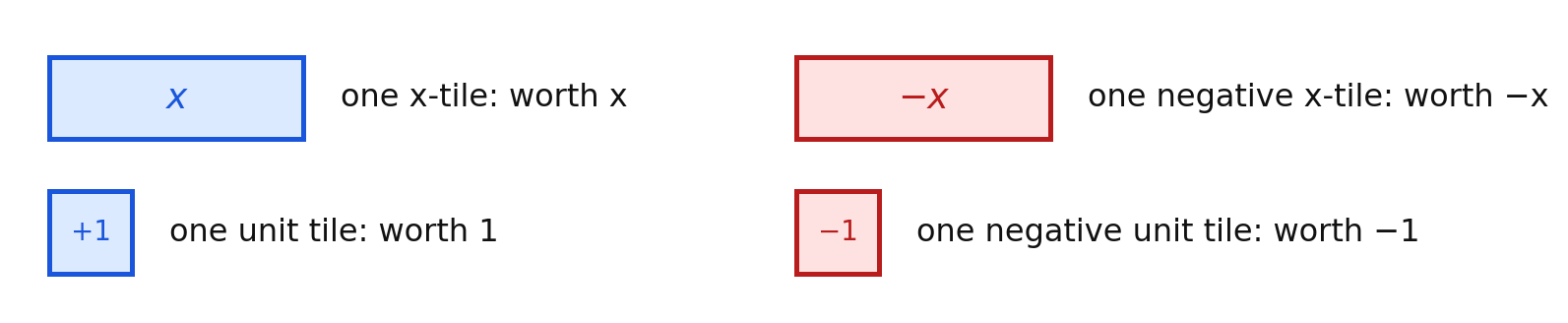
An algebra tile set has long rectangles and small squares. One long rectangle is an -tile: its value is , whatever turns out to be. One small square is a unit tile: its value is . Color carries the sign — blue pieces are positive, red pieces are negative.
Here is built from tiles: three -tiles, four negative unit tiles. The model is a literal picture of the expression.
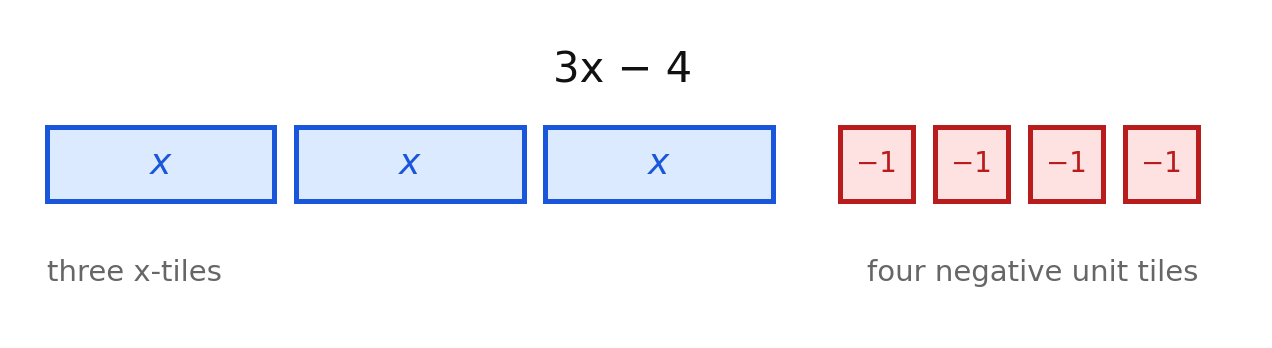
Notice that the -tile is drawn longer than the unit tile and we never say how much longer. That is exactly right: is unknown. A student who decides the -tile is worth three unit tiles has stopped modeling a variable.
Watch the signs when you read an expression. In , the subtraction sign belongs to the , so the model is six positive unit tiles and two negative -tiles. Rewriting the expression as a sum first, , makes the sign of each term impossible to lose.
Zero pairs
A positive -tile placed with a negative -tile is worth . That is a zero pair. The same goes for a unit tile with a negative unit tile.
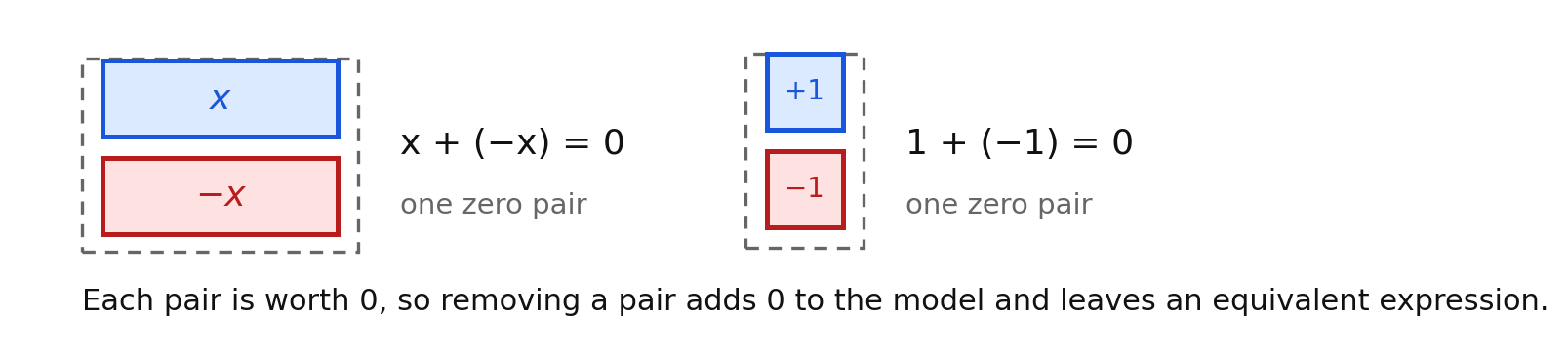
Zero pairs are the engine of the chapter. Removing a zero pair removes a value of , and removing never changes what the pile is worth, so the model before and the model after represent equivalent expressions. There is a property name for this, and Lesson 4.2 supplies it: is the additive inverse property.
Picturing the distributive property
The standard asks specifically for representations of expressions "that apply the distributive property," and tiles do that beautifully when you stop laying them in a line and arrange them in a rectangle.
Build three identical rows, each holding one -tile and two unit tiles. Each row is . Three rows make . Now ignore the rows and count the whole rectangle: three -tiles and six unit tiles, which is .
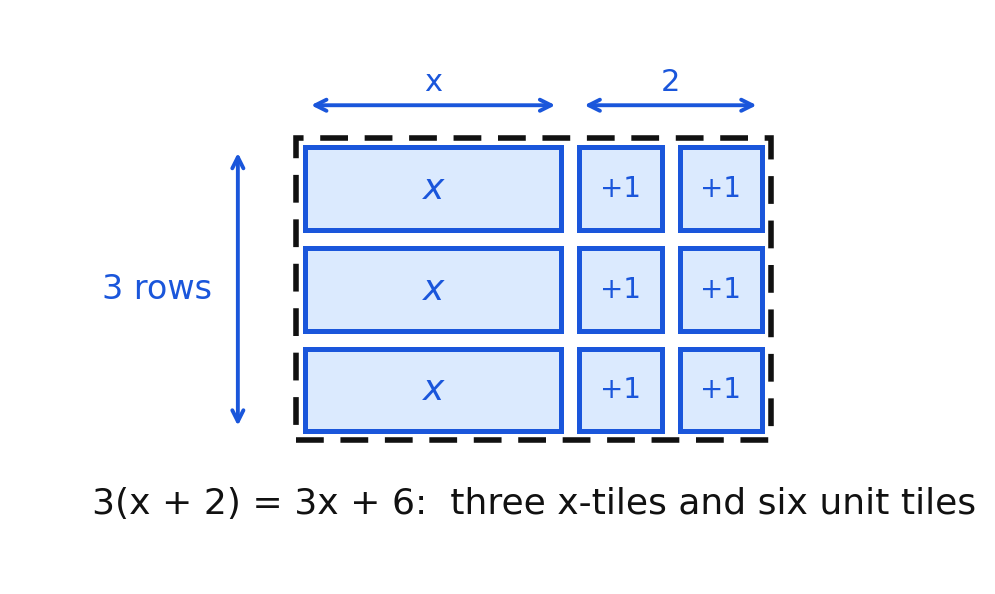
Same tiles, two descriptions, so the two expressions are equivalent:
The picture also shows why the outside factor multiplies every term inside. Each of the three rows contains its own copy of the , so there are three copies of the in the rectangle, not one.
A fractional factor is the same picture read backwards. To model , lay out six -tiles and nine unit tiles, then split the collection into three equal groups. Each group holds two -tiles and three unit tiles, so one-third of the pile is .
Worked examples
Example 1 — Reading an expression from a model
A model shows two -tiles and five negative unit tiles. Write the expression.
Two -tiles give . Five negative unit tiles give .
Answer:
Example 2 — A subtraction sign in front of the variable term
Describe a tile model for .
Rewrite as a sum so every sign is attached to its own term: .
Answer: Six positive unit tiles and two negative -tiles.
Example 3 — Using zero pairs on a model
A model shows five -tiles and three negative -tiles. What is left after all zero pairs are removed, and what does that tell you?
Pair each negative -tile with a positive -tile. Three pairs form and cancel, and positive -tiles remain.
Answer: Two -tiles remain, so is equivalent to .
Example 4 — A rectangular arrangement for a product
Describe a rectangular tile arrangement for and write the expanded expression.
Four identical rows, each holding one -tile and three unit tiles. Counting the whole rectangle gives four -tiles and twelve unit tiles.
Answer:
Example 5 — A fractional factor as equal groups
Describe how to model with tiles.
Lay out six -tiles and four unit tiles, then split the pile into two equal groups. Each group holds three -tiles and two unit tiles.
Answer:
Example 6 — Comparing two models
Model A: three -tiles and two negative -tiles, together with five unit tiles and eight negative unit tiles. Model B: one -tile and three negative unit tiles. Are the two expressions equivalent?
In Model A, two zero pairs of -tiles cancel, leaving one -tile. Five of the eight negative unit tiles pair off with the five positive unit tiles, leaving three negative unit tiles. So Model A reduces to one -tile and three negative unit tiles — exactly Model B.
Answer: Yes. Both are equivalent to .
Guided practice
- A model shows two -tiles and five negative unit tiles. Write the expression.
- Describe a tile model for .
- Describe a tile model for .
- A model shows three -tiles and four negative unit tiles. Write the expression.
- What is one zero pair worth, and why does removing one leave the value of a model unchanged?
- A model shows five -tiles and three negative -tiles. Remove all zero pairs and write what remains.
Independent practice
- Write the expression modeled by each set of tiles. a) four -tiles and seven negative unit tiles b) two negative -tiles and three positive unit tiles c) one -tile and six negative unit tiles
- Describe a tile model for .
- Describe a rectangular tile arrangement for , then write the expanded expression.
- Describe a rectangular tile arrangement for , then write the expanded expression.
- Reasoning. Explain how to model by splitting a pile of tiles into equal groups, and give the resulting expression.
- A model shows three -tiles, two negative -tiles, five positive unit tiles, and eight negative unit tiles. Remove all zero pairs and write the simplified expression.
- Application. A teacher fills five identical goody bags. Each bag holds pencils and stickers. Write an expression for the total number of items using parentheses, describe the rectangular tile arrangement, and write the expanded expression.
- Error analysis. To model , a student lays out two negative unit tiles and five positive -tiles. Explain the mistake and describe the correct model.
Exit ticket 4.1
- Write the expression modeled by four -tiles and two negative unit tiles.
- Describe a tile model for .
- Describe a rectangular tile arrangement for and write the expanded expression.
- Explain how a rectangular tile arrangement shows that the factor outside the parentheses multiplies every term inside.
Lesson 4.2 — The Properties of Real Numbers
Why the properties have names
The standard says you will simplify and generate equivalent expressions "by applying the order of operations and properties of real numbers." Those properties are the reasons your moves are legal. Naming them turns algebra from a list of tricks into a short list of facts you can point to.
Let , , and stand for any real numbers.
| Property | Addition form | Multiplication form |
|---|---|---|
| Commutative | ||
| Associative | ||
| Identity | ||
| Inverse | , for | |
| Distributive | — |
Two cautions about that table.
The commutative and associative properties are for addition and multiplication only. Subtraction is not commutative: but . This is the deepest reason we keep rewriting subtraction as adding the opposite. Once is written as , the terms are being added, and the commutative and associative properties apply freely.
The multiplicative inverse of a rational number is its reciprocal. Since and multiply to , multiplying by and dividing by are the same move. That equivalence is what makes fractional coefficients manageable in your head.
The properties at work
Watch get simplified, with a reason at every line.
Nobody writes that many lines in practice. The point is that every line has a name, so if a step ever feels like guessing, there is somewhere to look.
The order of operations has not gone away
Inside an expression with numeric terms, the order of operations still decides what happens first: grouping symbols, then exponents, then multiplication and division left to right, then addition and subtraction left to right.
Order of operations is also what forbids the most common wrong move in the chapter. In , the multiplication happens before the subtraction, so you may not subtract from first. Distribute, then combine:
Worked examples
Example 1 — Naming a property
Which property says ?
The two terms are added in a different order, and nothing else changed.
Answer: commutative property of addition
Example 2 — Regrouping a product
Which property says ?
The grouping of three factors changed; the order did not.
Answer: associative property of multiplication
Example 3 — An inverse
Which property says ?
A quantity is added to its opposite, giving .
Answer: additive inverse property
Example 4 — Order of operations with a rational factor
Simplify .
Multiplication comes before addition and subtraction. One-third of is .
Answer:
Example 5 — Why unlike terms stay put
A student claims by the commutative property. What is wrong?
The commutative property lets you reorder terms; it never lets you merge them. Reading the distributive property backwards, would need a common factor of in both terms to be pulled out front, and the term has none.
Answer: The expression is already simplified; it equals by the commutative property, and no further.
Guided practice
- Name the property: .
- Name the property: .
- Name the property: .
- Name the property: .
- Name the property: .
- Simplify using the order of operations.
Independent practice
- Name the property illustrated by each statement. a) b) c) d)
- Name the property that justifies each step in this simplification of . a) b) c)
- Simplify .
- Simplify .
- Reasoning. Is subtraction commutative? Test against , then explain why rewriting subtraction as adding the opposite lets you use the commutative property anyway.
- Reasoning. Use the distributive property read backwards to explain why is not equivalent to .
- Application. A rectangle has length centimeters and width centimeters. Its perimeter is . Simplify the expression and name the two properties you used.
- Error analysis. A student writes and cites the commutative property. Explain what the commutative property does and does not allow, and give the correct simplification.
Exit ticket 4.2
- Name the property: .
- Name the property: .
- Simplify .
- Which property lets you rewrite as ? Explain in one sentence.
Lesson 4.3 — Combining Like Terms with Rational Coefficients
Like terms, and one rule that decides everything
An expression is built from terms, separated by addition and subtraction signs. The number multiplying the variable is the coefficient; a term that is only a number is a numeric term, also called a constant.
Like terms are terms with exactly the same variable part. Because this chapter allows only linear and numeric terms, there are only ever two families to sort: the -terms and the numeric terms. And the coefficients play no part in the decision — and are like terms, because both have variable part .
To count and sort terms reliably, rewrite every subtraction as adding the opposite first. In :
- -terms: and
- numeric terms: and
The sign in front of a term belongs to that term. Nearly every sign error in this chapter traces back to that one sentence.
Combining like terms is the distributive property backwards
"Combine like terms" is usually taught as a rule. It is better understood as the distributive property read right to left: , so a common factor can be pulled out front.
Nothing was memorized. The was factored out, the numbers were added because they are plain numbers, and the was multiplied back in. Tiles show the same thing: five -tiles pushed together with eight -tiles make thirteen -tiles.
Try the move on and it stalls. There is no factor of in the second term, so there is nothing common to pull out. That is the real reason unlike terms do not combine.
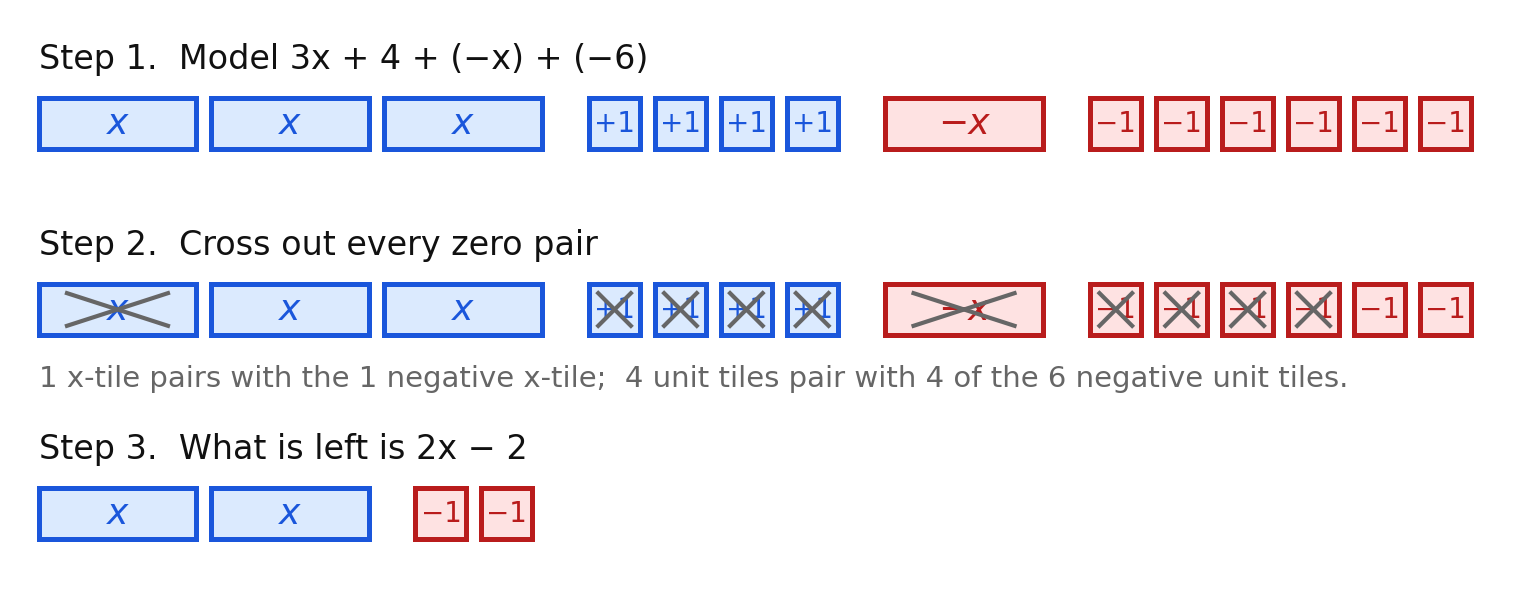
The tile picture below runs the whole process on , with the zero pairs marked.
Rational coefficients change the arithmetic, not the method
This is the Grade 8 advance. The coefficients may be fractions or decimals, positive or negative, and the four steps do not change: rewrite as a sum, group like terms, add the coefficients, write the result with the -term first.
With fractions, find a common denominator before adding the coefficients:
With decimals, line up the place values:
A mixed expression can go either way, as long as you are consistent. In , either write as or write as ; both give , which is also .
Worked examples
Example 1 — Fractional coefficients with different denominators
Simplify .
Answer:
Example 2 — Two families, decimal coefficients
Simplify .
Rewrite as a sum, then group.
Answer:
Example 3 — A negative fractional coefficient
Simplify .
The -coefficients need a common denominator of .
Answer:
Example 4 — Mixed fractions and integers
Simplify .
Answer:
Example 5 — Everything cancels
Simplify .
By the additive inverse property both groups vanish, and for every value of .
Answer:
Example 6 — Check by substitution
Show that and are equivalent, then check at and .
At : , and . At : , and .
Answer: Equivalent; both give and .
Guided practice
- Simplify .
- Simplify .
- Simplify .
- Simplify .
- Simplify .
- Simplify .
- Simplify .
- Simplify .
Independent practice
- Simplify each. a) b) c) d)
- Simplify .
- Simplify .
- Simplify .
- Simplify .
- Simplify .
- Reasoning. Use the distributive property to explain why . Then explain why the same reasoning does not combine .
- Show that and are equivalent by simplifying, then check by substituting and into both.
- Application. A triangle has sides of length , , and inches. Write and simplify an expression for its perimeter.
- Error analysis. A student simplifies to . Identify the error and give the correct simplification.
Exit ticket 4.3
- Simplify .
- Simplify .
- Simplify .
- Explain why cannot be simplified any further.
Lesson 4.4 — Expanding with the Distributive Property
One rectangle, two ways to measure it
The distributive property states that for any real numbers , , and ,
Lesson 4.1 showed this with a rectangular tile arrangement. An area model does the same job when the factor is not a whole number, which is exactly the Grade 8 case.
A strip of height and width has area . Cut it at the seam between the part and the part. Half of is ; half of is .
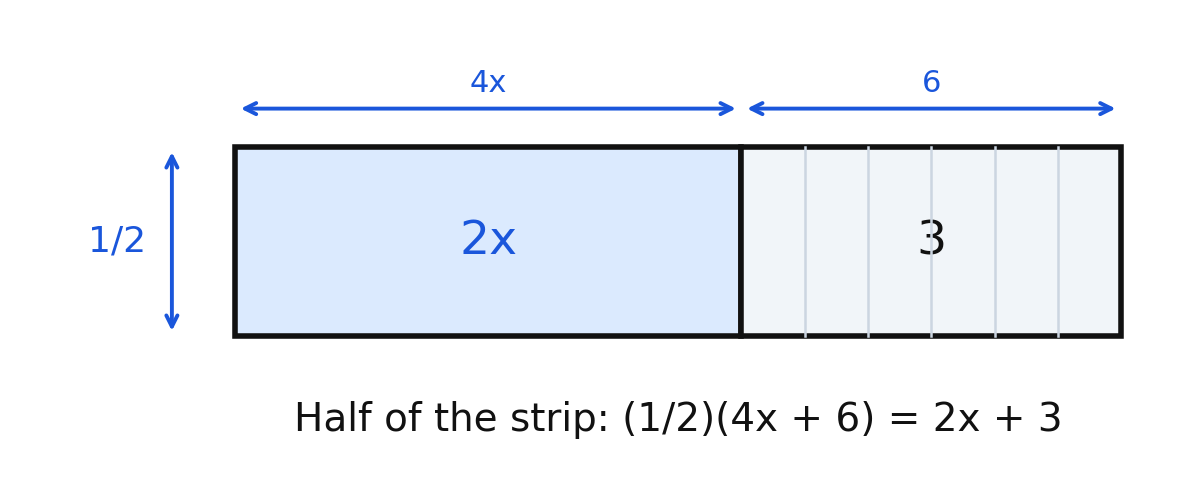
Same strip, two descriptions, so the expressions are equivalent. And the picture explains why the factor must multiply every term inside: leaving the alone would account for only part of the strip.
Choosing the factor so the numbers stay clean
Distributing a fraction is a signal, not an obstacle. Multiplying by is the same as taking two-thirds, so look for the multiple of inside:
Decimals work the same way once you read them as fractions. Multiplying by is multiplying by :
Distributing a negative factor
When the factor outside is negative, every product picks up a sign change. Take it one term at a time and write the sign down before moving on.
That second product is the trap. A negative times a negative is positive, so if your answer has two negative terms, check it again. A bare minus sign in front of parentheses means a factor of :
Distribute, then combine
Most problems ask for both moves. The order of operations decides which comes first: the parentheses are a grouping symbol, so distribute, then combine like terms.
Note how the subtraction in the middle was handled: it distributed as across both terms of , giving . Distributing it across only the is the most frequent error in this lesson.
Worked examples
Example 1 — A decimal inside
Simplify .
Answer:
Example 2 — A unit-fraction factor
Simplify .
Answer:
Example 3 — A non-unit fraction factor
Simplify .
Two-thirds of is ; two-thirds of is .
Answer:
Example 4 — A negative factor with a decimal
Simplify .
Answer:
Example 5 — Two fractional factors, then combine
Simplify .
Distribute each factor, keeping the attached to the second set of parentheses:
Now combine:
Answer: — the variable terms are additive inverses, so the expression has the same value for every .
Example 6 — A bare minus sign in front of parentheses
Simplify .
Answer:
Guided practice
- Simplify .
- Simplify .
- Simplify .
- Simplify .
- Simplify .
- Simplify .
- Simplify .
- Simplify .
Independent practice
- Expand each. a) b) c) d)
- Simplify .
- Simplify .
- Simplify .
- Simplify .
- Simplify .
- Reasoning. Use an area model to explain why . Say what each region of the strip represents.
- Application. A shop sells six identical smoothies. Each smoothie costs dollars, and every one gets a $1.50 topping. Write an expression for the total cost using parentheses, then expand it.
- Error analysis. A student writes . Identify the error and give the correct expansion.
- Error analysis. A student writes . Identify the error and give the correct expansion.
Exit ticket 4.4
- Expand .
- Simplify .
- Simplify .
- Explain why a fractional factor outside parentheses still has to multiply every term inside.
Lesson 4.5 — Generating Equivalent Expressions
Simplifying is one direction; generating is both
So far every task has pointed the same way: take a messy expression and make it short. Generating equivalent expressions means moving in whatever direction is useful, including making an expression longer or pulling a factor back out.
Given , all of these are equivalent, and each is justified by a property:
| Equivalent form | Why |
|---|---|
| commutative property of addition | |
| , so nothing changed in value | |
| distributive property, read backwards | |
| distributive property, read backwards |
There is no single "right answer" to generate an equivalent expression, but there is a right test: does it produce the same value for every replacement value?
Factoring out a common factor
To factor an expression, find a number that divides every term and pull it out front. This is the distributive property used right to left.
With rational terms the common factor can itself be rational, which is often the neatest way to write a decimal expression:
When the leading coefficient is negative, factoring out the negative flips the sign of every term inside. Check the inside terms after you write them:
Nested grouping symbols
An expression may have grouping inside grouping. The order of operations says work from the inside out.
Checking with substitution — and what the check is worth
Substituting a value into both expressions is a fast way to catch a sign or distribution error.
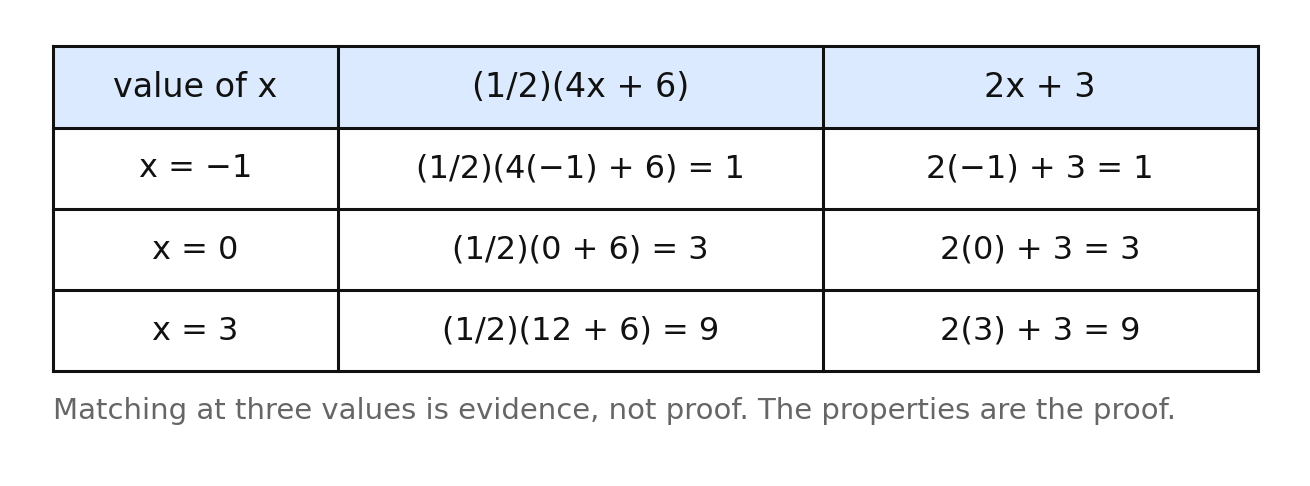
Be honest about what the check shows. Disagreement at even one value proves the expressions are not equivalent. Agreement at three values is strong evidence but never a proof, because equivalence is a claim about every replacement value, and there are infinitely many. Here is why that matters: and both equal at . Test only that value and you would wrongly call them equivalent; at they give and . The properties of real numbers are what prove equivalence.
Worked examples
Example 1 — Generating two equivalent forms
Write two expressions equivalent to , one of them using parentheses.
Splitting the numeric term gives . Factoring out gives .
Answer: and
Example 2 — Factoring with an integer factor
Factor .
Both terms are divisible by : and .
Answer:
Example 3 — Factoring with a decimal factor
Factor .
Both terms are divisible by : and .
Answer:
Example 4 — Distribute twice, then combine
Simplify .
Answer:
Example 5 — Nested grouping
Simplify .
Work the inner grouping first.
Answer:
Example 6 — Deciding equivalence and repairing a claim
Is equivalent to ? If not, write the expression it is equivalent to.
Distributing gives , not . A single substitution confirms the two differ: at , while .
Answer: Not equivalent; .
Guided practice
- Write two expressions equivalent to . At least one must use parentheses.
- Factor .
- Factor .
- Simplify .
- Simplify .
- Are and equivalent? Simplify to decide, then check at .
Independent practice
- Factor each. a) b) c) d)
- Write three different expressions equivalent to . At least one must use parentheses, and name the property that justifies each.
- Simplify .
- Simplify .
- Simplify .
- Simplify .
- Is equivalent to ? Justify your answer, and if not, write the expression that is equivalent to.
- Reasoning. Explain why and are equivalent for every replacement value. Then explain why checking a single value would not have been enough to establish it, using and as your example.
- Application. A phone plan costs dollars per month plus $4.50 per month in fees. Write an expression for the cost of four months using parentheses, expand it, and give one other equivalent form.
- Error analysis. A student simplifies to . Identify the error, name the rule that was broken, and give the correct simplification.
Exit ticket 4.5
- Factor .
- Simplify .
- Write an expression equivalent to that uses parentheses.
- Explain why simplifying an expression never changes its value, no matter what is.
Chapter 4 Review
Vocabulary. algebraic expression · variable · equivalent · algebra tile · -tile · unit tile · zero pair · term · coefficient · numeric term · like terms · commutative property · associative property · identity property · inverse property · distributive property · expand · factor · generate
Part A — Representing expressions with manipulatives and pictures (8.PFA.1a)
- Write the expression modeled by five -tiles and three negative unit tiles.
- Describe a tile model for .
- Describe a rectangular tile arrangement for and write the expanded expression.
- A model shows four -tiles, one negative -tile, two positive unit tiles, and six negative unit tiles. Remove all zero pairs and write the simplified expression.
- Explain, using zero pairs, why is equivalent to . Name the property involved.
- Describe how to model by splitting a pile of tiles into equal groups, and give the resulting expression.
- A tile arrangement has two identical rows, each holding three -tiles and one unit tile. Write the expression it models in factored form and in expanded form.
- Explain, in terms of the tiles themselves, why -tiles and unit tiles can never be combined into a single count.
Part B — Simplifying and generating equivalent expressions (8.PFA.1b)
- Simplify each. a) b) c) d)
- Simplify .
- Simplify .
- Simplify .
- Simplify .
- Simplify .
- Simplify .
- Simplify .
- Factor each. a) b) c)
- Write two expressions equivalent to . At least one must be factored, and explain why each is equivalent.
- Name the property that justifies each step. a) b) c)
- Simplify .
Part C — Mixed application and reasoning
- Show that and are equivalent by simplifying the first expression, then check by substituting and into both.
- Application. Three identical crates each hold kilograms of apples, and each crate itself weighs kilograms. Write an expression for the total weight using parentheses, then expand it.
- Error analysis. A student writes . Identify the error and give the correct expansion.
- Reasoning. Explain why checking a single replacement value is not enough to prove two expressions are equivalent. Use and in your explanation.
- Use a rectangular tile arrangement to justify that and are equivalent. Describe the tiles in both readings of the arrangement.
- Write an expression that uses a fractional coefficient and simplifies to . Show the simplification and name the properties you used.
Standards coverage check — Chapter 4
| Knowledge and Skill | Where it is taught | Where it is practiced |
|---|---|---|
| 8.PFA.1a — represent algebraic expressions using concrete manipulatives or pictorial representations, including expressions that apply the distributive property | 4.1; revisited in 4.3 (tile picture of combining like terms) and 4.4 (area model) | Items 1–18; 51; 73; Review Part A, items 101–108, and item 125 |
| 8.PFA.1b — simplify and generate equivalent algebraic expressions in one variable by applying the order of operations and properties of real numbers; expressions may need to be expanded using the distributive property or require combining like terms; linear and numeric terms only; coefficients and numeric terms may be rational | 4.2, 4.3, 4.4, 4.5 | Items 19–100; Review Part B, items 109–120, and items 121–124, 126 |
Both bullets are covered in every lesson's practice set, and the two are deliberately braided: the tile and area pictures of bullet (a) are the justifications students give when bullet (b) asks why a simplification is legal.
Answer keys for every set in this chapter are in Appendix A.