Chapter 5 — Multistep Linear Equations
Standard: 8.PFA.4 — The student will write and solve multistep linear equations in one variable, including problems in context that require the solution of a multistep linear equation in one variable.
By the end of this chapter you will be able to:
- Represent and solve multistep linear equations in one variable, with the variable on one or both sides, using concrete materials and pictorial representations (8.PFA.4a)
- Apply properties of real numbers and properties of equality to solve multistep linear equations in up to four steps, including equations that must be expanded with the distributive property or simplified by combining like terms (8.PFA.4b)
- Write a multistep linear equation in one variable to represent a verbal situation, including situations in context (8.PFA.4c)
- Create a verbal situation in context given a multistep linear equation in one variable (8.PFA.4d)
- Solve problems in context that require the solution of a multistep linear equation (8.PFA.4e)
- Interpret algebraic solutions in context, saying what the number means and whether it is usable (8.PFA.4f)
- Confirm algebraic solutions to linear equations in one variable (8.PFA.4g)
Lessons: 5.1 Simplify Each Side First · 5.2 Modeling Equations with the Variable on Both Sides · 5.3 Expanding with the Distributive Property · 5.4 Solving with the Variable on Both Sides · 5.5 Writing Equations and Writing Situations · 5.6 Problems in Context: Solving, Confirming, Interpreting
What is new here. In Grade 7 you solved two-step equations such as : one multiplication and one addition to undo. Multistep equations add two more possibilities. A side may need to be simplified first, by combining like terms or by expanding with the distributive property, and the variable may appear on both sides. Nothing about the properties of equality changes. You will just use them a little later in the process, and never more than four steps in all. Coefficients and numeric terms remain rational.
Numbering note. Item numbers run straight through the chapter, from 1 in Lesson 5.1 to 124 at the end of the review. They do not restart at each lesson.
Lesson 5.1 — Simplify Each Side First
One side, several terms
Consider . The left side is not yet in the familiar shape, because two different terms carry the variable. Before you undo anything, make each side as short as it can be.
and are like terms — terms with exactly the same variable part — so they combine: . The equation becomes , which is a two-step equation you already know how to finish.
Step 0 of every multistep equation: simplify each side by itself. Combining like terms happens within one side. It is not a move on the equation, so it does not require a property of equality and does not need to be matched on the other side.
That last sentence is worth reading twice. Combining like terms on the left changes how the left side is written, not what it is worth. The distributive property read backwards, , is what guarantees the value stays the same. Since neither side's value moved, the equation is still true and its solution set is unchanged.
The order of business
- Simplify each side by combining like terms.
- Undo the addition or subtraction, using the addition or subtraction property of equality.
- Undo the multiplication or division, using the division or multiplication property of equality.
- Confirm the solution by substituting into the original equation.
Step 4 is not one of the four solving steps. It is the check, and it is required by 8.PFA.4g. Notice that the check goes back to the original equation — not to the simplified line you wrote in step 1. If you combined like terms incorrectly, checking against your simplified line would confirm the mistake instead of catching it.
Watch the signs when you gather terms
The sign in front of a term belongs to that term. Rewriting subtraction as addition of the opposite makes this visible and stops most sign errors before they happen.
| Equation | Rewritten as a sum | Simplified side |
|---|---|---|
In the last row, the variable terms are and , whose coefficients are and , so together they make . The constant stays where it is.
Worked examples
Example 1 — Two variable terms on one side
Solve .
Combine the like terms on the left, then undo in reverse order.
Confirm in the original: . True.
Answer:
Example 2 — A variable term subtracted
Solve .
The variable terms are and , so the left side is .
Confirm: . True.
Answer:
Example 3 — The variable side on the right
Solve .
Simplify the right side to . The variable may sit on either side; nothing about the procedure changes.
Confirm: . True.
Answer:
Example 4 — Decimal coefficients
Solve .
Confirm: . True.
Answer:
Example 5 — Fractional coefficients
Solve .
Add the coefficients over a common denominator: .
Confirm: . True.
Answer:
Guided practice
- Solve . Show the simplified side, then each property of equality you use, then the check.
- Solve and confirm your solution.
- Solve and confirm your solution.
- Solve and confirm your solution.
Independent practice
- Solve and confirm. a) b) c) d)
- Solve and confirm. a) b)
- Solve and confirm:
- Solve and confirm: . State the solution exactly.
- Write an equation that requires combining like terms and whose solution is . Show the check.
- Application. A triangle has sides of , , and inches, and its perimeter is 34 inches. Write and solve an equation for , then give all three side lengths.
- Reasoning. Explain why combining like terms on one side does not require you to do anything to the other side, even though every property of equality does.
- Error analysis. Asked to solve , a student writes on the next line. Explain what went wrong, solve the equation correctly, and show the check.
Exit ticket 5.1
- Solve and confirm your solution.
- Solve and confirm your solution.
- Solve and confirm your solution.
- Explain why combining like terms cannot change the solution of an equation.
Lesson 5.2 — Modeling Equations with the Variable on Both Sides
Blocks in both pans
A balance scale is still the truest picture of an equal sign, and nothing stops you from putting variable blocks in both pans.
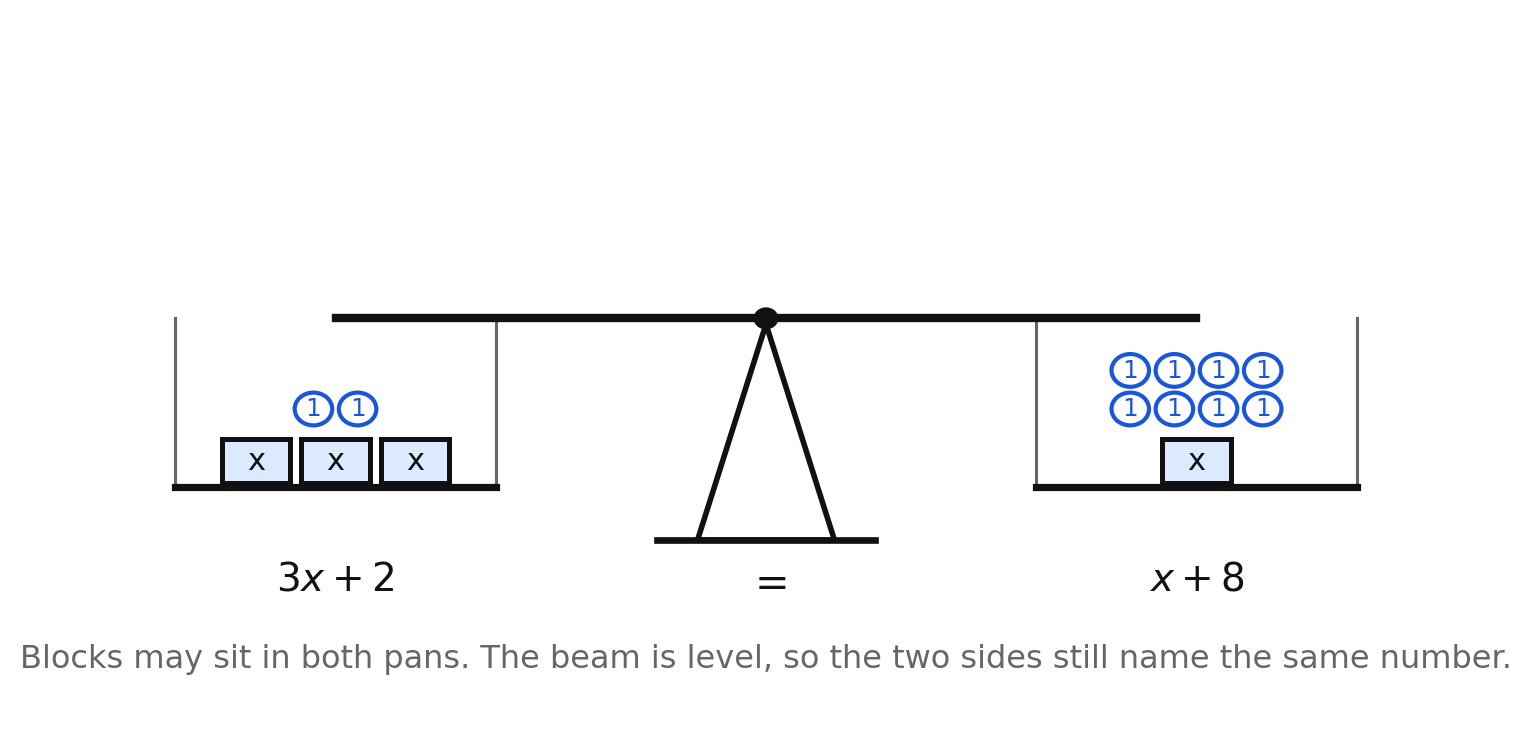
The left pan holds three blocks labeled and two 1-gram chips. The right pan holds one block labeled and eight 1-gram chips. Because the beam is level,
You do not know what one block weighs. You do know that every block weighs the same, and that is enough.
One new move
The rule has not changed: whatever you do to one pan, do to the other. What is new is that "remove one block from each pan" is now a legal, useful move — and it is the move that makes the equation solvable.
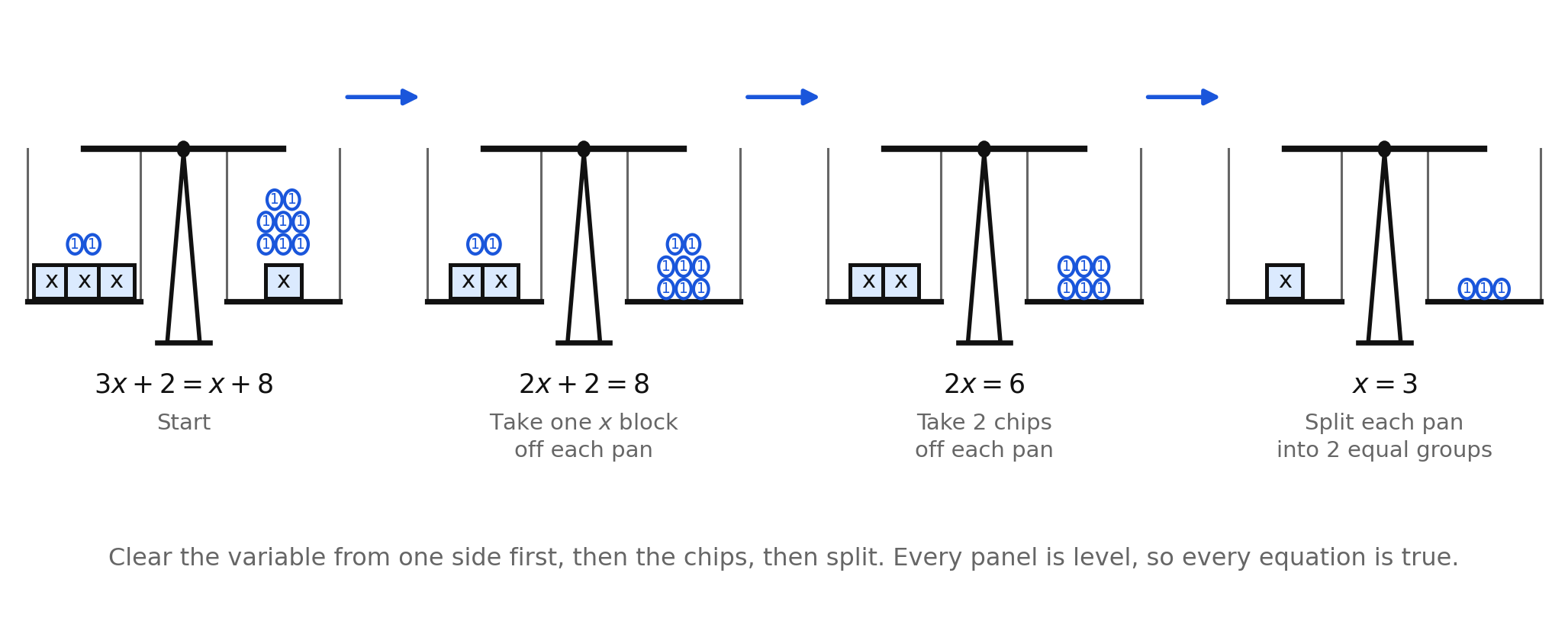
Panel 1 is the original. In panel 2 one block has come off each pan, leaving . In panel 3 two chips have come off each pan, leaving . In panel 4 each pan has been split into two equal groups, leaving . Every panel is level, so every panel is a true equation.
Why remove the blocks first? Because clearing the variable from one side is what turns the problem back into the two-step equation you already know. Chips first also works, but you would still have blocks on both sides afterward, so you would be one step behind.
Algebra tiles and combining like terms
Algebra tiles are the flat version. A long rectangle is an tile, a small square is a unit tile, and the opposite-colored pieces are and . Tiles for the left side go on one mat, tiles for the right side on another.
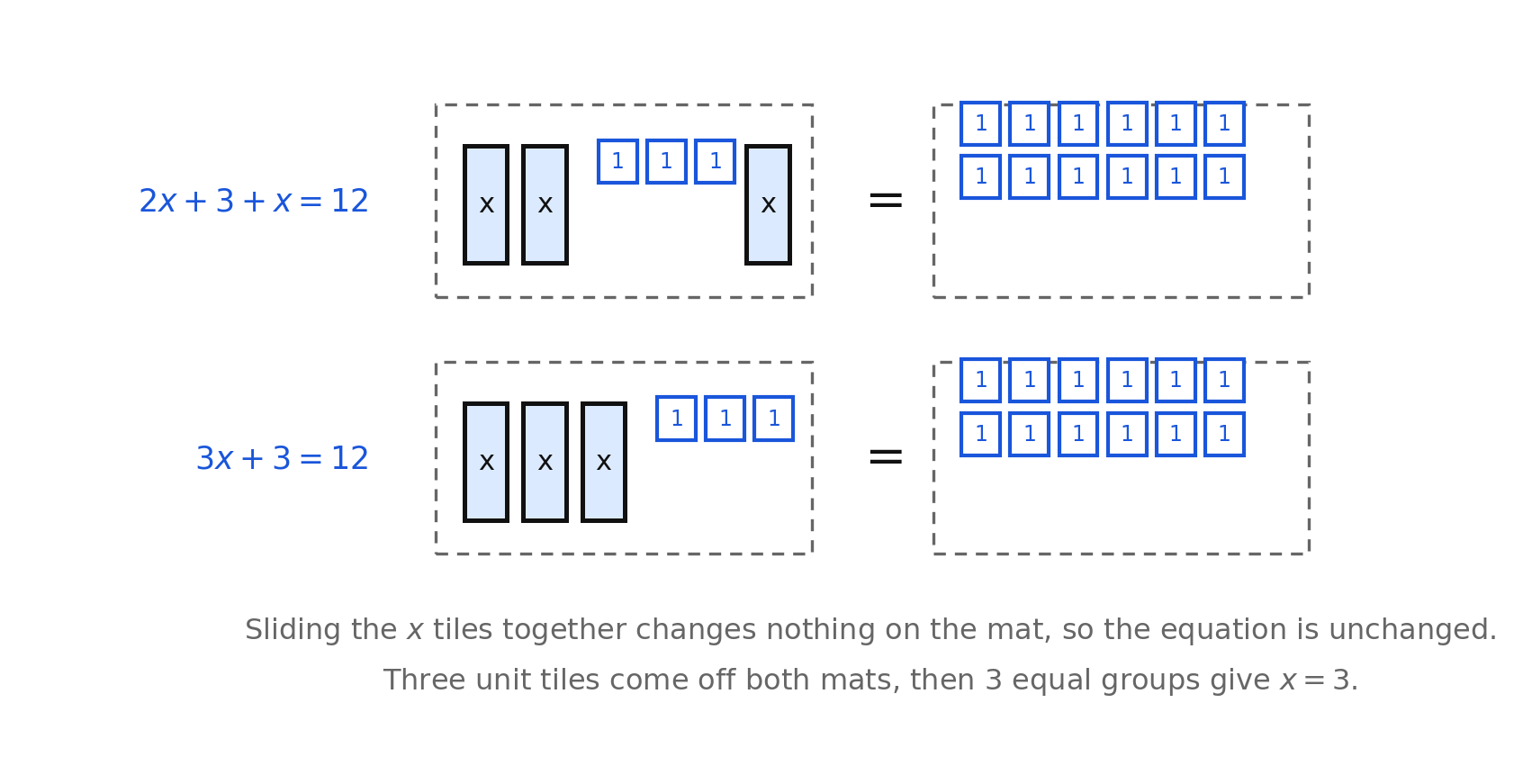
The top row is the mat for , laid out in the order the equation is written. Sliding the three tiles next to each other does not add or remove anything, so the mat is still worth the same — which is exactly what "combine like terms" means, done with your hands. Now the mat reads . Three unit tiles come off both mats to give , and three equal groups give .
Zero pairs handle subtraction
A tile and a tile together are worth . Together they form a zero pair, and adding or removing a zero pair changes nothing about a mat's value. Zero pairs are what let tiles model an equation with subtraction in it.
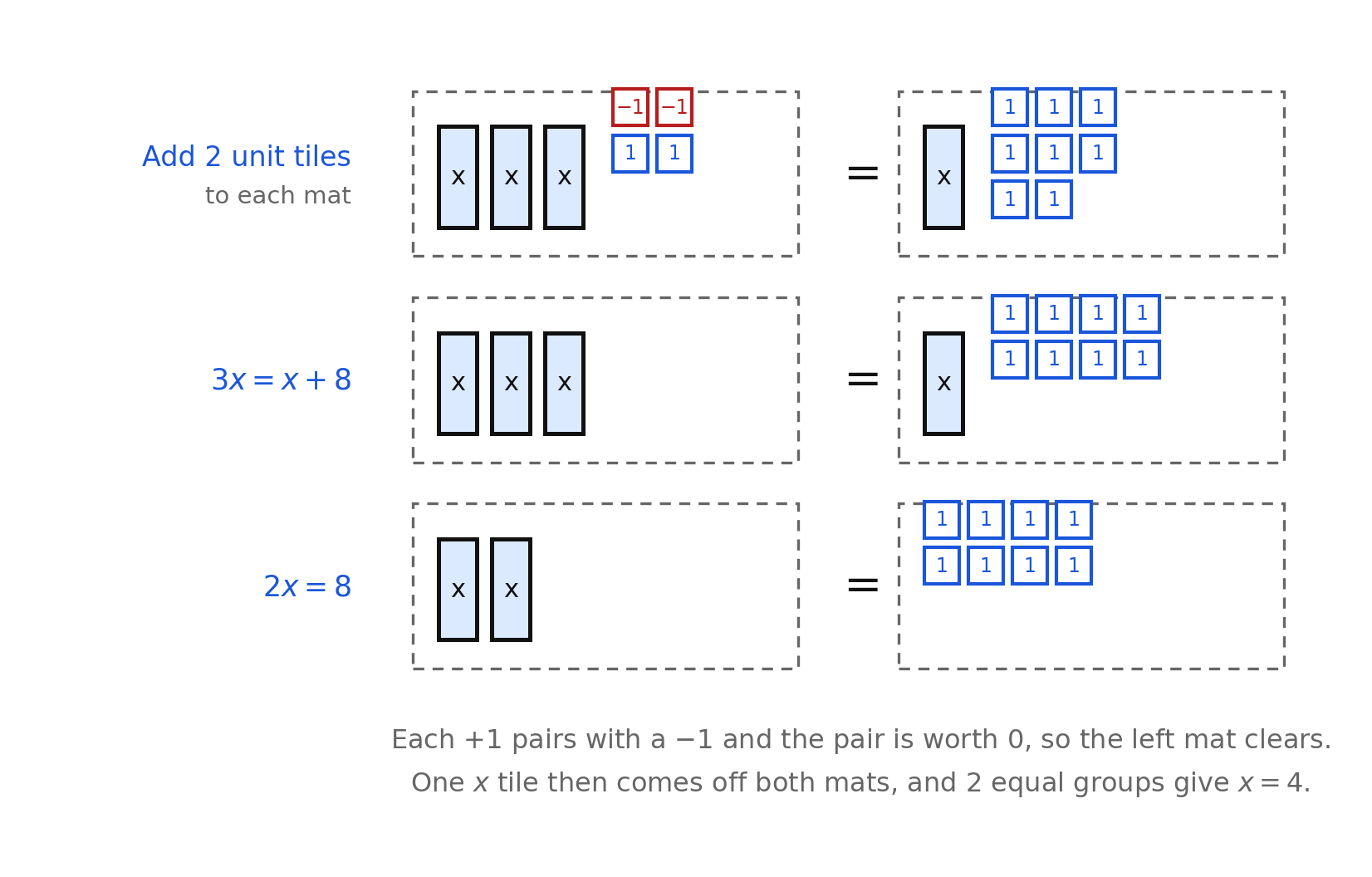
For : the left mat holds three tiles and two tiles, the right mat holds one tile and six tiles. Add two tiles to each mat. On the left, two zero pairs form and come off, leaving . On the right, . Now . Remove one tile from each mat to get , then split into two equal groups: .
Colored chips work the same way with round pieces: one color is , the other is , a chip of each color is a zero pair, and a cup or envelope marked stands in for the variable.
Confirming with the model
Solving and confirming are different jobs, and 8.PFA.4g asks for both. To confirm with a model, rebuild the original arrangement and replace every variable piece with the number of unit pieces your answer claims it is worth. Then count both sides. Equal counts mean the beam is level and the answer is right. Unequal counts mean the beam tips, and the proposed answer is wrong — before anyone grades it.
For with : the left pan holds chips and the right holds . Level, so confirmed.
Worked examples
Example 1 — Solving on a balance scale
The left pan holds three blocks labeled and 2 one-gram chips; the right pan holds one block labeled and 8 one-gram chips. Write the equation and find .
The beam is level, so .
Remove one block from each pan: . Remove 2 chips from each pan: . Split each pan into 2 equal groups: one block matches chips.
Confirm by rebuilding: chips on the left, on the right. Level.
Answer: , and .
Example 2 — Gathering like terms with tiles
Model with tiles and solve.
Left mat: two tiles, three tiles, and one more tile. Slide the tiles together — the mat now reads . Right mat: twelve tiles.
Remove three tiles from each mat, leaving on the left and on the right. Split both mats into 3 equal groups: one tile matches 3 unit tiles.
Confirm: , matching the right mat.
Answer:
Example 3 — Variable tiles on both mats
Model with tiles and solve.
Remove two tiles from each mat, leaving . Remove one unit tile from each mat, leaving . Split into 2 equal groups: one tile matches 4 unit tiles.
Confirm: and . Level.
Answer:
Example 4 — Zero pairs with tiles on both mats
Model with tiles and solve.
Left mat: three tiles and two tiles. Right mat: one tile and six tiles.
Add two tiles to each mat. Two zero pairs form on the left and come off, leaving ; the right becomes unit tiles plus the tile, so . Remove one tile from each mat: . Two equal groups give one tile matched to 4 unit tiles.
Confirm: and . Level.
Answer:
Example 5 — Confirming somebody else's answer
Nadia says the solution of is . Use a model to decide.
Replace each piece with 2 unit pieces. The left side holds ; the right side holds . The counts do not match, so the beam tips and is not the solution.
Rebuild and solve: add one tile to each mat to clear the , giving . Remove two tiles from each mat: . Two equal groups: .
Confirm: and . Level.
Answer: Nadia is incorrect; the solution is .
Guided practice
- A balance holds four blocks labeled and 3 one-gram chips on the left pan, and one block labeled and 12 one-gram chips on the right pan. Write the equation.
- Solve the equation from item 17 by describing the move you make at each pan, and confirm your solution by rebuilding the scale.
- Model with algebra tiles. Describe each move and give the solution.
- Model with algebra tiles, naming the zero pairs you use. Give the solution and confirm it with the model.
Independent practice
- Write the equation shown by each model and solve it. a) five blocks and 2 chips on the left pan, three blocks and 10 chips on the right pan b) two tiles, three more tiles, and one tile on the left mat, sixteen tiles on the right mat
- Model with tiles. Describe each move and give the solution.
- Model with tiles, naming the zero pairs you use. Give the solution and confirm it with the model.
- Model with tiles. Describe each move and give the solution.
- Model with tiles. Describe each move and give the solution. Explain why the answer is still a perfectly good solution.
- Error analysis. Devon models , removes one tile from the left mat only, and reports . Explain what went wrong and give the correct solution.
- Application. Two identical boxes together with a 5-pound weight balance one box of the same kind together with a 9-pound weight. Write an equation using for the weight of one box, solve it by describing the scale moves, and confirm the answer on the scale.
- Reasoning. Explain why removing one block from each pan is a legal move even though you do not know what is worth.
Exit ticket 5.2
- Write and solve the equation modeled by a balance with three blocks and 7 chips on the left pan and one block and 15 chips on the right pan.
- Model with tiles. Describe each move and give the solution.
- Use a model to confirm whether is the solution of .
- Explain why the counts on the two mats must match after every move you make.
Lesson 5.3 — Expanding with the Distributive Property
Parentheses are a package
Some equations arrive with a side wrapped in parentheses: . The parentheses say that the whole package has been multiplied by 3.
There are two honest ways forward, and both are worth knowing.
Route 1 — expand first. The distributive property says , so . The equation becomes , a two-step equation.
Route 2 — divide first. Since the entire left side is 3 times something, divide both sides by 3: . One step remains.
They agree, because they are the same equation being handled in different orders. Route 2 is faster when the number outside divides the other side cleanly. Route 1 always works, including when there is another term outside the parentheses — and that is the case that decides the matter.
When expanding is not optional
In you cannot divide both sides by 5, because 5 is not a factor of the whole left side; the is not inside the package. Expand, then combine.
That is four steps: expand, combine, subtract 10, divide by 2. Four is the limit in this course, and you have just used all of it.
Signs are where the points are lost
The factor outside multiplies every term inside, sign and all.
| Expression | Expanded | The step people miss |
|---|---|---|
| , not | ||
| the invisible factor is | ||
| both terms get halved | ||
| both terms get multiplied by | ||
| the sign of the second product flips |
A tile model says the same thing physically: is three identical groups, each holding one tile and two unit tiles, which is tiles all together.
Worked examples
Example 1 — Both routes
Solve .
Expanding: , so and . Dividing first: , so .
Confirm: . True.
Answer:
Example 2 — A coefficient inside the parentheses
Solve .
Confirm: . True.
Answer:
Example 3 — A term outside the parentheses
Solve .
Confirm: . True.
Answer:
Example 4 — A negative factor
Solve .
Distribute, watching the second product: .
Confirm: . True.
Answer:
Example 5 — A fractional factor
Solve .
Confirm: . True.
Answer:
Guided practice
- Solve two ways — dividing first, and expanding first — and confirm your solution.
- Solve and confirm your solution.
- Solve and confirm your solution.
- Solve and confirm your solution.
Independent practice
- Solve and confirm. a) b) c) d)
- Solve and confirm. a) b)
- Solve and confirm:
- Solve and confirm:
- Reasoning. Solve by dividing both sides by 3 first, and again by expanding first. Show both routes and explain why they must agree.
- Write an equation that requires the distributive property and whose solution is . Show the check.
- Application. Four identical gift bags each hold stickers and 3 pencils, and the bags hold 40 items in all. Write and solve an equation for , and say what the answer means.
- Error analysis. Asked to solve , a student writes and reports . Find the mistake, solve correctly, and show the check that exposes the wrong answer.
Exit ticket 5.3
- Solve and confirm your solution.
- Solve and confirm your solution.
- Solve and confirm your solution.
- Explain why the factor outside the parentheses must multiply every term inside.
Lesson 5.4 — Solving with the Variable on Both Sides
Gather the variable on one side
When the variable appears on both sides, you have one extra job: use the addition or subtraction property of equality to collect the variable terms on a single side. That is the algebraic version of taking a block off each pan.
For , subtract from both sides. The right side loses its variable entirely, and you are back to a two-step equation.
Confirm: and . True.
Which side should the variable end up on?
Either. The equation can be attacked by subtracting (giving ) or by subtracting (giving , then , then ). Both are correct and both give .
There is a practical reason to prefer one: move the smaller variable term, so the coefficient you finally divide by is positive. Fewer negative signs means fewer chances to lose one.
The full procedure, in at most four steps
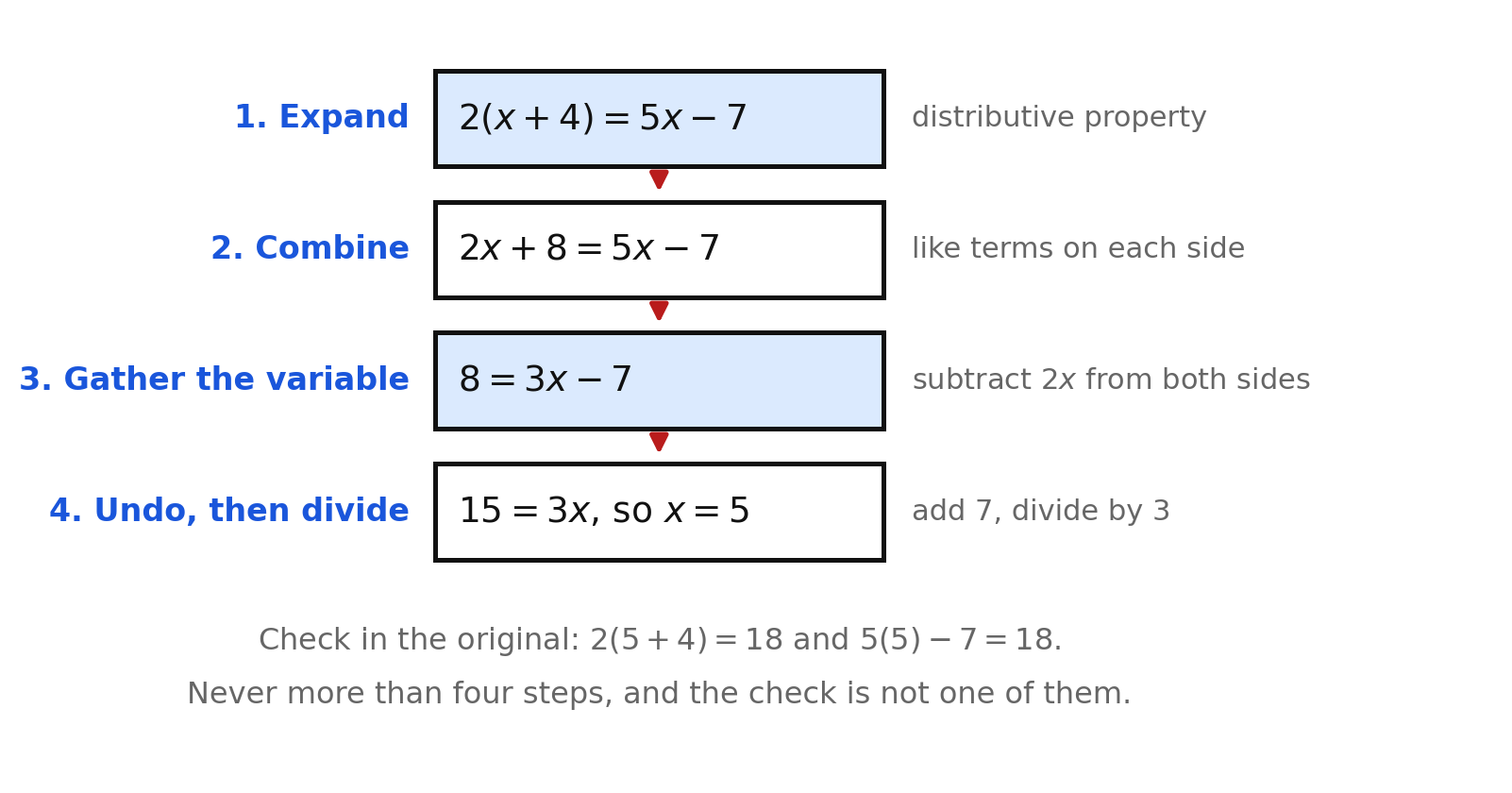
- Expand any parentheses, using the distributive property.
- Combine like terms within each side.
- Gather the variable terms on one side and the constants on the other, using the addition and subtraction properties of equality.
- Divide by the coefficient, using the division property of equality — or multiply by its reciprocal.
Not every equation needs all four. skips step 1 entirely. What matters is the order: you cannot sensibly gather variable terms until each side is simplified.
The properties of equality authorizing every move are the same four you have used since Grade 7.
Addition property of equality. Adding the same number to both sides keeps the sides equal. Subtraction property of equality. Subtracting the same number from both sides keeps the sides equal. Multiplication property of equality. Multiplying both sides by the same number keeps the sides equal. Division property of equality. Dividing both sides by the same nonzero number keeps the sides equal.
Two properties of real numbers do the quiet work underneath: the additive inverse property, , is what makes a variable term vanish from a side, and the multiplicative identity property, , is what leaves the variable standing alone after you divide.
Rational coefficients
Fractions and decimals do not change the method. You may also clear fractions first by multiplying both sides by a common denominator — the multiplication property of equality lets you, and it often costs fewer sign errors than working with fractions throughout.
For , multiply both sides by 4:
Confirm in the original: and . True.
Enrichment — when the variable disappears. Occasionally gathering variable terms removes the variable from both sides at once. If what remains is false, like from , then no number works and the equation has no solution. If what remains is true, like from , then every number works and the equation has infinitely many solutions. Both outcomes come straight from the properties of equality — nothing new is needed. These cases are beyond what 8.PFA.4 requires, so they appear here and in review items 123 and 124 as extensions.
Worked examples
Example 1 — Variable on both sides
Solve .
Confirm: and . True.
Answer:
Example 2 — Subtracting to gather
Solve .
Confirm: and . True.
Answer:
Example 3 — Expand, then gather
Solve .
Subtracting the smaller variable term, , kept the coefficient positive.
Confirm: and . True.
Answer:
Example 4 — Combine first, then gather
Solve .
Confirm: and . True.
Answer:
Example 5 — Clearing fractions
Solve .
Multiply both sides by 4, then gather.
Confirm: and . True.
Answer:
Guided practice
- Solve , naming the property of equality used at each step, and confirm your solution.
- Solve and confirm your solution.
- Solve and confirm your solution.
- Solve and confirm your solution.
Independent practice
- Solve and confirm. a) b) c) d)
- Solve and confirm. a) b)
- Solve and confirm:
- Solve and confirm:
- Solve and confirm:
- Reasoning. Solve twice: once by subtracting from both sides, once by subtracting . Show both routes, and explain why moving the smaller variable term is usually easier.
- Application. Studio A charges a $30 registration fee plus $4 per class. Studio B charges $6 per class and no fee. Write and solve an equation for the number of classes that makes the two totals equal.
- Error analysis. Solving , a student subtracts from the left side only and writes . Explain the error, solve correctly, and confirm the solution.
Exit ticket 5.4
- Solve and confirm your solution.
- Solve and confirm your solution.
- Solve and confirm your solution.
- List the four steps in order, and say what each one is for.
Lesson 5.5 — Writing Equations and Writing Situations
Two directions, one skill
8.PFA.4c asks you to turn a situation into an equation. 8.PFA.4d asks you to turn an equation into a situation. They are the same understanding, read forward and backward, and doing both is the surest way to know you have it.
From words to symbols
- Read the whole situation before writing anything.
- Name the unknown in a full sentence: "let = the number of classes." A variable without a definition is a guess.
- Build each quantity separately. A fixed amount plus a rate per unit becomes .
- Decide what is being set equal. If two different quantities are being compared, each one becomes a side of the equation. That is where variables on both sides come from.
- Write, solve, confirm, and reread the story.
Comparisons are the signature of a Grade 8 equation. "Which plan costs less?" "When are the two heights the same?" "How many before the totals match?" Each of these puts an expression on each side.
Do not trust keywords by themselves. "Five less than three times a number" is , not . "Less than" reverses the order of the words. Retelling the story from your finished equation catches this every time.
From symbols to words
Given , read each number's job before you invent anything.
- is the unknown count.
- and are two different amounts per unit.
- is a one-time amount attached to the smaller rate.
- The equal sign says the two totals match.
Shop A charges $4 per shirt plus a $10 setup fee. Shop B charges $6 per shirt with no fee. For how many shirts do the two shops charge the same? Solving gives , and confirms it.
A good invented situation passes three tests: the operations match, the numbers land in the right roles, and the answer is a sensible thing to have that many of. When a coefficient is negative, choose a context where something decreases — a tank draining, a candle burning, money being spent. When a factor multiplies a parenthesized sum, choose a context with identical groups: three identical bags, each holding apples and 2 oranges.
Geometry writes multistep equations too
Perimeter problems produce them naturally, because the sides are described in terms of each other. A rectangle whose length is 3 cm more than its width has length and width , so its perimeter is . Setting that equal to a known perimeter gives an equation needing expansion and combining.
Worked examples
Example 1 — Comparing two plans
Gym A charges a $30 joining fee plus $12 per month. Gym B charges $18 per month with no fee. After how many months are the totals equal?
Let = the number of months. Gym A costs ; Gym B costs .
Confirm: and . True.
Answer: ; the totals are equal after 5 months.
Example 2 — A number sentence in words
Five less than three times a number equals the number increased by 7. Write and solve an equation.
Let = the number.
Confirm: and . True.
Answer: ; the number is 6.
Example 3 — Perimeter
A rectangle's length is 3 cm more than its width, and its perimeter is 26 cm. Find both dimensions.
Let = the width in centimeters, so the length is .
Confirm: with width 5 and length 8, the perimeter is cm. True.
Answer: The width is 5 cm and the length is 8 cm.
Example 4 — Writing a situation for an equation with the variable twice
Write a situation in context for and solve it.
Answer: Shop A prints shirts for $4 each plus a one-time $10 setup fee. Shop B charges $6 each with no fee. For how many shirts are the two bills equal? The solution is shirts, and confirms it.
Example 5 — Writing a situation for an equation with parentheses
Write a situation in context for and solve it.
The factor 3 says there are three identical groups, each holding of one thing and 2 of another.
Answer: Three identical fruit baskets each hold apples and 2 oranges, and the baskets hold 24 pieces of fruit in all. How many apples are in one basket? The solution is apples, and confirms it.
Guided practice
- Rink A charges $8 for admission plus $3 per hour of skate rental. Rink B charges $5 per hour and no admission. Write and solve an equation for the number of hours that makes the costs equal.
- Four more than twice a number is the same as the number increased by 10. Write and solve an equation.
- A triangle has sides of , , and inches, and its perimeter is 27 inches. Write and solve an equation for , then give the three side lengths.
- Write a situation in context for and state the solution.
Independent practice
- Write and solve an equation: seven less than five times a number equals three times the number increased by 5.
- Application. Plan A costs $40 plus $2 per gigabyte of data. Plan B costs $6 per gigabyte with no monthly charge. Write and solve an equation for the number of gigabytes that makes the costs equal.
- Application. Three identical crates together with a 12-kilogram weight balance five identical crates together with a 2-kilogram weight. Write and solve an equation for the mass of one crate.
- A rectangle's length is 4 cm more than its width, and its perimeter is 36 cm. Write and solve an equation for the width, then give both dimensions.
- Write a situation in context for and solve it.
- Write a situation in context for and solve it.
- Write a situation in context for and solve it.
- Error analysis. For "shirts cost $12 each plus a $20 shipping charge at one store, and $16 each with free shipping at another; for how many shirts are the totals equal?" a student writes . Explain why that does not match the situation, write the correct equation, and solve it.
Exit ticket 5.5
- Club A charges an $18 membership fee plus $4 per visit. Club B charges $6 per visit. Write and solve an equation for the number of visits that makes the costs equal.
- Write and solve an equation: three more than four times a number is the same as twice the number increased by 15.
- Write a situation in context for and give the solution.
- Explain how you decide which quantity in a comparison belongs on each side of the equation.
Lesson 5.6 — Problems in Context: Solving, Confirming, Interpreting
A solved equation is not yet a finished problem
A problem in context is finished when you have
- defined the variable, with units,
- written the equation,
- solved it, naming your moves,
- confirmed the solution in the original equation,
- interpreted the solution in the context, and
- stated the result in a sentence with units.
Steps 4, 5, and 6 are the ones people skip. Step 4 is 8.PFA.4g. Step 5 is 8.PFA.4f. They are different jobs, and neither one substitutes for the other.
Confirming is arithmetic; interpreting is meaning
Confirming answers: does this number satisfy the original equation? You substitute, simplify each side separately, and compare. Two rules keep a check honest. Substitute into the original equation, not into a line written partway through — a check against your own line three will happily confirm your own error. And simplify each side separately before comparing.
Interpreting answers a different question: what does this number mean, and can it be used? Ask three things.
- What does the number count or measure? "" is not an answer. "The costs are equal at 15 classes" is.
- Is the size sensible? A negative number of hours or a width of feet means the model, not the arithmetic, is wrong.
- Can the quantity take this value? A ribbon can be inches long. A bus cannot make trips. When the exact answer is a fraction, the fraction is still the honest solution of the equation — it is the break-even point — and you then reason separately about whole units.
Break-even points, and what happens on either side of them
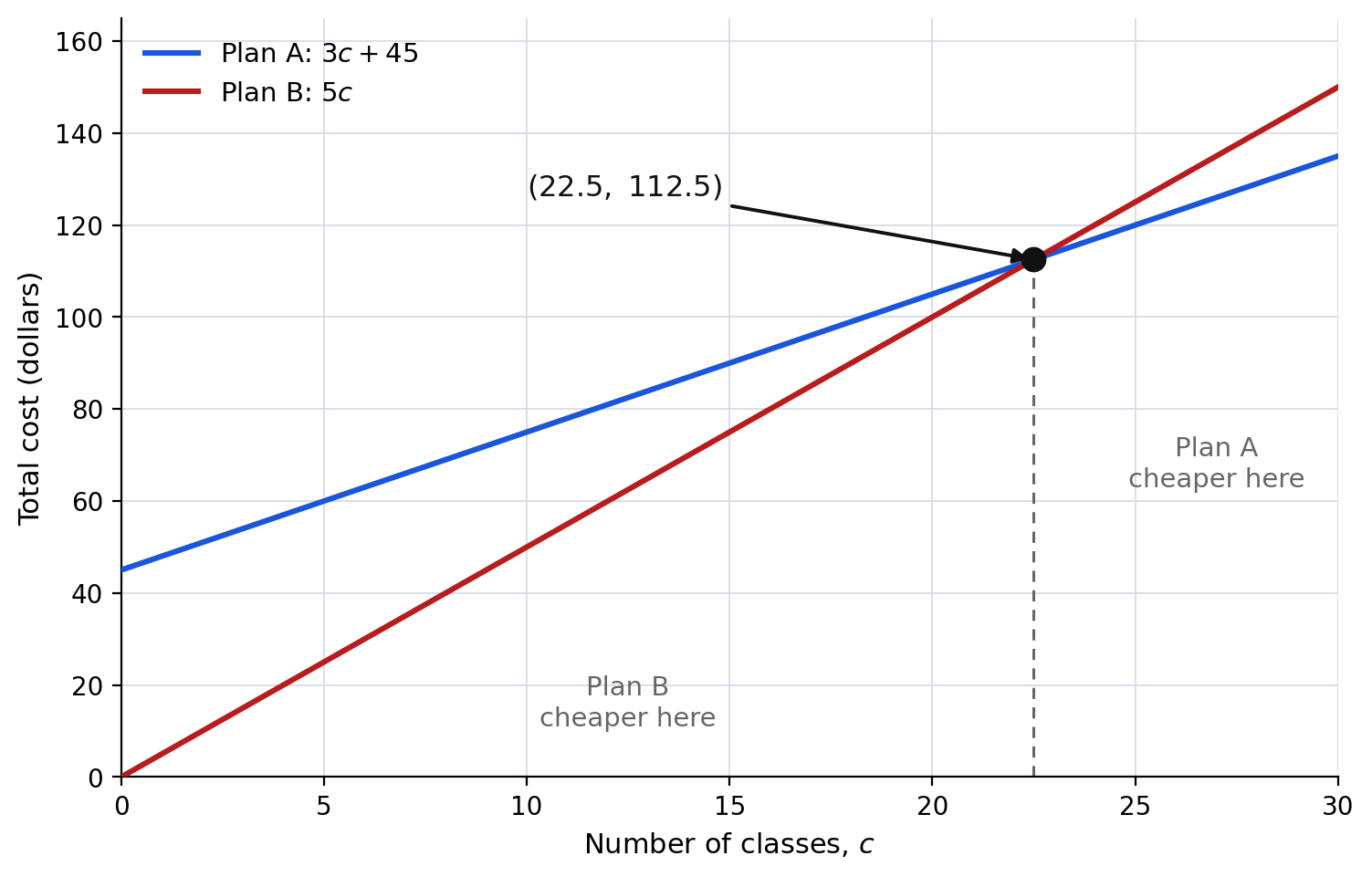
Plan A costs $45 plus $3 per class, so its total is . Plan B costs $5 per class, so its total is . Solving gives and .
Confirm: and . True.
Interpret: at exactly 22.5 classes the two plans cost the same — $112.50. Since classes come in whole numbers, no one actually pays that. What the solution tells you is where the advantage switches: for 22 classes or fewer, Plan B is cheaper; for 23 classes or more, Plan A is cheaper. The graph shows the same fact as a crossing point, with each plan's line lower on its own side of it.
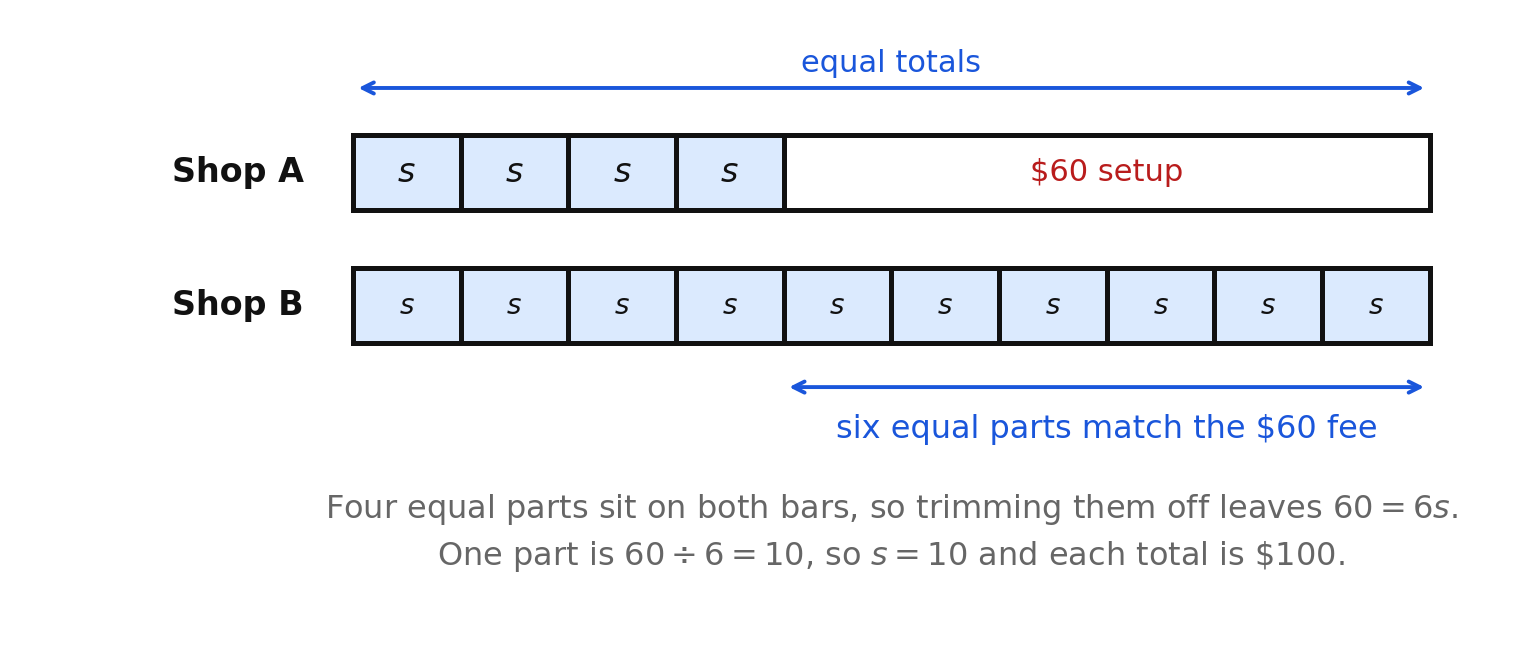
A bar model is often the fastest way to see the structure of a comparison. The bars above show Shop A charging for four shirts plus a $60 setup fee, and Shop B charging for ten shirts. The bars are the same length, four equal parts sit on both, and trimming those parts leaves . One part is $10, so and each total is $100.
Worked examples
Example 1 — A break-even point that is not a whole number
A studio charges $45 up front plus $3 per class; a drop-in rate is $5 per class. For how many classes do the two cost the same, and which is cheaper for 30 classes?
Let = the number of classes.
Confirm: and . True.
Interpret: the costs are equal at 22.5 classes. For 30 classes, the membership costs and drop-in costs .
Answer: The plans are equal at 22.5 classes; for 30 classes the membership is cheaper, $135 against $150.
Example 2 — Perimeter with a described side
A rectangle's length is 1 cm less than twice its width, and its perimeter is 46 cm. Find both dimensions.
Let = the width in centimeters, so the length is .
The length is cm. Confirm: cm. True. Both dimensions are positive, so they are usable measurements.
Answer: The width is 8 cm and the length is 15 cm.
Example 3 — Two accounts meeting
Ana has $150 and saves $20 per week. Ben has $300 and saves $5 per week. When will they have the same amount, and how much will that be?
Let = the number of weeks.
Confirm: and . True.
Interpret: after 10 weeks both have $350. Ten weeks is a sensible amount of time, and the amount is more than either started with, as it should be for two people who are both saving.
Answer: After 10 weeks, each has $350.
Example 4 — Two quantities changing in opposite directions
One candle is 24 cm tall and burns 2 cm per hour. Another is 18 cm tall and burns 1 cm per hour. When are they the same height?
Let = the number of hours.
Confirm: and . True.
Interpret: after 6 hours both candles are 12 cm tall. Both heights are still positive, so both candles really are still burning at that moment — worth checking, since a "solution" after a candle has burned out would be meaningless.
Answer: After 6 hours, both candles are 12 cm tall.
Example 5 — A fractional answer that is perfectly usable
Four identical books plus a $3 shipping charge came to $29. Find the price of one book.
Let = the price of one book in dollars.
Confirm: . True.
Interpret: $6.50 is an ordinary price for a book, so the fraction causes no trouble here — unlike a count of buses, a price can be half a dollar.
Answer: One book costs $6.50.
Guided practice
- Gym A charges a $50 joining fee plus $10 per month; Gym B charges $20 per month. Write and solve an equation for the number of months that makes the costs equal, then interpret the solution in a sentence.
- A rectangle's length is 3 times its width and its perimeter is 48 cm. Write and solve an equation for the width, give both dimensions, and confirm the perimeter.
- Tank A holds 80 liters and drains 6 liters per minute. Tank B holds 20 liters and fills at 4 liters per minute. Write and solve an equation for when the tanks hold the same amount, and say how much that is.
- Five concert tickets plus a $4 order fee came to $46.50. Write and solve an equation for the price of one ticket, and say whether the answer is usable as a price.
Independent practice
- Application. Print shop A charges a $60 setup fee plus $4 per shirt; shop B charges $10 per shirt. Write and solve an equation for the number of shirts that makes the bills equal, then state the equal total.
- A rectangle's length is 5 cm more than twice its width, and its perimeter is 64 cm. Write and solve an equation for the width, then give both dimensions.
- Sam has $240 and spends $15 per week. Tara has $120 and saves $15 per week. Write and solve an equation for when they have the same amount, and say how much that is.
- A phone was bought with a $25 deposit plus three equal monthly payments, for $187 in all. Write and solve an equation for one payment.
- Six friends each pay the same amount toward a bill, a $9 coupon is applied, and $51 is paid in all. Write and solve an equation for one friend's share, and interpret the answer.
- Ride service A charges $3.50 plus $1.25 per mile. Service B charges $8.00 plus $0.75 per mile. Write and solve an equation for the number of miles that makes the fares equal, and state that fare.
- Reasoning. A trip needs vans that each carry 6 students, or the same number of vans carrying 4 students each plus 15 students in cars. Write and solve , then explain what the answer means and how many vans would actually be needed.
- Error analysis. For "Plan A costs $40 plus $5 per class and Plan B costs $9 per class," a student writes , finds , and concludes "Plan A is always cheaper." The equation and the solution are right. Explain what is wrong with the interpretation, and state the correct conclusion.
Exit ticket 5.6
- Club A charges $24 plus $3 per visit; Club B charges $7 per visit. Write and solve an equation for the number of visits that makes the costs equal, and interpret the answer.
- A rectangle's length is 2 m more than its width and its perimeter is 28 m. Find both dimensions.
- Confirm whether is the solution of , showing both sides separately.
- Explain the difference between confirming a solution and interpreting a solution.
Chapter 5 Review
Vocabulary. multistep linear equation · like terms · combining like terms · distributive property · expand · properties of equality · addition property of equality · subtraction property of equality · multiplication property of equality · division property of equality · additive inverse property · multiplicative identity property · reciprocal · algebra tiles · zero pair · colored chips · balance scale · bar model · substitution · confirm · interpret · break-even point
Part A — Modeling with concrete and pictorial representations (8.PFA.4a)
- Write and solve the equation modeled by a balance holding five blocks and 2 chips on the left pan and two blocks and 11 chips on the right pan. Describe each move and confirm the answer on the scale.
- Describe how to model and solve with algebra tiles.
- Describe how to model and solve with algebra tiles, naming the zero pairs you use.
- Describe how to model and solve with algebra tiles, using two identical groups of tiles.
Part B — Solving with properties of equality (8.PFA.4b)
- Solve and confirm. a) b) c) d)
- Solve and confirm. a) b)
- Solve and confirm:
- Solve and confirm:
- Solve and confirm: . State the solution exactly.
- Show every step of , naming the property of real numbers or property of equality used at each step.
Part C — Writing an equation from a situation (8.PFA.4c)
- Rental shop A charges a $16 base fee plus $4 per hour; shop B charges $8 per hour. Write and solve an equation for the number of hours that makes the costs equal.
- Write and solve an equation: eight less than six times a number equals four times the number increased by 2.
- An isosceles triangle has two equal sides of length and a base 3 inches shorter than a leg. Its perimeter is 27 inches. Write and solve an equation for , then give all three sides.
Part D — Creating a situation from an equation (8.PFA.4d)
- Write a situation in context for and solve it.
- Write a situation in context for and solve it.
- Write a situation in context for and solve it.
Part E — Solving problems in context (8.PFA.4e)
- Jae has $100 and saves $25 per week; Mira has $180 and saves $15 per week. Write and solve an equation for when they have the same amount, and state that amount.
- A rectangle's length is 3 cm less than twice its width, and its perimeter is 42 cm. Write and solve an equation for the width, then give both dimensions.
- Four festival tickets plus a $6.50 service fee came to $50.50. Write and solve an equation for the price of one ticket.
Part F — Interpreting algebraic solutions in context (8.PFA.4f)
- Studio A charges $60 plus $3 per class; studio B charges $7 per class. Solve , interpret the solution in a sentence, and say which studio is cheaper for 20 classes.
- Solve , where is a number of buses. Confirm the solution, then explain why the exact solution cannot be the number of buses ordered and say how many would be.
- A student models a timing problem with , where is the number of hours since noon, and finds . Confirm that satisfies the equation, then explain what the negative solution means about the situation.
Part G — Mixed reasoning, error analysis, and enrichment
- Solve two ways — by gathering the variable on the left and by gathering it on the right — and confirm the solution once.
- Write one equation that requires the distributive property and one that requires combining like terms, each with the solution . Show both checks.
- Confirm whether is the solution of , showing both sides separately.
- Error analysis. Solving , a student writes and reports . Find the mistake, solve correctly, and show the check that exposes the wrong answer.
- Enrichment. Try to solve . Explain, using the properties of equality, why the equation has no solution.
- Enrichment. Try to solve . Explain, using the properties of equality, why every rational number is a solution.
Standards coverage check — Chapter 5
| Knowledge and Skill | Where it is taught | Where it is practiced |
|---|---|---|
| 8.PFA.4a — represent and solve multistep equations, variable on one or both sides, with concrete materials and pictorial representations | 5.2, and the bar model in 5.6 | Items 17–32, 100; Review Part A (97–100) |
| 8.PFA.4b — apply properties of real numbers and properties of equality to solve multistep equations in up to four steps, with rational coefficients, expanding or combining as needed | 5.1, 5.3, 5.4 | Items 1–16, 33–48, 49–64; Review Part B (101–106), 119, 120, 122 |
| 8.PFA.4c — write a multistep equation to represent a verbal situation, including in context | 5.5 | Items 65–67, 69–72, 76–78; Review Part C (107–109) |
| 8.PFA.4d — create a verbal situation in context given a multistep equation | 5.5 | Items 68, 73–75, 79; Review Part D (110–112) |
| 8.PFA.4e — solve problems in context requiring a multistep equation | 5.5, 5.6 | Items 10, 27, 43, 59, 70–72, 81–94; Review Part E (113–115) |
| 8.PFA.4f — interpret algebraic solutions in context | 5.6 | Items 43, 84, 89, 91, 92, 93; Review Part F (116–118) |
| 8.PFA.4g — confirm algebraic solutions to linear equations in one variable | 5.1, 5.2, 5.3, 5.4, 5.6 | Every "and confirm" in 1–8, 13–15, 33–40, 45–47, 49–57, 61–63; also 18, 20, 23, 31, 95; Review 101–105, 121 |
Answer keys for every set in this chapter are in Appendix A.