Chapter 6 — Multistep Linear Inequalities
Standard: 8.PFA.5 — The student will write and solve multistep linear inequalities in one variable, including problems in context that require the solution of a multistep linear inequality in one variable.
By the end of this chapter you will be able to:
- Apply properties of real numbers and properties of inequality to solve multistep linear inequalities (up to four steps) in one variable, with the variable on one or both sides, with rational coefficients and numeric terms, including inequalities that must be expanded with the distributive property or simplified by combining like terms (8.PFA.5a)
- Represent solutions to inequalities algebraically and graphically using a number line (8.PFA.5b)
- Write multistep linear inequalities in one variable to represent a verbal situation, including situations in context (8.PFA.5c)
- Create a verbal situation in context given a multistep linear inequality in one variable (8.PFA.5d)
- Solve problems in context that require the solution of a multistep linear inequality in one variable (8.PFA.5e)
- Identify numerical values that are part of the solution set of a given inequality (8.PFA.5f)
- Interpret algebraic solutions in context to linear inequalities in one variable (8.PFA.5g)
Lessons: 6.1 What Carries Over from One- and Two-Step Inequalities · 6.2 The Reversal Rule, Revisited and Deepened · 6.3 Expanding and Combining Like Terms · 6.4 The Variable on Both Sides · 6.5 Representing Solutions Algebraically and Graphically · 6.6 Inequalities in Context: Write, Solve, Interpret, Invent
What changes from Grade 7. In Grade 7 you solved one- and two-step inequalities and met the reversal rule. Nothing you learned there is being replaced. Three things are being added: an inequality may now take up to four steps, the variable may appear on both sides, and one side may need to be expanded with the distributive property or shortened by combining like terms before any solving begins. Coefficients and numeric terms are still rational numbers, and every solution is still described both algebraically and graphically.
Numbering note. Item numbers run straight through the chapter, from 1 in Lesson 6.1 to 134 at the end of the review. They do not restart at each lesson.
Lesson 6.1 — What Carries Over from One- and Two-Step Inequalities
The same four symbols, the same meaning
An inequality compares two expressions instead of claiming they are equal. The four symbols are unchanged from Grade 7.
| Symbol | Read it as | Boundary included? |
|---|---|---|
| is less than | no — strict | |
| is greater than | no — strict | |
| is less than or equal to | yes — inclusive | |
| is greater than or equal to | yes — inclusive |
A solution is a value that makes the sentence true, and the solution set is every such value. Solution sets are still infinite, so they are still described rather than listed.
What "multistep" means
A multistep linear inequality is one that takes more than two legal moves to solve. In this chapter an inequality takes up to four steps. A step is one operation applied to both sides, or one simplification of a side.
Count the steps in :
- subtract from both sides,
- add 4 to both sides,
- divide both sides by 4.
Three steps. Counting them before you start is worth the ten seconds it costs, because it tells you when you are finished and warns you if you have wandered.
Simplify each side before you move anything across
Two moves belong at the front of every solution, before any property of inequality is used at all.
- Expand any product written with parentheses, using the distributive property.
- Combine like terms on each side separately.
These are moves on one side at a time. They rewrite an expression into an equivalent expression, which is Chapter 4 work, not inequality work, so they can never change the direction of the symbol. Lesson 6.3 is devoted to them.
The properties that authorize each move
Addition and subtraction properties of inequality. Adding the same number to, or subtracting the same number from, both sides leaves the direction of the symbol unchanged. Multiplication and division properties of inequality. Multiplying or dividing both sides by the same positive number leaves the direction unchanged. Multiplying or dividing both sides by the same negative number reverses the direction.
Underneath these sit the properties of real numbers you have used since Chapter 4: the additive inverse property, which makes a constant term vanish, and the multiplicative identity property, which leaves the variable standing alone once you divide by its coefficient.
Testing a value is still the check that matters
Because the solution set is infinite, you check by substitution: put the value into the original inequality, simplify each side, and read the resulting number sentence.
Test twice, every time: one value from inside your solution set, which must make the original true, and one from outside, which must make it false. A single test can be passed by a wrong answer. A pair of tests, one from each side of the boundary, almost never can.
Test the boundary itself when the symbol is inclusive. If your answer is , then must satisfy the original inequality exactly. If it does not, the boundary is wrong.
Worked examples
Example 1 — Is this value a solution?
Is a solution of ?
Substitute into each side of the original inequality separately.
The sentence becomes , which is true.
Answer: Yes.
Example 2 — Choosing the solutions from a list
Which values from , , , and are solutions of ?
Solve first, then the list is easy to sort. Subtract from both sides, add 3, divide by 2.
So , , and qualify and does not. Confirm the two nearest cases in the original: gives , true; gives , false.
Answer: , , and
Example 3 — Expanding first
Solve .
Distribute, then combine like terms on the left, then use the properties of inequality.
Check the boundary: , and is true. Check outside: gives , and is false.
Answer:
Example 4 — Combining like terms first
Solve .
The left side has two like terms. Combine them before doing anything else.
Check inside: gives , and is true. Check the boundary: gives , and is false, correctly excluding it.
Answer:
Example 5 — Rational coefficients
Solve .
The two -terms are like terms, and .
Check the boundary: , and is true. Check outside: gives , and is false.
Answer:
Guided practice
- Is a solution of ? Show both substitutions.
- Which values from , , , and are solutions of ?
- Solve , naming the property used at each step.
- Solve , then test one value from inside your solution set and one from outside.
Independent practice
- Solve. a) b) c) d)
- Which values from , , , , and are solutions of ? Show your reasoning.
- List, in order, the operations you would use to solve . Then carry them out and state how many steps you used.
- Solve .
- Solve .
- Name three solutions of , including one negative number and one that is not an integer, and show that each one works.
- Application. A rideshare charges a $3.50 pickup fee plus $1.25 per mile, and Jordan will spend at most $21. Write and solve an inequality for the number of miles, and state the greatest whole number of miles he can travel.
- Error analysis. Rosa solves by combining like terms correctly to get and then writing , so . Identify her mistake, give the correct solution, and use the test value to show that her answer leaves out real solutions.
Exit ticket 6.1
- Solve .
- Is a solution of ? Show both substitutions.
- Solve .
- Describe, in your own words, what changes when an inequality takes more than two steps and what stays exactly the same.
Lesson 6.2 — The Reversal Rule, Revisited and Deepened
The one move that behaves differently
Every other move you make on an inequality preserves the direction of the symbol. One move does not, and in a four-step problem it is easy to lose track of when that move happened. This lesson is about seeing why it happens, so that you can decide rather than remember.
Start with a statement everyone accepts:
Multiply both sides by . The left becomes and the right becomes . On a number line sits to the right of , so is the larger number, and the true statement is
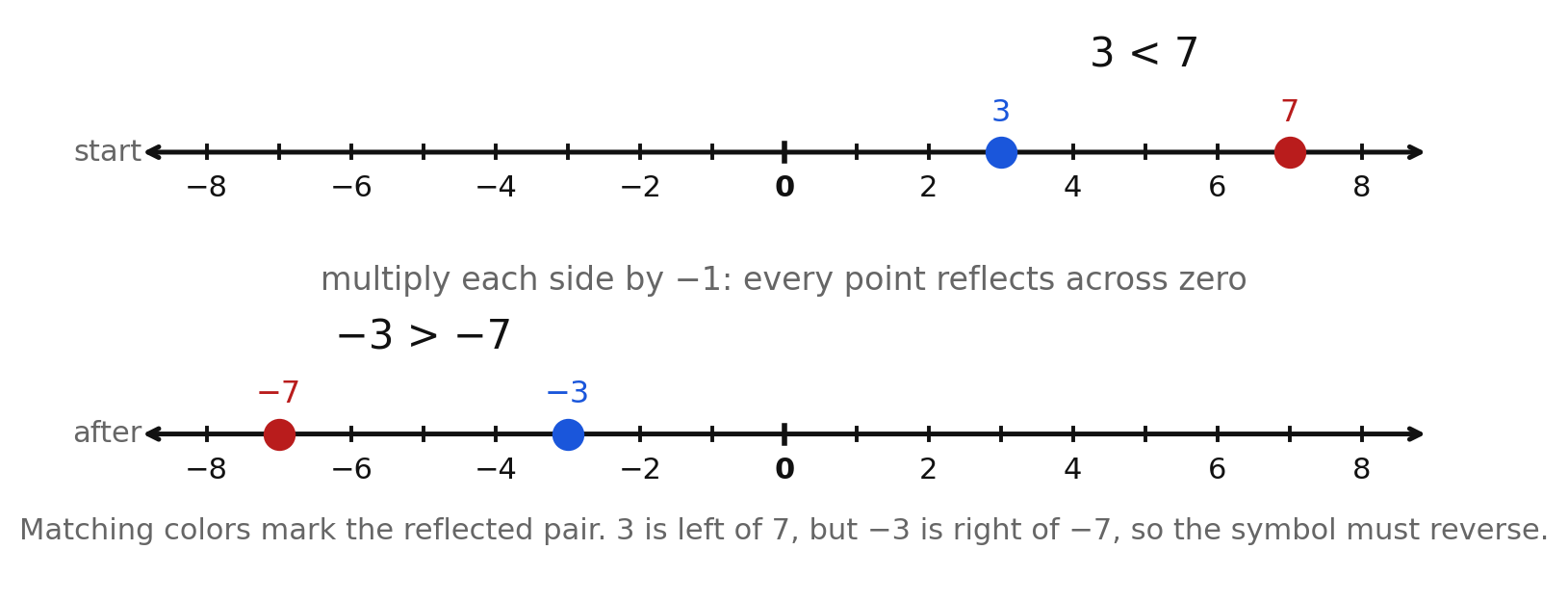
Multiplying by a negative number reflects every point across zero, the way a mirror reverses left and right. Because was to the left of , the reflection must land to the right of the reflection . The reflection reverses the order all by itself. The symbol has to be reversed as well, or the sentence you write down would be false.
That is the entire justification. It is not an arbitrary rule; it is a description of what reflection does.
Sliding is not reflecting
Here is the mistake that costs more points than any other in this chapter: seeing a minus sign somewhere on the page and reversing out of habit.
Start again with and this time add to both sides. The left becomes and the right becomes . Is ? Yes, and the direction did not reverse.
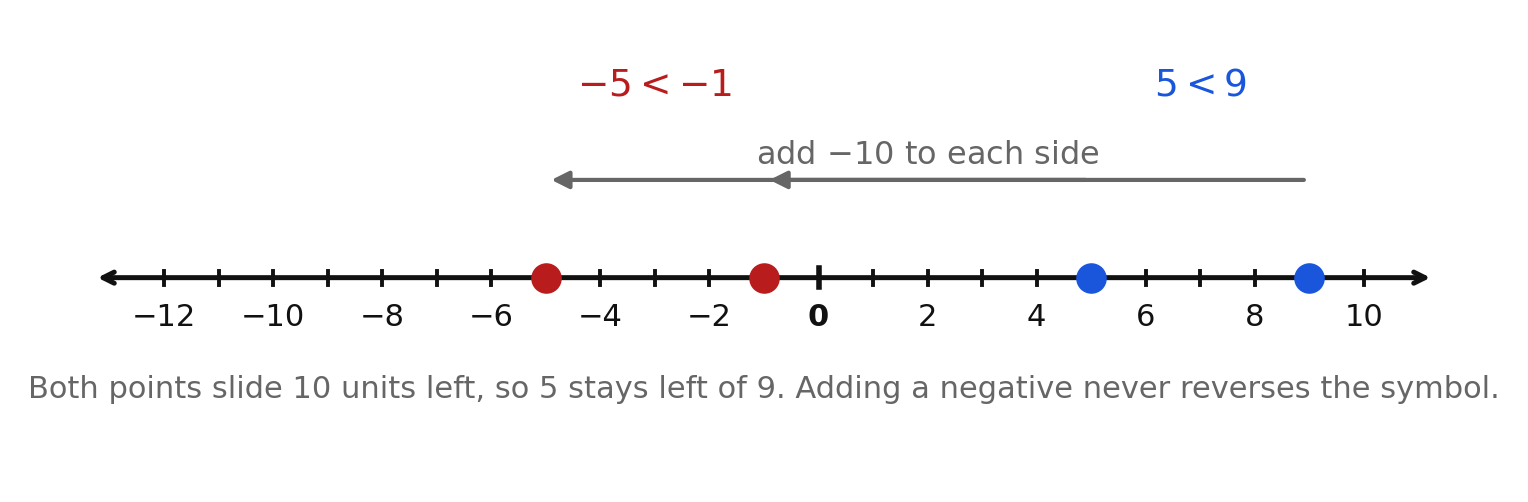
Adding a negative number slides both points the same distance in the same direction. A slide never changes which point is on the left. A reflection always does.
The reversal rule, stated precisely. Reverse the direction of the inequality symbol exactly when you multiply or divide both sides by a negative number. In every other case — adding any number, subtracting any number, multiplying or dividing by a positive number, distributing, combining like terms — the direction stays the same.
Two things do not trigger the rule, no matter how many minus signs are visible: adding or subtracting a negative number, and a negative number sitting by itself on one side.
The decision, asked once per step
In a four-step problem, ask one question at each step:
Am I multiplying or dividing both sides by a negative number?
If yes, reverse. If no, leave the symbol alone. Distributing a across a set of parentheses is not multiplying both sides; it changes one side only, so nothing reverses. Only the final division by a negative coefficient, or a deliberate multiplication of both sides by a negative, can reverse anything.
| The move | Reverses? | Why |
|---|---|---|
| subtract from both sides | no | a slide |
| add to both sides | no | a slide |
| distribute across | no | changes one side only |
| divide both sides by | yes | a reflection |
| multiply both sides by | yes | a reflection |
| multiply both sides by | no | a stretch, no crossing of zero |
A way to avoid the reversal entirely
There is an alternative that some students prefer: move the variable term to whichever side keeps its coefficient positive. Solving by adding to both sides gives , then , then , which is — with no reversal anywhere. Solving the same inequality by subtracting 7 gives and a division by that does reverse, landing on the same .
Both routes are correct. Knowing both means you can pick the one with fewer chances to slip, and you can check one against the other.
Worked examples
Example 1 — Investigating with multiplication and division
Begin with the true statement . Multiply both sides by . Then, starting over, add to both sides. Write the true statement each time.
Multiplying: and . On a number line is to the right of , so the true statement is .
Adding: and . On a number line is to the left of , so the true statement is .
Answer: , reversed; , not reversed. Only the multiplication reflected the points.
Example 2 — A negative coefficient at the last step
Solve and graph the solution set.
Subtract 9 from both sides. This step is a slide, so the symbol is untouched.
Now divide both sides by , a negative number, and reverse the symbol.
Check inside: gives , and is true. Check the boundary: gives , and is false, correctly excluded. Check outside: gives , which is false.
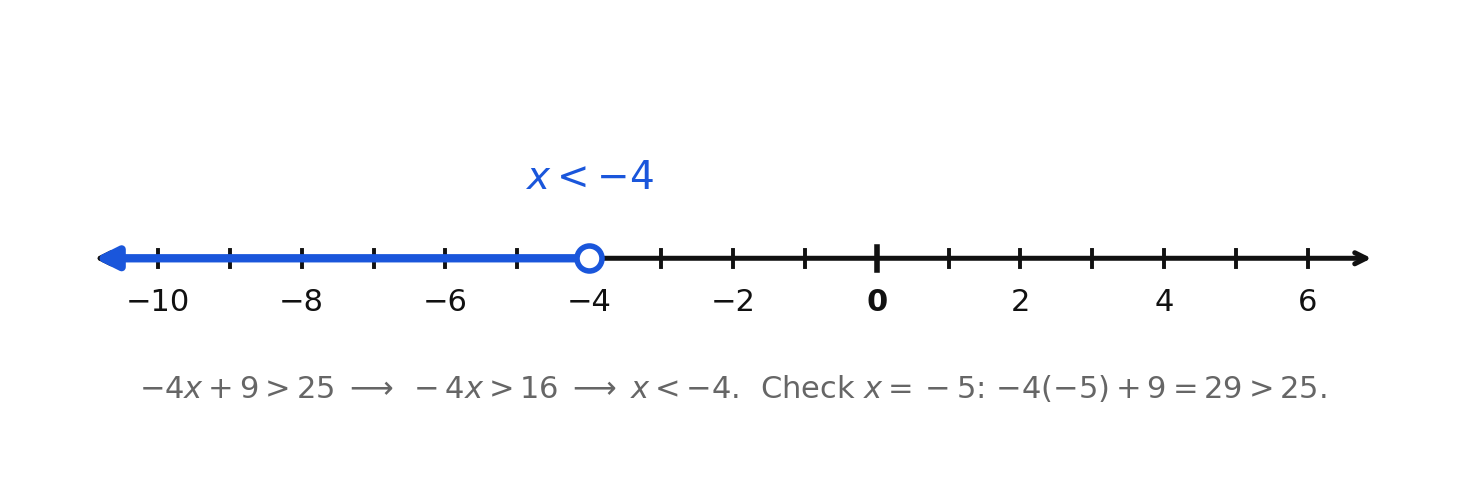
Answer:
Example 3 — A negative rational coefficient
Solve .
Add 5 to both sides, then multiply both sides by the reciprocal , which is negative, so reverse.
Check the boundary: , and is true. Check outside: gives , and is false.
Answer:
Example 4 — Distributing a negative does not reverse anything
Solve .
Distribute the across the parentheses. This changes the left side only, so the symbol stays put.
Now divide both sides by and reverse.
Check inside: gives , and is true. Check the boundary: gives , and is false.
Answer:
Example 5 — The pair that separates sliding from reflecting
Solve and , and explain why only one reverses.
For , a number is being subtracted from the variable, so add 6 to both sides. No reversal.
Check: gives , true; gives , false.
For , the variable is being multiplied by , so divide both sides by and reverse.
Check: gives , true, and ; gives , false.
Answer: with no reversal; with a reversal. The minus signs look similar; the operations do not.
Guided practice
- Begin with the true statement and multiply both sides by . Write the resulting true statement.
- Begin with the true statement and add to both sides. Write the resulting true statement, and state whether the direction changed.
- Solve , and name the exact step at which the direction reverses.
- Solve and test the boundary value in the original inequality.
Independent practice
- Solve. a) b) c) d)
- Solve each and explain why only one of the two requires a reversal. a) b)
- Solve .
- Solve .
- For each move, state whether the direction of the symbol reverses and give the reason. a) subtract from both sides b) divide both sides by c) add to both sides d) multiply both sides by
- Application. A hot-air balloon at 1{,}200 feet descends 75 feet every minute, so its altitude after minutes is feet. Write and solve an inequality for the times at which its altitude is below 600 feet, and state the answer in a sentence.
- Reasoning. Begin with the true statement and multiply both sides by . Write the resulting true statement, then explain, using the positions of the numbers on a number line, why the direction had to reverse.
- Error analysis. Nico solves by subtracting 5 to get and then dividing by without changing the symbol, writing . Test in the original inequality, explain what the test reveals, and give the correct solution.
Exit ticket 6.2
- Solve .
- Solve .
- Begin with the true statement and divide both sides by . Write the resulting true statement.
- Explain why distributing a negative number across parentheses does not reverse the symbol, but dividing both sides by a negative number does.
Lesson 6.3 — Expanding and Combining Like Terms
Clean up each side first
An inequality such as cannot be solved by undoing operations one at a time, because the left side is not yet in the form "coefficient times variable, plus constant." The first job is to rewrite it in that form.
Two tools do this, both of them from Chapter 4.
- The distributive property: . The outside factor multiplies every term inside, keeping its sign.
- Combining like terms: terms with the same variable part add or subtract into one term, and constants combine with constants.
Neither tool touches both sides at once, so neither can change the direction of the symbol. They are bookkeeping, done before the real solving begins.
The order of work
- Expand every product with parentheses, on both sides.
- Combine like terms on each side, separately.
- Collect the variable on one side, using the addition or subtraction property.
- Isolate the variable, using the multiplication or division property, and ask the reversal question exactly once, at that step.
That is at most four steps, which is the limit this chapter works within.
The sign trap in front of parentheses
A minus sign in front of parentheses is a factor of , and it multiplies every term inside.
The most common error in this lesson is distributing to the first term only: writing as instead of . Write the factor over each term before multiplying if that helps you catch it.
Worked examples
Example 1 — Distribute, then two more steps
Solve .
Check inside: gives , and is true. Check the boundary: gives , and is false.
Answer:
Example 2 — Distribute, then combine across the same side
Solve .
Check the boundary: , and is true. Check outside: gives , and is false.
Answer:
Example 3 — A negative factor outside the parentheses
Solve .
Distribute to both terms. Note that .
Divide both sides by and reverse.
Check inside: gives , and is true. Check the boundary: gives , and is false. Check outside: gives , false.
Answer:
Example 4 — A rational factor outside the parentheses
Solve .
Check the boundary: , and is true. Check outside: gives , and is false.
Answer:
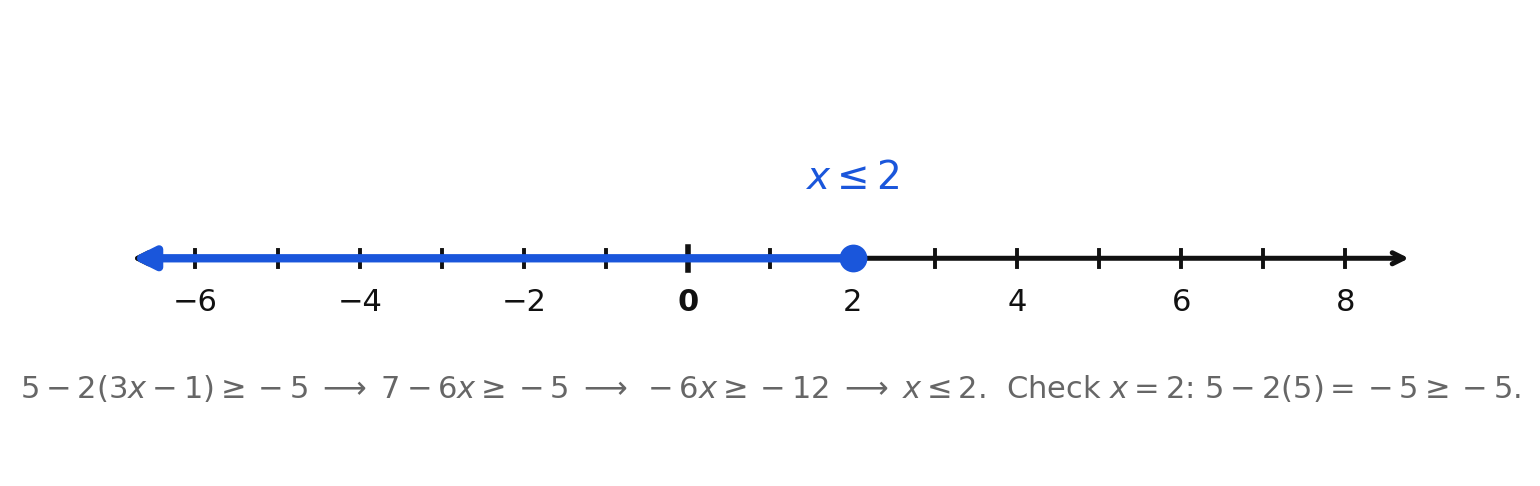
Example 5 — Subtracting a product
Solve .
The multiplies both terms inside, and .
Divide both sides by and reverse.
Check the boundary: , and is true. Check outside: gives , and is false. Check inside: gives , and is true.
Answer: , graphed above with a closed circle at 2 and shading to the left.
Guided practice
- Solve , naming the property used at each step.
- Solve and test the boundary value.
- Solve and state the step at which the direction reverses.
- Solve and test one value from inside your solution set and one from outside.
Independent practice
- Solve. a) b) c) d)
- Solve .
- Solve .
- Solve .
- Solve .
- Application. A club assembles gift bags. Each bag holds a $4 pen and a $6 notebook, and one flat $25 shipping charge covers the whole order. The club can spend at most $325. Write an inequality for the number of bags , combine like terms, solve, and state how many whole bags the club can assemble.
- Reasoning. Solve . Then explain the two separate places a sign could go wrong in this problem and how you guarded against each.
- Error analysis. Ivy solves by writing . Name her error, solve the inequality correctly, and use the test value to show that her answer excludes a number that really is a solution.
Exit ticket 6.3
- Solve .
- Solve .
- Solve .
- Explain why expanding and combining like terms can never reverse the inequality symbol, even when the number you distribute is negative.
Lesson 6.4 — The Variable on Both Sides
One new decision
When the variable appears on both sides, one extra move joins the procedure: collect the variable terms onto a single side, using the addition or subtraction property of inequality. Subtracting from both sides is a slide, exactly like subtracting 2, so the symbol never changes at this step.
The full procedure:
- Expand and combine like terms on each side.
- Choose a side for the variable, and add or subtract that variable term on both sides.
- Move the constant to the other side.
- Divide by the coefficient, asking the reversal question.
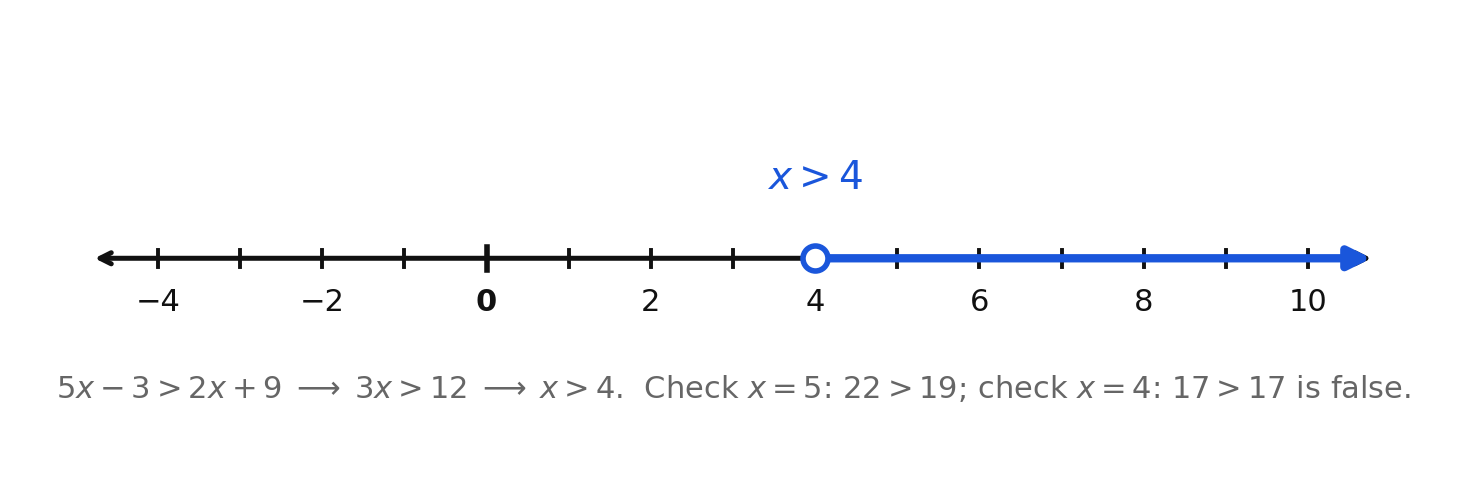
Which side should the variable go to?
Either side works, and both give the same answer. They differ in how much sign-handling you do.
Solve both ways.
Route 1 — move the smaller coefficient, keeping the variable positive. Subtract from both sides:
Rewritten with the variable first, that is . No reversal was needed anywhere.
Route 2 — move the larger coefficient. Subtract from both sides:
The last division was by , so the symbol reversed, and the answer matched.
Route 1 avoided the reversal entirely. That is a reason to prefer it, not a rule: choose the side that leaves the variable with a positive coefficient, and you remove the most error-prone step from the problem.
Rewriting with the variable first
Route 1 ended at . Read it out loud: "3 is less than or equal to ," which is the same claim as " is greater than or equal to 3." To rewrite, swap the two sides and swap the direction of the symbol, so the wide end still faces the same quantity.
Do this every time the variable lands on the right, before you graph. Graphing as though it read is a common and entirely avoidable error.
Worked examples
Example 1 — The basic form
Solve .
Subtract from both sides, add 3, divide by 3.
Check inside: gives on the left and on the right, and is true. Check the boundary: gives and , and is false.
Answer:
Example 2 — Two routes, one answer
Solve two ways.
Route 1: subtract , giving , then , then , that is .
Route 2: subtract , giving , then , then, dividing by and reversing, .
Check the boundary: and , and is true. Check outside: gives and , and is false.
Answer: by either route.
Example 3 — Expand first, then collect
Solve .
Subtract from both sides, then add 6, then divide by and reverse.
Check inside: gives , true. Check the boundary: gives and , and is false. Check outside: gives and , and is false.
Answer:
Example 4 — Rational coefficients on both sides
Solve .
Subtract from both sides, then subtract , then divide by and reverse.
Check the boundary: and , and is true. Check outside: gives and , and is false.
Answer:
Example 5 — Four steps, with a distribution
Solve .
Subtract from both sides, then add 4, then divide by and reverse.
Check the boundary: and , and is true. Check outside: gives and , and is false. Check inside: gives , true.
Answer:
Guided practice
- Solve , naming the property used at each step.
- Solve twice, once by subtracting first and once by subtracting first, and confirm the answers agree.
- Solve and test the boundary value.
- Solve and test one value from inside your solution set and one from outside.
Independent practice
- Solve. a) b) c) d)
- Solve .
- Solve .
- Solve .
- Solve .
- Application. Gym A charges a $30 membership fee plus $5 per class. Gym B charges $10 per class and no fee. Write and solve an inequality for the numbers of classes for which Gym A costs less than Gym B, and state the answer as a whole number of classes.
- Reasoning. Solve twice, once by subtracting first and once by subtracting first. State which route required a reversal and explain why the two answers still agree.
- Error analysis. Marco solves by subtracting to get , subtracting 5 to get , and then dividing by without changing the symbol, writing . Test in the original inequality, explain what the test reveals, and give the correct solution.
Exit ticket 6.4
- Solve .
- Solve .
- Solve .
- Explain why moving the variable to the side that keeps its coefficient positive can make a problem safer to solve, and why the other route is still correct.
Lesson 6.5 — Representing Solutions Algebraically and Graphically
Two required representations
A solution to an inequality is reported in two forms, and the standard asks for both.
- Algebraically, as a statement such as , with the variable written first.
- Graphically, as a shaded ray on a number line.
The graph carries exactly three pieces of information, each of them read straight off the solved inequality.
- The endpoint sits at the boundary number.
- The circle is open for a strict symbol, or , and closed for an inclusive symbol, or . A hollow circle says this exact number is not a solution; a filled circle says it is.
- The shading runs right for or and left for or , with an arrowhead showing that it never stops.
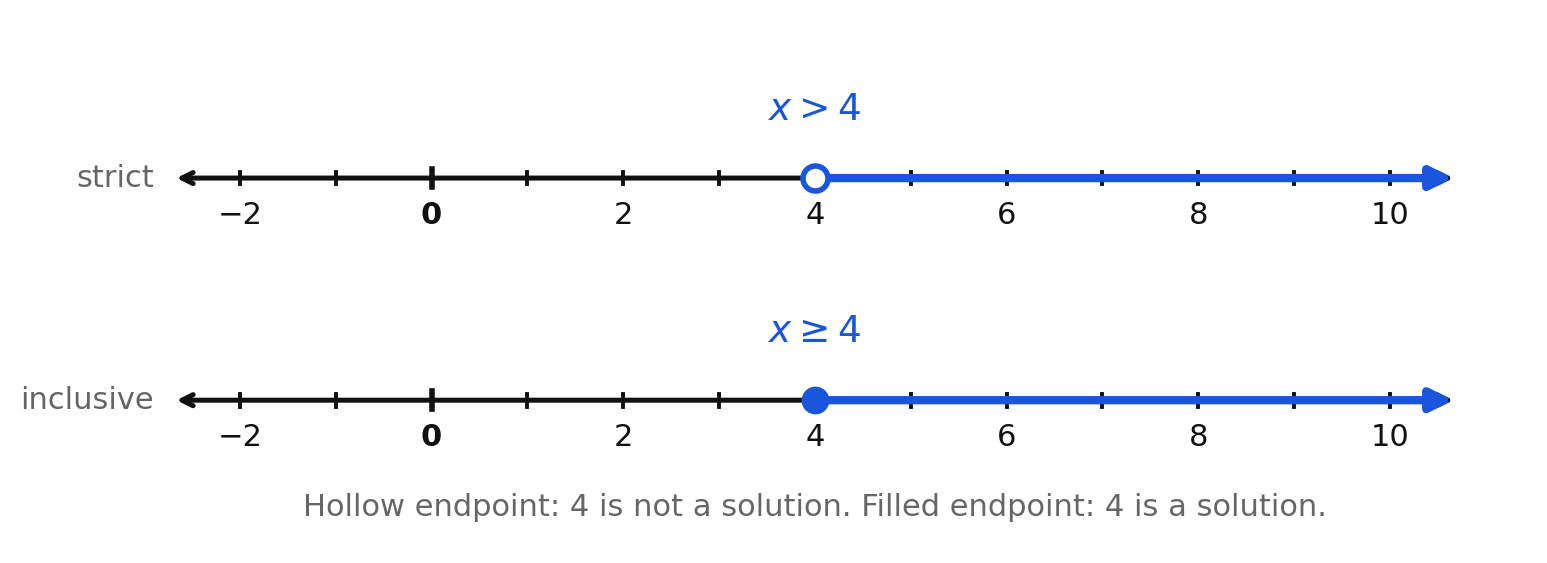
The two graphs above differ by a single point. In the top graph 4 is excluded, because is false. In the bottom graph 4 is included, because is true.
The four shapes
One boundary, two circle types, two directions: every inequality in this chapter graphs into one of four shapes. Boundaries need not be integers.
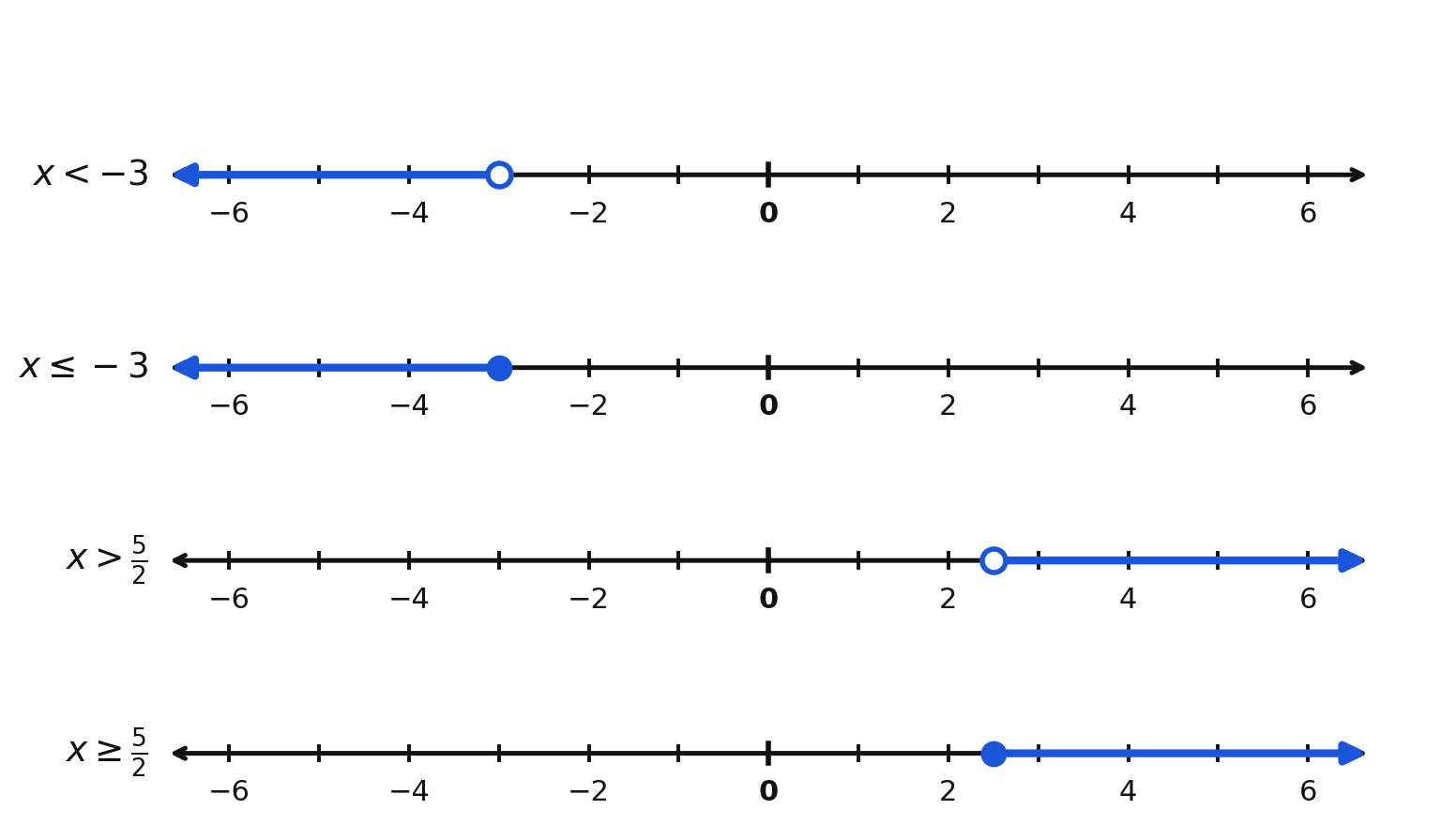
Learn to move in both directions. Given , draw the second graph. Given the second graph, write .
Graph the solved inequality, not the original
The symbol in the original inequality is not the direction of the graph. Only the solved form tells you which way to shade. Solving gives , so the graph runs left, even though the original showed a . Solve completely, rewrite with the variable first, and only then draw.
Identifying values in a solution set
Once a set is graphed, deciding whether a particular number belongs is a matter of looking — and then confirming by substitution into the original inequality.
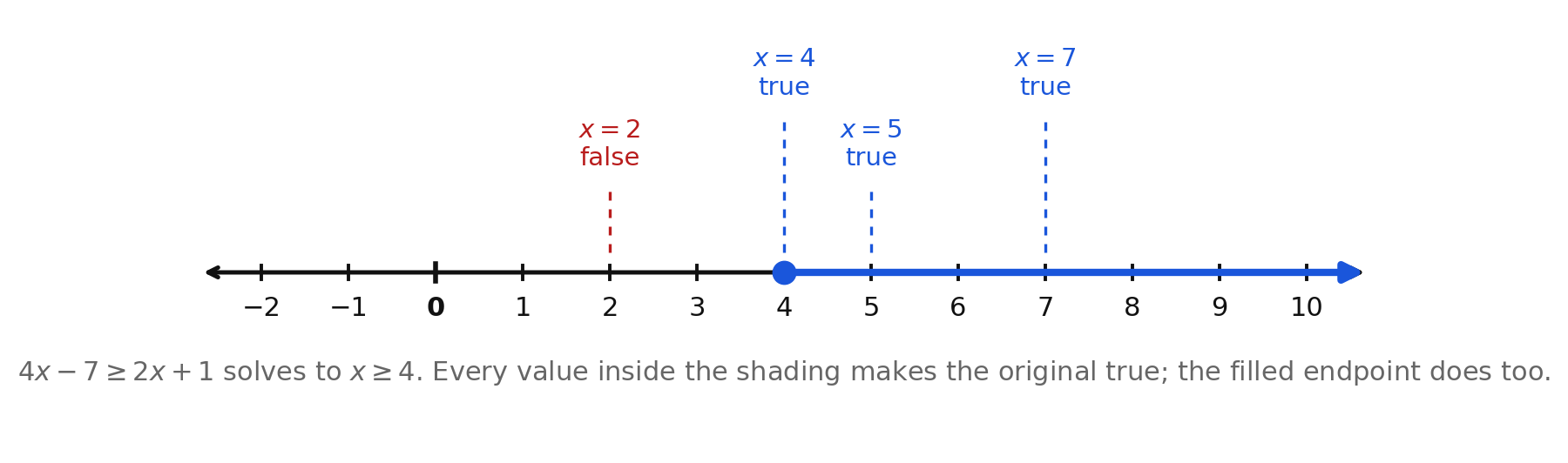
The inequality solves to . Substituting confirms the picture: gives on the left and on the right, and is false; gives and , and is true; gives and , true; gives and , true.
Notice how the boundary behaves. If the symbol had been instead of , the value would have dropped out of the set and the circle would have opened. Boundary values are the numbers worth testing, because they are the ones the symbol decides.
Reading a graph back into symbols
- Read the boundary number under the circle.
- Hollow circle means or ; filled means or .
- Shading right means or ; shading left means or .
A filled circle at shaded right is . Many different multistep inequalities share that solution set — is one — which is worth knowing when a problem asks you to write an inequality for a given graph.
Worked examples
Example 1 — Graphing a strict inequality
Graph .
The boundary is ; the symbol is strict, so the circle is open; the solution set runs upward, so shade right with an arrowhead.
Test: is true and lies inside the shading; is false and sits under a hollow circle.
Answer: An open circle at with shading to the right.
Example 2 — A non-integer boundary
Graph .
The boundary is , halfway between the tick marks at 2 and 3. The symbol is inclusive, so the circle is closed, and the shading runs left.
Test: is true; is false.
Answer: A closed circle at with shading to the left.
Example 3 — Solve, then graph
Solve and graph .
Check the boundary: and , and is true. Check outside: gives and , and is false.
Answer: , graphed with a closed circle at 4 and shading to the right.
Example 4 — Solve with a reversal, then graph
Solve and graph .
Divide both sides by and reverse.
Check the boundary: , and is true. Check outside: gives , false. Check inside: gives , true.
The graph runs left even though the original inequality displayed a pointing the other way.
Answer: , graphed with a closed circle at and shading to the left.
Example 5 — From a graph to an inequality
A number line shows an open circle at with shading to the left. Write the inequality, then write a multistep inequality with the same solution set.
Hollow circle means strict; shading left means less than. The inequality is .
For a multistep version, build one that collapses to it: gives , then .
Check: gives and , and is true; gives and , and is false.
Answer: ; one multistep inequality with that solution set is .
Guided practice
- Graph . State the endpoint value, the circle type, and the shading direction.
- Graph . State the endpoint value, the circle type, and the shading direction.
- Solve and graph , and name two values in the solution set.
- Solve and graph , and state why the graph runs left.
Independent practice
- Graph each. a) b) c) d)
- Solve and graph. a) b)
- Solve and graph .
- Rewrite with the variable written first, then graph it.
- A number line shows an open circle at with shading to the left. Write the inequality, then write a multistep inequality with the same solution set and show that it does.
- Application. A pool holds 500 gallons and drains 20 gallons per minute, so it holds gallons after minutes. Write and solve an inequality for the times at which the pool holds more than 100 gallons, graph the solution, and explain which part of the graph does not describe any real moment.
- Reasoning. Explain why the graph of runs to the left even though the symbol in the original inequality is .
- Error analysis. Priya solves and graphs an open circle at with shading to the left. Name both of her errors, use the test value to expose them, and describe the correct graph.
Exit ticket 6.5
- Solve and graph .
- Solve and graph .
- A number line shows a closed circle at with shading to the right. Write the inequality.
- State the rule for open and closed circles, and explain why the rule is what it is.
Lesson 6.6 — Inequalities in Context: Write, Solve, Interpret, Invent
From a situation to a symbol
Most real limits are inequalities. A budget is a ceiling, a minimum height is a floor, a weight limit is a boundary that must not be crossed. Writing one follows a reliable path.
- Read the whole situation before writing anything.
- Name the unknown, with units, in a full sentence: "let = the number of hours."
- Find the fixed amount and the per-unit amount on each side. Which number happens once, and which happens for every unit?
- Find the limit and its symbol, using the phrase table below.
- Write, solve, and interpret.
| Phrase | Symbol | Boundary included? |
|---|---|---|
| at least, no fewer than, a minimum of | yes | |
| at most, no more than, a maximum of | yes | |
| more than, greater than, exceeds, over | no | |
| fewer than, less than, under, below | no |
Grade 8 adds a second family of situations: comparisons. When two plans, two companies, or two savings accounts are set against each other, each side of the inequality models one of them, and the variable appears on both sides.
Do not trust keywords alone. In "shirts cost $12 each plus a $5 shipping fee, and Ana has at most $65," the $5 is added once to the order, not to each shirt. The inequality is , not . Retelling the story from your inequality catches this every time.
Interpreting the solution in context
Solving is not the last step. The algebra hands back a set of numbers; the context decides what those numbers mean and which of them are usable.
Three questions turn into an answer a person could act on.
- What does the variable count, and in what units? "" means nothing until you say "at most 5.2 weeks."
- Must the value be a whole number, and must it be non-negative? Weeks, tickets, boxes, and people cannot be split or negative. Gallons, hours, and dollars often can be.
- Which whole numbers actually satisfy the original inequality? Test the two nearest the boundary. If one passes and the next fails, you have found the edge.
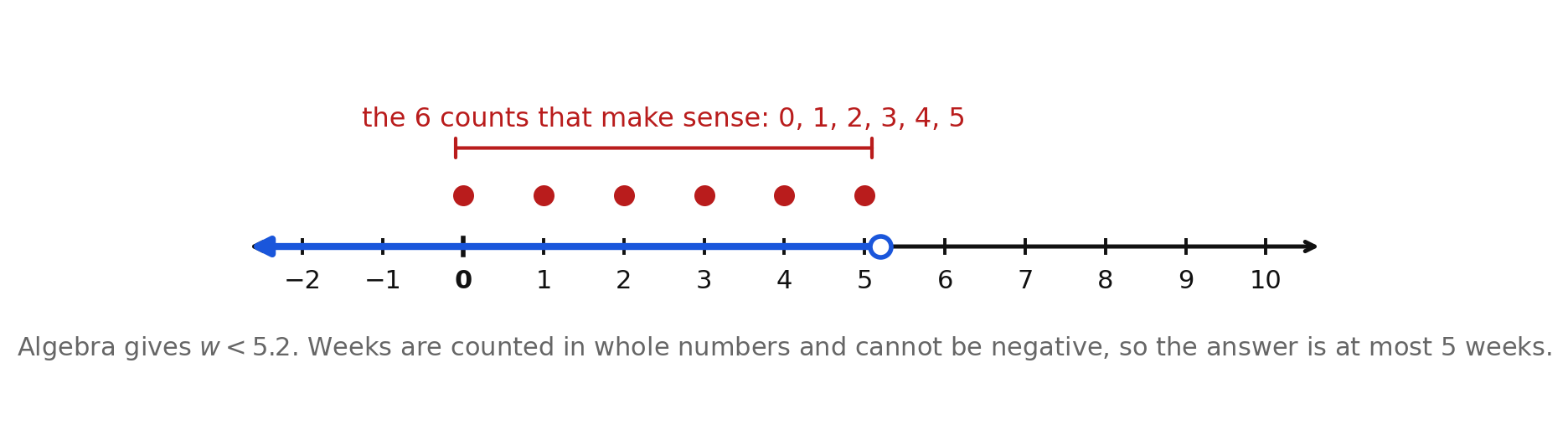
Rounding direction is decided by meaning, never by a memorized rule. A ceiling of whole weeks becomes at most 5. A floor of whole weeks becomes at least 9. Those round in opposite directions, and only a test of the nearby whole numbers tells you which is which.
Say the answer in a sentence, with units. "Fewer than 4 hours" is an answer. "" is a solution set.
Creating a situation from an inequality
Running the work backward proves you understand what each number does. Given , read the parts: and are per-unit amounts on two competing options, and are one-time amounts, and says the two totals may be exactly equal.
Company A charges a $20 booking fee plus $8 per mile. Company B charges a $60 booking fee plus $4 per mile. For which distances does Company A cost no more than Company B?
Solving: , so . Company A is the better deal up to and including 10 miles. The check confirms it: at 10 miles, and , and is true; at 11 miles A costs $108 and B costs $104, so A is no longer cheaper.
A good invented situation passes four tests: the operations match, the numbers land in the right roles, the symbol matches the phrase used, and the answer is a sensible thing to have that many of. When a coefficient is negative, choose a setting where something decreases — a tank draining, a balance being spent down, an altitude falling.
Worked examples
Example 1 — Comparing two plans
A moving company charges $90 plus $40 per hour. A second company charges $150 plus $25 per hour. For how many hours is the first company less expensive?
Let = the number of hours. "Less expensive" is strict.
Check inside: at the first costs and the second costs , and is true. Check the boundary: at both cost $250, and is false.
Answer: ; the first company is less expensive for any job shorter than 4 hours. At exactly 4 hours the two cost the same, which is why 4 is excluded.
Example 2 — Translating a sentence
Write and solve: five less than three times a number is at least twice the number increased by 4.
Let = the number. "Five less than three times a number" is ; "at least" is .
Check the boundary: and , and is true. Check outside: gives and , and is false.
Answer: ; the numbers that work are .
Example 3 — Spending down, with a whole-number answer
Devon has $120. He buys a $12 book and then spends $15 each week. For how many weeks will he still have more than $30 left?
Let = the number of whole weeks, with .
Divide both sides by and reverse.
Test the two nearest whole numbers: at he has dollars, and is true; at he has dollars, and is false.
Answer: , giving . Weeks are counted in whole numbers, so Devon still has more than $30 for 5 weeks.
Example 4 — Something decreasing
A drone at 240 meters descends 15 meters per second, so its altitude after seconds is meters. For what times is it below 90 meters?
Divide by and reverse.
Check inside: at the altitude is , and is true. Check the boundary: at the altitude is exactly 90, and is false.
Answer: , giving . The drone is below 90 meters after the tenth second — not at the tenth second, when it is exactly at 90 meters.
Example 5 — Creating a situation from an inequality
Write a situation in context for and solve it.
The two per-unit rates, 8 and 4, and the two one-time amounts, 20 and 60, say this is a comparison of two options, and allows the two totals to be equal.
Answer: Company A charges a $20 booking fee plus $8 per mile; Company B charges a $60 booking fee plus $4 per mile. For which trip lengths does Company A cost no more than Company B? The solution is : Company A costs no more for trips up to and including 10 miles. Check: and , and is true.
Guided practice
- A moving company charges $90 plus $40 per hour, and a second charges $150 plus $25 per hour. Write and solve an inequality for the numbers of hours for which the first company is less expensive, and state the answer in a sentence.
- Write and solve: five less than three times a number is at least twice the number increased by 4.
- Devon has $120, buys a $12 book, and then spends $15 each week. Write and solve an inequality for the numbers of weeks during which he still has more than $30 left, and state how many whole weeks that is.
- Write a situation in context for , solve it, and interpret the answer in a sentence.
Independent practice
- Application. A freight elevator can carry at most 1{,}500 pounds. A driver weighing 190 pounds and two helpers weighing 150 pounds each ride with boxes weighing 45 pounds apiece. Write and solve an inequality for the number of boxes, and state how many whole boxes may be loaded.
- Application. Plan A costs $25 per month plus $8 per gigabyte of data. Plan B costs $55 per month plus $4 per gigabyte. Write and solve an inequality for the amounts of data for which Plan A costs no more than Plan B, and interpret the answer.
- Write and solve: four more than twice a number is less than the number decreased by 6.
- Write a situation in context for , solve it, and interpret the answer.
- Write a situation in context for , choosing a setting in which something decreases, and solve it.
- Interpretation. Solving a problem about crates gives the solution set , where is a whole number of crates. State what the answer means in context, give the greatest usable value, and show the check that confirms it is the edge.
- Reasoning. For the moving-company comparison in item 81, explain what means in the situation and why the strict symbol excludes it.
- Error analysis. For "a printer costs $80 plus $0.20 per page, and the budget is at most $140," Sam writes . Explain why that does not match the situation, write the correct inequality, solve it, and state the greatest number of pages.
Exit ticket 6.6
- A caterer charges a $200 setup fee plus $18 per guest, and the budget is at most $920. Write and solve an inequality for the number of guests.
- Write and solve: seven more than four times a number is at most the number increased by 25.
- Write a situation in context for , solve it, and interpret the answer.
- Explain what it means to interpret a solution in context, and give an example in which the algebraic answer is not the practical answer.
Chapter 6 Review
Vocabulary. inequality · strict inequality · inclusive inequality · solution · solution set · multistep linear inequality · properties of inequality · additive inverse property · multiplicative identity property · distributive property · like terms · coefficient · constant term · reciprocal · reversal rule · boundary value · open circle · closed circle · ray · constraint · interpret in context
Part A — Solving multistep inequalities (8.PFA.5a)
- Solve. a) b) c) d)
- Solve .
- Solve .
- Solve .
- Solve .
- Solve .
- Solve .
Part B — Representing solutions algebraically and graphically (8.PFA.5b)
- Graph each. a) b) c) d)
- Solve and graph .
- Solve and graph .
- A number line shows a closed circle at with shading to the right. Write the inequality, then write a multistep inequality with the same solution set and show that it does.
- Explain how a graph shows whether the boundary value itself is a solution, and how you would confirm it algebraically.
Part C — Writing an inequality from a situation (8.PFA.5c)
- Write an inequality: a bus holds at most 52 riders, and 14 seats are already taken. Use for the number of additional riders.
- Write and solve: three times a number decreased by 8 is greater than the number increased by 6.
- Write and solve: a gym charges $60 to join plus $12 per month, and Priya can spend at most $240.
- Write and solve: Shop A charges a $35 setup fee plus $2.00 per shirt, and Shop B charges a $75 setup fee plus $1.50 per shirt. For which numbers of shirts is Shop A less expensive?
Part D — Creating a verbal situation from an inequality (8.PFA.5d)
- Write a situation in context for and solve it.
- Write a situation in context for and solve it.
- Write a situation in context for , choosing a setting in which something decreases, and solve it.
- Write a situation in context for , using two competing options, and solve it.
Part E — Solving problems in context (8.PFA.5e)
- A food truck charges $3.25 per taco plus a $1.50 packaging fee, and Priya has $20.00. Write and solve an inequality for the number of tacos, and state how many she can buy.
- An elevator can carry at most 2{,}000 pounds. An operator weighing 175 pounds rides with crates weighing 90 pounds each. Write and solve an inequality for the number of crates.
- Mia has $85 and saves $22 each week. Noah has $250 and spends $8 each week. Write and solve an inequality for the numbers of weeks after which Mia has at least as much as Noah.
- A 60-gallon tank drains 4 gallons per minute. Write and solve an inequality for the times at which it holds more than 12 gallons.
- A club sells tickets for $8 each. The hall costs $240, and programs cost $3 for each person who attends. Write and solve an inequality for the number of tickets the club must sell to make a profit of at least $300.
Part F — Identifying values in a solution set (8.PFA.5f)
- Which values from , , , , and are solutions of ? Show your reasoning.
- Which values from , , , and are solutions of ? Show each substitution.
- Name three solutions of , including one that is not an integer, and show that each one works.
- Give a number that is a solution of but not a solution of , and explain why.
Part G — Interpreting solutions in context (8.PFA.5g)
- A problem about boxes gives the solution set , where counts whole boxes. Interpret the answer in a sentence and give the greatest usable value.
- A comparison of two gyms gives , where counts whole classes. Interpret the answer in a sentence, and state what happens at exactly 6 classes.
- A drone problem gives , where is the time in seconds since the descent began. Interpret the answer in a sentence, and state the altitude at given that the altitude is meters.
- A worker's problem gives , where counts whole hours. Interpret the answer, then explain why this rounds upward while item 126 rounds downward.
Part H — Mixed application and reasoning
- Solve and graph , and test the boundary value in the original inequality.
- A student says the solution of is . Test in the original inequality, explain what the test shows, and give the correct solution.
- Write two different multistep inequalities whose solution set is , one with the variable on both sides and one with the variable on one side, and show that each has that solution set.
- Solve and then solve . Describe how the two answers are related, and how their graphs differ.
- Describe the complete procedure for deciding whether to reverse the inequality symbol while solving a four-step inequality. Give one example in which a reversal is required and one in which several minus signs appear but no reversal is required.
Standards coverage check — Chapter 6
| Knowledge and Skill | Where it is taught | Where it is practiced |
|---|---|---|
| 8.PFA.5a — apply properties of real numbers and properties of inequality to solve multistep linear inequalities (up to four steps) with the variable on one or both sides, rational coefficients and terms, including expanding with the distributive property and combining like terms | 6.1, 6.2, 6.3, 6.4 | Items 3–5, 7–9, 12, 13, 15, 17–32, 33–48, 49–64; Review Part A (97–103), 130, 131, 134 |
| 8.PFA.5b — represent solutions to inequalities algebraically and graphically using a number line | 6.2, 6.3, 6.5 | Items 19, 35, 65–80; Review Part B (104–108), 130, 132, 133 |
| 8.PFA.5c — write multistep linear inequalities in one variable to represent a verbal situation, including in context | 6.1, 6.2, 6.6 | Items 11, 26, 42, 58, 74, 81–83, 85–87, 92–94; Review Part C (109–112), Part E (117–121) |
| 8.PFA.5d — create a verbal situation in context given a multistep linear inequality in one variable | 6.6 | Items 84, 88, 89, 95; Review Part D (113–116) |
| 8.PFA.5e — solve problems in context that require the solution of a multistep linear inequality in one variable | 6.1, 6.2, 6.3, 6.4, 6.6 | Items 11, 26, 42, 58, 74, 81, 83, 85, 86, 93; Review Part E (117–121) |
| 8.PFA.5f — identify a numerical value that is part of the solution set of a given inequality | 6.1, 6.5 | Items 1, 2, 6, 10, 14, 20, 28, 36, 44, 52, 60, 67, 73, 76; Review Part F (122–125) |
| 8.PFA.5g — interpret algebraic solutions in context to linear inequalities in one variable | 6.6 | Items 11, 42, 58, 74, 81, 83–86, 88–92, 95, 96; Review Part G (126–129) |
Answer keys for every set in this chapter are in Appendix A.