Chapter 7 — Relations, Functions, Domain, and Range
Standard: 8.PFA.2 — The student will determine whether a given relation is a function and determine the domain and range of a function.
By the end of this chapter you will be able to:
- Read a relation written as a set of ordered pairs, as a table, or as a graph of discrete points, and rewrite it in any of the other two forms (8.PFA.2a, 8.PFA.2b)
- Decide whether a relation is a function by checking whether any input is paired with more than one output (8.PFA.2a)
- Use the vertical line test on a graph of discrete points, and say exactly what it detects (8.PFA.2a)
- Recognize that a repeated output never breaks the function rule, and that an input listed twice with the same output does not break it either (8.PFA.2a)
- Identify the domain and the range from a set of ordered pairs, a table, or a graph of discrete points, listing each value once and in increasing order (8.PFA.2b)
- Interpret what an ordered pair, the domain, and the range mean in a real situation (8.PFA.2a, 8.PFA.2b)
Lessons: 7.1 Relations and Three Ways to Show Them · 7.2 Deciding Whether a Relation Is a Function · 7.3 Domain and Range · 7.4 Putting It All Together
Scope note. Every relation in this chapter is a finite list of ordered pairs — no more than ten of them — so every graph you meet here is a set of separate dots. We never connect the dots, and we never work from a curve or a line. A dot is a fact the relation told you; the space between two dots is not. Grade 8 also does not use function notation such as : everything here is done with ordered pairs, tables, and graphs.
Numbering note. Item numbers run straight through the chapter, from 1 in Lesson 7.1 to 104 at the end of the review. They do not restart at each lesson.
Lesson 7.1 — Relations and Three Ways to Show Them
What a relation is
A relation is any set of ordered pairs. That is the whole definition. There is no requirement that the pairs follow a pattern, no requirement that they come from a rule, and no requirement that they behave nicely.
In an ordered pair , the first number is the input, also called the -coordinate, and the second number is the output, also called the -coordinate. The word ordered is doing real work: and are different pairs, because in the first the input is and in the second the input is .
Relations in this chapter are limited to no more than 10 ordered pairs.
The three representations
The same relation can be written three ways, and this standard expects you to move between all three.
- A set of ordered pairs, written inside braces:
- A table, with the inputs in one column and their outputs beside them
- A graph of discrete points, one dot for each ordered pair
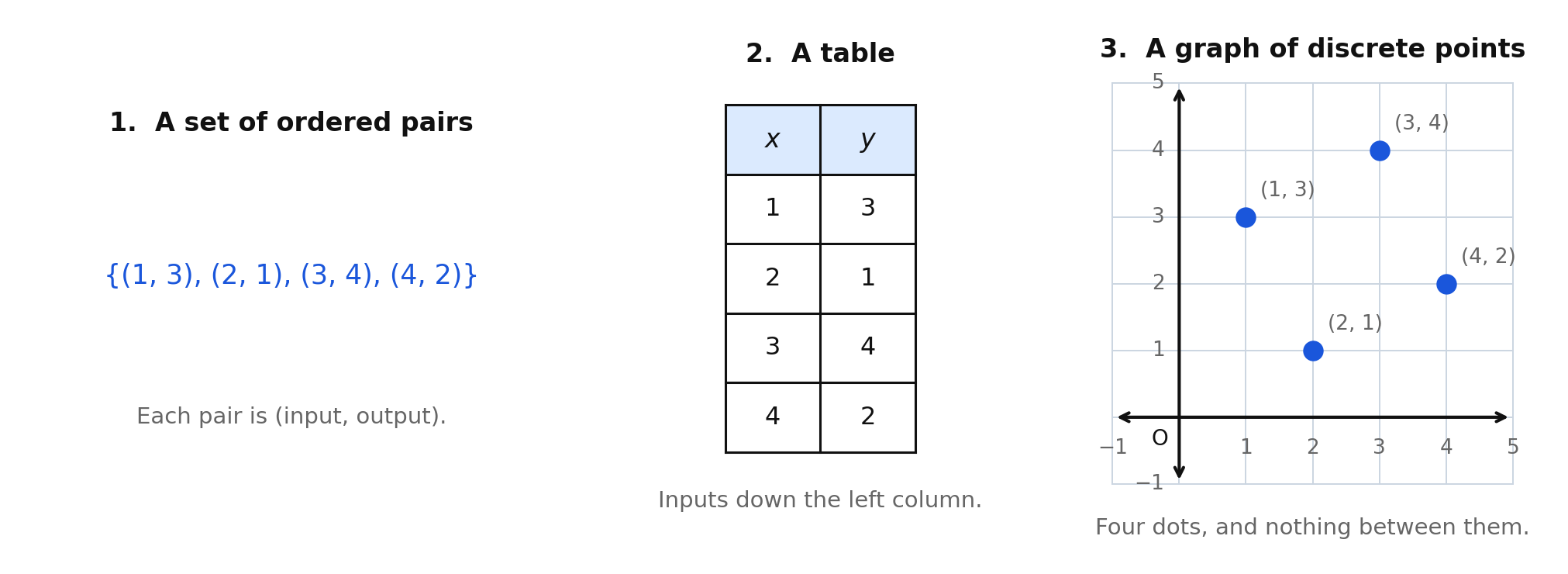
Nothing was added or lost between those three panels. They are three ways of writing the same four facts.
Why "discrete points" and not a line
The graph above is four dots. It is tempting to connect them, but connecting them would be a claim the relation never made. The relation says what happens at and says nothing at all about . A drawn line would invite you to read off an output at that does not exist.
Discrete means separated — countable dots with gaps between them. Every graph in this chapter is discrete, and every decision you make in this chapter is made from the dots themselves.
Moving between representations
Going from a set to a table: each pair becomes one row.
Going from a table to a set: each row becomes one pair, input first.
Going from either one to a graph: each pair becomes one dot, plotted by traveling units across and then units up or down.
Going from a graph to a set: read each dot's coordinates, across first and then up.
The one place this goes wrong is order. A table with -values and and -values and is the relation — never .
Worked examples
Example 1 — A set as a table
Write as a table.
Each pair becomes a row, input on the left.
Answer:
Example 2 — A table as a set
A table lists -values with -values . Write the relation as a set of ordered pairs.
Read across each row: pairs with , then with , then with .
Answer:
Example 3 — Naming input and output
In the ordered pair , which number is the input and which is the output?
The first coordinate is always the input.
Answer: input , output
Example 4 — A relation from a description
Each output is more than its input, and the inputs are . Write the relation as a set of ordered pairs.
Add to each input: , , , .
Answer:
Example 5 — A relation from a situation
A vending machine charges $2 per snack. Write the relation for buying , , , or snacks, and say what the input and output mean.
Multiply each count by .
Answer: . The input is the number of snacks; the output is the cost in dollars. The pair says three snacks cost $6.
Guided practice
- Write as a table.
- A table lists -values with -values . Write the relation as a set of ordered pairs.
- In the ordered pair , name the input and the output.
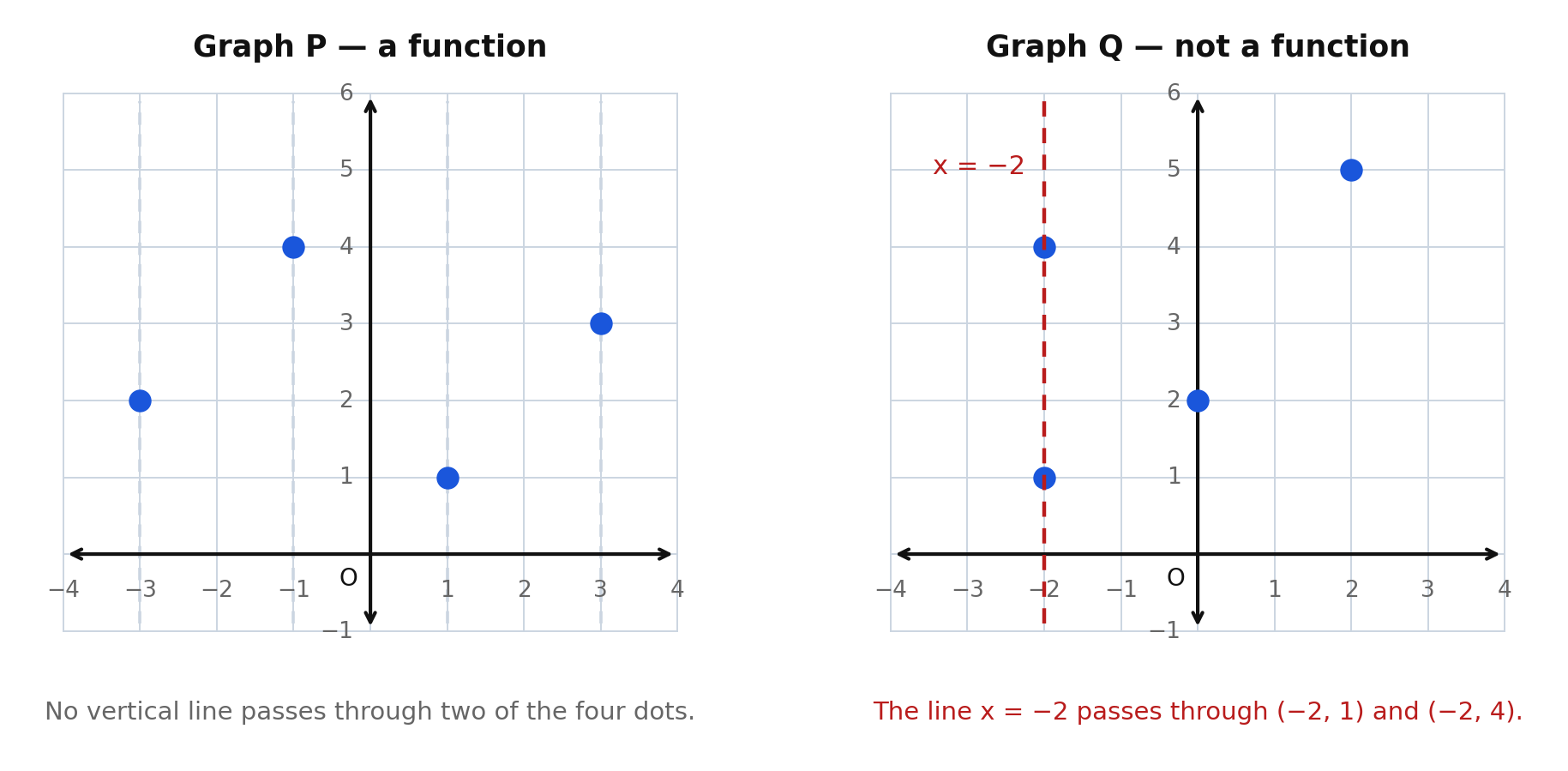
- Look at Graph P in the figure below. List its ordered pairs as a set.
- What is the largest number of ordered pairs a relation in this chapter may have?
- Explain why the graph of a relation in this chapter is a set of separate dots rather than a line.
Independent practice
- Write each table as a set of ordered pairs. a) -values with -values b) -values with -values
- Write as a table.
- List the ordered pairs of Graph Q from the figure above as a set.
- Each output is times its input, and the inputs are . Write the relation as a set of ordered pairs.
- Write the relation from item 10 as a table.
- Reasoning. Which representation makes a repeated input easiest to spot, and which makes it easiest to miss? Explain.
- Application. A parking garage charges $3 per hour. Write the relation for , , , and hours as a set of ordered pairs, and state what the input and the output represent.
- Error analysis. A table lists -values and with -values and . A student writes the relation as . Identify the error and write the relation correctly.
Exit ticket 7.1
- Write as a table.
- A table lists -values with -values . Write the relation as a set of ordered pairs.
- In the ordered pair , name the input and the output.
- Explain why and are different ordered pairs.
Lesson 7.2 — Deciding Whether a Relation Is a Function
The rule, in one sentence
A function is a relation in which each input is paired with exactly one output.
Read that sentence carefully, because almost every mistake in this lesson comes from reading it loosely.
- It says each input. It says nothing at all about outputs.
- It says exactly one output. Not "at most one" and not "at least one" — one.
So the only way a relation fails to be a function is this: some input shows up with two different outputs. That is the single thing you are hunting for.
Mapping diagrams make the rule visible
Draw the inputs in one box and the outputs in another, then draw an arrow from each input to its output.
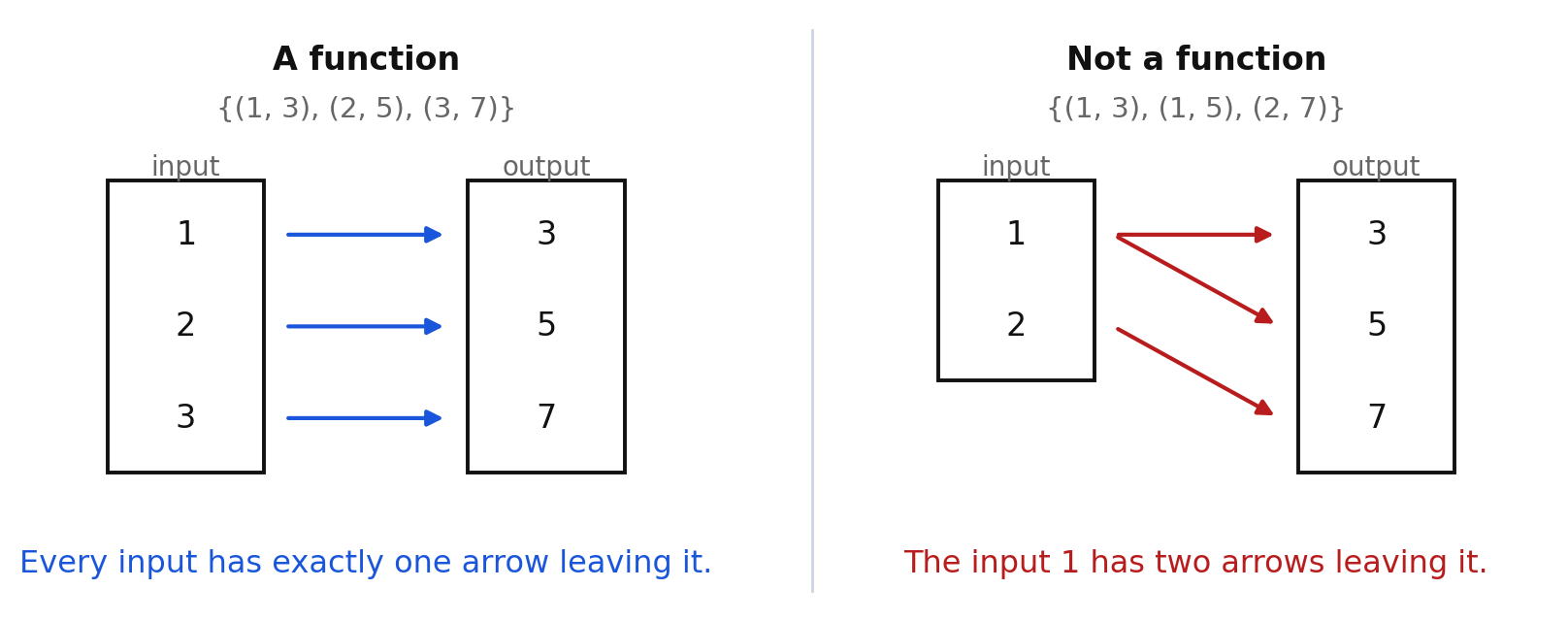
On the left, three arrows leave three different inputs. Every input has exactly one arrow leaving it, so the relation is a function.
On the right, two arrows leave the input — one to and one to . Ask "what is the output when the input is ?" and the relation gives two answers. It is not a function.
A repeated output is completely fine
Consider . The output appears three times. Is that a problem?
No. Check the rule: input has exactly one output, input has exactly one output, input has exactly one output. The relation is a function. Nothing in the definition limits how often an output may be reused. Two different students can have the same height; a machine can return the same answer for several different inputs.
This is worth memorizing as a pair of statements:
- A repeated input with two different outputs breaks the rule.
- A repeated output never breaks the rule.
A repeated input can still be fine
Here is the case students get wrong most often. Look at this relation, listed with a repeat:
The input appears twice. Does that break the rule?
No — because both times, the input is paired with the output . Ask "what is the output when the input is ?" and there is exactly one answer: . The relation is a function.
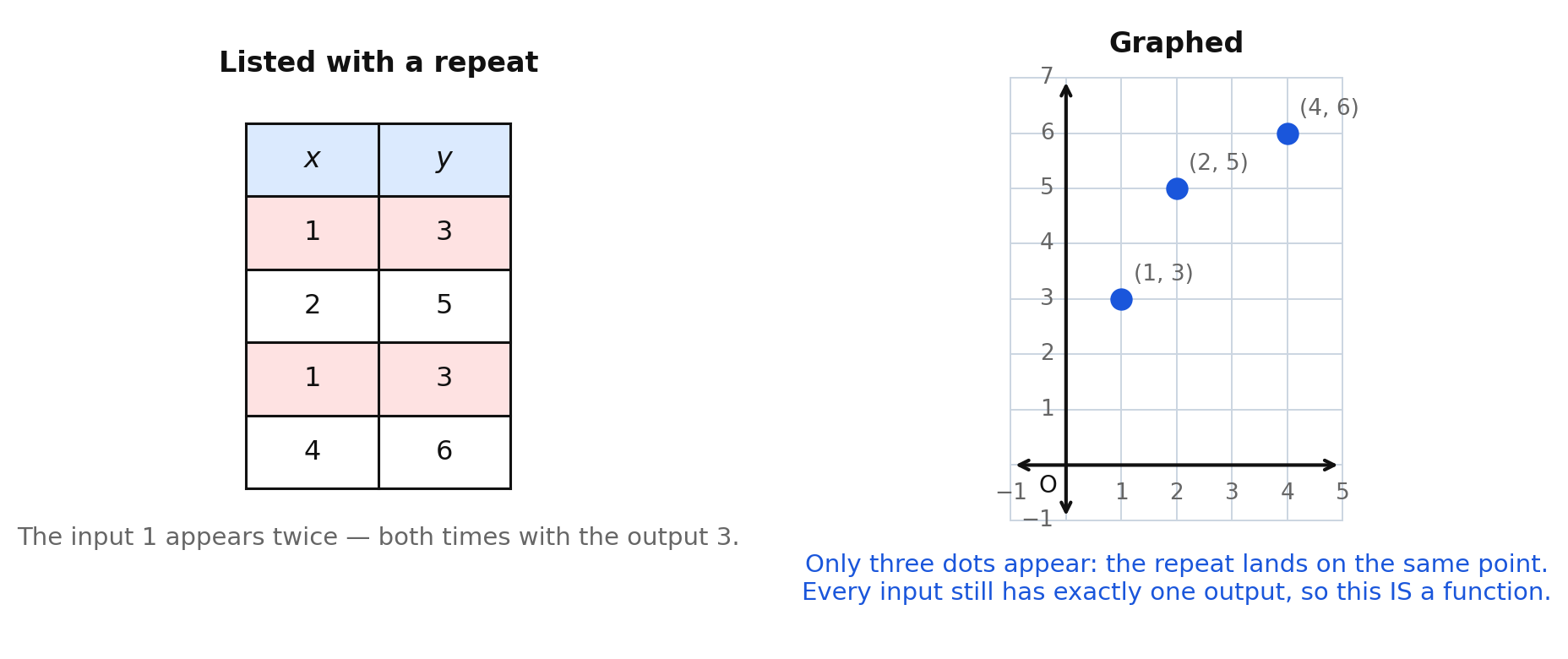
The graph settles it. The two copies of plot on top of each other, so the graph shows three dots, not four, and no vertical line meets two of them.
The test is not "does an input repeat." The test is does any input have two different outputs.
The vertical line test, on discrete points
Because a graph puts every pair with the same input on the same vertical line, the rule turns into something you can see.
Vertical line test. If any vertical line passes through two or more plotted points, the relation is not a function. If every vertical line passes through at most one plotted point, it is.
Look again at the two graphs from Lesson 7.1.
Graph P is . Every dot sits on its own vertical line, so P is a function.
Graph Q is . The vertical line passes through both and , so the input has two outputs and Q is not a function.
Notice that we tested the line against the dots, not against a drawn curve. That is what the test means here: a vertical line hitting two dots is the picture of one input with two outputs.
Checking a table
In a table, the inputs are a column, so scan that column for a value that appears more than once. If you find one, compare the outputs beside it.
| ← input , output | ||
| ← input again, output |
The input has outputs and , two different values, so this table is not a function.
Worked examples
Example 1 — Every input different
Is a function?
The inputs are , , — all different, so no input can have two outputs.
Answer: Yes, it is a function.
Example 2 — An input with two outputs
Is a function?
The input is paired with and also with .
Answer: No. The input has two different outputs.
Example 3 — A repeated output
Is a function?
Each of the inputs , , appears once, so each has exactly one output. The repeated output is irrelevant to the rule.
Answer: Yes, it is a function.
Example 4 — A repeated input with the same output
Is a function?
The input appears twice, but both times its output is . Asked for the output at , the relation gives one answer.
Answer: Yes, it is a function.
Example 5 — Using the vertical line test
A graph shows the dots , , , and . Is the relation a function?
Slide a vertical line across. At the line meets two dots.
Answer: No. The line passes through and , so the input has two outputs.
Guided practice
- Is a function? Explain in one sentence.
- Is a function? Explain in one sentence.
- Is a function? Explain in one sentence.
- Is a function? Explain in one sentence.
- Is Graph P a function? Name the test you used.
- Is Graph Q a function? If not, name a vertical line that proves it.
Independent practice
- Decide whether each relation is a function, and give the reason. a) b) c) d)
- A table lists -values with -values . Is the relation a function? Explain.
- A table lists -values with -values . Is the relation a function? Explain.
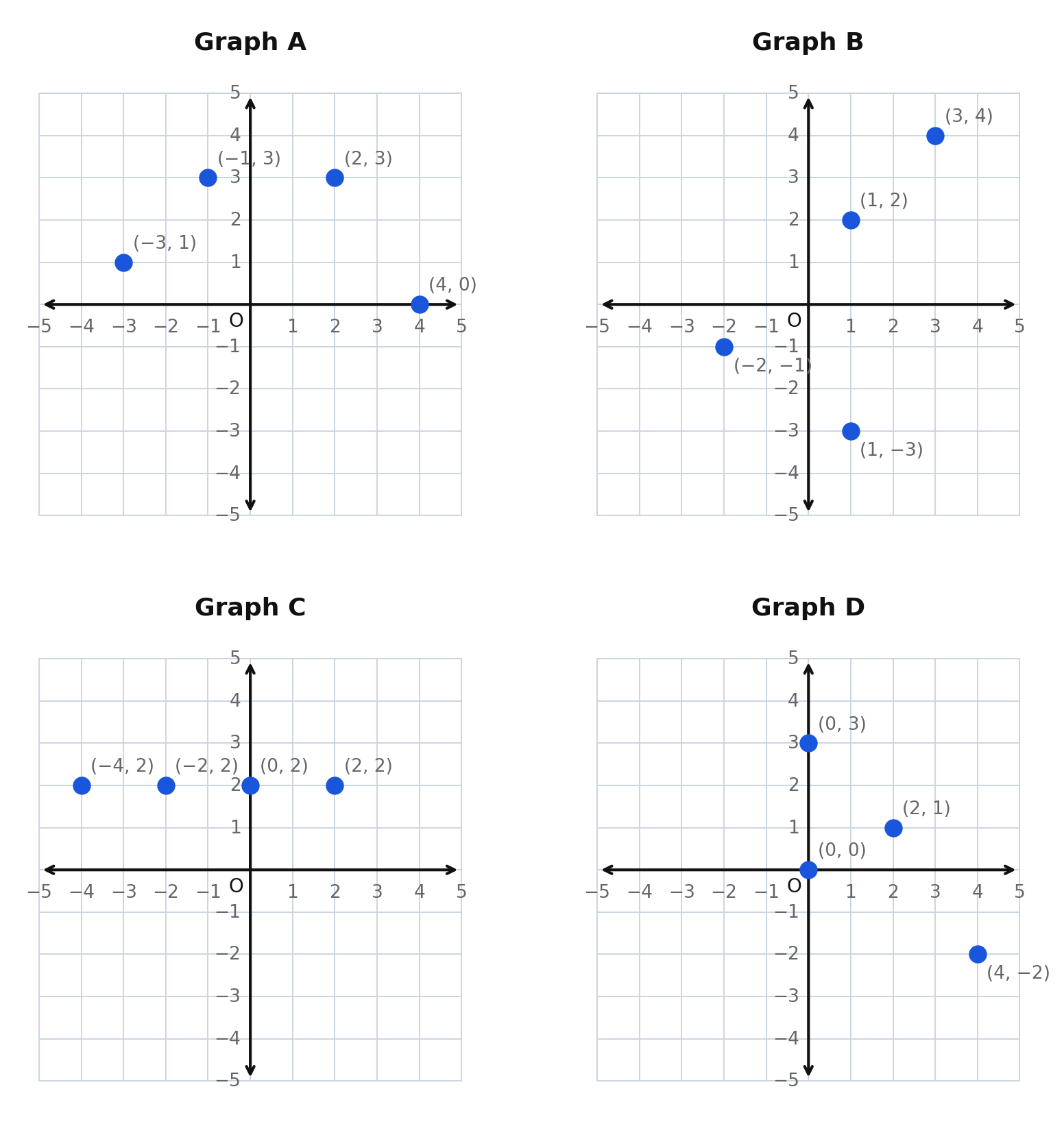
- Use the four graphs below. Which of Graphs A, B, C, and D are functions? For each one that is not, name a vertical line that proves it.
- A relation has ordered pairs and every -value is different. Must it be a function? Explain.
- Reasoning. Explain why a repeated output never breaks the function rule, but a repeated input sometimes does. Use one example of each.
- Application. A dog walker charges $12 per walk, giving the relation for walks and cost. Is it a function? Explain why a price list that was not a function would be a problem for a customer.
- Error analysis. A student says is not a function "because repeats." Explain what the student confused, and give the correct verdict.
Exit ticket 7.2
- Is a function? Explain.
- Is a function? Explain.
- Is a function? Explain.
- State the vertical line test as it applies to a graph of discrete points, and say what it detects.
Lesson 7.3 — Domain and Range
The two sets
Every relation carries two sets of numbers with it.
The domain is the set of all inputs — all the -values.
The range is the set of all outputs — all the -values.
Two conventions apply every time you write one of them down.
- No repeats. A set lists each value once. If the output occurs three times, the range contains once.
- Increasing order. Write the values from least to greatest. This is not required by the mathematics, but it makes two answers easy to compare and makes a missing value easy to spot.
Both sets are written inside braces: the domain of is and its range is .
From a set of ordered pairs
Take the first coordinates for the domain and the second coordinates for the range, then drop repeats and sort.
For :
- first coordinates: → domain
- second coordinates: → range , because the is listed once
From a table
The input column, cleaned up, is the domain. The output column, cleaned up, is the range.
Domain . Range — the appears in two rows and is written once.
From a graph of discrete points
Read the domain by traveling across: the -coordinate of every dot. Read the range by traveling up and down: the -coordinate of every dot.
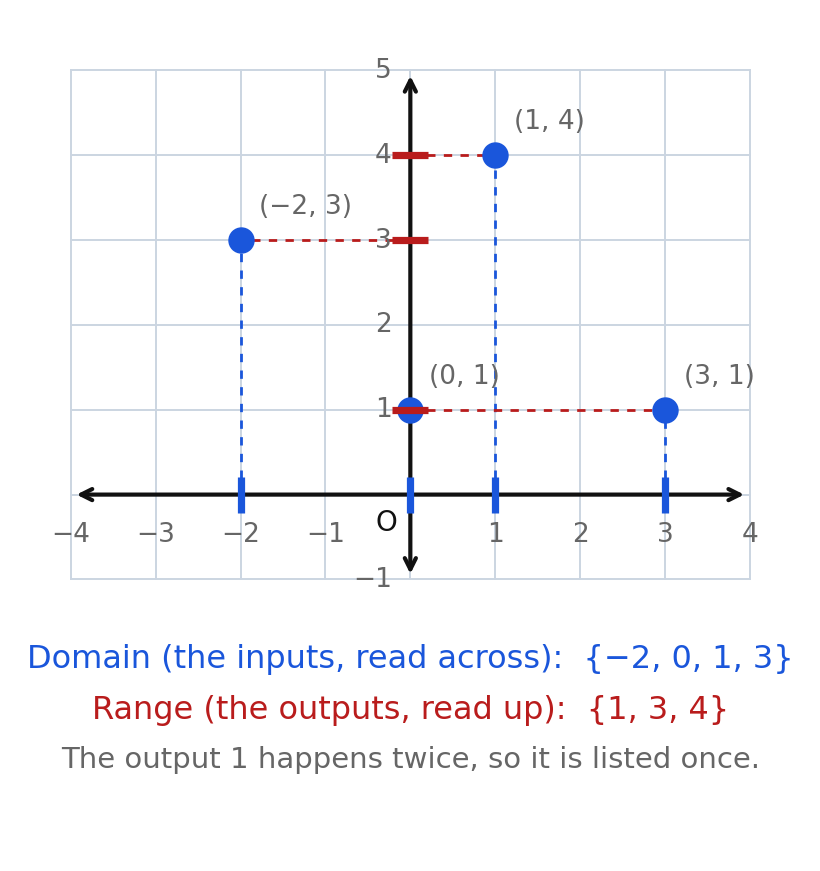
The four dots are , , , and .
- Domain:
- Range: — the output happens at two different inputs, so it appears once
How the two sets can differ in size
Because a function pairs each input with exactly one output, counting gives you a small but useful fact: the range of a function can never contain more values than the domain. Each input contributes one output, so there can be at most as many outputs as inputs.
The range can certainly contain fewer. In the domain has three values and the range has one. Nothing is wrong: three inputs share an output, which the function rule allows.
Worked examples
Example 1 — From a set
Give the domain and range of .
First coordinates ; second coordinates . No repeats to remove.
Answer: domain , range
Example 2 — A repeated output
Give the domain and range of .
The output occurs twice and is listed once.
Answer: domain , range
Example 3 — A repeated ordered pair
Give the domain and range of .
The pair is listed twice, so the input and the output each appear once in their set.
Answer: domain , range
Example 4 — From a graph
Give the domain and range of the relation graphed with dots at , , , and .
Across: . Up: , and the is written once.
Answer: domain , range
Example 5 — Building a relation from its two sets
A relation has domain and range . Write a set of ordered pairs, and say whether it is a function.
Every input must be paired with an output, and the only available output is .
Answer: . It is a function, because each of the three inputs has exactly one output.
Guided practice
- Give the domain and range of .
- Give the domain and range of .
- Give the domain and range of .
- A table lists -values with -values . Give the domain and range.
- Give the domain and range of the graph in the domain-and-range figure above.
- Explain why a value that appears twice as an output is written only once in the range.
- Give the domain and range of Graph A from the four-graph figure.
- Give the domain and range of Graph C from the four-graph figure.
Independent practice
- Give the domain and range of each relation. a) b) c) d)
- A table lists -values with -values . Give the domain and range.
- Give the domain and range of Graph B from the four-graph figure. (Graph B is not a function, but its inputs and outputs can still be listed.)
- Give the domain and range of Graph D from the four-graph figure.
- A function has domain , and every output is twice its input. List the ordered pairs and give the range.
- A relation has domain and range . Write a set of ordered pairs for it and say whether it is a function.
- Reasoning. Can the range of a function contain fewer values than its domain? Give an example or explain why not.
- Reasoning. Can the range of a function contain more values than its domain? Give an example or explain why not.
- Application. A student reads a book. The relation pairs minutes read with pages left. Give the domain and range, and say what each set means in the situation.
- Error analysis. A student gives the range of as . Identify the error and give the correct range.
Exit ticket 7.3
- Give the domain and range of .
- A table lists -values with -values . Give the domain and range.
- Give the domain and range of .
- Explain the two conventions used when writing a domain or a range: no repeats, and increasing order.
Lesson 7.4 — Putting It All Together
One routine, three questions
Almost every question in this standard is one of three, and they are always asked in the same order.
- Step 1 — What are the ordered pairs? Read them off the set, the table, or the graph.
- Step 2 — Is it a function? Look for one input with two different outputs.
- Step 3 — What are the domain and the range? Inputs in one set, outputs in the other — each value once, in increasing order.
Do them in that order and the third answer is nearly free, because by then you have already listed every pair.
A relation from a real situation
A student sells bracelets for $4 each. Buying one bracelet costs $4, two cost $8, and so on up to five.
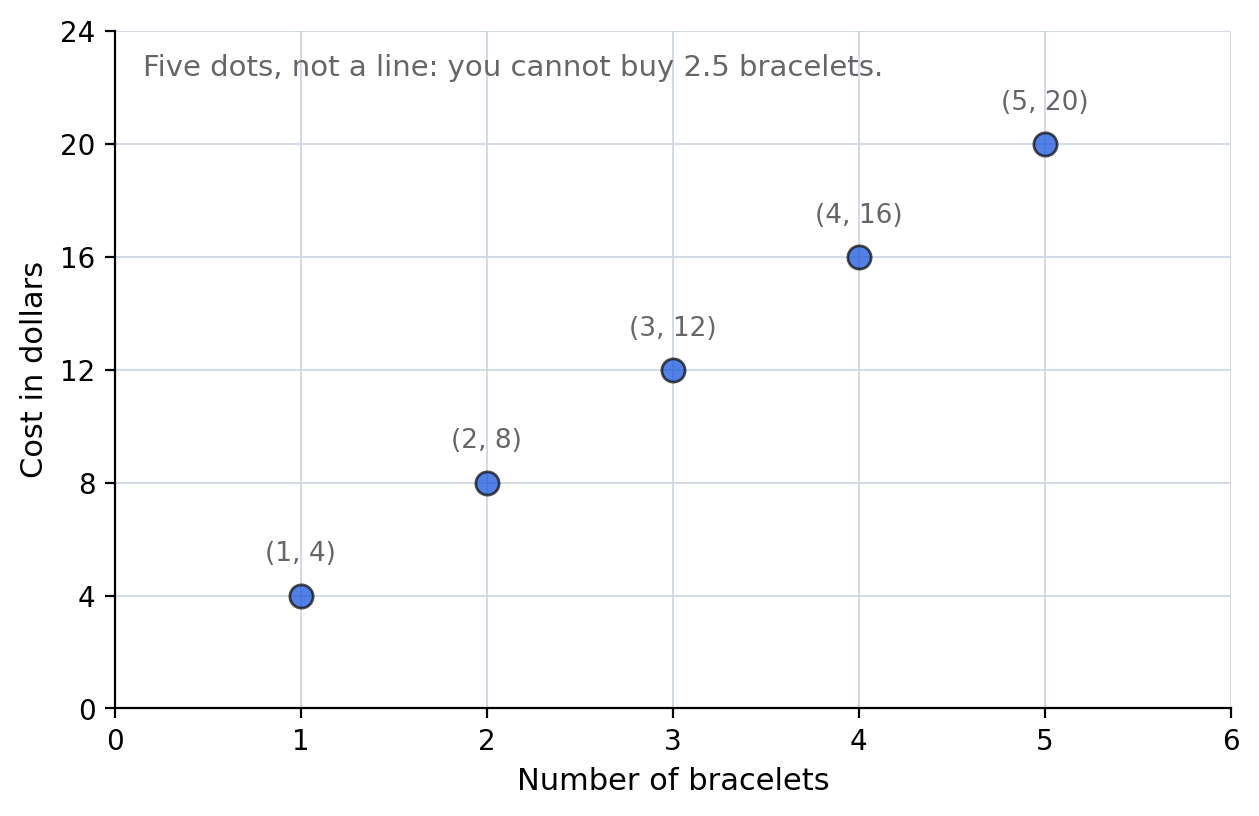
Run the routine.
- Step 1: the pairs are .
- Step 2: each of the inputs through appears once, so it is a function.
- Step 3: domain ; range .
In context, the domain is the numbers of bracelets a customer may buy and the range is the possible costs in dollars. The pair says three bracelets cost $12.
The graph is five dots and it should stay five dots. There is no point at , because you cannot buy two and a half bracelets — which is exactly why the standard keeps these graphs discrete.
What would break it
Suppose the seller tried to add the pair to that price list. Now the input has two outputs, and , so the relation stops being a function — and a customer asking the price of three bracelets gets two answers. That is what "not a function" costs you in practice.
Worked examples
Example 1 — All three questions, from a set
For : is it a function, and what are the domain and range?
The inputs each appear once, so it is a function.
Answer: function; domain , range
Example 2 — All three questions, from a table
A table lists -values with -values . Is it a function, and what are the domain and range?
The input has outputs and , two different values.
Answer: not a function; domain , range
Example 3 — A machine that squares its input
A machine multiplies each input by itself. The inputs are . Write the relation, decide whether it is a function, and give the range.
, , , , .
The pairs are . Each input appears once, so it is a function, even though the outputs and each occur twice.
Answer: function; range
Example 4 — Interpreting a pair in context
In the bracelet relation, what does the ordered pair mean?
The input is a number of bracelets and the output is a cost.
Answer: Five bracelets cost $20.
Example 5 — Repairing a relation
The relation is not a function. Change one number so that it is, and explain your change.
The trouble is the input appearing with and with . Changing the second to a value not already used as an input — say — removes the conflict.
Answer: is a function, because every input now appears exactly once. (Changing to also works: the input would then have the single output .)
Guided practice
- List the ordered pairs shown in the bracelet figure above.
- Is the bracelet relation a function? Explain.
- Give the domain and range of the bracelet relation.
- What does the ordered pair mean in the bracelet situation?
- A table lists -values with -values . Is the relation a function? Explain.
- Is a function? Give its domain and range.
Independent practice
- For each relation, state whether it is a function, then give the domain and range. a) b) c)
- A table records the temperature each hour: -values with -values . Is the relation a function? Give the domain and range.
- Graph D in the four-graph figure is not a function. Name the vertical line that proves it, and give the two points it passes through.
- Application. A taxi charges a $3 pickup fee plus $2 per mile, giving for miles and cost. Is it a function? Give the domain and range, and say what means.
- A machine multiplies each input by itself. The inputs are . Write the relation as a set of ordered pairs, decide whether it is a function, and give the range.
- Write a relation with four ordered pairs that is not a function. Then change exactly one number to make it a function, and explain why your change works.
- Reasoning. Explain why a vertical line meeting two plotted points is exactly the same thing as one input having two outputs.
- Error analysis. A student says is not a function because the input appears twice. Explain the mistake and give the correct verdict.
- Error analysis. A student gives the domain of as . Identify the error and give the correct domain and range.
- Application. A rain gauge is read for four days: , pairing the day with the inches of rain. Is it a function? Give the domain and range.
Exit ticket 7.4
- For : function or not, and what are the domain and range?
- A table lists -values with -values . Function or not? Give the domain and range.
- What does the ordered pair mean in the bracelet situation?
- Describe the three-step routine of this chapter in one or two sentences.
Chapter 7 Review
Vocabulary. relation · ordered pair · input · output · -coordinate · -coordinate · table · discrete points · function · vertical line test · mapping diagram · domain · range
Part A — Determining whether a relation is a function (8.PFA.2a)
- Is a function? Explain.
- Is a function? Explain.
- Is a function? Explain.
- Is a function? Explain.
- A table lists -values with -values . Is the relation a function? Explain.
- A table lists -values with -values . Is the relation a function? Explain.
- Is Graph A in the four-graph figure a function? Explain.
- Is Graph B in the four-graph figure a function? If not, name the vertical line that proves it.
- State the function rule in your own words, and explain why a repeated ordered pair does not break it.
- Reasoning. A relation is written out with ordered pairs, but only different -values appear. Can it still be a function? Explain what would have to be true.
Part B — Identifying the domain and range (8.PFA.2b)
- Give the domain and range of .
- Give the domain and range of .
- Give the domain and range of .
- A table lists -values with -values . Give the domain and range.
- Give the domain and range of the graph in the domain-and-range figure.
- Give the domain and range of Graph C in the four-graph figure.
- Give the domain and range of Graph D in the four-graph figure.
- A function has domain , and every output is one less than its input. List the ordered pairs and give the range.
- Write a function with domain whose range contains exactly two values.
- Reasoning. Explain why the range of a function can never contain more values than its domain.
Part C — Mixed application and reasoning
- Application. A recipe makes cookies per cup of flour: pairs cups of flour with cookies. Is it a function? Give the domain and range, and say what means.
- Using the bracelet relation : is it a function, and what are its domain and range? Could the pair be added and leave it a function? Explain.
- Error analysis. A graph shows dots at and along with . A student says the relation is a function "because the two points are different points." Explain the mistake and give the correct verdict.
- Reasoning. Explain why the vertical line test works, in terms of the definition of a function.
- Write a table for a function with ordered pairs, domain , and a range containing exactly values.
- Application. A shop charges a $3 delivery fee plus $9 per pizza. Write the relation for , , , and pizzas as a set of ordered pairs, decide whether it is a function, and give the domain and range.
Standards coverage check — Chapter 7
| Knowledge and Skill | Where it is taught | Where it is practiced |
|---|---|---|
| 8.PFA.2a — determine whether a relation, represented by a set of ordered pairs, a table, or a graph of discrete points, is a function; sets are limited to no more than 10 ordered pairs | 7.2 (the rule, mapping diagrams, repeated inputs and outputs, the vertical line test on discrete points); revisited in 7.4 | Items 19–36; 59, 60, 63, 64, 65, 66, 67, 68, 69, 70, 71, 72, 74, 75, 76, 78; Review Part A, items 79–88, and items 100, 101, 102, 104 |
| 8.PFA.2b — identify the domain and range of a function represented as a set of ordered pairs, a table, or a graph of discrete points | 7.3 (domain and range from all three representations, no repeats, increasing order, relative sizes); revisited in 7.4 | Items 37–58; 61, 64, 65, 66, 68, 69, 73, 74, 75, 76; Review Part B, items 89–98, and items 99, 100, 103, 104 |
Lesson 7.1 supports both bullets by establishing the three representations the standard names — a set of ordered pairs, a table, and a graph of discrete points — and items 1–18 practice moving between them, which is the reading skill both bullets depend on. Every relation in the chapter has at most ten ordered pairs, every graph is discrete, and the function determination is never made from a continuous curve or line.
Answer keys for every set in this chapter are in Appendix A.