Chapter 2 — Comparing and Ordering Real Numbers
Standard: 8.NS.1 — The student will compare and order real numbers and determine the relationships between real numbers.
By the end of this chapter you will be able to:
- Name both square roots of a number, positive and negative, for values from 0 to 400 (8.NS.1a, b)
- Estimate the two consecutive natural numbers a positive square root lies between, and justify which one is the better approximation (8.NS.1a)
- Write a rational approximation of an irrational number to the nearest hundredth (8.NS.1b)
- Locate irrational values on a number line, choosing a scale that shows the comparison you need (8.NS.1b)
- Compare and order up to five real numbers written as integers, fractions, decimals, mixed numbers, percents, scientific notation, radicals, and , and justify the order (8.NS.1c)
Lessons: 2.1 Both Square Roots of a Number · 2.2 Between Which Two Natural Numbers? · 2.3 Rational Approximations to the Nearest Hundredth · 2.4 Locating Real Numbers on a Number Line · 2.5 Comparing and Ordering Five Real Numbers
Calculator note. A calculator is available on the Grade 8 test, and it will hand you without comment. That is exactly why this chapter trains the estimate by hand: 8.NS.1a asks you to name the two consecutive natural numbers a square root lies between and justify which is the better approximation, and a decimal you did not reason about cannot be justified. Every estimate here is reachable by squaring a candidate in your head or on paper. The perfect squares from to , which you learned in Grade 7, are the only facts you need memorized. If you find yourself reaching for a calculator, you have usually skipped the step of asking which perfect squares the number sits between.
Numbering note. Item numbers run straight through the chapter, from 1 in Lesson 2.1 to 122 at the end of the review. They do not restart at each lesson.
Lesson 2.1 — Both Square Roots of a Number
What Grade 7 established, and what changes now
In Grade 7 you learned that a perfect square is a number formed by multiplying a whole number by itself, and that the positive square root of a perfect square is the whole number that was squared. You found because , and you learned the perfect squares from through .
All of that still holds. Grade 8 adds three things.
First, every positive number has two square roots, not one. Second, the radicand — the number under the radical sign — no longer has to be a perfect square, which means the root is often irrational. Third, you will be asked not just to name roots but to place them: between which whole numbers, at which decimal, in what order relative to other numbers.
Two numbers square to 144
Ask the question carefully: what numbers, when multiplied by themselves, give ?
Both work, because a negative times a negative is positive. So has two square roots, and .
The radical symbol is not ambiguous, though. The symbol always means the positive square root, also called the principal square root. To name the negative one, you write a minus sign in front:
Read as "the opposite of the square root of 144." The minus sign is applied after the root is taken. This is the notation students most often misread, and the number line shows why the two values are genuinely different numbers.
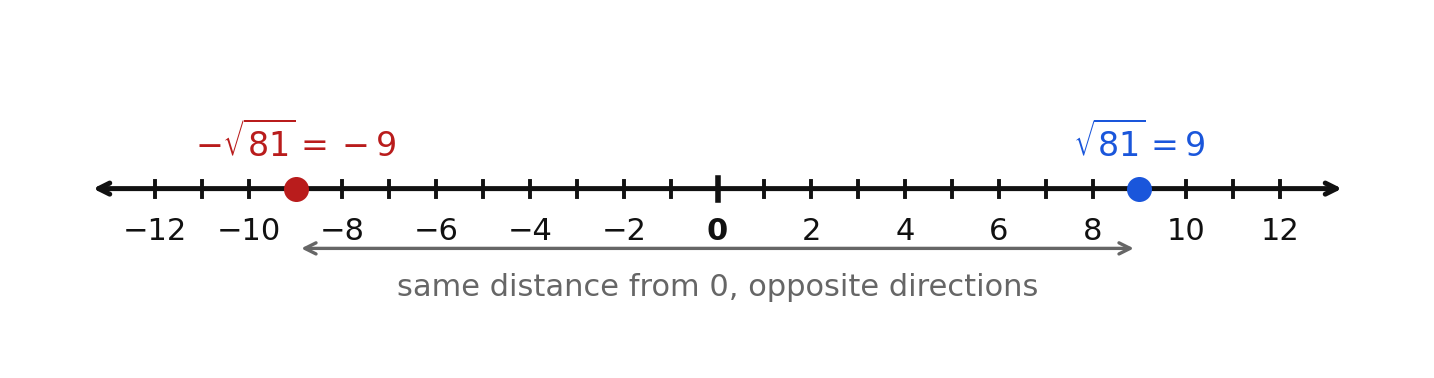
The two roots are the same distance from zero in opposite directions. They are opposites, and is the smaller of the two — a fact that will matter constantly once you start ordering numbers.
Zero is the one exception to "two roots." Since and no other number squares to , we have and nothing else.
When the root is irrational
A rational number can be written as a fraction of two integers; as a decimal it either terminates or repeats. An irrational number cannot, and its decimal goes on forever without ever settling into a repeating block.
If the radicand is a perfect square, the root is rational — in fact an integer. If the radicand is a whole number that is not a perfect square, the root is irrational.
| Radical | Value | Rational or irrational? |
|---|---|---|
| rational, because | ||
| irrational, because is not a perfect square | ||
| rational | ||
| irrational |
This chapter works with radicands from to , so the perfect squares you are checking against are exactly the ones you already know.
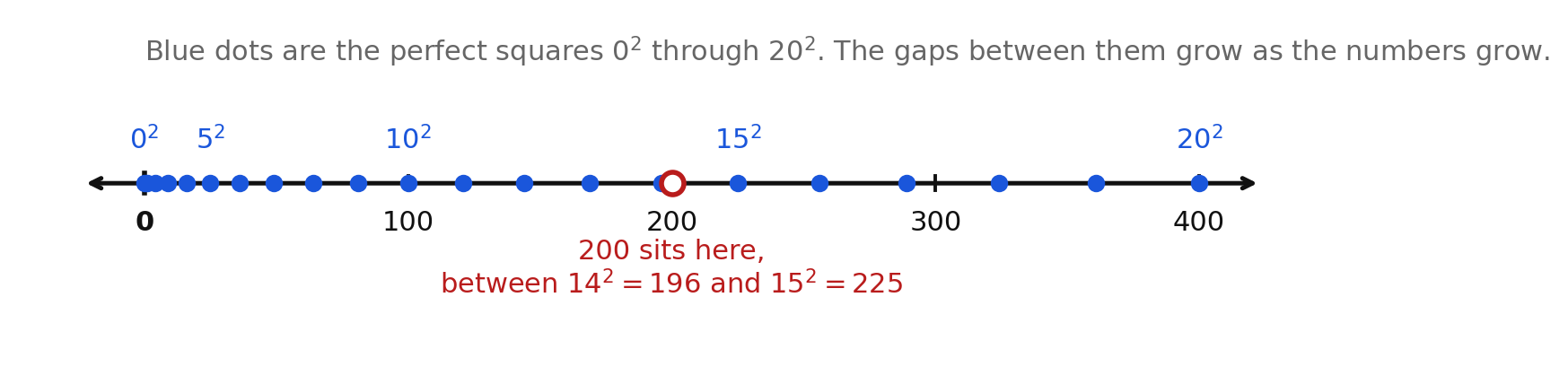
Notice how the perfect squares thin out as you move right. Near zero they are one or two apart; near 400 they are almost forty apart. That spreading is why estimating takes more care than estimating , and it is the reason Lesson 2.2 exists.
Worked examples
Example 1 — Both roots of a perfect square
Name both square roots of .
Since , the positive root is . Its opposite also squares to .
Answer: and
Example 2 — Reading the minus sign correctly
Evaluate .
Take the positive square root first: , since . Then apply the minus sign.
Answer:
Example 3 — The root of zero
Evaluate .
Only , so there is exactly one square root here.
Answer:
Example 4 — Rational or irrational
Classify and .
is a perfect square, , so is rational. falls between and , so it is not a perfect square and is irrational.
Answer: is irrational; is rational.
Example 5 — A side length from an area
A square tabletop has an area of square inches. How long is each side?
Area is (side), so the side is a square root of . Since , the two square roots are and . A length cannot be negative, so only the positive root is a possible answer.
Answer: inches. Both and square to , but a side length must be positive.
Guided practice
- Find .
- Find .
- Find .
- Name both square roots of .
- Is rational or irrational? Explain in one sentence.
- Is rational or irrational? Explain in one sentence.
Independent practice
- Evaluate each. a) b) c) d)
- Name both square roots of .
- Which of these are irrational? , , ,
- True or false: . Justify your answer.
- Reasoning. Both and come from the number . Explain why they are different numbers, and describe where each one sits on a number line.
- Application. A square patio covers square feet. Find the length of one side, and explain why only one of the two square roots of answers the question.
- Reasoning. Explain why has only one square root when every other perfect square has two.
- Error analysis. A student writes , reasoning that "the negative signs cancel." Explain the mistake and give the correct value.
Exit ticket 2.1
- Evaluate .
- Evaluate .
- Name both square roots of .
- Explain the difference between and .
Lesson 2.2 — Between Which Two Natural Numbers?
Trapping a root between two perfect squares
is not a whole number, because is not a perfect square. But you can trap it. Find the perfect square just below and the perfect square just above it:
Now take the positive square root of all three. Taking square roots preserves order for positive numbers — a bigger area means a bigger side — so the inequality survives:
lies between the consecutive natural numbers and . Consecutive means one right after the other, with nothing whole in between.
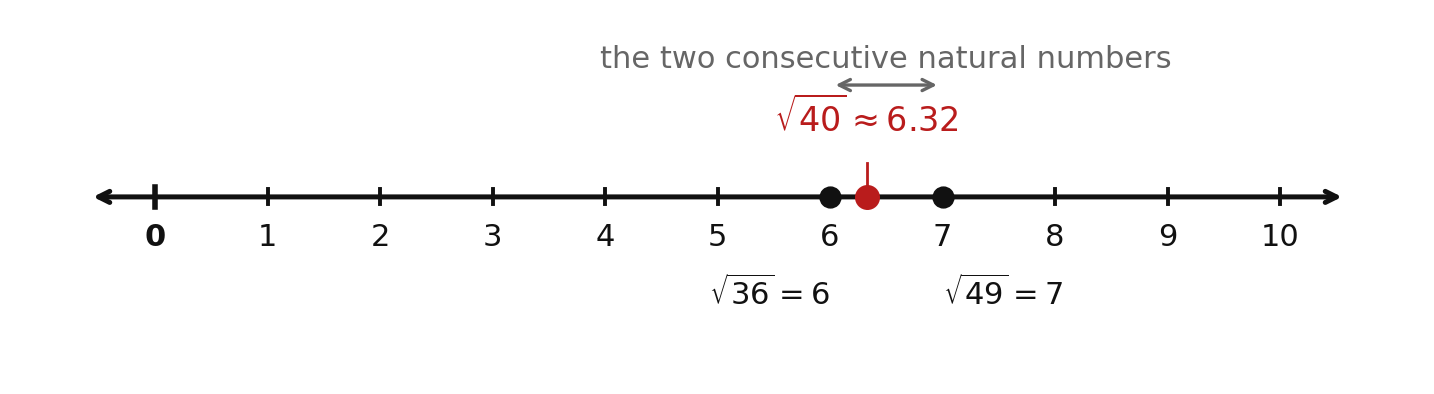
The whole procedure is: list the perfect squares you know, find the two that bracket your radicand, and take their roots.
Which of the two is the better approximation?
The standard asks a second question, and it is the more interesting one: is closer to or to ?
You could try to guess from the picture, but there is an exact test that needs no decimals at all. Compare the radicand to the number halfway between the two perfect squares.
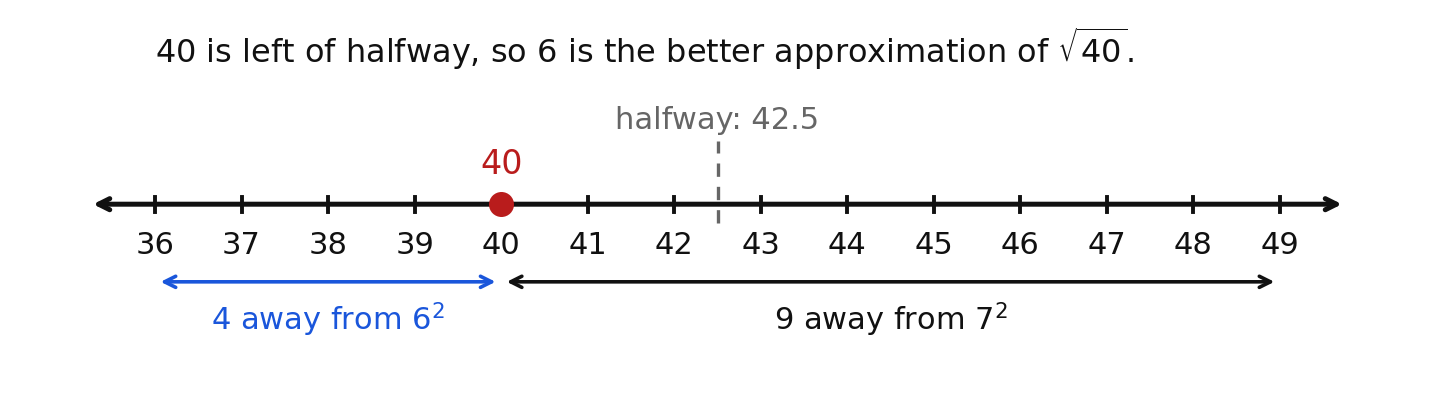
Halfway between and is . Since , the number sits in the lower half of that interval, so sits in the lower half of the interval from to . is the better approximation.
Counting the gaps says the same thing and is often faster: and . Four is less than nine, so is nearer to , and is nearer to .
Two cautions about this test.
Compare the radicands, not the roots — you do not know the root yet, which is the whole reason you are estimating. And do not eyeball "is close to ?" without doing the comparison. The gaps between consecutive perfect squares grow, so a radicand can look close to the upper square and still be nearer the lower one.
A closer look at a near-tie
Take . It sits between and . Which is better?
By one unit, is nearer to , so is the better approximation. That answer surprises many students, because "feels" close to . The arithmetic settles it, and it is right: , which is just short of the halfway mark .
Boundary cases like this are common because halfway between and is , and radicands are whole numbers. When the radicand lands exactly on — as does for — the root is just barely below the midpoint, and the smaller natural number always wins.
Worked examples
Example 1 — A straightforward estimate
Between which two consecutive natural numbers does lie, and which is the better approximation?
, so . Gaps: and .
Answer: Between and ; is the better approximation.
Example 2 — Nearer the upper square
Between which two consecutive natural numbers does lie, and which is better?
, so . Gaps: and .
Answer: Between and ; is the better approximation.
Example 3 — A small radicand
Estimate .
, so . Gaps: and .
Answer: Between and ; is the better approximation.
Example 4 — Near the top of the allowed range
Estimate .
, so . Gaps: and . The margin is one unit, but it decides the question.
Answer: Between and ; is the better approximation.
Example 5 — An application
A square vegetable garden has an area of square feet. Between which two whole numbers of feet is its side length, and which is the better estimate?
The side is . Since , the side is between and feet. Gaps: and .
Answer: Between and feet, and much nearer feet.
Guided practice
For items 19 through 26, name the two consecutive natural numbers the root lies between, then name the better approximation.
Independent practice
- Name the two consecutive natural numbers each root lies between. a) b) c) d)
- For each root in item 27, name the better approximation and show the gap comparison that justifies it.
- Estimate : between which two consecutive natural numbers, and which is better?
- Estimate : between which two consecutive natural numbers, and which is better?
- Estimate : between which two consecutive natural numbers, and which is better?
- Reasoning. Explain why the question "between which two consecutive natural numbers does lie?" has no answer.
- Application. A square patch of lawn has an area of square meters. Between which two whole numbers of meters is one side, and which whole number is the better estimate?
- Application. A square window has an area of square feet. Estimate the side length to the nearer whole foot, and say whether your estimate is a little too big or a little too small.
- Reasoning. Explain why comparing to is enough to decide whether is closer to or to , even though you never compute .
- Error analysis. A student says is between and and is closer to , "because is close to ." The first part is right and the second is wrong. Explain the error and give the correct better approximation.
Exit ticket 2.2
- Between which two consecutive natural numbers does lie? Which is the better approximation?
- Between which two consecutive natural numbers does lie? Which is the better approximation?
- Between which two consecutive natural numbers does lie? Which is the better approximation?
- Describe the halfway test in your own words, as instructions someone else could follow.
Lesson 2.3 — Rational Approximations to the Nearest Hundredth
Why we approximate at all
is an exact number. Its decimal expansion, , never terminates and never repeats, so no decimal you could finish writing is equal to it. What you can do is name a rational number that is very close, and say honestly that it is close. That is a rational approximation, and the symbol for "is approximately equal to" is .
The equals sign would be a lie here; the wavy sign tells the truth. This standard asks for approximations to the nearest hundredth, which means two decimal places.
Squaring your way in
Lesson 2.2 got you to and told you was the nearer whole number. Now narrow the trap. You are looking for the number whose square is , so square candidates and see which side of they land on.
Step 1 — find the tenths. Try numbers between and by tenths, starting near since the root is in the lower half:
, so .
Step 2 — find the hundredths. Now try hundredths between and :
, so .
Step 3 — round. Both endpoints are hundredths, so decide which one is nearer to: , while . The lower one is nearer.
Every multiplication in that process is by hand and small. The only skill it needs is multiplying a two- or three-digit decimal by itself — which is why you can carry out this whole method, justification included, faster than you can explain a calculator's decimal.
Here is the same reasoning for a radicand near the top of the range.
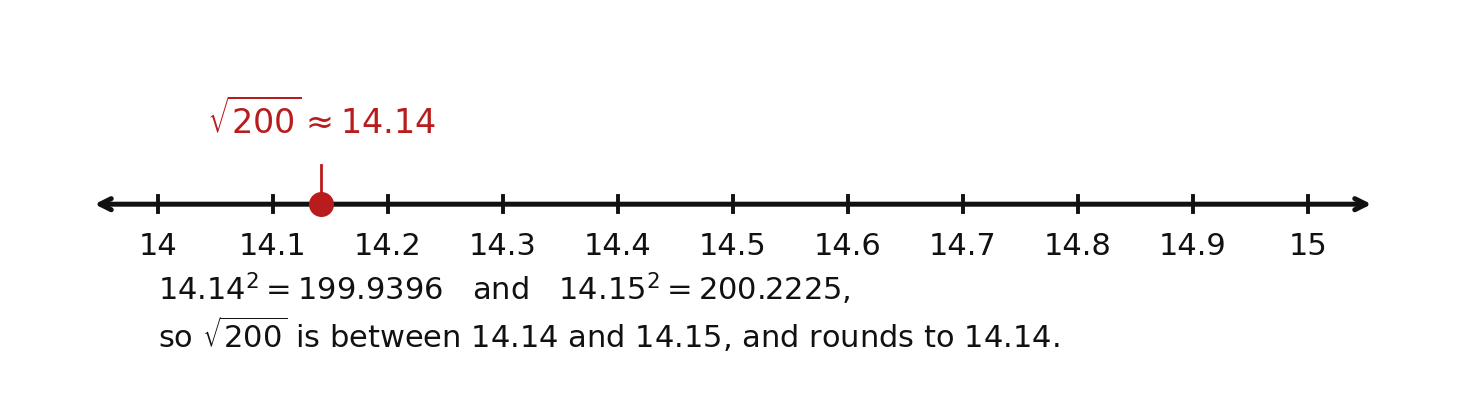
Negative radicals and
A negative radical is approximated by approximating its positive partner and then attaching the minus sign:
Watch the rounding direction when you do this. The positive value rounds up to , so the negative value rounds down to . Both statements say the same thing: the approximation is the nearest hundredth, whichever side of zero you are on.
One irrational number in this chapter is not a radical at all. The number , the ratio of a circle's circumference to its diameter, is irrational: , running forever without repeating. To the nearest hundredth, .
Be careful with the familiar approximations of . Both and are rational numbers used in place of ; neither is .
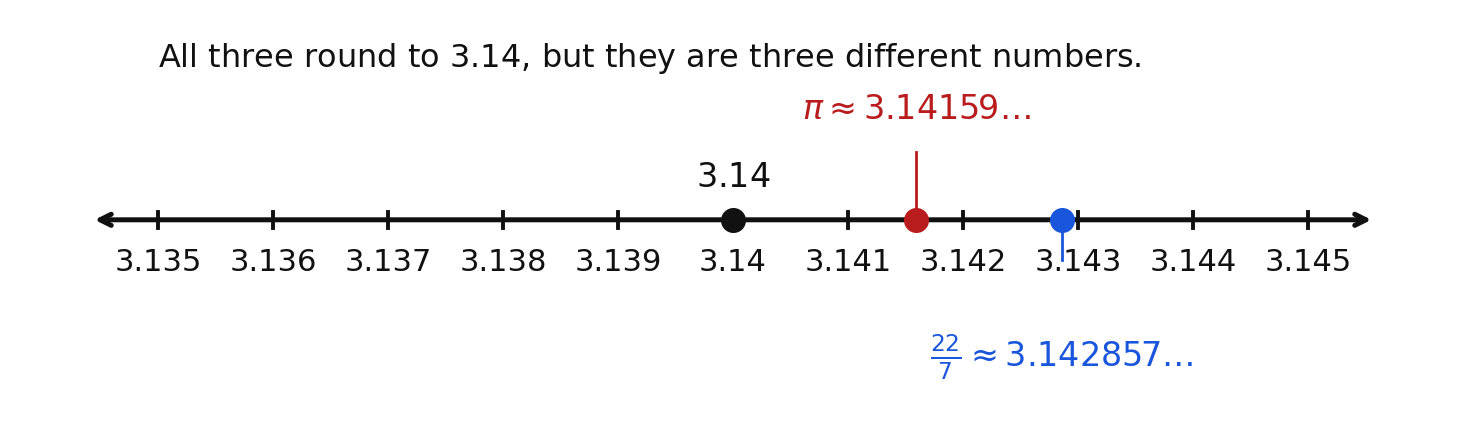
Under a fine enough zoom the three separate cleanly: , then , then . So , which is worth remembering, because ordering problems like to include two of the three at once.
Worked examples
Example 1 — A familiar root
Approximate to the nearest hundredth.
, so the root is between and . Tenths: and , so it is between and . Hundredths: and . Since and , the lower endpoint is nearer.
Answer:
Example 2 — Rounding up
Approximate to the nearest hundredth.
, so it is between and . Tenths: and , so it is between and . Hundredths: and . Since and , the upper endpoint is nearer.
Answer:
Example 3 — A negative radical
Approximate to the nearest hundredth.
First . It is between and . Tenths: and , so between and . Hundredths: and . The upper endpoint is nearer, since and . So , and the opposite carries the minus sign.
Answer:
Example 4 — Using an approximation to compare
Which is greater, or ?
, so is just above . Hundredths: and , so . Compare with .
You can also settle it in one step by squaring the competitor: , which is bigger than , so is bigger than .
Answer:
Example 5 — against a radical
Which is greater, or ?
. For : , and while , so . Since , the radical is greater. Checking against squares agrees: .
Answer:
Guided practice
For items 41 through 48, write a rational approximation to the nearest hundredth.
Independent practice
- Approximate to the nearest hundredth. a) b) c) d)
- Approximate to the nearest hundredth. a) b) c) d)
- Approximate to the nearest hundredth, showing the two hundredths you squared.
- Approximate to the nearest hundredth, showing the two hundredths you squared.
- Which is greater, or ? Justify with a squaring argument.
- Which is greater, or ? Justify.
- Which is greater, or ? Justify.
- Application. A square rug covers square feet. Find the side length to the nearest hundredth of a foot.
- Reasoning. Explain why is not equal to , and what the symbol is claiming when we write .
- Error analysis. Asked for to the nearest hundredth, a student computes , sees that , and answers . Explain what step is missing and give the correct approximation.
Exit ticket 2.3
- Approximate to the nearest hundredth.
- Approximate to the nearest hundredth.
- Which is greater, or ? Justify.
- Explain why a rational approximation can never be exactly equal to an irrational number, no matter how many decimal places you use.
Lesson 2.4 — Locating Real Numbers on a Number Line
Plotting is estimating, made visible
Every real number has exactly one home on the number line, irrational numbers included. Plotting one is a three-step routine that reuses everything from the last two lessons.
- Bracket it. Find the two consecutive whole numbers it lies between.
- Approximate it. Get a decimal to the nearest tenth or hundredth, depending on how fine the question is.
- Choose a scale that can show the answer. This is the step students skip.
To place : it is between and , since . Tenths: and , so it is between and , and much nearer . On a line marked in whole numbers, plot it a bit less than halfway from to .
Choosing the scale
A number line marked in whole numbers from to is useless for deciding whether or is greater. Both land in the same gap between and , and no amount of squinting resolves them. A line from to marked in tenths puts on a tick and just to its right, and the question is answered.
The rule of thumb: the scale has to be finer than the difference you are trying to see. Comparing to , whose difference is about , needs a line marked in thousandths — which is exactly what the figure in Lesson 2.3 does.
Negative values reverse your intuition
On the negative side, the number farther from zero is the smaller number. So sits to the left of , which means .
Students who reason "seven point oh seven is bigger than seven" and place to the right of have compared the distances from zero instead of the numbers. When in doubt, plot both and read left to right.
Worked examples
Example 1 — Plotting between whole numbers
Between which two tick marks on a whole-number line does sit, and where in that gap?
, so between and . Gaps: and , so it is in the lower half. To the nearest hundredth, .
Answer: Between and , a little less than halfway across, at about .
Example 2 — A negative radical
Plot on a number line from to .
, so . That is between and , just left of halfway.
Answer: At about , between and and slightly nearer than .
Example 3 — Choosing a finer scale
On a line from to marked in hundredths, plot and .
goes on the tick labeled . goes two ticks to its right.
Answer: at and at , with to the right.
Example 4 — Reading an inequality off the line
Use a number line to decide whether is greater or less than .
, which lies to the left of . On a number line, left means less.
Answer:
Example 5 — Nearest tenth
is plotted on a line marked in tenths. Which tick is it nearest?
and , so it is between and . Since and , it is much nearer .
Answer: The tick at .
Guided practice
- Between which two whole-number tick marks does sit, and roughly where in that gap?
- Plot on a number line from to . Give the value to the nearest hundredth.
- On a line from to marked in hundredths, where do and go?
- Which lies farther right, or ? Explain what scale you need to see the difference.
- Plot on a number line from to . Give the value to the nearest hundredth.
- On a line marked in tenths, which tick is nearest?
Independent practice
- Plot , , and on a number line from to , and give each value to the nearest hundredth.
- Plot , , and on a number line from to , and give each value to the nearest hundredth.
- Between which two consecutive tenths does lie?
- Between which two consecutive hundredths does lie?
- On a line from to marked in tenths, plot and . Which is farther right?
- Application. A carpenter needs to mark a length of feet on a tape measure that shows tenths of a foot. Between which two tenths does the mark fall, and which tenth should the carpenter use?
- Reasoning. Explain why a number line marked in whole numbers cannot show whether or is greater, and describe a scale that can.
- Error analysis. A student plots exactly halfway between and . Explain why that is not quite right and say which side of halfway it belongs on.
Exit ticket 2.4
- Plot on a number line from to . Which tenth is it nearest?
- Plot on a number line from to . Give the value to the nearest hundredth.
- Which lies farther right, or ? Justify.
- Explain how a number line shows that .
Lesson 2.5 — Comparing and Ordering Five Real Numbers
One list, many disguises
A single ordering problem can hand you an integer, a fraction, a decimal, a mixed number, a percent, a number in scientific notation, a radical, and — all at once, all in the same list. The numbers are not hard. The disguises are.
The dependable strategy is to convert every number to a decimal, rounding irrational values to the nearest hundredth, and then order the decimals. Here is the conversion table for the forms this standard uses.
| Form | Example | How to convert | Decimal |
|---|---|---|---|
| Improper fraction | divide numerator by denominator | ||
| Mixed number | whole part plus the fraction as a decimal | ||
| Percent | divide by , or move the point two places left | ||
| Scientific notation | move the point right by the exponent | ||
| Scientific notation | move the point left by the exponent | ||
| Radical | bracket, then square candidates | ||
| memorized |
Two habits make the conversions reliable. Line the decimals up with the same number of places before you compare — writing as makes the comparison to instant. And keep the original form written beside its decimal, because the answer must be given in the original forms, not the decimals you worked with.
A worked ordering
Order these ascending: , , , , .
| Number | Decimal (hundredths) |
|---|---|
Ordering the right-hand column ascending gives , so the answer, written in the original forms, is
Ascending means least to greatest, left to right on the number line. Descending means greatest to least. Read the question twice; reversing the two is the most common way to lose an otherwise perfect answer.
Other strategies worth having
Converting everything is reliable but not always fastest. Three shortcuts:
Benchmarks. Sort into negatives, then values below , then values above , before doing any careful work. Anything negative is less than anything positive, immediately.
Common denominators. Comparing to is one step with a denominator of : . No decimals needed.
Squaring. To compare a radical with a decimal, square both. against : against , so . This is exact, while comparing rounded decimals is not.
Seeing it on the line
A number line is a justification, not just a picture. Plotting the five numbers and reading left to right proves the order.
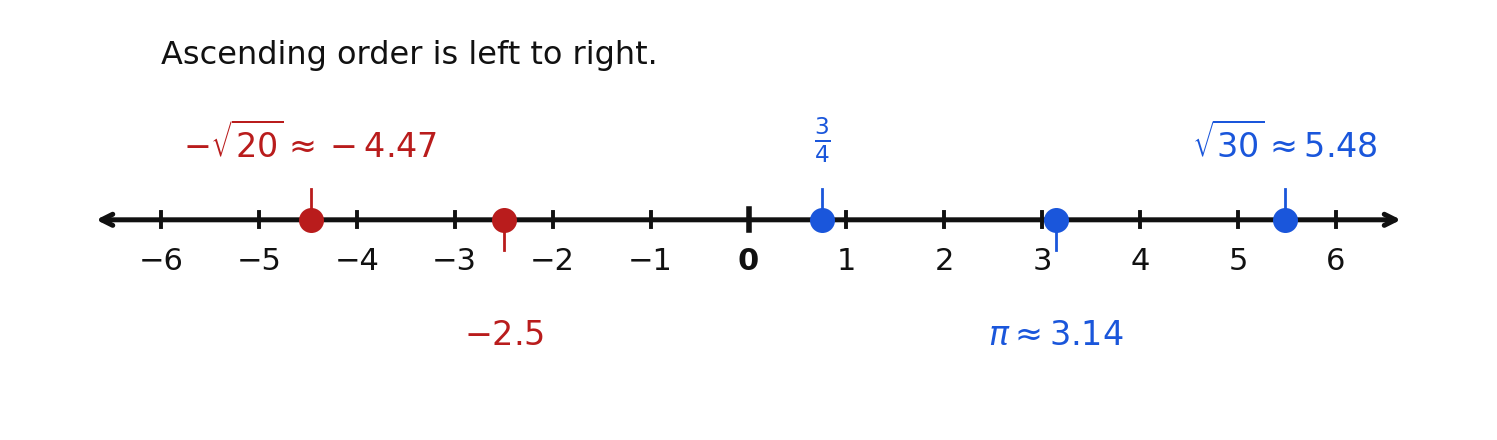
Negatives need the same care as always. When every number in the list is negative and close together, zoom in — and remember that the number farthest from zero comes first in ascending order and last in descending order.
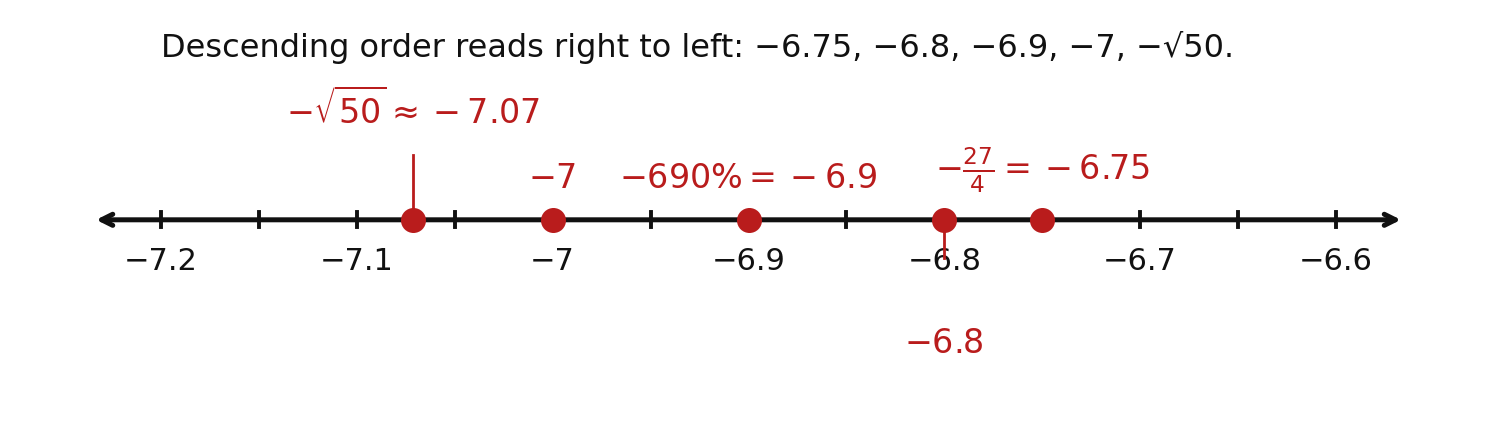
Worked examples
Example 1 — Comparing two numbers with a squaring argument
Compare and using or .
Squaring both: and . Since and both numbers are positive, the order carries back to the originals.
Answer:
Example 2 — A negative comparison
Compare and .
, so . On the number line, is to the right of .
Answer:
Example 3 — Scientific notation in the mix
Compare and .
Move the decimal point two places right: .
Answer:
Example 4 — Five numbers, ascending
Order ascending: , , , , .
Convert: ; ; ; ; .
Sorted: .
Answer:
Example 5 — Five numbers, descending, all negative
Order descending: , , , , .
Convert: ; ; ; ; .
Descending means greatest first, which on the negative side means closest to zero first: .
Answer:
Guided practice
For items 81 through 85, compare using or and justify in one sentence.
and
and
and
and
and
Order ascending: , , , ,
Order ascending: , , , ,
Order descending: , , , ,
Independent practice
- Order ascending: , , , ,
- Order descending: , , , ,
- Order ascending: , , , ,
- Order ascending: , , , ,
- Order descending: , , , ,
- Compare and , and justify with a squaring argument.
- Compare and , and justify.
- Application. Five square tiles have areas , , , , and square inches. Order the tiles by side length, from shortest to longest, and give each side length to the nearest hundredth of an inch.
- Reasoning. Describe two different strategies for deciding whether or is greater, and carry both out.
- Error analysis. Asked to order , , and ascending, a student writes . Explain the error and give the correct order.
Exit ticket 2.5
- Order ascending: , , , ,
- Order descending: , , , ,
- Compare and using or .
- Explain why converting every number to a decimal is a reliable ordering strategy, and give one situation where a different strategy is faster.
Chapter 2 Review
Vocabulary. perfect square · radicand · positive (principal) square root · negative square root · consecutive natural numbers · better approximation · rational number · irrational number · rational approximation · nearest hundredth · · scientific notation · ascending order · descending order
Part A — Estimating between consecutive natural numbers (8.NS.1a)
- Between which two consecutive natural numbers does lie? Which is the better approximation?
- Between which two consecutive natural numbers does lie? Which is the better approximation?
- Between which two consecutive natural numbers does lie? Which is the better approximation?
- Between which two consecutive natural numbers does lie? Which is the better approximation?
- Reasoning. For , name the two consecutive natural numbers and the better approximation. The two gaps are close, so show the halfway comparison that decides it.
Part B — Rational approximations and the number line (8.NS.1b)
- Approximate to the nearest hundredth. a) b) c) d)
- Locate on a number line from to marked in tenths. Which tenth is it nearest?
- Which is greater, or ? Justify.
- Between which two consecutive hundredths does lie?
- Reasoning. Explain how to place and on a number line between and , using rational approximations, and say which is farther right.
Part C — Comparing and ordering real numbers (8.NS.1c)
- Order ascending: , , , ,
- Order descending: , , , ,
- Order ascending: , , , ,
- Order descending: , , , ,
- Order ascending: , , , ,
- Which is greater, or ? Justify in writing.
Part D — Mixed application and reasoning
- Application. Five square rooms have floor areas of , , , , and square feet. Order the rooms by side length from shortest to longest, give each side length to the nearest hundredth of a foot, and name the two rooms whose sides are whole numbers of feet.
- Reasoning. A number line is marked in whole numbers from to . Explain why that picture cannot show whether or is greater, and describe what to do instead. Then answer the question.
- Error analysis. A student writes . Explain what is wrong with the equals sign, support your explanation with a computation, and write a correct statement.
- Plot , , , , and on a number line, then list them in ascending order and explain how the picture justifies your list.
Standards coverage check — Chapter 2
| Knowledge and Skill | Where it is taught | Where it is practiced |
|---|---|---|
| 8.NS.1a — estimate and identify the two consecutive natural numbers between which the positive square root of a given number lies, and justify which natural number is the better approximation; numbers limited to natural numbers from 1 to 400 | 2.2; set up in 2.1 and reused in 2.3 and 2.4 | Items 19–40; 51, 52; 63, 68, 71, 74, 76; Review Part A, items 103–107; items 119, 120 |
| 8.NS.1b — use rational approximations (to the nearest hundredth) of irrational numbers to compare, order, and locate values on a number line; radicals may include both positive and negative square roots of values from 0 to 400 yielding an irrational number | 2.3 and 2.4; notation established in 2.1 | Items 5, 6, 9, 11; 41–62; 63–80; Review Part B, items 108–112; items 120–122 |
| 8.NS.1c — use multiple strategies to compare and order no more than five real numbers expressed as integers, fractions (proper or improper), decimals, mixed numbers, percents, numbers written in scientific notation, radicals, and ; ascending or descending; justify solutions orally, in writing, or with a model | 2.5; comparison strategies previewed in 2.3 and 2.4 | Items 53–55, 61; 73, 79, 80; 81–102; Review Part C, items 113–118; items 119, 122 |
Every radicand in this chapter lies between and , every rational approximation is given to the nearest hundredth, and no ordering item asks for more than five numbers, as the standard requires.
Answer keys for every set in this chapter are in Appendix A.