Chapter 1 — Subsets of the Real Number System
Standard: 8.NS.2 — The student will investigate and describe the relationship between the subsets of the real number system.
By the end of this chapter you will be able to:
- Describe the natural numbers, whole numbers, and integers, and say exactly what each one adds to the one before it (8.NS.2c)
- Describe the rational numbers and recognize them in fraction, decimal, and radical form (8.NS.2c)
- Describe the irrational numbers and explain what makes a decimal irrational (8.NS.2c)
- Illustrate the relationships among the five subsets with a nested diagram and with number lines (8.NS.2a)
- Classify any given real number into every subset it belongs to, and explain why (8.NS.2b)
- Give examples and non-examples of each subset (8.NS.2c)
Lessons: 1.1 Counting Numbers, Whole Numbers, and Integers · 1.2 Rational Numbers · 1.3 Irrational Numbers · 1.4 The Whole System: Nesting and Classifying
Calculator note. On the Grade 8 test a calculator is available for every item, but it will not help you here: no calculator can tell you which subset a number belongs to. Every fraction, decimal, and square root in this chapter was chosen so you can handle it by hand, because deciding whether a number is rational is a reasoning question, not an arithmetic one. The perfect squares you should know on sight are .
Numbering note. Item numbers run straight through the chapter, from 1 in Lesson 1.1 to 102 at the end of the review. They do not restart at each lesson.
Lesson 1.1 — Counting Numbers, Whole Numbers, and Integers
Where numbers came from, in order
Mathematics did not hand you all the numbers at once. Each new collection was invented because the one before it ran out of room, and the names for those collections are what this chapter is about. A subset is a collection whose members are all also members of some larger collection. By the end of the chapter you will be able to say, for any number you are handed, exactly which subsets it belongs to.
The first numbers anyone uses are the ones you count with.
The natural numbers — also called the counting numbers — are , going on forever. There is no largest one, and there is no fractional or negative one. Zero is not a natural number, because you do not start counting a pile of apples at zero.
Counting alone cannot say "there are none." So the collection was extended by exactly one number.
The whole numbers are — the natural numbers together with .
That is the entire difference: the whole numbers are the natural numbers plus zero. Nothing else was added. Every natural number is a whole number, but is a whole number that is not a natural number.
Whole numbers still cannot describe a temperature below zero, a debt, or a floor below the lobby. So the collection was extended again, this time by every opposite.
The integers are — the whole numbers together with their opposites.
Two numbers are opposites when they are the same distance from on the number line in opposite directions: and are opposites. The opposite of is itself, which is why needs no partner. Integers have no fractional part at all.
Reading the nesting off a number line
Draw the same number line three times and mark only the members of each collection. The picture makes the nesting impossible to miss.
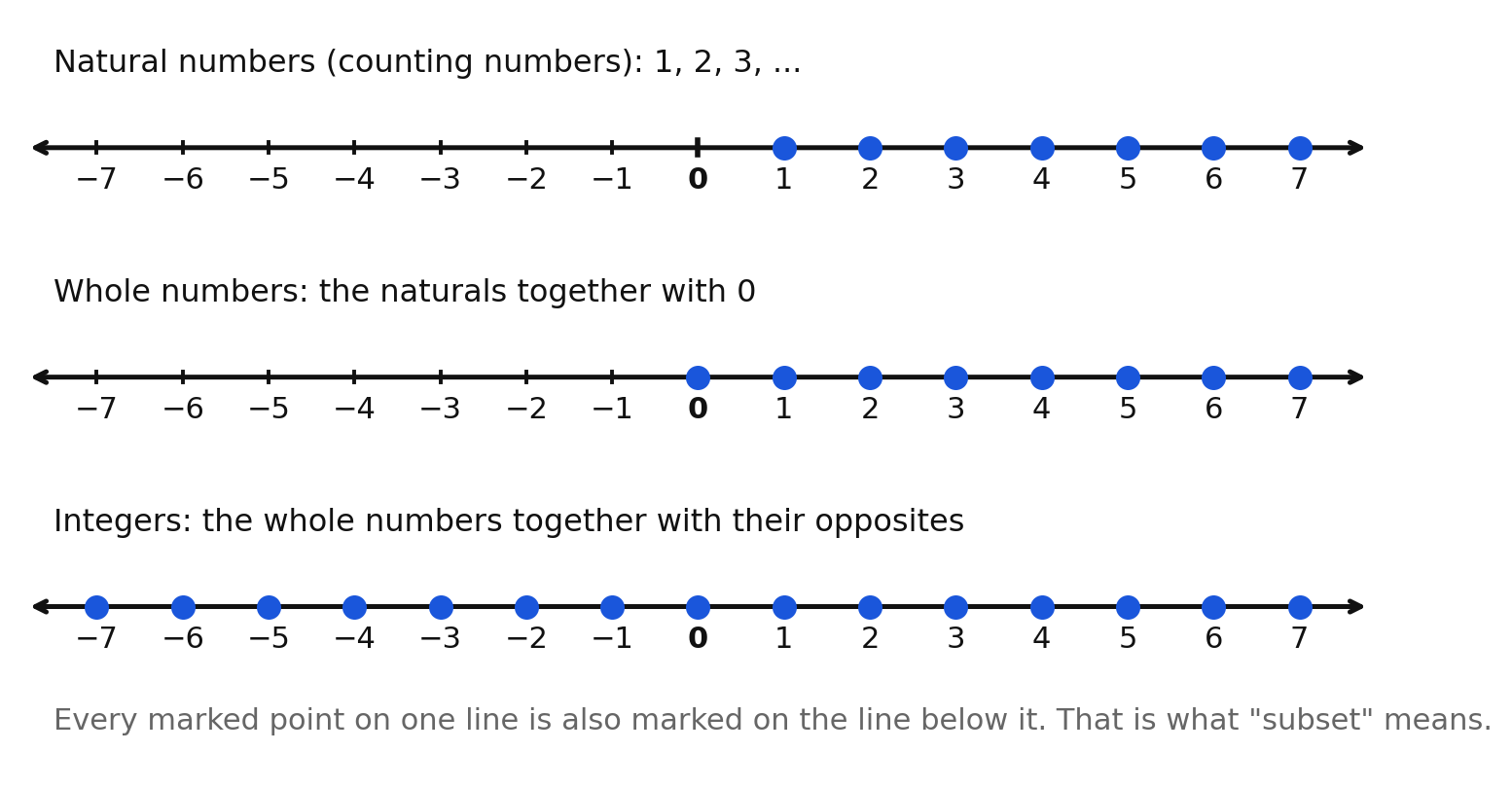
Every point marked on the top line is also marked on the middle line, and every point marked on the middle line is also marked on the bottom line. In symbols:
The symbol is read "is a subset of." It runs one direction only. Every natural number is an integer; it is not true that every integer is a natural number, and is all the proof you need.
Examples and non-examples
Naming a non-example is often the faster way to show you understand a definition. A non-example is a number that is not in the subset, together with the reason.
| Subset | Description | Examples | Non-examples |
|---|---|---|---|
| Natural numbers | the counting numbers | , , | (counting starts at ), (negative), (not a whole amount) |
| Whole numbers | the natural numbers together with | , , , | (negative), (has a decimal part) |
| Integers | the whole numbers together with their opposites | , , , | (has a fractional part), (has a decimal part) |
Worked examples
Example 1 — Which subsets contain ?
Is a natural number, a whole number, an integer?
Counting reaches , so it is a natural number. Every natural number is also a whole number and an integer.
Answer: all three — natural, whole, and integer.
Example 2 — The one number that separates two subsets
Is a natural number? Is it a whole number?
Counting starts at , so is not a natural number. The whole numbers were made by adding exactly to the naturals, so is a whole number.
Answer: not natural; yes whole (and also an integer).
Example 3 — A negative number
Name the smallest of the three subsets that contains .
The number is negative, so it is neither natural nor whole. It has no fractional part and it is the opposite of the whole number , so it is an integer.
Answer: integers.
Example 4 — A number in none of the three
Is an integer?
, which sits between and on the number line. No integer sits strictly between two consecutive integers, so it is not an integer, and therefore not a whole or natural number either.
Answer: no. It belongs to none of the three subsets in this lesson.
Example 5 — Justifying a subset claim
Explain why every whole number is an integer, but not every integer is a whole number.
The integers were built by starting from the whole numbers and adding the opposites, so every whole number was already there — nothing was thrown away. The reverse fails because the negatives that were added, such as , were never whole numbers.
Answer: The building process only added members, so ; the added negatives are integers that are not whole numbers.
Guided practice
- Which of , , and are natural numbers?
- Which of , , and are whole numbers?
- Which of , , and are integers?
- Give an example of a whole number that is not a natural number.
- Give an example of an integer that is not a whole number.
- Explain in one sentence why every natural number is also an integer.
Independent practice
- For each number, list every subset from this lesson that contains it: a) b) c) d)
- True or false, with a reason for each. a) Every whole number is a natural number. b) Every integer is a whole number. c) Every natural number is a whole number. d) is an integer.
- Give a non-example for each: a) a number that is an integer but not a natural number b) a number on the number line that is not an integer
- Complete with subset names: .
- A thermometer reads . Which of the three subsets in this lesson contains ? Which do not, and why?
- Application. An elevator panel is labeled for the second basement, for the lobby, and through for the upper floors. Which subset is the smallest one that contains every label? Explain why the whole numbers are not enough.
- Reasoning. Explain why the whole numbers need but the counting numbers do not. Use the idea of counting objects in your answer.
- Error analysis. A student says is a whole number "because it has no fraction part." Explain the mistake and name a subset that does contain .
Exit ticket 1.1
- Is a natural number? A whole number? An integer?
- Name an integer that is not a whole number.
- List every subset from this lesson that contains .
- Explain, in your own words, the difference between the whole numbers and the integers.
Lesson 1.2 — Rational Numbers
One definition, three costumes
The integers still leave gaps. Half a cup, three-quarters of an hour, and a batting average all live between the integers, so the collection was extended once more.
A rational number is any number that can be written as a ratio of two integers, , where and are integers and .
The word to hold onto is can be. A number does not have to arrive dressed as a fraction to be rational; it only has to be possible to write it as one. That is why rational numbers show up in three costumes.
Costume 1: a fraction or mixed number. These are already ratios of integers, or become one in a step. is a ratio. is a ratio, since . A mixed number converts: .
Costume 2: an integer. Every integer is rational, because you can always put it over :
This is the step students skip. It is what makes the integers a subset of the rationals rather than a separate collection.
Costume 3: a decimal that stops or repeats. A terminating decimal ends: , , . A repeating decimal has a block of digits that repeats forever, written with a bar over the repeating block: and
Both kinds can be turned into fractions.
Going the other way, dividing the numerator by the denominator always produces a decimal that either stops or repeats — those are the only two things long division can do, because the possible remainders eventually run out and a remainder has to come back around.
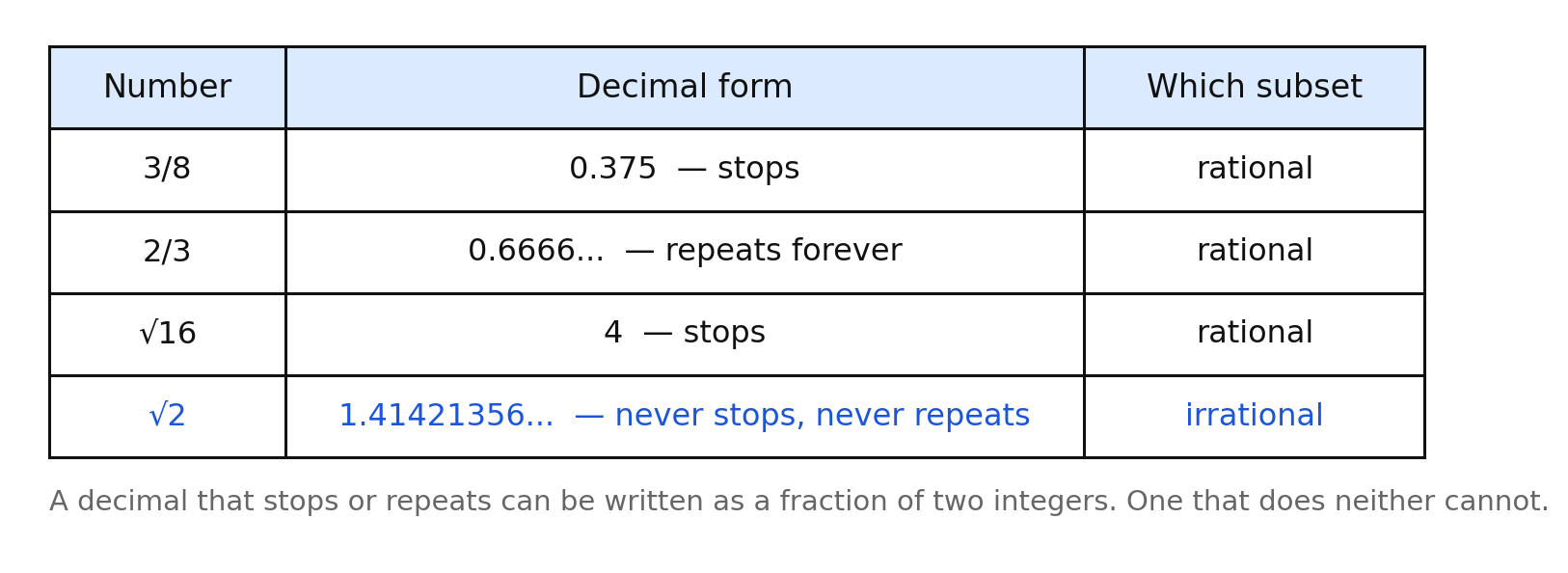
Radicals in disguise
A square root can be rational. is not a new kind of number at all — it is the number , just written differently, so it is a natural number, an integer, and a rational number.
Simplify the radical before you classify. A square root of a perfect square is rational. Deciding what happens when the number under the radical is not a perfect square is the whole job of Lesson 1.3.
What is not rational
A decimal that goes on forever and never falls into a repeating block cannot be written as a ratio of two integers. Those numbers exist, and they get their own name in the next lesson.
Worked examples
Example 1 — An integer as a ratio
Show that is a rational number.
Write it over : . Both and are integers and the denominator is not zero.
Answer: Yes, rational, because .
Example 2 — A terminating decimal
Write as a ratio of two integers in simplest form.
is hundredths, so . Divide numerator and denominator by :
Answer:
Example 3 — A fraction to a decimal
Write as a decimal. Does it stop or repeat?
Divide by : goes into six times with left, into twice with left, into five times with left. The remainder reaches , so the division ends.
Answer: ; it terminates.
Example 4 — A repeating decimal
Write as a decimal, and explain why it is still rational.
Dividing by gives . It never ends, but it is rational because it came from the ratio of two integers, which is the definition. Never ending is not the test; never repeating is.
Answer: , and it is rational because .
Example 5 — A radical that is rational
Is rational? Name every subset from this chapter so far that contains it.
is a perfect square, and .
Answer: Yes. , which is natural, whole, an integer, and rational.
Example 6 — A mixed number
Is rational?
Convert: , so . As a decimal it is , which terminates.
Answer: Yes, rational.
Guided practice
- Write as a ratio of two integers.
- Write as a ratio of two integers.
- Write as a fraction in simplest form.
- Write as a decimal. Does it stop or repeat?
- Write as a decimal. Does it stop or repeat?
- Is rational? Explain in one sentence.
- Is rational? Write it as a ratio of two integers.
- Is rational? Explain how the negative sign fits the definition.
Independent practice
- Each number below is rational. For each, also list every other subset from Lesson 1.1 that contains it: a) b) c) d) e)
- Write each as a ratio of two integers: a) b) c) d) e)
- Write each fraction as a decimal, then say whether it terminates or repeats: a) b) c) d)
- Which of these are rational? , , , , . Give a reason for each.
- Reasoning. Explain why every integer is a rational number. Use the definition, not an example alone.
- Application. A carpenter cuts a board feet long. Is rational? Write it as a ratio of two integers, and say whether it is an integer.
- Application. A player's batting average is reported as . Write that as a fraction in simplest form and name every subset that contains it.
- Error analysis. A student says must be irrational "because the digits never end." Explain what is wrong with that reasoning and give the correct classification.
Exit ticket 1.2
- Write as a ratio of two integers.
- Is rational? Write it as a fraction in simplest form.
- Is rational? Explain.
- Explain why a decimal that repeats forever is still a rational number.
Lesson 1.3 — Irrational Numbers
The numbers the fractions miss
An irrational number is a real number that cannot be written as a ratio of two integers. In decimal form, an irrational number never terminates and never repeats.
Read that decimal test carefully, because it has two conditions and both matter.
- terminates, so it is rational.
- repeats, so it is rational.
- , going on forever with no repeating block, is irrational.
"Never ends" by itself proves nothing — never ends and is rational. It is "never ends and never repeats" that puts a number outside the rationals.
Where irrational numbers come from
Two sources cover everything in this chapter.
Square roots of numbers that are not perfect squares. , , , are all irrational. So is . But is rational, so a radical sign is not by itself a signal. Check whether the number underneath is a perfect square.
The number . The ratio of any circle's circumference to its diameter is , an irrational number. The values and are approximations, and both are rational. They are not :
Those two disagree at the third decimal place. A rational approximation is useful for arithmetic and is never the same number as .
Irrational numbers still live on the number line
An irrational number is a real number, so it has an exact location on the number line even though its decimal never finishes. You can pin it between two consecutive whole numbers using perfect squares.
: the perfect squares on either side of are and , so
and lies between and .
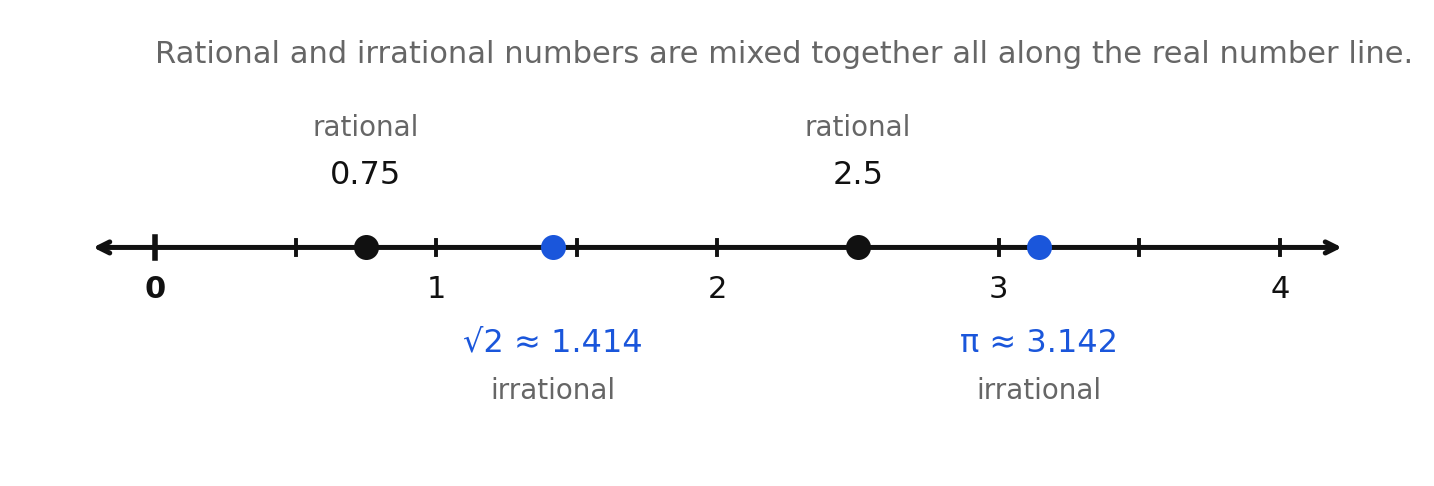
Rational and irrational numbers are threaded together all along the line. What they never do is overlap: a single number cannot be both rational and irrational, because it cannot both be writable as a ratio of two integers and not be.
Examples and non-examples
| Subset | Description | Examples | Non-examples |
|---|---|---|---|
| Rational numbers | any number writable as with , integers and ; decimal terminates or repeats | , , , , | , , |
| Irrational numbers | a real number not writable as a ratio of two integers; decimal never terminates and never repeats | , , , | (equals ), (terminates), (repeats) |
Worked examples
Example 1 — A perfect square under the radical
Is rational or irrational?
is a perfect square, so , a ratio of integers.
Answer: rational.
Example 2 — Not a perfect square
Is rational or irrational?
falls between the perfect squares and , so its square root is not a whole number, and its decimal never terminates or repeats.
Answer: irrational.
Example 3 — Trapping an irrational between whole numbers
Between which two consecutive whole numbers does lie?
The nearest perfect squares are and :
Answer: between and (and much closer to , since is close to ).
Example 4 — A negative radical
Classify and .
is a perfect square, so , an integer and rational. is not a perfect square, so is irrational.
Answer: is rational; is irrational.
Example 5 — Reading a decimal
A calculator display begins . Can you tell whether the number is rational?
Not from the display alone. A screen shows finitely many digits, so it cannot show you what happens forever. You need to know where the number came from. If it is , it is irrational; if it is , it terminates and is rational.
Answer: No — the decimal form must be described as terminating, repeating, or neither before you can classify it.
Example 6 — Giving a non-example
Give an irrational number and a non-example, with reasons.
An example is , whose decimal never terminates or repeats. A non-example is , because , a ratio of integers.
Answer: example ; non-example , which equals the rational number .
Guided practice
- Is rational or irrational? Explain.
- Is rational or irrational? Explain.
- Is rational or irrational?
- A number's decimal form is , continuing forever with no repeating block. Is it rational or irrational?
- Between which two consecutive whole numbers does lie?
- Give one example of an irrational number and one non-example.
Independent practice
- Classify each as rational or irrational: a) b) c) d) e)
- Name the perfect squares closest to on each side, then name the two consecutive whole numbers lies between.
- True or false: every square root is irrational. Justify your answer with an example.
- For each number, say whether its decimal form terminates, repeats, or does neither: a) b) c) d)
- Reasoning. Explain how the decimal form of shows that it cannot be written as a ratio of two integers.
- Application. A square garden has an area of square feet, so each side is feet long. Is that side length rational or irrational? Between which two consecutive whole numbers does it fall?
- Application. A circle has diameter centimeters, so its exact circumference is centimeters. Explain why the exact circumference is irrational, and why centimeters is a rational approximation rather than the answer.
- Error analysis. A student writes ", so is rational." Explain both errors in that sentence.
Exit ticket 1.3
- Is rational or irrational? Explain.
- Is rational or irrational? Between which two consecutive whole numbers does it lie?
- Give one example and one non-example of an irrational number.
- Explain how the decimal form of a number tells you whether it is rational or irrational.
Lesson 1.4 — The Whole System: Nesting and Classifying
The real numbers, all together
The real numbers are every number that has a location on the number line. That is the whole system this chapter describes, and it splits cleanly into two pieces that share no members.
Inside the rationals sit the integers, and inside those the whole numbers, and inside those the naturals:
The diagram below is the picture of those two sentences. It is worth copying by hand until you can draw it from memory.
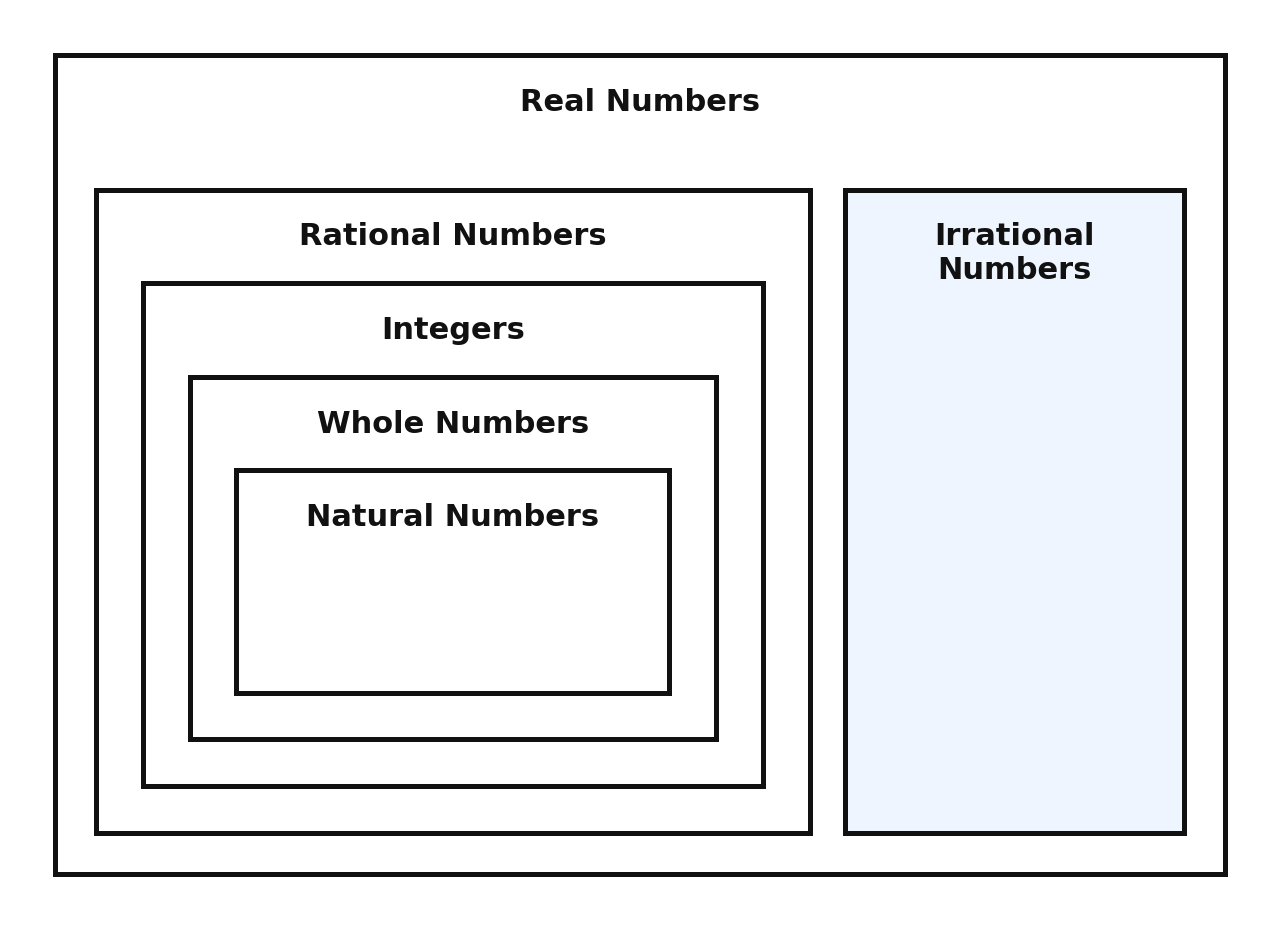
Two features of the drawing are the mathematics, not decoration.
The four inner rectangles are strictly nested. Each one sits wholly inside the next, because every natural number is a whole number, every whole number is an integer, and every integer is a rational number.
The irrational region sits beside the rational region, not inside it. This is the relationship students most often draw wrong. No number is both rational and irrational, so the two regions cannot overlap by even one point. Both are inside the real numbers, which is why irrational numbers still have locations on the number line.
Here is the same diagram with a number placed in each region.
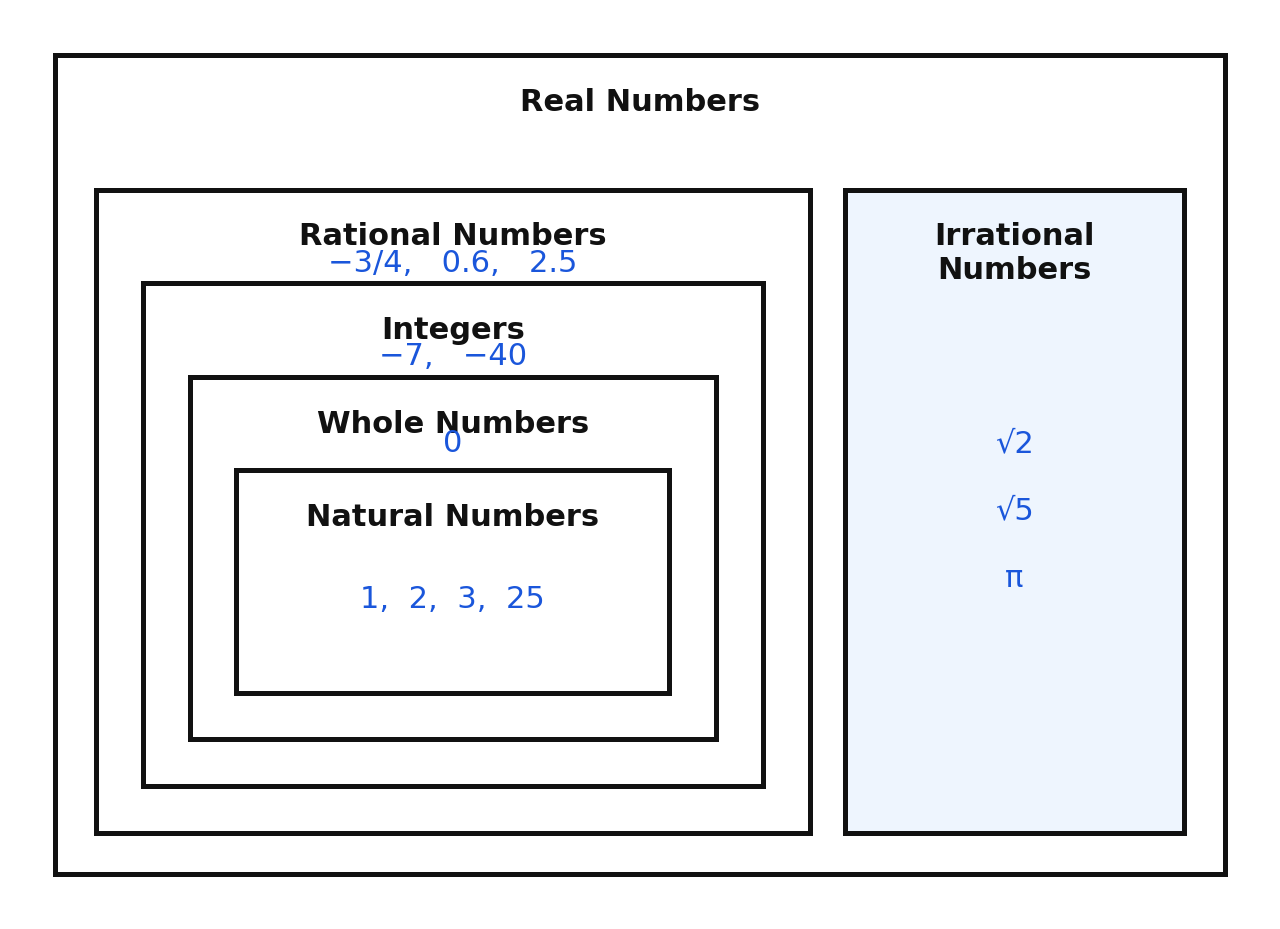
Read it as: is natural, and therefore also whole, an integer, rational, and real. is whole, an integer, rational, and real, but not natural. is an integer, rational, and real, but not whole. is rational and real, but not an integer. is irrational and real, and nothing else on the list.
A routine for classifying any number
Classifying is not guesswork. Put the number in decimal form first — simplifying any radical — and then work down.
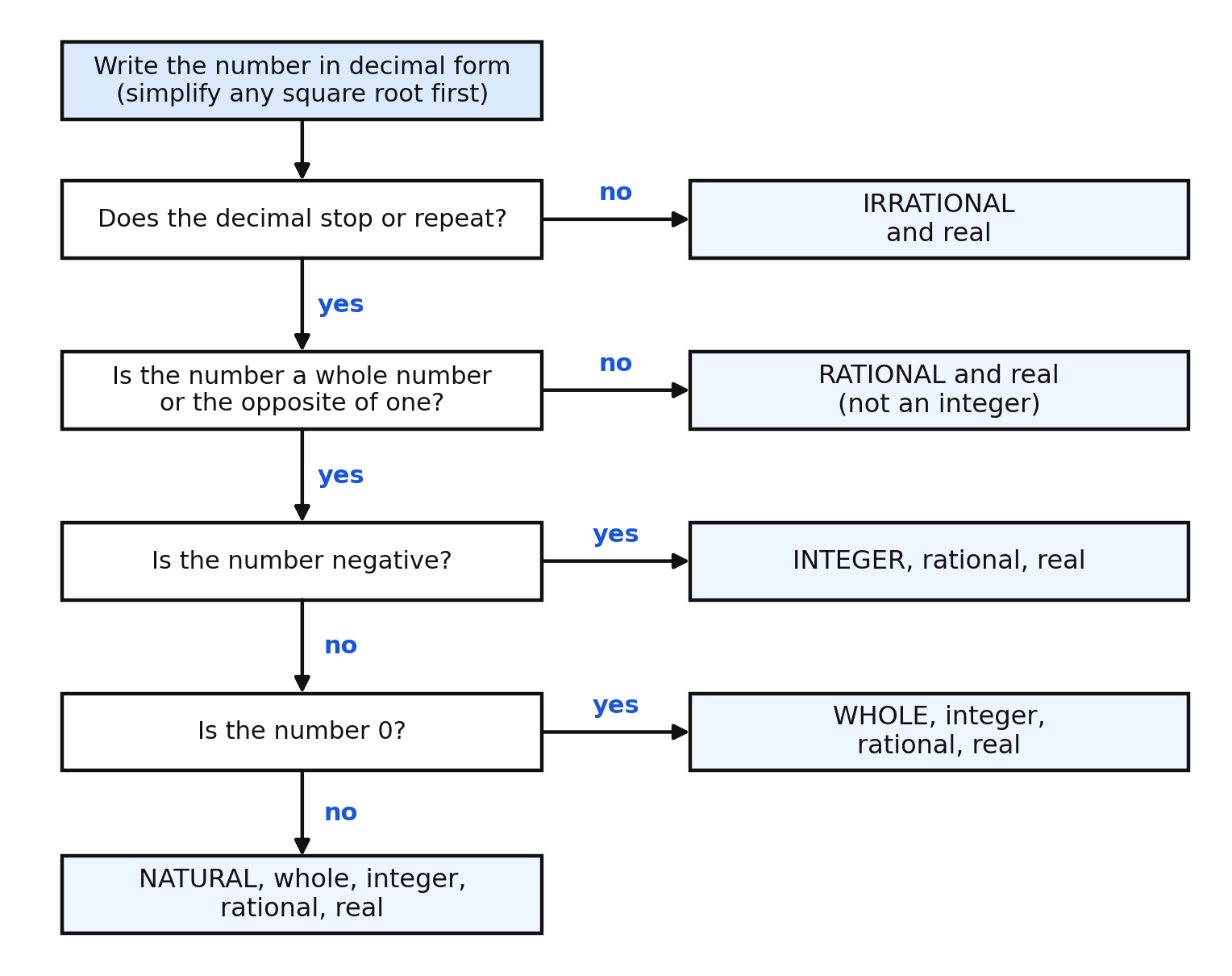
Three habits prevent nearly every classification error.
- Simplify radicals first. is not a mysterious radical; it is , which is natural, whole, an integer, rational, and real.
- List every subset, not just the smallest. If a number is natural, it is automatically whole, an integer, rational, and real. Naming only "natural" is an incomplete answer.
- Never name both rational and irrational. Exactly one of those two words applies to any real number.
Worked examples
Example 1 — A natural number
Name every subset containing .
is a counting number, and everything a natural number belongs to follows.
Answer: natural, whole, integer, rational, real.
Example 2 — A rational number that is not an integer
Name every subset containing .
The decimal terminates, so the number is rational: . It has a fractional part, so it is not an integer, and being negative it is not whole or natural.
Answer: rational and real.
Example 3 — A radical that collapses
Name every subset containing .
Simplify first: .
Answer: natural, whole, integer, rational, real.
Example 4 — A radical that does not collapse
Name every subset containing .
is not a perfect square. It sits between and , so is between and and its decimal never terminates or repeats.
Answer: irrational and real.
Example 5 — Building a number to order
Name a number that is an integer but not a whole number, and one that is real but not rational.
An integer that is not whole must be negative: works. A real number that is not rational must be irrational: works, and so does .
Answer: ; and (or any irrational number).
Example 6 — Fixing a diagram
A student draws the diagram with inside the rational rectangle. What is wrong, and where does it belong?
never terminates and never repeats, so it cannot be written as a ratio of two integers. Placing it inside the rationals claims exactly the opposite. It belongs in the irrational region, which is inside the real numbers and separate from the rationals.
Answer: is irrational; move it to the irrational region, still inside the real numbers.
Guided practice
For items 57 through 64, name every subset of the real numbers that contains the given number.
Independent practice
- Copy and complete the table, writing "yes" or "no" in each cell.
| Number | Natural | Whole | Integer | Rational | Irrational | Real |
|---|---|---|---|---|---|---|
- Name a number that is: a) an integer but not a whole number b) rational but not an integer c) real but not rational d) whole but not natural e) natural
- True or false, with justification. a) Every rational number is real. b) Every real number is rational. c) No irrational number is rational. d) Some integers are irrational. e) Every whole number is rational.
- Where in the subset diagram does each number belong? , , , ,
- Reasoning. Explain why a number cannot be both rational and irrational. Use the definition of each.
- Application. A science report lists four measurements: a length of inches, a temperature of , a volume of liters, and a diagonal of meters. Classify each into every subset that contains it, and say which of the four are real numbers.
- Application. One square tile has an area of square centimeters and another has an area of square centimeters. Their side lengths are and centimeters. Classify each side length, and say which one can be measured exactly with a ruler marked in whole centimeters.
- Error analysis. A student draws the subset diagram with the irrational numbers inside the rational rectangle. Explain what that drawing claims and why it is false.
Exit ticket 1.4
- Name every subset that contains .
- Name every subset that contains .
- Name every subset that contains .
- Explain why every natural number is a real number, but not every real number is a natural number.
Chapter 1 Review
Vocabulary. subset · natural numbers (counting numbers) · whole numbers · opposite · integers · rational number · terminating decimal · repeating decimal · perfect square · irrational number · real numbers
Part A — Relationships among the subsets (8.NS.2a)
- Sketch the subset diagram of the real number system. Label all five subset regions and the real numbers.
- Complete each sentence with a subset name. a) Every natural number is a number. b) Every whole number is an . c) Every integer is a number. d) Every rational number is a number.
- Explain why the irrational region of the diagram is drawn beside the rational region rather than inside it.
- Place each number in the correct region of the diagram: , , , , .
- True or false: the whole numbers are a subset of the integers. Justify your answer.
- Draw a number line from to and mark every integer. Then mark one rational number that is not an integer, and one irrational number between and .
- Using the three number lines from Lesson 1.1, explain what the word "subset" means.
Part B — Classifying numbers and explaining why (8.NS.2b)
- Name every subset that contains each number: a) b) c) d) e)
- Name every subset that contains each number: a) b) c) d) e)
- Explain why is a natural number.
- Explain why is irrational.
- Is a whole number? Explain why not, and name the smallest subset in the diagram that contains it.
- A number's decimal form is exactly . Name every subset that contains it, and write it as a ratio of two integers.
- A number's decimal form begins and never repeats. Name every subset that contains it.
- Error analysis. A student classifies as a natural number. Explain the error and give the complete correct classification.
Part C — Describing each subset with examples and non-examples (8.NS.2c)
- Describe the natural numbers in your own words. Give two examples and two non-examples, with a reason for each non-example.
- Describe the whole numbers. Give two examples and two non-examples.
- Describe the integers. Give two examples and two non-examples.
- Describe the rational numbers. Give three examples in three different forms (fraction, decimal, radical) and two non-examples.
- Describe the irrational numbers. Give two examples and two non-examples.
- Copy and complete the table with one example and one non-example in each row.
| Subset | Example | Non-example |
|---|---|---|
| Natural numbers | ||
| Whole numbers | ||
| Integers | ||
| Rational numbers | ||
| Irrational numbers |
Part D — Mixed application and reasoning
- Application. A square patio will cover square feet, so each side must be feet. Classify , name the two consecutive whole numbers it lies between, and explain why the builder writes feet on the plan.
- Application. A bank account balance is . Name every subset that contains , and explain why it is not an integer.
- Reasoning. Can a number be both irrational and an integer? Explain using the diagram and the definitions.
- Reasoning. A student concludes that a square root sign always means the number is irrational. Explain why that is false, using and .
- Application. A circle has a radius of inches, so its exact area is square inches. Explain why the exact area is irrational while the approximation square inches is rational.
Standards coverage check — Chapter 1
| Knowledge and Skill | Where it is taught | Where it is practiced |
|---|---|---|
| 8.NS.2a — describe and illustrate the relationships among the subsets of the real number system by using representations; subsets are rational numbers, irrational numbers, integers, whole numbers, and natural numbers | 1.1 (number-line representation), 1.4 (nested diagram and flowchart) | Items 4–6, 10; 27, 31; 57–68; Review Part A, items 77–83, and items 100, 101 |
| 8.NS.2b — classify and explain why a given number is a member of a particular subset or subsets of the real number system | 1.2, 1.3, 1.4 | Items 1–3, 7, 8, 11, 14–17; 19–30, 32–37; 39–43, 45–48, 50–54; 57–68, 70–75; Review Part B, items 84–91, and items 98, 99, 102 |
| 8.NS.2c — describe each subset of the set of real numbers and include examples and non-examples | 1.1 (examples/non-examples table), 1.2, 1.3 (examples/non-examples table), 1.4 | Items 9, 12, 13, 18; 38; 44, 49, 55, 56; 66, 69, 76; Review Part C, items 92–97 |
The standard names exactly five subsets — rational numbers, irrational numbers, integers, whole numbers, and natural numbers — inside the real numbers, and this chapter stays within that list. Comparing and ordering real numbers, and approximating irrational numbers to the nearest hundredth, belong to 8.NS.1 and are taken up in Chapter 2.
Answer keys for every set in this chapter are in Appendix A.