Chapter 14 — Circles: Circumference and Area
Standard: 6.MG.1 — The student will identify the characteristics of circles and solve problems, including those in context, involving circumference and area.
By the end of this chapter you will be able to:
- Identify and describe chord, diameter, radius, circumference, and area of a circle (6.MG.1a)
- Investigate and describe the relationship between diameter and radius, radius and circumference, and diameter and circumference (6.MG.1b)
- Develop an approximation for pi (3.14) by gathering data and comparing the circumference to the diameter of various circles (6.MG.1c)
- Develop the formula for circumference using the relationship between diameter, radius, and pi (6.MG.1d)
- Solve problems, including those in context, involving circumference and area of a circle when given the length of the diameter or radius (6.MG.1e)
Lessons: 14.1 Parts of a Circle · 14.2 Discovering Pi · 14.3 Circumference · 14.4 Area of a Circle · 14.5 Circle Problems in Context
Throughout this chapter, use for pi. Because is an approximation, your answers are approximations too.
Lesson 14.1 — Parts of a Circle
What makes a circle a circle
Every figure you have studied so far — triangles, rectangles, parallelograms — is built from straight segments. A circle is built from a single rule about distance.
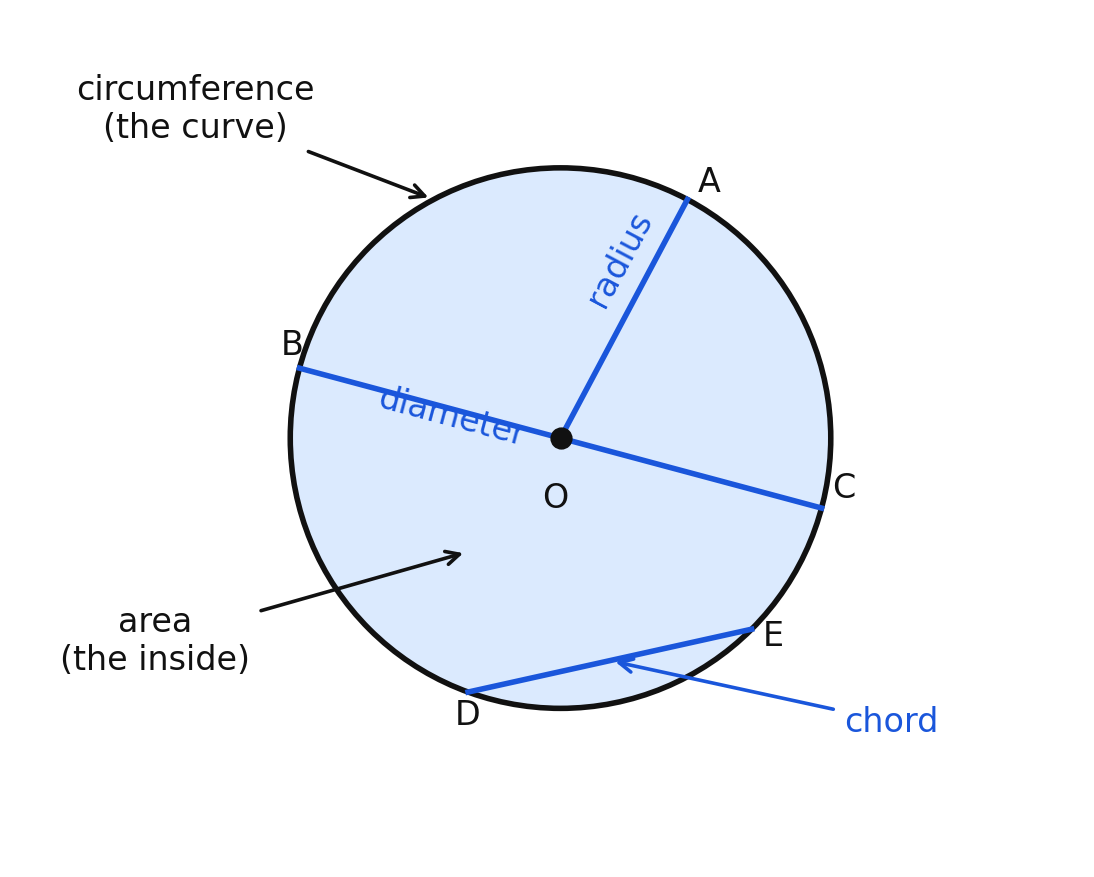
A circle is the set of all points in a plane that are the same distance from one fixed point. That fixed point is the center of the circle. The circle itself is only the curve; the center is not part of it.
That one rule is doing a lot of work. It is why a circle looks the same from every direction, and it is why the parts of a circle have such tidy relationships with each other.
Radius and diameter
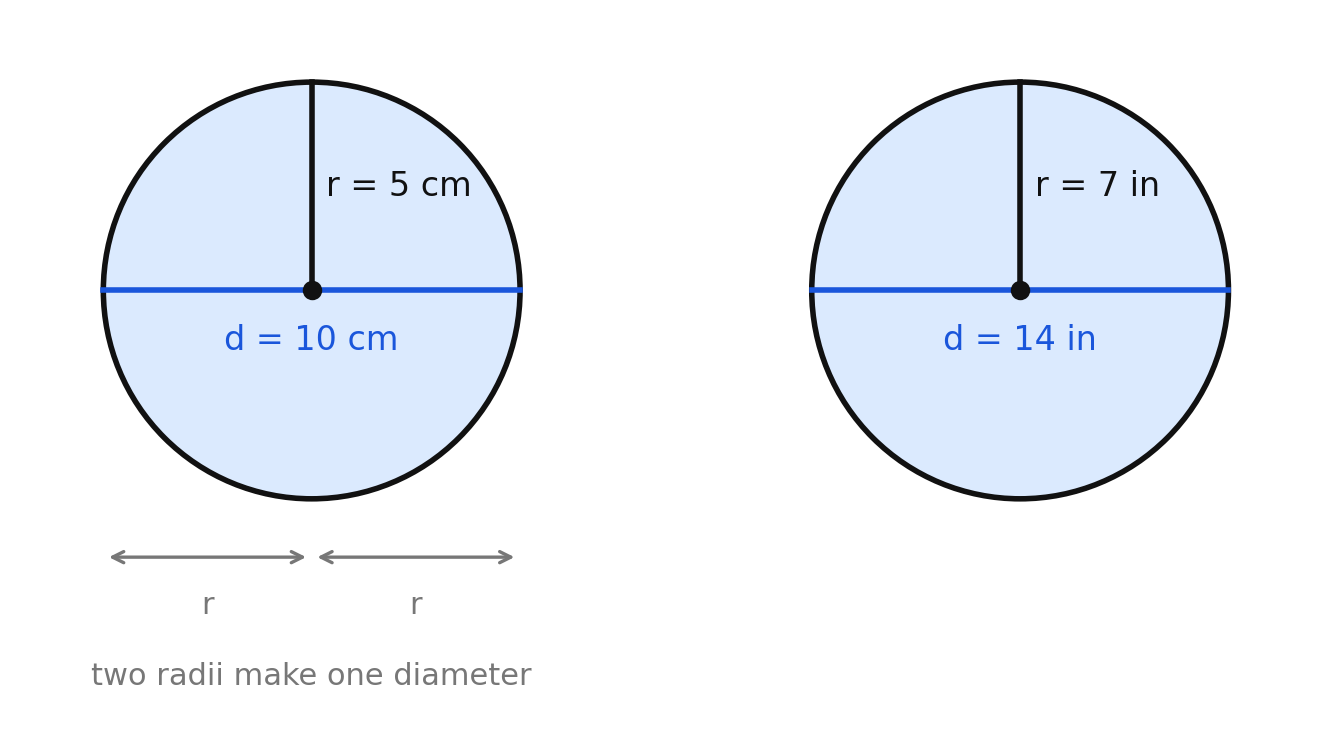
A radius is a segment from the center to any point on the circle. Because every point on the circle is the same distance from the center, every radius of a circle has the same length. When we say "the radius is 5 cm," we mean that common length. The plural of radius is radii.
A diameter is a segment that passes through the center and has both endpoints on the circle. A diameter is made of two radii lying end to end in a straight line, so:
Here stands for the length of the diameter and for the length of the radius. This is the first of the three relationships the standard asks you to investigate, and it is the one you will use most often, because problems hand you one and formulas ask for the other.
Chords
A chord is a segment whose endpoints are both on the circle. A chord does not have to pass through the center.
That definition should look familiar, because a diameter fits it. So:
Every diameter is a chord, but not every chord is a diameter. A diameter is exactly the chord that passes through the center, and it is the longest chord a circle has.
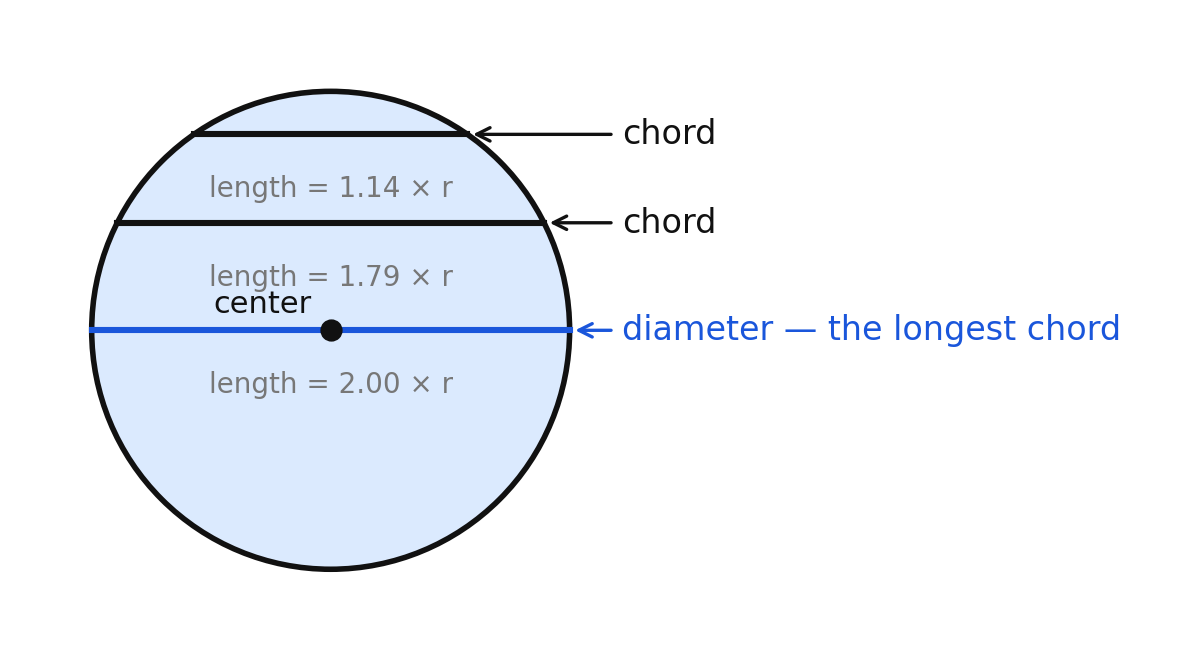
Why is the diameter longest? Any chord that misses the center takes a shortcut across the circle. Only the chord that goes straight through the center uses the full width.
Circumference and area
Two measurements describe the size of a circle, and they answer different questions.
The circumference is the distance around the circle — its perimeter. It is a length, so it is measured in units such as centimeters, inches, feet, or meters. If you walked once around a circular track, the circumference is how far you walked.
The area is the amount of surface inside the circle. It is measured in square units such as square centimeters () or square feet (). If you painted the inside of that track, the area is how much surface you covered.
| Measurement | Question it answers | Units |
|---|---|---|
| Circumference | How far around? | units (cm, in, ft, m) |
| Area | How much surface inside? | square units (, , , ) |
Keeping these straight is mostly a matter of watching your units. If your answer to a "how much fencing" question comes out in square feet, something went wrong.
Worked examples
Example 1 — Naming a part from a description
A segment has one endpoint at the center of a circle and the other endpoint on the circle. Name this part.
One endpoint at the center, one on the circle, is the definition of a radius.
Answer: a radius
Example 2 — From radius to diameter
A circle has a radius of cm. Find the diameter.
A diameter is two radii long, so double the radius.
Answer: cm
Example 3 — From diameter to radius
A circle has a diameter of in. Find the radius.
A radius is half a diameter, so divide by 2.
Answer: in
Example 4 — Chord or diameter?
In a circle of radius cm, a chord measures cm. Could this chord be a diameter? Explain.
The diameter of this circle is cm. A diameter must be cm long, and this chord is only cm.
Answer: No. It is a chord that does not pass through the center, since a diameter of this circle would measure cm.
Example 5 — Choosing circumference or area
A gardener wants to put a low fence around a round flower bed and then cover the soil inside with mulch. Which measurement does each job need?
Fencing goes around the edge; mulch covers the inside surface.
Answer: The fence needs the circumference (measured in feet). The mulch needs the area (measured in square feet).
Guided practice
- Name the part of a circle described: a segment from the center to a point on the circle.
- Name the part of a circle described: the longest chord of a circle.
- A circle has radius m. Find the diameter.
- A circle has diameter ft. Find the radius.
- Is every diameter a chord? Is every chord a diameter? Explain each answer in one sentence.
Independent practice
- Using the figure at the start of this lesson, name a radius, a diameter, and a chord that is not a diameter.
- Find the diameter for each radius: a) cm b) in c) m
- Find the radius for each diameter: a) ft b) cm c) in
- One of these measurements is a length and one is a surface. Which is which, and what units does each use: circumference or area?
- A circle has radius cm. Explain the difference between a chord that measures cm and a radius that measures cm.
- Application. A round pond measures ft straight across through the middle. Name that measurement, then give the distance from the center of the pond to its edge and name that measurement.
- Reasoning. Jonah says a circle can have a chord longer than its diameter. Explain why this is impossible.
Exit ticket 14.1
- A circle has radius cm. Find the diameter.
- A circle has diameter in. Find the radius.
- Define chord in your own words.
- Explain why circumference is measured in units but area is measured in square units.
Lesson 14.2 — Discovering Pi
An investigation, not a formula
You are about to find one of the most useful numbers in mathematics, and you are going to find it by measuring. The question driving the whole lesson is simple:
How many diameters does it take to go once around a circle?
Take a can lid. Wrap a string once around the outside, cut the string to that exact length, then lay it flat next to the lid. Now measure across the lid with that string. You will fit three full diameters and have a little piece of string left over — noticeably less than another full diameter.
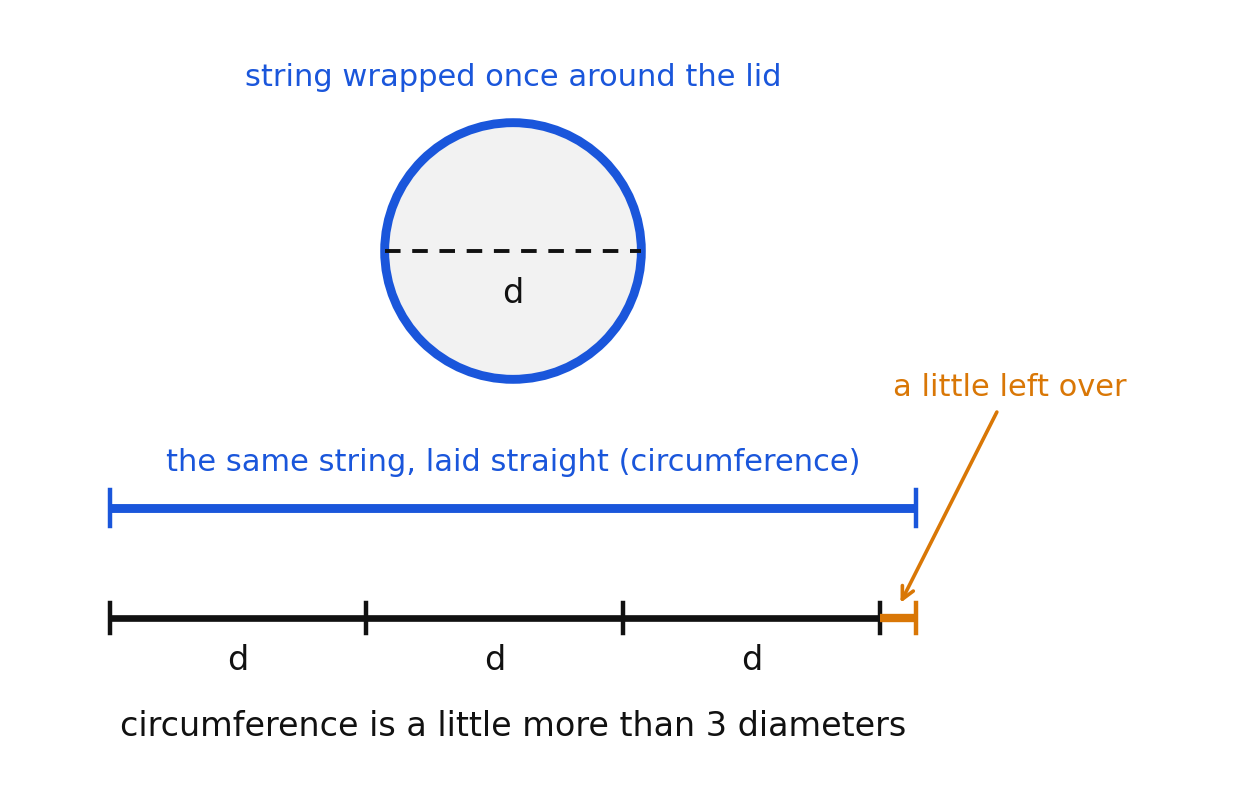
Do it with a bigger lid and the answer is the same: three diameters and a little more. Do it with a bottle cap, a plate, a bicycle tire, a hula hoop. Always the same. That constancy is the discovery.
Gathering the data
Investigating carefully means measuring several circles and recording the ratio each time, where is the circumference and is the diameter. Here is a data set collected by one class using string and a centimeter ruler.
| Object | Circumference | Diameter | rounded to hundredths |
|---|---|---|---|
| Soup can lid | cm | cm | |
| Tape roll | cm | cm | |
| Jar lid | cm | cm | |
| Dinner plate | cm | cm | |
| Bucket rim | cm | cm |
The objects range from a small jar lid to a bucket rim, and yet the ratios crowd into a narrow band around . Averaging the five ratios gives
Naming the number
That ratio has a name. Pi, written with the Greek letter , is the ratio of the circumference of any circle to its diameter:
Pi is the same number for every circle, large or small. It is not a nice fraction and its decimal never ends or repeats; it begins . In this course we use the approximation
Because that is an approximation, every circumference and area you compute is an approximation too. It is honest to say "about."
Why measured ratios vary. Your string slips, the ruler lands between marks, the lid is not perfectly round. Small measurement errors move the ratio a few hundredths in either direction. Getting or does not mean pi changed; it means measuring is imperfect. Averaging many circles pulls the noise out.
The data as a graph
Plotting diameter on the horizontal axis and circumference on the vertical axis makes the pattern visible in a second way.
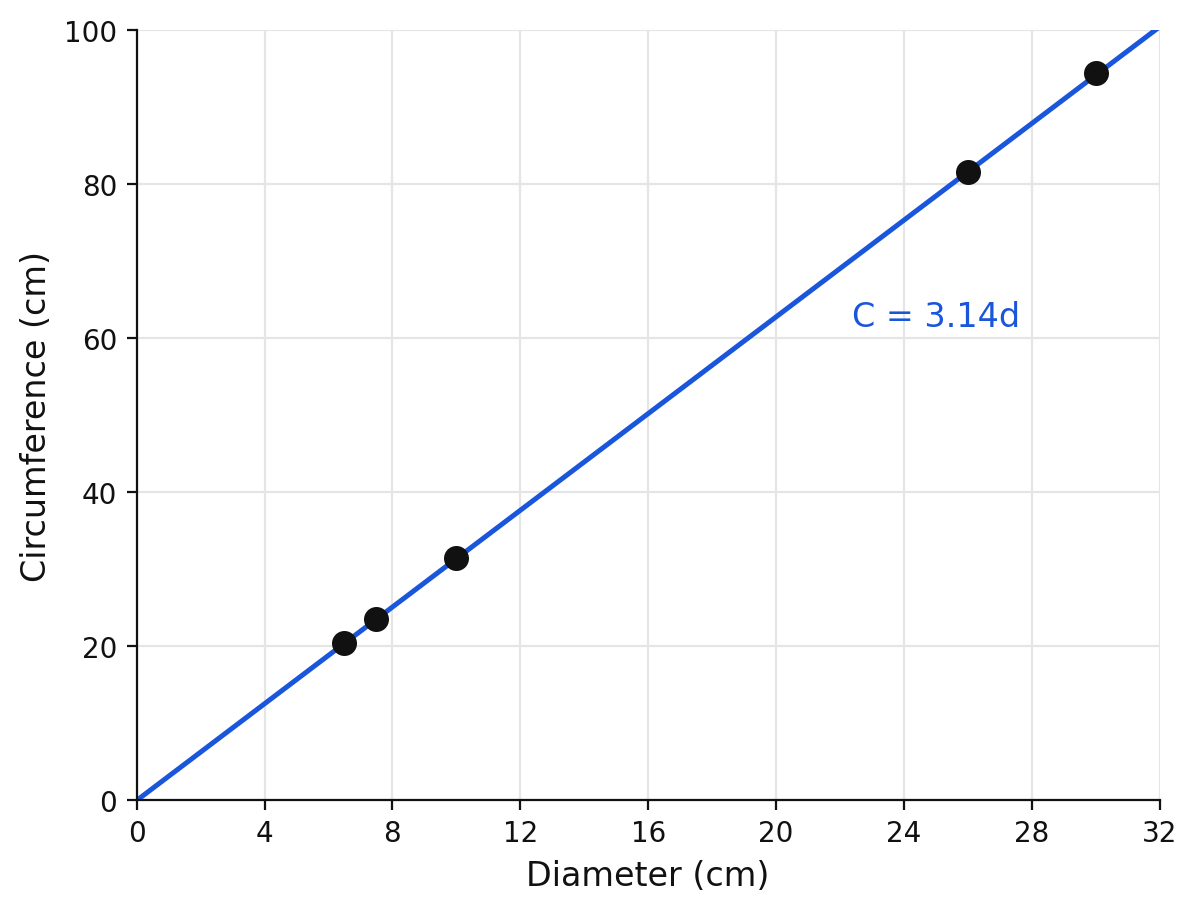
The points lie almost on a straight line through the origin. That is exactly what a constant ratio looks like on a graph: whatever the diameter, the circumference is about times as large.
Worked examples
Example 1 — Computing the ratio from measurements
A lid has circumference cm and diameter cm. Find rounded to the nearest hundredth.
Rounding to hundredths, the digit in the thousandths place is , so round down.
Answer: about
Example 2 — A ratio that runs high
A cup has circumference cm and diameter cm. Find the ratio and comment on it.
This is close to but a little high, which suggests the string was pulled slightly long or the diameter was measured a bit short.
Answer: about ; measurement error, not a different pi
Example 3 — Estimating with "a little more than 3 diameters"
A circle has diameter cm. Estimate its circumference without a formula.
Three diameters is cm, and the circumference is a little more than that.
Answer: a little more than cm — around cm
Example 4 — Averaging class data
Three groups report ratios of , , and . Find the average.
Answer: , close to
Example 5 — Judging a suspicious result
A group reports a ratio of for a circle. Is measurement error a good explanation?
Every careful measurement lands near , and is more than half a unit away. An error that large usually means the diameter was measured along a chord that missed the center, making it too long, or the string was not pulled all the way around.
Answer: No. This is too far off to be small measurement error; the group should re-measure, most likely the diameter.
Guided practice
For 1–3, find rounded to the nearest hundredth.
- Jar lid: cm, cm
- Cup rim: cm, cm
- Platter: cm, cm
- Find the average of your three ratios from items 1–3, rounded to the nearest hundredth.
- Explain why almost nobody measures a ratio of exactly .
Independent practice
Find to the nearest hundredth for each object.
Object a) Bottle cap cm cm b) Salad bowl cm cm c) Mug cm cm d) Wastebasket cm cm Average the four ratios from item 6, rounded to the nearest hundredth. What well-known number is it close to?
Use the ratio to predict the circumference of a circle whose diameter is cm.
A circle has a diameter of nearly miles, about the size of Earth. What is for that circle? Explain how you know without measuring.
Application. You mark one spot on a bicycle wheel, set the mark on the ground, and roll the wheel until the mark touches the ground again. Explain what distance the wheel traveled. If the wheel's diameter is m, about how far did it roll?
Application. A student measures a circular tray and reports cm with a ratio of . What diameter did the student record? What diameter should the tray actually have, to the nearest tenth? What probably went wrong?
Reasoning. Why is it better to gather data from many different circles than to measure just one very carefully?
Exit ticket 14.2
- A circle has cm and cm. Find to the nearest hundredth.
- What number does get close to for every circle? What is it called?
- About how many diameters fit around the outside of a circle?
- Explain why measured ratios are not all the same.
Lesson 14.3 — Circumference
Building the formula
Lesson 14.2 ended with a fact about every circle:
That is a statement about a ratio, but what problems actually ask for is the circumference. Multiply both sides by to move out of the denominator, and the ratio becomes a formula:
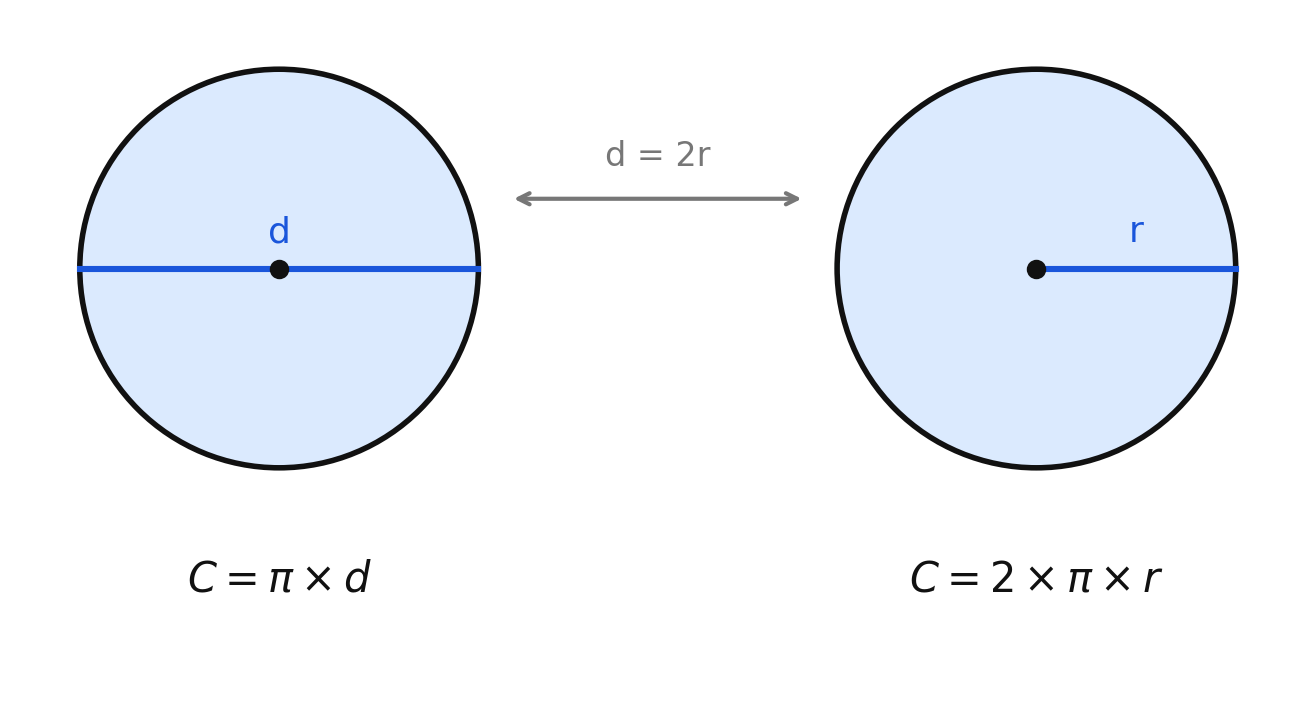
The circumference of a circle equals pi times the diameter. Read it as a sentence: going once around is times the distance straight across.
Many problems give you the radius instead. Since a diameter is two radii, replace with :
These are not two different facts. They are the same formula written for the measurement you happen to have.
Using the formulas
Three questions decide everything:
- What am I given — radius or diameter? Pick the matching formula.
- Did I substitute for ?
- Are my units plain units, not square units? Circumference is a distance.
Worked examples
Example 1 — Given the diameter
Find the circumference of a circle with diameter cm.
Answer: about cm
Example 2 — Given the radius
Find the circumference of a circle with radius in.
Answer: about in
Example 3 — Given the radius, using the other formula
Find the circumference of a circle with radius m by first finding the diameter.
Check with the other formula: . Same answer, as it must be.
Answer: about m
Example 4 — A decimal radius
Find the circumference of a circle with radius ft.
Answer: about ft
Example 5 — Working backward from the circumference
A circle has circumference cm. Find its diameter and its radius.
Start from and undo the multiplication by dividing.
Answer: diameter about cm; radius about cm
Guided practice
- Find the circumference of a circle with diameter cm.
- Find the circumference of a circle with diameter in.
- Find the circumference of a circle with radius ft.
- Find the circumference of a circle with radius m.
- A circle has radius cm. Find its diameter, then its circumference.
Independent practice
- Find each circumference: a) cm b) mm c) in d) m
- Find the circumference of a circle with diameter cm.
- A circle has circumference ft. Find its diameter and its radius.
- Circle A has radius cm and Circle B has radius cm. Find both circumferences and describe what happened to the circumference when the radius doubled.
- Application. A bicycle wheel has a diameter of in. How far does the bike travel in one full turn of the wheel? How far in full turns?
- Application. A circular flower bed has radius ft. Plastic edging is sold by the whole foot. How many feet should the gardener buy?
- Reasoning. Priya computes the circumference of a circle with radius cm as cm. Find her error, give the correct circumference, and state the rule she should remember.
Exit ticket 14.3
- Find the circumference of a circle with diameter cm.
- Find the circumference of a circle with radius in.
- A circle has circumference m. Find its diameter.
- Explain why and always give the same answer for the same circle.
Mid-chapter check (Lessons 14.1–14.3)
- A circle has radius cm. Find its diameter.
- A circle has diameter in. Find its radius.
- Name the longest chord of a circle.
- A lid has cm and cm. Find to the nearest hundredth.
- Find the circumference of a circle with diameter ft.
- Find the circumference of a circle with radius m.
- A circle has circumference cm. Find its radius.
- A round tabletop is ft across. About how much ribbon is needed to trim its edge exactly once?
Lesson 14.4 — Area of a Circle
Where the formula comes from
Area asks how much surface is inside the circle. A circle has no straight sides to multiply, so we borrow a shape that does.
Imagine cutting a circle into many thin wedges, like slices of a pizza, and then arranging the wedges in a row with the points facing up and down alternately. With enough thin wedges, the row is nearly a parallelogram.
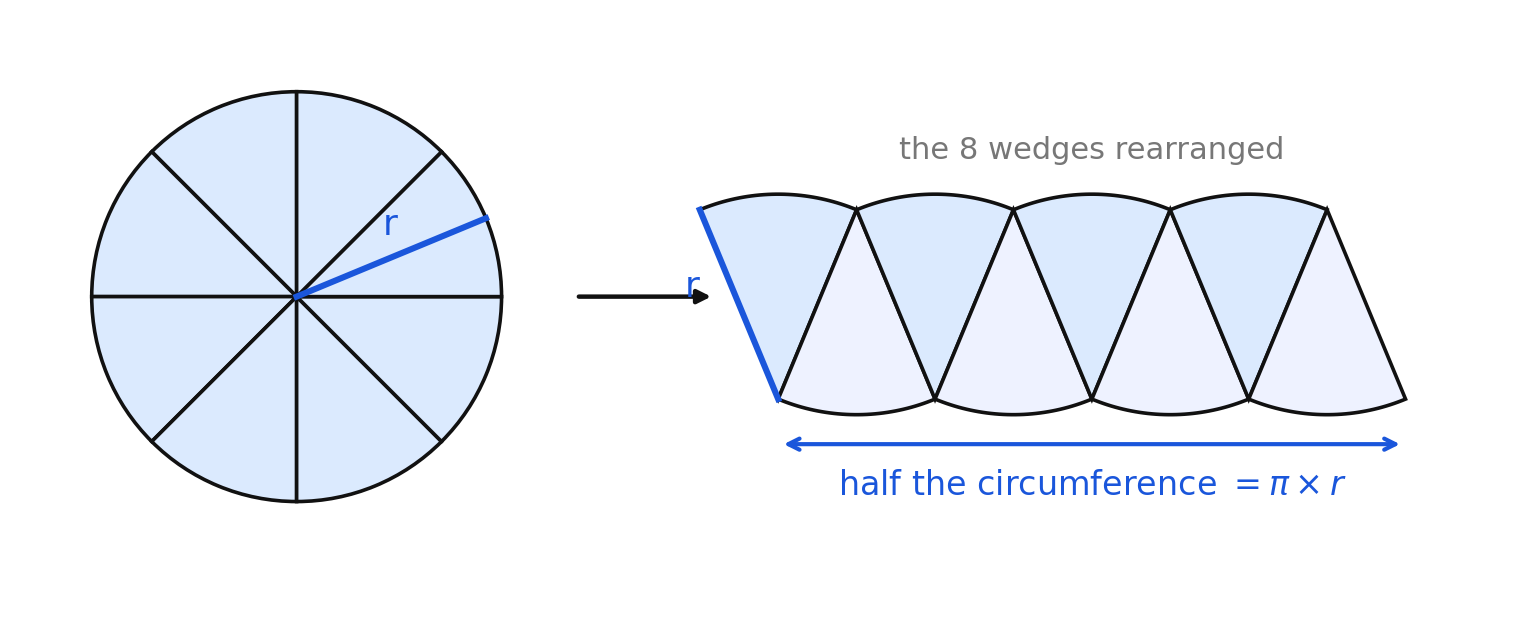
Look at that near-parallelogram:
- Its height is the radius, , because each wedge reaches from the center to the edge.
- Its base is half the circumference, because half the wedges point up along the top and half point down along the bottom. Half of is .
A parallelogram's area is base times height, so
The area of a circle equals pi times the radius squared. The exponent tells you why the answer comes out in square units: you are multiplying a length by a length.
Order of operations matters here
In , the square applies only to . Square the radius first, then multiply by .
For a radius of : square first, , then . Multiplying first would give and then , which is wrong.
When you are given the diameter
The area formula needs the radius, so if a problem gives the diameter, cut it in half before you square anything.
The most common area mistake is squaring the diameter. For a circle with : the radius is , so square units. Squaring the instead gives , which is four times too big.
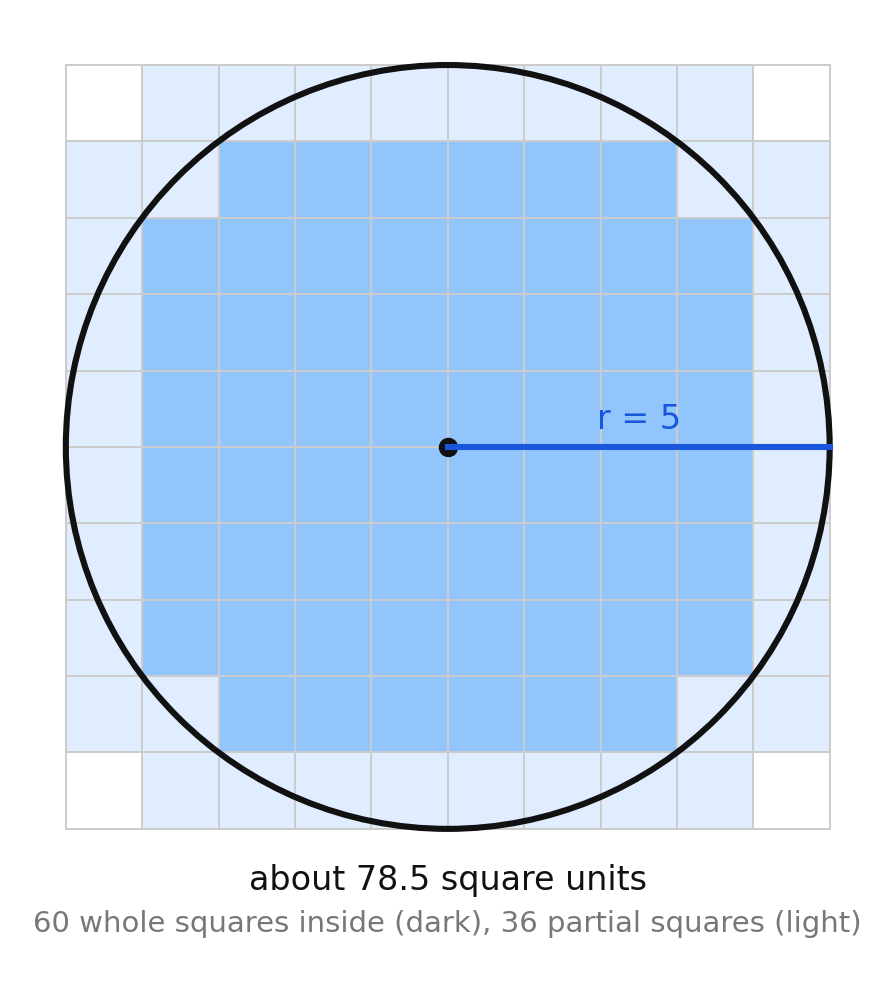
Counting squares on a grid is a good reality check. A circle of radius covers a little more than whole and partial squares, which agrees with the square units the formula gives.
Worked examples
Example 1 — Given the radius
Find the area of a circle with radius cm.
Answer: about
Example 2 — Given the diameter
Find the area of a circle with diameter in.
First halve the diameter.
Answer: about
Example 3 — A decimal radius
Find the area of a circle with radius cm.
Answer: about
Example 4 — Circumference and area for the same circle
A circle has radius m. Find its circumference and its area, and compare the units.
The circumference is a distance in meters. The area is a surface in square meters. The numbers are different and so are the units.
Answer: m;
Example 5 — Working backward from the area
A circle has area about . Find its radius.
Undo the multiplication by , then undo the squaring.
Answer: about ft
Guided practice
- Find the area of a circle with radius cm.
- Find the area of a circle with radius in.
- Find the area of a circle with diameter ft.
- Find the area of a circle with diameter m.
- Find the area of a circle with radius cm.
Independent practice
- Find each area: a) cm b) in c) ft d) m
- Find the area of a circle with radius in.
- A circle has radius cm. Find its circumference and its area, and explain why the units are different.
- Circle A has radius m and Circle B has radius m. Find both areas, then describe what happened to the area when the radius doubled.
- Application. A pizza is in across. Find the area of its top surface.
- Application. A round tabletop has diameter ft. Find its area to help decide how much glass is needed to cover it.
- Reasoning. Devon finds the area of a circle with diameter cm by computing . Explain the mistake, give the correct area, and state how many times too large Devon's answer was.
Exit ticket 14.4
- Find the area of a circle with radius cm.
- Find the area of a circle with diameter in.
- A circle has area about . Find its radius.
- Explain why area is reported in square units but circumference is not.
Lesson 14.5 — Circle Problems in Context
Deciding which formula the situation needs
Real problems do not announce "use ." They describe a job, and the job tells you which measurement to find.
| The job involves | You need | Units |
|---|---|---|
| Fencing, edging, trim, ribbon, a border | circumference | ft, m, in, cm |
| One full turn of a wheel or roller | circumference | ft, m, in, cm |
| Mulch, paint, sod, glass, fabric, a pizza's surface | area | , , , |
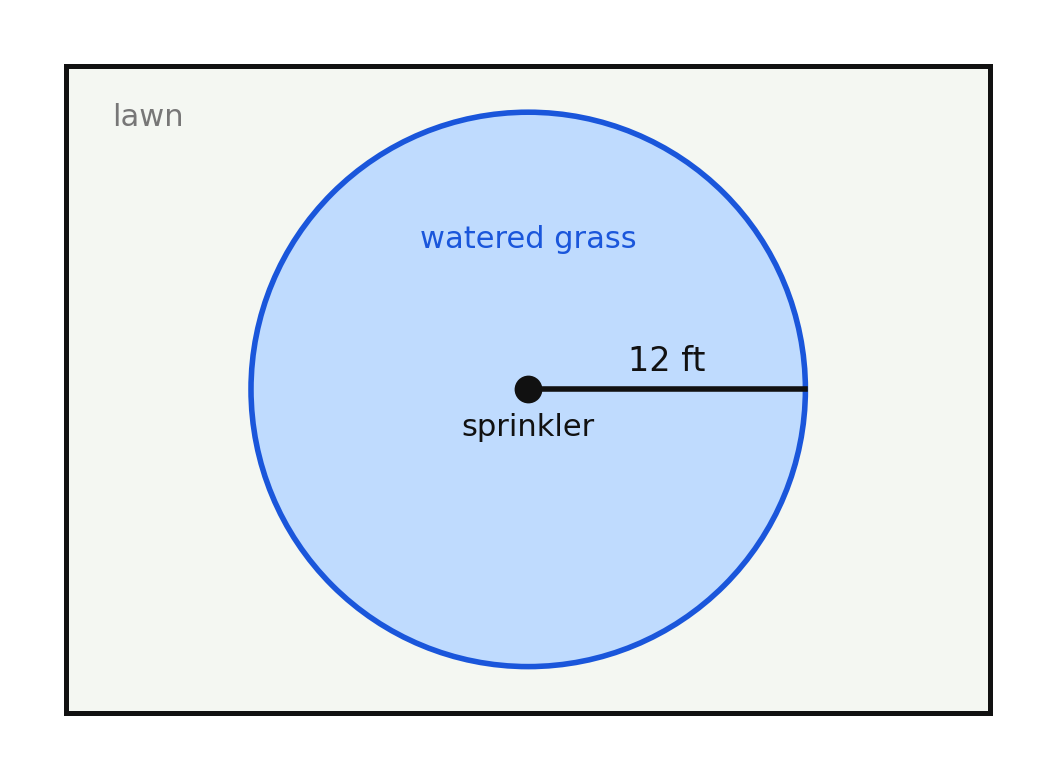
| Ground a sprinkler waters, region a light covers | area | , |
Then check what you were handed. Sprinklers and radar are described by reach, which is a radius. Pizzas, plates, wheels, and pipes are usually described by how far across, which is a diameter. Halve the diameter before using the area formula.
A four-step habit
- Name the job. Around the edge, or the surface inside?
- Name what you have. Radius or diameter?
- Substitute and compute with , showing each step.
- Answer the question asked, with correct units — and round the way the situation requires.
Step 4 does more than it looks like. If you need ft of edging sold by the whole foot, you buy ft, because ft would leave a gap. Real contexts sometimes round up no matter what the decimal says.
Rolling wheels
A wheel that turns one full revolution without slipping travels exactly its circumference. That single sentence turns every wheel question into a circumference question:
Half circles
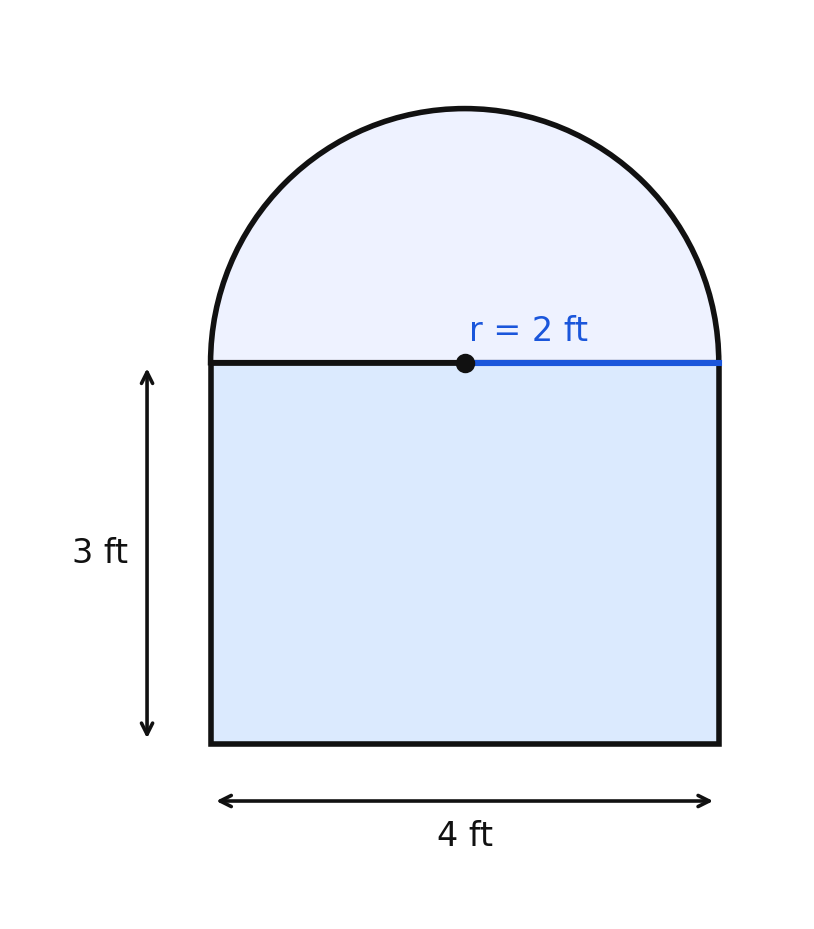
A semicircle is half of a circle. Its area is half the circle's area. Be careful with its perimeter: the curved part is half the circumference, but the straight part across the top is the diameter, and it counts.
Worked examples
Example 1 — A sprinkler
A sprinkler sprays water in a circle reaching ft in every direction. How much lawn does it water?
The job is the surface covered, so use area. The reach is a radius.
Answer: about
Example 2 — Fencing a pen
A circular dog pen is ft across. How much fencing goes around it?
Around the edge means circumference, and "across" means diameter.
Answer: about ft of fencing
Example 3 — Cost of edging
A circular garden has radius ft. Edging costs $3 per foot. Find the cost.
Answer: about $188.40
Example 4 — A rolling wheel
A wheel has diameter ft. How far does a cart travel in turns of the wheel?
Answer: about ft
Example 5 — A semicircular window
The window in the figure above has a semicircle of radius ft on top of a rectangle ft wide and ft tall. Find the total glass area.
Rectangle first:
Then half of a full circle of radius :
Answer: about
Guided practice
- A sprinkler waters a circle of radius ft. Find the area watered.
- A circular pen is ft across. Find the length of fence needed to enclose it.
- A round rug has radius ft. Find its area.
- A trampoline is ft across. Find the length of padding needed to wrap its edge once.
- A manhole cover has diameter in. Find the area of its top surface.
Independent practice
- A circular swimming pool is ft across. Find the distance around the pool and the area of its surface.
- A wagon wheel has diameter ft. How far does the wagon roll in turns of the wheel?
- A circular garden has radius ft. Fencing costs $4 per foot. Find the total cost.
- A round pizza pan has radius in. Find the area of the pan's surface.
- Application. Two -inch pizzas cost the same as one -inch pizza. (Pizza sizes give the diameter.) Which choice gives more pizza, and by how much?
- Application. A round table is ft across. A tablecloth must hang in past the edge all the way around. Find the diameter of the cloth and the area of fabric needed.
- Reasoning. A circle's diameter doubles from cm to cm. Compute the circumference and area both times, then describe what doubling the diameter does to each. Explain why the two effects are different.
Exit ticket 14.5
- A circular tabletop is ft across. Find the length of trim needed for its edge.
- A sprinkler reaches ft in every direction. Find the area it waters.
- A wheel with diameter ft makes turns. How far does it travel?
- A problem asks how much sod is needed for a circular lawn. Explain which formula you would use and why.
Chapter 14 Review
Vocabulary. circle · center · radius · diameter · chord · circumference · area · pi · semicircle
Use throughout. Include units in every answer.
Part A — Identifying and describing the parts of a circle (6.MG.1a)
- Name the part of a circle described by each: a) a segment from the center to the circle b) a segment with both endpoints on the circle c) the distance around the circle d) the surface inside the circle
- Explain the difference between a chord and a diameter.
- Which measurement is reported in square units, circumference or area? Why?
- A circle has radius cm. Name the length of its longest chord.
Part B — Relationships among radius, diameter, and circumference (6.MG.1b)
- Find the diameter: a) in b) ft
- Find the radius: a) m b) cm
- A circle's radius triples from cm to cm. Find both circumferences and describe the effect on the circumference.
- Complete the sentence and explain: the circumference of a circle is always about ______ times its diameter.
Part C — Approximating pi from data (6.MG.1c)
- Find to the nearest hundredth: a) cm, cm b) cm, cm
- Average the two ratios from item 9 and name the number they approximate.
- A group reports a ratio of . Explain why this is probably a measurement error and name one likely cause.
Part D — Developing and using the circumference formula (6.MG.1d)
- Starting from , show how to get .
- Explain why follows from .
- Find the circumference: a) cm b) in
- A circle has circumference ft. Find its diameter and radius.
Part E — Solving problems involving circumference and area (6.MG.1e)
- Find the area: a) cm b) in
- A circular fountain has radius ft. Find the distance around it and the area of its surface.
- A tire has diameter in. How far does it travel in one turn? In turns?
- Application. A circular patio has diameter ft. Concrete costs $5 per square foot and a decorative border costs $8 per foot. Find the total cost of the patio and its border.
- Reasoning. Two circles have radii cm and cm. Explain, with numbers, why doubling the radius doubles the circumference but multiplies the area by four.
Standards coverage check — Chapter 14
| Knowledge and Skill | Where it is taught | Where it is practiced |
|---|---|---|
| 6.MG.1a — identify and describe chord, diameter, radius, circumference, and area of a circle | 14.1 | 14.1 all sets; Mid-chapter check; Review Part A |
| 6.MG.1b — investigate and describe the relationships between diameter and radius, radius and circumference, and diameter and circumference | 14.1, 14.2, 14.3 | 14.1 items 3–8, 11; 14.2 all sets; 14.3 items 5, 9; Mid-chapter check; Review Part B |
| 6.MG.1c — develop an approximation for pi (3.14) by gathering data comparing circumference to diameter | 14.2 | 14.2 all sets; Mid-chapter check item 4; Review Part C |
| 6.MG.1d — develop the formula for circumference using the relationship between diameter, radius, and pi | 14.3 | 14.3 all sets; Review Part D |
| 6.MG.1e — solve problems, including those in context, involving circumference and area given the diameter or radius | 14.3, 14.4, 14.5 | 14.3, 14.4, 14.5 all sets; Mid-chapter check items 5–8; Review Parts D and E |
Answer keys for every set in this chapter are in Appendix A.