Chapter 13 — Area and Perimeter: Triangles and Parallelograms
Standard: 6.MG.2 — The student will reason mathematically to solve problems, including those in context, that involve the area and perimeter of triangles and parallelograms.
By the end of this chapter you will be able to:
- Develop the formula for determining the area of parallelograms and triangles using pictorial representations and concrete manipulatives, such as two-dimensional diagrams and grid paper (6.MG.2a)
- Solve problems, including those in context, involving the perimeter and area of triangles and parallelograms (6.MG.2b)
Lessons: 13.1 Perimeter of Triangles and Parallelograms · 13.2 Developing the Area Formula for Parallelograms · 13.3 Developing the Area Formula for Triangles · 13.4 Area and Perimeter Problems in Context
A note on how this chapter works. You will not be handed the area formulas and asked to trust them. In Lessons 13.2 and 13.3 you will cut, slide, and match shapes until the formulas appear on their own. Formulas you have built are much harder to forget than formulas you have copied.
Lesson 13.1 — Perimeter of Triangles and Parallelograms
Perimeter is a distance around
The perimeter of a figure is the total distance around its outside edge. If you walked all the way around a triangular garden and came back to your starting corner, the distance you walked is the perimeter.
Because perimeter is a distance, it is measured in linear units — inches, centimeters, feet, meters, yards. Never square units.
For any polygon, a closed figure made of straight sides, perimeter is found the same way: add the lengths of all the sides.
The two figures in this chapter
A triangle is a polygon with three sides and three vertices (corner points). Its perimeter is the sum of its three side lengths:
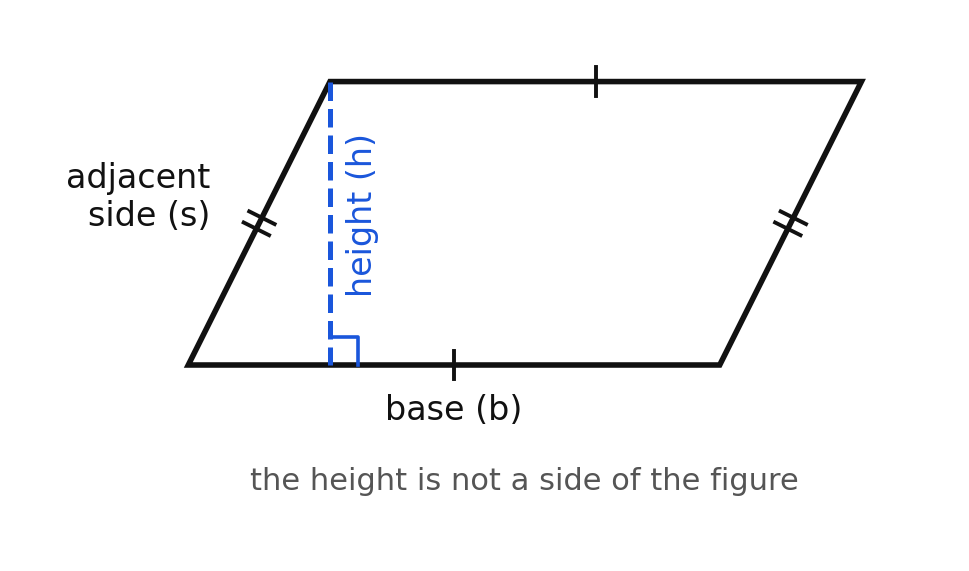
A parallelogram is a quadrilateral — a four-sided polygon — whose opposite sides are parallel. Parallel sides are sides that stay the same distance apart and never meet. An important property follows from that definition, and it saves you work:
In a parallelogram, opposite sides are congruent. Congruent means equal in length.
So a parallelogram has only two different side lengths, no matter how slanted it looks. Call one of them the base, written , and call a side next to it the adjacent side, written . Then
Rectangles and squares are parallelograms too
A rectangle is a parallelogram whose angles are all right angles, and a square is a rectangle whose four sides are congruent. Everything in this chapter applies to them. A square with side 5 in has perimeter in, which is the same as .
The measurement you do not use
Look again at the figure above. The dashed segment marked is the height of the parallelogram, and it is not one of the sides. It never appears in a perimeter calculation. You will need it constantly starting in Lesson 13.2, but for perimeter you use only the lengths of the edges you would walk along.
This is the single most common error in this chapter, and it is worth stating plainly now:
The height is not a side. A parallelogram's slanted side and its height are two different measurements with two different lengths. Perimeter uses the side. Area uses the height.
Working backward from a perimeter
If you know the perimeter and one side of a parallelogram, you can find the other. Suppose the perimeter is 60 ft and the base is 18 ft:
Half of 60 is 30, so , which gives ft. Check: ft. Every backward problem in this chapter deserves a check like that one.
Worked examples
Example 1 — Perimeter of a triangle
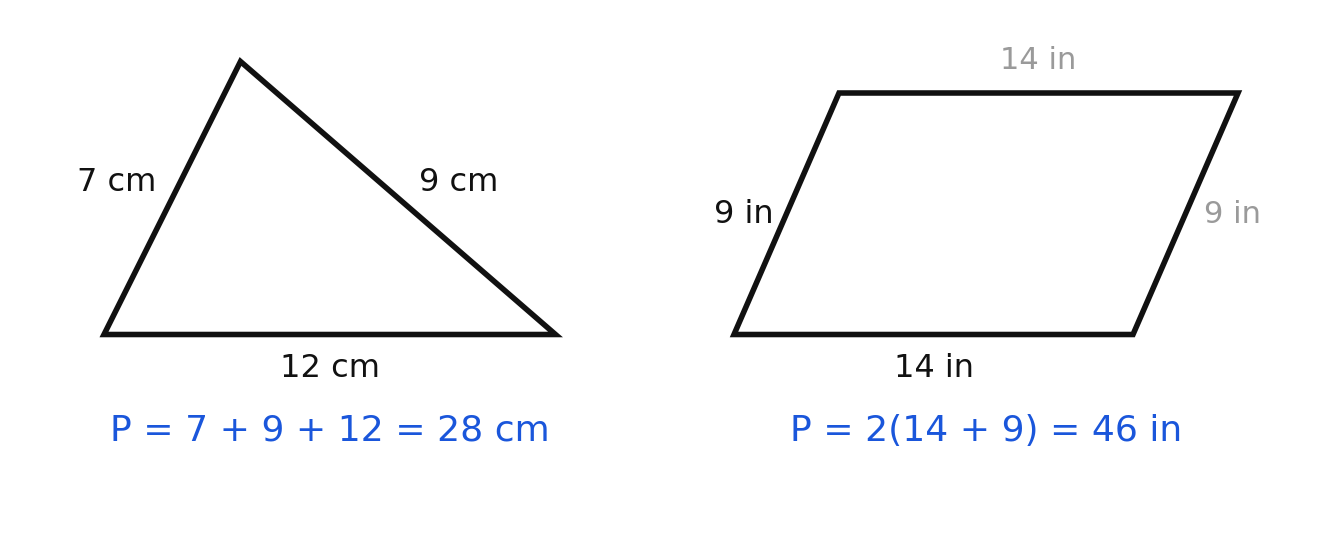
A triangle has sides 7 cm, 9 cm, and 12 cm. Find its perimeter.
Add the three side lengths.
Answer: cm
Example 2 — Perimeter of a parallelogram
A parallelogram has a base of 14 in and an adjacent side of 9 in. Find its perimeter.
Opposite sides are congruent, so there are two sides of each length.
Answer: in
Example 3 — An equilateral triangle
An equilateral triangle has all three sides congruent. Find the perimeter of one whose side is 6.5 m.
Answer: m
Example 4 — Working backward
A parallelogram has a perimeter of 60 ft and a base of 18 ft. Find the length of the adjacent side.
Check: ft.
Answer: ft
Example 5 — Perimeter in context
A triangular garden has sides of 15 ft, 20 ft, and 25 ft. Fencing costs $3 per foot. What is the cost to fence the garden completely?
First the perimeter, then the cost.
Answer: $180
Guided practice
- Find the perimeter of a triangle with sides 5 in, 8 in, and 11 in.
- Find the perimeter of a parallelogram with base 10 cm and adjacent side 4 cm.
- Find the perimeter of an equilateral triangle with side 9 ft.
- A parallelogram has all four sides 13 m long. Find its perimeter.
- Explain why the height of a parallelogram is never part of its perimeter.
Independent practice
- Find each triangle's perimeter: a) 6 cm, 6 cm, 9 cm b) 12.5 m, 9 m, 10.5 m c) 15 in, 20 in, 25 in
- Find each parallelogram's perimeter: a) base 7 ft, side 5 ft b) base 20 cm, side 11 cm c) base 6.5 m, side 3.5 m
- A parallelogram has a perimeter of 48 in and a base of 15 in. Find the adjacent side.
- A triangle has a perimeter of 31 cm. Two of its sides measure 9 cm and 12 cm. Find the third side.
- A parallelogram has base 9 m, height 4 m, and adjacent side 5 m. Find its perimeter and name the measurement you did not use.
- Application. A triangular dog run has sides of 18 ft, 24 ft, and 30 ft. The owner will fence the whole outside except for a 3-ft gate opening. Fencing costs $4 per foot. Find the perimeter, the length that must be fenced, and the total cost.
- Reasoning. Two parallelograms both have a base of 10 cm. One has an adjacent side of 6 cm and the other has an adjacent side of 8 cm. Do they have the same perimeter? Compute both and explain.
Exit ticket 13.1
- Find the perimeter of a triangle with sides 7 m, 10 m, and 13 m.
- Find the perimeter of a parallelogram with base 11 in and adjacent side 6 in.
- A parallelogram has a perimeter of 40 ft and a base of 12 ft. Find the adjacent side.
- Explain why you never need the height to find a perimeter.
Lesson 13.2 — Developing the Area Formula for Parallelograms
Start with what area means
The area of a figure is the amount of flat surface it covers, measured in square units — square inches, square centimeters, square feet. One square unit is a square whose sides are each one unit long.
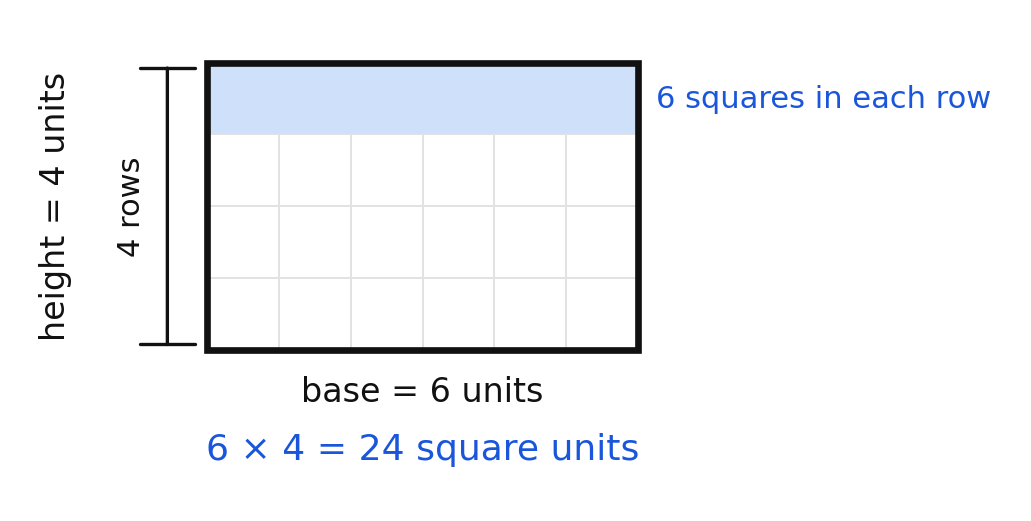
On grid paper you can find an area by counting. A rectangle 6 units wide and 4 units tall holds 6 squares in each row and 4 rows of them, so it holds squares. That is where the rectangle formula comes from — it is organized counting, not a rule handed down:
Cut and slide
Now take a parallelogram that is not a rectangle. Counting whole squares no longer works, because the slanted sides cut some squares into pieces. So we change the shape instead of changing the counting.
Here is the move, and it is worth doing with scissors and grid paper at least once:
- Draw the parallelogram on grid paper. Draw its height — a segment from one side straight across to the opposite side, perpendicular to the base. It cuts a right triangle off one end.
- Cut along that height. You now have a right triangle and a smaller piece.
- Slide the triangle over to the other end and fit it against the matching slanted edge.
What you get is a rectangle. And here is the point of the whole exercise: the rectangle has the same base and the same height as the parallelogram you started with. You never added or removed any material — you only moved a piece — so the area did not change.
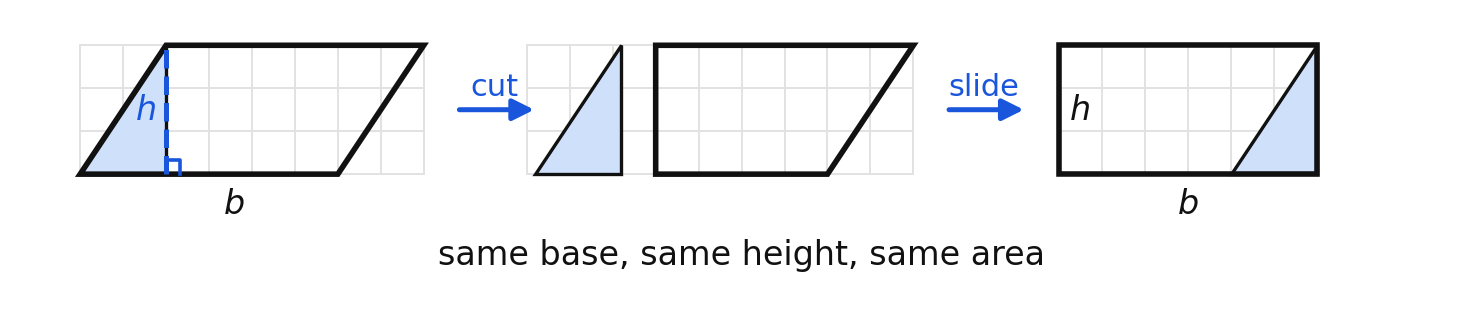
Since the rectangle's area is , the parallelogram's area is too:
What the height really is
The height of a parallelogram is the perpendicular distance between the base and the side opposite it. Two words in that sentence are doing all the work.
- Perpendicular means it meets the base at a right angle. In a diagram, look for the small square mark.
- Distance between the base and the opposite side means it is a measurement across the inside of the figure, not along an edge.
The slanted side is not the height. It is longer than the height, always. To see why, notice that the height, the slanted side, and a piece of the base form a right triangle in which the slanted side is the longest edge. The height is the shortest path from one side to the other, and a slanted path cannot be shorter than the straight-across one.
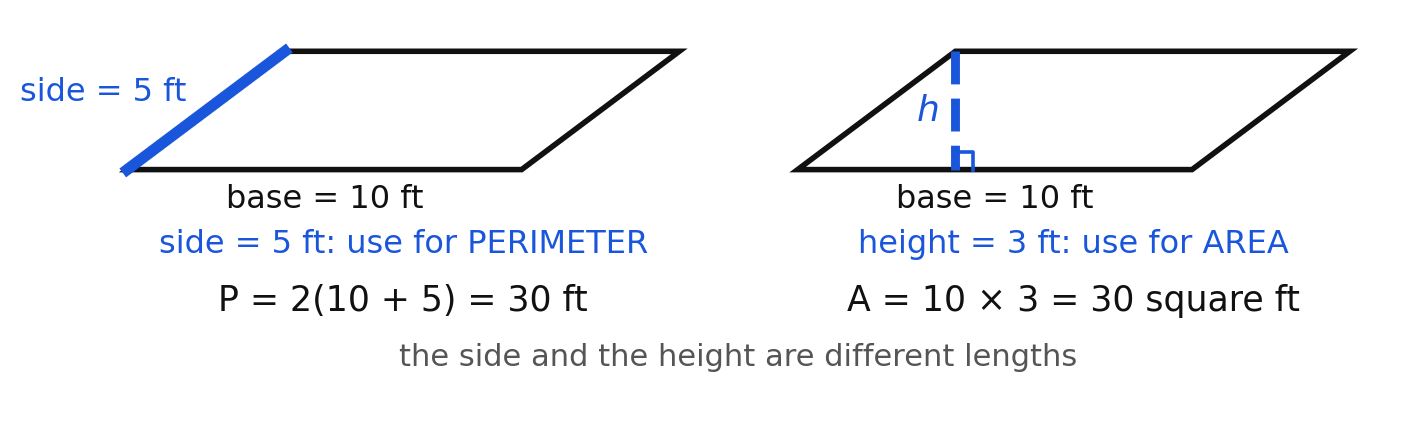
Why this matters so much. Every parallelogram diagram you meet will show you at least three numbers: a base, an adjacent side, and a height. Only two of them go into any one formula. If you multiply the base by the slanted side, you get a number that is too big and means nothing.
Which pair goes together
A parallelogram has two possible bases — either pair of parallel sides can play that role — and each base has its own height. What you may never do is pair a base with the height that belongs to the other base. In this chapter, diagrams will always show you a base and its matching height together.
Working backward
Because , knowing the area and one of the two measurements gives you the third. If m² and m, then , so m. Check: m².
Worked examples
Example 1 — Area from base and height
A parallelogram has base 8 cm and height 5 cm. Find its area.
Answer: cm²
Example 2 — Choosing the right two numbers
A parallelogram has base 12 in, height 7 in, and adjacent side 9 in. Find its area.
Area uses the base and the perpendicular height. The 9 in side is not the height, so it is not used here.
Answer: in²
Example 3 — Counting on grid paper
On grid paper, a parallelogram sits on a base 6 units long, and its height measures 4 units. Find its area in square units, and explain what the cut-and-slide move produces.
Cutting along the height and sliding the right triangle to the other end makes a rectangle 6 units by 4 units.
Answer: square units
Example 4 — Working backward for a height
A parallelogram has an area of 54 m² and a base of 9 m. Find its height.
Check: m².
Answer: m
Example 5 — Finding and fixing the classic error
A parallelogram has base 10 ft, height 3 ft, and adjacent side 5 ft. A student computed ft². Explain the error and give the correct area.
The student multiplied the base by the slanted side. Area needs the perpendicular height, which is 3 ft.
Answer: The correct area is ft². The 5 ft measurement belongs in a perimeter calculation, not an area one.
Guided practice
- Find the area of a parallelogram with base 7 cm and height 3 cm.
- Find the area of a parallelogram with base 15 in and height 8 in.
- A parallelogram has base 9 m, height 4 m, and adjacent side 6 m. Find its area and name the measurement you did not use.
- A parallelogram has area 40 ft² and base 8 ft. Find its height.
- Explain why cutting a right triangle off one end of a parallelogram and sliding it to the other end does not change the area.
Independent practice
- Find each area: a) base 12 cm, height 5 cm b) base 6.5 m, height 4 m c) base 20 in, height 11 in d) base 9 ft, height 9 ft
- Find the missing measurement: a) cm², base 8 cm, find the height b) m², height 6 m, find the base
- A parallelogram on grid paper has a base of 5 units and a height of 3 units. Find its area and describe how the cut-and-slide move lets you count whole squares.
- Two parallelograms each have base 10 cm and height 4 cm, but their slanted sides have different lengths. Do they have the same area? Do they have the same perimeter? Explain both answers.
- Explain why a parallelogram's slanted side is always longer than its height.
- Application. A parking space is shaped like a parallelogram with base 9 ft and height 18 ft. A sealer covers 50 ft² per bottle. Find the area of the space and the number of whole bottles needed to seal it.
- Reasoning. A parallelogram has base 10 ft, height 3 ft, and adjacent side 5 ft. Explain why the answer ft² must be wrong even before you compute the correct area, then give the correct area.
Exit ticket 13.2
- Find the area of a parallelogram with base 14 in and height 6 in.
- A parallelogram has area 63 m² and base 7 m. Find its height.
- A diagram shows a parallelogram with a slanted side of 8 cm and a dashed segment of 5 cm meeting the base at a right angle. Which one is the height?
- Explain how rearranging a parallelogram into a rectangle shows that .
Lesson 13.3 — Developing the Area Formula for Triangles
Two triangles make a parallelogram
The parallelogram formula gives us the triangle formula almost for free, using one construction.
Take any triangle and make an exact copy of it. Congruent figures are figures with the same shape and size, so the copy is congruent to the original. Now rotate the copy a half turn and fit it against the original along one of the sides.
The two triangles together form a parallelogram. The parallelogram's base is the triangle's base, and the parallelogram's height is the triangle's height.
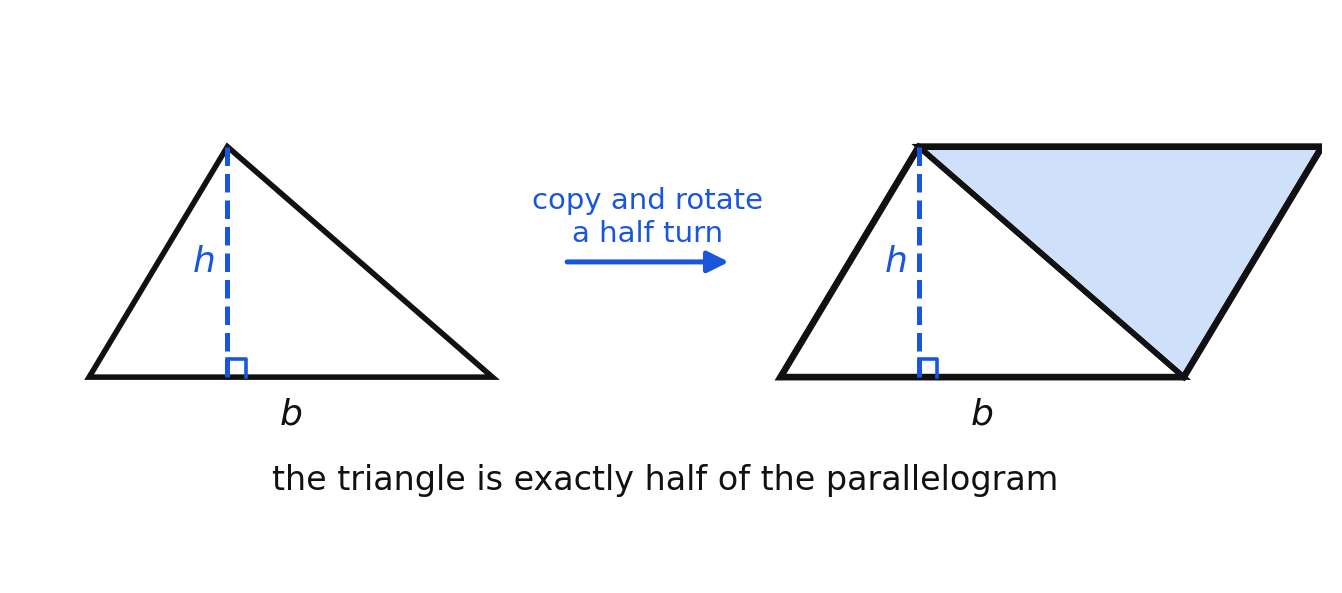
The parallelogram covers square units. The triangle is one of two congruent halves of it, so it covers half that much:
You can write the same formula as . Both say: multiply the base by the height, then take half. Many students find it easiest to multiply the two lengths first and halve at the end, because one of and is often odd.
The height of a triangle
A triangle's height (also called its altitude) is the perpendicular distance from a vertex to the line containing the opposite side. That opposite side is the base you pair it with. Three cases are worth seeing, because they look quite different on the page:
- Acute triangle. The height falls inside the triangle.
- Right triangle. The two legs — the sides that form the right angle — are already perpendicular to each other, so one leg is the base and the other is the height. The hypotenuse, the side opposite the right angle, is the longest side and is never the height.
- Obtuse triangle. For some choices of base, the height falls outside the triangle, and the diagram shows the base extended with a dashed line. The formula does not change.
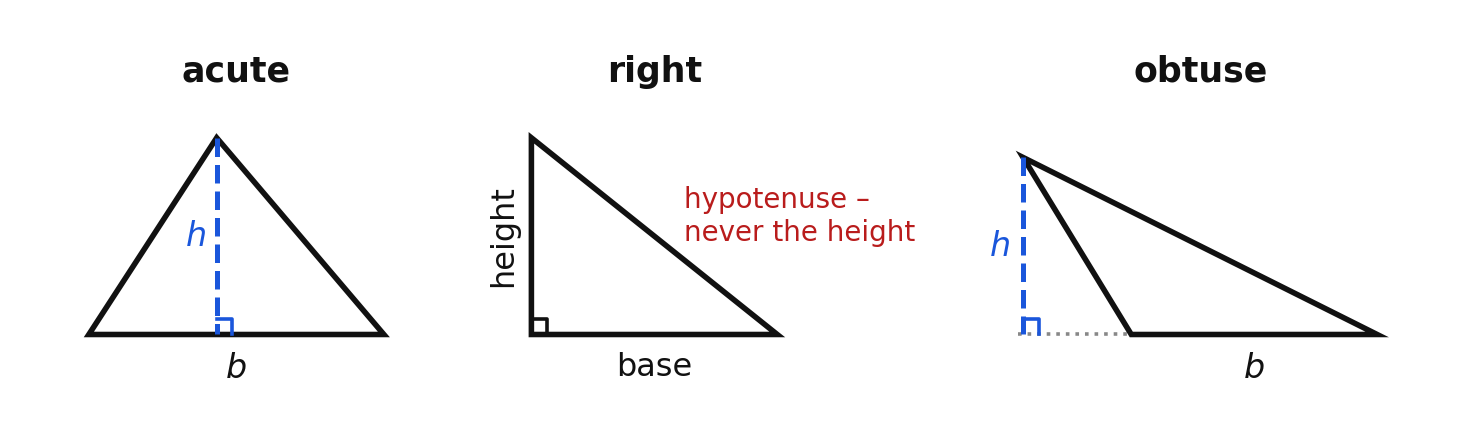
A useful check. Whatever base you choose, the height that goes with it is the one that meets that base (or its extension) at a right angle. If a length in a diagram has no right-angle mark and runs along an edge, it is a side, not a height.
Working backward
If ft² and ft, then , so and ft. A cleaner way to say the same thing: double the area, then divide by the known length. Here and ft. Check: ft².
Worked examples
Example 1 — Area of a triangle
A triangle has base 10 cm and height 6 cm. Find its area.
Answer: cm²
Example 2 — An odd product
A triangle has base 7 in and height 4 in. Find its area.
Multiply first, then halve.
Answer: in²
Example 3 — A right triangle
A right triangle has legs of 9 units and 12 units and a hypotenuse of 15 units. Find its area.
The legs are perpendicular, so use them as base and height. The hypotenuse is not used.
Answer: square units
Example 4 — An obtuse triangle
An obtuse triangle has a base of 8 m, and the height drawn to that base measures 5 m, landing outside the triangle on the extension of the base. Find the area.
The formula is unchanged; only the picture looks different.
Answer: m²
Example 5 — Working backward for a base
A triangle has an area of 36 ft² and a height of 8 ft. Find its base.
Double the area, then divide by the height.
Check: ft².
Answer: ft
Guided practice
- Find the area of a triangle with base 12 cm and height 5 cm.
- Find the area of a triangle with base 9 in and height 4 in.
- A right triangle has legs 6 m and 8 m and a hypotenuse of 10 m. Find its area and name the measurement you did not use.
- A triangle has area 30 ft² and base 10 ft. Find its height.
- Explain where the in the triangle formula comes from.
Independent practice
- Find each area: a) base 16 cm, height 5 cm b) base 7 m, height 6 m c) base 15 in, height 8 in d) base 9 ft, height 4 ft
- Find the missing measurement: a) cm², height 8 cm, find the base b) m², base 10 m, find the height
- An obtuse triangle has base 6 in, and its height to that base is 9 in and falls outside the triangle. Find the area.
- A triangle and a parallelogram both have base 10 cm and height 6 cm. Find both areas and state the relationship between them.
- A right triangle has legs 5 ft and 12 ft and a hypotenuse of 13 ft. Find both its area and its perimeter, and explain why the two answers have the same number but different units.
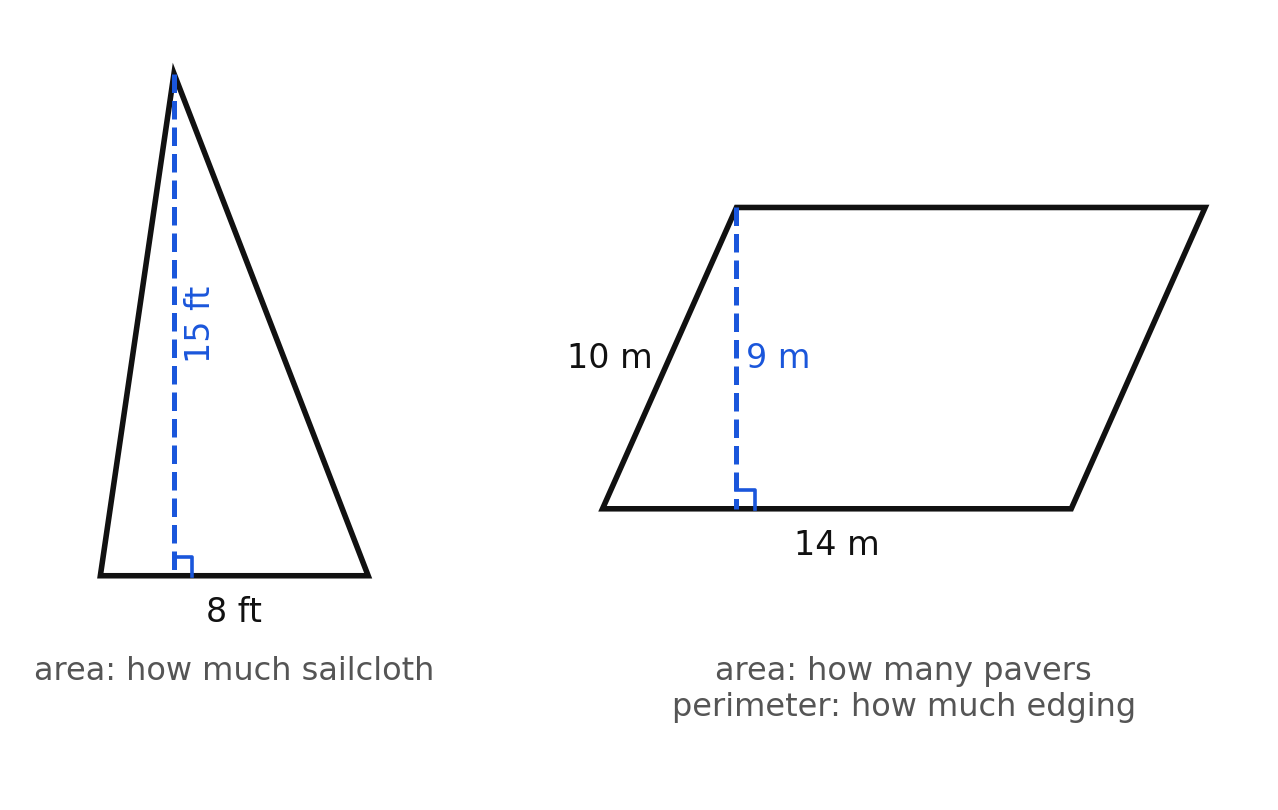
- Application. A triangular sail has a base of 8 ft and a height of 15 ft. Sailcloth costs $9 per square foot. Find the area of the sail and the cost of the cloth.
- Reasoning. For the right triangle with legs 5 ft and 12 ft and hypotenuse 13 ft, a student computed ft². Explain the error and give the correct area.
Exit ticket 13.3
- Find the area of a triangle with base 14 m and height 6 m.
- A triangle has area 54 in² and base 12 in. Find its height.
- A right triangle has legs 3 cm and 8 cm. Find its area.
- Explain why a triangle's area is half the area of a parallelogram with the same base and height.
Lesson 13.4 — Area and Perimeter Problems in Context
Deciding which question you are being asked
Almost every real problem in this chapter comes down to one decision, and it is not a computational one:
| If the situation involves… | You need… | Units |
|---|---|---|
| covering, filling, painting, carpeting, sodding, tiling, buying fabric | area | square units |
| bordering, fencing, framing, trimming, edging, walking around | perimeter | linear units |
Reading for that distinction first will keep you from reaching for the wrong measurement. A useful test: ask whether the answer is about the inside of the shape or its outline.
A reliable order of operations for word problems
- Sketch and label. Even a rough sketch with the given numbers on it prevents most mistakes.
- Decide area or perimeter using the table above.
- Pick out the measurements the formula needs, and set aside the ones it does not. For an area problem, that means finding the perpendicular height and ignoring the slanted side.
- Compute, with units attached.
- Answer the question that was asked. If the problem wants a number of paint cans, an area in square feet is not yet an answer.
Step 5 often needs one more step of reasoning. If a panel is 96 ft² and one can covers 80 ft², then cans. You cannot buy 1.2 cans, and 1 can is not enough, so you buy 2. When materials come in whole packages, round up, no matter what the decimal is.
Worked examples
Example 1 — A triangular garden
A triangular garden has a base of 10 ft and a height of 6 ft. One bag of soil covers 10 ft². How many whole bags are needed?
Covering the inside means area.
Answer: bags
Example 2 — A parallelogram patio
A patio is shaped like a parallelogram with base 14 m, height 9 m, and adjacent side 10 m. Find the area to be paved and the length of edging needed to border it.
Paving is area; edging is perimeter.
Answer: m² of paving and m of edging
Example 3 — Working backward in context
A triangular sail has an area of 84 ft² and a base of 12 ft. Find its height.
Double the area, then divide by the base.
Check: ft².
Answer: ft
Example 4 — Rounding up for materials
A wall panel is a parallelogram with base 12 ft and height 8 ft. One can of paint covers 80 ft² and costs $22. Find the area, the number of cans needed, and the cost.
One can leaves 16 ft² unpainted, so two cans are needed.
Answer: ft²; cans; $44
Example 5 — Comparing two options
A club will make one triangular banner. Design A has base 9 in and height 8 in. Design B has base 12 in and height 6 in. Which design uses less fabric?
Answer: Neither. Both designs use in² of fabric, even though their shapes differ.
Guided practice
- A triangular garden has base 10 ft and height 6 ft. One bag of soil covers 10 ft². Find the area and the number of bags.
- A rug is a parallelogram with base 8 ft and height 5 ft. Find its area.
- A parallelogram sign has base 24 in and adjacent side 15 in. Find the length of trim needed to border it.
- A triangular flag has base 18 in and height 12 in. Find its area.
- A gardener wants to put edging around a flower bed. Does the gardener need area or perimeter? Explain.
Independent practice
- A patio is a parallelogram with base 14 m, height 9 m, and adjacent side 10 m. Find its area and its perimeter.
- A triangular banner has base 4 ft and height 3 ft. Find the area of one banner and the total area of 5 banners.
- A triangular sail has an area of 84 ft² and a base of 12 ft. Find its height.
- A field is a parallelogram with base 60 yd, height 40 yd, and adjacent side 45 yd. Find the area of the field and the length of fencing needed to enclose it.
- Triangle A has base 9 in and height 8 in. Triangle B has base 12 in and height 6 in. Find both areas and compare them.
- Application. A wall panel is a parallelogram with base 12 ft and height 8 ft. One can of paint covers 80 ft² and costs $22. Find the area, the number of whole cans needed, and the total cost. Explain why you rounded the way you did.
- Reasoning. A club is making a parallelogram banner with base 5 ft, height 3 ft, and adjacent side 3.5 ft. They need fabric for the surface and ribbon for the border. Find the amount of each, and explain why the height is used for one and not for the other.
Exit ticket 13.4
- A triangular tabletop has base 6 ft and height 4 ft. Find its area.
- A parallelogram garden has base 11 m and adjacent side 7 m. Find the perimeter.
- A parallelogram has an area of 84 in² and a base of 12 in. Find its height.
- Explain how you decide whether a problem is asking for area or perimeter.
Chapter 13 Review
Vocabulary. perimeter · polygon · vertex · triangle · parallelogram · congruent · base · adjacent side · height · area · square units · linear units · equilateral triangle · rectangle · square · hypotenuse
Part A — Developing the area formulas (6.MG.2a)
- Describe how cutting a right triangle off one end of a parallelogram and sliding it to the other end shows that . State what stays the same during the move.
- Explain how two congruent triangles joined along a side show that a triangle's area is .
- On grid paper, a parallelogram has a base of 7 units and a height of 4 units. Find its area in square units and explain how the cut-and-slide move makes the squares countable.
- A parallelogram diagram shows a base of 10 cm, a slanted side of 8 cm, and a dashed segment of 6 cm that meets the base at a right angle. Identify the height and find the area.
Part B — Perimeter (6.MG.2b)
- Find the perimeter of a triangle with sides 13 in, 14 in, and 15 in.
- Find the perimeter of a parallelogram with base 16 cm and adjacent side 9 cm.
- A parallelogram has a perimeter of 54 ft and a base of 20 ft. Find the adjacent side.
- A triangle has a perimeter of 40 m and two sides measuring 12 m and 15 m. Find the third side.
Part C — Area (6.MG.2b)
- Find the area of a parallelogram with base 18 m and height 7 m.
- Find the area of a triangle with base 20 cm and height 9 cm.
- A parallelogram has an area of 96 in² and a height of 8 in. Find its base.
- A triangle has an area of 45 ft² and a base of 15 ft. Find its height.
Part D — Problems in context (6.MG.2b)
- A triangular flower bed has base 12 ft and height 7 ft. One bag of mulch covers 15 ft². Find the area and the number of whole bags needed.
- A deck is a parallelogram with base 20 ft, height 12 ft, and adjacent side 13 ft. Find the area of the decking and the length of railing needed to go all the way around.
- A triangular sail has base 9 ft and height 16 ft. Sailcloth costs $12 per square foot. Find the area and the total cost.
- A parallelogram sign has base 10 m and height 6 m. A triangular sign has base 15 m and height 8 m. Find both areas and state which sign has more surface to paint, or whether the two are equal.
Part E — Reasoning
- Explain why a parallelogram's slanted side cannot be used in place of the height when finding area.
- Can two parallelograms have the same base and the same height but different perimeters? Explain, and give measurements that support your answer.
- A triangle and a parallelogram have the same base and the same height. Describe the relationship between their areas and explain why it holds.
- Explain why area is reported in square units while perimeter is reported in linear units.
Standards coverage check — Chapter 13
| Knowledge and Skill | Where it is taught | Where it is practiced |
|---|---|---|
| 6.MG.2a — develop the area formula for parallelograms using pictorial representations and concrete manipulatives (two-dimensional diagrams, grid paper) | 13.2 | 13.2 items 3, 5, 8, 10, 12; Review Part A items 1, 3, 4; Review Part E item 17 |
| 6.MG.2a — develop the area formula for triangles using pictorial representations and concrete manipulatives | 13.3 | 13.3 items 5, 9; Review Part A item 2; Review Part E item 19 |
| 6.MG.2b — solve problems, including those in context, involving the perimeter of triangles and parallelograms | 13.1, 13.4 | 13.1 all sets; 13.4 items 3, 6, 9, 12; Review Part B; Review Part D item 14 |
| 6.MG.2b — solve problems, including those in context, involving the area of triangles and parallelograms | 13.2, 13.3, 13.4 | 13.2 all sets; 13.3 all sets; 13.4 all sets; Review Part C; Review Part D |
Answer keys for every set in this chapter are in Appendix A.