Chapter 12 — Inequalities in One Variable
Standard: 6.PFA.4 — The student will represent a contextual situation using a linear inequality in one variable with symbols and graphs on a number line.
By the end of this chapter you will be able to:
- Given the graph of a linear inequality in one variable on a number line, represent the inequality in two equivalent ways (e.g., or ) using symbols. Symbols include , , , (6.PFA.4a)
- Write a linear inequality in one variable to represent a given constraint or condition in context or given a graph on a number line (6.PFA.4b)
- Given a linear inequality in one variable, create a corresponding contextual situation or create a number line graph (6.PFA.4c)
- Use substitution or a number line graph to justify whether a given number in a specified set makes a linear inequality in one variable true (6.PFA.4d)
- Identify a numerical value(s) that is part of the solution set of a given inequality in one variable (6.PFA.4e)
Lessons: 12.1 What an Inequality Says · 12.2 The Four Inequality Symbols · 12.3 Graphing Inequalities on a Number Line · 12.4 Writing an Inequality Two Equivalent Ways · 12.5 Testing Values and Describing Solution Sets
A note on what this chapter asks of you. In Chapter 11 an equation had one answer, and your job was to find it. Here your job is different. An inequality usually has many answers, and this chapter is about representing them — in words, in symbols, and on a number line — and checking whether a particular number belongs. You will not be solving multi-step inequalities.
Lesson 12.1 — What an Inequality Says
Some conditions are not equalities
An equation states that two quantities are exactly the same. But a great deal of real life is not exact. A sign says you must be at least 48 inches tall to ride. A bridge posts a limit of 5 tons. A club needs fewer than 20 members to keep meeting in the small room. None of these names one number. Each one names a range of acceptable numbers.
An inequality is a mathematical statement that compares two quantities that are not necessarily equal. Like an equation, it can contain a variable — a letter that stands for an unknown or changing quantity.
Read the first one as " is greater than or equal to 48." It is the height sign written in symbols.
Solutions and the solution set
A solution of an inequality is any value of the variable that makes the statement true. Because an inequality describes a range, it normally has many solutions. All of them together form the solution set.
Consider . The value is a solution, because is true. So are , , , and . The value is not a solution, because is false. The solution set is every number 48 or greater.
A short vocabulary check. An equation like has one solution. An inequality like has infinitely many. That difference is not a flaw in the inequality — it is exactly the information the height sign is trying to give you.
Constraints in context
A constraint is a limit or condition that a real quantity has to satisfy. Writing an inequality from a constraint is mostly a matter of translating carefully, and English gives us several phrases for the same idea.
| Phrase in words | Meaning | Symbol |
|---|---|---|
| is more than, is greater than, exceeds | strictly above | |
| is less than, is fewer than, is under | strictly below | |
| is at least, is no less than, is a minimum of | at the value or above | |
| is at most, is no more than, is a maximum of, cannot exceed | at the value or below |
The four phrases in the bottom two rows all include the number itself. The phrases in the top two rows do not. That single distinction — is the boundary number included? — will come back in every lesson of this chapter, so it is worth naming now. We will call the number the inequality is compared to the boundary value.
Choosing and naming the variable
Before you write symbols, say in words what the variable stands for, including its units. "Let be the cost in dollars" is a complete definition. Just "let be the cost" leaves a reader guessing between dollars and cents.
Worked examples
Example 1 — From a sign to symbols
A ride requires that you be at least 48 inches tall. Write an inequality.
Let be a rider's height in inches. "At least 48" means 48 is allowed and anything taller is allowed.
Answer:
Example 2 — A maximum
A bridge cannot carry a load of more than 5 tons. Write an inequality.
Let be the load in tons. "Not more than 5" allows 5 and everything below it.
Answer:
Example 3 — A strict limit
A club keeps its small meeting room only if it has fewer than 20 members. Write an inequality, then state whether exactly 20 members is allowed.
Let be the number of members. "Fewer than 20" excludes 20 itself.
Answer: . Exactly 20 members is not allowed, since is false.
Example 4 — From symbols back to words
A store tracks its freezer temperature in degrees Fahrenheit and requires . Describe this requirement in words.
The symbol includes the boundary value .
Answer: The freezer temperature must be 0°F or colder.
Example 5 — Testing a value against a constraint
A parking garage charges a flat fee for cars up to and including 7 feet tall. Write an inequality for the allowed heights, then decide whether a van 7 feet tall qualifies.
Let be the car's height in feet. "Up to and including 7" is . Substituting gives , which is true because of the "or equal to" part.
Answer: ; the van qualifies.
Guided practice
- Write an inequality for each. Define your variable first. a) You must be at least 13 years old to join. b) The backpack weighs less than 20 pounds.
- Is a solution of ? Explain.
- Is a solution of ? Explain.
- Describe the solution set of in words.
- A sign reads "Maximum occupancy 60." Write an inequality using for the number of people.
Independent practice
- Write an inequality for each situation, defining the variable. a) The temperature stayed above 32°F. b) The trip cost no more than $75. c) At least 100 tickets were sold.
- Write each inequality in words: a) b) c)
- Name three numbers that are solutions of and one number that is not.
- Explain the difference between the constraints and using the value .
- A recipe says to bake until the internal temperature is at least 165°F. Write an inequality, then decide whether 165°F is done enough.
- Application. An elevator posts a limit of 2,500 pounds. Write an inequality for the allowed total weight in pounds. Then decide whether a load of exactly 2,500 pounds is permitted, and explain what the sign's wording would have to say for your answer to change.
- Reasoning. Jordan says that and describe the same solution set. Explain why this is false, and give one number that belongs to one solution set but not the other.
Exit ticket 12.1
- Write an inequality: a rider must weigh at most 250 pounds. Use .
- Is a solution of ? Explain.
- Describe the solution set of in words.
- Explain in your own words why an inequality usually has more than one solution.
Lesson 12.2 — The Four Inequality Symbols
The symbols
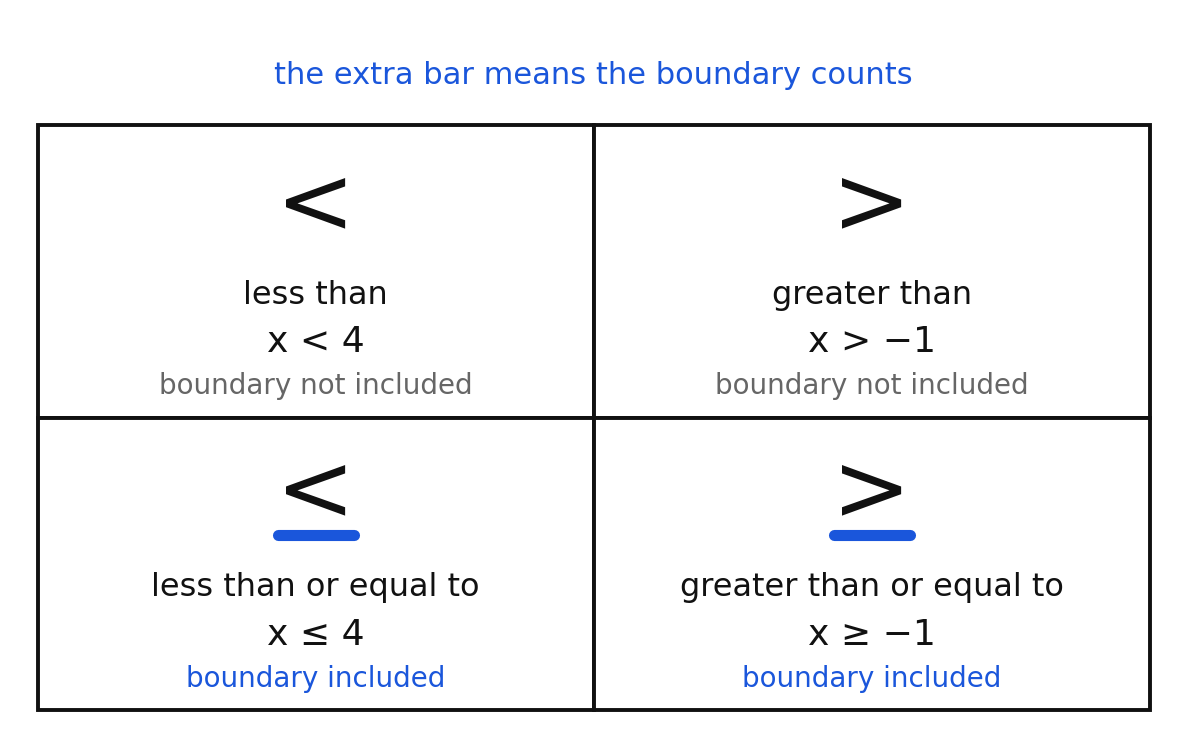
Chapter 1 introduced and for comparing integers. This chapter adds two more.
| Symbol | Meaning | Example | Read as | Boundary included? |
|---|---|---|---|---|
| is less than | is less than four | no | ||
| is greater than | is greater than negative one | no | ||
| is less than or equal to | is less than or equal to four | yes | ||
| is greater than or equal to | is greater than or equal to negative one | yes |
The extra bar underneath or is doing all the work in the last two rows. It adds the single case where the two sides are equal. So is a shorthand for "either or ."
Strict and inclusive
Mathematicians call and strict inequalities, because they leave the boundary value out. They call and inclusive inequalities, because they take the boundary value in. Keeping those two words handy will make the next lesson's open and closed circles feel like a natural consequence rather than a rule to memorize.
Which symbol does this phrase need?
Two questions, asked in order, settle every translation:
- Which direction? Does the quantity have to be above the boundary or below it?
- Is the boundary itself allowed? If yes, use the symbol with the bar.
Take "a package can weigh no more than 70 pounds." Direction: below. Boundary allowed? Yes — a 70-pound package ships. So .
Now take "a package must weigh under 70 pounds." Direction: below. Boundary allowed? No. So .
Watch the words no more than. They sound like a refusal, and students often reach for . But "no more than 70" means 70 is the largest acceptable value, so 70 is acceptable: . The same is true of "no fewer than 70," which means .
The pointed end still faces the lesser number
The reading rule from Chapter 1 has not changed. In and , and in and as well, the open end faces the greater quantity and the point faces the lesser one. In , the open end faces , so is the greater side.
Worked examples
Example 1 — Choosing between and
A checked bag must weigh no more than 50 pounds. Write an inequality.
Direction is below; the boundary 50 is allowed.
Answer: , where is the bag's weight in pounds
Example 2 — Choosing between and
To pass, a score must be more than 70 points. Write an inequality.
Direction is above; "more than" excludes 70.
Answer: , where is the score in points
Example 3 — Reading an inequality aloud
Read aloud and name the boundary value. Is the boundary in the solution set?
The bar makes it inclusive.
Answer: " is greater than or equal to negative four." The boundary value is , and it is in the solution set.
Example 4 — Two constraints, two symbols
A greenhouse must stay at or above 55°F and strictly below 90°F. Write one inequality for each condition.
The first is inclusive, the second strict.
Answer: and , where is the temperature in degrees Fahrenheit
Example 5 — Repairing a translation
A student wrote for "the team needs at least 12 players." Identify both errors and write the correct inequality.
"At least" means the boundary is included, and it points upward, not downward. Both the direction and the inclusiveness are wrong.
Answer:
Guided practice
- Read each aloud, then say whether the boundary value is in the solution set: a) b)
- Choose the symbol: the speed must be no more than 55 mph.
- Choose the symbol: there must be at least 4 volunteers.
- Choose the symbol: the balance stayed above $0.
- Name the two strict symbols and the two inclusive symbols.
Independent practice
- Fill in , , , or for each condition. a) fewer than 8 guests: b) a minimum of 15 points: c) a maximum of 3 pets: d) deeper than 20 feet below sea level:
- Write each in words: a) b) c)
- For each inequality, name the boundary value and say whether it is a solution: a) b) c)
- Write two different inequalities about the same boundary value 30, one strict and one inclusive, and explain how their solution sets differ.
- A sign reads "Children under 5 enter free." Write an inequality for the ages that enter free, using , and explain why you chose a strict symbol.
- Application. A food bank asks each volunteer to pack no fewer than 25 boxes per shift and posts a safety rule that no one may lift more than 40 pounds at a time. Write an inequality for each rule, defining each variable. Then explain why both rules include their boundary values, and rewrite the lifting rule in words so that 40 pounds would no longer be allowed.
- Reasoning. Explain why and " or " describe exactly the same solution set. Then explain why alone does not.
Exit ticket 12.2
- Fill in the symbol: the room holds at most 40 people.
- Read aloud in words.
- Which of , , , include the boundary value?
- Explain why "no more than 12" is written and not .
Lesson 12.3 — Graphing Inequalities on a Number Line
Why a graph helps
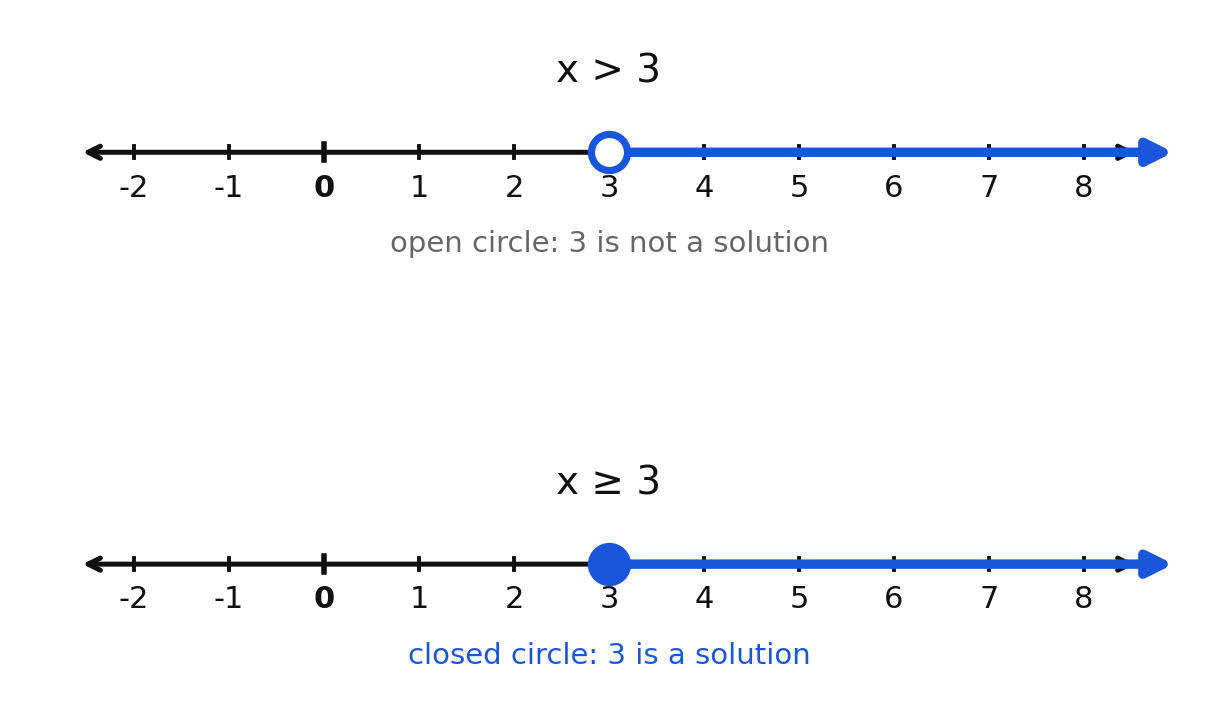
A solution set like "every number 48 or greater" is hard to hold in your head and impossible to list. A number line graph shows the whole set at once. Two marks carry all the information:
- A circle at the boundary value, either open or closed, saying whether that one number belongs.
- An arrow shading every number in the accepted direction.
An open circle is hollow and means the boundary value is not a solution. Use it with the strict symbols and . A closed circle is filled in and means the boundary value is a solution. Use it with the inclusive symbols and .
A three-step procedure
- Find the boundary value and locate it on the number line.
- Draw the circle — open for or , closed for or .
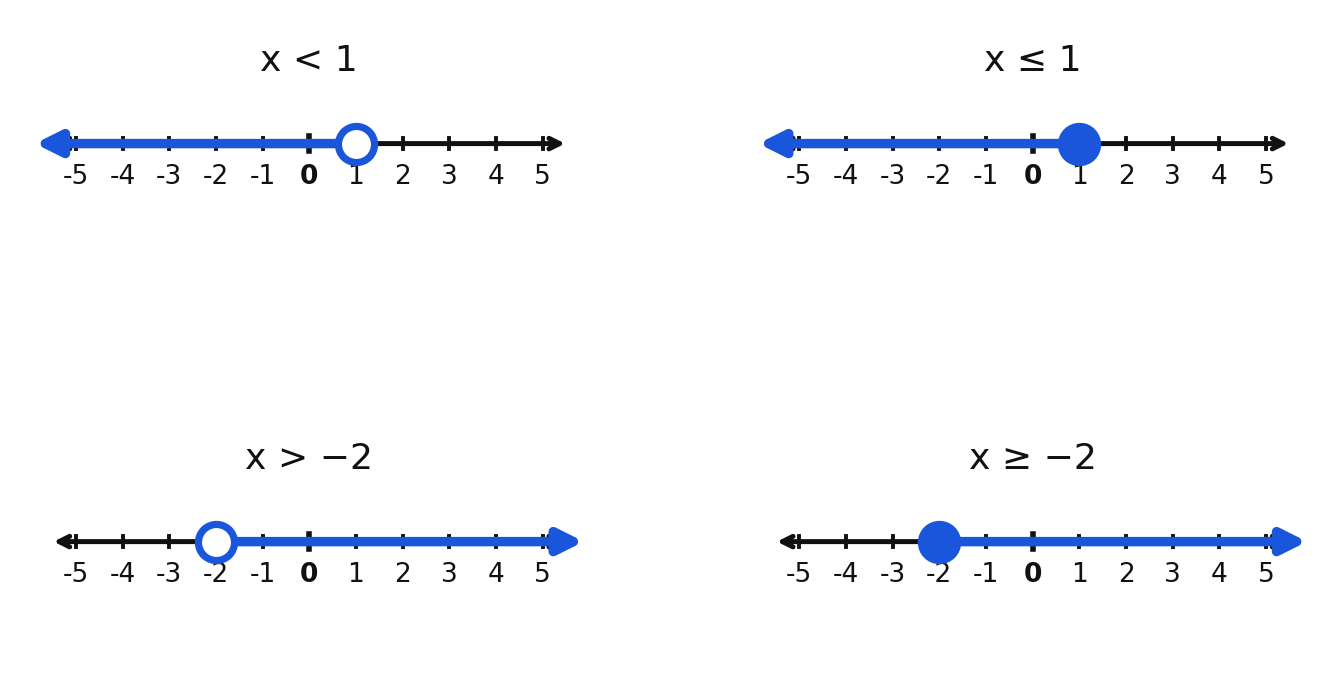
- Shade the direction — toward the greater numbers for and , toward the lesser numbers for and . End the shading with an arrowhead, because the solution set continues forever.
Step 3 has a trap, and it is the reason the next lesson exists. When the variable is written first, as in , the symbol points the same way you shade: shade right. But if the inequality is written , the symbol appears to point left while the correct shading is still right. The safe habit is to read the sentence, not to copy the symbol's shape: "three is less than " means is bigger than three, so shade right.
Reading a graph back into symbols
Going the other direction uses the same two clues in reverse. The circle's location gives the boundary value. Whether it is open or closed picks strict or inclusive. The shading direction picks greater or less.
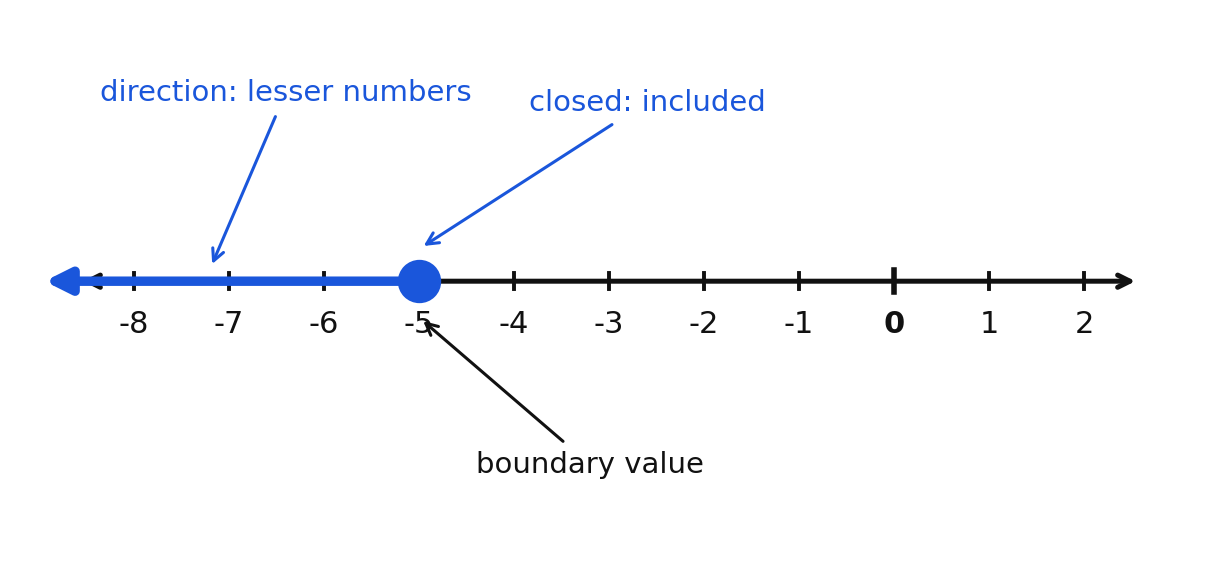
The graph in that figure has a closed circle at and shades left, so it says: is or less, which is .
Creating a graph or a context from an inequality
The standard also asks you to go from an inequality to a situation. A good invented context does three things: it names a quantity that makes sense as the variable, it uses a phrase that matches the symbol exactly, and it uses the right boundary value. For , "I have $20 to spend, so the cost in dollars can be at most $20" works. "The cost is under $20" does not, because it changes into .
Worked examples
Example 1 — Graphing a strict inequality
Graph .
The boundary is . The symbol is strict, so the circle is open. Greater numbers lie to the right.
Answer: Open circle at , shaded right with an arrowhead.
Example 2 — Graphing an inclusive inequality
Graph .
The boundary is . The symbol is inclusive, so the circle is closed. Lesser numbers lie to the left.
Answer: Closed circle at , shaded left with an arrowhead.
Example 3 — Reading a graph
A graph has an open circle at and shading to the right. Write the inequality with the variable first.
Open circle means strict. Shading right means greater.
Answer:
Example 4 — Graphing from a context
A ride requires riders to be at least 48 inches tall. Write the inequality and describe its graph.
"At least 48" is : inclusive, upward.
Answer: ; closed circle at , shaded right with an arrowhead.
Example 5 — Inventing a context for a graph
A graph has a closed circle at and shading to the left. Write the inequality and create a matching situation.
Closed circle means inclusive; shading left means less than or equal to.
Answer: . Situation: a highway has a speed limit of 65 mph, so a legal speed in miles per hour must satisfy .
Guided practice
- Describe the graph of : open or closed circle, at what value, shaded which way?
- Describe the graph of .
- A graph has a closed circle at and shades left. Write the inequality.
- A graph has an open circle at and shades right. Write the inequality.
- Why does every graph in this lesson end with an arrowhead instead of a dot?
Independent practice
- Sketch the graph of each: a) b) c) d)
- Write the inequality for each described graph: a) open circle at , shaded left b) closed circle at , shaded right c) closed circle at , shaded left
- Explain the difference between the graphs of and in one sentence.
- Write an inequality and describe its graph for: the tank holds no more than 15 gallons. Use .
- For , create a contextual situation that matches the inequality exactly, and say what the boundary value means in your situation.
- Application. A community pool opens the deep end only to swimmers at least 10 years old. Write an inequality using for age in years, describe its graph, and explain what the closed circle means to a 10-year-old standing at the gate.
- Reasoning. Priya graphs with a closed circle at . Explain what her graph claims that the inequality does not, and name one number that exposes the error.
Exit ticket 12.3
- Describe the graph of .
- A graph has an open circle at and shades right. Write the inequality.
- Which symbols get an open circle?
- Explain how the circle tells a reader whether the boundary value is a solution.
Mid-chapter check (Lessons 12.1–12.3)
- Write an inequality: the team needs at least 9 players. Use .
- Write an inequality: the package weighs less than 4 pounds. Use .
- Name the boundary value of and say whether it is a solution.
- Describe the graph of .
- A graph has a closed circle at and shades left. Write the inequality.
- Is a solution of ? Explain.
- Write in words.
- Create a contextual situation for .
Lesson 12.4 — Writing an Inequality Two Equivalent Ways
The same statement, read from either end
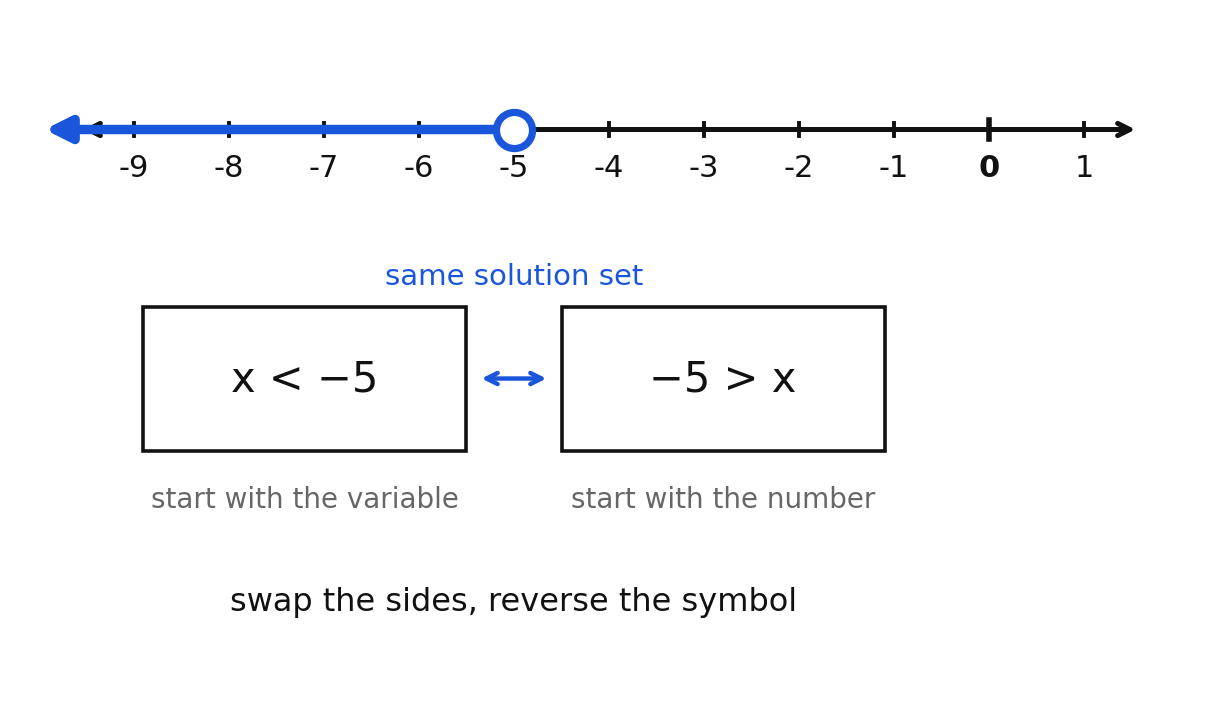
In Chapter 1 you saw that and say the same thing. That flexibility carries over to inequalities with variables, and the SOL asks for it by name: given a graph, you should be able to write the inequality two equivalent ways.
Take the graph with an open circle at shading left. Reading it starting from the variable gives
Reading the very same relationship starting from the number gives
Both sentences describe one fact: sits to the left of . Two equivalent inequalities are inequalities with exactly the same solution set.
The rule for flipping
If you swap the two sides of an inequality, you must reverse the symbol.
The reversal is not an extra rule to memorize; it is what keeps the sentence true. "Five is less than nine" and "nine is greater than five" both report that nine is the larger number. If you swapped the sides without reversing the symbol you would get , which is false.
The four symbols pair up like this:
| Original | Swapped form |
|---|---|
Notice that becomes and becomes . The bar stays; only the direction changes. That makes sense, because swapping sides does not change whether the boundary value is included.
The variable can be on either side
You will see inequalities written both ways in the wild, and neither is more correct. A recipe might say for oven temperature; a thermostat manual might write . When an inequality arrives with the number first, the reliable move is to read it aloud as a sentence and then rewrite it with the variable first before you graph. "Three hundred fifty is less than or equal to " tells you is the bigger side, so : closed circle at , shaded right.
The most common mistake in this lesson is graphing by shading right, because the symbol's open end points right. The symbol points toward the greater quantity, and here the greater quantity is , not . Rewrite first, then graph.
Worked examples
Example 1 — Two ways from a graph
A graph has a closed circle at and shades right. Write the inequality two equivalent ways.
Closed circle and rightward shading give . Swapping sides reverses to .
Answer: and
Example 2 — Two ways from a strict graph
A graph has an open circle at and shades left. Write the inequality two equivalent ways.
Open circle and leftward shading give . Swapping reverses to .
Answer: and
Example 3 — Rewriting with the variable first
Rewrite with the variable first, then describe its graph.
Read it: "twelve is less than ," so is greater than twelve. Swapping reverses to .
Answer: ; open circle at , shaded right.
Example 4 — Rewriting an inclusive inequality
Rewrite with the variable first.
Read it: "negative three is greater than or equal to ," so is at most .
Answer:
Example 5 — Catching an error
Devin rewrites as and says the two are equivalent. Explain the error and give a number that proves it.
Swapping sides requires reversing the symbol, so the correct partner is . The value satisfies but fails , so the two statements have different solution sets.
Answer: The symbol must reverse: pairs with . The value shows the difference.
Guided practice
- Rewrite with the number first.
- Rewrite with the number first.
- Rewrite with the variable first.
- Rewrite with the variable first.
- Why must the symbol reverse when the sides are swapped?
Independent practice
- Write each the other way: a) b) c) d)
- A graph has an open circle at and shades left. Write the inequality two equivalent ways.
- A graph has a closed circle at and shades right. Write the inequality two equivalent ways.
- Rewrite with the variable first, then describe its graph.
- Are and equivalent? Justify your answer by naming a value that satisfies both and a value that satisfies neither.
- Application. A theater's fire code is posted as , where is the number of people inside. Rewrite the inequality with the variable first, state the rule in plain English, and say whether exactly 220 people is allowed.
- Reasoning. Explain why the pair and are equivalent while the pair and are not, using the value and the value in your explanation.
Exit ticket 12.4
- Rewrite with the number first.
- Rewrite with the variable first.
- A graph has an open circle at and shades left. Write the inequality two equivalent ways.
- Explain why swapping the sides of an inequality requires reversing the symbol.
Lesson 12.5 — Testing Values and Describing Solution Sets
Two ways to justify
Deciding whether a number belongs to a solution set is a question you can answer two different ways, and the standard expects both.
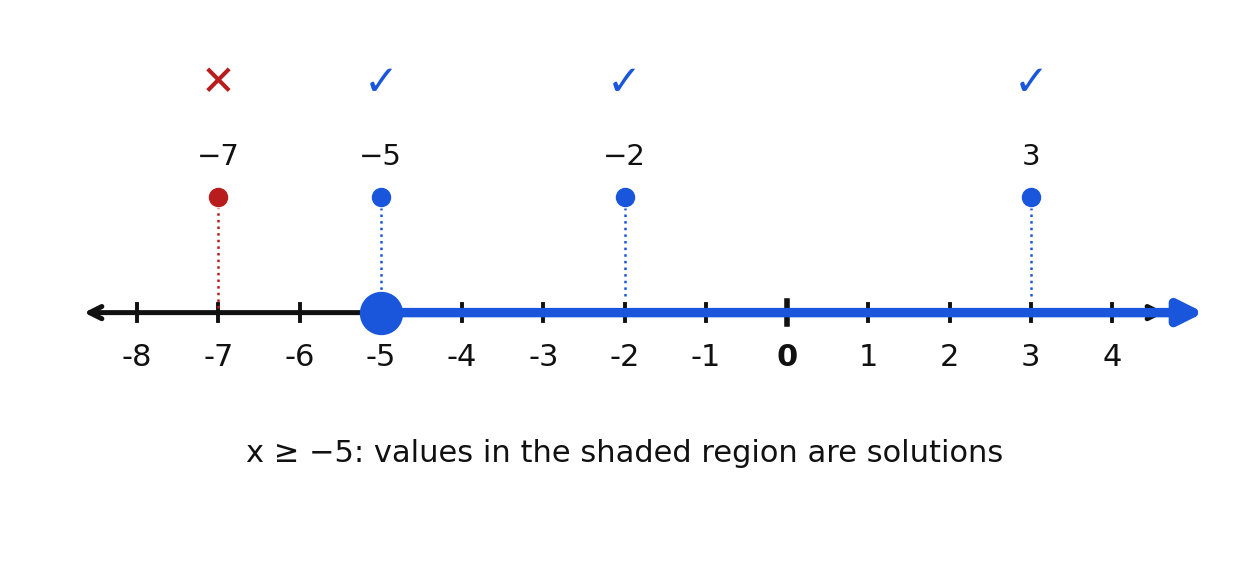
Substitution. Replace the variable with the number, then judge whether the resulting numerical statement is true. Is a solution of ? Substituting gives . Since lies to the right of , that statement is true, so is a solution.
A number line graph. Graph the inequality and see whether the number lands in the shaded region. For , the shading covers and everything to its right, and sits inside that region, so is a solution.
The two methods always agree. Substitution is faster for a single value; the graph is faster when you have several values to check at once, and it is the better choice when you want to see why the boundary behaves the way it does.
Negative boundary values need care
Testing a value in an inequality with a negative boundary is where Chapter 1's left–right rule earns its keep. Is a solution of ? Substituting gives . The digits tempt you to say yes, but sits to the left of , so the statement is false and is not a solution.
Checking a whole set at once
A common task gives you a specified set of values and asks which ones are solutions. Work through the set one value at a time and record the substitution for each. Organizing it in a table keeps you honest about the boundary case.
For and the set :
| Value | Substitution | True? | Solution? |
|---|---|---|---|
| true | yes | ||
| true | yes | ||
| true | yes | ||
| false | no | ||
| false | no |
The solutions from that set are , , and .
Naming values in the solution set
If you are asked to identify a value in the solution set rather than test one, pick a number safely away from the boundary — that avoids any doubt about whether the boundary is included. For , answering is cleaner than answering , which is not a solution at all. If a problem asks for the smallest value in the solution set, then the boundary matters completely: the smallest solution of is , while the smallest integer solution of is .
A useful habit. When a problem asks for the least or greatest value in a solution set, check first whether the problem limits you to integers. The least integer satisfying is . But if any number is allowed, values like and are also solutions, and there is no least one.
Worked examples
Example 1 — Substitution with a positive boundary
Is a solution of ? Justify by substitution.
Substituting gives , which is false because a number is not less than itself.
Answer: No.
Example 2 — Substitution with a negative boundary
Is a solution of ? Justify.
Substituting gives . On a number line lies left of , so it is less, and the statement is false.
Answer: No.
Example 3 — Checking a specified set
Which values in are solutions of ?
Test each: false; false; true; true.
Answer: and
Example 4 — Using a graph to justify
Use a number line graph to decide whether is a solution of .
Graph : closed circle at , shaded left. The point is the closed circle itself, so it is included.
Answer: Yes, is a solution.
Example 5 — Least integer in a solution set
A ride requires a height of more than 50 inches. Write the inequality and name the shortest whole number of inches that qualifies.
"More than 50" is , which excludes 50. The next whole number up is 51, and is true.
Answer: ; 51 inches
Example 6 — Naming values and justifying
Name two values in the solution set of and show a substitution for each.
Pick and : is true because of the "or equal to" part, and is true because lies left of .
Answer: and (many other answers are possible)
Guided practice
- Is a solution of ? Show the substitution.
- Is a solution of ? Show the substitution.
- Which values in are solutions of ?
- Name one value in the solution set of .
- Is a solution of ? Justify with a number line.
Independent practice
- For , test each value and state whether it is a solution: a) b) c) d)
- Which values in are solutions of ?
- Name three values in the solution set of , including one negative value and zero.
- What is the least integer in the solution set of ? Explain.
- What is the greatest integer in the solution set of ? Explain.
- Application. A shipping rule states that a box's longest side must be at most 36 inches. Write an inequality using for the length in inches. Then decide which of the boxes with longest sides in, in, and in may be shipped, showing a substitution for each.
- Reasoning. Malik says is a solution of because 12 is greater than 5. Explain his error using a number line, and name a value that is a solution.
Exit ticket 12.5
- Is a solution of ? Show the substitution.
- Which values in are solutions of ?
- Name one value in the solution set of .
- Explain how a number line graph can be used to justify that a number is not a solution.
Chapter 12 Review
Vocabulary. inequality · variable · solution · solution set · constraint · boundary value · strict inequality · inclusive inequality · open circle · closed circle · equivalent inequalities
Part A — Writing an inequality two equivalent ways from a graph (6.PFA.4a)
- A graph has an open circle at and shades left. Write the inequality two equivalent ways.
- A graph has a closed circle at and shades right. Write the inequality two equivalent ways.
- A graph has a closed circle at and shades left. Write the inequality two equivalent ways.
- Rewrite with the variable first, then describe its graph.
Part B — Writing an inequality from a constraint or a graph (6.PFA.4b)
- Write an inequality for each, defining the variable: a) the elevator holds at most 12 passengers b) the water temperature stayed above 68°F c) at least 40 cans were collected
- A sign reads "Under 48 inches must ride with an adult." Write an inequality for the heights that must ride with an adult.
- A graph has an open circle at and shades right. Write the inequality with the variable first.
- A budget allows spending of no more than $85. Write an inequality using for cost in dollars.
Part C — Creating a graph or a context from an inequality (6.PFA.4c)
- Describe the graph of each: a) b) c)
- Create a contextual situation for and say what the boundary value means in your situation.
- Create a contextual situation for .
- Describe the graph of after rewriting it with the variable first.
Part D — Justifying with substitution or a graph (6.PFA.4d)
- Is a solution of ? Show the substitution.
- Is a solution of ? Justify with a number line.
- Which values in are solutions of ?
Part E — Identifying values in a solution set (6.PFA.4e)
- Name two values in the solution set of .
- Name the least integer in the solution set of .
- Name the greatest integer in the solution set of .
Part F — Mixed application and reasoning
- A pool rule says swimmers must be at least 48 inches tall to use the diving board. Write the inequality, write it the other equivalent way, describe its graph, and decide whether a swimmer exactly 48 inches tall may use the board.
- Two students describe the same graph — a closed circle at shading right. One writes and the other writes . Explain why both are correct.
- Explain the difference between the solution sets of and , naming the one value that separates them.
- A delivery van may carry no more than 1,200 pounds. Write an inequality, name one weight in the solution set and one weight that is not, and justify both with substitutions.
Standards coverage check — Chapter 12
| Knowledge and Skill | Where it is taught | Where it is practiced |
|---|---|---|
| 6.PFA.4a — given a graph on a number line, represent the inequality in two equivalent ways using , , , | 12.2, 12.4 | 12.2 all sets; 12.4 all sets; Review Part A |
| 6.PFA.4b — write an inequality in one variable from a constraint or condition in context or from a graph | 12.1, 12.2, 12.3 | 12.1 all sets; 12.2 all sets; 12.3 items 7, 9, 11; Mid-chapter check; Review Part B |
| 6.PFA.4c — given an inequality, create a contextual situation or a number line graph | 12.3 | 12.3 all sets; 12.4 items 9, 11; Mid-chapter check; Review Part C |
| 6.PFA.4d — use substitution or a number line graph to justify whether a given number makes the inequality true | 12.1, 12.5 | 12.1 items 2, 3, 8, 10; 12.5 all sets; Review Part D |
| 6.PFA.4e — identify numerical values that are part of the solution set | 12.5 | 12.5 items 4, 8, 9, 10; Review Part E |
Answer keys for every set in this chapter are in Appendix A.