Chapter 11 — Writing and Solving One-Step Equations
Standard: 6.PFA.3 — The student will write and solve one-step linear equations in one variable, including contextual problems that require the solution of a one-step linear equation in one variable.
By the end of this chapter you will be able to:
- Identify and develop examples of the algebraic vocabulary equation, variable, expression, term, and coefficient (6.PFA.3a)
- Represent and solve one-step linear equations in one variable using concrete manipulatives and pictorial representations (6.PFA.3b)
- Apply properties of real numbers and properties of equality to solve a one-step equation in one variable (6.PFA.3c)
- Confirm solutions to one-step linear equations using manipulatives and pictorial representations (6.PFA.3d)
- Write a one-step linear equation to represent a verbal situation, including situations in context (6.PFA.3e)
- Create a verbal situation in context given a one-step linear equation (6.PFA.3f)
Lessons: 11.1 The Language of Algebra · 11.2 Modeling Equations with Balance Scales and Algebra Tiles · 11.3 Solving One-Step Equations with Addition and Subtraction · 11.4 Solving One-Step Equations with Multiplication and Division · 11.5 Writing an Equation from a Situation · 11.6 Writing a Situation from an Equation
What "one-step" means. Every equation in this chapter is undone by a single operation. Coefficients are integers or unit fractions such as , and every other number in the equation is an integer.
Lesson 11.1 — The Language of Algebra
Why the words matter
Algebra has a small number of precise words, and mixing them up makes instructions impossible to follow. "Simplify the expression" and "solve the equation" ask for completely different things. This lesson builds the vocabulary you will use for the rest of the chapter — and the rest of your mathematical life.
Variable
A variable is a letter or symbol that stands for a number. In , the letter is a variable.
A variable can stand for an unknown you are trying to find, or for a quantity that changes. Any letter works. Choosing a letter that matches the situation, like for cost or for distance, makes your work easier to read.
Expression
An expression is a mathematical phrase made of numbers, variables, and operations. It has no equal sign.
Because an expression has no equal sign, it does not make a claim. You cannot solve . You can only evaluate it once you know what is: when , the expression has the value .
Equation
An equation is a mathematical sentence stating that two expressions are equal. It always contains an equal sign.
The equal sign is the heart of it. It says the left side and the right side name the same number. Everything you will do in this chapter protects that statement.
A solution of an equation is a value for the variable that makes the equation true. For , the solution is , because is a true statement. To solve an equation is to find its solution.
| Expression | Equation | |
|---|---|---|
| Equal sign? | no | yes |
| What it is | a phrase | a complete sentence |
| What you do with it | evaluate it | solve it |
| Example |
Term
A term is a single number, a single variable, or a product of numbers and variables. In an expression, terms are separated by addition or subtraction signs.
- has two terms: and .
- has two terms: and .
- has one term.
A term that is only a number, with no variable, is a constant. In , the constant is . It is called a constant because its value never changes, while the value of depends on .
Coefficient
A coefficient is the number multiplied by a variable in a term. In , the coefficient is .
Three cases are worth naming carefully:
- A visible number. In , the coefficient is . The sign belongs to the coefficient.
- No visible number. In , the coefficient is , because means . We do not write the , but it is there.
- A fraction. In , the coefficient is . The expression means the same thing — dividing by 3 and multiplying by give identical results — so its coefficient is also . A fraction with a numerator of is called a unit fraction.
Coefficient versus constant. A coefficient is attached to a variable; a constant stands alone. In , the coefficient is and the constant is (subtracted).
Worked examples
Example 1 — Expression or equation?
Label each as an expression or an equation: a) b) c) d)
Look for the equal sign.
Answer: a) expression b) equation c) expression d) equation
Example 2 — Naming the parts
For the expression , name the variable, the terms, the coefficient, and the constant.
Terms are separated by the plus sign. The number multiplied by the variable is the coefficient; the number alone is the constant.
Answer: Variable ; terms and ; coefficient ; constant .
Example 3 — A hidden coefficient
Name the coefficient in each: a) b) c) d)
Answer: a) b) c) d)
Example 4 — Checking a solution
Is a solution of ?
Replace with and see whether the sentence is true.
Answer: No. The true solution is , since .
Example 5 — Building examples
Write an expression with two terms whose coefficient is , then turn it into an equation.
An expression with two terms needs a variable term and a constant, joined by addition or subtraction.
Answer: Expression: . Equation: . (Many answers are correct.)
Guided practice
- Is an expression or an equation? How do you know?
- Name the variable in .
- Name the coefficient in .
- How many terms are in ? Name them.
- Is a solution of ? Show your check.
Independent practice
- Label each as an expression or an equation: a) b) c) d)
- For , name the variable, the coefficient, the constant, and the number of terms.
- Name the coefficient in each: a) b) c) d)
- Write an equation that has the variable , a coefficient of , and a solution you can name. State the solution.
- Explain the difference between solving and evaluating, and give an example of each.
- Application. A movie ticket costs $9. Let be the number of tickets. Write an expression for the total cost of tickets, then write an equation stating that the total cost was $63. Name the coefficient in your equation.
- Reasoning. Ravi says the expression has no coefficient. Explain why he is mistaken and what the coefficient actually is.
Exit ticket 11.1
- Is an expression or an equation?
- Name the coefficient in .
- How many terms are in , and what is the constant?
- Explain in your own words what it means for a number to be a solution of an equation.
Lesson 11.2 — Modeling Equations with Balance Scales and Algebra Tiles
The balance scale idea
Picture a balance scale with weights on both pans. The scale balances exactly when the two sides weigh the same. That is precisely what an equal sign claims.
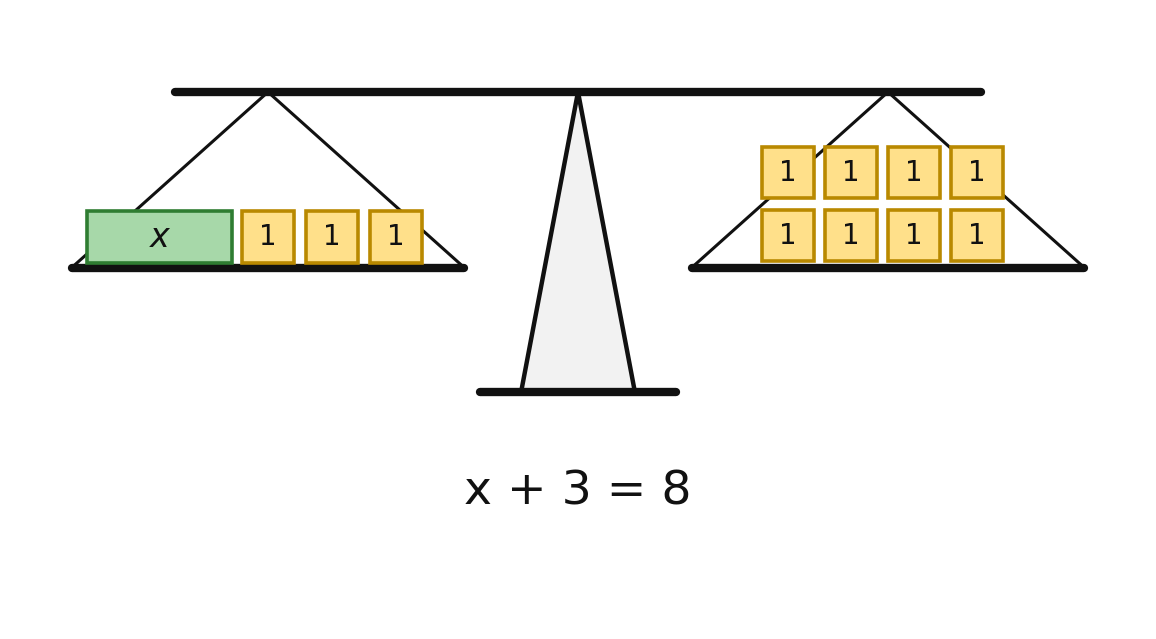
The scale in the figure shows . It balances, which is the picture of the equal sign.
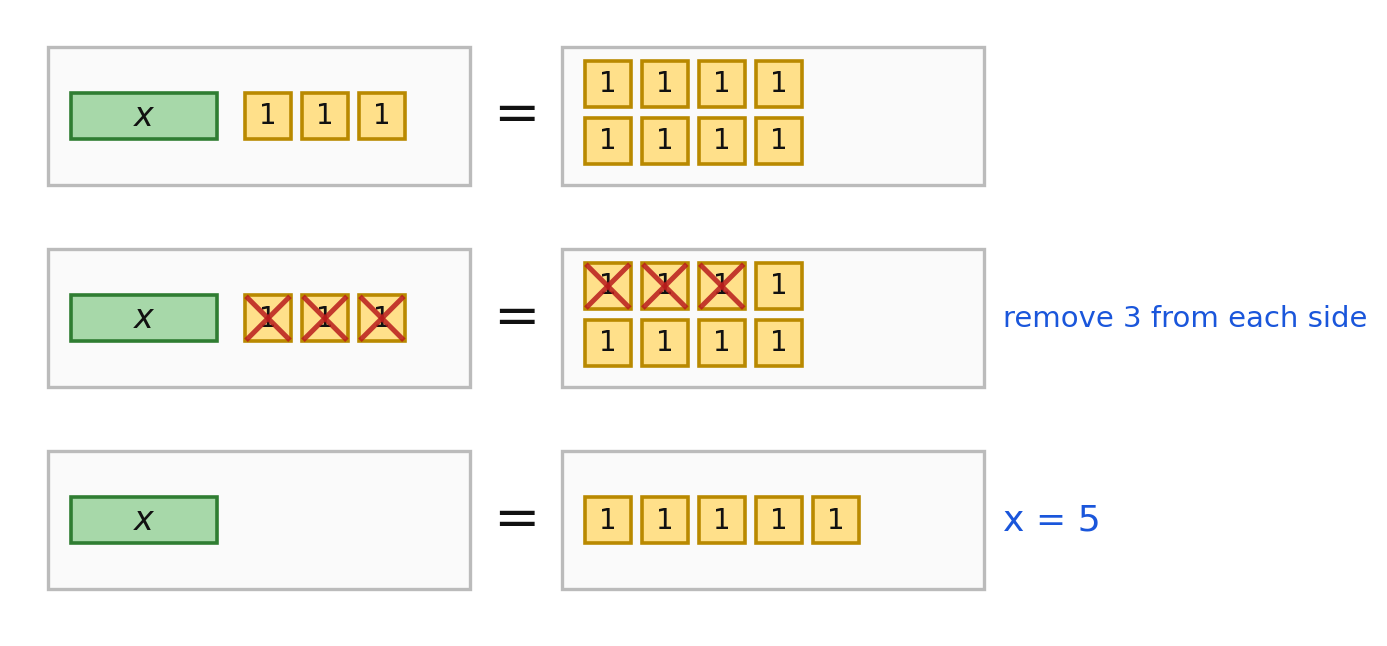
Now the key move. If you remove the same amount from both pans, the scale still balances. Remove three unit blocks from each side. The left pan holds just the block; the right pan holds five unit blocks. So .
That single idea — do the same thing to both sides — is the whole method for solving equations. Everything in the next two lessons is this picture, written in symbols.
Balance is a rule, not a suggestion. Take three off one side only and the scale tips. Tipping means the two sides are no longer equal, so the equation you write down is no longer true.
Algebra tiles
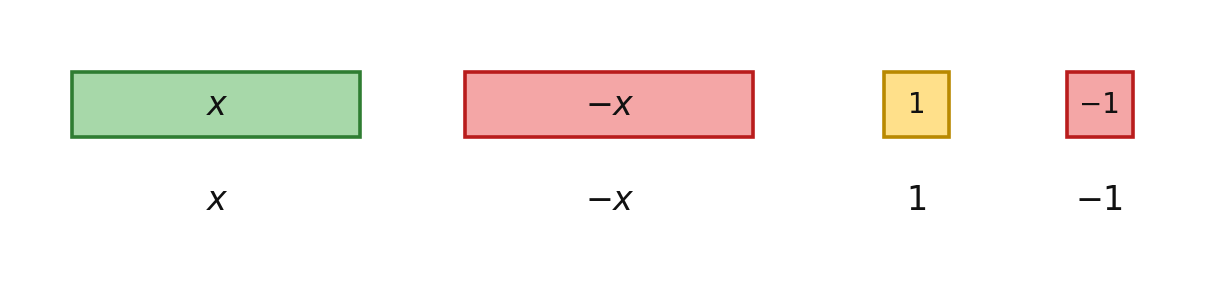
Algebra tiles are a set of flat pieces that stand for the parts of an equation:
- A long rectangular tile represents the variable, .
- A small square tile represents .
- Tiles of the opposite color represent negatives: and .
A tile model of an equation puts the tiles for the left side on one mat, the tiles for the right side on another, with an equal sign between the mats.
Zero pairs
A positive tile and a negative tile of the same size cancel each other. Together they make a zero pair, worth . Removing a zero pair from a mat changes nothing about the value on that mat, which is what lets tiles handle subtraction and negative numbers.
To model , place one tile and two tiles on the left mat, and three tiles on the right. To clear the two tiles, add two tiles to each side. On the left, each new pairs with a and both are removed, leaving alone. On the right, three plus two gives five. So .
Colored chips
Colored chips work the same way with a different picture: one color counts as , the other as , and a chip of each color forms a zero pair. A cup, an envelope, or a card labeled stands in for the variable. Chips are especially good for equations with negative numbers, because you can see zero pairs disappear.
Confirming a solution with a model
Finding an answer and confirming it are two different jobs, and models do both.
To confirm a solution, rebuild the original model, then replace the variable tile with the number of unit tiles your answer says it is worth. Count both mats. If the counts match, the model balances and the solution is correct. If they do not match, the balance tips and the answer is wrong.
For with the proposed solution : replace the tile with five unit tiles. The left mat now holds unit tiles, and the right mat holds . Both are , so it balances and is confirmed.
Worked examples
Example 1 — Modeling and solving with a balance scale
A balance scale holds a block labeled together with 2 one-gram weights on the left pan, and 6 one-gram weights on the right. Write the equation and find .
The scale balances, so the two sides are equal: .
Remove 2 one-gram weights from each pan. The left pan holds only ; the right holds .
Answer: , and . Confirm: replacing the block with 4 grams gives on the left and on the right, so the scale balances.
Example 2 — Modeling with algebra tiles
Model with tiles and solve.
Left mat: one tile and three tiles. Right mat: eight tiles.
Remove three tiles from each mat. Left: one tile. Right: five tiles.
Answer: . Confirm: five tiles plus three tiles is eight tiles, matching the right mat.
Example 3 — Using zero pairs
Model with tiles and solve.
Left mat: one tile and two tiles. Right mat: three tiles.
Add two tiles to each mat. On the left, the two new tiles pair with the two tiles to form zero pairs, which are removed, leaving the tile. On the right there are now tiles.
Answer: . Confirm: five tiles minus two tiles is three tiles, matching the right mat.
Example 4 — Equal groups with tiles
Model with tiles and solve.
Left mat: three tiles. Right mat: twelve tiles.
Split both mats into 3 equal groups. Each group has one tile on the left and unit tiles on the right.
Answer: . Confirm: three groups of 4 tiles is 12 tiles, matching the right mat.
Example 5 — Confirming a proposed solution
Kelsey says the solution of is . Use a tile model to confirm or correct her.
Replace the tile with six unit tiles. The left mat now holds tiles, but the right mat holds . The mats do not match, so the model does not balance.
Rebuild and solve: remove four tiles from each mat, leaving one tile and tiles.
Answer: Kelsey is incorrect. The solution is , and replacing the tile with five tiles gives on both mats.
Example 6 — Chips with negatives
Use colored chips to solve .
Left: an envelope labeled and five positive chips. Right: two positive chips.
Add five negative chips to each side. On the left, the five negative chips pair with the five positive chips and all ten are removed, leaving the envelope. On the right there are two positive chips and five negative chips; two zero pairs form and are removed, leaving three negative chips.
Answer: . Confirm: three negative chips plus five positive chips leaves two positive chips after zero pairs are removed, matching the right side.
Guided practice
- What does a balanced scale represent in an equation?
- Write the equation modeled by a scale with a block and 4 unit weights on the left pan and 9 unit weights on the right.
- Solve the equation from item 2 by describing what you remove from each pan.
- What is a zero pair, and why can you remove one without changing a side's value?
- Use a tile model to confirm whether is the solution of .
Independent practice
- Write the equation modeled by each: a) a scale with a block and 7 unit weights on the left and 10 on the right b) three tiles on the left mat and fifteen unit tiles on the right
- Solve each equation in item 6 by describing the tile or scale moves.
- Model with tiles. Describe the zero pairs you use and give the solution.
- Model with tiles. Describe how you split the mats into equal groups and give the solution.
- Jamal models and removes 2 tiles from the left mat only. Explain what goes wrong and what he should do instead.
- Application. A backpack and a 3-pound weight together balance an 11-pound weight on a scale. Write an equation with for the backpack's weight, describe the move that solves it, and confirm the solution on the scale.
- Reasoning. Explain why confirming a solution with a model is different from solving with a model, and why doing both is worth the time.
Exit ticket 11.2
- Write the equation modeled by a scale with a block and 5 unit weights on the left pan and 12 unit weights on the right.
- Solve the equation in item 1 and describe the move you made.
- What is a zero pair?
- Explain how you would use tiles to confirm that is the solution of .
Lesson 11.3 — Solving One-Step Equations with Addition and Subtraction
Inverse operations
Addition and subtraction undo each other. They are inverse operations. Adding 6 and then subtracting 6 leaves a number exactly where it started.
That is how you get a variable alone. If the equation adds something to the variable, you subtract it. If the equation subtracts something, you add it.
The properties that make it legal
Two properties of equality state the balance-scale rule in words:
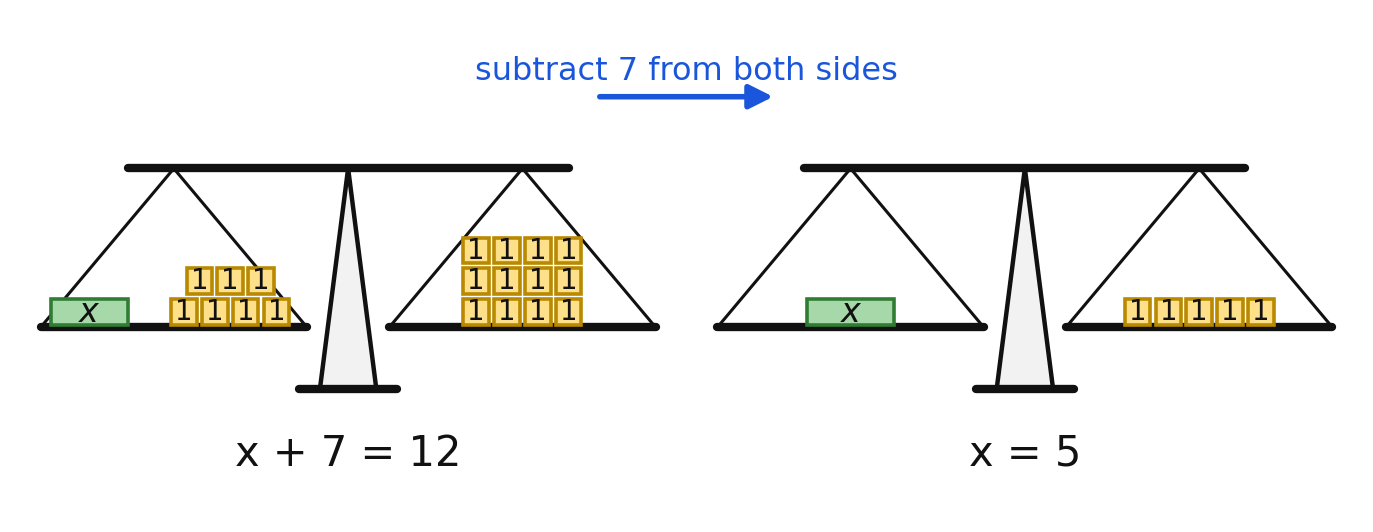
Addition property of equality. If you add the same number to both sides of an equation, the two sides remain equal. Subtraction property of equality. If you subtract the same number from both sides of an equation, the two sides remain equal.
You also use a property of real numbers along the way. The additive inverse property says that a number plus its opposite is zero: . That is what makes the unwanted number disappear. And the additive identity property says adding zero changes nothing: . That is what leaves the variable standing alone.
The procedure
- Look at what is being added to or subtracted from the variable.
- Do the inverse operation to both sides.
- Simplify each side.
- Check by substituting your solution into the original equation.
Step 4 is not optional. A check catches nearly every mistake, and it takes seconds.
Worked examples
Example 1 — Undoing addition
Solve .
The equation adds 7 to , so subtract 7 from both sides.
Check: . True.
Answer:
Example 2 — Undoing subtraction
Solve .
The equation subtracts 4 from , so add 4 to both sides.
Check: . True.
Answer:
Example 3 — A negative solution
Solve .
Subtract 15 from both sides.
Check: . True.
Answer:
Example 4 — A negative on the right
Solve .
Add 6 to both sides.
Check: . True.
Answer:
Example 5 — Variable on the right
Solve .
The variable can sit on either side; the method does not change. Subtract 3 from both sides.
Check: . True.
Answer:
Example 6 — In context
A hiker's elevation dropped 14 meters to reach meters. Solve to find the starting elevation.
Add 14 to both sides.
Check: . True.
Answer: The hiker started at 8 meters.
Guided practice
- What operation undoes adding 9?
- Solve and check your answer.
- Solve and check your answer.
- Solve and check your answer.
- Which property of equality lets you subtract 8 from both sides of an equation?
Independent practice
- Solve and check: a) b) c) d)
- Solve and check:
- Solve and check:
- Show every step for , naming the property you use.
- Write an equation whose solution is and that is solved by adding a number to both sides.
- Application. After spending $17, Elena has $28 left. Write an equation with for her starting amount, solve it, and check your answer in the context of the problem.
- Reasoning. Devin solves and gets . Identify his mistake, give the correct solution, and explain how a check would have revealed the error.
Exit ticket 11.3
- Solve .
- Solve .
- Check whether is the solution of .
- Explain why you must do the same operation to both sides of an equation.
Lesson 11.4 — Solving One-Step Equations with Multiplication and Division
The other pair of inverses
Multiplication and division undo each other, so the same strategy applies with a different operation.
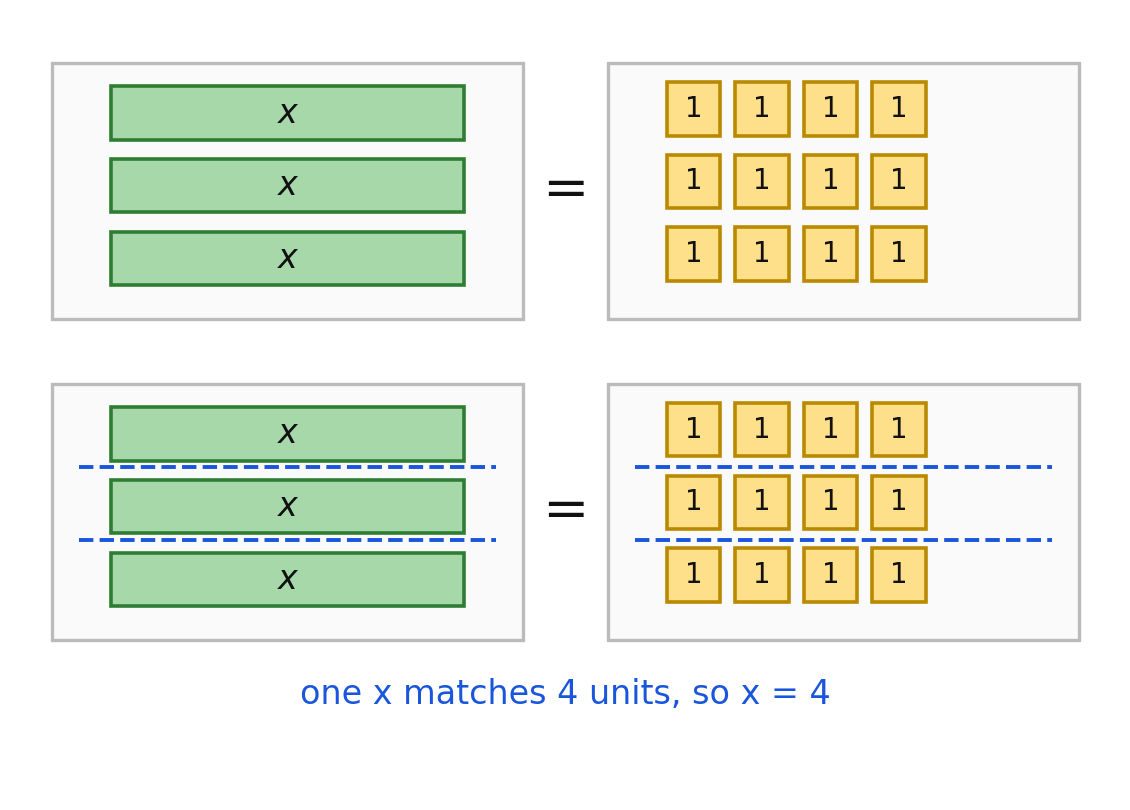
If the variable is multiplied by a number, divide both sides by that number. If the variable is multiplied by a unit fraction — which is the same as being divided — multiply both sides instead.
Two more properties of equality authorize the moves:
Multiplication property of equality. If you multiply both sides of an equation by the same number, the two sides remain equal. Division property of equality. If you divide both sides of an equation by the same nonzero number, the two sides remain equal.
The property of real numbers doing the quiet work here is the multiplicative identity property: . Dividing by 6 leaves , which is simply .
Reading the coefficient
Before you choose an operation, name the coefficient.
| Equation | Coefficient | What is happening to the variable | What undoes it |
|---|---|---|---|
| multiplied by 6 | divide both sides by 6 | ||
| multiplied by | divide both sides by | ||
| divided into 3 equal parts | multiply both sides by 3 | ||
| divided into 4 equal parts | multiply both sides by 4 |
The last two rows say the same thing twice. Writing and writing are two notations for one idea, and both are undone by multiplying by 4.
Signs
Dividing or multiplying by a negative number follows the integer rules from Chapter 3. A negative divided by a negative is positive; a positive divided by a negative is negative. The check at the end will confirm you handled the sign correctly.
The procedure
- Name the coefficient of the variable.
- If it is an integer, divide both sides by it. If it is a unit fraction , multiply both sides by .
- Simplify each side.
- Check by substituting into the original equation.
Worked examples
Example 1 — Undoing multiplication
Solve .
The coefficient is 6, so divide both sides by 6.
Check: . True.
Answer:
Example 2 — A negative coefficient
Solve .
The coefficient is , so divide both sides by .
Check: . True.
Answer:
Example 3 — A unit fraction coefficient
Solve .
The coefficient is , which means has been split into 3 equal parts and one part is 8. Multiply both sides by 3.
Check: . True.
Answer:
Example 4 — Division notation
Solve .
Dividing by 4 is multiplying by , so multiply both sides by 4.
Check: . True.
Answer:
Example 5 — Negative on the right
Solve .
Divide both sides by 8.
Check: . True.
Answer:
Example 6 — A unit fraction with a negative result
Solve .
Multiply both sides by 2.
Check: . True.
Answer:
Guided practice
- What operation undoes multiplying by 7?
- Solve and check your answer.
- Solve and check your answer.
- Solve and check your answer.
- Name the coefficient in and state what you would do to both sides to solve .
Independent practice
- Solve and check: a) b) c) d)
- Solve and check:
- Solve and check:
- Show every step for , naming the property of equality you use.
- Write an equation with a unit fraction coefficient whose solution is , and show the check.
- Application. A teacher divides 84 markers equally among some tables and each table gets 12 markers. Write an equation with for the number of tables, solve it, and confirm the answer makes sense in context.
- Reasoning. Nina solves by dividing both sides by 4 and gets . Explain why that is wrong, give the correct solution, and describe the check that exposes the error.
Exit ticket 11.4
- Solve .
- Solve .
- Solve .
- Explain why you multiply, rather than divide, to solve an equation with a unit fraction coefficient.
Lesson 11.5 — Writing an Equation from a Situation
From words to symbols
Writing the equation is usually harder than solving it, and it is the part that matters most. A reliable path:
- Read the whole situation before writing anything.
- Identify the unknown and choose a variable for it. Write a sentence saying what the variable stands for — "let = the number of stickers Maya started with."
- Find the action. What happened to the unknown? Something was added, taken away, repeated in equal groups, or split into equal parts.
- Find the result — the number the situation ends on. That is usually the value on the other side of the equal sign.
- Write the equation, then solve and check it against the story, not just the arithmetic.
Matching the action to the operation
| The situation says | The action is | The equation looks like |
|---|---|---|
| gained, earned, joined, rose | addition | |
| spent, lost, gave away, fell | subtraction | |
| equal groups, each, times as many | multiplication | |
| shared equally, split into parts, one third of | division or a unit fraction |
Do not trust keywords alone. "Nine more than a number is 20" gives , but "nine is more than a number" is not an equation at all. Read for the action, then check that your equation retells the story.
Where the variable goes
The variable stands for the quantity you do not know. Read the story again and ask what number is missing. In "Maya gave away 12 stickers and has 27 left," you know 12 and 27; you do not know how many she started with. So the starting amount is the variable.
Worked examples
Example 1 — Subtraction from a situation
Maya gave away 12 stickers and has 27 left. Write and solve an equation for the number she started with.
Let = the number of stickers Maya started with. She lost 12, and the result was 27.
Check against the story: starting with 39 and giving away 12 leaves . Correct.
Answer: ; Maya started with 39 stickers.
Example 2 — Addition from a situation
After earning $18, Tomas has $45. Write and solve an equation for the amount he had before.
Let = the amount Tomas had before earning.
Check: . Correct.
Answer: ; Tomas had $27.
Example 3 — Equal groups
Five identical boxes hold 60 books in all. Write and solve an equation for the number of books in each box.
Let = the number of books in one box. Five equal groups of total 60.
Check: . Correct.
Answer: ; each box holds 12 books.
Example 4 — A unit fraction of an amount
One third of the students in a class walk to school, and 9 students walk. Write and solve an equation for the number of students in the class.
Let = the number of students in the class. One third of is 9.
Check: one third of 27 is 9. Correct.
Answer: ; there are 27 students.
Example 5 — A negative result
The temperature fell 14 degrees to reach °F. Write and solve an equation for the starting temperature.
Let = the starting temperature.
Check: starting at 8°F and falling 14 degrees gives °F. Correct.
Answer: ; the starting temperature was 8°F.
Example 6 — Sorting the known from the unknown
A rope is cut into 6 equal pieces, each 7 feet long. Write and solve an equation for the original length.
Let = the original length in feet. Cutting into 6 equal pieces means one piece is of the rope.
Check: 42 feet cut into 6 pieces gives pieces of 7 feet. Correct.
Answer: ; the rope was 42 feet long.
Guided practice
- A number increased by 6 is 14. Write an equation and solve it.
- Jenna read 24 pages, which is 8 fewer than she planned. Write an equation for the number she planned, , and solve.
- Four friends share a bag of grapes equally, and each gets 15 grapes. Write an equation for the total, , and solve.
- Half of a number is 11. Write an equation and solve it.
- Explain why the variable in "Ben spent $9 and has $21 left" stands for the amount he had before, not the amount left.
Independent practice
- Write and solve an equation: a number decreased by 17 is 5.
- Write and solve an equation: seven times a number is 63.
- Write and solve an equation: one fifth of a number is 12.
- A submarine descended 30 meters to a depth of meters. Write and solve an equation for its starting depth.
- Write and solve an equation: a number increased by 20 is 4.
- Application. A school orders pizzas for a party. Each pizza is cut into 8 equal slices, and there are 96 slices in all. Write an equation with for the number of pizzas, solve it, and state the answer in a full sentence.
- Reasoning. For the situation "Omar gave 5 marbles to a friend and has 14 left," Carla writes . Explain why her equation does not match the story, write the correct equation, and solve it.
Exit ticket 11.5
- Write and solve an equation: a number plus 13 is 30.
- Write and solve an equation: six equal rows of chairs hold 54 chairs.
- A hiker's elevation rose 25 meters to reach 10 meters. Write and solve an equation for the starting elevation.
- Explain how you decide which quantity in a situation should be the variable.
Lesson 11.6 — Writing a Situation from an Equation
Reading an equation as a story
This lesson runs the previous one backward. Given symbols, you supply the words.
The equation gives you three things: the unknown, the action, and the result. Your job is to invent a setting where those three fit together sensibly.
For :
- is the unknown starting amount.
- means something of size 5 was gained or added.
- is the total after that gain.
A situation that matches: Ana had some songs on a playlist. She added 5 more, and now she has 20. How many did she start with?
What makes a situation correct
A good situation passes three tests.
- The operation matches. If the equation adds, the story must add. Adding 5 in the story cannot become "5 times as many."
- The numbers land in the right roles. In , the is the total after the change, not before.
- The context makes sense. The answer should be a reasonable thing to have that many of. A story where someone has friends is not sensible; a story about elevation or temperature handles negatives naturally.
Choosing a context for negatives
When an equation's solution is negative, pick a setting where negative values mean something real — the same contexts from Chapter 1. Temperature, elevation, bank balances, and yards lost in a game all work.
For , the solution is ; the story can be perfectly ordinary, because the answer is positive even though a number in the equation is negative. But for , the solution is , so the situation must be one where is meaningful — a starting temperature of °F that rose 15 degrees to 4°F, for instance.
A template you can adapt
| Equation form | Story shape |
|---|---|
| Something started at an unknown amount, gained , and ended at . | |
| Something started at an unknown amount, lost , and ended at . | |
| There are equal groups of an unknown size, totaling . | |
| An unknown amount was split into equal parts, and one part is . |
Worked examples
Example 1 — Addition
Write a situation for , then solve it.
The unknown starts, gains 5, and ends at 20.
Answer: Ana had some songs on a playlist. She added 5 more and now has 20. How many did she start with? The solution is songs, and checks.
Example 2 — Equal groups
Write a situation for , then solve it.
Seven equal groups total 56.
Answer: Seven identical crates hold 56 apples in all. How many apples are in each crate? The solution is apples, and checks.
Example 3 — A unit fraction
Write a situation for , then solve it.
Something is split into 4 equal parts and one part is 6.
Answer: A ribbon is cut into 4 equal pieces, and each piece is 6 inches long. How long was the ribbon? The solution is inches, and checks.
Example 4 — Subtraction with a negative result on one side
Write a situation for , then solve it.
The unknown loses 9 and ends below zero, so a temperature or elevation context fits.
Answer: The temperature fell 9 degrees and reached °C. What was the starting temperature? The solution is °C, and checks.
Example 5 — A negative coefficient
Write a situation for , then solve it.
A coefficient of fits a quantity that decreases by 3 units each time.
Answer: A diver descends 3 meters every minute, so her elevation changes by meters per minute. After minutes she is at meters. How many minutes has she been descending? The solution is minutes, and checks.
Example 6 — Matching the operation exactly
Which situation matches : "Sam has 4 fewer books than Rita, who has 10" or "Sam lost 4 books and now has 10"?
In the second story the unknown is Sam's original count, 4 are removed, and the result is 10 — exactly the equation. The first story describes Sam's count directly as , which is not what the equation says about the unknown.
Answer: The second situation, "Sam lost 4 books and now has 10," matches. The solution is , and checks.
Guided practice
- Write a situation for and solve it.
- Write a situation for and solve it.
- Write a situation for and solve it.
- Write a situation for and solve it.
- Explain why the story for must end at 15 rather than start at 15.
Independent practice
- Write a situation for and solve it.
- Write a situation for and solve it.
- Write a situation for and solve it.
- Write a situation for and solve it.
- Write a situation for , choosing a context where the negative solution makes sense, and solve it.
- Application. Write a situation for set in a classroom, solve it, and state the answer in a full sentence.
- Reasoning. Priya writes this situation for : "Priya had 4 dollars, earned some money, and now has 20." Explain why the situation does not match the equation, and rewrite either the situation or the equation so that they agree.
Exit ticket 11.6
- Write a situation for and solve it.
- Write a situation for and solve it.
- Write a situation for and solve it.
- Explain how you decide what the variable stands for when you invent a situation from an equation.
Chapter 11 Review
Vocabulary. variable · expression · equation · term · constant · coefficient · unit fraction · solution · inverse operations · properties of equality · algebra tiles · zero pair
Part A — Algebraic vocabulary (6.PFA.3a)
- Label each as an expression or an equation: a) b) c) d)
- For , name the variable, the terms, the coefficient, and the constant.
- Name the coefficient in each: a) b) c) d)
- Write your own example of an expression with a coefficient of 3, and turn it into an equation with a solution you can name.
Part B — Modeling with manipulatives (6.PFA.3b)
- Write the equation modeled by a balance scale with a block and 6 unit weights on the left pan and 14 unit weights on the right, then solve it by describing the move.
- Describe how to model and solve with algebra tiles.
- Describe how to model and solve with algebra tiles, naming the zero pairs you use.
Part C — Solving with properties (6.PFA.3c)
- Solve and check: a) b) c) d)
- Solve and check: a) b) c) d)
- Show every step for , naming the property of equality you use.
Part D — Confirming solutions (6.PFA.3d)
- Use a tile model to confirm whether is the solution of .
- Malik says the solution of is . Use a model or a check to decide, and correct the answer if needed.
- Explain how a balance scale shows that an incorrect solution is wrong.
Part E — Writing an equation from a situation (6.PFA.3e)
- Write and solve an equation: a number decreased by 9 is 16.
- A club sold 132 tickets, which is 12 times the number of members. Write and solve an equation for the number of members.
- One fourth of the pencils in a box is 7 pencils. Write and solve an equation for the number of pencils in the box.
- The temperature rose 11 degrees to reach 3°F. Write and solve an equation for the starting temperature.
Part F — Writing a situation from an equation (6.PFA.3f)
- Write a situation for and solve it.
- Write a situation for and solve it.
- Write a situation for and solve it.
Part G — Mixed application and reasoning
- A square's perimeter is described by , where is the length of one side. Solve for , then explain what the coefficient 4 represents in the situation.
- Explain why and have the same solution, using the balance scale idea.
- Write one situation and one equation for this fact: a savings account fell by $40 and now holds $85. Solve for the starting balance and check it in context.
- Yusuf claims that dividing both sides of by 2 will solve it. Explain the error, solve correctly, and show the check.
Standards coverage check — Chapter 11
| Knowledge and Skill | Where it is taught | Where it is practiced |
|---|---|---|
| 6.PFA.3a — identify and develop examples of equation, variable, expression, term, coefficient | 11.1 | 11.1 all sets; Review Part A |
| 6.PFA.3b — represent and solve one-step equations with concrete manipulatives and pictorial representations | 11.2 | 11.2 all sets; Review Part B |
| 6.PFA.3c — apply properties of real numbers and properties of equality to solve one-step equations | 11.3, 11.4 | 11.3 and 11.4 all sets; Review Part C |
| 6.PFA.3d — confirm solutions using concrete manipulatives and pictorial representations | 11.2 | 11.2 all sets; 11.3 and 11.4 checks; Review Part D |
| 6.PFA.3e — write a one-step equation to represent a verbal situation, including in context | 11.5 | 11.5 all sets; Review Parts E and G |
| 6.PFA.3f — create a verbal situation in context given a one-step equation | 11.6 | 11.6 all sets; Review Parts F and G |
Answer keys for every set in this chapter are in Appendix A.