Chapter 10 — The Coordinate Plane
Standard: 6.MG.3 — The student will describe the characteristics of the coordinate plane and graph ordered pairs.
By the end of this chapter you will be able to:
- Identify and label the axes, origin, and quadrants of a coordinate plane (6.MG.3a)
- Identify and describe the location — quadrant or axis — of a point given as an ordered pair (6.MG.3b)
- Graph ordered pairs in the four quadrants and on the axes (6.MG.3c)
- Identify ordered pairs represented by points in the four quadrants and on the axes (6.MG.3d)
- Relate the coordinates of a point to its distance from each axis, and relate a point to another point on the same horizontal or vertical line (6.MG.3e)
- Draw polygons given the coordinates of their vertices, and use coordinates to find the length of a horizontal or vertical side (6.MG.3f)
Lessons: 10.1 Parts of the Coordinate Plane · 10.2 Graphing and Naming Ordered Pairs · 10.3 Quadrants and the Axes · 10.4 Distance Between Points on a Horizontal or Vertical Line · 10.5 Polygons in the Coordinate Plane
Throughout this chapter, every coordinate is an integer. You will not need fractions or decimals to name a point here. Each point lands exactly where two grid lines cross.
Lesson 10.1 — Parts of the Coordinate Plane
Two number lines are better than one
In Chapter 1 you used a single number line to locate a number. One number line can answer how far left or right, and nothing else. But a location on a map, a seat in a theater, or a pixel on a screen needs two answers: how far across, and how far up or down.
So we take two number lines, make them perpendicular, and line up their zeros. The flat surface they create is the coordinate plane.
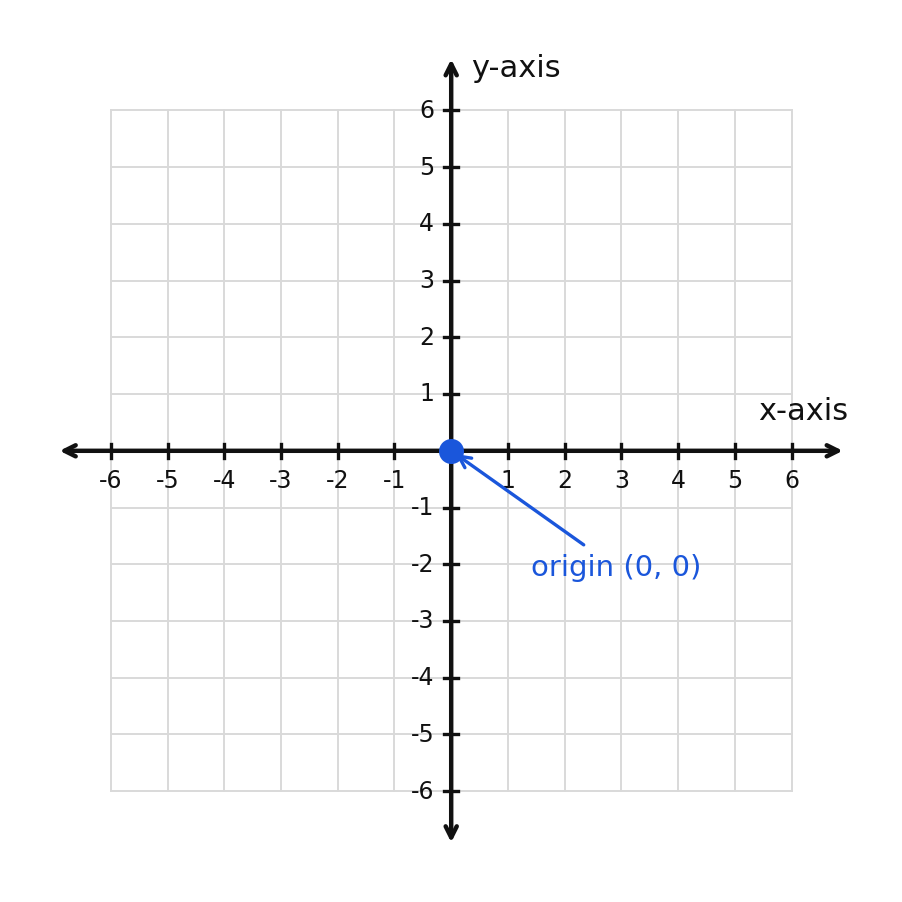
The horizontal number line is the x-axis. Just as in Chapter 1, values on it increase to the right and decrease to the left.
The vertical number line is the y-axis. Values on it increase upward and decrease downward.
The point where the two axes cross is the origin. The origin is zero on both number lines at once, which is exactly what makes it the starting point for every measurement in the plane.
The arrowheads on the ends of the axes mean the plane keeps going forever in all four directions. The picture is a window onto it, not the whole thing.
Naming a location with an ordered pair
A point in the coordinate plane is named by an ordered pair of numbers written in parentheses and separated by a comma:
The first number is the x-coordinate. It tells you how far to move right or left from the origin. The second number is the y-coordinate. It tells you how far to move up or down.
The word ordered is doing real work. The pair and the pair use the same two numbers, but they name two different points. Order is part of the name.
Reading the pair. Say as "the point three, negative four." The first number is always the horizontal one. A phrase many students use is "over, then up" — you travel along the -axis first, then away from it.
The four quadrants
The two axes cut the plane into four regions. Each region is a quadrant. Quadrants are numbered with Roman numerals, starting in the upper right and moving counterclockwise.
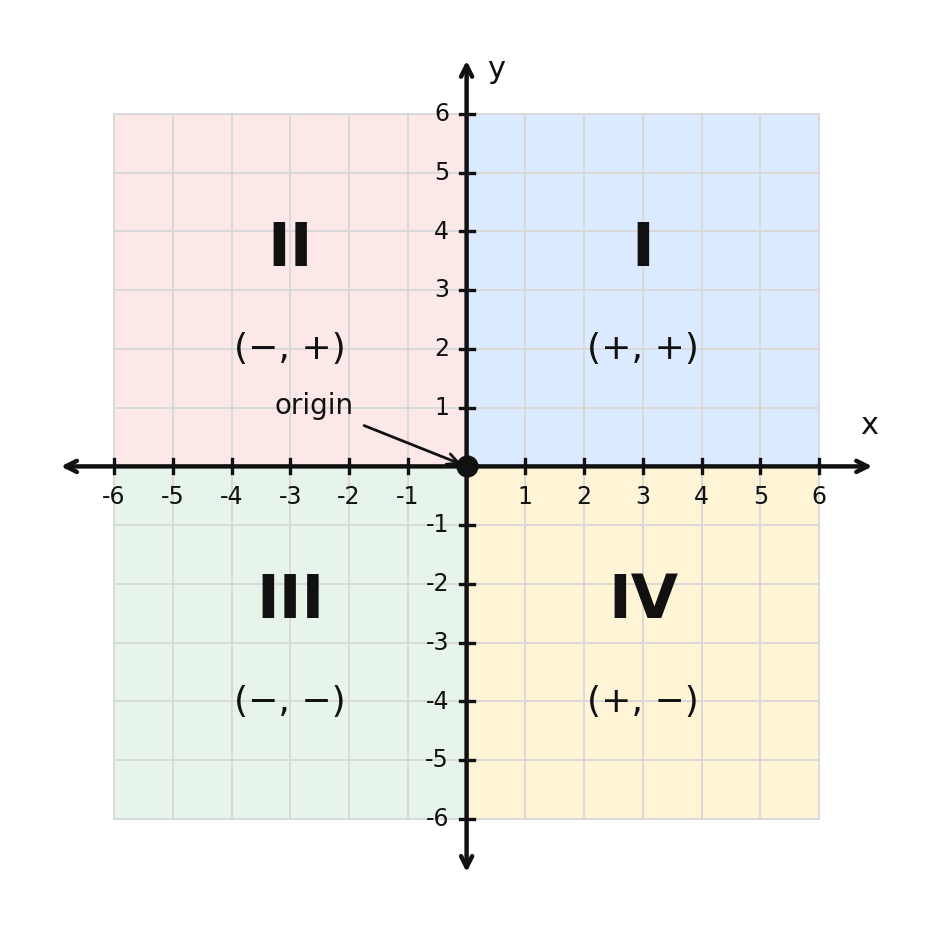
| Quadrant | Location | -coordinate | -coordinate | Example |
|---|---|---|---|---|
| I | upper right | positive | positive | |
| II | upper left | negative | positive | |
| III | lower left | negative | negative | |
| IV | lower right | positive | negative |
Counterclockwise ordering feels backward the first time, because we usually read left to right. A reliable way to remember it: start where both coordinates are positive, then sweep in the direction that makes the -coordinate go negative first.
Points that are not in any quadrant
Quadrants are the four open regions. The axes themselves are boundaries, so a point sitting on an axis is not in a quadrant at all.
- If the -coordinate is , the point sits on the -axis. Examples: , .
- If the -coordinate is , the point sits on the -axis. Examples: , .
- If both coordinates are , the point is the origin, which lies on both axes.
This is not a technicality to memorize and forget. A zero coordinate means "no movement in that direction," and no movement leaves you standing on the other axis.
Worked examples
Example 1 — Naming the parts
Which axis is horizontal, and what is the name of the point where the axes meet?
The horizontal number line runs left and right.
Answer: The -axis is horizontal. The axes meet at the origin, .
Example 2 — Reading an ordered pair
In the ordered pair , name the -coordinate and the -coordinate, and state what each one tells you.
The first number is always the -coordinate.
Answer: The -coordinate is , meaning move 7 units left of the origin. The -coordinate is , meaning move 2 units up.
Example 3 — Order matters
Are and the same point? Explain.
For you move 2 right and 8 up. For you move 8 right and 2 up.
Answer: No. They are different points, because the pair is ordered — the first number is horizontal and the second is vertical.
Example 4 — Quadrant from signs
A point has a negative -coordinate and a negative -coordinate. Which quadrant is it in?
Negative means left of the -axis; negative means below the -axis. Left and below is the lower left region.
Answer: Quadrant III
Example 5 — A point on an axis
Where is the point ?
The -coordinate is , so there is no horizontal movement. Starting at the origin you move straight down 4 units.
Answer: On the -axis, 4 units below the origin. It is not in any quadrant.
Guided practice
- Name the horizontal axis and the vertical axis of a coordinate plane.
- Write the ordered pair for the origin.
- Which quadrant is in the upper right?
- In the ordered pair , which number is the -coordinate?
- Explain why and are not the same point.
Independent practice
- List the four quadrants in order and give the sign pattern of the coordinates in each.
- What is true about the -coordinate of every point on the -axis?
- Name the quadrant for each point without graphing: a) b) c) d)
- Give an ordered pair with integer coordinates for a point on the -axis that is not the origin.
- Explain why the origin does not belong to any quadrant.
- Application. A city map places City Hall at the origin. East is the positive -direction and north is the positive -direction, with each unit equal to one block. A library is 5 blocks west and 3 blocks north of City Hall. Write the library's ordered pair and name its quadrant.
- Reasoning. Jonah says that any point with a negative number in it must be in Quadrant III. Give two ordered pairs that show he is wrong, and explain the rule he is missing.
Exit ticket 10.1
- What is the ordered pair for the origin?
- In , what does the tell you to do?
- Name the quadrant containing .
- Explain how you can tell, just by looking at an ordered pair, that the point lies on the -axis.
Lesson 10.2 — Graphing and Naming Ordered Pairs
Graphing a point
To graph (or plot) an ordered pair means to mark the one point it names. Every time, the procedure is the same:
- Start at the origin, . Every ordered pair is a set of directions from there.
- Move horizontally the amount of the -coordinate: right if positive, left if negative.
- Move vertically the amount of the -coordinate: up if positive, down if negative.
- Mark the point with a small filled dot and label it with its ordered pair.
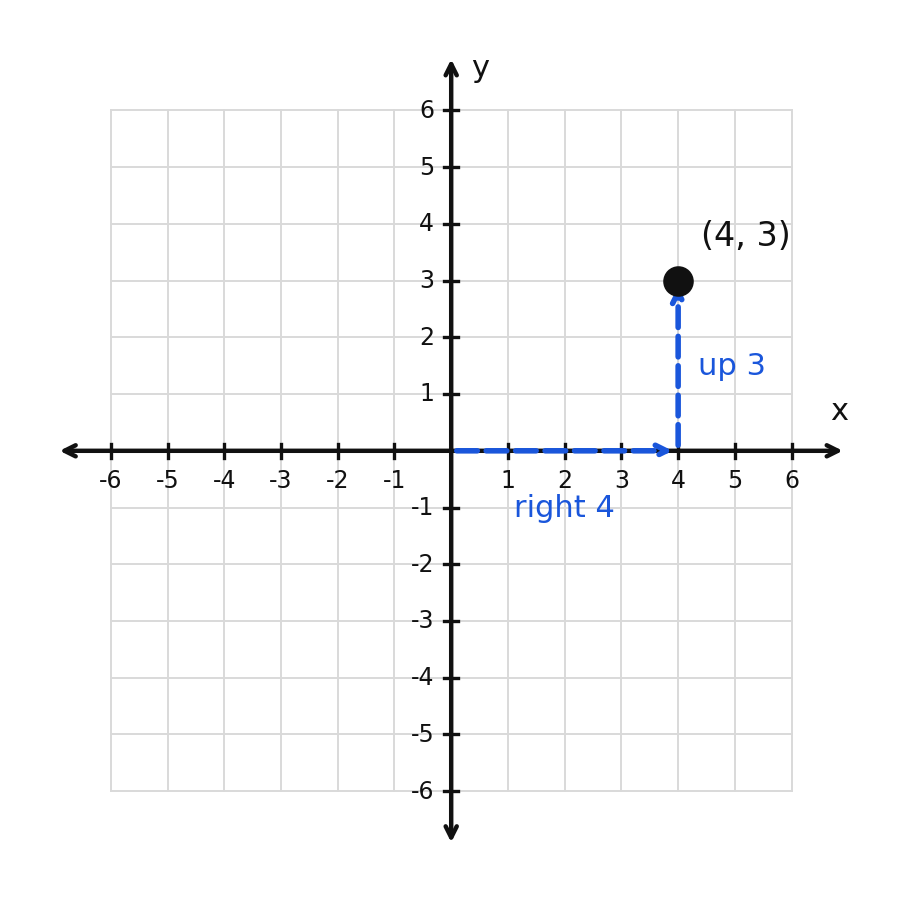
If a coordinate is , you simply skip that move. For , move 5 left and do not move vertically; the point lands on the -axis.
The most common mistake is moving up first. If you plot by going up 2 and right 6, you land on — a different point. Always travel along the -axis first.
Naming a point you can see
Reading a point off a graph reverses the same steps.
- Find the point.
- Travel straight up or down from the point to the -axis, and read the number there. That is the -coordinate.
- Travel straight left or right from the point to the -axis, and read the number there. That is the -coordinate.
- Write the pair in order, .
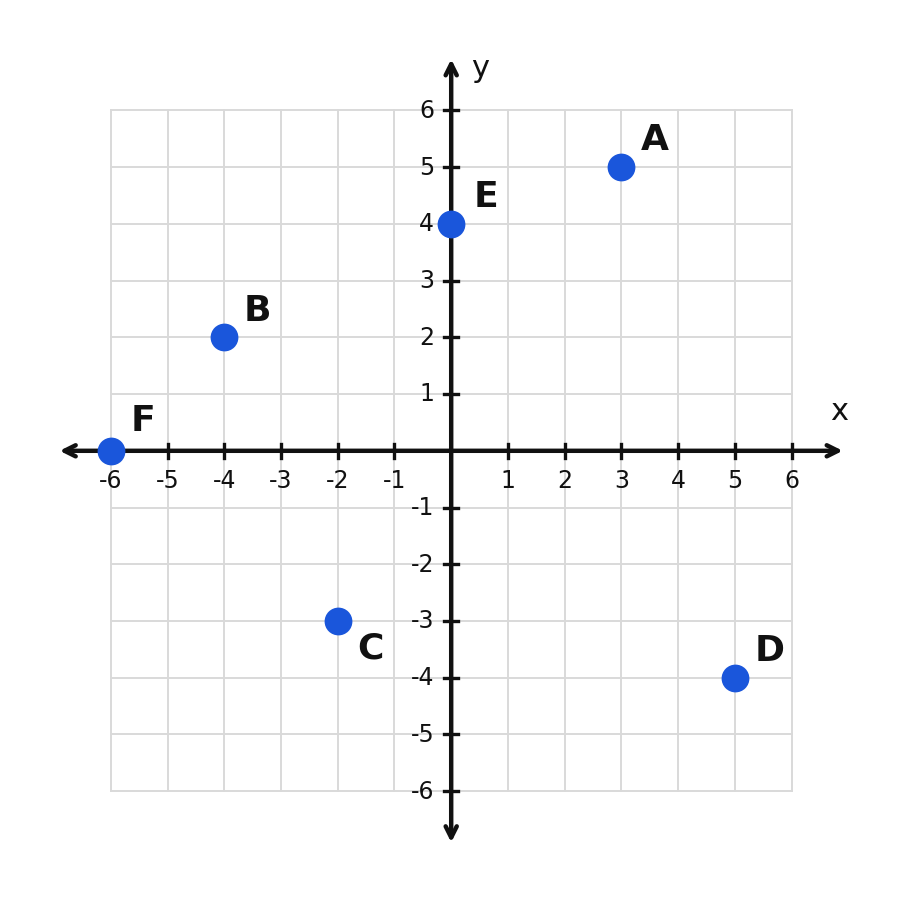
Using the figure above: point sits directly above on the -axis and directly right of on the -axis, so is . Point sits on the -axis itself, 6 units left of the origin, so is .
Worked examples
Example 1 — Graphing in Quadrant I
Describe how to graph .
Start at the origin. The -coordinate is positive, so move 4 units right. The -coordinate is positive, so move 3 units up.
Answer: The point is 4 right and 3 up from the origin, in Quadrant I.
Example 2 — Graphing with a negative coordinate
Describe how to graph .
The -coordinate is negative, so move 5 units left. The -coordinate is positive, so move 2 units up.
Answer: 5 left and 2 up from the origin, in Quadrant II.
Example 3 — Graphing with two negatives
Describe how to graph .
Move 2 units left, then 4 units down.
Answer: 2 left and 4 down from the origin, in Quadrant III.
Example 4 — Graphing on an axis
Describe how to graph .
The -coordinate is , so there is no horizontal move. Move 3 units down.
Answer: 3 units below the origin, on the -axis.
Example 5 — Naming points from a graph
Using the figure above, name the ordered pairs for points , , and .
lies 4 units left of the -axis and 2 units above the -axis. lies 5 units right and 4 units down. lies on the -axis, 4 units up.
Answer: ; ;
Guided practice
- Which coordinate do you use first when graphing a point, and which direction does it move you?
- Describe the moves needed to graph .
- Describe the moves needed to graph .
- Using the figure in this lesson, name the ordered pair for point .
- A point is graphed 7 units left of the origin, directly on the -axis. Write its ordered pair.
Independent practice
- Graph these points on one coordinate plane and label each with its ordered pair: , , , , , .
- Describe in words the moves that graph .
- A point is graphed 3 units right of the origin and 9 units down. Write its ordered pair.
- Graph and on the same plane. Describe how their positions differ.
- Write the ordered pairs of three different points that all lie on the -axis.
- Application. On a garden grid, the origin is the water spigot. Each unit is one meter, east is positive , and north is positive . Tomatoes are planted at 4 m west and 2 m south of the spigot; peppers at 3 m east and 6 m north. Write an ordered pair for each plant and name the quadrant it is in.
- Reasoning. Priya plots by moving 7 units right along the -axis. Explain her error and describe where the point actually belongs.
Exit ticket 10.2
- Describe the moves that graph .
- A point is 2 units left and 8 units down from the origin. Write its ordered pair.
- Write the ordered pair for a point on the -axis that is 5 units right of the origin.
- Explain why you must move horizontally before moving vertically when you graph an ordered pair.
Lesson 10.3 — Quadrants and the Axes
Deciding where a point lives without drawing it
You can name a point's region from its signs alone. This is faster than graphing and is worth becoming fluent in.
| If the ordered pair looks like… | Then the point is… |
|---|---|
| in Quadrant I | |
| in Quadrant II | |
| in Quadrant III | |
| in Quadrant IV | |
| , not the origin | on the -axis |
| , not the origin | on the -axis |
| the origin |
Read the table as two questions asked in order. First: is either coordinate zero? If so, the point is on an axis and you are done. If not: what are the two signs? That answers the quadrant.
Which zero puts you on which axis
Students mix these up often enough that it is worth slowing down.
A zero -coordinate means no vertical movement, so you never leave the horizontal axis. The point is on the -axis.
A zero -coordinate means no horizontal movement, so you never leave the vertical axis. The point is on the -axis.
In short, the coordinate that is zero is not the axis you land on. It is the direction you did not travel.
Sorting a group of points
When you are given several points at once, sort by asking the same two questions each time. Here is a worked sort:
| Point | Zero coordinate? | Signs | Location |
|---|---|---|---|
| no | Quadrant I | ||
| no | Quadrant II | ||
| no | Quadrant III | ||
| no | Quadrant IV | ||
| yes, | — | on the -axis | |
| yes, | — | on the -axis |
Worked examples
Example 1 — Quadrant from signs
Name the location of .
Neither coordinate is zero. The -coordinate is negative and the -coordinate is positive, which is left and up.
Answer: Quadrant II
Example 2 — A point on an axis
Name the location of .
The -coordinate is , so there is no vertical movement.
Answer: On the -axis, 7 units right of the origin. It is not in a quadrant.
Example 3 — Naming a point that fits a description
Write an ordered pair with integer coordinates for a point in Quadrant IV.
Quadrant IV needs a positive -coordinate and a negative -coordinate.
Answer: is one of many correct answers.
Example 4 — Changing one sign
The point is in Quadrant I. Where is ?
Only the -coordinate changed sign, so the point moved from above the -axis to below it, staying 5 units right.
Answer: Quadrant IV
Example 5 — Reasoning from a description
A point is 4 units from the -axis and lies on the -axis. Name both ordered pairs that could describe it.
Lying on the -axis forces . Being 4 units from the -axis means is or .
Answer: and
Guided practice
- Name the quadrant of .
- Name the location of .
- Which quadrant has a negative -coordinate and a positive -coordinate?
- Write an ordered pair with integer coordinates for a point in Quadrant III.
- A point has -coordinate and -coordinate . On which axis does it lie?
Independent practice
- Name the location of each point: a) b) c) d) e)
- Write one ordered pair with integer coordinates for each quadrant, I through IV.
- The point is in Quadrant II. Name the quadrant of and explain what changed.
- Explain how a point can have a negative coordinate and still not be in Quadrant III.
- Sort these into a table with columns for Quadrant I, II, III, IV, and On an axis: , , , , , , , .
- Application. In a video game the character starts at the origin. Moving right and up gives positive coordinates. After a move the character is at . Describe the character's position in words and name the quadrant.
- Reasoning. Dante says every point with a in it is the origin. Give a counterexample and explain the difference between a point on an axis and the origin.
Exit ticket 10.3
- Name the quadrant of .
- Name the location of .
- Write an ordered pair with integer coordinates for a point in Quadrant IV.
- Explain why a point with a -coordinate of lies on the -axis rather than the -axis.
Lesson 10.4 — Distance Between Points on a Horizontal or Vertical Line
Coordinates are distances
Every coordinate has a second meaning that makes the rest of this chapter possible.
The -coordinate tells you the point's distance from the -axis, along with the direction. The -coordinate tells you the point's distance from the -axis, along with the direction.
Since distance never has a direction, the distance itself is the absolute value of the coordinate — exactly the idea from Chapter 1.
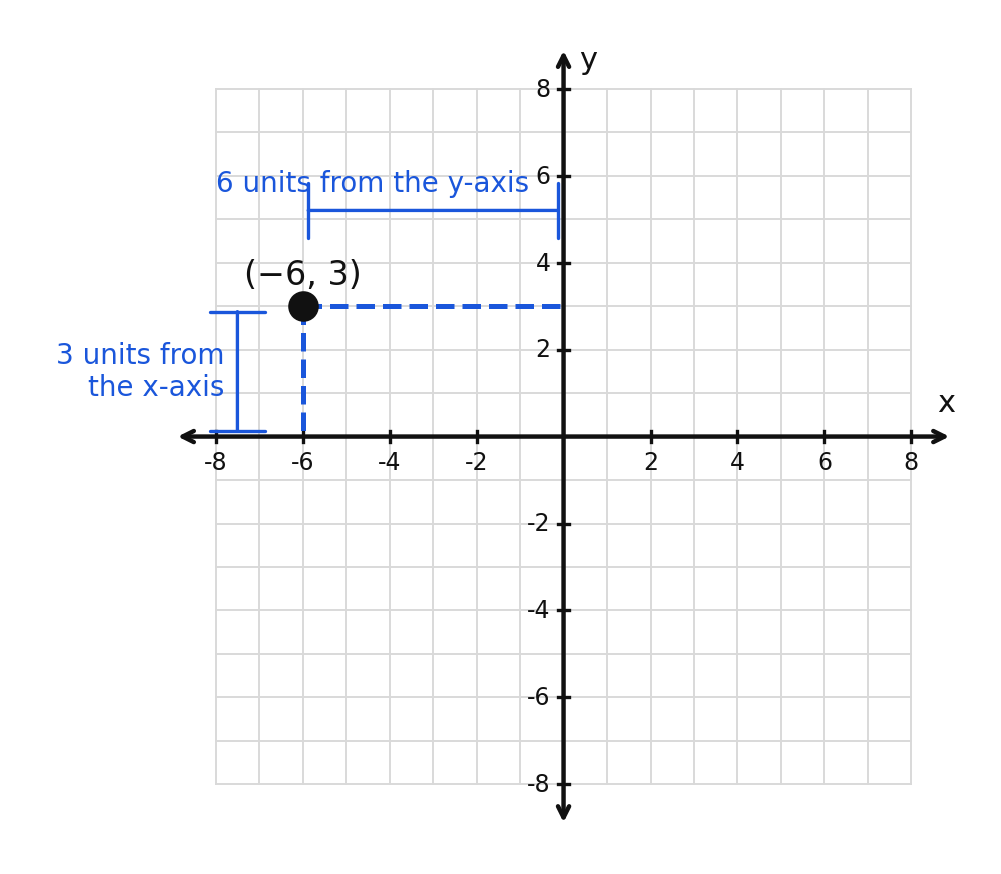
For the point : it is units from the -axis and units from the -axis.
Points on the same horizontal or vertical line
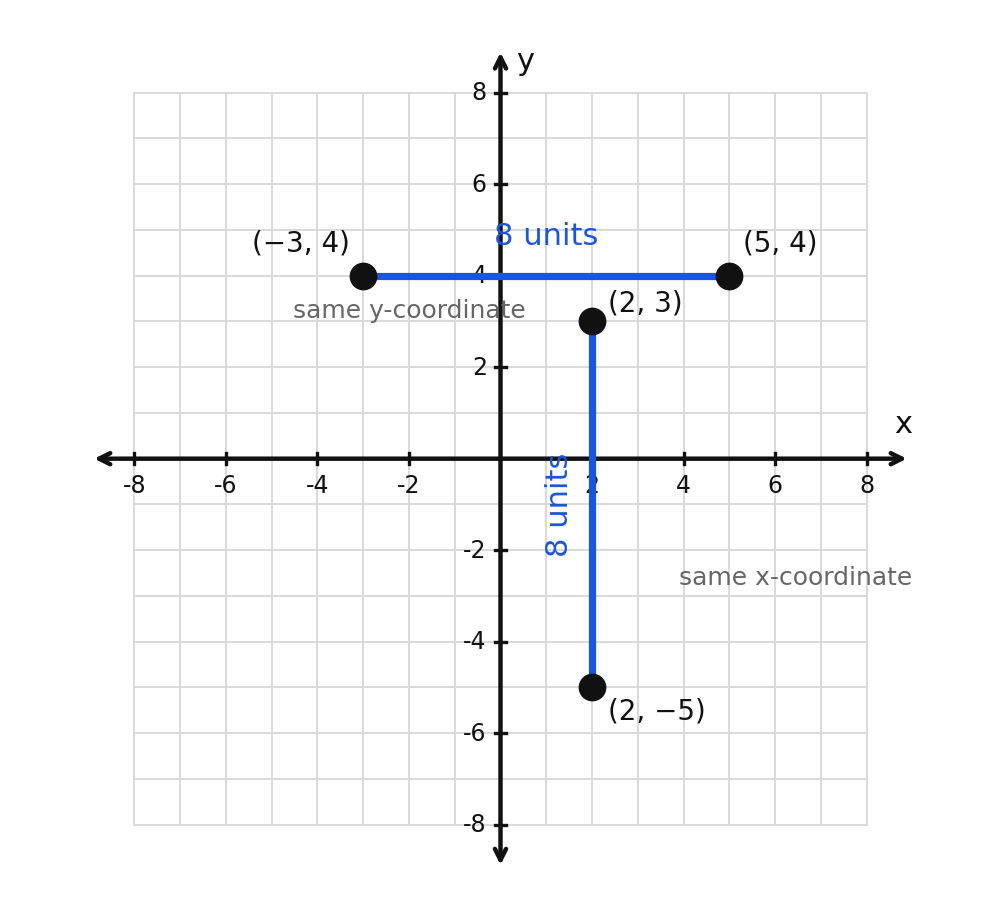
Two points sit on the same horizontal line exactly when their -coordinates are equal. They are at the same height, so the only difference between them is left-and-right.
Two points sit on the same vertical line exactly when their -coordinates are equal. They are the same distance across, so the only difference is up-and-down.
Finding the distance
When two points lie on the same horizontal line, count the units between them along that line. Counting works, and you should count the first several times. But counting gets slow and error-prone across the origin, so name the shortcut:
Horizontal distance: the -coordinates match, so the distance is the absolute value of the difference of the -coordinates. Vertical distance: the -coordinates match, so the distance is the absolute value of the difference of the -coordinates.
For and :
Counting on the figure confirms it: from to is 3 units, and from to is 5 units, and .
When the points are on opposite sides of an axis, add the distances. When they are on the same side, subtract. The absolute-value rule does both automatically, which is why it is worth learning.
Describing one point relative to another
You can also work backward: start from a point and move a stated number of units.
Moving right adds to the -coordinate. Moving left subtracts from it. Moving up adds to the -coordinate. Moving down subtracts from it. In every case the other coordinate stays the same, because a horizontal move changes only horizontal position.
Worked examples
Example 1 — Distance from each axis
How far is from each axis?
The distance from the -axis is . The distance from the -axis is .
Answer: 6 units from the -axis and 3 units from the -axis.
Example 2 — Vertical distance
Find the distance between and .
Both -coordinates are , so the points are on the same vertical line. Subtract the -coordinates and take the absolute value.
Answer: 8 units
Example 3 — Horizontal distance across the origin
Find the distance between and .
Both -coordinates are , so this is a horizontal line. Subtract the -coordinates.
Check by counting: 7 units from to , then 5 units from to , giving .
Answer: 12 units
Example 4 — Horizontal distance on the same side
Find the distance between and .
Same -coordinate, so subtract the -coordinates.
Both points are left of the -axis, so this time the distances subtract: .
Answer: 7 units
Example 5 — Locating a related point
Point is at . Point is 8 units to the right of . Write the ordered pair for .
Moving right changes only the -coordinate, and it adds: . The -coordinate stays .
Answer:
Example 6 — Context
On a map grid where each unit is one mile, a school is at and a park is at . How far apart are they, and in what direction is the park from the school?
The -coordinates match, so the points are on the same vertical line.
The park's -coordinate is smaller, so it is below the school.
Answer: 7 miles apart; the park is 7 miles directly south of the school.
Guided practice
- How far is the point from the -axis?
- How far is the point from the -axis?
- Do and lie on the same horizontal line or the same vertical line? How do you know?
- Find the distance between and .
- Point is at . Point is 6 units below . Write the ordered pair for .
Independent practice
- For each point, give its distance from the -axis and from the -axis: a) b) c) d)
- Find each distance: a) between and b) between and c) between and
- Two points lie on the same horizontal line. One is . Write a possible ordered pair for the other, and state the distance between them.
- Point is at . Write the ordered pair for the point 9 units to the left of , and the point 5 units above .
- Which point is farther from the -axis, or ? Show how you decided.
- Application. A rescue boat is at and a buoy is at on a chart where each unit is one kilometer. How many kilometers must the boat travel in a straight line to reach the buoy, and in which direction? Explain how you know the path is straight east or west without drawing it.
- Reasoning. Amara finds the distance between and by computing . Explain her error, give the correct distance, and describe a check that would have caught it.
Exit ticket 10.4
- How far is from the -axis?
- Find the distance between and .
- Point is at . Write the ordered pair for the point 7 units to the left of .
- Explain how you can tell from two ordered pairs alone whether the points lie on the same horizontal line.
Lesson 10.5 — Polygons in the Coordinate Plane
From points to shapes
A polygon is a closed figure made of straight sides. Its corners are its vertices (one corner is a vertex). If you are given the coordinates of the vertices, you can draw the polygon exactly: plot each vertex, then connect them in the order given, and connect the last one back to the first.
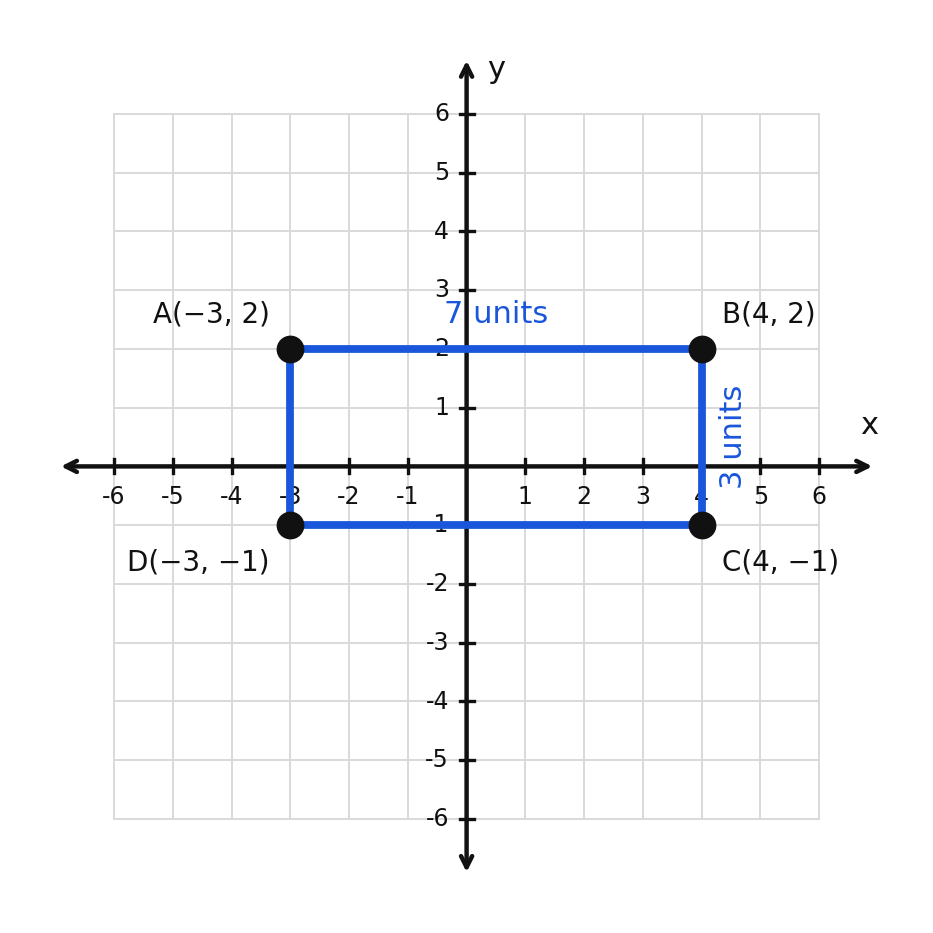
The rectangle in the figure has vertices , , , and .
Using coordinates to find side lengths
Look at side . Its endpoints and have the same -coordinate, so the side is horizontal, and Lesson 10.4 gives its length:
Side joins and . Those have the same -coordinate, so the side is vertical:
What you can and cannot measure this way. Coordinates give you the exact length of any side that is horizontal or vertical. A slanted side connects points that differ in both coordinates, and finding its length requires tools you will meet in a later course. In this chapter, only measure horizontal and vertical sides.
Perimeter and area
Once you have the horizontal and vertical side lengths of a rectangle, the formulas from earlier grades apply directly.
For rectangle above, with length 7 and width 3:
Finding a missing vertex
If three vertices of a rectangle are known, the fourth is forced. A rectangle has two pairs of matching sides, so the missing vertex must share an -coordinate with one known vertex and a -coordinate with another.
Worked examples
Example 1 — Side lengths of a rectangle
A rectangle has vertices , , , and . Find the length of each side.
The top and bottom sides are horizontal, since their endpoints share a -coordinate:
The left and right sides are vertical, since their endpoints share an -coordinate:
Answer: Two sides are 7 units and two sides are 3 units.
Example 2 — Perimeter and area
Find the perimeter and area of the rectangle in Example 1.
Answer: Perimeter units; area square units.
Example 3 — A right triangle
A triangle has vertices , , and . Find the lengths of the two sides you can measure with coordinates.
The side from to is vertical, since both -coordinates are :
The side from to is horizontal, since both -coordinates are :
The third side joins and , which differ in both coordinates, so it is slanted and cannot be measured with these tools.
Answer: The vertical side is 6 units and the horizontal side is 8 units.
Example 4 — A square
A square has vertices , , , and . Find its side length, perimeter, and area.
The side from to is vertical: . The side from to is horizontal: . All four sides are 5 units, which confirms the figure is a square.
Answer: Side 5 units; perimeter 20 units; area 25 square units.
Example 5 — Missing vertex
Three vertices of a rectangle are , , and . Find the fourth vertex.
The side from to is the top. The side from to is the right side. The fourth vertex must be directly below , so its -coordinate is , and directly left of , so its -coordinate is .
Answer:
Example 6 — Context
A dog run is laid out on a grid where each unit is one meter, with corners at , , , and . How much fencing surrounds it, and how much ground does it cover?
Horizontal side: meters. Vertical side: meters.
Answer: 28 meters of fencing; 48 square meters of ground.
Guided practice
- A side joins and . Is it horizontal or vertical, and how long is it?
- A side joins and . Is it horizontal or vertical, and how long is it?
- A rectangle has vertices , , , and . Find its perimeter.
- Find the area of the rectangle in item 3.
- Three vertices of a rectangle are , , and . Name the fourth vertex.
Independent practice
- A rectangle has vertices , , , and . Find the length of a horizontal side and the length of a vertical side.
- Find the perimeter and area of the rectangle in item 6.
- A triangle has vertices , , and . Give the lengths of the two sides that can be found from the coordinates, and explain why the third cannot.
- Three vertices of a rectangle are , , and . Name the fourth vertex and find the perimeter.
- A square has two vertices at and . Give the side length, and name two ordered pairs that could be the other vertices.
- Application. A community garden is a rectangle with corners at , , , and on a plan where each unit is one yard. Fencing costs $4 per yard. Find the perimeter and the total cost of fencing the garden.
- Reasoning. Kai says the distance between and is units because . Explain why this reasoning does not apply to those two points, and state what would have to be true for the method to work.
Exit ticket 10.5
- How long is the side joining and ?
- A rectangle has vertices , , , and . Find its area.
- Three vertices of a rectangle are , , and . Name the fourth.
- Explain how you can tell, from coordinates alone, that a side of a polygon is vertical.
Chapter 10 Review
Vocabulary. coordinate plane · -axis · -axis · origin · quadrant · ordered pair · -coordinate · -coordinate · graph · polygon · vertex
Part A — Axes, origin, and quadrants (6.MG.3a)
- Name the horizontal axis, the vertical axis, and the point where they meet.
- List the four quadrants in order, starting in the upper right, and give the sign pattern of each.
- Explain why the origin is not in any quadrant.
- Sketch a coordinate plane from to on both axes and label the two axes, the origin, and all four quadrants.
Part B — Locating a point from its ordered pair (6.MG.3b)
- Name the location of each: a) b) c) d) e)
- Write an ordered pair with integer coordinates for a point in Quadrant II and one for a point in Quadrant IV.
- A point has a positive -coordinate and a -coordinate of . Describe exactly where it is.
Part C — Graphing ordered pairs (6.MG.3c)
- Graph and label these points on one plane: , , , , , .
- Describe the moves that graph starting from the origin.
Part D — Identifying ordered pairs from points (6.MG.3d)
- Using the figure from Lesson 10.2, name the ordered pairs for points , , and .
- A point is graphed 6 units left of the origin and 4 units up. Write its ordered pair.
- A point is graphed on the -axis, 10 units right of the origin. Write its ordered pair.
Part E — Distance from the axes and between points (6.MG.3e)
- Give the distance from each axis for a) b)
- Find each distance: a) between and b) between and
- Point is at . Write the ordered pair for the point 11 units to the right of .
- Explain how two ordered pairs tell you whether the points share a vertical line.
Part F — Polygons in the coordinate plane (6.MG.3f)
- A rectangle has vertices , , , and . Find both side lengths, the perimeter, and the area.
- Three vertices of a rectangle are , , and . Name the fourth vertex.
- A triangle has vertices , , and . Find the lengths of the horizontal and vertical sides.
Part G — Mixed application and reasoning
- A park map uses one unit per block, with the fountain at the origin. The gate is at , the pond at , and the playground at . Find the distance from the gate to the pond and from the pond to the playground, then name the quadrant containing the playground.
- A rectangular pool deck has corners at , , , and , with each unit equal to one meter. Find the area of the deck and the length of railing needed to surround it.
- Explain why the point is 9 units from the -axis but 0 units from the -axis.
- Two points share the same -coordinate and are 14 units apart. One of them is . Name both points that the other could be, and explain how you found them.
Standards coverage check — Chapter 10
| Knowledge and Skill | Where it is taught | Where it is practiced |
|---|---|---|
| 6.MG.3a — identify and label the axes, origin, and quadrants | 10.1 | 10.1 all sets; Review Part A |
| 6.MG.3b — identify and describe the location (quadrant or axis) of a point given as an ordered pair | 10.1, 10.3 | 10.1, 10.3 all sets; Review Part B |
| 6.MG.3c — graph ordered pairs in the four quadrants and on the axes | 10.2 | 10.2 all sets; 10.5; Review Part C |
| 6.MG.3d — identify ordered pairs represented by points in the quadrants and on the axes | 10.2 | 10.2 all sets; Review Part D |
| 6.MG.3e — relate coordinates to distance from each axis; relate a point to another point on the same horizontal or vertical line | 10.4 | 10.4 all sets; 10.5; Review Part E |
| 6.MG.3f — draw polygons from given vertices; use coordinates to find the length of a horizontal or vertical side | 10.5 | 10.5 all sets; Review Parts F and G |
Answer keys for every set in this chapter are in Appendix A.