Chapter 9 — Proportional Relationships and Unit Rate
Standard: 6.PFA.2 — The student will identify and represent proportional relationships between two quantities, including those in context (unit rates are limited to positive values).
By the end of this chapter you will be able to:
- Identify the unit rate of a proportional relationship from a table, a context, or a graph (6.PFA.2a)
- Determine a missing value in a ratio table using the unit rate (6.PFA.2b)
- Determine whether a proportional relationship exists, given a table, a context, or a graph (6.PFA.2c)
- Find the unit rate for a context and create a table of values or a graph (6.PFA.2d)
- Make connections among verbal descriptions, ratio tables, and graphs of the same proportional relationship (6.PFA.2e)
Lessons: 9.1 Unit Rate · 9.2 Finding Missing Values in a Ratio Table · 9.3 Deciding Whether a Relationship Is Proportional · 9.4 Graphing Proportional Relationships · 9.5 Connecting Tables, Graphs, and Verbal Descriptions
Every rate in this chapter is positive. You will never be asked for a negative unit rate.
Lesson 9.1 — Unit Rate
Rates compare different units
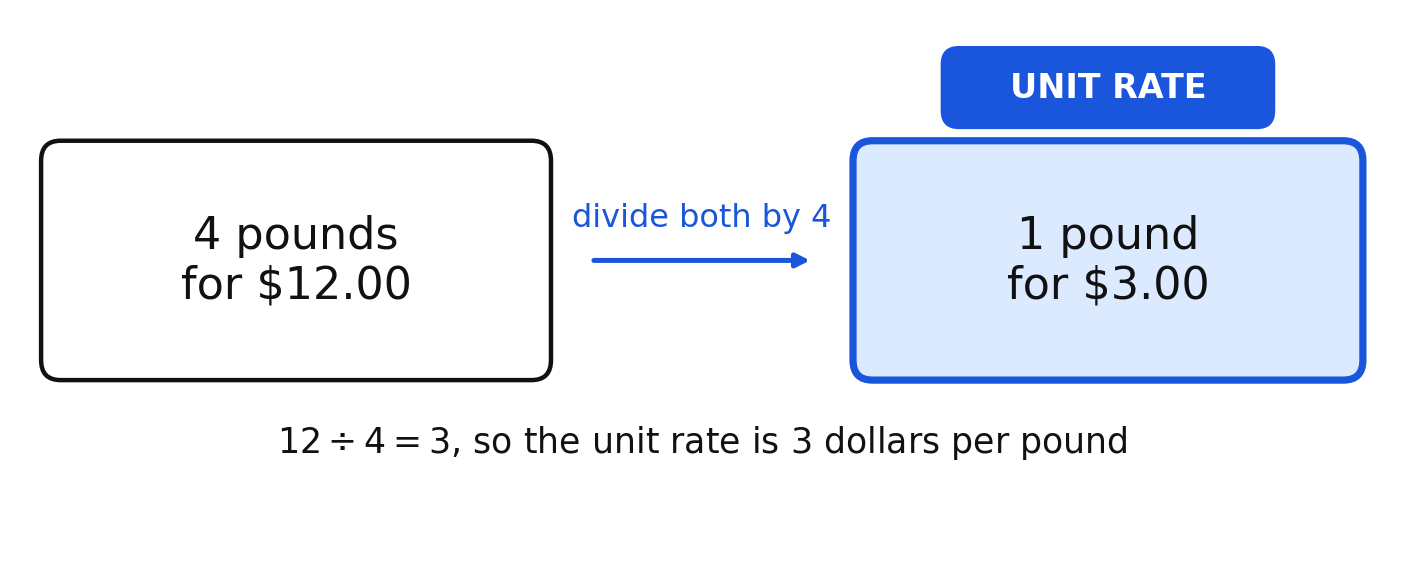
In Chapter 8 you compared apples to oranges and walkers to riders. A rate is a ratio that compares two quantities measured in different units: 180 miles in 3 hours, 12 dollars for 4 pounds, 250 words in 5 minutes.
A unit rate is a rate whose second quantity is 1. It answers "how much for exactly one?"
To find a unit rate, divide the first quantity by the second:
The word per means "for each one." Sixty miles per hour, three dollars per pound, fifty words per minute — every one of these is a unit rate.
Finding a unit rate from a table
A ratio table gives you many pairs, and every pair produces the same unit rate when the relationship is proportional.
| Books | 3 | 6 | 9 |
|---|---|---|---|
| Cost (dollars) | 21 | 42 | 63 |
Divide cost by books in each column:
The unit rate is 7 dollars per book. Checking more than one column is worth the few extra seconds: if the quotients disagree, the table is not showing a single constant rate, which is the subject of Lesson 9.3.
Finding a unit rate from a graph
On a graph of a proportional relationship, the unit rate is the second coordinate of the point where the first coordinate is 1. If a graph of distance against time passes through , the unit rate is 4 miles per hour. You will work with graphs in detail in Lesson 9.4.
Saying the unit rate correctly
Always attach both units, in the right order. "60 miles per hour" and "60 hours per mile" use the same number and describe wildly different situations. Write the unit you divided by after the word "per."
Worked examples
Example 1 — From a context
A car travels 180 miles in 3 hours. Find the unit rate.
Divide the miles by the hours.
Answer: 60 miles per hour
Example 2 — Cost per pound
Four pounds of cheese cost 12 dollars. Find the price per pound.
Answer: 3 dollars per pound
Example 3 — From a table
Find the unit rate.
| Minutes | 5 | 10 | 15 |
|---|---|---|---|
| Words typed | 250 | 500 | 750 |
Divide words by minutes in each column: , , .
Answer: 50 words per minute
Example 4 — From a graph
A graph of cost against number of tickets passes through and . Find the unit rate.
The point with first coordinate 1 gives the unit rate directly. Checking with the other point: .
Answer: 9 dollars per ticket
Example 5 — A unit rate that is not a whole number
Seven apples cost 3 dollars and 50 cents. Find the price per apple.
Answer: 0.50 dollars per apple, or 50 cents per apple
Guided practice
A cyclist rides 120 miles in 4 hours. Find the unit rate in miles per hour.
Six pens cost 18 dollars. Find the price per pen.
A student types 84 words in 2 minutes. Find the words per minute.
Find the unit rate.
Hours 2 4 6 Dollars earned 9 18 27 A graph of cost against pounds passes through . What is the unit rate, and what does it mean?
Independent practice
Find each unit rate: a) 135 miles in 3 hours b) 10 dollars for 5 pounds
Eight bottles hold 96 ounces in all. Find the ounces per bottle.
Find the unit rate.
Tickets 4 8 12 Cost (dollars) 30 60 90 A graph of pages read against hours passes through and . Find the unit rate and state its units.
A car goes 300 miles on 12 gallons of gas. Find the miles per gallon.
Application. A store sells cashews two ways: 3 pounds for 7 dollars and 50 cents, or 5 pounds for 11 dollars and 25 cents. Find both unit rates and decide which is the better buy.
Reasoning. From "180 miles in 3 hours" you can compute or Explain what each quotient means and why 60 miles per hour is the answer to the question "how far in one hour?"
Exit ticket 9.1
A train travels 240 miles in 4 hours. Find the unit rate.
Eight notebooks cost 24 dollars. Find the price per notebook.
Find the unit rate.
Bags 5 10 Pounds 40 80 Explain in your own words what a unit rate tells you.
Lesson 9.2 — Finding Missing Values in a Ratio Table
The unit rate is the key
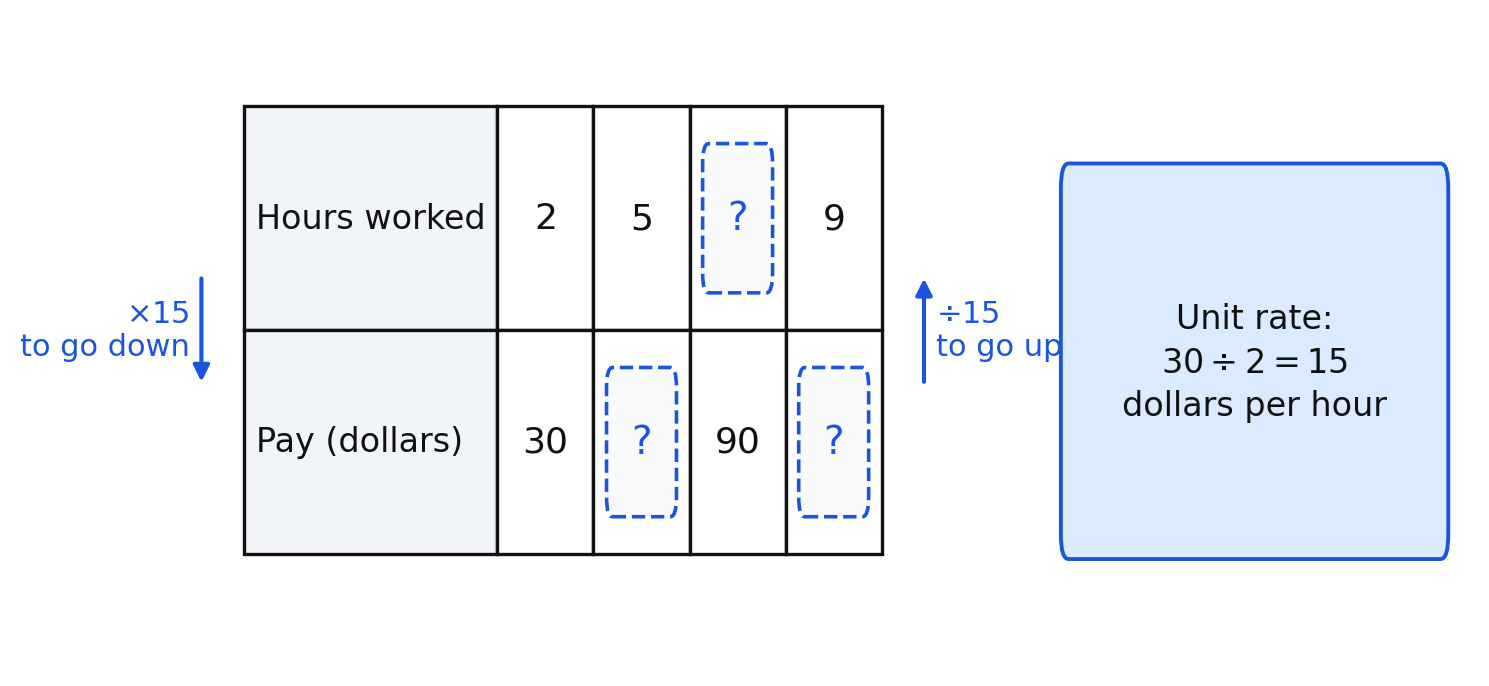
A ratio table can have holes in it. The fastest way to fill them is to find the unit rate once, then use it on every missing entry.
| Hours worked | 2 | 5 | ? | 9 |
|---|---|---|---|---|
| Pay (dollars) | 30 | ? | 90 | ? |
Use the complete column to find the unit rate: dollars per hour.
Now fill the rest.
- 5 hours: dollars
- 90 dollars: hours
- 9 hours: dollars
| Hours worked | 2 | 5 | 6 | 9 |
|---|---|---|---|---|
| Pay (dollars) | 30 | 75 | 90 | 135 |
Two directions, two operations
The unit rate works both ways, and choosing the wrong operation is the most common error here.
- Given the first quantity, find the second: multiply by the unit rate.
- Given the second quantity, find the first: divide by the unit rate.
For pay at 15 dollars per hour: hours = pay, and pay = hours.
A quick sanity check catches mistakes. More hours should mean more pay. If your answer for 9 hours came out smaller than the pay for 5 hours, you divided when you should have multiplied.
Filling a table from a context
When the table starts from a story, pull the unit rate out of the story first.
A recipe uses 3 cups of broth for every 2 cups of rice. How much broth goes with 7 cups of rice?
Unit rate: cups of broth per cup of rice. For 7 cups of rice, cups of broth.
Worked examples
Example 1 — One missing value
Three pounds of grapes cost 12 dollars. Find the cost of 7 pounds.
Unit rate: dollars per pound. Then .
Answer: 28 dollars
Example 2 — Filling two blanks in a table
| Gallons | 2 | 5 | 8 |
|---|---|---|---|
| Miles | 62 | ? | ? |
Unit rate: miles per gallon. and .
Answer: 155 miles and 248 miles
Example 3 — Working backward
Notebooks cost 9 dollars each. How many can be bought with 45 dollars?
Going from the second quantity to the first means dividing.
Answer: 5 notebooks
Example 4 — Blanks in both rows
| Cups of mix | 4 | ? | 12 |
|---|---|---|---|
| Servings | 10 | 25 | ? |
Unit rate: servings per cup. cups, and servings.
Answer: 10 cups and 30 servings
Example 5 — From a context with money
Six pencils cost 1 dollar and 50 cents. Find the cost of 20 pencils.
Unit rate: dollars per pencil. .
Answer: 5 dollars
Guided practice
Five kilograms of flour cost 20 dollars. Find the cost of 9 kilograms.
Find the missing value.
Boxes 3 6 ? Cans 24 48 96 A car travels 220 miles in 4 hours at a steady speed. How far does it travel in 7 hours?
Complete the table for a rate of 3.5 units of the second quantity per unit of the first.
First quantity 2 4 10 Second quantity 7 ? ? Explain how the unit rate lets you fill in any missing value in a ratio table.
Independent practice
Find the missing value.
Items 1 3 ? 10 Cost (dollars) 6 18 48 60 Eight muffins cost 10 dollars. Find the cost of 14 muffins.
Complete the table.
Minutes 4 ? 12 Pages 6 15 ? Three gallons of paint cover 1,050 square feet. How many square feet do 7 gallons cover?
Complete the table.
Cups 2 5 ? 11 Servings 6 15 24 ? Application. A car travels 250 miles on 10 gallons of gas. Find the miles per gallon, then find how far the car goes on 16 gallons and how many gallons it needs for 350 miles.
Reasoning. To find the cost of 12 pounds of apples at 2 dollars per pound, Sam computed and answered 6 dollars. Explain the error, give the correct answer, and describe a quick check that would have caught it.
Exit ticket 9.2
Six pounds of rice cost 9 dollars. Find the cost of 10 pounds.
Complete the table.
Hours 3 5 9 Miles 21 ? ? A student solves 15 problems in 45 minutes at a steady pace. How long will 25 problems take?
Explain when you multiply by the unit rate and when you divide by it.
Lesson 9.3 — Deciding Whether a Relationship Is Proportional
What makes a relationship proportional
Two quantities are in a proportional relationship when every pair of values forms the same ratio — in other words, when the relationship has one constant unit rate that works for every pair.
Doubling one quantity doubles the other. Tripling one triples the other. Nothing extra gets added along the way.
The test looks different in a table, in a context, and in a graph, but it is really the same test three times.
Test 1 — From a table
Divide the second quantity by the first in every column. If all the quotients agree, the relationship is proportional.
Proportional:
| Pounds | 2 | 4 | 7 |
|---|---|---|---|
| Cost (dollars) | 10 | 20 | 35 |
, , . One constant unit rate of 5 dollars per pound, so yes.
Not proportional:
| Hours | 1 | 2 | 3 |
|---|---|---|---|
| Cost (dollars) | 8 | 14 | 20 |
, but and . The quotients disagree, so no. Looking closely, this table charges 2 dollars up front plus 6 dollars per hour. That starting charge is exactly what breaks proportionality.
Test 2 — From a context
Read the story for two things:
- Is there a constant rate? "3 dollars per pound," "12 gallons per minute," "45 words per minute."
- Is there a starting amount, fee, or head start? A flat fee, a membership charge, a delivery charge, or a tank that already has water in it.
Constant rate and no starting amount means proportional. Any starting amount means not proportional.
- A store sells rope for 2 dollars per foot. Proportional. Zero feet costs zero dollars.
- A plumber charges a 45 dollar call fee plus 30 dollars per hour. Not proportional. Zero hours still costs 45 dollars.
Test 3 — From a graph
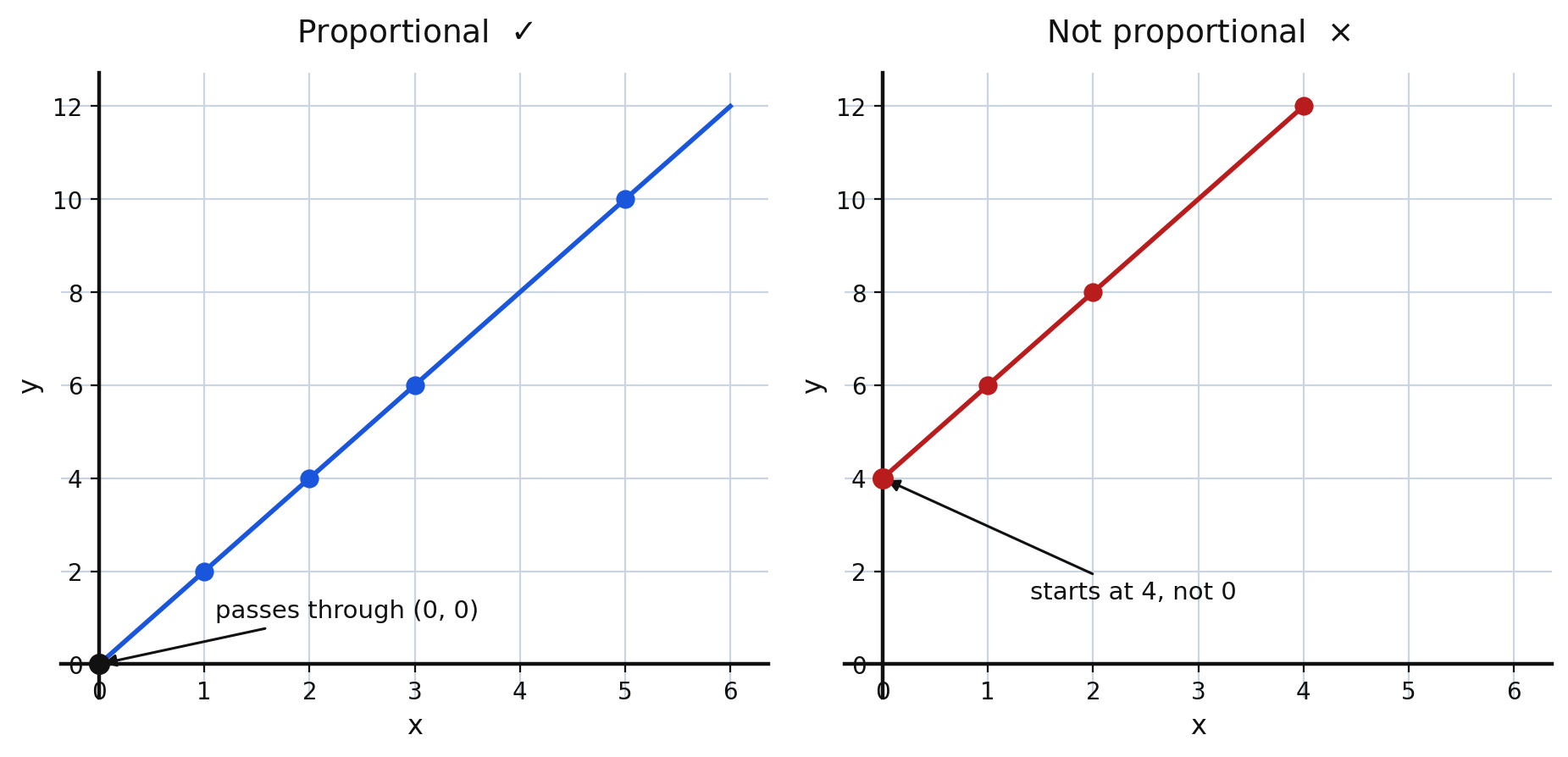
A relationship is proportional exactly when its graph is a straight line that passes through the origin, the point .
Both conditions matter. A straight line that crosses the vertical axis at is not proportional, because it starts with 5 already in place. A curve is not proportional either, because its rate keeps changing.
Worked examples
Example 1 — A proportional table
Is this relationship proportional?
| Bags | 2 | 4 | 7 |
|---|---|---|---|
| Pounds | 10 | 20 | 35 |
, , .
Answer: Yes. The unit rate is a constant 5 pounds per bag.
Example 2 — A table that fails the test
Is this relationship proportional?
| Rides | 1 | 2 | 3 |
|---|---|---|---|
| Cost (dollars) | 8 | 14 | 20 |
but .
Answer: No. The ratios are not all equal, so there is no single unit rate.
Example 3 — A context with a fee
A gym charges a 20 dollar sign-up fee plus 5 dollars per visit. Is the total cost proportional to the number of visits?
Zero visits still costs 20 dollars, so the graph would not pass through the origin. Check two pairs: 1 visit costs 25 dollars and 2 visits cost 30 dollars, and while .
Answer: No. The sign-up fee breaks the proportional relationship.
Example 4 — A context without a fee
A market sells peaches for 3 dollars per pound with no other charges. Is cost proportional to weight?
There is one constant rate and no starting amount. Zero pounds costs zero dollars.
Answer: Yes, with a unit rate of 3 dollars per pound.
Example 5 — From a graph
A graph of distance against time is a straight line through , , and . Is it proportional? If so, give the unit rate.
Straight, and through the origin. Check: and .
Answer: Yes, proportional, with a unit rate of 3 units of distance per unit of time.
Example 6 — A graph that misses the origin
A straight-line graph passes through and . Is it proportional?
It is straight, but it starts at 4 when the first quantity is 0. Also , and dividing by zero is not even defined.
Answer: No. A proportional graph must pass through the origin.
Guided practice
Is this proportional? If yes, give the unit rate.
Hours 2 5 9 Miles 6 15 27 Is this proportional?
Days 1 2 3 Cost (dollars) 4 7 10 A gym charges a 20 dollar fee plus 5 dollars per visit. Proportional or not? Explain.
A store sells apples at 3 dollars per pound with no other charge. Proportional or not? Explain.
A straight-line graph passes through the origin. What does that tell you?
Independent practice
Decide whether each table shows a proportional relationship, and give the unit rate when it does.
a)
Items 4 8 12 Cost (dollars) 9 18 27 b)
Items 2 4 6 Cost (dollars) 5 9 13 A pool starts empty and fills at 12 gallons per minute. Is the amount of water proportional to time? Explain.
A plumber charges a 45 dollar call fee plus 30 dollars per hour. Is the total charge proportional to the hours worked? Explain.
A graph passes through , , and . Is it proportional? Give the unit rate.
A straight-line graph passes through and . Is it proportional? Explain.
Application. Plan A charges 10 cents per minute with no monthly fee. Plan B charges a 5 dollar monthly fee plus 5 cents per minute. Decide which plan gives a proportional relationship between minutes and cost, and find the cost of 200 minutes on each plan.
Reasoning. Owen says, "The graph is a perfectly straight line, so the relationship must be proportional." Explain why a straight line is not enough, and give an example of a straight-line graph that is not proportional.
Exit ticket 9.3
Is this proportional? Give the unit rate if it is.
Hours 3 6 10 Dollars 12 24 40 Is this proportional?
Items 1 2 Cost (dollars) 3 5 A delivery service charges 8 dollars plus 2 dollars per package. Proportional or not?
Explain why a proportional graph has to pass through .
Lesson 9.4 — Graphing Proportional Relationships
From table to points
Every column of a ratio table is an ordered pair you can plot. Put the first quantity on the horizontal axis and the second on the vertical axis.
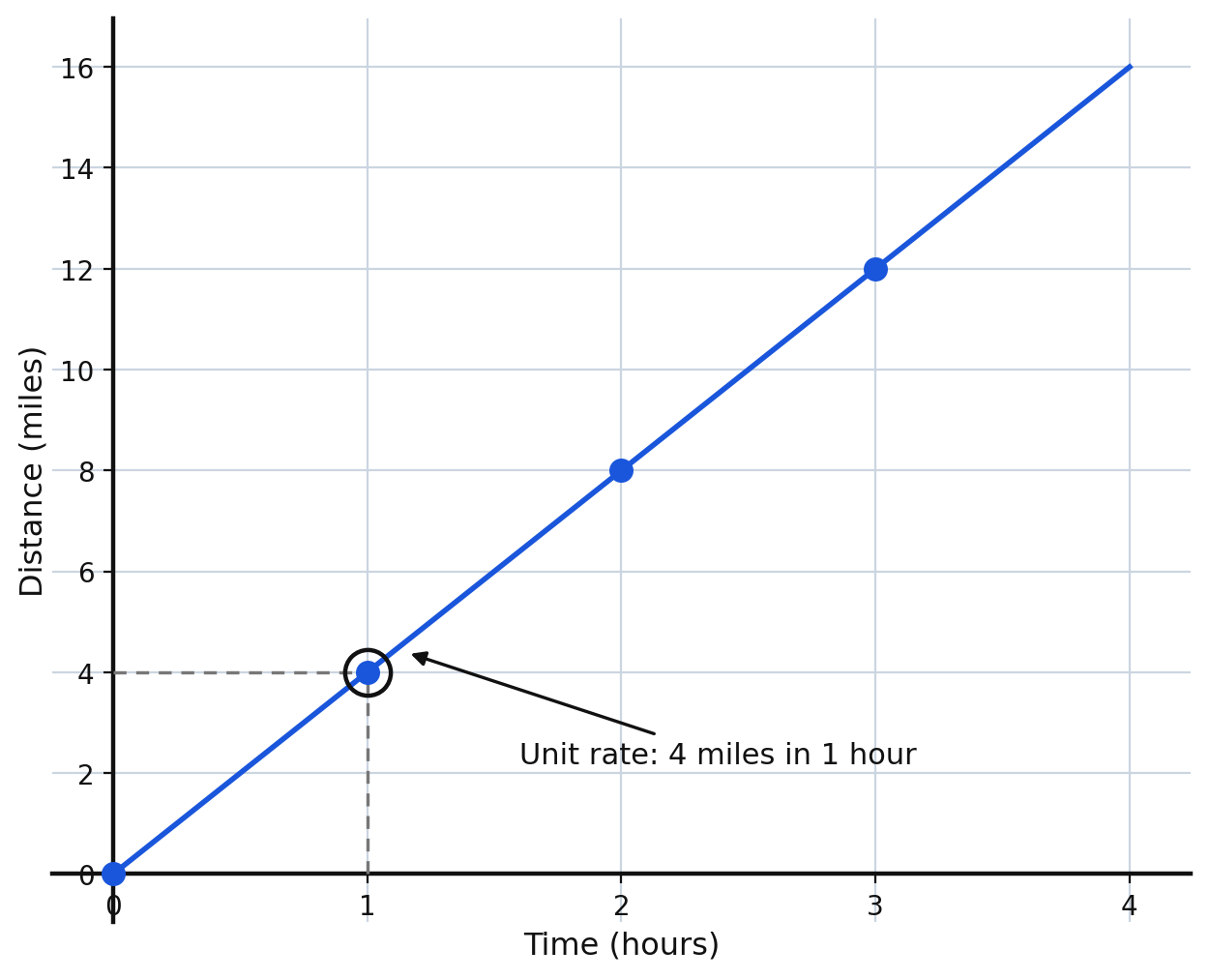
A bike rider covers 4 miles every hour:
| Time (hours) | 0 | 1 | 2 | 3 |
|---|---|---|---|---|
| Distance (miles) | 0 | 4 | 8 | 12 |
The ordered pairs are , , , and . Plot them and they line up perfectly, and the line runs straight through the origin.
Including the point
Zero hours of riding covers zero miles. Every proportional relationship contains the pair , so the point belongs on the graph even when the table does not list it.
Reading the unit rate off a graph
The point where the horizontal coordinate is 1 gives the unit rate as its vertical coordinate. On the graph above, says 4 miles in 1 hour.
If the graph does not show the point at 1, use any point and divide: from , the unit rate is .
Steeper means faster
When two proportional relationships are graphed on the same axes, the one with the greater unit rate rises more steeply. A line through climbs faster than a line through , because it gains 5 units for every 1 unit across instead of 3.
Building a graph from a context
- Find the unit rate.
- Make a short table, starting at 0.
- Plot the ordered pairs.
- Draw a straight line from the origin through the points.
- Label both axes with the quantity and its unit.
Step 5 is not decoration. An unlabeled graph cannot be read by anyone, including you next week.
Worked examples
Example 1 — Table to ordered pairs
Write the ordered pairs for this table and say whether the graph passes through the origin.
| Hours | 1 | 2 | 3 |
|---|---|---|---|
| Miles | 3 | 6 | 9 |
Answer: , , . The unit rate is 3 miles per hour and the relationship is proportional, so the graph also contains .
Example 2 — Unit rate from a graph
A proportional graph passes through . What is the unit rate, and what is the second coordinate when the first is 5?
The point at 1 gives the unit rate directly: 7. Then .
Answer: unit rate 7; the point is
Example 3 — Unit rate from a point that is not at 1
A proportional graph passes through . Find the unit rate and the value when the first quantity is 5.
Answer: unit rate 7; the value is 35
Example 4 — Context to table to graph
Tickets cost 2 dollars and 50 cents each. Build a table for 0 to 4 tickets and list the points to plot.
| Tickets | 0 | 1 | 2 | 3 | 4 |
|---|---|---|---|---|---|
| Cost (dollars) | 0 | 2.50 | 5.00 | 7.50 | 10.00 |
Answer: plot , , , , and draw a straight line from the origin through them
Example 5 — Comparing two graphs
Line A passes through and line B passes through . Which is steeper, and what does that mean if both graphs show distance against time?
Answer: Line B is steeper. Its unit rate of 5 is greater than 3, so B represents the faster trip.
Guided practice
Write the ordered pairs for this table.
Hours 1 2 3 Miles 3 6 9 A proportional graph passes through . What is the unit rate?
Why does a proportional graph include the point ?
A hiker walks 6 miles per hour. Make a table for 1, 2, 3, and 4 hours.
A proportional graph passes through . Find the unit rate.
Independent practice
Write the ordered pairs for this table and give the unit rate.
Bags 2 4 6 Pounds 10 20 30 A proportional graph passes through . Find the unit rate, then find the second coordinate when the first coordinate is 5.
Blueberries cost 2 dollars and 50 cents per pound. Make a table for 1, 2, 3, and 4 pounds, then list the ordered pairs to plot.
Line A passes through and line B passes through . Which is steeper, and what does the steepness mean?
A proportional graph passes through . Find the unit rate, then find the first coordinate when the second coordinate is 45.
Application. A printer prints 15 pages per minute. Build a table for 0, 1, 2, 3, and 4 minutes, list the ordered pairs, and state how many minutes 90 pages will take.
Reasoning. A classmate plots , , and , then draws a line that stops at and never reaches the axis. Explain what is missing and why the origin belongs on this graph.
Exit ticket 9.4
Write the ordered pairs for this table.
Hours 1 2 3 Pages 8 16 24 A proportional graph passes through . What is the unit rate?
For that same graph, what is the second coordinate when the first is 7?
Explain how you can tell from a graph that a relationship is proportional.
Lesson 9.5 — Connecting Tables, Graphs, and Verbal Descriptions
One relationship, three views
A proportional relationship can be described in words, organized in a ratio table, or drawn as a graph. All three carry exactly the same information, and the unit rate is the thread that ties them together.
Take this situation: A store sells grapes for 2 dollars per pound.
| Pounds | 0 | 1 | 2 | 3 | 4 |
|---|---|---|---|---|---|
| Cost (dollars) | 0 | 2 | 4 | 6 | 8 |
Graphed, those pairs make a straight line from the origin through , , , and .
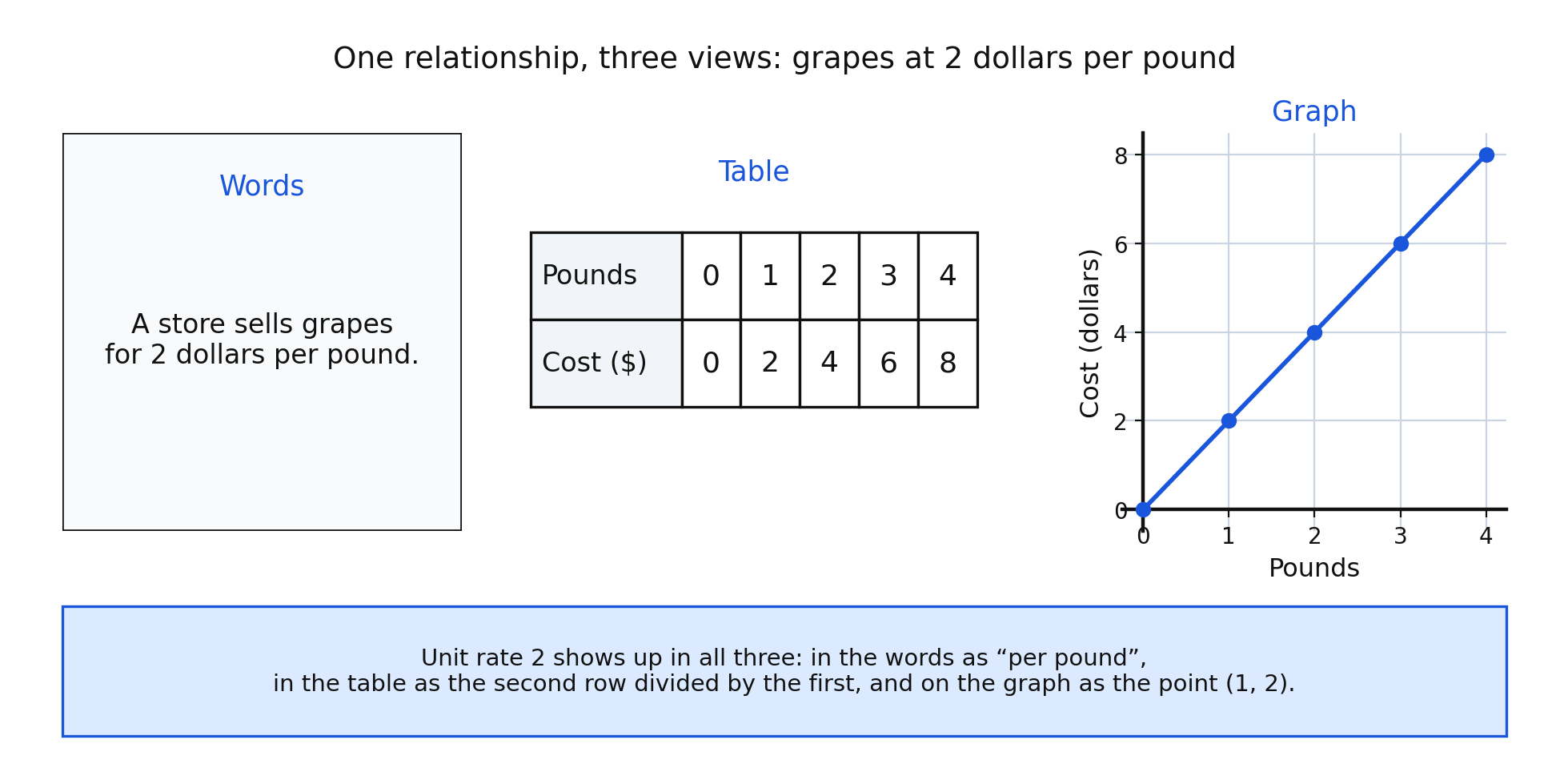
Where the unit rate lives in each view
| Representation | Where you find the unit rate |
|---|---|
| Words | after the word "per," or in a phrase like "for each" |
| Table | second quantity divided by first, in any column |
| Graph | the vertical coordinate of the point where the horizontal coordinate is 1 |
Once you have the unit rate from any one view, you can build the other two.
Moving between the views
Words to table. Find the unit rate, start the table at 0, and multiply.
Table to words. Divide a column to get the unit rate, then write a sentence naming both quantities with the word "per."
Graph to table. Read the coordinates of the plotted points and copy them into two rows.
Table to graph. Treat each column as an ordered pair and plot it, then draw a line from the origin.
Comparing two relationships across views
When two relationships are given in different forms, convert them to the same form — usually the unit rate — before comparing.
Runner A covers 6 kilometers in 30 minutes. Runner B's graph passes through , where the first coordinate is minutes and the second is kilometers. Who is faster?
Runner A: kilometers per minute. Runner B: kilometers per minute.
Runner B is faster, because 0.25 is greater than 0.2.
Worked examples
Example 1 — Table to words
Write a verbal description for this table.
| Hours | 1 | 2 |
|---|---|---|
| Dollars | 9 | 18 |
and .
Answer: The job pays 9 dollars per hour.
Example 2 — Words to table
A babysitter earns 4 dollars per hour. Make a table for 0 through 4 hours.
| Hours | 0 | 1 | 2 | 3 | 4 |
|---|---|---|---|---|---|
| Dollars | 0 | 4 | 8 | 12 | 16 |
Answer: the table above
Example 3 — Graph to words
A proportional graph of cost against pounds passes through . Describe the relationship in words.
Answer: The item costs 12 dollars per pound.
Example 4 — Words to graph
A faucet fills 7 gallons per minute. List the points that belong on the graph for 0 through 4 minutes.
, , , , .
Answer: , , , , , joined by a straight line through the origin
Example 5 — Comparing across representations
Car A travels 150 miles in 3 hours. Car B's graph passes through , with hours on the horizontal axis and miles on the vertical axis. Which car is faster?
Car A: miles per hour. Car B: 45 miles per hour.
Answer: Car A is faster, by 5 miles per hour.
Guided practice
Write a verbal description for this table.
Hours 1 2 Miles 9 18 A worker earns 4 dollars per hour. Make a table for 0 through 4 hours.
A proportional graph passes through . Write a verbal description and state the unit rate.
Car A travels 150 miles in 3 hours. Car B's graph passes through with hours across and miles up. Which is faster?
Explain what the point tells you on the graph of a proportional relationship.
Independent practice
A car gets 20 miles per gallon. Make a table for 1 through 5 gallons and list the ordered pairs.
Find the unit rate for this table and write a verbal description.
Hours 2 4 6 Dollars 7 14 21 A proportional graph passes through . Find the unit rate and build a table for 1, 2, 3, and 4.
Which of these describe the same relationship: (i) "3 dollars per pound," (ii) a table with 2 pounds costing 6 dollars and 5 pounds costing 15 dollars, (iii) a graph through ? Justify your choice.
A relationship has the unit rate 6. Describe it in words, give three columns of a table, and name three points on its graph.
Application. Runner A covers 6 kilometers in 30 minutes. Runner B's graph passes through , with minutes across and kilometers up. Find both unit rates, decide who is faster, and state how far each runner goes in 60 minutes.
Reasoning. Explain where you see the unit rate in a table and where you see it on a graph, and why those two places give the same number.
Exit ticket 9.5
Find the unit rate for this table.
Pounds 3 6 Dollars 15 30 A machine makes 24 parts per hour. Name the point on its graph where the first coordinate is 1.
A proportional graph passes through . Write a verbal description of a situation it could represent.
Explain how a table and a graph of the same proportional relationship carry the same information.
Chapter 9 Review
Vocabulary. rate · unit rate · per · proportional relationship · ratio table · ordered pair · origin
Part A — Identifying the unit rate (6.PFA.2a)
Find the unit rate.
Books 3 6 9 Dollars 21 42 63 A car travels 156 miles in 3 hours. Find the miles per hour.
A proportional graph passes through . State the unit rate.
Part B — Missing values in a ratio table (6.PFA.2b)
Complete the table.
First quantity 2 5 ? Second quantity 9 ? 36 Four pounds of coffee cost 14 dollars. Find the cost of 10 pounds.
Part C — Deciding whether a relationship is proportional (6.PFA.2c)
Is this proportional? Give the unit rate if it is.
Items 2 3 5 Cost (dollars) 8 12 20 Is this proportional?
Items 1 2 Cost (dollars) 6 11 A tutoring service charges a 12 dollar registration fee plus 4 dollars per hour. Proportional or not? Explain.
A straight-line graph passes through and . Proportional or not? Explain.
Part D — From a context to a table or graph (6.PFA.2d)
- A faucet fills 7 gallons per minute. Find the unit rate, build a table for 0 through 5 minutes, and list the ordered pairs.
- Three shirts cost 36 dollars. Find the unit rate and build a table for 1 through 5 shirts.
Part E — Connecting representations (6.PFA.2e)
For the table below, write a verbal description and name the point on the graph where the first coordinate is 1.
Hours 2 4 Miles 13 26 A proportional graph passes through . Find the unit rate and build a three-column table.
Which representations describe the same relationship: (i) "5 dollars per hour," (ii) a table with 3 hours paying 15 dollars, (iii) a graph through ? Explain.
Part F — Mixed application and reasoning
- A store sells 5 pounds of rice for 12 dollars and 50 cents. Find the unit rate, then find the cost of 8 pounds and the weight you can buy for 20 dollars.
- Plan A charges 10 cents per minute. Plan B charges a 5 dollar fee plus 5 cents per minute. Which plan is proportional? Find the cost of 200 minutes on each.
- Explain why a graph that is a straight line but crosses the vertical axis above the origin is not proportional.
- Two workers are paid at different rates. Worker A earns 108 dollars in 9 hours. Worker B's graph passes through , with hours across and dollars up. Find both unit rates and state who earns more per hour and by how much.
Standards coverage check — Chapter 9
| Knowledge and Skill | Where it is taught | Where it is practiced |
|---|---|---|
| 6.PFA.2a — identify the unit rate from a table, context, or graph | 9.1 | 9.1 all sets; 9.5 items 1, 7, 8; Review Part A |
| 6.PFA.2b — determine a missing value in a ratio table using a unit rate | 9.2 | 9.2 all sets; Review Part B |
| 6.PFA.2c — determine whether a proportional relationship exists from a table, context, or graph | 9.3 | 9.3 all sets; Review Part C, item 17 |
| 6.PFA.2d — given a context, find the unit rate and create a table or graph | 9.4 | 9.4 items 4, 8, 11; 9.5 items 2, 6; Review Part D |
| 6.PFA.2e — connect verbal descriptions, ratio tables, and graphs | 9.5 | 9.5 all sets; Review Part E, item 18 |
Answer keys for every set in this chapter are in Appendix A.