Chapter 8 — Ratios
Standard: 6.PFA.1 — The student will use ratios to represent relationships between quantities, including those in context.
By the end of this chapter you will be able to:
- Represent a relationship between two quantities using ratios (6.PFA.1a)
- Represent a relationship in context using the notations , , and " to " (6.PFA.1b)
- Represent different comparisons within the same quantity or between different quantities — part to part, part to whole, whole to whole (6.PFA.1c)
- Create a relationship in words for a given ratio expressed symbolically (6.PFA.1d)
- Create a table of equivalent ratios when given a ratio (6.PFA.1e)
- Create a table of equivalent ratios when given a contextual situation (6.PFA.1f)
Lessons: 8.1 What a Ratio Is · 8.2 Three Ways to Write a Ratio · 8.3 Part-to-Part, Part-to-Whole, Whole-to-Whole · 8.4 Equivalent Ratios and Ratio Tables · 8.5 Writing a Situation for a Ratio
Lesson 8.1 — What a Ratio Is
Comparing by "for every"
You already know how to compare two amounts by subtracting. If a bowl holds 4 apples and 7 oranges, there are 3 more oranges than apples. That is a comparison by difference, and it answers "how many more?"
This chapter is about a different kind of comparison, one that answers a question like "how many oranges are there for every apple?" A ratio is a comparison of two quantities by division. It tells you how the two amounts pair up, not how far apart they are.
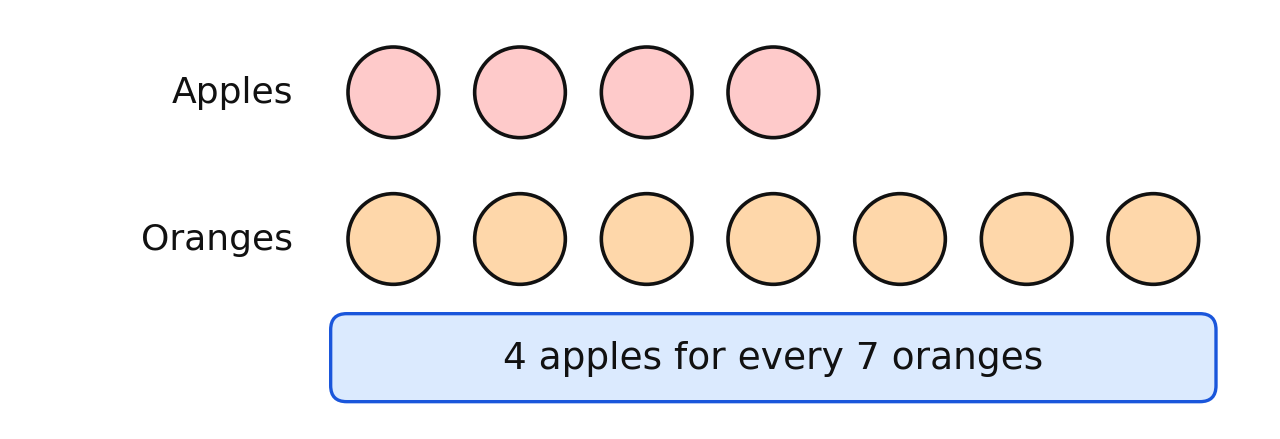
For the bowl above, the ratio of apples to oranges is 4 to 7. Read that as "four to seven." It means the bowl pairs 4 apples with 7 oranges.
Order matters
A ratio carries an order, and swapping the order changes what the ratio says.
- The ratio of apples to oranges is to .
- The ratio of oranges to apples is to .
Both statements describe the same bowl, but they answer different questions. Always write the quantities in the order the question names them. The first quantity named goes first.
Ratios are not always about "how many." You can compare measurements too: 3 cups of water to 2 cups of juice, or 5 miles in 20 minutes. Anything you can count or measure can go into a ratio.
The two quantities in a ratio
The two amounts in a ratio are called its terms. In the ratio to , the first term is and the second term is . Naming the terms in order, and saying what each one counts, is a habit worth building now, because in the next lesson you will meet three different ways to write the same comparison.
A ratio can compare:
- Two parts of one group (apples to oranges in one bowl)
- A part to the whole group (apples to all the fruit)
- Two separate groups (the fruit in my bowl to the fruit in your bowl)
You will study all three kinds in Lesson 8.3.
Worked examples
Example 1 — Writing a ratio from a picture
A tray holds 5 muffins and 8 rolls. Write the ratio of muffins to rolls.
The question names muffins first, so the muffin count is the first term.
Answer: to
Example 2 — Reversing the order
Using the same tray, write the ratio of rolls to muffins.
Now rolls are named first.
Answer: to
Example 3 — A ratio from a measurement
A recipe uses 3 cups of flour and 2 cups of milk. Write the ratio of flour to milk, then say in words what it means.
Flour is named first, so 3 is the first term.
Answer: to . For every 3 cups of flour, the recipe uses 2 cups of milk.
Example 4 — Two different quantities
A car travels 120 miles using 4 gallons of gas. Write the ratio of miles to gallons.
Miles first, gallons second. The two quantities have different units, and that is fine.
Answer: to
Example 5 — Deciding what is being compared
In a class of 24 students, 10 walk to school and 14 ride the bus. A student writes "the ratio is to ." What comparison did that student make?
The 10 counts walkers. The 24 counts everyone in the class, not just the riders.
Answer: The student compared walkers to the whole class, not walkers to riders. The ratio of walkers to riders would be to .
Guided practice
- A basket has 6 pears and 9 plums. Write the ratio of pears to plums.
- Using the same basket, write the ratio of plums to pears.
- A paint mix uses 2 quarts of blue and 5 quarts of white. Write the ratio of blue to white.
- Explain the difference between saying "there are 3 more oranges than apples" and "the ratio of apples to oranges is 4 to 7."
- A printer makes 30 pages in 5 minutes. Write the ratio of pages to minutes.
Independent practice
- A shelf holds 7 novels and 4 comic books. Write: a) the ratio of novels to comics b) the ratio of comics to novels
- A team won 11 games and lost 5. Write the ratio of wins to losses.
- A trail mix uses 4 scoops of nuts for every 3 scoops of raisins. Write the ratio of raisins to nuts.
- Write in words what the ratio " to " means for a garden with 9 tomato plants and 2 pepper plants.
- A bus holds 48 riders and travels 6 miles per trip. Name two different quantities in this situation you could compare with a ratio, and write one of those ratios.
- Application. A juice recipe calls for 5 cups of water for every 2 cups of concentrate. A cook uses 5 cups of concentrate and 2 cups of water. Explain what went wrong and describe how the drink will taste compared to the recipe.
- Reasoning. Jamal says the ratio to and the ratio to are the same because they use the same numbers. Explain why he is wrong, using an example with a real situation.
Exit ticket 8.1
- A box has 9 markers and 12 crayons. Write the ratio of markers to crayons.
- Using the same box, write the ratio of crayons to markers.
- A runner covers 8 laps in 20 minutes. Write the ratio of laps to minutes.
- Explain why the order of the two numbers in a ratio matters.
Lesson 8.2 — Three Ways to Write a Ratio
One comparison, three notations
Every ratio can be written three ways. All three say exactly the same thing, and you are expected to move between them freely.
Suppose a jar holds 3 quarters and 5 dimes. The ratio of quarters to dimes can be written:
| Notation | How it looks | How you read it |
|---|---|---|
| Fraction form | three to five | |
| Colon form | three to five | |
| Word form | 3 to 5 | three to five |
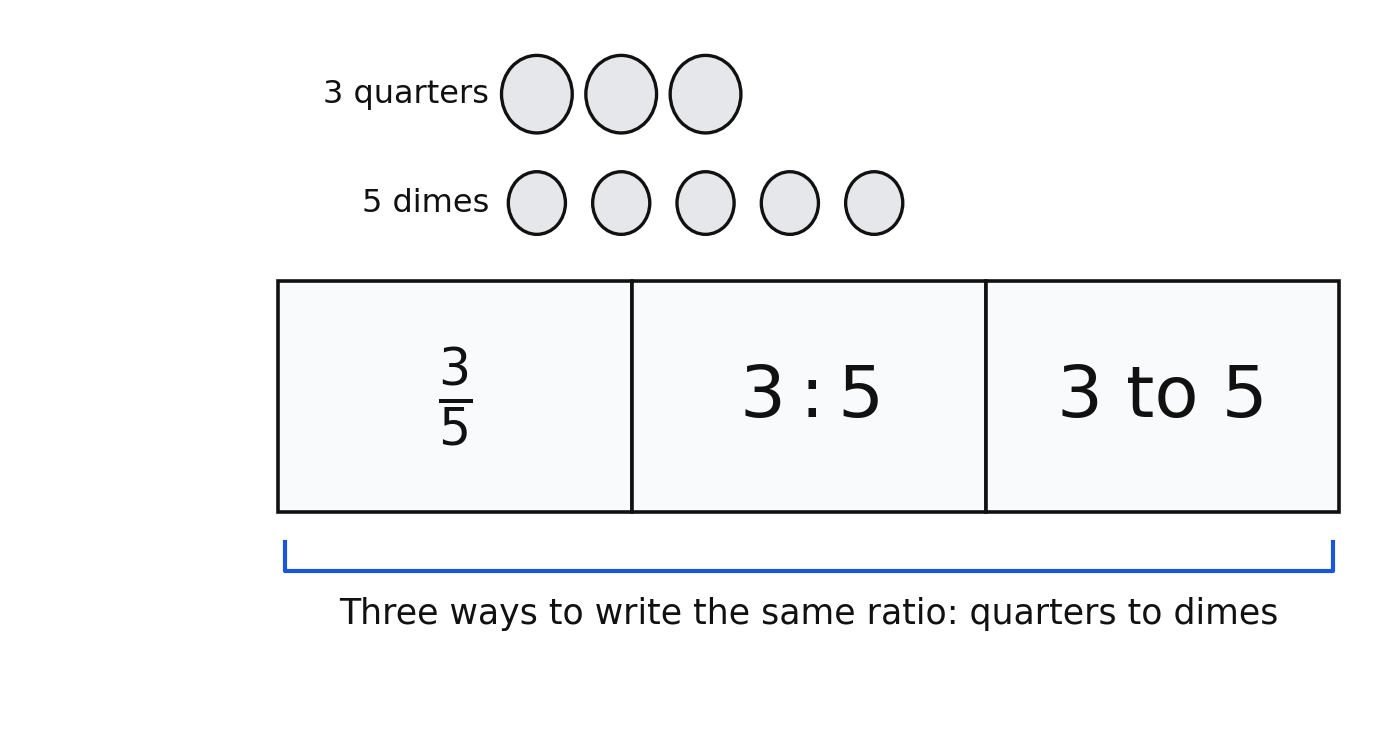
In every notation, the first quantity named goes first: on top in fraction form, on the left of the colon, and before the word "to."
Reading fraction form carefully
Fraction form is the one that needs care. When you write the quarters-to-dimes ratio as , the 3 and the 5 are the two things being compared. The jar does not contain "three-fifths quarters." There are 8 coins in all, and 3 of them are quarters, so quarters make up of the coins.
So and are both correct ratios about the same jar — they just compare different things:
- compares quarters to dimes.
- compares quarters to all the coins.
Whenever you write a ratio in fraction form, name both quantities in words next to it. That one habit prevents most mistakes in this chapter.
Writing ratios from a context
To write a ratio for a situation:
- Identify the two quantities being compared.
- Decide which one the question names first.
- Write that amount as the first term.
- Choose a notation and write it, then label what each term counts.
Worked examples
Example 1 — All three notations
A garden has 7 sunflowers and 4 daisies. Write the ratio of sunflowers to daisies three ways.
Sunflowers are named first, so 7 is the first term.
Answer: , , and 7 to 4
Example 2 — Reversed order, all three notations
Using the same garden, write the ratio of daisies to sunflowers three ways.
Answer: , , and 4 to 7
Example 3 — Translating between notations
Rewrite in fraction form and in word form.
The left term stays first.
Answer: and 9 to 2
Example 4 — From a context with different units
A store sells 5 bagels for 4 dollars. Write the ratio of bagels to dollars in colon form, and explain what each term counts.
Answer: . The 5 counts bagels; the 4 counts dollars.
Example 5 — Same jar, two different ratios
A jar holds 3 quarters and 5 dimes. Write the ratio of quarters to dimes and the ratio of quarters to all coins, both in fraction form.
There are coins in all.
Answer: quarters to dimes is ; quarters to all coins is
Guided practice
- A bin has 6 red balls and 11 green balls. Write the ratio of red to green in all three notations.
- Rewrite in fraction form.
- Rewrite in colon form and word form.
- A recipe uses 2 eggs for every 5 cups of flour. Write the ratio of eggs to flour in colon form.
- A student writes the ratio of cats to dogs at a shelter as . What do the 7 and the 10 count?
Independent practice
- Write each ratio in all three notations: a) 9 boys to 13 girls b) 4 cups of oil to 1 cup of vinegar
- Rewrite each in the two other notations: a) b) c) 15 to 8
- A backpack has 3 pens and 8 pencils. Write, in colon form: a) pens to pencils b) pencils to pens c) pens to all writing tools
- A bag has 5 blue tiles and 7 yellow tiles. Explain why and are both correct ratios for this bag, and say what each one compares.
- A train travels 180 miles in 3 hours. Write the ratio of miles to hours in all three notations.
- Application. A concrete mix uses 1 part cement to 3 parts sand. A worker needs to write this on a job sheet in colon form and then explain it to a helper in words. Write both versions, and state how many parts of sand go with 2 parts of cement.
- Reasoning. Nia sees the ratio describing almonds to cashews in a nut mix and says, "So almonds are two-ninths of the mix." Explain why that is not correct, and state what fraction of the mix is almonds.
Exit ticket 8.2
- Write the ratio 6 forks to 5 spoons in all three notations.
- Rewrite in colon form.
- A tray has 4 tarts and 6 cookies. Write the ratio of tarts to all baked goods in fraction form.
- Explain why and describe different comparisons for that same tray.
Lesson 8.3 — Part-to-Part, Part-to-Whole, Whole-to-Whole
Three kinds of comparison
Ratios compare, but not every comparison is the same kind. Sorting them into three types keeps your thinking straight.
A part-to-part ratio compares one part of a group to another part of the same group.
A part-to-whole ratio compares one part of a group to the entire group.
A whole-to-whole ratio compares one complete group or quantity to a different complete group or quantity.
One class, several ratios
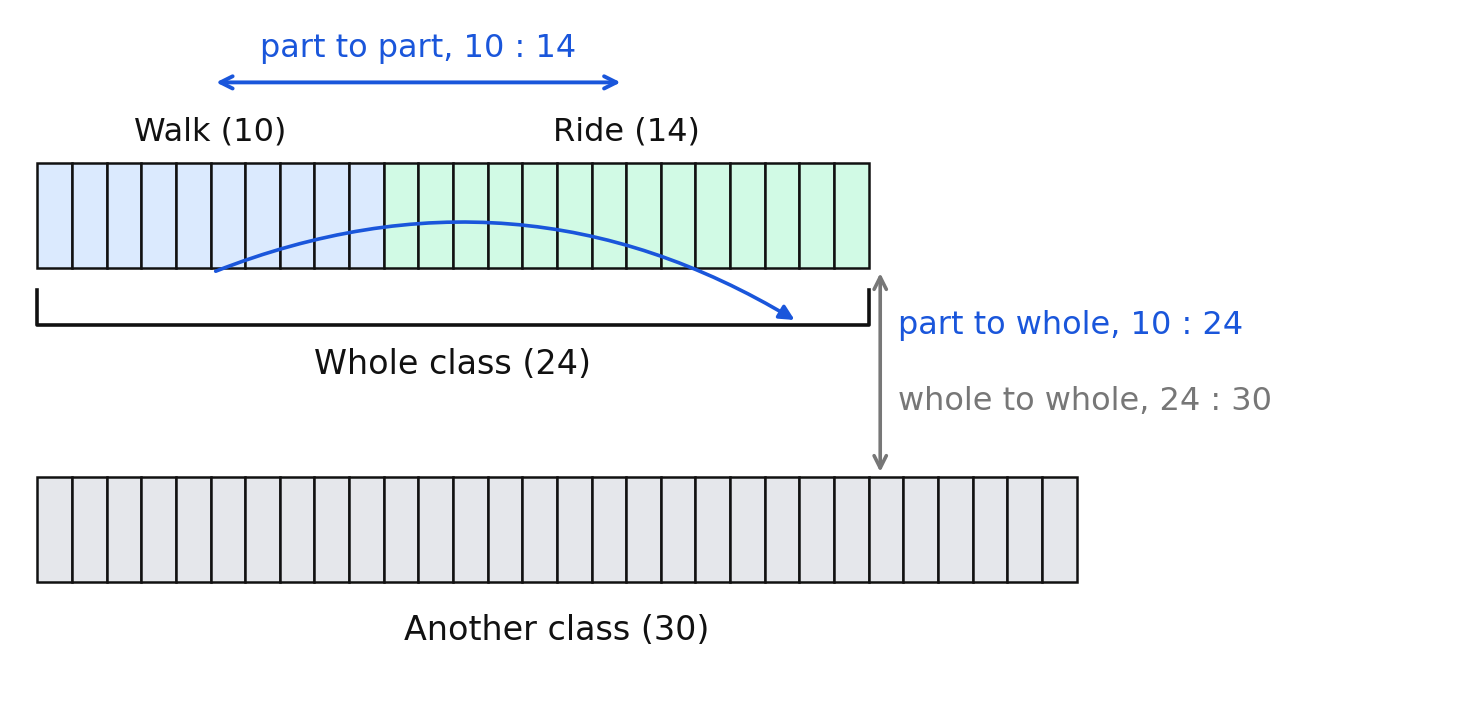
A class has 10 students who walk to school and 14 who ride the bus. The whole class is students.
| Comparison | Type | Ratio |
|---|---|---|
| walkers to riders | part to part | |
| riders to walkers | part to part | |
| walkers to whole class | part to whole | |
| riders to whole class | part to whole |
Now bring in a second class of 30 students. Comparing the size of one whole class to the size of the other whole class gives a whole-to-whole ratio: .
How to tell which type you have
Ask two questions:
- Are both amounts pieces of the same group? If yes, it is part to part.
- Is one amount the total of the group the other belongs to? If yes, it is part to whole.
If the two amounts are complete quantities that do not sit inside each other — two classes, two recipes, two trips — the comparison is whole to whole.
The total is not given to you. In part-to-whole problems you usually have to build the whole yourself by adding the parts. With 10 walkers and 14 riders, nobody hands you the 24; you add for it.
Worked examples
Example 1 — Naming the type
A fruit bowl has 6 apples and 9 bananas. Classify the ratio .
Both amounts are pieces of the same bowl.
Answer: part to part
Example 2 — Building the whole
Using the same bowl, write the ratio of apples to all the fruit and name its type.
The whole is pieces of fruit.
Answer: , a part-to-whole ratio
Example 3 — All the ratios in one situation
A shelf has 8 hardcover books and 12 paperbacks. Write the part-to-part ratio of hardcovers to paperbacks, and both part-to-whole ratios.
The whole is books.
Answer: hardcovers to paperbacks, ; hardcovers to all books, ; paperbacks to all books,
Example 4 — Whole to whole
Team A scored 45 points in a game. Team B scored 36 points. Write a ratio comparing the two teams' scores and name its type.
Each score is a complete quantity, not a part of the other.
Answer: , a whole-to-whole ratio
Example 5 — Working backward from a part-to-whole ratio
In a bag of marbles, the ratio of red marbles to all marbles is . How many marbles are not red?
The whole is 19 and the red part is 7, so the rest is .
Answer: 12 marbles are not red. The part-to-part ratio of red to not-red is .
Guided practice
- A pack has 5 grape juice boxes and 7 apple juice boxes. Write the part-to-part ratio of grape to apple.
- Using the same pack, how many juice boxes are there in all?
- Write the part-to-whole ratio of apple juice boxes to all juice boxes.
- A garden has 9 roses; a second garden has 15 roses. Write a ratio comparing the two gardens and name its type.
- Explain how to find the whole when a problem gives you only the two parts.
Independent practice
- A choir has 18 sopranos and 12 altos. Write: a) sopranos to altos b) altos to the whole choir c) the type of each ratio
- A pizza is cut into 8 slices; 3 are pepperoni and the rest are cheese. Write the part-to-part ratio of pepperoni to cheese and the part-to-whole ratio of pepperoni to all slices.
- Classify each as part to part, part to whole, or whole to whole: a) 4 red pens to 9 blue pens in one cup b) 4 red pens to 13 pens in one cup c) 13 pens in my cup to 20 pens in your cup
- In a survey, the ratio of students choosing soccer to all students surveyed is . How many students did not choose soccer?
- A parking lot holds 25 cars and 15 trucks. Write all three ratios you can form that are part to whole or part to part, and label each.
- Application. A snack mix is made of 6 cups of pretzels and 4 cups of popcorn. Write the part-to-part ratio and both part-to-whole ratios. Then explain which ratio you would use to answer "what portion of the mix is popcorn?" and why.
- Reasoning. In a club, the ratio of sixth graders to seventh graders is . Ellie says the ratio of sixth graders to all club members is also . Explain her error and write the correct part-to-whole ratio.
Exit ticket 8.3
- A drawer has 7 blue socks and 5 gray socks. Write the part-to-part ratio of blue to gray.
- Write the part-to-whole ratio of gray socks to all socks in that drawer.
- Classify: "the 18 books on my shelf compared to the 24 books on yours."
- Explain the difference between a part-to-part ratio and a part-to-whole ratio in your own words.
Lesson 8.4 — Equivalent Ratios and Ratio Tables
When two ratios say the same thing
Two ratios are equivalent ratios if they describe the same relationship between quantities. A lemonade mix of 2 cups of lemon juice to 3 cups of water tastes exactly the same as 4 cups of juice to 6 cups of water, or 20 cups to 30 cups. The batch grows; the relationship does not.
You make an equivalent ratio by multiplying or dividing both terms by the same nonzero number.
What you may not do is add the same number to both terms. Adding 1 to each term of gives , and is a different mix — more juice per cup of water. Scaling is multiplication, not addition.
Ratio tables
A ratio table lists equivalent ratios in an organized way, one pair per column or row. Here is a table for :
| Lemon juice (cups) | 2 | 4 | 6 | 8 | 10 |
|---|---|---|---|---|---|
| Water (cups) | 3 | 6 | 9 | 12 | 15 |
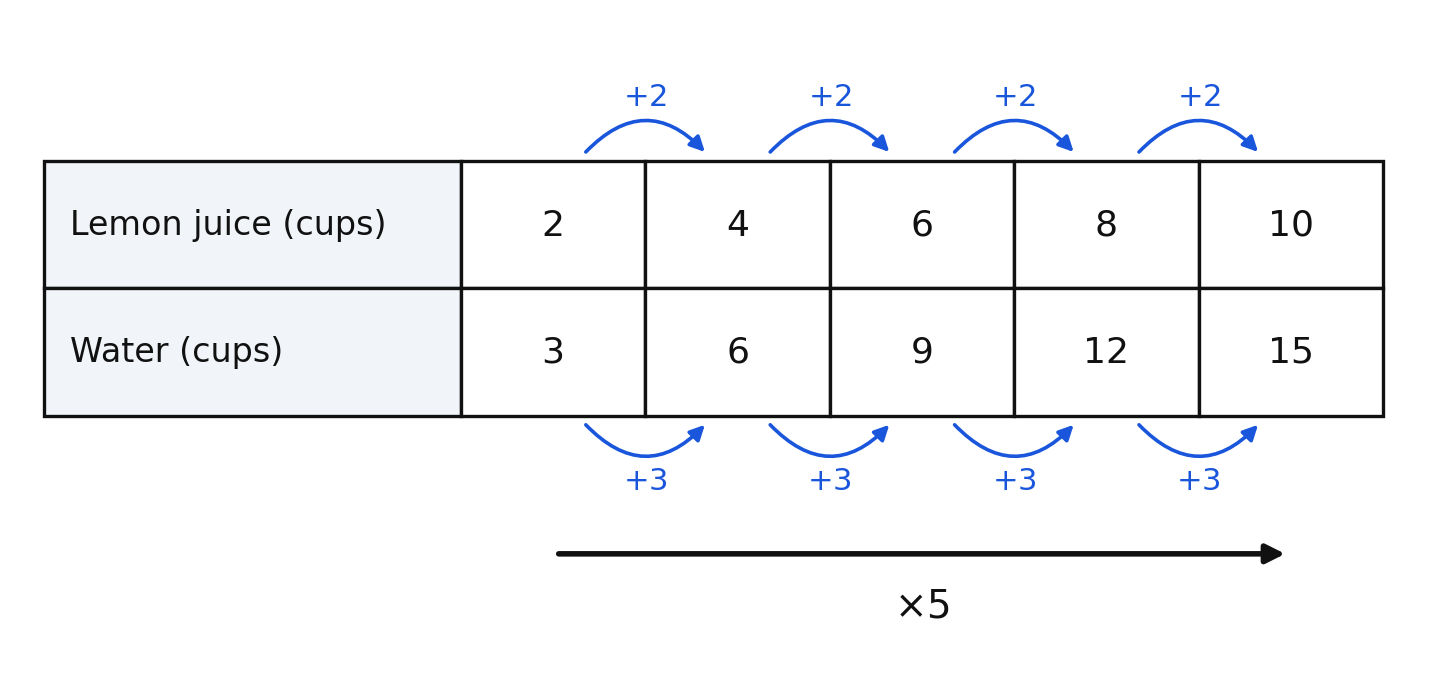
Read any column as a ratio: , , , , . Every column is equivalent to every other column.
Notice two patterns in the table:
- Down a column you have the ratio itself, the relationship between the two quantities.
- Across a row the numbers grow by a repeated addition — the juice row counts by 2, the water row counts by 3. That pattern happens because each column is the previous column plus one more copy of the original ratio.
Building a table from a given ratio
To build a table from a ratio like , put the ratio in the first column and multiply both terms by , then , then , and so on:
| Part A | 5 | 10 | 15 | 20 |
|---|---|---|---|---|
| Part B | 8 | 16 | 24 | 32 |
Check the last column: and , so is equivalent to .
Building a table from a context
When the ratio comes from a story, label the rows with the quantities from the story, including units. That labeling is what makes the table usable.
A store sells 3 notebooks for 4 dollars.
| Notebooks | 3 | 6 | 9 | 12 | 15 |
|---|---|---|---|---|---|
| Cost (dollars) | 4 | 8 | 12 | 16 | 20 |
From the table you can read off answers directly: 12 notebooks cost 16 dollars, and 20 dollars buys 15 notebooks.
Checking whether two ratios are equivalent
Ask: is there one number that multiplies both terms of the first ratio to give the second?
- Is equivalent to ? Divide both terms of by 3: and . Yes.
- Is equivalent to ? Both reduce to , since and . Yes.
- Is equivalent to ? Dividing by 2 gives , which is not . No.
Worked examples
Example 1 — Making equivalent ratios
Write three ratios equivalent to .
Multiply both terms by 2, then 3, then 4.
and . and . and .
Answer: , ,
Example 2 — Building a table from a ratio
Create a table of five equivalent ratios for .
Multiply both terms by 1, 2, 3, 4, and 5.
| First quantity | 4 | 8 | 12 | 16 | 20 |
|---|---|---|---|---|---|
| Second quantity | 5 | 10 | 15 | 20 | 25 |
Answer: , , , ,
Example 3 — Building a table from a context
A bakery uses 2 cups of sugar for every 5 cups of flour. Make a ratio table for 1, 2, 3, and 4 batches.
Each batch adds 2 cups of sugar and 5 cups of flour.
| Sugar (cups) | 2 | 4 | 6 | 8 |
|---|---|---|---|---|
| Flour (cups) | 5 | 10 | 15 | 20 |
Answer: the table above; for example, 4 batches need 8 cups of sugar and 20 cups of flour.
Example 4 — Scaling down
Is equivalent to ?
Divide both terms of by 6: and .
Answer: Yes, they are equivalent.
Example 5 — Spotting the addition error
A recipe uses 3 cups of oats to 2 cups of raisins. Tomás wants to make a bigger batch and uses 5 cups of oats to 4 cups of raisins. Did he keep the ratio?
He added 2 to each term instead of multiplying. Scaling by 2 would give , not .
Answer: No. is not equivalent to . To keep the ratio with 4 cups of raisins he needs 6 cups of oats.
Guided practice
- Write two ratios equivalent to .
- Fill in the missing value:
- Is equivalent to ? Show how you know.
- Make a ratio table with four columns for the ratio .
- A recipe uses 1 cup of rice for every 2 cups of water. How much water goes with 5 cups of rice?
Independent practice
Write three ratios equivalent to each: a) b)
Fill in each blank: a) b) c)
Which of these are equivalent to ? , , ,
Complete the ratio table.
Cups of paint 3 6 9 12 Square feet covered 25 Make a five-column ratio table for the ratio and state the fifth column as a ratio.
Application. A go-kart track charges 7 dollars for every 3 laps. Build a ratio table for 3, 6, 9, 12, and 15 laps. Then use the table to find the cost of 15 laps and the number of laps you can buy with 28 dollars.
Reasoning. Priya says and are equivalent because "each one goes up by 2." Explain her mistake and write a ratio that really is equivalent to and has 6 as its first term.
Exit ticket 8.4
- Write two ratios equivalent to .
- Fill in:
- A recipe uses 4 eggs for every 3 cups of milk. Make a ratio table with three columns.
- Explain why you multiply, and not add, to make an equivalent ratio.
Lesson 8.5 — Writing a Situation for a Ratio
Going from symbols to a story
So far you have started with a situation and produced a ratio. This lesson runs the other direction: you are handed a ratio in symbols, like , and you write a situation it could describe. This matters because it proves you understand what the symbols claim, not just how to copy them.
A good written situation does three things:
- Names both quantities, with units where units make sense.
- Keeps the order — the first term describes the first quantity named.
- Uses "for every" or an equivalent phrase, so the comparison is clear.
For , a strong answer is: For every 3 teachers on the trip, there are 8 students. A weak answer is: There are 3 and 8. The weak version names no quantities and makes no comparison.
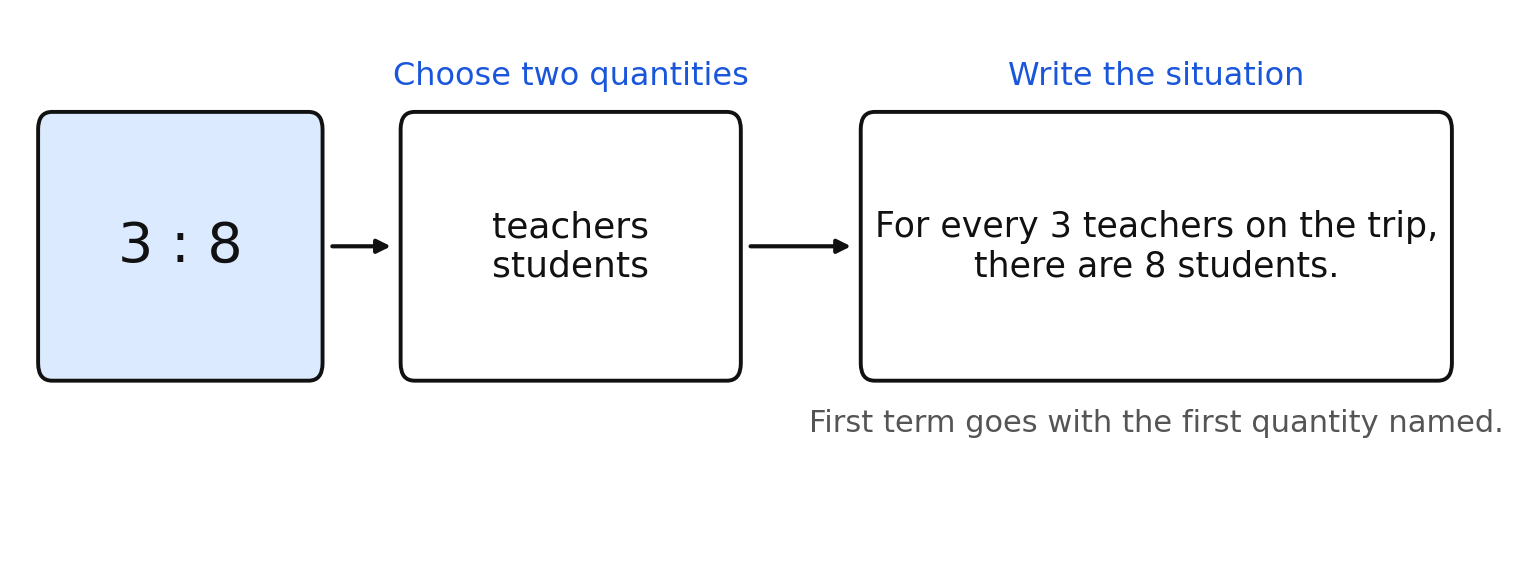
Choosing the kind of comparison
The same symbolic ratio can describe a part-to-part, part-to-whole, or whole-to-whole situation. You get to choose, but say clearly which one you mean.
For :
- Part to part: For every 3 red tulips in the bed, there are 8 yellow tulips.
- Part to whole: 3 of every 8 students in the club play an instrument.
- Whole to whole: My team scored 3 goals; the other team scored 8.
Notice the part-to-whole wording. Saying "3 of every 8" makes it clear that the 8 includes the 3. If you mean part to whole, do not write "for every 3 students there are 8 students," which sounds like 11 students in all.
Checking your situation
Read your sentence back and ask:
- Could someone rebuild the original ratio from my sentence alone?
- Are the two quantities different from each other and clearly labeled?
- Did I keep the order?
If a reader could pull back out of your sentence, in the right order, the situation works.
Worked examples
Example 1 — A part-to-part situation
Write a situation for .
Choose two parts of one group and keep the order.
Answer: In the aquarium, there are 5 goldfish for every 2 guppies.
Example 2 — A part-to-whole situation
Write a part-to-whole situation for .
The 9 must be the total, and the 4 must be included in it.
Answer: 4 out of every 9 students in the class ride the bus.
Example 3 — Different units
Write a situation for using two different units.
Answer: The printer prints 12 pages every 1 minute.
Example 4 — Matching a required order
Write a situation for the ratio of cats to dogs equal to .
The problem fixes which quantity comes first, so cats must go with the 2.
Answer: At the shelter, there are 2 cats for every 7 dogs.
Example 5 — Fixing a weak situation
A student writes this for : "There were 6 things and then 5 more things." Improve it.
The sentence names no quantities and does not make a comparison.
Answer: For every 6 chairs in the room, there are 5 desks.
Example 6 — A whole-to-whole situation
Write a whole-to-whole situation for , then give an equivalent ratio.
Two complete quantities, compared to each other. Dividing both terms by 15 gives .
Answer: I read 30 pages on Monday and 45 pages on Tuesday. An equivalent ratio is .
Guided practice
- Write a part-to-part situation for .
- Write a part-to-whole situation for .
- Write a situation for using two different units.
- A student writes "8 to 3" as "there are 8 and 3 of something." Rewrite it as a clear situation.
- Explain why "for every 3 students there are 10 students" is confusing as a part-to-whole sentence, and rewrite it clearly.
Independent practice
- Write a situation in words for each ratio: a) b) c) 9 to 4
- Write a part-to-whole situation for and say what the two terms count.
- Write a whole-to-whole situation for .
- Write a situation for , then write the same relationship as an equivalent ratio in simplest terms.
- For the ratio , write one part-to-part situation and one part-to-whole situation. Explain how the two situations differ even though the symbols are the same.
- Application. A camp needs 1 counselor for every 12 campers. Write the situation as a ratio in all three notations, then write a new situation describing the camp when 36 campers attend.
- Reasoning. Devin writes this situation for : "There are 3 boys and 7 children in the group, so there are 7 girls." Explain what is wrong and state the correct number of girls.
Exit ticket 8.5
- Write a part-to-part situation for .
- Write a part-to-whole situation for .
- Write a situation for using two different units.
- Explain why a written situation for a ratio has to name both quantities.
Chapter 8 Review
Vocabulary. ratio · terms · part-to-part ratio · part-to-whole ratio · whole-to-whole ratio · equivalent ratios · ratio table
Part A — Representing a relationship with a ratio (6.PFA.1a)
- A crate holds 8 melons and 5 pineapples. Write the ratio of melons to pineapples.
- A car travels 150 miles on 5 gallons of gas. Write the ratio of miles to gallons.
- Explain the difference between comparing two amounts by subtraction and comparing them with a ratio.
Part B — The three notations (6.PFA.1b)
- Write "11 cats to 4 dogs" in all three notations.
- Rewrite in colon form and word form.
- Rewrite in fraction form.
- A bag has 5 red and 9 blue chips. Explain what compares and what compares.
Part C — Types of comparison (6.PFA.1c)
- A class has 13 boys and 12 girls. Write: a) boys to girls b) girls to the whole class c) the type of each ratio
- Classify each: a) 6 apples to 10 pieces of fruit in one bowl b) 6 apples to 4 oranges in one bowl c) 10 pieces of fruit in my bowl to 14 in yours
- In a jar, the ratio of green beads to all beads is . How many beads are not green?
Part D — Tables of equivalent ratios (6.PFA.1e, 6.PFA.1f)
- Write three ratios equivalent to .
- Fill in: a) b)
- Build a five-column ratio table for .
- A shop sells 4 apples for 3 dollars. Build a ratio table for 4, 8, 12, 16, and 20 apples, then state the cost of 20 apples.
Part E — Writing a situation for a ratio (6.PFA.1d)
- Write a part-to-part situation for .
- Write a part-to-whole situation for .
Part F — Mixed application and reasoning
- A trail mix uses 5 cups of oats to 3 cups of dried cherries. Write the part-to-part ratio, both part-to-whole ratios, and a ratio table with four columns.
- Marco doubles a recipe that calls for 3 cups of broth and 2 cups of rice by using 5 cups of broth and 4 cups of rice. Explain his error and give the correct amounts.
- Explain why can mean "2 out of 3 parts of a whole" in one problem and "2 compared to 3 of something else" in another. Give an example of each.
- Two ratios, and , describe two paint mixes. Are the mixes the same color strength? Justify your answer with equivalent ratios.
Standards coverage check — Chapter 8
| Knowledge and Skill | Where it is taught | Where it is practiced |
|---|---|---|
| 6.PFA.1a — represent a relationship between two quantities using ratios | 8.1 | 8.1 all sets; 8.3; Review Part A |
| 6.PFA.1b — represent a relationship in context using , , and to | 8.2 | 8.2 all sets; 8.5 item 11; Review Part B |
| 6.PFA.1c — part to part, part to whole, whole to whole | 8.3 | 8.3 all sets; 8.5 item 10; Review Part C |
| 6.PFA.1d — create a relationship in words for a ratio given symbolically | 8.5 | 8.5 all sets; Review Part E |
| 6.PFA.1e — create a table of equivalent ratios when given a ratio | 8.4 | 8.4 items 1–10, 12; Review Part D |
| 6.PFA.1f — create a table of equivalent ratios when given a contextual situation | 8.4 | 8.4 items 5, 9, 11; Review Part D items 14, 17 |
Answer keys for every set in this chapter are in Appendix A.