Chapter 7 — Exponents, Perfect Squares, and Powers of Ten
Standard: 6.NS.3 — The student will recognize and represent patterns with whole number exponents and perfect squares.
By the end of this chapter you will be able to:
- Recognize and represent patterns with bases and exponents that are whole numbers (6.NS.3a)
- Recognize and represent patterns of perfect squares using concrete and pictorial models (6.NS.3b)
- Justify whether a number between 0 and 400 is a perfect square through modeling or mathematical reasoning (6.NS.3c)
- Recognize and represent powers of 10 with whole number exponents by examining patterns in place value (6.NS.3d)
Lessons: 7.1 Exponents and Repeated Multiplication · 7.2 Patterns with Bases and Exponents · 7.3 Perfect Squares · 7.4 Powers of Ten and Place Value
Lesson 7.1 — Exponents and Repeated Multiplication
A shorter way to write repeated multiplication
Multiplication is a shortcut for repeated addition: is . Exponents do the same job for repeated multiplication. Instead of writing , write .
In , the base is the number being multiplied and the exponent is how many times the base is used as a factor. The whole expression is called a power.
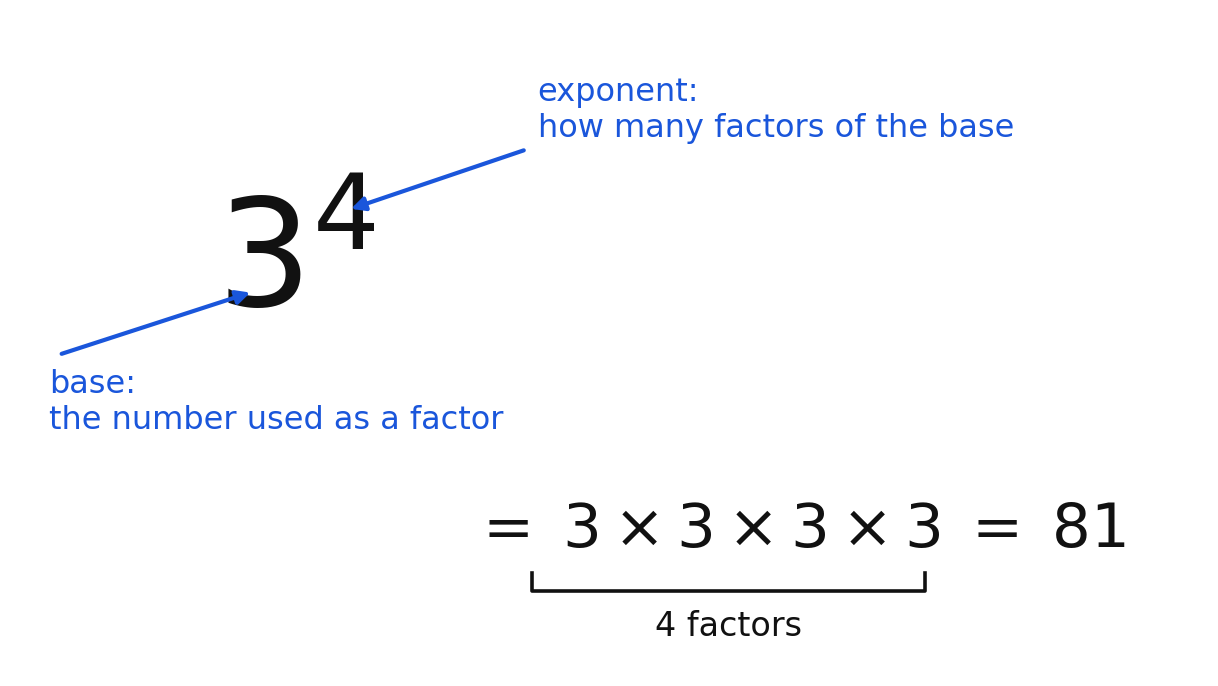
Writing is exponential form. Writing is expanded form. Writing is the value of the power.
How to read powers
| Power | Read as | Expanded form | Value |
|---|---|---|---|
| two to the third power, or two cubed | |||
| five to the second power, or five squared | |||
| seven to the fourth power | |||
| ten to the first power |
An exponent of is read squared and an exponent of is read cubed. Those two names come from geometry: is the number of unit squares in a -by- square, and is the number of unit cubes in a -by--by- cube.
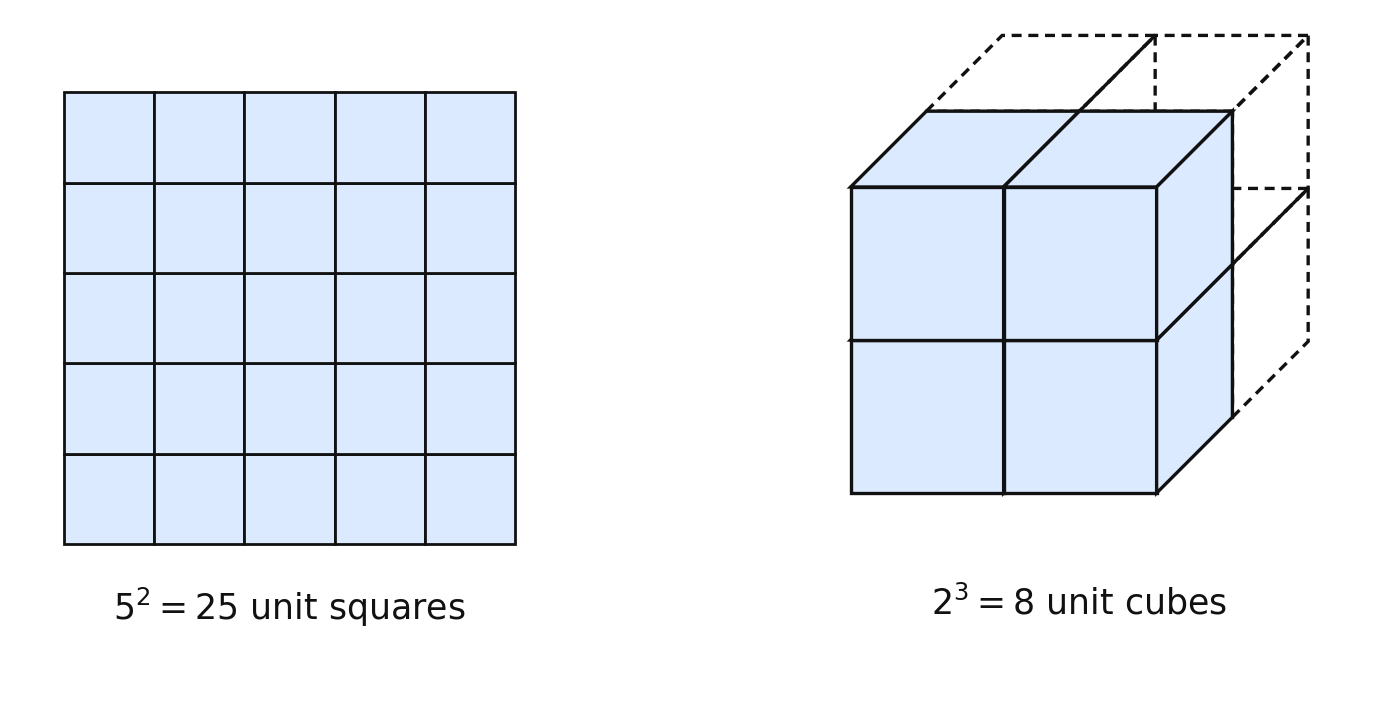
The exponent is not a multiplier. means , not . This is the single most common error with exponents.
Order matters
Swapping the base and the exponent usually changes the value:
Two special cases are worth knowing. A base of always gives , because multiplying by itself any number of times stays . An exponent of always gives the base itself, because the base is used exactly once.
Worked examples
Example 1 — Exponential form
Write using an exponent, then find its value.
The base is and it appears as a factor times, so the exponent is .
Multiply left to right: , then .
Answer:
Example 2 — Expanded form
Write in expanded form and find its value.
Multiply in pairs: , , , , .
Answer:
Example 3 — Comparing two powers with the same digits
Evaluate and , then compare them.
Since :
Answer:
Example 4 — Squares and cubes
Evaluate and .
Answer: and ; the larger exponent wins here even though the base is smaller.
Example 5 — A power in context
Each time a sheet of paper is folded, the number of layers doubles. Starting from 1 layer, how many layers are there after 7 folds?
Each fold multiplies the layer count by , and there are folds, so the number of layers is .
Answer: layers
Guided practice
- Write using an exponent and find its value.
- Write in expanded form and find its value.
- Evaluate .
- Evaluate and .
- Which is greater, or ? Show both values.
Independent practice
- Evaluate: a) b) c) d)
- Write in exponential form: a) b)
- Write in expanded form and find its value.
- Fill in , , or :
- Order from least to greatest: , , , .
- Application. A single bacterium doubles every hour. Starting with 1 bacterium, write the count after 6 hours as a power of 2 and find its value.
- Reasoning. Explain why and are not equal, using the meaning of base and exponent.
Exit ticket 7.1
- Evaluate .
- Write using an exponent.
- Which is greater, or ?
- In , name the base and the exponent, and explain what each one tells you.
Lesson 7.2 — Patterns with Bases and Exponents
Building a power table
Listing the powers of a base in order reveals a pattern you can use to extend the list without starting over.
| Exponent | ||||
|---|---|---|---|---|
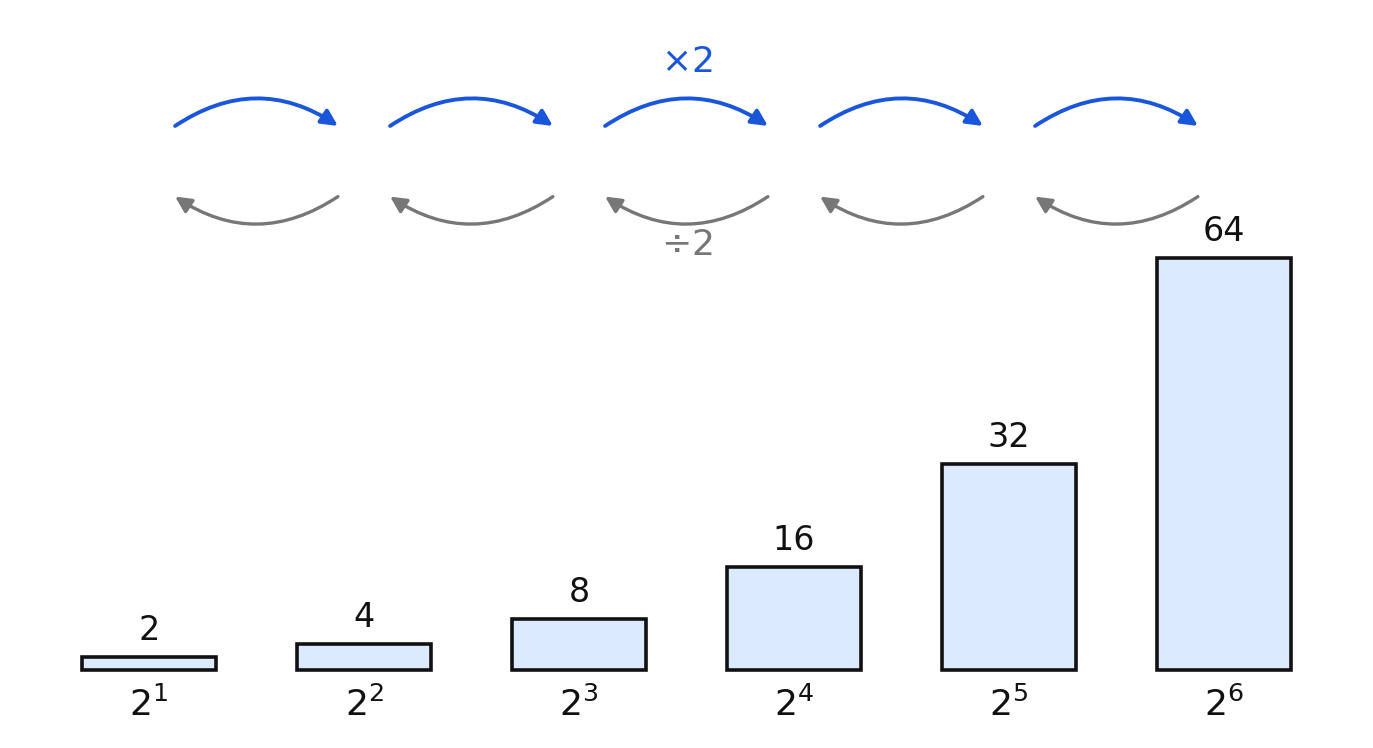
Two rules come straight out of the table:
- Moving up one exponent multiplies by the base. Since , you get .
- Moving down one exponent divides by the base. Since , you get .
Continuing rule 2 past an exponent of gives a useful result. Because , the next step down is , so . The same reasoning works for any base other than zero.
Patterns in the ones digit
The ones digits of powers repeat in short cycles, which makes them easy to predict.
| Base | Ones digits of the first several powers | Cycle |
|---|---|---|
| length 4 | ||
| length 2 | ||
| length 1 | ||
| length 1 | ||
| length 2 |
Powers of always end in because any number ending in , multiplied by , ends in again. Powers of behave the same way.
Which powers are also perfect squares
Look down the column for : , , , and are all squares of whole numbers (, , , ). Those are exactly the entries with even exponents. This connection sets up the next lesson.
Worked examples
Example 1 — Extending a power table
Complete the powers of 3 from to and describe the pattern.
Each value is the one before it multiplied by : , , , .
Answer: , , , , ; multiply by 3 to move to the next power.
Example 2 — Using the pattern instead of restarting
Given , find and .
Multiply by the base each time.
Answer: and
Example 3 — Predicting a ones digit
What is the ones digit of ?
The ones digits of are , alternating. Odd exponents end in and even exponents end in . Since is odd, ends in .
Checking: .
Answer:
Example 4 — Extending a pattern downward
Use the powers of 5 to explain the value of .
Answer: , because each step down the table divides by the base.
Example 5 — Comparing two powers
Which is greater, or ?
Answer: is greater. A larger exponent can matter more than a larger base.
Guided practice
- Complete: , , , .
- Describe the rule that takes you from to to , and use it to find .
- Given , find without expanding.
- What is the ones digit of ?
- Given , explain how to get from it.
Independent practice
- Complete the powers of 5 from to .
- Given , find and .
- List the ones digits of through , then predict the ones digit of .
- Which is larger, or ? Show both values.
- Continue the pattern downward: , , , .
- Application. A single-elimination tournament starts with 64 teams, and each round cuts the field in half. Write 64 as a power of 2, and use the exponent to say how many rounds are played until one team remains.
- Reasoning. Explain why every power of 5 ends in the digit 5.
Exit ticket 7.2
- Complete: , , , .
- Given , find .
- What is the ones digit of ?
- Describe the rule that moves from one power of a base to the next power up.
Lesson 7.3 — Perfect Squares
Squares you can see
A perfect square is a whole number that can be written as a whole number multiplied by itself. The name comes from the picture: a perfect square is exactly the number of unit squares needed to build a square array with the same number of rows as columns.
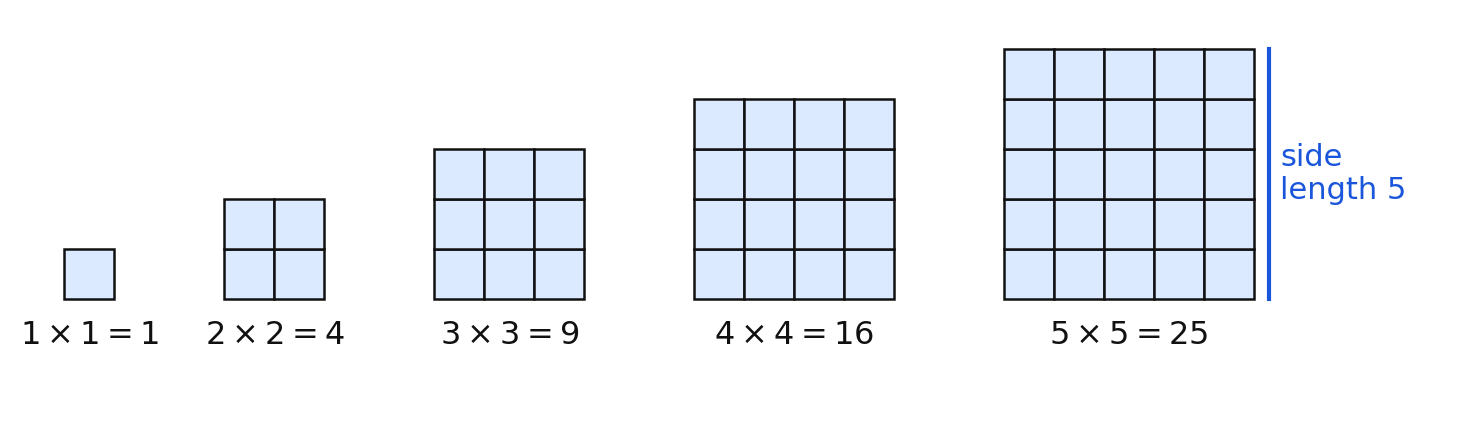
A square array has equal rows and columns. If you can arrange a number of tiles into a square array with no tiles left over, the number is a perfect square, and the number of tiles along one side is the number that was squared.
The perfect squares from 1 to 400
Knowing this list by sight is worth the effort. It makes the justification work in this lesson quick.
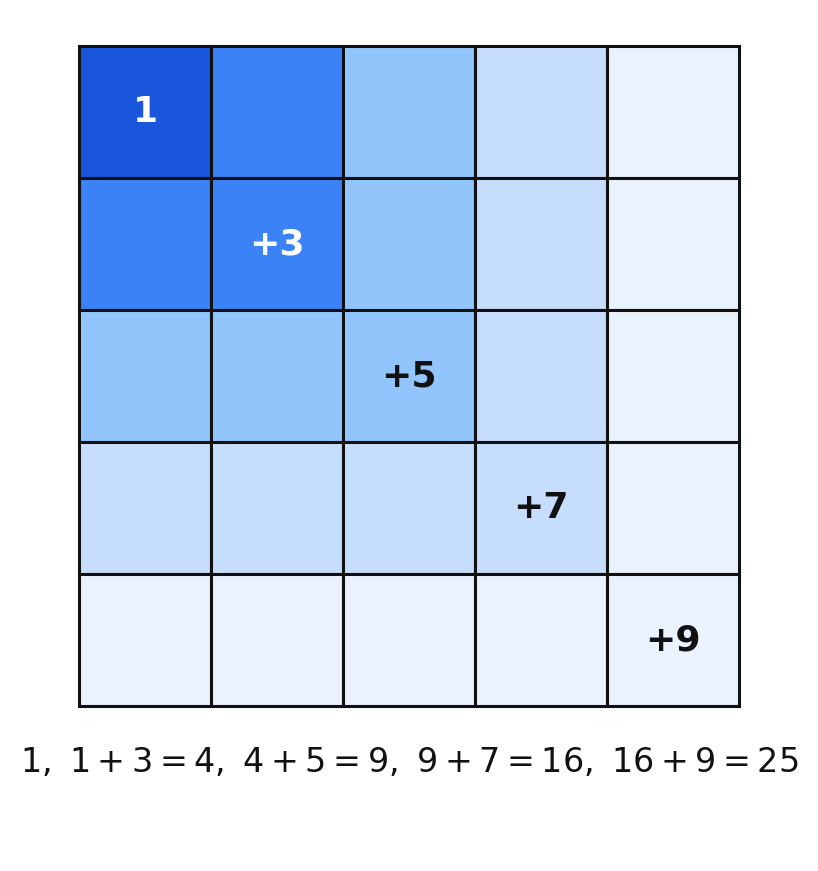
The growth pattern
Look at the gaps between consecutive perfect squares:
The gaps are the consecutive odd numbers. The model shows why: to grow a square array from -by- to -by-, you add a new column of 4, a new row of 4, and one corner tile, which is .
Justifying whether a number is a perfect square
To justify that a number is a perfect square, name the whole number that squares to it: is a perfect square because , so 144 tiles form a 12-by-12 array.
To justify that a number is not a perfect square, trap it between two consecutive perfect squares: lies between and . Since there is no whole number between 12 and 13, no whole number squared gives 150.
Trapping is the whole argument. Saying "I tried some numbers and none worked" is not a justification. Naming the two consecutive squares on either side is, because it rules out every whole number at once.
Worked examples
Example 1 — Building the first perfect squares
Use square arrays to find the first four perfect squares.
A -by- array uses 1 tile. A -by- array uses 4. A -by- array uses 9. A -by- array uses 16.
Answer: , , ,
Example 2 — Justifying that a number is a perfect square
Is a perfect square? Justify your answer.
Test whole numbers near the size of the answer. is too small and is too large, so try : .
Answer: Yes. , so 144 tiles form a 12-by-12 square array.
Example 3 — Justifying that a number is not a perfect square
Is a perfect square? Justify your answer.
Find the consecutive perfect squares on either side: and . Since , any whole number squaring to 150 would have to be between 12 and 13.
Answer: No. There is no whole number between 12 and 13, so 150 is not a perfect square.
Example 4 — Using the odd-number pattern
The perfect square after is . Show that the gap fits the odd-number pattern.
The gaps so far are — consecutive odd numbers. Growing a -by- array into a -by- array adds a row of 5, a column of 5, and 1 corner tile: .
Answer: The gap is , the next odd number, and the model explains it as .
Example 5 — Finding perfect squares in a range
List every perfect square between 200 and 300.
Work from the table: is below 200. Then , , and all fall in the range, and is above 300.
Answer: , ,
Guided practice
- List the first five perfect squares.
- Is a perfect square? Justify your answer.
- Is a perfect square? Justify your answer.
- Find .
- Describe the square array that models , including its side length.
Independent practice
- Evaluate: a) b) c) d)
- Which of these are perfect squares: , , , , ?
- Justify whether is a perfect square.
- Justify whether is a perfect square.
- List every perfect square between 100 and 200.
- Application. A square patio is built from 169 square tiles with none left over. How many tiles run along one side, and how many tiles form the border around the outside edge?
- Reasoning. Explain, using two consecutive perfect squares, why 200 cannot be a perfect square.
Exit ticket 7.3
- Find .
- Is a perfect square? Justify your answer.
- Is a perfect square? Justify your answer.
- Explain how a square array shows whether a number is a perfect square.
Lesson 7.4 — Powers of Ten and Place Value
The pattern in the place-value chart
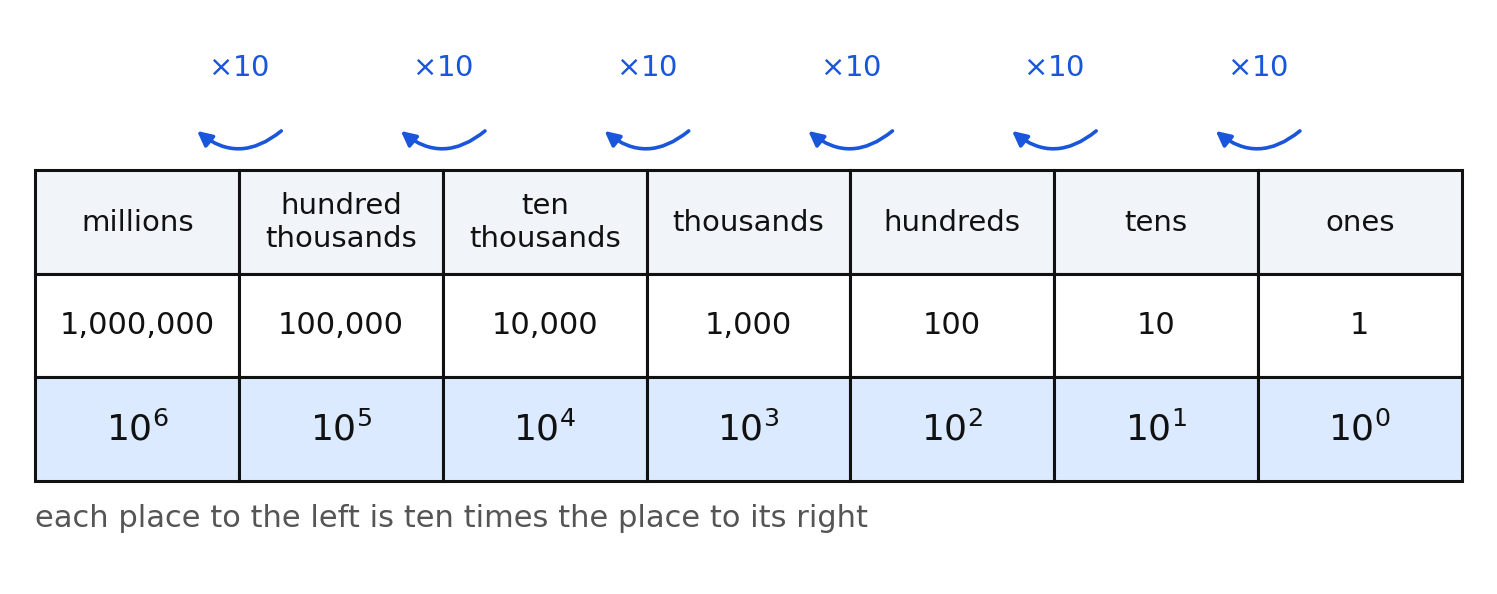
Our number system is built on tens. Each place is worth 10 times the place to its right, so every place value is a power of 10.
| Power | Expanded form | Value | Number of zeros |
|---|---|---|---|
| — | |||
The exponent equals the number of zeros. That happens because each extra factor of 10 shifts every digit one place to the left and drops a new zero into the ones place.
Reading the table downward multiplies by 10 each time; reading it upward divides by 10 each time. Dividing by gives , which is why and why the ones place fits the pattern.
Expanded form with powers of ten
Every whole number can be written as a sum of digits times powers of ten. For :
Check it: . Include the zero terms while you are learning the form — they keep each digit lined up with its place.
Multiplying by a power of ten
Multiplying by shifts every digit places to the left, which looks like writing zeros after the number:
Worked examples
Example 1 — Evaluating a power of ten
Find .
The exponent 5 means five factors of 10, so the value has five zeros.
Answer:
Example 2 — Writing a number as a power of ten
Write as a power of ten.
Count the zeros: there are six.
Answer:
Example 3 — Expanded form with powers of ten
Write in expanded form using powers of ten.
The digits are 4 thousands, 0 hundreds, 6 tens, and 2 ones.
Check: .
Answer:
Example 4 — Multiplying by a power of ten
Find .
, and multiplying by 1,000 shifts each digit three places left.
Answer:
Example 5 — Reading the pattern downward
Use the pattern in the powers of ten to explain why .
Answer: Each step down divides by 10, and , so continues the pattern.
Guided practice
- Evaluate .
- Write as a power of ten.
- How many zeros are in , and what is its value?
- Find .
- Write in expanded form using powers of ten.
Independent practice
- Evaluate: a) b) c) d)
- Write as a power of ten: a) b)
- Write in expanded form using powers of ten.
- Compute: a) b)
- Which is greater, or ? Show both values.
- Application. A stadium seats people. Write that in standard form, and compare it to .
- Reasoning. Explain why the exponent on a power of 10 tells you the number of zeros in its standard form.
Exit ticket 7.4
- Evaluate .
- Write as a power of ten.
- Write in expanded form using powers of ten.
- Explain how the place-value chart shows that each place is 10 times the place to its right.
Chapter 7 Review
Vocabulary. base · exponent · power · exponential form · expanded form · squared · cubed · perfect square · square array · power of 10
Part A — Patterns with bases and exponents (6.NS.3a)
- Evaluate: a) b) c)
- Write as a power and find its value.
- Given , find without expanding.
- Order from least to greatest: , , , .
Part B — Perfect squares with models (6.NS.3b)
- List every perfect square from 1 to 100.
- A square array uses 144 tiles. How many tiles are along one side?
- Find the gap between and , and explain how the square-array model produces that gap.
Part C — Justifying perfect squares (6.NS.3c)
- Justify whether is a perfect square.
- Justify whether is a perfect square.
- List every perfect square between 300 and 400.
Part D — Powers of ten and place value (6.NS.3d)
- Evaluate and .
- Write in expanded form using powers of ten.
- Compute .
Part E — Mixed application and reasoning
- Which is greater, or ? Show both values.
- A square garden has an area of 225 square feet. Find the side length and the perimeter.
- Is every power of 10 a perfect square? Justify your answer with examples.
Standards coverage check — Chapter 7
| Knowledge and Skill | Where it is taught | Where it is practiced |
|---|---|---|
| 6.NS.3a — recognize and represent patterns with bases and exponents that are whole numbers | 7.1, 7.2 | 7.1 all sets; 7.2 all sets; Review Parts A, E |
| 6.NS.3b — recognize and represent patterns of perfect squares using concrete and pictorial models | 7.2, 7.3 | 7.2 independent practice; 7.3 all sets; Review Part B |
| 6.NS.3c — justify if a number between 0 and 400 is a perfect square through modeling or mathematical reasoning | 7.3 | 7.3 all sets; Review Parts C, E |
| 6.NS.3d — recognize and represent powers of 10 with whole number exponents by examining patterns in place value | 7.4 | 7.4 all sets; Review Parts D, E |
Answer keys for every set in this chapter are in Appendix A.