Chapter 6 — Problem Solving with Fractions
Standard: 6.CE.1 — The student will estimate, demonstrate, solve, and justify solutions to problems using operations with fractions and mixed numbers, including those in context.
By the end of this chapter you will be able to:
- Estimate, determine, and justify the solution to single-step and multistep problems in context that involve addition and subtraction with fractions (proper or improper) and mixed numbers, with and without regrouping, that include like and unlike denominators of 12 or less; answers expressed in simplest form (6.CE.1d)
- Estimate, determine, and justify the solution to single-step and multistep problems in context that involve multiplication and division with fractions (proper or improper) and mixed numbers that include denominators of 12 or less; answers expressed in simplest form (6.CE.1e)
Lessons: 6.1 Estimating with Fractions · 6.2 Addition and Subtraction Problems in Context · 6.3 Multiplication and Division Problems in Context · 6.4 Multistep Problems and Justifying Your Answer
Lesson 6.1 — Estimating with Fractions
Why estimate first
In Chapter 5 you learned how to multiply and divide fractions. This chapter is about the harder part: reading a real situation, deciding what to do, and knowing whether your answer makes sense.
An estimate is a value close to the exact answer, found quickly with easier numbers. Estimating first does two jobs. It tells you roughly what to expect, and it gives you something to compare your exact answer against. If a recipe question should come out near 5 cups and your arithmetic says 40 cups, you know to look for the mistake before you turn on the oven.
Benchmark fractions
A benchmark fraction is a familiar value used as a reference point. For fractions between 0 and 1, the three benchmarks are , , and .
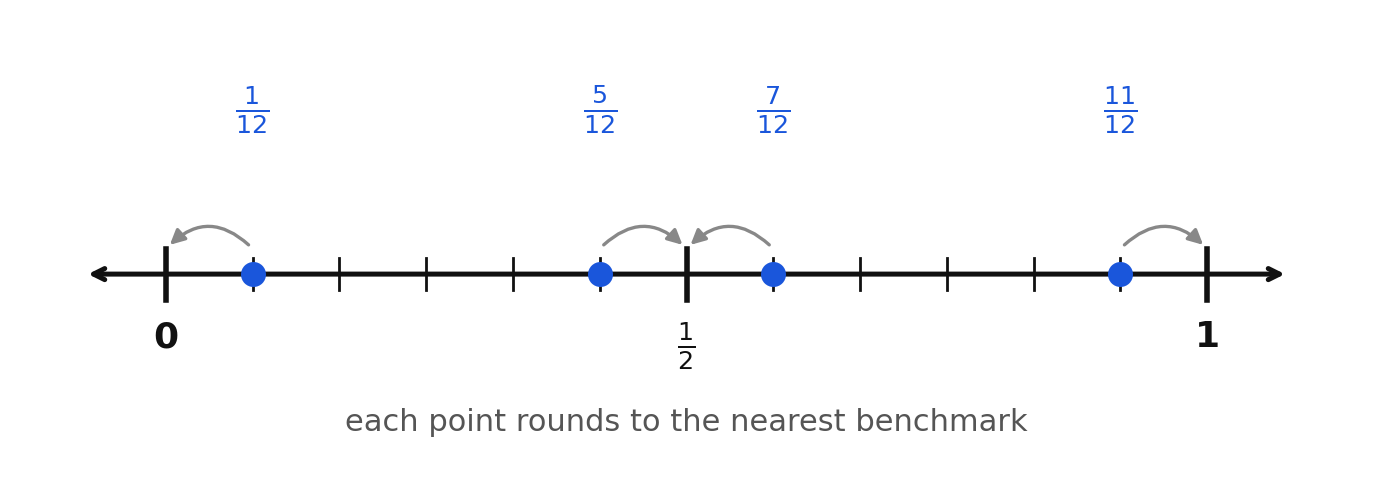
To decide which benchmark a fraction is nearest, compare the numerator to half of the denominator:
- If the numerator is much smaller than half the denominator, the fraction is close to . Example: .
- If the numerator is about half the denominator, the fraction is close to . Example: .
- If the numerator is close to the denominator, the fraction is close to . Example: .
Rounding mixed numbers
To round a mixed number to the nearest whole number, look only at the fraction part. If it is less than , drop it. If it is or more, round up to the next whole number.
The symbol means "is approximately equal to." Use it for estimates, and save for exact values.
Estimating each operation
| Operation | How to estimate | Example |
|---|---|---|
| Addition | Round each number to , , , or a whole number, then add | |
| Subtraction | Round each number, then subtract | |
| Multiplication | Round to whole numbers or use a benchmark fraction | |
| Division | Choose compatible numbers that divide easily |
Compatible numbers are numbers close to the originals that are easy to compute with mentally. Rounding to helps because divides evenly by .
Two reasonableness rules worth memorizing
- Multiplying by a number less than 1 makes the result smaller. So must be less than .
- Dividing by a number less than 1 makes the result larger. So must be greater than .
These two facts catch more errors than any other check in this chapter.
Worked examples
Example 1 — Estimating a sum
Estimate .
: the numerator is close to the denominator , so . : half of is , and is close to that, so . Add the benchmarks: .
Answer: about (the exact value is )
Example 2 — Estimating a difference
Estimate .
is more than , so rounds up to . is less than , so rounds down to . Subtract: .
Answer: about (the exact value is )
Example 3 — Estimating a product
A bag holds pounds of soil. About how much is of the bag?
Round up to , because is easy to divide into three parts.
Answer: about pounds (the exact value is pounds)
Example 4 — Estimating a quotient
A roll holds feet of wire. Each project uses foot. About how many projects can be cut?
Use the compatible number , since is divisible by .
Answer: about projects (the exact value is , so whole projects)
Example 5 — Using an estimate to catch a mistake
Malik writes . Is his answer reasonable? If not, find the correct answer.
Estimate first: and , so the sum should be about . Malik's answer, , is less than — it is not even as large as the he started with, which is impossible when you add a positive number.
His error was adding numerators and denominators. Rewrite with a common denominator instead:
Answer: Not reasonable. The correct sum is , which matches the estimate of about .
Guided practice
- Round each fraction to , , or : a) b) c) d)
- Round each mixed number to the nearest whole number: a) b) c)
- Estimate .
- Estimate .
- Without computing, explain why cannot be correct.
Independent practice
- Round each fraction to , , or : a) b) c) d)
- Estimate each: a) b) c)
- Estimate each product: a) b)
- Estimate using compatible numbers.
- Explain why rounding to is reasonable but rounding it to is not.
- Application. Nia needs cups of flour for one batch of bread and cups for a second batch. She has a 5-cup bag. Estimate to decide whether she has enough. Then find the exact amount and say how much flour is left over or missing.
- Reasoning. Devon says because "multiplying always makes a number bigger." Use an estimate to show his statement is wrong, then find the exact product.
Exit ticket 6.1
- Round to , , or .
- Estimate .
- Estimate using a compatible number.
- Explain how an estimate helps you catch the error in .
Lesson 6.2 — Addition and Subtraction Problems in Context
Reading the situation
Addition and subtraction problems with fractions almost always come from one of four situations:
| Situation | Operation | Signal words |
|---|---|---|
| Joining amounts | addition | in all, total, altogether, combined |
| Taking away | subtraction | left, remaining, used, spent |
| Finding a difference | subtraction | how much more, how much longer, difference |
| Finding a missing part | subtraction | how much more is needed, how far to go |
Notice that three of the four are subtraction. When a problem gives you a whole and one part, you subtract — even when nothing is physically taken away.
Like and unlike denominators
Fractions with like denominators describe pieces of the same size, so you can add or subtract the numerators directly and keep the denominator.
Fractions with unlike denominators describe pieces of different sizes. Before combining them, rewrite both with a common denominator. The least common denominator (LCD) is the smallest number that both denominators divide into evenly.
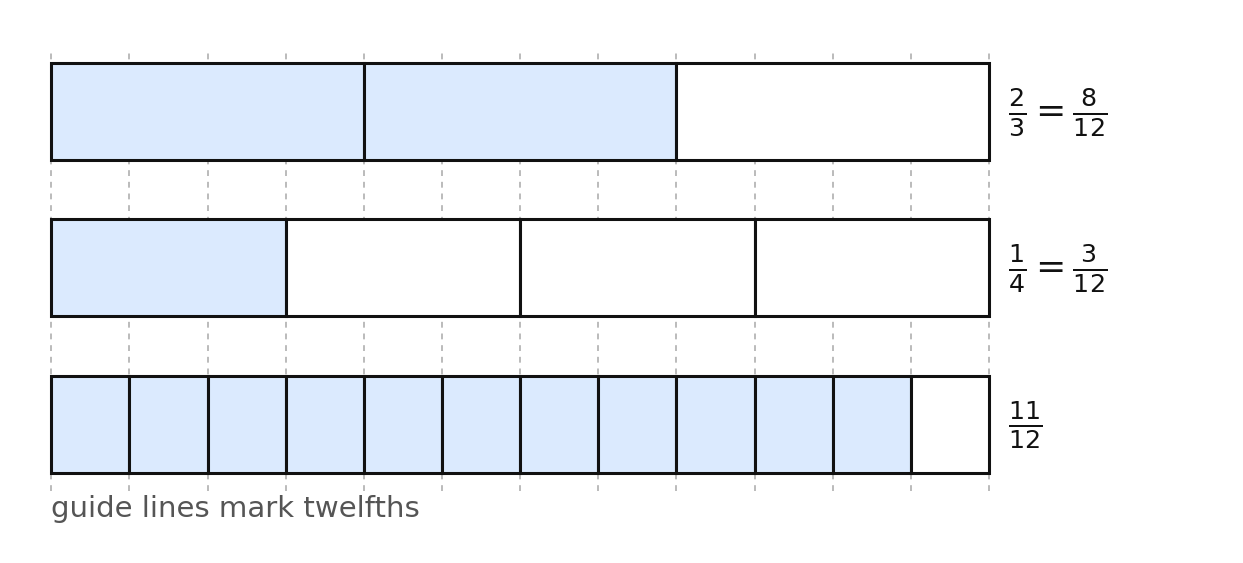
Every answer in this chapter must be written in simplest form, which means the numerator and denominator share no common factor other than 1, and any improper fraction in an answer is rewritten as a mixed number when the context calls for it.
Regrouping with mixed numbers
Sometimes the fraction you are subtracting is larger than the fraction you are subtracting from. Then you regroup: trade one whole for its equivalent fraction and add it to the fraction part.
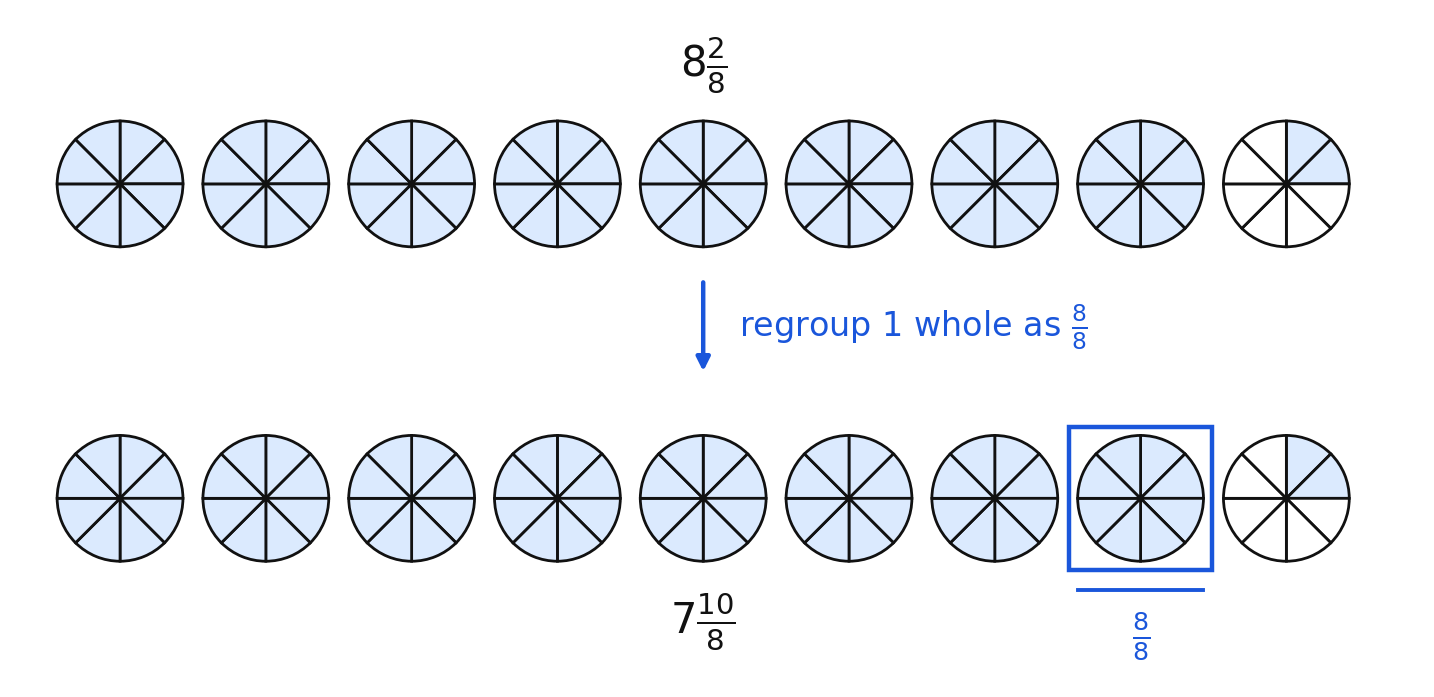
Now the subtraction works:
Check the whole numbers too. After regrouping, the whole-number part is one less than you started with. Writing instead of is the most common regrouping error.
Worked examples
Example 1 — Like denominators
Ana walks mile to the library and then mile to the park. How far does she walk in all?
"In all" means join the two distances.
Simplify by dividing numerator and denominator by 2: .
Answer: mile
Example 2 — Unlike denominators
A smoothie uses cup of yogurt and cup of juice. How much liquid is that altogether?
The LCD of and is .
and share no common factor, so this is simplest form.
Answer: cup
Example 3 — Mixed numbers without regrouping
A ribbon is feet long. Dara cuts off feet. How much ribbon remains?
Rewrite with the LCD of : .
Since , no regrouping is needed.
Answer: feet
Example 4 — Mixed numbers with regrouping
A board is feet long. A carpenter cuts off feet. How long is the piece that is left?
Estimate: , so expect a little more than 4 feet.
Rewrite with the LCD of : .
Since , regroup one whole:
The result is close to the estimate of .
Answer: feet
Example 5 — Finding a missing part
A pitcher holds quarts. It currently has quarts in it. How much more will it hold?
The whole is and one part is , so subtract.
Rewrite with the LCD of : .
Since , regroup: .
Answer: more quarts
Guided practice
- Tomas jogs mile, rests, then jogs mile more. How far did he jog in all? Write the answer in simplest form.
- Find .
- A plant grew inches in May and inches in June. How much did it grow in the two months?
- Find .
- Estimate , then find the exact sum and compare it to your estimate.
Independent practice
- A tank held gallon and then gallon was added. How much is in the tank now?
- Find .
- Find .
- Find .
- A garden border is built from three pieces of edging measuring feet, feet, and foot. What is the total length?
- Application. A water jug held gallons. A team drank gallons during a game, and then a coach added gallons. How much water is in the jug now? Show each step.
- Reasoning. A student wrote . Explain what went wrong, use an estimate to show the answer is unreasonable, and give the correct sum.
Exit ticket 6.2
- Find in simplest form.
- Find .
- Lin has yards of ribbon and uses yards. How much is left?
- Explain how you decide whether a subtraction problem with mixed numbers requires regrouping.
Lesson 6.3 — Multiplication and Division Problems in Context
Deciding which operation
With fractions, the words in a problem matter more than they did with whole numbers, because the answer can be smaller than what you started with.
| Situation | Operation | Example phrasing |
|---|---|---|
| A part of an amount | multiplication | of the recipe |
| Repeating an amount | multiplication | batches, each using cups |
| How many groups fit | division | how many -cup servings are in 6 cups |
| Sharing into equal groups | division | pounds split among 6 bags |
The word of between a fraction and a quantity nearly always means multiply.
The last two rows are the two faces of division. Measurement division asks how many groups of a known size fit inside a total. Sharing division asks how large each group is when the number of groups is known. Both are solved the same way, but picturing which one you have keeps the units straight.
Multiplying: the area model
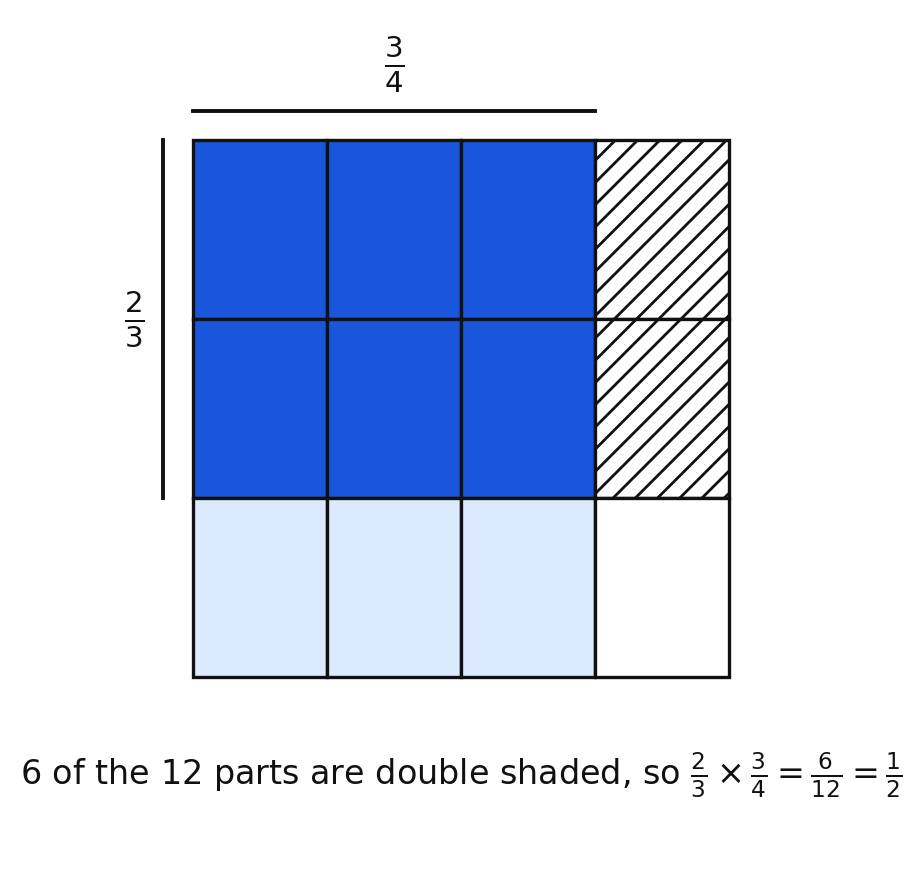
To multiply mixed numbers, first rewrite each as an improper fraction, then multiply numerators and denominators, then simplify.
Dividing: multiply by the reciprocal
The reciprocal of a fraction is the fraction turned upside down. The reciprocal of is , and the reciprocal of is .
To divide by a fraction, multiply by its reciprocal:
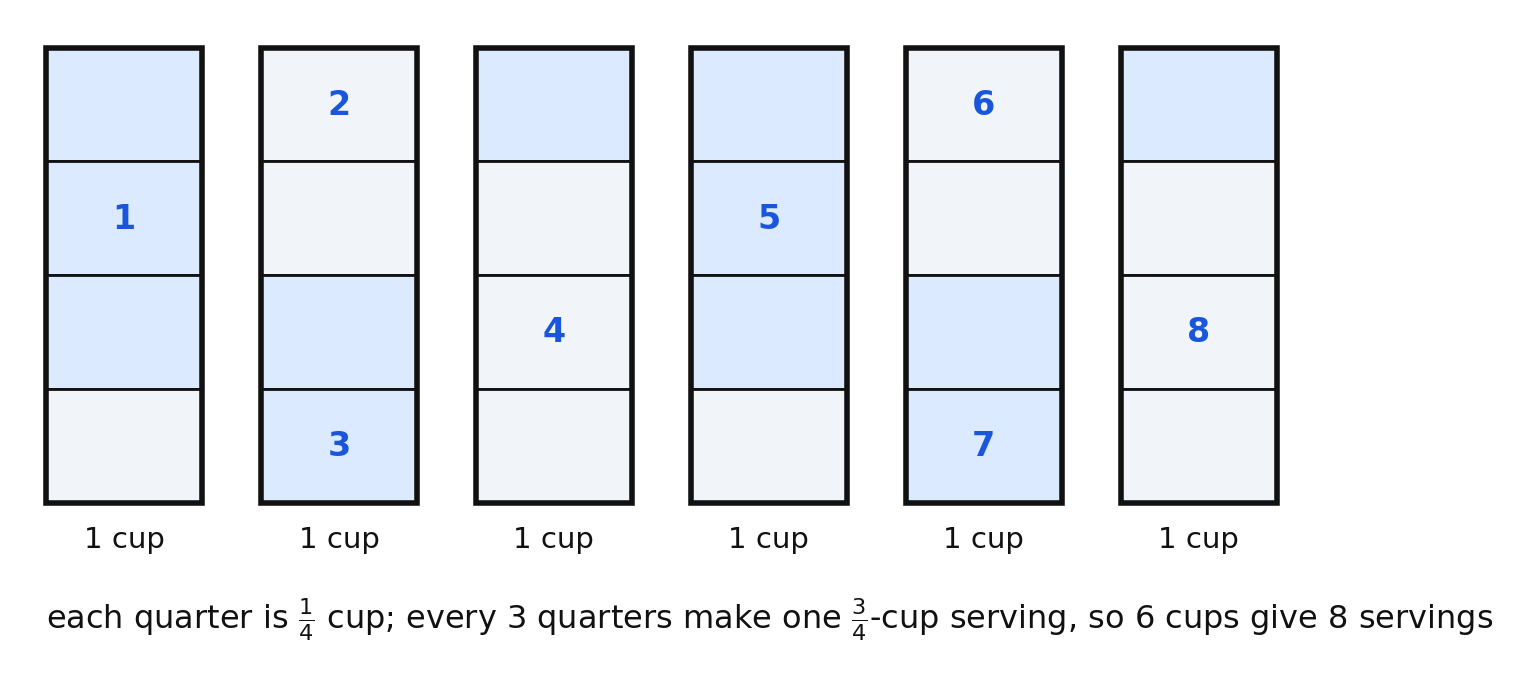
The picture explains why the answer is larger than 6: each serving is smaller than a cup, so there are more servings than cups.
Worked examples
Example 1 — A fraction of a fraction
A recipe calls for cup of sugar. Ben makes only of the recipe. How much sugar does he use?
" of " means multiply.
Answer: cup
Example 2 — Repeating a mixed-number amount
Each batch of granola uses cups of oats. How many cups are needed for batches?
Estimate: , so expect about 9 cups.
Rewrite both as improper fractions:
Answer: cups, which matches the estimate
Example 3 — Measurement division
A pot holds 6 cups of soup. Each bowl takes cup. How many bowls can be filled?
This asks how many groups of fit in 6.
Answer: bowls
Example 4 — Sharing division
pounds of trail mix is divided equally into 6 bags. How much goes in each bag?
The number of groups is known, so this is sharing division.
Answer: pound per bag
Example 5 — Dividing a mixed number by a mixed number
A rope is feet long. It is cut into pieces feet long. How many pieces are there?
Estimate: about , so expect roughly 6 to 8 pieces.
Answer: pieces
Guided practice
- Find of .
- A class of 10 students voted, and chose soccer. How many students chose soccer?
- How many -cup scoops are in 8 cups?
- Three friends share pound of grapes equally. How much does each get?
- Find .
Independent practice
- Find in simplest form.
- How many -mile laps are in a 5-mile run?
- Find .
- Find .
- A -pound block of cheese is cut into 4 equal pieces. How much does each piece weigh?
- Application. A rectangular garden bed measures yards by yards. Find its area, and explain why multiplying is the right operation.
- Reasoning. Explain why is greater than 12, and give the exact quotient.
Exit ticket 6.3
- Find in simplest form.
- Find .
- A cook has pounds of cheese and uses pound per pizza. How many pizzas can be made?
- Explain why of 8 is less than 8.
Lesson 6.4 — Multistep Problems and Justifying Your Answer
A routine that works every time
A multistep problem requires two or more operations before you reach the answer. The steps are rarely hard on their own; the difficulty is keeping track of them. Use the same four-part routine every time.
- Understand. Name what you are looking for and list the amounts you are given.
- Estimate. Round and get a rough answer before doing any careful arithmetic.
- Solve. Do one step at a time, writing the result of each step with its units.
- Justify. Explain why the answer is correct: compare it to the estimate, check it against the context, or work backward.
To justify an answer means to give a reason it is right, not just to restate it. "It is cups because minus is , and that is close to my estimate of 3 cups" is a justification. "It is cups because that is what I got" is not.
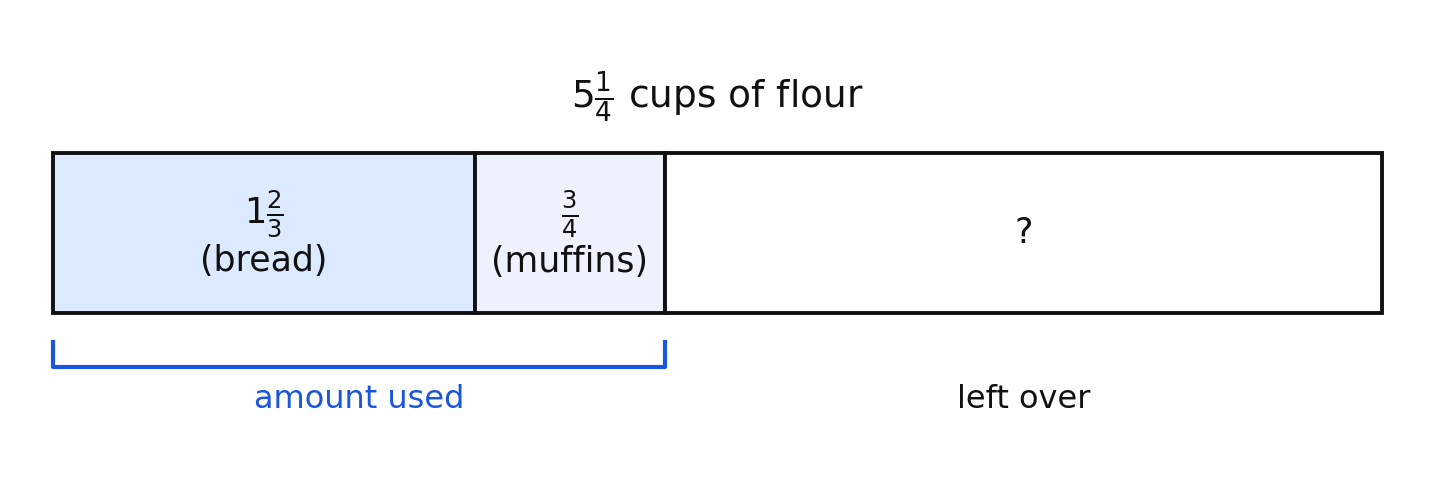
Watch the units at every step
In a multistep problem, each intermediate result is a real quantity. If step 1 gives cups and step 2 gives cups per bag, the units tell you the steps were done in a sensible order. Units that do not make sense are a signal that an operation is wrong.
Worked examples
Example 1 — Add, then subtract
Jamal starts with cups of flour. He uses cups for bread and cup for muffins. How much flour is left?
Understand. Whole amount: cups. Two parts used. Find what remains.
Estimate. , so expect a little under 3 cups.
Solve, step 1 — total used. The LCD of and is .
Solve, step 2 — subtract from the start. Rewrite , then regroup because :
Justify. is close to the estimate of to cups. Checking by working backward: , the amount he started with.
Answer: cups
Example 2 — Three related distances
A runner goes miles Monday. Tuesday she runs miles more than Monday. Wednesday she runs half of Tuesday's distance. What is her three-day total?
Estimate. About miles.
Step 1 — Tuesday: miles.
Step 2 — Wednesday: miles.
Step 3 — total, using the LCD of :
Justify. is close to the estimate of 11, and it is more than any single day's distance, as a total must be.
Answer: miles
Example 3 — Multiply, then subtract
One batch of rice pilaf uses cups of rice. A cook makes batches and starts with cups of rice. How much rice is left?
Estimate. About cups used, leaving about cups.
Step 1 — rice used:
Step 2 — rice left: cups.
Justify. Three cups used is a little more than one batch, which makes sense for batches, and cups left is close to the estimate.
Answer: cups
Example 4 — Subtract, then divide
A rope is feet long. A worker cuts off feet for a repair and cuts the rest into -foot pieces. How many pieces does he get?
Estimate. About feet, and is a bit more than 9.
Step 1 — rope remaining: feet.
Step 2 — number of pieces:
Justify. Nine pieces at feet is feet, exactly the rope that was left.
Answer: pieces
Example 5 — Comparing two results
Maya claims that of cups is more than of cups. Is she right? By how much?
Step 1: cups.
Step 2: cups.
Step 3: cup.
Justify. Both amounts are close to 3 cups, so a small difference is expected; cup is small compared to 3 cups.
Answer: Maya is right, by cup.
Guided practice
- Anna has gallon of paint. She uses gallon on a door and gallon on trim. How much paint is left?
- Find the sum of and , then double it.
- A crate holds 6 melons. Two-thirds of them are ripe. How many are not ripe?
- Estimate, then find the exact value of .
- Is of more or less than 5? Justify your answer with a computation.
Independent practice
- A jug holds liters. After liters are poured out, the rest is split evenly among 3 glasses. How much is in each glass?
- A trail is miles long. A hiker covers miles in the morning and miles in the afternoon. How far is left?
- A worker uses of a -pound bag of seed and splits what he used evenly between 2 containers. How much is in each container?
- Four banners each use yards of fabric, cut from a 10-yard roll. How much fabric is left on the roll?
- Estimate , then find the exact value.
- Application. Kai has hours before dinner. He spends hours on homework and hour at band practice, then splits the remaining time evenly between two chores. How long does he spend on each chore? Justify your answer.
- Reasoning. Rosa says . Use an estimate to show her answer is unreasonable, explain the likely mistake, and give the correct product.
Exit ticket 6.4
- Find .
- A -pound melon is cut into 6 equal pieces. How much do 2 pieces weigh?
- Estimate , then find the exact sum.
- Explain what it means to justify an answer, and give one way to justify a subtraction result.
Chapter 6 Review
Vocabulary. estimate · benchmark fraction · round · compatible numbers · like denominators · unlike denominators · least common denominator · regroup · simplest form · reciprocal · measurement division · sharing division · multistep problem · justify
Part A — Estimating and reasonableness (6.CE.1d, 6.CE.1e)
- Round each fraction to , , or : a) b) c)
- Estimate .
- Estimate .
- Is reasonable? Explain, then give the correct sum.
Part B — Addition and subtraction in context (6.CE.1d)
- Find .
- Find .
- One dog weighs pounds and another weighs pounds. Find their combined weight and the difference between their weights.
- A shelf holds a -inch book and a -inch book side by side. How much shelf width do they use?
Part C — Multiplication and division in context (6.CE.1e)
- Find .
- Find .
- A rehearsal lasts hours, and of it is spent on one song. How long is spent on that song?
- How many -foot bows can be made from feet of ribbon?
Part D — Multistep problems and justification (6.CE.1d, 6.CE.1e)
- Find .
- Find of , then subtract .
- Which is greater, of 8 or of 9? Justify your answer.
- A student writes . Use an estimate to show the answer is unreasonable, then find and justify the correct difference.
Standards coverage check — Chapter 6
| Knowledge and Skill | Where it is taught | Where it is practiced |
|---|---|---|
| 6.CE.1d — estimate, determine, and justify solutions to single-step and multistep contextual problems involving addition and subtraction of fractions and mixed numbers, like and unlike denominators of 12 or less, with and without regrouping, answers in simplest form | 6.1, 6.2, 6.4 | 6.1 all sets; 6.2 all sets; 6.4 all sets; Review Parts A, B, D |
| 6.CE.1e — estimate, determine, and justify solutions to single-step and multistep contextual problems involving multiplication and division of fractions and mixed numbers with denominators of 12 or less, answers in simplest form | 6.1, 6.3, 6.4 | 6.1 all sets; 6.3 all sets; 6.4 all sets; Review Parts A, C, D |
Answer keys for every set in this chapter are in Appendix A.