Chapter 5 — Multiplying and Dividing Fractions
Standard: 6.CE.1 (a, b, c) — The student will estimate, demonstrate, solve, and justify solutions to problems using operations with fractions and mixed numbers, including those in context.
By the end of this chapter you will be able to:
- Demonstrate and model multiplication and division of fractions and mixed numbers using multiple representations (6.CE.1a)
- Multiply and divide fractions and mixed numbers with denominators of 12 or less, expressing answers in simplest form (6.CE.1b)
- Investigate and explain the effect of multiplying or dividing a fraction, whole number, or mixed number by a number between zero and one (6.CE.1c)
Lessons: 5.1 Modeling Fraction Multiplication · 5.2 Multiplying Fractions and Mixed Numbers · 5.3 Modeling Fraction Division · 5.4 Dividing Fractions and Mixed Numbers · 5.5 What Happens When You Multiply or Divide by a Number Between 0 and 1
Calculator note. Parts a, b, and c of 6.CE.1 are assessed without a calculator. Every computation in this chapter is designed to be done by hand.
What the numbers in this chapter look like. All fractions — proper or improper — have denominators of 12 or less, and mixed numbers are built from those fractions. Every answer is written in simplest form, and improper-fraction answers are usually rewritten as mixed numbers. Contextual problem solving with these operations continues in Chapter 6.
Lesson 5.1 — Modeling Fraction Multiplication
"Of" means multiply
Before any procedure, get the meaning straight. When you take a fraction of an amount, you are multiplying.
That is not new. What is new in Grade 6 is taking a fraction of a fraction, and for that you need a picture. The two numbers you multiply are called factors, and the result is the product.
The area model
The area model is the most useful representation for fraction multiplication. Start with one square that stands for one whole. Shade a fraction of it going one direction, then shade a fraction of it going the other direction. The part that is shaded both ways is the product.
Consider .
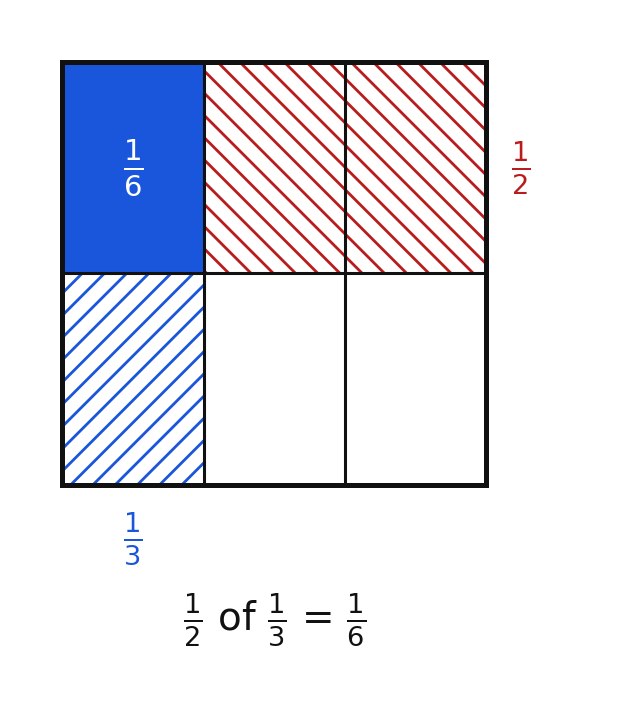
The square is cut into equal cells, and exactly 1 of them is double-shaded:
The model shows something important. The number of equal pieces the whole gets cut into is the product of the two denominators, and the number of pieces you keep is the product of the two numerators. That is where the multiplication rule of Lesson 5.2 comes from — it is not a rule someone invented, it is a description of the picture.
Now a case with numerators larger than 1: .
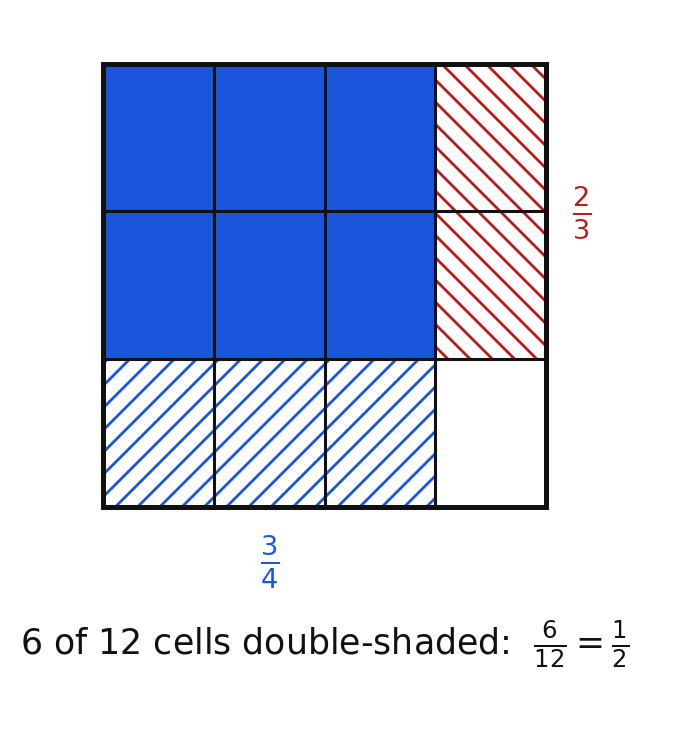
The whole is cut into cells, and of them are double-shaded:
A fraction is in simplest form when the numerator and denominator share no common factor except 1. Since 6 and 12 share the factor 6, becomes .
The set model
When the whole is a group of objects rather than a shape, use a set model: split the group into equal parts and take the number of parts you need.
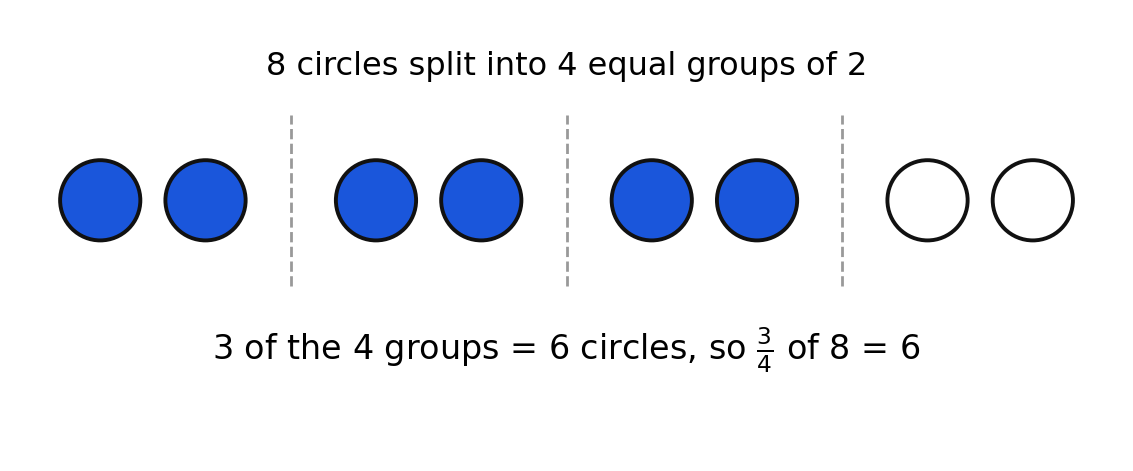
To find of 8: split 8 into 4 equal groups of 2, then take 3 groups.
Repeated addition with fraction strips
When a whole number multiplies a fraction, you can read it as repeated addition and lay out fraction strips end to end.
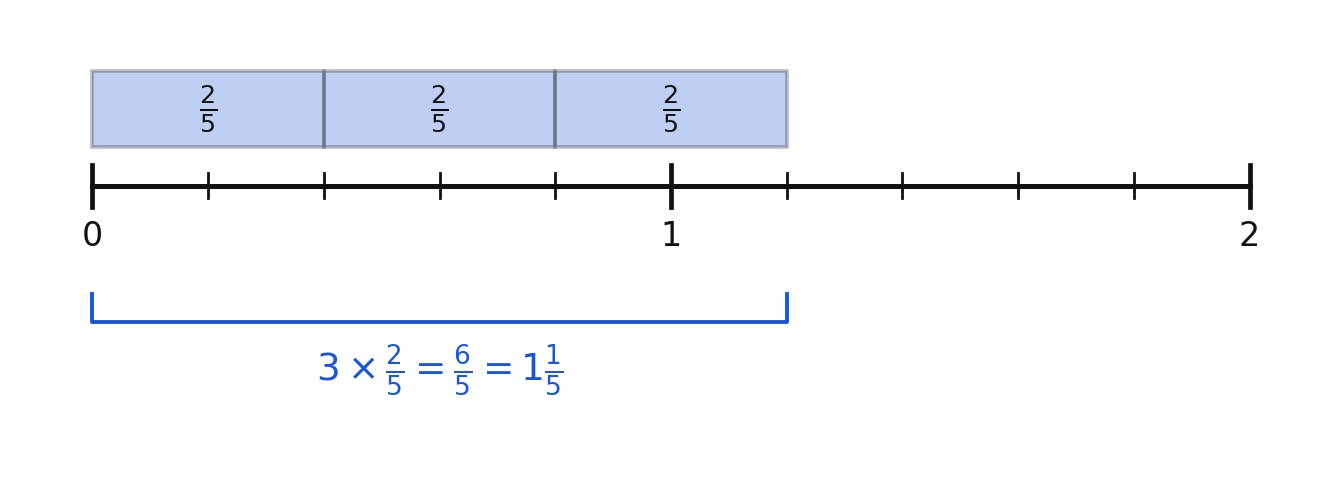
Three copies of two fifths is six fifths, which passes 1 and lands one fifth beyond it.
Three representations, one operation. Area models are best for fraction times fraction. Set models are best for a fraction of a group of objects. Number lines and strips are best for a whole number times a fraction. Being able to switch among them is exactly what standard 6.CE.1a asks for.
Worked examples
Example 1 — Unit fraction times unit fraction
Use an area model to find .
Cut a square into 3 equal columns and shade 1. Cut the same square into 2 equal rows and shade 1. The square now has equal cells, and 1 is shaded both ways.
Answer:
Example 2 — Both numerators greater than 1
Use an area model to find .
Cut the square into 4 columns and shade 3. Cut it into 3 rows and shade 2. That makes cells, with double-shaded.
Simplify by dividing both parts by 6.
Answer:
Example 3 — Fraction of a set
Find of 8 using a set model.
Split 8 objects into 4 equal groups: each group has objects. Take 3 groups: .
Answer:
Example 4 — Whole number times a fraction
Find using repeated addition on a number line.
Rewrite as a mixed number: with remainder 1.
Answer:
Example 5 — Simplifying the product
Use an area model to find .
Cut the square into 5 columns and shade 4; cut it into 2 rows and shade 1. There are cells, and are double-shaded.
The greatest common factor of 4 and 10 is 2.
Answer:
Guided practice
- Use an area model to find .
- Use an area model to find .
- Use a set model to find of 9.
- Use repeated addition to find . Write the answer in simplest form.
- Draw an area model for and give the product in simplest form.
Independent practice
- Use an area model for each: a) b) c)
- Use repeated addition to find . Write the answer as a mixed number.
- Use a set model to find of 12.
- Draw an area model for and give the product in simplest form.
- Find and describe the area model that shows it.
- Application. A recipe calls for cup of sugar. Aisha is making half of the recipe. How much sugar does she need? Draw or describe a model that shows your answer.
- Reasoning. Explain why an area model shows that the denominators of the two factors get multiplied together. Use in your explanation.
Exit ticket 5.1
- Find and write it in simplest form.
- Find of 16.
- Find and write it as a mixed number in simplest form.
- Explain how an area model shows that .
Lesson 5.2 — Multiplying Fractions and Mixed Numbers
The rule, and where it comes from
The area models in Lesson 5.1 said it: the product's denominator counts how many equal cells the whole was cut into, and the product's numerator counts how many you kept.
To multiply fractions, multiply the numerators and multiply the denominators. Then write the answer in simplest form.
That last step divides both 12 and 72 by their greatest common factor, 12.
Simplifying before you multiply
You may also cancel a common factor before multiplying, which keeps the numbers small. In , the 3 and the 9 share a factor of 3, and the 4 and the 8 share a factor of 4:
Both routes give . Simplifying first is a convenience, never a requirement — but you may only cancel a numerator against a denominator, never two numerators or two denominators.
Whole numbers as fractions
Any whole number can be written over 1, which lets one rule handle every case.
Mixed numbers: convert first
You cannot multiply the whole parts and the fraction parts separately — that gives a wrong answer. Convert every mixed number to an improper fraction first.
To convert : multiply the whole number by the denominator, add the numerator, and keep the denominator.
Then multiply as usual, and convert back at the end.
Estimating to check
Before computing, round each mixed number to the nearest whole number and multiply. For , that is about , so an answer of 3 is reasonable while an answer of 30 would signal an error. An estimate will not catch a small slip, but it catches the large ones — and those are the ones that matter most.
Worked examples
Example 1 — Two proper fractions
Multiply .
The greatest common factor of 12 and 72 is 12.
Answer:
Example 2 — Simplifying the product
Multiply .
Answer:
Example 3 — Two mixed numbers
Multiply .
Convert both:
Multiply:
Estimate check: about , so 3 is reasonable.
Answer:
Example 4 — Mixed number times a proper fraction
Multiply .
Answer:
Example 5 — Whole number times a mixed number
Multiply .
Estimate check: about , so is reasonable.
Answer:
Guided practice
Write every answer in simplest form.
Independent practice
Write every answer in simplest form.
- a) b) c)
- Application. A trail is miles long. Jonah walks of it. How far does he walk? Estimate first, then compute.
- Reasoning. Before computing , predict whether the product will be greater or less than , and explain your prediction. Then compute the product and check whether you were right.
Exit ticket 5.2
Write every answer in simplest form.
- Explain why you convert a mixed number to an improper fraction before multiplying.
Lesson 5.3 — Modeling Fraction Division
What a division question is really asking
can be read two ways: "how many groups of 4 fit in 12?" or "if 12 is split into 4 equal groups, how big is each?" For fraction division, the first reading — how many of the divisor fit into the dividend — is far easier to picture, and it is the one this lesson uses.
In , the number being divided () is the dividend, the number you divide by () is the divisor, and the answer is the quotient.
How many fit?
Ask: how many quarters fit into 3 wholes?
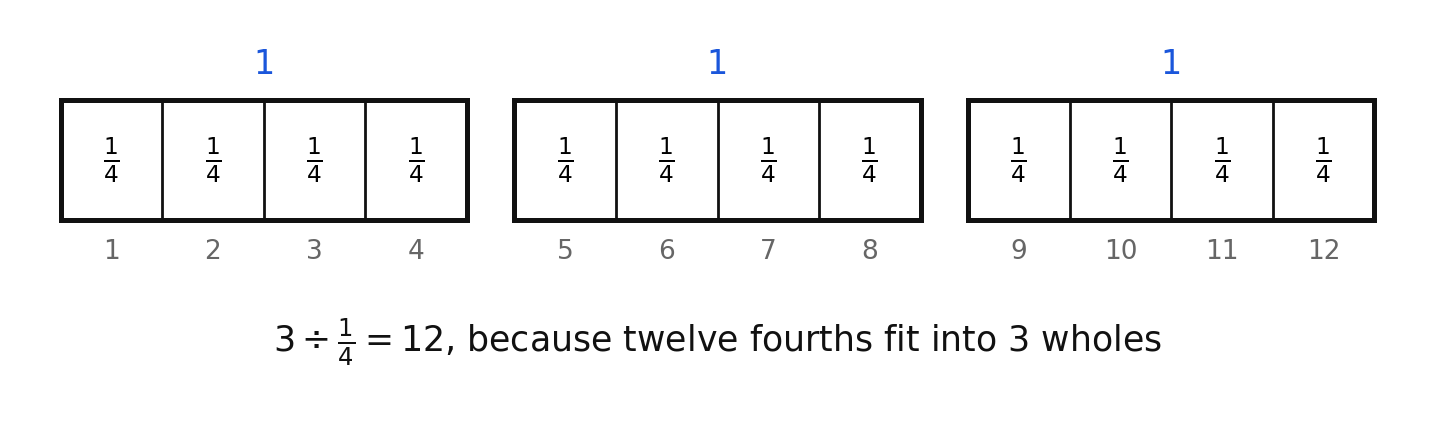
Each whole holds 4 fourths, and there are 3 wholes, so:
Notice the quotient is larger than the dividend. That is not strange once you read the question correctly: fourths are small, so a lot of them fit. Lesson 5.5 studies exactly when this happens.
Dividing a fraction by a fraction
The same question works when the dividend is also a fraction. How many eighths fit into ?
Rewrite using eighths: . Six eighths hold six pieces of size .
This is a second useful strategy: rename both fractions with a common denominator, then divide the numerators. It works because once the pieces are the same size, you are just counting pieces.
When the answer is not a whole number
Sometimes the divisor does not fit a whole number of times, and part of one more fits.
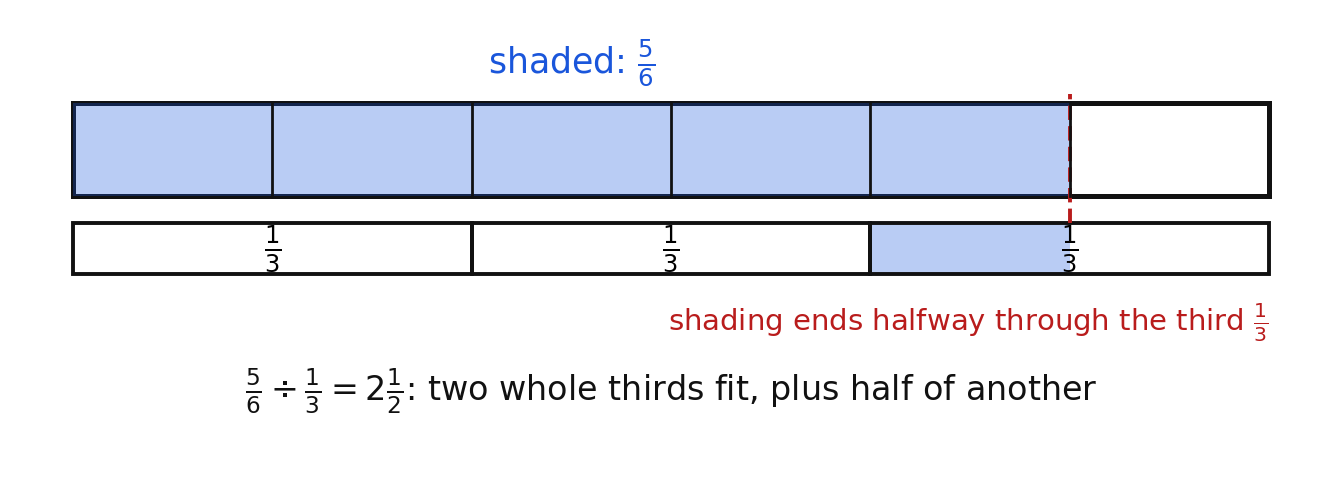
Two full thirds fit inside , using up . The leftover is , which is half of a third. So:
The common-denominator strategy agrees: .
Read the fractional part of the answer carefully. In , that means "half of a third," not "half of a sixth" and not "half of a whole." The remainder is always measured against the divisor, because the divisor is what you are counting.
Worked examples
Example 1 — Whole divided by a unit fraction
Model .
Draw 3 whole strips and cut each into fourths. Each whole gives 4 fourths, so there are fourths.
Answer:
Example 2 — Fraction divided by a unit fraction
Model .
Rename with a common denominator: . Now count eighths: there are 6.
Answer:
Example 3 — Common denominator strategy
Find .
Answer:
Example 4 — Whole divided by a non-unit fraction
Model .
Cut 2 wholes into thirds: that is 6 thirds. Group them 2 at a time, since the divisor is : groups.
Answer:
Example 5 — A quotient with a fractional part
Model .
Rename: . Then .
In the picture, two whole thirds fit and half of a third is left over.
Answer:
Guided practice
- How many thirds fit into 2? Find .
- Find .
- Find using a common denominator.
- Find .
- Find using a common denominator.
Independent practice
- Find each: a) b) c)
- Find .
- Find .
- Find and describe the model that shows it.
- Find .
- Application. Nadia has feet of ribbon and cuts it into pieces foot long. How many pieces does she get? Describe the model you used.
- Reasoning. Explain why gives an answer larger than 3, even though dividing usually feels like it should make a number smaller.
Exit ticket 5.3
- Find .
- Find .
- Find .
- Explain what the question "how many -cup scoops fill 2 cups?" has to do with division, and answer it.
Lesson 5.4 — Dividing Fractions and Mixed Numbers
Reciprocals
Two numbers are reciprocals — also called multiplicative inverses — when their product is 1. To find the reciprocal of a fraction, swap the numerator and denominator.
| Number | Reciprocal | Check |
|---|---|---|
Zero has no reciprocal, because no number times 0 equals 1. That is the same reason you cannot divide by zero.
The rule
To divide by a fraction, multiply by its reciprocal.
Why it works
Lesson 5.3 already showed the reason in pictures, and the arithmetic agrees. Take . How many eighths in ? Each whole holds 8 eighths, so of a whole holds of 8 eighths:
Multiplying by 8 is exactly multiplying by the reciprocal of . Dividing by a fraction asks how many small pieces fit, and multiplying by the reciprocal counts them.
Mixed numbers and whole numbers
Convert every mixed number to an improper fraction and every whole number to a fraction over 1 before flipping. Flip only the divisor.
Checking a division answer
Multiplication undoes division, so multiply the quotient by the divisor and see whether you get the dividend back.
Worked examples
Example 1 — Fraction divided by fraction
Find .
Multiply by the reciprocal of , which is .
Answer:
Example 2 — A quotient less than 1
Find .
The quotient is less than 1 because the divisor is larger than the dividend — less than one copy of it fits.
Answer:
Example 3 — Mixed number divided by a fraction
Find .
Answer:
Example 4 — Two mixed numbers
Find .
Check: .
Answer:
Example 5 — Dividing by a whole number
Find .
This makes sense: splitting into 7 equal parts gives each.
Answer:
Guided practice
Write every answer in simplest form.
Independent practice
Write every answer in simplest form.
- a) b) c)
- Application. A recipe uses cups of flour per batch. Priya has cups of flour. How many full batches can she make?
- Reasoning. Explain why multiplying by the reciprocal gives the same answer as asking "how many of the divisor fit into the dividend." Use in your explanation, then check the answer to problem 6a by multiplying.
Exit ticket 5.4
Write every answer in simplest form.
- Write the reciprocal of , of , and of .
Lesson 5.5 — What Happens When You Multiply or Divide by a Number Between 0 and 1
Multiplying by 1 changes nothing
Start at the boundary. Any number times 1 is itself:
That makes 1 the dividing line for this whole lesson. Multiplying by a factor just under 1 gives a result just under the original. Multiplying by a factor just over 1 gives a result just over it.
Multiplying by a number between 0 and 1 makes the result smaller
And . This should feel right: taking three quarters of something gives you less than all of it. Any fraction between 0 and 1 asks for part of the original amount, so the product must be smaller than the number you started with.
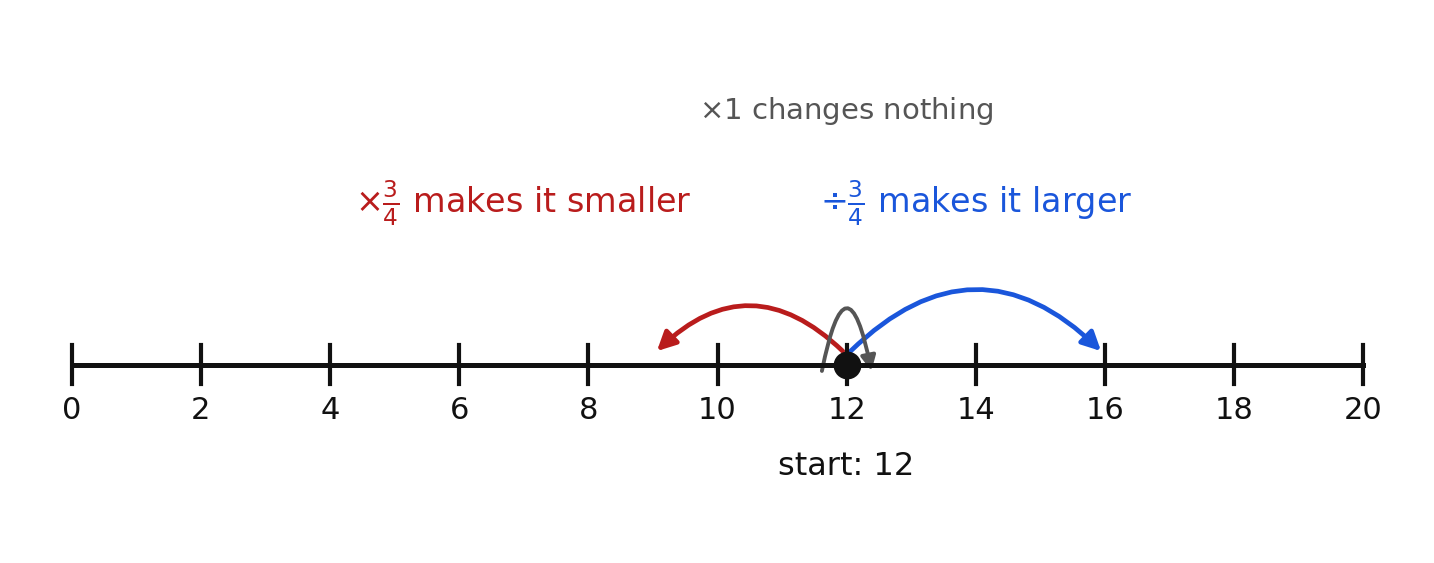
The rule holds for fraction starting values too:
Is less than ? Yes — twelfths are smaller pieces than sixths, and there are the same number of them. Written with a common denominator, , and .
Dividing by a number between 0 and 1 makes the result larger
And . Lesson 5.3 gives the reason: dividing asks how many copies of the divisor fit. When the divisor is less than one whole, more than one copy fits per whole, so the count exceeds the dividend.
And .
The complete picture
Let be a positive number.
| Multiply or divide by | Effect on |
|---|---|
| a number between 0 and 1 (multiply) | result is less than |
| exactly 1 (multiply or divide) | result equals |
| a number greater than 1 (multiply) | result is greater than |
| a number between 0 and 1 (divide) | result is greater than |
| a number greater than 1 (divide) | result is less than |
Two habits come out of this table. First, you can predict before you compute, which turns the table into an error-checking tool: if you multiply by and get a bigger number, something went wrong. Second, "multiplying makes things bigger" and "dividing makes things smaller" — rules that worked for whole numbers greater than 1 — are simply not true in general. This lesson is where that belief gets retired.
Why shrinks and grows. Multiplying by means taking 5 of 8 equal parts, which is less than all 8. Multiplying by means taking 8 of 5 equal parts — more parts than the whole has — so the result is larger. The two factors are reciprocals, and they push in opposite directions.
Worked examples
Example 1 — Multiplying a whole number
Find , then compare it to 12. Also find .
The factor is between 0 and 1, so the product shrinks. The factor is greater than 1, so the product grows.
Answer: , which is less than 12; and , which is greater than 12
Example 2 — Dividing a whole number
Find and compare it to 12.
, because each whole holds more than one three-quarter piece.
Answer: , which is greater than 12
Example 3 — Multiplying a fraction by a fraction
Find and compare it to .
Compare using a common denominator: , and .
Answer: , which is less than
Example 4 — Dividing a fraction by a fraction
Find and compare it to .
Answer: , which is greater than
Example 5 — Predict, then compute
Will be greater or less than ? Predict, then compute.
Prediction: less, because is between 0 and 1.
And , so the prediction holds.
Answer: less; the product is
Guided practice
- Is more or less than 20? Predict, then compute.
- Is more or less than 20? Predict, then compute.
- Is more or less than ? Predict, then compute.
- Find and say whether it is more or less than 6.
- Find . Explain why 1 is the boundary between factors that shrink a number and factors that grow it.
Independent practice
- Without computing, say whether each result is more or less than 15: a) b) c) d)
- Compute each and compare it to 10: a) b)
- Find and compare it to .
- Find and compare it to .
- Sort these into two groups — products less than 9, and products not less than 9: , , , .
- Application. A photo is 8 inches wide. A printer scales it by a factor of , then a second printer scales the original by a factor of . Find each new width and explain which scale factor enlarges the photo and why.
- Reasoning. Jaden says, "Multiplying always makes a number bigger and dividing always makes it smaller." Give one multiplication example and one division example with fractions that disprove him, and explain what condition he left out.
Exit ticket 5.5
- Is more or less than 16? Compute it.
- Is more or less than 16? Compute it.
- Find and compare it to .
- Explain why multiplying by shrinks a number but multiplying by grows it.
Chapter 5 Review
Vocabulary. factor · product · area model · set model · fraction strip · simplest form · dividend · divisor · quotient · improper fraction · reciprocal · multiplicative inverse
Part A — Modeling multiplication and division (6.CE.1a)
- Draw an area model for and give the product in simplest form.
- Draw a strip model for and give the quotient.
- Use repeated addition on a number line to find . Write the answer as a mixed number.
- Use a set model to find of 10.
Part B — Multiplying and dividing (6.CE.1b)
Write every answer in simplest form.
- a) b) c)
- a) b)
- a) b) c)
- a) b)
Part C — The effect of multiplying or dividing by a number between 0 and 1 (6.CE.1c)
- Say whether each result is more or less than 24, then compute it: a) b)
- Explain why is less than .
- Which of these results are greater than ? Compute each to justify your answer. , ,
Part D — Mixed application and reasoning
- Application. Each bag of trail mix holds pound. How much do bags hold?
- Application. A board feet long is cut into pieces foot long. How many pieces are there?
- Reasoning. but . Explain why the two results are so different.
- Reasoning. Show how to check the answer to using multiplication, and explain why that check works.
Standards coverage check — Chapter 5
| Knowledge and Skill | Where it is taught | Where it is practiced |
|---|---|---|
| 6.CE.1a — demonstrate and model multiplication and division of fractions and mixed numbers using multiple representations | 5.1, 5.3 | 5.1 all sets; 5.3 all sets; 5.4 reasoning 12; Review Part A |
| 6.CE.1b — multiply and divide fractions and mixed numbers with denominators of 12 or less; answers in simplest form | 5.2, 5.4 | 5.2 all sets; 5.4 all sets; 5.5 all sets; Review Part B |
| 6.CE.1c — investigate and explain the effect of multiplying or dividing a fraction, whole number, or mixed number by a number between zero and one | 5.5 | 5.5 all sets; 5.2 reasoning 12; 5.3 reasoning 12; Review Part C |
Knowledge and Skills 6.CE.1d and 6.CE.1e — contextual problem solving with fractions — are covered in Chapter 6.
Answer keys for every set in this chapter are in Appendix A.