Chapter 4 — Fractions, Decimals, and Percents
Standard: 6.NS.1 — The student will reason and use multiple strategies to express equivalency, compare, and order numbers written as fractions, mixed numbers, decimals, and percents.
By the end of this chapter you will be able to:
- Estimate and determine the percent represented by a given model, including percents greater than 100% and less than 1% (6.NS.1a)
- Represent and determine equivalencies among decimals through the thousandths place and percents (6.NS.1b)
- Represent and determine equivalencies among fractions, mixed numbers, and percents (6.NS.1c)
- Represent and determine equivalencies among decimals, percents, fractions, and mixed numbers (6.NS.1d)
- Use multiple strategies — benchmarks, number lines, and equivalency — to compare and order up to four positive rational numbers, and justify your answer (6.NS.1e)
Lessons: 4.1 Percent as Parts per Hundred · 4.2 Decimals and Percents · 4.3 Fractions and Percents · 4.4 Converting Among All Three Forms · 4.5 Comparing and Ordering Rational Numbers · 4.6 Percents Greater Than 100% and Less Than 1%
Calculator note. Every part of standard 6.NS.1 is assessed without a calculator. Everything in this chapter is built to be done by hand or in your head, so practice it that way.
What the numbers in this chapter look like. Decimals go out to the thousandths place. Fractions have denominators of 12 or less, or denominators that are factors of 100 — that is, 2, 4, 5, 10, 20, 25, 50, and 100. When you compare or order, you will work with no more than four numbers at a time, and all of them will be positive.
Lesson 4.1 — Percent as Parts per Hundred
A third way to say the same thing
You already have two ways to describe part of a whole. You can use a fraction, like , or a decimal, like . This chapter adds a third: percent.
A percent is a ratio that compares a number to . The symbol means "per hundred," so means "35 out of every 100."
Percents are everywhere — test scores, phone batteries, sale signs, weather forecasts — for one reason: when every part-to-whole comparison is rewritten out of the same 100, comparing them is easy. That is the whole idea. A percent is not a new kind of number. It is a familiar number wearing a standard uniform.
The hundred grid
The clearest model for percent is a hundred grid: a square divided into 100 equal small squares. One small square is of the grid, because it is one part out of 100.
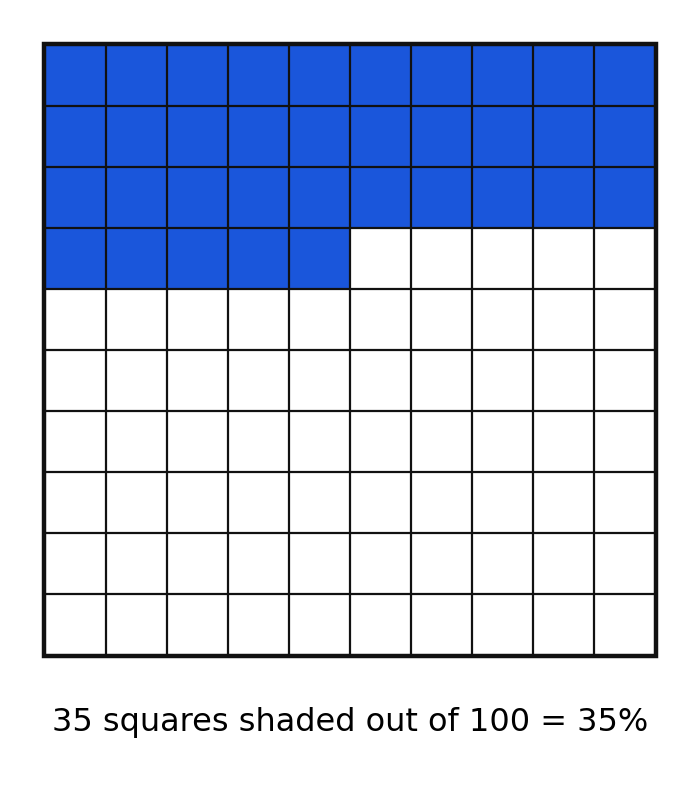
Reading a hundred grid takes one step: count the shaded squares. That count is the percent.
- 7 squares shaded is
- 50 squares shaded is
- All 100 squares shaded is , the whole thing
That last line is worth pausing on. means one whole. Not "everything possible" and not "the maximum" — just one complete whole of whatever you are describing. You will see in Lesson 4.6 that percents can go past , which only makes sense once you know that is one whole.
When the model is not divided into 100 parts
Many models are divided into some other number of equal parts. If that number is a factor of 100, you can scale up to hundredths.
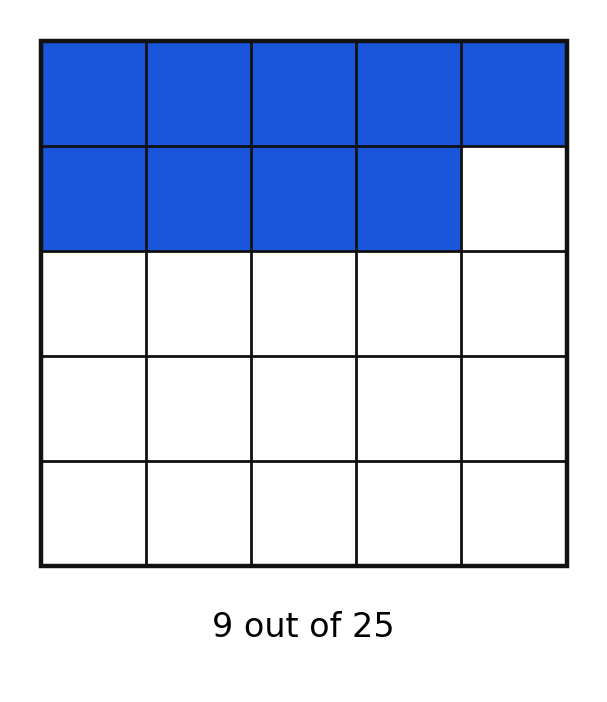
Nine of 25 equal parts are shaded. Since , multiply both parts of the comparison by 4:
The same move works for tenths (), fifths (), twentieths (), and halves ().
Estimating a percent from a picture
Not every model is neatly divided. When a bar or a region is just shaded, you estimate using benchmark percents — landmark values you know on sight.
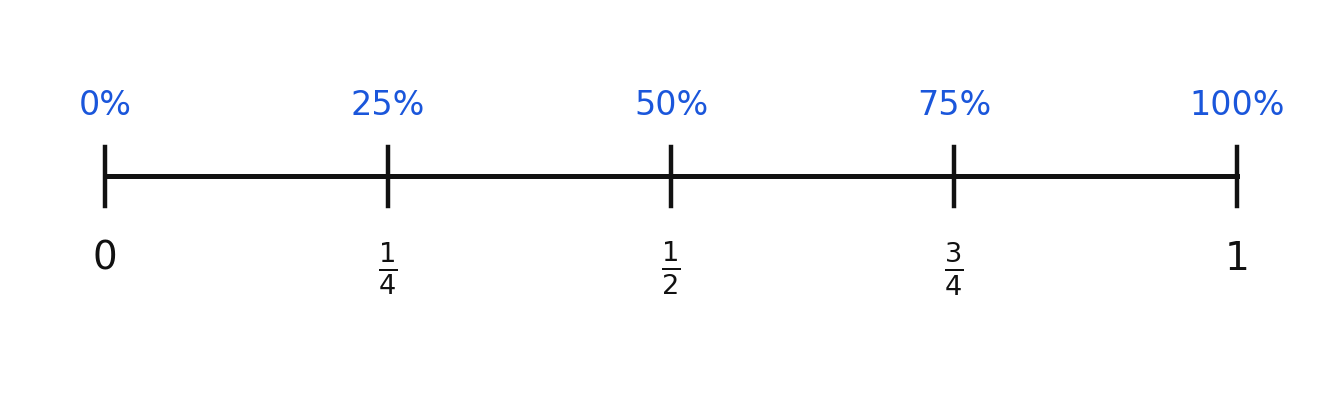
| Benchmark | Percent |
|---|---|
| none | |
| about one quarter | |
| about one half | |
| about three quarters | |
| the whole thing |
To estimate, decide which benchmarks the shaded part falls between, then judge whether it is closer to one or the other. A bar shaded a little past halfway is "a bit more than " — maybe or . A good estimate is one you can defend, not one that matches a hidden exact answer.
Naming the whole. A percent means nothing until you know what it is a percent of. Half of a large pizza and half of a small pizza are both , but they are not the same amount of food. Always ask, " of what?"
Worked examples
Example 1 — Reading a hundred grid
A hundred grid has 35 squares shaded. What percent is shaded, and what percent is unshaded?
Each square is , so 35 shaded squares is . The whole grid is , so the unshaded part is .
Answer: shaded; unshaded
Example 2 — Percent from a verbal description
In a survey of exactly 100 students, 43 chose soccer. What percent chose soccer?
Percent means parts per hundred, and the whole here is already 100.
Answer:
Example 3 — A model with 25 parts
A square is divided into 25 equal parts and 9 are shaded. What percent is shaded?
Scale the comparison up to a denominator of 100. Since :
Answer:
Example 4 — Estimating
A bar is shaded from the left end to a point just short of the middle. Estimate the percent shaded.
The shaded part is between the and benchmarks, and much closer to . A reasonable estimate is about .
Answer: about (anything from about to is defensible)
Example 5 — More than one whole
One full hundred grid is shaded, and beside it a second grid has 20 squares shaded. What percent is shaded in all?
The full grid is and the 20 squares are .
Answer:
Guided practice
- A hundred grid has 62 squares shaded. What percent is shaded?
- Of exactly 100 people surveyed, 17 ride the bus. What percent ride the bus?
- A square is divided into 25 equal parts and 9 are shaded. What percent is shaded?
- A bar is shaded a little past the three-quarters mark. Estimate the percent shaded.
- Write as a comparison to 100.
Independent practice
- Give the percent shaded for each grid: a) 5 of 100 squares b) 50 of 100 squares c) 100 of 100 squares d) one full grid plus 30 squares of a second grid
- A rectangle is divided into 20 equal parts and 3 are shaded. What percent is shaded?
- A strip is divided into 10 equal parts and 7 are shaded. What percent is shaded?
- In a hundred grid, exactly half of one small square is shaded. What percent is shaded?
- Application. A hundred grid shows a school's lunch choices, one square per student, for 100 students. Pizza fills 38 squares and salad fills 24. What percent chose pizza, what percent chose salad, and what percent chose something else?
- Application. Rosa answered 22 of 25 quiz questions correctly. What percent did she answer correctly?
- Reasoning. Deshawn says a model cannot show more than , because a grid only has 100 squares. Explain why he is wrong, and describe a model that shows .
Exit ticket 4.1
- A hundred grid has 41 squares shaded. What percent is shaded?
- A square divided into 25 equal parts has 6 parts shaded. What percent is shaded?
- A bar is shaded to a point just short of halfway. Estimate the percent shaded.
- Explain what tells you about a whole.
Lesson 4.2 — Decimals and Percents
Percents and hundredths are the same thing
A percent is hundredths, written a different way. That single fact does all the work in this lesson.
Read out loud in place-value language — "thirty-seven hundredths" — and the percent is already there.
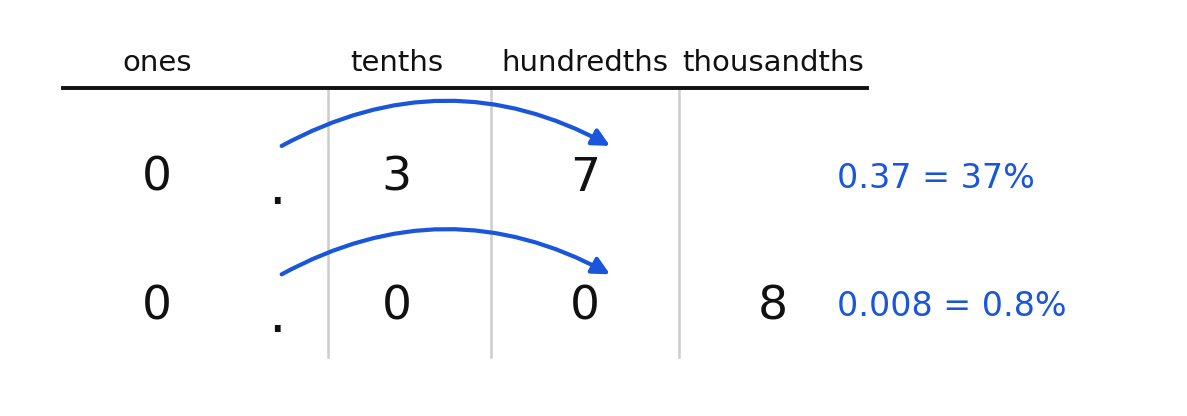
Decimal to percent: multiply by 100
Because a percent counts hundredths, changing a decimal to a percent means multiplying by 100 — which shifts every digit two places to the left of where it was, so the decimal point appears to move two places to the right.
Two of those deserve comment. In , you may write in a zero to fill the hundredths place — — before moving the point; and are equal, so this changes nothing but makes the shift easy to see. And in , moving the point two places lands inside a digit, giving . That is allowed. A percent does not have to be a whole number.
Percent to decimal: divide by 100
Going the other direction, divide by 100, so the decimal point moves two places to the left. If a percent is written without a decimal point, it sits at the right end of the number: is .
In , there is only one digit to move past, so you write a zero as a placeholder and get . Skipping that zero and writing is the most common mistake in this lesson, and it is off by a factor of ten.
A quick check. A percent less than always becomes a decimal less than . A percent greater than always becomes a decimal greater than . If your answer breaks that rule, you moved the point the wrong way.
Worked examples
Example 1 — Decimal to percent
Write as a percent.
is 37 hundredths, and hundredths are percents.
Answer:
Example 2 — A decimal in tenths
Write as a percent.
Fill the hundredths place first: .
Answer:
Example 3 — A decimal in thousandths
Write as a percent.
Move the decimal point two places right: , which is .
Check it: means per hundred, and .
Answer:
Example 4 — Percent to decimal
Write and as decimals.
Divide each by 100, moving the point two places left. For , write a placeholder zero in the tenths place.
Answer: and
Example 5 — Past one whole, and below one percent
Write as a percent, and write as a percent.
Both answers pass the check: is greater than 1, so its percent is greater than ; is much less than , so its percent is less than .
Answer: and
Guided practice
- Write as a percent.
- Write as a percent.
- Write as a decimal.
- Write as a decimal.
- Write as a percent.
Independent practice
- Write each decimal as a percent: a) b) c) d)
- Write each percent as a decimal: a) b) c) d)
- Write as a percent.
- Is greater than, less than, or equal to ? Justify your answer.
- Write as a percent.
- Application. A phone battery reads of full charge on a diagnostic screen, and a sales tax rate is listed as . Write each as a percent, and explain which form you would rather see on a store sign.
- Reasoning. Nina writes . Explain her mistake, give the correct percent for , and give the correct decimal for .
Exit ticket 4.2
- Write as a percent.
- Write as a decimal.
- Write as a percent.
- Explain why changing a decimal to a percent moves the decimal point two places to the right.
Lesson 4.3 — Fractions and Percents
Two strategies, one goal
To write a fraction as a percent, you need hundredths. There are two dependable ways to get them.
Strategy 1 — Build an equivalent fraction with denominator 100. This works whenever the denominator divides evenly into 100: that is 2, 4, 5, 10, 20, 25, 50, and 100.
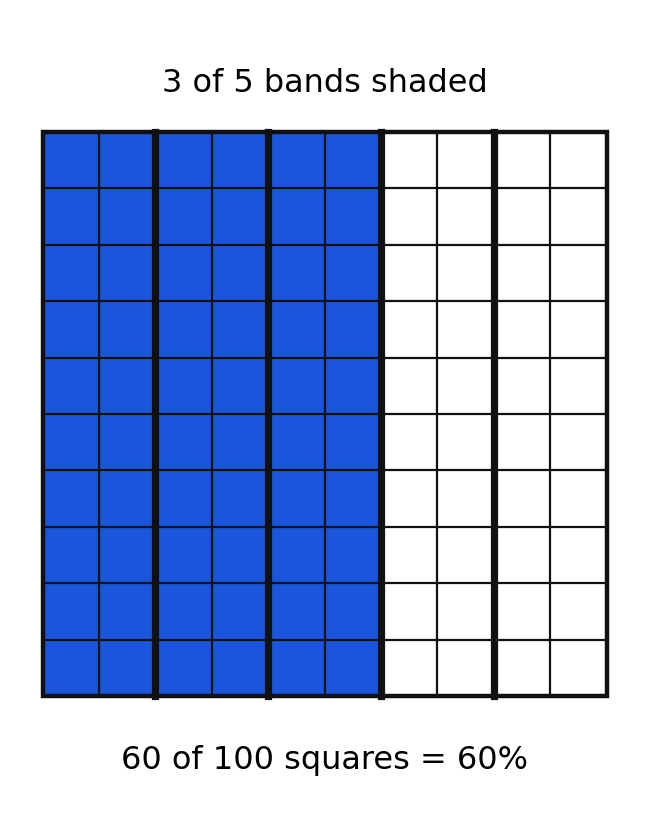
The picture shows why this is not a trick. Shading 3 of the 5 bands shades 60 of the 100 small squares. Nothing about the amount changed; only the size of the parts you count changed.
Strategy 2 — Divide the numerator by the denominator, then convert the decimal. This works for any fraction, including denominators like 8, 3, 6, and 12 that do not divide 100 evenly.
Fractions with denominators 3, 6, 9, and 12
Some fractions do not produce a terminating decimal. , with the 3 repeating forever. Rounding to gives , which is close but not exact. The exact percent uses a fraction inside it:
Here is where comes from. One third of 100 is , so one third is per hundred.
Percent to fraction
Write the percent over 100, then simplify. A fraction is in simplest form when the only common factor of the numerator and denominator is 1.
Percents and mixed numbers
A fraction greater than 1 gives a percent greater than , and so does a mixed number.
Percents worth memorizing
Knowing these on sight makes the rest of the chapter much faster.
| Fraction | Percent | Fraction | Percent |
|---|---|---|---|
Worked examples
Example 1 — Build to hundredths
Write as a percent.
, so multiply the numerator by 20 as well.
Answer:
Example 2 — A denominator of 20
Write as a percent.
.
Answer:
Example 3 — Divide instead
Write as a percent.
8 does not divide 100 evenly, so divide.
Answer:
Example 4 — Percent to a fraction in simplest form
Write as a fraction in simplest form.
The greatest common factor of 45 and 100 is 5.
Answer:
Example 5 — A repeating case
Write as a percent.
Two thirds of 100 is .
Rounded, this is about , but is exact.
Answer:
Guided practice
- Write as a percent.
- Write as a percent.
- Write as a percent.
- Write as a fraction in simplest form.
- Write as a percent.
Independent practice
- Write each as a percent: a) b) c) d)
- Write each as a percent: a) b) c)
- Write each percent as a fraction in simplest form: a) b) c)
- Write as a percent.
- Write as a percent.
- Application. Malik made 12 of his 16 free throws. Write his result as a fraction in simplest form and as a percent.
- Reasoning. Explain why can be changed to a percent without dividing, but cannot. What is it about the denominators that makes the difference?
Exit ticket 4.3
- Write as a percent.
- Write as a fraction in simplest form.
- Write as a percent.
- Describe two different ways to change into a percent, and show that both give the same answer.
Lesson 4.4 — Converting Among All Three Forms
One number, three outfits
Fractions, decimals, and percents are three notations for the same quantity. This lesson connects all three at once, so you can enter with any form and leave with the other two.
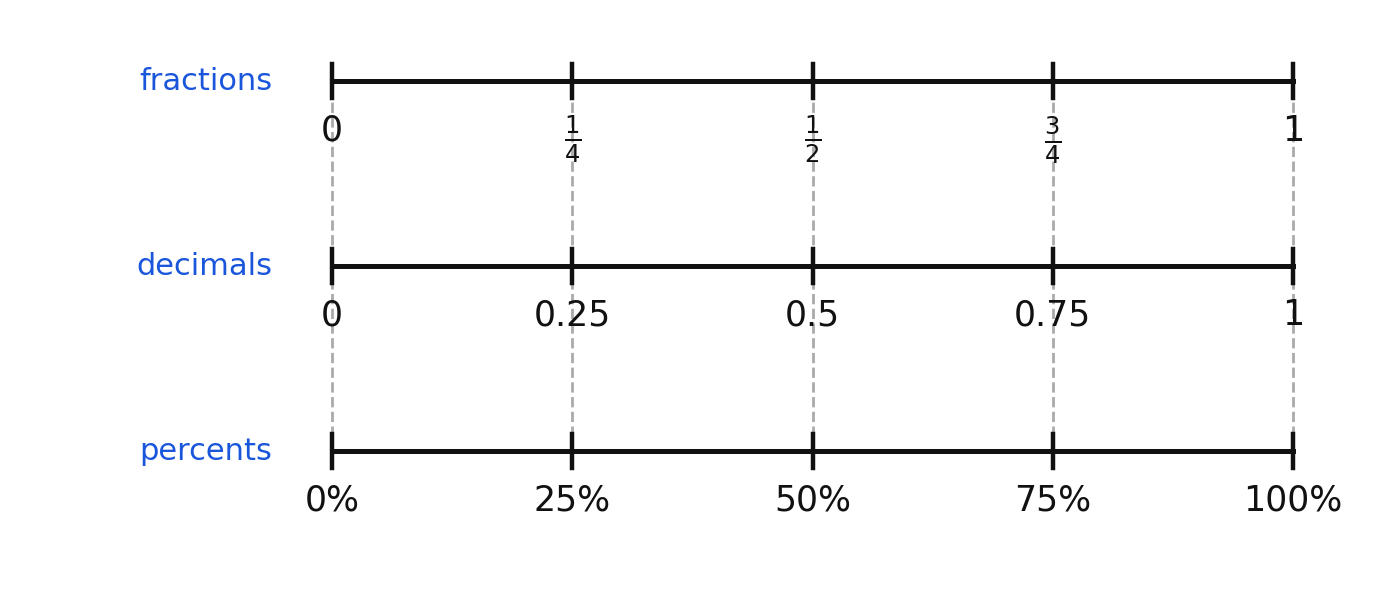
The three routes you need are short:
| From | To | What to do |
|---|---|---|
| decimal | percent | multiply by 100 (point moves 2 right) |
| percent | decimal | divide by 100 (point moves 2 left) |
| fraction | decimal | divide the numerator by the denominator |
| decimal | fraction | write the digits over 10, 100, or 1000, then simplify |
| fraction | percent | build to hundredths, or go through the decimal |
| percent | fraction | write over 100, then simplify |
Notice that the decimal sits in the middle of every route. When you are unsure, convert to a decimal first. It is the reliable hub.
Writing a decimal as a fraction
Use the place value of the last digit to choose the denominator.
For the last one, and share a factor of 125: and . If spotting 125 is hard, simplify in smaller steps — divide by 5 three times:
When the decimal repeats
Fractions with denominators of 3, 6, 9, or 12 produce repeating decimals. You can round the decimal to the thousandths place, but say so. The exact value belongs in fraction or fractional-percent form.
The bar over the 6 means the 6 repeats forever. The symbol means "is approximately equal to."
Choose your form on purpose. Fractions are exact and are best for computing with thirds and sixths. Decimals are best for lining up place value and for ordering. Percents are best for communicating a part-to-whole comparison to another person. Same number, different jobs.
Worked examples
Example 1 — Start with a decimal
Write as a percent and as a fraction in simplest form.
Percent: move the point two places right, giving .
Fraction: the last digit is in the hundredths place, so use 100, then simplify by 5.
Answer: and
Example 2 — Start with a fraction
Write as a decimal and as a percent.
Answer: and
Example 3 — Start with a percent
Write as a decimal and as a fraction in simplest form.
Answer: and
Example 4 — A mixed number
Write as a decimal and as a percent.
, so . Then move the point two places right.
Answer: and
Example 5 — A repeating decimal
Write as a decimal and as a percent.
For the exact percent, find of 100: .
Answer: about , and exactly
Guided practice
Give the two missing forms for each. Write all fractions in simplest form.
Independent practice
Give the two missing forms for each. Write all fractions in simplest form.
- a) b)
- a) b)
- a) b)
- (give the decimal rounded to the thousandths place and the exact percent)
- Application. A survey reports that of a class walks to school. Write that as a percent and as a fraction in simplest form, then state which of the three forms you would put in a headline and why.
- Reasoning. Which form makes it easiest to decide whether or is greater? Explain your choice, then use it to answer the question.
Exit ticket 4.4
Give the two missing forms. Write fractions in simplest form.
- Explain the steps you would use to get from a fraction to a percent when the denominator is 8.
Lesson 4.5 — Comparing and Ordering Rational Numbers
The one rule that makes comparing safe
A rational number is any number that can be written as a fraction with a whole-number numerator and a nonzero whole-number denominator. Every fraction, mixed number, terminating decimal, and percent you meet in this chapter is a positive rational number.
You cannot compare numbers reliably while they are wearing different outfits. and and look nothing alike, and the digits give no honest hint about which is largest.
Convert all the numbers to a single form first. Then compare.
Either decimals or percents work as that single form, and for this chapter percents are usually fastest, since two of your three starting forms are already close to hundredths. In this chapter you will order at most four numbers at a time, and all of them will be positive.
Strategy 1 — Common form
Convert everything to percents (or everything to decimals), compare, then answer in the original forms.
Order , , , from least to greatest.
| Original | As a percent |
|---|---|
Now the order is obvious: , , , . Answer in the original forms: , , , .
Strategy 2 — Number line
Placing the values on a number line shows the order and the spacing at once, which makes your reasoning easy to explain.
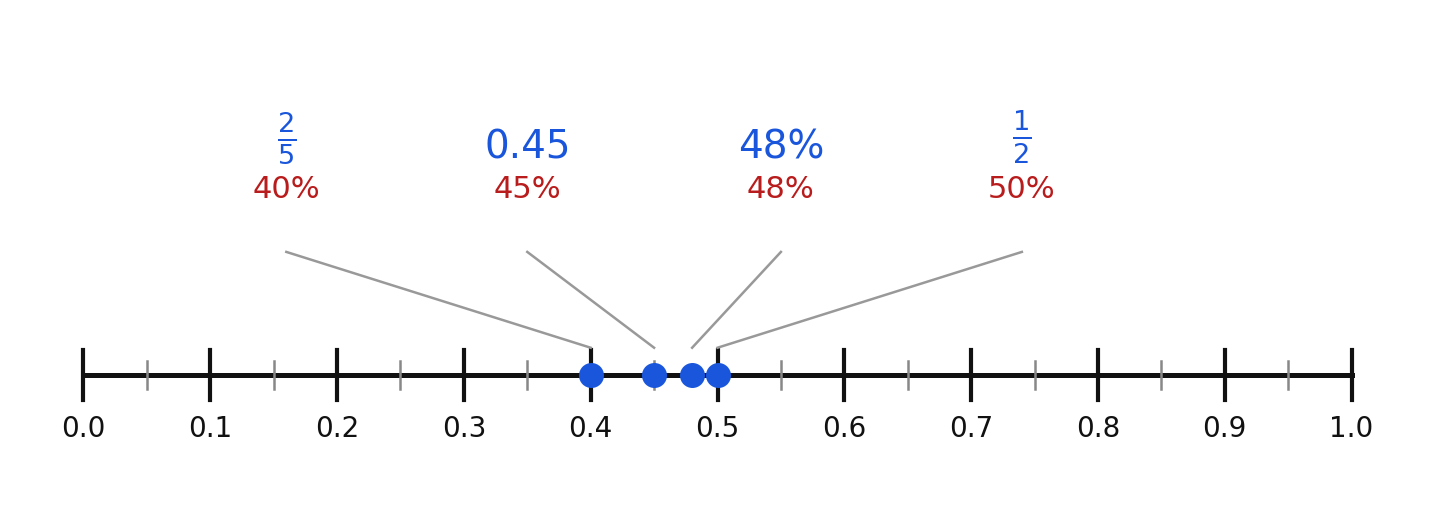
Strategy 3 — Benchmarks
Sometimes you do not need exact values, only a comparison to a landmark such as () or (). A benchmark argument can settle a comparison in one line.
Which is greater, or ? Half of 12 is 6, and , so is less than , which is . Since is more than , the answer is — no long division required.
Benchmarks also make "closer to" questions quick. To decide which of and is closer to , compare distances: is away, and is away, so is closer.
Justifying your answer
The standard asks you to justify your ordering, not just produce it. A complete justification names the strategy and shows the comparison. For example:
I changed each number to a percent: , , , and . In percent form the values increase in the order , , , , so from least to greatest the numbers are , , , .
Worked examples
Example 1 — Two numbers, two forms
Which is greater, or ?
Compare and by place value: the tenths are 7 and 7, and the hundredths are 0 and 5.
Answer: is greater.
Example 2 — Fraction against percent
Which is greater, or ?
Since :
Answer: is greater.
Example 3 — Four numbers, ascending
Order , , , from least to greatest.
As percents: , , , .
Answer: , , ,
Example 4 — Four numbers, descending
Order , , , from greatest to least.
As percents: ; ; ; and , since .
Greatest to least: , , , .
Answer: , , ,
Example 5 — Benchmark shortcut
Which is greater, or ? Justify without converting exactly.
Half of 12 is 6, so . Since , . And .
Answer: is greater.
Guided practice
- Compare and using , , or .
- Which is greater, or ?
- Order from least to greatest: , , .
- Which is closer to : or ? Show the distances.
- Compare and using , , or .
Independent practice
- Order from least to greatest: , , , .
- Order from greatest to least: , , , .
- Fill in , , or : a) b) c) d)
- Order from least to greatest: , , .
- Which is closest to : , , or ? Justify with distances.
- Application. Three players' free-throw records are , , and . List them from best to worst and justify your ordering.
- Reasoning. Explain why converting to a common form is more reliable than comparing the digits you see. Use and in your explanation.
Exit ticket 4.5
- Which is greater, or ?
- Order from least to greatest: , , .
- Which is closer to : or ?
- You need to compare and . Name the strategy you would use, explain why, and give the answer.
Lesson 4.6 — Percents Greater Than 100% and Less Than 1%
Past the whole
is one whole. Nothing stops a quantity from being more than one whole, so nothing stops a percent from being greater than .
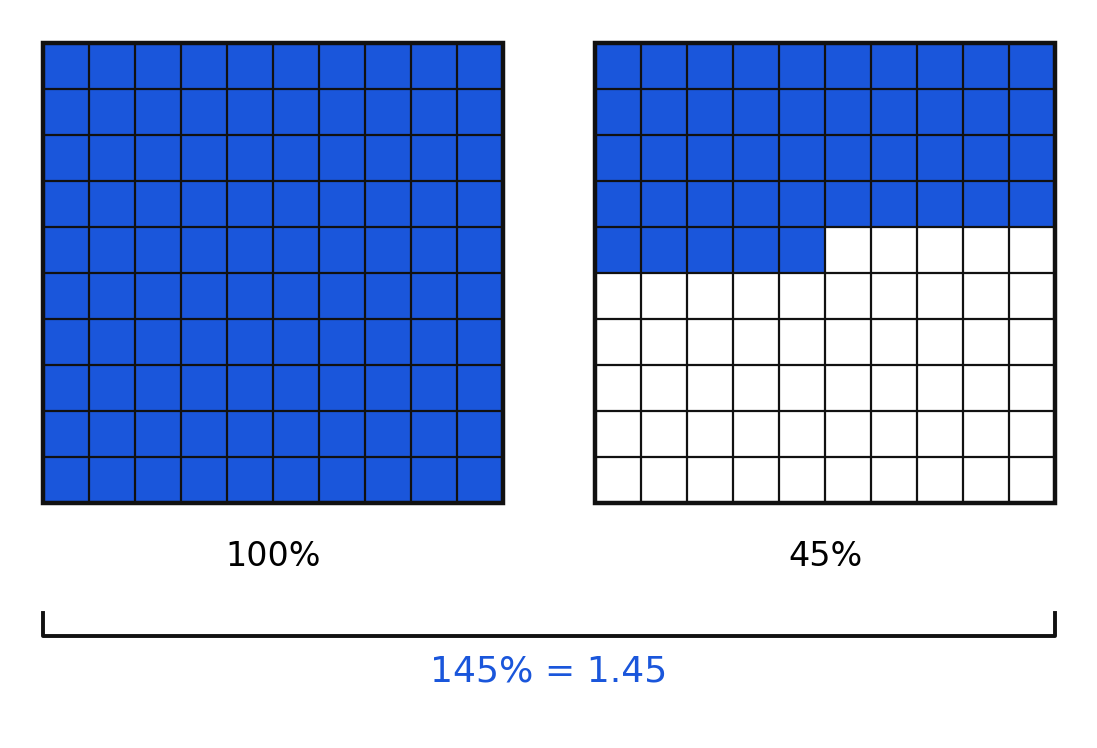
The fraction comes from , which simplifies by 5 to , and remainder , so .
Three anchors are worth knowing on sight:
| Percent | Decimal | Fraction or mixed number | In words |
|---|---|---|---|
| one whole | |||
| one and a half wholes | |||
| two wholes | |||
| two and a half wholes |
A percent greater than always converts to a decimal greater than 1. If a growth report says a city's population is now of what it was in 2000, that means times as many people — the whole earlier population, plus of it again.
Below one percent
The other end works the same way. One small square of a hundred grid is . Shade only part of that one square and you have a percent less than .
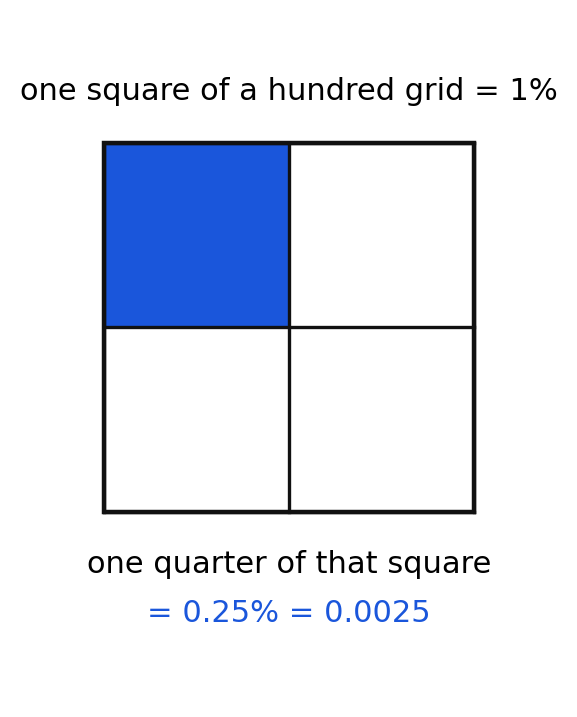
Each of these follows the Lesson 4.2 rule with no changes: to convert a percent to a decimal, divide by 100 and move the point two places left. Because the percent already contains a decimal point, the result lands in the thousandths place or beyond.
You meet these small percents in real places — interest rates, medicine doses, rare-event statistics, and the fine print on loans.
The trap in this lesson. and are wildly different. is five thousandths, . is one half, which is . They differ by a factor of 100. Whenever you see a decimal point inside a percent, read it slowly.
Comparing across the range
Once every number is in one form, small percents order just as easily as any others. Compare , , and :
| Original | Decimal |
|---|---|
Least to greatest: , , — so , , . Written as percents that is , , , which makes the spread easy to see.
Worked examples
Example 1 — A model past one whole
One full hundred grid is shaded, and a second grid has 45 squares shaded. Write the total as a percent, a decimal, and a mixed number in simplest form.
Answer: , ,
Example 2 — A large percent
Write as a decimal and as a mixed number in simplest form.
Answer: and
Example 3 — A percent below one percent
Write as a decimal.
Divide by 100, moving the point two places left: .
Check: is less than , and is , so an answer below is right.
Answer:
Example 4 — A quarter of one percent
Write as a decimal, and describe it with a model.
A model: shade one quarter of one small square in a hundred grid, since one whole square is .
Answer:
Example 5 — Comparing a small percent to a decimal
Which is greater, or ?
Compare and : the thousandths place gives 5 in the first and the hundredths place gives 5 in the second, so is ten times as large.
Answer: is greater.
Guided practice
- Write as a decimal.
- Write as a percent.
- Write as a decimal.
- Two full hundred grids are shaded, plus 25 squares of a third grid. What percent is shaded?
- Is greater than or less than ? Explain.
Independent practice
- Write each percent as a decimal: a) b) c)
- Write each percent as a decimal: a) b) c)
- Write each decimal as a percent: a) b) c)
- Write as a mixed number in simplest form.
- Order from least to greatest: , , .
- Application. A savings account advertises a rate of , and a news report says a town's population is now of its population in 2000. Write the rate as a decimal and explain why it is less than one percent. Then explain in your own words what tells you about the town.
- Reasoning. Malik writes . Explain the error, give the correct decimal for , and give the correct percent for .
Exit ticket 4.6
- Write as a decimal.
- Write as a decimal.
- Which is greater, or ?
- Explain how a model can show a percent greater than .
Chapter 4 Review
Vocabulary. percent · hundred grid · benchmark percent · simplest form · rational number · repeating decimal
Part A — Percent from a model (6.NS.1a)
- A hundred grid has 68 squares shaded. What percent is shaded?
- A rectangle is divided into 20 equal parts and 9 are shaded. What percent is shaded?
- A bar is shaded from the left end to a point a little past the one-quarter mark. Estimate the percent shaded.
- a) One full hundred grid is shaded plus 60 squares of a second grid. What percent is shaded? b) In a hundred grid, exactly half of one small square is shaded. What percent is shaded?
Part B — Decimals and percents (6.NS.1b)
- Write each decimal as a percent: a) b) c) d)
- Write each percent as a decimal: a) b) c) d)
- Is greater than, less than, or equal to ? Justify your answer.
Part C — Fractions, mixed numbers, and percents (6.NS.1c)
- Write each as a percent: a) b) c) d)
- Write each percent as a fraction or mixed number in simplest form: a) b) c)
Part D — All three forms together (6.NS.1d)
- Give the two missing forms. Write fractions in simplest form. a) b) c)
- Write as a decimal and as a percent.
Part E — Comparing and ordering (6.NS.1e)
- Order from least to greatest: , , , . Justify your ordering.
- Order from greatest to least: , , , .
- Fill in , , or : a) b) c)
Part F — Mixed application and reasoning
- Application. On the same quiz, Ana scored , Ben scored , and Cruz scored . Order the scores from highest to lowest and justify your ordering.
- Reasoning. Use a benchmark to decide whether is greater or less than , without converting to a decimal. Explain your reasoning.
- Reasoning. Explain why is much smaller than , and give the decimal form of each.
- Application. A store sign reads "This year's sales are of last year's." Explain what that means about this year compared to last year, and write as a decimal and as a mixed number in simplest form.
Standards coverage check — Chapter 4
| Knowledge and Skill | Where it is taught | Where it is practiced |
|---|---|---|
| 6.NS.1a — estimate and determine the percent represented by a given model, including percents greater than 100% and less than 1% | 4.1, 4.6 | 4.1 all sets; 4.6 all sets; Review Part A |
| 6.NS.1b — equivalencies among decimals through thousandths and percents, using number lines and models | 4.2, 4.6 | 4.2 all sets; 4.6 all sets; Review Part B |
| 6.NS.1c — equivalencies among fractions and mixed numbers (denominators 12 or less, or factors of 100) and percents, using number lines and models | 4.3 | 4.3 all sets; Review Part C |
| 6.NS.1d — equivalencies among decimals, percents, fractions, and mixed numbers, using number lines and models | 4.4 | 4.4 all sets; Review Part D |
| 6.NS.1e — multiple strategies (benchmarks, number line, equivalency) to compare and order no more than four positive rational numbers, with justification, ascending or descending | 4.5 | 4.5 all sets; 4.6 independent practice 10; Review Part E |
Answer keys for every set in this chapter are in Appendix A.