Chapter 3 — Multiplying and Dividing Integers; Absolute Value Expressions
Standard: 6.CE.2 — The student will estimate, demonstrate, solve, and justify solutions to problems using operations with integers, including those in context.
By the end of this chapter you will be able to:
- Demonstrate and model multiplication and division of integers using pictorial representations or concrete manipulatives (6.CE.2a)
- Multiply and divide two integers (6.CE.2b)
- Simplify an expression that contains absolute value bars and an operation with two integers, and represent the result on a number line (6.CE.2c)
- Estimate, determine, and justify the solution to one- and two-step contextual problems involving all four operations with integers (6.CE.2d)
Lessons: 3.1 Modeling Integer Multiplication and Division · 3.2 Multiplying and Dividing Integers · 3.3 Simplifying Expressions with Absolute Value Bars · 3.4 One- and Two-Step Problems in Context
Calculator note. On the state assessment, items measuring 6.CE.2a and 6.CE.2b are assessed without a calculator, so Lessons 3.1 and 3.2 are built for mental math and estimation. Keep those habits in Lessons 3.3 and 3.4 as well; the numbers there stay friendly on purpose.
Lesson 3.1 — Modeling Integer Multiplication and Division
Multiplication is groups
Multiplication started as a shortcut for repeated addition, and that meaning still works with integers. In the product , the first factor tells you how many groups, and the second factor tells you what is in each group. So means four groups of 3 red chips.
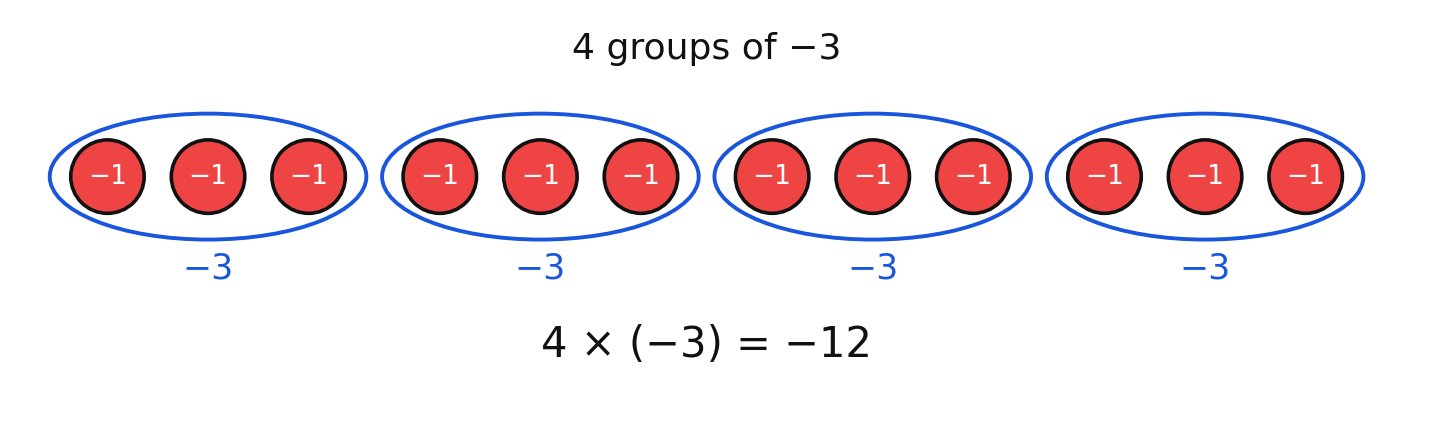
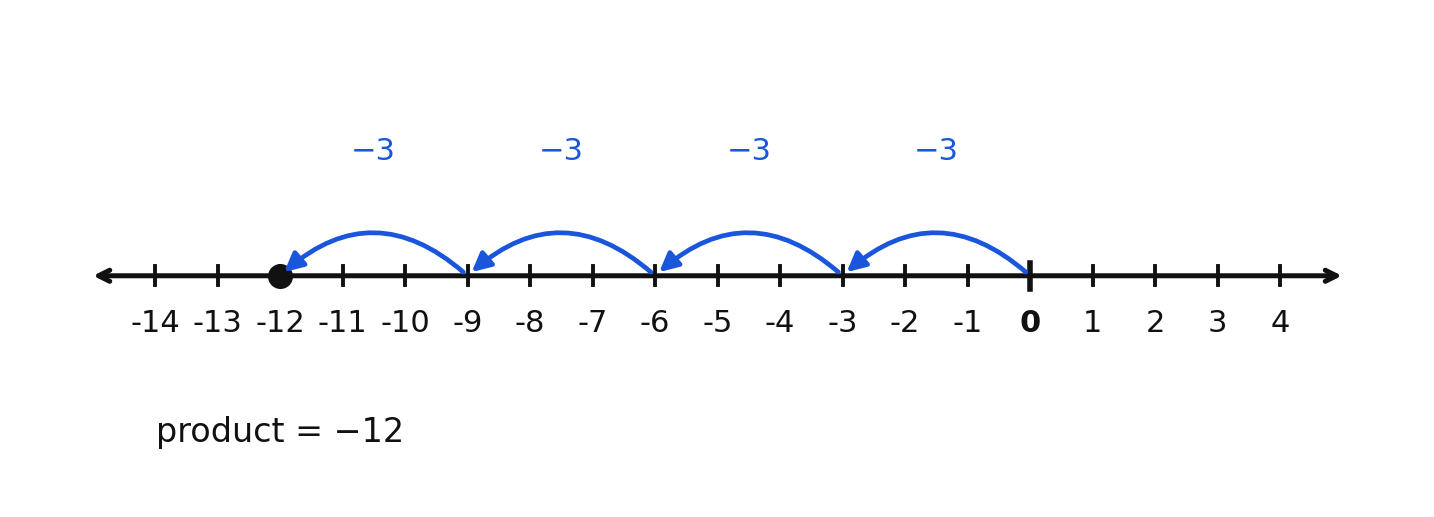
On a number line, the same product is four equal jumps of 3 units each, all to the left, starting at zero and landing on .
What a negative number of groups means
You cannot make groups of anything, so the model shifts slightly: a negative first factor means remove groups instead of adding them.
To model , start with a pile worth zero, made of as many zero pairs as you need. Then remove 3 groups of 4 yellow chips. Taking away 12 yellow chips from a pile worth zero leaves 12 red chips behind.
To model , again start from a pile worth zero. Now remove 3 groups of 2 red chips. Taking away 6 red chips leaves 6 yellow chips.
Removing negatives raises the value. That is the same fact you used in Lesson 2.3, applied several times at once.
A pattern gives a second reason to trust this result. Read the column downward and watch the products climb by 4 each time:
| Product | Value |
|---|---|
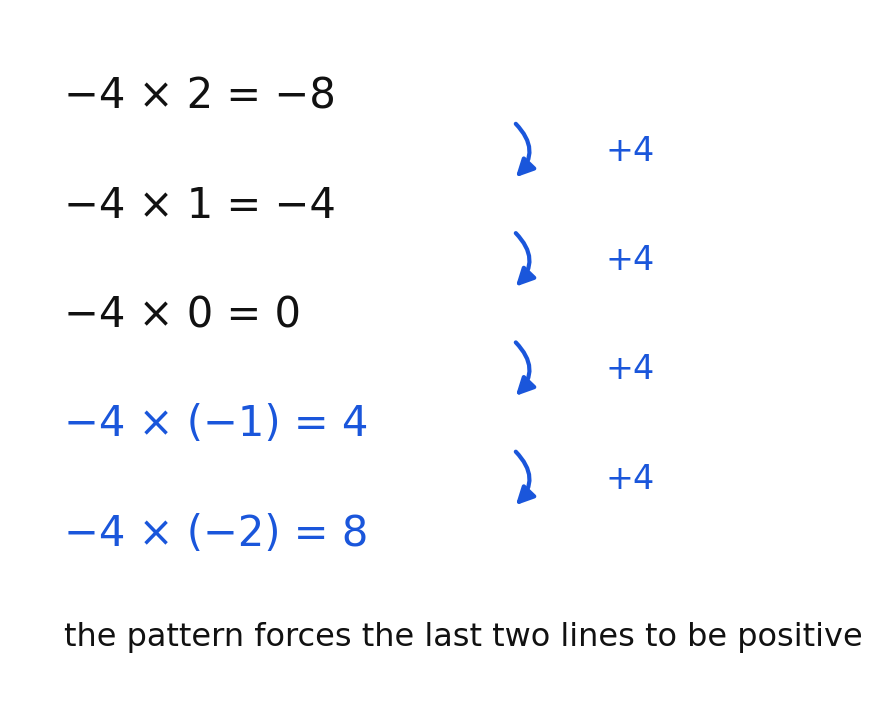
If the pattern is going to keep its steady step of , the last two lines have no choice but to be positive.
Division is sharing, or measuring
Division undoes multiplication, and the chip model shows it two ways.
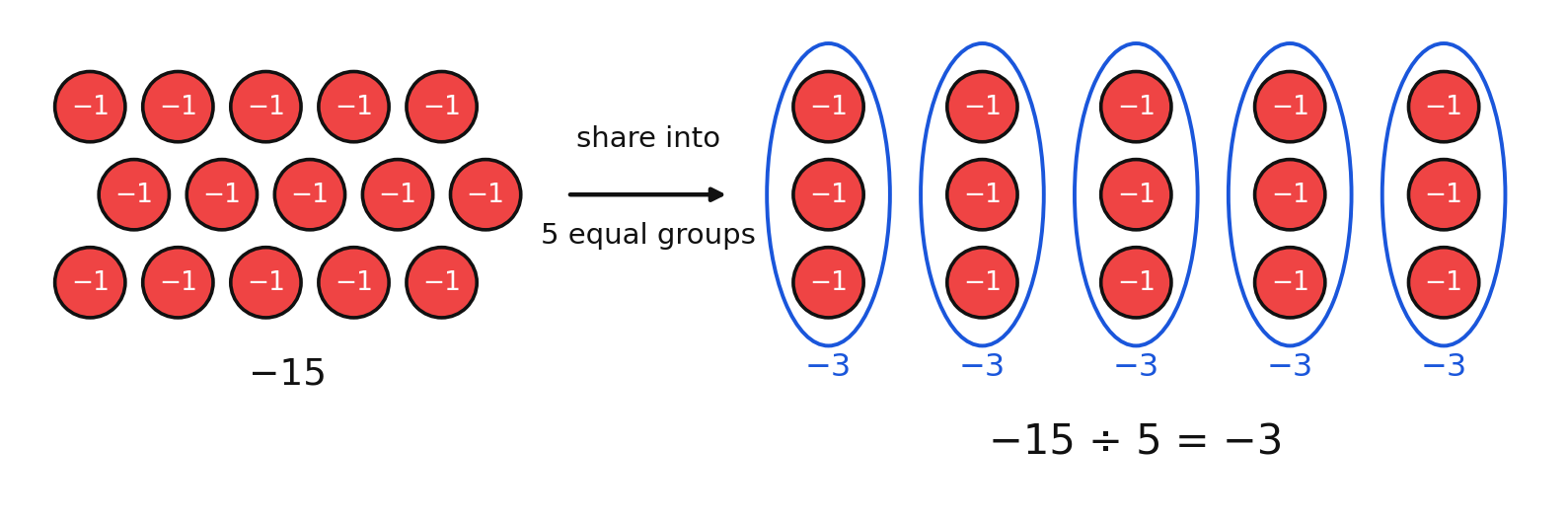
Sharing. asks you to share 15 red chips equally among 5 groups. Each group gets 3 red chips, so the quotient is .
Measuring. asks how many groups of 4 red chips you can make from 12 red chips. The answer is 3 groups, so the quotient is .
Every division fact has a matching multiplication fact, and checking one against the other is the fastest way to be sure. Since , you know . Since , you know . The three numbers , , and form a fact family.
Worked examples
Example 1 — Repeated addition
Model with chips and with a number line.
Chips: four groups of 3 red chips is 12 red chips. Number line: four jumps of 3 units left from zero lands on .
Answer:
Example 2 — Negative first factor
Model .
Start from a pile worth zero and remove 2 groups of 5 yellow chips. Removing 10 yellow chips from zero leaves 10 red chips.
Answer:
Example 3 — Two negative factors
Model .
Start from a pile worth zero with at least 6 zero pairs. Remove 3 groups of 2 red chips, that is 6 red chips in all. The 6 yellow chips that were paired with them remain.
Answer:
Example 4 — Division by sharing
Model .
Share 15 red chips into 5 equal groups. Each group holds 3 red chips.
Answer:
Example 5 — Division by measuring
Model .
Ask how many groups of 4 red chips fit in 12 red chips. Three groups fit. Check with multiplication: .
Answer:
Guided practice
- , modeled as groups of chips
- , modeled by removing groups
- , modeled by removing groups
- , modeled by sharing
- , modeled by measuring
Independent practice
- Find each product: a) b) c) d)
- Find each quotient: a) b) c)
- Write the multiplication sentence modeled by 4 groups of 3 red chips, and give the product.
- Write all four facts in the fact family for , , and .
- Write as a repeated addition and find the product.
- Application. A drought lowers the water level in a well by 3 feet each week for 6 weeks. Write a multiplication sentence for the total change and interpret the answer.
- Reasoning. Use the pattern , , to explain why must be positive.
Exit ticket 3.1
- Explain how the chip model shows that removing groups of red chips increases the value of a pile.
Lesson 3.2 — Multiplying and Dividing Integers
Two rules, both operations
The models in Lesson 3.1 always came out the same way, and that regularity is the rule.
Same signs give a positive result. Different signs give a negative result.
This holds for multiplication and for division alike.
To use it, multiply or divide the absolute values first and then attach the sign. For : the absolute values give , and the signs match, so the product is . For : the absolute values give , and the signs differ, so the quotient is .
Two special cases: any integer times is , and any integer times is itself. Also, divided by any nonzero integer is , but you may never divide by — no number multiplied by gives a nonzero result, so the question has no answer.
More than two factors
When a product has several factors, count the negative ones.
- An even number of negative factors gives a positive product.
- An odd number of negative factors gives a negative product.
The reason is that negatives cancel in pairs: each pair of negative factors multiplies to a positive. In there are three negative factors. The first two give , and , which is negative, as the odd count predicted.
Estimating products and quotients
Rounding works the same way here as it did with sums, and it matters more because products grow fast. To estimate , round to . The exact product is , so the estimate confirms both the size and the sign. If you had computed or , the estimate would have caught it.
Worked examples
Example 1 — Different signs, multiplication
Find .
Absolute values: . The signs differ, so the product is negative.
Answer:
Example 2 — Same signs, multiplication
Find .
Absolute values: . Both factors are negative, so the signs match.
Answer:
Example 3 — Same signs, division
Find .
Absolute values: . The signs match.
Answer:
Example 4 — Different signs, division
Find .
Absolute values: . The signs differ.
Answer:
Example 5 — Three factors
Find .
Work left to right. First, , because the signs differ. Then , because the signs match. There were two negative factors, an even count, so a positive product was expected.
Answer:
Guided practice
Independent practice
- Find each product: a) b) c) d)
- Find each quotient: a) b) c)
- Find . Show each step.
- Find the missing number: a) b)
- Without multiplying, state the sign of and explain how you know. Then find the product.
- Application. A diver descends 8 feet each minute for 7 minutes. Write a multiplication sentence for the change in depth. Then, at the same rate, how many minutes would it take to reach feet from the surface?
- Reasoning. Explain why by writing the matching multiplication fact.
Exit ticket 3.2
- Explain, using the fact family idea, why a negative divided by a negative must be positive.
Lesson 3.3 — Simplifying Expressions with Absolute Value Bars
Bars group, then measure
In Chapter 1, absolute value bars held a single number: . The bars can hold a whole calculation, and when they do, they act like parentheses. Everything inside gets simplified first, and only then do you take the distance from zero.
To simplify an expression with absolute value bars:
- Do the operation inside the bars.
- Take the absolute value of that result. The value is now positive or zero.
- Apply anything outside the bars, such as a negative sign in front.
Step 3 is where care pays off. Compare these two expressions carefully:
The bars in both problems produce . In the second expression, the negative sign sits outside the bars, so it is applied last, to the finished distance. A negative sign outside the bars never gets absorbed by them.
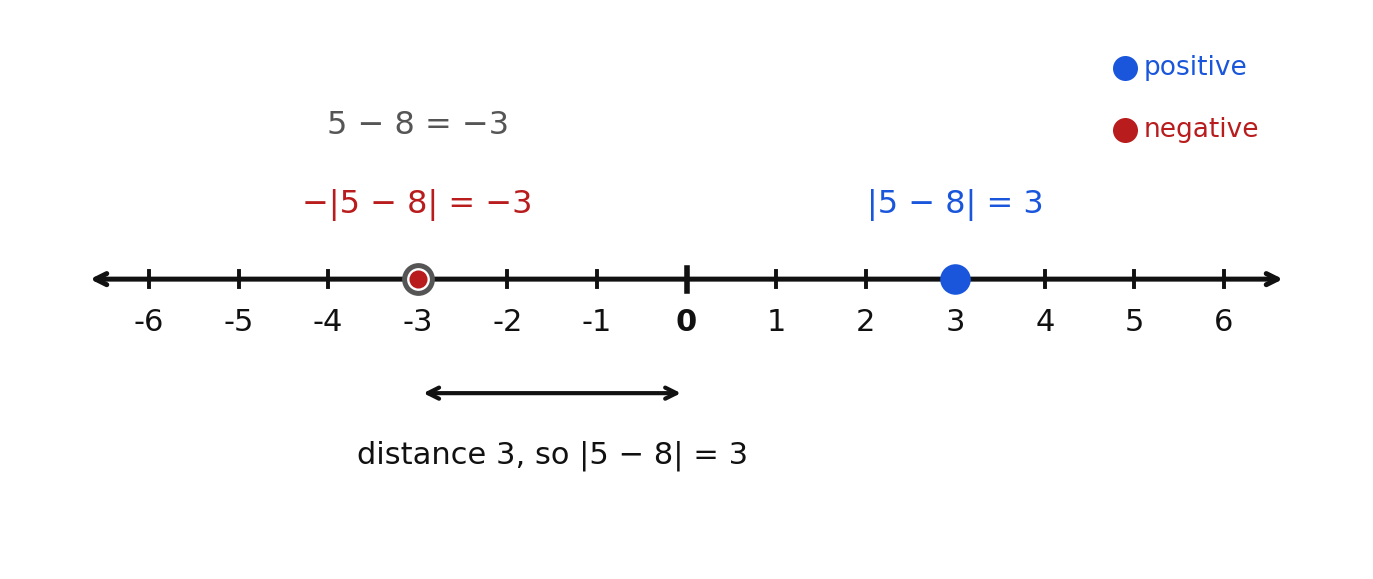
Representing the result on a number line
The standard asks you to show the simplified result on a number line, and the picture is worth drawing. Graph a single solid dot at the final value and label it with the original expression. For , that is a dot at . Doing this keeps the two ideas separate in your mind: the bars measured a distance of 3, and the sign outside placed the answer 3 units to the left of zero.
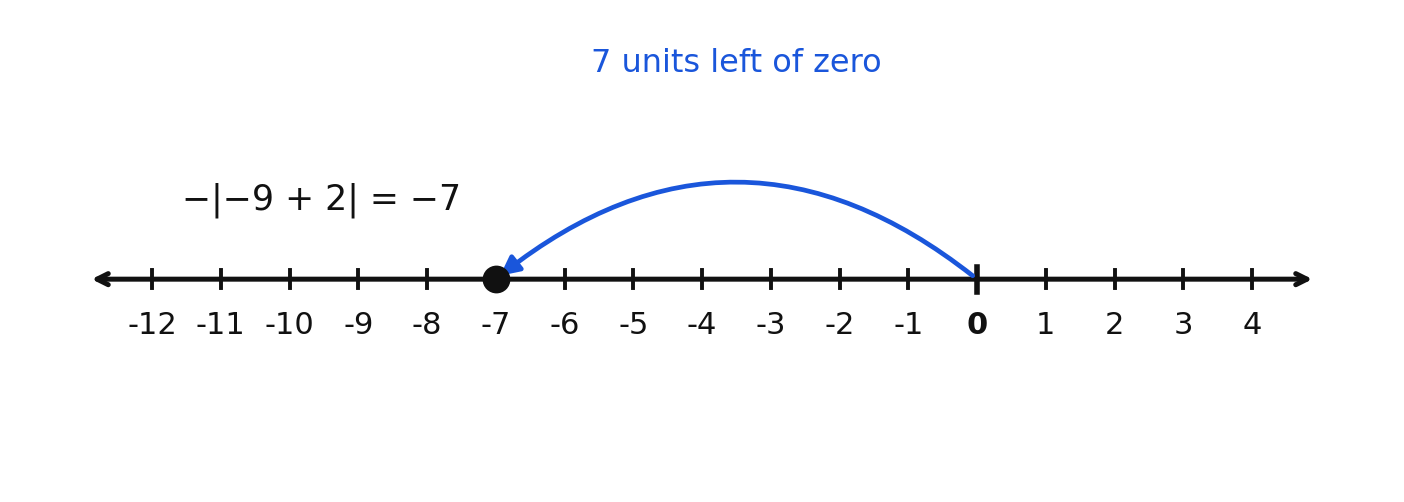
Worked examples
Example 1 — Subtraction inside the bars
Simplify .
Inside first: . Then take the absolute value: .
Answer:
Example 2 — Negative sign outside the bars
Simplify and graph the result.
Inside: . Bars: . Outside: apply the negative sign to get . On a number line, place a solid dot at .
Answer:
Example 3 — Addition inside the bars
Simplify .
Inside: , since the signs differ, , and has the larger absolute value. Bars: .
Answer:
Example 4 — Two negatives inside, sign outside
Simplify .
Inside: . Bars: . Outside: .
Answer:
Example 5 — Multiplication and division inside the bars
Simplify and .
First expression: inside, ; bars give . Second expression: inside, ; bars give ; the sign outside makes it .
Answer: and
Guided practice
Independent practice
- Simplify: a) b) c) d)
- Simplify: a) b) c) d)
- Simplify: a) b)
- Simplify and describe exactly where you would graph the result on a number line.
- Which is greater, or ? Show both values and explain.
- Application. A stock's price moved from $52 to $45. Write an absolute value expression for the size of the change and evaluate it. Then write a different expression whose value gives the signed change, and evaluate that.
- Reasoning. Is always equal to ? Test the claim with and , then explain your conclusion in terms of distance.
Exit ticket 3.3
- Show where the answer to item 3 belongs on a number line, and explain why the negative sign outside the bars is applied last.
Lesson 3.4 — One- and Two-Step Problems in Context
Which operation, and in what order
Contextual problems with integers usually fit one of four shapes.
| The question asks | Operation | Example phrasing |
|---|---|---|
| the result after one change | addition | "rises 9 degrees," "deposits $50" |
| how far apart two values are | subtraction | "how many degrees separate" |
| a repeated change | multiplication | "drops 4 feet each minute for 6 minutes" |
| a change split into equal parts | division | "shared equally among 8," "at a steady rate" |
A two-step problem combines two of these. When it does, order of operations matters: multiply or divide before you add or subtract, unless the story clearly tells you otherwise. In , the repeated drop of 4 degrees an hour is computed first, and only then is it applied to the starting temperature.
Estimating to check yourself
Round, compute the easy version, then compare. For , the estimate tells you to expect a negative number in the hundreds. For , the estimate tells you to expect a negative number near . An exact answer far from the estimate means something went wrong, usually a sign.
Justifying your answer
The standard asks you to justify solutions, not just produce them. A complete justification names the operation and says why the situation calls for it, shows the computation, and states what the answer means in the story, including what the sign says. "The temperature ends at °F, which is 13 degrees below zero" is a finished answer. "" alone is not.
Worked examples
Example 1 — Repeated change, then a starting value
The temperature is °F and falls 4 degrees each hour for 6 hours. What is the temperature after 6 hours?
The repeated fall is a multiplication: . Apply it to the starting temperature:
Answer: °F, or 13 degrees below zero.
Example 2 — Two-step with depth
A diver is at feet and descends 9 feet each minute for 5 minutes. What is the final depth?
The descent is feet. Then .
Answer: feet, or 57 feet below the surface.
Example 3 — Sharing a loss
Four friends share a loss of $96 equally. Write an integer for each person's share.
A loss is negative, and sharing equally is division: .
Answer: each.
Example 4 — Estimate, then compute
A tank loses 38 gallons each hour for 21 hours. Estimate the total change, then compute it.
Estimate: gallons. Exact: .
Answer: about gallons; exactly gallons, a loss of 798 gallons.
Example 5 — Finding a rate, then using it
A submarine descends from the surface to feet in 15 minutes at a steady rate. Find the rate per minute, then find its depth after 8 minutes.
Rate: feet per minute. Depth after 8 minutes: feet.
Answer: feet per minute; feet after 8 minutes.
Guided practice
- The temperature is °C and falls 5 degrees each hour for 4 hours. What is the final temperature?
- An account loses $12 each week for 7 weeks. Write an integer for the total change.
- A balloon is 240 feet up and descends 30 feet each minute. How many minutes until it lands?
- A player loses 72 points spread equally over 6 rounds. Write an integer for the change each round.
- Estimate by rounding, then compute the exact product.
Independent practice
- A diver at feet descends 6 feet each minute for 9 minutes. Find the final depth.
- A debt of $150 is shared equally among 5 people. Write an integer for each person's share.
- At midnight the temperature was °F. It rose 3 degrees each hour for 6 hours. Find the temperature at 6 a.m.
- Estimate by rounding, then compute the exact quotient.
- In a game, a player takes 5 penalties worth points each and earns one bonus of points. Find the total score change.
- Application. An elevator starts on floor 12 and goes down 3 floors at each of 6 stops. Write a numerical expression for the final level, evaluate it, and describe the ending location in words.
- Reasoning. Two students simplify . One gets and the other gets . Decide who is correct and explain the mistake the other student made.
Exit ticket 3.4
- The temperature is °F and falls 5 degrees each hour for 3 hours. What is the final temperature?
- A penalty of 84 points is spread equally over 7 rounds. Write an integer for the change each round.
- Estimate by rounding, then compute the exact product.
- Explain how you decide whether a contextual problem calls for multiplication or for division.
Chapter 3 Review
Vocabulary. factor · product · dividend · divisor · quotient · fact family · absolute value bars · rate
Part A — Modeling multiplication and division (6.CE.2a)
- Use a chip or number-line model to find each product: a) b) c)
- Use a chip model to find each quotient: a) b)
- Write the multiplication sentence modeled by 6 groups of 2 red chips, and give the product.
- Use the pattern , , , to explain why the product of two negative integers is positive.
Part B — Multiplying and dividing two integers (6.CE.2b)
- a) b) c) d)
- a) b) c)
- Find . Show each step.
- Find the missing number: a) b)
Part C — Absolute value expressions (6.CE.2c)
- Simplify: a) b)
- Simplify: a) b)
- Simplify: a) b)
- Simplify and state where the result belongs on a number line.
Part D — Problems in context (6.CE.2d)
- A diver at feet descends 7 feet each minute for 6 minutes. Find the final depth.
- A loss of $144 is shared equally among 8 people. Write an integer for each share.
- Estimate by rounding, then compute the exact product.
- The temperature is °F and rises 4 degrees each hour. How many hours until it reaches °F? Explain the operation you chose.
Standards coverage check — Chapter 3
| Knowledge and Skill | Where it is taught | Where it is practiced |
|---|---|---|
| 6.CE.2a — model multiplication and division of integers with pictorial representations or manipulatives | 3.1 | 3.1 all sets; Review Part A |
| 6.CE.2b — multiply and divide two integers | 3.2 | 3.2 all sets; 3.1 independent practice; Review Part B |
| 6.CE.2c — simplify an expression containing absolute value bars and an operation with two integers; represent the result on a number line | 3.3 | 3.3 all sets; Review Part C |
| 6.CE.2d — estimate, determine, and justify solutions to one- and two-step contextual problems with all four operations | 3.4 | 3.4 all sets; 3.1 item 11; 3.2 item 11; Review Part D |
Addition and subtraction of integers are taught in Chapter 2.
Answer keys for every set in this chapter are in Appendix A.