Chapter 2 — Adding and Subtracting Integers
Standard: 6.CE.2 — The student will estimate, demonstrate, solve, and justify solutions to problems using operations with integers, including those in context.
By the end of this chapter you will be able to:
- Demonstrate and model addition and subtraction of integers using pictorial representations or concrete manipulatives (6.CE.2a)
- Add and subtract two integers (6.CE.2b)
- Estimate, determine, and justify the solution to one- and two-step contextual problems involving addition and subtraction with integers (6.CE.2d)
Lessons: 2.1 Modeling Integer Addition · 2.2 Adding Integers · 2.3 Subtraction as Adding the Opposite · 2.4 Adding and Subtracting in Context
Calculator note. On the state assessment, items measuring 6.CE.2a and 6.CE.2b are assessed without a calculator. Everything in this chapter is built for mental math, estimation, and models. Work every problem by hand.
Lesson 2.1 — Modeling Integer Addition
Two models, one idea
Chapter 1 gave you a number line and the language of positive, negative, and opposite. Now you will put integers together. Addition of integers is easier to trust when you can see it, so this lesson uses two models side by side.
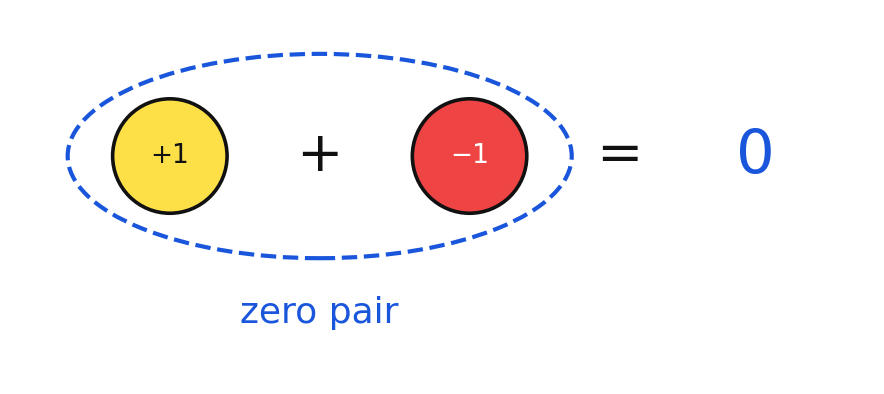
The first model uses integer chips. A yellow chip stands for . A red chip stands for . A yellow chip and a red chip placed together make a zero pair, because . A zero pair has a value of zero, so you may add zero pairs to a pile or take them away without changing what the pile is worth.
The second model uses the number line. Adding an integer means making a jump: adding a positive integer jumps to the right, and adding a negative integer jumps to the left. You start at the first addend, jump by the second addend, and land on the sum.
Both models answer the same question, and they always agree. When you are unsure of an answer, model it twice.
Adding two integers with the same sign
If both chips in a problem are the same color, nothing cancels. You just have more of the same thing.
To model , put down 3 red chips, then 5 more red chips. There are no yellow chips, so no zero pairs form. You are left with 8 red chips, which is .

On the number line, the same problem is two jumps in the same direction: start at , jump 3 units left to , then jump 5 more units left to .
Adding two integers with different signs
When the signs differ, zero pairs do the work.
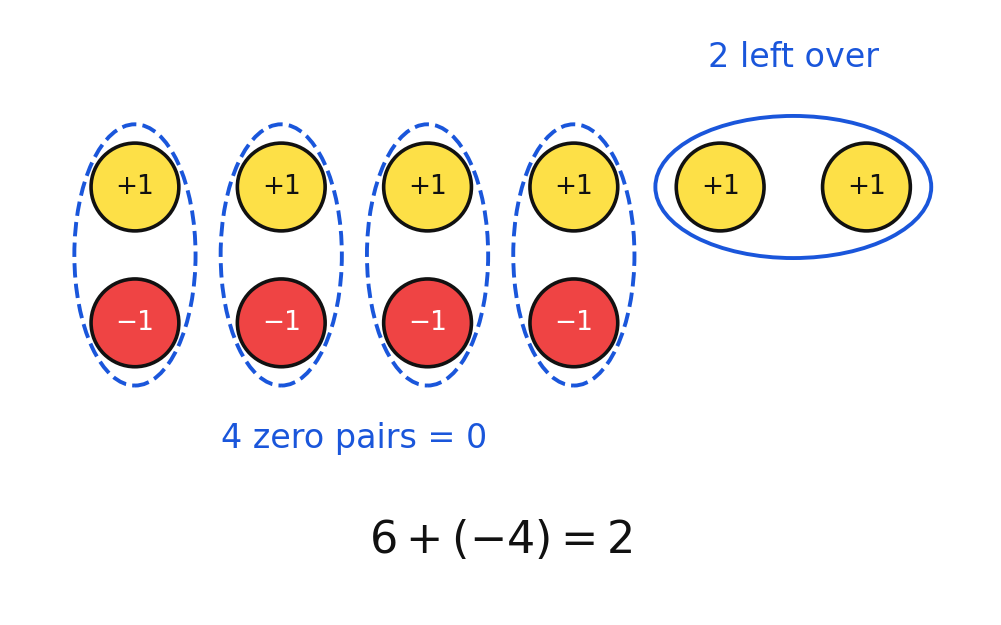
To model , put down 6 yellow chips and 4 red chips. Match each red chip with a yellow chip. Four zero pairs form, and each is worth . Two yellow chips are left unmatched, so the sum is .
On the number line, starts at and jumps 4 units left, landing on . The jump left partly undoes the distance you had traveled right, which is exactly what the zero pairs showed.
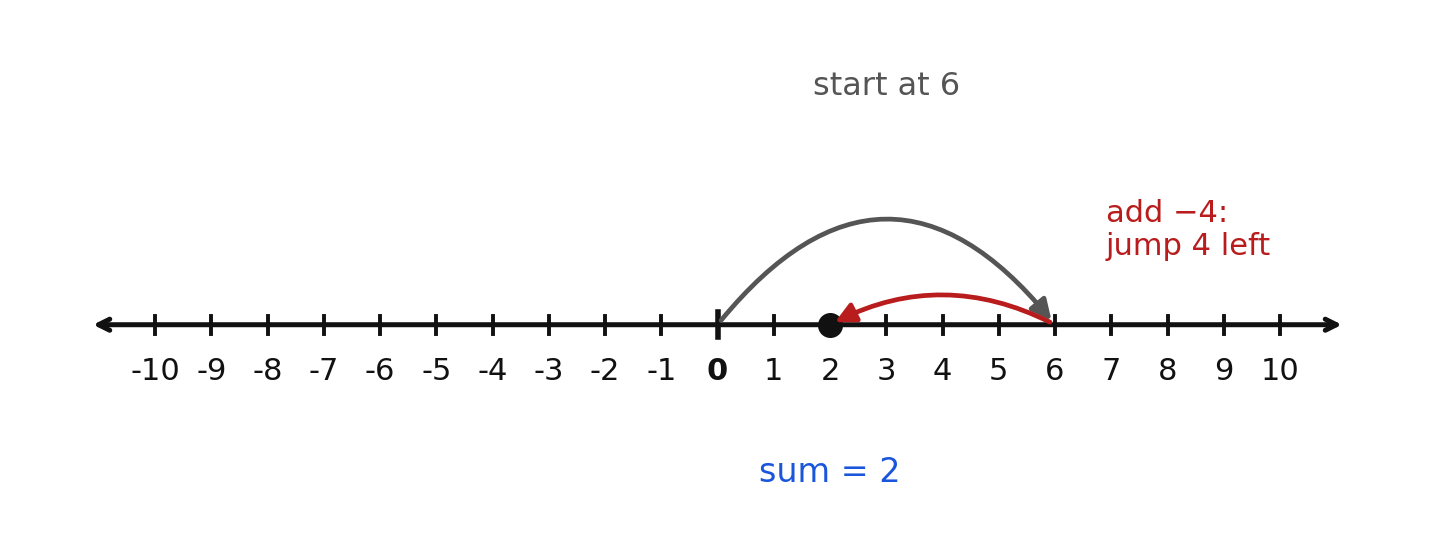
The sign tells you the direction; the digits tell you the size of the jump. That one sentence covers every addition problem in this chapter.
Worked examples
Example 1 — Same signs, chip model
Model with integer chips.
Place 3 red chips, then 4 more red chips. All chips are red, so no zero pairs form. Count: 7 red chips.
Answer:
Example 2 — Different signs, chip model
Model with integer chips.
Place 5 yellow chips and 2 red chips. Two zero pairs form and are worth . That leaves yellow chips.
Answer:
Example 3 — More negatives than positives
Model with integer chips.
Place 6 red chips and 2 yellow chips. Two zero pairs form. That leaves red chips.
Answer:
Example 4 — Number-line jump
Use a number line to find .
Start at . Adding a positive means jumping right, so jump 3 units right: .
Answer:
Example 5 — Landing on zero
Use a number line to find , then explain the result with chips.
Start at and jump 4 units left, landing on . With chips, 4 yellow and 4 red make 4 zero pairs and nothing is left over.
Answer: . Opposites always add to zero.
Guided practice
- Model with chips. How many chips are left, and what color?
- Model with chips. How many zero pairs form?
- Model with chips and give the sum.
- On a number line, start at and jump 5 units right. Write the addition sentence and the sum.
- On a number line, start at and jump 6 units left. Write the addition sentence and the sum.
Independent practice
- Use chips to find each sum: a) b) c) d)
- Use a number line to find each sum: a) b) c)
- How many zero pairs form when you model ? How many chips are left over, and what is the sum?
- A pile has 5 yellow chips and 5 red chips. What is the pile worth? Explain using zero pairs.
- Write the addition sentence modeled by 3 yellow chips and 8 red chips, and give the sum.
- Application. At 5 a.m. the temperature was °F. By noon it had risen 9 degrees. Write an addition sentence for the noon temperature, model it on a number line, and give the temperature.
- Reasoning. Model both and with chips. Explain why the two piles must give the same sum.
Exit ticket 2.1
- Use chips to find .
- Use chips to find . How many zero pairs formed?
- On a number line, start at and jump 4 units right. Write the addition sentence and the sum.
- Explain what a zero pair is and why adding one to a pile does not change the pile's value.
Lesson 2.2 — Adding Integers
From models to rules
Models are reliable, but drawing 41 chips is not. In this lesson you turn what the models showed into two rules you can run in your head. Both rules use absolute value, which you met in Chapter 1 as distance from zero.
Rule 1 — Same signs. Add the absolute values. Keep the sign the addends share.
Rule 2 — Different signs. Subtract the smaller absolute value from the larger. Use the sign of the addend with the larger absolute value.
Rule 1 is the "all one color" case: nothing cancels, so the pile grows. Rule 2 is the "zero pairs" case: the smaller group cancels away, and whatever color had more chips decides the sign of what remains.
Two special results are worth naming. Adding zero changes nothing: . And adding opposites gives zero: . For that reason, the opposite of a number is also called its additive inverse.
Order does not matter
Addition of integers is commutative, meaning . It is also associative, so in a sum of three or more integers you may group in any order. That freedom is a real tool: in you can add the two negatives first, , then add to get . Same answer, less work.
Estimating first
Because this is a no-calculator chapter, get in the habit of estimating before computing. Round each addend to a friendly number, add, and keep that estimate in mind as a check. For , round to . When your exact answer comes out to , the estimate confirms both the size and the sign.
Worked examples
Example 1 — Same signs
Find .
Both addends are negative, so use Rule 1. Add the absolute values: . Keep the shared negative sign.
Answer:
Example 2 — Different signs, negative wins
Find .
Different signs, so use Rule 2. Absolute values are and . Subtract: . The larger absolute value belongs to , which is negative.
Answer:
Example 3 — Different signs, larger numbers
Find .
Absolute values are and . Subtract: . The larger absolute value belongs to , which is negative.
Answer:
Example 4 — Opposites
Find .
The addends are opposites, the same distance from zero in opposite directions.
Answer:
Example 5 — Three addends
Find .
Work left to right. First, : different signs, , and has the larger absolute value, so the result is . Then : different signs, , and has the larger absolute value.
Answer:
Guided practice
Independent practice
- Find each sum: a) b) c) d)
- Find each sum: a) b) c)
- Find . Show the two steps.
- Estimate by rounding, then find the exact sum and compare.
- Find the missing addend: a) b)
- Application. On three plays a football team gained 7 yards, lost 12 yards, then gained 3 yards. Write one addition sentence for the three plays, find the sum, and describe the team's net result in words.
- Reasoning. Without computing the sum, decide whether is positive or negative, and explain how you know.
Exit ticket 2.2
- Two integers have different signs. Explain how you decide whether their sum is positive or negative.
Lesson 2.3 — Subtraction as Adding the Opposite
One rule replaces two
You already know how to add any two integers. This lesson turns every subtraction problem into an addition problem, so you do not need a second set of rules.
Start with chips. To find , put down 7 yellow chips and take away 3 of them. Four are left. Subtraction means remove.
Now try . Put down 6 red chips and remove 4 red chips. Two red chips are left, so the answer is . Notice what happened: removing 4 negatives raised the value by 4. Removing negatives and adding positives do the same thing.
The trouble comes with a problem like . You need to remove 6 red chips, but only 4 are on the table. Here is where zero pairs earn their keep: add two zero pairs to the pile. The pile is still worth , but now there are 6 red chips available to remove. Remove them, and 2 yellow chips remain.
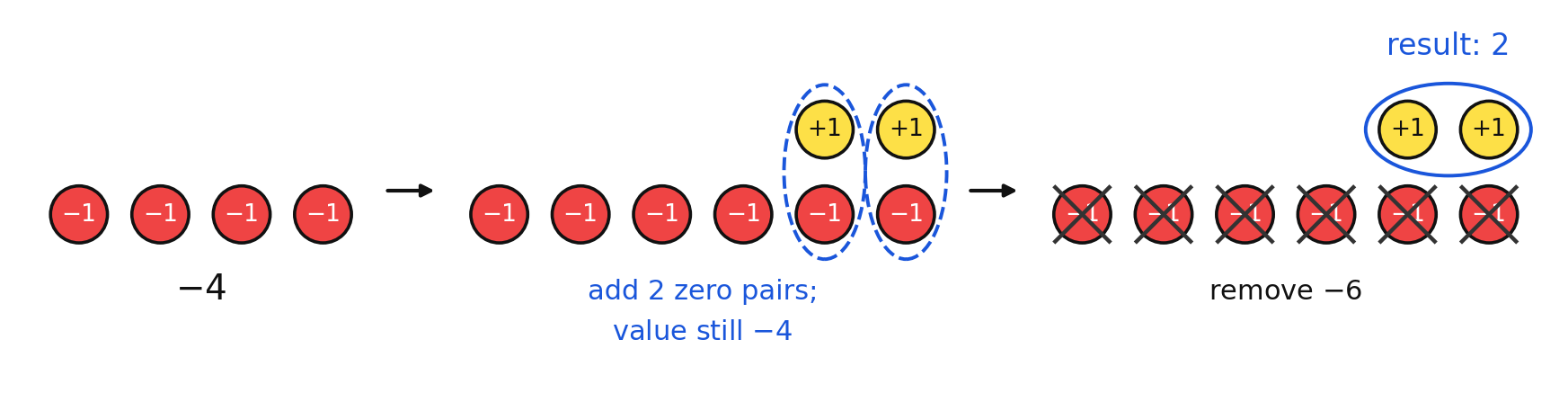
Every one of these cases is captured by a single rule.
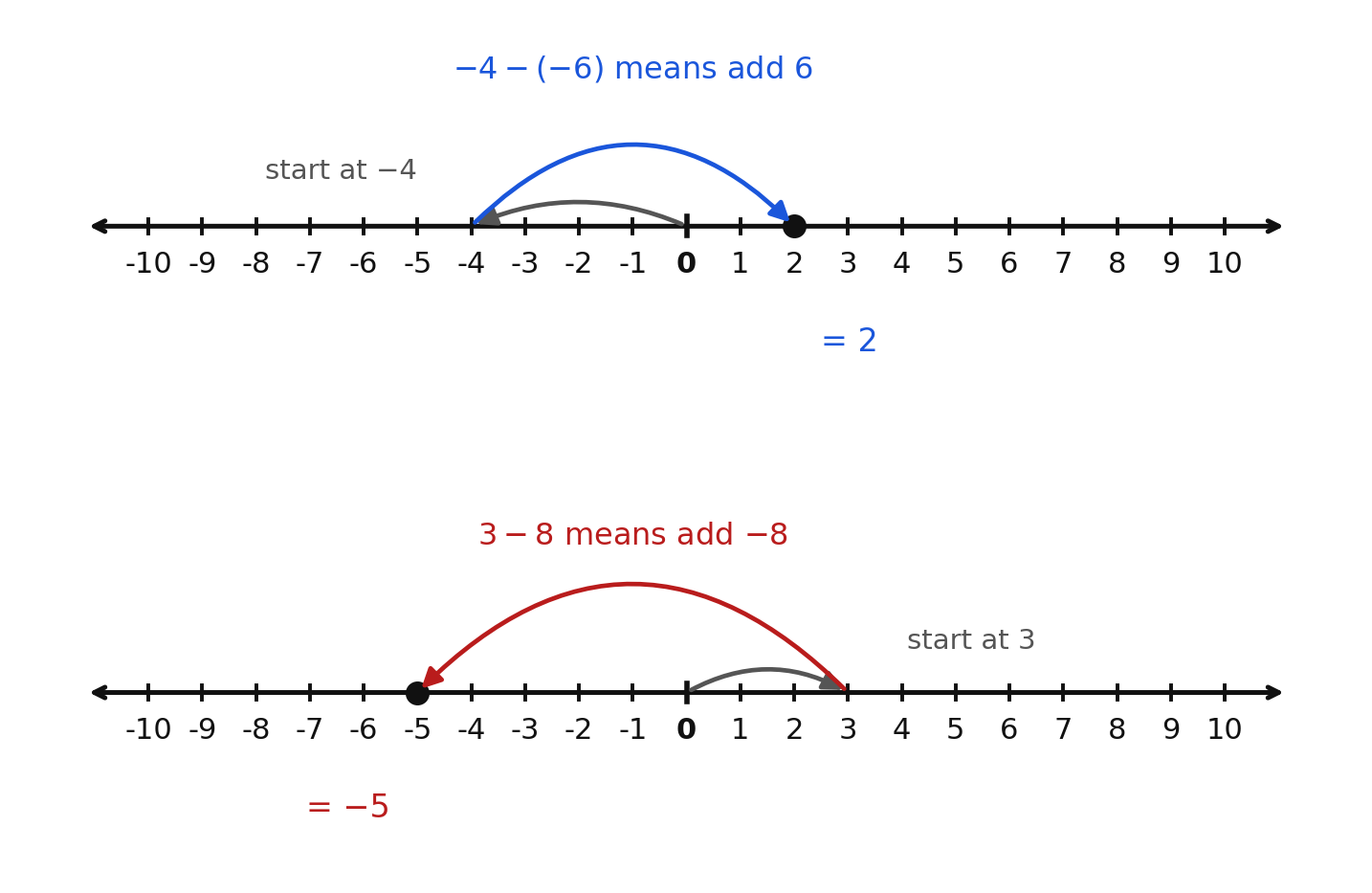
To subtract an integer, add its opposite: .
Check it against the cases above. , which matches the chips. , which also matches.
Why this works
Subtraction asks a distance-and-direction question: is the number you must add to to get . On a number line, that is the trip from to . Traveling from to means moving 2 units right, so . Adding the opposite is just a shortcut for that trip.
Careful with the two signs. In , the first sign is the operation minus and the second is part of the number negative seven. Rewrite it as before you compute. Some students call this "keep, change, change": keep the first number, change subtraction to addition, change the sign of the second number.
Worked examples
Example 1 — Positive minus larger positive
Find .
Add the opposite: . Different signs, , and has the larger absolute value.
Answer:
Example 2 — Negative minus positive
Find .
Add the opposite: . Same signs, so add absolute values and keep the negative sign.
Answer:
Example 3 — Negative minus negative
Find .
Add the opposite: . Different signs, , and has the larger absolute value.
Answer:
Example 4 — Positive minus negative
Find .
Add the opposite: .
Answer:
Example 5 — Matching the chip model
Find two ways.
With chips: place 9 red chips and remove 4 of them, leaving 5 red chips. With the rule: . The two methods agree.
Answer:
Guided practice
- Rewrite as an addition problem, then find the value.
Independent practice
- Find each difference: a) b) c) d)
- Find each difference: a) b) c)
- Find and explain the result using opposites.
- Find . Show each step.
- Find the missing number: .
- Application. At noon the temperature was °F. By midnight it was °F. Write a subtraction expression for how many degrees the temperature fell, and evaluate it.
- Reasoning. Marcus says, "Subtracting always makes a number smaller." Give an integer example that proves him wrong, and explain when subtraction increases a value.
Exit ticket 2.3
- State the rule for subtracting integers and show it working on one example of your own.
Lesson 2.4 — Adding and Subtracting in Context
Choosing the operation
Real problems do not announce which operation to use. Two questions sort out almost every situation in this lesson.
- "What is the result after a change?" That is addition. A change up is a positive addend; a change down is a negative addend. The answer is called the net change when you are reporting the change itself.
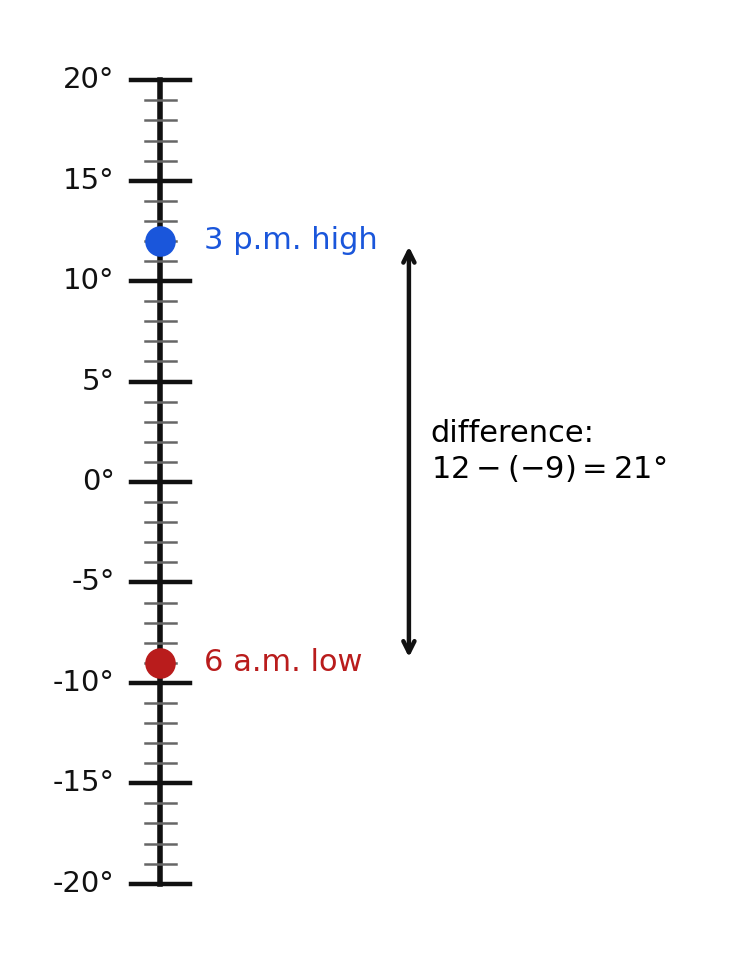
- "How far apart are these two values?" That is subtraction. The difference between two values is found by subtracting the lesser from the greater, and the result is never negative when you ask it that way.
A two-step problem simply strings two of these together: apply one change, then apply the next to the result.
Estimating in context
Estimating is not a shortcut you take when you are tired; it is how you catch a wrong answer. Round to friendly numbers, do the easy arithmetic, and ask whether the exact answer you got is close to it and pointing the same direction.
A submarine at feet rises 189 feet. Rounding gives , so the sub should end a bit deeper than 100 feet below the surface, still below zero. The exact answer, feet, fits.
Reading the sign of your answer
Finish every contextual problem by translating the integer back into words. An answer of is not the end of the work — it is degrees below zero, or an overdraft of dollars, or 13 feet below sea level. If the sign of your answer does not make sense in the story, that is a signal to check the computation.
Worked examples
Example 1 — One-step, bank balance
Kara's account balance is . She deposits $50. What is her new balance?
A deposit is a positive change, so add.
Answer: $15. Her account is now $15 in the positive.
Example 2 — One-step, elevation
A diver is at feet and descends 24 more feet. What is the new depth?
Descending is a negative change.
Answer: feet, or 42 feet below the surface.
Example 3 — Difference of two values
On one day the high was °F and the low was °F. How many degrees separate them?
Subtract the lesser from the greater.
Answer: degrees.
Example 4 — Two-step problem
An account is at . A deposit of $75 is made, then $20 is withdrawn. What is the final balance?
Step 1, the deposit: . Step 2, the withdrawal: .
Answer: $13.
Example 5 — Estimate, then compute
A submarine at feet rises 189 feet. Estimate the new depth, then find it exactly.
Estimate: feet. Exact: . Different signs, , and has the larger absolute value, so the sum is .
Answer: about 100 feet below the surface; exactly feet.
Guided practice
- A balance of receives a deposit of $40. What is the new balance?
- The temperature is °F and rises 12 degrees. What is the new temperature?
- A hiker at feet above sea level descends 110 feet. What is the new elevation?
- How many degrees apart are °F and °F?
- A team loses 8 yards, then gains 3 yards. Write one addition sentence and describe the net result.
Independent practice
- An elevator is on level . It goes up 9 levels, then down 4 levels. What level does it end on? Show both steps.
- An account is at . A deposit of $120 is made, then $35 is withdrawn. Find the final balance.
- A diver at feet rises 19 feet, then descends 33 feet. Find the final depth.
- The temperature is °C and rises 41 degrees. Estimate the result by rounding, then compute it exactly.
- Four overnight lows were °F, °F, °F, and °F. Find the difference between the greatest and the least.
- Application. The summit of Mount Whitney is feet above sea level. The lowest point in Death Valley is feet. Write a subtraction expression for the difference in elevation and evaluate it.
- Reasoning. Explain why the difference between two elevations is found by subtracting, and explain why subtracting a negative elevation makes the difference larger rather than smaller.
Exit ticket 2.4
- A balance of receives a deposit of $18. What is the new balance?
- The temperature goes from °F to °F. How many degrees did it rise?
- A diver at feet descends 15 more feet. What is the new depth?
- Estimate by rounding, then compute the exact sum and explain what the estimate told you.
Chapter 2 Review
Vocabulary. integer chips · zero pair · addend · sum · additive inverse · commutative · associative · difference · net change
Part A — Modeling addition and subtraction (6.CE.2a)
- Use chips to find each sum: a) b) c)
- Use a number line to find each sum: a) b)
- Write the addition sentence modeled by 2 yellow chips and 7 red chips, and give the sum.
- Model with chips. Explain why you must add zero pairs before you can remove anything, and give the answer.
Part B — Adding and subtracting two integers (6.CE.2b)
- a) b) c) d)
- a) b) c) d)
- Find . Show the two steps.
- Find . Show the two steps.
- Find the missing number: a) b)
Part C — Problems in context (6.CE.2d)
- An account is at . A deposit of $95 is made, then $18 is withdrawn. Find the final balance.
- A day's high was °F and its low was °F. How many degrees apart are they?
- A diver at feet rises 12 feet, then descends 27 feet. Find the final depth.
Part D — Mixed application and reasoning
- Estimate by rounding, then compute the exact sum.
- Explain, using a number line, why gives the same result as .
- Decide whether each statement is always true. Explain, and give a counterexample when it is false. a) The sum of two negative integers is negative. b) The sum of a positive integer and a negative integer is positive.
- Write a real situation that the sentence could describe, and say what the means in your situation.
Standards coverage check — Chapter 2
| Knowledge and Skill | Where it is taught | Where it is practiced |
|---|---|---|
| 6.CE.2a — model addition and subtraction of integers with pictorial representations or manipulatives | 2.1, 2.3 | 2.1 all sets; 2.3 guided and independent; Review Part A |
| 6.CE.2b — add and subtract two integers | 2.2, 2.3 | 2.2 all sets; 2.3 all sets; Review Part B |
| 6.CE.2d — estimate, determine, and justify solutions to one- and two-step contextual problems with addition and subtraction | 2.4 | 2.4 all sets; 2.2 item 11; Review Parts C and D |
Multiplication and division of integers, and 6.CE.2c, are taught in Chapter 3.
Answer keys for every set in this chapter are in Appendix A.