Chapter 1 — Integers and the Number Line
Standard: 6.NS.2 — The student will reason and use multiple strategies to represent, compare, and order integers.
By the end of this chapter you will be able to:
- Represent integers on a number line and with models, including models that come from real situations (6.NS.2a)
- Compare and order integers using a number line (6.NS.2b)
- Compare integers using the symbols
<,>, and=(6.NS.2c) - Describe the absolute value of an integer as its distance from zero (6.NS.2d)
Lessons: 1.1 Representing Integers · 1.2 Comparing and Ordering on a Number Line · 1.3 Comparing with Symbols · 1.4 Absolute Value
Lesson 1.1 — Representing Integers
Why we need new numbers
In earlier grades every number you counted with was zero or greater. But plenty of real situations need numbers on both sides of zero. A scuba diver 30 feet below the surface. A checking account overdrawn by 12 dollars. A temperature 8 degrees below zero. In each case, "how far" is not enough — you also need "which direction."
The integers are the whole numbers together with their opposites:
A positive integer is greater than zero. A negative integer is less than zero and is written with a negative sign, like . Zero is an integer, but it is neither positive nor negative — it is the dividing point.
Integers do not include fractions or decimals. So , , and are integers; and are not.
Integers on a number line
A number line is the most useful model for integers. Zero sits in the middle, positive integers extend to the right, and negative integers extend to the left.
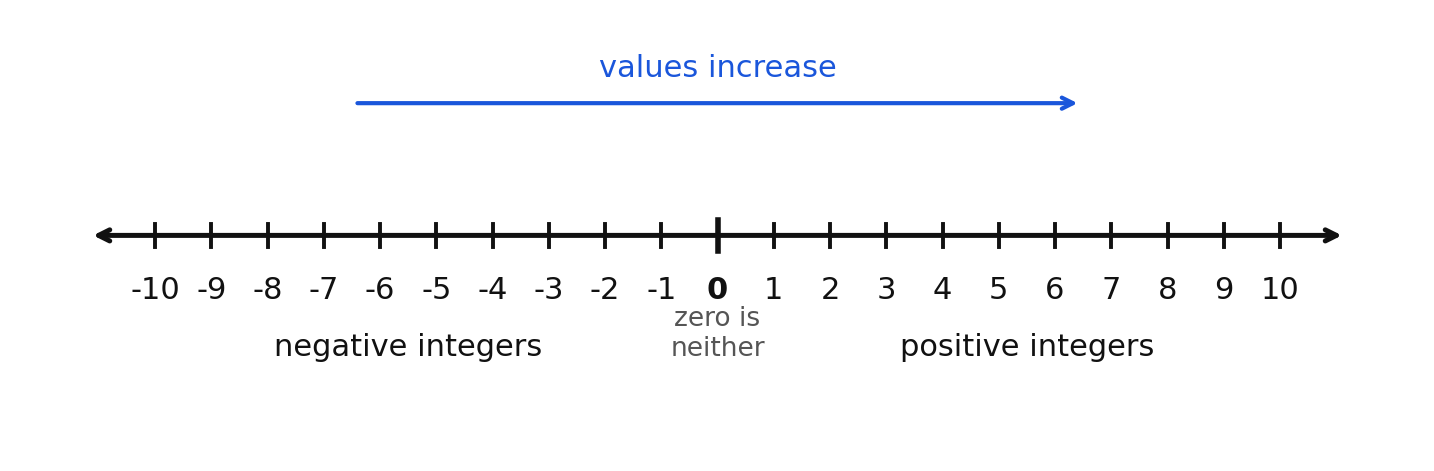
Two features of this picture matter for everything that follows:
- Values increase to the right. Any number is greater than every number to its left.
- The spacing is equal. The distance from to is the same as the distance from to . Equal spacing is what lets you compare distances later in this chapter.
Reading the negative sign. In , the sign is part of the number and is read "negative seven," not "minus seven." Save the word minus for subtraction.
Opposites
Two integers are opposites if they are the same distance from zero but on opposite sides of it.
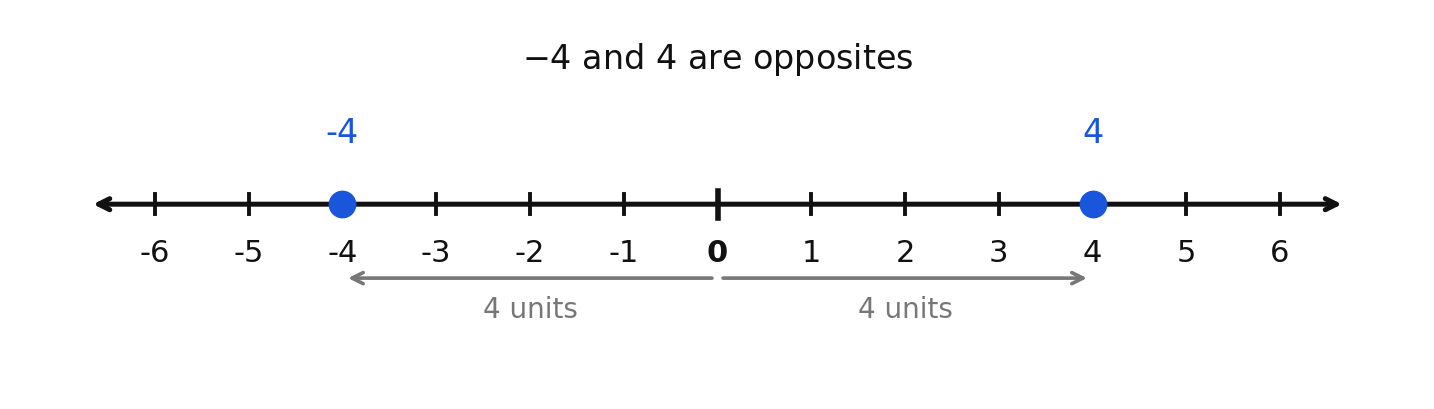
The opposite of is , and the opposite of is . The opposite of is , since zero is the only integer that is its own opposite.
Integers in context
Many real quantities have a natural zero with meaningful values on both sides. Choosing which direction is positive is a decision you make and then state.
| Situation | Zero means | Positive means | Example |
|---|---|---|---|
| Temperature (°F) | zero degrees | above zero | = 8 degrees below zero |
| Elevation | sea level | above sea level | = 30 ft below sea level |
| Bank account | balanced | deposit | = overdrawn by $12 |
| Football yardage | line of scrimmage | yards gained | = a 5-yard loss |
| Time around launch | liftoff | after liftoff | = 10 seconds before liftoff |
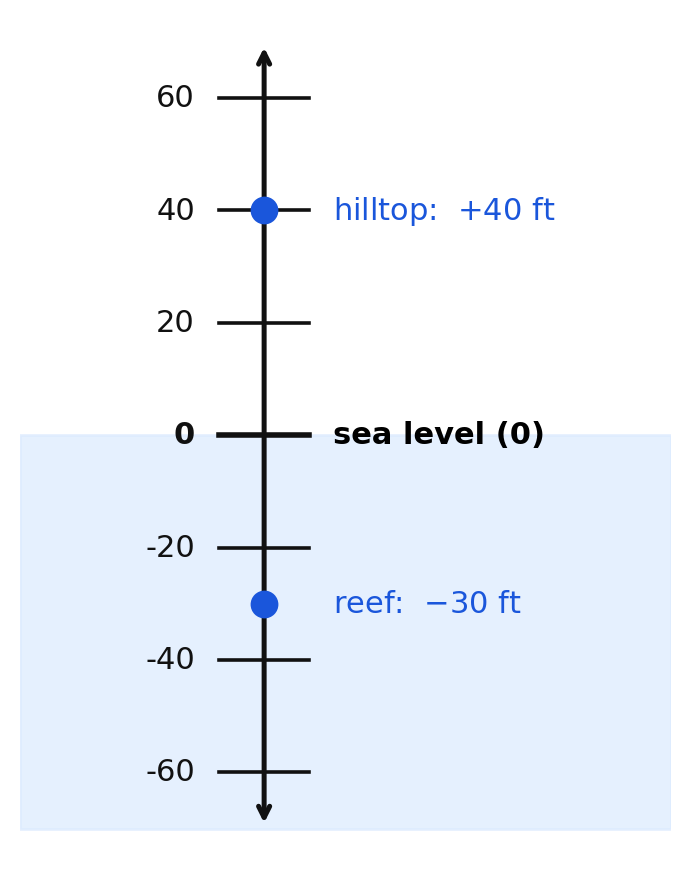
Notice that a number line can be drawn vertically when the situation is vertical. For elevation, up is positive and down is negative, which matches how we already think about above and below sea level.
Worked examples
Example 1 — Writing an integer for a situation
A cave floor is 45 feet below sea level. Write an integer for this elevation.
Below sea level is the negative direction, and the distance is 45 feet.
Answer:
Example 2 — Interpreting an integer in context
A submarine's depth is recorded as feet. What does this mean?
The sign says below sea level; the 120 says how far.
Answer: The submarine is 120 feet below sea level.
Example 3 — Identifying a point on a number line
On the number line in the figure above, a point sits three tick marks to the left of zero. What integer does it represent?
Each tick mark is one unit, and left of zero is negative.
Answer:
Example 4 — Opposites
Write the opposite of each integer: , , .
Same distance from zero, other side.
Answer: ; ;
Example 5 — Choosing a direction
A team loses 6 yards on a play, then gains 6 yards on the next. Write an integer for each play and explain what the pair shows.
A loss is negative and a gain is positive.
Answer: and . They are opposites, so together the team is back where it started at .
Guided practice
- Write an integer for each situation. a) 14 degrees below zero b) a deposit of $50 c) 7 seconds before liftoff
- What does mean if it describes a golf score compared to par?
- Write the opposite of .
- Is an integer? Explain how you know.
- A point is 5 units to the right of zero on a number line. What integer is it?
Independent practice
- Write an integer for each: a) a 9-yard gain b) 200 feet below sea level c) breaking even
- Explain why zero is neither positive nor negative.
- Name two integers that are opposites and 12 units apart in total.
- List all integers between and .
- A thermometer reads °F at 6 a.m. and °F at noon. Write a sentence describing each temperature without using the negative sign.
- Application. An elevator starts on the ground floor (0), goes down 2 levels to a parking garage, then up 7 levels. Write an integer for each of the two moves, and name the floor it ends on.
- Reasoning. Marcus says is bigger than because 20 is bigger than 2. Explain his mistake using a number line.
Exit ticket 1.1
- Write an integer for "35 feet below sea level."
- What is the opposite of ?
- Which of these are integers: , , , , ?
- Explain what the sign in tells you and what the 14 tells you.
Lesson 1.2 — Comparing and Ordering Integers on a Number Line
The left–right rule
The number line gives one rule that settles every comparison:
On a number line, the number farther to the right is always greater.
That rule holds for negatives too, which is where it does the most work. Look at and . Since sits to the right of , we know is greater than — even though 8 looks like the "bigger" digit. This is the single most common error with integers, and the number line is the fix. A debt of $8 leaves you worse off than a debt of $3.
Ordering a set of integers
To order a set of integers, plot every value, then read them off left to right for least-to-greatest.
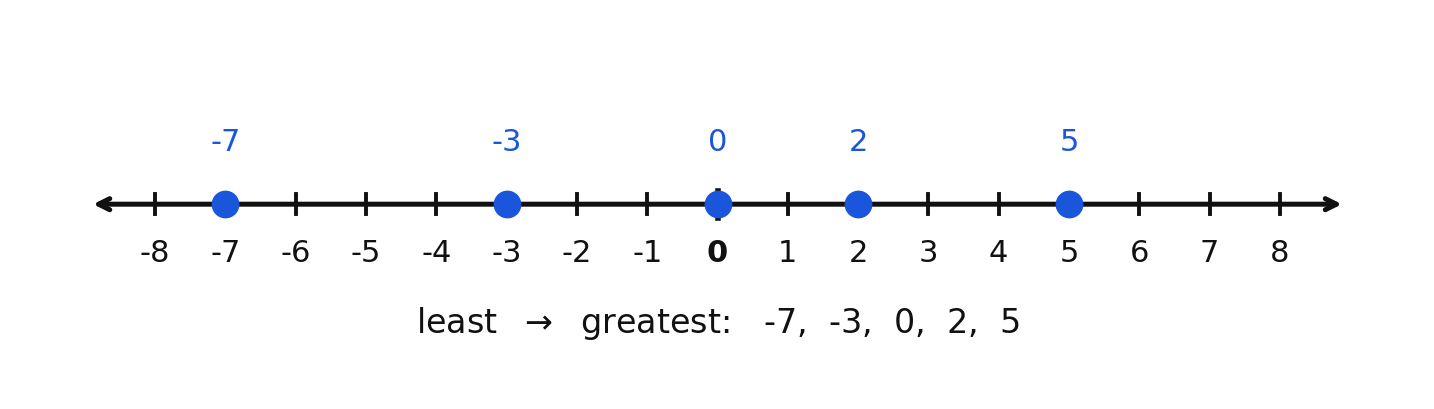
Reading left to right: , , , , . That is least to greatest. Reading right to left gives greatest to least.
Two patterns are worth naming, because they let you sort quickly before you plot:
- Every negative integer is less than every positive integer, and less than zero.
- Among negatives, the one with the larger digits is the smaller number. So .
Worked examples
Example 1 — Comparing two negatives
Which is greater, or ?
On a number line, is to the right of .
Answer: is greater.
Example 2 — Ordering least to greatest
Order , , , , from least to greatest.
Negatives first (most negative leftmost), then zero, then positives.
Answer: , , , ,
Example 3 — Ordering greatest to least
Order , , , from greatest to least.
All are negative, so the one closest to zero is greatest.
Answer: , , ,
Example 4 — Context comparison
On Monday the low was °F. On Tuesday it was °F. Which day was colder?
is farther left, so it is the lesser temperature.
Answer: Tuesday was colder.
Example 5 — Between two integers
Name all integers greater than and less than .
Move right from , stopping before .
Answer: , , ,
Guided practice
- Which is greater, or ?
- Which is less, or ?
- Order from least to greatest: , , , .
- Name the integer directly to the left of on a number line.
- True or false: every negative integer is less than zero. Explain.
Independent practice
- Order from least to greatest: , , , , .
- Order from greatest to least: , , , .
- List all integers between and .
- Which integer is greater, or ? Explain using the number line.
- Application. Four divers are at ft, ft, ft, and ft. List them from deepest to shallowest, then state which integer is greatest and explain why "greatest" and "deepest" are not the same thing here.
- Application. Overnight lows for five cities were °F, °F, °F, °F, and °F. Order them from coldest to warmest.
- Reasoning. Explain why a number line makes comparing negative integers easier than comparing them by looking at the digits.
Exit ticket 1.2
- Which is greater, or ?
- Order least to greatest: , , , .
- Name an integer between and .
- A friend says . Correct the statement and explain the error.
Lesson 1.3 — Comparing Integers with Symbols
The three comparison symbols
| Symbol | Meaning | Example | Read as |
|---|---|---|---|
| is less than | negative seven is less than three | ||
| is greater than | two is greater than negative five | ||
| is equal to | negative four equals negative four |
The open end of or always faces the greater number, and the point always faces the lesser one. So the same fact can be written two ways: and say exactly the same thing. Which one you write depends on which number you start with.
A reliable procedure
- Locate both integers on a number line (mentally once you are comfortable).
- Decide which is farther right.
- Write the symbol so its open end faces that number.
- Read the finished statement aloud to check it is true.
Step 4 catches most mistakes. "Negative nine is greater than negative two" sounds wrong when you say it, and it is.
Worked examples
Example 1 — Compare and using a symbol.
is farther right, so it is greater. The open end faces the .
Answer: (equivalently )
Example 2 — Compare and .
is farther right.
Answer:
Example 3 — Fill in the blank: .
Same number on both sides.
Answer:
Example 4 — Write two true statements comparing and .
Answer: and
Example 5 — Context
Kara's account balance is and Dev's is . Write a comparison with a symbol and say who is better off.
is farther right than , so .
Answer: ; Kara is better off, since a $25 overdraft is smaller than a $40 overdraft.
Guided practice
- Fill in , , or :
- Fill in:
- Fill in:
- Rewrite using the symbol.
- Is true or false? Explain.
Independent practice
- Fill in , , or for each: a) b) c) d)
- Rewrite each statement the other way: a) b)
- Write a true comparison statement using and .
- Which statements are false? Correct each one: a) b) c)
- Application. Two hikers are at elevations ft and ft. Write a comparison using a symbol and explain which hiker is higher.
- Application. A game scores for a miss and for a foul. Write a comparison and explain which penalty costs less.
- Reasoning. Explain why even though 100 is greater than 1.
Exit ticket 1.3
- Fill in , , or :
- Fill in:
- Rewrite using .
- Explain how you decide which way the symbol points.
Lesson 1.4 — Absolute Value
Distance from zero
Sometimes the direction does not matter — only how far. A diver 30 feet below the surface and a kite 30 feet above the launcher are both 30 feet from the reference point.
The absolute value of an integer is its distance from zero on the number line. Because distance is never negative, absolute value is never negative.
We write absolute value with a pair of vertical bars: is read "the absolute value of negative five."
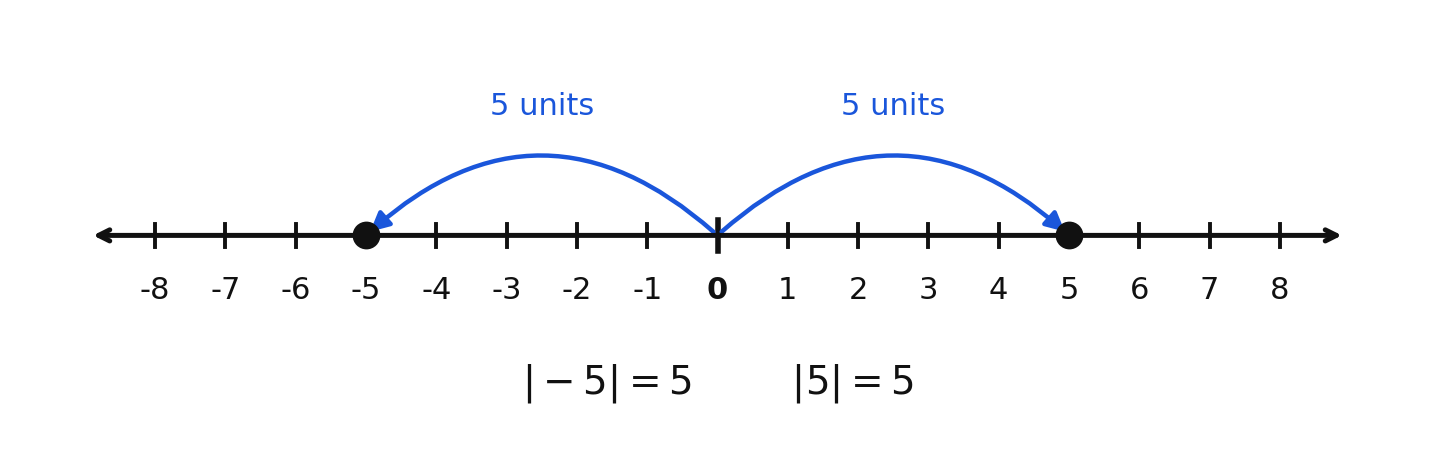
Both and sit 5 units from zero, so:
Three facts to hold onto
- Opposites have equal absolute value. .
- . Zero is zero units from itself.
- Absolute value is a distance, not a comparison. is true, and at the same time is also true, because . The lesser number can be farther from zero. Keeping these two questions separate — which is greater? versus which is farther from zero? — is the heart of this lesson.
Careful with the bars. The expression asks for a distance and equals . It does not "cancel" the sign as a rule to memorize; it reports how far is from zero.
Worked examples
Example 1 — Find .
is 14 units from zero.
Answer:
Example 2 — Find and .
Answer: and
Example 3 — Which is farther from zero, or ?
and . Since :
Answer: is farther from zero.
Example 4 — Name all integers whose absolute value is .
Two integers are 7 units from zero, one on each side.
Answer: and
Example 5 — Comparing value and distance
For and : which integer is greater, and which is farther from zero?
is farther right, so . But and , so is farther from zero.
Answer: is greater; is farther from zero.
Example 6 — Context
Two temperatures differ from freezing (0°C) by these amounts: °C and °C. Which is farther from freezing?
and .
Answer: °C is farther from freezing.
Guided practice
- Find .
- Find .
- Find .
- Name both integers whose absolute value is .
- Which is farther from zero, or ?
Independent practice
- Evaluate: a) b) c) d)
- Name all integers with absolute value .
- True or false, with a reason: .
- Order , , , from least to greatest.
- Is there an integer whose absolute value is ? Explain.
- Application. Two divers are at ft and ft. Use absolute value to say which is farther from the surface, then write an inequality comparing the two elevations. Explain why the two answers point in opposite directions.
- Reasoning. Lena says that if then must be true. Give a counterexample with integers and explain what went wrong.
Exit ticket 1.4
- Find .
- Name both integers whose absolute value is .
- Which is farther from zero, or ?
- Explain why absolute value can never be negative.
Chapter 1 Review
Vocabulary. integer · positive integer · negative integer · opposites · number line · absolute value
Part A — Representing integers (6.NS.2a)
- Write an integer for each: a) 22 feet below sea level b) a gain of 14 yards c) 5 minutes before the start
- Write the opposite of each: a) b) c)
- Which of these are integers: , , , , ?
- A point on a number line is 6 units left of zero. Name the integer.
Part B — Comparing and ordering (6.NS.2b, 6.NS.2c)
- Order from least to greatest: , , , , .
- Order from greatest to least: , , , .
- Fill in , , or : a) b) c)
- Rewrite using .
- List all integers between and .
Part C — Absolute value (6.NS.2d)
- Evaluate: a) b) c)
- Name both integers whose absolute value is .
- Which is farther from zero, or ?
Part D — Mixed application and reasoning
- Overnight lows: °F, °F, °F, °F. Order coldest to warmest, then name which is farthest from zero.
- A submarine at ft and a drone at ft. Which is farther from sea level? Which elevation is greater? Explain why these have different answers.
- Explain, using a number line, why the integer with the larger digits is not always the greater integer.
- Two integers are opposites. One is 13 units from zero. Name both integers and write a comparison statement using a symbol.
Standards coverage check — Chapter 1
| Knowledge and Skill | Where it is taught | Where it is practiced |
|---|---|---|
| 6.NS.2a — represent integers with models and contexts; identify an integer at a point on a number line | 1.1 | 1.1 all sets; Review Part A |
| 6.NS.2b — compare and order integers using a number line | 1.2 | 1.2 all sets; Review Part B |
| 6.NS.2c — compare integers using , , | 1.3 | 1.3 all sets; Review Part B |
| 6.NS.2d — absolute value as distance from zero | 1.4 | 1.4 all sets; Review Part C |
Answer keys for every set in this chapter are in Appendix A.