Chapter 15 — Congruence and Regular Polygons
Standard: 6.MG.4 — The student will determine congruence of segments, angles, and polygons.
By the end of this chapter you will be able to:
- Identify regular polygons (6.MG.4a)
- Draw lines of symmetry to divide regular polygons into two congruent parts (6.MG.4b)
- Determine the congruence of segments, angles, and polygons given their properties (6.MG.4c)
- Determine whether polygons are congruent or noncongruent according to the measures of their sides and angles (6.MG.4d)
Lessons: 15.1 Congruent Segments and Angles · 15.2 Regular Polygons · 15.3 Lines of Symmetry · 15.4 Congruent and Noncongruent Polygons
Lesson 15.1 — Congruent Segments and Angles
What congruent means
Two figures are congruent if they have the same size and the same shape. One could be placed exactly on top of the other and match perfectly — even if you have to slide, turn, or flip it to get there.
That definition sounds visual, but for the two simplest figures it becomes a measurement you can check.
- Two segments are congruent when they have the same length.
- Two angles are congruent when they have the same measure.
Nothing else matters. A segment's position on the page, the direction it points, whether it is drawn thick or thin — none of that changes its length, so none of it changes congruence.
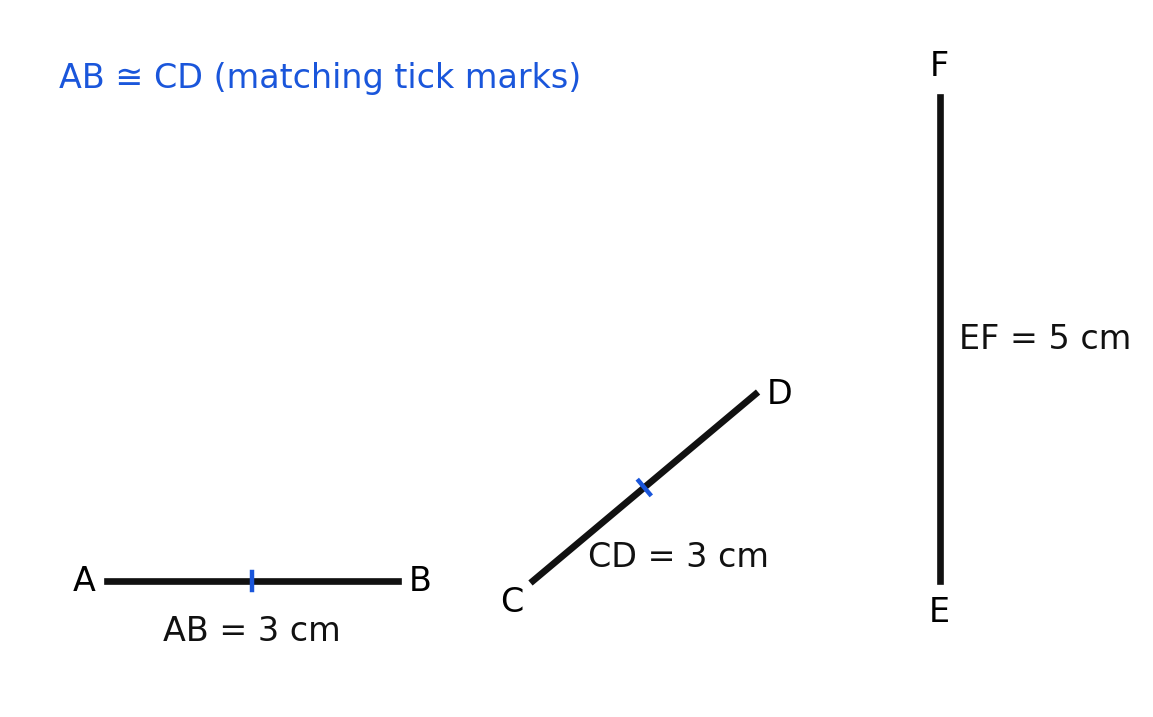
Segments and above are congruent because both measure cm, even though one is horizontal and the other is slanted. Segment is not congruent to them, because .
Notation you need to read and write
Geometry is picky about notation here, and for a good reason: it separates a figure from a measurement.
| Symbol | What it names | Read as |
|---|---|---|
| the segment with endpoints and — a figure | segment | |
| the length of that segment — a number | the length of | |
| the angle with vertex — a figure | angle | |
| the measure of that angle — a number | the measure of angle | |
| is congruent to — used between figures | is congruent to | |
| is equal to — used between numbers | equals |
So these two statements say the same thing in two correct ways:
The first says the two segments are congruent figures. The second says their lengths are equal numbers. Likewise, means exactly .
The rule of thumb. Use when you are talking about shapes and when you are talking about numbers. Writing cm mixes the two, because a segment is a figure and cm is a number. Write cm instead.
To say two figures are not congruent, write : .
Angle measure does not depend on side length
This one surprises people. An angle is the amount of turn between two rays, and the rays go on as far as you like. Drawing them longer does not open the angle any wider.
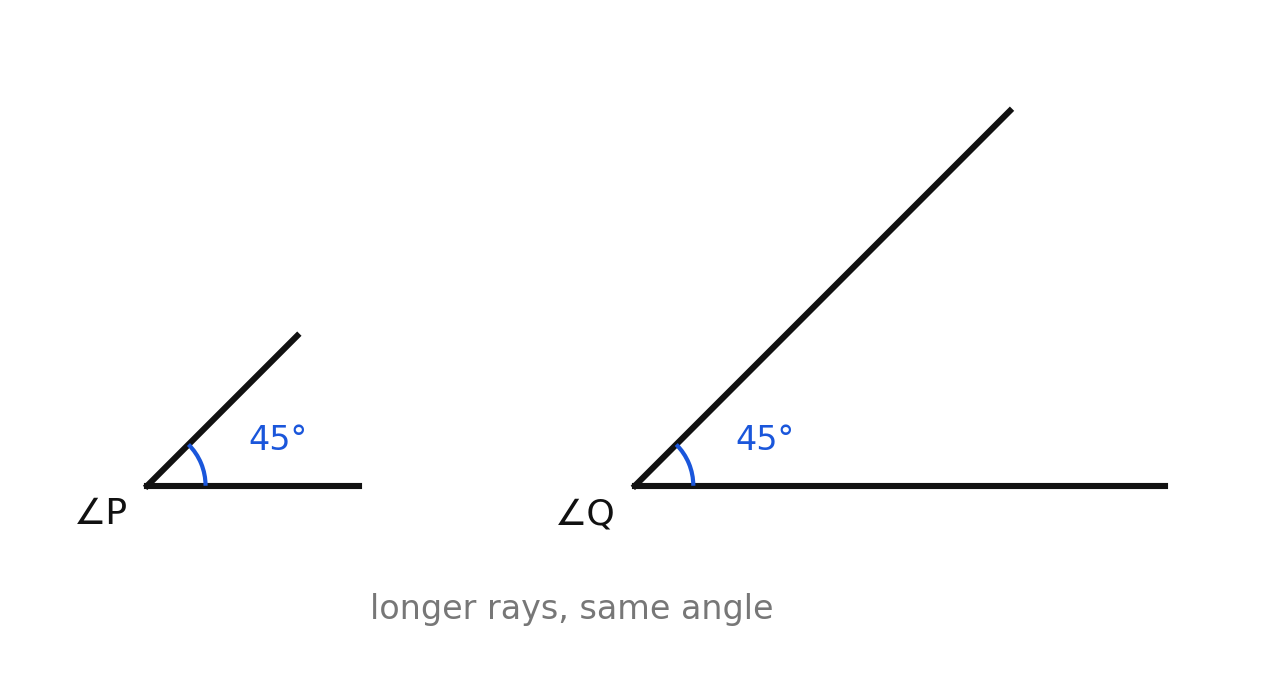
Both angles above measure , so . The longer rays on the right make the drawing bigger, not the angle.
Marks on figures
Drawings show congruence with marks instead of numbers, which is handy when a problem does not give measurements.
- Tick marks on segments: segments with the same number of ticks are congruent.
- Arcs at angles: angles with the same number of arcs are congruent.
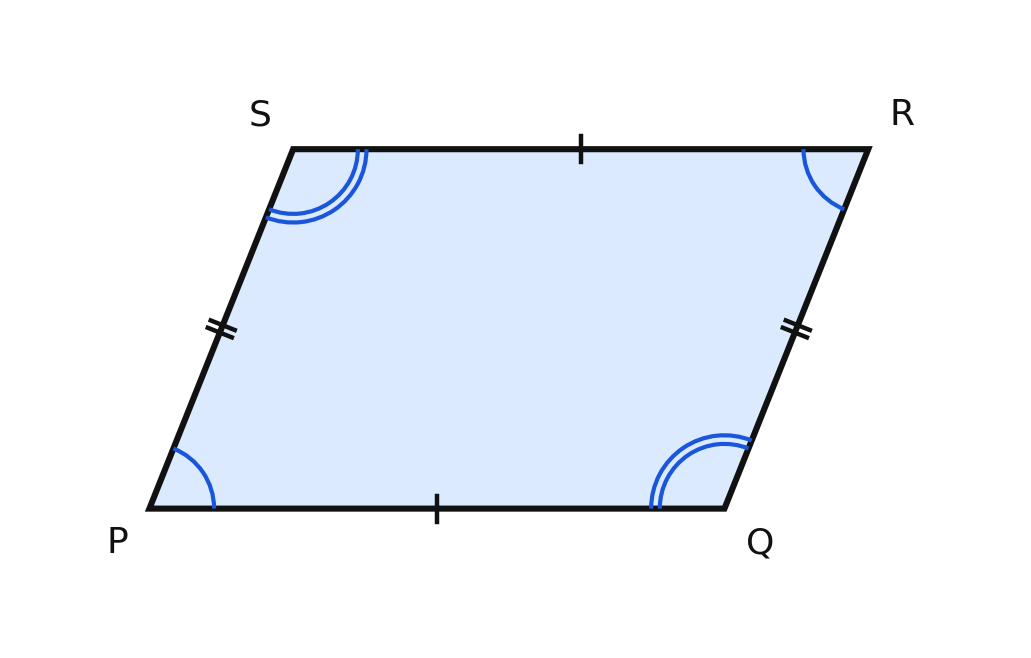
Reading the figure above: , , , and .
Worked examples
Example 1 — Segments from lengths
cm and cm. Are the segments congruent? Write a statement.
Segments are congruent when their lengths are equal, and .
Answer: Yes.
Example 2 — Angles from measures
and . Are the angles congruent? Write a statement.
Angles are congruent when their measures are equal.
Answer: Yes.
Example 3 — Not congruent
and . Determine congruence.
Since , the measures are different.
Answer: Not congruent.
Example 4 — Using a congruence statement to find a measurement
Given and in, find .
Congruent segments have equal lengths, so .
Answer: in
Example 5 — Splitting a segment into congruent parts
A shelf board cm long is cut into two congruent pieces. How long is each piece?
Congruent pieces have equal lengths, so each is half the whole.
Answer: cm each
Guided practice
- cm and cm. Are the segments congruent? Write a congruence statement.
- and . Write a congruence statement.
- and . Are the angles congruent? Explain.
- Given and in, find .
- When should you use the symbol , and when should you use ?
Independent practice
- Congruent or not congruent? a) segments of cm and cm b) segments of in and in c) angles of and d) angles of and
- Given and mm, find .
- Given and , find .
- Using the marked quadrilateral in this lesson, list every pair of congruent segments and every pair of congruent angles.
- A ribbon cm long is cut into two congruent pieces. Find the length of each piece.
- Application. A bookcase needs two side boards that are congruent. One board measures in. The second is cut to in. Are the boards congruent? Explain what has to happen, and state exactly how much material is involved.
- Reasoning. In a small sketch, measures and its rays are cm long. In a large poster, measures and its rays are cm long. Are the angles congruent? Explain what an angle actually measures.
Exit ticket 15.1
- cm and cm. Write a congruence statement.
- Given and , find .
- Are angles of and congruent? Explain.
- Explain the difference between and , and give one correct example of each.
Lesson 15.2 — Regular Polygons
Polygons first
A polygon is a closed plane figure made of three or more straight sides that meet only at their endpoints. The corner points where sides meet are vertices (one of them is a vertex).
The number of sides names the polygon.
| Sides | Name | Sides | Name |
|---|---|---|---|
| 3 | triangle | 7 | heptagon |
| 4 | quadrilateral | 8 | octagon |
| 5 | pentagon | 9 | nonagon |
| 6 | hexagon | 10 | decagon |
Two conditions, both required
A regular polygon is a polygon in which all sides are congruent and all angles are congruent.
Both conditions, at the same time. That "and" is the whole lesson, because most figures that fail to be regular fail only one of the two tests.
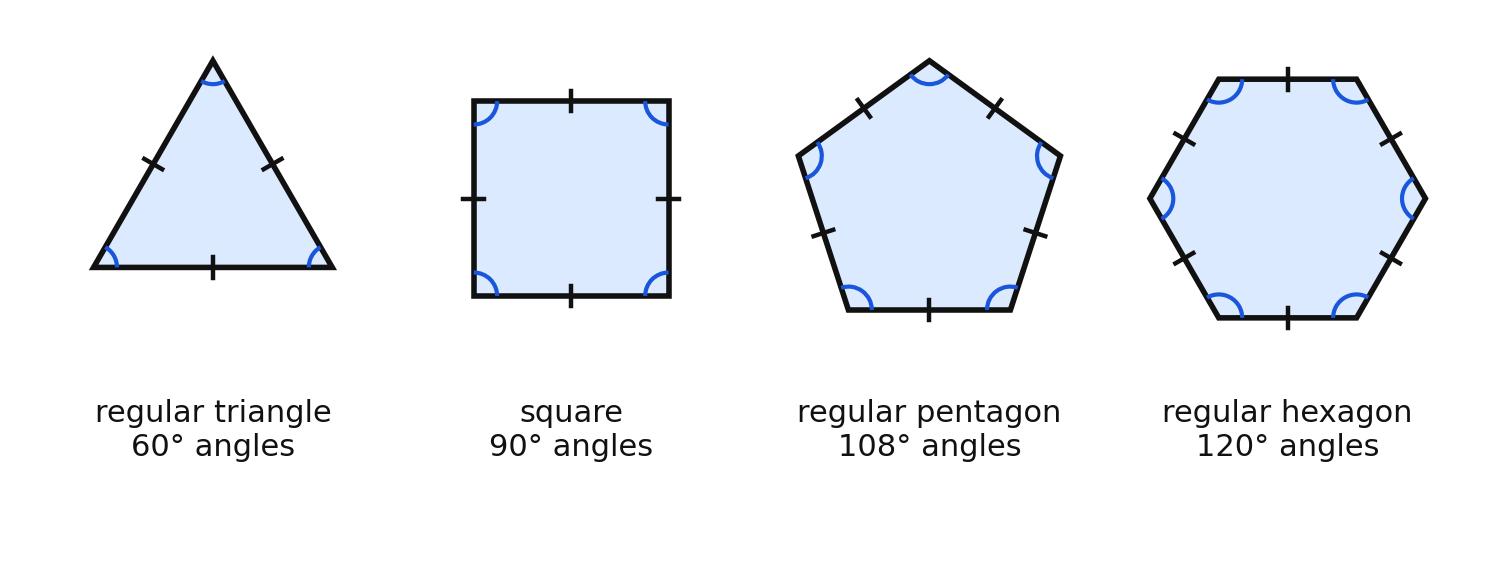
Here is the angle measure in each regular polygon you will meet in this course. These are facts to use, not something you need to derive.
| Regular polygon | Measure of each angle |
|---|---|
| Regular triangle (equilateral) | |
| Square | |
| Regular pentagon | |
| Regular hexagon | |
| Regular octagon | |
| Regular decagon |
Notice the naming: a regular triangle is usually called an equilateral triangle, and a regular quadrilateral is called a square. Both are regular polygons; they just have older, shorter names.
Two ways to fail
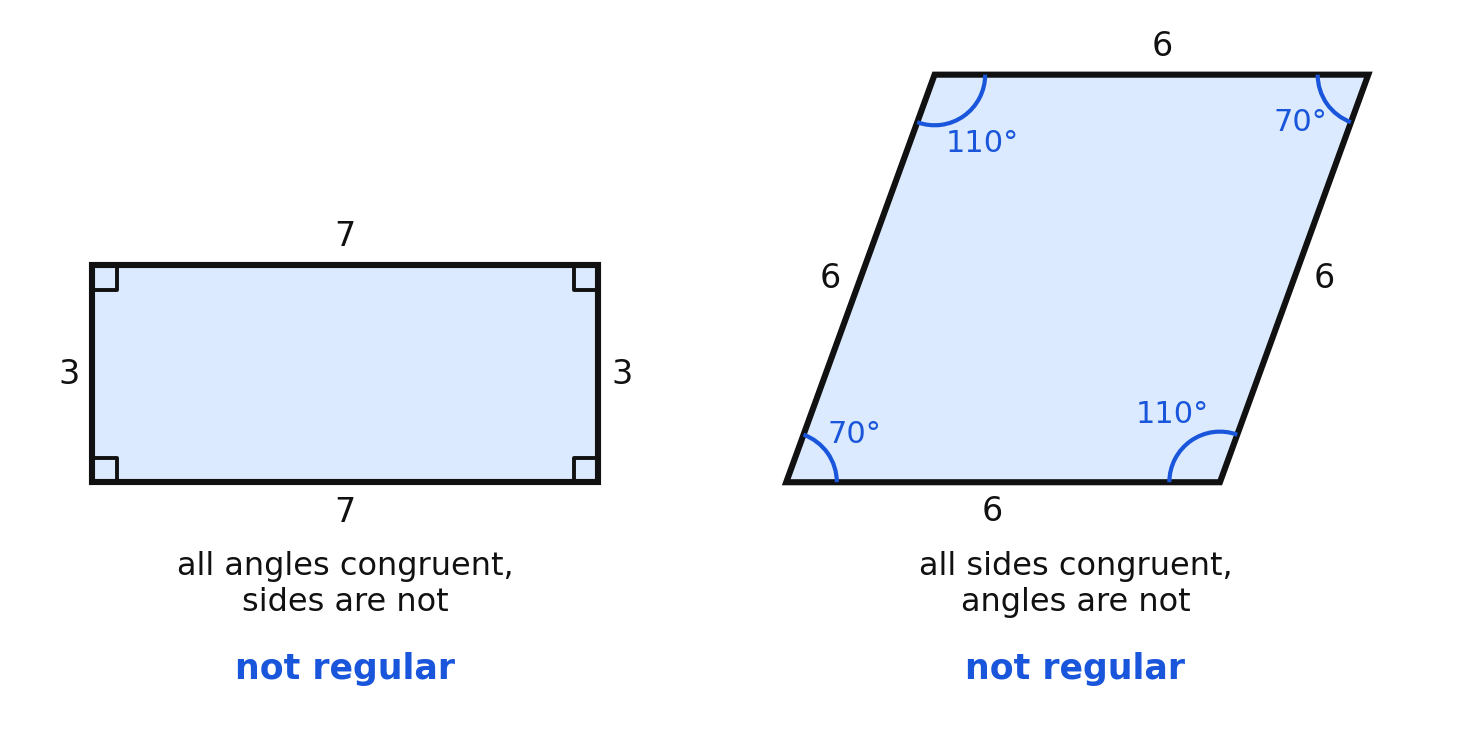
- A rectangle that is not a square has four congruent angles ( each) but two different side lengths. It fails the side test, so it is not regular.
- A rhombus that is not a square has four congruent sides but two different angle measures. It fails the angle test, so it is not regular.
Each figure passes one test and fails the other, and one failure is enough.
A square is the one quadrilateral that passes both tests, which is why a square is a regular polygon. And notice that a rectangle whose length and width are equal is a square, so it is regular.
Perimeter of a regular polygon
Because every side of a regular polygon is the same length, its perimeter is a multiplication instead of a long addition. For a regular polygon with sides of length :
That relationship runs both directions: if you know the perimeter and the number of sides, divide to get the side length.
Worked examples
Example 1 — Testing a description
A quadrilateral has four sides of cm and four angles of . Is it regular? Name it.
All four sides congruent, all four angles congruent — both tests pass.
Answer: Yes, it is regular. It is a square.
Example 2 — A rectangle
A rectangle measures in by in. Is it regular? Explain.
All four angles measure , so the angle test passes. But the sides are , , , , and , so the side test fails.
Answer: Not regular, because its sides are not all congruent.
Example 3 — A rhombus
A rhombus has four sides of cm, with angles of , , , and . Is it regular? Explain.
The side test passes. The angle test fails, since .
Answer: Not regular, because its angles are not all congruent.
Example 4 — Perimeter of a regular hexagon
Find the perimeter of a regular hexagon with sides of cm.
A hexagon has sides, all congruent.
Answer: cm
Example 5 — Working backward to a side length
A regular pentagon has a perimeter of in. Find the length of one side.
A pentagon has congruent sides, so divide.
Answer: in
Guided practice
- State the two conditions a polygon must meet to be regular.
- Is a square a regular polygon? Explain.
- Is a rectangle measuring cm by cm regular? Explain.
- Find the perimeter of a regular octagon with sides of cm.
- A regular decagon has a perimeter of m. Find the length of one side.
Independent practice
- Regular or not regular? Give a reason for each. a) an equilateral triangle with cm sides b) a rhombus with cm sides and angles of and c) a square with in sides d) a rectangle measuring in by in
- Name the regular polygon that has: a) congruent sides b) congruent sides c) congruent sides
- Find the perimeter of a regular hexagon with sides of cm.
- A regular pentagon has a perimeter of in. Find the length of one side.
- Each angle of a regular hexagon measures . Find the sum of all six angle measures.
- Application. A stop sign is a regular octagon with sides of in. A shop wraps reflective tape around all of its edges exactly once. How many inches of tape are needed, and how many feet is that?
- Reasoning. Kai says any polygon with all congruent sides must be regular. Give a specific counterexample with measurements and explain which test his figure fails.
Exit ticket 15.2
- What two conditions make a polygon regular?
- Name the polygon with sides.
- Find the perimeter of a regular hexagon with sides of cm.
- Explain why most rectangles are not regular polygons, and name the one kind that is.
Lesson 15.3 — Lines of Symmetry
Folding a figure onto itself
A line of symmetry is a line that divides a figure into two parts that match exactly when the figure is folded along that line. Because the two parts match exactly, they are congruent parts — same size, same shape.
Folding is a fair test, and it is worth doing with paper at least once. Cut out a paper square, fold it corner to corner, and the two halves land on each other with no overhang. That fold line is a line of symmetry. Now fold the same square along a slanted line that is not through the center and the halves do not match. That line is not a line of symmetry.
Regular polygons are generous with symmetry
Every regular polygon has exactly as many lines of symmetry as it has sides.
| Regular polygon | Sides | Lines of symmetry |
|---|---|---|
| Equilateral triangle | 3 | 3 |
| Square | 4 | 4 |
| Regular pentagon | 5 | 5 |
| Regular hexagon | 6 | 6 |
| Regular heptagon | 7 | 7 |
| Regular octagon | 8 | 8 |
| Regular decagon | 10 | 10 |
The reason is the regularity itself. Since all the sides are congruent and all the angles are congruent, the figure looks the same from every vertex and from every side, so a symmetry line exists in every one of those directions.
Where the lines go depends on odd or even
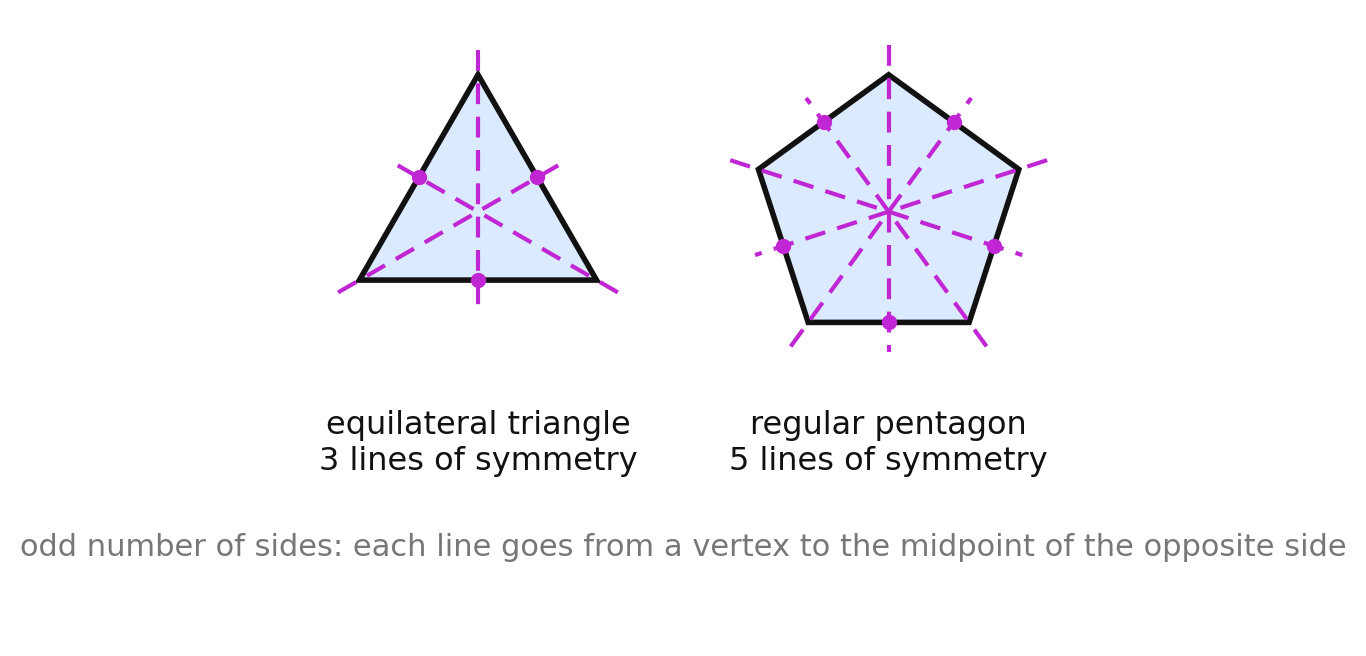
Odd number of sides. Every line of symmetry runs from one vertex through the midpoint of the opposite side. There is no side directly across from a side, so no line connects two vertices.
Even number of sides. The lines come in two kinds, half of each. Half connect two opposite vertices, and half connect the midpoints of two opposite sides.
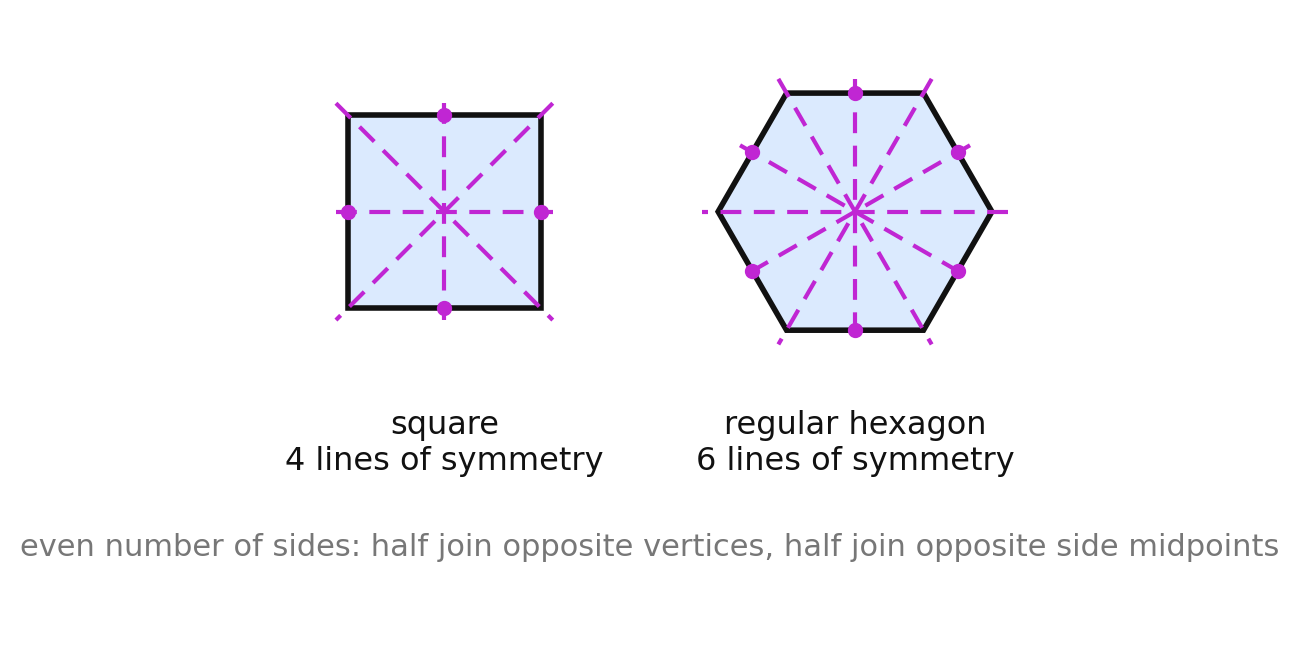
So a square has lines: diagonals and through side midpoints. A regular hexagon has lines: vertex to vertex and midpoint to midpoint. For a regular polygon with an even number of sides , there are of each kind.
Figures with few or no lines of symmetry
Irregular figures are far less generous, which is another way to see that regularity is doing real work.
- A rectangle that is not a square has only 2 lines of symmetry: the two lines through the midpoints of opposite sides. Its diagonals are not lines of symmetry — fold a by rectangle along a diagonal and the halves do not land on each other.
- A parallelogram that is not a rectangle or a rhombus has 0 lines of symmetry.
- A scalene triangle, with three different side lengths, has 0.
Worked examples
Example 1 — Equilateral triangle
How many lines of symmetry does an equilateral triangle have, and where do they go?
It has sides, so lines. With an odd number of sides, each line runs from a vertex to the midpoint of the opposite side.
Answer: lines, each from a vertex through the midpoint of the opposite side
Example 2 — Square
Describe all lines of symmetry of a square.
Four sides means lines. Four is even, so half are vertex to vertex and half are midpoint to midpoint: of each.
Answer: lines — the diagonals, plus lines joining midpoints of opposite sides
Example 3 — Regular pentagon
How many lines of symmetry does a regular pentagon have? Does any of them join two vertices?
Five sides means lines. Five is odd, so each line goes from a vertex to a side midpoint.
Answer: lines; none join two vertices
Example 4 — Regular hexagon
Describe all lines of symmetry of a regular hexagon.
Six sides means lines, and of each kind.
Answer: lines — joining opposite vertices and joining midpoints of opposite sides
Example 5 — A regular 12-gon
A regular polygon has sides. How many lines of symmetry does it have, and how do they split into the two kinds?
The count matches the number of sides, and is even.
Answer: lines — vertex to vertex and midpoint to midpoint
Guided practice
- How many lines of symmetry does an equilateral triangle have?
- How many lines of symmetry does a square have?
- How many lines of symmetry does a regular pentagon have?
- A regular octagon has how many lines of symmetry? How many are vertex to vertex, and how many are midpoint to midpoint?
- Explain why the two parts made by a line of symmetry are congruent.
Independent practice
- Give the number of lines of symmetry: a) regular heptagon b) regular nonagon c) regular decagon d) regular polygon with sides
- For a regular hexagon, how many lines of symmetry pass through two opposite vertices, and how many pass through the midpoints of opposite sides?
- In a regular pentagon, does any line of symmetry connect two vertices? Explain using odd and even.
- A rectangle measures cm by cm. How many lines of symmetry does it have? Explain why its diagonals do not count.
- A regular polygon has lines of symmetry. How many sides does it have? Are its symmetry lines vertex to vertex, vertex to midpoint, or a mix? Explain.
- Application. A designer cuts a paper regular hexagon along a line of symmetry to get two matching pieces for a quilt block. Explain why the two pieces are guaranteed to be congruent, and state how many different folds would work.
- Reasoning. Rosa says the diagonals of any parallelogram are lines of symmetry. Give a specific parallelogram that shows she is wrong, and explain what goes wrong when you fold along the diagonal.
Exit ticket 15.3
- How many lines of symmetry does a square have?
- How many lines of symmetry does a regular decagon have?
- What is always true about the two parts a line of symmetry creates?
- Explain why a regular polygon has exactly as many lines of symmetry as it has sides.
Lesson 15.4 — Congruent and Noncongruent Polygons
Corresponding parts
Two polygons are congruent when every pair of corresponding sides is congruent and every pair of corresponding angles is congruent.
Corresponding parts are the parts that occupy matching positions in the two figures. The naming order of a congruence statement tells you the matching. In
the vertices match in order: with , with , with . From that single statement you can read off six facts:
| Corresponding sides | Corresponding angles |
|---|---|
Because the order carries the information, write congruence statements carefully. and make different claims.
Position does not matter
A congruent copy may be slid, turned, or flipped. It is still congruent, because sliding, turning, and flipping change where a figure sits without changing any length or any angle measure.
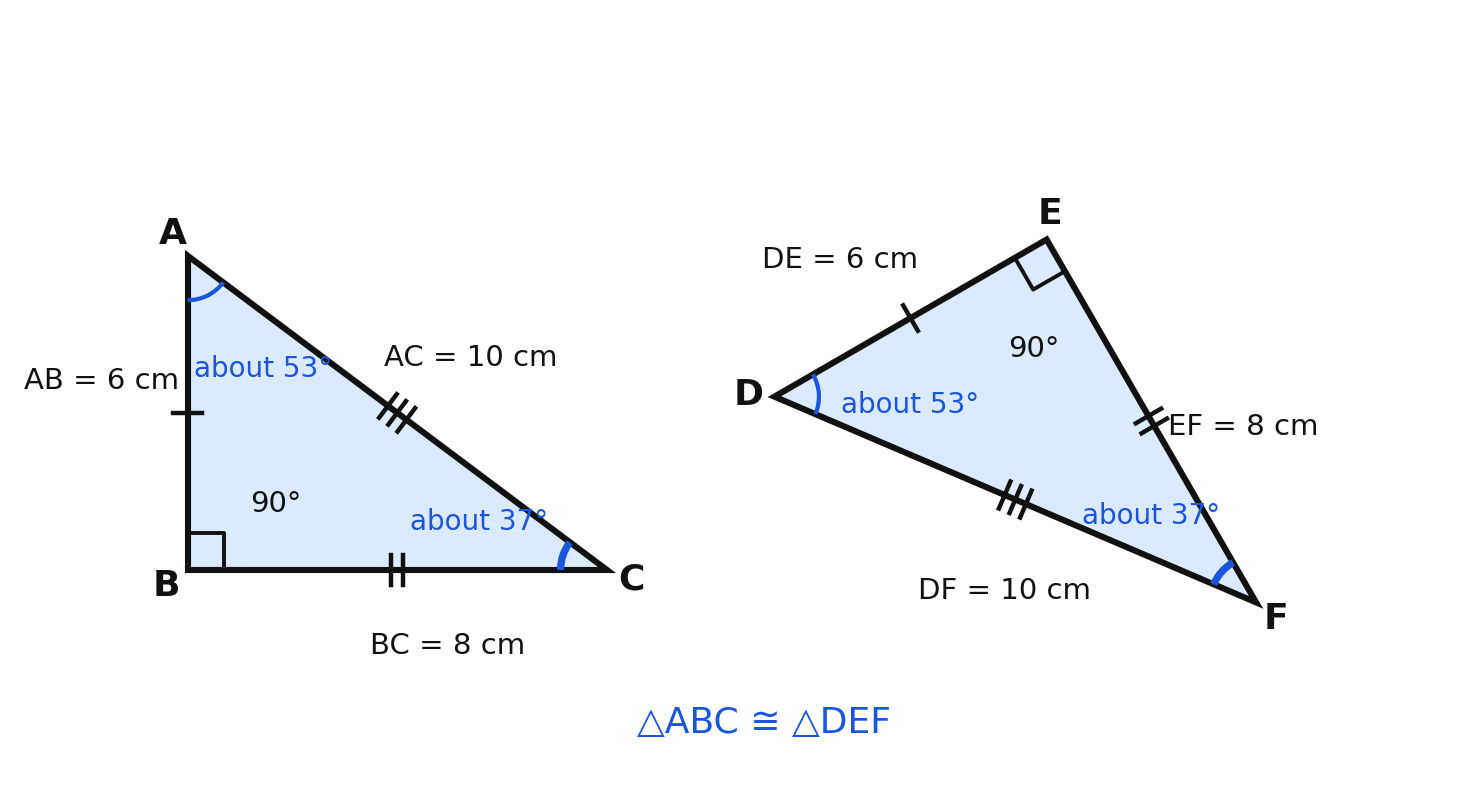
The two triangles above sit at different angles on the page, yet all three pairs of corresponding sides are congruent and all three pairs of corresponding angles are congruent. So .
Noncongruent
Two polygons are noncongruent when at least one pair of corresponding sides or corresponding angles is not congruent. One mismatch is enough. You do not need to check every part once you have found a difference — but you do need to check every part before declaring two figures congruent.
"Same shape" is not the same as "congruent"
This distinction matters, and it is where most errors live.
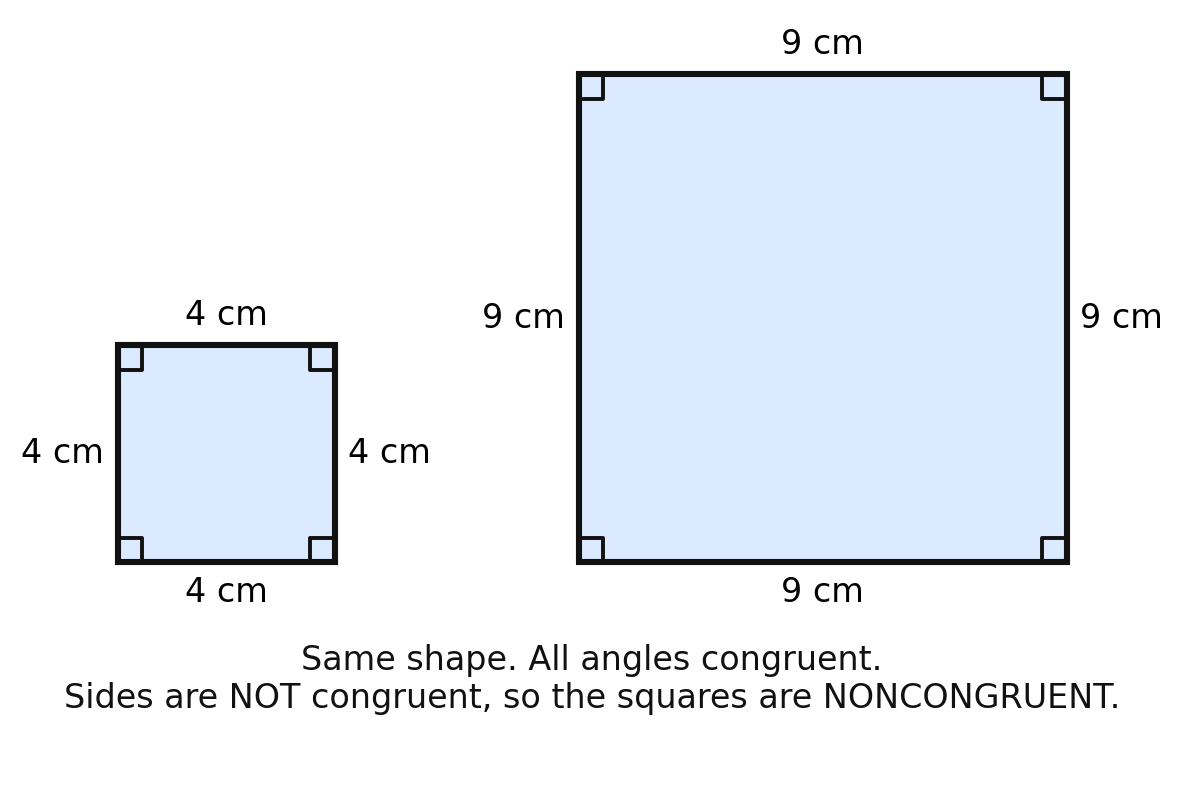
Both figures above are squares. They have the same shape, and all eight angles measure , so every pair of corresponding angles is congruent. But , so no pair of corresponding sides is congruent.
Congruent means same shape and same size. Two figures with the same shape but different sizes are called similar, not congruent. Every congruent pair is also similar, but a similar pair is only congruent when the sizes match too.
That is why matching angles alone never settles congruence. All equilateral triangles have three angles, no matter how big they are.
A checklist for deciding
- Do the two polygons have the same number of sides? If not, stop — noncongruent.
- Pair up corresponding sides and compare their lengths.
- Pair up corresponding angles and compare their measures.
- All pairs congruent means congruent. Any pair not congruent means noncongruent.
Worked examples
Example 1 — Two triangles from measurements
Triangle 1 has sides cm, cm, cm with angles of about , about , and . Triangle 2 has sides cm, cm, cm with the same three angle measures, and the parts match up in that order. Congruent or noncongruent?
Compare the corresponding sides: , , . Compare the corresponding angles: each measure equals its partner, including the pair. Every pair matches.
Answer: Congruent
Example 2 — Two rectangles
Rectangle measures in by in. Rectangle measures in by in. Congruent or noncongruent?
All eight angles are , so the angles all match. But one pair of corresponding sides measures in and in, and .
Answer: Noncongruent, because a pair of corresponding sides is not congruent
Example 3 — Two squares
A square has sides of cm and another has sides of cm. Do they have the same shape? Are they congruent?
Both are squares, so the shape is the same and all angles are . The side lengths differ.
Answer: Same shape, but noncongruent, because
Example 4 — Using a congruence statement
Given with m, m, and , find , , and .
Read the matching from the order of the letters: with , with , with . So corresponds to , corresponds to , and corresponds to .
Answer: m, m,
Example 5 — All angles congruent is not enough
One equilateral triangle has sides of cm and another has sides of cm. Every angle in both is . Congruent or noncongruent?
All three pairs of corresponding angles are congruent. But the corresponding sides measure cm and cm.
Answer: Noncongruent. Matching angles fix the shape but not the size, so the sides must match too.
Guided practice
- Two triangles each have sides cm, cm, cm and angles of about , about , and , matching in that order. Congruent or noncongruent?
- Two rectangles each measure ft by ft. Congruent or noncongruent? Explain.
- One rectangle measures ft by ft and another measures ft by ft. Congruent or noncongruent? Name the pair that fails.
- Given and cm, find .
- Explain why two squares with different side lengths are not congruent even though both are squares.
Independent practice
- Congruent or noncongruent, with a reason for each: a) two equilateral triangles with cm sides b) an equilateral triangle with cm sides and one with cm sides c) two squares with in sides d) a square with in sides and a rhombus with in sides whose angles measure and
- Given , name the side that corresponds to and the angle that corresponds to .
- Given with m, m, m, and , find , , , and .
- A triangle is turned upside down and set beside an identical triangle. Are the two triangles congruent? Explain what turning a figure does and does not change.
- Two regular hexagons each have sides of cm. Are they congruent? Explain how the definition of regular makes this quick to decide.
- Application. A factory stamps metal plates that must be congruent to a template pentagon with sides cm, cm, cm, cm, cm and matching angles. One plate comes out with sides cm, cm, cm, cm, cm and otherwise matching angles. Is the plate congruent to the template? State what has to change and by how much.
- Reasoning. Explain the difference between "same shape" and "congruent." Use two squares with specific side lengths as your example, and name the word that describes figures with the same shape but different sizes.
Exit ticket 15.4
- Two rectangles each measure in by in, with corresponding parts matching. Congruent or noncongruent?
- Given and , find .
- A square has cm sides and another has cm sides. Do they have the same shape? Are they congruent?
- Explain what must be true about the sides and angles of two polygons for them to be congruent.
Chapter 15 Review
Vocabulary. congruent · noncongruent · similar · polygon · vertex · regular polygon · equilateral triangle · line of symmetry · corresponding sides · corresponding angles
Part A — Identifying regular polygons (6.MG.4a)
- State the two conditions a polygon must satisfy to be regular.
- Regular or not regular, with a reason: a) a square with cm sides b) a rectangle measuring m by m c) a rhombus with in sides and angles of and d) an equilateral triangle with ft sides
- Name the regular polygon with each number of congruent sides: a) b) c)
- Find the perimeter of a regular pentagon with sides of cm.
- A regular octagon has a perimeter of in. Find the length of one side.
Part B — Lines of symmetry in regular polygons (6.MG.4b)
- Give the number of lines of symmetry: a) equilateral triangle b) square c) regular hexagon d) regular decagon
- Describe where each line of symmetry of a regular pentagon goes, and explain why none of them joins two vertices.
- A regular octagon's lines of symmetry split into two kinds. Describe each kind and give how many there are of each.
- What is always true about the two parts created by a line of symmetry?
- A rectangle measures cm by cm. Give its number of lines of symmetry and explain why the diagonals are not among them.
Part C — Congruence of segments and angles (6.MG.4c)
- mm and mm. Write a congruence statement.
- Given and , find .
- Are angles of and congruent? Explain.
- Explain when to use and when to use , giving one correct example of each.
Part D — Congruent and noncongruent polygons (6.MG.4d)
- Congruent or noncongruent, with a reason: a) two rectangles, each cm by cm b) two rectangles, cm by cm and cm by cm c) two regular hexagons with mm sides d) two squares, one with in sides and one with in sides
- Given with cm, cm, and , find , , and .
- Given , name the side corresponding to and the angle corresponding to .
Part E — Mixed application and reasoning
- Application. A tile pattern uses regular hexagons with sides of cm. Find the perimeter of one tile, state how many lines of symmetry it has, and explain why any two of these tiles are congruent.
- Application. A woodworker needs two shelf brackets congruent to a template triangle with sides in, in, in. One bracket measures in, in, in and one measures in, in, in. Which bracket is congruent to the template? Explain what is wrong with the other.
- Reasoning. A classmate says two polygons must be congruent if all their corresponding angles are congruent. Give a counterexample with measurements, explain the error, and name the word that correctly describes the classmate's figures.
Standards coverage check — Chapter 15
| Knowledge and Skill | Where it is taught | Where it is practiced |
|---|---|---|
| 6.MG.4a — identify regular polygons | 15.2 | 15.2 all sets; 15.4 items 6, 10; Review Part A |
| 6.MG.4b — draw lines of symmetry to divide regular polygons into two congruent parts | 15.3 | 15.3 all sets; Review Part B and item 18 |
| 6.MG.4c — determine the congruence of segments, angles, and polygons given their properties | 15.1, 15.4 | 15.1 all sets; 15.4 items 4, 7, 8; Review Part C and Part D |
| 6.MG.4d — determine whether polygons are congruent or noncongruent according to the measures of their sides and angles | 15.4 | 15.4 all sets; Review Part D and items 19, 20 |
Answer keys for every set in this chapter are in Appendix A.