Chapter 16 — Surface Area and Volume of Solids
Standard: G.DF.1 (a, b, c, d)
G.DF.1 — verbatim. The student will create models and solve problems, including those in context, involving surface area and volume of rectangular and triangular prisms, cylinders, cones, pyramids, and spheres. Students will demonstrate the following Knowledge and Skills: a) Identify the shape of a two-dimensional cross section of a three-dimensional figure. b) Create models and solve problems, including those in context, involving surface area of three-dimensional figures, as well as composite three-dimensional figures. c) Solve multistep problems, including those in context, involving volume of three-dimensional figures, as well as composite three-dimensional figures. d) Determine unknown measurements of three-dimensional figures using information such as length of a side, area of a face, or volume.
By the end of this chapter you will be able to:
- Identify the two-dimensional cross section produced when a plane cuts a three-dimensional figure (G.DF.1a)
- Find the volume and surface area of rectangular and triangular prisms (G.DF.1 b, c)
- Find the volume and surface area of cylinders and cones, using the Pythagorean Theorem to find a cone's slant height (G.DF.1 b, c)
- Find the volume and surface area of square pyramids and spheres (G.DF.1 b, c)
- Find the volume and surface area of composite solids built from two of the five solids above (G.DF.1 b, c)
- Work backward from a given surface area or volume to find an unknown dimension (G.DF.1d)
Lessons: 16.1 Cross Sections · 16.2 Prisms · 16.3 Cylinders and Cones · 16.4 Pyramids and Spheres · 16.5 Composite Solids · 16.6 Working Backward
Why this chapter matters. Every solid in this chapter answers two questions: how much does it hold (volume), and how much material covers it (surface area). Five formula pairs cover every solid the EOC formula sheet lists — but the formula sheet cannot tell you which numbers to plug in. That takes knowing what a cross section looks like, knowing how to find a slant height the sheet never hands you directly, and knowing how to add or subtract faces when two solids are fused into one.
Scope note. This chapter covers exactly the five solids G.DF.1 names — rectangular and triangular prisms, cylinders, cones, pyramids, and spheres — plus composite solids built from two of them. Every prism and pyramid in this chapter has integer edge lengths, and every cone's or pyramid's slant height is a genuine Pythagorean triple, never rounded. Oblique solids (a leaning cylinder or prism, tilted rather than standing straight up from its base) are not named by the standard and are not taught here.
Conventions this chapter fixes.
- A slant height, , is never handed to you directly — it is always found from the radius (or half the base) and the height, using the Pythagorean Theorem, the same way this book has found every hypotenuse since Chapter 8.
- Answers involving are left as an exact coefficient of , never a rounded decimal — the same convention fixed in Chapter 14.
- A composite solid's surface area is found by adding each piece's own full surface area — as if it were standing alone — and then subtracting the shared, internal face TWICE, once for each piece that would otherwise still be claiming it.
- Item numbering runs straight through the chapter, from 1 in Lesson 16.1 to 124 at the end of Lesson 16.6.
Lesson 16.1 — Cross Sections
Cuts parallel to the base

A cross section is the flat shape left behind where a plane slices through a solid. Cutting parallel to the base is the simplest cut there is, and it behaves differently depending on the solid:
- A prism's cross section, cut parallel to a face, is a rectangle the same shape as that face — and the same size, no matter where along the prism the cut is made.
- A cylinder's cross section, cut parallel to its circular base, is a circle — and like the prism, it is always the same size as the base, no matter where the cut is made.
- A cone's cross section, cut parallel to its base, is also a circle — but unlike the cylinder, it shrinks the closer the cut is to the apex. Only a cut at the base itself matches the base's size.
- A sphere's cross section is a circle for any cut at all, not just ones "parallel to a base" — a sphere has no base to be parallel to. The circle is biggest through the center and shrinks toward either edge.
Cuts through the axis or the apex

A different cut — one that runs the other way, through the middle of the solid rather than parallel to its base — produces a different family of shapes:
- A cylinder cut straight through its axis (its two straight sides plus its two flat ends) leaves a rectangle.
- A cone or a pyramid, cut through its apex perpendicular to the base, leaves a triangle — the curved or slanted sides meet the flat base at a point on each side, and a point on both sides of a cut is exactly what makes a triangle.
The one thing to check before naming a cross section is where the cutting plane sits relative to the solid — parallel to the base, or through the apex or axis — because the same solid can produce two entirely different families of shapes depending on the answer.
Worked examples
Example 1 — A cylinder, two ways
A cylinder is cut (a) parallel to its circular base, and (b) through its axis. Name each cross section.
Answer: (a) a circle, the same size as the base. (b) a rectangle.
Example 2 — A cone through the apex
A cone is cut through its apex, perpendicular to its base. Name the cross section.
Answer: A triangle.
Example 3 — A sphere, off-center
A sphere is cut by a plane that does not pass through its center. Name the cross section, and compare its size to a cut that does pass through the center.
Answer: Still a circle — every cut of a sphere is a circle — but smaller than a cut through the center, which produces the largest possible circle.
Example 4 — A cube
A cube is cut by a plane parallel to one of its faces. Name the cross section.
Answer: A square — a cube's faces are squares, and a prism's cross section parallel to a face always matches that face's shape.
Guided practice
- Use the parallel-cuts figure. Name the shape from the prism's cut, and state whether it stays the same size no matter where the cut is made.
- On that figure, name the shape from the cylinder's cut and from the cone's cut, and explain the one difference between them.
- On that figure, name the shape from the sphere's cut, and explain why a sphere doesn't need the word "parallel" attached to its cross-section rule the way the other three solids do.
- Use the through-the-apex figure. Name the shape from the cylinder's cut.
- On that figure, name the shape produced by the cone and by the pyramid, and explain what the two cuts have in common.
- Compare the two figures: what single fact about the cutting plane's position decides which family of shapes — the parallel-cut family or the through-the-apex family — a solid will produce?
Independent practice
Name the two-dimensional shape produced by each cut.
A cylinder is cut by a plane parallel to its base.
A cylinder is cut by a plane containing its axis.
A cone is cut by a plane parallel to its base, partway up from the base.
A cone is cut through its apex, perpendicular to its base.
A square pyramid is cut through its apex, perpendicular to its base.
A square pyramid is cut by a plane parallel to its base.
A rectangular prism is cut by a plane parallel to one of its rectangular faces.
A triangular prism is cut by a plane parallel to its triangular base.
A triangular prism is cut by a plane parallel to one of its rectangular side faces.
A sphere is cut by a plane through its center.
A sphere is cut by a plane that misses the center.
A cylinder is cut by a plane parallel to its base, close to one end.
Application. A carpenter saws straight through a wooden triangular-prism doorstop, parallel to its triangular ends. What shape is the newly exposed face?
Error analysis. A student claims that cutting a cone parallel to its base always produces a circle the same size as the base, no matter where the cut is made. Explain the error.
Reasoning. Explain why every cross section of a sphere is a circle no matter where the cutting plane sits, while a cylinder's or a cone's cross section is a circle only for cuts parallel to the base — and something else entirely for a cut through the axis or the apex.
Exit ticket 16.1
- A plane cuts a cylinder parallel to its base. Name the shape, and state whether its size depends on where along the cylinder the cut is made.
- A plane cuts a square pyramid through its apex. Name the shape.
Lesson 16.2 — Prisms
A rectangular prism
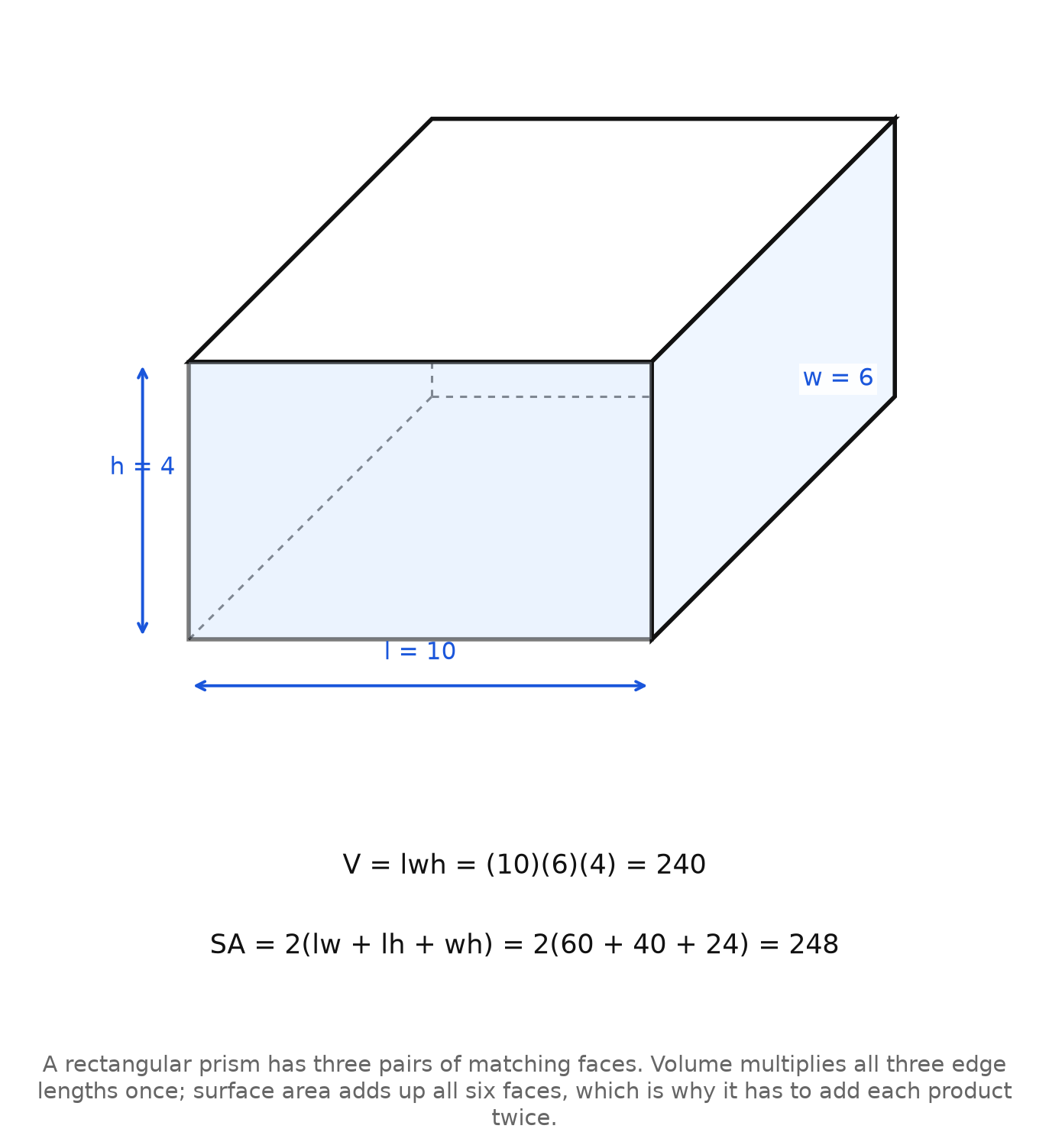
A rectangular prism has three pairs of matching faces, and its two formulas both come straight from that fact:
Volume multiplies all three edge lengths once — length, width, and height meeting at a single corner define the whole box. Surface area adds up all six faces, and since they come in three matching pairs, each of the three products , , and gets counted twice.
A triangular prism
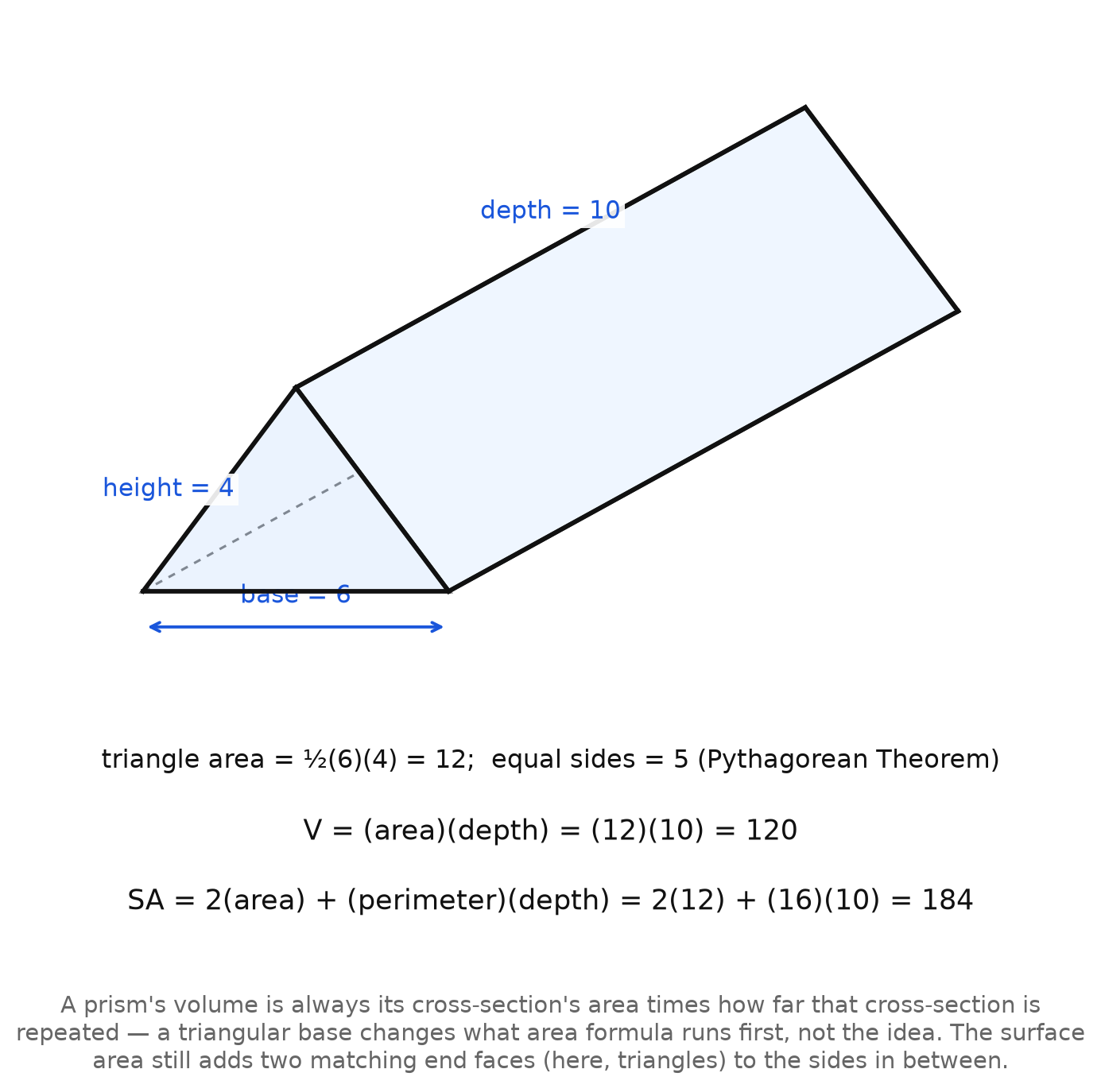
A prism's volume is always its cross section's area, times how far that cross section is repeated — a triangular base changes which area formula runs first, not the underlying idea:
The triangle's own two equal sides are not given directly — they are the hypotenuse of the right triangle formed by half the base and the height, found by the Pythagorean Theorem exactly as in Chapter 8. Once that side is known, the perimeter follows, and both formulas use the same "two matching ends, plus the sides running the depth in between" idea a rectangular prism's formula uses — the ends are just triangles here instead of rectangles.
Worked examples
Example 1 — Rectangular prism
, , .
Answer: . .
Example 2 — A cube
A cube has edge length .
Answer: . .
Example 3 — Triangular prism
base , height , depth .
Answer: half the base is ; leg ; area ; perimeter . . .
Example 4 — Which formula needs an extra step first?
Between the rectangular and triangular prism formulas above, which one cannot be used until a Pythagorean Theorem step is done first, and why?
Answer: The triangular prism's — its perimeter needs the triangle's slanted side, which is never given directly, only the base and height are.
Example 5 — A preview of working backward
A triangular prism has volume and a triangular cross section of area . Find its depth.
Answer: .
Guided practice
- Use the rectangular prism figure. Identify , , and , and give the volume.
- On that figure, give the surface area, and explain why each of , , and is doubled.
- Use the triangular prism figure. Identify the base, height, and depth, and give the triangle's area.
- On that figure, explain how the triangle's equal side of was found, and give the triangle's perimeter.
- On that figure, give the prism's volume.
- On that figure, give the prism's surface area, and name what the "two matching ends" are for this prism.
Independent practice
Find the volume and surface area of each rectangular prism.
- , ,
- , ,
- , ,
- , ,
- a cube with edge length
- , ,
- , ,
- , ,
Find the volume and surface area of each triangular prism. (Each triangle's base and height are given; find its equal sides first.)
base , height , depth
base , height , depth
base , height , depth
base , height , depth
Application. A cedar storage chest is a rectangular prism ft long, ft wide, and ft tall. Find its volume (storage capacity) and its surface area (the wood needed to build it).
Error analysis. A student finds the surface area of the prism with , , by computing . Identify the error and give the correct surface area.
Reasoning. A rectangular prism's surface area formula and a triangular prism's surface area formula look different on paper. Explain why they are really the same idea — two matching end faces, plus the sides running the depth in between.
Exit ticket 16.2
- , , . Find and .
- A triangular prism has a triangular base of and height , and a depth of . Find and .
Lesson 16.3 — Cylinders and Cones
A cylinder
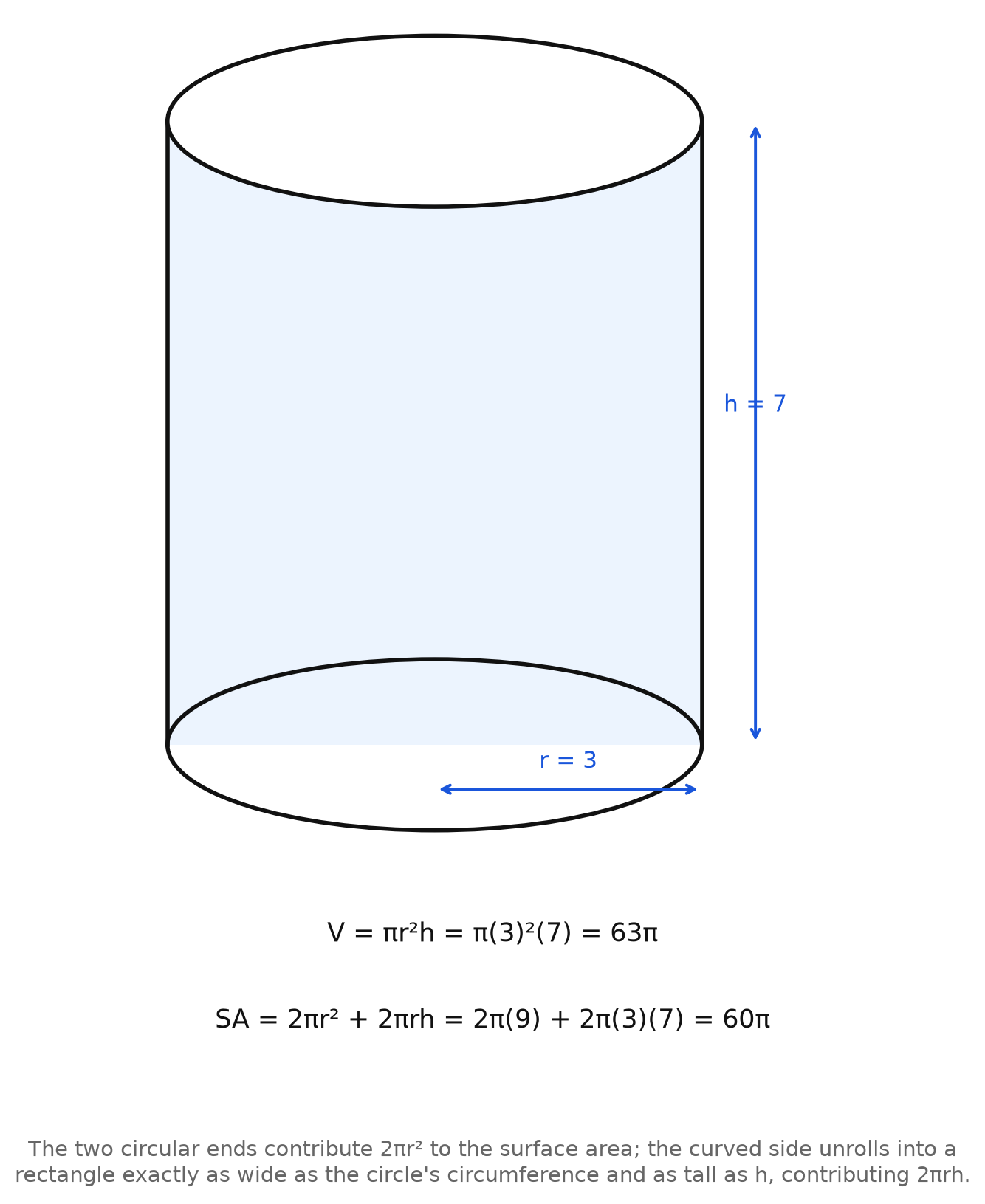
The two circular ends contribute to the surface area. The curved side unrolls flat into a rectangle exactly as wide as the circle's circumference, , and as tall as — contributing .
A cone
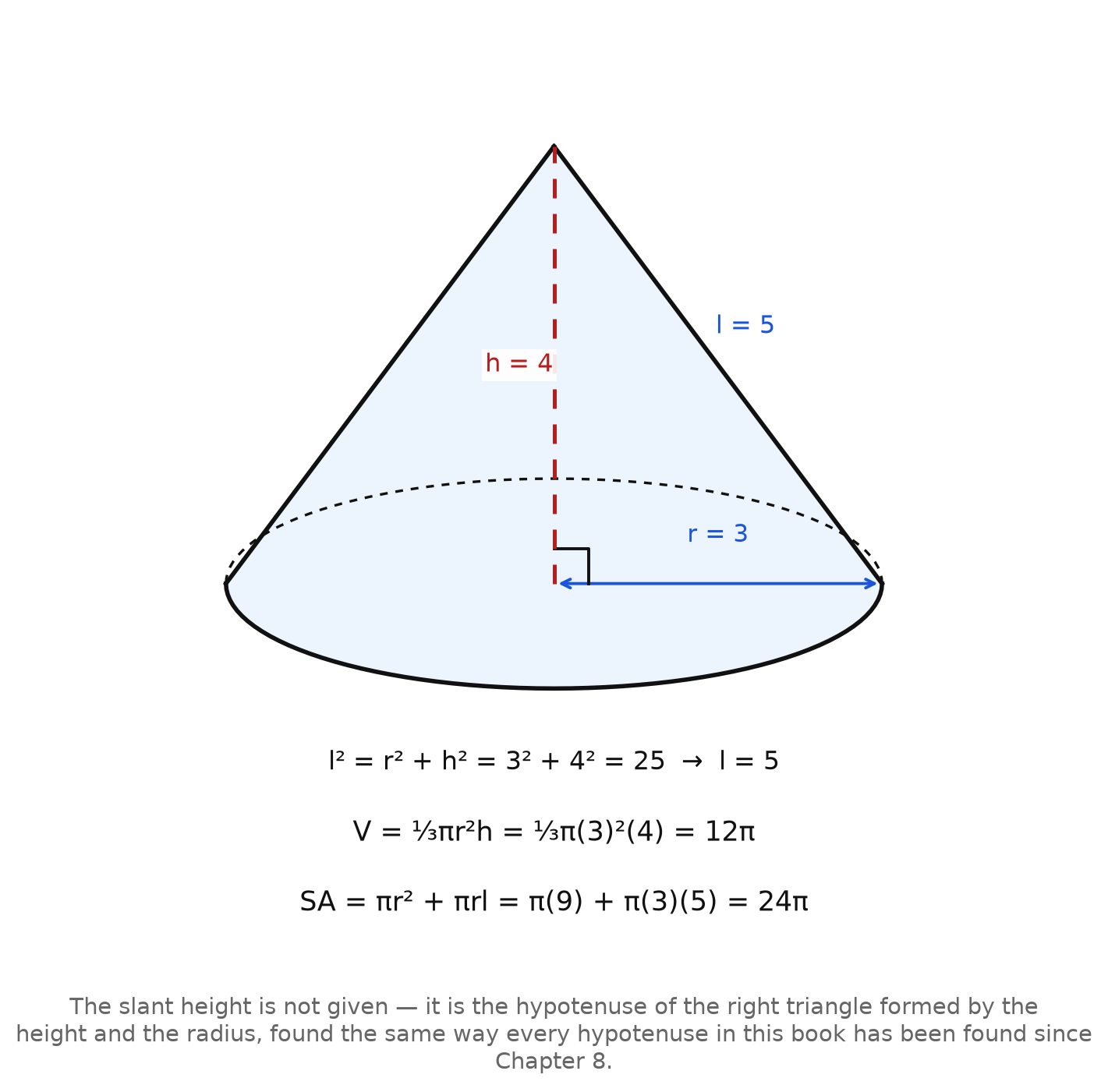
A cone's volume is always exactly one third of a cylinder's with the same and — both formulas start with , and the cone's simply carries an extra factor of . Its surface area has only one circular base, not two — a cone comes to a point, so there is no second flat end to add in — plus a lateral (side) surface of , where is the slant height. The slant height is not given — it is the hypotenuse of the right triangle formed by and :
Worked examples
Example 1 — Cylinder
, .
Answer: . .
Example 2 — Cylinder, larger radius
, .
Answer: . .
Example 3 — Cone, same numbers as the figure
, .
Answer: . . .
Example 4 — Cone
, .
Answer: . . .
Example 5 — Same and , cylinder vs. cone
A cylinder has , (the figure above). Compare its volume to a cone with the same and .
Answer: cylinder ; cone , which is exactly — confirming the relationship.
Guided practice
- Use the cylinder figure. Identify and , and give the volume.
- On that figure, give the surface area, and explain what the part represents if the curved side were unrolled flat.
- Use the cone figure. Identify and , and find using the Pythagorean Theorem.
- On that figure, give the volume.
- On that figure, give the surface area, and explain why a cone's formula has only one term while a cylinder's has two.
- Compare the two figures: both formulas start with somewhere. What does that term represent in each solid?
Independent practice
Find the volume and surface area of each cylinder.
- ,
- ,
- ,
- ,
- ,
Find the slant height, then the volume and surface area, of each cone.
,
,
,
,
,
Application. A cylindrical rain barrel has a radius of ft and a height of ft. Find its volume, in terms of , and the amount of material needed to build it.
Error analysis. A student finds the surface area of a cone with , by computing , using the height in place of the slant height. Find the correct slant height and the correct surface area.
Reasoning. Explain, using the two formulas directly, why a cone's volume is always exactly one third of a cylinder's when they share the same radius and height.
Exit ticket 16.3
- , (cylinder). Find and .
- , (cone). Find , then and .
Lesson 16.4 — Pyramids and Spheres
A square pyramid
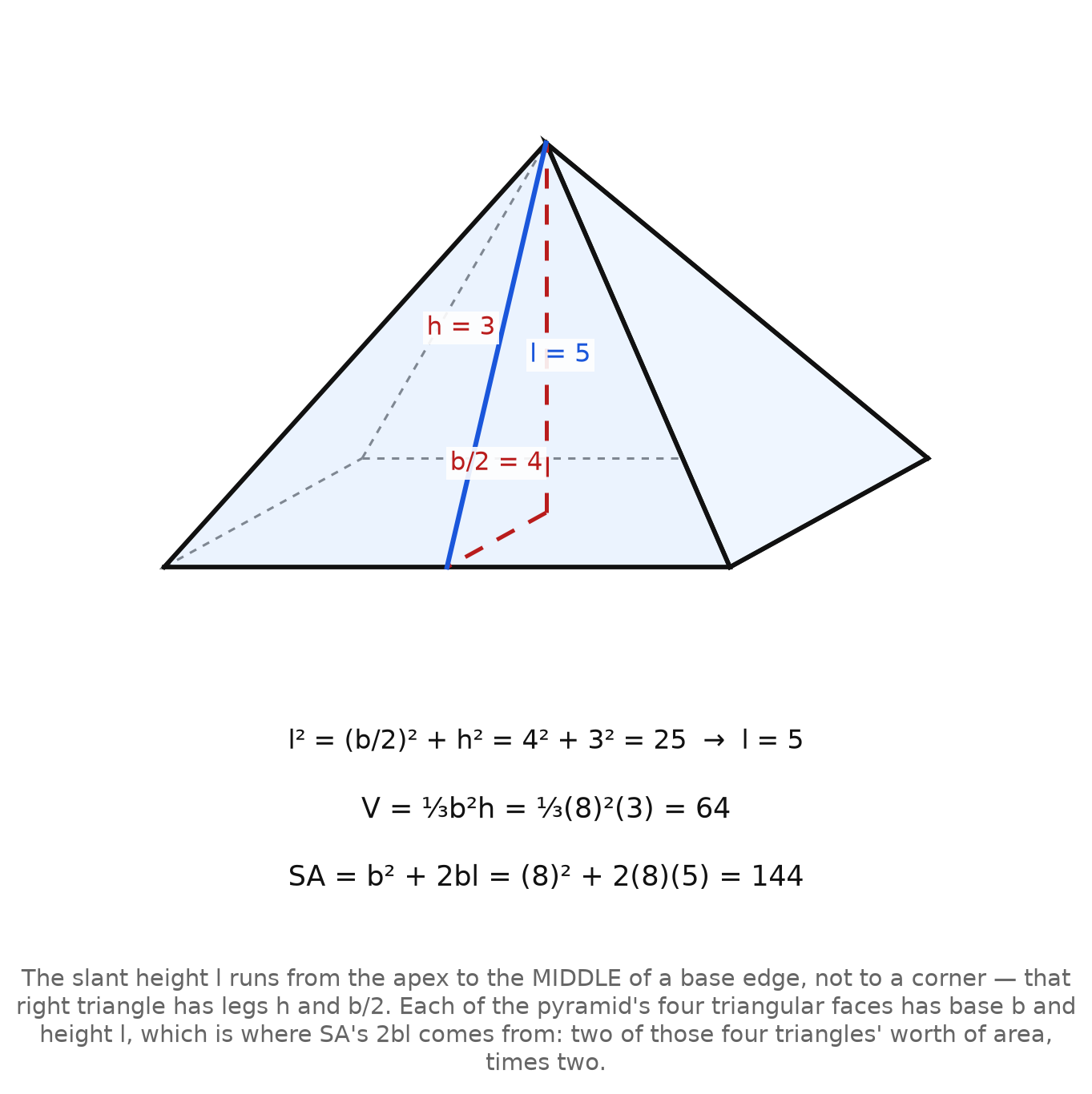
The slant height runs from the apex to the middle of a base edge, not to a corner — that right triangle has legs and :
Each of the pyramid's four triangular faces has base and height , so is the area of one face; in the formula is twice that, which is the area of all four — the same "double a product" pattern the rectangular prism's formula used, applied to triangles instead of rectangles.
A sphere
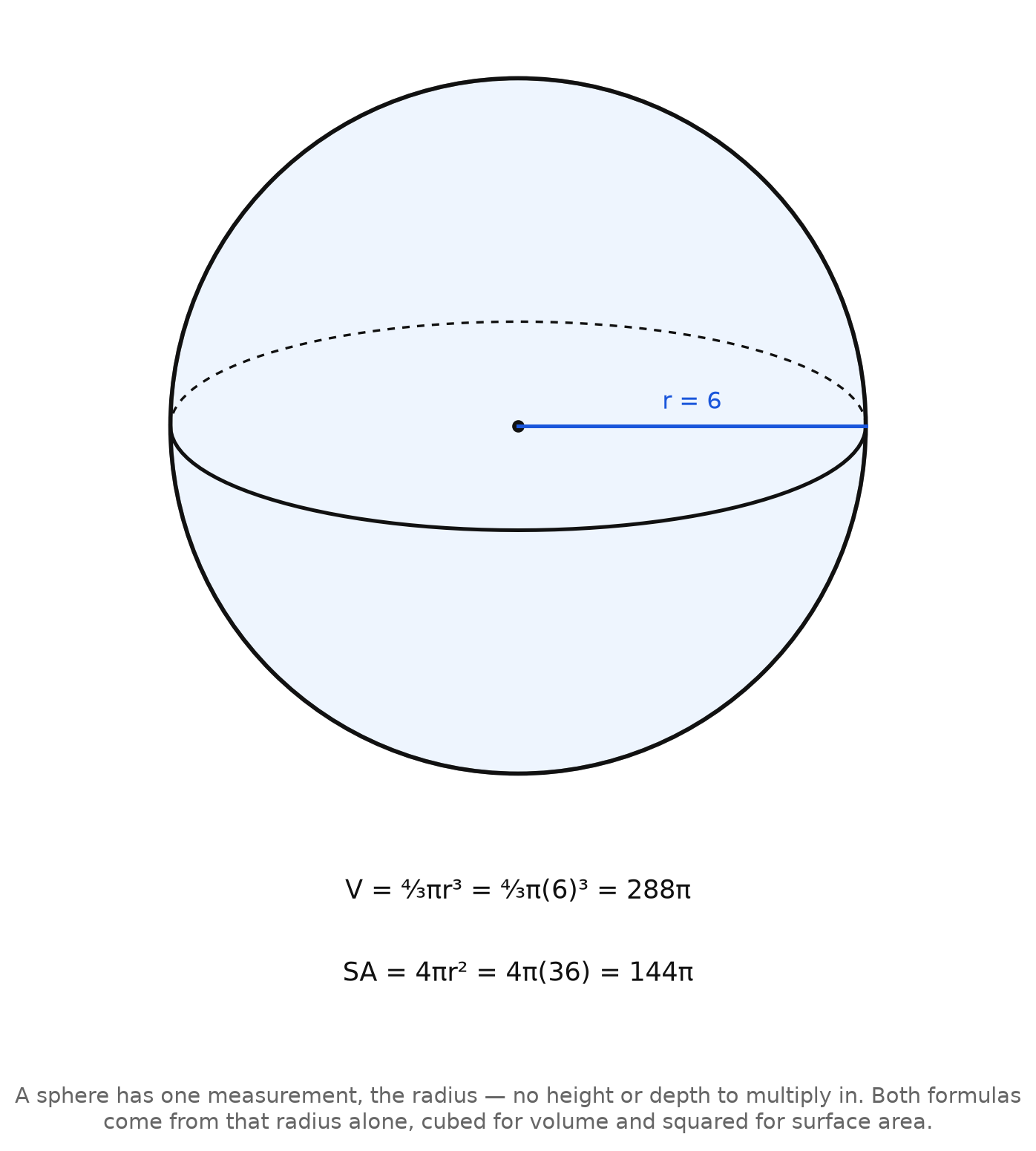
A sphere has exactly one measurement — the radius — no height or depth to multiply in. Both formulas build from that radius alone: cubed for volume, squared for surface area.
The five solids, side by side
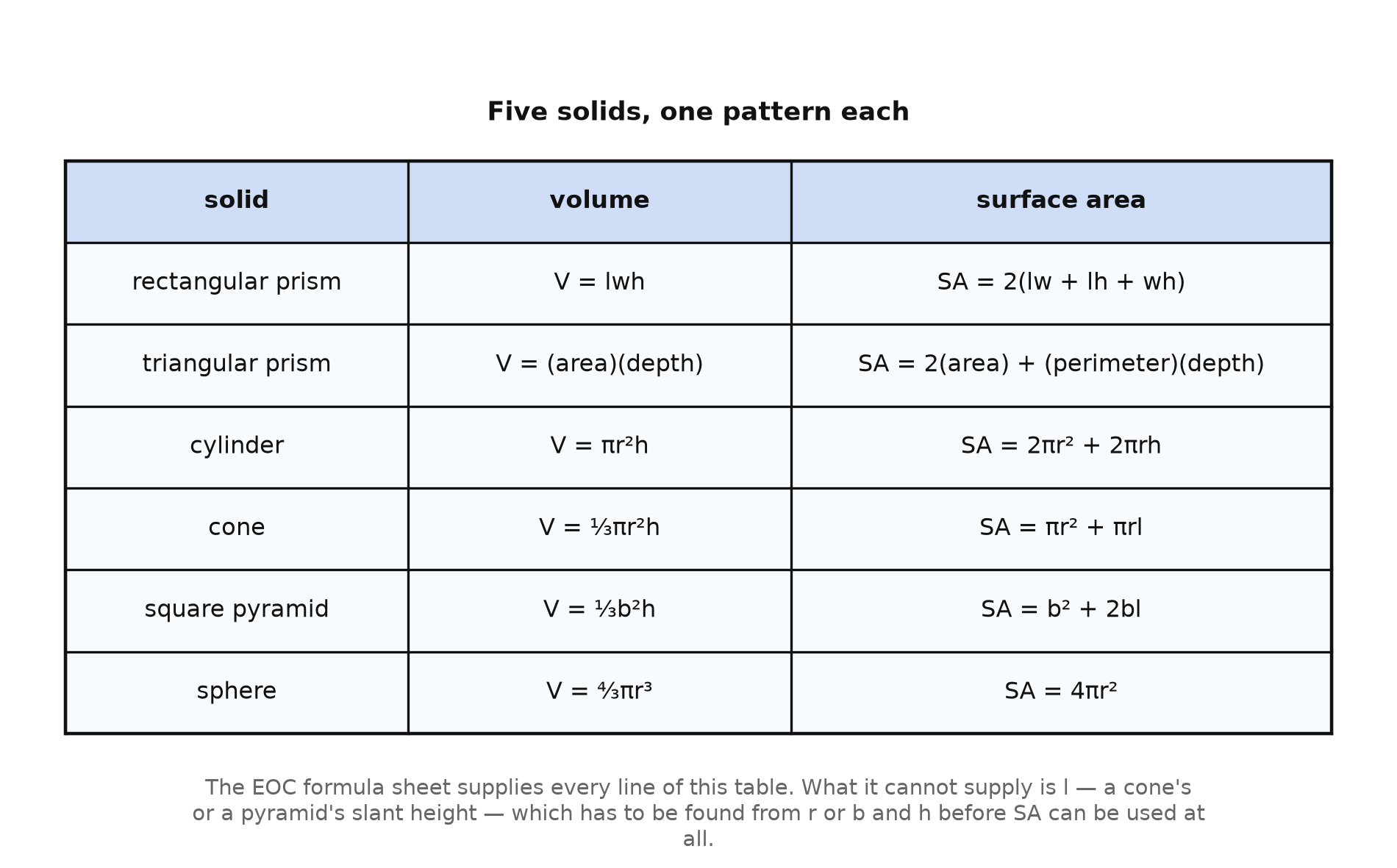
An EOC formula sheet supplies every line of this table. What it cannot supply is — a cone's or a pyramid's slant height — which has to be found from or , and , before either solid's surface area formula can be used at all.
Worked examples
Example 1 — Square pyramid
, .
Answer: half the base is ; . . .
Example 2 — Sphere
.
Answer: . .
Example 3 — Sphere, larger radius
.
Answer: . .
Example 4 — Why the ?
A rectangular prism has and . A square pyramid shares the same base and height (, ). Compare their volumes.
Answer: prism ; pyramid (Example 1) — the same relationship a cone has with a cylinder of matching dimensions.
Example 5 — The sphere's four circles
For the sphere above (), compare its surface area to the area of one "great circle" cut through its center.
Answer: great circle area ; sphere — a sphere's entire surface is always exactly four times its largest possible circular cross section.
Guided practice
- Use the pyramid figure. Identify and , and find using the Pythagorean Theorem.
- On that figure, give the volume.
- On that figure, give the surface area, and explain where the term comes from.
- Use the sphere figure. Identify , and give the volume.
- On that figure, give the surface area, and explain why a sphere's formulas need only one measurement.
- Use the formula board. Which two of the six formulas need a value the board itself does not supply, and how is that value found?
Independent practice
Find the slant height, then the volume and surface area, of each square pyramid.
- ,
- ,
- ,
- ,
- ,
Find the volume and surface area of each sphere.
Application. A pyramid-shaped monument has a square base of ft and a height of ft. Find its volume and its surface area (not counting the base, which sits on the ground — find the four triangular faces' area only, then the total including the base separately).
Error analysis. A student finds the volume of a square pyramid with , as , forgetting the factor. Identify the error and give the correct volume.
Reasoning. A sphere of radius has and — the same coefficient of . Explain, using the two formulas, why makes this happen, and why it does not mean volume and surface area are the same kind of quantity.
Exit ticket 16.4
- , (pyramid). Find , then and .
- (sphere). Find and .
Lesson 16.5 — Composite Solids
A silo — cylinder and hemisphere
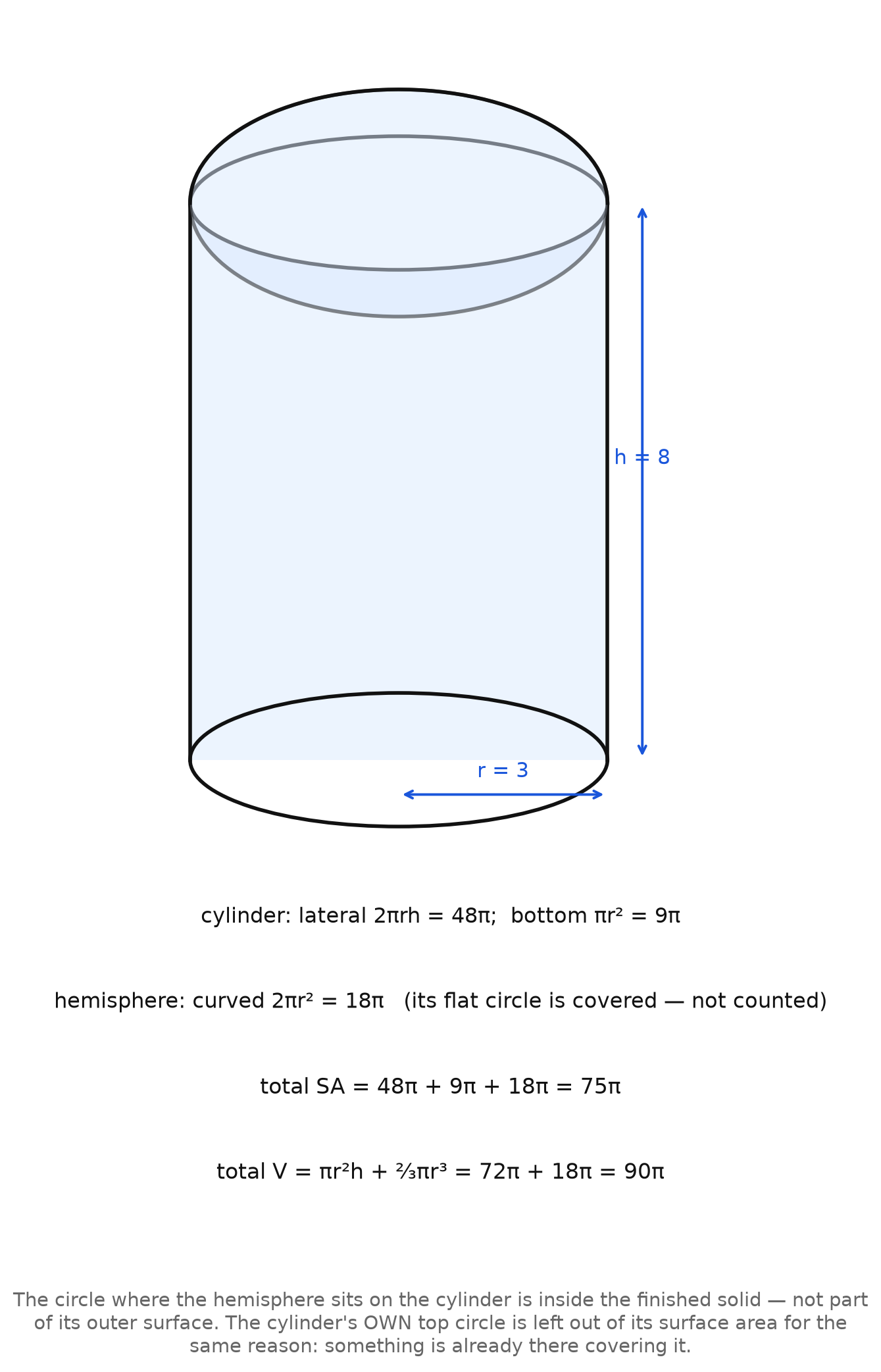
A grain silo's rounded roof is a hemisphere — half a sphere — sitting on top of a cylinder. To find the total surface area, add each piece's own full surface area, then subtract the shared circle twice: once because the cylinder no longer shows that circle as its top, and once because the hemisphere never had a flat circle of its own once it was placed there.
The cylinder's own top circle and the hemisphere's own flat circle are the same circle, sitting inside the finished solid rather than on its outer surface — so neither one is ever counted.
A house — rectangular prism and triangular prism
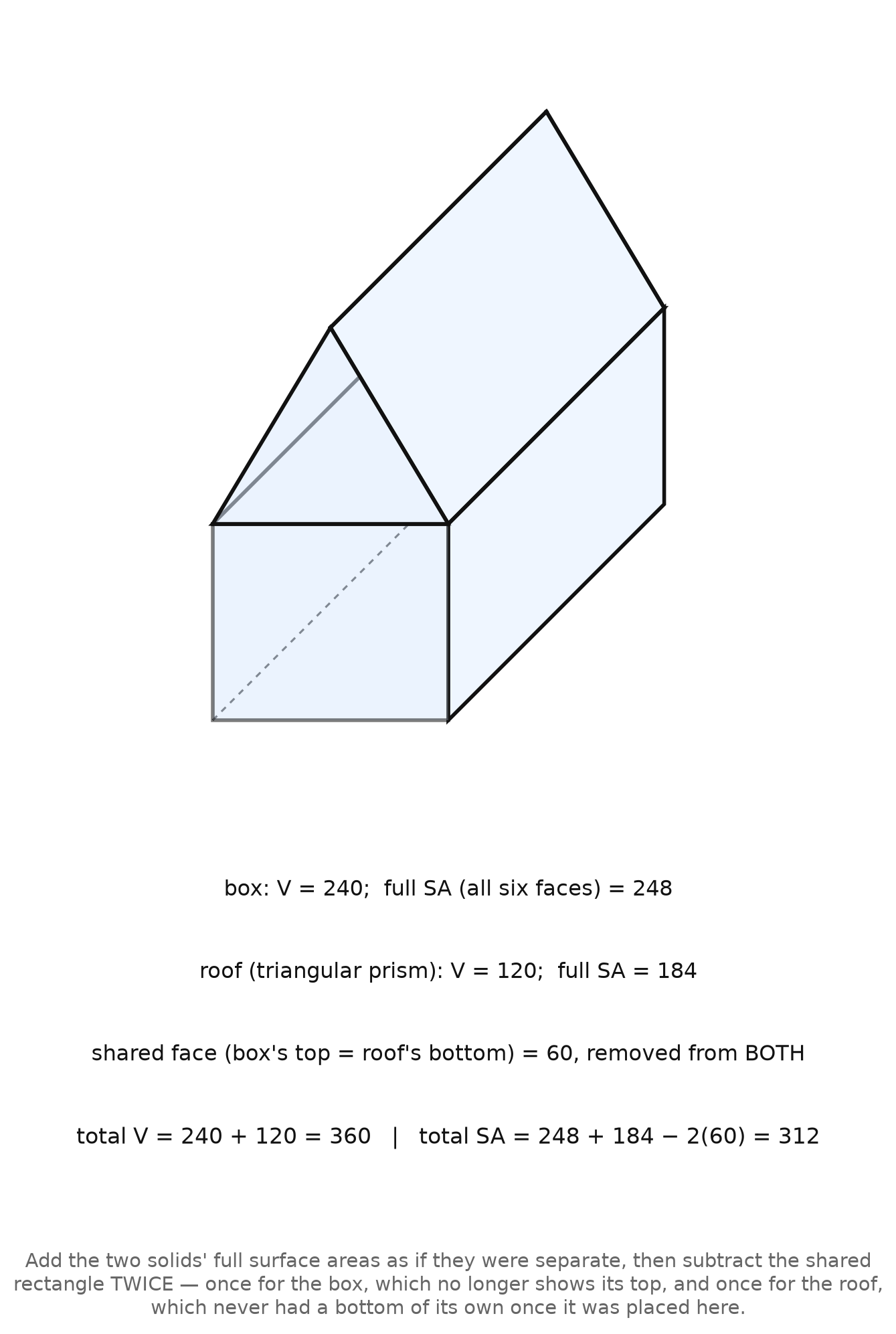
The same rule applies to solids with flat shared faces, not just curved ones. A box topped with a triangular-prism roof shares one rectangle — the box's top, which is also the roof's bottom:
Volume never needs the subtraction — every bit of space inside each piece is still inside the finished solid. Only surface area loses the shared, now-internal face, and it loses it from both pieces' counts, which is why the correction is , not .
An ice-cream cone — cone and hemisphere
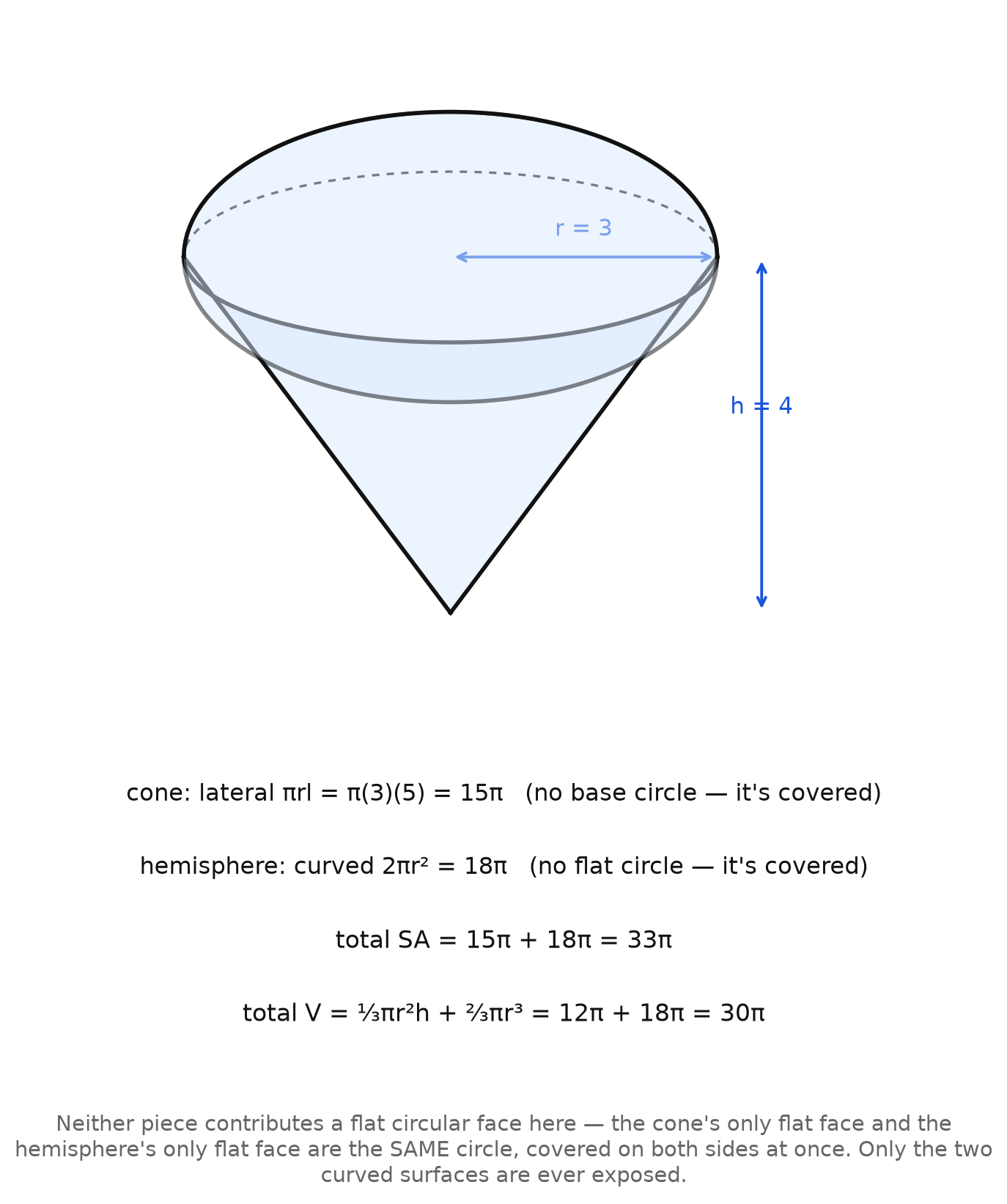
Here neither piece contributes a flat circular face to the total. The cone's only flat face and the hemisphere's only flat face are the same circle, covered on both sides at once — there is no second flat end anywhere else on either piece, unlike the silo's cylinder, which still has an exposed flat bottom.
Worked examples
Example 1 — The silo, restated
Cylinder , ; hemisphere (the figure above).
Answer: cylinder lateral ; bottom ; hemisphere curved . . .
Example 2 — A new composite: cylinder and cone
A cylinder (, ) is topped with a cone (, ).
Answer: the cone's slant height is . Cylinder ; cone ; total . Cylinder lateral ; cylinder bottom ; cone lateral (the cylinder's own top and the cone's own base are the same covered circle, so neither appears). Total .
Example 3 — A new composite: box and pyramid
A box by by is topped with a square pyramid, , .
Answer: box ; box . Pyramid: ; ; full . Shared face . Total . Total .
Example 4 — Comparing the silo and the ice-cream cone
Both composites in this lesson join a hemisphere to another solid, but the silo's total surface area keeps an extra flat circle that the ice-cream cone's does not. Which circle, and why?
Answer: the silo's cylinder has a separate flat bottom, distinct from the shared top circle where the hemisphere sits — that bottom stays exposed and is added in. The cone in the ice-cream-cone composite has no separate second flat end at all; its only flat face is the shared one, so once that is covered, the cone contributes nothing else flat.
Guided practice
- Use the silo figure. Identify the cylinder's and , and the hemisphere's radius.
- On that figure, give the total volume, and explain why the hemisphere's own flat circle is left out of the total surface area.
- Use the house figure. Identify the box's and the roof's dimensions, and give the area of the shared face.
- On that figure, give the total volume and total surface area, and explain why the shared face is subtracted twice rather than once.
- Use the ice-cream cone figure. Identify the shared radius, and explain why neither solid contributes a flat circular face to the total.
- On that figure, give the total volume and total surface area.
Independent practice
Find the total volume and total surface area of each composite solid.
A cylinder (, ) topped with a cone (, ) — like a pencil.
A box ( by by ) topped with a square pyramid (, ) — like a tent.
A cylinder (, ) topped with a hemisphere () — a larger silo.
A cone (, ) capped with a hemisphere () — a larger ice-cream cone.
A cylinder (, ) capped with a hemisphere () on both ends — a capsule. (Together, the two hemispheres make one full sphere.)
Error analysis. A student finds the silo's surface area (Example 1: cylinder , ; hemisphere ) by adding the cylinder's full surface area () to the hemisphere's full surface area, curved plus flat (), for a total of . Identify which circle got counted twice, and give the correct surface area.
Reasoning. Explain why "add each piece's own full surface area, then subtract the shared face twice" always gives the same answer as directly counting only the exposed faces — connect your answer to how many times the shared face appears in the two pieces' own full-surface-area counts.
Exit ticket 16.5
- For the silo (cylinder , ; hemisphere ), name the one circle that gets subtracted twice, and give its area.
- Find the total volume and total surface area of a cone (, ) capped with a hemisphere of the same radius, and list every surface that is actually included.
Lesson 16.6 — Working Backward
From a given volume
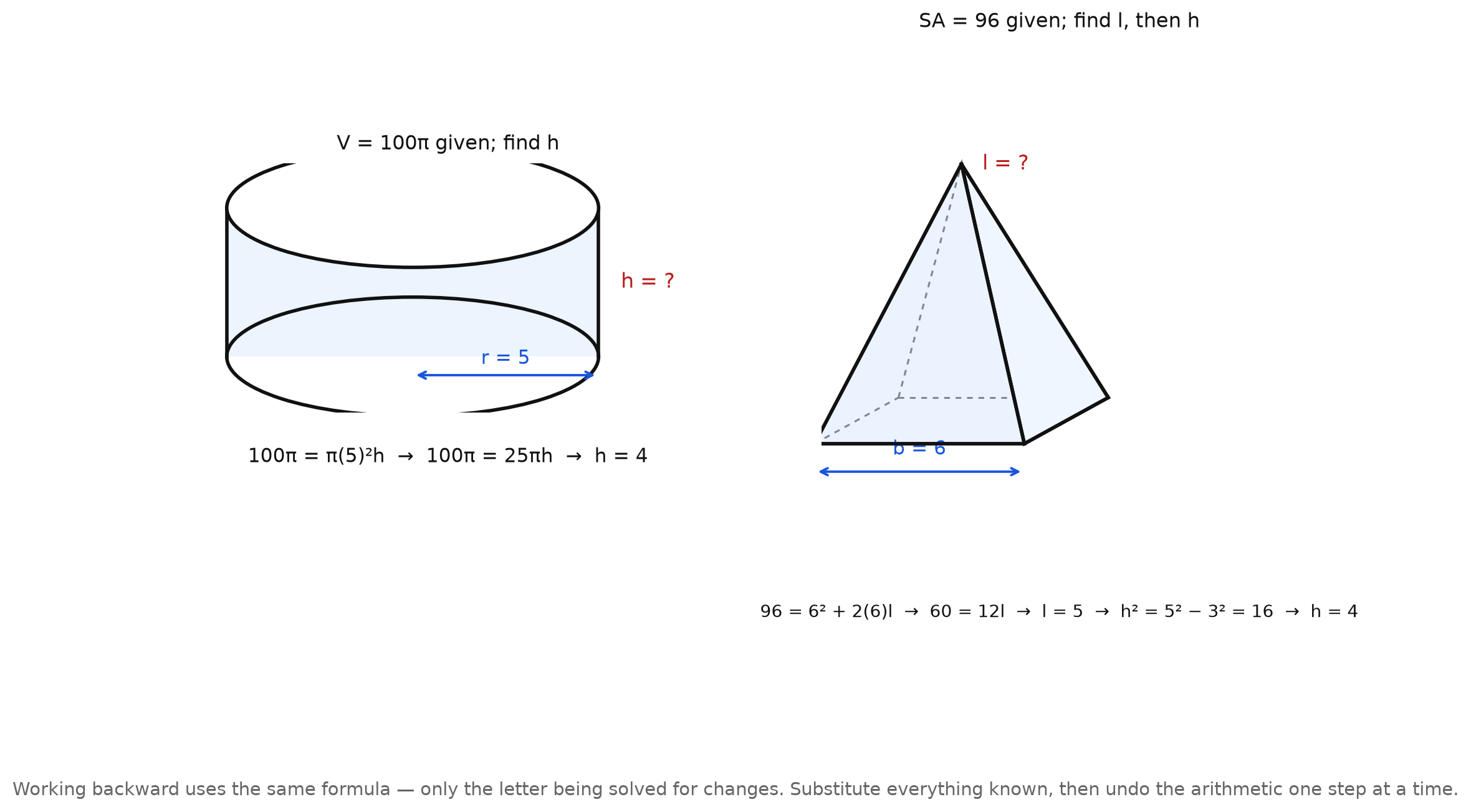
Every problem so far has started with a solid's dimensions and computed its volume or surface area. Working backward starts with the volume or surface area and finds a missing dimension instead — but it uses the exact same formula, only the letter being solved for changes.
Substitute everything already known, then undo the remaining arithmetic one step at a time — here, dividing both sides by .
From a given surface area — a longer chain
The pyramid in the same figure starts from a surface area instead, and needs two unknowns solved in sequence rather than one:
Once is known, it becomes the hypotenuse of the same right triangle every pyramid's slant height comes from, and the Pythagorean Theorem finds :
A surface-area formula for a cone or a pyramid mixes a squared term with a slant-height term, so working backward from almost always means solving for first, then using in a second, separate Pythagorean Theorem step to reach . Working backward from a volume never needs that second step — 's formula uses directly, with no slant height in it at all.
Worked examples
Example 1 — Cylinder, from volume
, . Find .
Answer: .
Example 2 — Cylinder, from surface area
, . Find .
Answer: .
Example 3 — Cone, from volume
, . Find .
Answer: .
Example 4 — Sphere, from surface area
. Find .
Answer: .
Example 5 — Triangular prism, from volume
, triangular base , height . Find the depth.
Answer: area . .
Guided practice
- Use the cylinder in the figure. Identify what is given and what is unknown.
- On that figure, show the substitution and solve for .
- Use the pyramid in the figure. Identify what is given and what is unknown.
- On that figure, solve for first.
- On that figure, use to find with the Pythagorean Theorem.
- Compare the two working-backward problems in the figure: what is the same about the strategy, and what is different about how many steps each one needs?
Independent practice
Find the missing dimension.
Rectangular prism: , , . Find .
Rectangular prism: , , . Find .
Cylinder: , . Find .
Cylinder: , . Find .
Cone: , . Find .
Cone: , . Find , then .
Sphere: . Find .
Sphere: . Find .
Square pyramid: , . Find , then the slant height .
Triangular prism: , triangular base , height . Find the depth.
Triangular prism: , triangular base , height . Find the depth.
Application. A cylindrical silo holds cubic feet of grain and has a radius of ft. Find its height.
Error analysis. A student is asked to find the height of a cylinder given and . They write , forgetting to square the radius, and solve . Identify the mistake and find the correct height.
Reasoning. Explain, in general, why working backward from a surface area is often a longer chain of steps than working backward from a volume, for a cone or a pyramid specifically.
Exit ticket 16.6
- Cylinder: , . Find .
- Cone: , . Find , then .
Chapter 16 Review
Vocabulary. cross section · prism · cylinder · cone · pyramid · sphere · hemisphere · apex · base · radius · slant height · lateral surface · composite solid · Pythagorean Theorem
Review 1 (G.DF.1a). A rectangular prism, a cylinder, a cone, and a sphere sit on a table.
- A plane cuts the rectangular prism parallel to one of its side faces. Name the resulting shape.
- A plane cuts the cylinder through its axis. Name the resulting shape.
- A plane cuts the cone parallel to its base, one-third of the way up from the base. Name the resulting shape, and state whether it is the same size as the base.
- A plane cuts the sphere anywhere at all. Name the resulting shape, and explain why the solid's own identity guarantees that answer no matter where the cut is made.
Review 2 (G.DF.1 b, c). A storage shed is a rectangular prism ft long, ft wide, and ft tall, topped with a triangular-prism roof whose triangular cross section has a base of ft (matching the shed's width) and a height of ft, running the full -ft length of the shed.
- Find the volume of the box part and the volume of the roof part, then the shed's total volume.
- Find each part's own full surface area, identify the area of the shared face, and find the shed's total surface area.
- Explain why the shared face is subtracted twice rather than once.
Review 3 (G.DF.1d). A cone's surface area is square units, and its radius is units.
- Find the slant height .
- Use and to find the height with the Pythagorean Theorem.
- Find the cone's volume using your value of .
- Confirm your answer by computing the volume directly from , using and your value of .
Standards coverage check — Chapter 16
| Knowledge and Skill | Where it is taught | Where it is practiced | Where it is applied in context |
|---|---|---|---|
| G.DF.1a — identify the shape of a two-dimensional cross section of a three-dimensional figure | 16.1 (cuts parallel to the base; cuts through the axis or apex) | 1–18, 20, 21 | 19; Review 1 |
| G.DF.1 b, c — surface area and volume of rectangular and triangular prisms, cylinders, cones, pyramids, spheres, and composite figures | 16.2 (prisms); 16.3 (cylinders and cones); 16.4 (pyramids and spheres); 16.5 (composite solids) | 24–41, 43, 44; 47–62, 64, 65; 68–82, 84, 85; 88–98, 99, 100 | 42; 63; 83; 94–98; Review 2 |
| G.DF.1d — determine unknown measurements using a given side, face area, or volume | 16.6 (working backward from volume; working backward from surface area) | 103–119, 121 | 120; Review 3 |
Supporting items: 21, 44, 65, 85, 100, and 122 are the reasoning items. Item 100 carries the chapter's organizing claim about composite solids — that adding each piece's full surface area and subtracting the shared face twice always matches a direct count of only the exposed faces. The error analyses target the recurring failures: assuming a cone's parallel cross sections never change size (20), doubling an entire product instead of three separate ones (43), using a cone's height in place of its slant height (64), forgetting the in a pyramid's or a cone's volume (84), over-counting a composite's shared face as if it were exposed on both pieces (99), and skipping the squared radius when working backward through a cylinder's volume (121).
Boundaries respected. This chapter covers exactly the five solids G.DF.1 names, plus composites built from two of them, and exactly the four knowledge-and-skills bullets: cross sections, surface area, volume, and working backward from a known measurement. Oblique solids are not named by the standard and are not taught here.
Answer keys for every item in this chapter are in Appendix A.