Chapter 17 — Changing Dimensions
Standard: G.DF.2 (a, b, c)
G.DF.2 — verbatim. The student will determine the effect of changing one or more dimensions of a three-dimensional geometric figure and describe the relationship between the original and changed figure. Students will demonstrate the following Knowledge and Skills: a) Describe how changes in one or more dimensions of a figure affect other derived measures, including perimeter, area, total surface area, and volume, of the figure. b) Describe how changes in surface area and/or volume of a figure affect the measures of one or more dimensions of the figure. c) Solve problems, including those in context, involving the effect of a change in one or more dimensions on the surface area and/or volume of a three-dimensional figure.
By the end of this chapter you will be able to:
- Describe how uniformly scaling every dimension of a figure by a factor affects its perimeter or circumference, and its area (G.DF.2a)
- Describe how uniformly scaling every dimension of a solid by affects its surface area and its volume (G.DF.2a)
- Describe how changing only ONE dimension of a solid — not all of them — affects its volume and its surface area differently (G.DF.2a)
- Recover a scale factor from a given change in area, surface area, or volume, using a square root or a cube root (G.DF.2b)
- Solve problems in context that involve a change in one or more dimensions (G.DF.2c)
Lessons: 17.1 Scale Factor: Perimeter and Area · 17.2 Scale Factor: Surface Area and Volume · 17.3 Changing One Dimension · 17.4 Working Backward
Why this chapter matters. Chapter 16 asked "how big is this solid, given its dimensions." This chapter asks the opposite question: if a dimension changes — a little or a lot, on purpose or as a typo — how does the answer change? The relationship is not "twice as big" straight across the board. A length doubles by exactly ×2. An area doubles by ×4. A volume doubles by ×8. Which one applies depends entirely on how many lengths are multiplied together to build that measure — and when only ONE dimension changes instead of all of them, even that pattern breaks, and a measure has to be recomputed directly rather than shortcut.
Scope note. This chapter's "before" and "after" figures are always similar in the ordinary geometric sense when every dimension changes by the same factor — the shape is the same, only the size differs. Lesson 17.1 builds the underlying pattern with plane figures (perimeter, area) before Lesson 17.2 extends it to the five solids of Chapter 16 (surface area, volume), matching bullet a's own list of derived measures. Every scale factor in this chapter is exact — a whole number or an exact fraction — never a rounded decimal.
Conventions this chapter fixes.
- Scale factor is always called . A dimension "scaled by " becomes times as long; grows a figure, shrinks it.
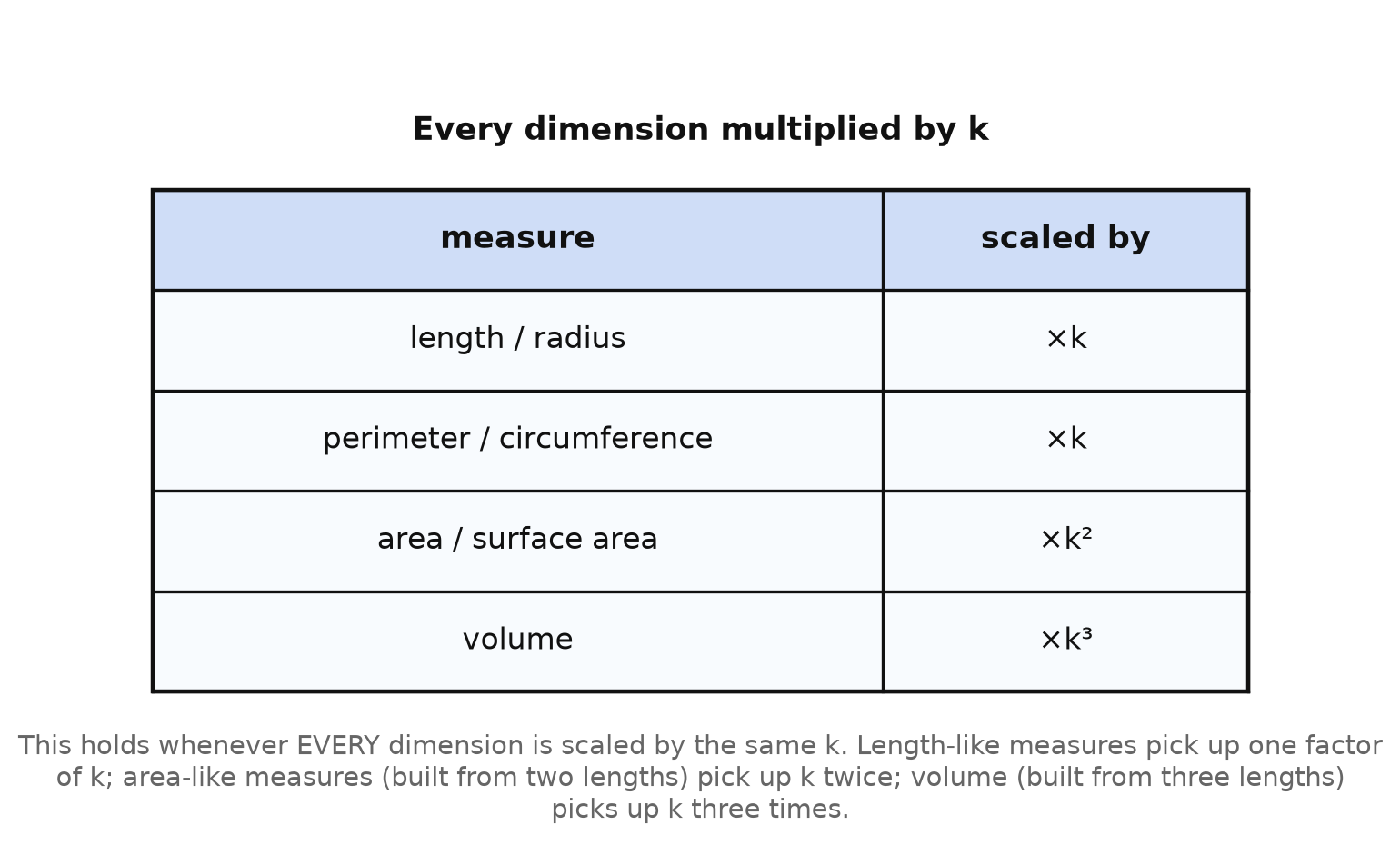
- Length-like measures (length, perimeter, circumference) scale by . Area-like measures (area, surface area) scale by . Volume scales by . This holds only when every dimension of the figure is scaled by the same .
- Changing only one dimension is not the same as scaling. If a single dimension is multiplied by and every other dimension is held fixed, only the derived measures whose formula actually contains that dimension change — and a measure built from a sum of differently-shaped terms (like surface area) generally cannot be found by a single shortcut power of ; it has to be recomputed from the changed dimensions directly.
- Recovering from a given ratio uses a root that matches the exponent: a perimeter or circumference ratio needs no root at all ( itself), an area or surface-area ratio needs a square root, and a volume ratio needs a cube root.
- Item numbering runs straight through the chapter, from 1 in Lesson 17.1 to 98 at the end of Lesson 17.4.
Lesson 17.1 — Scale Factor: Perimeter and Area
A rectangle scaled by
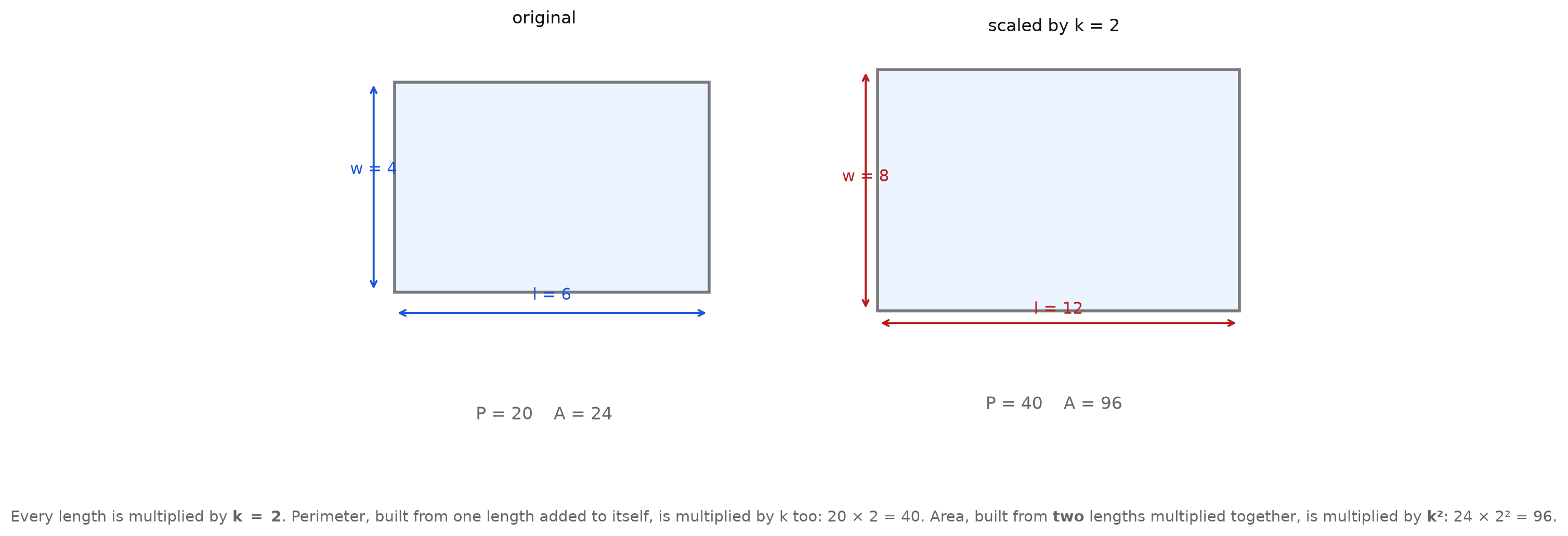
Every length in the rectangle — length and width alike — is multiplied by . Perimeter is built from those lengths added, so it is multiplied by too:
Area is built from two of those lengths multiplied together, so it picks up a factor of from each one:
A right triangle scaled by
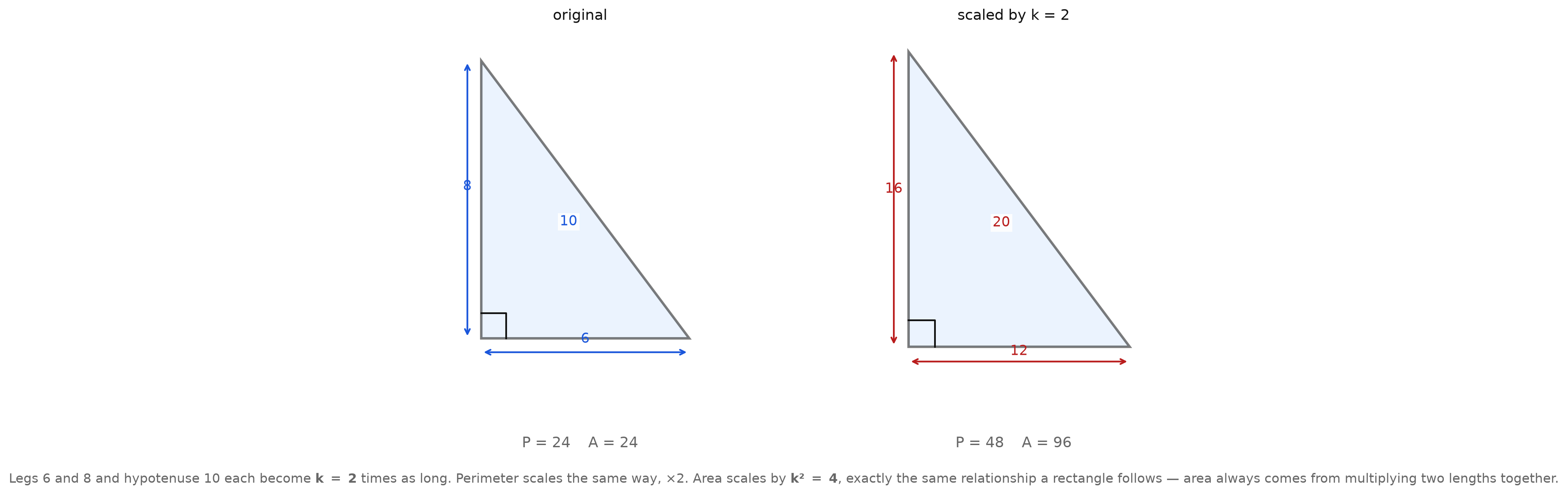
The same two rules hold for any figure, not just rectangles. Every side of the triangle — both legs and the hypotenuse — is multiplied by , so the perimeter is multiplied by . The area, , is a product of two lengths, so it is multiplied by .
Worked examples
Example 1 — Rectangle scaled up
, , .
Answer: . .
Example 2 — Rectangle scaled down
, , .
Answer: . .
Example 3 — A circle
, .
Answer: . .
Example 4 — Finding from before and after
A rectangle becomes . Find .
Answer: (check: too — every dimension used the same ).
Example 5 — A shrink, found from before and after
A rectangle becomes . Find .
Answer: .
Guided practice
- Use the rectangle figure. Give the original and , and the scale factor shown.
- On that figure, give the new and , and confirm scaled by and scaled by .
- Use the triangle figure. Give the original and new perimeters.
- On that figure, give the original and new areas, and explain why area needed and not .
- Explain, in one sentence, why perimeter only ever needs one factor of no matter how many sides a figure has.
- Explain why area always needs exactly two factors of , even for a triangle instead of a rectangle.
Independent practice
Find the new perimeter and area after scaling by .
- ,
- ,
- ,
- a square with side ,
- right triangle, legs and (hypotenuse ),
- right triangle, legs and (hypotenuse ),
- ,
- ,
Find the new circumference and area after scaling by . Leave answers in terms of .
- ,
- ,
- ,
Find the scale factor used.
rectangle
rectangle
right triangle legs legs
circle radius radius
Application. A rectangular garden plot is m by m. The owner triples every dimension for a new plot. Find the new perimeter and area, and state how many times as much fencing and how many times as much sod are needed.
Error analysis. A student says tripling a rectangle's dimensions triples its area, since "everything is 3 times bigger." Using () scaled to , show the actual new area and explain the error.
Reasoning. Using , explain algebraically why scaling both and by multiplies area by and not by .
Exit ticket 17.1
- , . Find the new and .
- , . Find the new and , in terms of .
Lesson 17.2 — Scale Factor: Surface Area and Volume
A rectangular prism scaled by
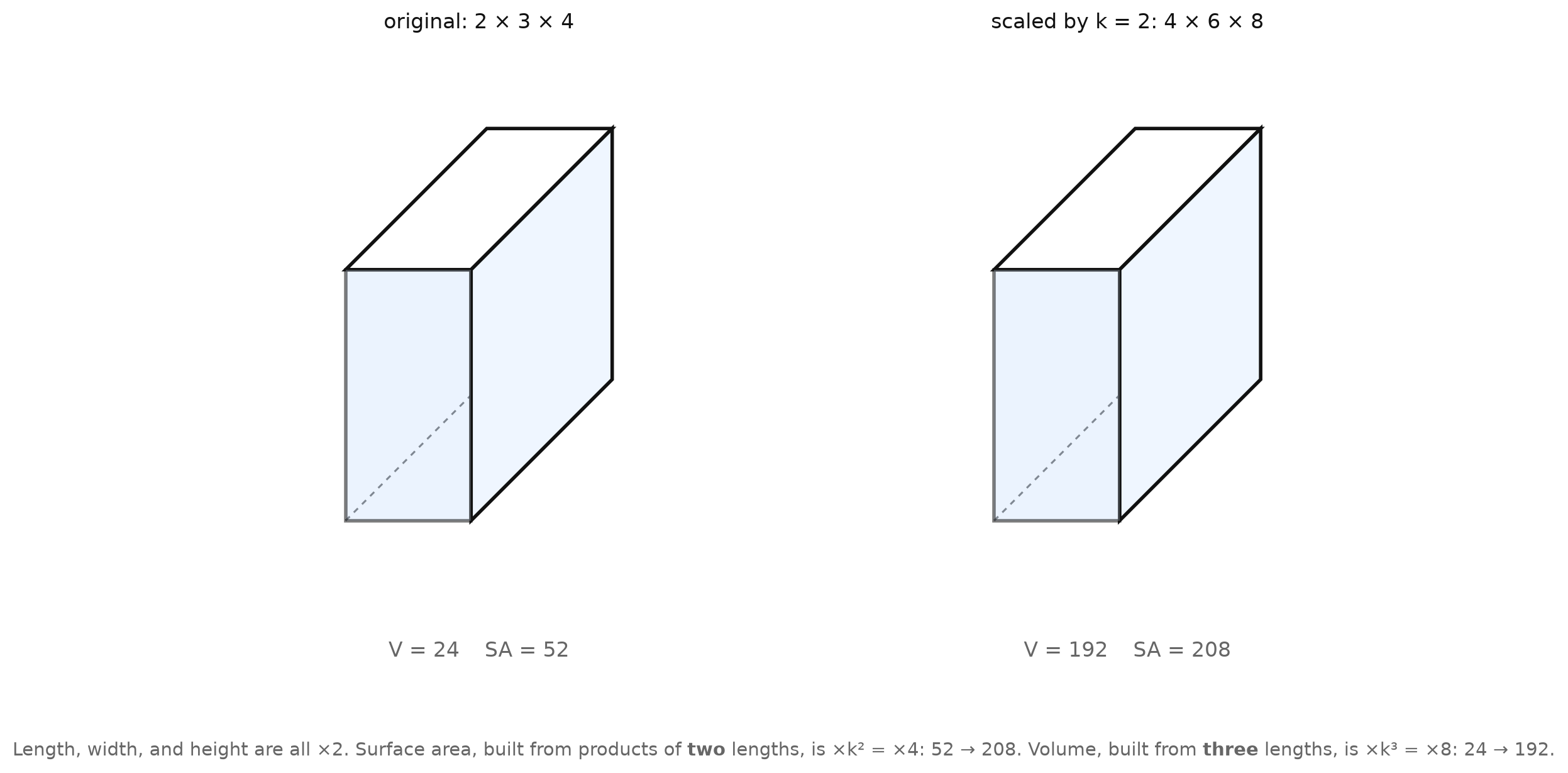
The same two rules extend one dimension further. Surface area is built from products of two lengths — it scales by . Volume is built from products of three lengths — it scales by :
A cylinder scaled by
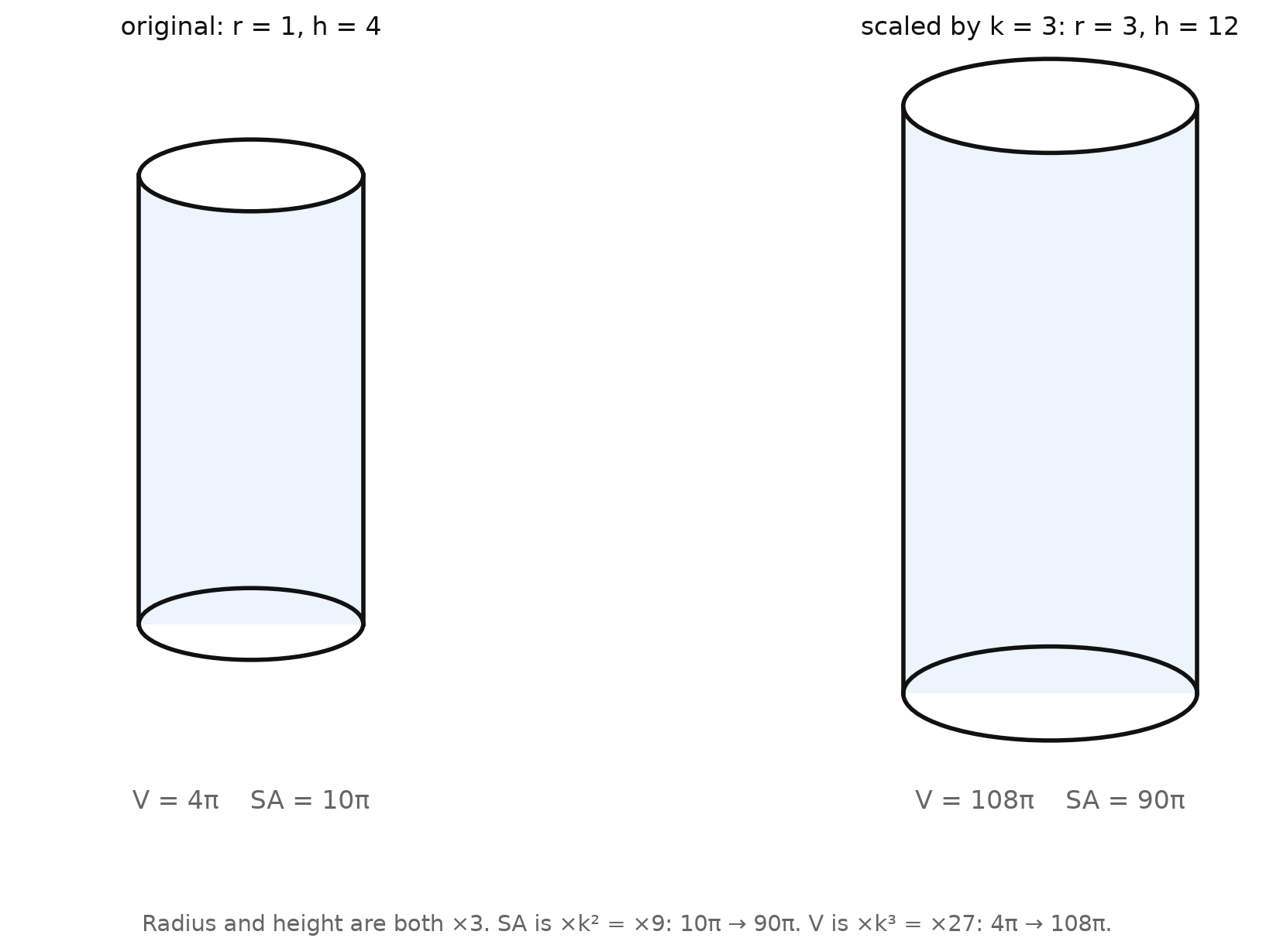
Every solid follows the same pattern, curved surfaces included — is always built from area-like terms, always from volume-like terms, regardless of which formula a particular solid uses.
A cone scaled by — even the slant height scales
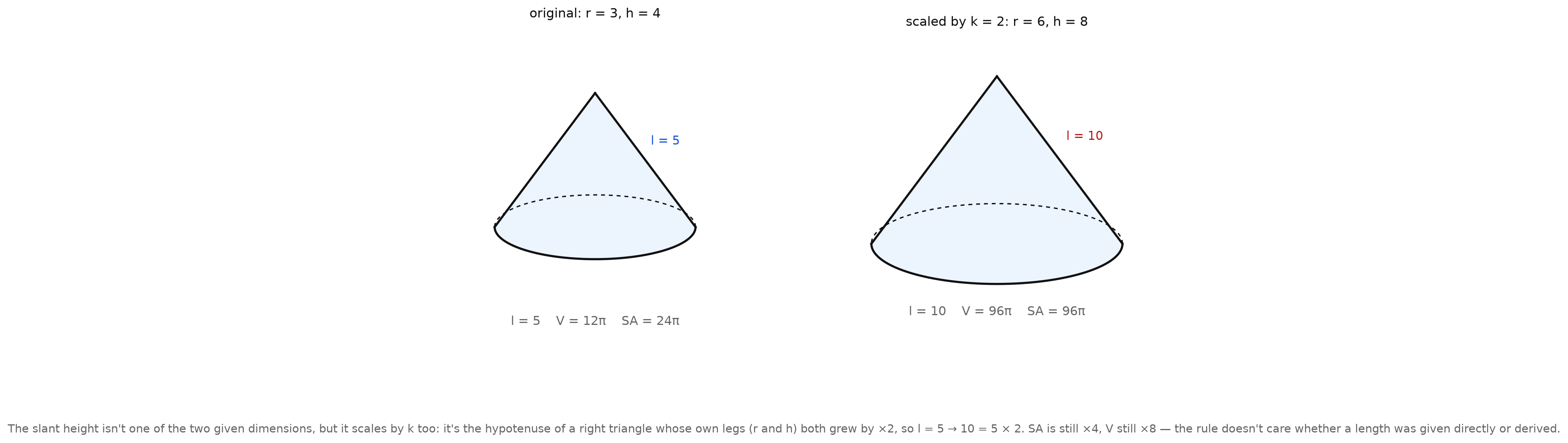
A cone's slant height is not one of its two given dimensions — but it still scales by , because it is the hypotenuse of a right triangle whose own legs ( and ) both scaled by . A derived length scales exactly like a given one.
The pattern, in one table
Worked examples
Example 1 — Rectangular prism
, .
Answer: . .
Example 2 — Cube
, .
Answer: . .
Example 3 — Cylinder, shrinking
, .
Answer: . .
Example 4 — Square pyramid
(so ), .
Answer: . . New slant height: .
Example 5 — Finding
A cone becomes . Find .
Answer: (check: too).
Guided practice
- Use the prism figure. Identify the original dimensions and ; give the new dimensions.
- On that figure, give the original and new volume; confirm the ratio is .
- On that figure, give the original and new surface area; confirm the ratio is .
- Use the cylinder figure. Identify the original and ; give the new .
- On that figure, confirm the volume and surface area ratios match and .
- Use the cone figure. Explain why the slant height scales by even though it isn't one of the two given dimensions.
Independent practice
Find the new volume and surface area after scaling by .
- ,
- ,
- a cube with side ,
- cylinder ,
- cylinder ,
- cylinder ,
Find the new slant height, volume, and surface area after scaling by .
- cone ,
- cone ,
- square pyramid ,
Find the new volume and surface area of the sphere after scaling by .
- ,
Find the scale factor used.
rectangular prism
cylinder
cone
sphere
Application. A spherical balloon with radius in is inflated so its radius doubles. Find the original and new volume and surface area, and state how many times as much material and air the larger balloon needs.
Error analysis. A student scales a cylinder's and both by (, so ) and claims the new volume is times as large. Find the actual new volume and explain the error.
Reasoning. Explain why scaling every dimension of ANY solid by always multiplies surface area by and volume by — refer to how many lengths each measure is built from.
Exit ticket 17.2
- rectangular prism , . Find the new and .
- sphere , . Find the new and .
Lesson 17.3 — Changing One Dimension
A rectangular prism, only its length changed
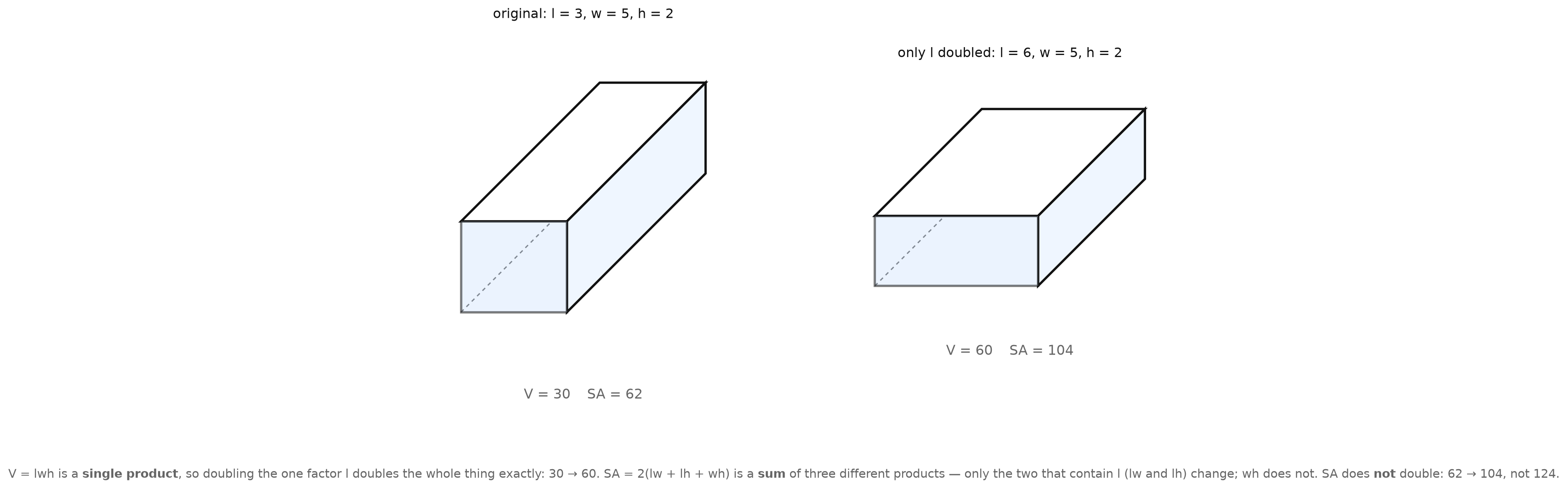
is a single product. Doubling only doubles the whole product exactly, because and are unchanged constants riding along:
is a sum of three different products. Only the two containing — and — change; does not. The whole sum does not double. There is no shortcut here: has to be recomputed directly from the new dimensions.
A cylinder, only its radius changed
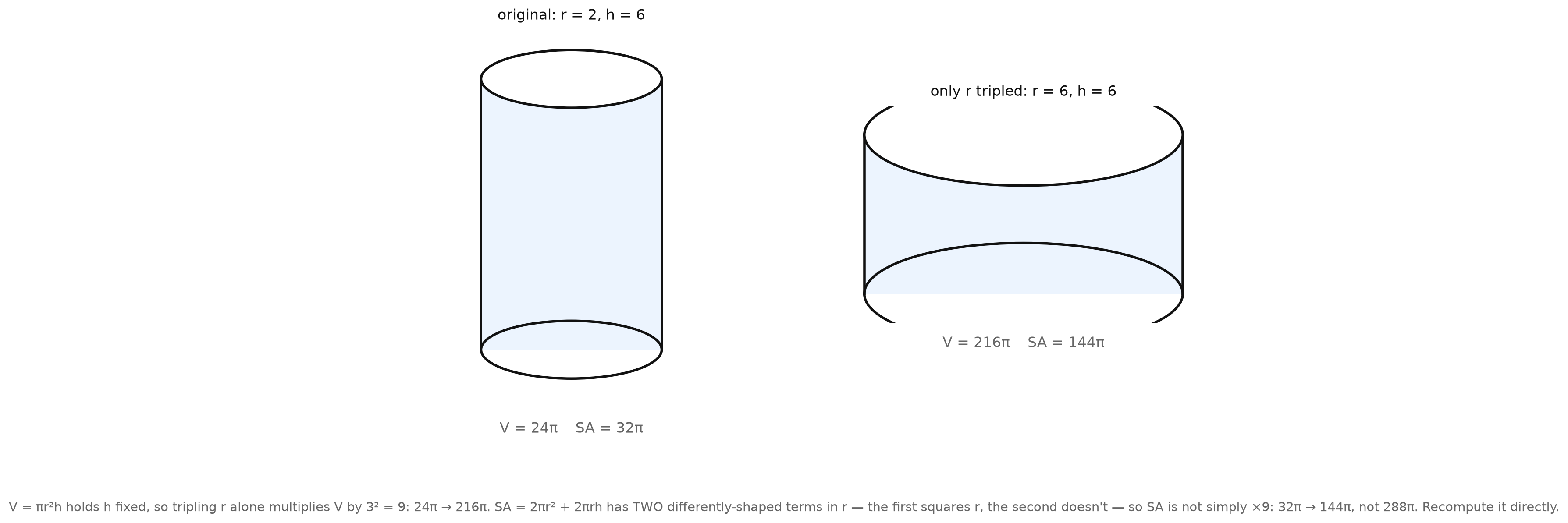
holds fixed, so tripling alone multiplies by exactly — the whole formula is a single product, and appears to the second power in it. has two differently-shaped terms in : one squares , the other does not. is not simply ; it has to be recomputed.
A cylinder, only its height changed
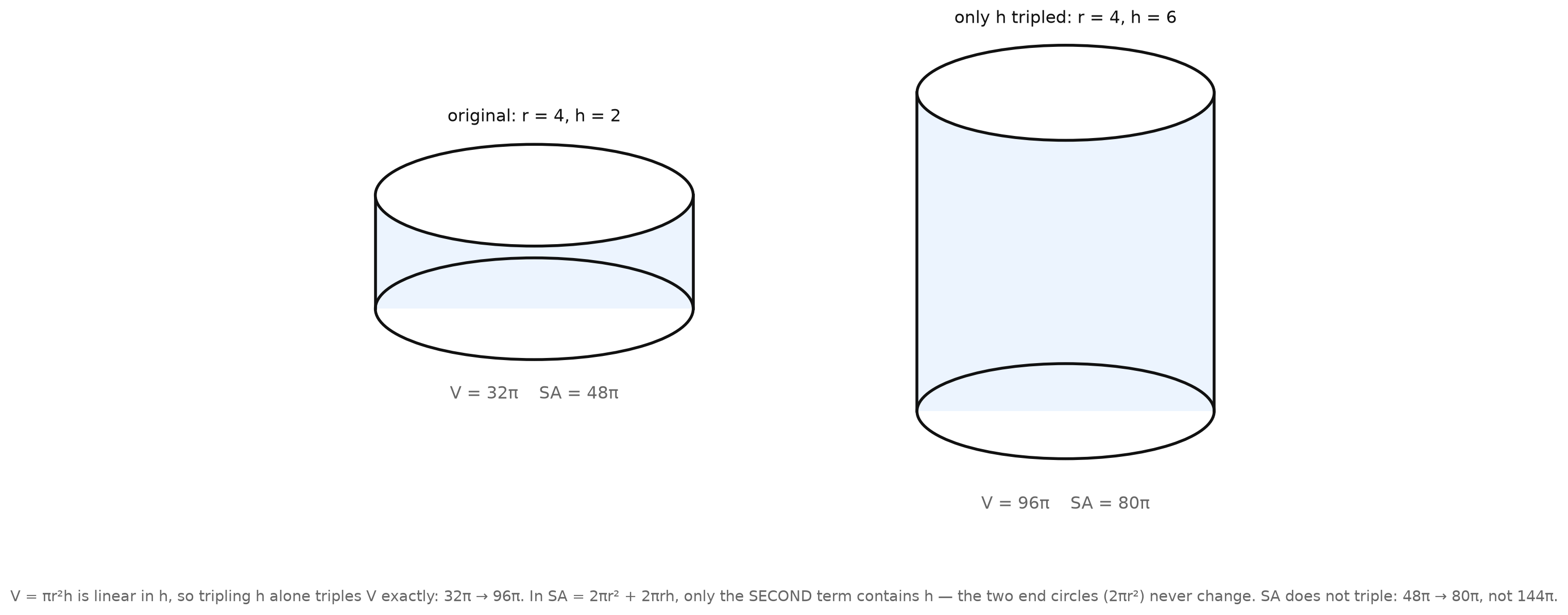
Tripling only triples exactly, since is linear in . But in , only the second term contains — the two end circles, , never change size at all. does not triple.
A sphere — the contrast case
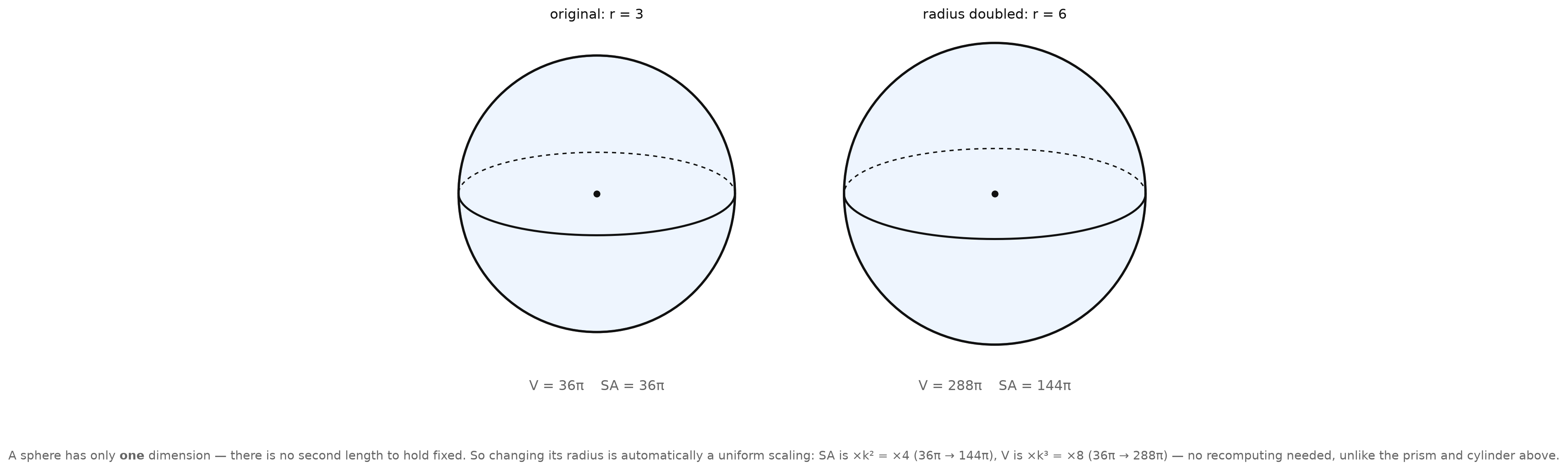
A sphere has only one dimension — there is no second length to hold fixed while the first one changes. So "changing a sphere's radius" is never the "one dimension out of several" case above; it is automatically a uniform scaling, and both and do scale by a clean power of , exactly as in Lesson 17.2.
Worked examples
Example 1 — Prism, length changed
, only tripled ().
Answer: (exact — is a single factor in ). recomputed directly (not ).
Example 2 — Cylinder, radius changed
, only doubled ().
Answer: (exact). recomputed (not ).
Example 3 — Cylinder, height changed
, only halved ().
Answer: (exact). recomputed (not ).
Example 4 — Sphere, the contrast
, radius tripled ().
Answer: since a sphere has only one dimension, this IS a uniform scaling: , — both clean, no recomputing needed.
Example 5 — Naming which measure stays clean
For any prism or cylinder, changing only one dimension always changes by a clean power of that dimension's exponent. Does the same hold for ? Explain.
Answer: No. is always a single product, so one changed factor scales the whole thing exactly. is a sum of several differently-shaped terms; only the terms containing the changed dimension move, so the total generally does not follow a single power of and must be recomputed.
Guided practice
- Use the prism figure. Identify which dimension changed and by what factor.
- On that figure, give the original and new volume, and explain why scaled by exactly that factor.
- On that figure, give the original and new surface area, and explain why it did not scale by that same factor.
- Use the radius-only cylinder figure. Give the original and new volume, and explain the exponent.
- Use the height-only cylinder figure. Give the original and new surface area, and explain why only one term of the formula changed.
- Use the sphere figure. Explain why changing a sphere's only dimension always behaves like uniform scaling.
Independent practice
Only ONE dimension changes. Find the new volume and surface area directly.
- , only doubled
- , only tripled
- , only halved
- , only (the -edge) quadrupled
- , only doubled
- a cube , only one edge doubled (so it is no longer a cube)
Only the radius OR only the height changes. Find the new volume and surface area directly.
- cylinder , only tripled
- cylinder , only doubled
- cylinder , only tripled
- cylinder , only halved
- cylinder , only halved
- cylinder , only quadrupled
The sphere's only dimension changes. Find the new volume and surface area.
, radius doubled
, radius tripled
Application. A drinking glass is a cylinder cm, cm. A taller glass triples only the height. Find the original and new volume, and the factor by which volume increased.
Error analysis. A student doubles only the radius of a cylinder () and claims the surface area doubles too. Find the actual original and new surface area and explain the error.
Reasoning. Explain why changing only one dimension of a rectangular prism always scales its volume by exactly that factor, but generally does not scale its surface area by that same factor.
Exit ticket 17.3
- , only tripled. Find the new and directly.
- cylinder , only doubled. Find the new and directly.
Lesson 17.4 — Working Backward
From a given volume ratio: a cube
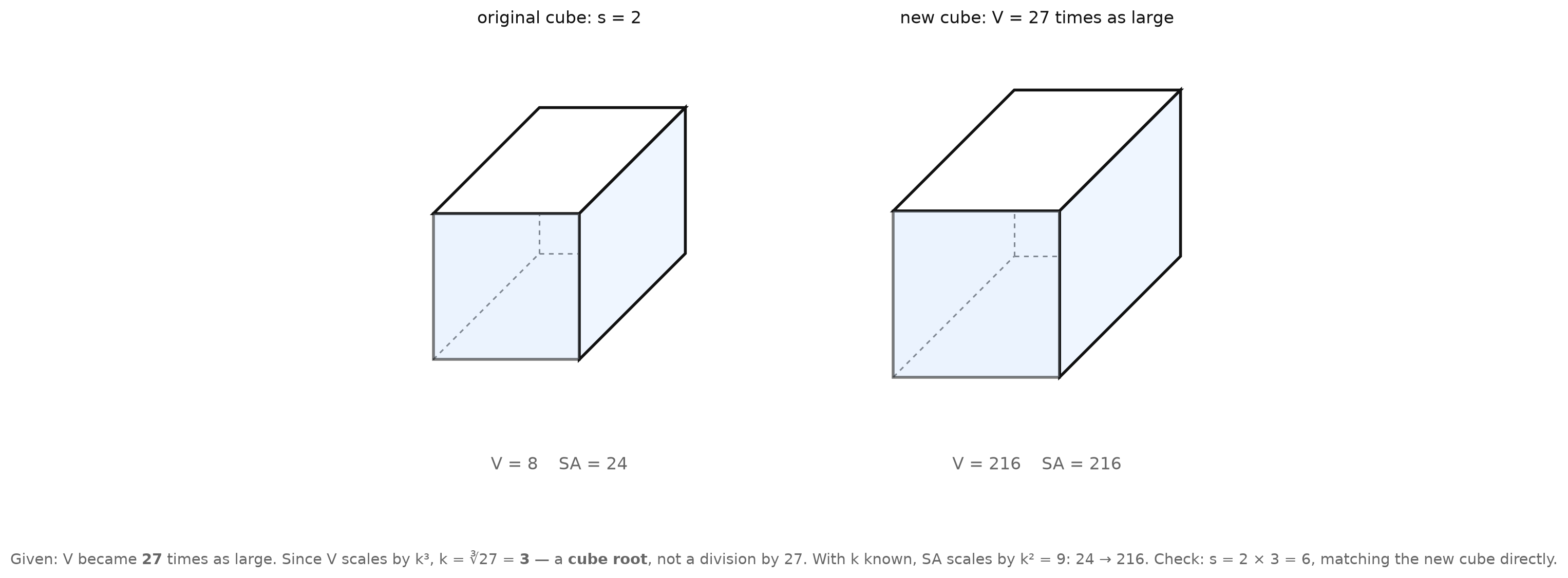
Given that a solid's volume became a known number of times as large, the scale factor comes from undoing the cube: since ,
Here , so — a cube root, not a division by . Once is known, every other measure follows: scales by .
From a given surface-area ratio: a sphere
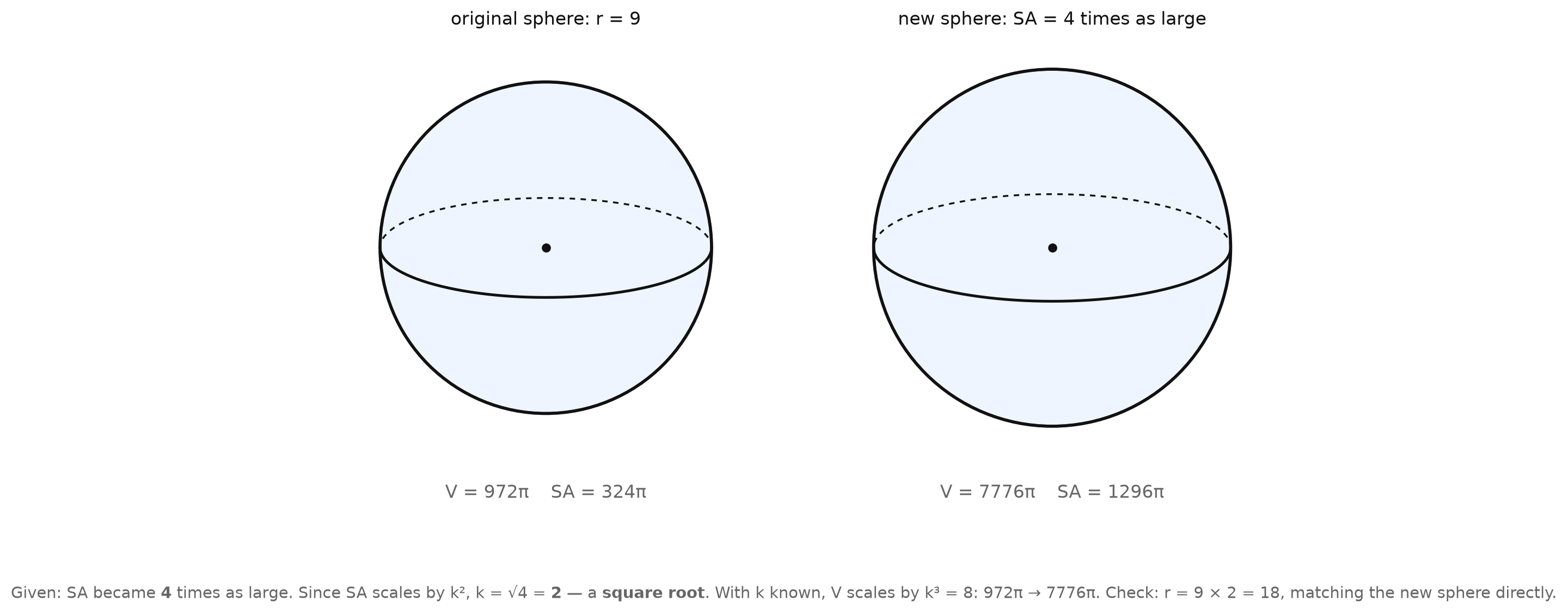
The same idea, one power lower: since ,
Here the ratio is , so — a square root. With known, scales by .
In context: a water tank
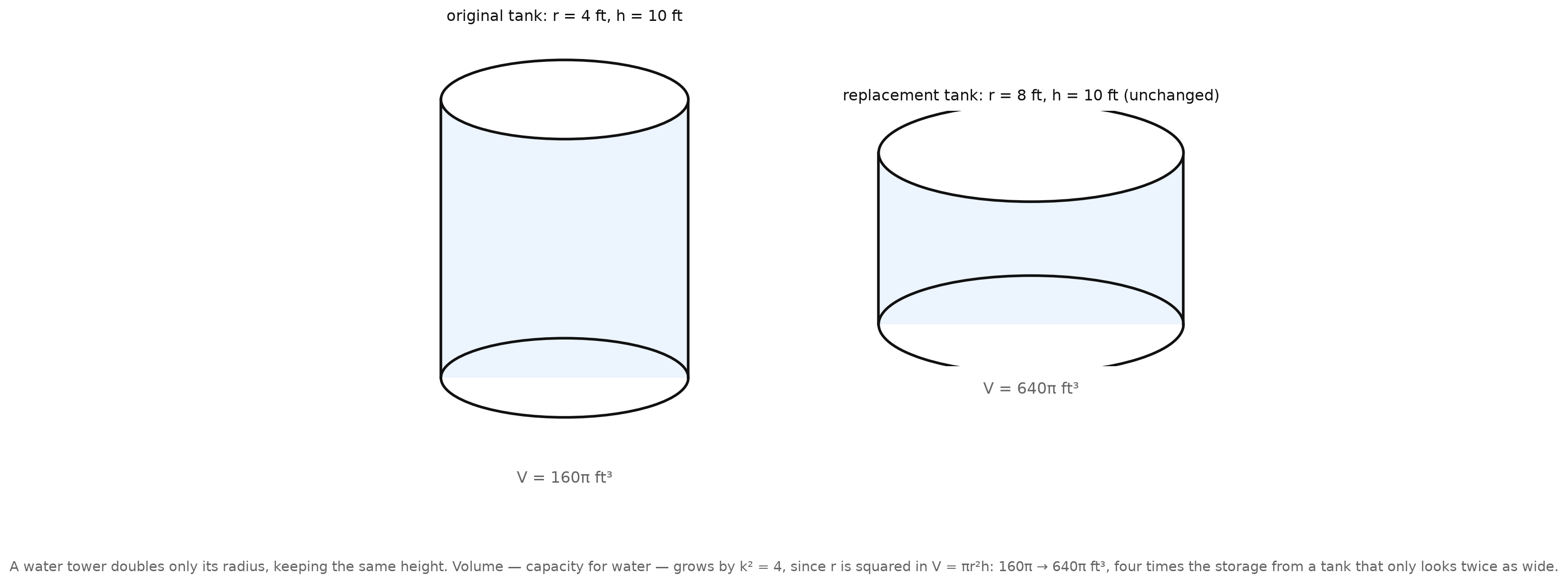
A water tower doubles only its radius, keeping the same height. This is Lesson 17.3's single-dimension case, applied in context: volume — the tank's water capacity — grows by , since is squared in , giving four times the storage from a tank that only looks twice as wide.
Worked examples
Example 1 — From a volume ratio
A solid's volume becomes times as large. Find , then the factor by which its surface area increases.
Answer: . increases by .
Example 2 — From a surface-area ratio
A solid's surface area becomes times as large. Find , then the volume factor.
Answer: . increases by .
Example 3 — A shrink
A solid's volume becomes as large. Find , then the factor.
Answer: . becomes as large.
Example 4 — A named change, forward
A cube's edge length is doubled. By what factor do its surface area and volume increase?
Answer: every dimension of a cube changes together, so this is uniform scaling with : , .
Example 5 — Recognizing which case applies
A cylinder's radius is doubled but its height stays the same. Does its surface area also quadruple?
Answer: No. Only one dimension changed, so this is Lesson 17.3's case, not uniform scaling — does scale cleanly by (it's a single product), but must be recomputed directly, since its formula has terms of different degree in .
Guided practice
- Use the cube figure. Given that became times as large, find .
- On that figure, use to find how changed.
- Use the sphere figure. Given that became times as large, find .
- On that figure, use to find how changed.
- Use the tank figure. Identify which dimension changed and by what factor; give the effect on volume.
- Compare the cube and sphere figures: which root do you take from a volume ratio, and which from a surface-area ratio?
Independent practice
A solid is scaled uniformly. Find , then the requested ratio.
- becomes times as large. Find , then the factor.
- becomes times as large. Find , then the factor.
- becomes times as large. Find , then the factor.
- becomes times as large. Find , then the factor.
- becomes as large. Find , then the factor.
- becomes as large. Find , then the factor.
Name whether every dimension changed (uniform scaling) or only one, then answer.
A cube's edge length is doubled. Find the and factors.
A cylinder's radius is doubled, height unchanged. Find the factor. Explain why cannot be found the same way.
A sphere's radius is tripled. Find the and factors.
A rectangular prism's height is halved, length and width unchanged. Find the factor.
Application. A cube-shaped shipping box has edge length ft. A larger box has edge length ft. Find the scale factor, and how many times as much cardboard and packing volume the larger box needs.
Application. A spherical weather balloon's surface area grows from ft² to ft². Find the scale factor for its radius, and how many times as much helium it now holds.
Error analysis. A student is told a solid's volume increased by a factor of and concludes the scale factor is . Identify the error and give the correct scale factor.
Reasoning. Explain why finding from a given volume ratio requires a cube root, while finding it from a given surface-area ratio requires a square root — connect each to the exponent in that measure's relationship to .
Exit ticket 17.4
- A solid's volume becomes times as large. Find , then the factor.
- A cylinder's height is tripled, radius unchanged. Find the factor by which volume increases.
Chapter 17 Review
Vocabulary. scale factor · uniform scaling · perimeter · circumference · surface area · volume · derived measure · square root · cube root
Review 1 (G.DF.2a). A rectangle by is scaled by .
- Give the original and new perimeter.
- Give the original and new area.
- A right triangle with legs and is scaled by the same . Give its original and new area.
- Explain, in general, why every one of these areas scaled by regardless of the figure's shape.
Review 2 (G.DF.2a). A cylindrical candle has radius cm and height cm.
- Find its volume and surface area.
- The candle is remade with only its height doubled (radius unchanged). Find the new volume directly, and state the factor by which it changed.
- Find the new surface area directly, and explain why it did not double along with the volume.
- A second candle scales BOTH the radius and the height by instead. Find its new volume and surface area, and explain why this candle's surface area did scale by a clean factor while the height-only candle's did not.
Review 3 (G.DF.2 b, c). A spherical storage tank's surface area increases from ft² to ft².
- Find the scale factor .
- Find the original and new radius.
- Find the factor by which the tank's volume (storage capacity) increased.
- A rectangular tank with the same original volume as the spherical tank has its length only tripled, width and height unchanged. Explain, without computing it, whether its volume increased by the same factor as the spherical tank's did.
Standards coverage check — Chapter 17
| Knowledge and Skill | Where it is taught | Where it is practiced | Where it is applied in context |
|---|---|---|---|
| G.DF.2a — describe how changes in one or more dimensions affect perimeter, area, total surface area, and volume | 17.1 (uniform scaling of perimeter and area); 17.2 (uniform scaling of surface area and volume); 17.3 (changing one dimension) | 7–21, 23, 24; 33–46, 48, 49; 58–71, 73, 74 | 22; 47; 72; Review 1, Review 2 |
| G.DF.2b — describe how changes in surface area and/or volume affect one or more dimensions | 17.4 (recovering from a volume or surface-area ratio) | 83–88, 95, 96 | Review 3 |
| G.DF.2c — solve problems, including in context, involving the effect of a dimension change on surface area and/or volume | 17.4 (named changes; in-context problems) | 89–92 | 93, 94; Review 2, Review 3 |
Supporting items: 24, 49, 74, and 96 are the reasoning items. Item 74 carries the chapter's central distinction — that a single-dimension change scales volume (a single product) by a clean power, but not surface area (a sum of differently-shaped terms), which must be recomputed directly. The error analyses target the recurring failures: assuming a uniform-looking change scales area by instead of (23), assuming a uniformly-scaled solid's volume changed by instead of (48), assuming changing one dimension of a cylinder scales its surface area the same way its volume scaled (73), and mistaking a volume ratio itself for the scale factor instead of taking its cube root (95).
Boundaries respected. This chapter's scope is exactly what G.DF.2 names: the effect of changing one or more dimensions of a three-dimensional figure on its perimeter, area, surface area, and volume, in both directions. It does not extend to non-uniform scaling of more than one dimension at differing factors, which the standard does not name.
Answer keys for every item in this chapter are in Appendix A.