Chapter 15 — Equations of Circles
Standard: G.PC.4 (a, b)
G.PC.4 — verbatim. The student will solve problems in the coordinate plane involving equations of circles. Students will demonstrate the following Knowledge and Skills: a) Derive the equation of a circle given the center and radius using the Pythagorean Theorem. b) Solve problems in the coordinate plane involving equations of circles: given a graph or the equation of a circle in standard form, identify the coordinates of the center of the circle; given the coordinates of the endpoints of a diameter of a circle, determine the equation of the circle; given the coordinates of the center and the coordinates of a point on the circle, determine the equation of the circle; and given the equation of a circle in standard form, identify the coordinates of the center and find the radius of the circle.
By the end of this chapter you will be able to:
- Derive the standard equation of a circle from the Pythagorean Theorem (G.PC.4a)
- Write a circle's equation directly from its center and radius (G.PC.4a)
- Read a center and a radius off a standard-form equation — and off a graph (G.PC.4b)
- Determine a circle's equation from the endpoints of a diameter (G.PC.4b)
- Determine a circle's equation from its center and one point on the circle (G.PC.4b)
- Decide which of those four starting points a problem has handed you (G.PC.4 a, b)
Lessons: 15.1 Deriving the Equation · 15.2 Reading the Equation and the Graph · 15.3 Writing the Equation from Two Points · 15.4 Putting It Together
Why this chapter matters. A circle is every point the same distance from one center — and "distance" already has a formula, from the Pythagorean Theorem. This chapter writes that formula down once, for a variable point instead of two fixed ones, and then spends the rest of its four lessons using the result in both directions: from an equation to a picture, and from a picture — or just two pieces of information about it — to an equation.
Scope note. G.PC.4 covers exactly the standard-form equation and the four things bullet b names you can do with it. Completing the square to recover a center from an expanded equation — one already multiplied out — is not named by the standard and is not taught here. Every equation in this chapter starts in, or is built directly into, standard form.
Conventions this chapter fixes.
- Standard form is , with center and radius . Both -terms and -terms are subtractions — a negative center coordinate makes the sign you see flip.
- The right-hand side is , not . Reading a radius off an equation always costs one square root.
- Radii are given in simplest radical form when is not a perfect square — , never a rounded decimal — the same convention this book has used since Chapter 8.
- A diameter's two endpoints are not the same information as a center and a radius. Their midpoint gives the center; the radius is the distance from that midpoint to either endpoint, not the distance between the endpoints themselves.
- Item numbering runs straight through the chapter, from 1 in Lesson 15.1 to 112 at the end of Lesson 15.4.
Lesson 15.1 — Deriving the Equation
The right triangle inside every circle
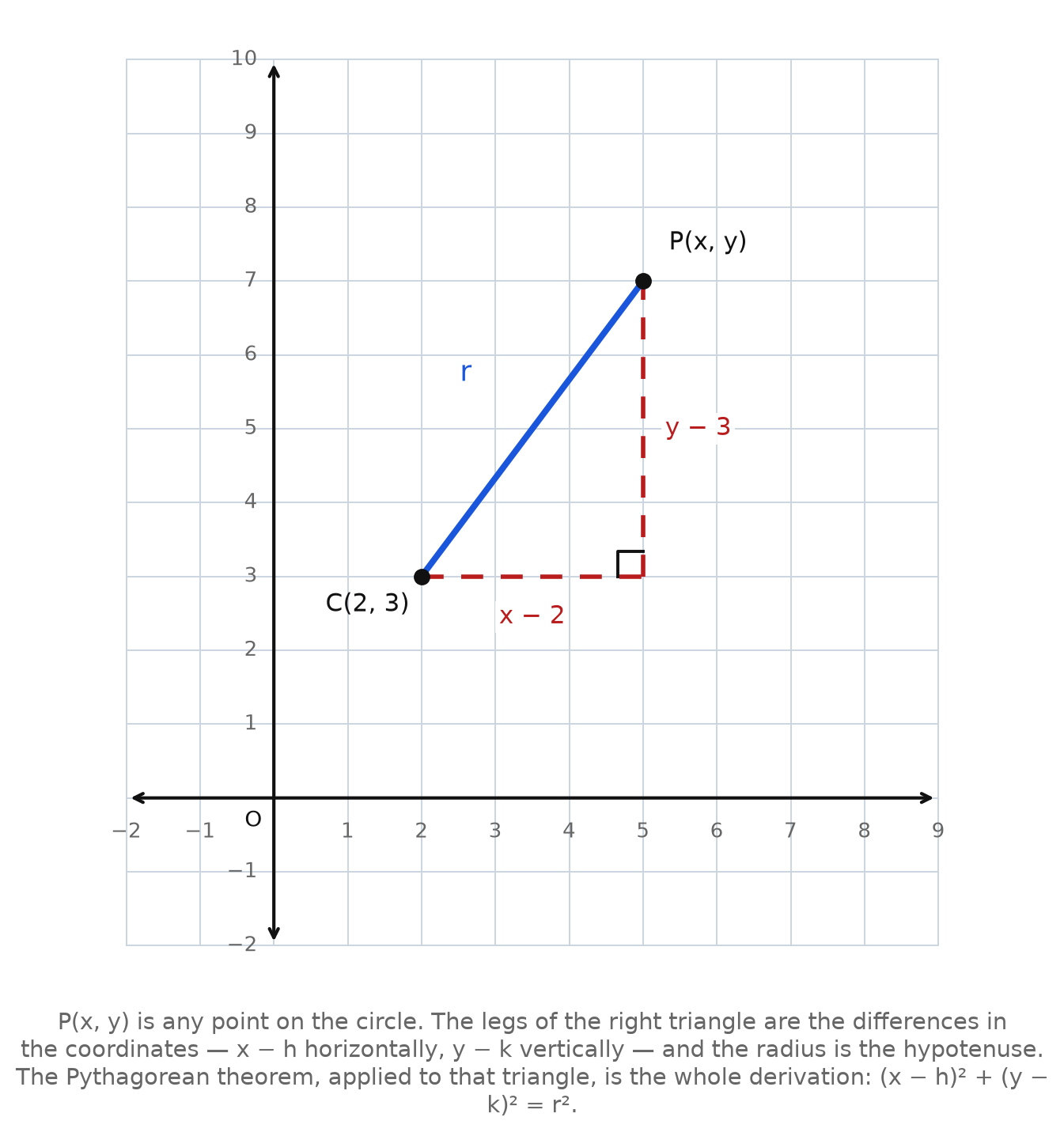
Let be the center of a circle of radius , and let be any point on the circle. Drop a horizontal segment and a vertical segment from to meet at a right angle, the way every coordinate-plane right triangle in this book has been built since Chapter 6.
- the horizontal leg has length
- the vertical leg has length
- the hypotenuse is the radius,
The Pythagorean Theorem, applied to that triangle, is the derivation:
Standard form of a circle
Nothing about was special — it was any point on the circle — so this equation is true for every point on the circle and false for every point off it. That is exactly what an equation of a circle needs to do.
The origin case
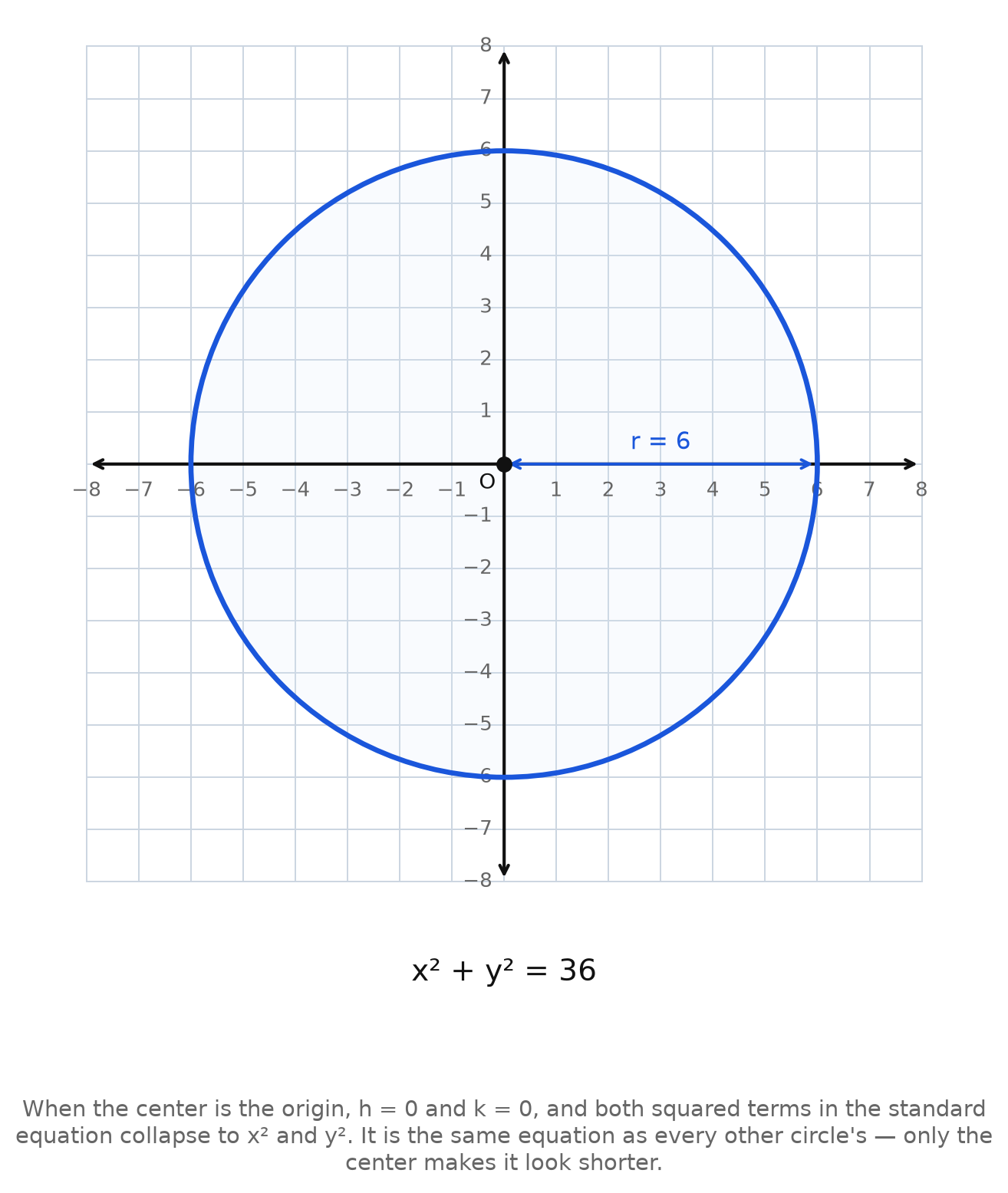
When the center is the origin, and , and both subtractions vanish:
This is not a different formula — it is the case of the one derived above. It looks shorter only because two of its four numbers happen to be zero.
Writing an equation straight from a center and a radius
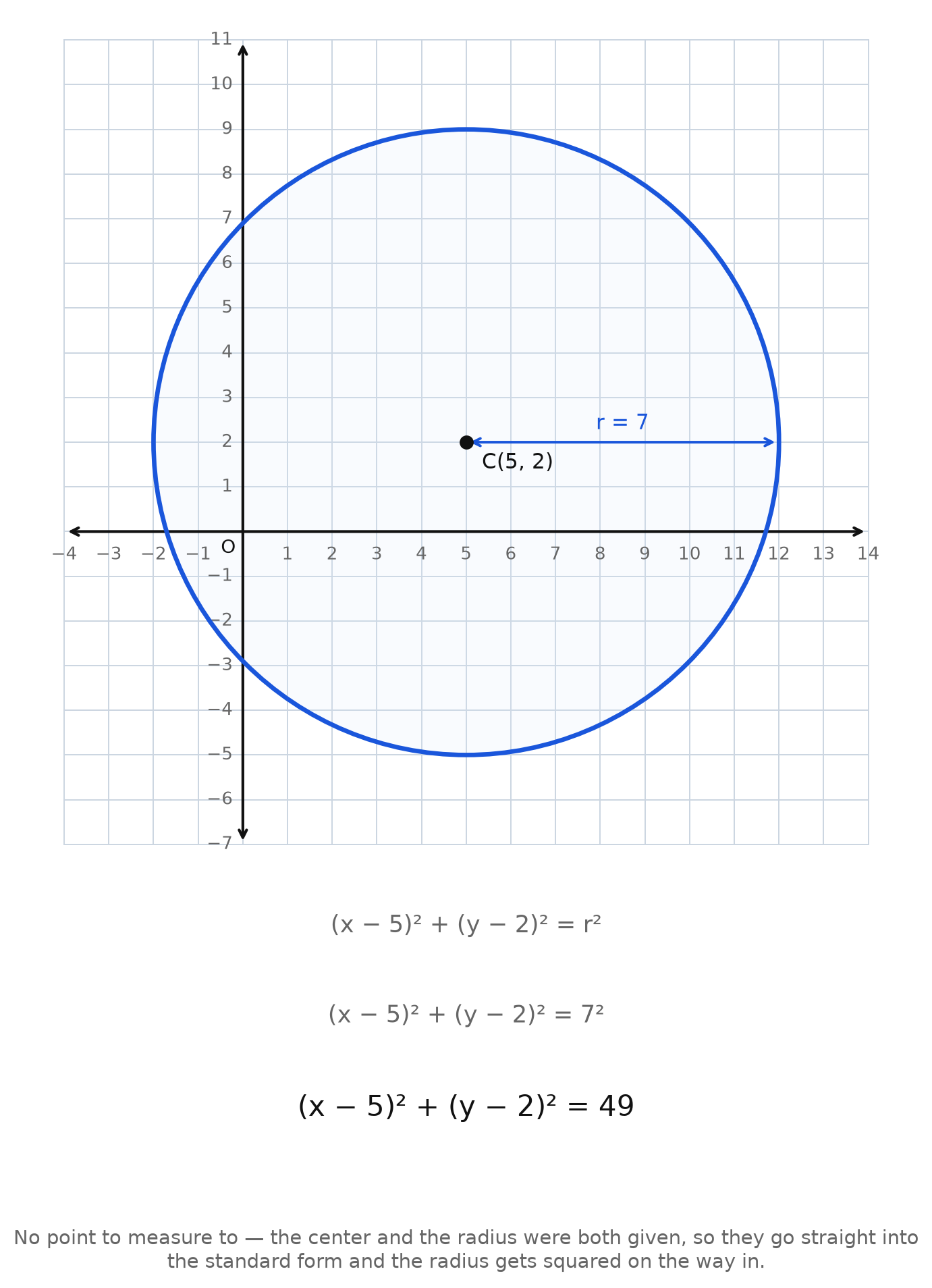
No point to measure to here — the center and the radius are simply substituted into standard form, and the radius is squared on the way in:
This is the most direct of the chapter's four problem types, and the one every other type eventually reduces to: find a center, find a radius, substitute.
Worked examples
Example 1 — The derivation, with numbers
Center , point on the circle. Find and give the equation.
Answer: legs and , so and . Equation: .
Example 2 — Center and radius
Center , radius .
Answer: .
Example 3 — A negative center coordinate
Center , radius .
Answer: .
Example 4 — Is a point on the circle?
Is on the circle ?
Answer: . Yes.
Example 5 — Deriving from center and a point, again
Center , point on the circle.
Answer: legs and ; . Equation: .
Guided practice
- Use the deriving-the-equation figure. Name the two legs of the right triangle and what each one measures.
- On that figure, name the hypotenuse and give the equation it produces.
- Use the circle-at-the-origin figure. Give the equation shown, and identify and .
- On that figure, explain in one sentence why a center at the origin shortens the equation.
- Use the writing-from-center-and-radius figure. Give the center and the radius shown.
- On that figure, give the three steps that turn a center and a radius into an equation.
Independent practice
Give the equation of the circle with the stated center and radius.
- center , radius
- center , radius
- center , radius
- center , radius
- center , radius
- center , radius
- center , radius
- center , radius
Is the given point on the given circle? Answer yes or no.
- on
- on
- on
- on
- on
- on
Derive the equation from the given center and point on the circle.
center , point
center , point
center , point
Application. A circular fountain is centered at the origin of a park's coordinate grid, in meters, and its edge reaches the point . Give the equation of the fountain.
Error analysis. A student derives the equation for center and radius as . Identify and correct the sign errors.
Reasoning. Explain, tracing back to the right triangle, why the right-hand side of the standard equation is and not .
Exit ticket 15.1
- Give the equation of a circle with center and radius .
- Is on the circle ? Justify your answer using the Pythagorean Theorem.
Lesson 15.2 — Reading the Equation and the Graph
The anatomy of standard form
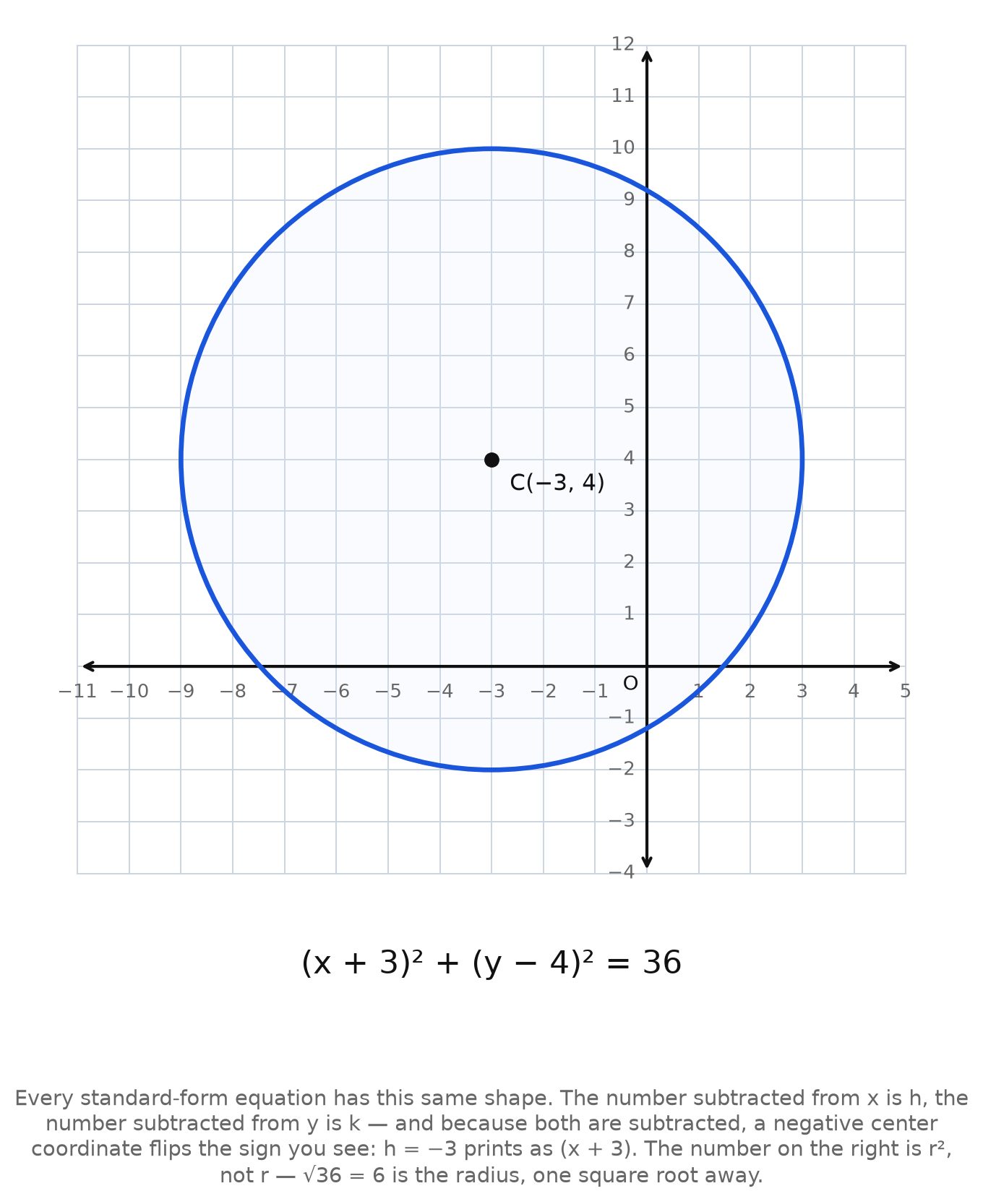
Every standard-form equation has the same four numbers hidden inside it — , , and , plus the arithmetic that makes into . Reading one back out means undoing exactly that arithmetic.
- The number subtracted from is . The number subtracted from is .
- Because both are subtracted, a negative center coordinate makes the sign in the equation flip: prints as .
- The number on the right is . Finding costs one square root.
A table of them
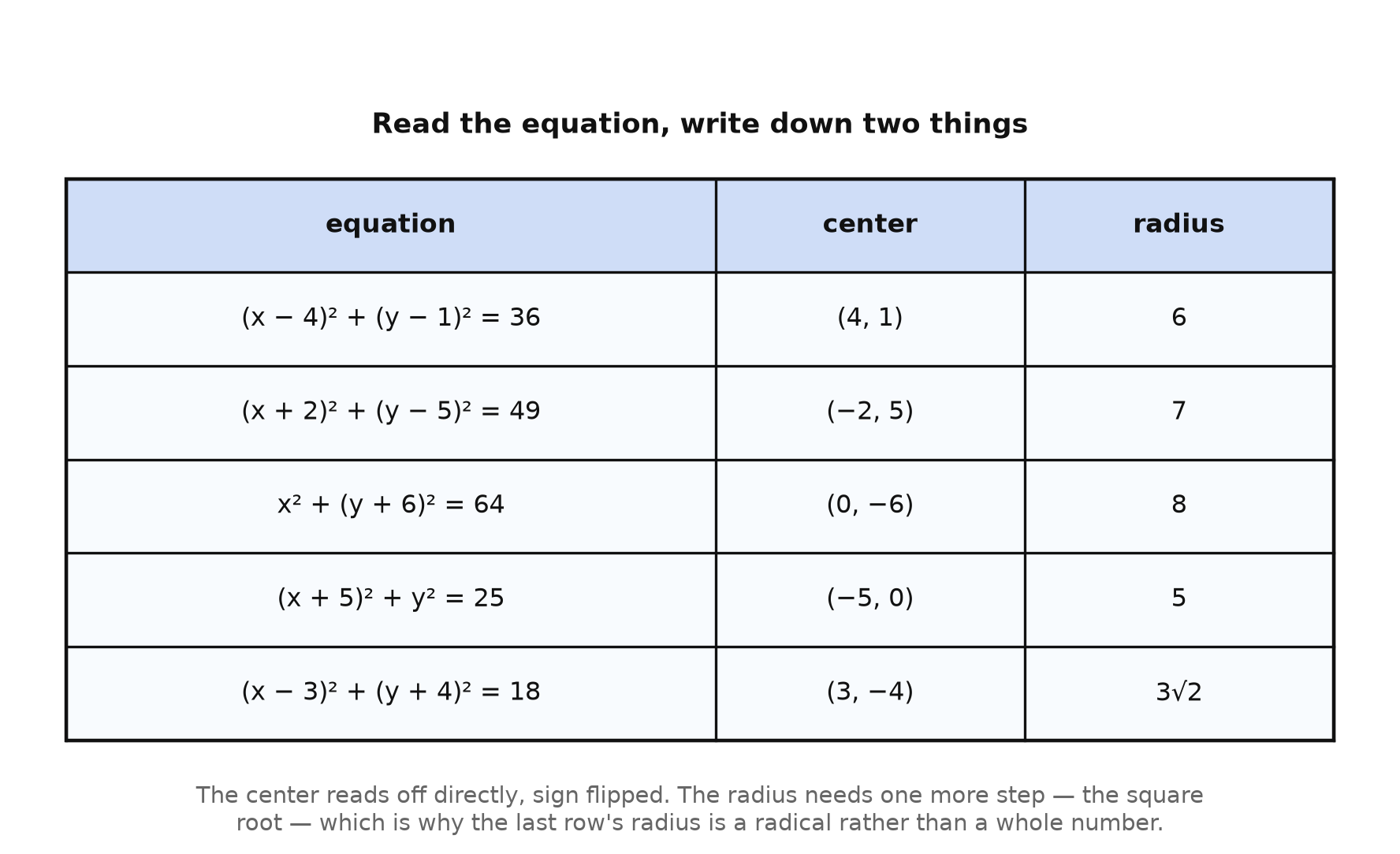
Reading straight off a graph
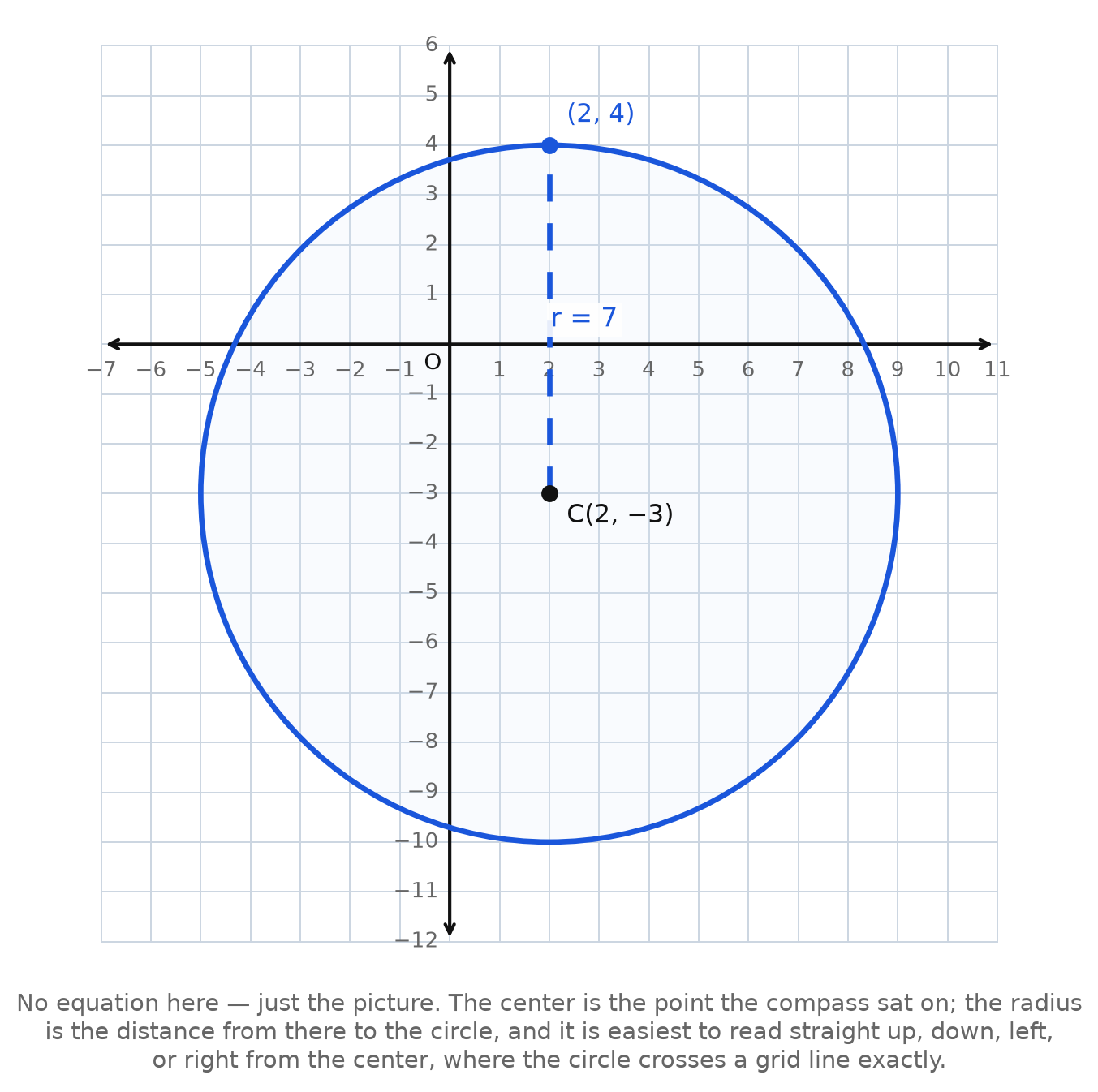
No equation here at all — just the picture. The center is the point the compass sat on. The radius is the distance from there to the circle, and it is easiest to read where the circle crosses a grid line exactly: straight up, down, left, or right from the center.
When the radius is not a whole number
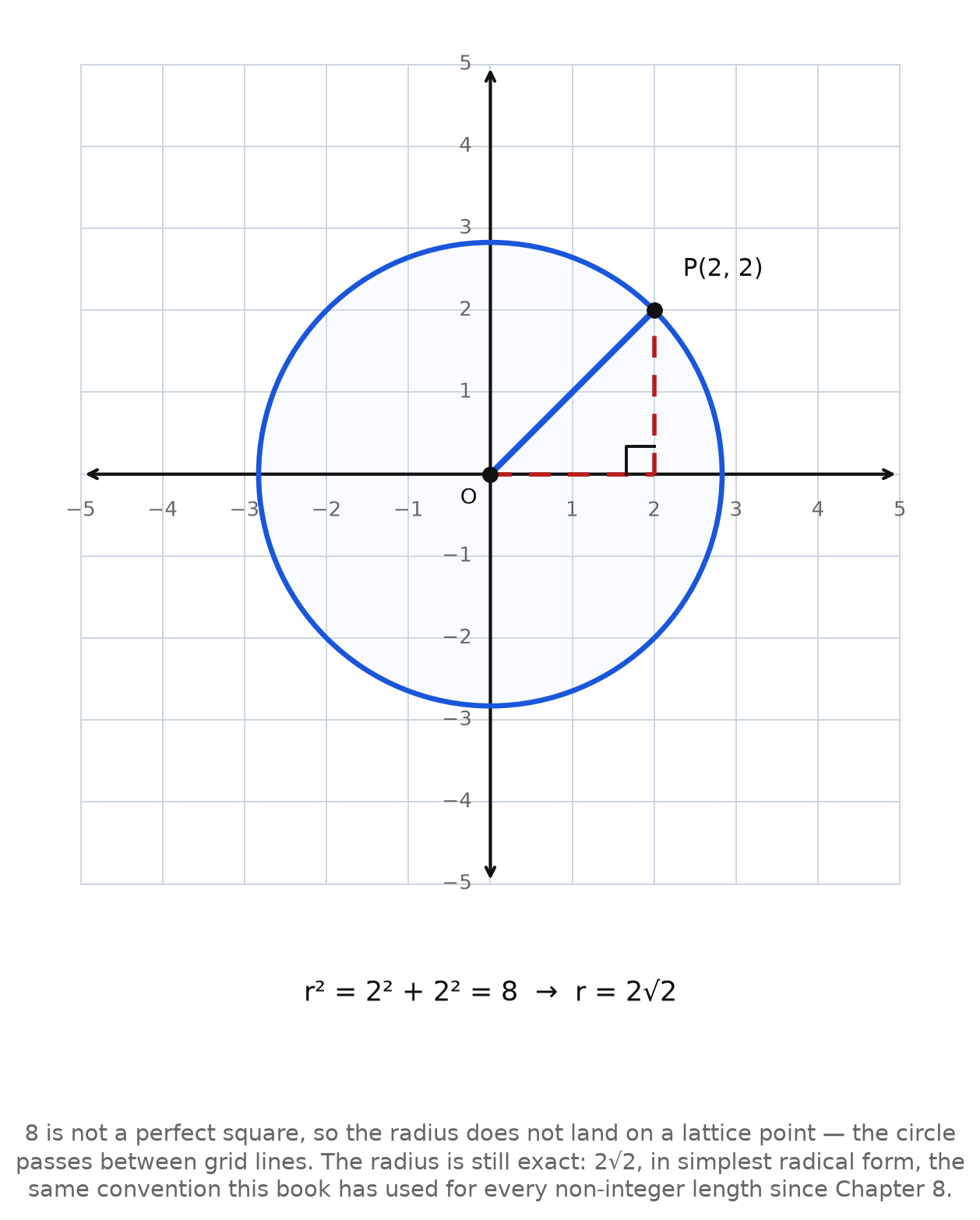
is not a perfect square, so the radius does not land on a lattice point — the circle passes between grid lines. The radius is still exact: , in simplest radical form, not a rounded decimal.
Worked examples
Example 1 — Reading an equation
Give the center and radius of .
Answer: center , radius .
Example 2 — A negative-negative center
Give the center and radius of .
Answer: center , radius .
Example 3 — A radical radius
Give the center and radius of .
Answer: center , radius .
Example 4 — Reading a graph
A circle is graphed with center and passes through , straight across from the center. Give the radius and the equation.
Answer: . Equation: .
Example 5 — Writing from center and radius, reinforced
Center , radius .
Answer: . Equation: .
Guided practice
- Use the anatomy figure. Give the center and the radius shown.
- On that figure, explain why the center's negative -coordinate makes the equation show a plus sign.
- Use the reading-a-graph figure. Give the center and the radius directly from the picture.
- On that figure, say which directions are easiest to measure a radius along, and why.
- Use the reading-center-and-radius table. Give the equation, center, and radius from the radical row.
- Use the radical-radius figure. Give the two legs, the value of , and the radius in simplest radical form.
Independent practice
Give the center and radius.
Give the center and radius. Leave the radius in simplest radical form.
A circle is graphed with center and passes through , straight up from the center. Give the radius and the equation.
A circle is graphed with center and passes through , straight across from the center. Give the radius and the equation.
A circle is graphed with center and passes through . Give the radius and the equation.
Give the equation from the center and radius.
center , radius
center , radius
Application. A cell tower at on a town's coordinate grid, in miles, has a signal radius reaching . Confirm the radius and give the equation of the coverage boundary.
Error analysis. A student reads as having center and radius . Identify both mistakes.
Reasoning. Explain why the number on the right of a standard-form equation needs a square root to become a radius, while the numbers subtracted from and are already the center's coordinates — connect each to where it came from in the derivation.
Exit ticket 15.2
- Give the center and radius of , with the radius in simplest radical form.
- A circle is graphed with center and passes through . Give the radius and the equation.
Lesson 15.3 — Writing the Equation from Two Points
Center and a point on the circle
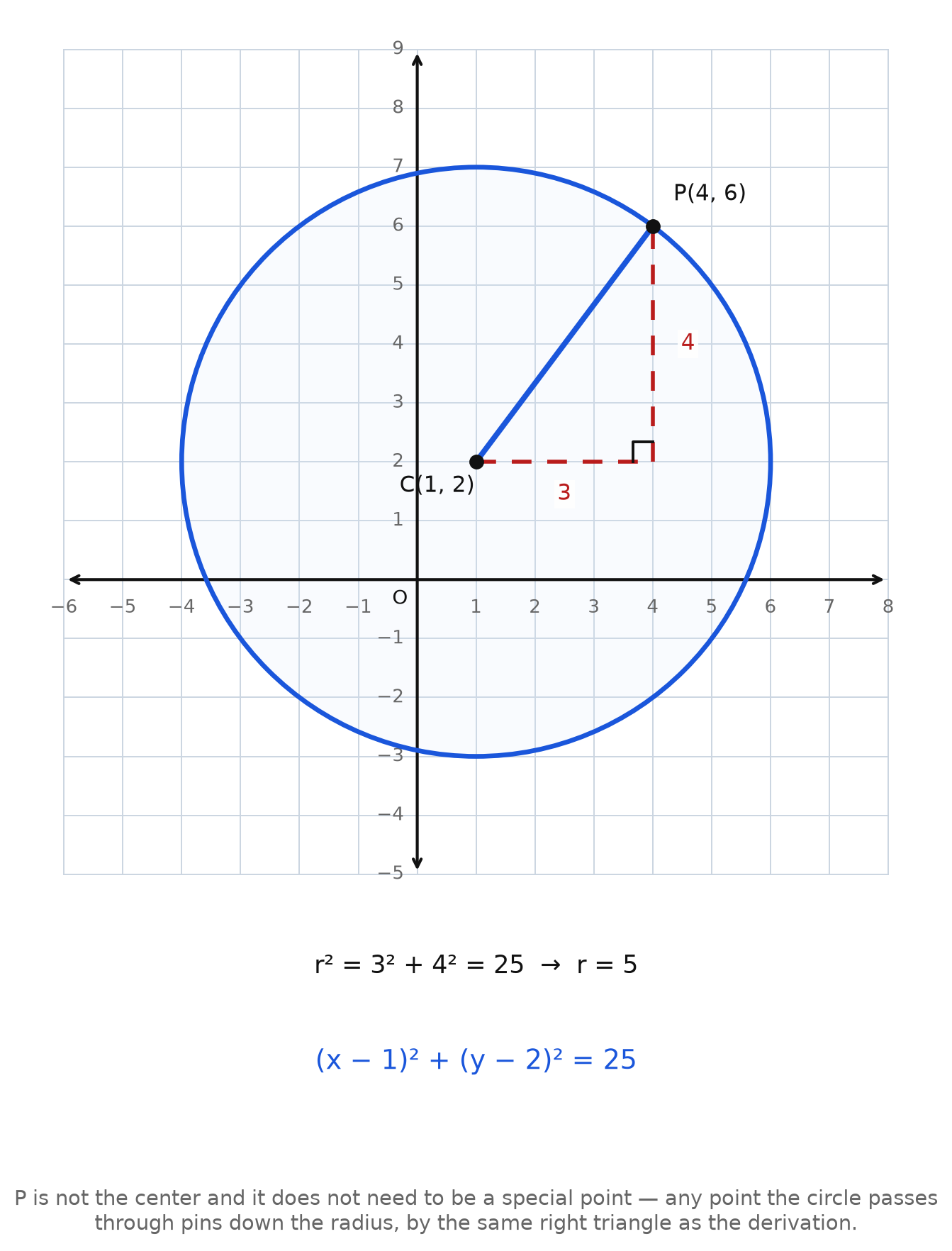
If you know the center and one point the circle passes through, that point pins down the radius by exactly the right triangle from Lesson 15.1 — does not need to be special in any other way.
The endpoints of a diameter
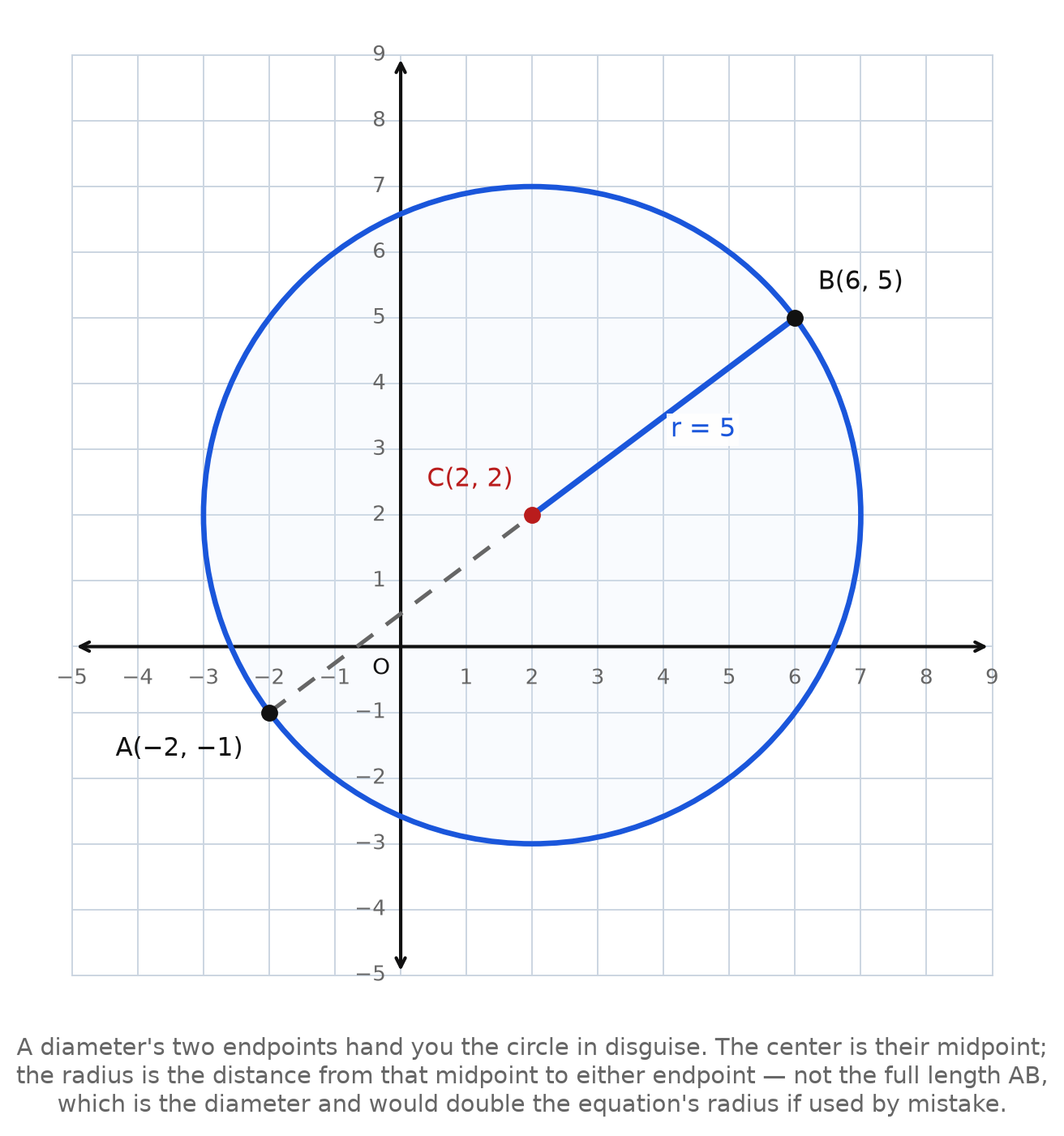
A diameter's two endpoints hand you the circle in disguise:
- the center is their midpoint
- the radius is the distance from that midpoint to either endpoint
Not the distance between and — that is the full diameter, and using it in place of the radius doubles it by mistake.
Worked examples
Example 1 — Center and a point
Center , point on the circle.
Answer: legs and ; . Equation: .
Example 2 — A vertical case
Center , point on the circle.
Answer: the point is straight above the center, so directly. Equation: .
Example 3 — Diameter endpoints
and are endpoints of a diameter.
Answer: midpoint . Distance from to : legs and , so . Equation: .
Example 4 — Diameter endpoints, vertical
and are endpoints of a diameter.
Answer: midpoint . . Equation: .
Example 5 — The trap
For the diameter in Example 3, a student uses as the radius. What goes wrong?
Answer: is the diameter, not the radius; using it directly gives a circle with four times the correct area. The radius is half of it, — which is exactly what the midpoint-then-distance method already produced.
Guided practice
- Use the center-and-a-point figure. Give the two legs of the triangle and the radius they produce.
- On that figure, give the resulting equation.
- Use the diameter-endpoints figure. Give the coordinates of the center, and explain how you found them.
- On that figure, give the radius, and name the segment you measured to find it.
- Explain what goes wrong if the full length of is used as the radius instead.
- Compare the two methods of this lesson: what step do they share, and what step is different?
Independent practice
Center and a point on the circle. Give the equation.
- center , point
- center , point
- center , point
- center , point
- center , point
- center , point
- center , point
- center , point
Endpoints of a diameter. Give the equation.
,
,
,
,
,
,
,
,
,
Application. A lighthouse's beam sweeps a circle centered at the lighthouse, on a coastal map in kilometers, and reaches a marker at . Give the equation of the beam's circle.
Error analysis. Given diameter endpoints and , a student computes the center by adding the coordinates instead of averaging them. Identify the correct center and give the correct equation.
Reasoning. Both methods of this lesson end at the same two computations — a center and a radius. Explain which one each method skips because it was already given, and which one it has to compute.
Exit ticket 15.3
- center , point on the circle. Give the equation.
- , are endpoints of a diameter. Give the equation.
Lesson 15.4 — Putting It Together
Four starting points, two computations
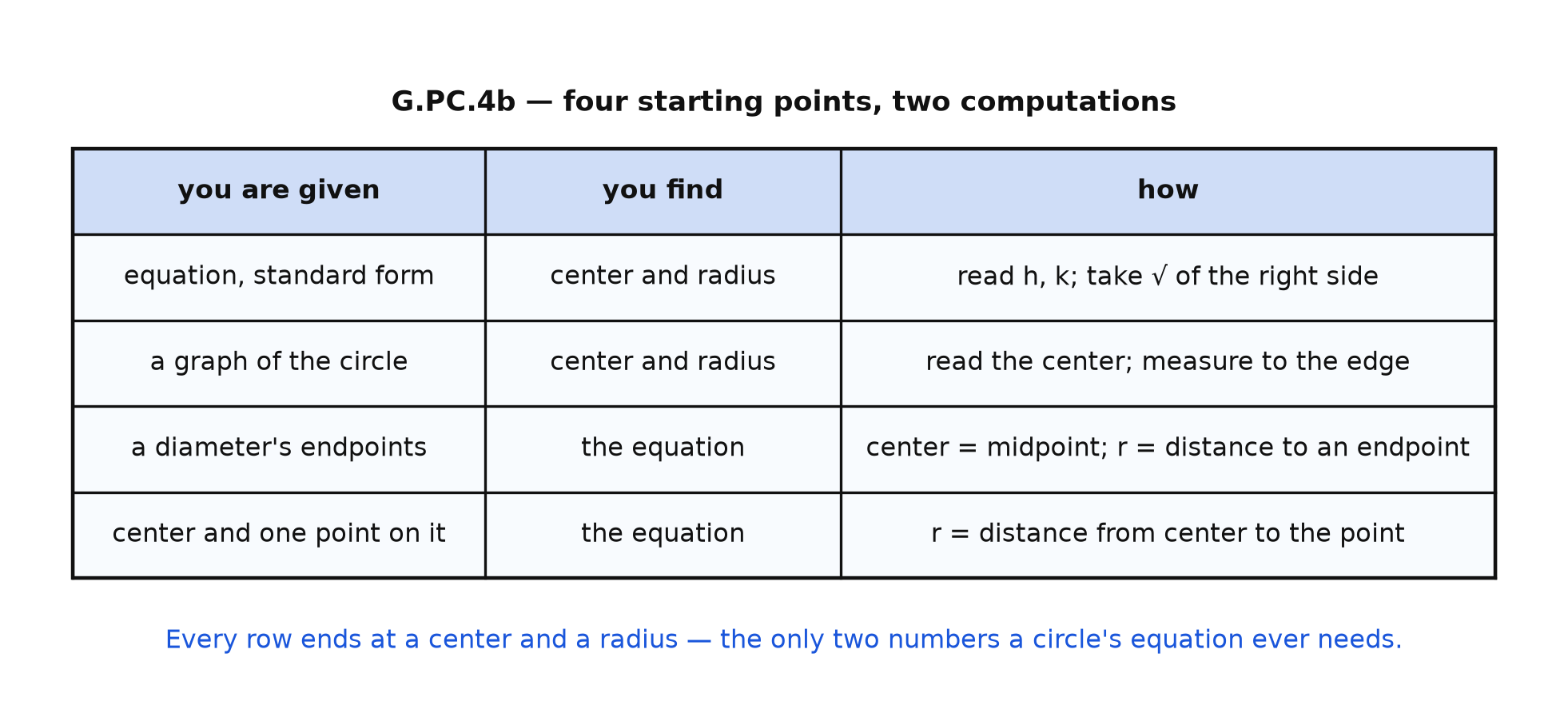
Every type this chapter has covered ends in the same place: a center and a radius. The only real decision is which of the two you still have to compute, because the other one was already handed to you.
The most common mistake
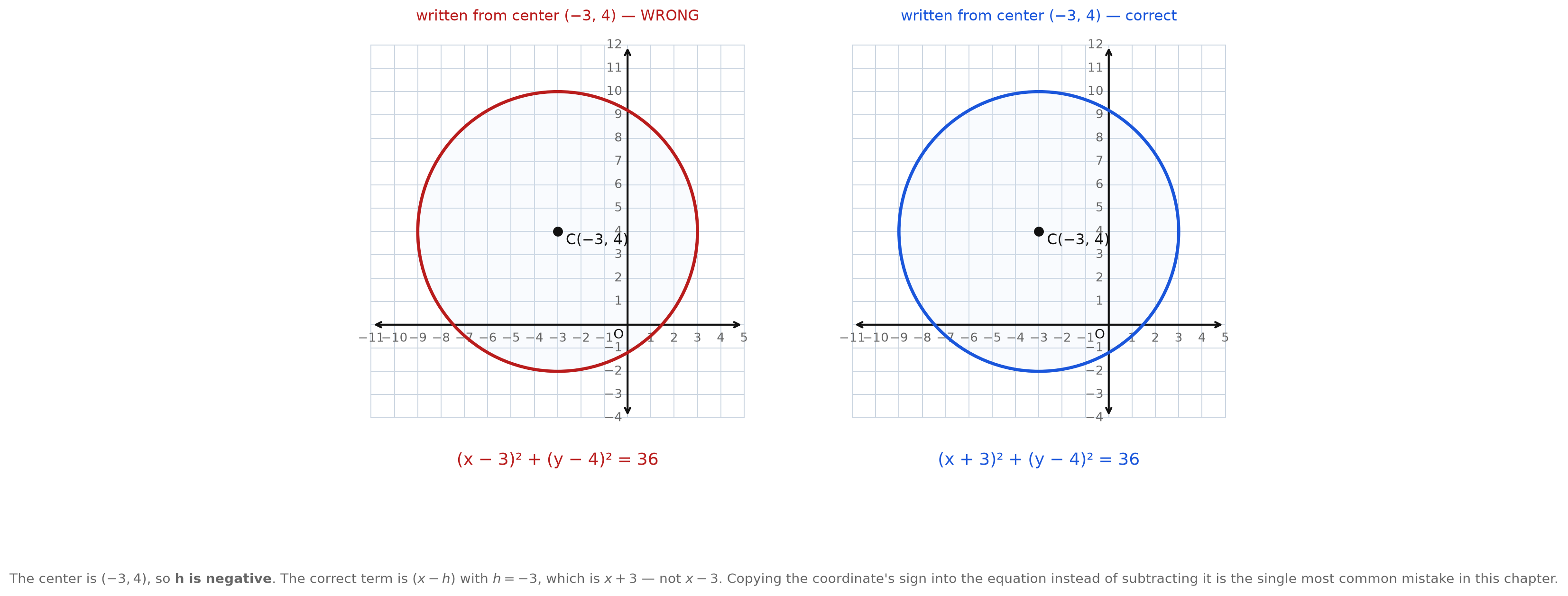
Center : is negative. The correct term is with , which is — not . Copying the coordinate's own sign into the equation instead of subtracting it is the single most common mistake in this chapter.
What each part of the equation controls
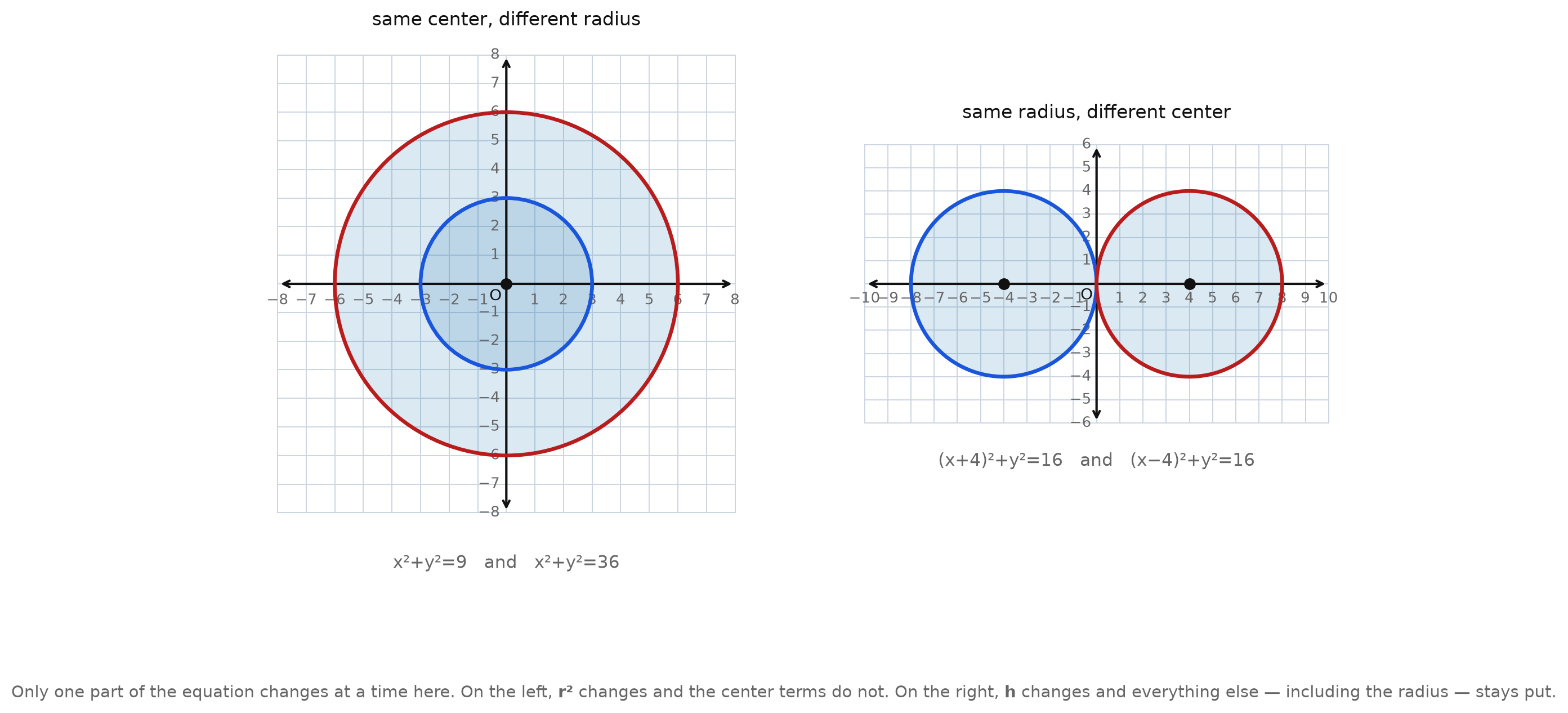
Change alone and the circle grows or shrinks in place. Change alone and the circle slides sideways without changing size. Each of the equation's parts controls exactly one thing about the picture.
In context
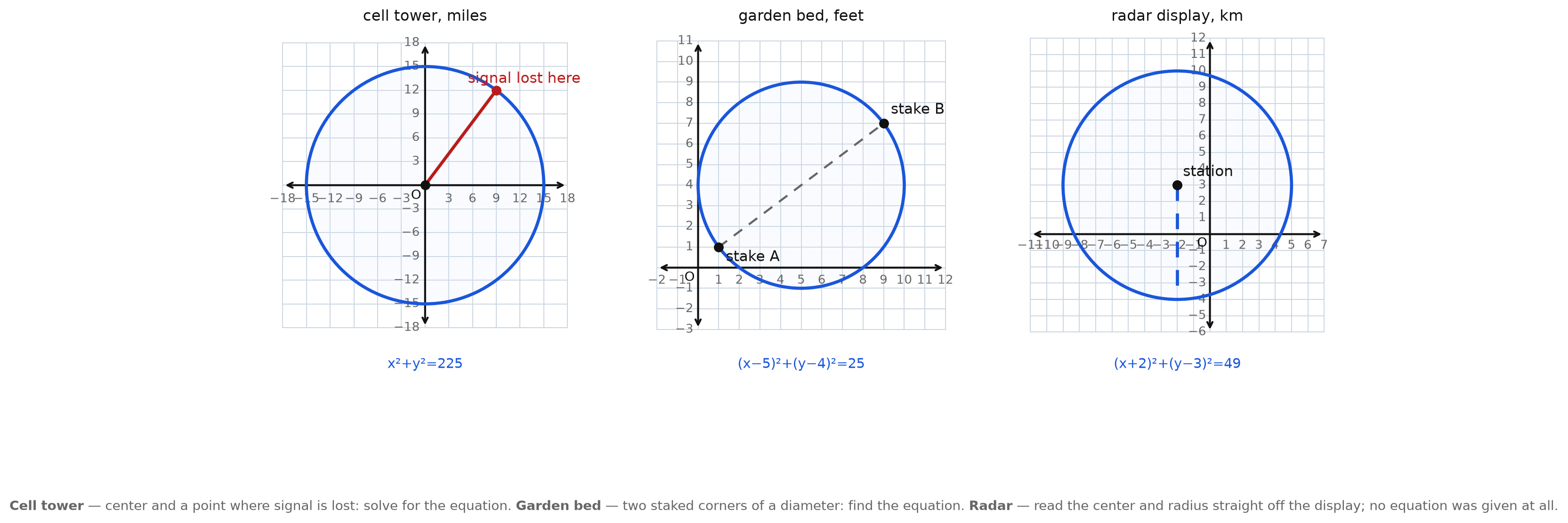
- Cell tower — center and the point where signal is lost: solve for the equation.
- Garden bed — two staked corners of a diameter: find the equation.
- Radar — read the center and radius straight off the display; no equation was ever given.
Worked examples
Example 1 — Which type is this?
"A circle's equation is . Give its center and radius." Which of the four types, and what do you compute?
Answer: Reading an equation. Center reads off directly (sign flipped on the -term); radius .
Example 2 — Which type is this?
"A circular garden's opposite edge stakes are at and . Give its equation." Which type?
Answer: Diameter endpoints. Midpoint ; distance to gives . Equation: .
Example 3 — Both quantities in one figure
A -swept radar center is at , reaching a target km straight down at . Give the equation.
Answer: .
Example 4 — Scaling a circle
A circle's radius is doubled and its center is left alone. What happens to the number on the right side of its equation?
Answer: It becomes four times as large — the radius is squared in the equation, so doubling multiplies by .
Example 5 — Sliding a circle
A circle's center moves units right and its radius is unchanged. What happens to the equation?
Answer: Only changes, by ; the -term and the right-hand side stay exactly as they were.
Guided practice
- Use the four-types board. Give the "how" column for each of the four given-information types.
- Use the sign-error figure. Give the wrong equation, the correct equation, and say exactly what changed between them.
- Use the two-circles-compared figure. Give both equations in the left panel and say what changed between them.
- On the right panel of that figure, give both equations and say what changed between them.
- Use the context figure. Name which of the four G.PC.4b types each of the three panels is.
- Use the blank-circle figures. Pick one panel and give its center and radius by reading the grid.
Independent practice
Name the type — reading an equation, reading a graph, diameter endpoints, or center and a point — then solve.
. Give the center and radius.
. Give the center and radius.
. Give the center and radius.
. Give the center and radius.
A circle is graphed with center , passing through straight above the center. Give the equation.
A circle is graphed with center , passing through . Give the equation.
Diameter endpoints , . Give the equation.
Diameter endpoints , . Give the equation.
Center , point on the circle. Give the equation.
Center , point on the circle. Give the equation.
Diameter endpoints , . Give the equation.
Center , point on the circle. Give the equation, with the radius in simplest radical form.
. Give the center and radius, in simplest radical form.
. Give the center and radius, in simplest radical form.
Application. A weather balloon's tracking station is at the origin of a regional grid, in kilometers, and loses the balloon's signal at . Give the equation of the range circle demonstrated.
Application. A surveyor stakes the opposite corners of a circular plaza's diameter at and , in meters. Give the equation of the plaza's boundary.
Application. A lighthouse beam is centered at on a nautical chart, in kilometers, and reaches a rock at . Give the equation of the beam's circle.
Error analysis. A student is given the equation and states the radius as . Identify the mistake and give the correct radius, in simplest radical form.
Reasoning. Explain why finding a diameter's midpoint and finding a segment's length are genuinely different computations, and why the diameter-endpoints method needs both — one for the center, one for the radius.
Reasoning. A circle's equation is written . Explain what must be true of for this to be an actual circle rather than a single point or no points at all, and connect your answer back to the derivation.
Exit ticket 15.4
- Center , point on the circle. Give the equation.
- State the one question to ask before choosing among the four methods of this chapter.
Chapter 15 Review
Vocabulary. standard form · center · radius · Pythagorean Theorem · leg · hypotenuse · diameter · midpoint · simplest radical form · coordinate plane
Review 1 (G.PC.4a). A circle has center and passes through the point .
- Give the horizontal leg and the vertical leg of the right triangle the derivation uses.
- Use the Pythagorean Theorem to find and .
- Give the equation of the circle in standard form.
- A third point, , is proposed to also lie on the circle. Check it, and explain — without fully re-deriving — how you know.
Review 2 (G.PC.4b). A circle's equation is .
- Give the center and the radius.
- A second, different circle is graphed with center , passing through straight below the center. Give its radius and its equation.
- Compare the two circles' radii, and say which is bigger and by how much.
- Explain why finding the radius from the first equation needed a square root, while finding the center did not.
Review 3 (G.PC.4b). and are the endpoints of one circle's diameter. A second circle has center and passes through the point .
- Give the equation of the first circle.
- Give the equation of the second circle.
- Name the method used for each — diameter endpoints, or center and a point.
- Say which single quantity, computed differently in each method, both circles' equations still needed in the end.
Standards coverage check — Chapter 15
| Knowledge and Skill | Where it is taught | Where it is practiced | Where it is applied in context |
|---|---|---|---|
| G.PC.4a — derive the equation of a circle given the center and radius, using the Pythagorean Theorem | 15.1 (the derivation triangle; the origin case; writing from center and radius) | 1–23, 25, 26; 50, 51 | 24; 52; 105–107; Review 1 |
| G.PC.4b — given a graph or equation, identify the center; given diameter endpoints, determine the equation; given center and a point, determine the equation; given an equation, identify the center and find the radius | 15.2 (reading equations and graphs); 15.3 (diameter endpoints; center and a point); 15.4 (choosing among the four types) | 29–49, 53, 54; 57–81; 85–104, 108–110 | 47–49, 52; 80; 89, 105–107; Review 2, Review 3 |
Supporting items: 26, 54, 61, 82, 109, and 110 are the reasoning items. Item 82 carries the chapter's organising claim — that every one of the four G.PC.4b starting points ends at the same two computations, a center and a radius, differing only in which one is already given. The error analyses target the recurring failures: mixing up the sign of a negative center coordinate (25), reporting as if it were (53), averaging instead of adding coordinates when finding a midpoint (81), and using a full diameter's length as if it were a radius (61) or reading off an equation without the square root (108).
Boundaries respected. This chapter teaches standard form and exactly the four things G.PC.4b names doing with it. Completing the square, to recover a center from an equation already expanded out of standard form, is not named by the 2023 standard and is not taught here — every equation in this chapter starts in, or is built straight into, .
Answer keys for every item in this chapter are in Appendix A.