Chapter 14 — Circles: Arc Length and Sector Area
Standard: G.PC.3 (a, d, e)
G.PC.3 — verbatim. The student will solve problems, including those in context, by applying properties of circles. Students will demonstrate the following Knowledge and Skills: a) Determine the proportional relationship between the arc length or area of a sector and other parts of a circle. b) Solve for arc measures and angles in a circle formed by central angles. c) Solve for arc measures and angles in a circle involving inscribed angles. d) Calculate the length of an arc of a circle. e) Calculate the area of a sector of a circle.
By the end of this chapter you will be able to:
- Say what fraction of a circle a central angle opens onto, and reduce it (G.PC.3a)
- Keep arc measure and arc length apart, and say which one a question wants (G.PC.3 a, d)
- Calculate the length of an arc, exactly and as a decimal (G.PC.3d)
- Calculate the area of a sector, exactly and as a decimal (G.PC.3e)
- Work backwards from a length or an area to the angle or the radius (G.PC.3 d, e)
- Say what happens to an arc and to a sector when the radius changes (G.PC.3a)
Lessons: 14.1 The Fraction of a Circle · 14.2 Arc Length · 14.3 Sector Area · 14.4 Putting It Together
Why this chapter matters. Chapter 13 measured arcs in degrees. Degrees answer how far round the circle you have gone, and they say nothing at all about how far you have walked. This chapter gives an arc a length, and gives the region between two radii an area. Both come from one number — the fraction — applied to two different totals.
Scope note. This chapter is G.PC.3 a, d, and e. The two angle rules — central and inscribed — are Chapter 13, and you will need them, because you cannot find a fraction of a circle until you know the central angle.
There is nothing new to memorise beyond one fraction. Virginia's Geometry End-of-Course test supplies a formula sheet with and on it. What the sheet cannot do is tell you which one the question is asking about. That decision is the assessed skill.
Conventions this chapter fixes.
- Arc measure is in degrees. Arc length is in the units of the radius. They are different quantities with different units, and the same arc has both.
- Exact before approximate. is the answer; is the answer rounded. Give the answer in terms of first, then, if the question asks for a decimal, round to the nearest hundredth and write about.
- Reduce the fraction first. is , and one fifth of a circumference is easier to compute — and far easier to check — than seventy-two three-hundred-sixtieths of one.
- An area is in square units. A sector area reported in plain centimetres has lost track of what it measures.
- always means the central angle in degrees, and always means the radius.
- Item numbering runs straight through the chapter, from 1 in Lesson 14.1 to 112 at the end of Lesson 14.4.
Lesson 14.1 — The Fraction of a Circle
Measure is not length
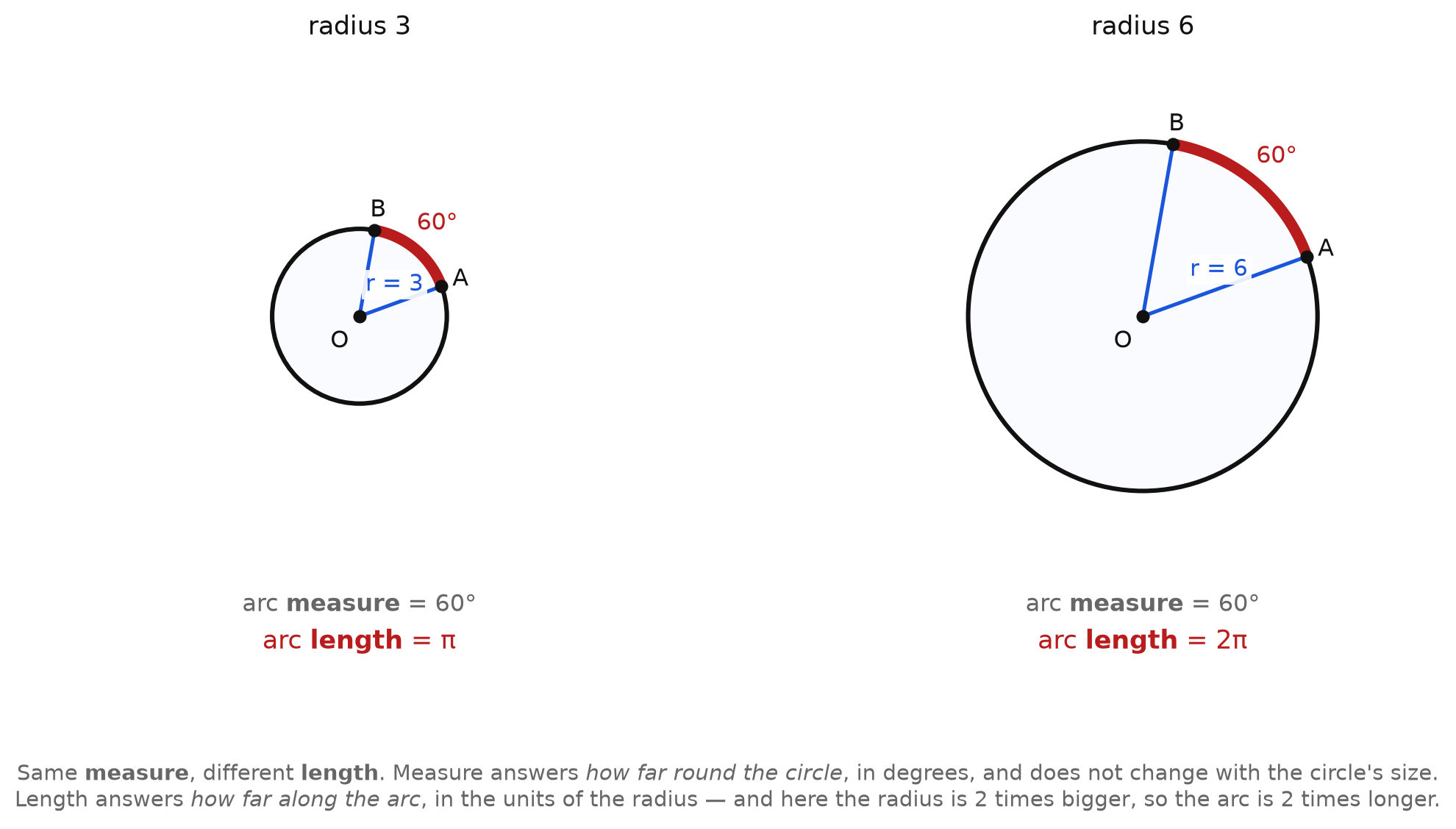
Two circles. Both arcs measure . The arcs are not the same size.
| small circle | large circle | |
|---|---|---|
| radius | ||
| arc measure | ||
| arc length |
Measure answers how far round the circle. It is a share of a full turn, so it does not care how big the circle is.
Length answers how far along the arc. It is a distance, in the same units as the radius, and it grows with the circle.
The most common error in this standard is answering "the arc is " when is the measure and the length is . Before writing anything, decide which of the two the question wants — and check your units at the end.
The fraction
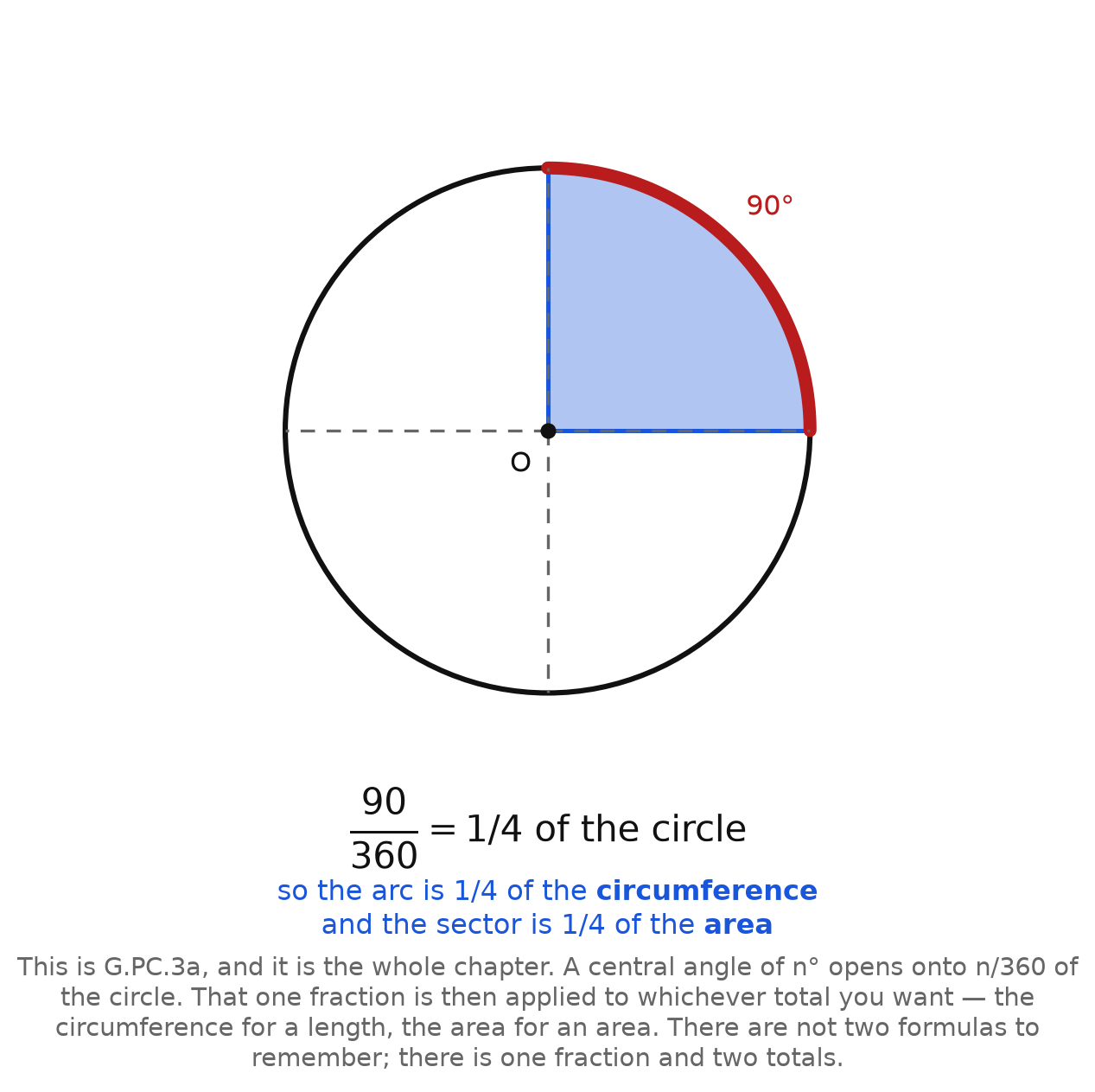
A central angle of opens onto
of the circle. That single fraction is the whole of G.PC.3a, and everything else in this chapter is that fraction applied to something:
- the arc is that fraction of the circumference
- the sector is that fraction of the area
A angle opens onto of the circle. So its arc is a quarter of the way round, and its sector is a quarter of the inside.
Reduce first
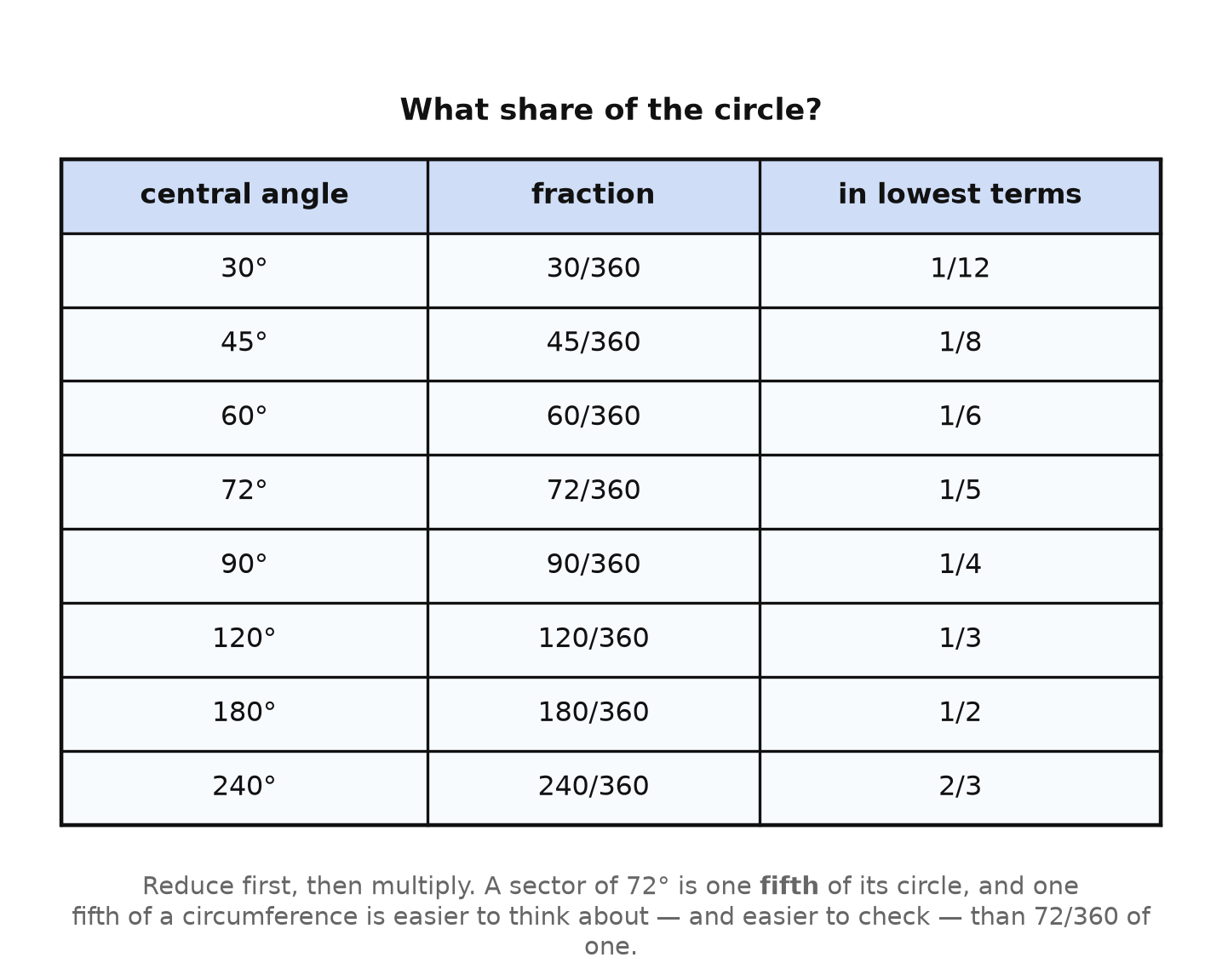
| angle | fraction | lowest terms |
|---|---|---|
Reducing is not tidiness. "One fifth of the circle" is a sentence you can check against a picture; "seventy-two three-hundred-sixtieths of the circle" is not.
A sector, and what it is not
A sector is the region bounded by two radii and the arc between them — the pizza slice, cheese included.
An arc is only the curved edge — the crust, with no cheese.
The same and the same give you both. Which one you are being asked for is a question about the words, not about the arithmetic.
Worked examples
Example 1 — The fraction
Give the fraction of the circle opened onto by a central angle.
Answer: .
Example 2 — Reducing
Give the fraction for .
Answer: .
Example 3 — Backwards
A sector is of its circle. Give the central angle.
Answer: of .
Example 4 — Measure or length?
Circle has radius and circle has radius . Each has an arc of measure . Compare the measures, then the lengths.
Answer: The measures are equal — both . The lengths are not: circle 's arc is ten times as long, because its radius is ten times as big.
Example 5 — Naming the region
A slice of pie is cut from the centre. Name the region, and name its curved edge.
Answer: The region is a sector; its curved edge is an arc.
Guided practice
- Use the two-circle figure. Give the arc measure in each circle.
- On that figure, give the arc length in each circle, and say why they differ.
- On that figure, say what would happen to both numbers if the radius were tripled.
- Use the fraction figure. Give the central angle and the fraction it opens onto.
- On that figure, say what that fraction is a fraction of, for an arc and for a sector.
- Use the fraction table. Give the reduced fraction for and say what it means in words.
Independent practice
Give each fraction in lowest terms.
Give the central angle.
A sector is of its circle.
A sector is of its circle.
A sector is of its circle.
A sector is of its circle.
Name the region bounded by two radii and the arc between them.
Name the curved edge of that region on its own.
Circle has radius and circle has radius . Each has a arc. Compare the two arc measures.
Application. A circular running track is marked into equal lanes' worth of arc by radial lines. Give the fraction of the track in one section, and its central angle.
Error analysis. A student is asked for the length of a arc and answers "." Say what they gave instead, and what else they needed to know to answer the question asked.
Reasoning. Explain why two arcs can have equal measure and unequal length, but two arcs in the same circle with equal measure must have equal length.
Exit ticket 14.1
- Give the fraction of a circle opened onto by a central angle, in lowest terms.
- State, in one sentence each, what arc measure tells you and what arc length tells you.
Lesson 14.2 — Arc Length
Where the formula comes from
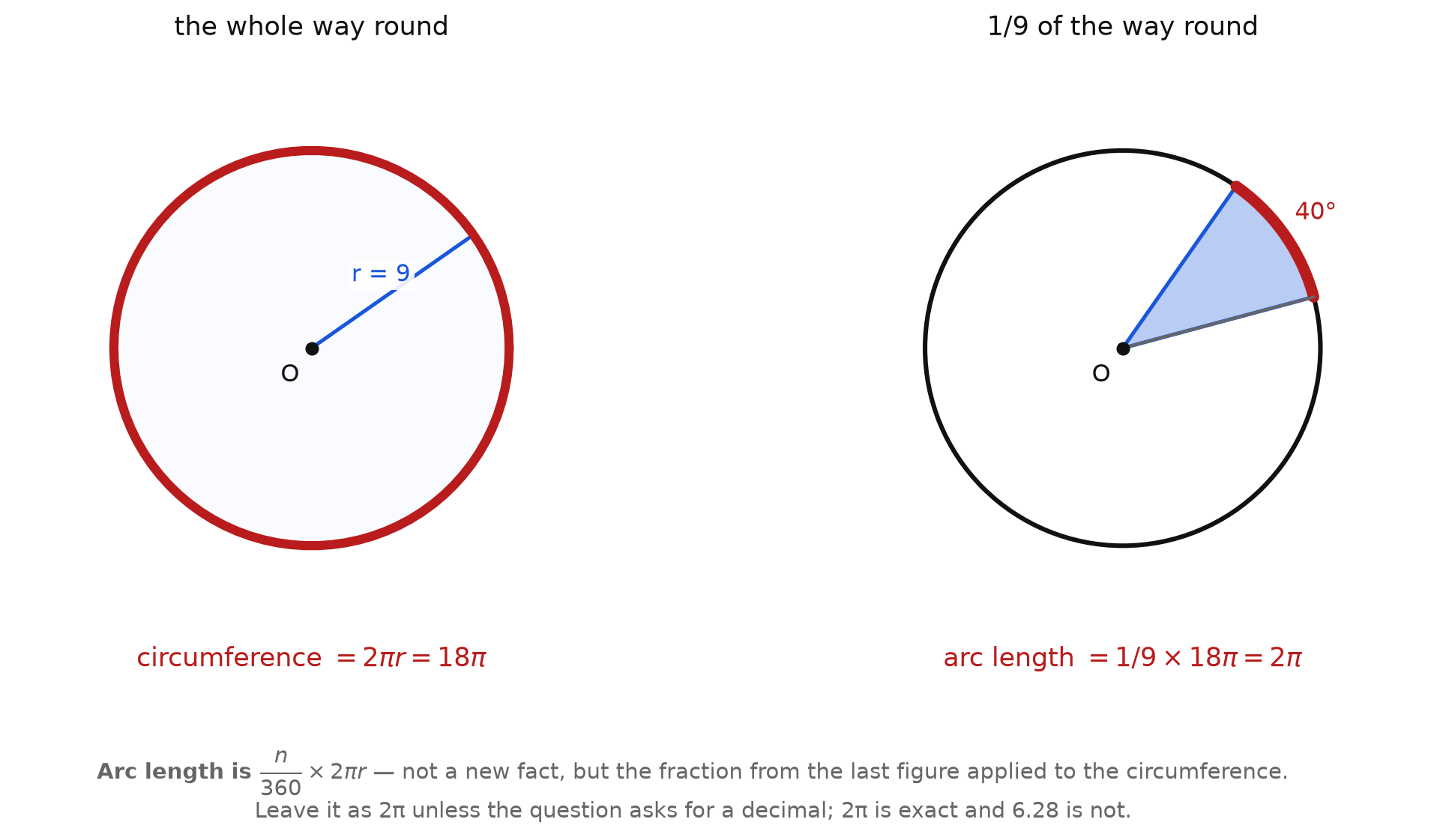
All the way round a circle is the circumference:
An arc of is of the way round. So it is that fraction of the circumference:
Arc length
This is not a second formula to learn. It is the circumference, cut down by the fraction from Lesson 14.1.
A worked one, with the units watched
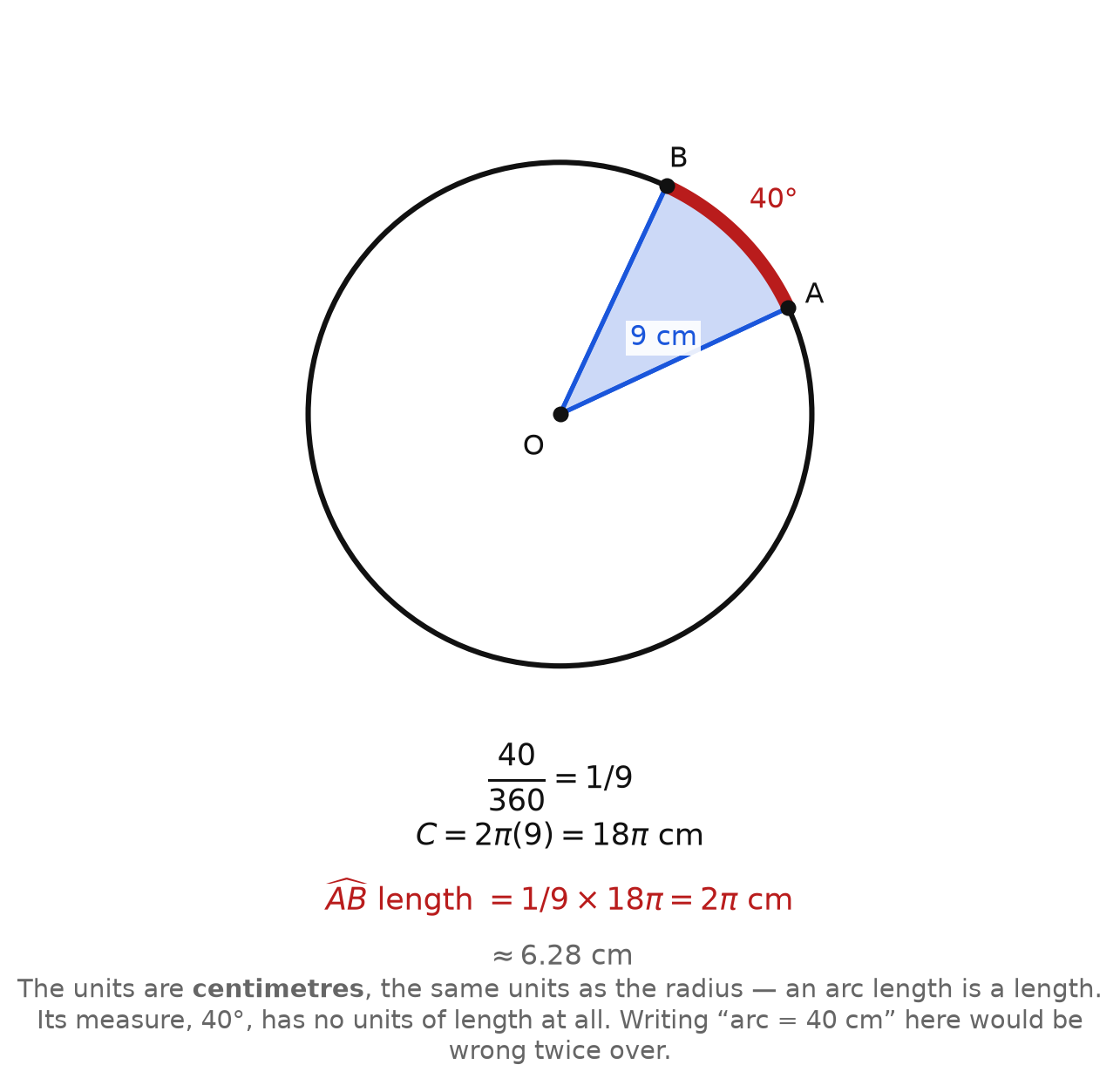
Radius cm, central angle .
The units are centimetres — the same units as the radius, because a length is a length. The measure of that arc is , which is not a number of centimetres at all.
The same angle in different circles
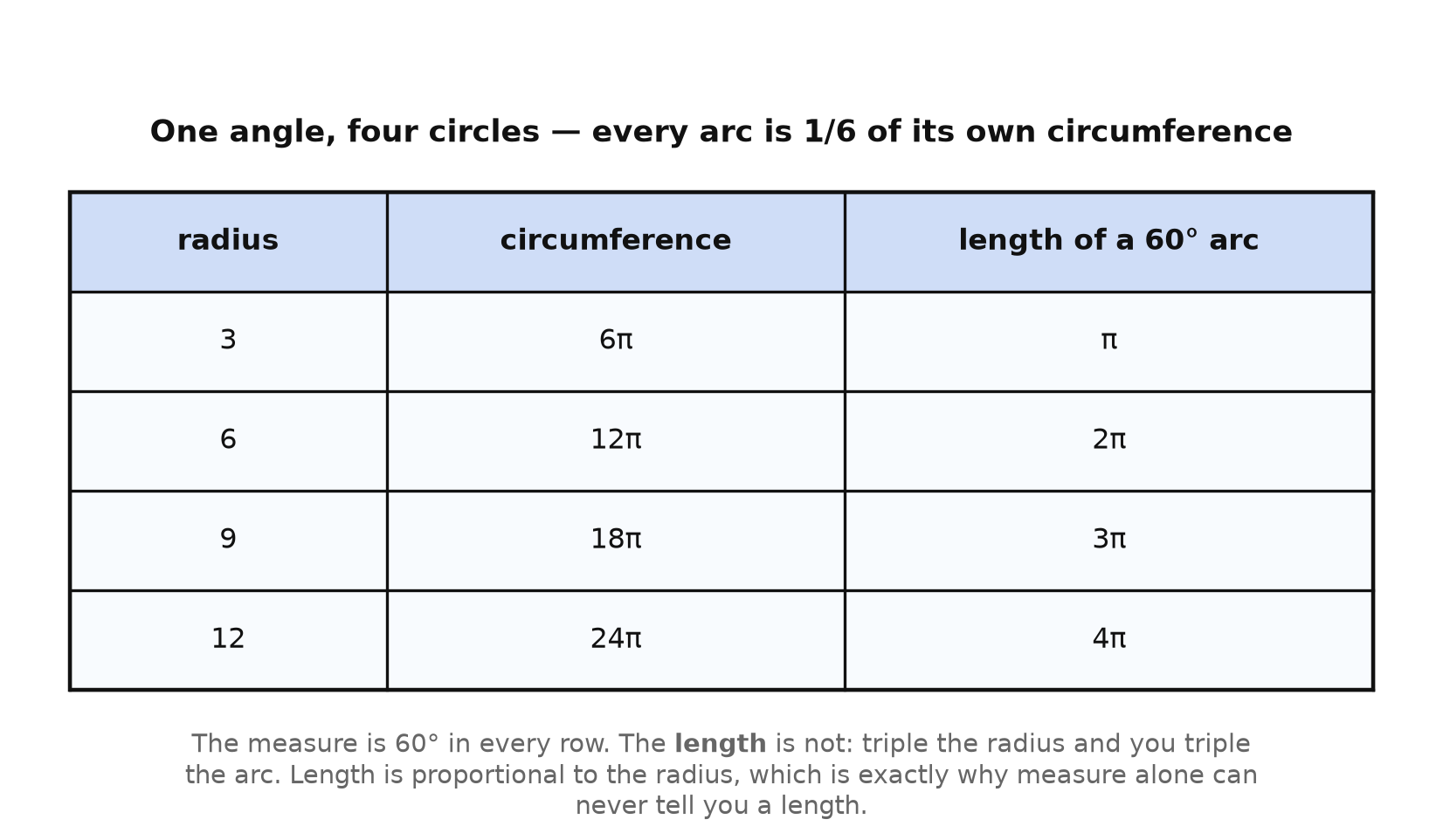
| radius | circumference | length of a arc |
|---|---|---|
Every row is of its own circumference. The measure is in all four. The length triples when the radius triples: arc length is proportional to the radius.
That is exactly why the measure alone can never tell you a length. You need as well.
Going backwards
The formula has three letters in it. Given any two, you can find the third — write the formula, substitute, and solve.
cancels every time, which is the practical reason to keep answers in terms of until the last step.
Worked examples
Example 1 — Straight ahead
Radius , central angle . Give the arc length.
Answer: , and , so .
Example 2 — As a decimal
Give the answer to Example 1 to the nearest hundredth.
Answer: .
Example 3 — A semicircle
Radius , central angle . Give the arc length.
Answer: and , so .
Example 4 — Find the angle
An arc of a circle of radius has length . Give the central angle.
Answer: .
Example 5 — Find the radius
A arc has length . Give the radius.
Answer: .
Guided practice
- Use the derivation figure. Give the circumference of the whole circle.
- On that figure, give the fraction and the arc length, and say how the two are connected.
- Use the worked figure. Give the units of the arc length, and say why they are those units.
- On that figure, say what the number measures, and in what units.
- Use the four-circle table. Give the arc length when the radius is .
- On that table, say what happens to the arc length when the radius is doubled.
Independent practice
Give the arc length in terms of .
- ,
- ,
- ,
- ,
- ,
- ,
- ,
- ,
Give the arc length to the nearest hundredth.
- ,
- ,
- ,
Find the missing quantity.
- A circle of radius has an arc of length . Give the central angle.
- A circle of radius has an arc of length . Give the central angle.
- A circle of radius has an arc of length . Give the central angle.
- A arc has length . Give the radius.
- A arc has length . Give the radius.
- A arc has length . Give the radius.
- Application. A circular garden path has radius feet. A section of it is bounded by a central angle. Give the length of that section in terms of , then to the nearest hundredth.
- Error analysis. A student calculates a arc in a circle of radius as . Identify the mistake and give the correct arc length.
- Reasoning. Two arcs have the same length. Explain why their measures need not be equal, and give a pair of examples that shows it.
Exit ticket 14.2
- Give the length of a arc in a circle of radius , in terms of .
- A arc has length . Give the radius.
Lesson 14.3 — Sector Area
Where this formula comes from
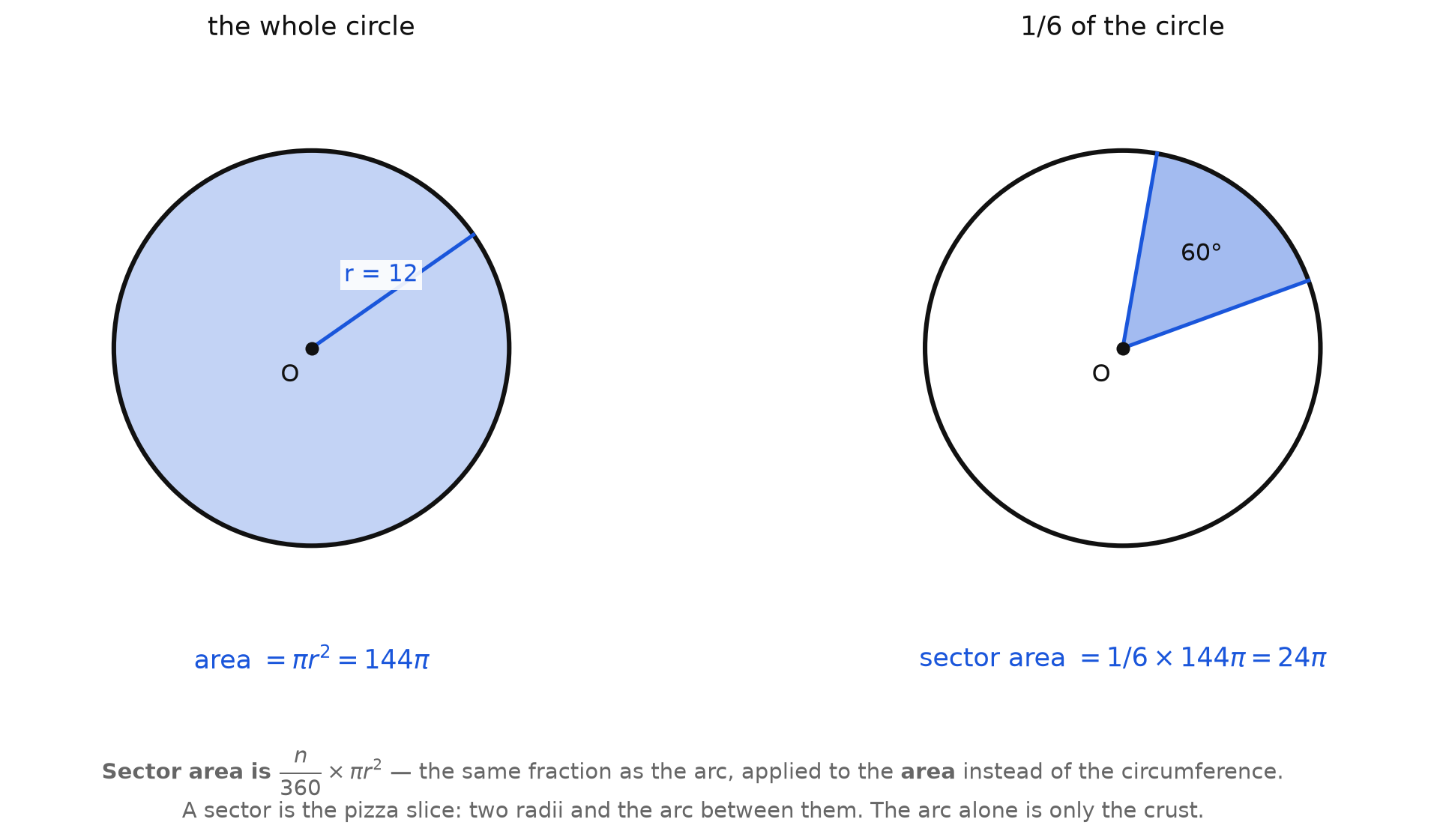
The whole circle has area
A sector of is of the circle. So it is that fraction of the area:
Sector area
Same fraction as the arc. Different total.
A worked one
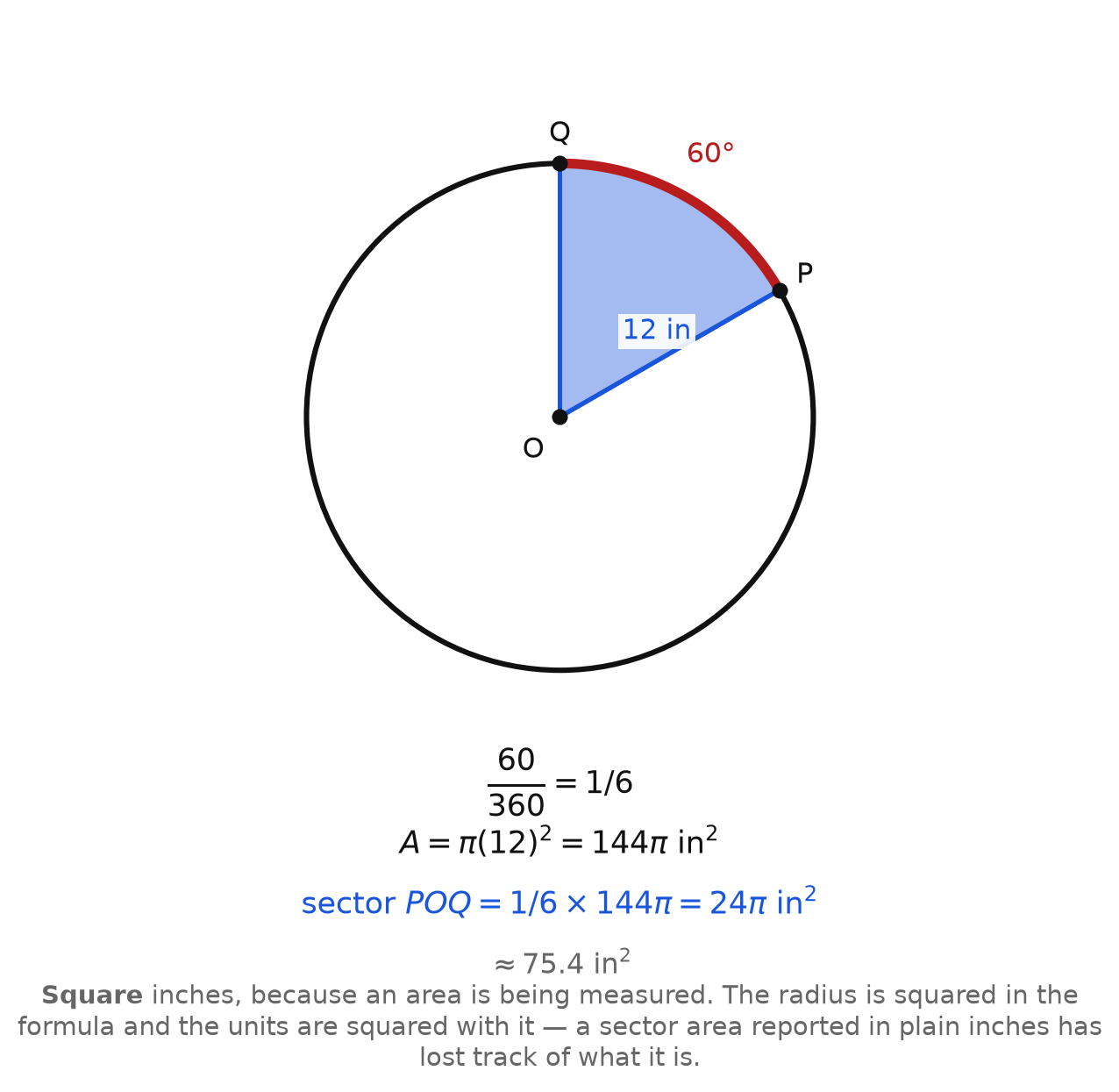
Radius in, central angle .
Square inches. The radius is squared in the formula, and the units are squared with it.
The check that always works
Put into either formula. You should get the whole circle back:
If a sector answer comes out bigger than , it is wrong, and you can see that without knowing the right answer.
Going backwards
Given the sector area and one of or , solve for the other. Finding needs a square root at the end, because the formula squares it.
Worked examples
Example 1 — Straight ahead
Radius , central angle . Give the sector area.
Answer: .
Example 2 — A third
Radius , central angle . Give the sector area.
Answer: .
Example 3 — As a decimal
Give the answer to Example 2 to the nearest hundredth.
Answer: .
Example 4 — Find the angle
A sector of a circle of radius has area . Give the central angle.
Answer: , and , so .
Example 5 — Find the radius
A sector has area . Give the radius.
Answer: .
Guided practice
- Use the derivation figure. Give the area of the whole circle.
- On that figure, give the fraction and the sector area, and say how they are connected.
- Use the worked figure. Give the units of the sector area, and say why they are squared.
- On that figure, say which quantity gets squared in the formula and which does not.
- State the check that a sector area can never fail.
- Say what is different between the arc length formula and the sector area formula, and what is the same.
Independent practice
Give the sector area in terms of .
- ,
- ,
- ,
- ,
- ,
- ,
- ,
- ,
- ,
- ,
Give the sector area to the nearest hundredth.
- ,
- ,
Find the missing quantity.
- A circle of radius has a sector of area . Give the central angle.
- A circle of radius has a sector of area . Give the central angle.
- A circle of radius has a sector of area . Give the central angle.
- A sector has area . Give the radius.
- A sector has area . Give the radius.
- Application. A lawn sprinkler on a post sprays water feet and sweeps through . Give the area it waters in terms of , then to the nearest hundredth.
- Error analysis. A student finds the area of a sector of a circle of radius as . Identify the mistake and give the correct sector area. Say which unit would have caught it.
- Reasoning. A sector's central angle is doubled and its radius is left alone. Say what happens to its area, and explain why the answer is not "it is squared."
Exit ticket 14.3
- Give the area of a sector of a circle of radius , in terms of .
- A sector has area . Give the radius.
Lesson 14.4 — Putting It Together
One figure, two answers
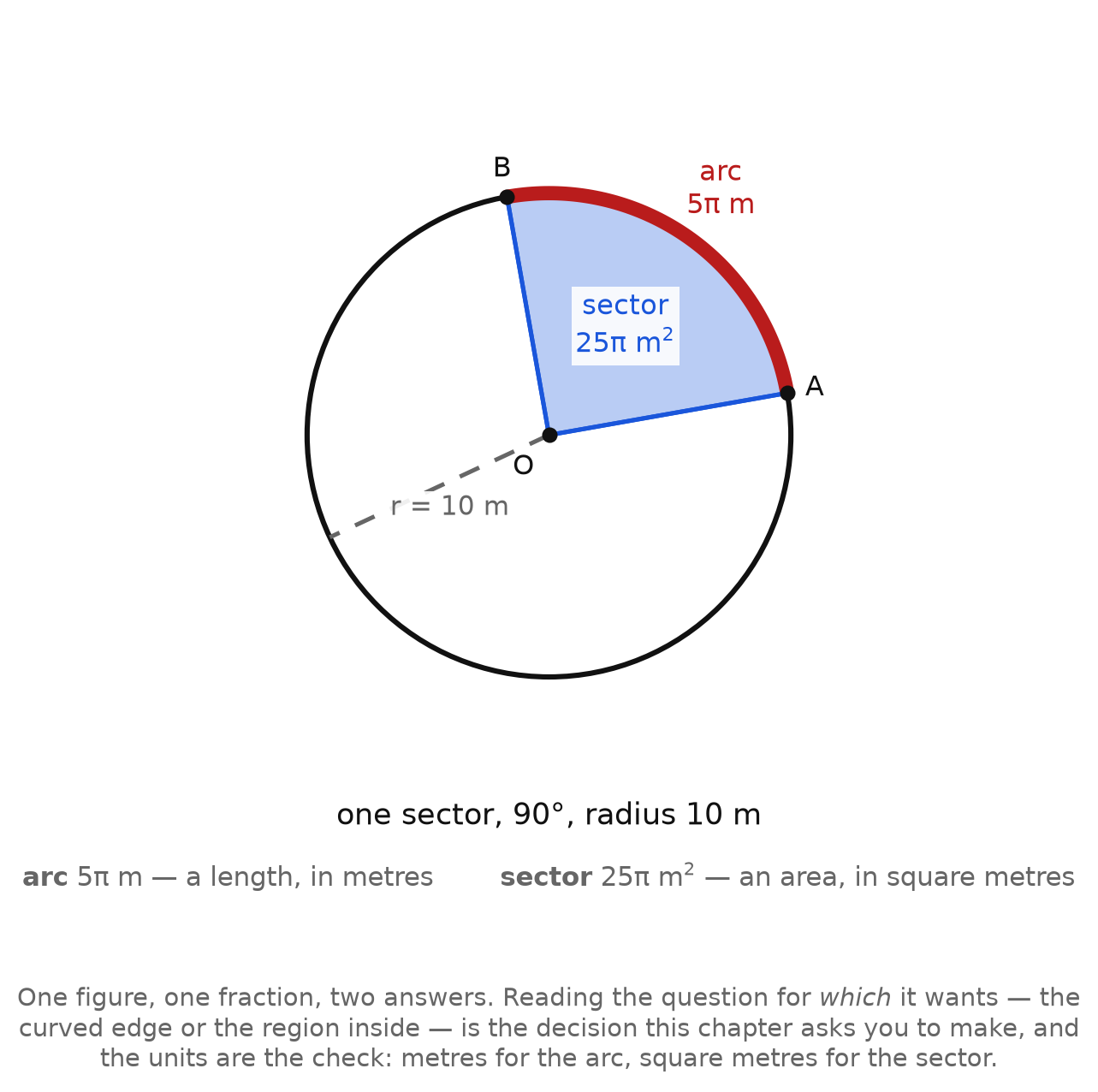
One sector. One fraction. Two different questions:
| the question | the total | the answer | the units |
|---|---|---|---|
| how long is the curved edge? | metres | ||
| how much region is inside? | square metres |
The fraction is in both rows. Everything else follows from which total the question wanted.
The whole chapter on one page
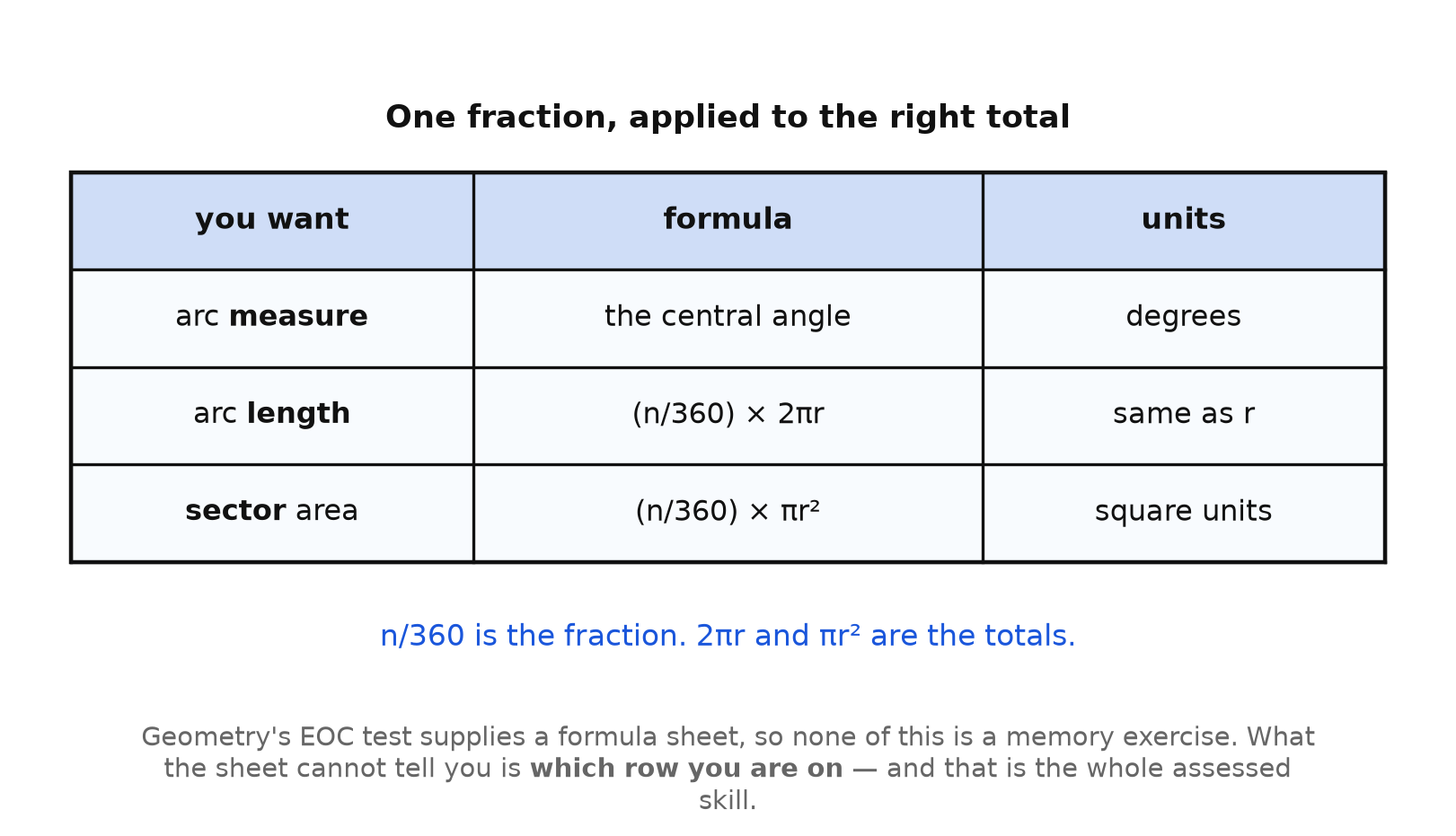
| you want | formula | units |
|---|---|---|
| arc measure | the central angle itself | degrees |
| arc length | same as | |
| sector area | square units |
Read the units off your answer and check them against the question. Metres where the question wanted square metres means you used the wrong row.
Both directions
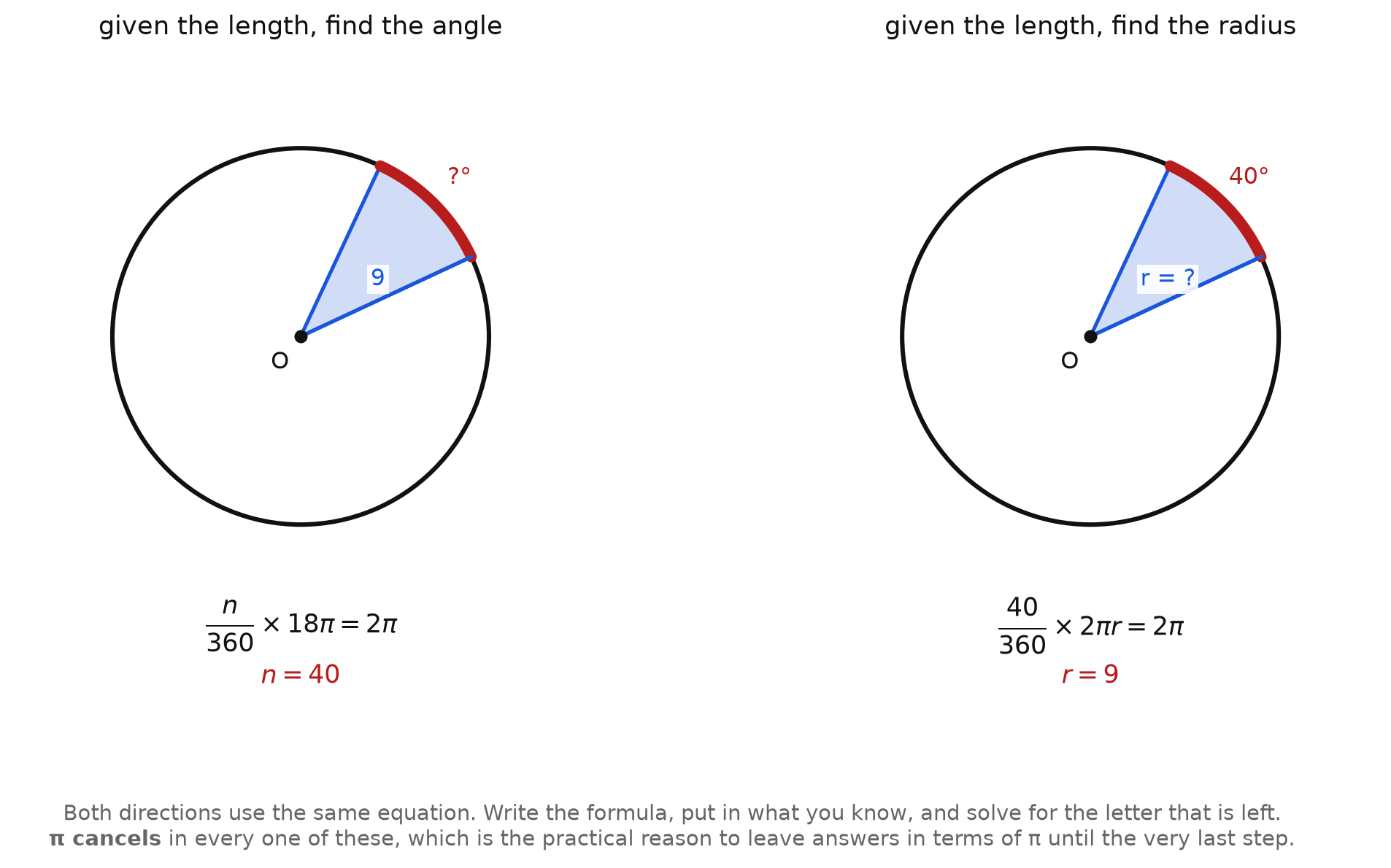
Whichever letter is missing, the method is the same: write the formula, substitute what you know, solve.
Changing the radius
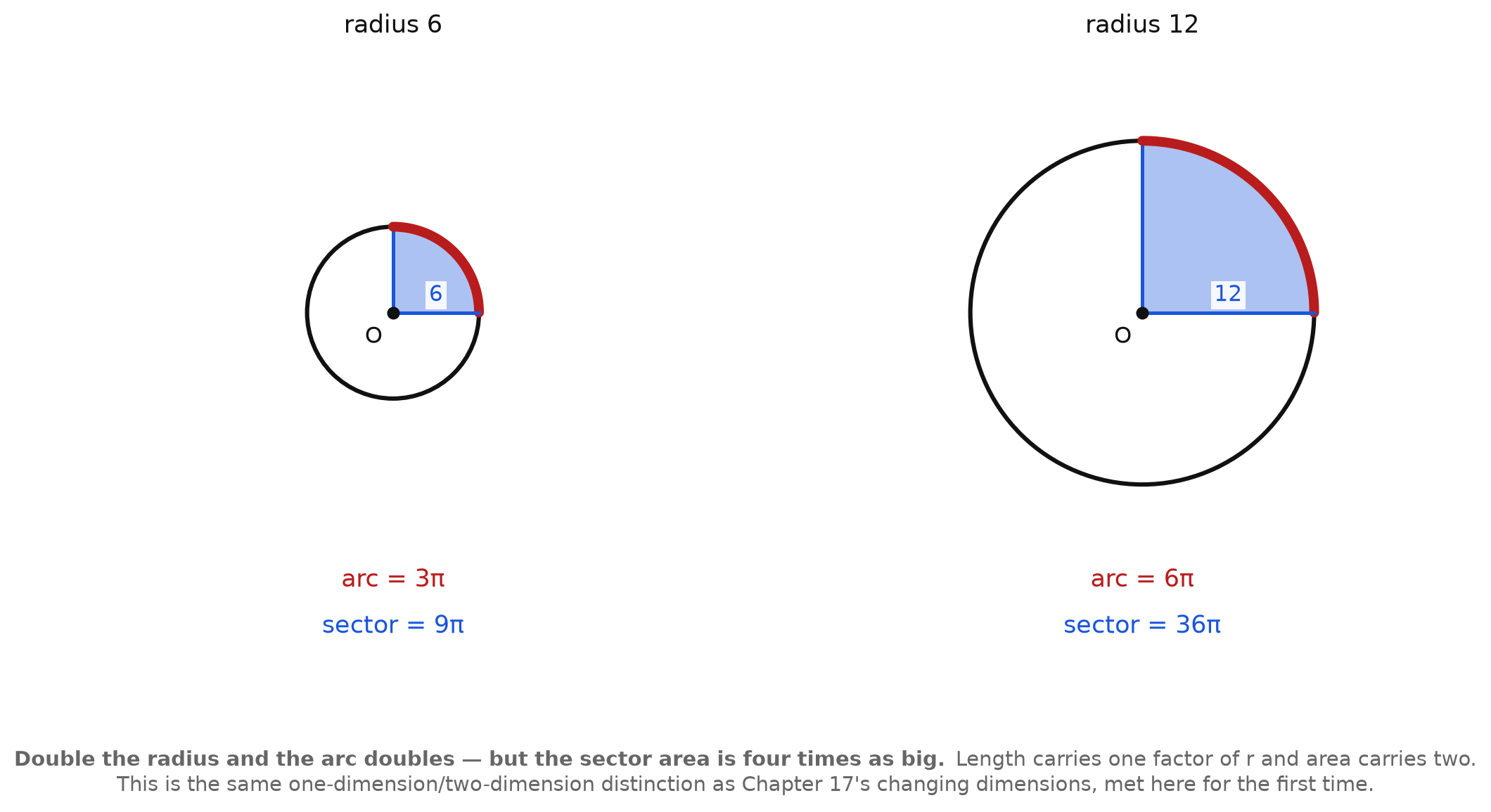
Double the radius, keep the angle:
| radius | radius | factor | |
|---|---|---|---|
| arc length | |||
| sector area |
The arc doubles. The sector area is four times as big.
A length carries one factor of ; an area carries two. You will meet this again in Chapter 17, where the same idea is applied to solids.
In context
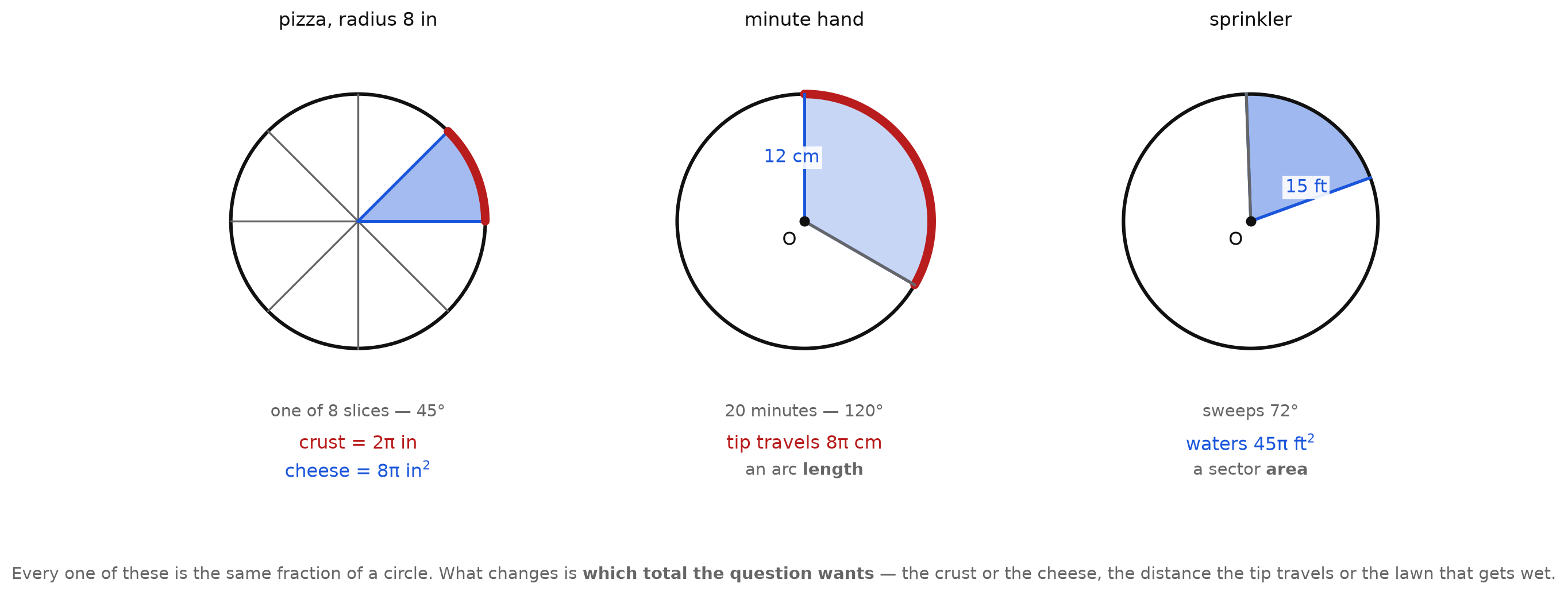
- Pizza, radius in, one of slices, so . The crust is an arc: in. The cheese is a sector: in².
- A minute hand of length cm sweeps per minute, so minutes is . The tip travels an arc: cm.
- A sprinkler reaching ft and sweeping waters a sector: ft².
Every one is the same fraction of a circle. The word that decides the formula is the one naming what is being measured — a distance along the edge, or a region inside.
Worked examples
Example 1 — Which one?
"How much fence is needed for the curved side of a garden bed of radius m?" Name the quantity and give it.
Answer: An arc length: m.
Example 2 — Which one?
"How much turf is needed for that garden bed?" Name the quantity and give it.
Answer: A sector area: m².
Example 3 — Both
A sector has radius . Give the arc length and the sector area.
Answer: Arc ; sector .
Example 4 — Perimeter of a sector
Give the distance all the way round the sector in Example 3.
Answer: The boundary is two radii plus the arc: . Not — an arc is only part of the boundary.
Example 5 — Scaling
A sector's radius is multiplied by and its angle is unchanged. Give the factor for its arc length and for its area.
Answer: Arc ; area .
Guided practice
- Use the one-sector figure. Give the arc length and the sector area, with units.
- On that figure, say which of the two answers a question about fencing would want.
- Use the formula board. Say what tells you which row you are on.
- Use the backwards figure. Give the equation you would write to find the radius.
- Use the doubling figure. Give the factor for the arc and the factor for the area.
- Use the context figure. Say which of the three quantities is an area, and how you know.
Independent practice
For each, name the quantity — arc length or sector area — and give it in terms of .
The curved edge of a sector of radius .
The region inside a sector of radius .
The curved edge of a sector of radius .
The region inside a sector of radius .
The curved edge of a sector of radius .
The region inside a sector of radius .
A sector has radius . Give its arc length and its sector area.
A sector has radius . Give its arc length and its sector area.
Give the perimeter of a sector of radius , in terms of .
Give the perimeter of a sector of radius , in terms of .
A sector's radius is doubled, angle unchanged. Give the factor for its arc length.
A sector's radius is doubled, angle unchanged. Give the factor for its area.
A sector's angle is doubled, radius unchanged. Give the factor for its arc length and for its area.
A sector's radius is halved, angle unchanged. Give the factor for its area.
Application. A pizza of radius in is cut into equal slices. Give the crust length of one slice and the area of one slice, both in terms of .
Application. A minute hand is cm long. Give the distance its tip travels in minutes, in terms of .
Application. A sprinkler reaches ft and sweeps . Give the watered area in terms of , then to the nearest hundredth.
Error analysis. A student is asked for the perimeter of a sector of radius and answers . Say what they gave, and give the perimeter.
Reasoning. Explain why the units alone are enough to tell you whether an answer belongs to arc length or to sector area.
Reasoning. Explain why doubling the radius does not double the sector area, using the formula rather than the picture.
Exit ticket 14.4
- A sector has radius . Give its arc length and its sector area, in terms of .
- Give the one question to ask before choosing between the two formulas.
Chapter 14 Review
Vocabulary. circumference · area of a circle · arc measure · arc length · sector · sector area · central angle · proportional · exact form · perimeter of a sector
Review 1 (G.PC.3a). A circle has radius , and a central angle of is drawn.
- Give the fraction of the circle that angle opens onto, in lowest terms.
- Give what that fraction is a fraction of, for the arc and for the sector.
- Give the arc length and the sector area, in terms of .
- Say which of the two answers would change if the angle stayed at and the radius became , and by what factor each changes.
Review 2 (G.PC.3d). A circle of radius has an arc of length .
- Give the central angle.
- Give the arc's measure and the arc's length, and say which units each carries.
- A second circle of radius has an arc of the same measure. Give its length.
- Say what stayed the same between the two circles and what did not, and why.
Review 3 (G.PC.3 d, e). A sector is cut from a circle of radius .
- Give the arc length and the sector area, in terms of .
- Give the perimeter of the sector, and say why it is not the same as the arc length.
- Give the sector area as a decimal to the nearest hundredth.
- Check your sector area against the area of the whole circle, and say what that check rules out.
Standards coverage check — Chapter 14
| Knowledge and Skill | Where it is taught | Where it is practiced | Where it is applied in context |
|---|---|---|---|
| G.PC.3a — determine the proportional relationship between the arc length or area of a sector and other parts of a circle | 14.1 (measure against length; the fraction ; reducing); 14.2 (arc length proportional to ); 14.4 (changing the radius) | 1–23, 25, 26; 33, 34, 54; 101–104, 109, 110 | 24; 52; 105–107; Review 1, Review 2 |
| G.PC.3d — calculate the length of an arc of a circle | 14.2 (the formula, its derivation, and both reverse directions); 14.4 (choosing between the two) | 29–51, 53–56; 85–89, 91, 93, 95, 97–100, 108 | 52; 105, 106; Review 2, Review 3 |
| G.PC.3e — calculate the area of a sector of a circle | 14.3 (the formula, its derivation, the check, and both reverse directions); 14.4 (choosing between the two) | 57–79, 81–84; 90, 92, 94, 96–98 | 80; 107; Review 1, Review 3 |
Supporting items: 26, 54, 82, 109, and 110 are the reasoning items. Item 109 carries the chapter's organising claim — that the units of an answer identify which quantity it is, so a unit check catches the chapter's central error without knowing the right answer. The error analyses target the recurring failures: reporting a measure when a length was asked for (25), using inside the arc length formula (53), using inside the sector area formula (81), and mistaking an arc for the whole boundary of a sector (108).
Boundaries respected. This chapter teaches the proportional relationship (a), arc length (d), and sector area (e), and relies on the central angle work of Chapter 13 without re-teaching it. Radians do not appear — every angle in this volume is in degrees, as Chapter 13 fixed. The area of a circular segment — the region between a chord and its arc — is not named anywhere in G.PC.3 and is not taught here; every region in this chapter is bounded by two radii and an arc. Answers are exact in terms of first, with decimals given only where a question asks for one.
Answer keys for every item in this chapter are in Appendix A.