Chapter 13 — Circles: Central and Inscribed Angles
Standard: G.PC.3 (b, c)
G.PC.3 — verbatim. The student will solve problems, including those in context, by applying properties of circles. Students will demonstrate the following Knowledge and Skills: a) Determine the proportional relationship between the arc length or area of a sector and other parts of a circle. b) Solve for arc measures and angles in a circle formed by central angles. c) Solve for arc measures and angles in a circle involving inscribed angles. d) Calculate the length of an arc of a circle. e) Calculate the area of a sector of a circle.
By the end of this chapter you will be able to:
- Name the parts of a circle and the three kinds of arc (G.PC.3b)
- Use arc measures around a circle total to find a missing arc (G.PC.3b)
- Use a central angle equals its arc (G.PC.3b)
- Use an inscribed angle is half its arc — and justify it (G.PC.3c)
- Get the three consequences out of that one rule: same arc, semicircle, inscribed quadrilateral (G.PC.3c)
- Decide, before computing anything, where the vertex is (G.PC.3 b, c)
Lessons: 13.1 Circles and Arcs · 13.2 Central Angles · 13.3 Inscribed Angles · 13.4 Three Consequences · 13.5 Putting It Together
Why this chapter matters. Almost every mistake in circle work is one decision made wrong: is the vertex at the centre, or on the circle? At the centre the angle equals its arc; on the circle it is half. Same arc, same endpoints, and answers that differ by a factor of two. Lesson 13.5 exists to make that decision automatic.
Scope note. This chapter is G.PC.3 b and c — the angles. Bullets a, d, and e — the proportional relationship, arc length, and sector area — are Chapter 14. Here an arc is measured in degrees only; it acquires a length in the next chapter.
What the 2023 standard does not include. Chord–chord, secant–secant, and tangent–secant angle and segment theorems are not in G.PC.3, and this book does not teach them. If you meet "two chords intersect inside a circle," that is beyond this course.
Conventions this chapter fixes.
- Arc measure is in degrees. says nothing about how long the arc is. Two circles of different sizes can have arcs of the same measure and very different lengths.
- Minor arcs take two letters, major arcs take three. is the short way round; goes the long way, through . A semicircle is exactly .
- Arcs add, the way adjacent angles do, and the arcs all the way round total .
- "Subtends" means "opens onto." An angle subtends the arc between the two points its sides cut off.
- Congruent arcs need one circle (or congruent circles). A arc on a coin and a arc on a running track have equal measure and nothing like equal size.
- Item numbering runs straight through the chapter, from 1 in Lesson 13.1 to 126 at the end of Lesson 13.5.
Lesson 13.1 — Circles and Arcs
The parts
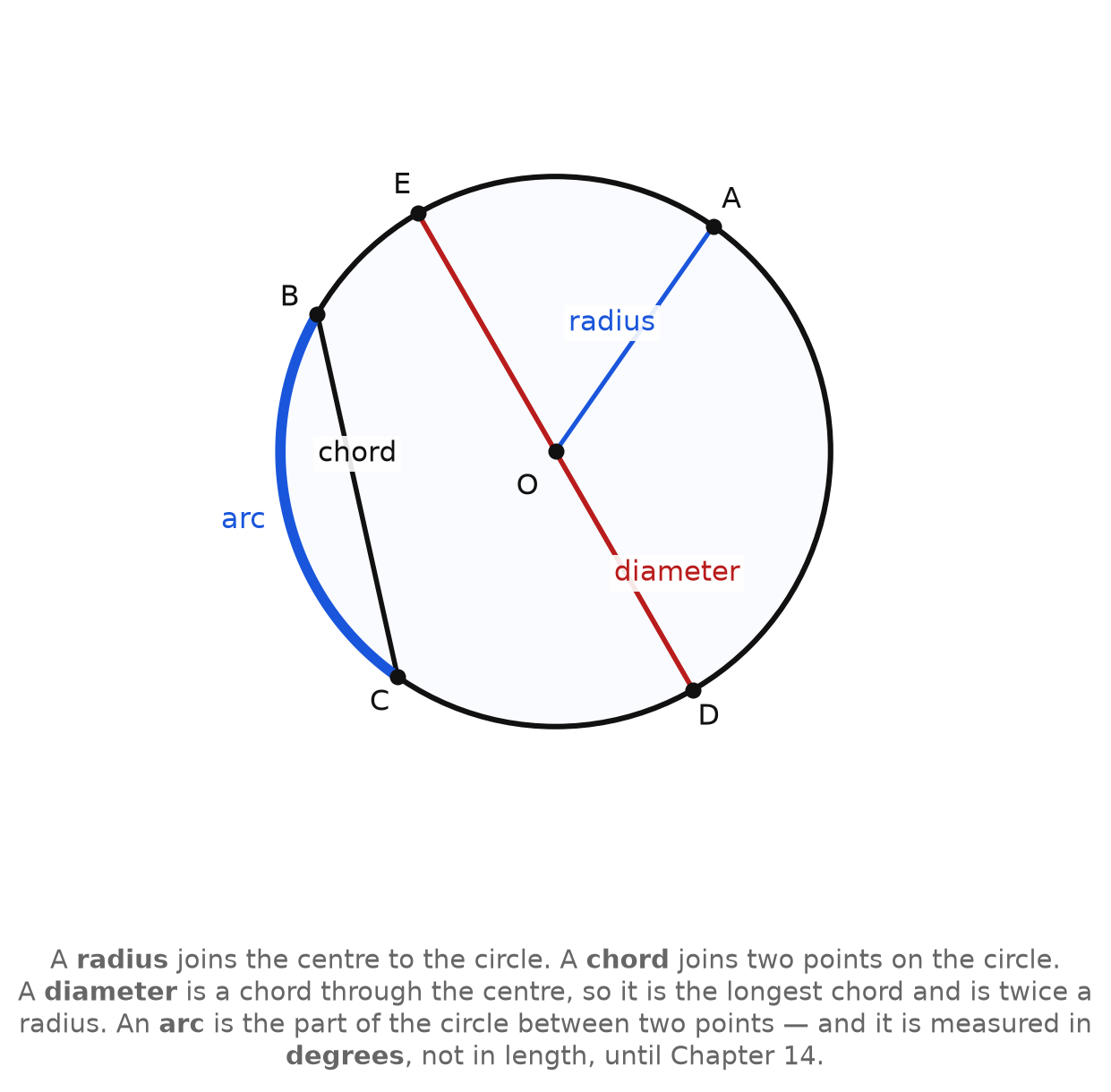
| Part | What it is |
|---|---|
| centre | the point every point of the circle is the same distance from |
| radius | a segment from the centre to the circle |
| chord | a segment joining two points on the circle |
| diameter | a chord through the centre — the longest chord, and twice a radius |
| arc | the part of the circle between two points |
A circle is named by its centre: circle .
Three kinds of arc
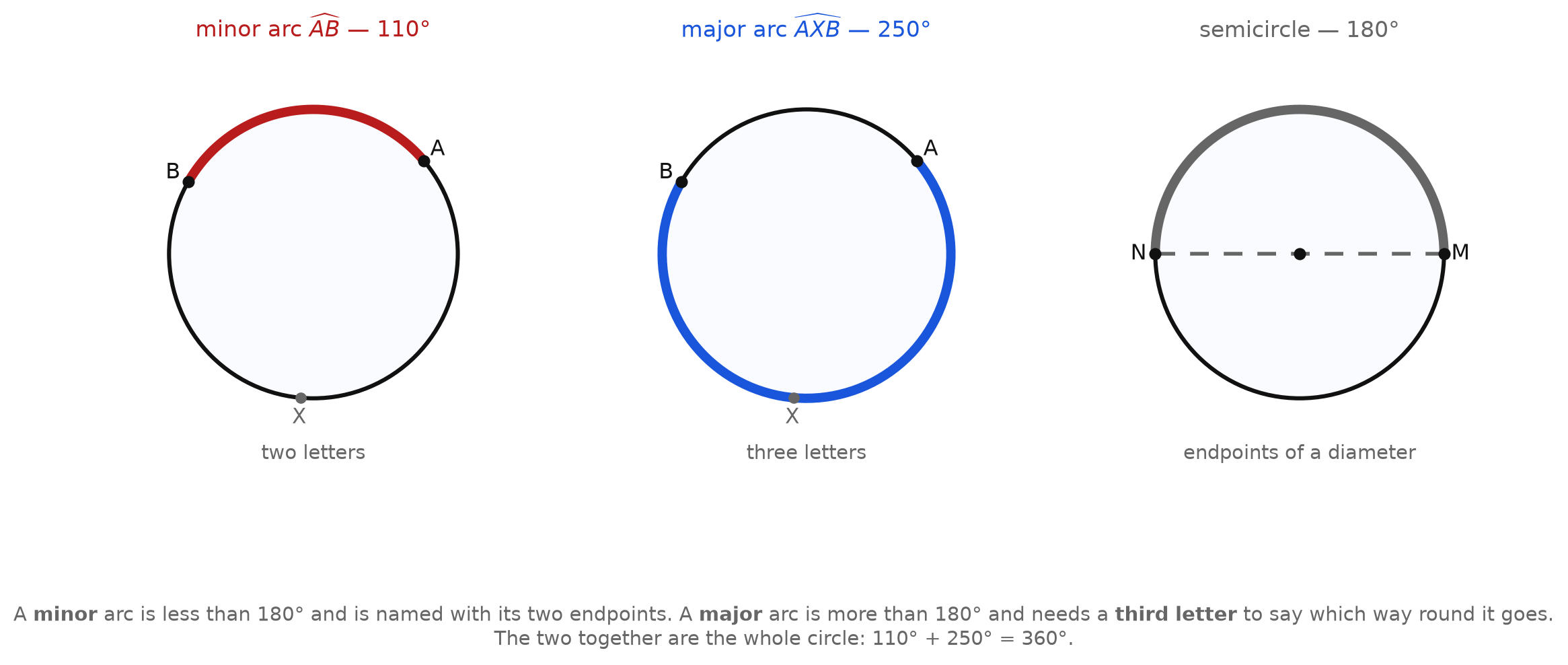
- A minor arc is less than and is named with its two endpoints: .
- A major arc is more than and needs a third letter to say which way round: .
- A semicircle is exactly — the arc cut off by a diameter.
The minor and major arc with the same endpoints together make the whole circle:
Two letters is ambiguous for a major arc. always means the minor arc. If you mean the long way round, you must name a point on it.
Arcs add, and total
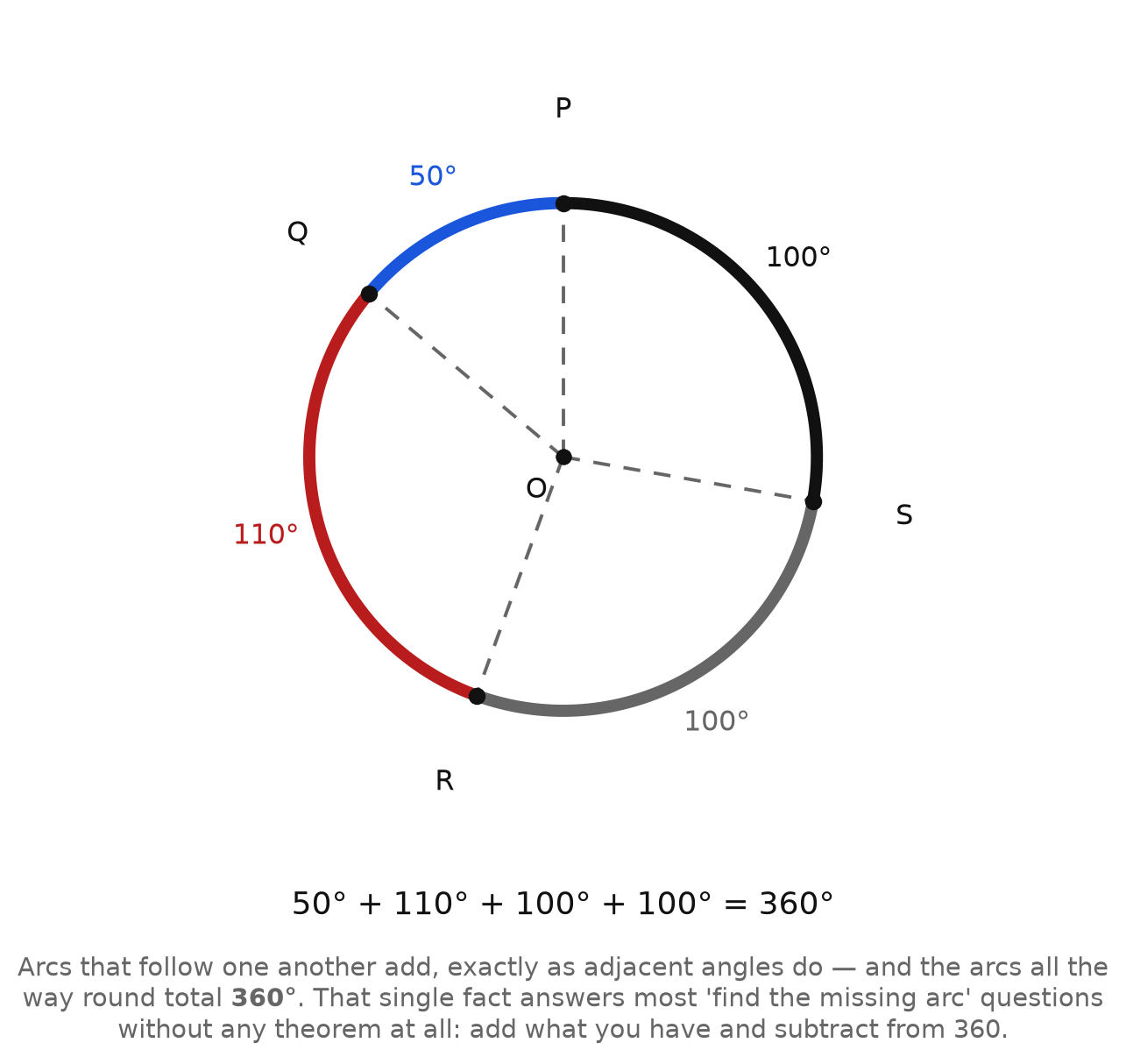
Arcs that follow one another add, exactly as adjacent angles do:
And all the way round:
That one fact answers most "find the missing arc" questions with no theorem at all — add what you have and subtract from .
Worked examples
Example 1 — Naming
An arc measures . Minor or major? How many letters?
Answer: Minor (less than ), so two letters.
Example 2 — The other arc
. Give the measure of the major arc with the same endpoints.
Answer: .
Example 3 — A missing arc
Three arcs of a circle are , , and . Give the fourth.
Answer: .
Example 4 — Adding
and . Give .
Answer: .
Example 5 — Measure is not length
Circle has radius cm and circle radius cm. Both have a arc. Are the arcs congruent?
Answer: No. They have the same measure but very different lengths. Congruent arcs need congruent circles.
Guided practice
- Use the parts figure. Name the segment from the centre to the circle.
- On that figure, say what makes a chord a diameter.
- On that figure, give the relationship between a diameter and a radius.
- Use the arc-naming figure. Give the minor arc and its measure.
- On that figure, give the major arc, its measure, and why it needs three letters.
- Use the arcs-total figure. Give the four arcs and their total.
Independent practice
- A chord through the centre is called a ____.
- Circle has radius . Give the diameter.
- Circle has diameter . Give the radius.
- . Minor or major?
- . Give the major arc with the same endpoints.
- . Give the major arc with the same endpoints.
- Three arcs of a circle are , , and . Give the fourth.
- Three arcs of a circle are , , and . Give the fourth.
- Three arcs of a circle are , , and . Give the fourth.
- and . Give .
- , , . Give .
- Give the measure of a semicircle, and say what makes an arc one.
- Application. A round pizza is cut into equal slices. Give the arc measure of one slice's crust.
- Error analysis. A student writes . Explain what is wrong with the notation, and how to fix it.
- Reasoning. Explain why an arc's measure tells you nothing about its length.
- Reasoning. Explain why the minor and major arcs on the same two points must total .
Exit ticket 13.1
- . Give the major arc with the same endpoints.
- Three arcs of a circle are , , and . Give the fourth.
Lesson 13.2 — Central Angles
The angle is the arc
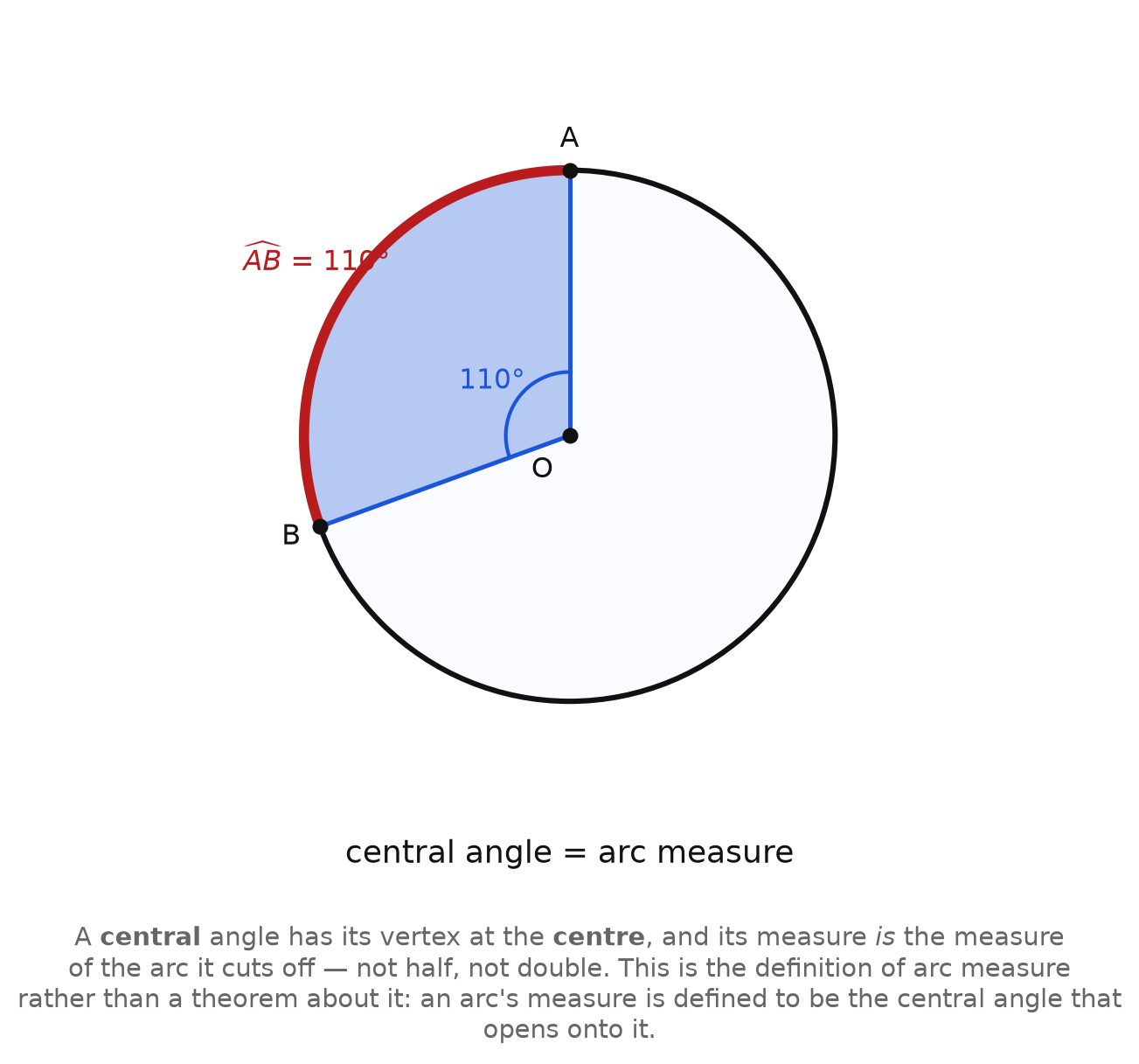
A central angle has its vertex at the centre.
Central angle = arc measure.
This is not a theorem to prove — it is the definition of arc measure. An arc's measure is the central angle that opens onto it. That is why arcs are in degrees at all.
Equal angles, equal arcs, equal chords
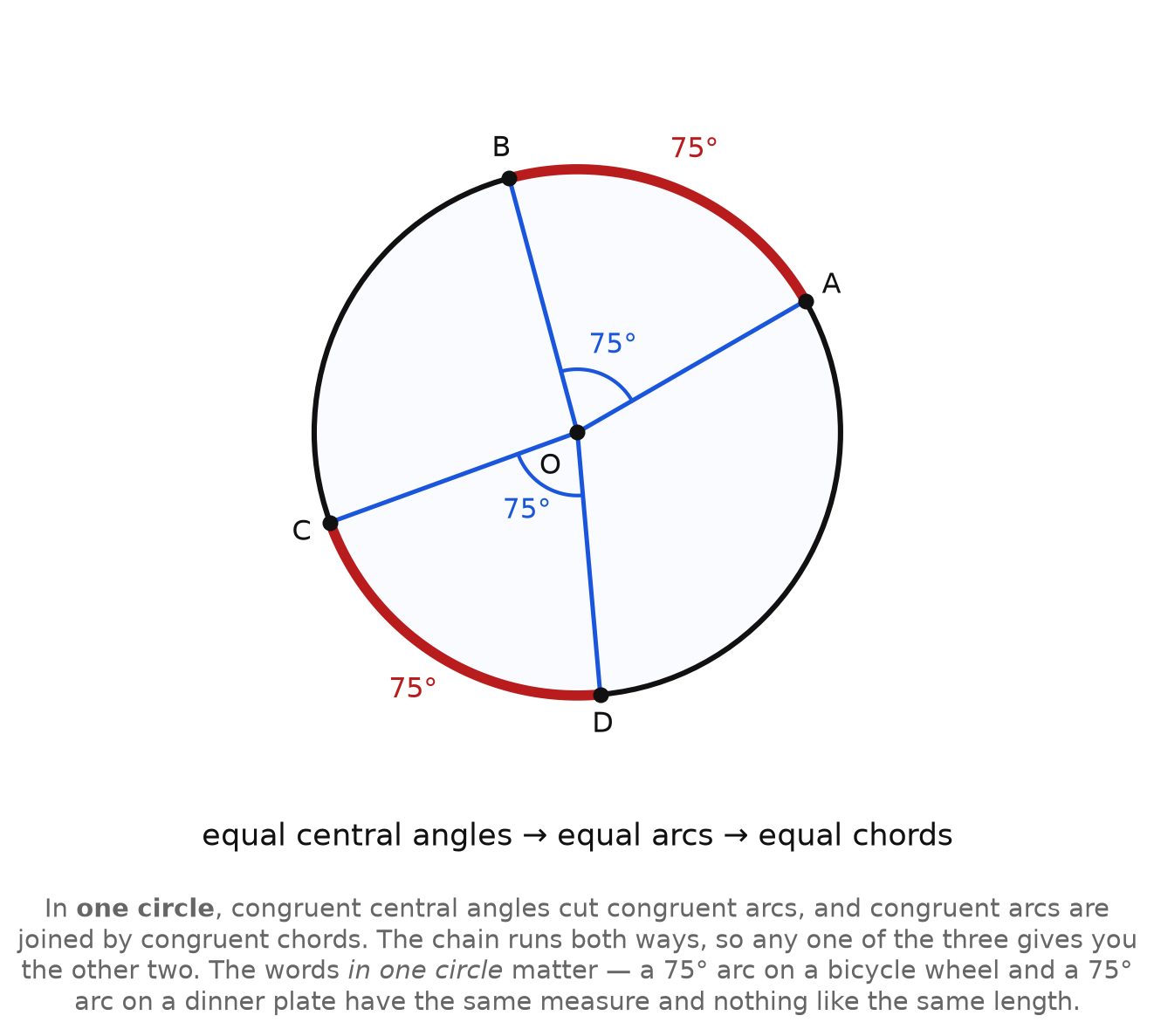
In one circle (or in congruent circles): congruent central angles congruent arcs congruent chords.
The chain runs both ways, so any one of the three gives you the other two.
"In one circle" is doing real work. Across two circles of different sizes, equal central angles still give equal arc measures — but not equal arcs or chords.
Equally spaced points
If points are equally spaced around a circle, each arc between neighbours is
Eight equally spaced points give each; twelve give .
Worked examples
Example 1 — Angle to arc
, with the centre. Give .
Answer: — a central angle equals its arc.
Example 2 — Arc to angle
, with the centre. Give .
Answer: .
Example 3 — The reflex direction
. Give the major arc .
Answer: .
Example 4 — Equally spaced
Twelve points are equally spaced on a circle. Give the central angle between neighbours.
Answer: .
Example 5 — With algebra
Three central angles fill a circle and measure , , and . Find and the three arcs.
Answer: , so the arcs are , , and .
Guided practice
- Use the central-angle figure. Give the angle and the arc, and say how they are related.
- On that figure, explain why this relationship is a definition rather than a theorem.
- Use the congruent-angles figure. Give the two angles and the two arcs.
- On that figure, state the three-way chain that links angles, arcs, and chords.
- Explain why that chain needs the words in one circle.
- Give the formula for the arc between neighbouring points when points are equally spaced.
Independent practice
is the centre in every item below.
- . Give .
- . Give .
- . Give .
- . Give .
- . Give the major arc .
- . Give the major arc with the same endpoints.
- Six points are equally spaced on a circle. Give the central angle between neighbours.
- Ten points are equally spaced on a circle. Give the central angle between neighbours.
- Nine points are equally spaced on a circle. Give the central angle between neighbours.
- Two central angles in one circle are congruent and one cuts a arc. Give the other arc.
- Three central angles fill a circle and measure , , and . Find and all three arcs.
- Four central angles fill a circle and measure , , , and . Find and all four arcs.
- Two arcs of a circle are and . Give .
- Application. A Ferris wheel has cars equally spaced around the rim. Give the central angle between neighbouring cars, and the arc a car travels between two stops.
- Application. A pie chart shows one category as a sector. Give that category's share of the whole as a fraction in lowest terms.
- Error analysis. A student says a arc on a bicycle wheel is congruent to a arc on a merry-go-round. Correct them.
- Reasoning. Explain why a central angle can never be more than , and what an angle of exactly cuts off.
- Reasoning. Two chords in one circle are congruent. Explain what follows about their arcs and about their central angles.
Exit ticket 13.2
- . Give and the major arc with the same endpoints.
- Five points are equally spaced on a circle. Give the central angle between neighbours.
Lesson 13.3 — Inscribed Angles
The angle is half the arc
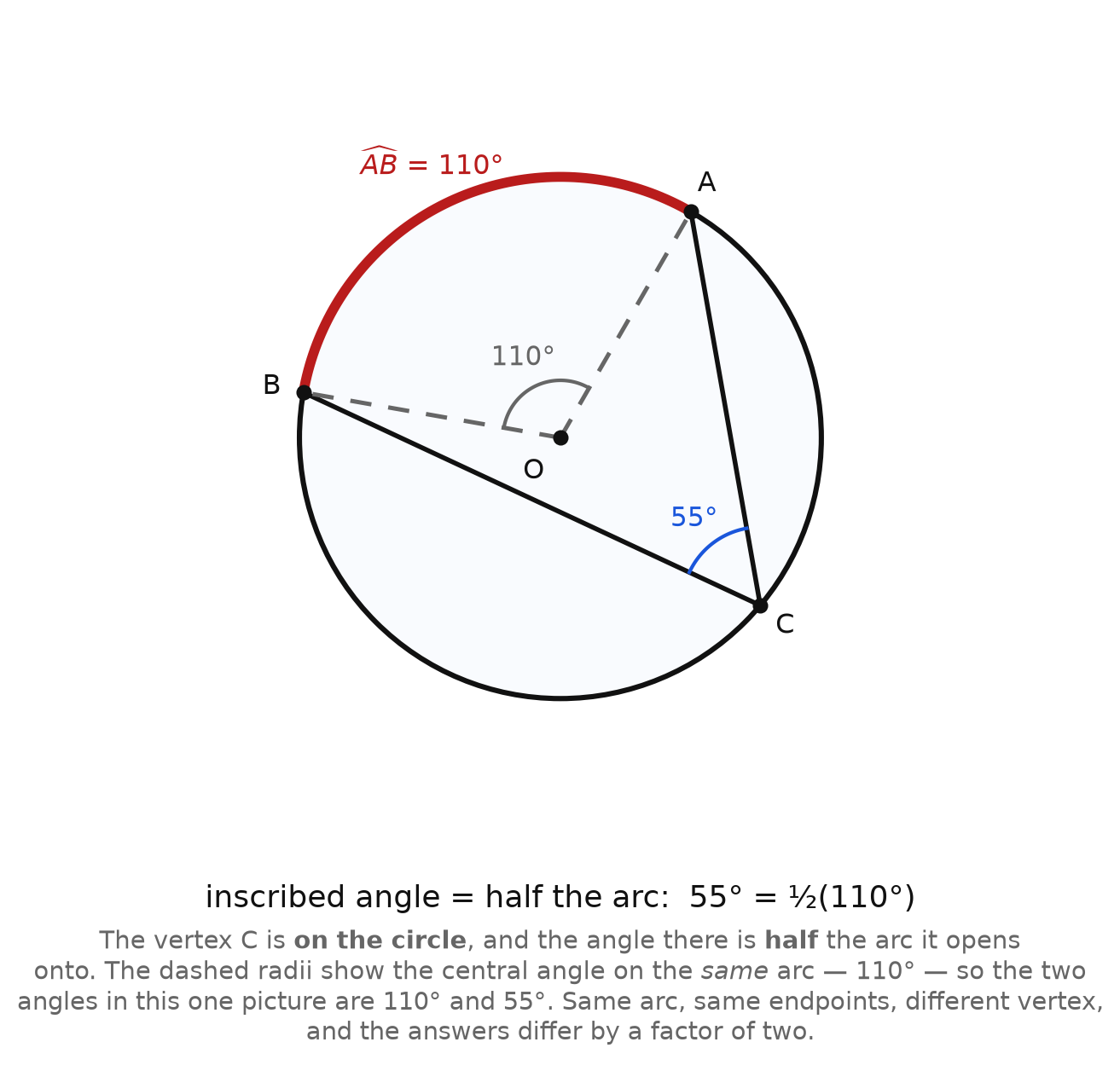
An inscribed angle has its vertex on the circle, with both sides chords.
Inscribed angle half its arc.
In the figure the arc is , the central angle on that same arc is , and the inscribed angle is . One picture, two angles, factor of two.
Running it backwards: if the inscribed angle is , the arc is . Double, don't halve.
Why it is half
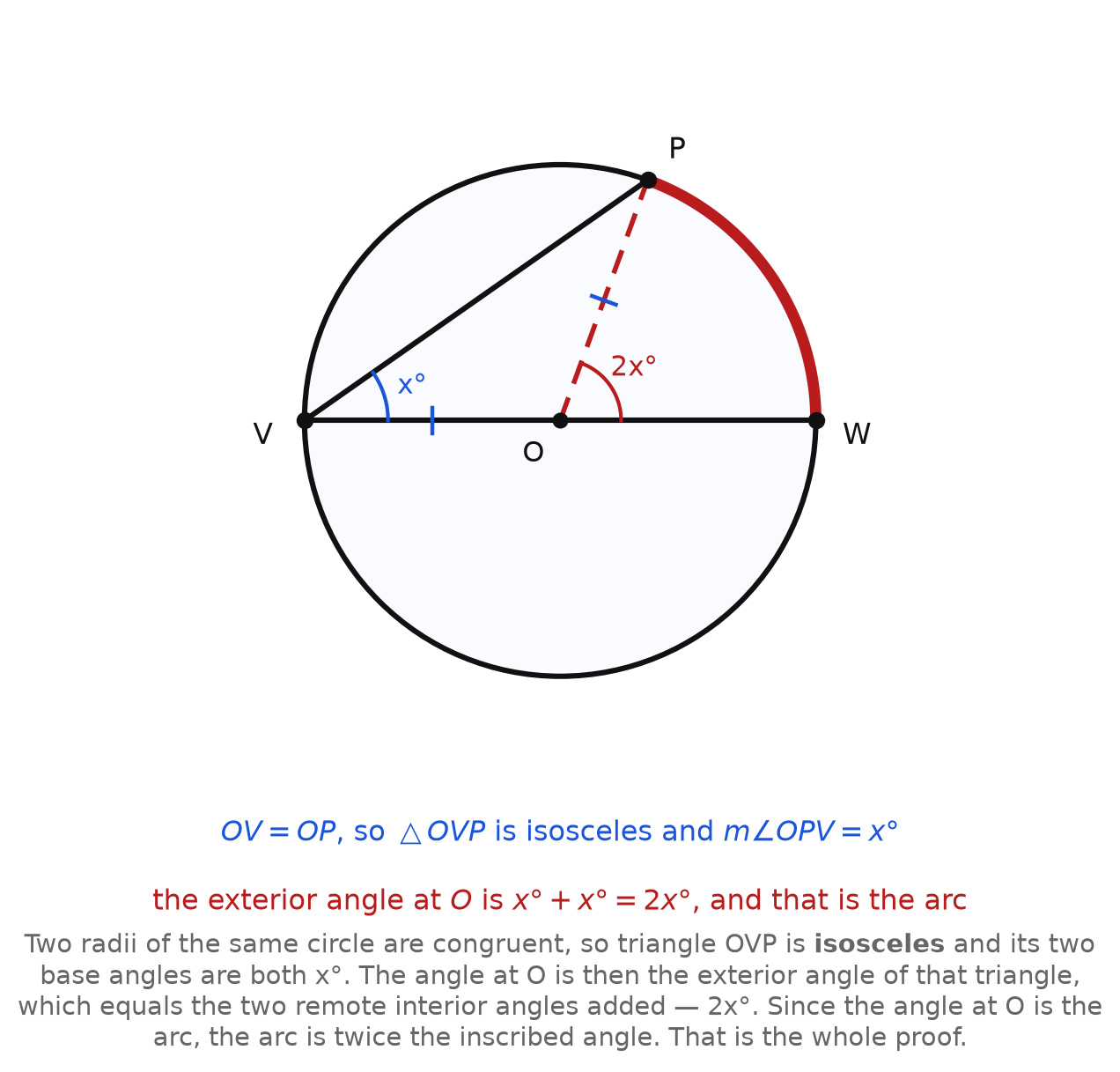
Take the case where one side of the angle passes through the centre. Let .
- and are both radii, so is isosceles and too.
- The angle at is the exterior angle of that triangle, so it equals the two remote interior angles added: .
- The angle at is a central angle, so it is the arc.
So the arc is while the inscribed angle is — the arc is twice the angle. That is the whole proof, and the general case is built by splitting any inscribed angle into two of these with a diameter.
Worked examples
Example 1 — Arc to angle
An inscribed angle subtends a arc. Give the angle.
Answer: .
Example 2 — Angle to arc
An inscribed angle measures . Give its arc.
Answer: .
Example 3 — A major arc
An inscribed angle subtends a arc. Give the angle.
Answer: .
Example 4 — Both angles at once
The arc . Give the central angle and the inscribed angle on that arc.
Answer: Central ; inscribed .
Example 5 — With algebra
An inscribed angle measures and its arc measures . Find and both measures.
Answer: , so . The angle is and the arc is . (Check: . ✓)
Guided practice
- Use the inscribed-angle figure. Give the arc and the inscribed angle.
- On that figure, give the central angle on the same arc, and the ratio of the two angles.
- Say where the vertex of an inscribed angle sits, and what its two sides are.
- Use the proof figure. Say why is isosceles.
- On that figure, name the theorem that makes the angle at equal to .
- On that figure, say why the angle at is the same as the arc.
Independent practice
Give the inscribed angle for each arc.
- .
- .
- .
- .
- .
Give the arc for each inscribed angle.
.
.
.
.
.
An arc is . Give both the central angle and the inscribed angle on it.
An arc is . Give both the central angle and the inscribed angle on it.
An inscribed angle is . Give its arc and the central angle on that arc.
An inscribed angle measures and its arc . Find and both measures.
An inscribed angle measures and its arc . Find and both measures.
Application. A camera at a point on a circular gallery wall views a painting whose ends cut off a arc. Give the angle the camera must cover.
Error analysis. A student is told an inscribed angle is and answers "the arc is ." Identify the error.
Error analysis. A student sees an angle with its vertex on the circle and writes "angle = arc." Say which rule they used and which they needed.
Reasoning. Explain why an inscribed angle can never be or more.
Reasoning. Explain how the diameter case proves the general case.
Exit ticket 13.3
- An inscribed angle subtends a arc. Give the angle.
- An inscribed angle is . Give its arc.
Lesson 13.4 — Three Consequences
All three of the results below are the halving rule again. None is a new fact to memorise.
Angles on the same arc are congruent
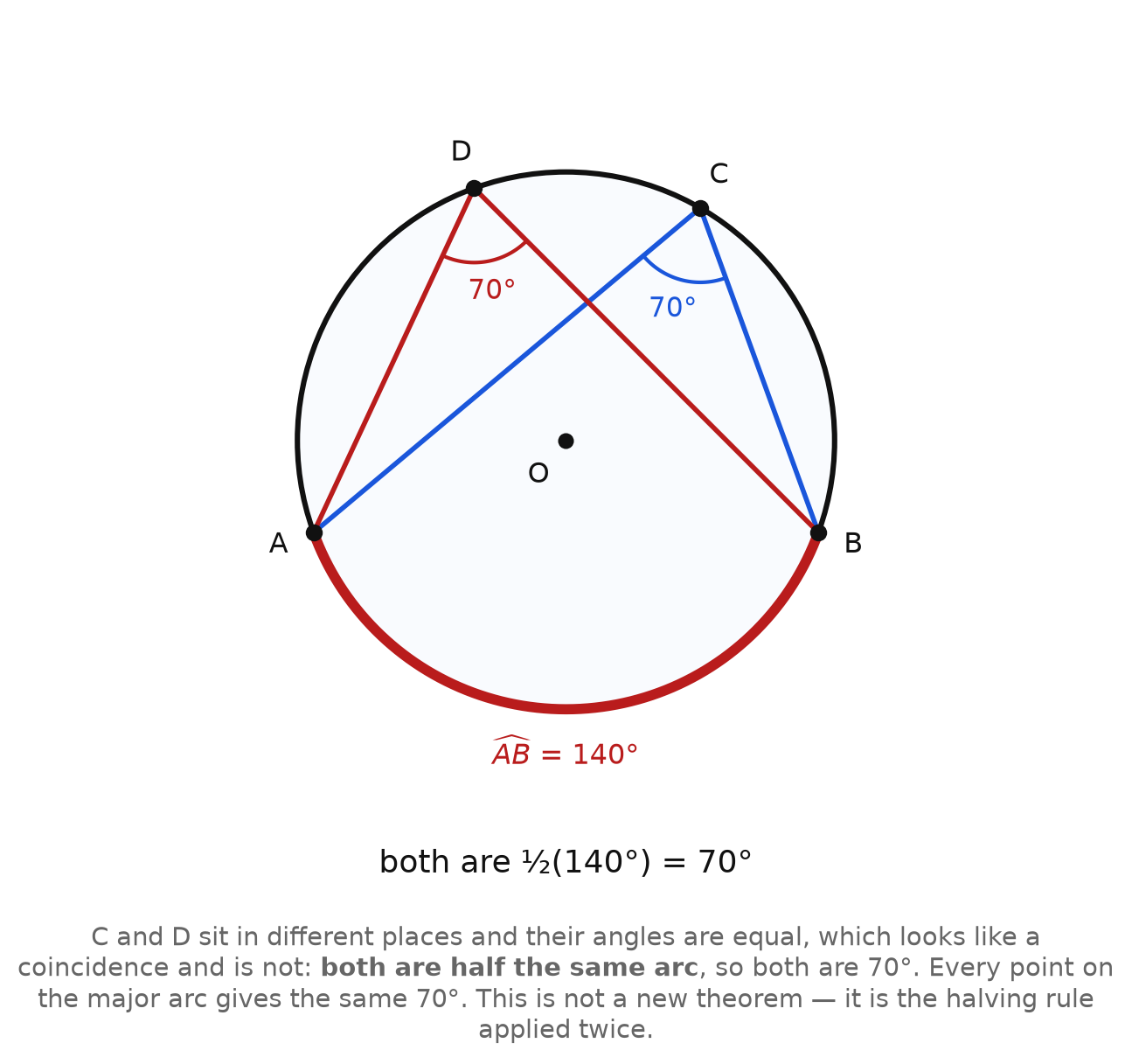
Two inscribed angles standing on the same arc are half the same number, so they are equal. Slide the vertex anywhere along the rest of the circle and the angle does not change.
An angle in a semicircle is right
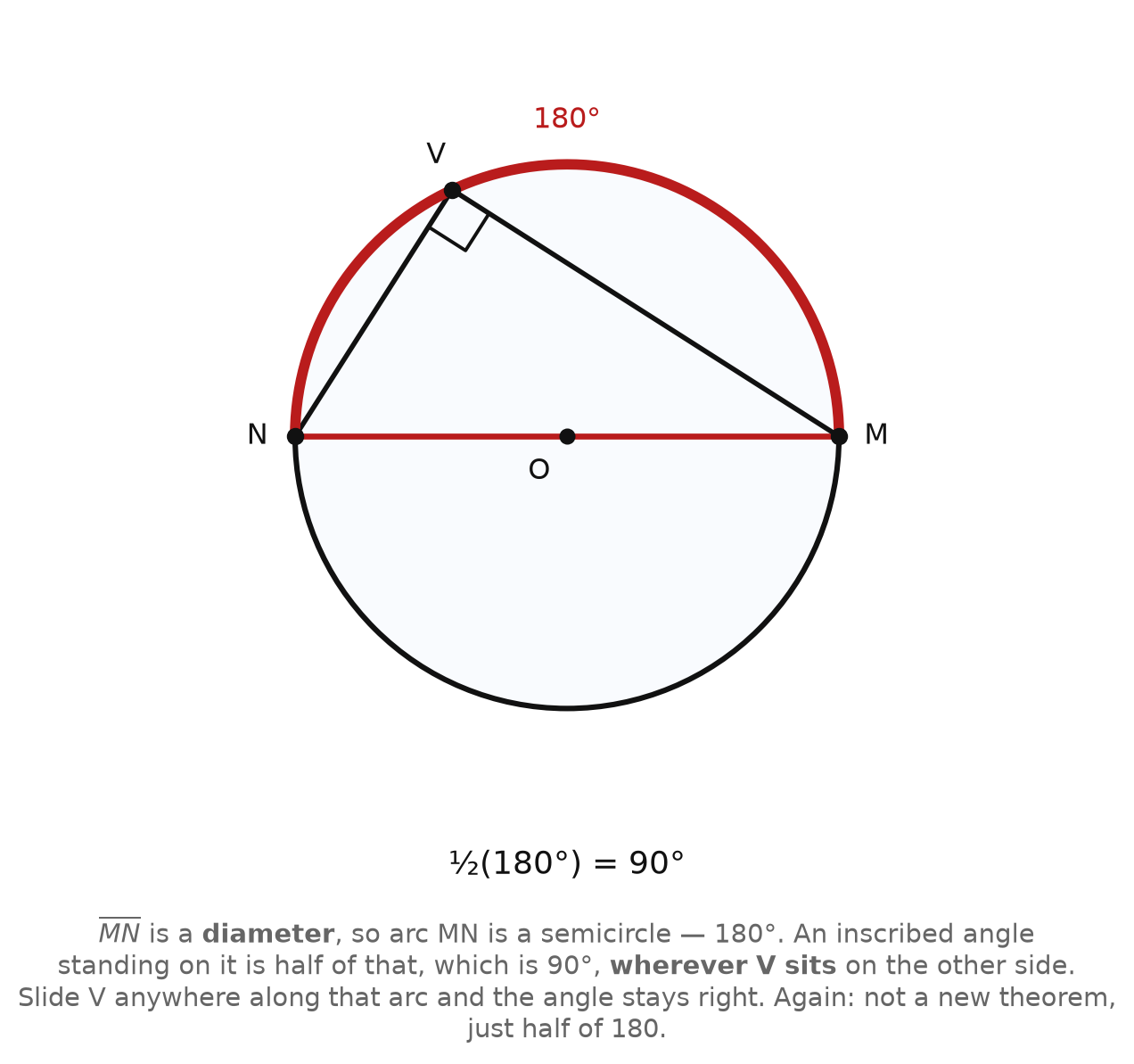
If the two endpoints are the ends of a diameter, the arc is a semicircle — — and the inscribed angle is
wherever the vertex sits on the other side. This one is worth recognising instantly: a diameter and a point on the circle make a right angle.
Opposite angles of an inscribed quadrilateral
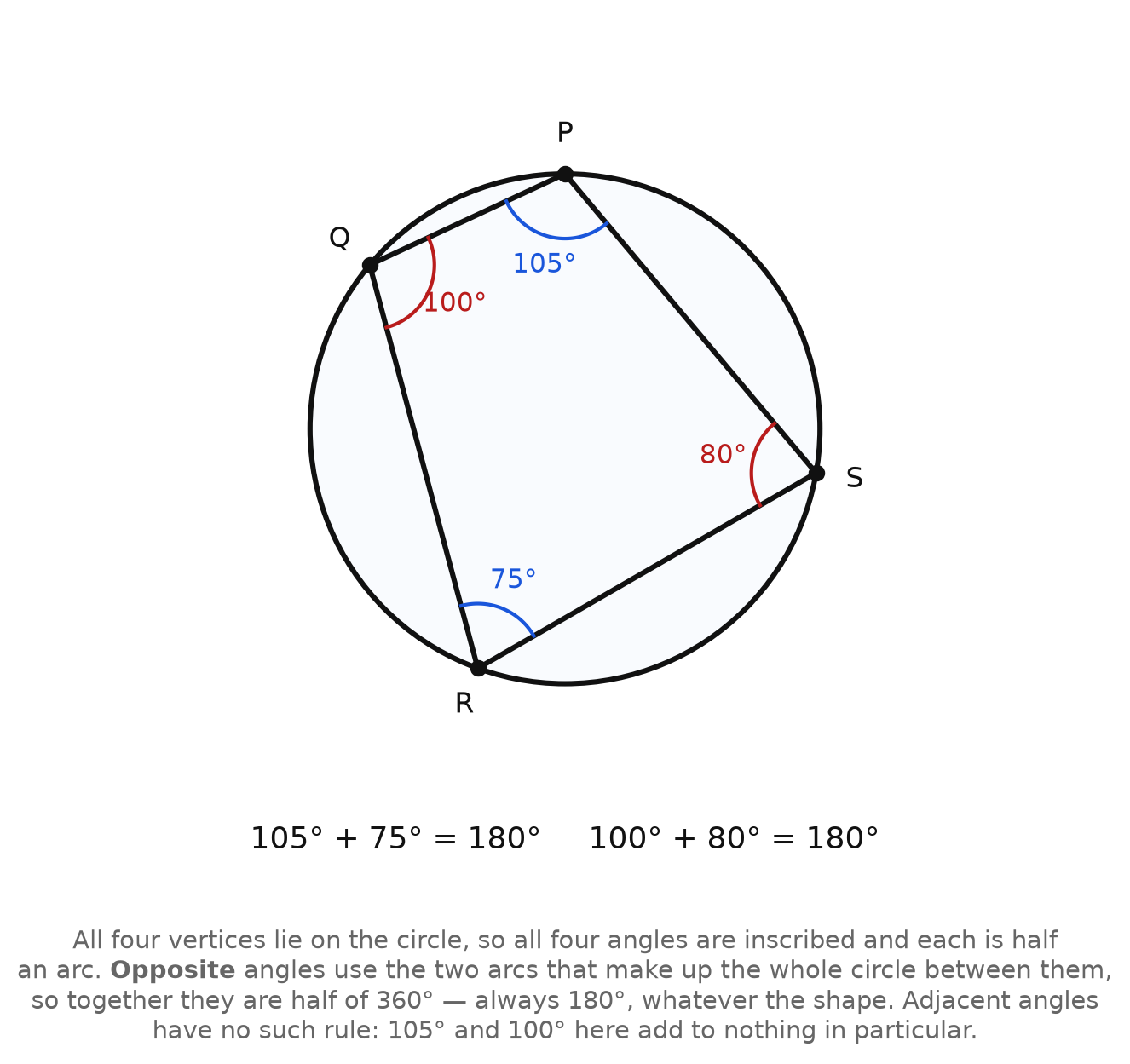
If all four vertices lie on the circle, each angle is half an arc — and opposite angles use the two arcs that make up the whole circle. So together they are half of :
Opposite angles of an inscribed quadrilateral are supplementary.
Adjacent angles have no such rule. In this figure and add to nothing in particular.
Worked examples
Example 1 — Same arc
Two inscribed angles stand on the same arc, and one is . Give the other.
Answer: — both are half the same arc.
Example 2 — Semicircle
is a diameter and is on the circle. Give .
Answer: .
Example 3 — Inside the right triangle
In that figure, . Give .
Answer: The angle at is , so .
Example 4 — Inscribed quadrilateral
is inscribed in a circle with . Give .
Answer: — and are opposite.
Example 5 — With algebra
Opposite angles of an inscribed quadrilateral are and . Find and both angles.
Answer: , giving and .
Guided practice
- Use the same-arc figure. Give the arc and both angles, and say why they are equal.
- On that figure, say what happens to the angle if the vertex slides along the major arc.
- Use the semicircle figure. Give the arc, the angle, and the arithmetic.
- On that figure, say what has to be true of for the angle to be right.
- Use the inscribed-quadrilateral figure. Give both pairs of opposite angles and their sums.
- On that figure, say why adjacent angles have no such rule.
Independent practice
- Two inscribed angles stand on the same arc and one is . Give the other.
- Two inscribed angles stand on the same arc and one is . Give the other, and give the arc.
- is a diameter and is on the circle. Give .
- In that figure, . Give .
- In that figure, . Give .
- is inscribed in a circle with . Give .
- is inscribed in a circle with . Give .
- is inscribed in a circle with and . Give and .
- Opposite angles of an inscribed quadrilateral are and . Find and both angles.
- An inscribed quadrilateral's arcs, in order, are , , , and . Give all four angles.
- An inscribed quadrilateral's arcs, in order, are , , , and . Give all four angles.
- An inscribed angle is . Give its arc, and say what that makes the chord joining its endpoints.
- Application. A carpenter needs a right angle but has only a straightedge and a round tabletop. Describe what to draw, and say why it works.
- Application. A quadrilateral window has all four corners on a circular frame. Two opposite corners measure and . Is that possible? Explain.
- Error analysis. A student says two inscribed angles are equal because their vertices are close together. Give the correct reason, and say when two inscribed angles are not equal.
- Error analysis. A student adds two adjacent angles of an inscribed quadrilateral and expects . Correct them.
- Reasoning. Explain why every one of this lesson's three results follows from the halving rule.
- Reasoning. A triangle is inscribed in a circle with one side a diameter. Explain why it must be a right triangle, and where the right angle is.
Exit ticket 13.4
- is a diameter and is on the circle. Give .
- An inscribed quadrilateral has . Give the angle opposite it.
Lesson 13.5 — Putting It Together
The one decision
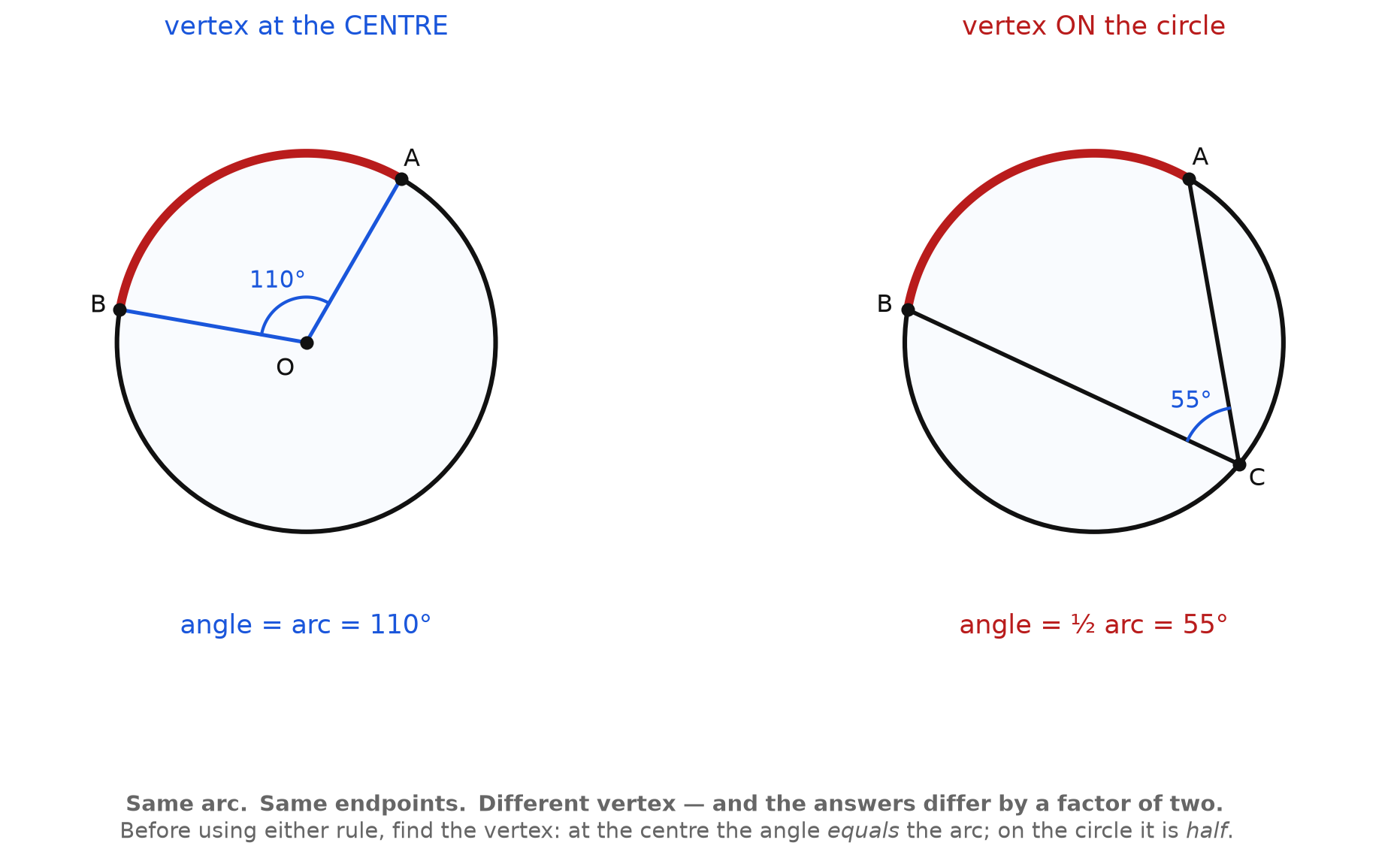
Same arc. Same endpoints. Different vertex — and the answers differ by a factor of two.
Find the vertex first.
- At the centre → the angle equals the arc.
- On the circle → the angle is half the arc.
The rules on one page
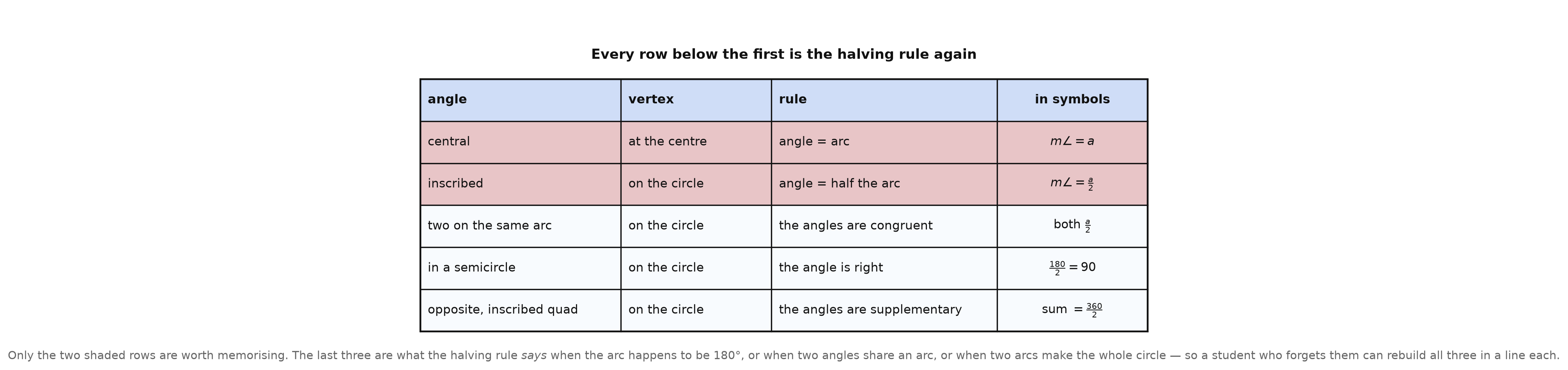
| Angle | Vertex | Rule |
|---|---|---|
| central | at the centre | angle arc |
| inscribed | on the circle | angle half the arc |
| two on the same arc | on the circle | the angles are congruent |
| in a semicircle | on the circle | the angle is |
| opposite, inscribed quadrilateral | on the circle | the angles are supplementary |
Only the first two rows are worth memorising. The last three are what the halving rule says when the arc is , or when two angles share an arc, or when two arcs make the whole circle.
In context
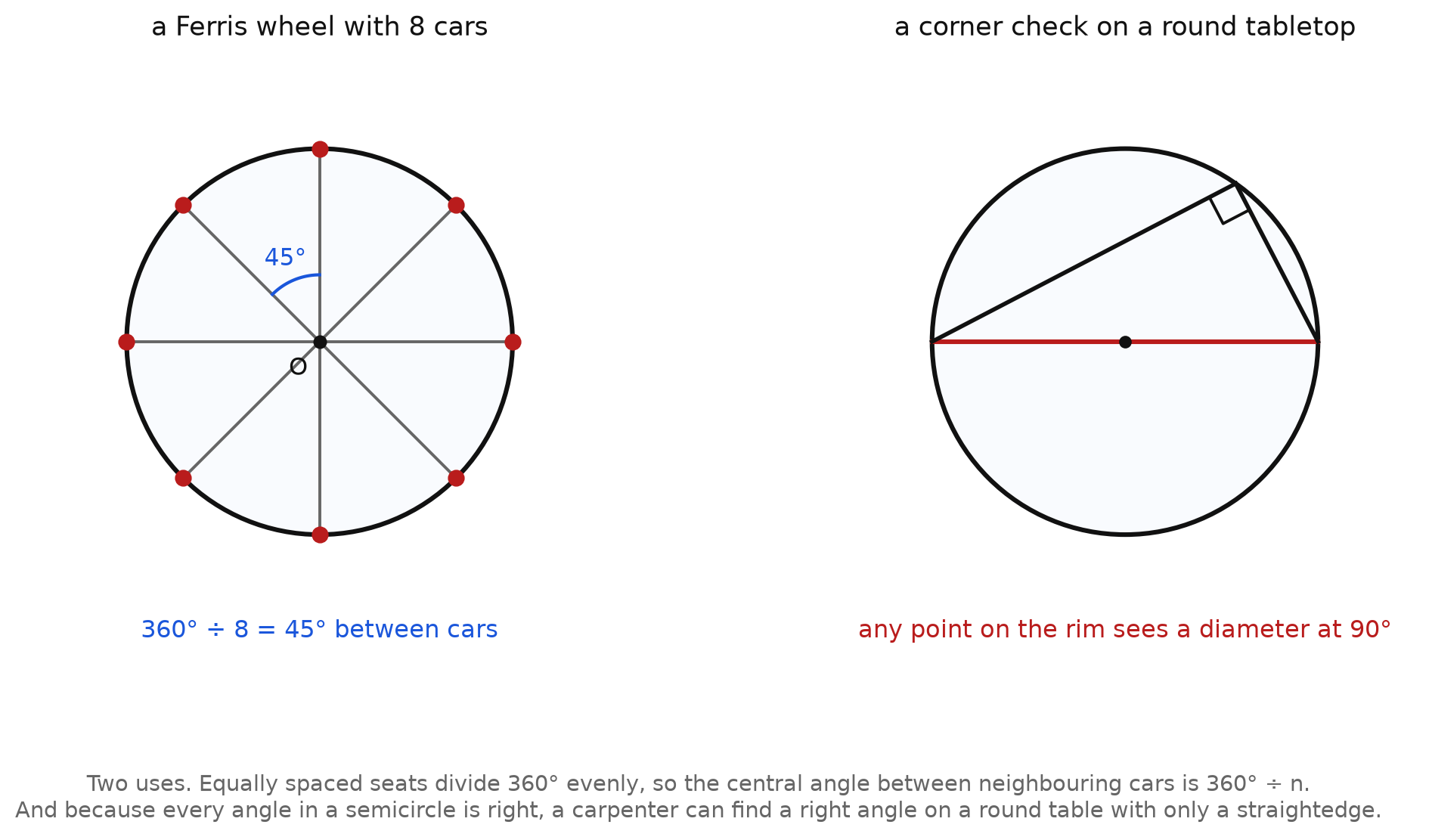
Equally spaced seats divide evenly. And because every angle in a semicircle is right, a carpenter can find a true right angle on a round table with nothing but a straightedge.
Worked examples
Example 1 — Which rule
An angle has its vertex at the centre and subtends a arc. Give the angle.
Answer: — central, so equal.
Example 2 — Which rule
An angle has its vertex on the circle and subtends a arc. Give the angle.
Answer: — inscribed, so half.
Example 3 — Two steps
and . Give the inscribed angle subtending .
Answer: , so the inscribed angle is .
Example 4 — Backwards
An inscribed angle is . Give the central angle on the same arc.
Answer: The arc is , so the central angle is .
Example 5 — Mixed
A circle has a sector. Give the central angle, the inscribed angle on that arc, and the major arc.
Answer: Central ; inscribed ; major arc .
Guided practice
- Use the comparison figure. Give both angles and the one thing that differs between the panels.
- State the two-line rule for choosing between them.
- Use the rules table. Name the two rows worth memorising, and say why the rest are not.
- On that table, say what the semicircle row is a special case of.
- Use the context figure. Give the central angle between neighbouring cars, and the arithmetic.
- On that figure, explain the carpenter's right angle.
Independent practice
For each, decide whether the angle is central or inscribed, then give it.
Vertex at the centre, arc .
Vertex on the circle, arc .
Vertex on the circle, arc .
Vertex at the centre, arc .
Vertex on the circle, arc .
and . Give the inscribed angle subtending .
An inscribed angle is . Give the central angle on the same arc.
A central angle is . Give the inscribed angle on the same arc.
Three arcs of a circle are , , and . Give the fourth, and the inscribed angle standing on it.
Application. A round window has equally spaced leadlight spokes from the centre. Give the central angle between neighbours, and the inscribed angle standing on one of those arcs.
Application. A satellite dish rim has two markers cutting off a arc. A sensor at the centre and a sensor on the rim both aim at both markers. Give each sensor's angle.
Error analysis. A student halves a central angle. Say what they confused, and give the correct rule.
Reasoning. Explain how to tell, from a figure alone, which rule applies.
Reasoning. Explain why an inscribed angle and a central angle on the same arc can never be equal.
Exit ticket 13.5
- Vertex on the circle, arc . Give the angle.
- Give the one question to ask before using either rule.
Chapter 13 Review
Vocabulary. circle · centre · radius · chord · diameter · arc · minor arc · major arc · semicircle · arc measure · central angle · inscribed angle · subtend · inscribed quadrilateral
Review 1 (G.PC.3b). A circle is divided by four radii into arcs of , , , and one more.
- Give the fourth arc, and say what fact you used.
- Give the four central angles.
- Two of those arcs are adjacent and measure and . Give the central angle across both, then name the arc that is left — carefully.
- Say what would change if the circle's radius were doubled, and what would not.
Review 2 (G.PC.3c). is a diameter of circle , and is a point on the circle with .
- Give , with a reason.
- Give .
- Give , with a reason.
- Check your three angles against the triangle sum, and say which of the two rules you used at each step.
Review 3 (G.PC.3 b, c). is inscribed in a circle, and the arcs , , , measure , , , and .
- Check that the four arcs are possible.
- Give all four angles of .
- Verify both pairs of opposite angles.
- Give the central angle , and say why it is not the same as .
Standards coverage check — Chapter 13
| Knowledge and Skill | Where it is taught | Where it is practiced | Where it is applied in context |
|---|---|---|---|
| G.PC.3b — solve for arc measures and angles in a circle formed by central angles | 13.1 (arc measure, naming, the total); 13.2 (central angle arc; the angle–arc–chord chain; equal spacing); 13.5 (choosing the rule) | 1–18, 20–24; 25–43, 46–50; 105–119, 122–126 | 19; 44, 45; 120, 121; Review 1, Review 3 |
| G.PC.3c — solve for arc measures and angles in a circle involving inscribed angles | 13.3 (the halving rule and its proof); 13.4 (same arc, semicircle, inscribed quadrilateral); 13.5 (choosing the rule) | 51–71, 73–78; 79–96, 99–104; 111–119, 123, 124 | 72; 97, 98; 121; Review 2, Review 3 |
Supporting items: 21, 22, 47, 48, 75, 76, 101, 102, 123, and 124 are the reasoning items, and 101 carries the chapter's organising claim — that the same-arc, semicircle, and inscribed-quadrilateral results are all the halving rule again rather than three more things to remember. The error analyses target the recurring failures: naming a major arc with two letters (20), treating equal arc measure as equal arc size across different circles (46), halving in the wrong direction (73), using the central rule at a vertex on the circle (74), justifying equal inscribed angles by how close the vertices look (99), expecting adjacent angles of an inscribed quadrilateral to be supplementary (100), and halving a central angle (122).
Boundaries respected. Arcs are measured in degrees only here; arc length and sector area are G.PC.3 a, d, e and belong to Chapter 14, and item 45 deliberately asks for a fraction of the whole rather than an area. The chapter teaches exactly the two angle rules the standard names, plus the three consequences that follow from the second by one line of arithmetic each. Chord–chord, secant–secant, and tangent–secant angle and segment theorems are not taught — they are not in the 2023 G.PC.3, and no item or figure uses one.
Answer keys for every item in this chapter are in Appendix A.