Chapter 12 — Angles of Convex Polygons
Standard: G.PC.2 (a, b, c)
G.PC.2 — verbatim. The student will verify relationships and solve problems involving the number of sides and measures of angles of convex polygons. Students will demonstrate the following Knowledge and Skills: a) Solve problems involving the number of sides of a regular polygon given the measures of the interior and exterior angles of the polygon. b) Justify the relationship between the sum of the measures of the interior and exterior angles of a convex polygon and solve problems involving the sum of the measures of the angles. c) Justify the relationship between the measure of each interior and exterior angle of a regular polygon and solve problems involving the measures of the angles.
By the end of this chapter you will be able to:
- Say what convex means, and why the chapter needs it (G.PC.2b)
- Justify the interior angle sum by cutting a polygon into triangles (G.PC.2b)
- Justify why the exterior angles of any convex polygon total (G.PC.2b)
- Find each interior and exterior angle of a regular polygon (G.PC.2c)
- Run both relationships backwards to find from an angle (G.PC.2a)
- Recognise when an angle describes no regular polygon at all (G.PC.2a)
Lessons: 12.1 Convex Polygons and the Interior Angle Sum · 12.2 Exterior Angles · 12.3 Regular Polygons, One Angle at a Time · 12.4 Working Backwards to
Why this chapter matters. The standard says justify twice, and that is the whole point. Both of this chapter's relationships have a one-picture reason — cut the polygon into triangles, or walk once around its boundary — and a student who has those two pictures can rebuild both formulas from scratch. A student who has only memorised has one formula and no way to check it.
Two formulas, and they are not interchangeable.
- The interior sum and the exterior sum hold for every convex polygon, regular or not.
- Each interior angle and each exterior angle need the polygon to be regular — otherwise there is no single "each."
Reading a value out of the wrong row is the most common error in this chapter, and Lesson 12.3 exists to keep the two apart.
Conventions this chapter fixes.
- Convex only. Every result here assumes every interior angle is less than . A figure with a vertex pushed inward is outside the chapter, and Lesson 12.1 shows one so you know what is being excluded.
- Regular means all sides congruent and all angles congruent. Equal angles alone is not regular — a non-square rectangle has four equal angles.
- One interior and one exterior angle at the same vertex are supplementary. They sit on a straight line, so they total . This is the hinge that converts every question in the chapter into every other.
- must be a whole number. A regular polygon has a whole number of sides, so an angle that produces a fraction describes no polygon. Lesson 12.4 drills this.
- Exterior angle means one per vertex — the angle between a side and the extension of the side next to it. There are two such angles at each vertex and they are congruent, so "the" exterior angle is unambiguous.
- Item numbering runs straight through the chapter, from 1 in Lesson 12.1 to 112 at the end of Lesson 12.4.
Lesson 12.1 — Convex Polygons and the Interior Angle Sum
What convex rules out
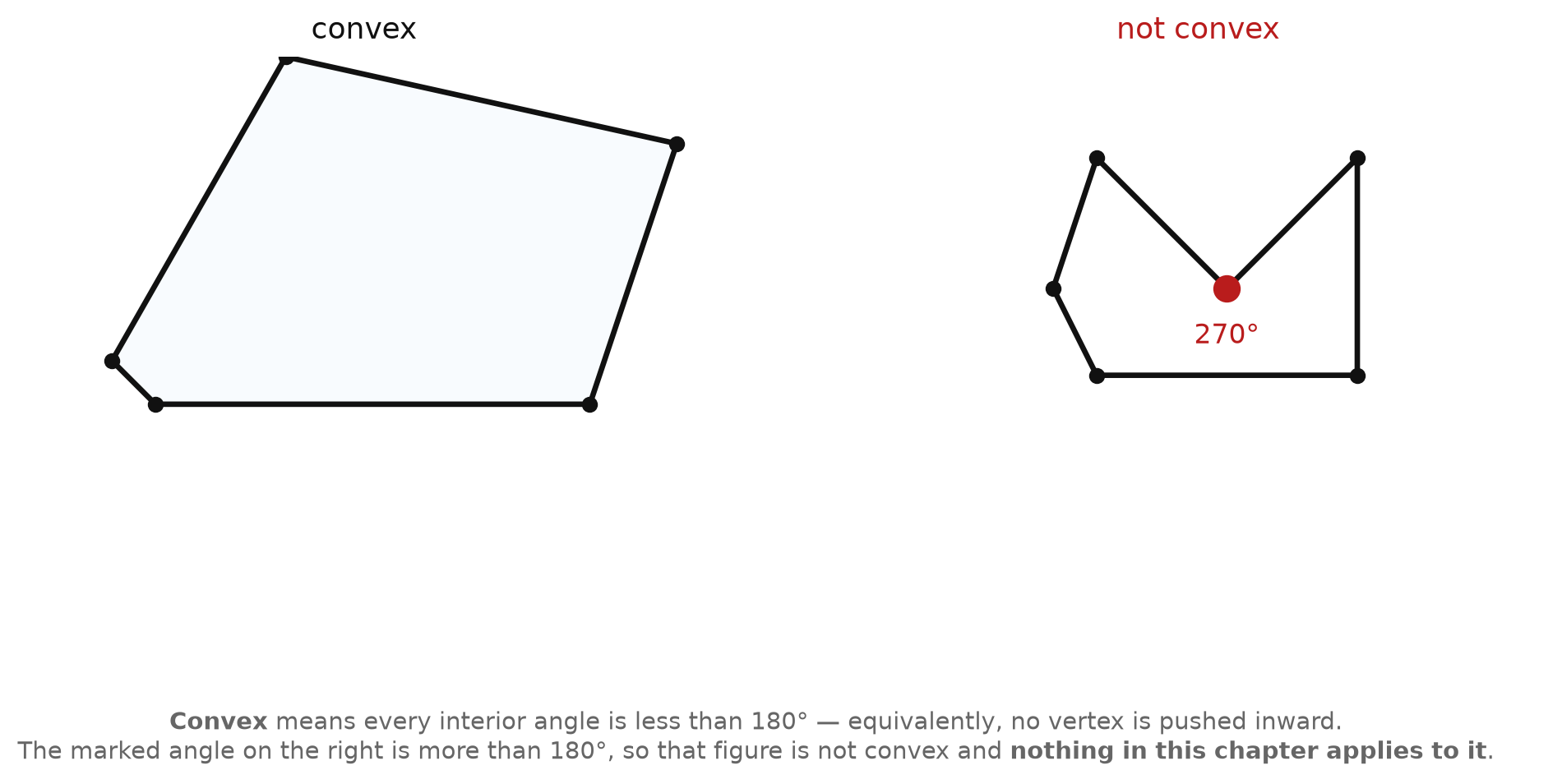
A polygon is convex when every interior angle is less than — equivalently, when no vertex is pushed inward. The figure on the right has a vertex of , so it is not convex, and nothing in this chapter applies to it.
A quicker test: in a convex polygon, every diagonal stays inside the figure. In the right-hand figure, a diagonal across the notch leaves it.
The justification: cut it into triangles
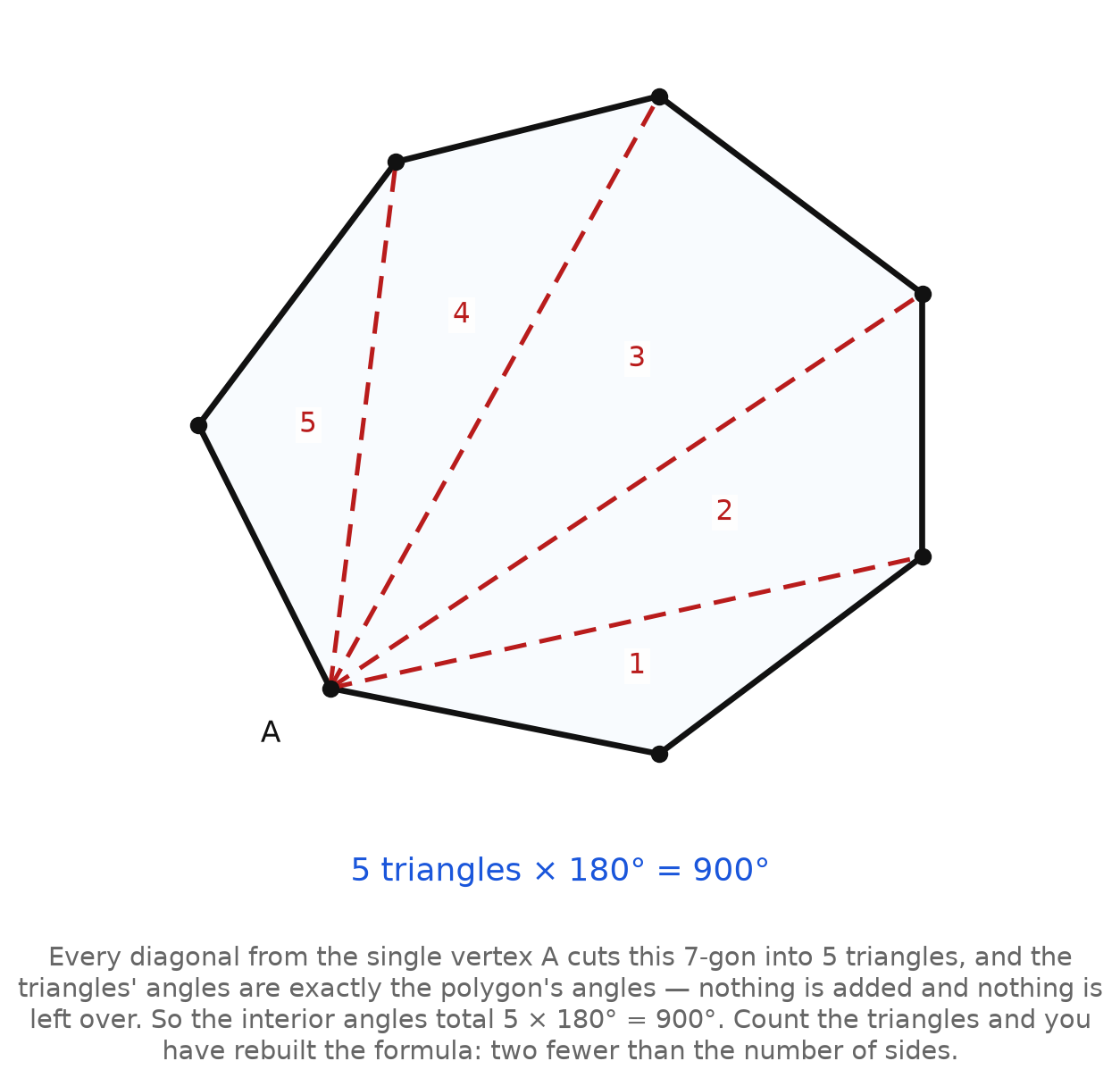
Pick one vertex and draw every diagonal from it. In a -gon you get 5 triangles — and the triangles' angles are exactly the polygon's angles, with nothing added and nothing left over.
Each triangle contributes , so:
Count the triangles in general: from one vertex you can reach every vertex except itself and its two neighbours, so you draw diagonals, which cut the polygon into triangles.
Interior angle sum. For any convex polygon with sides,
This is a justification, not a formula to trust. If you forget the formula, draw the polygon, cut it from one vertex, and count.
The sum depends on alone
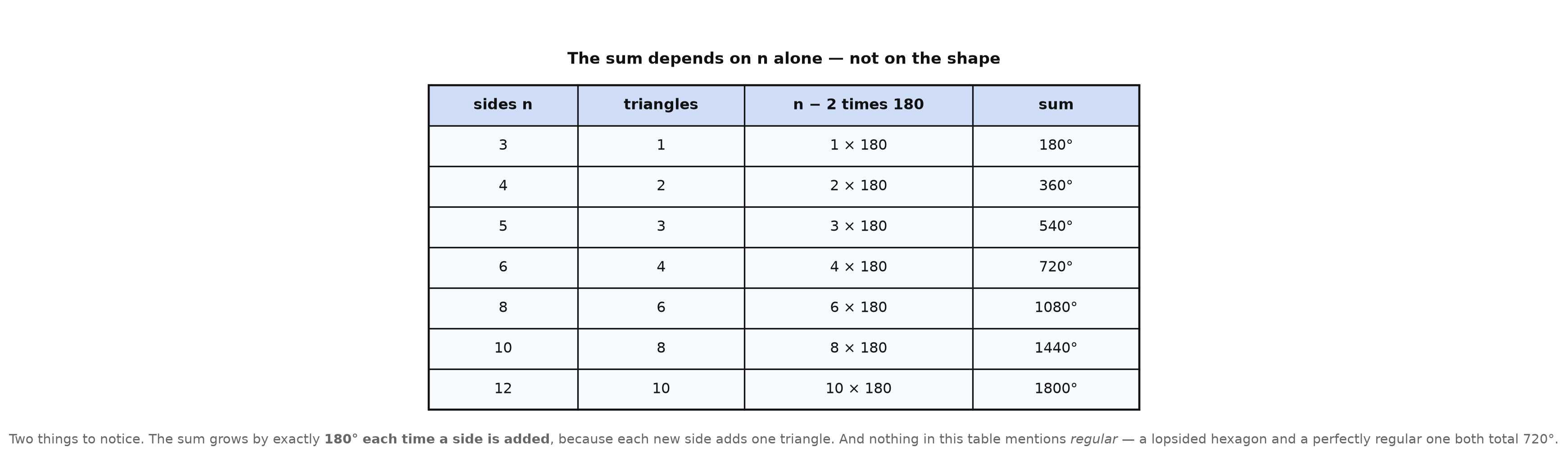
| Sides | Triangles | Sum |
|---|---|---|
| 3 | 1 | |
| 4 | 2 | |
| 5 | 3 | |
| 6 | 4 | |
| 8 | 6 | |
| 10 | 8 | |
| 12 | 10 |
Two things worth noticing. The sum grows by exactly each time a side is added, because each new side adds one triangle. And nothing here mentions regular — a lopsided hexagon and a perfect one both total .
Finding a missing angle
If you know all but one angle, subtract from the sum.
Angles given with algebra
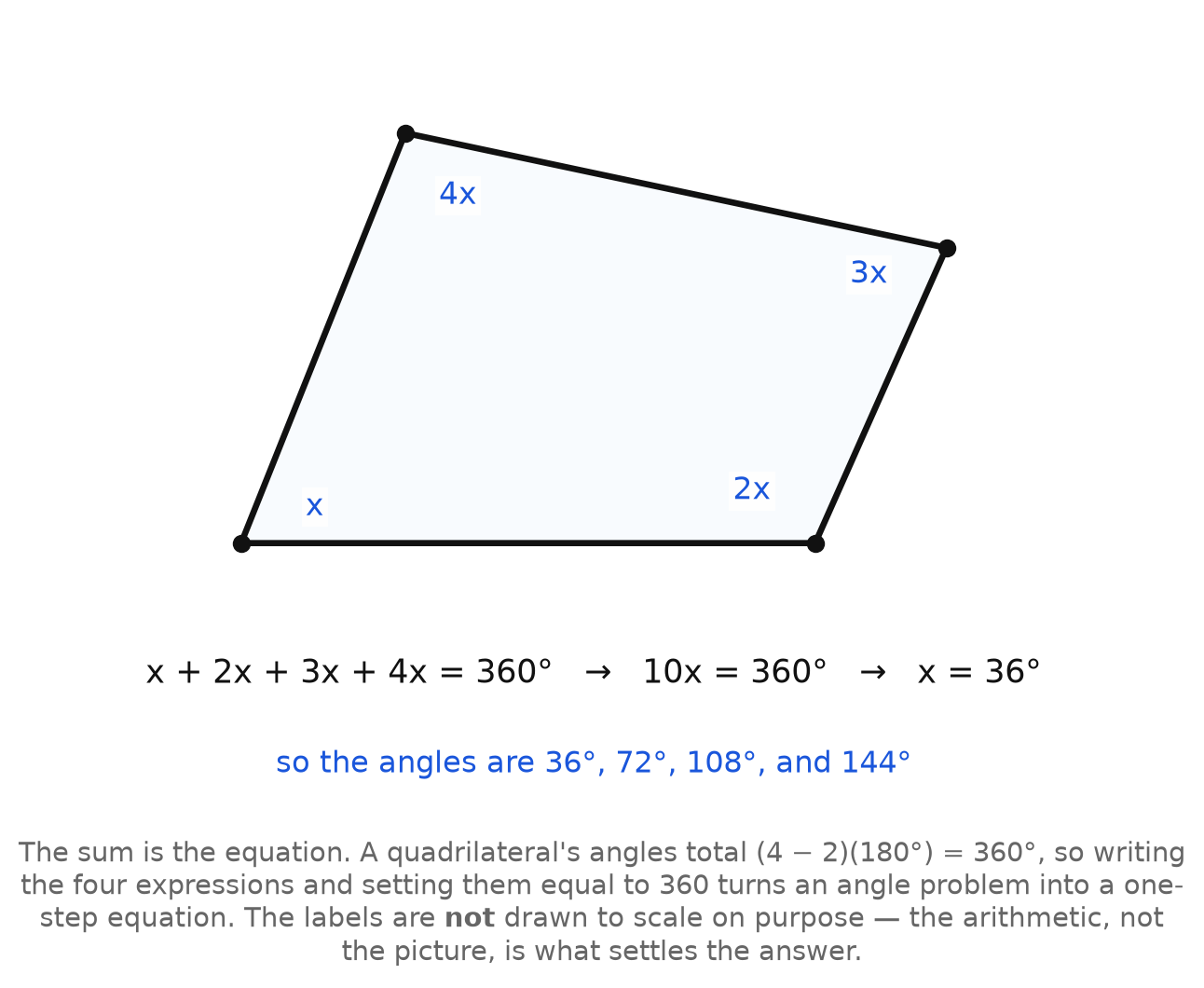
The sum is the equation. A quadrilateral totals , so:
giving , , , and . Notice the labels are not drawn to scale — the arithmetic settles the answer, not the picture.
Worked examples
Example 1 — A sum
Find the interior angle sum of a convex decagon.
Answer: .
Example 2 — A missing angle
Four angles of a convex pentagon are , , , and . Find the fifth.
Answer: The sum is , and , so the fifth is .
Example 3 — Backwards to
A convex polygon's interior angles total . How many sides?
Answer: .
Example 4 — With algebra
The angles of a convex quadrilateral are in the ratio . Find them.
Answer: , so the angles are , , , and .
Example 5 — Not convex
Does apply to a figure with a vertex?
Answer: Not in this course. The relationship is stated for convex polygons, and a angle means the figure is not convex.
Guided practice
- Use the convex figure. Give the definition of convex in your own words.
- On that figure, give the measure of the marked angle on the right and say what it proves.
- Use the triangle-cut figure. How many triangles, and from how many diagonals?
- On that figure, give the sum and the arithmetic that produced it.
- Explain why the triangles' angles are exactly the polygon's angles, with nothing left over.
- Use the sum table. By how much does the sum grow when one side is added, and why?
Independent practice
Find the interior angle sum.
- A convex quadrilateral.
- A convex hexagon.
- A convex nonagon ( sides).
- A convex -gon.
- A convex -gon.
Find the number of sides.
- The interior angles total .
- The interior angles total .
- The interior angles total .
- The interior angles total .
Find the missing angle.
- Four angles of a convex pentagon are , , , and .
- Three angles of a convex quadrilateral are , , and .
- Five angles of a convex hexagon are , , , , and .
- Six angles of a convex heptagon are , , , , , and .
With algebra.
- The angles of a convex quadrilateral are in the ratio . Find all four.
- The angles of a convex quadrilateral are in the ratio . Find all four.
- Application. A garden bed is a convex hexagon. A landscaper measures five of its corners as , , , , and . Give the sixth, and say how you know without measuring it.
- Error analysis. A student computes the interior angle sum of a hexagon as . Identify the error and give the correct sum.
- Reasoning. Explain why the interior angle sum does not depend on whether the polygon is regular.
Exit ticket 12.1
- Give the interior angle sum of a convex octagon.
- A convex polygon's angles total . How many sides?
- Three angles of a convex quadrilateral are , , and . Find the fourth.
- In one sentence, justify without stating the formula.
Lesson 12.2 — Exterior Angles
What an exterior angle is
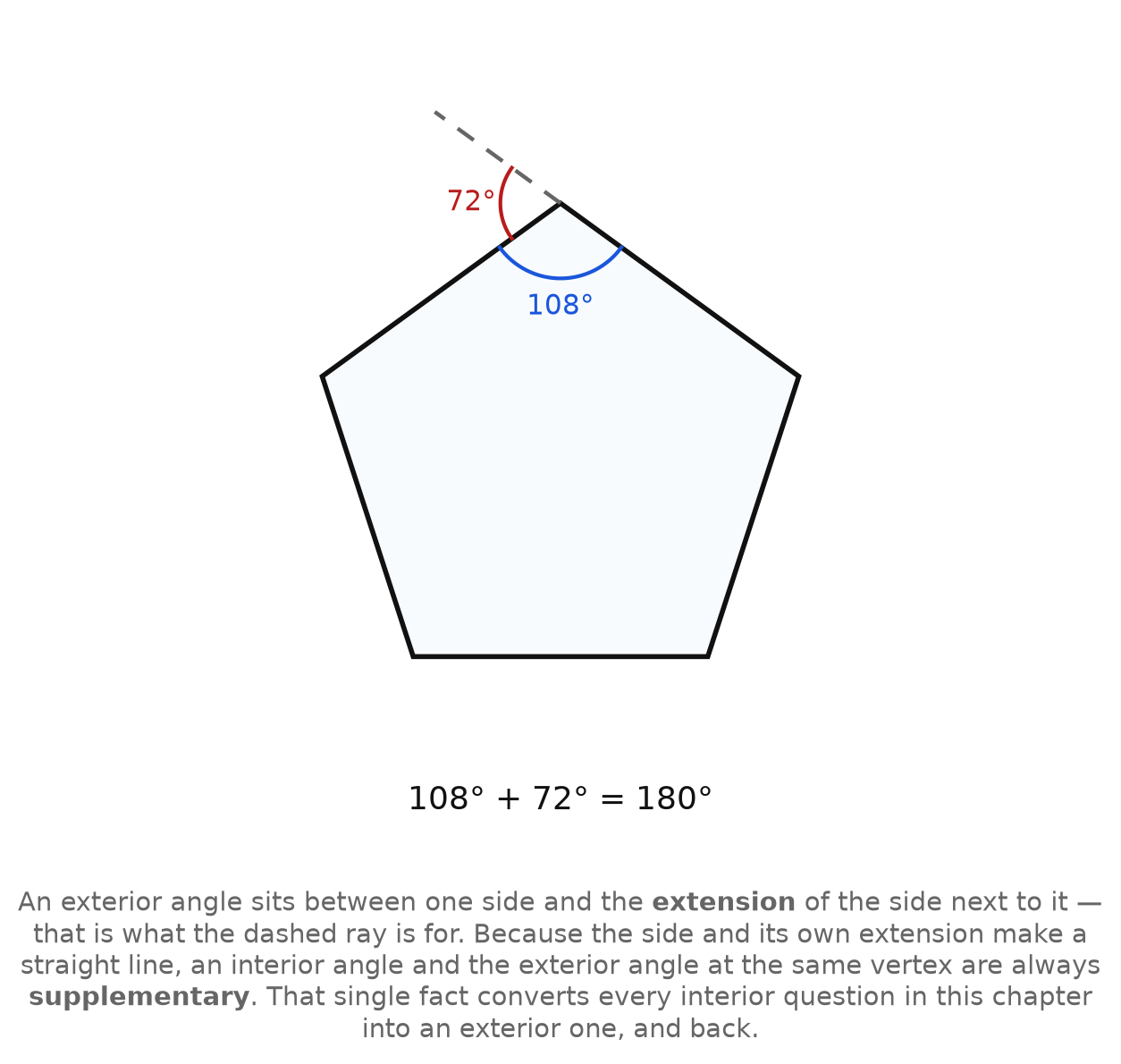
An exterior angle sits between one side and the extension of the side next to it — that is what the dashed ray is for.
Because a side and its own extension form a straight line:
At every vertex, the interior angle and the exterior angle are supplementary.
That single fact converts every interior question in this chapter into an exterior one, and back. It is the most useful line in the chapter.
The justification: walk around once
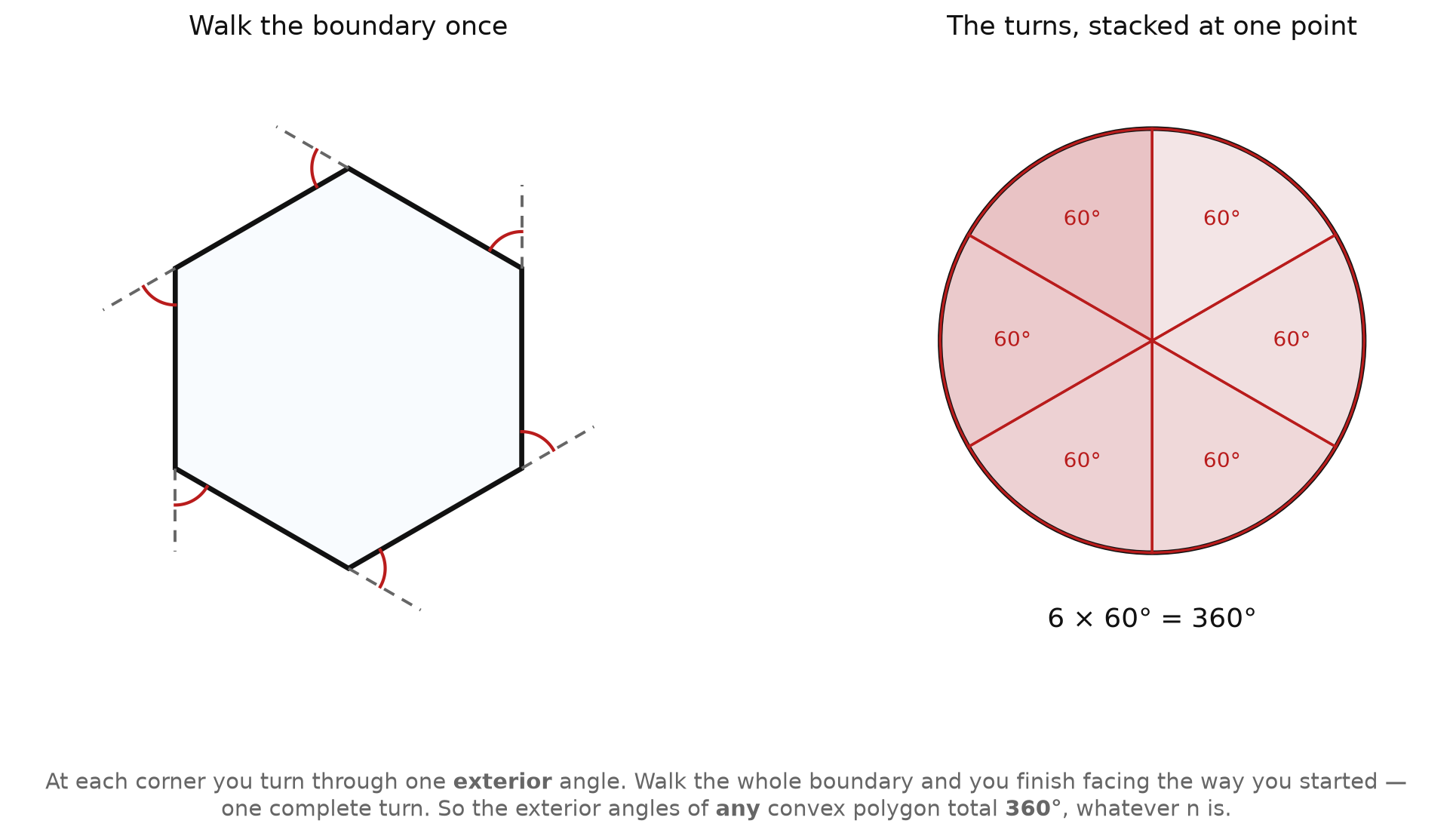
Imagine walking around the boundary. At each corner you turn — and the amount you turn is exactly the exterior angle. Walk the whole way around and you finish facing the direction you started, having made one complete turn.
Exterior angle sum. For any convex polygon,
Notice what is not in that statement: . A triangle's three exterior angles total ; a -gon's twenty exterior angles total . More angles, each smaller, same total.
It really does not need regularity
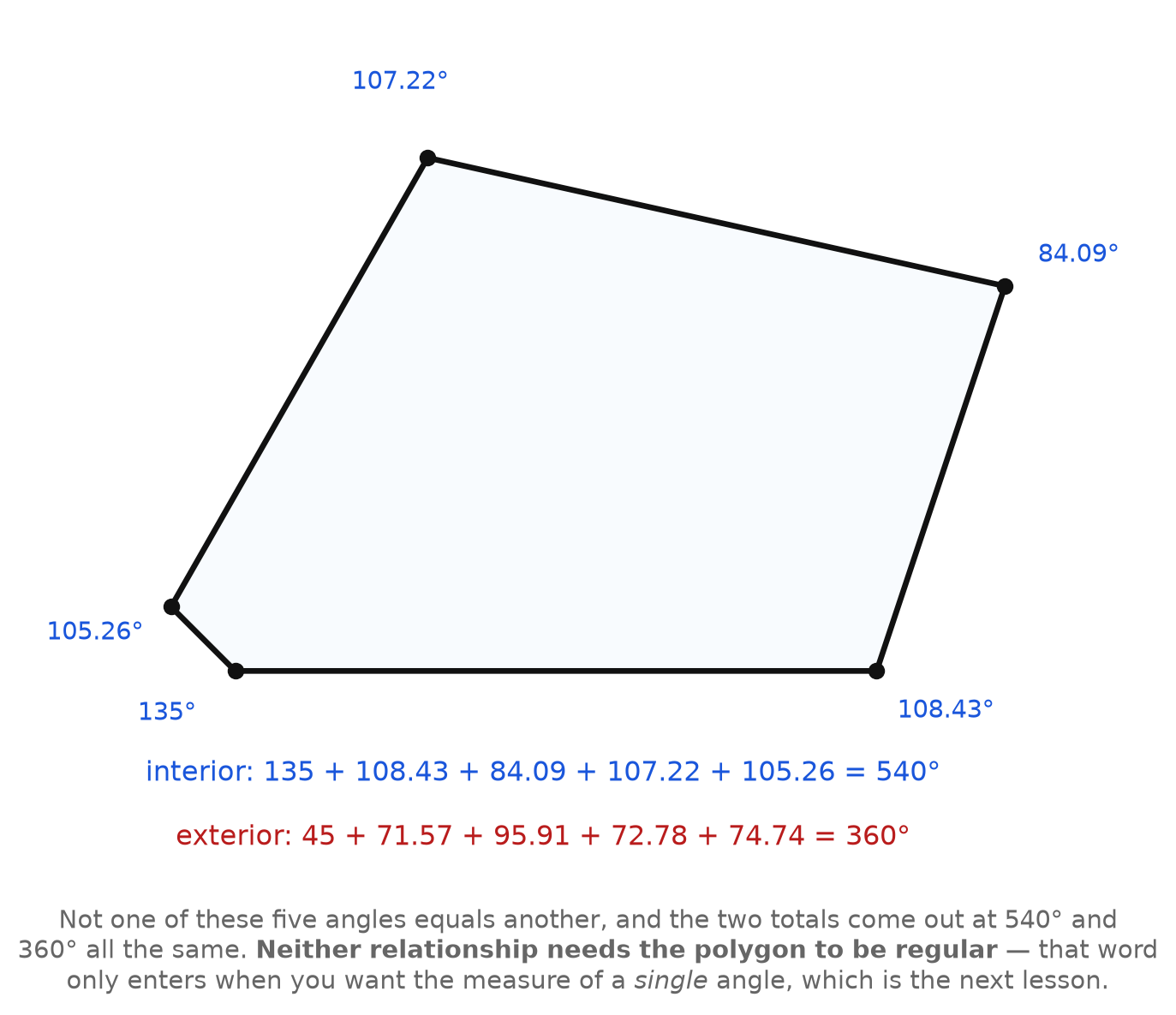
Not one of that pentagon's five angles equals another, and the totals still come out at and . Neither relationship needs the polygon to be regular. That word only matters when you want one angle, which is the next lesson.
Worked examples
Example 1 — Supplementary
An interior angle of a convex polygon is . Give the exterior angle at that vertex.
Answer: .
Example 2 — The sum
Give the sum of the exterior angles of a convex -gon.
Answer: . The number of sides does not enter.
Example 3 — A missing exterior angle
Four exterior angles of a convex pentagon are , , , and . Find the fifth.
Answer: , so the fifth is .
Example 4 — Both directions
A convex polygon has an exterior angle of at one vertex. Give the interior angle there.
Answer: .
Example 5 — Why 360
Justify the exterior angle sum in one sentence.
Answer: Walking once around the boundary turns you through each exterior angle exactly once and returns you to your starting direction, which is one full turn of .
Guided practice
- Use the exterior-angle figure. Say what the dashed ray is, and why it is needed.
- On that figure, give the two angle measures and their sum.
- Explain why an interior and an exterior angle at the same vertex are always supplementary.
- Use the walking figure. Say what you turn through at each corner.
- On that figure, say why one trip around the boundary is .
- Use the irregular pentagon. Give its two totals, and say what the figure is there to prove.
Independent practice
- Give the exterior angle sum of a convex triangle.
- Give the exterior angle sum of a convex -gon.
- Give the exterior angle sum of a convex -gon.
- An interior angle is . Give the exterior angle at that vertex.
- An interior angle is . Give the exterior angle at that vertex.
- An exterior angle is . Give the interior angle at that vertex.
- An exterior angle is . Give the interior angle at that vertex.
- Four exterior angles of a convex pentagon are , , , and . Find the fifth.
- Five exterior angles of a convex hexagon are , , , , and . Find the sixth.
- Three exterior angles of a convex quadrilateral are , , and . Find the fourth.
- A convex polygon has sides. Give the sum of its exterior angles and the sum of its interior angles.
- A convex polygon's interior angles total . Give the sum of its exterior angles.
- Application. A robot drives once around a convex flower bed and returns to its starting point facing its starting direction. Give the total of all the turns it made, and say why it does not depend on the number of corners.
- Application. A convex quadrilateral gate has interior angles , , , and . Give all four exterior angles and check their total.
- Error analysis. A student writes "a hexagon has sides, so its exterior angles total ; a pentagon has , so its exterior angles total ." Identify the error.
- Error analysis. A student says the exterior angles of an irregular pentagon cannot total because the angles are all different. Correct them.
- Reasoning. Explain why adding a side to a convex polygon increases the interior sum but leaves the exterior sum unchanged.
- Reasoning. Explain why the exterior angle sum being means the interior angles of an -gon must total , and check that this matches .
Exit ticket 12.2
- Give the exterior angle sum of any convex polygon.
- An interior angle is . Give the exterior angle at that vertex.
- Five exterior angles of a convex hexagon are , , , , and . Find the sixth.
- Justify the in one sentence.
Lesson 12.3 — Regular Polygons, One Angle at a Time
Divide, but only when it is regular
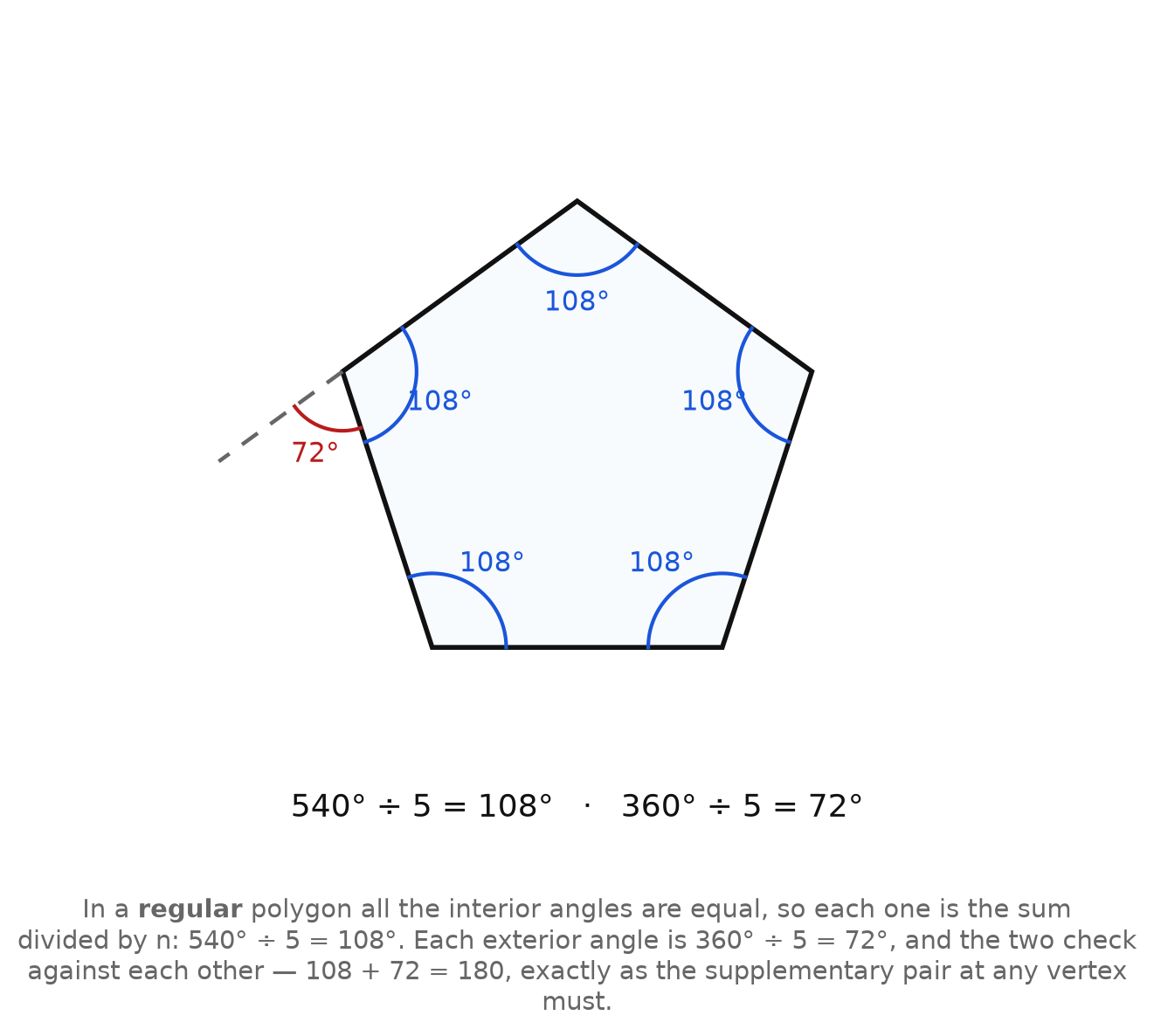
In a regular polygon all the interior angles are equal, so each one is the sum divided by :
Each angle of a regular -gon.
For a regular pentagon: and . The two check against each other — , exactly as a supplementary pair at any vertex must.
The exterior formula is the easier one. needs no sum computed first, and the interior angle is then one subtraction away.
As grows
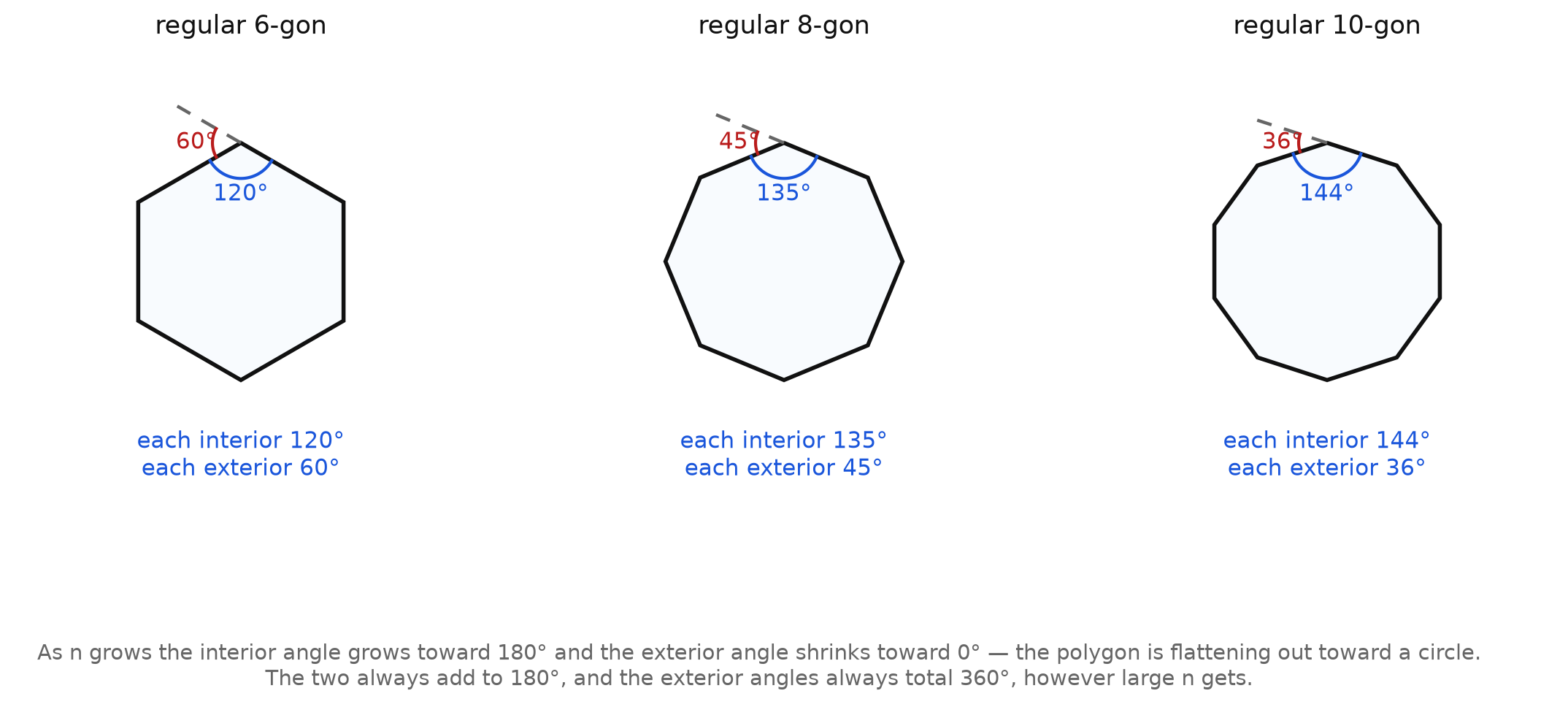
| interior | exterior | |
|---|---|---|
| regular hexagon | ||
| regular octagon | ||
| regular decagon |
The interior angle grows toward and the exterior shrinks toward — the polygon is flattening out toward a circle. The two always add to , and the exterior angles always total , however large gets.
The reference table, and the trap in it
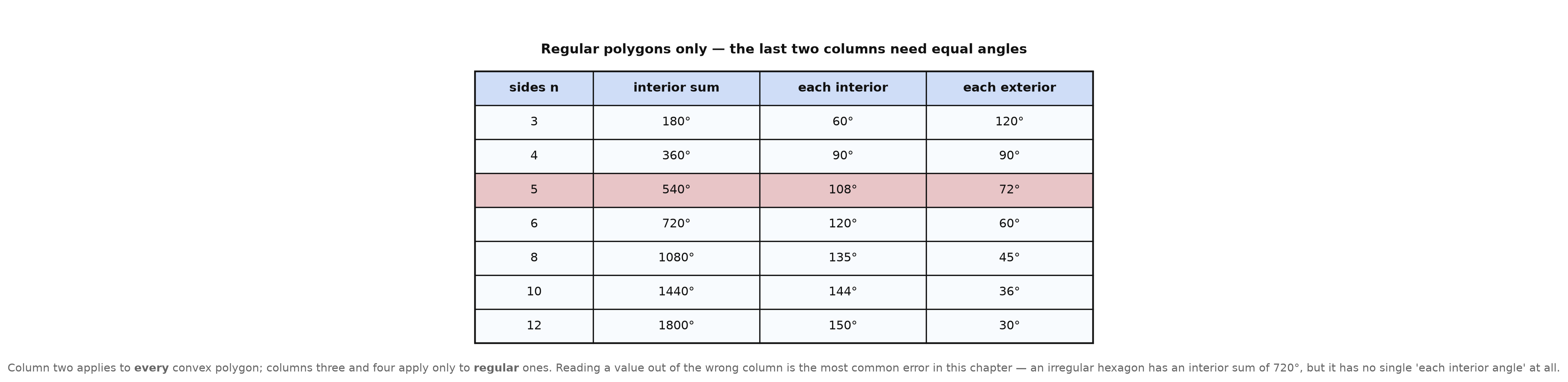
| interior sum | each interior | each exterior | |
|---|---|---|---|
| 3 | |||
| 4 | |||
| 5 | |||
| 6 | |||
| 8 | |||
| 10 | |||
| 12 |
Column two applies to every convex polygon. Columns three and four apply only to regular ones. An irregular hexagon has an interior sum of — but it has no single "each interior angle" at all, so the question has no answer for it.
Why hexagons tile and pentagons do not
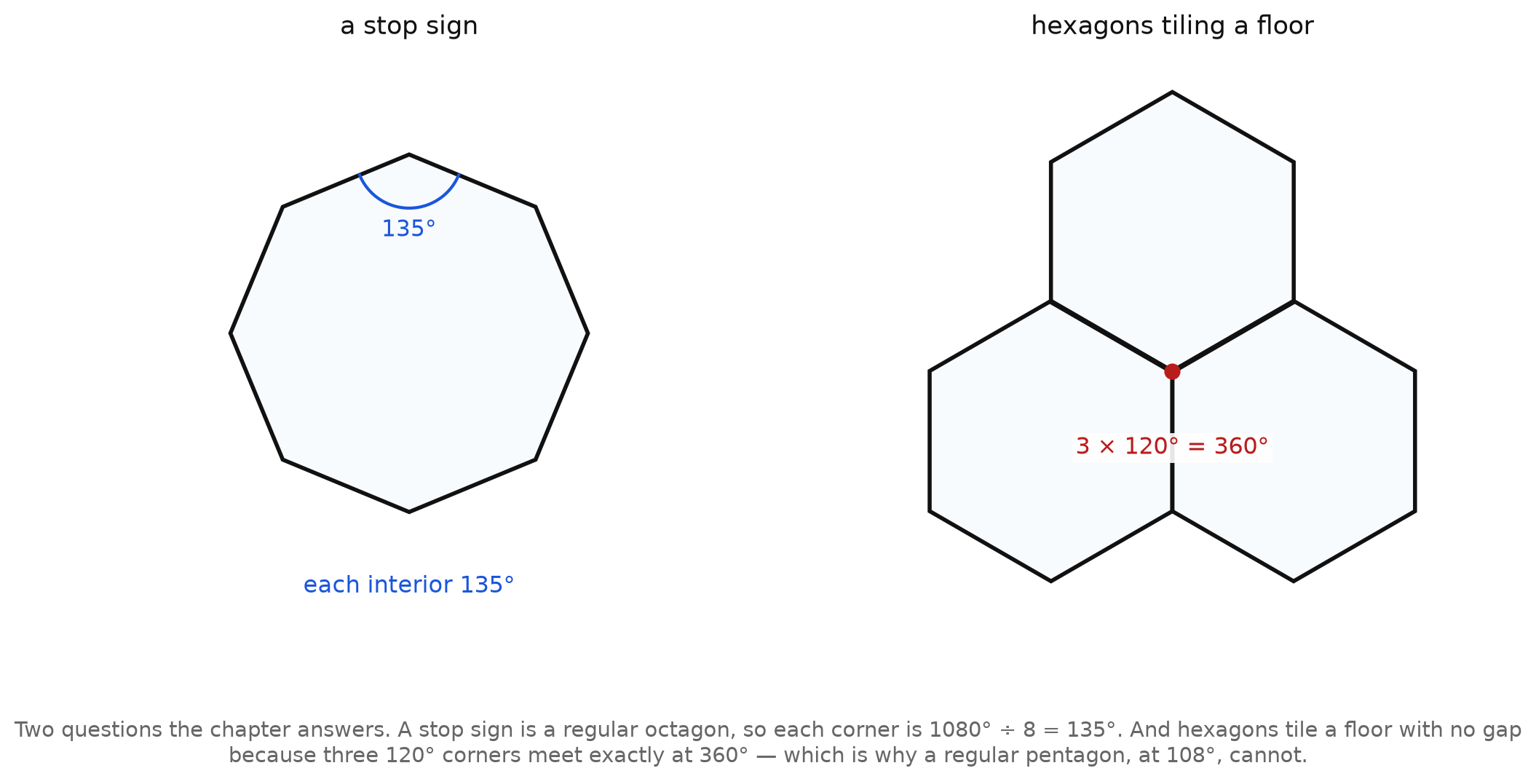
Shapes meeting around a point must fill exactly . Three regular hexagons do it: . Regular pentagons cannot — is not a whole number, so no number of them closes the gap.
Worked examples
Example 1 — Each interior
Give each interior angle of a regular octagon.
Answer: .
Example 2 — Each exterior, the fast way
Give each exterior angle of a regular -gon.
Answer: .
Example 3 — Interior from exterior
Give each interior angle of that regular -gon.
Answer: .
Example 4 — Not regular
An irregular hexagon has an interior sum of . What is each interior angle?
Answer: The question has no answer. Without equal angles there is no single "each" — only the total is determined.
Example 5 — Tiling
Can regular octagons tile a floor by themselves?
Answer: No. Each interior angle is , and , not a whole number, so they cannot meet exactly around a point.
Guided practice
- Use the regular pentagon figure. Give each interior angle and the arithmetic.
- On that figure, give each exterior angle and the arithmetic.
- On that figure, check the two against each other and say what the check confirms.
- Use the three-polygon figure. Say what happens to each angle as grows, and why.
- Use the reference table. Which columns need the polygon to be regular, and which do not?
- Use the tiling figure. Explain why three hexagons close and pentagons do not.
Independent practice
Give each interior angle of a regular polygon with:
- sides.
- sides.
- sides.
- sides.
- sides.
Give each exterior angle of a regular polygon with:
sides.
sides.
sides.
sides.
sides.
A regular polygon has each exterior angle . Give each interior angle.
A regular polygon has each interior angle . Give each exterior angle.
Give the interior sum and each interior angle of a regular -gon.
An irregular octagon has an interior sum of . Give each interior angle, or say why you cannot.
Application. A stop sign is a regular octagon. Give the measure of one of its corners, and give the angle a saw must be set to if it cuts along the extension of one edge.
Application. A tiler wants a floor of identical regular polygons with no gaps. Show that squares work and that regular pentagons do not.
Error analysis. A student finds each interior angle of a regular pentagon by computing . Identify the error and give the correct value.
Reasoning. Explain why each interior angle of a regular polygon is always less than , no matter how large is.
Exit ticket 12.3
- Give each interior angle of a regular hexagon.
- Give each exterior angle of a regular -gon.
- Give each interior angle of that same -gon.
- An irregular pentagon has an interior sum of . Give each interior angle, or say why you cannot.
Lesson 12.4 — Working Backwards to
From an exterior angle: one division
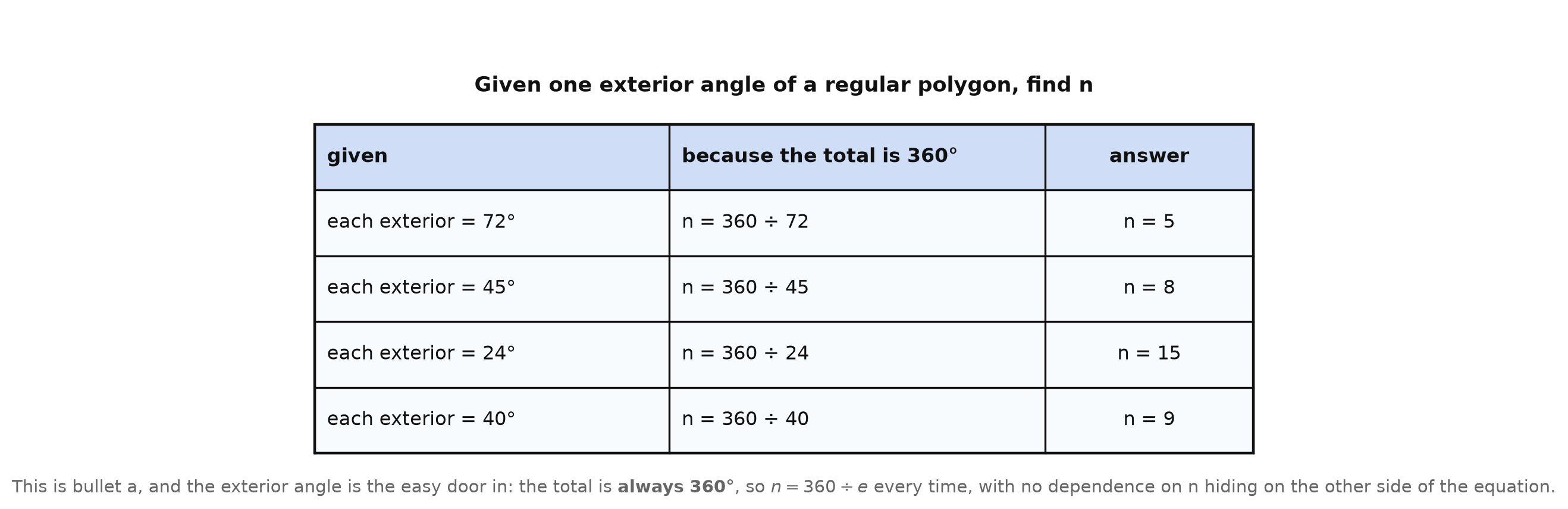
The exterior angles always total , so in a regular polygon:
There is no hiding on the other side of the equation — one division and you are done. If each exterior angle is , then .
From an interior angle: subtract first

Given an interior angle, go through the exterior angle:
Step one: . Step two: .
For : , so . Going straight at the interior angle means solving , which reaches the same answer through more algebra.
The case with no answer
must be a whole number. A regular polygon has a whole number of sides.
If , then and — not a whole number. There is no regular polygon with a interior angle. "About " is not the answer; "no such polygon" is.
This is the item that decides whether you have understood the lesson rather than memorised the division.
Worked examples
Example 1 — From an exterior angle
Each exterior angle of a regular polygon is . Find .
Answer: . A decagon.
Example 2 — From an interior angle
Each interior angle of a regular polygon is . Find .
Answer: , so .
Example 3 — No such polygon
Each interior angle of a regular polygon is . Find .
Answer: , and , which is not a whole number. No such regular polygon exists.
Example 4 — From the sum
The interior angles of a convex polygon total . Find .
Answer: .
Example 5 — Choosing the route
Each interior angle of a regular polygon is . Which is faster — the interior formula or the exterior route?
Answer: The exterior route. and , in two steps. The interior formula needs , cross-multiplied and rearranged, to reach the same .
Guided practice
- Use the exterior table. Give the one-line rule for finding from an exterior angle.
- On that table, say why the exterior angle is the easier door in.
- Use the interior table. Give the two steps, in order.
- On that table, say what happens in the shaded row and what the correct answer is.
- Explain why has to be a whole number.
- Explain why going straight at the interior angle gives the same answer as the two-step route.
Independent practice
Find from each exterior angle of a regular polygon.
- .
- .
- .
- .
- .
Find from each interior angle of a regular polygon.
- .
- .
- .
- .
- .
Decide whether a regular polygon exists, and give if it does.
Each exterior angle is .
Each interior angle is .
Each interior angle is .
Each interior angle is .
The interior angles of a convex polygon total . Find .
A regular polygon has each interior angle three times each exterior angle. Find .
Application. A machinist must cut identical regular polygon plates whose corners are . How many sides, and what angle does the cutting guide make with the edge?
Error analysis. A student is told each interior angle is and answers "about a -gon." Explain why that is wrong rather than merely imprecise.
Exit ticket 12.4
- Each exterior angle of a regular polygon is . Find .
- Each interior angle of a regular polygon is . Find .
- Each interior angle of a regular polygon is . Find , or say why you cannot.
- Give the two-step route from an interior angle to .
Chapter 12 Review
Vocabulary. polygon · convex · non-convex · regular · interior angle · exterior angle · supplementary · interior angle sum · -gon · diagonal · vertex · tile
Review 1 (G.PC.2b). A convex heptagon.
- Give the interior angle sum, and justify it by describing the triangle cut rather than citing the formula.
- Give the exterior angle sum, and justify it in one sentence.
- Six of its interior angles are , , , , , and . Find the seventh.
- Give the exterior angle at that seventh vertex, and say which relationship you used.
Review 2 (G.PC.2c). For a regular polygon with sides:
- Give the interior angle sum.
- Give each interior angle and each exterior angle, and check them against each other.
- Say which of those three answers would still be available if the polygon were not regular, and which would not.
- A second regular polygon has each exterior angle exactly twice this one's. Give its number of sides and each of its interior angles.
Review 3 (G.PC.2a). A designer is choosing a regular polygon for a paving stone.
- The first candidate has each interior angle . Give .
- The second has each interior angle . Give , or say why there is none.
- The stones must tile the floor with no gaps, so a whole number of corners must meet at each point. Show that the first candidate fails this test even though it exists.
- Name every regular polygon that does tile a floor by itself, and show the arithmetic for each.
Standards coverage check — Chapter 12
| Knowledge and Skill | Where it is taught | Where it is practiced | Where it is applied in context |
|---|---|---|---|
| G.PC.2a — solve problems involving the number of sides of a regular polygon given the measures of the interior and exterior angles | 12.4 (both directions, and the whole-number requirement) | 91–106, 108–112 | 107; Review 3 |
| G.PC.2b — justify the relationship between the sum of the measures of the interior and exterior angles of a convex polygon, and solve problems involving the sum | 12.1 (the triangle cut, and what convex rules out); 12.2 (walking the boundary; the irregular pentagon) | 1–21, 23–28; 29–46, 49–56 | 22; 47, 48; Review 1 |
| G.PC.2c — justify the relationship between the measure of each interior and exterior angle of a regular polygon, and solve problems involving the measures | 12.3 (dividing by , and when you may not) | 57–76, 79–84 | 77, 78; Review 2 |
Supporting items: 24, 51, 52, 80, 89, and 90 are the reasoning items, and 51 and 52 together carry the chapter's structural idea — the exterior sum is constant while the interior sum grows, and each relationship implies the other, since . The error analyses target the recurring failures: multiplying by instead of (23), thinking the exterior sum depends on (49), thinking irregularity breaks the totals (50), using for an interior angle (79), and reporting a decimal number of sides instead of "no such polygon" (108).
Boundaries respected. Every result is stated for convex polygons, and Lesson 12.1 shows a non-convex figure so the restriction is visible rather than silent. The distinction the standard draws between a sum (bullet b, any convex polygon) and each angle (bullet c, regular only) is kept in force throughout, including an item — 76 — whose correct answer is that the question cannot be answered. Nothing here needs area, apothem, or trigonometry; those are not in G.PC.2, and the tiling items are settled by angle arithmetic alone.
Answer keys for every item in this chapter are in Appendix A.