Chapter 11 — Quadrilaterals in the Coordinate Plane
Standard: G.PC.1 (a, b)
G.PC.1 — verbatim. The student will prove and justify theorems and properties of quadrilaterals, and verify and use properties of quadrilaterals to solve problems, including the relationships between the sides, angles, and diagonals. Students will demonstrate the following Knowledge and Skills: a) Solve problems, including those in context, by applying properties specific to parallelograms, rectangles, rhombi, squares, isosceles trapezoids, and trapezoids. b) Prove and justify that quadrilaterals have specific properties, using coordinate and algebraic methods, such as the slope formula, the distance formula, and the midpoint formula. c) Prove and justify theorems and properties of quadrilaterals using deductive reasoning. d) Use congruent segment, congruent angle, angle bisector, perpendicular line, and/or parallel line constructions to verify properties of quadrilaterals.
By the end of this chapter you will be able to:
- Say which of the three formulas — slope, distance, midpoint — settles a given claim (G.PC.1b)
- Prove a quadrilateral is a parallelogram four different ways, and say which is cheapest (G.PC.1b)
- Prove a rectangle, a rhombus, and a square from coordinates (G.PC.1 a, b)
- Prove a trapezoid and an isosceles trapezoid, including the step most people skip (G.PC.1 a, b)
- Choose an efficient proof instead of computing everything in sight (G.PC.1b)
- Use the same formulas backwards to solve for a missing coordinate (G.PC.1b)
Lessons: 11.1 The Three Formulas · 11.2 Proving a Parallelogram · 11.3 Rectangles, Rhombi, and Squares · 11.4 Trapezoids, and Choosing the Proof
Why this chapter matters. Chapter 10 proved these properties from congruent triangles. This chapter proves the same properties again, from coordinates — so the two chapters are one set of theorems reached two ways. The coordinate route is the one that scales: it needs no auxiliary lines, no diagram to reason about, and no cleverness. It needs arithmetic and a decision about which formula to run.
Scope note. This chapter is G.PC.1 b, with a along for the ride — you cannot prove a figure is a rhombus without knowing what a rhombus is. Bullets c and d, the deductive proofs and the constructions, were Chapter 10.
The whole toolkit is three formulas. G.PC.1b names them: slope, distance, midpoint. Between them they settle exactly four kinds of claim — parallel, perpendicular, congruent, and bisects — and nothing else. There is no coordinate method in this course for showing an angle is , or that a diagonal bisects an angle. If a question cannot be phrased in those four words, coordinates will not answer it.
Conventions this chapter fixes.
- Name the formula before you compute. Deciding which of the three you need is the step that makes a proof short. Lesson 11.4 is built on it.
- Exact answers, in simplest radical form. is not a finished answer; is. Decimals are never used to compare two lengths — and are equal, and two roundings of them might not look it.
- A picture is not a proof. Sides that look parallel are not parallel until two slopes match. This is the whole reason the chapter exists, and the figures are deliberately tilted so nothing can be read off the grid.
- A trapezoid has exactly one pair of parallel sides. Virginia's exclusive definition, fixed in Chapter 1. Proving a trapezoid therefore takes two slope facts: one pair parallel, and the other pair not.
- Vertices are named in order. means to to to and back; and are the diagonals. Reading them out of order is the fastest way to prove something false.
- Item numbering runs straight through the chapter, from 1 in Lesson 11.1 to 112 at the end of Lesson 11.4.
Lesson 11.1 — The Three Formulas
One tool for each kind of claim

| Formula | What you compute | What it lets you prove |
|---|---|---|
| slope | parallel (equal slopes) · perpendicular (product ) | |
| distance | congruent (equal lengths) | |
| midpoint | bisects (a shared midpoint) |
Learn the table in the right-hand direction. You will almost never be asked "what is the slope of ?" — you will be asked "is a parallelogram?", and the work is deciding that the question is about parallel, and therefore about slope.
Slope proves two things
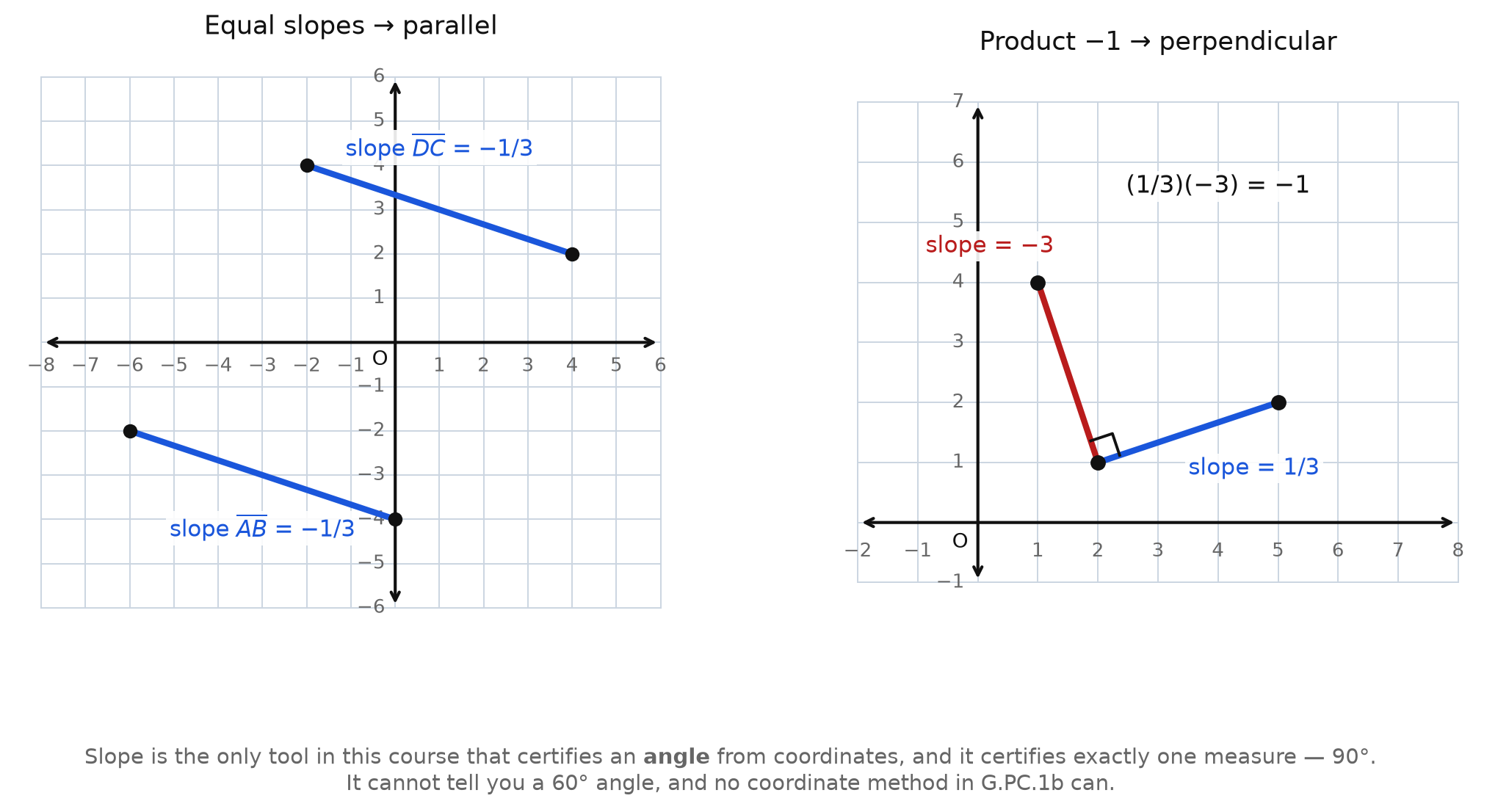
- Equal slopes → parallel. and both have slope , so they are parallel.
- Product → perpendicular. , so those two sides meet at a right angle.
A vertical side has undefined slope, not zero. A vertical segment and a horizontal one are perpendicular, but you cannot show it with a product — there is no number to multiply. Say instead: one is vertical and one is horizontal, so they are perpendicular. This comes up in Lesson 11.3, where a rhombus has a vertical diagonal and a horizontal one.
Distance proves congruent
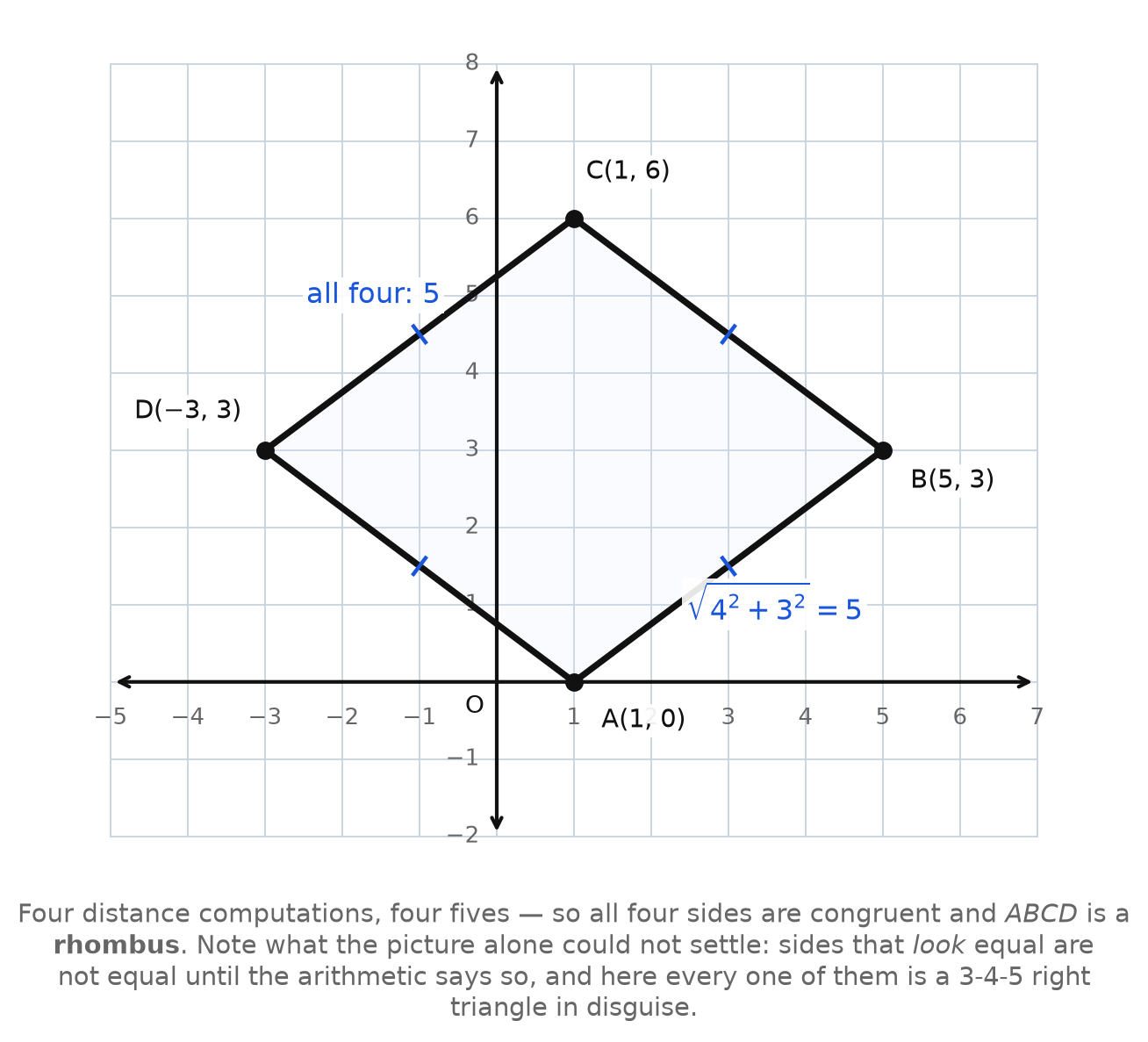
Four distance computations, four fives, so all four sides are congruent. Notice what the picture could not settle: sides that look equal are not equal until the arithmetic says so.
Leave the radical exact. , and is what you write. Comparing with proves nothing about and that comparing them exactly does not prove better.
Midpoint proves bisects
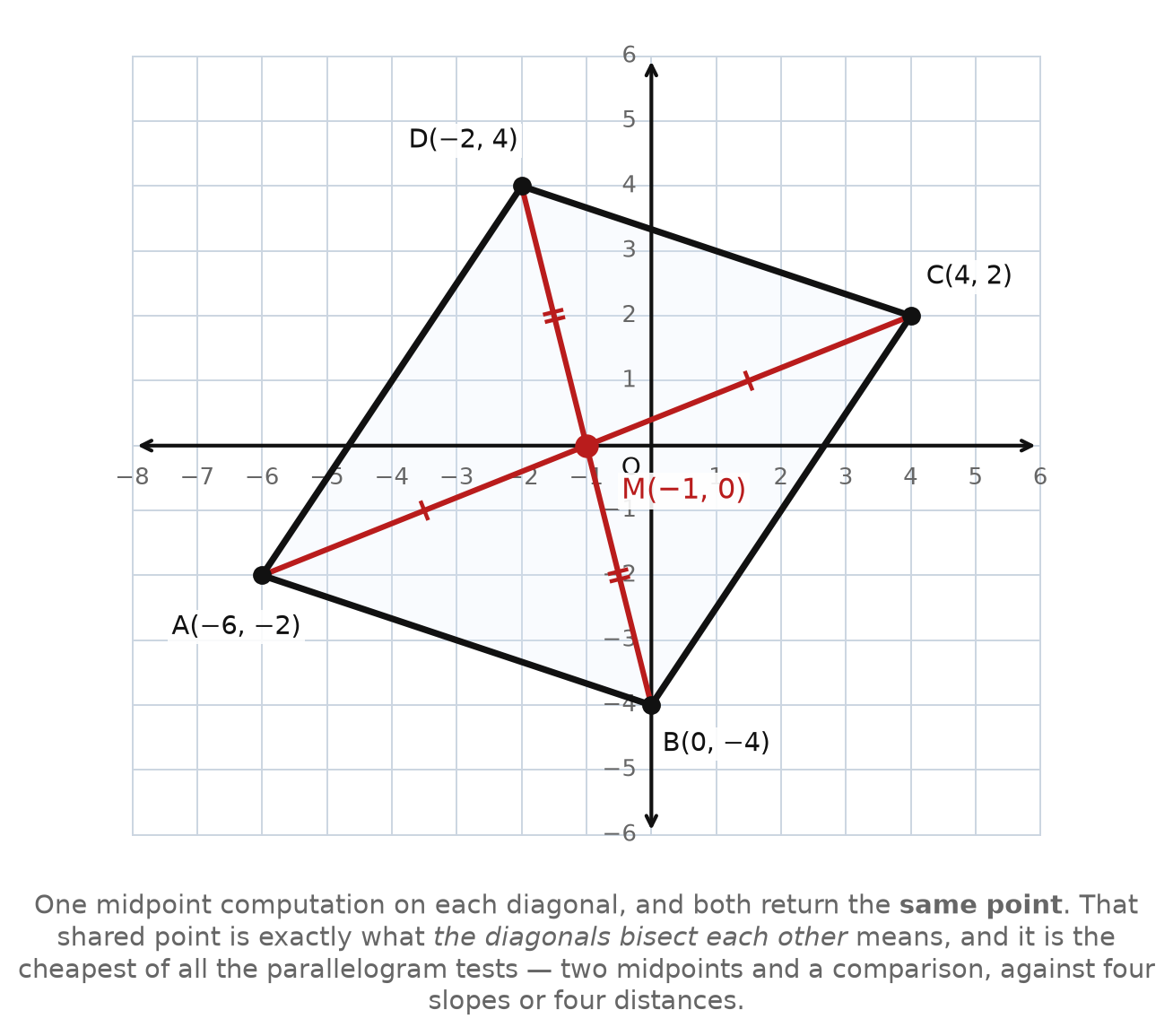
One midpoint on each diagonal, and both return the same point. A shared midpoint is exactly what the diagonals bisect each other means — and it is the cheapest test in the chapter, two computations against four.
Midpoints need not be lattice points: and have midpoint . A fractional midpoint is a fine answer and not a sign of an error.
Worked examples
Example 1 — Which formula?
"Show that and are parallel." Which formula?
Answer: Slope. Parallel is a slope claim. Compute both and check they match.
Example 2 — Which formula?
"Show that the diagonals of bisect each other." Which formula?
Answer: Midpoint, twice — once on each diagonal. If the two results agree, they bisect.
Example 3 — Slope
Find the slope of for and .
Answer: .
Example 4 — Distance
Find for and .
Answer: .
Example 5 — Midpoint
Find the midpoint of for and .
Answer: .
Guided practice
- Use the formula table. Which formula proves two segments are congruent?
- On that table, which formula proves two segments are parallel, and what has to be true?
- On that table, which formula proves the diagonals bisect each other?
- Use the slope figure. Give the two slopes on the left panel and say what they prove.
- On the right panel, give the two slopes and the product, and say what they prove.
- Use the midpoint figure. Give , and explain why one point proves a statement about two segments.
Independent practice
Find each, exactly.
- The slope of for and .
- The slope of for and .
- for and .
- for and .
- for and , in simplest radical form.
- The midpoint of for and .
- The midpoint of for and .
- The slope of a vertical segment, and the slope of a horizontal one.
Name the formula you would use — do not compute.
- Show that one pair of opposite sides of is congruent.
- Show that is a right angle.
- Show that and bisect each other.
- Show that .
- Application. A surveyor records four corner stakes at , , , and . She needs to know whether the north and south edges run parallel. Name the formula, run it, and answer.
- Error analysis. A student writes and , then concludes "." Explain why the conclusion is weaker than what they actually proved.
- Reasoning. Explain why slope can certify a angle but no other angle measure.
- Reasoning. A student says "the midpoint came out to , so I must have made a mistake." Correct them.
Exit ticket 11.1
- Which formula proves perpendicular, and what must the two numbers do?
- Find the slope of for and .
- Find for those same two points, in simplest radical form.
- Find the midpoint of for those same two points.
Lesson 11.2 — Proving a Parallelogram
Four routes, all valid

| What you show | Formula | Computations |
|---|---|---|
| both pairs of opposite sides parallel | slope | 4 |
| both pairs of opposite sides congruent | distance | 4 |
| one pair both parallel and congruent | slope + distance | 2 |
| the diagonals bisect each other | midpoint | 2 |
The first is the definition. The other three are converse theorems from Chapter 10 — and they are theorems, which is why you are allowed to stop after showing one of them.
Half of the third row is not enough. One pair of opposite sides parallel gives a trapezoid. One pair of opposite sides congruent gives nothing at all — you can draw a quadrilateral with one congruent pair that is no family whatsoever. It is the combination that works.
The slope route
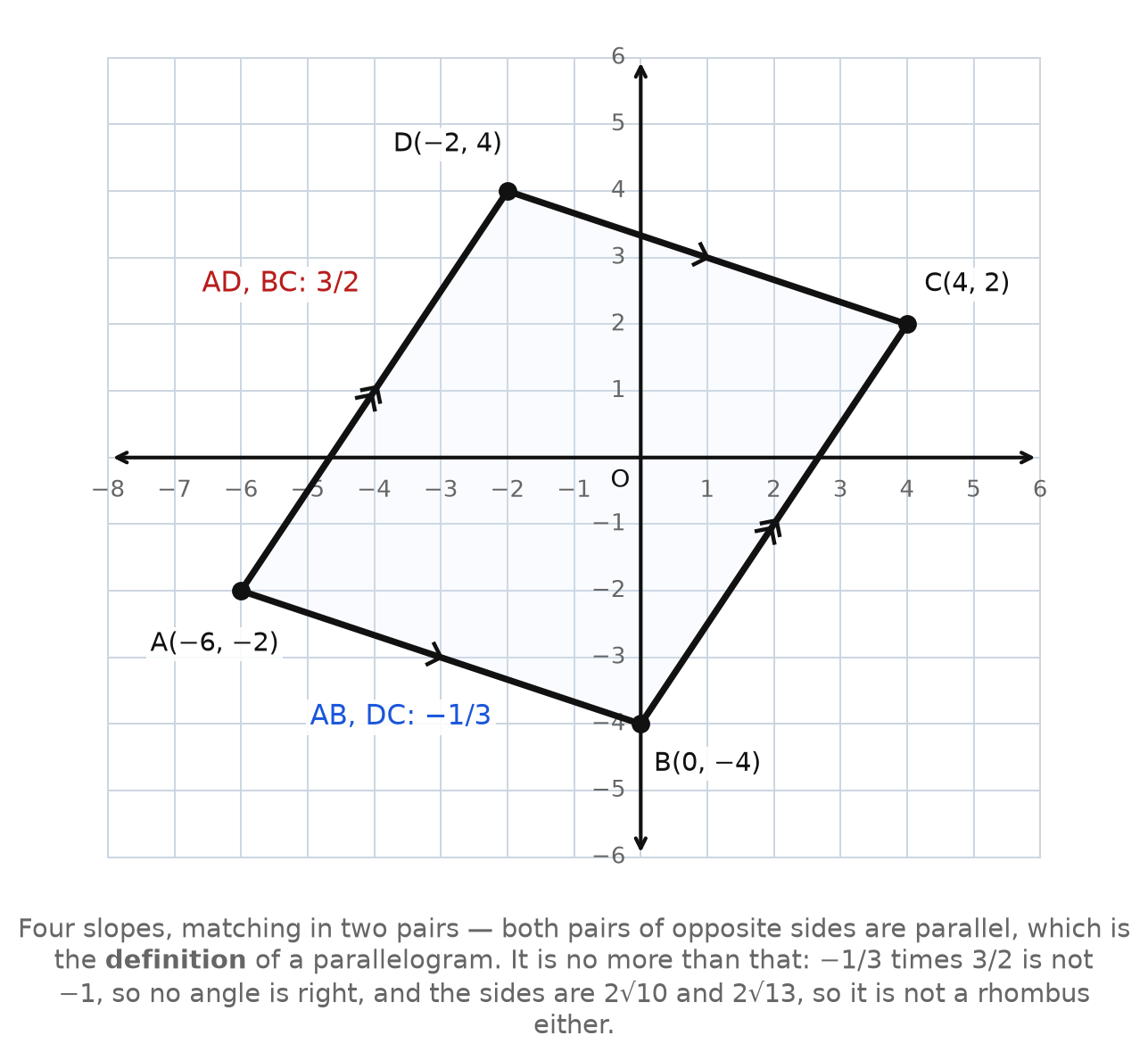
For , , , :
Both pairs match, so both pairs are parallel, so is a parallelogram by definition. Four computations, and done.
And it is only a parallelogram: , so no angle is right, and while , so it is not a rhombus.
The midpoint route, which is cheaper
For the same figure: the midpoint of is , and the midpoint of is . Same point, so the diagonals bisect each other, so is a parallelogram.
Two computations instead of four, and the same conclusion with the same force. When a question just asks is this a parallelogram, this is the route to reach for.
Writing it up
A coordinate proof is three things: the computation, the comparison, and the conclusion with its reason. All three have to be on the page.
Given: , , , . Prove: is a parallelogram.
Midpoint of : . Midpoint of : . The midpoints are the same point, so and bisect each other. A quadrilateral whose diagonals bisect each other is a parallelogram.
Dropping the last line is the most common way to lose the credit: two matching midpoints are not a conclusion until you say what they mean.
Solving for a missing vertex
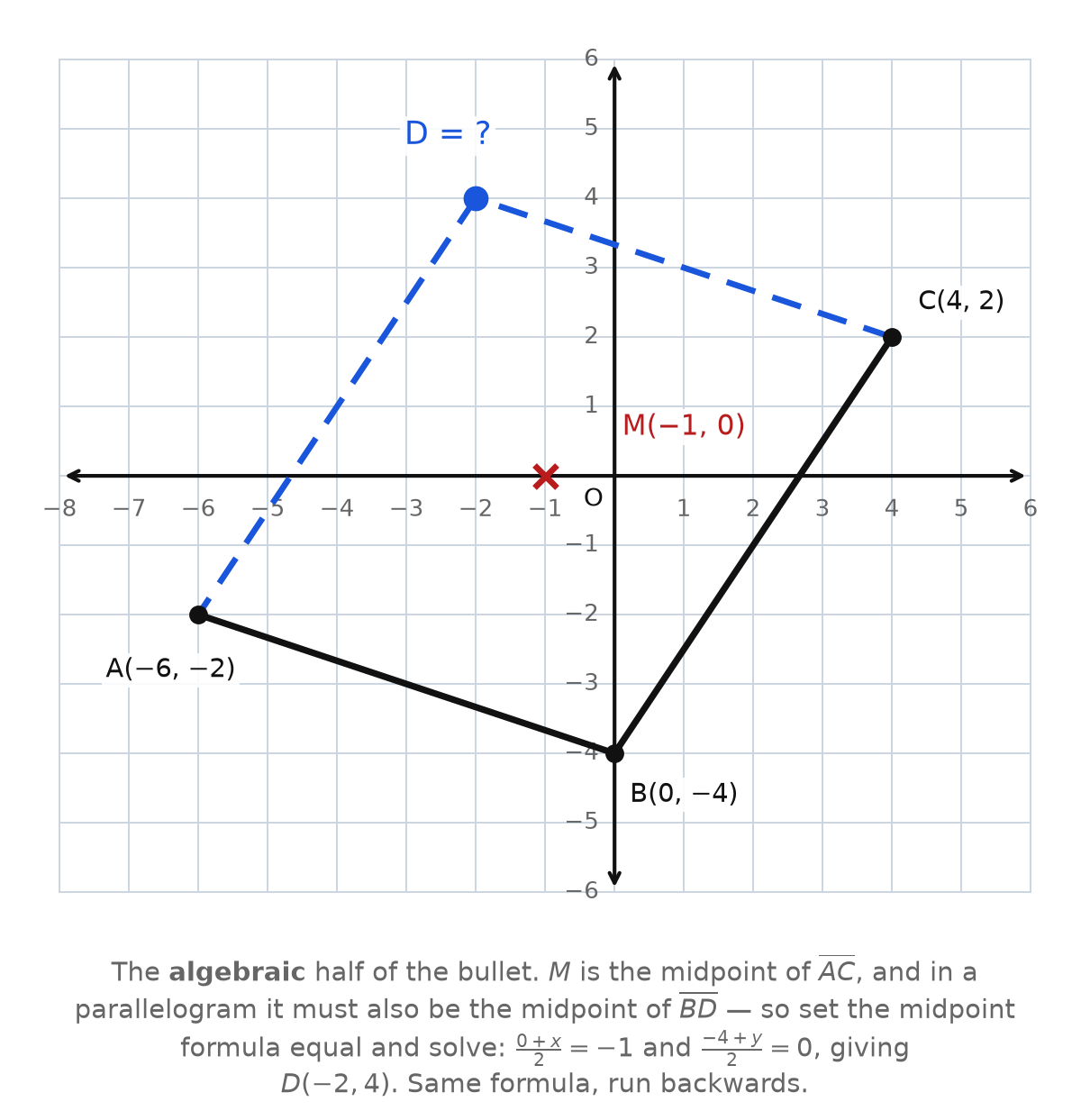
Given , , and , where must be for to be a parallelogram?
The diagonals must share a midpoint. , the midpoint of , is — so must also be the midpoint of :
So . This is the algebraic half of the bullet: the same formula, run backwards.
Worked examples
Example 1 — By midpoint
Is , , , a parallelogram?
Answer: Midpoint of is ; midpoint of is . Same point, so yes.
Example 2 — By slope
Show the same figure is a parallelogram using slopes.
Answer: and . Both pairs parallel, so yes — four computations where two would have done.
Example 3 — One pair, both ways
and both have slope , and . Is that enough?
Answer: Yes. One pair of opposite sides both parallel and congruent proves a parallelogram.
Example 4 — Missing vertex
In parallelogram , , , . Find .
Answer: Midpoint of is , so and , giving .
Example 5 — Not a parallelogram
, , , . Is it a parallelogram?
Answer: No. Midpoint of is and midpoint of is — different points, so the diagonals do not bisect each other.
Guided practice
- Use the four-routes table. Name all four ways to prove a parallelogram.
- On that table, which route takes the fewest computations, and how many?
- On that table, explain why "one pair of opposite sides parallel" is not on the list by itself.
- Use the slope figure. Give the four slopes and say what pairing them proves.
- On that figure, give one reason the parallelogram is not a rectangle and one reason it is not a rhombus.
- Use the missing-vertex figure. Say which property is being used to locate , and why it pins down exactly.
Independent practice
For each, decide whether is a parallelogram and show the work that proves it.
- , , , — use midpoints.
- , , , — use slopes.
- , , , — use midpoints.
- , , , — use midpoints.
Now the arithmetic.
- Give the midpoint of for and .
- Give the midpoint of for and .
- Give and for , , , .
- Give and for those same four points, in simplest radical form.
- In parallelogram , , , . Find .
- In parallelogram , , , . Find .
- The diagonals of parallelogram meet at , and . Find .
- The diagonals of parallelogram meet at , and . Find .
- Write a full coordinate proof that , , , is a parallelogram, using the midpoint route.
- Write a full coordinate proof of the same figure using the slope route, and say which proof you would rather write.
- Show that , , , is a parallelogram using one pair of opposite sides only.
- Application. A parking bay is marked at , , , , in metres. The contractor claims opposite edges are parallel. Verify the claim, and give the two edge lengths.
- Error analysis. A student shows and concludes is a parallelogram. Give a reason the conclusion does not follow, and say what one extra fact would fix it.
- Error analysis. A student computes the midpoint of and the midpoint of , finds them different, and concludes the figure is not a parallelogram. Identify the error.
- Reasoning. Explain why the midpoint route needs only two computations while the slope route needs four.
- Reasoning. Explain why "both pairs of opposite sides congruent" is a theorem you may use, rather than the definition.
Exit ticket 11.2
- Name the cheapest test for a parallelogram and say how many computations it takes.
- Is , , , a parallelogram? Show the two midpoints.
- In parallelogram , , , . Find .
- Give the one line of a coordinate proof that students most often leave out.
Lesson 11.3 — Rectangles, Rhombi, and Squares
Prove the parallelogram first, then add one check
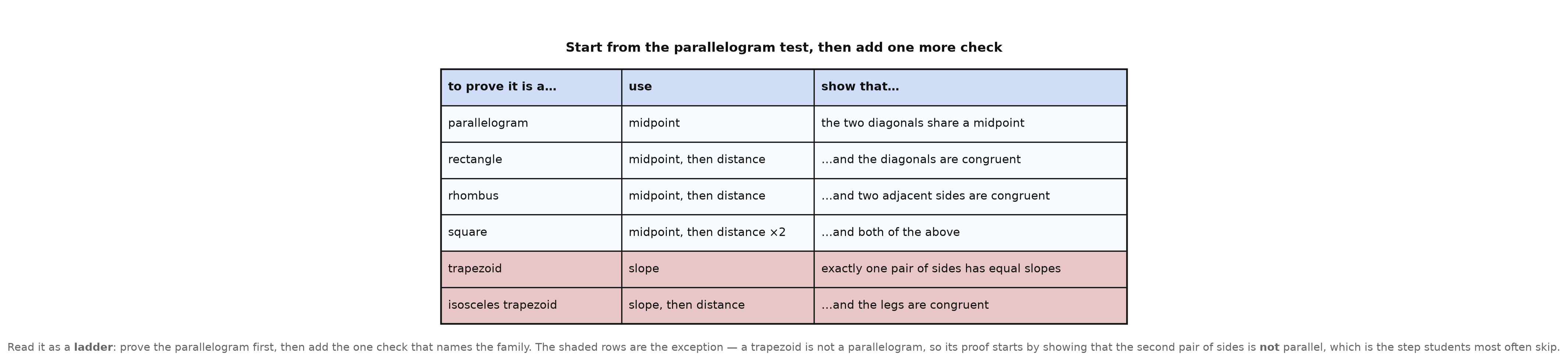
| To prove it is a… | Use | Show that… |
|---|---|---|
| parallelogram | midpoint | the diagonals share a midpoint |
| rectangle | midpoint, then distance | …and the diagonals are congruent |
| rhombus | midpoint, then distance | …and two adjacent sides are congruent |
| square | midpoint, then distance twice | …and both of the above |
Read it as a ladder. Each family is a parallelogram plus one more fact, so each proof is the parallelogram proof plus two more computations.
Two adjacent sides, not all four. In a parallelogram, opposite sides are already congruent — that is a theorem you have. So makes all four sides congruent, and computing and tells you nothing you did not have. Two adjacent sides is the whole rhombus check.
A rectangle
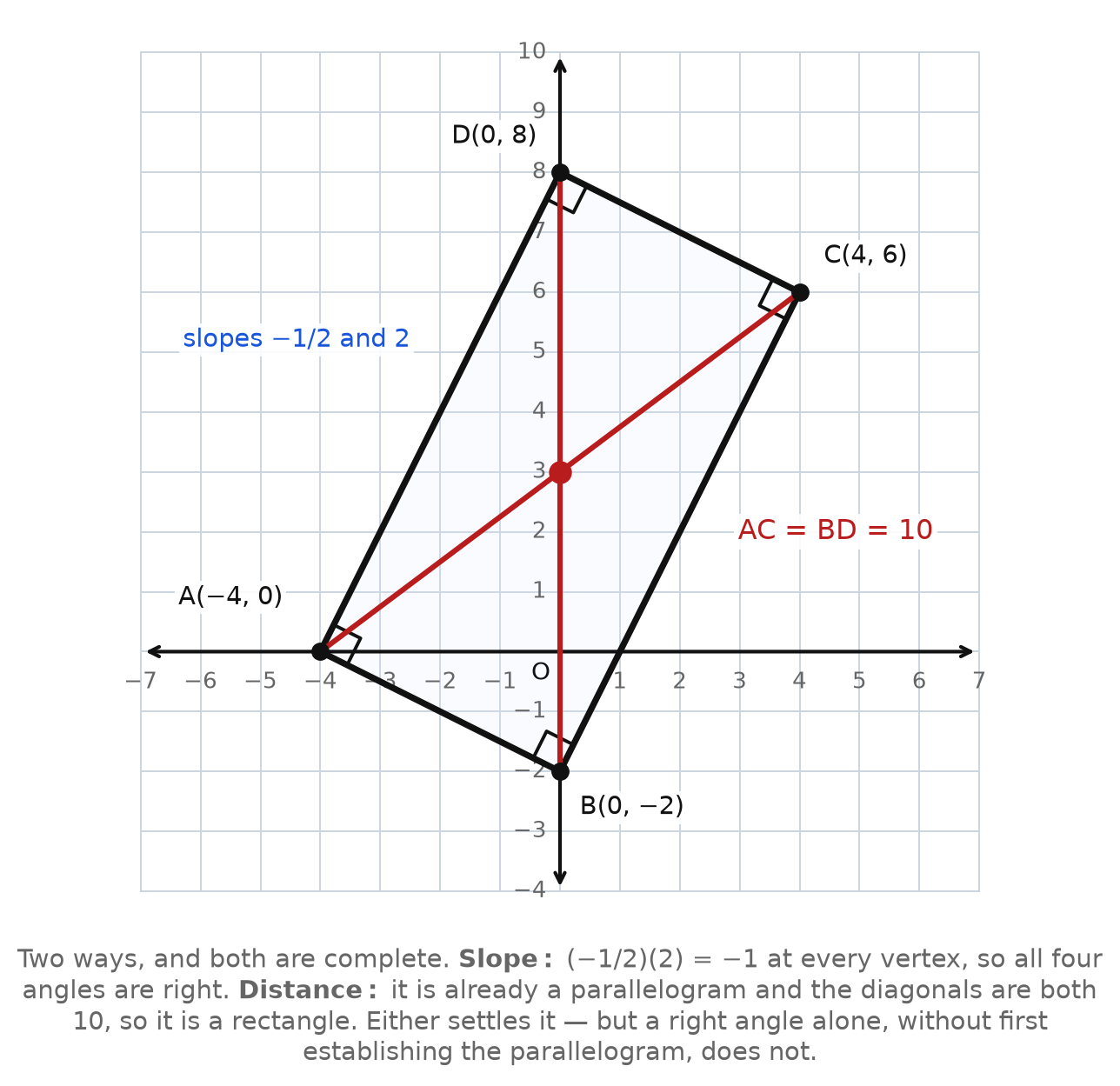
For , , , — two complete routes:
- Slope: and , and . The angle at is right; a parallelogram with one right angle is a rectangle.
- Distance: and . A parallelogram with congruent diagonals is a rectangle.
Either finishes it. What does not finish it is a right angle with no parallelogram established first — plenty of quadrilaterals have one right angle and no family at all.
A rhombus
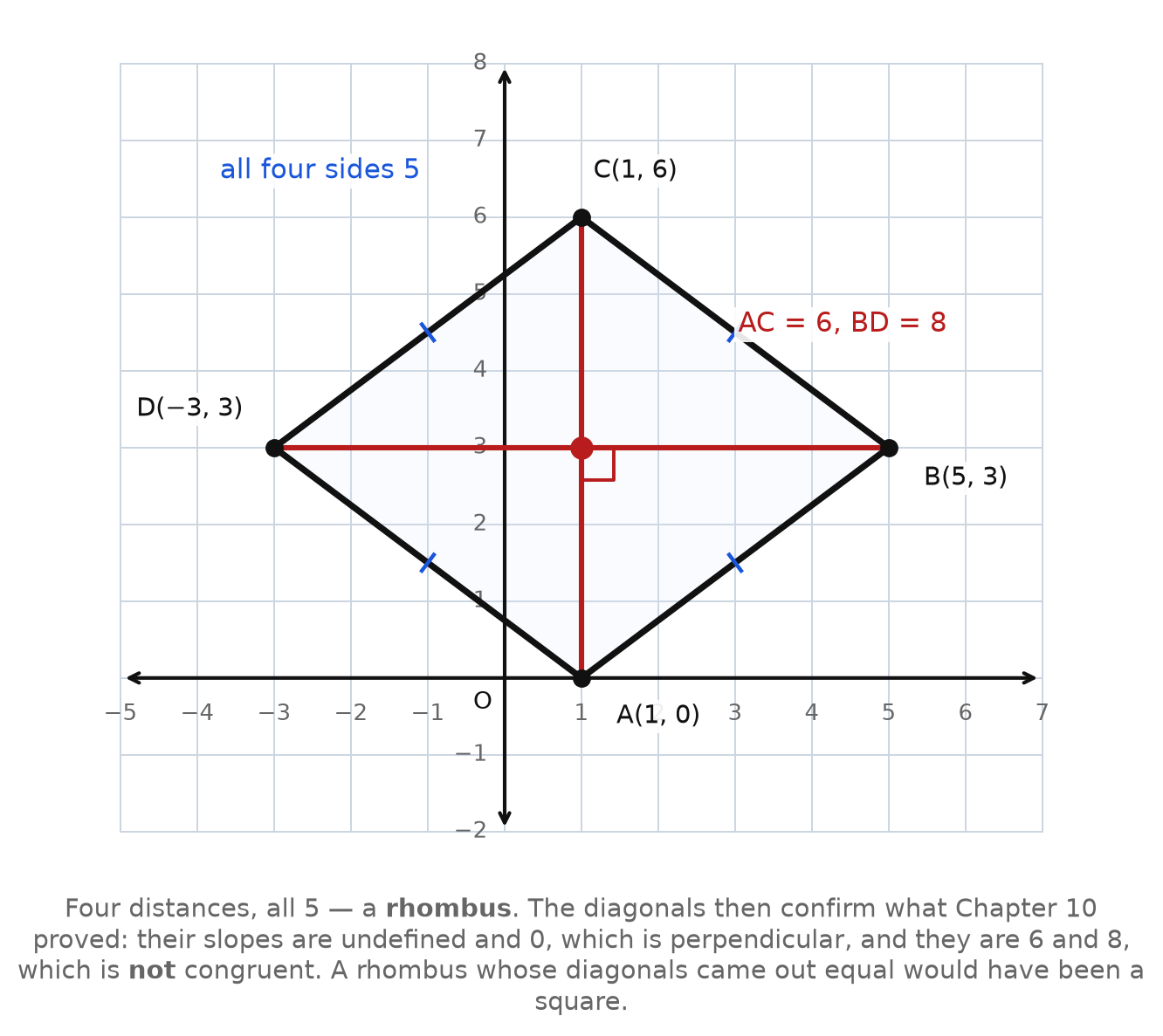
For , , , : all four sides are , so it is a rhombus.
The diagonals then confirm Chapter 10's theorem. runs from to — vertical, slope undefined. runs from to — horizontal, slope . Vertical and horizontal are perpendicular, and you say so in words rather than multiplying. Their lengths are and : not congruent, exactly as a non-square rhombus requires.
A square
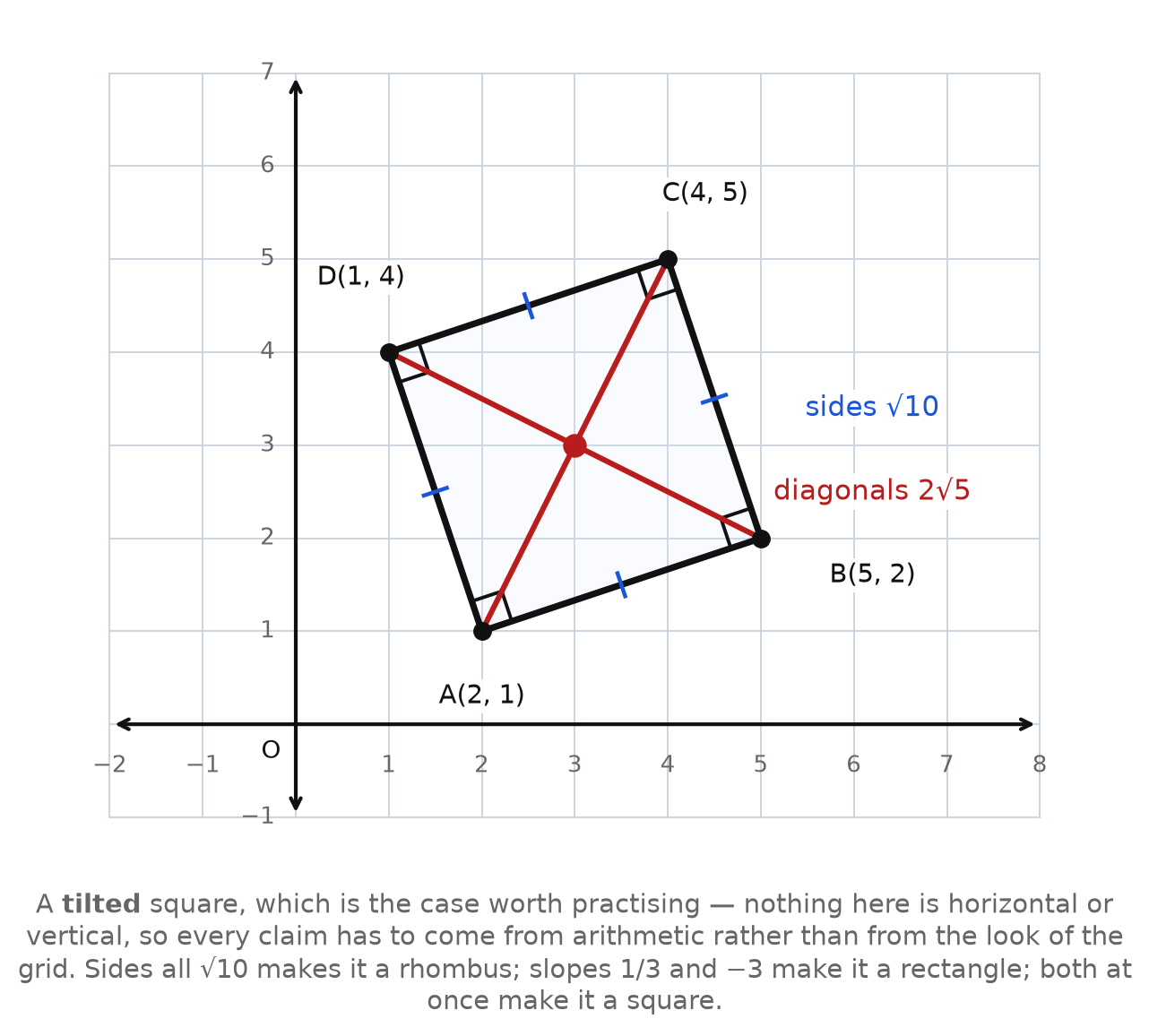
For , , , — deliberately tilted, so nothing can be read off the grid:
- diagonals share the midpoint → parallelogram;
- → rhombus;
- → rectangle;
- both at once → square.
Six computations. Computing all four sides and all four slopes and both diagonals would be ten, and would prove exactly the same thing.
Worked examples
Example 1 — Rectangle
Is , , , a rectangle?
Answer: Midpoints of and are both → parallelogram. → rectangle. Yes.
Example 2 — Not a square
Is that same figure a square?
Answer: No. and — adjacent sides differ, so it is not a rhombus, so it is not a square.
Example 3 — Rhombus
Is , , , a rhombus?
Answer: Midpoints both → parallelogram. → rhombus. Yes. Its diagonals are and — different, so not a square.
Example 4 — Square
Is , , , a square?
Answer: Midpoints both → parallelogram. → rhombus. → rectangle. Both → square.
Example 5 — Which check is missing
A student proves a figure is a parallelogram and that . What have they got, and what would they still need for a square?
Answer: A rectangle. For a square they still need two adjacent sides congruent (or perpendicular diagonals).
Guided practice
- Use the family table. What do the rectangle, rhombus, and square rows all start with?
- On that table, name the one extra check for a rectangle and the one for a rhombus.
- Use the rectangle figure. Give the two routes, and the numbers each one produces.
- Use the rhombus figure. Explain why its diagonals are perpendicular without multiplying two slopes.
- On that figure, give the two diagonal lengths and say what their being different rules out.
- Use the square figure. List the four facts, in the order you would prove them.
Independent practice
Name the most specific family, and show the computations that prove it.
- , , , .
- , , , .
- , , , .
- , , , .
Now the individual checks.
- Give and for , , , , and say what they prove.
- Give and for those same points, and say what they rule out.
- Give and for , , , and say what they prove.
- Give the slopes of both diagonals of , , , , and state the conclusion carefully.
- Give and for that rhombus, and say what their being unequal rules out.
- Give and for , , .
- Give and for , , , .
- A parallelogram has . Name the most specific family.
- A parallelogram has . Name the most specific family.
- A parallelogram has both. Name the most specific family.
- Application. A tile is cut with corners at , , , , in inches. Prove it is a square, using the fewest computations you can, and give its side length exactly.
- Application. A gate frame has corners , , , . The builder needs it square-cornered but not equal-sided. Verify both requirements.
- Error analysis. A student computes all four sides of a parallelogram, finds them , and writes "so it is a square." Correct them.
- Error analysis. A student shows the angle at is right and concludes is a rectangle, with nothing else shown. Explain what is missing.
- Reasoning. Explain why checking two adjacent sides is enough for a rhombus once you know the figure is a parallelogram.
- Reasoning. A rhombus has a vertical diagonal and a horizontal one. Explain why you cannot prove they are perpendicular by multiplying slopes, and what you write instead.
Exit ticket 11.3
- Name the extra check that turns a parallelogram into a rectangle.
- Name the extra check that turns a parallelogram into a rhombus.
- Is , , , a square? Show the deciding computation.
- Give the smallest number of computations that proves a square, and list what they are.
Lesson 11.4 — Trapezoids, and Choosing the Proof
A trapezoid takes two slope facts
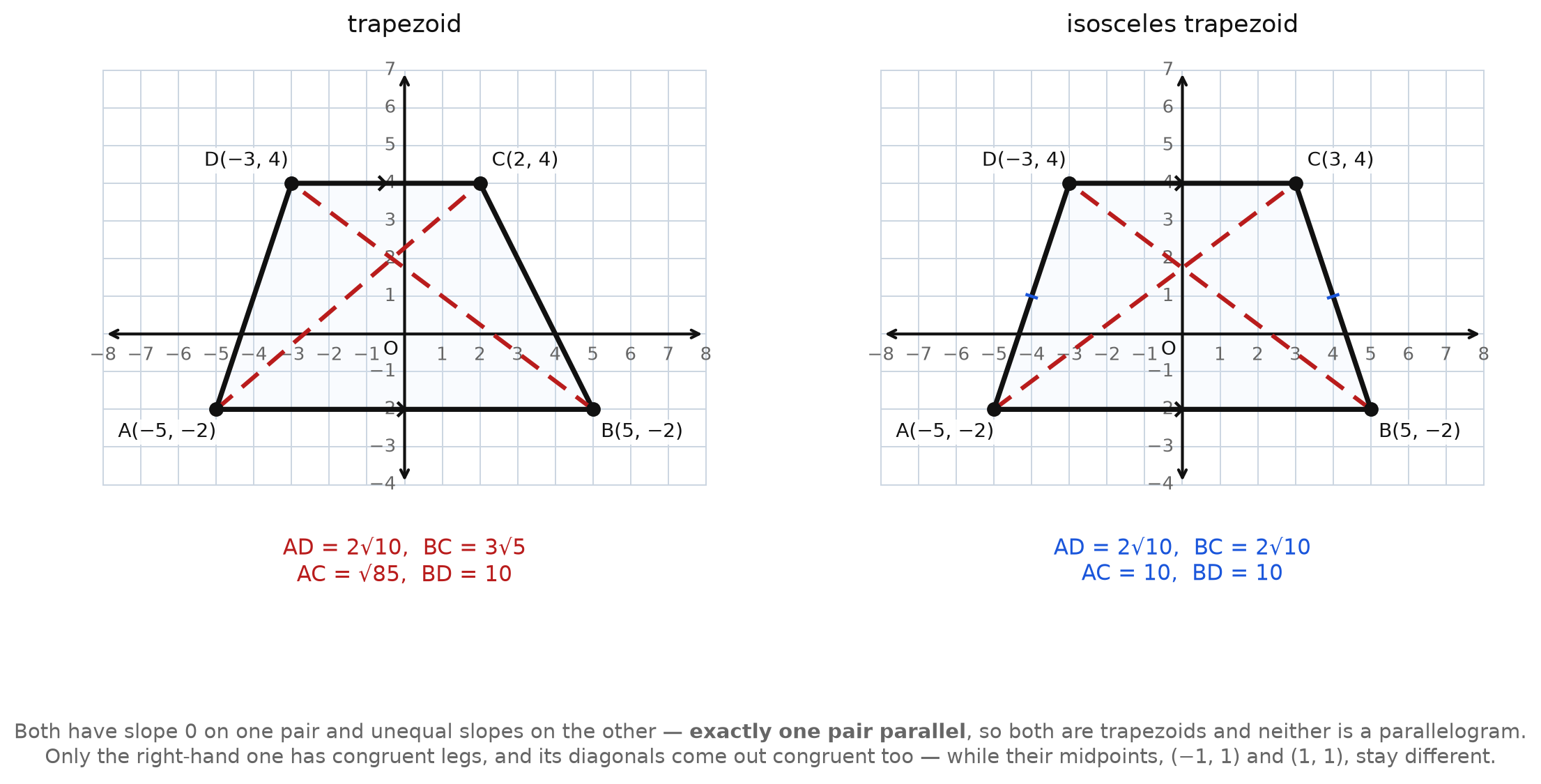
Virginia's definition is exclusive: exactly one pair of parallel sides. So a trapezoid proof has two halves, and the second is the one people skip.
For , , , :
- and — the bases are parallel;
- and — the legs are not parallel.
Both halves, and only then is it a trapezoid. Showing just the first half proves nothing: every parallelogram also has a pair of parallel sides.
What congruent legs add
For , , , : the bases are again parallel and the legs again are not, so it is a trapezoid. Then — congruent legs, so it is an isosceles trapezoid.
Its diagonals come out congruent too: . And their midpoints, and , stay different — congruent diagonals that do not bisect, exactly as Chapter 10 proved.
Congruent diagonals do not make a rectangle. They make a rectangle in a parallelogram. An isosceles trapezoid has congruent diagonals and is not a parallelogram at all, which is why the midpoint check has to come first.
Choosing the proof

| Ask | Compute | How many |
|---|---|---|
| Is it a parallelogram at all? | midpoint of both diagonals | 2 |
| If yes — are the diagonals congruent? | distance | 2 |
| If yes — are two adjacent sides congruent? | distance | 2 |
| If not a parallelogram — is one pair parallel? | slope | 4 |
| If a trapezoid — are the legs congruent? | distance | 2 |
Two midpoints answer the biggest question first, and every question after it costs two more computations. A correct long proof still earns the credit — the point of choosing well is that there is less to get wrong.
Worked examples
Example 1 — Trapezoid
Is , , , a trapezoid?
Answer: , so one pair is parallel. and , so the other pair is not. Yes — and not a parallelogram.
Example 2 — Isosceles or not
Is that figure isosceles?
Answer: No. and — the legs differ.
Example 3 — Isosceles trapezoid
Is , , , isosceles?
Answer: Bases parallel ( both), legs not ( and ), so a trapezoid. , so yes.
Example 4 — A trap
That same figure has , and the diagonals are perpendicular. Is it a square?
Answer: No. Its diagonal midpoints are and — different, so it is not a parallelogram, so it cannot be a square. Congruent and perpendicular diagonals only name a square inside the parallelogram family.
Example 5 — Choosing
You are asked only "is a parallelogram?" What do you compute?
Answer: Two midpoints. Nothing else is needed.
Guided practice
- Use the trapezoid figure. Give the two slope facts that prove the left figure is a trapezoid.
- On that figure, say why the second slope fact cannot be skipped.
- On the right figure, give the leg lengths and the family they establish.
- On the right figure, give the two diagonal lengths and the two diagonal midpoints, and say what the pair of facts together shows.
- Use the choosing table. Which question is asked first, and why that one?
- On that table, count the computations for a square and for an isosceles trapezoid.
Independent practice
Name the most specific family and show the computations.
- , , , .
- , , , .
- , , , .
- , , , .
Now the individual checks.
- Give the four slopes of , , , , and the two facts they establish.
- Give and for those points, and the family that follows.
- Give and for those points.
- Give the midpoints of and for those points, and say what their being different proves.
- Give and for , , , .
- A quadrilateral has one pair of parallel sides and one pair that is not. Name the family.
- A quadrilateral has both pairs parallel. Say why it cannot be a trapezoid in this course.
- Application. A roof truss panel has corners , , , , in feet. Prove it is an isosceles trapezoid, and give the length of each leg exactly and to the nearest hundredth.
- Application. You must decide, in as few computations as possible, whether , , , is a rectangle. Say what you compute, in what order, and answer.
- Error analysis. A student shows and writes "so is a trapezoid." Explain what is missing and why it matters.
- Error analysis. A student finds that a figure's diagonals are congruent and perpendicular and concludes it is a square. Using item 94's figure, show that the conclusion can be false, and name the check that was skipped.
- Reasoning. Explain why the midpoint question is worth asking before any other, whatever family you suspect.
Exit ticket 11.4
- Give the two slope facts a trapezoid proof needs.
- Give the extra check that makes a trapezoid isosceles.
- Is , , , a parallelogram? Show the deciding computation.
- Name the first question to ask about any quadrilateral in the coordinate plane, and the formula that answers it.
Chapter 11 Review
Vocabulary. coordinate plane · slope formula · distance formula · midpoint formula · parallel · perpendicular · congruent · bisect · simplest radical form · coordinate proof · converse · most specific family
Review 1 (G.PC.1b). For , , , :
- Show it is a parallelogram in two computations, and name the property used.
- Show it is a rhombus in two more, and name the property used.
- Show it is a rectangle in two more, and name the property used.
- Name the most specific family, and say how many computations it took in total. Then say how many it would have taken to compute all four sides, all four slopes, and both diagonals.
Review 2 (G.PC.1 a, b). For each set of four points, name the most specific family and give the one computation that decided it.
- , , ,
- , , ,
- , , ,
- , , ,
- , , ,
Review 3 (G.PC.1b). A designer places three corners of a parallelogram-shaped panel at , , and , in centimetres.
- Find , and show the algebra rather than the picture.
- Give the two side lengths exactly, and say whether the panel is a rhombus.
- Give both diagonal lengths exactly, and say whether the panel is a rectangle.
- The designer now wants the same three corners but a square panel. Explain why no choice of can do it, using one of the computations you have already made.
Standards coverage check — Chapter 11
| Knowledge and Skill | Where it is taught | Where it is practiced | Where it is applied in context |
|---|---|---|---|
| G.PC.1a — solve problems by applying properties specific to parallelograms, rectangles, rhombi, squares, isosceles trapezoids, and trapezoids | 11.2 (which property each parallelogram test uses); 11.3 (the extra property that names each family); 11.4 (the trapezoid families) | 33–36, 47, 49, 52; 63–66, 74–76, 79–81; 93–96, 102, 103, 107 | 48; 77, 78; 104, 105; Review 2 |
| G.PC.1b — prove and justify that quadrilaterals have specific properties, using coordinate and algebraic methods, such as the slope formula, the distance formula, and the midpoint formula | 11.1 (each formula and the claim it settles); 11.2 (four routes, the write-up, and solving for a missing vertex); 11.3 (the ladder of extra checks); 11.4 (two slope facts, and choosing the proof) | 1–18, 20–26; 27–47, 49–56; 57–76, 79–86; 87–103, 106–112 | 19; 48; 77, 78; 104, 105; Review 1, Review 2, Review 3 |
Supporting items: 21, 22, 51, 52, 81, 82, and 108 are the reasoning items, and 21 and 82 together fix the one real limit of the method — slope certifies and no other angle, and it cannot certify even that when a segment is vertical. The error analyses target the recurring failures: rounding a radical before comparing (20), concluding a parallelogram from one congruent pair (49), taking midpoints of sides instead of diagonals (50), calling an equal-sided parallelogram a square (79), claiming a rectangle from one right angle with no parallelogram established (80), stopping a trapezoid proof after one slope fact (106), and — the sharpest one — reading congruent and perpendicular diagonals as a square when the figure is not a parallelogram at all (107).
Boundaries respected. The methods are exactly the three G.PC.1b names — slope, distance, midpoint — and no item asks for anything they cannot settle: every claim in this chapter is parallel, perpendicular, congruent, or bisects. Deductive proofs and constructions of these same properties are not here; that was Chapter 10, bullets c and d. Virginia's exclusive trapezoid definition from Chapter 1 holds throughout, so every trapezoid proof carries the second slope fact. Kites do not appear, for the reason given in Chapter 10.
Answer keys for every item in this chapter are in Appendix A.