Chapter 10 — Properties of Quadrilaterals
Standard: G.PC.1 (a, c, d)
G.PC.1 — verbatim. The student will prove and justify theorems and properties of quadrilaterals, and verify and use properties of quadrilaterals to solve problems, including the relationships between the sides, angles, and diagonals. Students will demonstrate the following Knowledge and Skills: a) Solve problems, including those in context, by applying properties specific to parallelograms, rectangles, rhombi, squares, isosceles trapezoids, and trapezoids. b) Prove and justify that quadrilaterals have specific properties, using coordinate and algebraic methods, such as the slope formula, the distance formula, and the midpoint formula. c) Prove and justify theorems and properties of quadrilaterals using deductive reasoning. d) Use congruent segment, congruent angle, angle bisector, perpendicular line, and/or parallel line constructions to verify properties of quadrilaterals.
By the end of this chapter you will be able to:
- Name the six families the standard lists and give each one's defining condition (G.PC.1a)
- State and use the four properties of a parallelogram, and prove two of them (G.PC.1 a, c)
- Say what a rectangle adds, what a rhombus adds, and why those two additions are different (G.PC.1 a, c)
- Say why a square needs no properties of its own (G.PC.1a)
- Use the properties specific to a trapezoid and an isosceles trapezoid (G.PC.1 a, c)
- Verify a property with a compass-and-straightedge construction rather than asserting it (G.PC.1d)
Lessons: 10.1 The Six Families · 10.2 Properties of Parallelograms · 10.3 Rectangles and Rhombi · 10.4 Squares, and What "Specific To" Means · 10.5 Trapezoids and Isosceles Trapezoids · 10.6 Constructions That Verify Properties
Why this chapter matters. Chapter 5 proved triangles congruent, and this chapter spends that. Every property of a parallelogram in Lesson 10.2 is proved by cutting the figure with a diagonal and using ASA — the theorems are new, the machinery is not. This is also the first chapter where the question is usually "which family is this?" rather than "what is this length?", and answering that well is what the whole Polygons and Circles strand is built on.
Scope note. This chapter covers G.PC.1 a, c, and d — the properties, the deductive proofs, and the constructions that verify them. Bullet b, which proves the same properties with slope, distance, and midpoint, is Chapter 11.
Six families, and kites are not among them. The standard's list is parallelograms, rectangles, rhombi, squares, isosceles trapezoids, and trapezoids. Kites appeared in Chapter 1 as a set in a Venn diagram and as a counterexample in a logic item — both legitimate uses of a shape you already know — but no property of a kite is taught or assessed here, because the standard does not name one. Isosceles trapezoids are named, and Lesson 10.5 gives them a full treatment.
Properties specific to. The standard's phrase is doing real work. A rhombus has diagonals that bisect each other, but so does every parallelogram, so that property tells you nothing about which family you are in. What is specific to a rhombus is that its diagonals are perpendicular. Lesson 10.4 makes that distinction the point.
Conventions this chapter fixes.
- A trapezoid has exactly one pair of parallel sides. This is Virginia's exclusive definition, fixed in Chapter 1, and it means no parallelogram is a trapezoid. The two boxes in the hierarchy do not touch.
- Definition versus theorem. Each family has one defining condition — the thing you check. Everything else is a theorem, and this chapter proves several of them rather than listing them.
- Inherited is not specific. When asked what makes a figure a rhombus, an inherited property is not an answer.
- A construction verifies; a ruler measures. G.PC.1d asks for constructions, and the arcs stay on the page — they are the evidence, exactly as in Chapter 5.
- Congruent versus equal and order carries the claim hold unchanged from Chapter 5.
- Item numbering runs straight through the chapter, from 1 in Lesson 10.1 to 132 at the end of Lesson 10.6.
Lesson 10.1 — The Six Families
One defining condition each
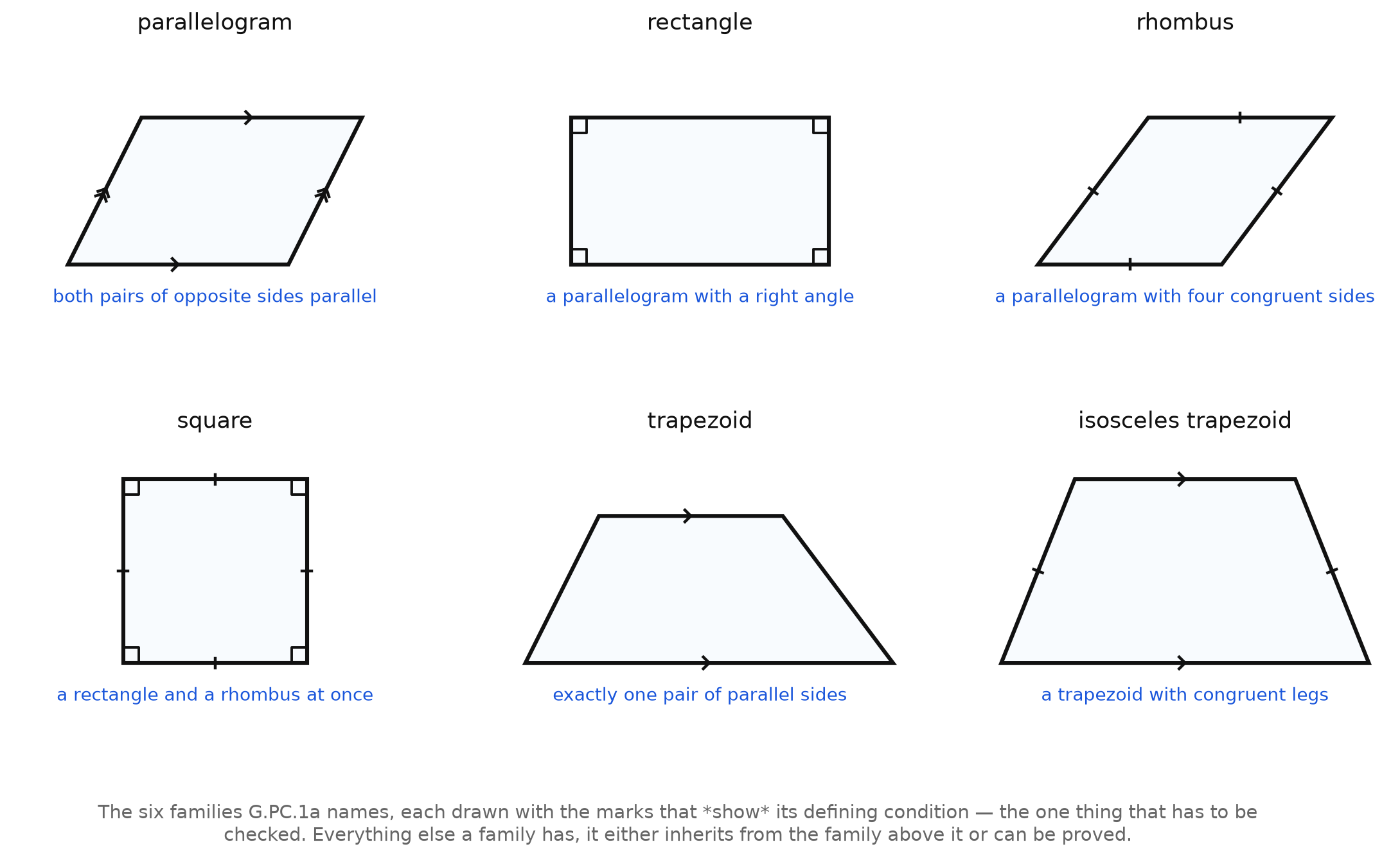
| Family | Defining condition |
|---|---|
| parallelogram | both pairs of opposite sides parallel |
| rectangle | a parallelogram with a right angle |
| rhombus | a parallelogram with four congruent sides |
| square | a rectangle and a rhombus |
| trapezoid | exactly one pair of parallel sides |
| isosceles trapezoid | a trapezoid with congruent legs |
The definition is what you check. Everything else a family has is a theorem, and several of them get proved in this chapter.
The hierarchy
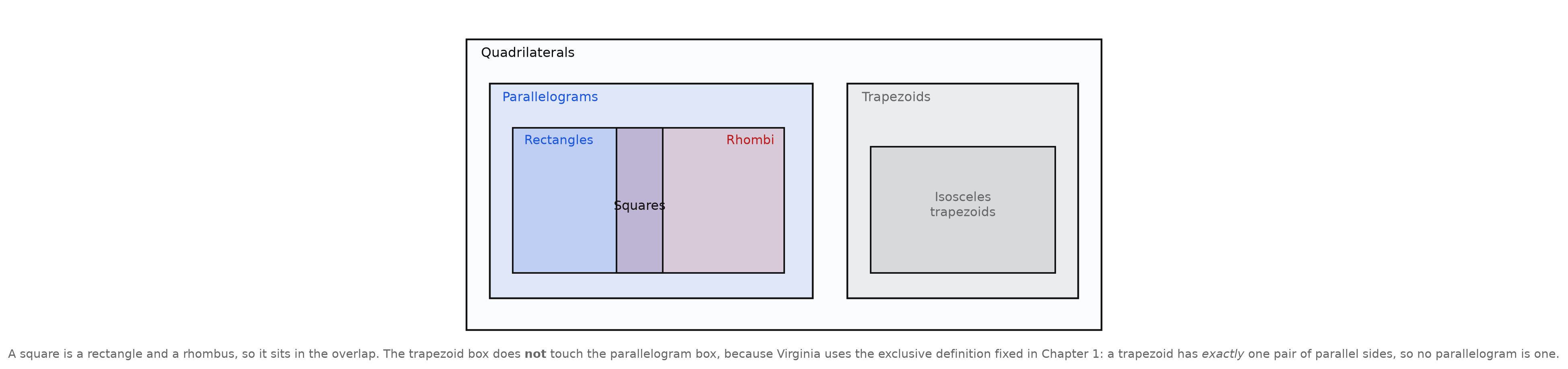
Two things in that picture are worth saying out loud.
- Squares sit in the overlap. A square is a rectangle and a rhombus at the same time, so it inherits both sets of properties.
- The trapezoid box does not touch the parallelogram box. Under Virginia's exclusive definition a trapezoid has exactly one pair of parallel sides, and a parallelogram has two — so no parallelogram is a trapezoid, and no trapezoid is a parallelogram.
Reading the hierarchy both ways
Downward, every property is inherited: anything true of all parallelograms is true of every rectangle, rhombus, and square. Upward, it is not: a rectangle's congruent diagonals say nothing about parallelograms in general.
That asymmetry is the source of most errors in this chapter, and Lesson 10.4 is about it.
Worked examples
Example 1 — Naming from a definition
A quadrilateral has both pairs of opposite sides parallel and one right angle. What is it?
Answer: A rectangle. Both pairs parallel makes it a parallelogram; the right angle makes it a rectangle.
Example 2 — Exactly one pair
A quadrilateral has exactly one pair of parallel sides. Can it be a parallelogram?
Answer: No. A parallelogram has two pairs, and exactly one excludes that. It is a trapezoid.
Example 3 — Inheriting
Is every square a rhombus?
Answer: Yes. A square has four congruent sides and is a parallelogram, which is the definition of a rhombus.
Example 4 — Not inheriting
Is every rhombus a square?
Answer: No. A rhombus needs four congruent sides; a square also needs a right angle, and most rhombi have none.
Example 5 — Two conditions at once
A quadrilateral has four congruent sides and four right angles. Name every family it belongs to.
Answer: Square, rhombus, rectangle, and parallelogram — all four.
Guided practice
- Use the six-families figure. Give the defining condition of a rhombus.
- On that figure, give the defining condition of a trapezoid.
- On that figure, which two families is a square in at once?
- Use the hierarchy. Why do the trapezoid box and the parallelogram box not touch?
- On that hierarchy, which region holds the squares, and why is it where it is?
- Explain the difference between a family's definition and its theorems.
Independent practice
- A quadrilateral has both pairs of opposite sides parallel and one right angle. Name it.
- A quadrilateral has exactly one pair of parallel sides. Can it be a parallelogram? Explain.
- Is every square a rhombus? Explain.
- Is every rhombus a square? Explain.
- Is every rectangle a parallelogram? Explain.
- Is every parallelogram a rectangle? Explain.
- A quadrilateral has four congruent sides and four right angles. Name every family it belongs to.
- A quadrilateral has exactly one pair of parallel sides and congruent legs. Name it.
- A quadrilateral has four congruent sides but no right angle. Name the most specific family it belongs to.
- Can a trapezoid have two pairs of parallel sides in this course? Explain.
- Application. A window frame is built with both pairs of opposite sides parallel and all four corners square. Name the most specific family, and say which two conditions were checked.
- Error analysis. A student says a square is not a rectangle "because it has equal sides." Correct them.
- Reasoning. Explain why a property true of all parallelograms is automatically true of all rhombi, but not the other way round.
- Reasoning. Explain why the exclusive definition of a trapezoid means the two boxes in the hierarchy cannot overlap.
Exit ticket 10.1
- Give the defining condition of a rectangle.
- Name the six families the standard lists.
Lesson 10.2 — Properties of Parallelograms
Four properties, all of them theorems
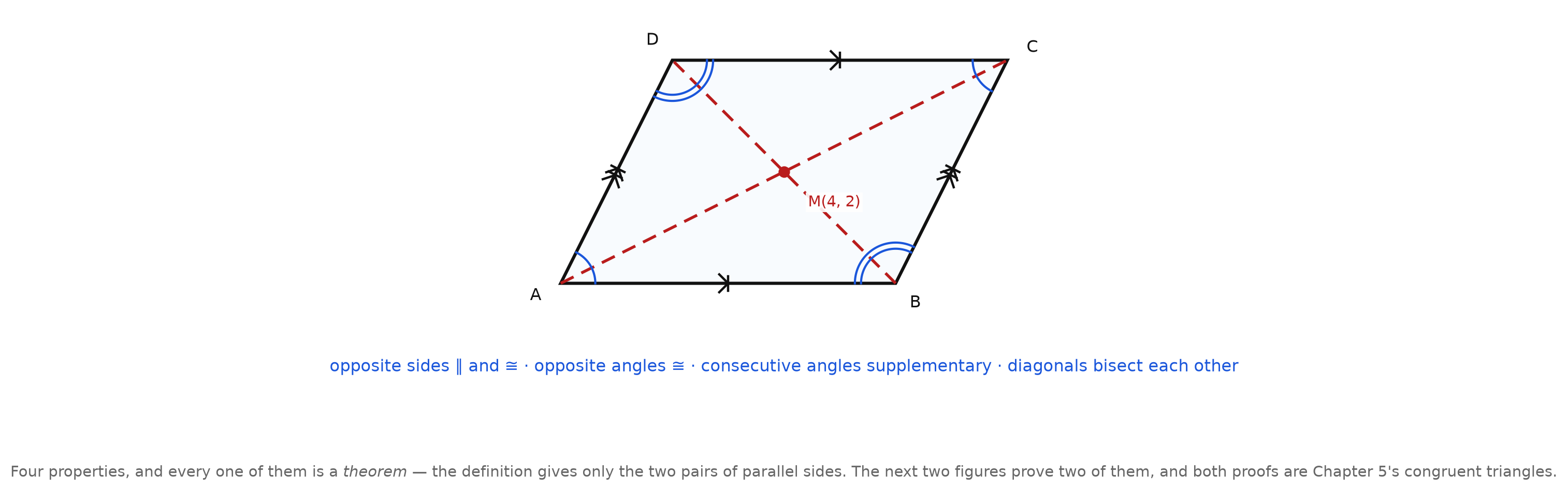
Parallelogram properties. In a parallelogram,
- opposite sides are parallel and congruent;
- opposite angles are congruent;
- consecutive angles are supplementary;
- the diagonals bisect each other.
Only the first half of the first line is the definition. The rest are theorems — and the proofs are Chapter 5's.
Proving opposite sides congruent
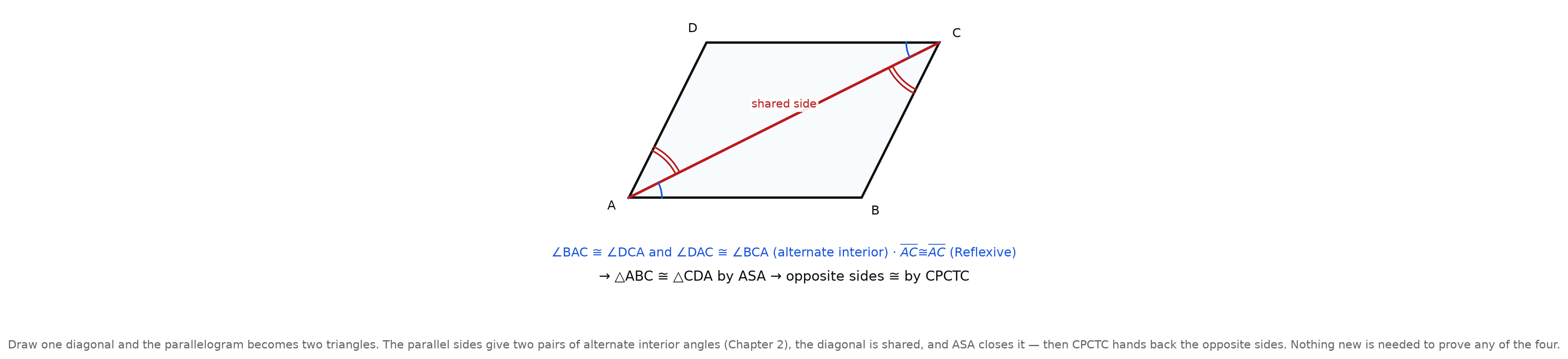
Draw diagonal . It makes two triangles, and:
- — alternate interior angles, since ;
- — the shared side, by the Reflexive Property;
- — alternate interior angles, since .
That is ASA, so , and CPCTC gives and . The congruent opposite angles come from the same CPCTC.
Proving the diagonals bisect each other
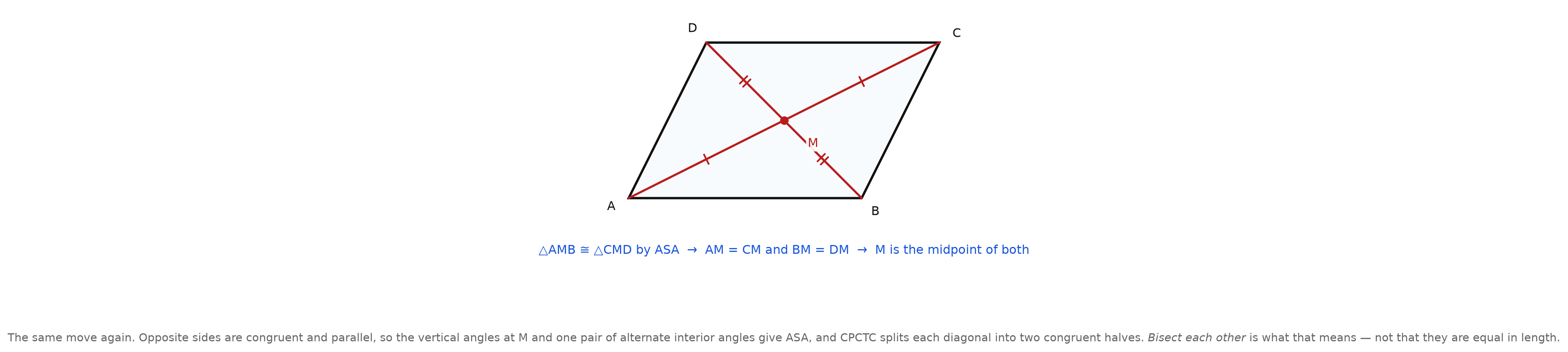
Both diagonals make and , where is the intersection. Vertical angles at are congruent, alternate interior angles give a second pair, and from the theorem just proved. ASA again, and CPCTC splits each diagonal into congruent halves.
Bisect each other is not the same as congruent. A parallelogram's diagonals cut each other in half; they are generally different lengths. Confusing the two is the single most common error in this chapter, and Lesson 10.3 is where it bites.
Consecutive angles
Consecutive angles are same-side interior angles across a pair of parallel sides, so they are supplementary — Chapter 2, unchanged. If one angle of a parallelogram is , the two next to it are and the opposite is .
Worked examples
Example 1 — Opposite sides
In parallelogram , and . Give and .
Answer: and .
Example 2 — Angles
In parallelogram , . Give the other three angles.
Answer: (opposite), and (consecutive, supplementary).
Example 3 — Diagonals
In parallelogram the diagonals meet at , with . Give .
Answer: is the midpoint, so and .
Example 4 — With algebra
In parallelogram , and . Find and .
Answer: Opposite sides are congruent, so , , , and .
Example 5 — Angles with algebra
In parallelogram , and . Find .
Answer: Consecutive angles are supplementary: , so and .
Guided practice
- Use the properties figure. Name the four properties of a parallelogram.
- On that figure, which one of the four is the definition and which three are theorems?
- On that figure, give the point where the diagonals meet, and say what is true of it.
- Use the proof figure. Name the two pairs of alternate interior angles and their reason.
- On that figure, name the criterion and the reason that gives the opposite sides.
- Use the diagonal figure. Explain the difference between bisect each other and congruent.
Independent practice
- In parallelogram , and . Give and .
- In parallelogram , . Give the other three angles.
- In parallelogram , . Give and .
- In parallelogram the diagonals meet at with . Give .
- In parallelogram the diagonals meet at with . Give .
- In parallelogram , and . Find and .
- In parallelogram , and . Find and .
- In parallelogram , and . Find and both measures.
- In parallelogram , and . Find and .
- In parallelogram the diagonals meet at with and . Find and .
- The perimeter of parallelogram is and . Give .
- Application. A gate is built as a parallelogram ft wide and ft tall, with a diagonal brace. The brace meets the other diagonal at . If one diagonal measures ft, how far is from each of its endpoints?
- Error analysis. A student says the diagonals of a parallelogram are congruent because they bisect each other. Correct them.
- Reasoning. Explain why proving opposite sides congruent also proves opposite angles congruent, with no extra work.
- Reasoning. Explain why one angle of a parallelogram determines all four.
- Write a two-column proof that the diagonals of a parallelogram bisect each other.
Exit ticket 10.2
- In parallelogram , . Give and .
- In parallelogram the diagonals meet at with . Give .
Lesson 10.3 — Rectangles and Rhombi
What a rectangle adds
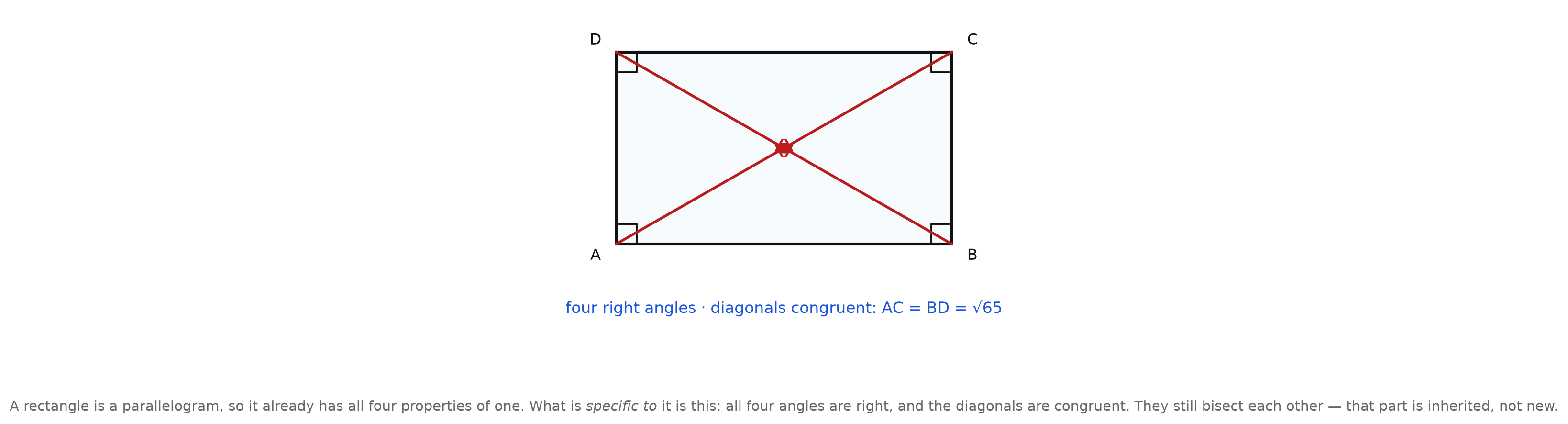
A rectangle is a parallelogram, so it already has all four properties of one. Specific to a rectangle:
- all four angles are right;
- the diagonals are congruent.
They still bisect each other — that is inherited, not new.
What a rhombus adds
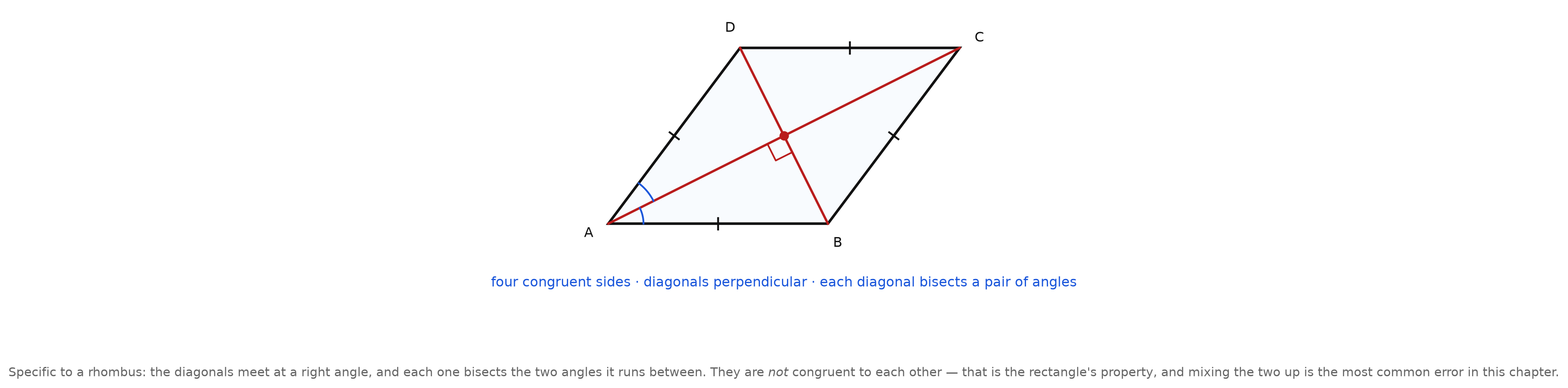
A rhombus is also a parallelogram. Specific to a rhombus:
- all four sides are congruent;
- the diagonals are perpendicular;
- each diagonal bisects a pair of opposite angles.
A rhombus's diagonals are generally not congruent. That is the rectangle's property, and swapping the two is the error this lesson exists to prevent.
Congruent versus perpendicular. Rectangle → congruent diagonals. Rhombus → perpendicular diagonals. Both bisect each other, because both are parallelograms. A figure with both extra properties at once is a square.
Worked examples
Example 1 — Rectangle diagonals
In rectangle , . Give and , where is the intersection.
Answer: (congruent diagonals) and (they bisect each other).
Example 2 — Rhombus diagonals
In rhombus the diagonals meet at . Give .
Answer: — a rhombus's diagonals are perpendicular.
Example 3 — A rhombus's angle bisector
In rhombus , . Give .
Answer: bisects , so .
Example 4 — Rectangle with algebra
In rectangle , and . Find and .
Answer: The diagonals are congruent: , so , , and .
Example 5 — Which property applies
A parallelogram has perpendicular diagonals. What is the most you can conclude?
Answer: It is a rhombus. Perpendicular diagonals are specific to rhombi among parallelograms; nothing here forces a right angle, so it need not be a square.
Guided practice
- Use the rectangle figure. Name the two properties specific to a rectangle.
- On that figure, name one property it has that is inherited rather than specific.
- Use the rhombus figure. Name the three properties specific to a rhombus.
- On that figure, are the diagonals congruent? Explain.
- State the one-line rule that keeps the rectangle and rhombus diagonal properties apart.
- Explain why both figures still have diagonals that bisect each other.
Independent practice
- In rectangle , . Give and .
- In rectangle , . Give and .
- In rhombus the diagonals meet at . Give .
- In rhombus , . Give .
- In rhombus , . Give and .
- In rectangle , and . Find and .
- In rectangle , and . Find and .
- In rhombus , and . Find and the perimeter.
- A parallelogram has perpendicular diagonals. What is the most specific family it must be in?
- A parallelogram has congruent diagonals. What is the most specific family it must be in?
- A parallelogram has diagonals that are both congruent and perpendicular. Name it.
- In rhombus the diagonals are and . Give the side length.
- In rectangle , and . Give the length of each diagonal.
- Application. A carpenter checks a doorframe by measuring both diagonals and finding them equal. What has that verified, and what has it not?
- Error analysis. A student says the diagonals of a rhombus are congruent because they bisect each other. Identify both errors.
- Reasoning. Explain why a rhombus's diagonals bisect its angles, using the congruent triangles they create.
Exit ticket 10.3
- Name the property specific to a rectangle's diagonals, and the one specific to a rhombus's.
- In rhombus the diagonals are and . Give the side length.
Lesson 10.4 — Squares, and What "Specific To" Means
A square has no properties of its own
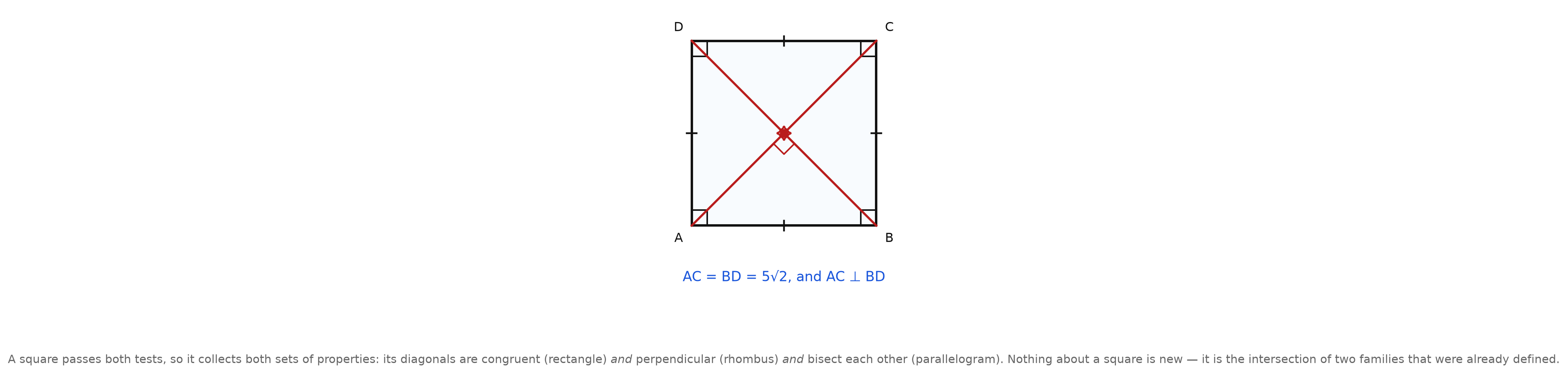
A square is a rectangle and a rhombus, so it collects both sets:
- diagonals congruent — from the rectangle;
- diagonals perpendicular — from the rhombus;
- diagonals bisect each other — from the parallelogram;
- four right angles and four congruent sides.
Nothing on that list is new. A square is the intersection of two families that were already defined, which is why the hierarchy puts it in the overlap.
The table that answers "which family?"
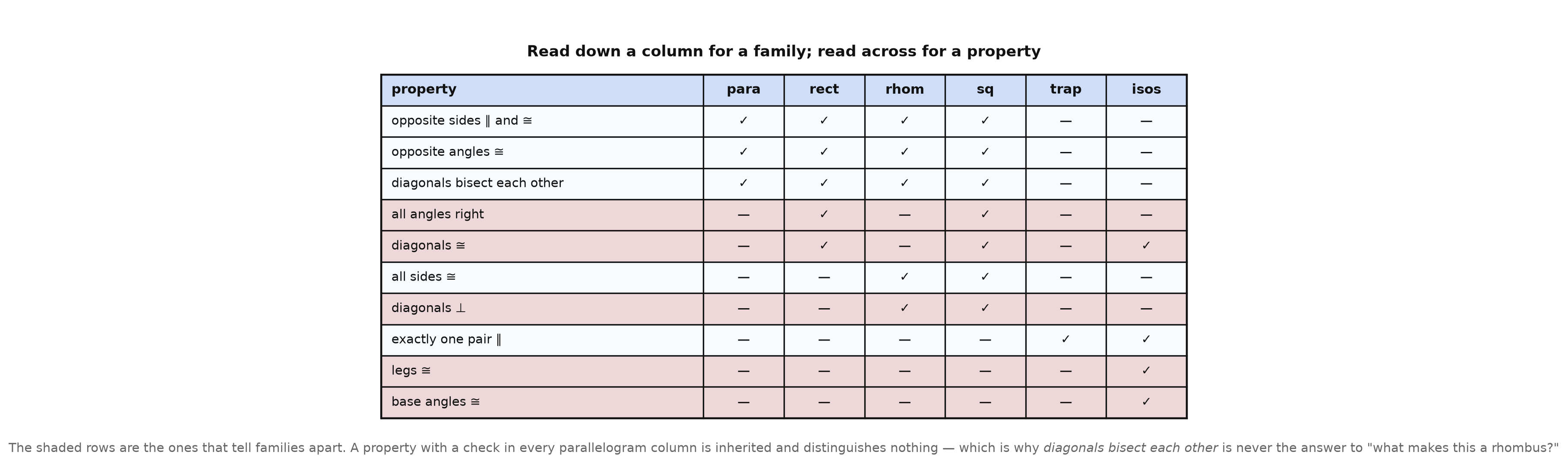
Read down a column to get everything one family has. Read across a row to see which families share a property — and that is the reading the standard's phrase specific to is about.
A property with a check in every parallelogram column distinguishes nothing. So:
- "The diagonals bisect each other" never answers "what makes this a rhombus?"
- "The diagonals are congruent" is a rectangle answer, not a rhombus answer.
- "Opposite sides are congruent" is not a rectangle answer either — it is a parallelogram answer, and every rectangle inherits it.
Choosing the most specific name
Given a list of properties, name the smallest family that has all of them. Four congruent sides and one right angle: rhombus + rectangle = square. Four congruent sides alone: rhombus. Congruent diagonals alone, in a parallelogram: rectangle.
Worked examples
Example 1 — Which is specific
Which of these is specific to a rhombus: diagonals bisect each other, diagonals are perpendicular, opposite angles congruent?
Answer: Diagonals are perpendicular. The other two belong to every parallelogram.
Example 2 — Most specific name
A parallelogram has four congruent sides and one right angle. Name it.
Answer: A square.
Example 3 — Not enough
A quadrilateral has congruent diagonals. Must it be a rectangle?
Answer: No. An isosceles trapezoid has congruent diagonals too. Only a parallelogram with congruent diagonals must be a rectangle.
Example 4 — Reading the table across
Which two families have congruent diagonals?
Answer: Rectangles (and squares, which are rectangles) and isosceles trapezoids.
Example 5 — A useless answer
A student explains that a figure is a square "because its diagonals bisect each other." What is wrong?
Answer: Every parallelogram's diagonals bisect each other, so that property rules out nothing. A square needs the diagonals to be congruent and perpendicular.
Guided practice
- Use the square figure. List the three diagonal properties a square has, and name the family each comes from.
- On that figure, explain why a square needs no property of its own.
- Use the property table. Read down the rhombus column and list what a rhombus has.
- On that table, read across the "diagonals ≅" row and name every family with a check.
- On that table, name a property that distinguishes nothing among parallelograms.
- Explain in one sentence what specific to means.
Independent practice
- Which of these is specific to a rhombus: diagonals bisect each other, diagonals perpendicular, opposite angles congruent?
- Which of these is specific to a rectangle: opposite sides congruent, diagonals congruent, diagonals bisect each other?
- A parallelogram has four congruent sides and one right angle. Name it.
- A quadrilateral has congruent diagonals. Must it be a rectangle? Explain.
- Name the most specific family: a parallelogram whose diagonals are perpendicular.
- Name the most specific family: a parallelogram whose diagonals are congruent.
- Name the most specific family: a quadrilateral with four congruent sides and four right angles.
- Name the most specific family: a quadrilateral with exactly one pair of parallel sides and congruent diagonals.
- Which families have all four sides congruent?
- Which families have diagonals that bisect each other?
- Application. A tile is checked and found to have four congruent sides and perpendicular diagonals. Which family is confirmed, and what would still need checking to call it a square?
- Error analysis. A student says a figure is a square because its diagonals bisect each other. Explain what that property does and does not establish.
- Reasoning. Explain why a square has no properties that a rectangle and a rhombus do not already have between them.
- Reasoning. Explain why "opposite sides are congruent" is a poor answer to "what makes this a rectangle?"
Lesson 10.5 — Trapezoids and Isosceles Trapezoids
Exactly one pair
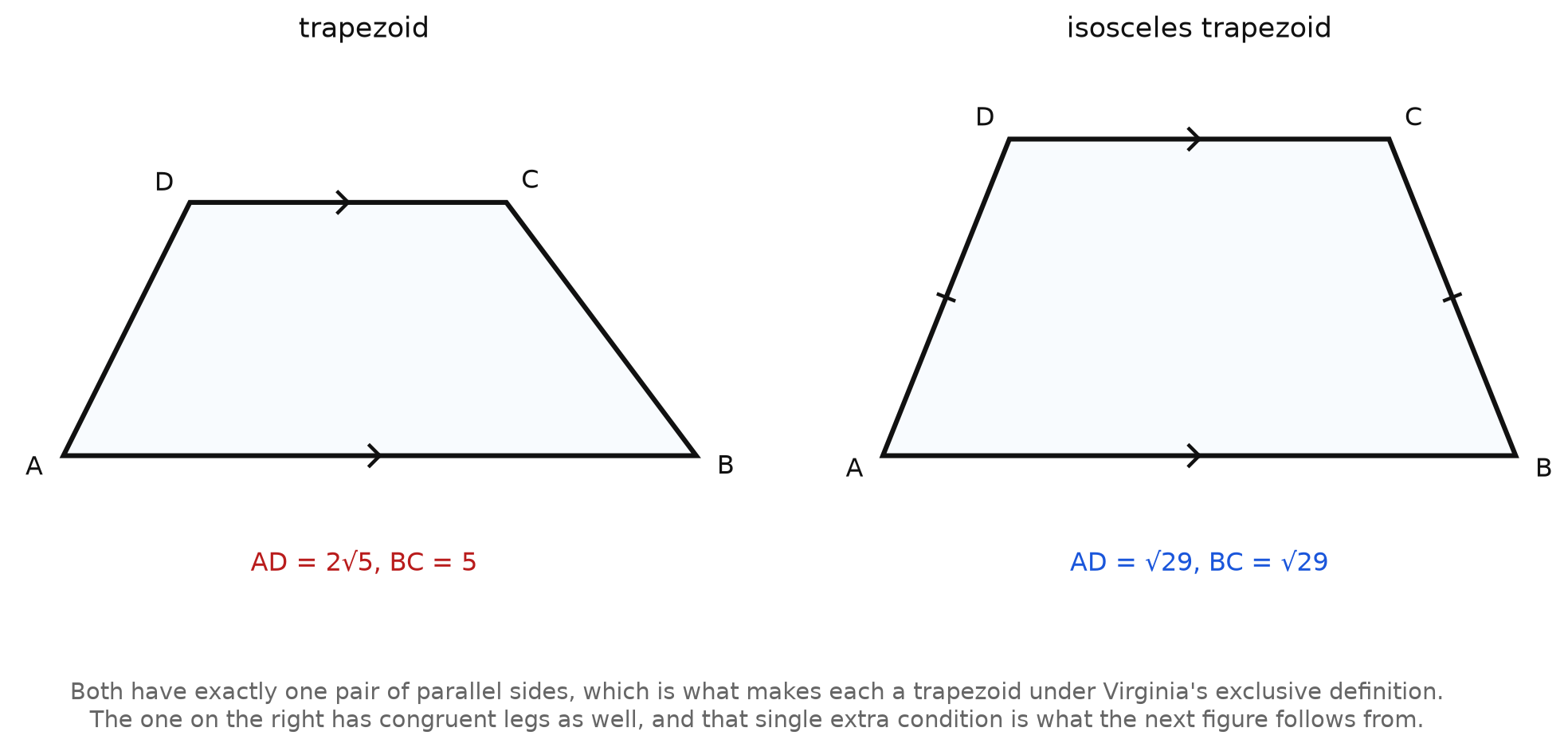
Both figures are trapezoids: each has exactly one pair of parallel sides — the bases. The other two sides are the legs.
The one on the right has congruent legs, and that single extra condition makes it an isosceles trapezoid.
What congruent legs buy
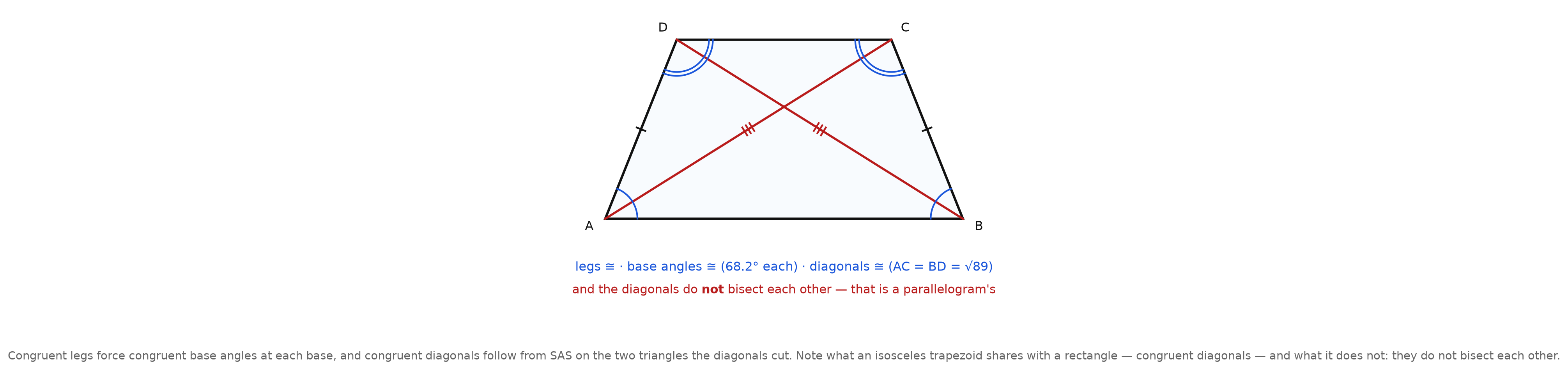
Isosceles trapezoid properties. In an isosceles trapezoid,
- the legs are congruent (the definition);
- each pair of base angles is congruent;
- the diagonals are congruent.
The base angles come from the symmetry of the figure; the congruent diagonals follow from SAS on the two triangles the diagonals cut.
Congruent, but not bisecting. An isosceles trapezoid shares one property with a rectangle — congruent diagonals — and not the other: its diagonals do not bisect each other. That is a parallelogram's property, and an isosceles trapezoid is not a parallelogram.
A plain trapezoid has none of these three. Its legs differ, its base angles differ, and its diagonals differ.
Worked examples
Example 1 — Base angles
In isosceles trapezoid with , . Give .
Answer: — base angles at the same base are congruent.
Example 2 — The other base
Same figure. Give and .
Answer: and are same-side interior angles across the parallel bases, so they are supplementary: , and .
Example 3 — Diagonals
In isosceles trapezoid , . Give .
Answer: — the diagonals are congruent.
Example 4 — With algebra
In isosceles trapezoid , and . Find and the leg length.
Answer: Congruent legs: , so , , and each leg is .
Example 5 — Not a parallelogram
In isosceles trapezoid the diagonals meet at . Is ?
Answer: No. The diagonals are congruent to each other but do not bisect each other — bisecting is a parallelogram property, and this figure is not one.
Guided practice
- Use the two-trapezoid figure. What makes both of them trapezoids?
- On that figure, what makes the right-hand one isosceles?
- On that figure, give the two leg lengths of the plain trapezoid and say why it is not isosceles.
- Use the isosceles figure. Name the three properties.
- On that figure, are the diagonals congruent? Do they bisect each other?
- Explain why an isosceles trapezoid is not a parallelogram.
Independent practice
- In isosceles trapezoid with , . Give .
- Same figure. Give and .
- In isosceles trapezoid , . Give the other three angles.
- In isosceles trapezoid , . Give .
- In isosceles trapezoid , and . Find and the leg length.
- In isosceles trapezoid , and . Find and .
- In isosceles trapezoid the diagonals meet at . Is ? Explain.
- A trapezoid has legs of and . Is it isosceles? What follows about its base angles?
- A quadrilateral has exactly one pair of parallel sides and congruent diagonals. Name it.
- Name every family in this chapter whose diagonals are congruent.
- Application. A bridge truss panel is an isosceles trapezoid with bases ft and ft and legs of ft each. Give the perimeter, and give the second leg's length without measuring it.
- Error analysis. A student says the diagonals of an isosceles trapezoid bisect each other because they are congruent. Correct them.
- Reasoning. Explain why the base angles at one base of an isosceles trapezoid are congruent, and why the angles at the other base are supplementary to them.
- Reasoning. An isosceles trapezoid and a rectangle both have congruent diagonals. Explain what else you would check to tell them apart.
Exit ticket 10.5
- In isosceles trapezoid with , . Give and .
- In isosceles trapezoid , . Give , and say whether .
Lesson 10.6 — Constructions That Verify Properties
The five constructions, and what each tests
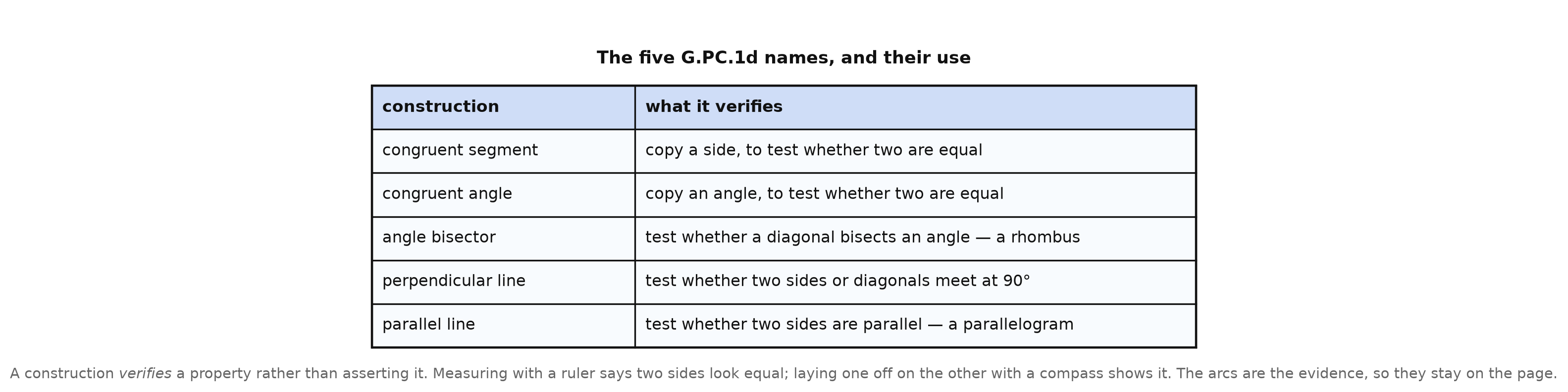
G.PC.1d names five constructions: congruent segment, congruent angle, angle bisector, perpendicular line, and parallel line. Each one verifies a property rather than asserting it:
| Construction | Verifies |
|---|---|
| congruent segment | two sides are congruent — a rhombus, or a trapezoid's legs |
| congruent angle | two angles are congruent — opposite angles, or base angles |
| angle bisector | a diagonal bisects an angle — a rhombus |
| perpendicular line | two segments meet at — a rectangle's corner, a rhombus's diagonals |
| parallel line | two sides are parallel — a parallelogram or a trapezoid |
Verifying a rhombus
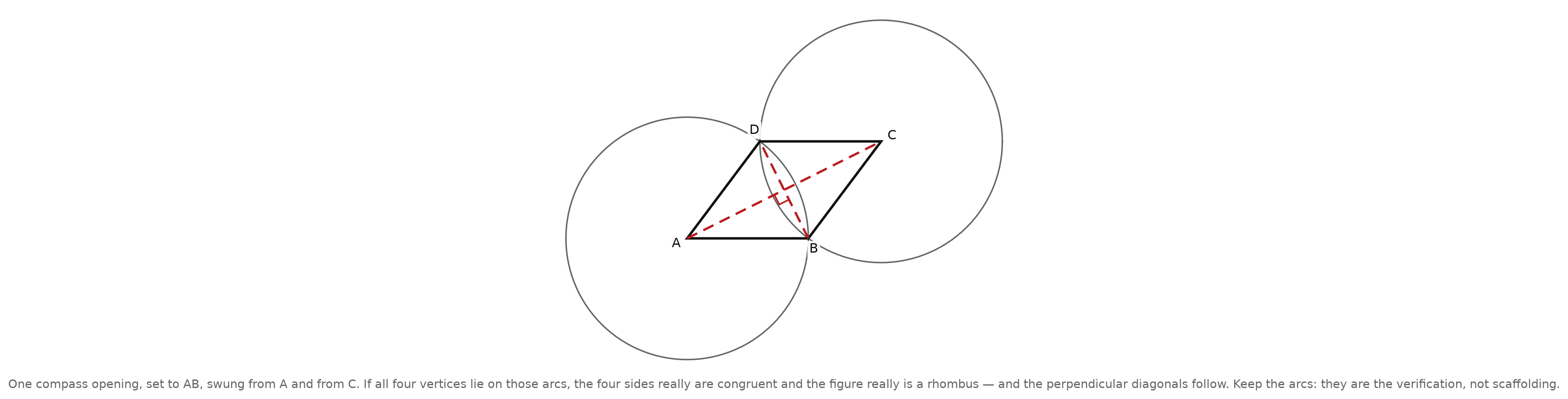
Set the compass to and swing it from and from . If all four vertices land on those arcs, the four sides really are congruent — and the perpendicular diagonals follow from the theorem.
The arcs stay on the page. They are the evidence, exactly as in Chapter 5. A construction with the arcs erased is a drawing, and a drawing verifies nothing.
Measuring is not verifying
A ruler says two sides look equal to within whatever the ruler can resolve. A compass carries one length onto the other and shows whether they coincide. That difference is why the standard asks for constructions.
Worked examples
Example 1 — Choosing a construction
Which construction verifies that a quadrilateral is a parallelogram?
Answer: The parallel line construction, used twice — once for each pair of opposite sides.
Example 2 — A rhombus
Which construction verifies four congruent sides?
Answer: The congruent segment construction, copying one side onto each of the other three.
Example 3 — A rectangle's corner
Which construction verifies a right angle at a vertex?
Answer: The perpendicular line construction.
Example 4 — An angle bisector
A student wants to show that a diagonal of a quadrilateral bisects an angle. Which construction, and what would confirm it?
Answer: The angle bisector construction. Bisect the angle; if the bisector falls along the diagonal, the diagonal bisects the angle, which points to a rhombus.
Example 5 — What is missing
A finished construction shows a correct figure with no arcs. What has been lost?
Answer: The verification. Without the arcs there is no evidence the lengths were carried rather than eyeballed, and G.PC.1d assesses the construction itself.
Guided practice
- Use the construction table. Which construction verifies that two sides are parallel?
- On that table, which verifies that a diagonal bisects an angle, and which family does that point to?
- On that table, which verifies a right angle?
- Use the rhombus figure. What was the compass set to, and from which points was it swung?
- On that figure, what does it prove if all four vertices lie on the arcs?
- Why must the arcs be left on the page?
Independent practice
- Which construction verifies that a quadrilateral is a parallelogram, and how many times is it used?
- Which construction verifies four congruent sides?
- Which construction verifies a right angle at a vertex?
- Which construction verifies that a diagonal bisects an angle?
- Describe, in order, how to verify that a quadrilateral is a rhombus using one compass setting.
- Describe how to verify that a trapezoid is isosceles using a construction.
- Describe how to verify that a parallelogram is a rectangle using a construction.
- A figure's opposite sides are verified parallel and one angle is verified right. Name the family that has been established.
- Application. A shop must confirm that a metal panel is a true rhombus before welding. Describe the construction check and say what would be left on the panel as evidence.
- Error analysis. A student verifies that a parallelogram's diagonals bisect each other and concludes it is a rhombus. Explain the error and name a construction that would settle it.
- Reasoning. Explain the difference between measuring a property with a ruler and verifying it with a construction.
- Reasoning. Explain why verifying four congruent sides is enough to conclude the diagonals are perpendicular, without constructing the diagonals at all.
Exit ticket 10.6
- Name the five constructions G.PC.1d lists.
- Name the construction that verifies a rhombus, and say what stays on the page.
Chapter 10 Review
Vocabulary. quadrilateral · parallelogram · rectangle · rhombus · square · trapezoid · isosceles trapezoid · base · leg · base angles · diagonal · bisect · perpendicular · consecutive angles · defining condition · inherited property · specific to · construction
Review 1 (G.PC.1 a, c). In parallelogram , , , and the diagonals meet at with and .
- Find , then give all four angle measures.
- Find , then give and .
- Name the property used in each of the two computations, and say which is a definition and which is a theorem.
- A different parallelogram has . Name the most specific family it must be in, say what would still be needed to call it a square, and explain why above cannot be in that family.
Review 2 (G.PC.1a). For each description, name the most specific family from the six the standard lists, and name one property that is specific to it rather than inherited.
- Both pairs of opposite sides parallel, diagonals perpendicular.
- Both pairs of opposite sides parallel, diagonals congruent.
- Both pairs of opposite sides parallel, diagonals congruent and perpendicular.
- Exactly one pair of parallel sides, diagonals congruent.
- Exactly one pair of parallel sides, legs of different lengths.
Review 3 (G.PC.1 a, c, d). A fabricator is checking a batch of panels. Each is supposed to be an isosceles trapezoid with bases in and in and legs of in.
- Give the perimeter of a correct panel.
- One panel measures at one end of the long base. Give the other three angles of a correct panel, with a reason for each.
- Describe the construction that verifies the legs are congruent, and say what is left on the panel as evidence.
- A panel comes back with congruent diagonals and diagonals that bisect each other. Explain why it cannot be the intended isosceles trapezoid, and name what it is instead.
Standards coverage check — Chapter 10
| Knowledge and Skill | Where it is taught | Where it is practiced | Where it is applied in context |
|---|---|---|---|
| G.PC.1a — solve problems by applying properties specific to parallelograms, rectangles, rhombi, squares, isosceles trapezoids, and trapezoids | 10.1 (the six families and the hierarchy); 10.2 (a parallelogram's four); 10.3 (what a rectangle and a rhombus each add); 10.4 (specific to versus inherited); 10.5 (trapezoids and isosceles trapezoids) | 1–16, 18–22; 23–39, 41–46; 47–65, 67–70; 71–86, 88–90; 91–106, 108–112 | 17; 40; 66; 87; 107; Review 1, Review 2, Review 3 |
| G.PC.1c — prove and justify theorems and properties of quadrilaterals using deductive reasoning | 10.2 (the ASA proof of opposite sides, and of the diagonals bisecting); 10.3 (why a rhombus's diagonals bisect its angles); 10.5 (why base angles are congruent and the other pair supplementary) | 26–28, 42–44; 50–52, 68; 96, 109, 110 | Review 1, Review 3 |
| G.PC.1d — use congruent segment, congruent angle, angle bisector, perpendicular line, and/or parallel line constructions to verify properties of quadrilaterals | 10.6 (each construction and what it verifies; the rhombus check; measuring versus verifying) | 113–126, 128–132 | 127; Review 3 |
Supporting items: 19, 20, 42, 43, 68, 89, 90, 109, 110, 129, and 130 are the reasoning items, and 19 and 89 together carry the chapter's central idea — that properties run downward through the hierarchy and not upward, which is exactly why specific to is the phrase the standard uses. The error analyses target the recurring failures: calling a square not a rectangle (18), reading bisect each other as congruent (41, 67), citing an inherited property as an identifying one (88), thinking congruent diagonals bisect (108), and concluding a rhombus from a parallelogram property (128).
Boundaries respected. The families are exactly the six G.PC.1a names, and kites are not taught — they appear nowhere in this chapter, because the standard's list does not include them. Virginia's exclusive trapezoid definition from Chapter 1 holds throughout, so no parallelogram is a trapezoid. The constructions are exactly the five G.PC.1d names. Coordinate and algebraic proofs of these same properties are not here — that is G.PC.1b and Chapter 11 — so every proof in this chapter is deductive, and every one of them runs on Chapter 5's congruent triangles.
Answer keys for every item in this chapter are in Appendix A.