Chapter 9 — Right Triangle Trigonometry
Standard: G.TR.4 (d, e, g)
G.TR.4 — verbatim. The student will model and solve problems, including those in context, involving trigonometry in right triangles and applications of the Pythagorean Theorem. Students will demonstrate the following Knowledge and Skills: a) Determine whether a triangle formed with three given lengths is a right triangle. b) Solve for missing lengths in geometric figures, using properties of 45-45-90 triangles, where rationalizing denominators may be necessary. c) Solve for missing lengths in geometric figures, using properties of 30-60-90 triangles, where rationalizing denominators may be necessary. d) Find and verify trigonometric ratios using right triangles. e) Solve problems, including those in context, involving right triangles using sine, cosine, and tangent ratios. f) Solve problems, including those in context, using the Pythagorean Theorem and its converse, including recognizing Pythagorean Triples. g) Solve problems, including those in context, involving angles of elevation and angles of depression.
By the end of this chapter you will be able to:
- Name a side opposite, adjacent, or hypotenuse relative to a chosen acute angle (G.TR.4d)
- Find the sine, cosine, and tangent of an angle from a right triangle's sides (G.TR.4d)
- Verify a ratio, against a calculator and against the complementary angle (G.TR.4d)
- Solve for a missing side when an angle and one side are known (G.TR.4e)
- Solve for a missing angle when two sides are known, using an inverse function (G.TR.4e)
- Solve problems involving angles of elevation and depression (G.TR.4g)
Lessons: 9.1 Naming and Finding the Ratios · 9.2 Verifying the Ratios · 9.3 Finding a Missing Side · 9.4 Finding a Missing Angle · 9.5 Angles of Elevation and Depression
Why this chapter matters. Chapter 8 solved right triangles from lengths alone and could never produce a general angle measure. This chapter adds exactly that, and it is Chapter 7 that makes it possible: every right triangle with the same acute angle is similar to every other, so the ratio of two of its sides depends on the angle and nothing else. That single fact is what lets a calculator have a button at all. Chapter 9 closes the Triangles strand.
Scope note. This chapter covers the trigonometric bullets of G.TR.4 — finding and verifying the three ratios, solving with them, and the angles of elevation and depression. The Pythagorean Theorem, the converse, the triples, and the two special triangles are Chapter 8, and they are used here without being re-taught.
Sine, cosine, and tangent only. There is no Law of Sines and no Law of Cosines in this standard, so there is none in this chapter: every problem here lives inside a right triangle. A problem that is not about a right triangle is either out of scope or is asking you to find one inside the figure first.
As in Chapter 8, G.TR.4's bullet lettering is this volume's inference rather than a reading of the VDOE document, so Chapters 8 and 9 are split by content. A corrected lettering would relabel the citations here without moving an item.
Conventions this chapter fixes.
- Name the angle first. Opposite and adjacent mean nothing until you have said which acute angle you are working from. The hypotenuse never moves — it is opposite the right angle.
- A ratio is unitless. A length divided by a length has no units, which is why the same works for inches and for miles.
- Rounding. Side lengths are given to the nearest hundredth, angle measures to the nearest degree, and both are computed from unrounded values. Rounding a ratio and then multiplying is how an answer drifts.
- Degrees, not radians. Every angle in this volume is in degrees. A calculator in radian mode will return where was wanted, and that is the single most common wrong answer in the chapter.
- Find, then verify. Bullet d asks for both. A ratio is found by reading two sides off the triangle; it is verified against the calculator's value for that angle, or against the complementary angle.
- Item numbering runs straight through the chapter, from 1 in Lesson 9.1 to 112 at the end of Lesson 9.5.
Lesson 9.1 — Naming and Finding the Ratios
A side's name depends on the angle
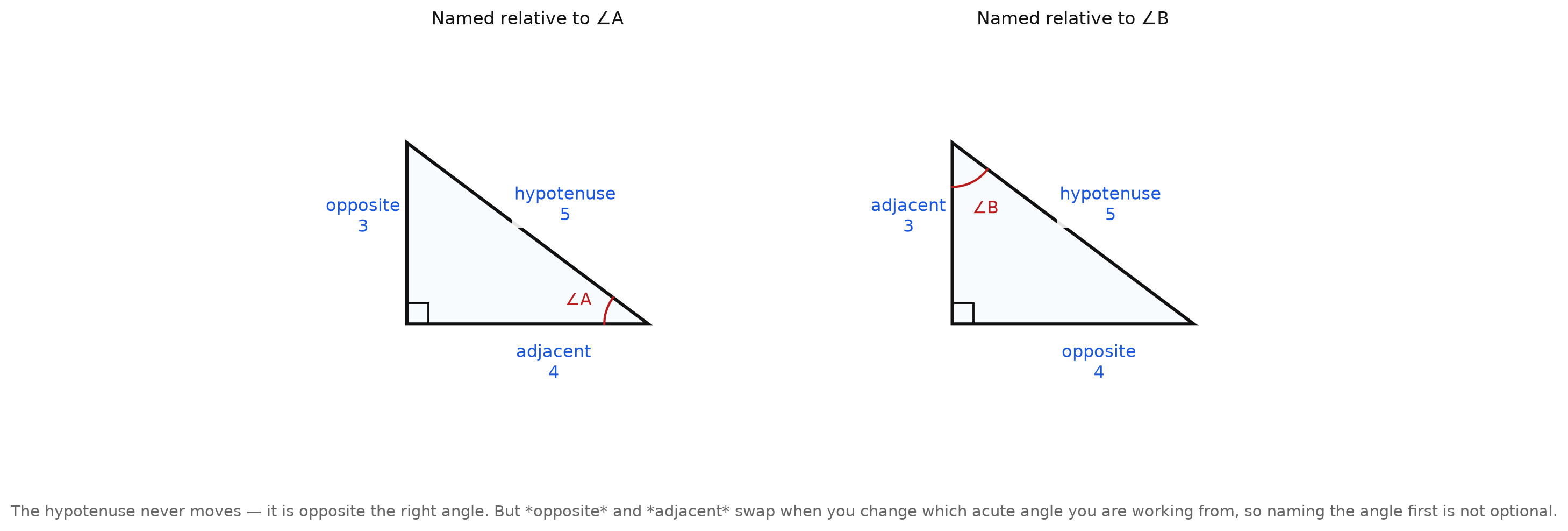
The hypotenuse is fixed: it is the side opposite the right angle. The other two swap names depending on which acute angle you have chosen, so naming the angle is the first step, not a formality.
The three ratios

There are three because there are only three ways to pick two sides out of three. Each is a plain number with no units, since a length over a length cancels them.
Six ratios from one triangle
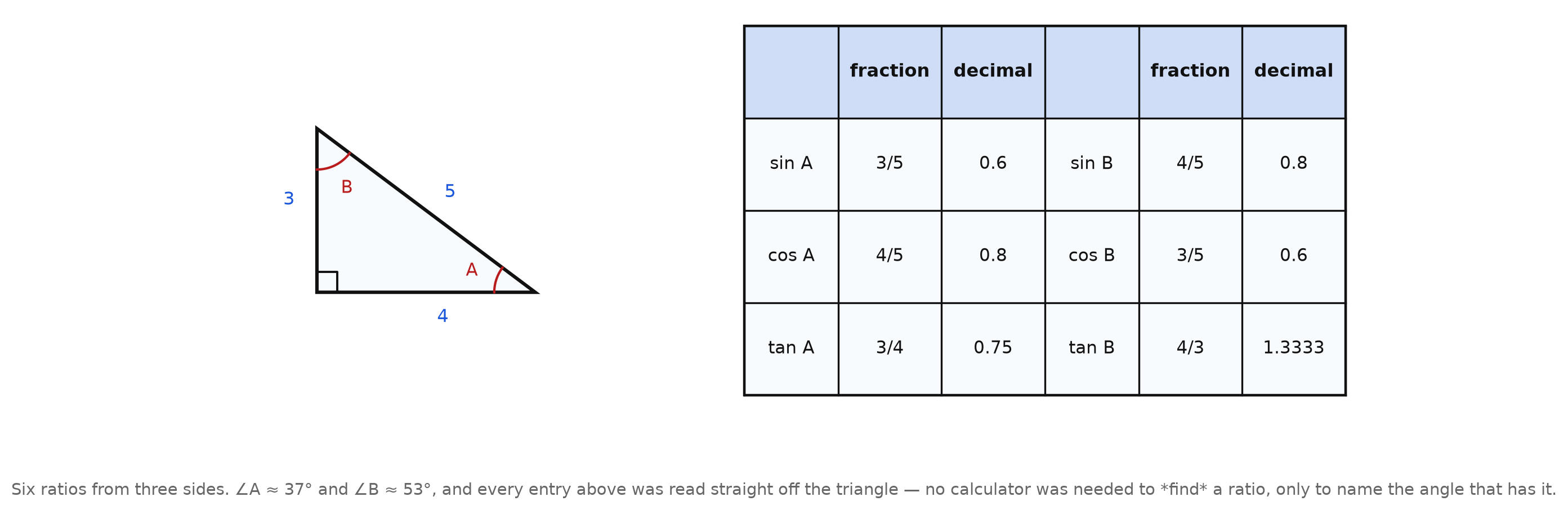
Notice that finding a ratio needs no calculator at all. The calculator enters only when you want to know which angle has that ratio.
Worked examples
Example 1 — Reading ratios
A right triangle has legs and and hypotenuse . Give , where is opposite the .
Answer: .
Example 2 — The other angle
Same triangle. Give .
Answer: Relative to the opposite side is and the adjacent is , so .
Example 3 — Finding the third side first
In a right triangle . Give and .
Answer: The opposite side is and the hypotenuse , so the adjacent side is . Then and .
Example 4 — From a tangent
. Give and .
Answer: Opposite , adjacent , so the hypotenuse is : and .
Example 5 — Naming against the wrong angle
A student writes . What did they write instead?
Answer: The cosine. is opposite over hypotenuse.
Guided practice
- Use the naming figure. Which side is the hypotenuse, and does it change between the two panels?
- On that figure, name the and the relative to .
- On that figure, name them relative to .
- Use the ratio table. Give the three definitions.
- Use the -- figure. Give , , and .
- On that figure, give , , and .
Independent practice
A right triangle has legs and and hypotenuse , with opposite the and opposite the . Use it for items 7–12.
- Give .
- Give .
- Give .
- Give .
- Give .
- Give .
- A right triangle has legs and . Give the hypotenuse, then the tangent of the angle opposite the .
- In a right triangle . Give and .
- In a right triangle . Give and .
- Explain why a trigonometric ratio has no units.
- Error analysis. A student writes . Name what they actually wrote, and give the correct definition.
- Reasoning. Explain why there are exactly three ratios and not four or five.
Exit ticket 9.1
A right triangle has legs and and hypotenuse , with opposite the .
- Give .
- Give .
- Give .
- State the three definitions in words.
Lesson 9.2 — Verifying the Ratios
Why a ratio belongs to the angle
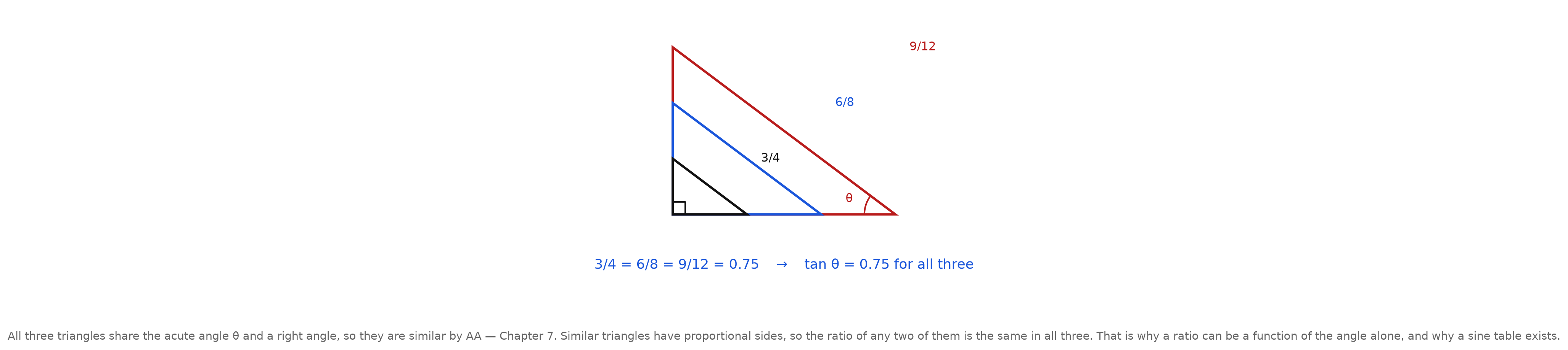
All three triangles share the acute angle and a right angle, so they are similar by AA. Similar triangles have proportional sides, so the ratio of any two of them is the same in every one:
That is the whole reason trigonometry works. The ratio is a property of the angle, not of the particular triangle you drew, which is why a calculator can store one number per angle.
Verifying against a calculator

Bullet d asks you to find and verify. Finding is reading two sides off the triangle. Verifying is checking that the calculator's value for that angle agrees.
A disagreement almost always means the sides were named against the wrong angle — which is exactly the error worth catching before it reaches a problem.
Verifying against the complement
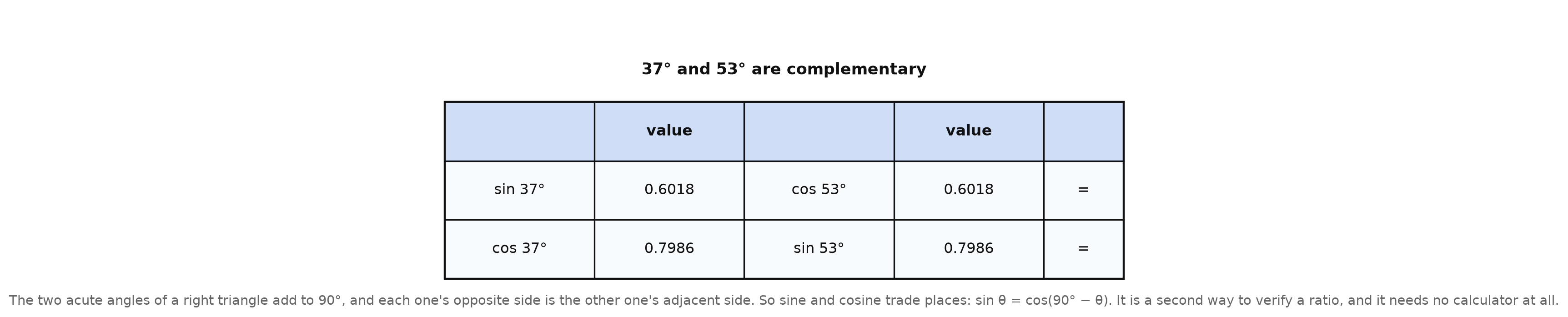
The two acute angles of a right triangle add to , and each one's opposite side is the other one's adjacent side. So
This is a second check, and it needs no calculator at all.
A word about . For any acute angle, , by the Pythagorean Theorem. It is a third way to verify a pair of ratios, and it is the theorem from Chapter 8 wearing different clothes.
Worked examples
Example 1 — Verifying by scaling
A -- triangle. Verify that , where is opposite the .
Answer: . The triangle is twice a --, and the ratio is unchanged.
Example 2 — Complementary check
Given , give .
Answer: , since .
Example 3 — Which angle equals its own cofunction
For which acute is ?
Answer: , because forces .
Example 4 — The Pythagorean check
For a -- triangle, verify .
Answer: .
Example 5 — A false identity
A student writes . Check it.
Answer: , so it is false. The true identity squares each term: .
Guided practice
- Use the nested-triangles figure. What do the three triangles have in common?
- On that figure, name the criterion that makes them similar, and say why that forces one tangent.
- On that figure, give as a decimal.
- Use the verification table. Name the two routes to the same number.
- On that table, what does a disagreement usually mean?
- Use the complement table. Give and .
Independent practice
- A -- triangle, opposite the . Verify that .
- A -- triangle, opposite the . Verify that .
- . Give .
- . Give .
- ______ .
- For which acute angle does ?
- For a -- triangle, verify .
- For a -- triangle, verify that .
- One student measures a ramp and reports ; another reports the angle as . Do the two agree? Show the check.
- Application. A ramp rises ft over a run of ft. Give and the angle to the nearest degree.
- Error analysis. A student writes . Check it and state the identity they were reaching for.
- Reasoning. Explain why , using the two acute angles of a right triangle.
Exit ticket 9.2
- . Give .
- A -- triangle, opposite the . Verify .
- for an acute . Give .
- Name two ways to verify a ratio you found from a triangle.
Lesson 9.3 — Finding a Missing Side
Choosing the ratio
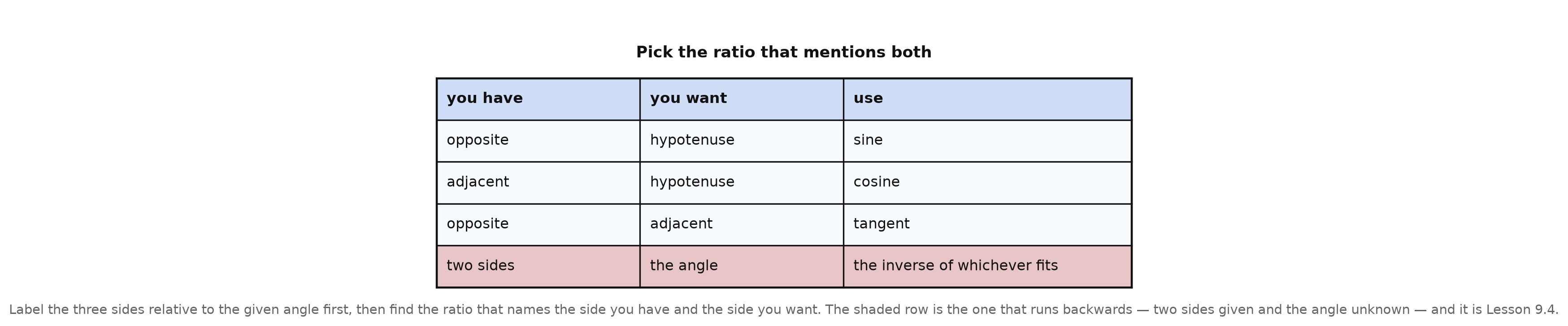
The method is three steps, every time:
- Name the sides relative to the given angle.
- Choose the ratio that mentions the side you have and the side you want.
- Solve.
Where the unknown lands
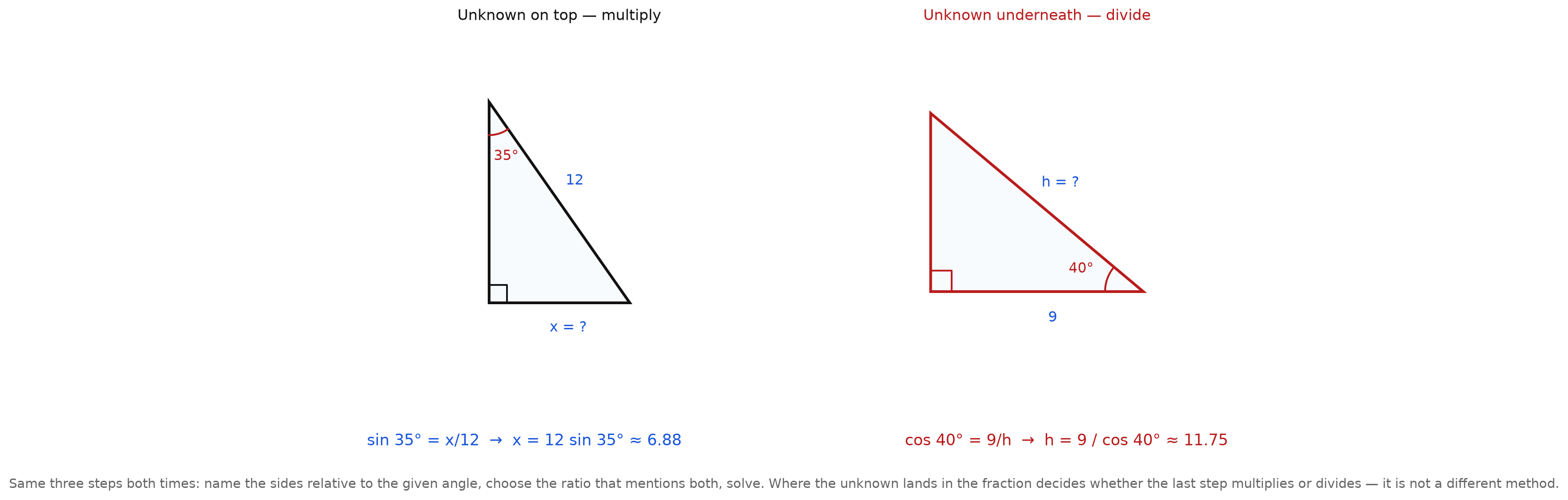
Whether the last step multiplies or divides depends only on where the unknown sits in the fraction. It is the same method, not a second one.
Rounding, once, at the end
Compute with the unrounded ratio and round the answer. Rounding to first and then multiplying gives instead of — a small error here, and a growing one in any problem with two steps.
Side lengths in this chapter are given to the nearest hundredth.
Worked examples
Example 1 — Unknown opposite
Angle , hypotenuse . Find the opposite side.
Answer: , so .
Example 2 — Unknown adjacent
Angle , adjacent . Find the opposite side.
Answer: , so .
Example 3 — Unknown hypotenuse
Angle , opposite . Find the hypotenuse.
Answer: , so .
Example 4 — In context
A guy wire runs from the top of a ft pole to the ground, meeting the ground at . How long is the wire?
Answer: , so ft.
Example 5 — Rounding too early
A student rounds to and computes . What is the correct value?
Answer: . The ratio must stay unrounded until the final answer.
Guided practice
- Use the ratio-choice table. You have the hypotenuse and want the opposite side. Which ratio?
- On that table, you have the adjacent side and want the hypotenuse. Which ratio?
- Use the two-triangles figure. Write the equation for .
- On that figure, solve for .
- On that figure, write the equation for .
- On that figure, solve for .
Independent practice
- Angle , hypotenuse . Find the opposite side.
- Angle , hypotenuse . Find the adjacent side.
- Angle , adjacent . Find the opposite side.
- Angle , adjacent . Find the hypotenuse.
- Angle , opposite . Find the hypotenuse.
- Angle , opposite . Find the adjacent side.
- Angle , hypotenuse . Find both legs.
- Angle , adjacent . Find the opposite side.
- Application. A loading ramp is ft long and meets the ground at . How high is its upper end?
- Application. A guy wire runs from the top of a ft pole to the ground at . How long is the wire?
- Error analysis. Given an angle and its two legs — one known, one wanted — a student uses sine. Explain why that cannot work and name the ratio that does.
- Reasoning. Explain why the position of the unknown in the fraction decides whether the last step multiplies or divides.
- Application. A kite is flying at the end of ft of taut string that makes a angle with the ground. How high is the kite above the ground?
- Error analysis. A student rounds to before multiplying by . Give both answers and say which is correct and why.
Exit ticket 9.3
- Angle , hypotenuse . Find the opposite side.
- Angle , adjacent . Find the opposite side.
- Angle , opposite . Find the hypotenuse.
- State the three steps for finding a missing side.
Lesson 9.4 — Finding a Missing Angle
Running the ratio backwards
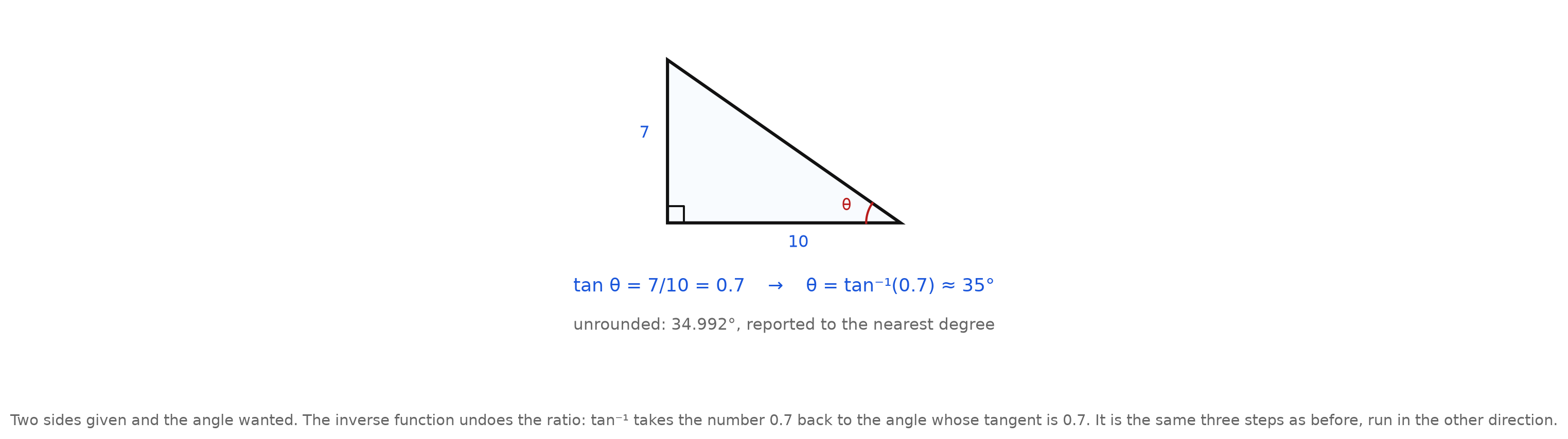
When two sides are known and the angle is not, the same three steps run in the other direction. Choose the ratio that names both known sides, then undo it with an inverse function:
takes a ratio back to the angle that has it. The same is true of and .
Angle measures in this chapter are given to the nearest degree, computed from the unrounded value — here .
Check the mode. A calculator in radian mode returns where was wanted. If an angle answer is a small number under about , suspect the mode before suspecting the arithmetic.
Worked examples
Example 1 — Sine
Opposite , hypotenuse . Find the angle.
Answer: , so .
Example 2 — Cosine
Adjacent , hypotenuse . Find the angle.
Answer: , so (unrounded, ).
Example 3 — Both acute angles
A right triangle has legs and . Find both acute angles.
Answer: and . They add to , as they must.
Example 4 — In context
A ft ladder reaches ft up a wall. What angle does it make with the ground?
Answer: , so (unrounded, ).
Example 5 — Radian mode
A student computes an angle and reports . What happened?
Answer: The calculator was in radians. radians is , which rounds to .
Guided practice
- Use the angle figure. Which two sides are given?
- On that figure, which ratio names both of them?
- On that figure, write the equation.
- On that figure, solve for to the nearest degree.
- On that figure, give the unrounded value.
- What does an inverse trigonometric function do?
Independent practice
- Opposite , hypotenuse . Find the angle.
- Adjacent , hypotenuse . Find the angle.
- Opposite , adjacent . Find the angle.
- Opposite , hypotenuse . Find the angle.
- Opposite , adjacent . Find the angle.
- A right triangle has legs and . Find both acute angles, and check them.
- Application. A ramp rises ft over a run of ft. Find the angle it makes with the ground.
- Application. A ft ladder reaches ft up a wall. Find the angle it makes with the ground.
- Error analysis. Given the two legs of a right triangle, a student uses . Explain why that is wrong and name the correct function.
- Reasoning. Explain why the two acute angles found this way always add to .
- Application. A road rises m over a horizontal run of m. Find its angle of inclination.
- Error analysis. A student computes an angle and reports . Identify the cause and give the correct answer.
Exit ticket 9.4
- Opposite , hypotenuse . Find the angle.
- Adjacent , opposite . Find the angle.
- Adjacent , hypotenuse . Find the angle.
- State the three steps for finding a missing angle.
Lesson 9.5 — Angles of Elevation and Depression
The two angles are the same angle

Angle of elevation. The angle from a horizontal up to a line of sight. Angle of depression. The angle from a horizontal down to a line of sight.
Both are measured from a horizontal, and the two horizontals are parallel. The line of sight is a transversal, so the angle of elevation from the lower point and the angle of depression from the upper point are alternate interior angles — congruent, by Chapter 2.
That is why a problem can be solved from whichever end is convenient, and why the depression angle drops inside the triangle at the far end.
An elevation problem
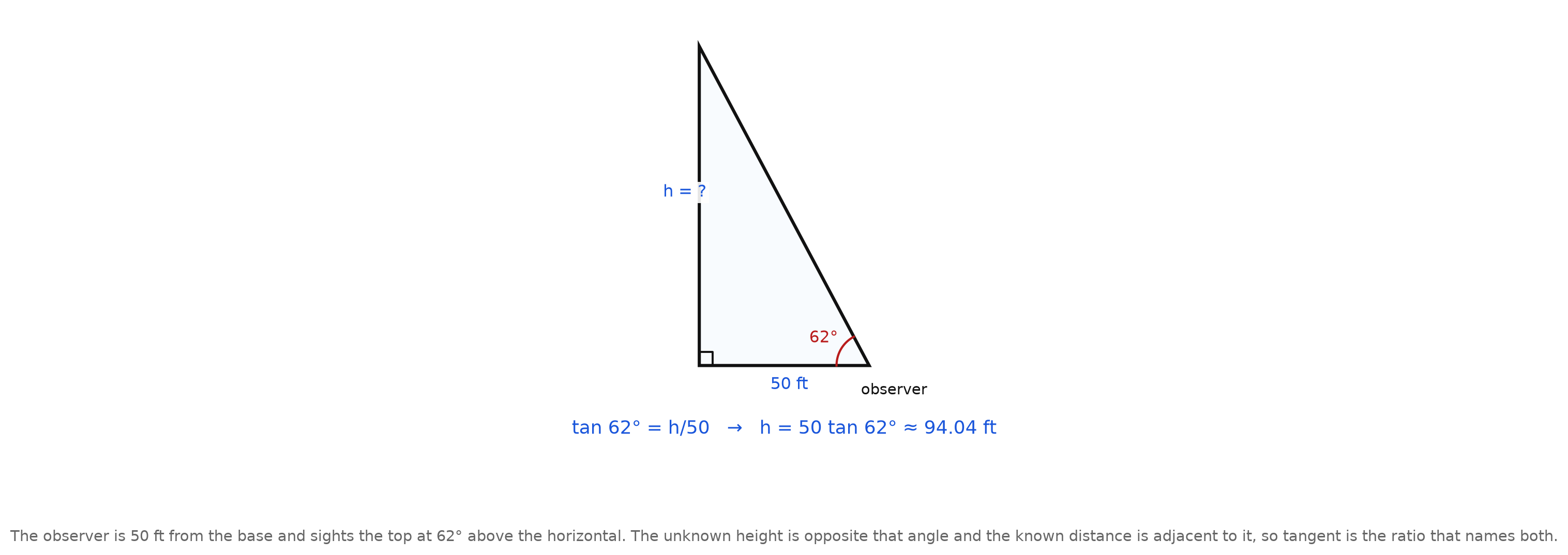
The unknown height is opposite the angle and the known distance is adjacent to it, so tangent is the ratio that names both.
A depression problem
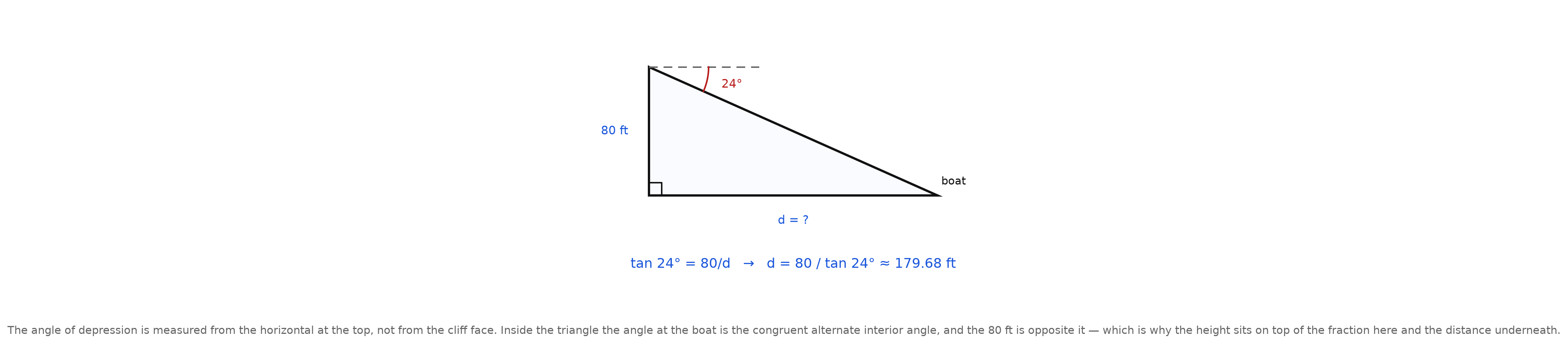
The is marked at the top, from the horizontal — not from the cliff face. Inside the triangle it reappears at the boat, as the congruent alternate interior angle, and from there the ft is opposite and is adjacent.
Two habits
- Draw the horizontal. Most errors in this lesson come from measuring a depression angle from the vertical. Sketching the horizontal dashed line first makes that impossible.
- Watch for eye height. If the observer's eyes are above the ground, the triangle gives the height above eye level; the observer's height must be added at the end.
Worked examples
Example 1 — Elevation
From a point ft from a tower's base, the angle of elevation to its top is . Find the height.
Answer: ft.
Example 2 — Elevation, distance unknown
A building is ft tall and the angle of elevation to its top from a point on the ground is . How far is that point from the base?
Answer: , so ft.
Example 3 — Depression
From the top of a ft lighthouse, the angle of depression to a boat is . How far is the boat from the base?
Answer: ft.
Example 4 — With eye height
Standing ft from a tree, an observer whose eyes are ft above the ground sights the top at an elevation of . How tall is the tree?
Answer: The triangle gives ft above eye level, so the tree is ft.
Example 5 — Working backwards
A ramp must rise ft and may not exceed an angle of . What is the shortest run that satisfies both?
Answer: , so ft.
Guided practice
- Use the elevation-and-depression figure. From what is each angle measured?
- On that figure, why are the two angles congruent? Name the reason.
- Use the elevation figure. Write the equation and give the height.
- Use the depression figure. Which angle inside the triangle equals , and why?
- On that figure, write the equation and give the distance.
- Why is the angle of depression not measured from the cliff face?
Independent practice
- From ft from a tower's base, the elevation to its top is . Find the height.
- From ft from a flagpole's base, the elevation to its top is . Find the height.
- A building is ft tall and the elevation to its top is . Find the distance to the base.
- From the top of a ft lighthouse, the depression to a boat is . Find the distance to the base.
- From a ft cliff, the depression to a car is . Find the distance to the base.
- A plane at ft sights an airport at a depression of . Find the ground distance, to the nearest hundredth of a foot, and then to the nearest mile.
- A kite flies at the end of ft of taut string at an elevation of . Find its height above the ground.
- Application. Standing ft from a tree, an observer whose eyes are ft above the ground sights the top at an elevation of . Find the tree's height.
- Application. A ramp must rise ft and may not exceed . Find the shortest run.
- Application. From a boat, the elevation to the top of a lighthouse ft above the water is . Find the distance from the boat to the lighthouse's base.
- Error analysis. For the depression problem, a student places the inside the triangle at the top, between the cliff face and the line of sight. Explain the error and give the correct placement.
- Reasoning. Explain why an elevation problem and the matching depression problem have the same answer.
Exit ticket 9.5
- From ft away, the elevation to a tower's top is . Find the height.
- From a ft tower, the depression to a car is . Find the distance to the base.
- The elevation to the top of a ft tower is . Find the distance to the base.
- State what an angle of elevation is measured from, and what an angle of depression is measured from.
Chapter 9 Review
Vocabulary. opposite · adjacent · hypotenuse · sine · cosine · tangent · SOH-CAH-TOA · ratio · inverse function · · · · complementary · angle of elevation · angle of depression · line of sight · horizontal
Review 1 (G.TR.4d). A right triangle has legs and and hypotenuse , with opposite the .
- Give , , and as fractions.
- Give , , and , and say which two of the six are equal to which.
- Verify , and name the theorem the verification is really using.
- Find to the nearest degree, then verify your ratio for against the calculator's sine of that angle. Explain why the two values are close but not identical.
Review 2 (G.TR.4e). A right triangle has one acute angle of and a hypotenuse of .
- Find both legs, to the nearest hundredth.
- Verify your two legs with the Pythagorean Theorem, and say why the check does not come out exactly.
- A classmate rounds to before multiplying. Give their answer and yours, and say which is correct.
- Now suppose instead that the two legs are and and the angles are unknown. Find both acute angles to the nearest degree, and check them against each other.
Review 3 (G.TR.4g). A drone hovers directly above a landing pad. From a point on level ground ft from the pad, the angle of elevation to the drone is .
- Find the drone's height above the ground, to the nearest hundredth of a foot.
- The drone's camera looks back at the same observation point. Give the angle of depression, and name the reason it is what it is.
- The observer's eyes are ft above the ground. Explain what changes in the answer to the first bullet and what does not, and give the corrected height.
- The drone climbs until the angle of elevation from the same point is . Find the new height, and give the climb, to the nearest hundredth of a foot.
Standards coverage check — Chapter 9
| Knowledge and Skill | Where it is taught | Where it is practiced | Where it is applied in context |
|---|---|---|---|
| G.TR.4d — find and verify trigonometric ratios using right triangles | 9.1 (naming a side relative to an angle; the three ratios; six ratios from one triangle); 9.2 (why a ratio belongs to the angle; verifying against the calculator, against the complement, and against ) | 1–18, 19–22; 23–37, 39–44 | 38; Review 1 |
| G.TR.4e — solve problems, including those in context, involving right triangles using sine, cosine, and tangent ratios | 9.3 (choose the ratio, where the unknown lands, rounding once); 9.4 (inverse functions, and the radian-mode trap) | 45–58, 61, 62, 64–68; 69–80, 83, 84, 86–90 | 59, 60, 63; 81, 82, 85; Review 2 |
| G.TR.4g — solve problems, including those in context, involving angles of elevation and angles of depression | 9.5 (both definitions, why they are congruent, drawing the horizontal, and eye height) | 91–96, 107, 108, 112 | 97–106, 109–111; Review 3 |
Supporting items: 16, 18, 40, 62, 74, 84, and 108 are the reasoning items, and 24 and 40 together carry the chapter's foundation — that AA similarity is what makes a ratio depend on the angle alone, and that the two acute angles of a right triangle trade sine for cosine. The error analyses target the recurring failures: naming a ratio against the wrong angle (17), choosing sine when both known sides are legs (61), rounding the ratio before multiplying (64), using on two legs (83), leaving the calculator in radian mode (86), and measuring a depression angle from the vertical rather than the horizontal (107).
Boundaries respected. Sine, cosine, and tangent only — there is no Law of Sines and no Law of Cosines anywhere in this chapter, and every problem lives inside a right triangle. Angles are in degrees throughout. Side lengths are reported to the nearest hundredth and angles to the nearest degree, both computed from unrounded values, and the chapter says so in every worked answer. The Pythagorean Theorem and the special right triangles are used freely but not re-taught; they are Chapter 8's. The similarity that justifies the whole subject is Chapter 7's AA, cited by name.
Answer keys for every item in this chapter are in Appendix A.