Chapter 8 — The Pythagorean Theorem and Special Right Triangles
Standard: G.TR.4 (a, b, c, f)
G.TR.4 — verbatim. The student will model and solve problems, including those in context, involving trigonometry in right triangles and applications of the Pythagorean Theorem. Students will demonstrate the following Knowledge and Skills: a) Determine whether a triangle formed with three given lengths is a right triangle. b) Solve for missing lengths in geometric figures, using properties of 45-45-90 triangles, where rationalizing denominators may be necessary. c) Solve for missing lengths in geometric figures, using properties of 30-60-90 triangles, where rationalizing denominators may be necessary. d) Find and verify trigonometric ratios using right triangles. e) Solve problems, including those in context, involving right triangles using sine, cosine, and tangent ratios. f) Solve problems, including those in context, using the Pythagorean Theorem and its converse, including recognizing Pythagorean Triples. g) Solve problems, including those in context, involving angles of elevation and angles of depression.
By the end of this chapter you will be able to:
- Use the Pythagorean Theorem to find a hypotenuse or a leg, and report the answer in simplest radical form (G.TR.4f)
- Use the converse to decide from three lengths whether a triangle is right, acute, or obtuse (G.TR.4 a, f)
- Recognize Pythagorean Triples and their multiples, and use one as a shortcut (G.TR.4f)
- Solve 45°-45°-90° triangles in both directions, rationalizing the denominator when the hypotenuse is the given side (G.TR.4b)
- Solve 30°-60°-90° triangles in both directions, with the same rationalizing discipline (G.TR.4c)
Lessons: 8.1 The Pythagorean Theorem · 8.2 The Converse, and Classifying a Triangle · 8.3 Pythagorean Triples · 8.4 45°-45°-90° Triangles · 8.5 30°-60°-90° Triangles
Why this chapter matters. Chapter 7 ended with similarity, and this chapter opens by cashing it in: the altitude to the hypotenuse of a right triangle cuts it into two triangles similar to the whole, and the two proportions that follow add up to the Pythagorean Theorem. So the theorem is not a fact arriving from nowhere — it is the previous chapter's machinery applied once. Everything after it in this volume leans on the result: Chapter 9's ratios, Chapter 15's equation of a circle, and Chapter 16's slant heights.
Scope note. This chapter covers the parts of G.TR.4 that need no trigonometry: determining whether three lengths make a right triangle, both special right triangles, and the Pythagorean Theorem with its converse and its triples. The trigonometric bullets — finding and verifying the sine, cosine, and tangent ratios, solving with them, and angles of elevation and depression — are Chapter 9.
A note on the lettering. G.TR.4's seven bullets were reconstructed for this volume from search rather than read from the VDOE document, and while the text of each bullet is corroborated, the order is this volume's inference. Chapters 8 and 9 are therefore split by content rather than by letter, so that a corrected lettering would relabel the citations in these pages without moving a single item from one chapter to the other.
Conventions this chapter fixes.
- Name the hypotenuse first. It is the side opposite the right angle, and it is always the longest. In , is that side and nothing else.
- Adding and subtracting are different problems. Two legs given: add. Hypotenuse and one leg given: subtract, and subtract the leg from the hypotenuse — never the other way, which produces a negative square.
- Exact before approximate. is the answer; is that answer rounded, labelled about, and given only when a context asks for a measurement. is neither — it is an unfinished answer.
- Rationalize the denominator. is a correct value and an unfinished answer. The standard names this explicitly for both special triangles, so is what gets written down.
- Sort before you classify. The converse compares with , where is the longest of the three lengths — not the last one written.
- A triple is a shortcut, not a rule. Recognizing , , as saves arithmetic. The long way is always available and is the only way on a triangle that is not a multiple of a known triple.
- Item numbering runs straight through the chapter, from 1 in Lesson 8.1 to 110 at the end of Lesson 8.5.
Lesson 8.1 — The Pythagorean Theorem
The statement
The Pythagorean Theorem. In a right triangle with legs and and hypotenuse , .
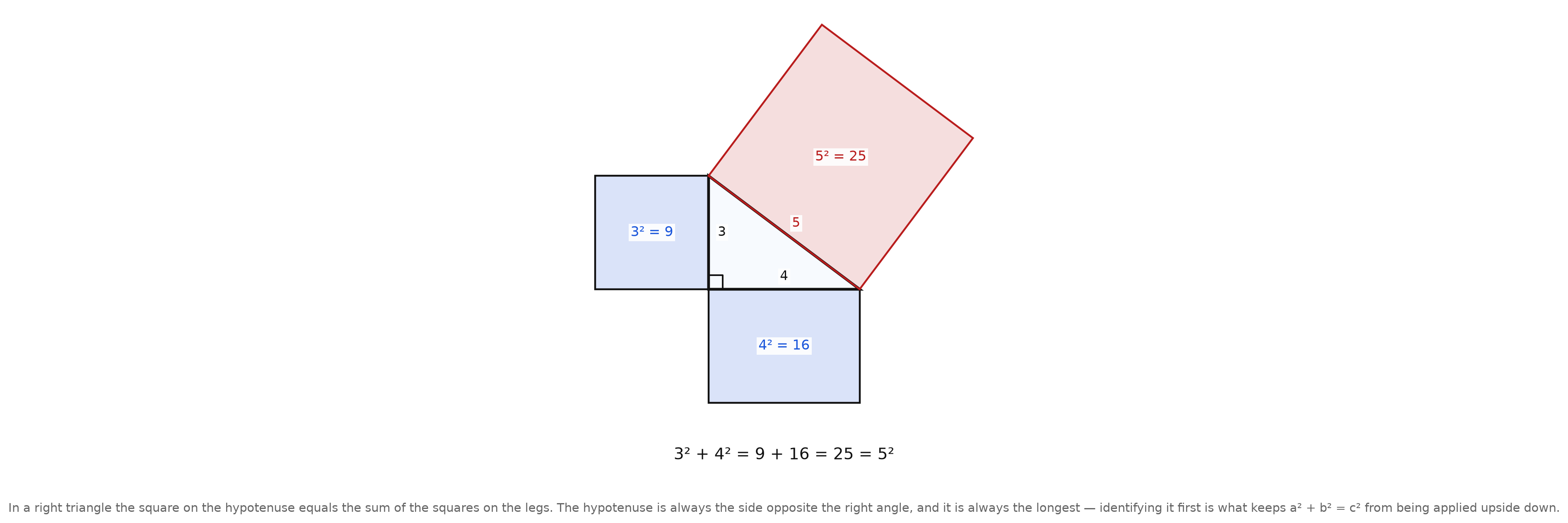
The squares are where the name comes from: the square built on the hypotenuse has exactly the area of the two leg squares together. Identifying the hypotenuse before writing anything is what keeps the equation from being applied upside down.
Why it is true — Chapter 7 in one figure
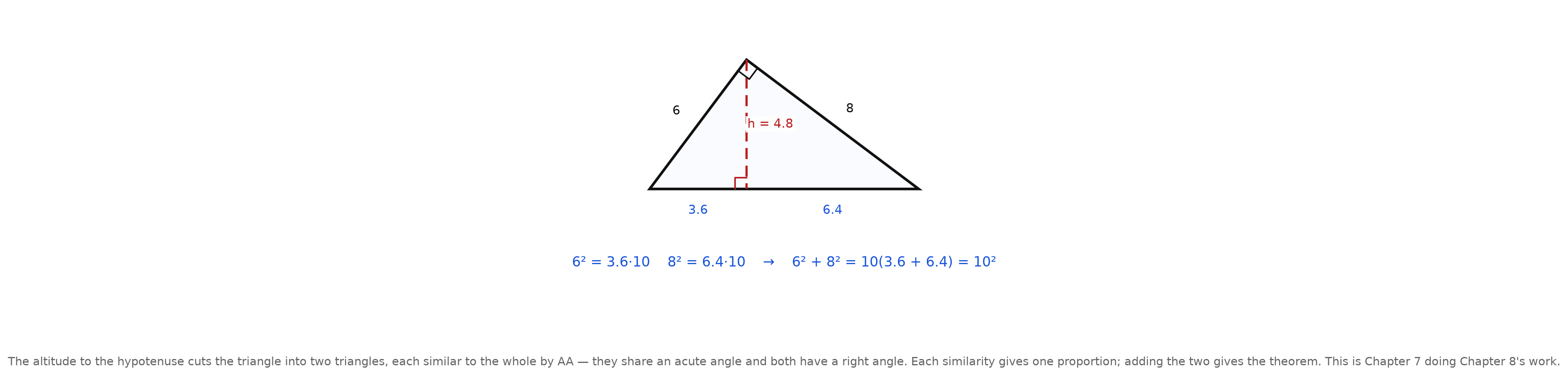
Drop the altitude from the right angle to the hypotenuse. It creates two smaller triangles, and each shares an acute angle with the original and has a right angle of its own — AA, from Chapter 7. Each similarity gives a proportion:
Add them. The two segments make up the whole hypotenuse, so
Two shapes of the same problem
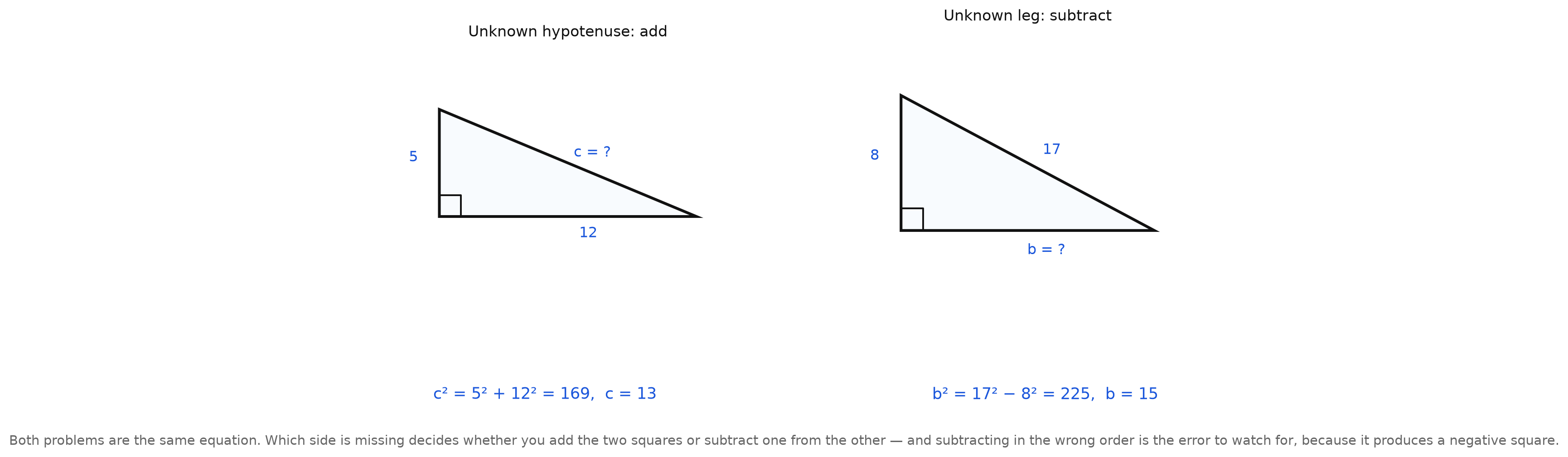
- Both legs given — the hypotenuse is unknown, so add: .
- Hypotenuse and one leg given — a leg is unknown, so subtract: .
Subtracting in the wrong order is the error to watch. is negative, and a squared length cannot be.
Exact before approximate
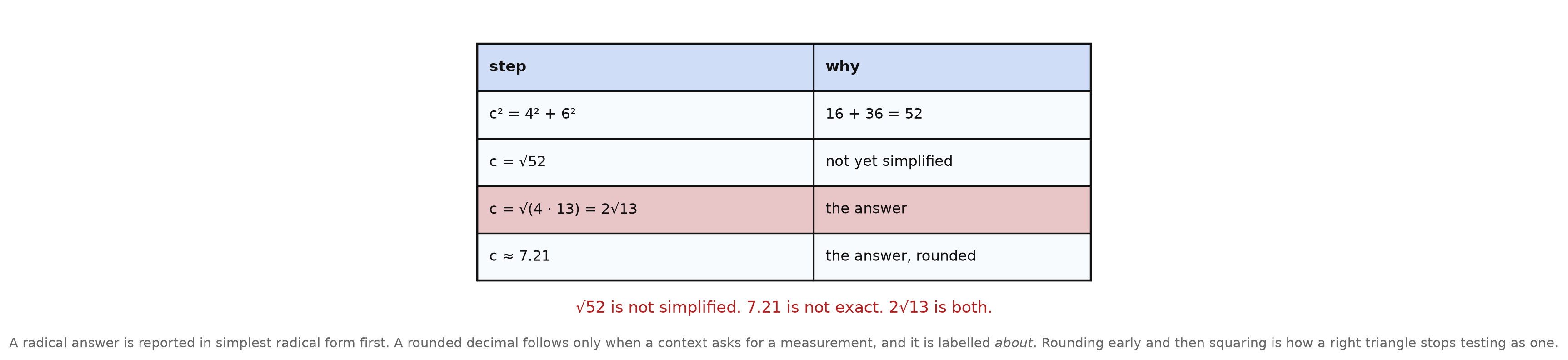
Three forms appear there and only one is the answer. is unfinished, is rounded, is exact and simplified.
Worked examples
Example 1 — Hypotenuse
Legs and . Find the hypotenuse.
Answer: , so .
Example 2 — Leg
Hypotenuse , one leg . Find the other leg.
Answer: , so .
Example 3 — A radical answer
Legs and . Find the hypotenuse.
Answer: , so .
Example 4 — In context
A ladder ft long leans against a wall with its foot ft from the base. How high does it reach?
Answer: , so ft.
Example 5 — The subtraction error
Legs and ; a student writes . What went wrong?
Answer: Both given sides are legs, so they add: and . Subtracting treats as the hypotenuse, which it is not.
Guided practice
- Use the squares figure. Which side is the hypotenuse, and how do you know?
- On that figure, give the area of each of the three squares.
- On that figure, write the equation the three areas satisfy.
- Use the altitude figure. What two triangles does the altitude create, and why is each similar to the whole?
- On that figure, give the altitude and the two hypotenuse segments.
- Use the two-problems figure. Which problem adds the squares and which subtracts?
Independent practice
- Legs and . Find the hypotenuse.
- Legs and . Find the hypotenuse.
- Hypotenuse , leg . Find the other leg.
- Hypotenuse , leg . Find the other leg.
- Legs and . Find the hypotenuse in simplest radical form.
- Legs and . Find the hypotenuse in simplest radical form.
- Legs and . Find the hypotenuse in simplest radical form.
- Hypotenuse , leg . Find the other leg in simplest radical form.
- Legs and . Find the hypotenuse.
- Application. A ft ladder leans against a wall with its foot ft from the base. How high up the wall does it reach?
- Application. A rectangular gate measures ft by ft. How long is the diagonal brace that runs corner to corner?
- Error analysis. Given legs and , a student writes . Identify the error and give the correct hypotenuse.
Exit ticket 8.1
- Legs and . Find the hypotenuse.
- Hypotenuse , leg . Find the other leg.
- Legs and . Find the hypotenuse in simplest radical form.
- Why does identifying the hypotenuse come before writing the equation?
Lesson 8.2 — The Converse, and Classifying a Triangle
Three lengths in, one word out
The theorem says a right triangle satisfies . Its converse runs the other way, and it is the whole of bullet a.
Converse of the Pythagorean Theorem. If for the three sides of a triangle, with the longest, the triangle is a right triangle.
The comparison also decides the other two cases:
- → right
- → acute
- → obtuse
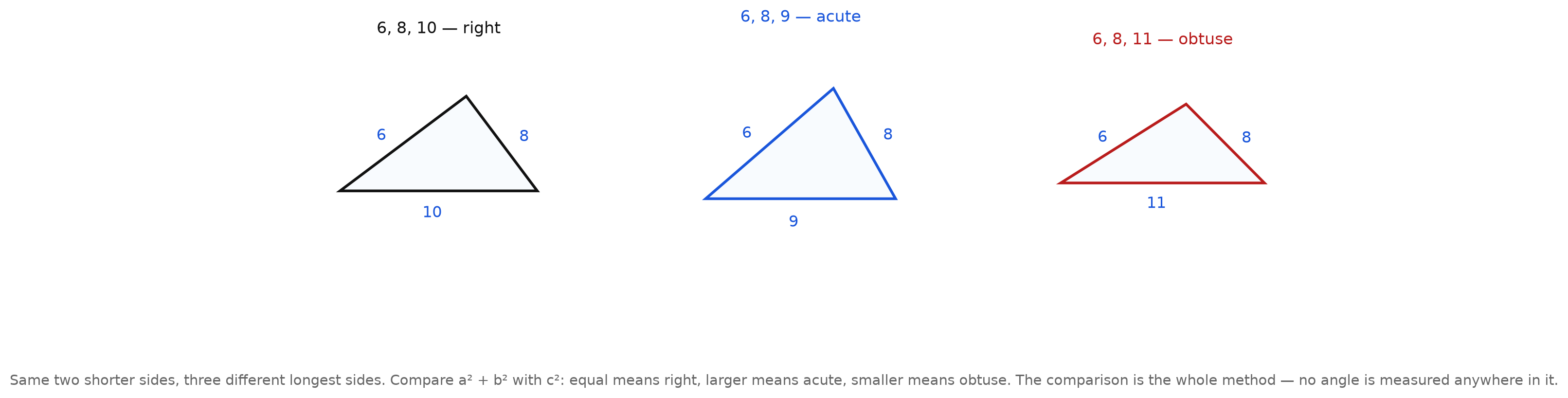
Same two shorter sides each time. Lengthening the third side alone walks the triangle from right through obtuse; shortening it makes the triangle acute. No angle is measured anywhere in the method.
Two things to do first
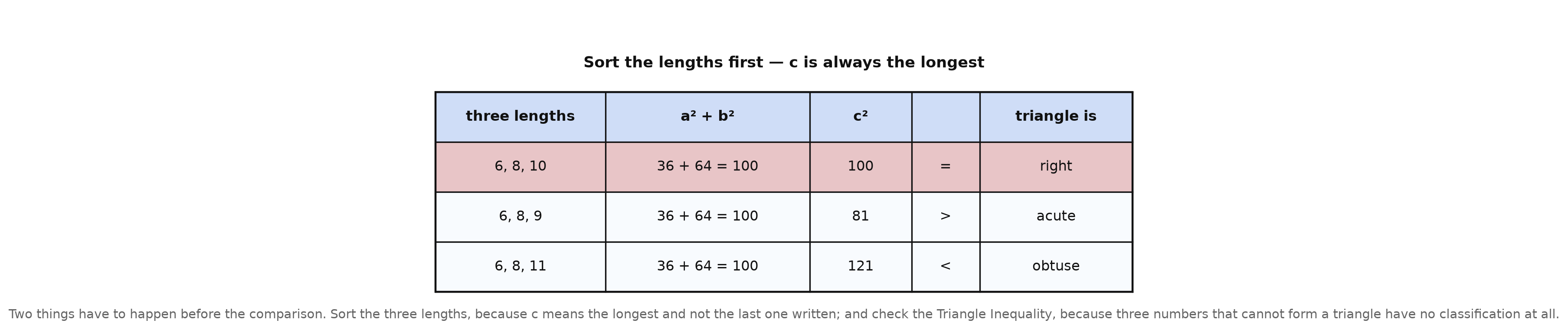
- Sort the three lengths. means the longest, not the last one written. Comparing with for the lengths , , gets the wrong answer for the right reason.
- Check the Triangle Inequality. Three numbers that cannot form a triangle have no classification at all. , , is not an obtuse triangle — it is not a triangle.
Worked examples
Example 1 — Right
Classify , , .
Answer: . Right.
Example 2 — Obtuse
Classify , , .
Answer: and . Since , obtuse.
Example 3 — Acute
Classify , , .
Answer: and . Since , acute.
Example 4 — Not a triangle
Classify , , .
Answer: , so the Triangle Inequality fails and there is no triangle to classify.
Example 5 — Radical sides
Classify , , .
Answer: . Right.
Guided practice
- Use the three-triangles figure. Which triangle is right, and what comparison shows it?
- On that figure, which is acute, and what comparison shows it?
- On that figure, which is obtuse, and what comparison shows it?
- Use the classification board. What must be done to the three lengths before comparing?
- On that board, what else must be checked before classifying at all?
- State the classification rule in one sentence.
Independent practice
- Classify , , .
- Classify , , .
- Classify , , .
- Classify , , .
- Classify , , .
- Classify , , .
- Classify , , .
- Classify , , .
- Classify , , .
- Classify , , .
- Application. A carpenter measures ft along one wall and ft along the other, then measures ft between those two marks. Is the corner square? If not, is the angle more or less than ?
- Error analysis. For the lengths , , , a student compares with and concludes the triangle is acute. Identify the error and give the correct classification.
Exit ticket 8.2
- Classify , , .
- Classify , , .
- Classify , , .
- Name the two checks that come before comparing with .
Lesson 8.3 — Pythagorean Triples
What a triple is
Pythagorean Triple. Three whole numbers , , with .
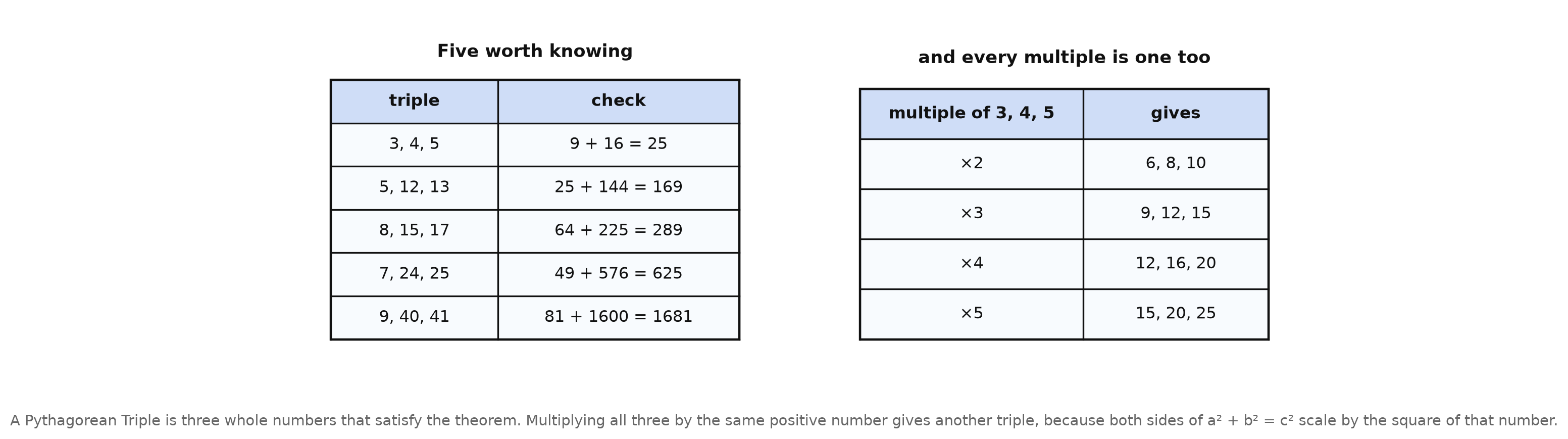
Multiplying all three numbers of a triple by the same positive number gives another triple, because both sides of scale by the square of that number. So generates ; ; ; and so on forever.
Five worth knowing by sight: · · · · .
Why recognize one
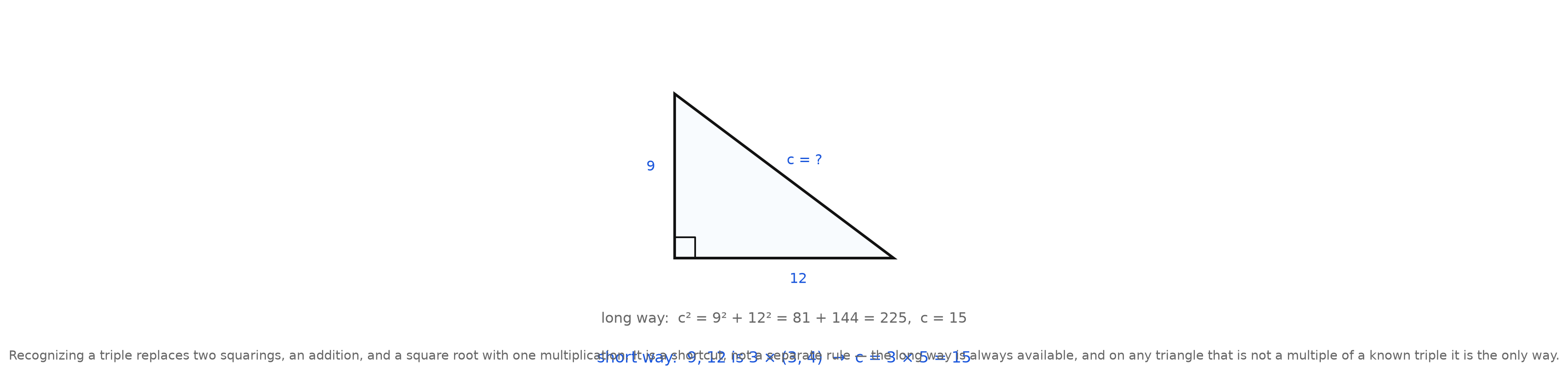
The long way squares two numbers, adds them, and takes a square root. The short way notices that is and multiplies once: .
That is a shortcut and not a separate rule. On a triangle with legs and there is no triple to spot, and the long way is the only way — which is why Lesson 8.1 comes first.
Working backwards
A triple is just as useful when the hypotenuse is the given side. Hypotenuse with a leg of : both are times a member of , so the missing leg is .
Worked examples
Example 1 — Recognizing
Is , , a Pythagorean Triple?
Answer: Yes. , and it is .
Example 2 — Not one
Is , , a Pythagorean Triple?
Answer: No. , and .
Example 3 — Using one forwards
Legs and . Find the hypotenuse.
Answer: is , so the hypotenuse is .
Example 4 — Using one backwards
Hypotenuse , leg . Find the other leg.
Answer: and , so this is and the other leg is .
Example 5 — In context
A television screen measures inches by inches. What is its diagonal?
Answer: is , so the diagonal is inches.
Guided practice
- Use the triples table. State in your own words what a Pythagorean Triple is.
- On that table, verify , , .
- On that table, explain why every multiple of a triple is also a triple.
- Use the shortcut figure. Give the long way to the hypotenuse of a - right triangle.
- On that figure, give the short way.
- When is the short way not available?
Independent practice
- Is , , a Pythagorean Triple? Name the triple it comes from.
- Is , , a Pythagorean Triple? Show the check.
- Is , , a Pythagorean Triple? Show the check.
- Legs and . Find the hypotenuse using a triple.
- Legs and . Find the hypotenuse using a triple.
- Hypotenuse , leg . Find the other leg using a triple.
- Hypotenuse , leg . Find the other leg using a triple.
- Legs and . Find the hypotenuse using a triple.
- Legs and . Find the hypotenuse using a triple.
- Hypotenuse , leg . Find the other leg using a triple.
- Application. A television screen measures inches by inches. Give its diagonal, and name the triple you used.
- Reasoning. Explain why multiplying all three numbers of a triple by gives another triple.
Exit ticket 8.3
- Legs and . Find the hypotenuse.
- Hypotenuse , leg . Find the other leg.
- Is , , a Pythagorean Triple? Show the check.
- State what a Pythagorean Triple is.
Lesson 8.4 — 45°-45°-90° Triangles
Where the ratio comes from
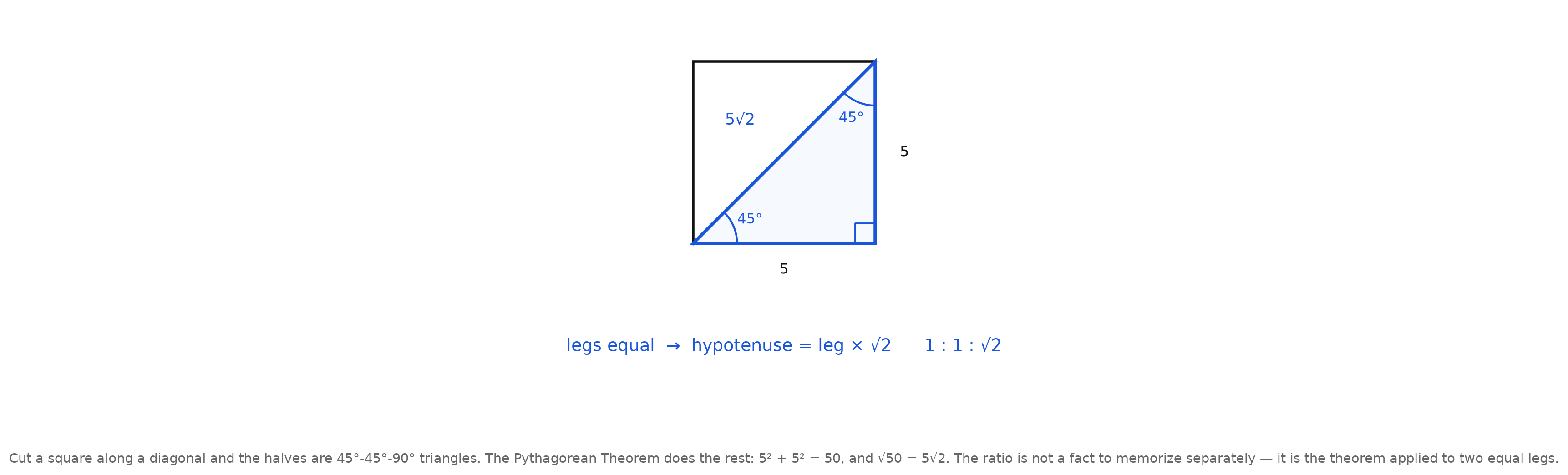
Cut a square along a diagonal. Each half has two equal legs and a right angle between them, so its other two angles are each. The theorem finishes it:
45°-45°-90°. leg : leg : hypotenuse .
That ratio is not a separate fact to memorize. It is the Pythagorean Theorem applied to two equal legs, which is worth knowing because it means you can always rebuild it.
Both directions
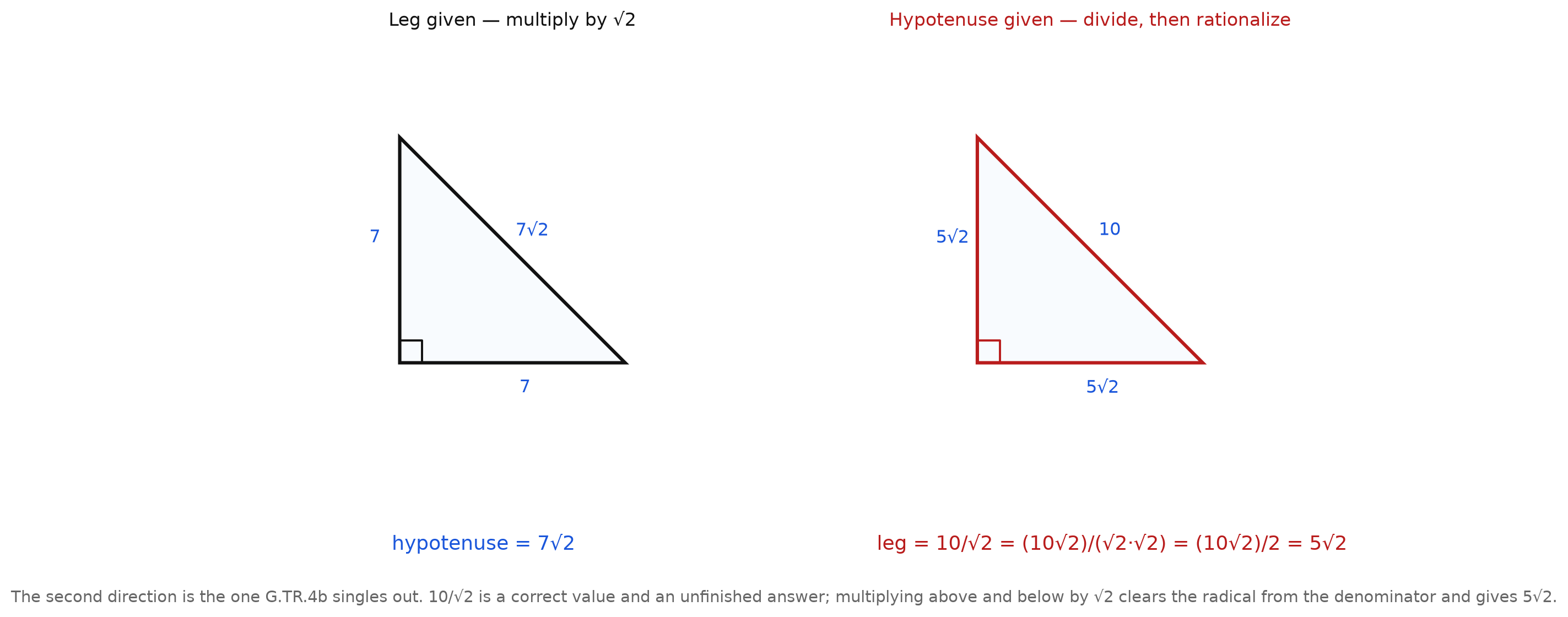
- Leg given — multiply by . Leg gives hypotenuse .
- Hypotenuse given — divide by , then rationalize:
The second direction is the one G.TR.4b singles out. is a correct value and an unfinished answer; multiplying above and below by clears the radical from the denominator.
Worked examples
Example 1 — Leg to hypotenuse
A -- triangle has a leg of . Find the hypotenuse.
Answer: .
Example 2 — Hypotenuse to leg
The hypotenuse is . Find a leg.
Answer: .
Example 3 — A radical given
A leg is . Find the hypotenuse.
Answer: .
Example 4 — A square's diagonal
A square has side . Find the diagonal.
Answer: .
Example 5 — Backwards from a diagonal
A square has diagonal . Find the side.
Answer: .
Guided practice
- Use the square figure. Where does the -- triangle come from?
- On that figure, state the ratio of the three sides.
- On that figure, show the computation and the simplification of .
- Use the two-directions figure. Given a leg of , give the hypotenuse.
- On that figure, given a hypotenuse of , give a leg and show the rationalizing.
- Why is called an unfinished answer?
Independent practice
- Leg . Find the hypotenuse.
- Leg . Find the hypotenuse.
- Leg . Find the hypotenuse.
- Hypotenuse . Find a leg.
- Hypotenuse . Find a leg.
- Hypotenuse . Find a leg.
- Hypotenuse . Find a leg.
- A square has side . Find the diagonal.
- A square has diagonal . Find the side.
- Application. A square floor tile is inches on a side and is to be cut along its diagonal. How long is the cut, exactly and to the nearest hundredth of an inch?
- Error analysis. A student says the leg of a -- triangle is half the hypotenuse. Give a counterexample from this lesson.
- Reasoning. Explain why the hypotenuse of a -- triangle is always longer than a leg, without computing anything.
Exit ticket 8.4
- Leg . Find the hypotenuse.
- Hypotenuse . Find a leg.
- A square has side . Find the diagonal.
- State the -- ratio and say which side each number belongs to.
Lesson 8.5 — 30°-60°-90° Triangles
Where this ratio comes from
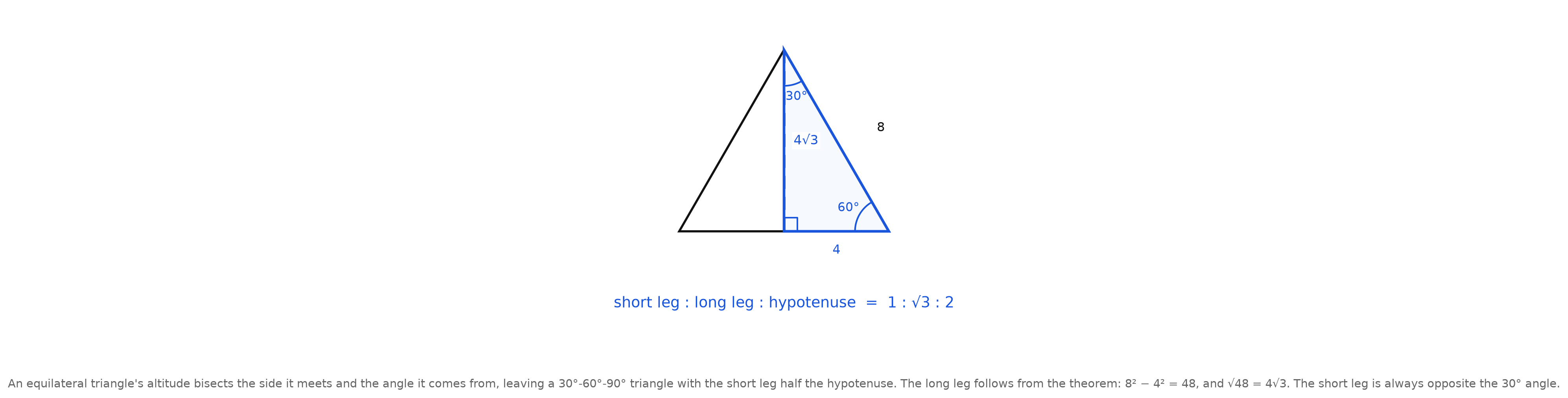
An equilateral triangle's altitude bisects both the side it meets and the angle it comes from. What is left is a -- triangle whose short leg is half the hypotenuse. The theorem gives the third side:
30°-60°-90°. short leg : long leg : hypotenuse .
The short leg is always the one opposite the angle, and the long leg is opposite the . Naming them by the angle they face, rather than by where they sit on the page, is what keeps the ratio from being applied sideways.
Find the short leg first, always
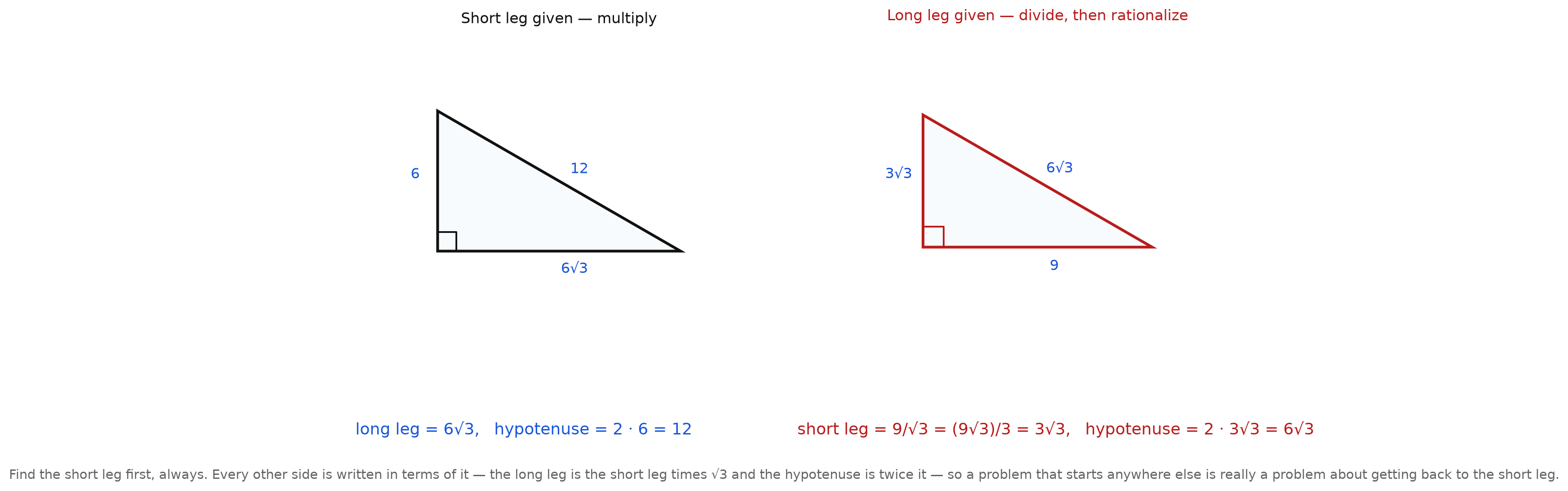
Every other side is written in terms of the short leg — the long leg is the short leg times , and the hypotenuse is twice it. So a problem that gives you anything else is really a problem about getting back to the short leg.
- Short leg given. Multiply: long leg , hypotenuse .
- Hypotenuse given. Halve it: .
- Long leg given. Divide by and rationalize:
Both triangles, in context
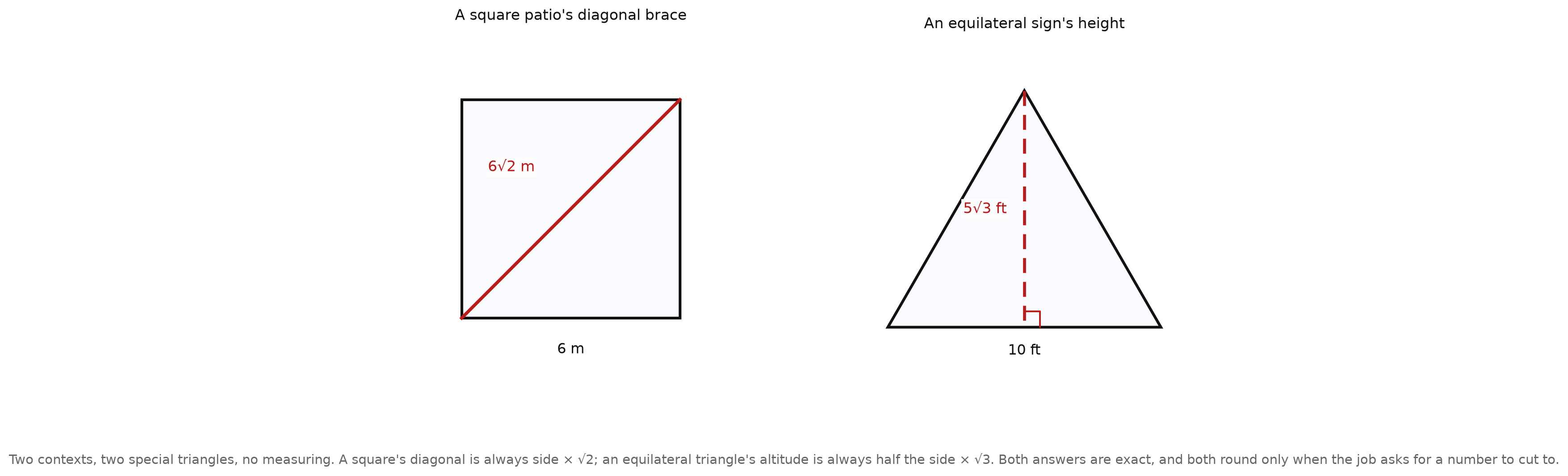
Two facts fall out and are worth carrying:
- a square's diagonal is always ;
- an equilateral triangle's altitude is always .
Worked examples
Example 1 — Short leg given
The short leg is . Find the other two sides.
Answer: Long leg , hypotenuse .
Example 2 — Hypotenuse given
The hypotenuse is . Find the other two sides.
Answer: Short leg , long leg .
Example 3 — Long leg given
The long leg is . Find the other two sides.
Answer: , and the hypotenuse is .
Example 4 — An equilateral altitude
An equilateral triangle has side . Find its altitude.
Answer: The short leg is , so the altitude is .
Example 5 — Backwards from an altitude
An equilateral triangle has altitude . Find its side.
Answer: The altitude is the long leg, so the short leg is — which is half the side. The side is .
Guided practice
- Use the equilateral figure. Where does the -- triangle come from?
- On that figure, state the ratio of the three sides.
- On that figure, which leg is opposite the angle, and what is it called?
- Use the two-directions figure. Given a short leg of , give the other two sides.
- On that figure, given a long leg of , give the other two sides and show the rationalizing.
- Use the context figure. Give the square's diagonal and the equilateral triangle's altitude.
Independent practice
- Short leg . Find the long leg and the hypotenuse.
- Short leg . Find the long leg and the hypotenuse.
- Hypotenuse . Find both legs.
- Hypotenuse . Find both legs.
- Long leg . Find the short leg and the hypotenuse.
- Long leg . Find the short leg and the hypotenuse.
- Long leg . Find the short leg and the hypotenuse.
- An equilateral triangle has side . Find its altitude.
- An equilateral triangle has side . Find its altitude.
- An equilateral triangle has altitude . Find its side.
- Application. An equilateral warning sign measures ft on each side. Give its height exactly and to the nearest hundredth of a foot.
- Error analysis. Given a long leg of , a student doubles it to get a hypotenuse of . Identify the error and give the correct hypotenuse.
Exit ticket 8.5
- Short leg . Find the long leg and the hypotenuse.
- Hypotenuse . Find both legs.
- Long leg . Find the short leg and the hypotenuse.
- State the -- ratio and say which side each number belongs to.
Chapter 8 Review
Vocabulary. hypotenuse · leg · Pythagorean Theorem · converse · right · acute · obtuse · Pythagorean Triple · simplest radical form · rationalize the denominator · -- · -- · short leg · long leg · altitude · diagonal
Review 1 (G.TR.4 a, f). A landscaper stakes out a rectangular bed. She measures m along one side, m along the other, and m between the two far stakes.
- Is the corner square? Name the theorem you used and show the comparison.
- Name the Pythagorean Triple this is a multiple of, and give the multiplier.
- A second bed measures m, m, and m between the far stakes. Classify that corner as right, acute, or obtuse, and show the comparison.
- A third measurement comes back as m, m, and m. Explain why this one cannot be classified at all.
Review 2 (G.TR.4 b, c). A square window frame is inches on a side, and an equilateral gable above it is inches on a side.
- Give the window's diagonal, exactly.
- Give the gable's height, exactly.
- A brace is cut at inches. Simplify that, compute half the diagonal separately, and say whether the two agree. Explain the result rather than just reporting it.
- Both answers involve a radical. Give each to the nearest hundredth of an inch, and say why the exact form was written first.
Review 3 (G.TR.4 b, c, f). A right triangle has one angle of and a hypotenuse of cm.
- Give both legs, exactly.
- A second right triangle has two angles of and the same hypotenuse of cm. Give both legs, exactly, showing the rationalizing.
- Which of the two triangles has the longer shortest side? Support your answer with the exact values, not decimals.
- Verify each triangle with the Pythagorean Theorem, and say what that verification is checking that the ratios alone did not.
Standards coverage check — Chapter 8
| Knowledge and Skill | Where it is taught | Where it is practiced | Where it is applied in context |
|---|---|---|---|
| G.TR.4a — determine whether a triangle formed with three given lengths is a right triangle | 8.2 (the converse, the two checks that come first, and the acute and obtuse cases) | 23–38, 40–44 | 39; Review 1 |
| G.TR.4b — solve for missing lengths using properties of 45-45-90 triangles, where rationalizing denominators may be necessary | 8.4 (the ratio derived from a square, and both directions with the rationalizing) | 67–81, 83–88 | 82; Review 2, Review 3 |
| G.TR.4c — solve for missing lengths using properties of 30-60-90 triangles, where rationalizing denominators may be necessary | 8.5 (the ratio derived from an equilateral triangle, short leg first, and the rationalizing) | 89–104, 106–110 | 105; Review 2, Review 3 |
| G.TR.4f — solve problems, including those in context, using the Pythagorean Theorem and its converse, including recognizing Pythagorean Triples | 8.1 (the theorem, the similarity proof, both directions, exact form); 8.2 (the converse); 8.3 (triples and their multiples) | 1–15, 18–22; 23–38, 40–44; 45–60, 62–66 | 16, 17; 39; 61; Review 1, Review 3 |
Supporting items: 22, 44, 62, 66, 84, and 110 are the reasoning and statement items, and 62 carries the idea the whole of Lesson 8.3 depends on — that both sides of scale by , so a multiple of a triple is a triple. The error analyses target the recurring failures: subtracting when both legs are given (18), comparing without sorting the three lengths (40), halving the hypotenuse of a -- triangle instead of dividing by (83), and doubling the long leg of a -- triangle instead of returning to the short leg first (106).
Boundaries respected. No trigonometric ratio appears anywhere in this chapter; sine, cosine, tangent, and the angles of elevation and depression are Chapter 9. The special triangles are exactly the two the standard names, and every answer that begins as a fraction with a radical denominator is rationalized, which the standard requires by name. The converse is used to classify as right, acute, or obtuse — the three cases the comparison distinguishes — and the Triangle Inequality from Chapter 4 gates the classification, because three lengths that are not a triangle have no classification. The similarity proof in Lesson 8.1 uses only AA from Chapter 7.
Answer keys for every item in this chapter are in Appendix A.