Chapter 7 — Proving Triangles Similar
Standard: G.TR.3 (a, b, c, d, e)
G.TR.3 — verbatim. The student will, given information in the form of a figure or statement, prove and justify two triangles are similar using direct and indirect proofs, and solve problems, including those in context, involving measured attributes of similar triangles. Students will demonstrate the following Knowledge and Skills: a) Use definitions, postulates, and theorems, including SAS, SSS, and AA, to prove and justify that triangles are similar. b) Use algebraic methods to prove that triangles are similar. c) Use coordinate methods, such as the slope formula and the distance formula, to prove two triangles are similar. d) Describe a sequence of transformations that can be used to verify similarity of triangles located in the same plane. e) Solve problems, including those in context, involving attributes of similar triangles.
By the end of this chapter you will be able to:
- Read a similarity statement and give the scale factor in either direction (G.TR.3a)
- Prove two triangles similar by AA, SSS, and SAS, and explain why AA needs only two angles (G.TR.3a)
- Recognize the configuration that produces AA most often — a line parallel to one side of a triangle (G.TR.3a)
- Turn a similarity statement into a proportion, solve it, and report the length rather than the variable (G.TR.3b)
- Prove similarity from coordinates, using distance for SSS and slope for AA (G.TR.3c)
- Describe a sequence of transformations — a dilation followed by rigid motions — that carries one triangle onto another (G.TR.3d)
- Solve attribute problems, including indirect measurement, from a similarity you proved (G.TR.3e)
Lessons: 7.1 Similar Triangles, Correspondence, and Scale Factor · 7.2 AA — Two Angles Are Enough · 7.3 SSS Similarity and SAS Similarity · 7.4 Similarity by Algebra · 7.5 Similarity by Coordinates · 7.6 Similarity as a Sequence of Transformations · 7.7 Measured Attributes and Indirect Measurement
Why this chapter matters. Similarity is congruence with one requirement relaxed: corresponding sides are proportional instead of equal. Everything Chapters 5 and 6 built survives that change, and one thing improves — AAA, which was useless for congruence, becomes AA, the fastest criterion in the book. Chapter 9 exists because of this chapter: the sine, cosine, and tangent of an angle are well defined only because every right triangle with that acute angle is similar to every other.
Scope note. This chapter covers all five bullets of G.TR.3. The similarity criteria are exactly the three the standard names: SAS, SSS, AA. ASA and AAS are not separate similarity criteria — each reduces to AA — and HL reduces to SSS, so the list really is three long.
One correction is worth recording here, because it changed this chapter's plan. The draft of this volume had G.TR.3 with four bullets and no transformations bullet. Two independent searches returned five, including d) Describe a sequence of transformations that can be used to verify similarity of triangles located in the same plane, which pushed measured attributes to e. Lesson 7.6 exists because of that correction. Bullet c also names the slope formula as well as the distance formula, which is why Lesson 7.5 spends real time on slope — in Chapter 6 slope certified only a right angle, but for similarity it reaches AA, and that is a much bigger job.
Conventions this chapter fixes.
- The tilde means proportional, not equal. claims three pairs of congruent angles and three pairs of sides in one constant ratio. Six claims, exactly as with congruence.
- Order still carries the claim. Everything Chapter 5 said about correspondence applies unchanged.
- A scale factor has a direction. The factor from to is . Reading the pair the other way gives the reciprocal. Both are correct; saying which one you mean is required.
- Scale factors are positive. A dilation in this course never has a negative factor; a half-turn is a separate rotation step.
- A variable is not a length. Solve the proportion, then substitute back, then check the ratio — the same discipline Chapter 6 fixed, with ratio in place of length.
- Exact before approximate. Coordinate lengths stay in simplest radical form. The radicals are an advantage here: is on sight.
- A sequence is ordered. A description of a transformation sequence names each step in order, and names the centre and the factor of any dilation.
- Perimeter scales by . The effect of scaling on area is G.DF.2's subject and waits for Chapter 17.
- Item numbering runs straight through the chapter, from 1 in Lesson 7.1 to 144 at the end of Lesson 7.7.
Lesson 7.1 — Similar Triangles, Correspondence, and Scale Factor
What similar means
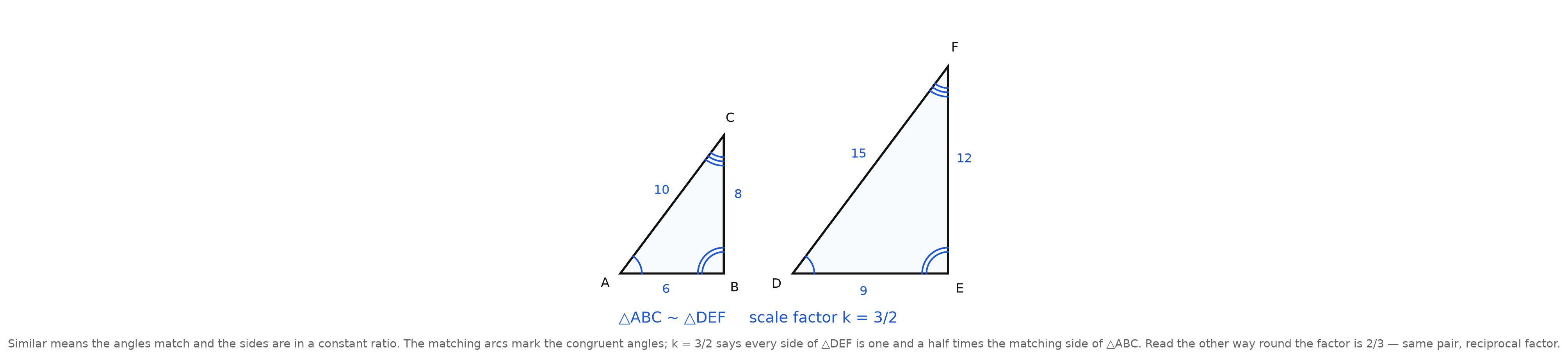
Two triangles are similar when their corresponding angles are congruent and their corresponding sides are proportional. The constant ratio is the scale factor, written .
Six claims, three of them ratios
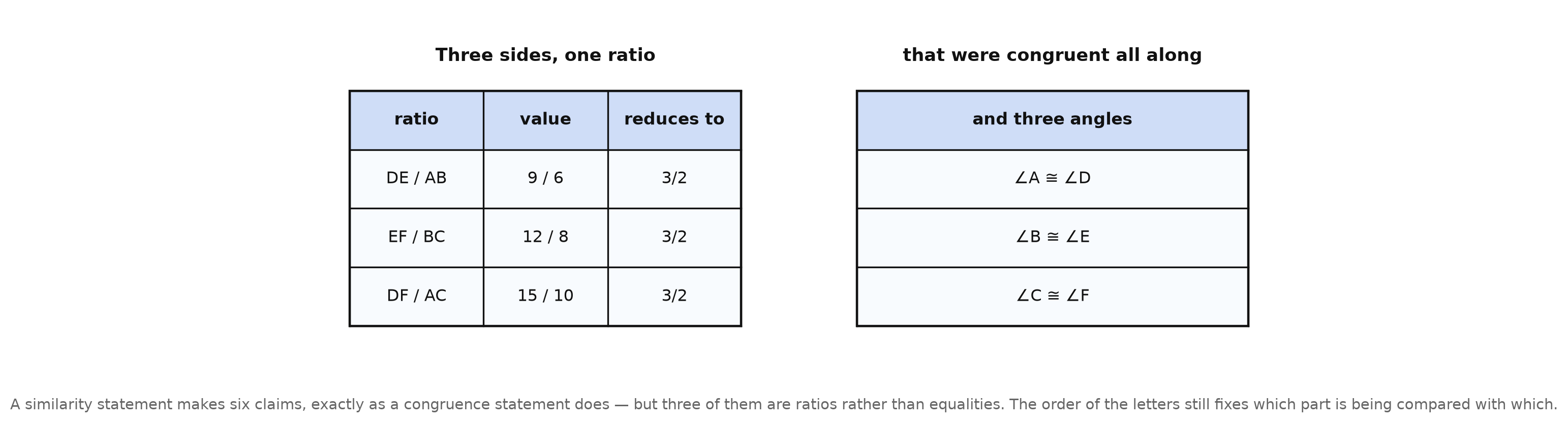
A similarity statement makes exactly as many claims as a congruence statement — six — but three of them are ratios instead of equalities. And the letter order still says which part is being compared with which: pairs with , with , with , and nothing else.
The factor has a direction
From to the factor is , an enlargement. From to it is , a reduction. These describe the same pair of triangles. An answer of "" is complete only when the direction is clear from the question or from your sentence.
The most common slip is writing the ratio upside down. Fix it with a habit: the new triangle's side goes on top.
Perimeter scales by
If every side is multiplied by , so is their sum. A triangle with perimeter and scale factor has an image with perimeter . That is the one derived measure this chapter uses; what scaling does to area belongs to G.DF.2 and Chapter 17.
Worked examples
Example 1 — Finding
with and . Give from to .
Answer: .
Example 2 — Using
with and . Give .
Answer: .
Example 3 — Angles
with and . Give all three angles of .
Answer: , , and .
Example 4 — Deciding from three sides
Are triangles with sides , , and , , similar?
Answer: . Yes, with .
Example 5 — Perimeter
with and the perimeter of equal to . Give the perimeter of .
Answer: .
Guided practice
- Use the scale-factor figure. Give the scale factor from to .
- On that figure, which side of corresponds to ?
- On that figure, give the scale factor from to .
- Use the ratio table. Show that and reduce to the same value.
- On that table, how many separate claims does make, and what are they?
- Explain why the order of the letters in a similarity statement matters.
Independent practice
- with and . Give from to .
- with and . Give .
- with , , and . Give .
- with , , , and . Give and .
- with and . Give all three angles of .
- Triangles have sides , , and , , . Are they similar? Give .
- Triangles have sides , , and , , . Are they similar? Show the check that settles it.
- with and the perimeter of equal to . Give the perimeter of .
- Error analysis. with and . A student reports from to . Correct them.
- Reasoning. Explain why two congruent triangles are always similar, but two similar triangles need not be congruent.
Exit ticket 7.1
- with and . Give .
- with and . Give .
- with and . Give .
- State in full what a similarity statement claims.
Lesson 7.2 — AA — Two Angles Are Enough
Why two angles suffice
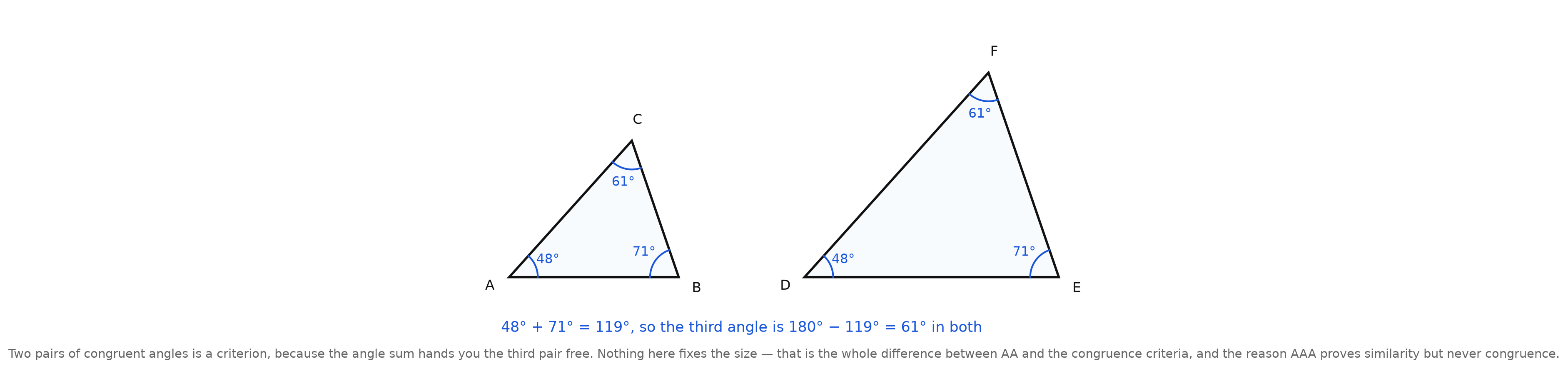
If two angles of one triangle are congruent to two angles of another, the third pair is congruent too — the angle sum has no choice in the matter. So AA is a criterion, and it is the cheapest one in the chapter: two facts and you are done.
Notice what AA does not do. Nothing in the figure fixes the size. That is exactly the difference between AA and the congruence criteria of Chapter 5, and it is why AAA proved nothing there and proves everything here.
AA Similarity. If two angles of one triangle are congruent to two angles of another triangle, the triangles are similar.
The configuration that produces AA
Most AA proofs in this book and on the test come from one picture: a line parallel to one side of a triangle.
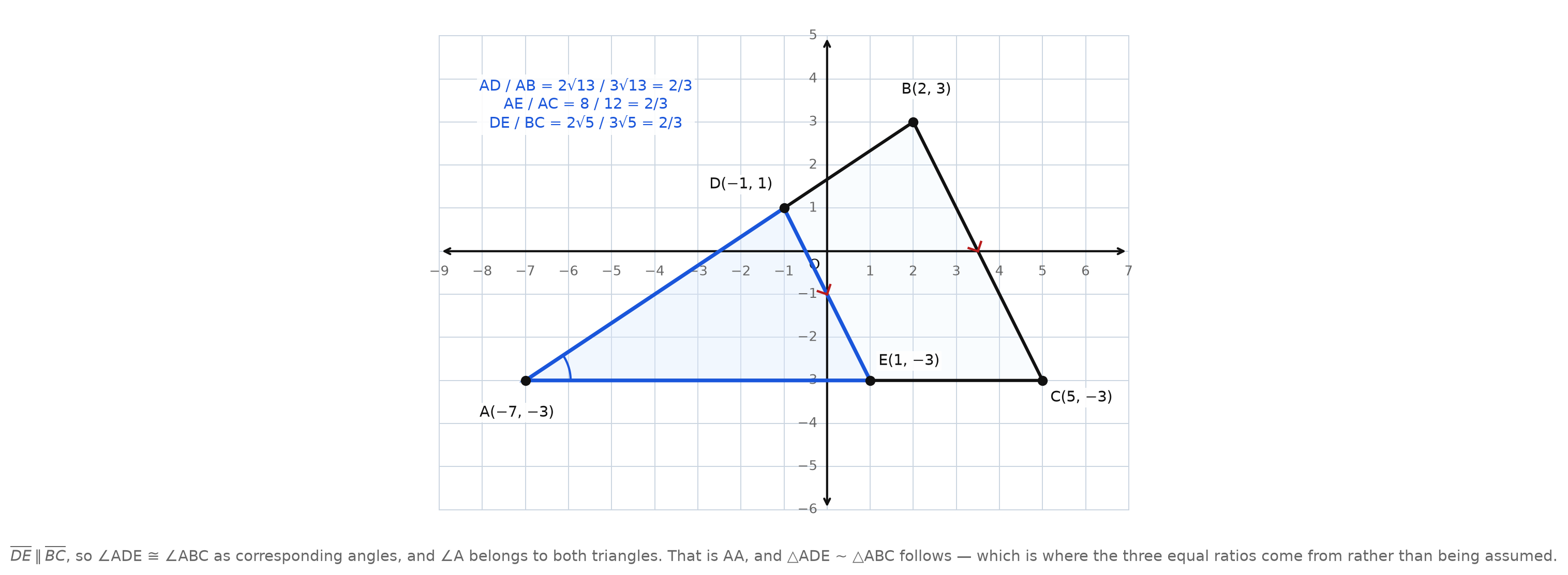
With :
- — the two triangles share it;
- — corresponding angles, from Chapter 2.
That is AA, so , and the three equal ratios follow. This is worth saying carefully: the ratios are a conclusion, not an assumption. A student who writes as a first line has skipped the proof.
Two more sources of AA are worth knowing:
- Two right triangles sharing one acute angle are similar — the right angles are the second pair.
- Parallel rays, such as the sun's, make congruent angles with a common line. That is Lesson 7.7's whole engine.
Worked examples
Example 1 — Deciding by AA
One triangle has angles and ; another has and . Are they similar?
Answer: The first triangle's third angle is , so its angles are , , . The second's third is . Same three measures, so yes, by AA.
Example 2 — Deciding against
One triangle has angles and ; another has and . Similar?
Answer: The first is , , ; the second is , , . Only one pair matches, so no.
Example 3 — A parallel cut
In , is on and is on with . , , . Find .
Answer: , so . Then gives , so and .
Example 4 — Right triangles
Two right triangles each contain a angle. Similar?
Answer: Yes. The right angles are one pair and the angles are the other, so AA applies.
Example 5 — One pair is not enough
A student says two triangles with a pair of congruent angles must be similar. Give a counterexample.
Answer: A triangle with angles , , and one with angles , , share a angle and nothing else. They are not similar.
Guided practice
- Use the AA figure. Which two angle measures are marked in both triangles?
- On that figure, why is the third pair congruent without being marked?
- On that figure, are the two triangles congruent? Explain.
- Use the parallel-cut figure. Name the two angle congruences that give AA, with a reason for each.
- On that figure, give .
- On that figure, give , and say how you know it without measuring or .
Independent practice
- One triangle has angles and ; another has and . Similar? Justify.
- One triangle has angles and ; another has and . Similar? Justify.
- In , with on and on . , , . Find .
- Same configuration, with , , and . Find .
- Same configuration, with , , and . Find and .
- Two right triangles each contain a angle. Are they similar? Name the two pairs.
- by AA with and . Give and .
- Application. A wheelchair ramp rises ft over a run of ft. A longer ramp is built to the same slope over a run of ft. Explain why the two ramp triangles are similar, and give the rise of the longer ramp.
- Error analysis. A student claims that one pair of congruent angles makes two triangles similar. Give a counterexample.
- Reasoning. Explain why AA needs only two pairs of angles when the definition of similarity asks for three.
Exit ticket 7.2
- One triangle has angles and ; another has and . Similar? Justify.
- In , with , , and . Find .
- Why is AA not a congruence criterion?
- Name the two angle facts that make a parallel cut produce a similar triangle.
Lesson 7.3 — SSS Similarity and SAS Similarity
SSS similarity
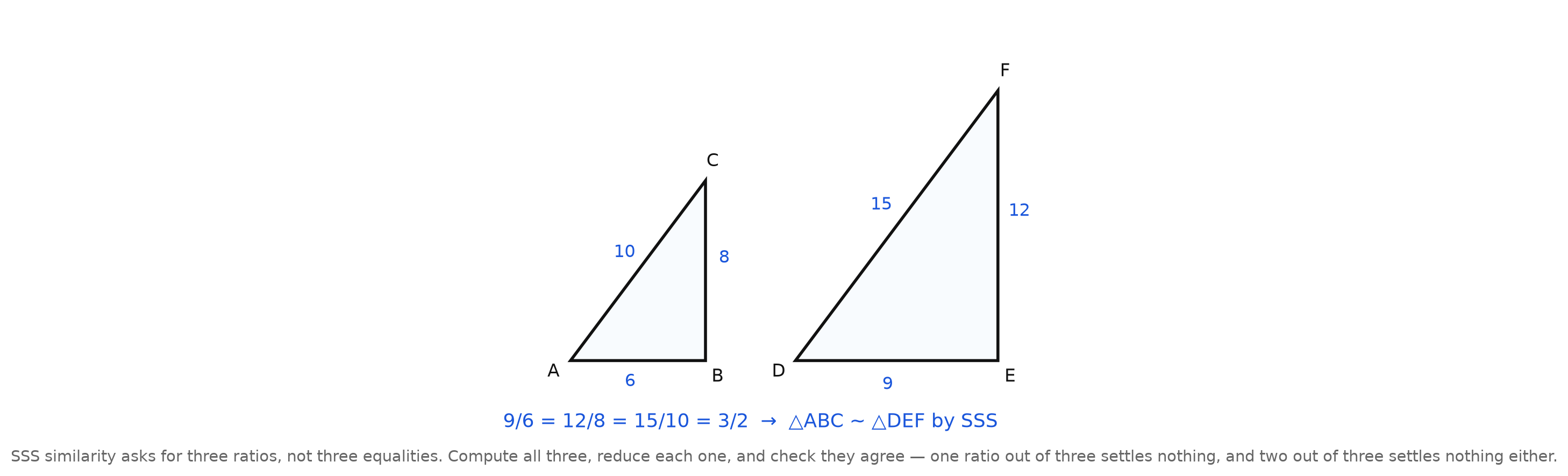
SSS Similarity. If the three sides of one triangle are proportional to the three sides of another, the triangles are similar.
The word that changed is proportional. Compute all three ratios, reduce each, and check that they agree. Two out of three settles nothing — the third can always spoil it, and in the exercises it often does.
SAS similarity
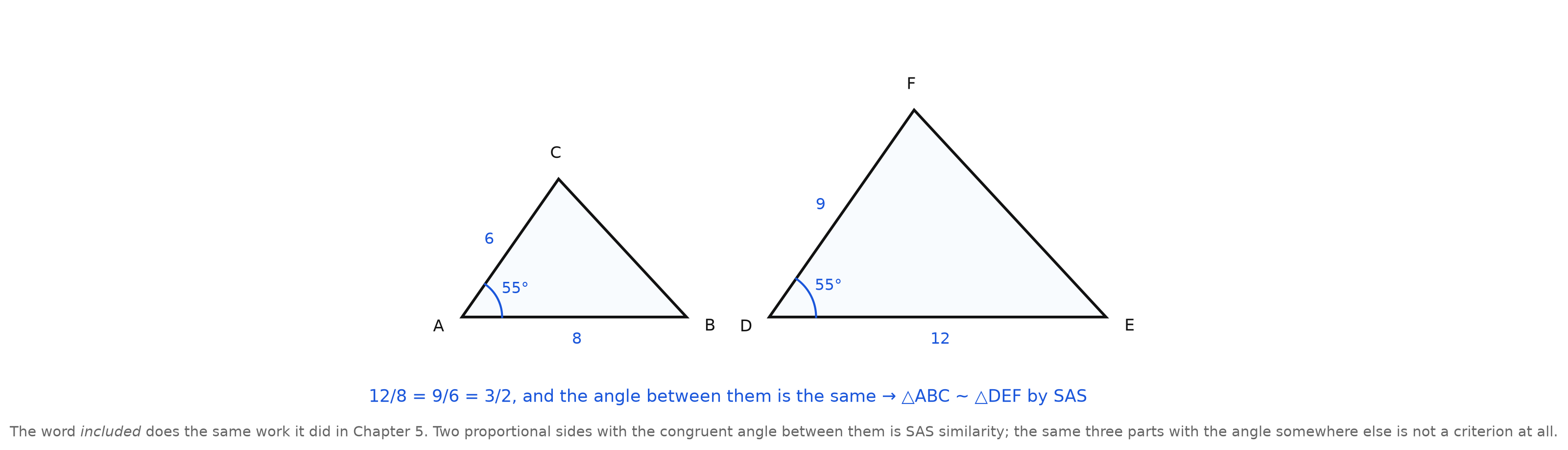
SAS Similarity. If two sides of one triangle are proportional to two sides of another and the included angles are congruent, the triangles are similar.
Included does the same work it did in Chapter 5. The congruent angle must sit between the two sides whose ratio you computed. Move it anywhere else and the arrangement is SSA, which is not a criterion for similarity any more than it was for congruence.
Where similarity and congruence differ
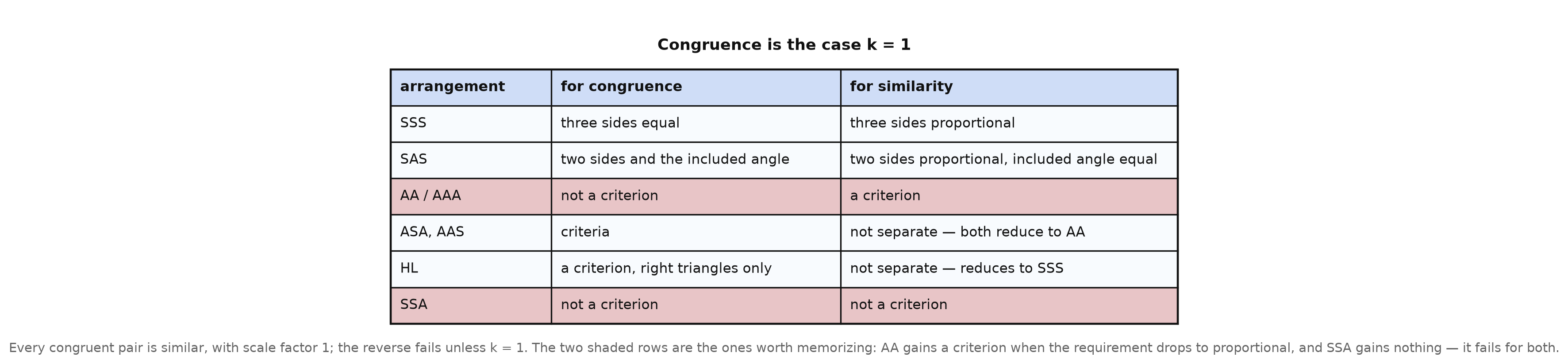
Two rows are worth memorizing.
- AA/AAA is the row that changes. It proves nothing about congruence and everything about similarity.
- SSA is the row that does not change. It fails for both, for the same reason: the data admits two different triangles.
The other rows are bookkeeping. ASA and AAS each contain two angles, so each reduces to AA; HL on two right triangles gives the third side by the Pythagorean Theorem, so it reduces to SSS. The standard names three criteria because three is all there are.
And congruence is not a separate idea: it is similarity with .
Worked examples
Example 1 — SSS similarity
Are triangles with sides , , and , , similar?
Answer: , , . Yes, by SSS similarity with .
Example 2 — The third ratio spoils it
Sides , , and , , .
Answer: and , but . Not similar.
Example 3 — SAS similarity
has , , . has , , . Similar?
Answer: , and and are the included angles. Yes, by SAS similarity.
Example 4 — The angle is not included
Same side lengths as Example 3, but the congruent angles are and .
Answer: is not between and — those meet at . The arrangement is SSA, which is not a criterion, so no conclusion follows.
Example 5 — Using a proved similarity
by SSS with and . Given , find .
Answer: , so .
Guided practice
- Use the SSS figure. Give the three ratios and their common value.
- On that figure, what would two matching ratios out of three prove?
- Use the SAS figure. Which two sides and which angle does the criterion use?
- On that figure, why must the congruent angle be the included one?
- Use the comparison table. Which row changes between congruence and similarity?
- On that table, which arrangement fails for both?
Independent practice
- Sides , , and , , . Similar? Give the criterion and .
- Sides , , and , , . Similar? Show the comparison that settles it.
- Sides , , and , , . Similar? Give .
- has , , ; has , , . Name the criterion.
- Same lengths as item 50, but the congruent angles are and . What can you conclude, and why?
- Sides , , and , , . Similar? Give from the first to the second.
- with , , and . Give .
- has , , ; has , , . Name the criterion and give .
- Sides , , and , , . Similar? Justify.
- Application. A shelf bracket is a triangle with sides , , and inches. A larger bracket in the same range has sides , , and inches. Show the two are similar and give the scale factor.
- Error analysis. A student checks and and writes "similar by SSS." What is missing, and why does it matter?
- Reasoning. Explain why the angle in SAS similarity must be the included one, using the SSA failure from Chapter 5.
Exit ticket 7.3
- Sides , , and , , . Similar? Give .
- has , , ; has , , . Name the criterion and give .
- Which arrangement is a similarity criterion but not a congruence criterion?
- Name the three similarity criteria.
Lesson 7.4 — Similarity by Algebra
A similarity statement is a proportion
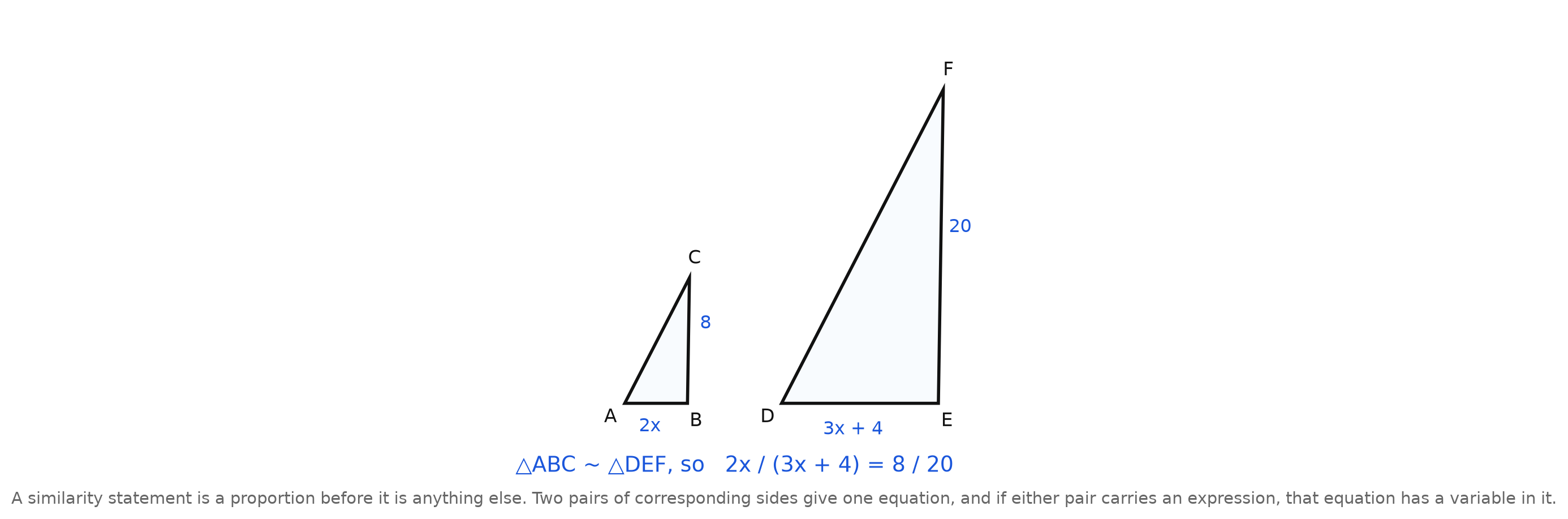
Two pairs of corresponding sides give one equation:
If either pair carries an expression, that equation has a variable in it. Nothing else about the method changes.
Solve, then check twice
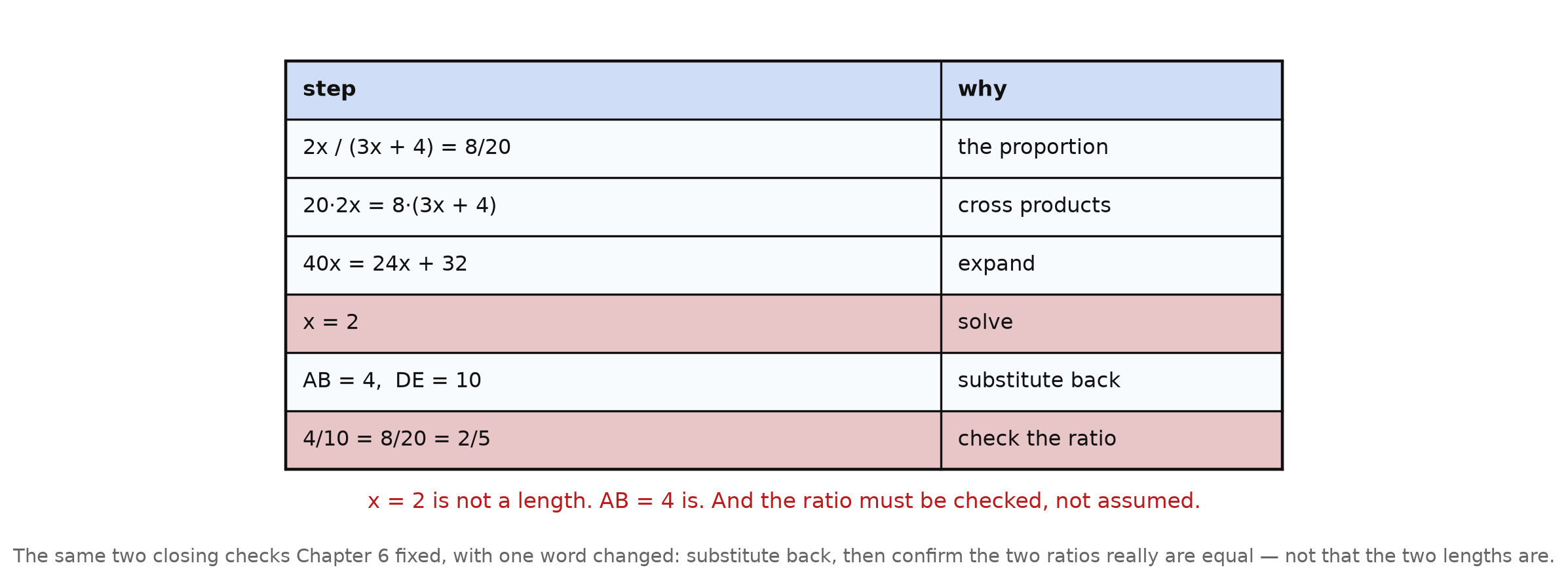
and then, exactly as in Chapter 6:
- Substitute back. and .
- Check the thing that was claimed. Here that is the ratio, not the length: .
is a fact about the variable. is the answer.
When the algebra says no
Two outcomes mean "there is no such pair of triangles," and both are worth recognizing rather than forcing:
- A false statement. If the equation reduces to something like , no value of the variable satisfies it.
- A negative length. If the solution makes a side length zero or negative, reject it. A length is positive.
Worked examples
Example 1 — A plain proportion
Solve .
Answer: , so .
Example 2 — One expression
with , , , . Find .
Answer: , so and .
Example 3 — Two expressions
, , , . Find , , and .
Answer: , so , , . Then and , and checks.
Example 4 — Rejecting a solution
, , , . Find .
Answer: , so and . That makes , which is not a length. There is no such pair of triangles — and you could have seen it coming: says , but says the opposite.
Example 5 — In context
A print's triangular logo has a long edge of inches. An enlargement with scale factor has a matching edge of inches. Find and the print's edge.
Answer: , so and . The print's edge is inches.
Guided practice
- Use the expressions figure. Write the proportion the similarity statement gives.
- Use the solve-and-check board. Give the cross products.
- On that board, solve for .
- On that board, give and .
- On that board, show the ratio check.
- Explain why is not the answer to "find ."
Independent practice
- Solve .
- Solve .
- with , , , . Find .
- with , , , . Find and .
- with , , , . Find , , and .
- with , , , . Find , , and .
- with , , , . Find and say what your answer means.
- Application. A print's triangular logo has a long edge of inches; an enlargement with scale factor has a matching edge of inches. Find and the print's edge.
- Error analysis. For with , , , and , a student writes and gets . Identify the error and give the correct value.
- Reasoning. Explain why a proportion with a variable in it is still an ordinary equation, and what the cross products are doing.
Exit ticket 7.4
- Solve .
- with , , , . Find and .
- A solved proportion gives a side length of . What do you report?
- Name the two checks that finish an algebraic similarity problem.
Lesson 7.5 — Similarity by Coordinates
Two formulas, two criteria
Bullet c names the slope formula as well as the distance formula, and each one reaches a different criterion:
| Formula | What it gives | Criterion it reaches |
|---|---|---|
| distance | the ratio of two corresponding sides | SSS similarity, after three ratios |
| slope | that two corresponding sides are parallel, so the angles between them are congruent | AA, after two angle pairs |
That is a larger role than slope had in Chapter 6, where it certified only a right angle. For similarity it can certify an angle congruence outright — no measure needed, just the fact that two pairs match.
SSS from six distances
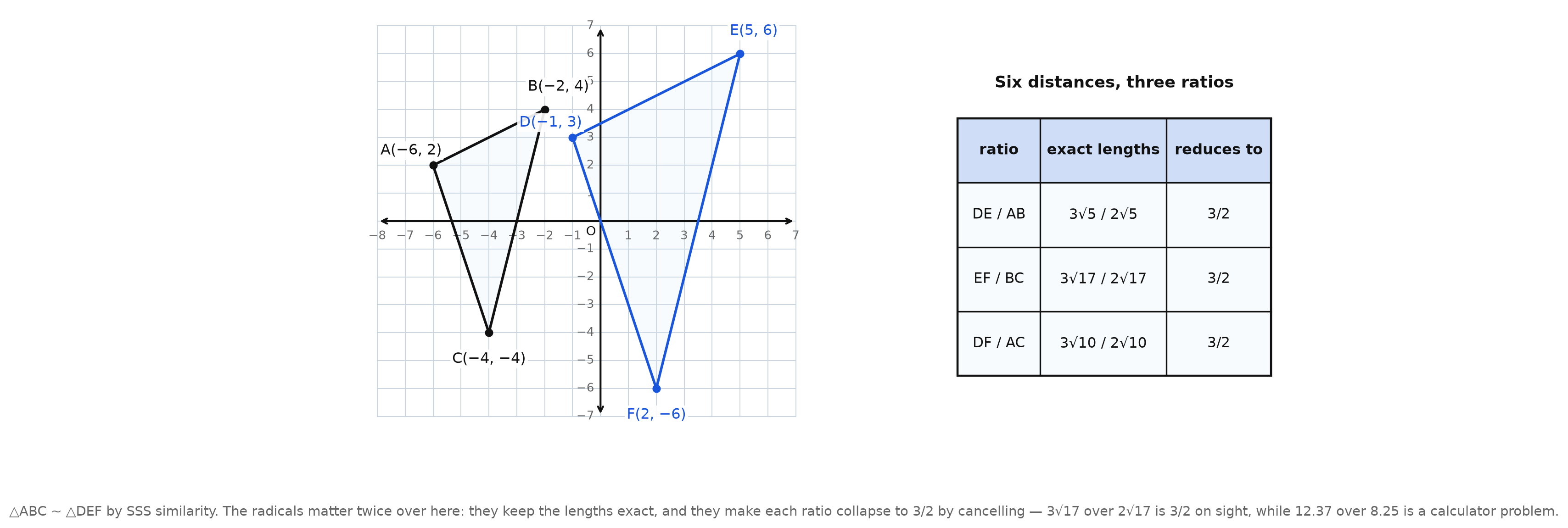
Here the radicals do double duty. They keep the lengths exact, and they make each ratio collapse on sight — the cancels. Rounded to over , the same comparison is a calculator problem with a rounding error hiding in it.
AA from three slopes
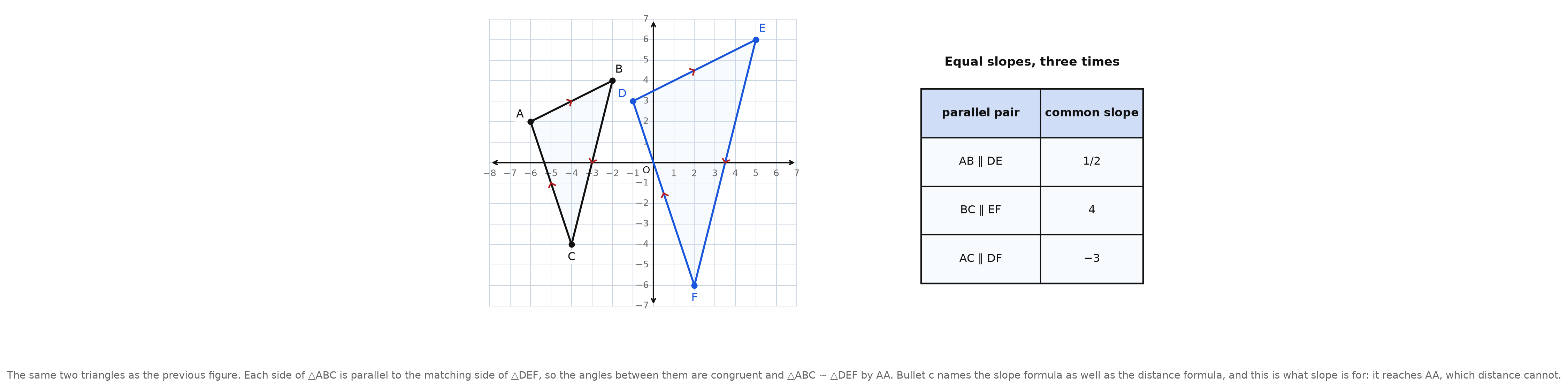
Those are the same two triangles. Each side of is parallel to the matching side of , and two pairs of parallel sides make the angle between them congruent. Two such pairs is AA, and the similarity follows without a single distance.
Either proof is complete on its own. Distance is the safer default because it works for any pair; slope is faster when the sides happen to be parallel, which they always are when one triangle is a dilation of the other with no rotation.
The four steps
- Plot and name the correspondence you intend to prove.
- Choose the tool. Distances if you want SSS; slopes if the sides look parallel and you want AA.
- Compute in exact form, and compare in correspondence order.
- Name the criterion and state the similarity, with the scale factor.
Worked examples
Example 1 — SSS from coordinates
has , , ; has , , . Prove they are similar.
Answer: , , ; , , . Every ratio is , so by SSS similarity with .
Example 2 — AA from slopes
has , , ; has , , . Show the corresponding sides are parallel.
Answer: and both have slope ; and both have slope ; and both have slope . Three parallel pairs, so every angle matches and by AA.
Example 3 — Deciding against
has , , ; has , , . Similar?
Answer: , , ; , , . The first ratio is and the third is , so no.
Example 4 — Finding from one pair, then verifying
For Example 2's triangles, and . Give and check it against a second pair.
Answer: . Checking: and , and .
Example 5 — What equal slopes do not prove
A student says three pairs of equal slopes prove the triangles congruent. Correct them.
Answer: Equal slopes prove the sides are parallel, so the angles are congruent — that is AA, and AA gives similarity only. Congruence would need the sides to be equal, and parallel sides can have any lengths at all.
Guided practice
- Use the SSS-on-coordinates figure. Give and in simplest radical form.
- On that figure, give the three ratios.
- On that figure, name the criterion and the scale factor.
- Use the slope figure. Give the slopes of and .
- On that figure, state what equal slopes prove about the angles.
- On that figure, name the criterion the slopes reach.
Independent practice
- has , , ; has , , . Compute all six lengths and decide, naming the criterion and .
- has , , ; has , , . Compute all six lengths in simplest radical form and give .
- has , , ; has , , . Are they similar? Justify with two ratios.
- For the triangles of item 90, give the three pairs of slopes and say what they prove.
- For the triangles of item 90, find from one pair of sides and then verify it with a second pair.
- has , , . Give the vertices of its image under a dilation by centered at the origin, and give the three ratios that confirm the image is similar.
- Error analysis. A student computes and writes "similar by SSS." What is missing?
- Application. On a trail map whose grid units are metres, loop 1 has corners at , , and loop 2 has corners at , , . Is loop 2 a scaled copy of loop 1? If so, how much longer is it to walk?
- Reasoning. Explain why the slope formula reaches AA while the distance formula reaches SSS, and why that makes slope more useful here than it was in Chapter 6.
- Error analysis. A student says three pairs of equal slopes prove the two triangles congruent. Correct them.
Exit ticket 7.5
- Two corresponding sides measure and . Give the scale factor from the first triangle to the second.
- Two corresponding sides both have slope . What does that establish?
- Which formula reaches SSS similarity, and which reaches AA?
- State the four steps of a coordinate similarity proof.
Lesson 7.6 — Similarity as a Sequence of Transformations
What bullet d asks for
Similarity transformation. A dilation followed by any sequence of rigid motions — translations, reflections, rotations — carries a figure onto a similar figure. Two triangles in the same plane are similar exactly when some such sequence carries one onto the other.
The dilation is what changes the size; the rigid motions change only position and orientation. So describing a sequence means naming the dilation and then naming the moves.
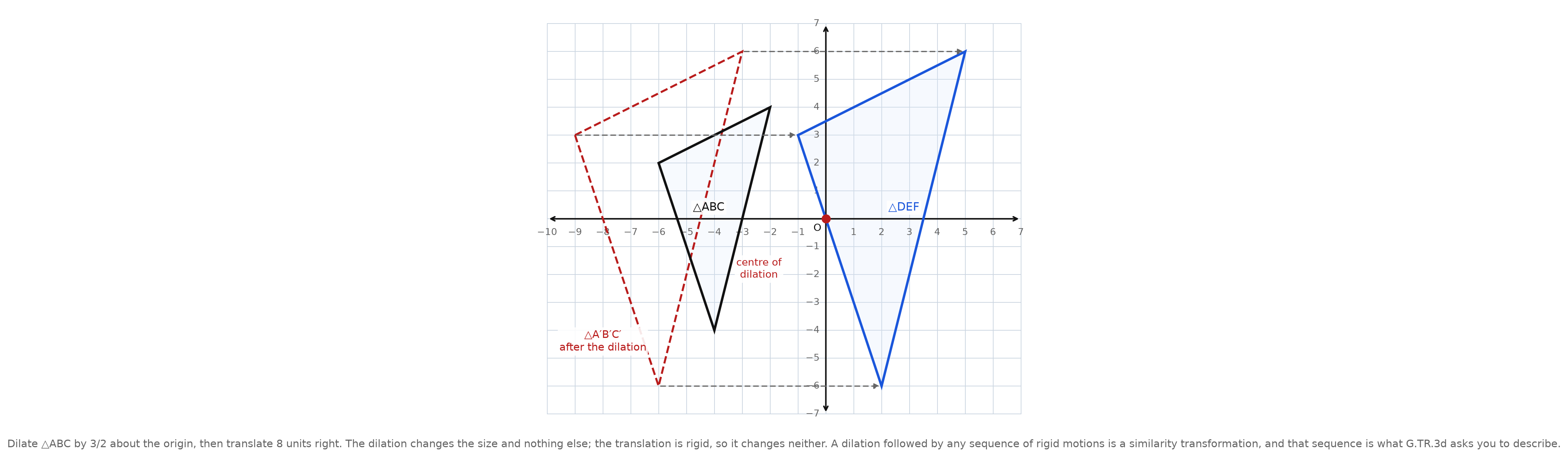
Those are the same two triangles Lesson 7.5 proved similar twice over. The sequence is the third proof, and it is the one G.TR.3d asks for.
A complete description
An answer to "describe a sequence" is complete when it contains all of:
- each step, in order;
- for a dilation, the centre and the scale factor;
- for a translation, the direction and distance; for a reflection, the line; for a rotation, the centre, the angle, and the direction.
"A dilation and a translation" is not an answer. It names neither the factor, nor the centre, nor the order.
Order matters
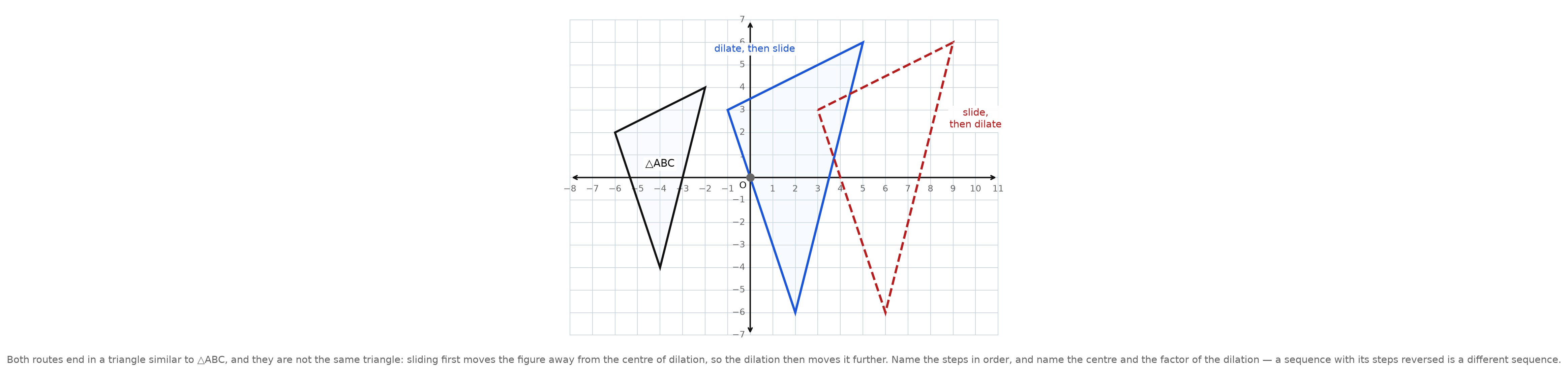
Dilating first and sliding second lands in one place. Sliding first and dilating second lands somewhere else, because the slide moved the figure further from the centre of dilation before the dilation multiplied that distance. Both results are similar to — but they are not the same triangle, which is exactly why the standard says sequence.
Worked examples
Example 1 — Applying a dilation
Give the image of under a dilation by centered at the origin.
Answer: .
Example 2 — A reduction
Give the image of under a dilation by centered at the origin.
Answer: .
Example 3 — One step is enough
Describe a sequence carrying with , , onto with , , .
Answer: A dilation by centered at the origin. It sends , , , which is exactly, so no rigid motion is needed.
Example 4 — Two steps
Describe a sequence carrying with , , onto with , , .
Answer: A dilation by centered at the origin gives , , ; a rotation of about the origin then gives , , .
Example 5 — Why rigid motions alone are not enough
Why can a sequence of rigid motions alone not verify that two triangles are similar?
Answer: Rigid motions preserve length, so they can only ever carry a triangle onto a congruent one. Unless , a dilation is required, and it is the only step in the sequence that changes the size.
Guided practice
- Use the dilation-then-translation figure. Name the two steps, in order.
- On that figure, which step changes the size?
- On that figure, which step is a rigid motion?
- On that figure, give the coordinates of .
- Use the order figure. Do the two orders give the same triangle?
- On that figure, list everything a complete description of a sequence must contain.
Independent practice
- has , , . Give the image under a dilation by centered at the origin.
- Translate your answer to item 109 eight units right, and give the result.
- Give the image of under a dilation by centered at the origin.
- Give the image of under a dilation by centered at the origin.
- Describe a sequence carrying with , , onto with , , .
- Describe a sequence carrying with , , onto with , , .
- Explain why a sequence of rigid motions alone cannot verify similarity in general.
- A logo triangle is dilated by about the origin and then reflected over the -axis. Give the image of the vertex .
- Error analysis. A student describes a sequence as "a dilation and a translation." List everything the description is missing.
- Reasoning. Explain why a dilation followed by any rigid motions always produces a similar figure.
Exit ticket 7.6
- Give the image of under a dilation by centered at the origin.
- Name the two pieces of information a dilation needs.
- Do "dilate then translate" and "translate then dilate" always give the same result?
- State what an answer to G.TR.3d must contain.
Lesson 7.7 — Measured Attributes and Indirect Measurement
The four-step method
Bullet e is the payoff. Once two triangles are known to be similar, one proportion measures whatever you cannot reach.
- Prove the similarity — by AA, SSS, SAS, algebra, coordinates, or a transformation sequence.
- Write the correspondence in order.
- Set up one proportion matching the part you want to the parts you know.
- Solve, and name the reason — the similarity, and the criterion that established it.
Indirect measurement
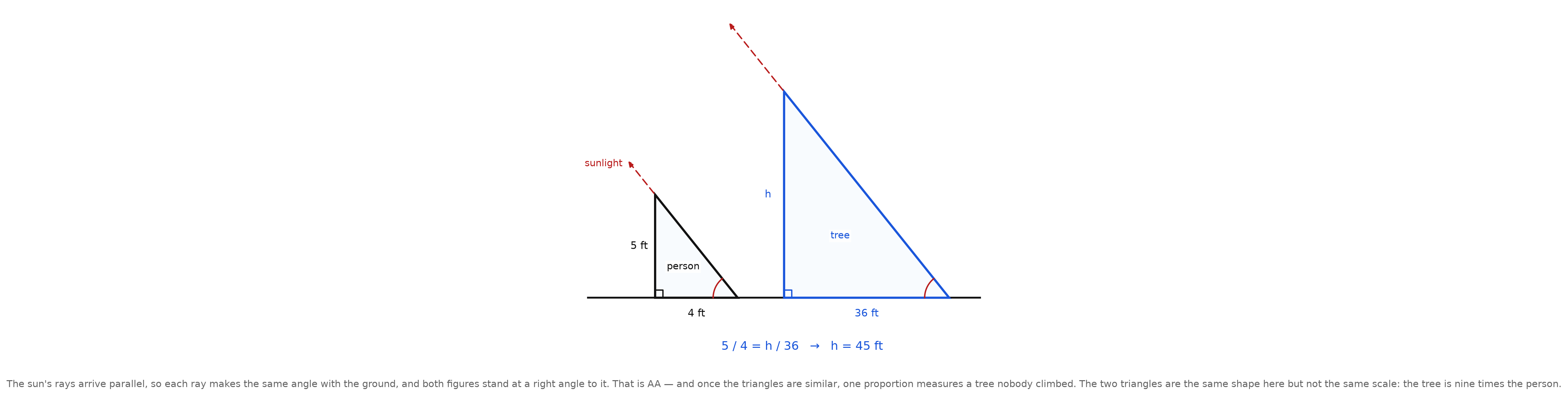
The sun's rays arrive parallel, so each ray makes the same angle with the ground; both the person and the tree stand at right angles to it. That is AA, and it makes the two shadow triangles similar. Then
The mirror method is the same idea with the angle supplied by reflection instead of by the sun: place a mirror on level ground, step back until you see the top of the object in it, and the two triangles are again similar.
Two habits keep these problems honest:
- Set the proportion up from the correspondence, not from the order the numbers appeared. Height goes with height and shadow with shadow. Writing is the standard way to get a wrong answer.
- Keep units consistent, and state them in the answer.
Perimeter and scale
If with scale factor , then every side of is times the matching side of , so the perimeter is too:
Read backwards, that finds from two perimeters, or finds one perimeter from the other. What scaling does to area is a different question, and it belongs to G.DF.2 in Chapter 17.
Worked examples
Example 1 — Shadows
A ft person casts an ft shadow. A pole casts a ft shadow. How tall is the pole?
Answer: , so and ft.
Example 2 — Perimeter from
with and the perimeter of equal to . Give the perimeter of .
Answer: .
Example 3 — from two sides, then a perimeter
with , , and the perimeter of equal to . Give the perimeter of .
Answer: , so the perimeter is .
Example 4 — The mirror method
A mirror lies flat on the ground ft from the base of a tower. Standing ft from the mirror, a surveyor whose eyes are ft above the ground sees the top of the tower in it. How tall is the tower?
Answer: , so and ft.
Example 5 — Scale model
A model is built at a scale of . A roof edge on the model measures inches. Give the real edge in feet.
Answer: inches, which is feet.
Guided practice
- Use the shadow figure. What makes the two triangles similar? Name the criterion and both angle pairs.
- On that figure, write the proportion.
- On that figure, give .
- On that figure, explain why the tree's height was not measured directly.
- On that figure, are the two triangles drawn to the same scale? What is the same about them?
- On that figure, which angle pair comes from the parallel rays?
Independent practice
- A ft person casts an ft shadow; a pole casts a ft shadow. Give the pole's height.
- A ft stick casts a ft shadow; a building casts a ft shadow. Give the building's height.
- with and the perimeter of equal to . Give the perimeter of .
- with , , and the perimeter of equal to . Give the perimeter of .
- with , , and the perimeter of equal to . Give the perimeter of .
- with . If , give ; if , give .
- In , with , , and . Give .
- Application. A mirror lies flat ft from the base of a tower. Standing ft from the mirror, a surveyor whose eyes are ft above the ground sees the tower's top in it. Give the tower's height.
- Application. A model is built at a scale of . A roof edge on the model measures inches. Give the real edge in feet.
- Error analysis. For the shadow figure, a student writes . Identify the error and give the correct proportion and answer.
- Reasoning. Explain why the perimeter of a similar triangle scales by , and why this chapter does not make the matching claim about area.
- Reasoning. Explain why similar triangles let you measure something you cannot reach, and name the step where the similarity is actually used.
Exit ticket 7.7
- A ft person casts a ft shadow; a tree casts a ft shadow. Give the tree's height.
- with and the perimeter of equal to . Give the perimeter of .
- Name the criterion that makes shadow problems work, and the fact about sunlight it depends on.
- State the four-step method for finding a measured attribute of a similar pair.
Chapter 7 Review
Vocabulary. similar · scale factor · proportional · proportion · cross products · AA · SSS similarity · SAS similarity · included angle · dilation · centre of dilation · rigid motion · similarity transformation · sequence · indirect measurement · perimeter
Review 1 (G.TR.3 a, b). In , lies on and lies on with . , , and .
- Name the two angle congruences that prove , with a reason for each, and name the criterion.
- Solve for , and give , , and . Show the substitution check.
- If , give , and name the reason.
- A classmate writes . Explain why that proportion is wrong, and give the one that is right.
Review 2 (G.TR.3 c, d). has , , . has , , .
- Prove by SSS similarity, giving all six lengths in simplest radical form and the scale factor.
- Prove the same similarity a second way, using slopes, and name the criterion that reaches.
- Describe a sequence of transformations that carries onto , naming the centre and factor of the dilation and the translation that follows it.
- Explain why the two proofs and the sequence are three answers to the same question rather than three different results.
Review 3 (G.TR.3 e). A surveyor needs the height of a cliff across a gorge. She plants a ft rod upright and finds its shadow is ft long. At the same moment the cliff's shadow, measured along level ground, is ft.
- Explain why the rod's triangle and the cliff's triangle are similar, naming the criterion and both pairs of congruent angles.
- Set up the proportion and give the cliff's height.
- A colleague sets up instead. Say what that proportion claims, and why it is wrong.
- The rod and the cliff are also the two legs of a pair of similar triangles whose perimeters are in the ratio . Give , and say what it would take to compute either perimeter.
Standards coverage check — Chapter 7
| Knowledge and Skill | Where it is taught | Where it is practiced | Where it is applied in context |
|---|---|---|---|
| G.TR.3a — use definitions, postulates, and theorems, including SAS, SSS, and AA, to prove and justify that triangles are similar | 7.1 (similarity, correspondence, scale factor); 7.2 (AA, and the parallel cut); 7.3 (SSS and SAS similarity, and where similarity parts company with congruence) | 1–20; 21–33, 35–40; 41–55, 57–62 | 34; 56; Review 1 |
| G.TR.3b — use algebraic methods to prove that triangles are similar | 7.4 (a similarity statement is a proportion; solve, substitute back, check the ratio; when the algebra says no) | 63–75, 77–82 | 76; Review 1 |
| G.TR.3c — use coordinate methods, such as the slope formula and the distance formula, to prove two triangles are similar | 7.5 (distance reaches SSS, slope reaches AA, and the four steps) | 83–95, 97–102 | 96; Review 2 |
| G.TR.3d — describe a sequence of transformations that can be used to verify similarity of triangles located in the same plane | 7.6 (dilation then rigid motions; what a complete description contains; why order matters) | 103–115, 117–122 | 116; Review 2 |
| G.TR.3e — solve problems, including those in context, involving attributes of similar triangles | 7.1 (perimeter scales by k); 7.7 (the four-step method, indirect measurement, the mirror method) | 14; 123–135, 138–144 | 136, 137; Review 3 |
Supporting items: 16, 36, 58, 78, 97, 115, 118, 139, and 140 are the reasoning items, and 36 and 58 together carry the chapter's central idea — that relaxing equal to proportional gains AA and costs nothing else. The error analyses target the recurring failures: writing the scale factor upside down (15), treating one pair of congruent angles as enough (35), stopping after two of three ratios (57), pairing the wrong sides across a proportion (77, 138), quoting one ratio as a proof (95), reading equal slopes as congruence (98), and describing a transformation sequence without its order, centre, or factor (117).
Boundaries respected. The similarity criteria are exactly the three G.TR.3a names; ASA, AAS, and HL are shown to reduce to them rather than added to the list. Scale factors are positive throughout, and a half-turn appears as a separate rotation step rather than as a negative dilation. The transformations used in Lesson 7.6 stay inside the list G.RLT.3d fixes. Coordinate work uses only the two formulas G.TR.3c names. Perimeter is the one derived measure this chapter scales; the effect of scaling on area belongs to G.DF.2 and is left to Chapter 17. Right-triangle trigonometry, which similarity makes possible, is Chapter 9.
Answer keys for every item in this chapter are in Appendix A.