Chapter 6 — Congruence by Algebra and Coordinates
Standard: G.TR.2 (b, c, e)
G.TR.2 — verbatim. The student will, given information in the form of a figure or statement, prove and justify two triangles are congruent using direct and indirect proofs, and solve problems involving measured attributes of congruent triangles. Students will demonstrate the following Knowledge and Skills: a) Use definitions, postulates, and theorems, including SSS, SAS, ASA, AAS, and HL, to prove and justify that two triangles are congruent. b) Use algebraic methods to prove that two triangles are congruent. c) Use coordinate methods, such as the distance formula, to prove that two triangles are congruent. d) Use congruent segment, congruent angle, and/or perpendicular line constructions to create a congruent triangle (SSS, SAS, ASA, AAS, and HL). e) Solve problems, including those in context, involving measured attributes of congruent triangles.
By the end of this chapter you will be able to:
- Turn a pair of tick marks into an equation, solve it, and report the length rather than the variable (G.TR.2b)
- Check an algebraic solution twice — substitute back, and confirm the sides can form a triangle (G.TR.2b)
- Use the distance formula, slope, and the midpoint formula on lattice points, in exact form (G.TR.2c)
- Prove two triangles congruent from coordinates alone, by SSS and by SAS with a right included angle (G.TR.2c)
- Recognize a pair that is congruent but written in the wrong order, and repair the correspondence (G.TR.2c)
- Read measured attributes — lengths, perimeters, angle measures — off a congruence you proved, including in context (G.TR.2e)
Lessons: 6.1 Congruence from Algebra · 6.2 Distance, Slope, and Midpoint · 6.3 Coordinate Proofs of Congruence · 6.4 Measured Attributes from Algebra and Coordinates
Why this chapter matters. Chapter 5 proved triangles congruent from a marked picture. Real problems rarely hand you a marked picture. They hand you a table of expressions, or a set of coordinates on a map, a cutting table, or a screen — and expect the same conclusion. This chapter is the same five criteria fed by two new kinds of data. The coordinate half is also the door into the rest of the book: Chapter 11 tests quadrilaterals with slope and distance, and Chapter 15 builds the equation of a circle out of the distance formula.
Scope note. This chapter covers G.TR.2 b, c, and e — algebraic methods, coordinate methods, and the measured-attribute problems that both of them feed. Bullets a and d — the five criteria in synthetic proofs, and the compass-and-straightedge constructions — are Chapter 5. Nothing new joins the list of criteria here: it is still SSS, SAS, ASA, AAS, and HL. What changes is where the six facts come from.
One boundary is worth stating before you meet it. Coordinates give you lengths exactly and they give you one angle measure exactly — , certified by slopes. They do not give you a general angle measure; that needs trigonometry, which is Chapter 9. So on the coordinate plane, SSS is the workhorse and SAS is available exactly when the included angle is right. This is a real limit of the tools, not a preference, and this chapter says so rather than pretending otherwise.
Conventions this chapter fixes.
- A variable is not a length. Solving gives . The length is . An answer of "5" to "find " is wrong, and answer keys mark it wrong.
- Substitute back. Every algebraic congruence problem ends by putting the value into both expressions and confirming they agree.
- Then check the triangle. Three solved side lengths must satisfy the Triangle Inequality; two solved angle measures must leave a positive third angle. A value that fails either check is not a solution.
- Exact before approximate. A coordinate distance is , not . Radical answers are given in simplest radical form first, and as a rounded decimal only when a context asks for a measurement, labelled about.
- Coordinates are integers, with one exception: a midpoint is allowed to land on a half unit, and that is the only place a non-integer coordinate appears in this chapter.
- Slope certifies exactly one angle. A slope product of proves a right angle. Nothing about slope proves an angle is .
- Order still carries the claim. Everything Chapter 5 said about correspondence applies unchanged. Three matching distances prove congruence; they do not automatically prove the congruence as you wrote it.
- Item numbering runs straight through the chapter, from 1 in Lesson 6.1 to 88 at the end of Lesson 6.4.
Lesson 6.1 — Congruence from Algebra
A pair of tick marks is an equation
In Chapter 5 a tick mark meant "this side is congruent to that one," and that was the end of it. Now the sides carry expressions, and the same mark says something stronger.
Congruent segments have equal lengths. So if , then — and if those two lengths are written as expressions, you have an equation.
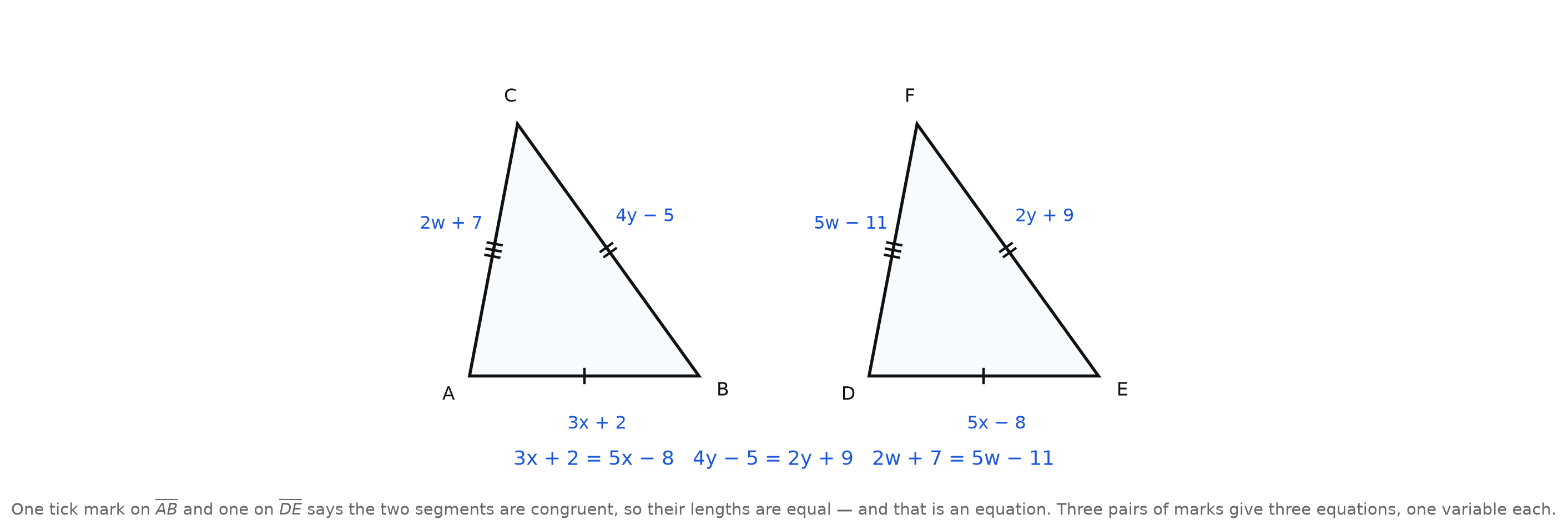
Three pairs of marks give three equations. Each one has a single variable, so each one is a one-step or two-step solve — the hard part is not the algebra, it is knowing that the marks were an instruction to write an equation at all.
The variable is not the answer
This is the most common error in the whole bullet, and it is worth being blunt about.
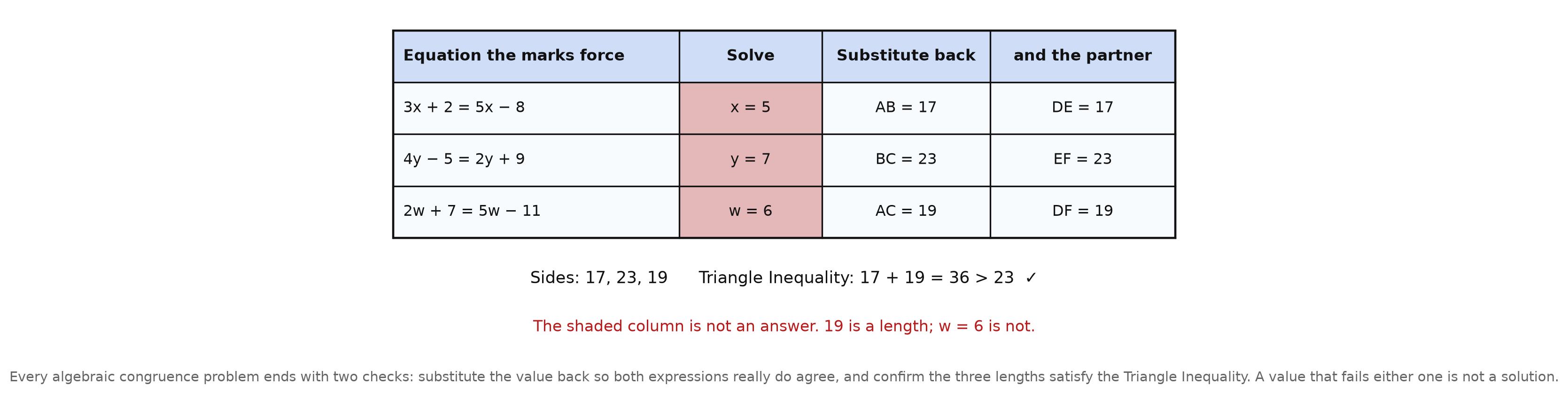
is a fact about the variable. The question asked for , and
Substituting into the other expression is not optional busywork — it is the check. as well, so the two expressions really do describe one length, and the marking on the figure was consistent.
Then check that a triangle exists
Solving three equations gives three numbers. Numbers are not automatically a triangle. Chapter 4's Triangle Inequality still applies: the two shorter lengths must add to more than the longest.
For the figure above the solved sides are , , and , and , so a triangle exists and the problem is finished.
If instead the sides had solved to , , and , the answer would be that no such pair of triangles exists — — and reporting the three lengths as though they were a triangle would be wrong.
The angle version of the same check: two solved angle measures must leave something positive for the third. If and , then and no triangle has both.
Angles give equations too
Everything above works for angle measures without a single change. Congruent angles have equal measures, so a pair of matching arcs is an equation.
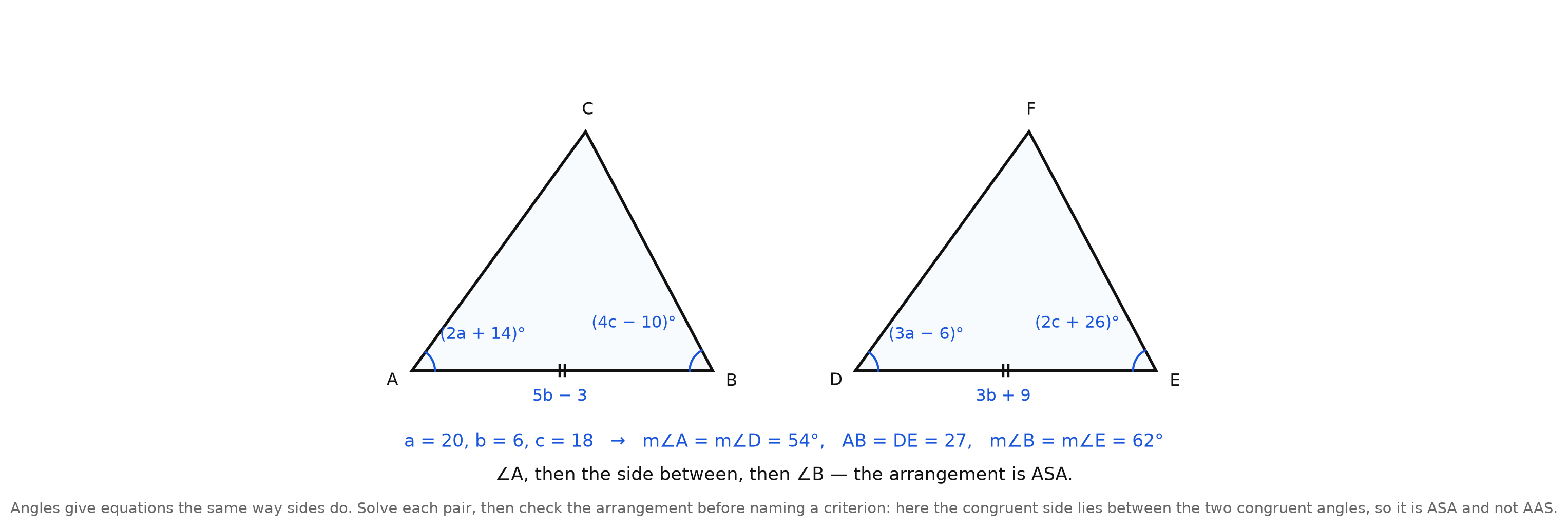
Then — and only then — name the criterion. In that figure the congruent side lies between the two congruent angles, so the arrangement is ASA. Had the congruent side been instead, the same three congruences would have been AAS. Solving the algebra does not tell you which criterion you have; the arrangement does, exactly as in Chapter 5.
Worked examples
Example 1 — One pair
with and . Find .
Answer: , so and . Then , and as a check.
Example 2 — Angles
with and . Find .
Answer: , so and . Then , and .
Example 3 — Reporting the wrong thing
A student solves and answers "." What went wrong?
Answer: gives , which is the value of , not a length. .
Example 4 — An impossible marking
A figure marks with and . Find .
Answer: reduces to , which is false for every . No value of makes the marking correct, so the figure is impossible as drawn.
Example 5 — The arrangement decides
Two triangles have , , and . Which criterion?
Answer: runs between and , and the two congruent angles are at and . The side between those two angles is , so is not included: the arrangement is AAS.
Guided practice
- Use the tick-marks figure. Which pair of sides do the single tick marks name?
- On that figure, write the equation the double tick marks force.
- Solve and give .
- Use the solve-and-check board. Explain in one sentence why is not the length of .
- On that board, which check confirms the three solved lengths really form a triangle? Show it.
- Use the algebraic-angles figure. Which criterion do the solved parts land on, and why is it not AAS?
Independent practice
- with and . Find and both lengths.
- with and . Find and both lengths.
- with and . Find and both measures.
- with and . Find and both measures.
- with and ; and ; and . Give , , and , and the perimeter of .
- Show that the three lengths you found in item 11 can be the sides of a triangle.
- with and ; with and . Give all three angle measures of .
- A student solves and writes "." Identify the error and give the correct length.
- A figure marks with and . What does solving tell you about the figure?
- Three solved side lengths are , , and . Can they be the sides of a triangle? Justify with the inequality.
- Two solved angle measures are and , both in the same triangle. What is wrong?
- Application. A truss shop cuts two identical triangular gussets from one template. On the template the long edge measures inches; on the cut piece the corresponding edge measures inches. Find and the length of the long edge.
- Reasoning. Explain why an algebraic congruence problem is not finished when the variable has been found. Name both remaining steps.
- Error analysis. Given , , and , a student names the criterion ASA. Correct them, and name the criterion that actually applies.
Exit ticket 6.1
- Solve and give the length both expressions describe.
- Solve and give the angle measure.
- Three solved side lengths are , , and . Is the triangle possible? Show the check.
- Name the two checks that finish every algebraic congruence problem.
Lesson 6.2 — Distance, Slope, and Midpoint
Three tools, three jobs
A coordinate proof has exactly three instruments, and each answers a different question.
| Tool | Formula | What it certifies |
|---|---|---|
| Distance | two segments are congruent | |
| Slope | two segments are parallel () or perpendicular () | |
| Midpoint | a point cuts a segment into congruent halves |
The distance formula is the Pythagorean Theorem
There is nothing to memorize here that you did not already know. Drop a horizontal segment from one endpoint and a vertical segment from the other. They meet at a right angle, the two differences are the legs, and the segment you wanted is the hypotenuse.
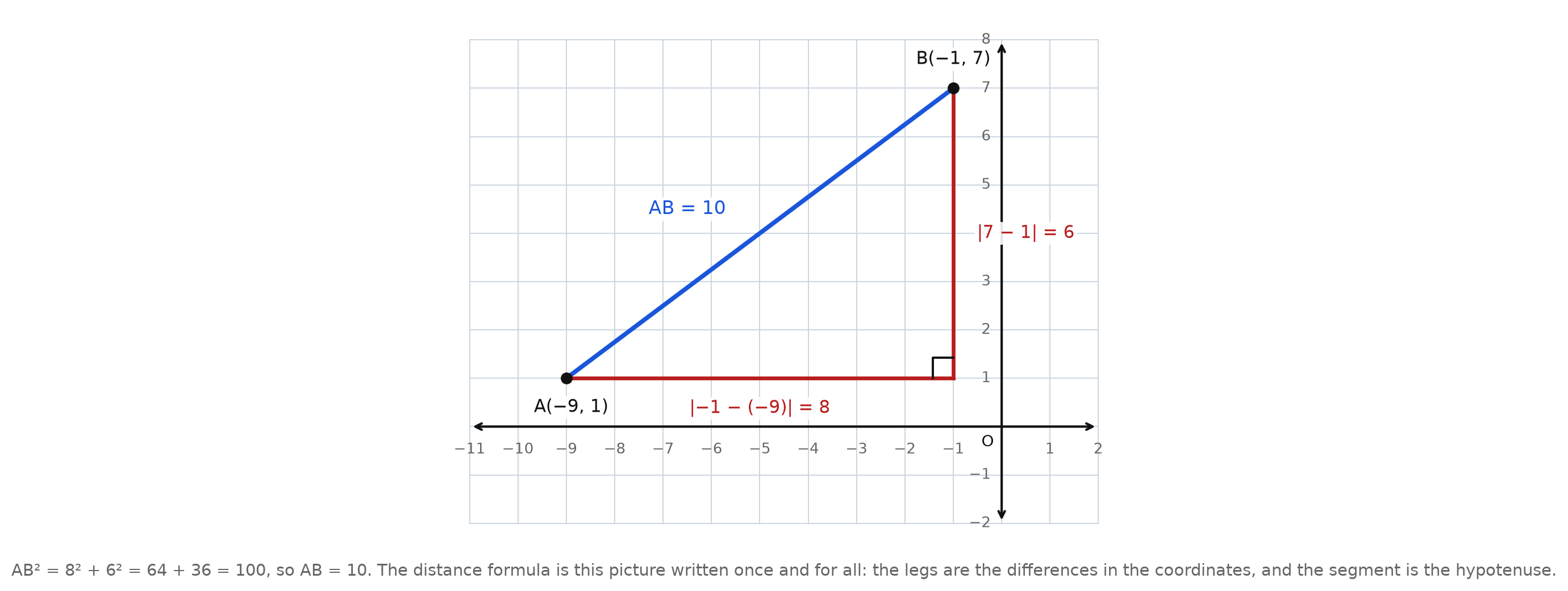
Two habits make this reliable:
- Subtract in a consistent order and square immediately. The square kills the sign, so and are the same number. There is no need to worry about which point is "first."
- Simplify the radical; do not round it. is an answer. is that answer rounded, and rounding is exactly what makes two different lengths look like one.
Slope is the only angle tool this course has
Slope answers two yes-or-no questions and nothing else.
- Two segments are parallel when their slopes are equal.
- Two segments are perpendicular when their slopes multiply to — equivalently, when one slope is the negative reciprocal of the other.
A horizontal segment has slope and a vertical segment has undefined slope; the product test does not apply to that pair, and you say instead that a horizontal segment and a vertical segment are perpendicular because the axes are.
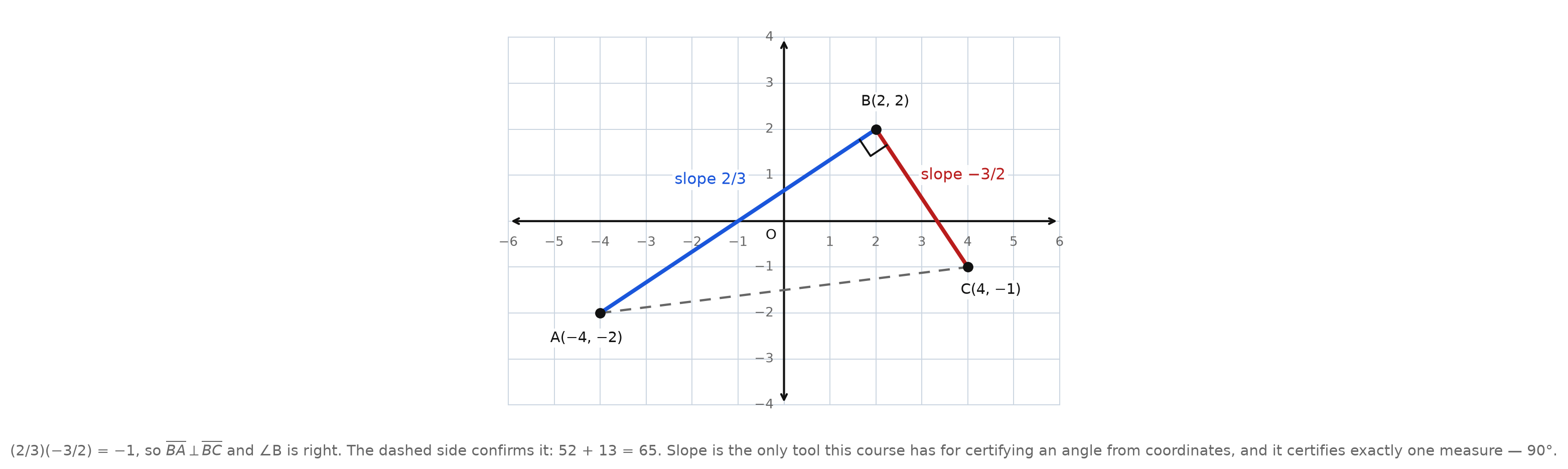
Notice what slope does not do. It never tells you that an angle measures . It certifies one measure, , and that single fact is what makes SAS usable on the coordinate plane in Lesson 6.3.
Midpoint, and the one half unit
The midpoint is the average of the coordinates. Averaging two integers gives an integer only when their sum is even, so a midpoint is the one place in this chapter where a coordinate is allowed to be a half unit.
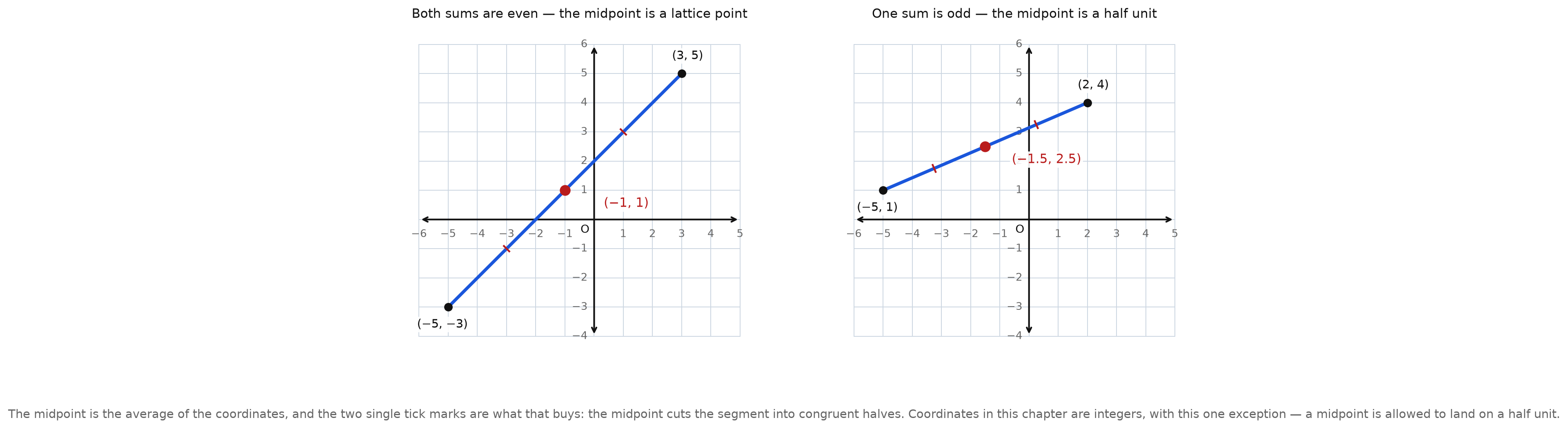
Reading the formula backwards is a standard question. If is the midpoint of and you know and , then is as far past as is before it:
Worked examples
Example 1 — Distance
Find the distance from to .
Answer: .
Example 2 — Distance in radical form
Find the distance from to .
Answer: . Leave it there; is a rounding, not the answer.
Example 3 — Perpendicular
Are the segments from to and from to perpendicular?
Answer: The slopes are and . Their product is , so yes.
Example 4 — Midpoint
Find the midpoint of the segment from to .
Answer: .
Example 5 — Midpoint backwards
is the midpoint of and is . Find .
Answer: .
Guided practice
- Use the distance figure. What are the two leg lengths, and which subtraction produced each one?
- On that figure, compute and show the squares.
- Use the slope figure. Give the slopes of and and their product.
- On that figure, state exactly what the product proves.
- Use the midpoint figure. Give the midpoint of the segment from to .
- On that figure, explain why the second midpoint is not a lattice point.
Independent practice
- Find the distance from to .
- Find the distance from to .
- Find the distance from to .
- Find the distance from to in simplest radical form.
- Find the distance from to in simplest radical form.
- Find the slope of the segment from to .
- Find the slope of the segment from to .
- Are the segments from to and from to perpendicular? Show the product.
- Find the midpoint of the segment from to .
- Find the midpoint of the segment from to .
- is the midpoint of and is . Find .
- Application. On a search map whose grid units are metres, a drone flies straight from a launch pad at to a marker at . How far does it fly, in metres?
- Reasoning. A student says the distance from to is . Explain the error and give the correct distance.
Exit ticket 6.2
- Find the distance from to .
- Find the slope of the segment from to .
- Find the midpoint of the segment from to .
- Which of the three tools certifies a right angle, and what exactly must it show?
Lesson 6.3 — Coordinate Proofs of Congruence
The four steps
A coordinate proof is short, and it is always the same four steps.
- Plot and name. Plot both triangles and write down the correspondence you intend to prove.
- Compute. Find the parts the criterion needs, in exact form. SSS needs three distances from each triangle. SAS needs two distances and the slopes at the included vertex.
- Compare in order. First side against first side, second against second, third against third. All three must match.
- Name the criterion and state the congruence. " by SSS."
SSS is the workhorse
Distance is the tool coordinates hand you for free, and three distances is a complete criterion. Almost every coordinate congruence proof you will write is SSS.
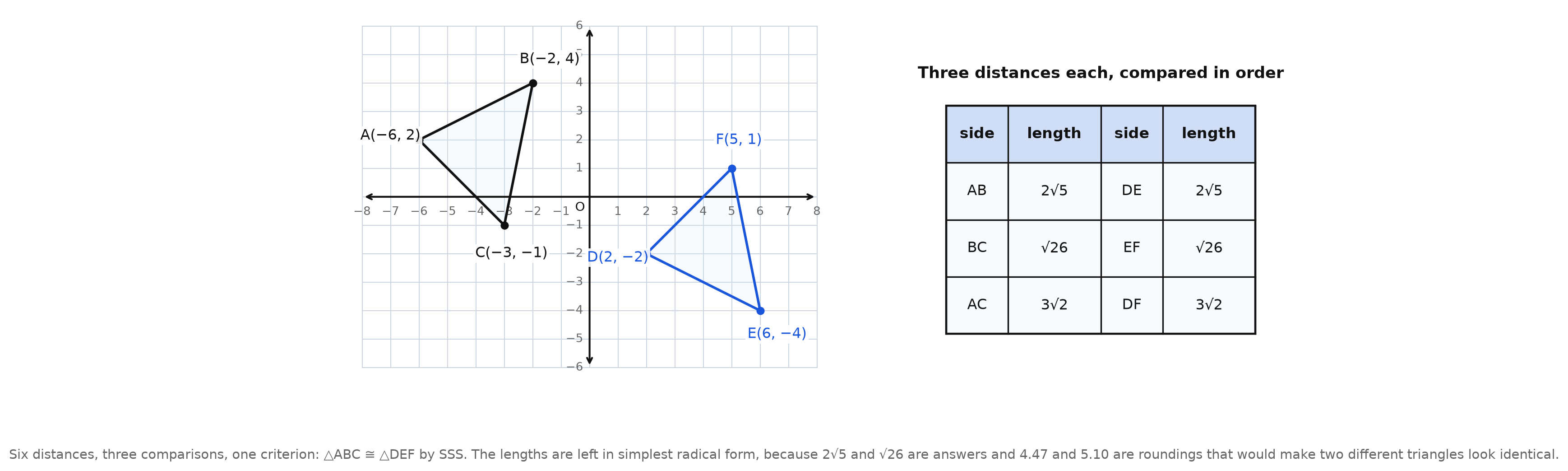
Three matching pairs, in correspondence order, so by SSS.
Look at what the exact forms are protecting you from. Rounded to two decimals those six lengths read , , twice over — and a length of and a length of would read the same. Keeping the radicals keeps the proof a proof.
SAS, when the included angle is right
SAS needs an angle, and coordinates supply exactly one angle measure: , certified by a slope product of . When the included angle happens to be right, SAS is available and it is one computation shorter than SSS.
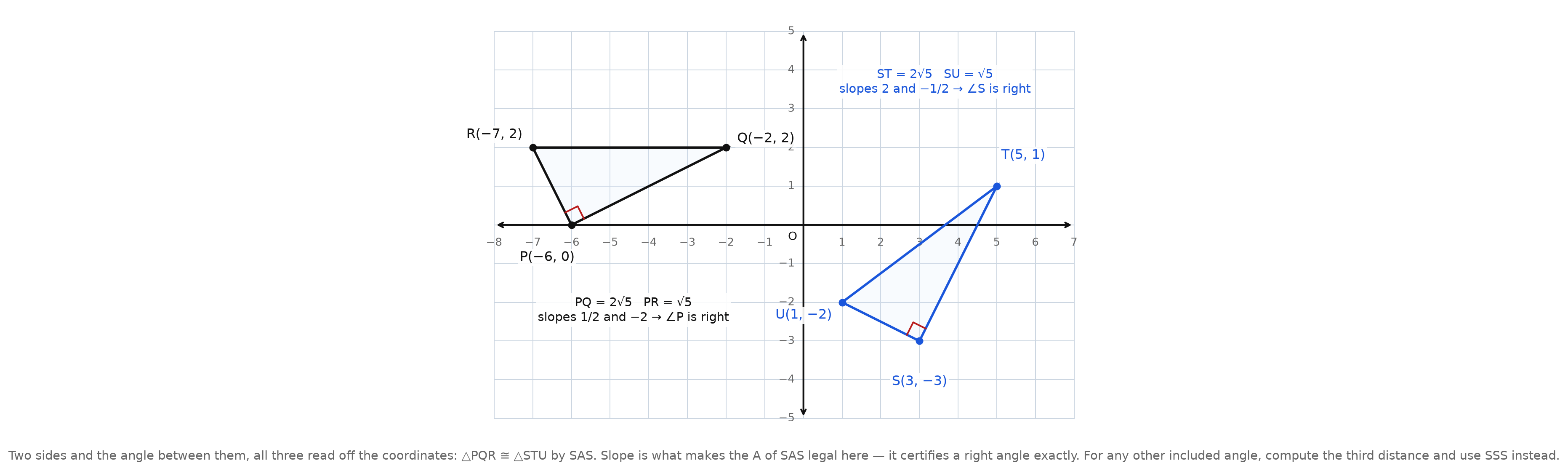
so by SAS.
If the included angle is anything other than right, do not try to force SAS. Compute the third distance and use SSS. That is not a workaround — it is the correct method, and it is why SSS earns the name workhorse.
What coordinates cannot do yet. ASA, AAS, and the angle half of HL all need a general angle measure, and reading one off coordinates requires the inverse trigonometric functions of Chapter 9. Until then, a coordinate proof uses SSS, or SAS with a right included angle, or HL when both triangles are already known to be right — and that is the complete list.
Congruent, but not in that order
Here is the failure worth spending the most time on, because it looks like a wrong answer and is not.
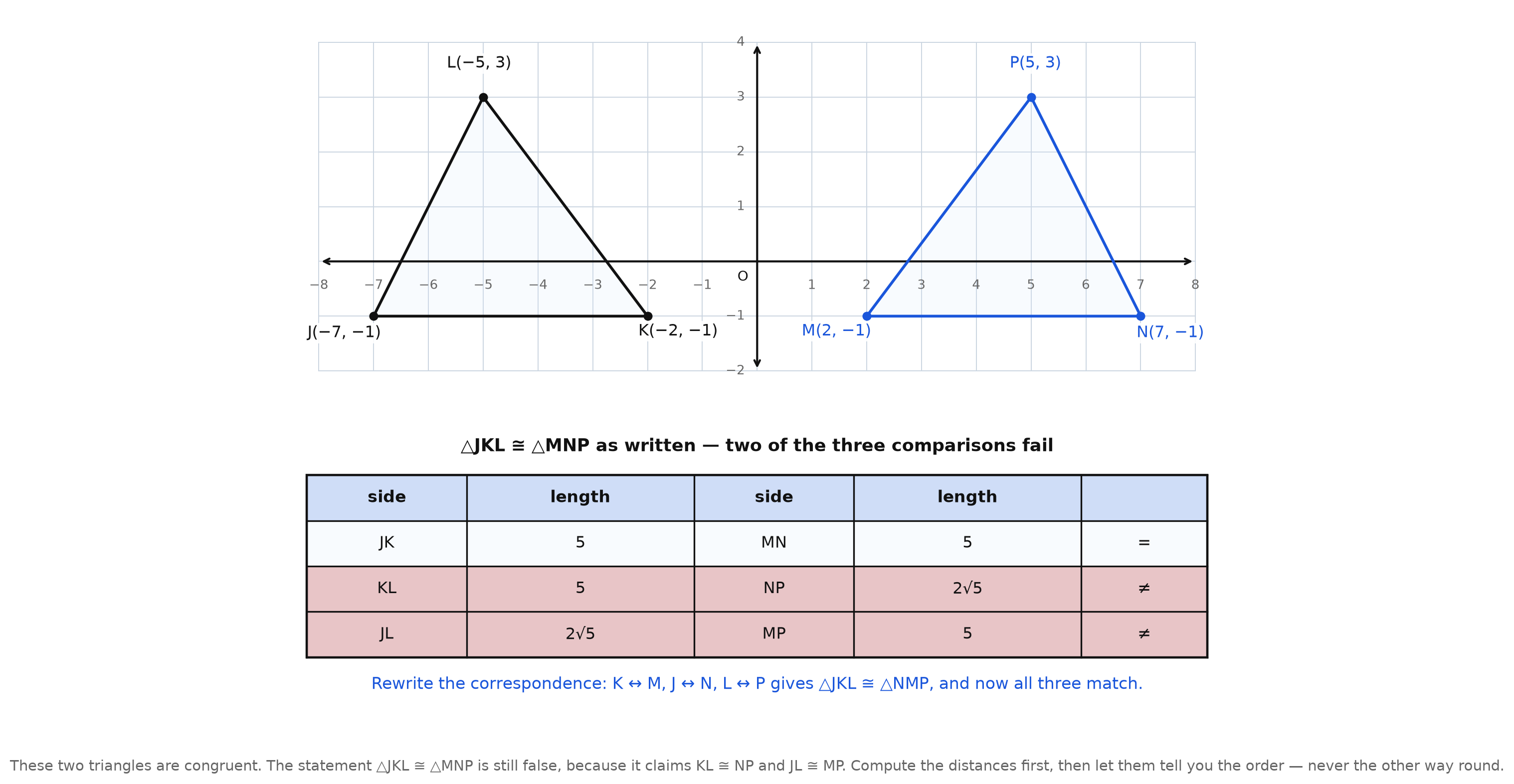
The written statement compares with — which match — then with and with , which do not. That is enough to make the statement false.
It is not enough to make the triangles different. Both triangles have sides , , and ; they are congruent. What is wrong is the pairing. Matching each vertex to the one with the same two side lengths gives , , , and
is true, with all three comparisons matching.
The habit that prevents this: compute all six distances first, then let them tell you the order. Writing the correspondence from left to right because that is how the letters were printed is guessing.
Worked examples
Example 1 — A full SSS proof
has , , ; has , , . Prove they are congruent.
Answer: , , ; , , . All three pairs match in order, so by SSS.
Example 2 — SAS with slopes
has , , . Show is right.
Answer: The slope of is and the slope of is . Their product is , so and .
Example 3 — Deciding "not congruent"
has , , ; has , , . Are they congruent?
Answer: , , ; , , . The sets of lengths are different — — so no correspondence can work. The triangles are not congruent.
Example 4 — Repairing the order
Three distances of are , , . Three distances of are , , . Write a true congruence statement.
Answer: In the vertex with two sides of length is ; in it is . So , and then , : .
Example 5 — Choosing the criterion
You have plotted two triangles and found that the included angle at the matching vertices is in each. Which criterion should you use?
Answer: Neither slope nor distance certifies , so SAS is not available from coordinates. Compute the third distance in each triangle and use SSS.
Guided practice
- Use the SSS figure. Give and in simplest radical form.
- On that figure, give and .
- On that figure, name the criterion and write the congruence statement.
- Use the SAS figure. Give the slopes of and , and say what their product proves.
- On that figure, name the criterion and say which three parts it used.
- Use the wrong-order figure. Which comparison fails first, and why does that failure not mean the triangles are different?
Independent practice
- has , , ; has , , . Compute all six distances and decide whether , naming the criterion.
- has , , ; has , , . Decide whether , showing the three comparisons.
- has , , ; has , , . Decide whether they are congruent and justify your answer with one comparison.
- has , , ; has , , . Show that is false, then find and state a correspondence that is true.
- has , , ; has , , . Prove by SAS, showing the slopes that establish the included angles.
- Reasoning. Explain why SSS, rather than ASA or AAS, is the criterion nearly every coordinate proof uses.
- has , , . Show that is right in two ways: with slopes, and with the three squared side lengths.
- Error analysis. A student computes one triangle's longest side as and another's as , rounds both to , and declares the triangles congruent. Explain why the conclusion does not follow.
- Application. A park plan places one triangular flower bed at , , and a second at , , , with each grid unit equal to one metre. The gardener wants to know whether one edging kit will fit both beds. Answer, and give the reason.
- Reasoning. Explain why SAS is available on the coordinate plane only when the included angle is right, and what you do instead when it is not.
- Error analysis. A student verifies , , and , then writes . Identify the error.
Exit ticket 6.3
- has , , ; has , , . Compute and , and say whether that pair alone proves anything.
- The segments from to and from to meet at . Is the angle there right? Show the product.
- A proof verifies , , and . Name the criterion.
- State the four steps of a coordinate proof, in order.
Lesson 6.4 — Measured Attributes from Algebra and Coordinates
The four-step method
Bullet e is the payoff of the whole standard: once two triangles are known to be congruent, every measurement of one is a measurement of the other. The method does not care which bullet produced the congruence.
- Prove the congruence — from a marked figure (Chapter 5), from algebra (Lesson 6.1), or from coordinates (Lesson 6.3).
- Write the correspondence in order.
- Match the part you want to the part you know, using that correspondence.
- Name CPCTC as the reason.
The third step is where the errors are. with does not give ; corresponds to , so .
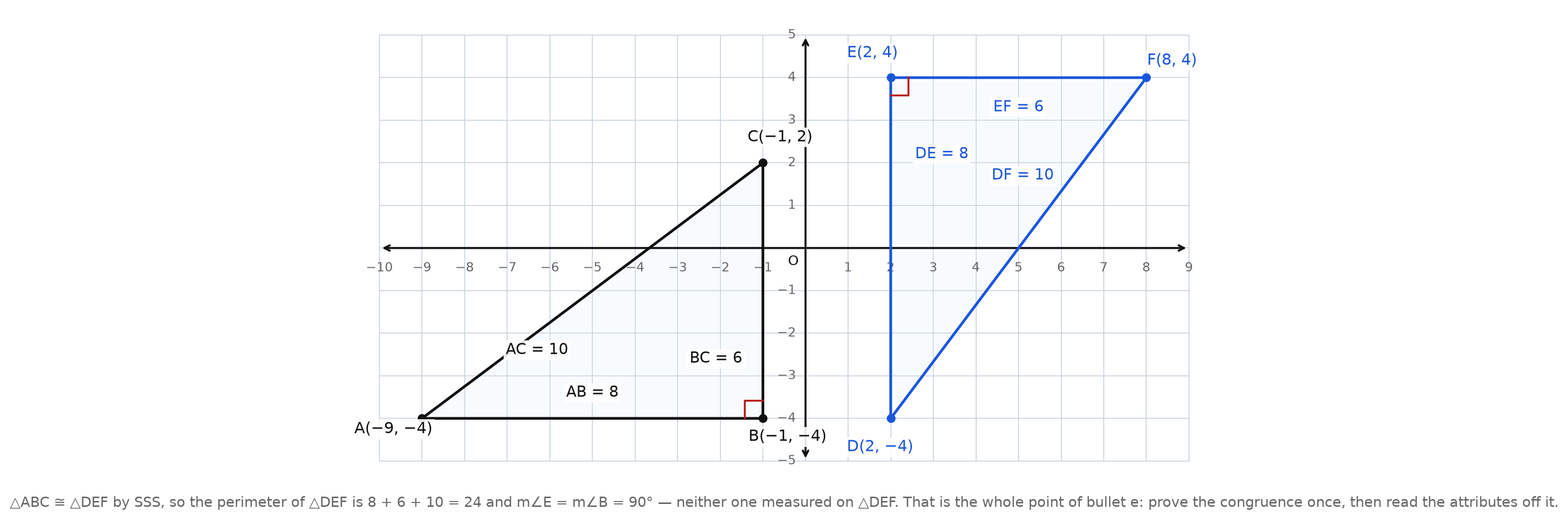
so by SSS, and therefore
- the perimeter of is , and
- ,
neither of them measured on at all.
Attributes in exact form
A perimeter built from coordinate distances is usually a sum of radicals, and the volume's convention applies: give the exact form first.
For the SSS pair of Lesson 6.3, the perimeter of each triangle is
The radicals do not combine, because , , and are not like terms. Writing or any other single radical would be wrong.
In context
Contexts for this bullet share one shape: a triangle you can measure, and a congruent triangle you cannot.
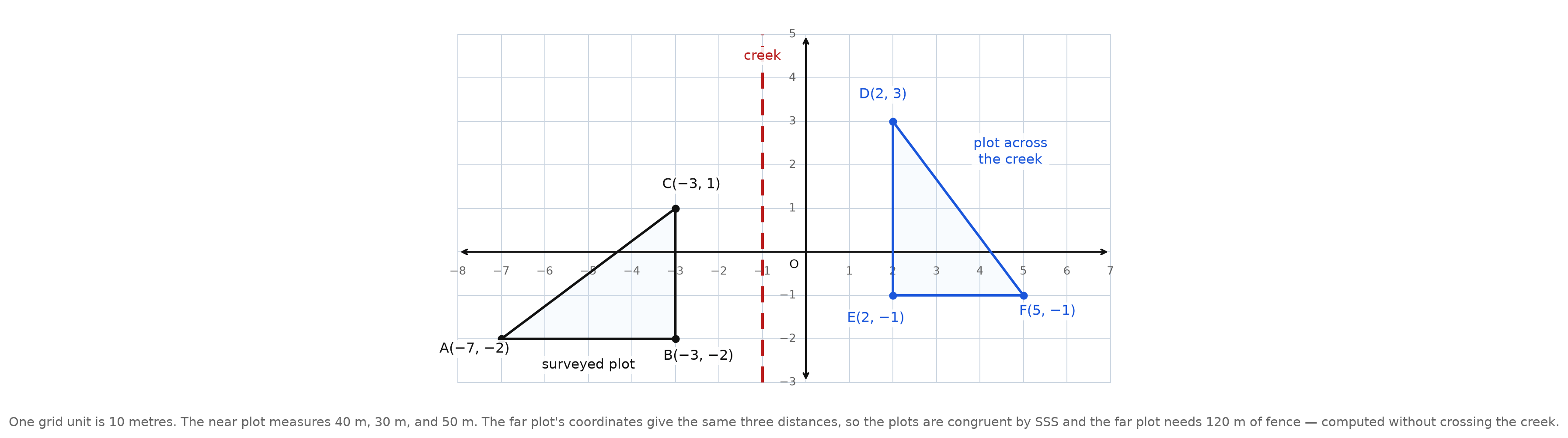
The near plot's sides work out to m, m, and m. The far plot's coordinates give the same three distances, so the plots are congruent by SSS and the far plot needs m of fence — a number obtained without crossing the creek.
Two habits keep context problems honest:
- Convert once, at the end. Work in grid units, prove the congruence, then multiply by the scale. Converting first turns clean integers into clutter.
- Say what the reason is. " m" is half an answer. " m, because the plots are congruent by SSS and corresponding parts of congruent triangles are congruent" is the whole one.
Worked examples
Example 1 — Perimeter by CPCTC
with , , and . Give the perimeter of .
Answer: , , by CPCTC, so the perimeter is .
Example 2 — The third angle
with and . Give all three angles of .
Answer: and by CPCTC, and .
Example 3 — Perimeter from coordinates
has , , . Give its perimeter.
Answer: , , . The perimeter is .
Example 4 — Working backwards
, the perimeter of is , , and . Find and .
Answer: The perimeters are equal, so . Since corresponds to , .
Example 5 — In context with a cost
Two congruent triangular sails have sides m, m, and m. Edge binding costs $14 per metre. What does binding both sails cost?
Answer: Each perimeter is m, so both together need m, and .
Guided practice
- Use the attributes figure. Give the three side lengths of .
- On that figure, give the perimeter of and say why you need not compute its sides.
- On that figure, give and the reason.
- Use the survey map. How many metres is one grid unit, and what are the near plot's three sides in metres?
- On that map, how much fence does the far plot need?
- On that map, which criterion licensed your answer to item 73?
Independent practice
- with , , and . Give the perimeter of in simplest radical form, and then to the nearest hundredth.
- has , , . Give the perimeter.
- with and . Find and give .
- with and . Give all three angle measures of .
- A triangle has vertices , , and . Give its perimeter and name the vertex where the right angle sits.
- , the perimeter of is , , and . Find and .
- Application. A steel fabricator cuts brackets from one template whose corners sit at , , and on a cutting table marked in centimetres. Give the perimeter of every bracket cut from that template, and the reason it is the same for all of them.
- Application. Two congruent triangular sails have sides m, m, and m. Edge binding costs $14 per metre. Find the cost of binding both sails.
- Error analysis. with . A student reports . Correct the error and give the length that really is .
- Reasoning. Explain why proving a congruence lets you report an attribute of a triangle you never measured, and name the reason you would write beside that step.
Exit ticket 6.4
- with , , and . Give the perimeter of .
- has , , . Give the perimeter.
- and . Which angle of measures , and what is the reason?
- State the four-step method for finding a measured attribute of a triangle you cannot reach.
Chapter 6 Review
Vocabulary. algebraic method · coordinate method · distance formula · slope · negative reciprocal · perpendicular · midpoint · lattice point · simplest radical form · correspondence · CPCTC · perimeter · Triangle Inequality
Review 1 (G.TR.2b). Two triangles are marked congruent, with and , where and , and and .
- Solve each pair and give , , and , showing the substitution check for one of them.
- sits between and . Name the criterion these three congruences establish.
- A classmate answers ", , " and stops. Say precisely what is still missing.
- Suppose the third pair had been and instead. Name the criterion then, and explain what changed.
Review 2 (G.TR.2c). has , , . has , , .
- Compute all six side lengths in simplest radical form.
- State the congruence and name the criterion.
- Explain why you did not need to compute a single angle measure.
- A classmate writes instead. Show, with one comparison, that this statement is false — and explain why the triangles are still congruent.
Review 3 (G.TR.2 c, e). A landscaper's site map is drawn on a coordinate grid where one unit is metres. Bed 1 has corners at , , and . Bed 2, on the far side of a retaining wall, has corners at , , and .
- Show that the two beds are congruent, naming the criterion and the correspondence.
- Give the three side lengths of Bed 1 in metres.
- Bed 2 needs steel edging along all three sides. How many metres are needed, and which reason licenses the answer without measuring Bed 2?
- Edging costs $7.50 per metre. Give the cost for Bed 2, and explain why the crew does not need to walk the far side of the wall to quote it.
Standards coverage check — Chapter 6
| Knowledge and Skill | Where it is taught | Where it is practiced | Where it is applied in context |
|---|---|---|---|
| G.TR.2b — use algebraic methods to prove that two triangles are congruent | 6.1 (marks become equations; the variable is not the length; the two checks; algebraic angle measures and the arrangement) | 1–17, 19–24 | 18; Review 1 |
| G.TR.2c — use coordinate methods, such as the distance formula, to prove that two triangles are congruent | 6.2 (distance from the Pythagorean Theorem, slope as the one angle tool, midpoint); 6.3 (the four steps, SSS, SAS with a right included angle, and the wrong-order failure) | 25–41, 43–61, 63–68 | 42, 62; Review 2, Review 3 |
| G.TR.2e — solve problems, including those in context, involving measured attributes of congruent triangles | 6.4 (the four-step method, attributes in exact form, converting at the end) | 69–71, 75–80, 83–87, 88 | 72–74, 81, 82; Review 3 |
Supporting items: 19, 43, 59, 63, and 84 are the reasoning items, and 59 and 63 together carry the chapter's central limitation — that coordinates give lengths exactly and give exactly one angle measure, so SSS does nearly all the work. The error analyses target the recurring failures: reporting the variable instead of the length (14), naming a criterion from the congruences without checking the arrangement (20), rounding a radical until two different lengths agree (61), and writing a correspondence in the printed order rather than the computed one (64, 83).
Boundaries respected. The criteria are still exactly the five G.TR.2a names; nothing is added. Coordinate work is limited to the methods G.TR.2c names — the distance formula, with slope and midpoint as the supporting tools G.PC.1b will name again in Chapter 11. Every coordinate in the chapter is an integer except a midpoint, which may fall on a half unit. No angle measure is read off coordinates except , and the chapter says plainly that the general case waits for Chapter 9. The constructions of G.TR.2d and the synthetic proofs of G.TR.2a stay in Chapter 5.
Answer keys for every item in this chapter are in Appendix A.