Chapter 5 — Proving Triangles Congruent
Standard: G.TR.2 (a, d, e)
G.TR.2 — verbatim. The student will, given information in the form of a figure or statement, prove and justify two triangles are congruent using direct and indirect proofs, and solve problems involving measured attributes of congruent triangles. Students will demonstrate the following Knowledge and Skills: a) Use definitions, postulates, and theorems, including SSS, SAS, ASA, AAS, and HL, to prove and justify that two triangles are congruent. b) Use algebraic methods to prove that two triangles are congruent. c) Use coordinate methods, such as the distance formula, to prove that two triangles are congruent. d) Use congruent segment, congruent angle, and/or perpendicular line constructions to create a congruent triangle (SSS, SAS, ASA, AAS, and HL). e) Solve problems, including those in context, involving measured attributes of congruent triangles.
By the end of this chapter you will be able to:
- Write a correspondence in the right order, and use CPCTC to unpack a proved congruence into six facts (G.TR.2a)
- Prove two triangles congruent by SSS and SAS, and say what makes an angle included (G.TR.2a)
- Prove two triangles congruent by ASA and AAS (G.TR.2a)
- Use HL on right triangles, and explain why SSA and AAA are not criteria (G.TR.2a)
- Write both a direct and an indirect proof of a congruence (G.TR.2a)
- Construct a triangle congruent to a given one with compass and straightedge (G.TR.2d)
- Find measured attributes — lengths and angle measures — of a triangle you cannot measure, including in context (G.TR.2e)
Lessons: 5.1 Congruent Triangles and Corresponding Parts · 5.2 SSS and SAS · 5.3 ASA and AAS · 5.4 HL, and What Does Not Work · 5.5 Direct and Indirect Proofs · 5.6 Constructing a Congruent Triangle, and Measured Attributes
Why this chapter matters. This is the chapter the course has been building toward. Chapter 1 gave you conditionals and counterexamples, Chapter 2 gave you the two-column format, Chapter 3 gave you the rigid motions that define congruence, and Chapter 4 gave you the angle sum. Here they combine into the single most reused tool in Geometry: showing that two triangles are the same triangle in two places, and then reading off everything else for free. Chapter 10 proves the properties of parallelograms by cutting them with a diagonal and using this chapter. Chapter 7 is this chapter with one requirement relaxed.
Scope note. This chapter covers G.TR.2 a, d, and e — the five criteria used in direct and indirect proofs, the constructions, and the measured-attribute problems. Bullets b and c, which prove congruence by algebraic and coordinate methods, are Chapter 6. The criteria are exactly the five the standard names: SSS, SAS, ASA, AAS, HL. SSA and AAA appear only as the two combinations that fail, because knowing why they fail is what keeps a student from using them.
Conventions this chapter fixes.
- Order carries the claim. asserts , , — six correspondences at once. A congruence written with the letters in the wrong order is a different, usually false, statement, and answer keys mark it incomplete rather than close.
- CPCTC comes last, never first. Corresponding Parts of Congruent Triangles are Congruent is a reason you may use only after the triangles have been proved congruent.
- An angle is included between two sides when its vertex is an endpoint of both. A side is included between two angles when its endpoints are the two vertices.
- A shared side is congruent to itself by the Reflexive Property, and it is a legal proof step even though it is not in the Given.
- Every proof line has a claim and a reason. An indirect proof states the assumption being contradicted in its first line and names the contradiction in its last.
- Constructions keep their arcs. A construction with the arcs erased is a drawing.
- Item numbering runs straight through the chapter, from 1 in Lesson 5.1 to 126 at the end of Lesson 5.6.
Lesson 5.1 — Congruent Triangles and Corresponding Parts
What congruent means
Two figures are congruent when one can be carried exactly onto the other by a sequence of rigid motions — translations, reflections, and rotations. That is Chapter 3's definition, and it is why congruent figures have equal side lengths and equal angle measures: rigid motions preserve both.
For triangles, that gives six equalities — three pairs of sides and three pairs of angles.
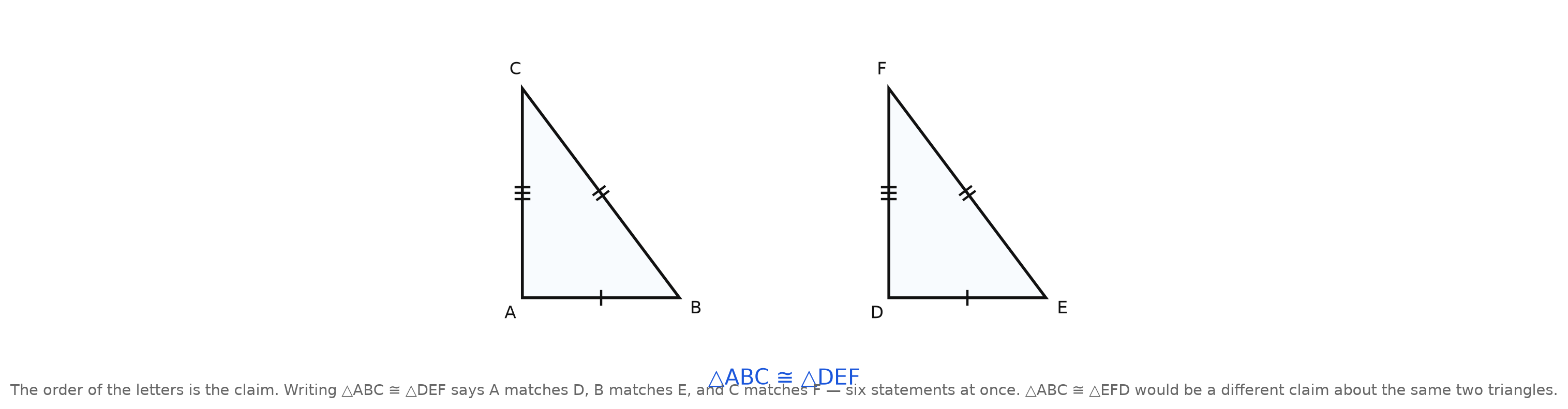
Order is the claim
Writing is not just naming two triangles. It asserts a correspondence:
and therefore all six of these at once:
Reorder the letters and you have made a different claim. says matches — which is usually false even when the two triangles really are congruent. Getting the triangles right and the order wrong is not a small error; it is a wrong statement about which parts equal which.
The practical rule: read the two triangles in the same rotational direction, starting from parts you know match.
CPCTC
Once a congruence is proved, every one of those six facts is available.
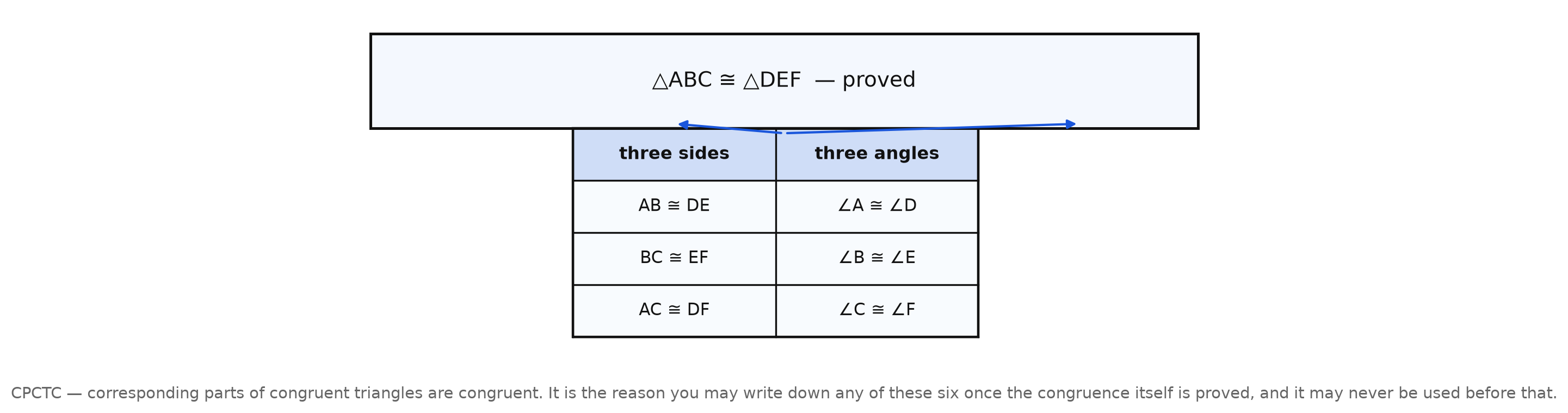
CPCTC. Corresponding Parts of Congruent Triangles are Congruent.
CPCTC is the bridge from "these triangles are congruent" to "so this particular side equals that one." It is the reason almost every proof in this chapter has the same shape:
- prove the triangles congruent using one of the five criteria;
- then use CPCTC to get the one part you actually wanted.
The order matters and is worth saying twice: CPCTC may not be used to prove a congruence. Using it before the triangles are proved congruent assumes exactly what you set out to show — the circular-reasoning error, and the most common way a congruence proof goes wrong.
Worked examples
Example 1 — Reading a correspondence
. Which side corresponds to ?
Answer: — matches and matches .
Example 2 — Listing all six
. List the six congruences.
Answer: , , , , , .
Example 3 — Wrong order
A student writes when the true correspondence is , , . What did the statement claim, and why is it wrong?
Answer: It claimed and , so it asserts and . Those are false unless the triangle happens to be isosceles in just the right way. The correct statement is .
Example 4 — Using CPCTC
Given and , find .
Answer: by CPCTC.
Example 5 — Recognizing circular reasoning
A proof's second line reads ", Reason: CPCTC," and its last line is "." What is wrong?
Answer: CPCTC requires the congruence, which has not been proved until the last line. The proof uses its conclusion as a step, which is circular.
Guided practice
- Use the correspondence figure. Which vertex of corresponds to ?
- On that same figure, which side corresponds to ?
- Write the six congruences asserted by .
- Use the CPCTC figure. What must be true before CPCTC may be used?
- Why is a different claim from ?
- State CPCTC in your own words.
Independent practice
- . Complete each. a) ______ b) ______ c) ______
- with , , . Give , , and .
- with and . Give , , and .
- . Name the angle congruent to and the side congruent to .
- Two triangles have all six pairs of parts congruent, matched as , , . Write the congruence statement.
- In the figure of item 11's triangles, a student writes . Which two correspondences did that claim get wrong?
- share side . Which side of corresponds to , and what does that tell you?
- Application. Two identical triangular tabletops are cut from one template. A carpenter measures one edge of the first as inches. What does she know about the second, and which reason lets her say it?
- Application. A steel truss is built from congruent triangles and . . Give and name the reason.
- Error analysis. A student writes ", so ." Identify the error and give the correct statement.
- Reasoning. Explain why congruence gives six facts rather than three.
- Reasoning. Explain why CPCTC may never appear before the congruence statement in a proof.
Exit ticket 5.1
- . Which angle corresponds to ?
- with . Give and name the reason.
- Why is the order of the letters in a congruence statement part of the claim?
- State in one sentence when CPCTC may be used.
Lesson 5.2 — SSS and SAS
You do not need all six
Six congruences make two triangles congruent — but you never have to check all six. Certain groups of three are enough to force the rest. The standard names five such groups, and this lesson covers the first two.
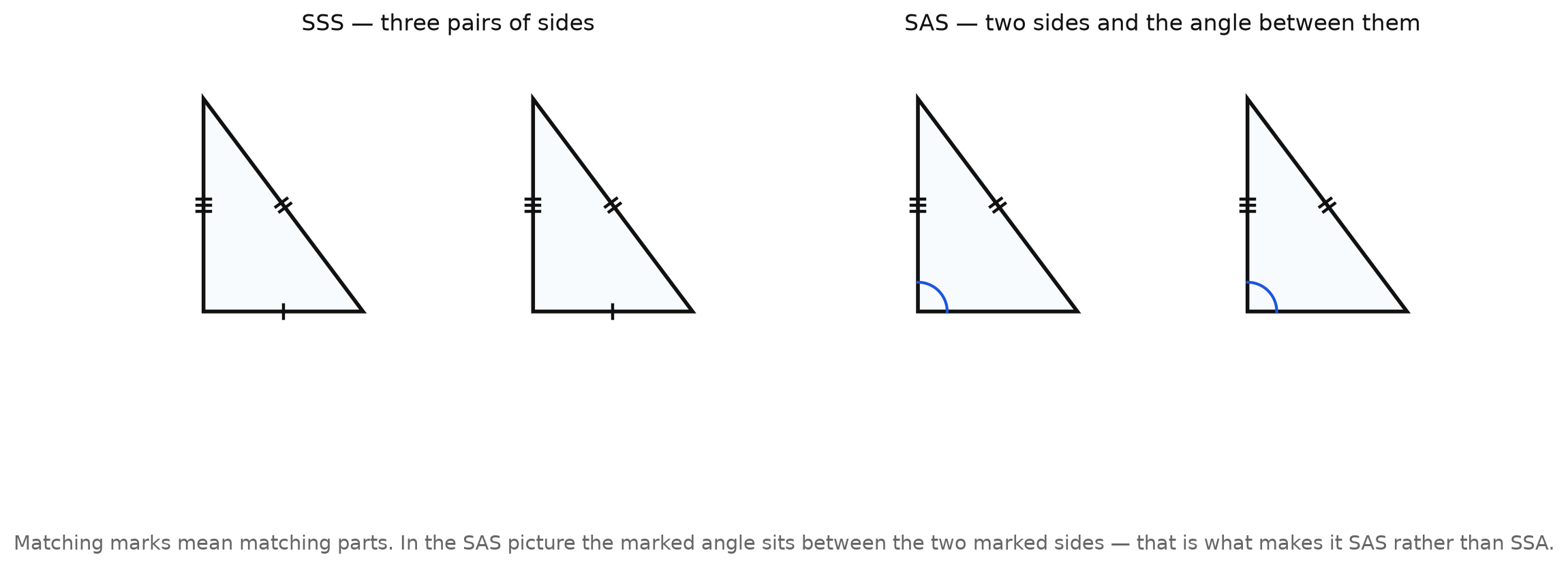
SSS (Side-Side-Side). If three sides of one triangle are congruent to three sides of another, the triangles are congruent.
SAS (Side-Angle-Side). If two sides and the included angle of one triangle are congruent to two sides and the included angle of another, the triangles are congruent.
SSS is believable from Chapter 4: three side lengths determine every angle, because the Triangle Inequality either lets them close in exactly one shape or not at all.
The word "included" is doing all the work
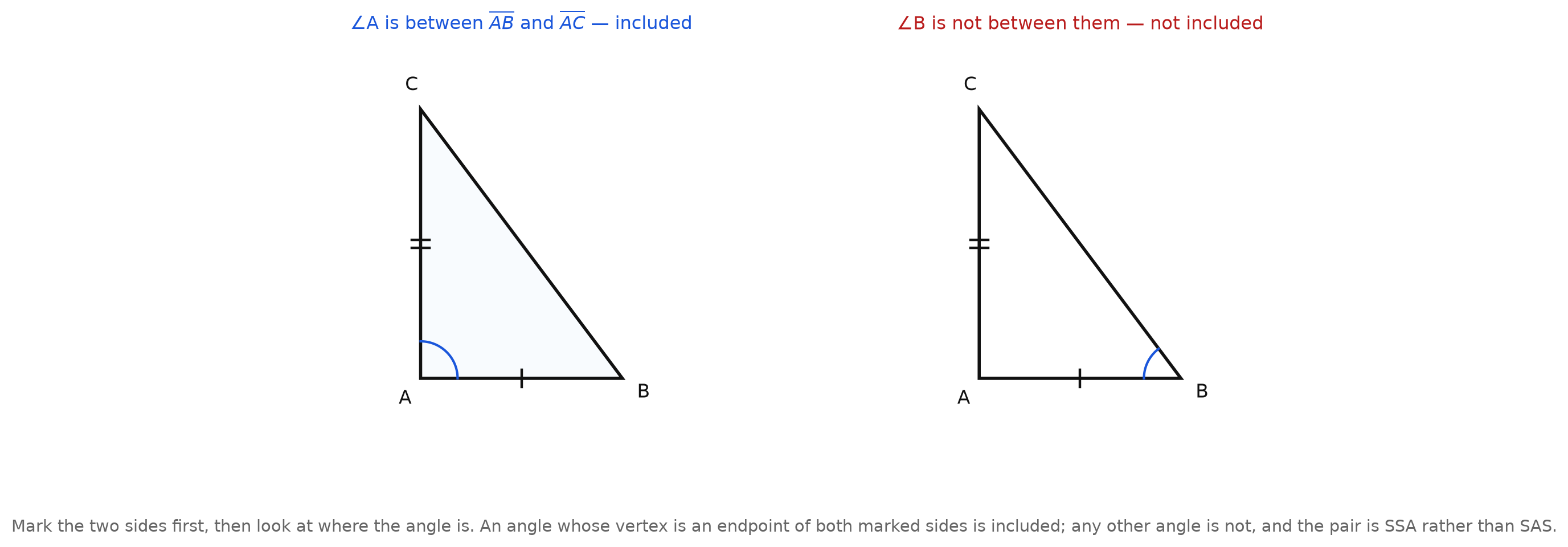
An angle is included between two sides when its vertex is an endpoint of both.
- Sides and meet at , so is the included angle. Marking those two sides and gives SAS.
- Marking those same two sides and gives SSA, which is not a criterion. Lesson 5.4 shows why with a counterexample.
The habit that prevents the error: mark the two sides first, then look at where the angle is. If its vertex is where the two marked sides meet, you have SAS. Anywhere else, you do not.
Choosing the criterion from the marks
A proof starts by reading the figure. Count what you have:
| What is marked | Criterion |
|---|---|
| three sides | SSS |
| two sides and the angle between them | SAS |
| two sides and an angle elsewhere | none — see Lesson 5.4 |
And remember the givens that are not written down — Lesson 5.1's shared side is the most common. If two triangles share a side, that side is congruent to itself, and it counts toward your three.
Worked examples
Example 1 — Naming the criterion
, , . Which criterion applies?
Answer: SSS.
Example 2 — SAS
, , . Which criterion?
Answer: SAS — is included between and , and is included between and .
Example 3 — Not SAS
, , . Which criterion?
Answer: None of the five. is not included between and , so this is SSA.
Example 4 — Using the shared side
and share , with and . Prove the triangles congruent.
Answer: by the Reflexive Property, so all three pairs of sides are congruent and by SSS.
Example 5 — Finding the missing given
and . What single additional congruence would give SAS?
Answer: . Then is included between and , and between and .
Guided practice
- Use the SSS-and-SAS figure. What is marked in the left panel, and which criterion is it?
- What is marked in the right panel, and which criterion is it?
- Use the included-angle figure. Which angle is included between and ?
- Why is not included between those two sides?
- Two sides and an angle are marked, but the angle is not between them. What is that arrangement called, and is it a criterion?
- State SAS in your own words, using the word "included."
Independent practice
- Name the criterion, or write "none." a) , , b) , , c) , ,
- In , which angle is included between and ?
- In , which two sides include ?
- and share . Write the congruence the Reflexive Property gives you.
- Given and , what one more congruence gives SAS? What one more gives SSS?
- Write a two-column proof: given and , prove .
- Write a two-column proof: given and , prove .
- Application. A gate is braced by a diagonal, splitting the rectangular frame into two triangles that share the diagonal. The two pairs of opposite frame sides are congruent. Which criterion proves the two triangles congruent?
- Application. A tent's two identical side panels each have edges of ft, ft, and ft. Which criterion says the panels are congruent?
- Error analysis. Given , , and , a student writes "SAS." Identify the error.
- Reasoning. Explain why SSS works, using what Chapter 4 established about three side lengths.
- Reasoning. Two triangles share a side and have one more pair of congruent sides. What is the fewest additional givens needed for SSS? For SAS?
Exit ticket 5.2
- Which criterion is three pairs of congruent sides?
- In , which angle is included between and ?
- , , . Criterion?
- Two triangles share a side. State the congruence that gives you and the reason.
Lesson 5.3 — ASA and AAS
Two angles and a side
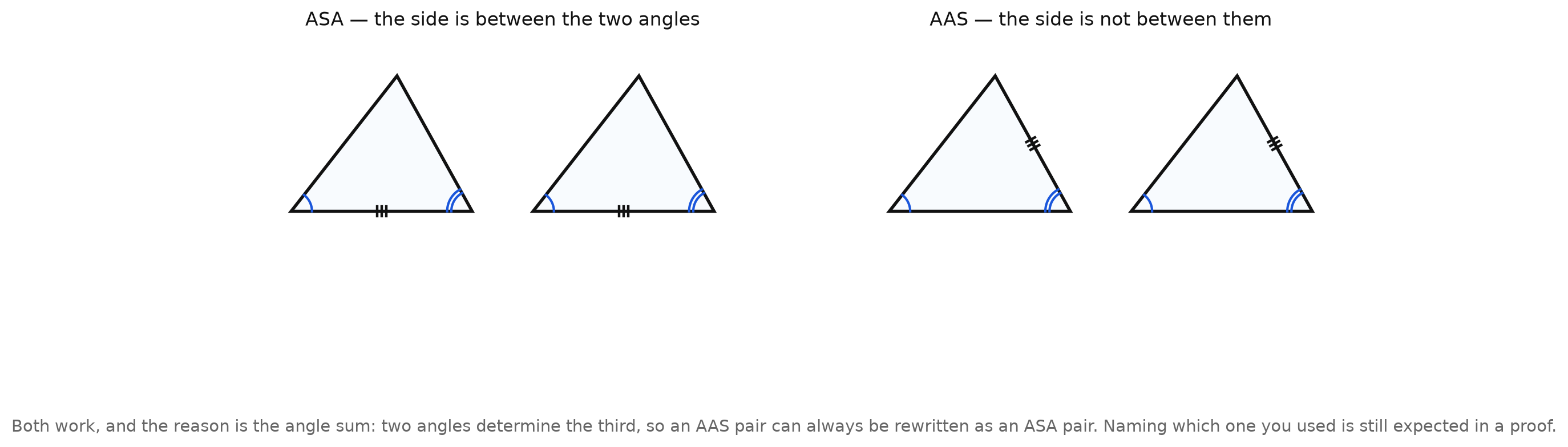
ASA (Angle-Side-Angle). If two angles and the included side of one triangle are congruent to two angles and the included side of another, the triangles are congruent.
AAS (Angle-Angle-Side). If two angles and a non-included side of one triangle are congruent to the corresponding two angles and side of another, the triangles are congruent.
A side is included between two angles when its two endpoints are the vertices of those angles.
Why both work
Unlike the sides case, where SSA fails, both arrangements of two angles and a side are criteria. The reason is Chapter 4's angle sum:
Two angles determine the third.
So an AAS pair is really an ASA pair in disguise — once the third angle is filled in, the given side is included between some pair of known angles. That is why AAS is safe and SSA is not: the angle sum recovers the missing information for angles, and nothing recovers it for sides.
You are still expected to name which one you used. A proof that says "ASA" for an AAS arrangement has cited the wrong theorem.
Reading the marks
| What is marked | Criterion |
|---|---|
| two angles and the side between them | ASA |
| two angles and a side not between them | AAS |
| three angles and no side | none — see Lesson 5.4 |
And again, watch for the free givens: a shared side, and a pair of vertical angles where two segments cross.
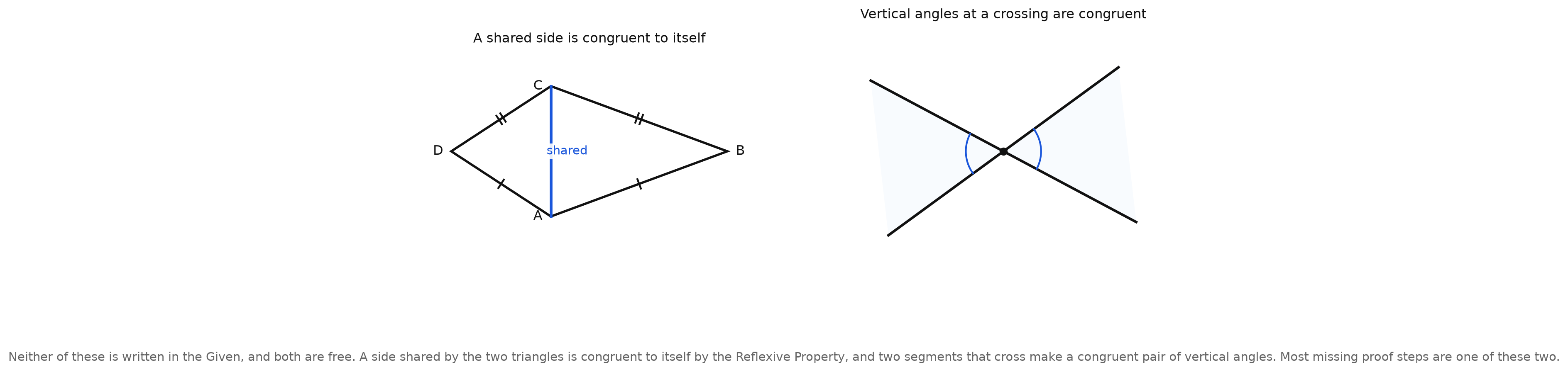
Neither is in the Given, and both are free. A side shared by the two triangles is congruent to itself by the Reflexive Property. Two segments that cross produce a congruent pair of vertical angles. Most missing proof steps are one of these two.
Worked examples
Example 1 — ASA
, , . Criterion?
Answer: ASA — is included between and .
Example 2 — AAS
, , . Criterion?
Answer: AAS — is not between and .
Example 3 — Using vertical angles
and cross at , with and . Prove .
Answer: because vertical angles are congruent. With and the included side , the triangles are congruent by ASA.
Example 4 — Turning AAS into ASA
, , . Explain why the third angles must also be congruent.
Answer: The angle sum forces and the same for , so . Then is included between and , and ASA applies — which is exactly why AAS is a valid criterion.
Example 5 — Naming the right one
, , . Is this ASA or AAS?
Answer: ASA. has endpoints and , the vertices of the two marked angles, so it is included.
Guided practice
- Use the ASA-and-AAS figure. What is marked in the left panel?
- What is marked in the right panel, and how does it differ from the left?
- Which side is included between and in ?
- Explain in one sentence why AAS is a valid criterion.
- Use the shared-side-and-vertical-angles figure. What congruence does the shared diagonal give, and by what reason?
- On that same figure, what congruence does the crossing give, and by what reason?
Independent practice
- Name the criterion, or write "none." a) , , b) , , c) , ,
- In , which side is included between and ?
- In , which two angles include ?
- Given and , name one more congruence giving ASA and one giving AAS.
- Write a two-column proof: given and intersect at , , and , prove .
- Write a two-column proof: given , , prove .
- Which criterion does item 56 use, and which free given did you need?
- Two triangles have and . Explain why follows without being given.
- Application. A surveyor sights across a river, forming two triangles that share a segment and have a pair of vertical angles at the crossing. She measures one angle at each bank as . Which criterion completes the congruence, and what free given did she use?
- Application. Two roof gables have equal base angles of and equal ridge beams of ft between them. Which criterion proves the gables congruent?
- Error analysis. Given , , and , a student writes "ASA." Identify the error.
- Reasoning. Explain why there is no "SSA" criterion but there is an AAS one, in terms of what the angle sum recovers.
Exit ticket 5.3
- Which criterion is two angles and the side between them?
- , , . ASA or AAS?
- Two segments cross. Name the congruence that gives you, free, and the reason.
- Why does knowing two pairs of angles give you the third pair?
Lesson 5.4 — HL, and What Does Not Work
HL, for right triangles only
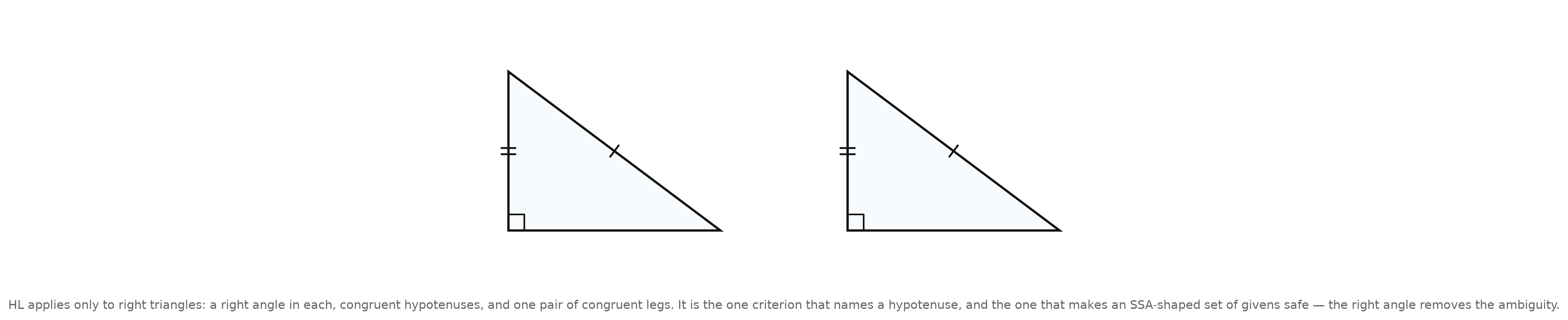
HL (Hypotenuse-Leg). If the hypotenuse and one leg of a right triangle are congruent to the hypotenuse and a leg of another right triangle, the triangles are congruent.
Three things make HL different from the other four:
- It applies only to right triangles. The right angle is part of the hypothesis, not an extra.
- It is the only criterion that names a hypotenuse.
- Its given parts are two sides and a non-included angle — an SSA arrangement. It works anyway, because the Pythagorean Theorem recovers the third side: with hypotenuse and leg known, the other leg is and there is only one answer. The right angle removes the ambiguity that sinks SSA in general.
SSA is not a criterion
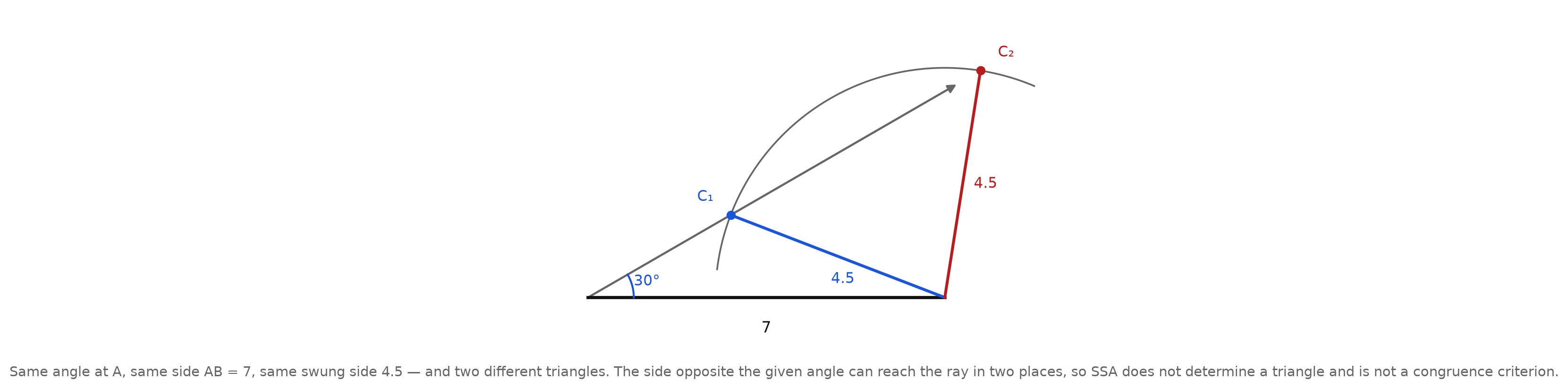
The figure is the whole argument. The angle at is , side , and the swung side is — and there are two different triangles with exactly that data. The arc from meets the ray in two places, so and both satisfy the same SSA givens and they are not congruent.
One counterexample is enough, exactly as Chapter 1 said. SSA is not a criterion, and citing it is not a small slip — it is citing something false.
AAA is not a criterion either
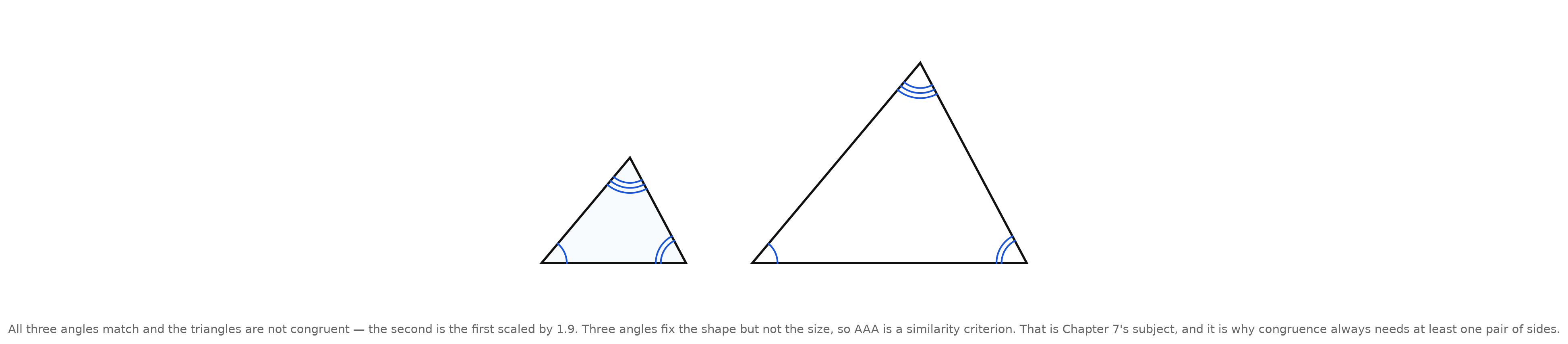
All three angles match. The triangles are obviously not congruent — the second is the first scaled up. Three angles fix the shape and say nothing about the size.
That failure is not a dead end; it is the definition of a different relationship. Two figures with the same shape and different size are similar, and AAA is the similarity criterion Chapter 7 is built on. Congruence always needs at least one pair of sides, and every one of the five valid criteria contains at least one S.
The five, and the two
| Combination | Congruence criterion? |
|---|---|
| SSS | yes |
| SAS | yes |
| ASA | yes |
| AAS | yes |
| HL (right triangles) | yes |
| SSA | no — two triangles fit the same data |
| AAA | no — fixes shape, not size (similarity) |
Worked examples
Example 1 — Applying HL
Two right triangles have congruent hypotenuses and one pair of congruent legs. Are they congruent?
Answer: Yes, by HL.
Example 2 — HL does not apply
Two triangles have congruent hypotenuses and one pair of congruent legs, but neither is marked with a right angle. Congruent?
Answer: Not by HL — HL requires the right angles. Without them the arrangement is SSA and nothing follows.
Example 3 — Spotting SSA
, , . Which combination is this, and what follows?
Answer: SSA — is not between and . Nothing follows; the triangles may or may not be congruent.
Example 4 — Spotting AAA
All three pairs of angles of two triangles are congruent. What can you conclude?
Answer: They are similar, not necessarily congruent. Nothing about size follows.
Example 5 — Why HL escapes the SSA problem
Explain why HL is safe when SSA is not.
Answer: In a right triangle, the hypotenuse and one leg determine the other leg exactly, by the Pythagorean Theorem: has one non-negative answer. So the "two possible triangles" of the SSA figure collapse to one, and the data really does determine the triangle.
Guided practice
- Use the HL figure. What three things are marked in each triangle?
- Why can HL not be applied to a triangle with no right angle?
- Use the SSA figure. What are the two triangles, and which parts do they share?
- Why does the arc from meet the ray twice?
- Use the AAA figure. What is congruent, and what is not?
- What relationship does AAA establish, and which chapter covers it?
Independent practice
- Decide whether the triangles must be congruent, naming the criterion or the reason none applies. a) two right triangles, congruent hypotenuses, one pair of congruent legs b) , , c) all three pairs of angles congruent d) , ,
- Two right triangles have congruent legs — both pairs. Which criterion applies, and is HL needed?
- In the SSA figure, and the swung side is . Explain what would happen if the swung side were instead.
- In the SSA figure, explain what would happen if the swung side were exactly equal to the perpendicular distance from to the ray.
- Write a two-column proof using HL: given and are right angles, , and , prove .
- Application. Two ramps each rise to a vertical post and have equal sloped edges and equal post heights. Which criterion proves them congruent, and what must be true of the posts?
- Application. Two triangular sails have all three angles matching but one is a scale model of the other. Are they congruent? What are they?
- Error analysis. A student proves two triangles congruent by "SSA" because two sides and an angle matched. Explain what is wrong and what the correct conclusion is.
- Error analysis. A student uses HL on two triangles with congruent hypotenuses and legs but no right angles marked. Explain the error.
- Reasoning. Explain why every valid congruence criterion contains at least one S.
Exit ticket 5.4
- State HL, including its restriction.
- Give the two combinations that are not congruence criteria.
- Why does AAA fail to prove congruence?
- Why is HL safe even though its parts form an SSA arrangement?
Lesson 5.5 — Direct and Indirect Proofs
The direct proof
G.TR.2 names direct and indirect proofs. A direct proof is what Chapters 2 and 5 have been writing: start from the Given and reason forward to the conclusion.
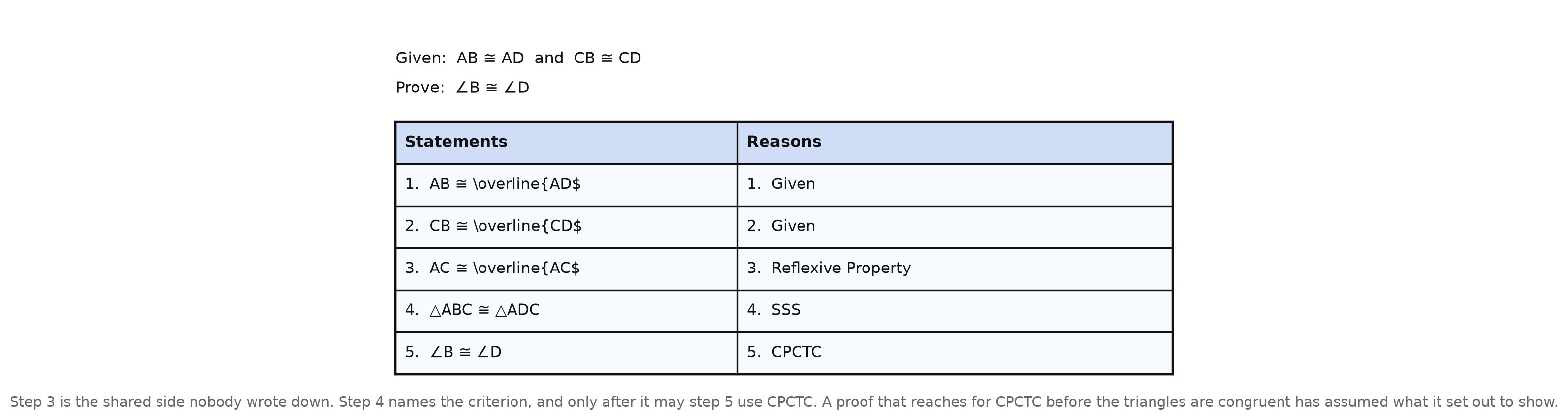
The shape is worth memorizing, because most congruence proofs have exactly it:
- write the givens;
- add the free congruence — the shared side by the Reflexive Property, or the vertical angles;
- name the criterion to conclude the triangles are congruent;
- use CPCTC to get the specific part the problem asked for.
Step 3 in the figure is the shared side nobody wrote down. Step 5 is the one that answers the question, and it is legal only because step 4 came first.
The indirect proof
Sometimes the direct route is hard and the reverse is easy. An indirect proof (or proof by contradiction) assumes the opposite of what it wants and shows that assumption is impossible.
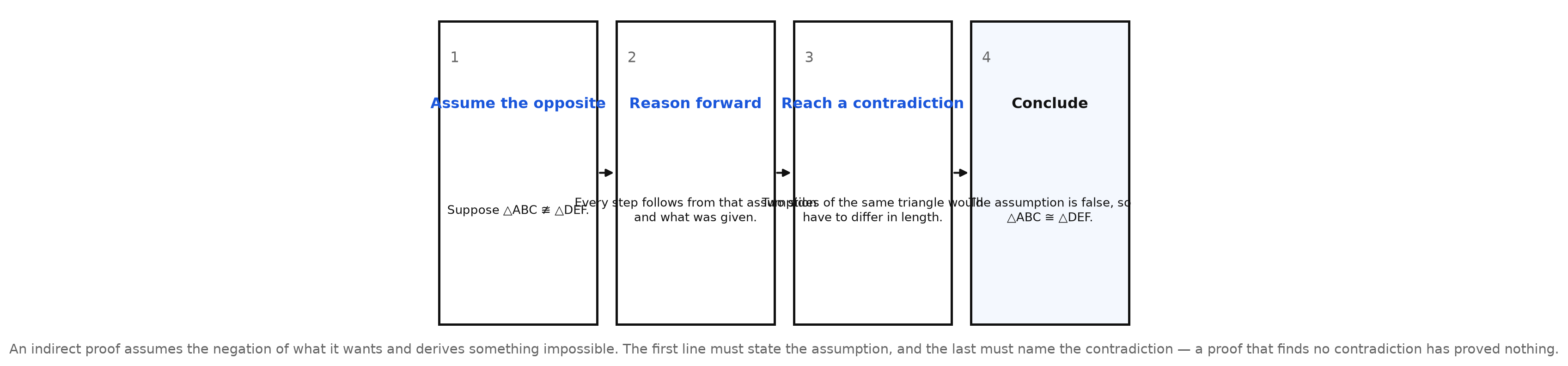
Two rules make an indirect proof valid:
- The first line states the assumption, and it must be the negation of the conclusion. If you want , assume .
- The last line names the contradiction, then rejects the assumption. A proof that wanders without ever hitting an impossibility has proved nothing.
This is Chapter 1's contrapositive doing work. Showing "assumption leads to something false" establishes "the assumption is false," which is exactly the conclusion.
Sample. Given , , and , prove indirectly.
Assume . All three pairs of corresponding sides are congruent, so SSS would give the congruence — contradicting the assumption. The assumption is false, so .
That example is deliberately simple, because the point is the structure. Indirect proof earns its keep when the direct statement is awkward and its negation is concrete — as when proving that a triangle cannot have two right angles.
Choosing a format
Two-column, paragraph, and flow proofs are all legal. This book uses two-column while the habit forms, because the second column makes a missing reason impossible to hide. A paragraph proof states the same claims and reasons in sentences and is expected to name every one.
Worked examples
Example 1 — Supplying a missing reason
In the sample proof, what justifies ?
Answer: The Reflexive Property of Congruence.
Example 2 — Supplying a missing step
A proof reads: 1. (Given). 2. (Given). 3. ? 4. (SSS). What is step 3?
Answer: , by the Reflexive Property.
Example 3 — Where CPCTC goes
Why can not be step 3 of that proof?
Answer: It would need CPCTC, which requires the congruence proved in step 4. Using it earlier is circular.
Example 4 — Starting an indirect proof
Write the first line of an indirect proof of "."
Answer: Assume .
Example 5 — An indirect argument
Prove indirectly that a triangle cannot have two right angles.
Answer: Assume a triangle has two right angles. Their measures total , so the third angle measures — impossible, since a triangle's three vertices are not collinear. The assumption is false, so no triangle has two right angles.
Guided practice
- Use the two-column proof figure. What is the Given, and what is being proved?
- Which step is the free given, and what reason justifies it?
- Which step names the criterion, and which criterion is it?
- Which step uses CPCTC, and why can it not come earlier?
- Use the indirect-proof figure. What must the first line do?
- What must the last line do?
Independent practice
- Write a two-column proof: given and , prove .
- Write a two-column proof: given and , prove . (Hint: the parallel lines give an angle pair from Chapter 2, and is shared.)
- Give the reason for each step. a) b) , where and are vertical c) , immediately after
- Rewrite the proof in item 93 as a paragraph proof.
- Write the first line of an indirect proof of each. a) b) c) two lines are parallel
- Complete an indirect proof: prove that a triangle cannot have two obtuse angles.
- Complete an indirect proof: given , , , prove indirectly.
- Application. A bridge inspector must show two support triangles are identical. She has both pairs of outer edges congruent and the included angles equal. Write the proof she would use, in two columns.
- Error analysis. A proof's step 2 is ", Reason: CPCTC," and its step 5 is "." Identify the error.
- Reasoning. Explain why an indirect proof that never reaches a contradiction has proved nothing.
Exit ticket 5.5
- In a congruence proof, which step must come immediately before CPCTC?
- What reason justifies a shared side?
- Write the first line of an indirect proof of "."
- Name the two things an indirect proof must do, one at its start and one at its end.
Lesson 5.6 — Constructing a Congruent Triangle, and Measured Attributes
Building a copy with compass and straightedge
G.TR.2d asks for a triangle constructed congruent to a given one, using congruent segment, congruent angle, and perpendicular line constructions. The SSS construction is the cleanest.

The SSS construction:
- Copy one side. Draw a ray and lay off a segment congruent to using the compass. Call it .
- Swing an arc from each endpoint. From , swing an arc of radius . From , swing an arc of radius .
- The arcs cross at . Draw and .
The result is congruent by SSS, and it is congruent by construction — the compass guarantees the three side lengths match.
Keep the arcs. G.TR.2d assesses the construction, not the finished picture. Erased arcs make a correct construction indistinguishable from a traced one, which is why every construction in this book leaves them visible.
The other criteria give other constructions: copy an angle and two sides for SAS, copy a side and two angles for ASA, and for HL construct a perpendicular at one endpoint and swing the hypotenuse from the other.
Measured attributes

G.TR.2e is the payoff. Once two triangles are known congruent, every unmeasured part of one is read off the other.
The bracket on the left can be measured. The one on the right is on a roof. The tick marks establish by SSS, and CPCTC then gives every unknown on the right — no ladder required.
That is the whole method, and it is worth stating as a procedure:
- Establish the congruence by one of the five criteria, from marks or from given measurements.
- Write the correspondence in order, so you know which part matches which.
- Apply CPCTC to the specific part you were asked for.
- Answer in context, with units.
The middle step is where errors happen. A correspondence written backwards produces a confidently wrong answer, because the arithmetic afterwards is trivial.
Worked examples
Example 1 — Naming the construction
Which construction copies a triangle using only its three side lengths?
Answer: The SSS construction — copy one side, then swing an arc of each remaining side from its endpoints.
Example 2 — Why the arcs matter
A student's construction is geometrically perfect but the arcs are erased. What has been lost?
Answer: The evidence. The arcs show the third vertex was located by the compass rather than by eye, and G.TR.2d assesses the construction itself.
Example 3 — A measured attribute
, cm, cm, . Find and .
Answer: cm and , both by CPCTC.
Example 4 — In context
Two identical triangular gables have base ft and a apex. The near gable's slant edge measures ft. What is the far gable's slant edge?
Answer: ft. The gables are congruent, so corresponding slant edges are congruent by CPCTC.
Example 5 — Correspondence first
with . A student reports . Correct them.
Answer: corresponds to , not . So , and is whatever is.
Guided practice
- Use the construction figure. What is drawn first in the copy?
- What do the two arcs locate, and why do they cross at exactly one useful point?
- Which criterion makes the constructed triangle congruent?
- Why must the arcs be left on the page?
- Use the measured-attributes figure. Which criterion establishes the congruence?
- Which reason gives the unknown side on the right?
Independent practice
- List the steps of the SSS construction in order.
- Describe how you would construct a triangle congruent to a given one using SAS instead.
- with , , . Give , , and .
- with and . Give all three angles of .
- , m, . Give and , naming the reason.
- with , , . A student says . Identify the error and give the correct value.
- Application. Two congruent triangular garden beds share a template. One has sides m, m, and m and an apex angle of . Give every side and the apex angle of the other.
- Application. A surveyor establishes that a triangle across a ravine is congruent to one she can walk. Her triangle has sides m, m, and m. What is the longest distance across the ravine, and which reason lets her claim it?
- Error analysis. Given and , a student writes . Identify the error.
- Reasoning. Explain why writing the correspondence before applying CPCTC prevents the most common error in these problems.
Exit ticket 5.6
- Name the first step of the SSS construction.
- Why are construction arcs kept rather than erased?
- with . Give and the reason.
- State the four-step method for finding a measured attribute of a triangle you cannot measure.
Chapter 5 Review
Vocabulary. congruent · correspondence · CPCTC · included angle · included side · SSS · SAS · ASA · AAS · HL · SSA · AAA · Reflexive Property · vertical angles · direct proof · indirect proof · contradiction · construction
Review 1 (G.TR.2a). In the figure, and intersect at , with and .
- Name the free given the crossing provides, and its reason.
- Write a two-column proof that , naming the criterion.
- Use CPCTC to conclude , and explain why that step could not have come earlier.
- Suppose were replaced by . Explain why the triangles could then not be proved congruent, naming the arrangement. Then find a different replacement that would still work, and name its criterion.
Review 2 (G.TR.2a). For each set of givens, name the criterion or say why none applies: (i) three pairs of congruent sides; (ii) two pairs of congruent sides and a pair of congruent non-included angles; (iii) two pairs of congruent angles and a pair of congruent non-included sides; (iv) three pairs of congruent angles; (v) congruent hypotenuses and one pair of congruent legs in two right triangles. Then explain, in two sentences, why (ii) fails but (v) succeeds even though both are SSA arrangements.
Review 3 (G.TR.2 d, e). A metal shop makes identical triangular brackets. The template has sides in, in, and in, with the angle opposite the -inch side measuring .
- Describe the SSS construction that copies the template, in order, and say what must be left on the page.
- A finished bracket is measured: one side is in. Which side of the template does it correspond to, and what are the other two sides?
- Which two criteria could prove a finished bracket congruent to the template, given that a right angle is present?
- The shop needs the angle opposite the -inch side. Explain how CPCTC gets it from a single measurement of the template, and why measuring every bracket is unnecessary.
Standards coverage check — Chapter 5
| Knowledge and Skill | Where it is taught | Where it is practiced | Where it is applied in context |
|---|---|---|---|
| G.TR.2a — use definitions, postulates, and theorems including SSS, SAS, ASA, AAS, and HL to prove and justify two triangles congruent, in direct and indirect proofs | 5.1 (correspondence, CPCTC); 5.2 (SSS, SAS, included angle); 5.3 (ASA, AAS, the free givens); 5.4 (HL, and why SSA and AAA fail); 5.5 (direct and indirect proof) | 1–13, 16–22; 23–35, 38–44; 45–58, 61–66; 67–77, 80–86; 87–99, 101–106 | 14, 15; 36, 37; 59, 60; 78, 79; 100; Review 1, Review 2 |
| G.TR.2d — use congruent segment, congruent angle, and/or perpendicular line constructions to create a congruent triangle | 5.6 (the SSS construction, with the SAS, ASA, and HL variants named) | 107–110, 113, 114, 123, 124 | Review 3 |
| G.TR.2e — solve problems, including those in context, involving measured attributes of congruent triangles | 5.1 (CPCTC as the tool); 5.6 (the four-step method) | 8, 9, 20; 111, 112, 115–118, 121, 122, 125, 126 | 14, 15; 119, 120; Review 3 |
Supporting items: 17, 18, 39, 40, 58, 62, 66, 82, 102, and 122 are the reasoning items; 62 and 82 together carry the chapter's central idea — that the angle sum rescues AAS while nothing rescues SSA, and that every valid criterion therefore contains at least one S. The error analyses target the recurring failures: correspondence written in the wrong order (16, 118, 121), CPCTC used before the congruence is proved (101), an angle claimed as included when it is not (38, 61), and SSA or HL cited without the conditions that make them legal (80, 81).
Boundaries respected. The criteria are exactly the five G.TR.2a names. SSA and AAA appear only as counterexamples, and AAA is explicitly deferred to Chapter 7 as a similarity criterion rather than treated as a failure to be forgotten. Algebraic and coordinate proofs of congruence are not here — they are G.TR.2 b and c, and Chapter 6's subject. Constructions are limited to the congruent segment, congruent angle, and perpendicular line constructions the standard names.
Answer keys for every item in this chapter are in Appendix A.