Chapter 4 — Sides and Angles of a Triangle
Standard: G.TR.1 (a, b, c, d, e)
G.TR.1 — verbatim. The student will determine the relationships between the measures of angles and lengths of sides in triangles, including problems in context. Students will demonstrate the following Knowledge and Skills: a) Given the lengths of three segments, determine whether a triangle could be formed. b) Given the lengths of two sides of a triangle, determine the range in which the length of the third side must lie. c) Order the sides of a triangle by their lengths when given information about the measures of the angles. d) Order the angles of a triangle by their measures when given information about the lengths of the sides. e) Solve for interior and exterior angles of a triangle, when given two angles.
By the end of this chapter you will be able to:
- Use the Triangle Angle Sum Theorem and the Exterior Angle Theorem to find a missing angle measure (G.TR.1e)
- Order the sides of a triangle from shortest to longest when you know the angles (G.TR.1c)
- Order the angles from smallest to largest when you know the sides (G.TR.1d)
- Decide whether three given lengths can form a triangle (G.TR.1a)
- Give the range the third side must lie in, when two sides are known (G.TR.1b)
- Solve problems in context by choosing the right one of these relationships (G.TR.1, opening clause)
Lessons: 4.1 The Angle Sum and the Exterior Angle · 4.2 Ordering the Sides from the Angles · 4.3 Ordering the Angles from the Sides · 4.4 Does a Triangle Exist? · 4.5 The Range for a Third Side, and Problems in Context
Why this chapter matters. Every remaining chapter about triangles assumes what is here. Chapter 5 proves triangles congruent, which needs the angle sum to fill in a third angle. Chapter 7 proves them similar, which uses the angle sum to turn two matching angles into three. Chapter 8's Pythagorean work is about a specific triangle whose angles you already know sum correctly. And the ordering relationships — biggest angle faces the longest side, and the reverse — are the quickest sanity check you own: if a computed answer puts the long side across from the small angle, something is wrong before you check the arithmetic.
Scope note. The standard is about the two-way relationship between a triangle's angles and its sides, plus the question of whether a triangle exists at all. Bullet e names the angle work directly — solve for interior and exterior angles of a triangle, when given two angles — which is exactly Lesson 4.1. The contextual problems in Lesson 4.5 come from the standard's opening clause, "including problems in context," rather than from any single bullet. No trigonometry appears here. Ordering tells you which side is longest; it never tells you how long. Finding an actual length from angles is Chapter 9's job, under G.TR.4.
Conventions this chapter fixes.
- A triangle's vertices are capital letters; the side opposite a vertex takes the matching lowercase letter. In , side is , side is , and side is . Every ordering question in this chapter is really a question about which side is opposite which angle.
- An ordering answer is written as a chain: , or . When two are equal, the chain says so: . Forcing a strict order onto a tie is wrong.
- The Triangle Inequality is strict. Three lengths form a triangle when the two shorter ones add to more than the longest — not "at least."
- A range for a third side is an open interval, written and graphed with open circles at both ends.
- Figures in this book are drawn to scale unless labelled otherwise, but a drawing is never a reason. The reason is the theorem.
- Item numbering runs straight through the chapter, from 1 in Lesson 4.1 to 108 at the end of Lesson 4.5.
Lesson 4.1 — The Angle Sum and the Exterior Angle
The angle sum, and why it is true
Triangle Angle Sum Theorem. The measures of the three interior angles of a triangle sum to .
You have used this since Grade 8. Here is the proof, and it is Chapter 2 doing the work.
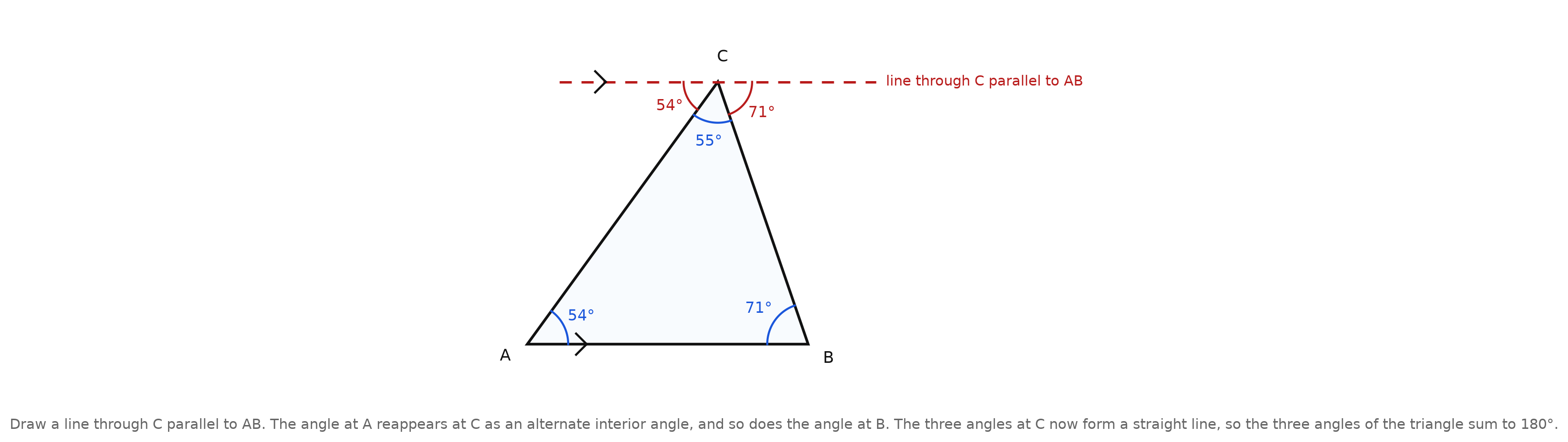
Proof.
| Statements | Reasons |
|---|---|
| 1. Draw the line through parallel to | 1. Through a point not on a line, exactly one parallel line exists |
| 2. the angle at on the left | 2. Alternate interior angles are congruent |
| 3. the angle at on the right | 3. Alternate interior angles are congruent |
| 4. The three angles at form a straight angle | 4. Definition of a straight angle |
| 5. | 5. Substitution into the straight angle |
The auxiliary parallel line is the whole idea. Everything else is Chapter 2's alternate interior angles theorem, used twice.
Two consequences worth naming right away:
- A triangle has at most one right or obtuse angle. Two angles of or more would already reach with nothing left for the third.
- Knowing two angles determines the third. That is why almost every problem in this chapter starts by subtracting from .
The exterior angle
Extend one side of a triangle past a vertex and you get an exterior angle. The two angles of the triangle not adjacent to it are its remote interior angles.
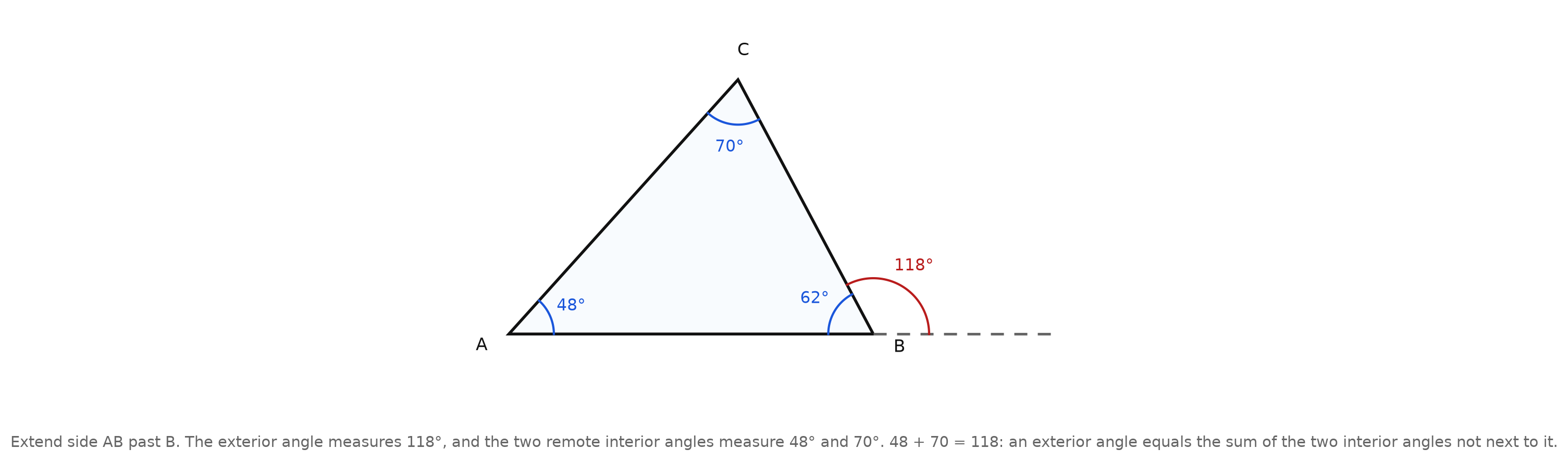
Exterior Angle Theorem. The measure of an exterior angle of a triangle equals the sum of its two remote interior angles.
In the figure, the exterior angle at measures , and .
The reason is short: the exterior angle and form a linear pair, so the exterior angle is . The angle sum says the other two angles also total . Both equal the same thing, so they equal each other.
An exterior angle is therefore larger than either of its remote interior angles — a fact Lesson 4.4 leans on quietly, and one that Chapter 5's indirect proofs use directly.
Using both
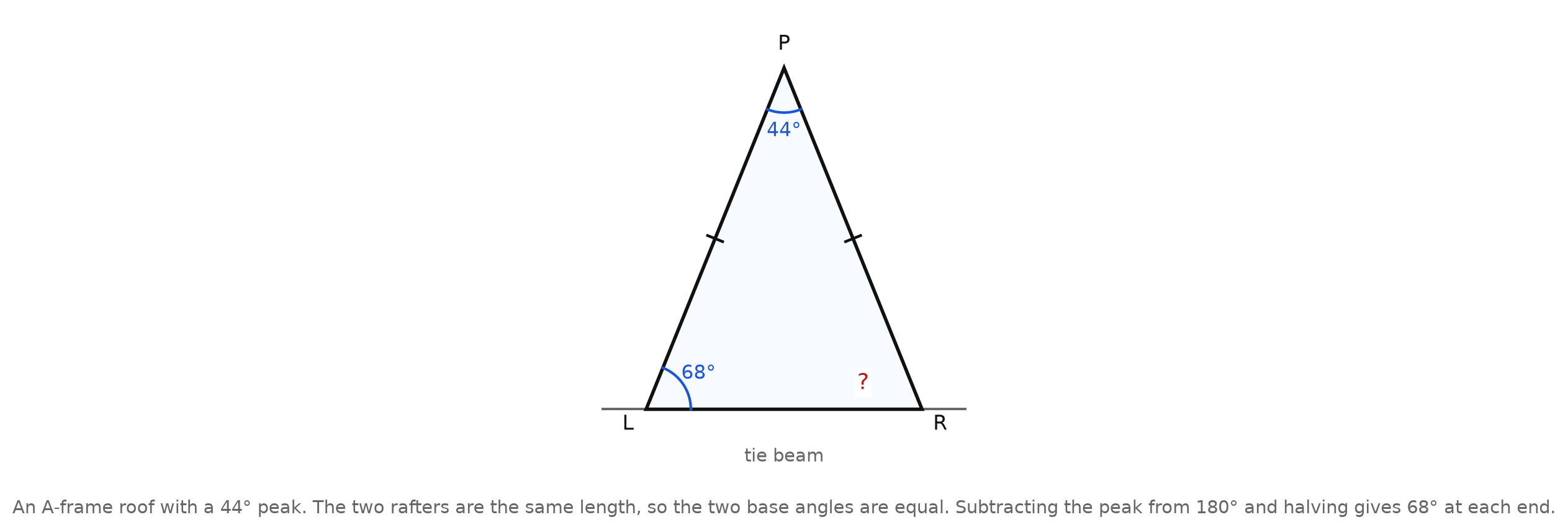
An A-frame with a peak has two rafters of equal length, so the two base angles are equal. Subtracting the peak leaves for the two of them, and halving gives each.
That last step used a fact this chapter proves properly in Lesson 4.3: equal sides face equal angles. For now, take it from the tick marks.
Worked examples
Example 1 — The third angle
Two angles of a triangle measure and . Find the third.
Answer: .
Example 2 — An exterior angle
An exterior angle of a triangle measures , and one remote interior angle measures . Find the other remote interior angle.
Answer: .
Example 3 — Working backwards
The exterior angle at measures . Find .
Answer: — the exterior angle and form a linear pair.
Example 4 — With algebra
The angles of a triangle measure , , and . Find all three.
Answer: , so and . The angles are , , and .
Example 5 — An impossible claim
A student says a triangle has angles of and . Respond.
Answer: Impossible — those two already total , leaving nothing for the third angle. A triangle can have at most one angle of or more.
Guided practice
- Use the angle-sum figure. What are the three angle measures, and what do they sum to?
- On that same figure, which theorem from Chapter 2 justifies the two angles reappearing at ?
- Why does the proof draw the auxiliary line parallel to rather than any line through ?
- Use the exterior-angle figure. What is the exterior angle's measure, and which two angles are its remote interior angles?
- Verify the Exterior Angle Theorem on that figure by adding.
- Use the A-frame figure. What is the peak angle, and how were the two base angles found?
Independent practice
- Find the third angle. a) and b) and c) and
- An exterior angle measures . Find the adjacent interior angle.
- An exterior angle measures and one remote interior angle measures . Find the other remote interior angle.
- The angles of a triangle measure , , and . Find and all three angles.
- The angles of a triangle measure , , and . Find all three, and classify the triangle by its angles.
- An exterior angle at measures and the two remote interior angles measure and . Find and the exterior angle.
- Application. A roof truss has a peak of and two equal rafters. Find each base angle.
- Application. A triangular garden bed has one angle of . The other two are equal. Find them.
- Error analysis. A student says a triangle can have angles of , , and . Explain what is wrong.
- Error analysis. A student says the exterior angle at equals plus one other angle. Correct the statement.
- Reasoning. Explain why an exterior angle is always larger than either of its remote interior angles.
- Reasoning. A triangle has an angle of . What do you immediately know about the other two, without any calculation?
Exit ticket 4.1
- Two angles measure and . Find the third.
- An exterior angle measures . Find the adjacent interior angle and the sum of the two remote interior angles.
- Can a triangle have angles of and ? Justify.
- State the Exterior Angle Theorem in one sentence.
Lesson 4.2 — Ordering the Sides from the Angles
The rule
In any triangle, the longest side is opposite the largest angle, and the shortest side is opposite the smallest angle.
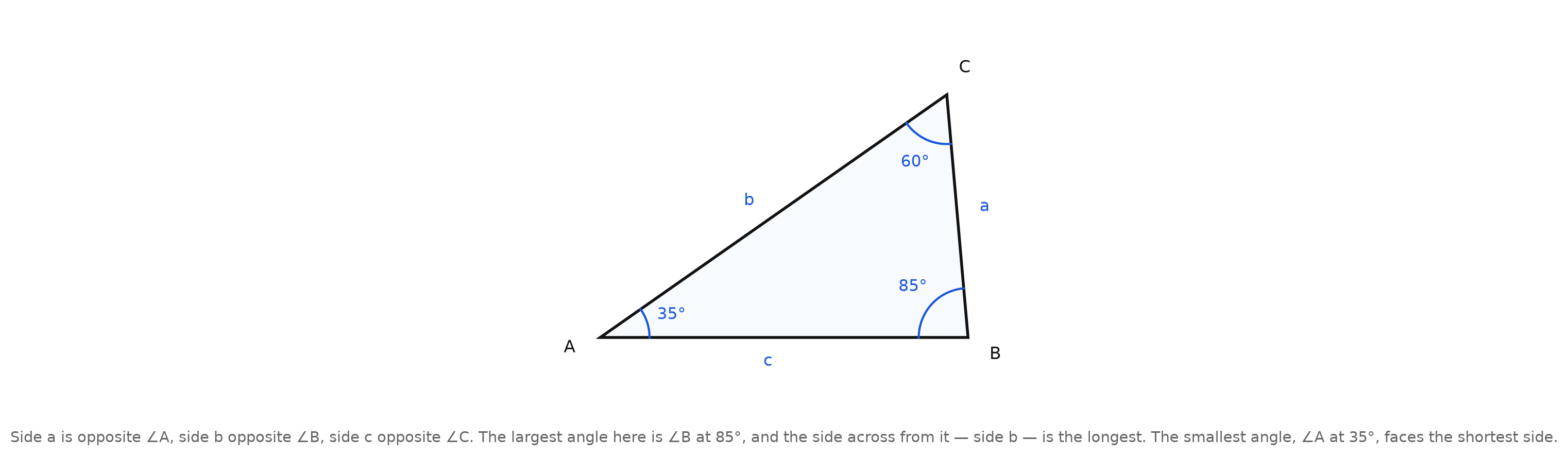
Read the figure carefully, because the labelling convention is doing half the work. Side is opposite , side is opposite , side is opposite . Here:
- Largest angle: . Longest side: .
- Smallest angle: . Shortest side: .
- So the ordering is .
The rule is intuitive once you picture it: to open an angle wider, you have to swing its two sides apart, and the piece joining their far ends has to stretch to keep up.
Find the third angle first
The single most common error in this lesson is ordering from two angles when three were needed.
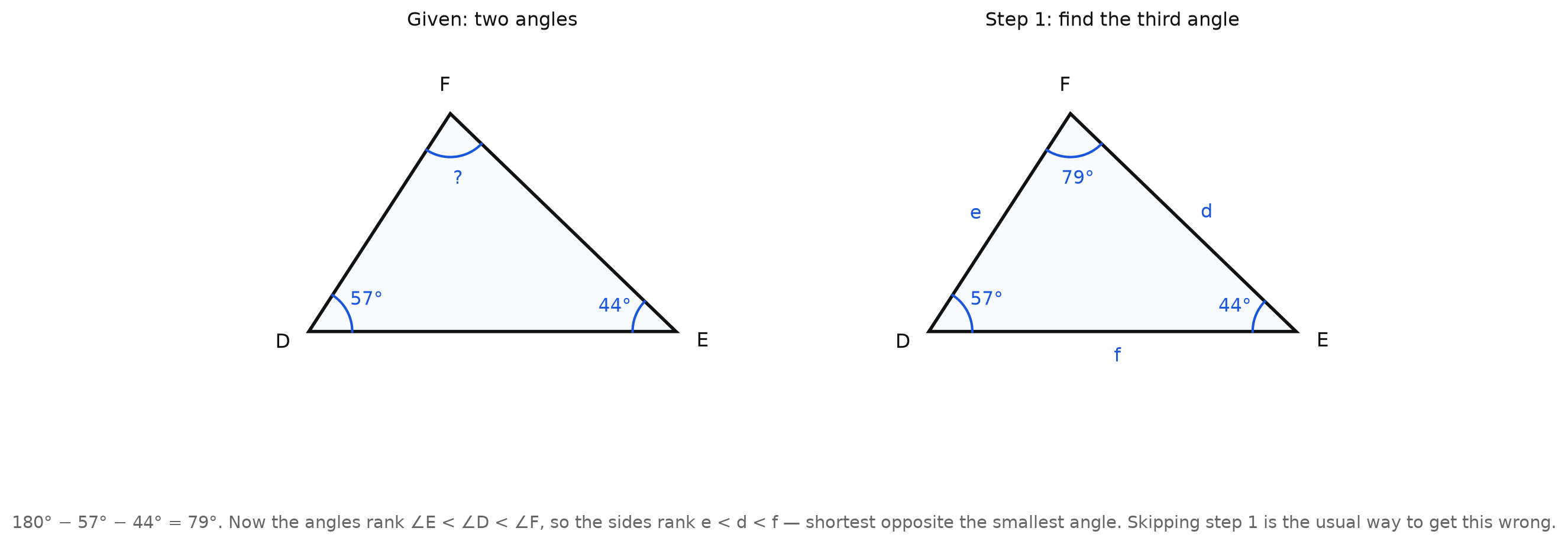
Given and , you cannot order anything yet — the unnamed third angle might be the largest, and here it is. Fill it in first:
Now the angles rank , so the sides rank .
Habit worth building: write the angles in a row, sort them, then replace each angle with its opposite side. Two mechanical steps beat one clever one.
Answering the question that was asked
Ordering questions come in three shapes, and they want different answers:
| Question | Answer looks like |
|---|---|
| "Order the sides from shortest to longest." | |
| "Which side is longest?" | side , or |
| "Name the shortest side of ." |
Notice the third row. When a problem names segments rather than lowercase letters, translate: the side opposite is , because and are the two vertices that are not .
Worked examples
Example 1 — Straight ordering
In , , , . Order the sides.
Answer: Angles rank , so sides rank .
Example 2 — Find the third first
In , and . Order the sides.
Answer: . Angles rank , so sides rank .
Example 3 — Naming segments
In the triangle of Example 2, which segment is the longest?
Answer: Side , which is — the side opposite .
Example 4 — A right triangle
In a right triangle, which side is always the longest?
Answer: The hypotenuse. The right angle is and the other two angles sum to , so each is smaller than the right angle; the side opposite the right angle is therefore the longest.
Example 5 — With a tie
In , and . Order the sides.
Answer: . Angles rank , so sides rank . Write the equality; do not invent an order between and .
Guided practice
- Use the longest-side figure. Which angle is largest, and which side is opposite it?
- On that same figure, which angle is smallest, and which side is opposite it?
- Write the full side ordering for that figure.
- Use the find-the-third-angle figure. Why can you not order the sides from the left panel alone?
- Compute the third angle in that figure, then write the angle ordering.
- Write the side ordering that follows.
Independent practice
- Order the sides from shortest to longest. a) , , b) , , c) , ,
- Find the third angle, then order the sides. a) , b) , c) ,
- In , and . Name the longest side as a segment.
- In , and . Name the shortest side as a segment.
- A triangle has angles , , and . Which side is longest? Is the triangle a right triangle?
- In , an exterior angle at measures and . Order the sides of .
- Application. A triangular sail has corner angles of , , and . Which edge needs the longest piece of rope along it?
- Application. A triangular plot has angles , , and . The owner wants to fence the shortest side first. Which side is it, and how do you know?
- Error analysis. Given and , a student writes and stops, saying is the longest side. Identify the error.
- Error analysis. In with , a student says is the longest side. Explain the mistake.
- Reasoning. Explain in your own words why a larger angle must face a longer side.
- Reasoning. In a triangle with angles , , , what is the side ordering, and what does that tell you about the triangle?
Exit ticket 4.2
- , , . Order the sides.
- and . Find and name the longest side.
- In , which side is opposite ? Write it as a segment.
- State the ordering rule in one sentence.
Lesson 4.3 — Ordering the Angles from the Sides
The rule, read backwards
In any triangle, the largest angle is opposite the longest side, and the smallest angle is opposite the shortest side.
This is Lesson 4.2's rule with the hypothesis and conclusion swapped — its converse — and unlike most converses you met in Chapter 1, this one is true and is a theorem in its own right.
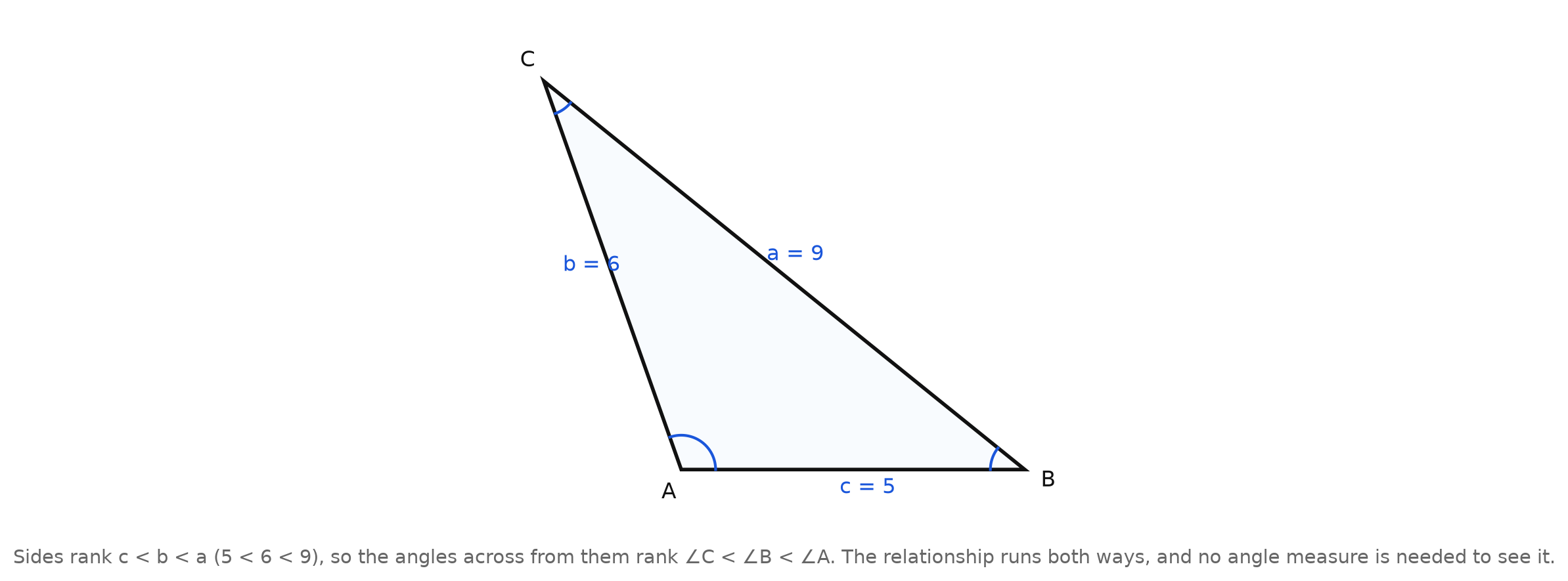
Sides rank , that is . So the angles rank
and you never needed a single angle measure to say so. That is the point of the lesson: the ordering is available directly from the side lengths.
Ties
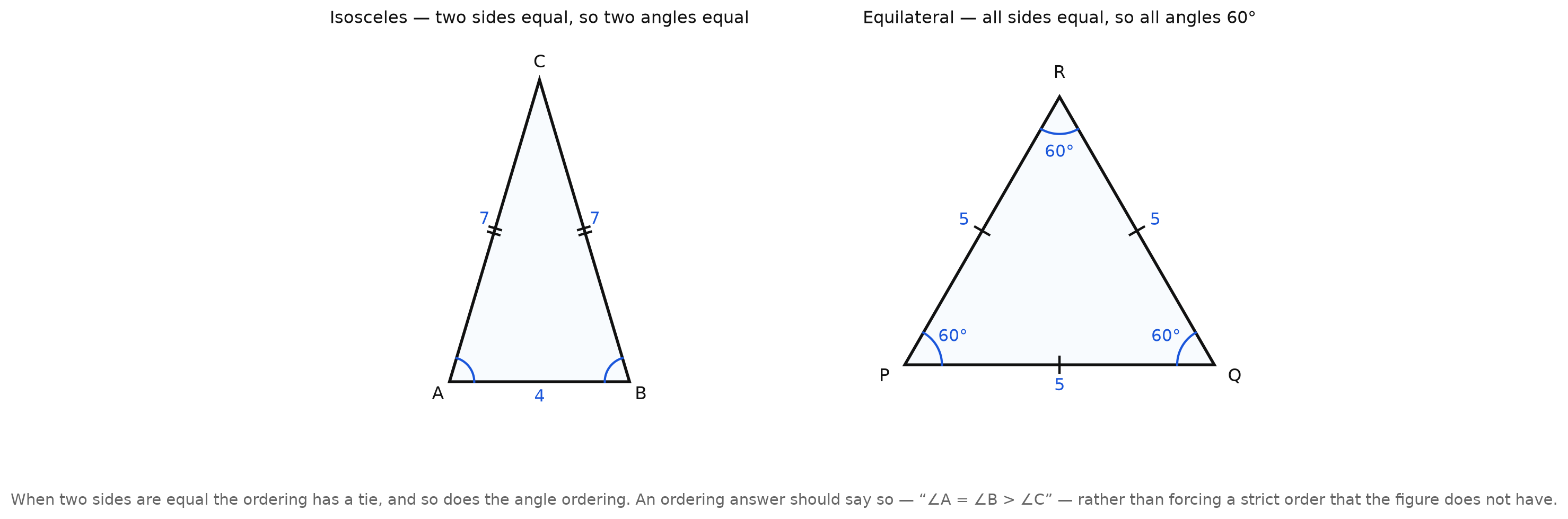
- Isosceles. Two congruent sides face two congruent angles. With sides , , , the ordering is — the two big angles tie, and the angle opposite the short side is smallest.
- Equilateral. All three sides equal means all three angles equal, and since they sum to , each is . An equilateral triangle is always equiangular.
Write the ties. An answer of "" for the isosceles triangle is wrong, not merely imprecise — it claims a difference the figure does not have.
Both directions at once
The two lessons together say the ordering of the angles and the ordering of the opposite sides are the same ordering. So you can start from whichever you are given:
| Given | Do this |
|---|---|
| Three angles | Rank them; the opposite sides rank the same way |
| Two angles | Find the third from the angle sum, then rank |
| Three sides | Rank them; the opposite angles rank the same way |
| Two sides only | You cannot rank all three — the third side is not determined |
That last row matters. Two sides do not fix a triangle; Lesson 4.5 shows how much freedom the third side has.
Worked examples
Example 1 — Straight ordering
In , , , . Order the angles.
Answer: Sides rank , so angles rank .
Example 2 — Segments instead of letters
In , , , . Order the angles.
Answer: is opposite , is opposite , and is opposite . Sides rank , so angles rank .
Example 3 — Isosceles
A triangle has sides , , and . Order the angles.
Answer: The two angles opposite the s are equal and are both larger than the angle opposite the . Writing the vertices so that : .
Example 4 — Naming the largest
In , , , . Which angle is largest?
Answer: is longest and is opposite , so is largest.
Example 5 — A quick check
A student computes the angles of a triangle with sides , , and gets opposite the as the largest. Respond.
Answer: Impossible. The largest angle must be opposite the longest side, which is . The answer contradicts the ordering rule before any arithmetic is checked.
Guided practice
- Use the ordering-from-sides figure. What are the three side lengths?
- Rank the sides, then rank the angles.
- Which angle is largest, and which side is it opposite?
- Use the isosceles-and-equilateral figure. Which two angles of the isosceles triangle are equal, and why?
- What is each angle of the equilateral triangle, and how do you know?
- Why is "" a wrong answer for the isosceles triangle?
Independent practice
- Order the angles from smallest to largest. a) , , b) , , c) , ,
- In , , , . Order the angles.
- In , , , . Order the angles and note any tie.
- Which angle is largest in a triangle with sides , , and ?
- Which angle is smallest in with , , ?
- A triangle has sides , , and . Order the angles, and predict what kind of triangle it is.
- In , , , . Give the angle ordering and each angle measure.
- Application. A triangular brace has sides in, in, and in. At which corner is the widest opening, and which side is across from it?
- Application. A triangular flowerbed has two sides of ft and one of ft. Which corner angle is smallest?
- Error analysis. A student is told , , and writes . Identify the two errors.
- Reasoning. Explain why an equilateral triangle must be equiangular, using the ordering rule and the angle sum together.
- Reasoning. You are given only two side lengths of a triangle. Explain why you cannot order all three angles.
Exit ticket 4.3
- , , . Order the angles.
- A triangle has sides , , and . Order the angles, showing the tie.
- In , is the longest side. Which angle is largest?
- State the ordering rule in one sentence, and say how it relates to the rule in Lesson 4.2.
Lesson 4.4 — Does a Triangle Exist?
The Triangle Inequality
Not every three lengths make a triangle. Two short pieces at the ends of a long one may simply never reach each other.
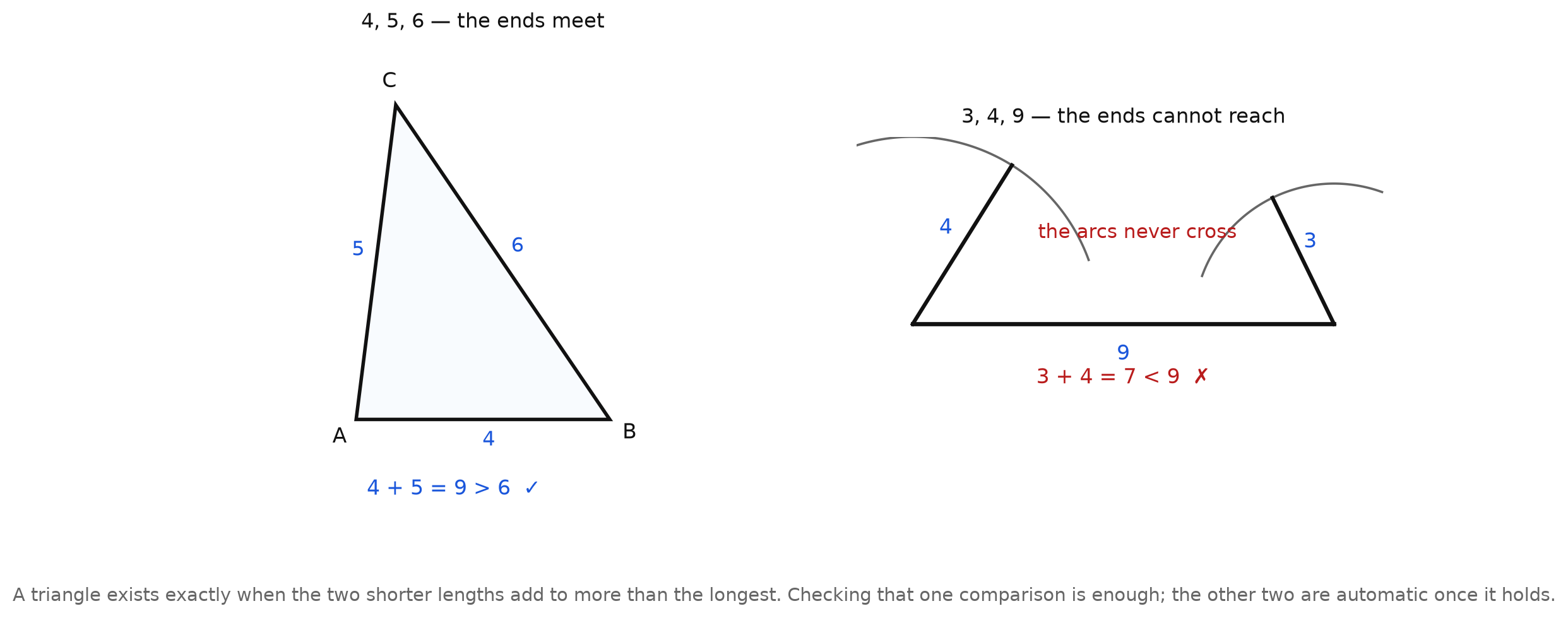
Triangle Inequality Theorem. Three positive lengths form a triangle if and only if the sum of any two is greater than the third.
The right-hand panel is the picture of the failure. Swing the from one end of the and the from the other, and their arcs never cross — the two together span only , and the gap is .
One comparison is enough
The theorem names three comparisons, but you only ever have to check one.
Sort the three lengths and check that the two shorter ones add to more than the longest.
If that holds, the other two comparisons are automatic: the longest plus either other length is certainly bigger than the remaining one, because the longest already is. So the whole test is: sort, add the two small ones, compare.
- , , : sorted, ✓ — a triangle exists.
- , , : sorted, ✗ — no triangle.
The boundary case

What if the two shorter lengths add to exactly the longest? Then the arcs meet in exactly one place — right on the long segment. The "triangle" flattens: no height, no area, and no angles to speak of. This is a degenerate triangle, and it is not a triangle.
That is why the inequality is strict. fails the test, just as does. When a problem's numbers land exactly on the boundary, the answer is "no triangle."
Worked examples
Example 1 — A quick yes
Can , , and form a triangle?
Answer: Sorted: , , . ✓ — yes.
Example 2 — A quick no
Can , , and form a triangle?
Answer: Sorted: , , . ✗ — no.
Example 3 — The boundary
Can , , and form a triangle?
Answer: , which is equal to the longest, not greater. No triangle — this is the degenerate case.
Example 4 — Two equal sides
Can , , and form a triangle?
Answer: ✗ — no. Two congruent sides do not guarantee a triangle.
Example 5 — Choosing a possible third length
Two sides measure and . Which of , , , could be the third side?
Answer: and work. fails (), and fails (). Lesson 4.5 turns this into a single interval instead of a case-by-case check.
Guided practice
- Use the inequality figure, left panel. What are the three lengths, and what comparison is shown?
- Use the right panel. Why do the two arcs never cross?
- State the Triangle Inequality Theorem in your own words.
- Explain why checking only the two shorter lengths against the longest is enough.
- Use the degenerate figure. What do and add to, and what does the figure look like as a result?
- Why is the inequality strict rather than "greater than or equal to"?
Independent practice
- Decide whether a triangle exists, showing the comparison you used. a) , , b) , , c) , , d) , ,
- Decide whether a triangle exists. a) , , b) , , c) , ,
- Two sides are and . Which of , , , could be the third side?
- Two sides are and . Which of , , , could be the third side?
- A triangle has sides , , and with a whole number. What is the smallest possible ?
- Using item 77, what is the largest possible whole-number ?
- A student is given , , and and checks and , then stops. Which comparison actually decides the question, and what is the answer?
- Application. Three straight boards measure in, in, and in. Can they be joined end to end into a triangular frame? Show the comparison.
- Application. A camp needs a triangular sail from three cut ropes of ft, ft, and ft. Will it work? If not, by how much would the longest rope need to be shortened?
- Error analysis. A student says , , forms a triangle because . Identify the error and give the correct answer.
- Reasoning. Explain why two congruent sides of length can never form a triangle with a third side of length or more.
- Reasoning. Explain what goes wrong geometrically in the boundary case, and why "degenerate" is a fair name for it.
Exit ticket 4.4
- Can , , and form a triangle? Show the comparison.
- Can , , and form a triangle?
- Can , , and form a triangle? Explain what is special about this case.
- State the single comparison that decides the question, and say why the other two are unnecessary.
Lesson 4.5 — The Range for a Third Side, and Problems in Context
Turning the test into an interval
Lesson 4.4 checked one candidate at a time. G.TR.1b asks for all of them at once.
Suppose two sides measure and , and call the third side . The Triangle Inequality gives three conditions:
Two of them bite, and together they give an interval.

Third-Side Range. If two sides measure and , the third side satisfies
In words: greater than the difference, less than the sum. Both endpoints are excluded, and both circles on the graph are open, because either endpoint would flatten the triangle into the degenerate case of Lesson 4.4.
For and : the difference is , the sum is , and the range is .
Whole-number answers
Problems often ask for whole-number possibilities. From , the whole numbers are through — that is values. Do not include or .
A common follow-up asks for the largest or smallest possible whole-number side. From this range, the smallest is and the largest is .
Problems in context
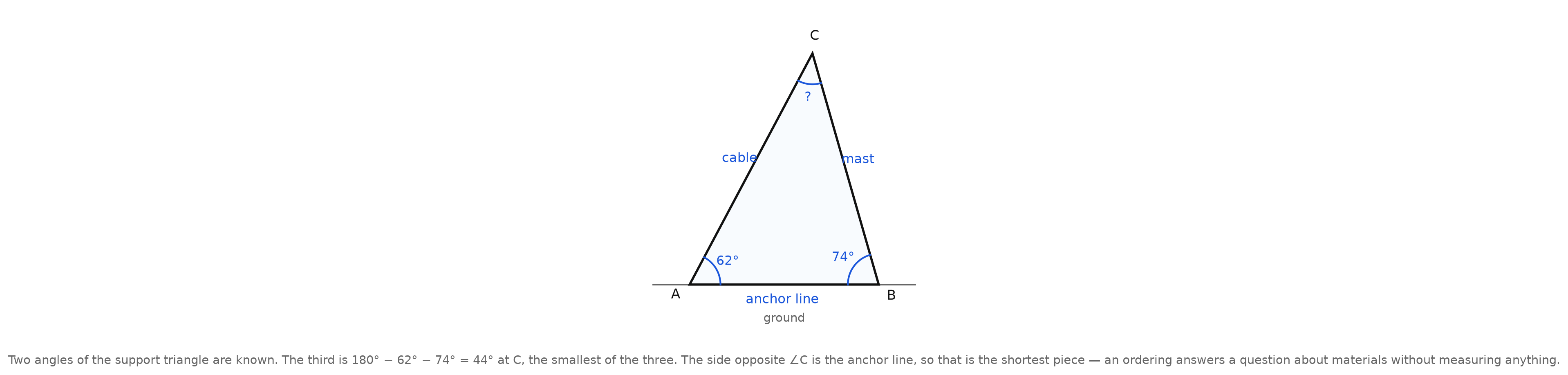
The standard's opening clause — "including problems in context" — is where the chapter's pieces get chosen rather than practiced. The support triangle above gives two angles, so:
is the smallest angle, so the side opposite it — the anchor line — is the shortest of the three pieces. A question about which piece needs the least material is answered without measuring anything.
Deciding which tool a context problem wants:
| The problem gives you | Use |
|---|---|
| Two angles, asks for the third | Angle sum (4.1) |
| An exterior angle and one remote interior angle | Exterior Angle Theorem (4.1) |
| Angles, asks which side is longest/shortest | Ordering, angles → sides (4.2) |
| Side lengths, asks which angle is largest/smallest | Ordering, sides → angles (4.3) |
| Three lengths, asks "will it work?" | Triangle Inequality (4.4) |
| Two lengths, asks what the third could be | Third-side range (4.5) |
Worked examples
Example 1 — A range
Two sides measure and . Give the range for the third side.
Answer: and , so .
Example 2 — Whole numbers
How many whole-number lengths are possible in Example 1?
Answer: through , which is values.
Example 3 — Equal sides
Two sides measure and . Give the range for the third.
Answer: and , so . The lower bound is because the two given sides are equal, and any positive length shorter than works.
Example 4 — Ordering in context
A triangular shelf bracket has angles , , and . Which edge is longest?
Answer: The edge opposite the angle — the hypotenuse.
Example 5 — Choosing the tool
A frame uses two struts of cm and cm plus a crosspiece. The shop has crosspieces of , , , and cm. Which will work?
Answer: The range is to , so . The cm and cm crosspieces work; and do not.
Guided practice
- Use the third-side-range figure. What are the two known sides, and what is the range?
- Why are both circles open rather than closed?
- Give the whole-number values allowed by that range, and count them.
- Use the context figure. What is ?
- Which side is the shortest, and which relationship told you?
- If the angle at were instead, what would become, and would the shortest side change?
Independent practice
- Give the range for the third side. a) and b) and c) and
- Give the range for the third side, and the number of whole-number possibilities. a) and b) and
- Two sides are and . What are the smallest and largest whole-number lengths the third side could be?
- A triangle has sides , , and . Write the range for and give the whole-number count.
- Application. A triangular sign has angles , , and . Which edge is longest, and which two are equal?
- Application. A bracing triangle has two struts of in and in. A supplier sells crosspieces in whole inches. List the possible crosspiece lengths.
- Application. A trail forms a triangle. Two legs are km and km. Between what two distances must the third leg lie?
- Application. A truss has one angle of and another of . Order its three sides, shortest to longest, naming them as segments of with and .
- Error analysis. Asked for the range with sides and , a student writes . Identify the error and give the correct range.
- Reasoning. Explain why the lower bound of the range is the difference of the two sides, using the picture of two arcs swinging from the ends of a segment.
Exit ticket 4.5
- Two sides measure and . Give the range for the third side.
- How many whole-number values are possible in item 105?
- A triangle has angles , , and . Order the sides from shortest to longest.
- Name the relationship you would use for each: (i) two sides given, asked what the third could be; (ii) three angles given, asked which side is longest; (iii) three lengths given, asked whether a triangle exists.
Chapter 4 Review
Vocabulary. interior angle · exterior angle · remote interior angles · Triangle Angle Sum Theorem · Exterior Angle Theorem · opposite side · ordering · Triangle Inequality Theorem · degenerate triangle · third-side range · isosceles · equilateral · equiangular
Review 1 (G.TR.1 a, e). In , and the exterior angle at measures .
- Find and , naming the theorem used for each.
- Order the three angles, then order the three sides.
- Name the longest side as a segment.
- Explain why you could not have ordered the sides from the two pieces of given information without first finding a missing angle.
Review 2 (G.TR.1 b, c, d). A triangle has two sides measuring and .
- Give the range for the third side, and graph it on a number line with the correct endpoints.
- List the whole-number possibilities and count them.
- Of the whole numbers you listed, choose the one that makes the triangle isosceles, and say what the angle ordering becomes for that choice.
- For the choice , order the three angles of the resulting triangle.
Review 3 (G.TR.1 e). A triangular roof brace is built from three pieces. Two of the corner angles measure and .
- Find the third angle.
- Order the three sides, shortest to longest.
- The builder has boards of ft, ft, and ft. Can those three lengths form any triangle at all? Show the comparison.
- If the two shorter boards are kept at ft and ft, what range must the third board fall in? Give the whole-number options.
Standards coverage check — Chapter 4
| Knowledge and Skill | Where it is taught | Where it is practiced | Where it is applied in context |
|---|---|---|---|
| G.TR.1a — given three segment lengths, determine whether a triangle could be formed | 4.4 (the inequality, the one-comparison shortcut, the degenerate case) | 67–79, 82–88 | 80, 81; Review 3 |
| G.TR.1b — given two sides, determine the range the third side must lie in | 4.5 (deriving the interval, open endpoints, whole-number counts) | 89–91, 95–98, 103–106 | 100, 101; Review 2, Review 3 |
| G.TR.1c — order the sides by length, given the angle measures | 4.2 (the rule, the opposite-side convention, find-the-third-angle-first) | 23–34, 37–44; 107 | 35, 36; Review 1, Review 3 |
| G.TR.1d — order the angles by measure, given the side lengths | 4.3 (the converse rule, ties in isosceles and equilateral triangles) | 45–57, 60–66 | 58, 59; Review 2 |
| G.TR.1e — solve for interior and exterior angles, given two angles | 4.1 (angle sum, exterior angle, and the proof of each) | 1–12, 15–22; 92, 94 | 13, 14; Review 1 |
| opening clause — "including problems in context" | 4.5 (choosing which relationship a problem wants) | 93, 108 | 99, 102; Review 3 |
Supporting items: 3, 17, 18, 39, 40, 61, 62, 83, 84, and 104 are the reasoning items; 62 and 104 together make the point that two sides leave the third undetermined, which is what Lesson 4.5 quantifies. The error analyses target the five recurring mistakes: claiming a triangle with two angles of or more (15), adding the adjacent rather than the remote interior angles to an exterior angle (16), ordering from two angles without finding the third (37), naming a side by the vertex it touches rather than the vertex it faces (38), inverting the ordering or missing a tie (60), checking a comparison that cannot fail (79, 82), and reading the range as "between the two given sides" (103).
Boundaries respected. No item asks for an actual side length from angle measures — that requires trigonometry, which is Chapter 9 under G.TR.4. No item asks for a triangle congruence or similarity claim; those are Chapters 5 through 7. The angle sum and exterior angle theorems are bullet e itself, and their proofs draw only on Chapter 2's parallel-line results. Ordering answers are always chains, never numeric angle measures inferred from side lengths.
Answer keys for every item in this chapter are in Appendix A.