Chapter 3 — Symmetry and Transformations
Standard: G.RLT.3 (a, b, c, d)
G.RLT.3 — verbatim. The student will solve problems, including contextual problems, involving symmetry and transformation. Students will demonstrate the following Knowledge and Skills: a) Locate, count, and draw lines of symmetry given a figure, including figures in context. b) Determine whether a figure has point symmetry, line symmetry, both, or neither, including figures in context. c) Given an image or preimage, identify the transformation or combination of transformations that has/have occurred. d) Transformations include: i) translations; ii) reflections over any horizontal or vertical line or the lines or ; iii) clockwise or counterclockwise rotations of degrees, degrees, degrees, or degrees on a coordinate grid where the center of rotation is limited to the origin; and iv) dilations, from a fixed point on a coordinate grid.
By the end of this chapter you will be able to:
- Locate, count, and draw every line of symmetry of a figure, including a figure from a real design (G.RLT.3a)
- Decide whether a figure has line symmetry, point symmetry, both, or neither, and justify the decision (G.RLT.3b)
- Apply the coordinate rules for translations, the four named reflections, rotations of , , and about the origin, and dilations centered at the origin (G.RLT.3d)
- Find a preimage from an image by running a rule backwards (G.RLT.3d)
- Name the transformation from a preimage-and-image pair, including a combination of two (G.RLT.3c)
- Say which transformations preserve distance and which do not, and use that to connect this chapter to congruence and similarity (G.RLT.3 c, d)
- Reflect over any horizontal or vertical line, not just the two axes; dilate from any center, not just the origin; and apply the rotation (G.RLT.3d)
Lessons: 3.1 Lines of Symmetry · 3.2 Line Symmetry and Point Symmetry · 3.3 Translations and Reflections · 3.4 Rotations and Dilations · 3.5 Naming a Transformation from Its Image · 3.6 General Lines, Any Center, and the Full Turn
Why this chapter matters. Transformations are not a detour before the "real" geometry — they are the definition of the two ideas the rest of the course is built on. Two figures are congruent exactly when a sequence of translations, reflections, and rotations carries one onto the other, which is why the congruence criteria of Chapter 5 work at all. Two figures are similar exactly when a dilation is allowed as well, which is why the trigonometric ratios of Chapter 9 depend only on an angle and not on a triangle's size. Everything in this chapter gets used later; nothing in it is decoration.
Scope note. G.RLT.3d fixes the transformation list: translations; reflections over any horizontal or vertical line or the lines and ; rotations of , , , or , clockwise or counterclockwise, with the center of rotation limited to the origin; and dilations from a fixed point on the grid. So a rotation about a point other than the origin really is out of scope — but a reflection over a line such as , and a dilation from a center other than the origin, are in scope. Combinations are limited to two transformations, which is what bullet c's "combination of transformations" reasonably covers at this level.
Conventions this chapter fixes.
- The original figure is the preimage; the result is the image. Image vertices carry a prime: . A second transformation adds a second prime: .
- Rotations are counterclockwise about the origin unless a problem says otherwise. A counterclockwise turn is the same as a clockwise turn, and this book will sometimes say so.
- A rigid motion (translation, reflection, rotation) preserves distance and angle measure. A dilation preserves angle measure and multiplies every length by the scale factor .
- A line of symmetry folds a figure exactly onto itself. Point symmetry means a turn about one point carries the figure exactly onto itself.
- Coordinate rules are written as maps: .
- Item numbering runs straight through the chapter, from 1 in Lesson 3.1 to 133 at the end of Lesson 3.6.
Lesson 3.1 — Lines of Symmetry
What a line of symmetry is
A line of symmetry is a line you could fold the figure along so that the two halves land exactly on each other. Every point on one side has a matching point on the other, the same distance from the line.
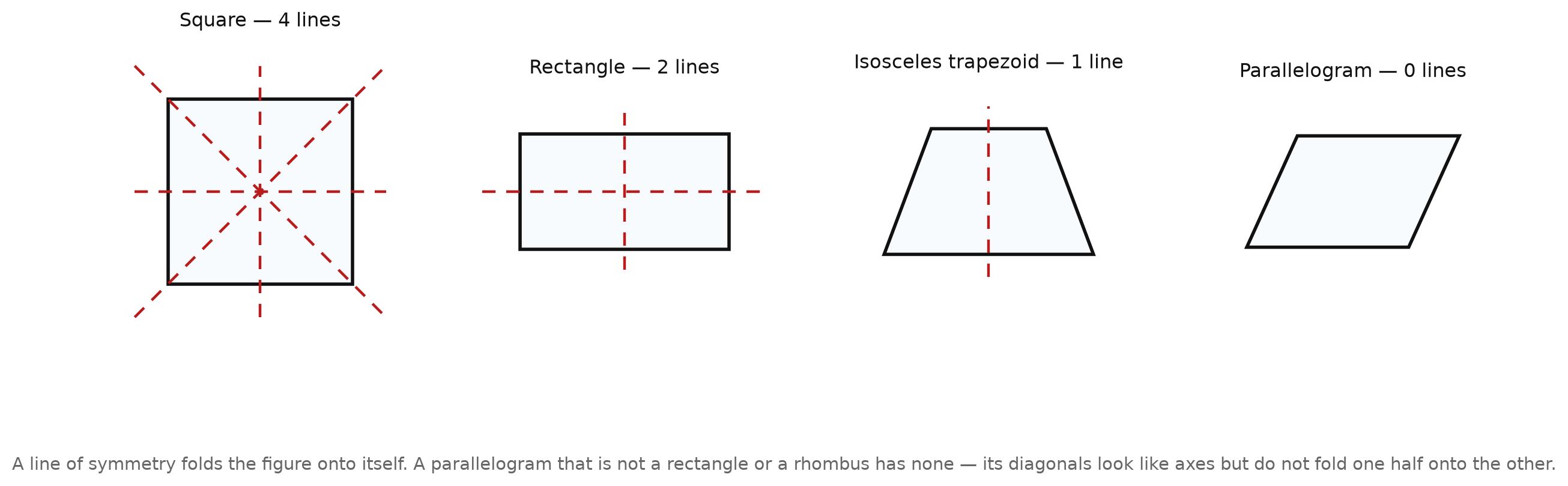
Read the four cases and one warning falls out. A parallelogram that is not a rectangle or a rhombus has no lines of symmetry. Its diagonals look like they should work, but folding along a diagonal does not carry one half onto the other — the two triangles are congruent, but they are turned, not flipped, relative to the fold. Congruent halves are not enough; the fold has to land them on top of each other.
Counting them
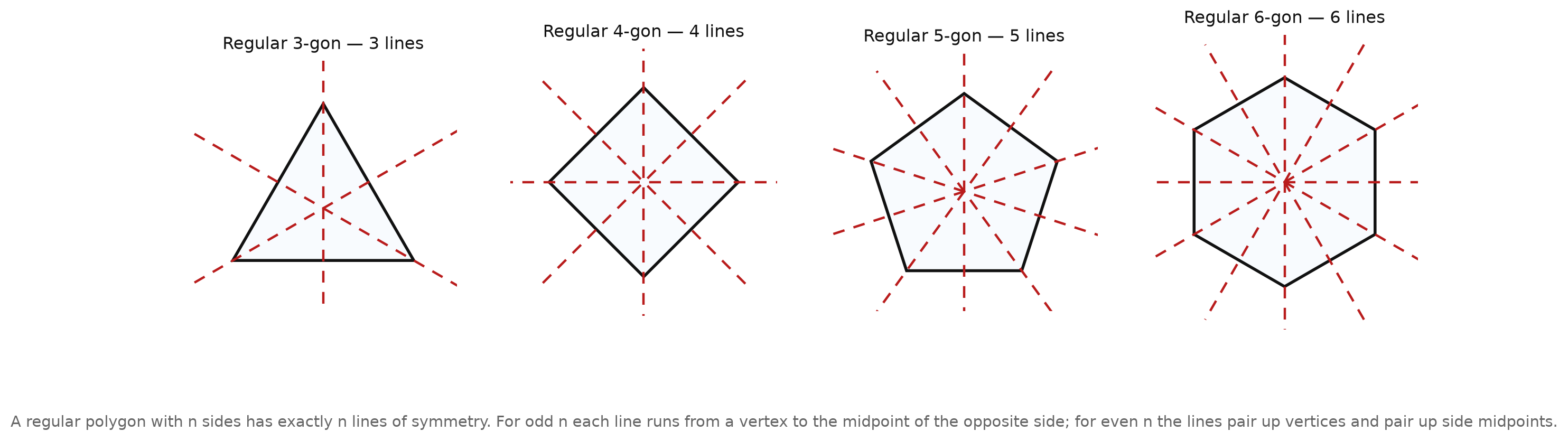
A regular polygon with sides has exactly lines of symmetry.
The picture also shows where they are, and the pattern splits on parity:
- Odd : each line runs from a vertex to the midpoint of the opposite side. There is no "vertex to vertex" line, because a vertex has no opposite vertex.
- Even : half the lines join opposite vertices and half join midpoints of opposite sides — of each.
Some other counts worth knowing, because they come up constantly:
| Figure | Lines of symmetry |
|---|---|
| Square | |
| Rectangle (not a square) | |
| Rhombus (not a square) | (the diagonals) |
| Parallelogram (neither) | |
| Isosceles trapezoid | |
| Kite | |
| Equilateral triangle | |
| Isosceles triangle (not equilateral) | |
| Scalene triangle | |
| Circle | infinitely many |
Notice the rhombus and the rectangle both have , but they are different lines: a rhombus folds along its diagonals, a rectangle folds along the lines through opposite side midpoints. A square has all four, which is exactly what being both a rectangle and a rhombus buys it.
Symmetry in context
G.RLT.3a says "including figures in context," and real designs are the same problem with better pictures.
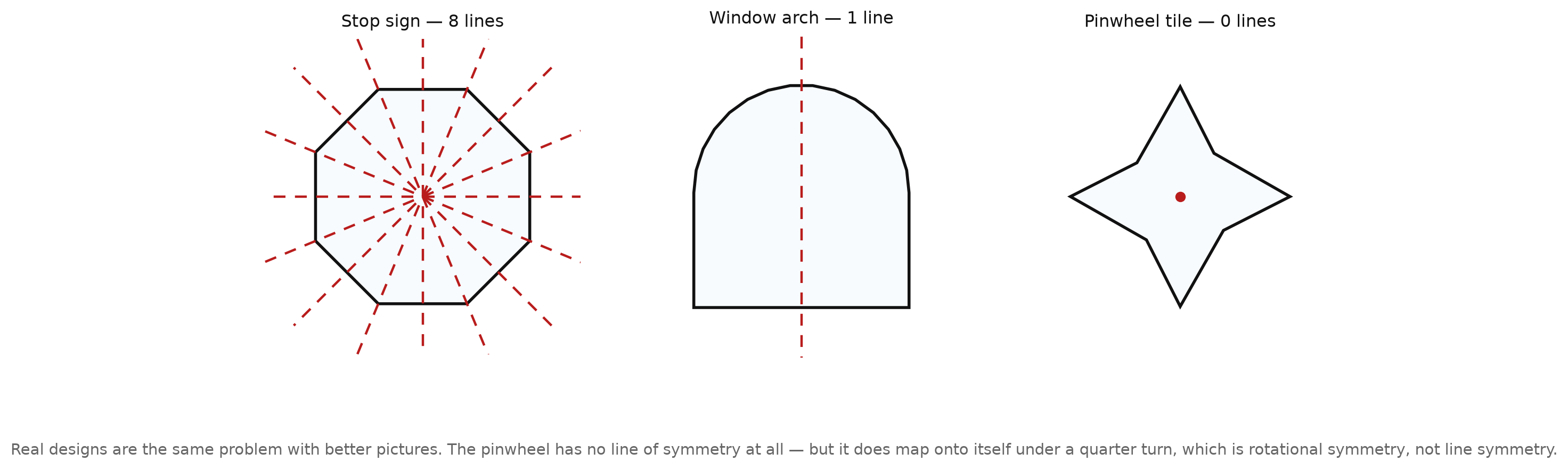
The pinwheel is the interesting one. It has no line of symmetry — no fold works, because the blades all sweep the same way and a fold would reverse them. It does map onto itself under a quarter turn, which is rotational symmetry. Lesson 3.2 separates those two ideas carefully, because "it looks symmetric" is not one property.
Worked examples
Example 1 — Counting on a regular polygon
How many lines of symmetry does a regular decagon have?
Answer: — a regular -gon has .
Example 2 — A figure with fewer than you expect
How many lines of symmetry does a parallelogram with and angles have?
Answer: None. Folding along either diagonal does not match the halves; folding along a line through opposite side midpoints does not either.
Example 3 — Telling a rhombus from a rectangle
Both have two lines of symmetry. Where are they in each?
Answer: A rhombus folds along its two diagonals. A rectangle folds along the two lines through the midpoints of opposite sides. A square has all four because it is both.
Example 4 — Drawing them
Draw all lines of symmetry of a regular hexagon and describe them.
Answer: Six lines: three joining opposite vertices and three joining the midpoints of opposite sides.
Example 5 — In context
A rectangular company logo has a design inside it that is identical on the left and right but different top and bottom. How many lines of symmetry does the logo have?
Answer: One — the vertical line. The rectangle alone would have two, but the interior design removes the horizontal fold.
Guided practice
- Use the polygons figure. How many lines of symmetry does the square have? The rectangle?
- On that same figure, how many does the isosceles trapezoid have, and where is it?
- How many does the parallelogram have? Explain why a diagonal does not work.
- Use the counting figure. How many lines does the regular pentagon have? The regular hexagon?
- For the regular hexagon, describe where the six lines are.
- Use the context figure. How many lines does the stop sign have? The window arch?
Independent practice
- Give the number of lines of symmetry. a) equilateral triangle b) isosceles triangle that is not equilateral c) scalene triangle d) regular octagon
- Give the number of lines of symmetry. a) square b) rhombus that is not a square c) rectangle that is not a square d) kite
- A regular polygon has lines of symmetry. How many sides does it have?
- A regular polygon has sides. How many lines of symmetry, and how many run vertex to vertex?
- Sketch a rhombus and draw all of its lines of symmetry. Say what they are in terms of the figure.
- Sketch a rectangle and draw all of its lines of symmetry. Say what they are.
- Application. A tile is a regular hexagon with a pattern that repeats identically in all six sections. How many lines of symmetry does the tile have?
- Application. A road sign is an equilateral triangle with a single word printed across it horizontally. How many lines of symmetry does the sign have once the word is added? Explain.
- Error analysis. A student says a parallelogram has two lines of symmetry because its diagonals cut it into congruent triangles. Identify the error.
- Reasoning. Explain why a regular polygon with an odd number of sides has no line of symmetry joining two vertices.
- Reasoning. A circle has infinitely many lines of symmetry. Describe them all in one sentence.
- Draw a figure with exactly one line of symmetry, and a different figure with exactly two.
Exit ticket 3.1
- How many lines of symmetry does a regular nonagon ( sides) have?
- How many does a rectangle that is not a square have, and where are they?
- Does a parallelogram that is not a rectangle or rhombus have any lines of symmetry? Explain in one sentence.
- What is the rule for the number of lines of symmetry of a regular -gon?
Lesson 3.2 — Line Symmetry and Point Symmetry
Two different properties
G.RLT.3b asks for a four-way decision: line symmetry, point symmetry, both, or neither. So the two have to be kept apart.
- Line symmetry — some line folds the figure onto itself. (This is Lesson 3.1.)
- Point symmetry — some point is a center about which a turn carries the figure onto itself.
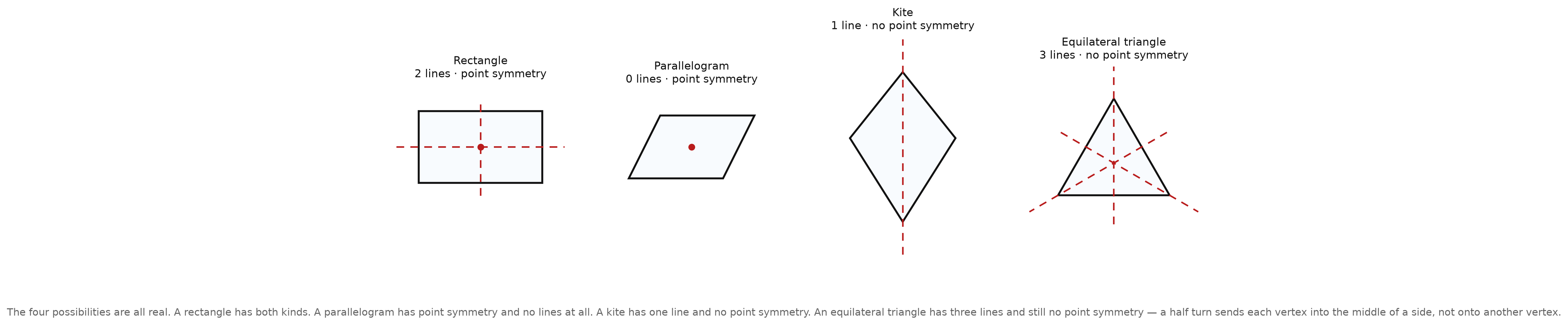
All four combinations really occur, and the figure shows three of them plus a fourth case worth stating: a scalene triangle has neither.
| Figure | Line symmetry | Point symmetry |
|---|---|---|
| Rectangle | yes () | yes |
| Parallelogram (neither rect. nor rhombus) | no | yes |
| Kite | yes () | no |
| Equilateral triangle | yes () | no |
| Scalene triangle | no | no |
| Regular hexagon | yes () | yes |
| Regular pentagon | yes () | no |
The parallelogram and the equilateral triangle are the two rows that surprise people, and they surprise in opposite directions.
Point symmetry is a half turn
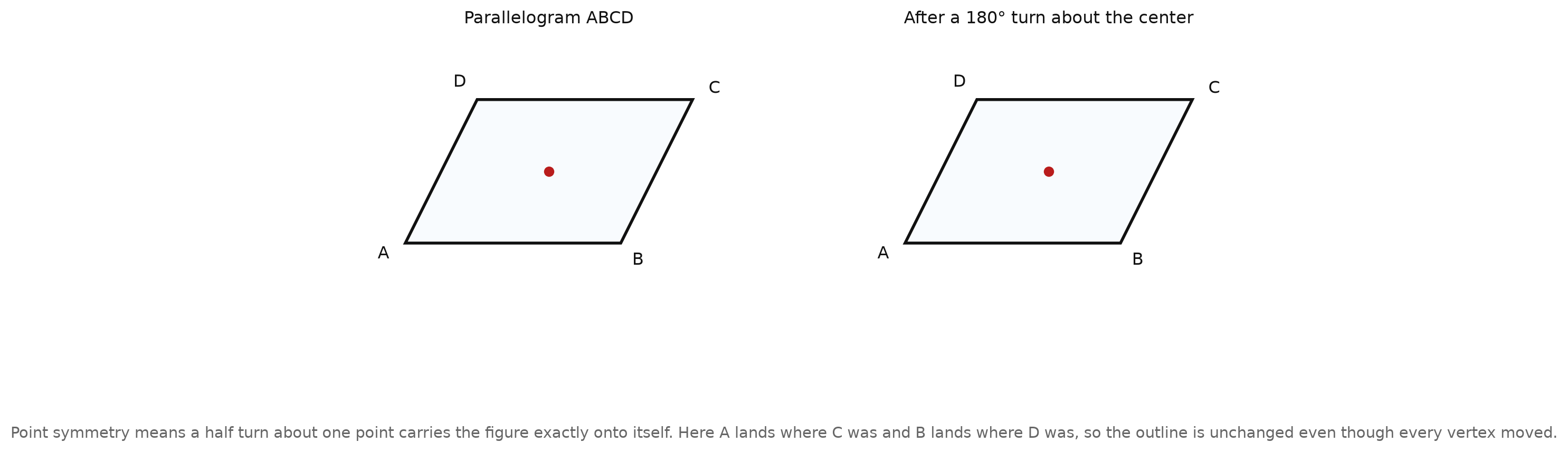
Turn the parallelogram a half turn about the point where its diagonals meet. Every vertex moves — goes to where was, goes to where was — but the outline is unchanged. That is exactly what point symmetry means, and it is why a parallelogram has it despite having no fold.
Regular polygons: an even/odd rule
Look at the last two rows of the table. A regular hexagon has point symmetry; a regular pentagon does not.
A regular -gon has point symmetry exactly when is even.
The reason is short. A half turn moves vertex number to the position steps around the polygon. When is even, that position is another vertex and the figure lands on itself. When is odd, is not a whole number of steps — a vertex lands in the middle of a side, and the outline does not match.
Deciding for a figure in context
For any figure, ask the two questions in order:
- Is there a fold? Try the obvious candidates — vertical, horizontal, diagonals, vertex-to-midpoint lines. Every one that works is a line of symmetry, and you must count all of them.
- Is there a half turn? Find the likely center (usually the middle of the figure) and check whether turning reproduces the outline.
The answers are independent. Getting one does not tell you the other.
Worked examples
Example 1 — Both
Does a square have line symmetry, point symmetry, both, or neither?
Answer: Both. Four lines of symmetry, and a half turn about the center maps it onto itself.
Example 2 — Point only
Does a parallelogram with and angles have line symmetry, point symmetry, both, or neither?
Answer: Point symmetry only. No fold works; a half turn about the intersection of the diagonals does.
Example 3 — Line only
Does an isosceles trapezoid have point symmetry?
Answer: No. It has one line of symmetry, but a half turn would put the short base where the long base is, and they are different lengths.
Example 4 — The odd regular polygon
Does a regular pentagon have point symmetry?
Answer: No, because is odd. A half turn sends each vertex into the middle of an opposite side.
Example 5 — Neither
Give a figure with neither kind of symmetry.
Answer: A scalene triangle. No fold matches its sides, and a half turn about any point changes the outline's position.
Guided practice
- Use the line-versus-point figure. Which figure has both kinds of symmetry?
- On that same figure, which has point symmetry but no lines?
- Which has one line and no point symmetry?
- Use the half-turn figure. After the turn, where does vertex land?
- Why does the parallelogram's outline look unchanged even though every vertex moved?
- Does a regular pentagon have point symmetry? State the rule you used.
Independent practice
- For each, state line symmetry, point symmetry, both, or neither. a) square b) rhombus that is not a square c) isosceles trapezoid d) scalene triangle
- For each, state line symmetry, point symmetry, both, or neither. a) regular octagon b) regular heptagon ( sides) c) kite d) circle
- Give the number of lines of symmetry and whether there is point symmetry, for a regular -gon.
- Explain why an equilateral triangle has three lines of symmetry but no point symmetry.
- Sketch a figure with point symmetry and exactly zero lines of symmetry.
- Sketch a figure with exactly one line of symmetry and no point symmetry.
- Application. A playing card's design is unchanged when the card is turned upside down. Which kind of symmetry is that, and which kind does it not guarantee?
- Application. A company logo is made of four identical curved blades sweeping the same way around a center, like a pinwheel. Does it have line symmetry? Point symmetry? Explain.
- Error analysis. A student says every figure with point symmetry also has line symmetry. Give a counterexample and explain.
- Error analysis. A student says a regular polygon always has point symmetry because it is regular. Give a counterexample and state the correct rule.
- Reasoning. Explain why the parity of decides whether a regular -gon has point symmetry.
- Reasoning. A figure has exactly two lines of symmetry that are perpendicular to each other. Explain why it must also have point symmetry.
Exit ticket 3.2
- Does a parallelogram that is not a rectangle have line symmetry? Point symmetry?
- Does a regular hexagon have point symmetry? Why?
- Give a figure with line symmetry and no point symmetry.
- State the difference between line symmetry and point symmetry in one sentence each.
Lesson 3.3 — Translations and Reflections
Translations
A translation slides every point of a figure the same distance in the same direction.
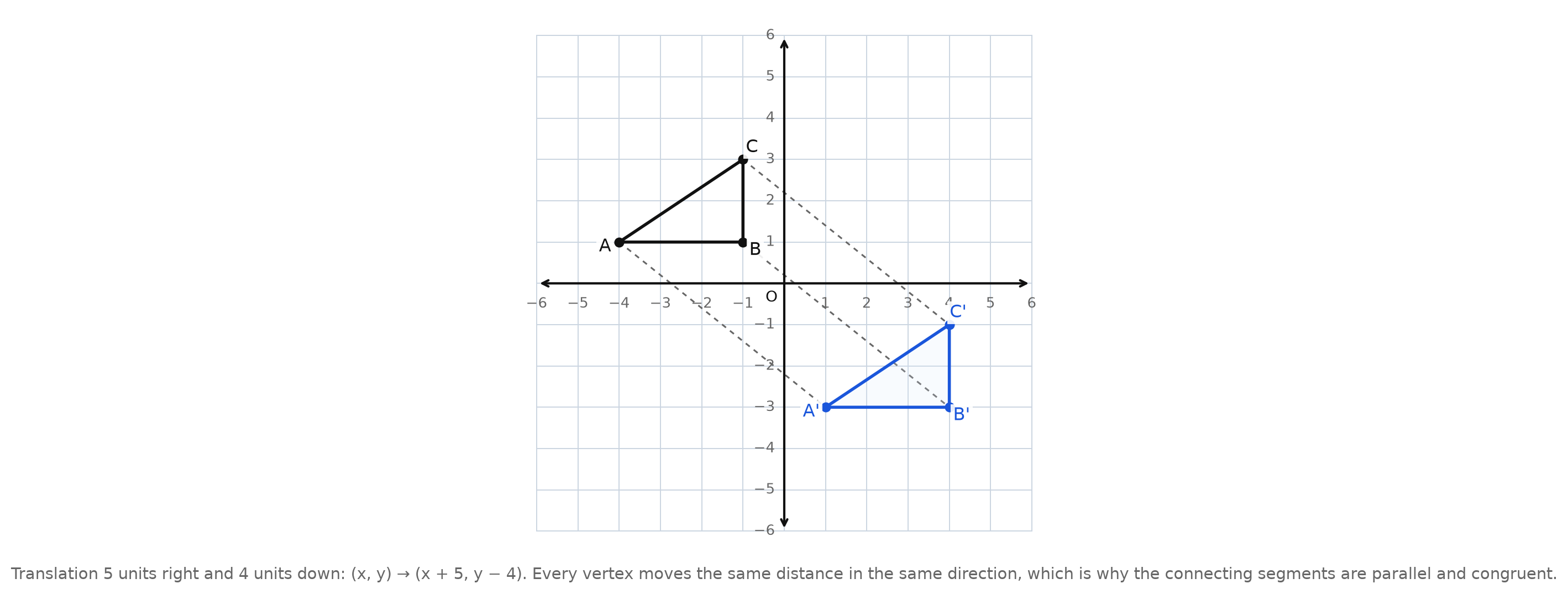
The rule for a slide of units horizontally and units vertically is
with positive for right and negative for left, positive for up and negative for down. The figure uses : five right, four down.
Look at the dashed segments joining to , to , and to . They are parallel and congruent, because every point made the same trip. That is a good check on your work: if the connecting segments are not parallel and the same length, it is not a translation.
A translation is a rigid motion — the image is congruent to the preimage, same size and same orientation.
The four reflections
A reflection flips a figure over a line, called the line of reflection or the mirror line. G.RLT.3d names exactly four mirror lines.
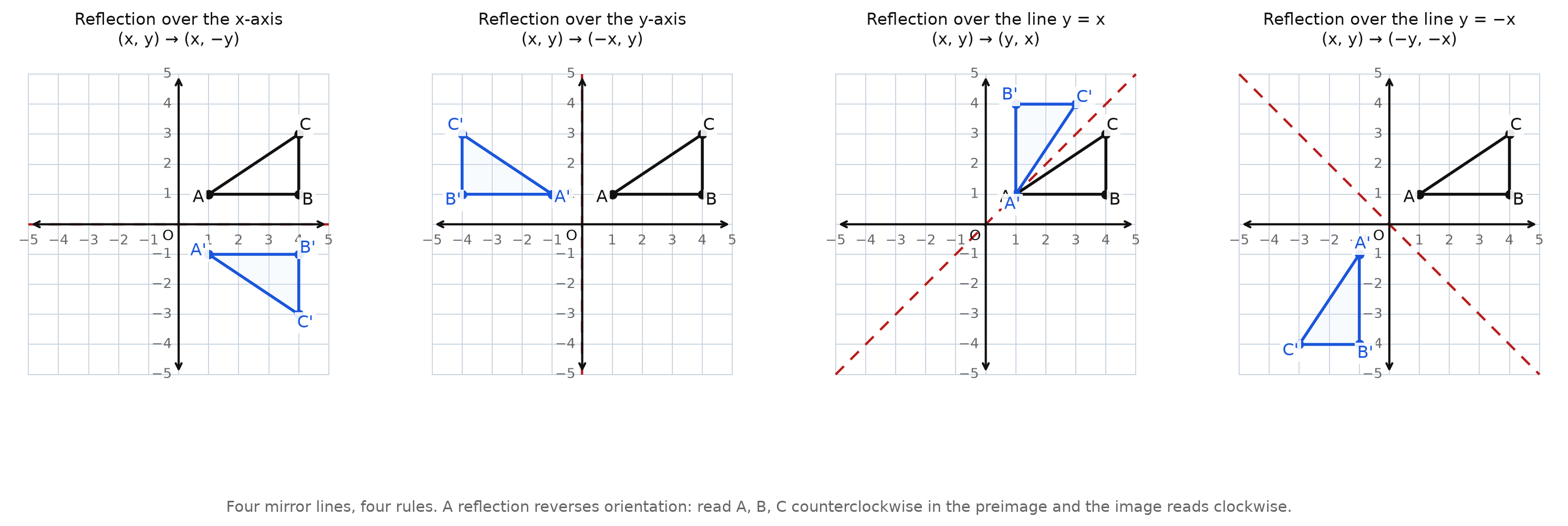
| Mirror line | Rule | What changes |
|---|---|---|
| -axis | sign of | |
| -axis | sign of | |
| coordinates swap | ||
| swap and both signs change |
Three facts to hold on to:
- A reflection is a rigid motion, so the image is congruent to the preimage.
- A reflection reverses orientation. If , , read counterclockwise around the preimage, then , , read clockwise. No translation or rotation does that, which is what makes reflection identifiable in Lesson 3.5.
- A point on the mirror line does not move. In the panel, is on the line, so as well. That is not an error in the drawing.
Running a rule backwards
G.RLT.3d says "the image or preimage." Finding a preimage means undoing the rule.
If a translation produced the image point , then the preimage satisfies and , so it was . In short: subtract what was added.
Reflections undo themselves. Reflecting over the -axis twice returns every point to where it started, so the preimage of under a reflection over the -axis is — the same rule applied again.
Worked examples
Example 1 — Applying a translation
Find the image of under .
Answer: .
Example 2 — Writing the rule from a picture
maps to under a translation. Write the rule.
Answer: and , so .
Example 3 — Reflecting a triangle
Reflect , , over the -axis.
Answer: , , .
Example 4 — Reflecting over
Find the image of over the line .
Answer: — swap and negate both.
Example 5 — Finding a preimage
A reflection over produced . What was the preimage?
Answer: . Reflecting over swaps coordinates, and applying it again undoes it.
Guided practice
- Use the translation figure. Give the coordinates of , , and of , , .
- Write the translation rule shown in that figure.
- Why are the dashed connecting segments parallel and congruent?
- Use the reflections figure. Give the rule for a reflection over the -axis and over the -axis.
- On that same figure, give the rule for and for .
- In the panel, why is in the same place as ?
Independent practice
- Find the image of each point under . a) b) c)
- Triangle , , is translated units left and units down. Give the image coordinates and write the rule.
- Find the image of under a reflection over each of the four named lines.
- Reflect , , over the -axis, then over the -axis, and give both images.
- A translation maps to . Write the rule, then use it to find the image of .
- A reflection over the -axis produced . What was the preimage?
- A translation produced . What was the preimage?
- Application. A game piece at is moved squares right and squares up each turn. Write the rule and give its position after one turn and after two turns.
- Application. A design on graph paper is flipped over the -axis to make the other half of a logo. A point of the original is at . Where is its mirror point?
- Error analysis. A student reflects over and writes . Identify the error and give the correct image.
- Reasoning. Explain why a reflection reverses orientation but a translation does not.
- Reasoning. A point does not move under a reflection. What must be true about the point?
Exit ticket 3.3
- Find the image of under .
- Reflect over the -axis and over .
- A translation maps to . Write the rule.
- Which named reflection changes both coordinates' signs and swaps them?
Lesson 3.4 — Rotations and Dilations
Rotations about the origin
A rotation turns every point about a fixed center through a fixed angle. G.RLT.3d limits the center to the origin and the angle to , , or .
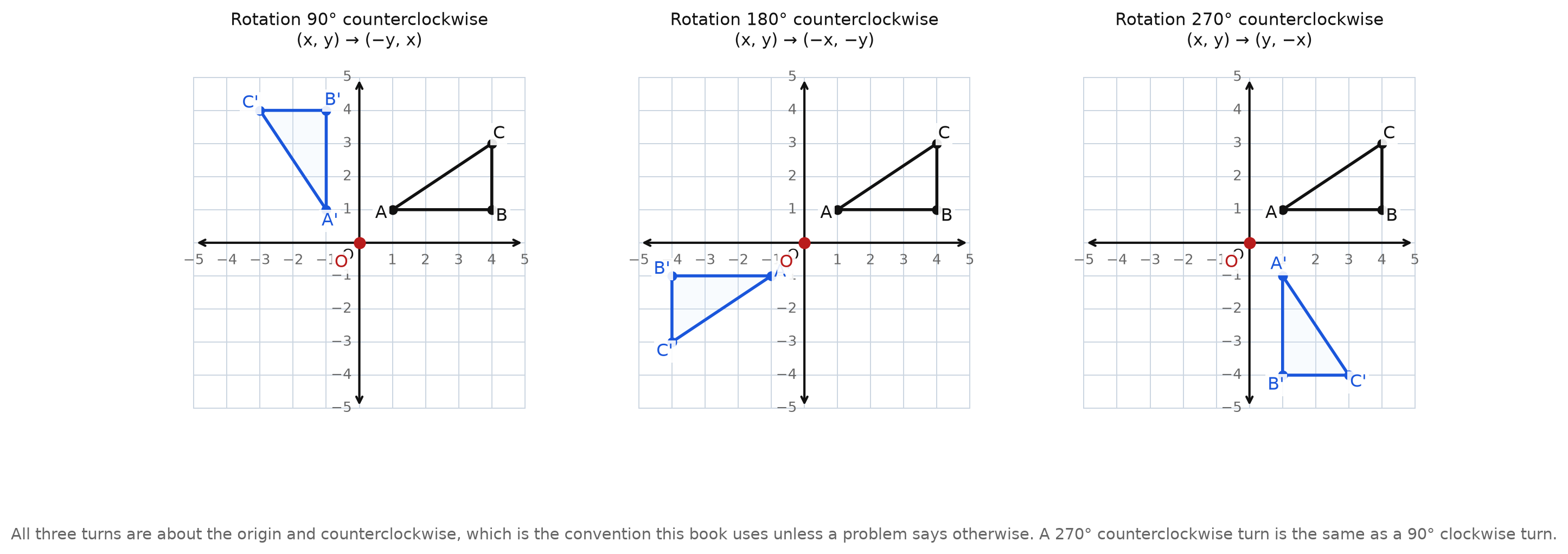
| Turn (counterclockwise) | Rule |
|---|---|
Three things make these easier to remember than they look:
- is the easy one — negate both. It is also the point-symmetry turn from Lesson 3.2.
- and both swap the coordinates, and differ only in which one gets the negative sign. If you can remember one, the other is its opposite.
- Direction matters, and this book's default is counterclockwise. A counterclockwise turn is the same as a clockwise turn, so a problem that says " clockwise" is asking for the rule.
A rotation is a rigid motion: same size, same orientation (a rotation does not reverse orientation the way a reflection does).
A quick check on your arithmetic
Rotating an integer point by a quarter turn must land on another integer point, and the distance from the origin must not change. If is units from the origin, so is its image. Checking that distance catches sign errors immediately.
Dilations from the origin
A dilation resizes a figure from a center by a scale factor . G.RLT.3d centers it at the origin, which makes the rule simple:
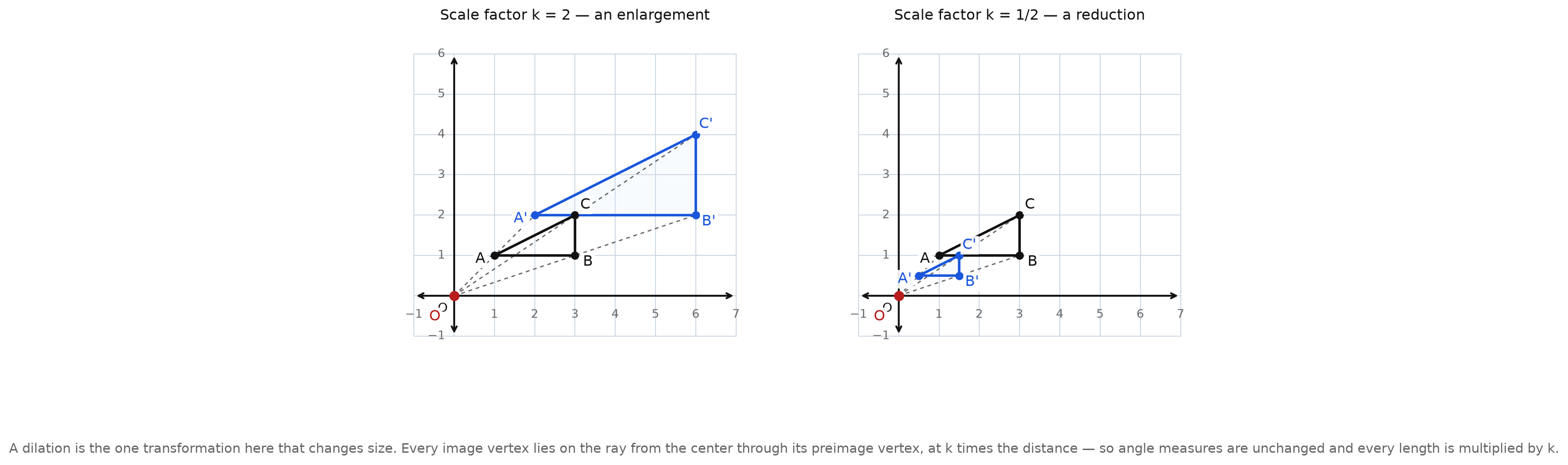
- gives an enlargement; the image is farther from the center.
- gives a reduction; the image is closer.
- leaves the figure alone.
The dashed rays are what makes a dilation recognizable: every image vertex lies on the ray from the center through its preimage vertex, at times the distance.
A dilation is not a rigid motion. It multiplies every length by — so a side that was units becomes — while leaving every angle measure unchanged. That combination, same angles and proportional sides, is exactly the definition of similar figures in Chapter 7.
Comparing the four transformations
| Transformation | Distances | Angle measures | Orientation |
|---|---|---|---|
| Translation | preserved | preserved | preserved |
| Reflection | preserved | preserved | reversed |
| Rotation | preserved | preserved | preserved |
| Dilation | multiplied by | preserved | preserved |
The first three are the rigid motions, and they produce congruent figures. The fourth produces a similar figure. This table is the whole reason the chapter exists where it does in the book.
Worked examples
Example 1 — A quarter turn
Rotate by counterclockwise about the origin.
Answer: .
Example 2 — A half turn
Rotate by about the origin.
Answer: .
Example 3 — Clockwise wording
Rotate by clockwise about the origin.
Answer: That is the counterclockwise rule, , so the image is .
Example 4 — A dilation
Dilate , , from the origin by .
Answer: , , . Each side length doubled; each angle is unchanged.
Example 5 — Finding the scale factor
A dilation from the origin maps to . Find .
Answer: and , so . Both coordinates must give the same ratio; if they do not, it is not a dilation from the origin.
Guided practice
- Use the rotations figure. Give the rule for a counterclockwise rotation about the origin.
- Give the rule for and for .
- On that figure, which rotation is the same as a half turn, and where else has it appeared in this chapter?
- Use the dilations figure. What scale factor is used in each panel, and which is an enlargement?
- What do the dashed rays show?
- Which of the four transformations is not a rigid motion, and what does it change?
Independent practice
- Rotate each point counterclockwise about the origin. a) b) c)
- Rotate each point about the origin. a) b)
- Rotate each point counterclockwise about the origin. a) b)
- Triangle , , is rotated counterclockwise about the origin. Give the image coordinates.
- Dilate from the origin by , and by .
- A dilation from the origin maps to . Find .
- Rectangle , , , is dilated by from the origin. Give the image, and compare the perimeter of the image with the perimeter of the preimage.
- Application. A logo is enlarged from the origin by a factor of for a banner. A point of the small logo is at . Where is it on the banner, and what happens to the logo's angles?
- Application. A robot arm at swings counterclockwise about a pivot at the origin. Where does it end up? What if it swings clockwise instead?
- Error analysis. A student rotates by counterclockwise and writes . Identify the error and give the correct image.
- Error analysis. A student says a dilation with triples every angle measure. Correct the statement.
- Reasoning. Explain why the distance from the origin is unchanged by any of the three rotations, and how that fact catches sign errors.
- Reasoning. Explain why a dilation produces a similar figure rather than a congruent one, using the comparison table.
Exit ticket 3.4
- Rotate by counterclockwise about the origin.
- Rotate by about the origin.
- Dilate from the origin by .
- Which transformation preserves angle measures but not distances?
Lesson 3.5 — Naming a Transformation from Its Image
Reading the picture backwards
G.RLT.3c gives you a preimage and an image and asks which transformation happened. Three questions settle it, asked in this order.
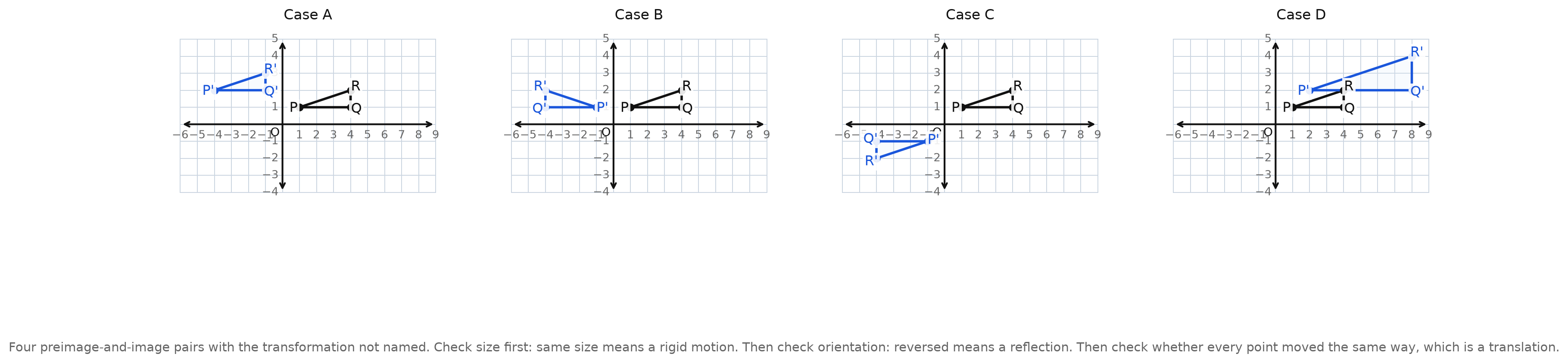
- Is it the same size?
- No → it is a dilation. Find by dividing an image length by the matching preimage length (or an image coordinate by the matching preimage coordinate, if the center is the origin).
- Yes → it is a rigid motion; keep going.
- Is the orientation reversed? Read the vertices in order around each figure. If the preimage reads counterclockwise and the image reads clockwise, it is a reflection.
- Did every point move the same distance in the same direction?
- Yes → translation. Check by computing , , ; all three differences must be identical.
- No → rotation. Confirm by checking that each vertex kept its distance from the center.
Applying this to the figure: Case A is a translation, Case B is a reflection over the -axis, Case C is a rotation about the origin, and Case D is a dilation with .
Watch the rotation. It negates both coordinates, and so does a reflection over the origin — but a reflection over a line is what the standard names, and a rotation preserves orientation while any reflection reverses it. Reading the vertex order is what separates them.
Combinations of two
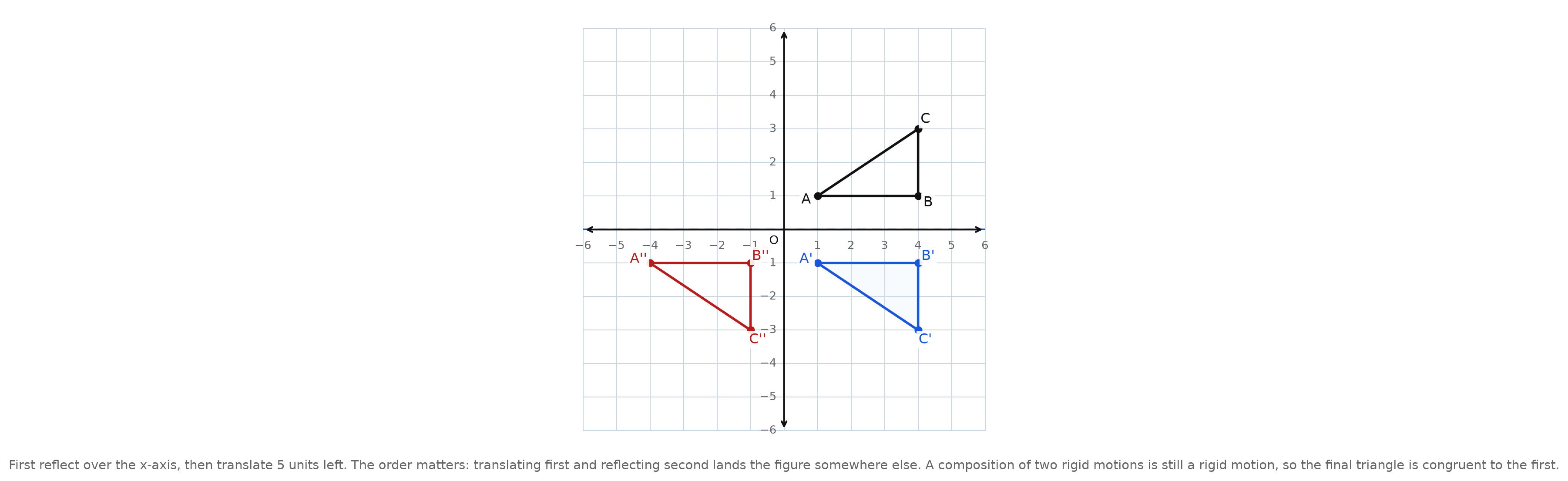
A composition applies one transformation and then another to the result. The figure reflects over the -axis first and then translates units left:
Two things matter:
- Order matters. Translating first and then reflecting produces a different final position, so a description of a composition must say which came first.
- A composition of rigid motions is a rigid motion. The final triangle here is congruent to the original — which is exactly the statement Chapter 5 turns into congruence criteria.
To name a combination from a picture, look for an intermediate step: is there a reflection that gets the orientation right, followed by a slide that gets the position right?
Worked examples
Example 1 — Same size, reversed orientation
with , , has image , , . Name the transformation.
Answer: A reflection over the -axis — each -coordinate changed sign and each -coordinate did not.
Example 2 — Same difference every time
, , . Name the transformation and write its rule.
Answer: A translation, since every difference is . Rule: .
Example 3 — A different size
and . Name the transformation and give .
Answer: A dilation from the origin with ; both coordinates of each point tripled.
Example 4 — Telling a rotation from a reflection
has image , , . Rotation or reflection?
Answer: A rotation about the origin. Both coordinates changed sign, and reading , , around the preimage and , , around the image gives the same direction — orientation is preserved, so it is not a reflection.
Example 5 — Naming a composition
, and the intermediate image was . Describe the composition.
Answer: A reflection over the -axis, then a translation units left.
Guided practice
- Use the identify figure. Which case is a dilation, and how do you know before computing anything?
- In that figure, which case reverses orientation?
- Which case has the same difference for every pair of corresponding vertices?
- Name the transformation in Case C, and say how you separated it from a reflection.
- Use the composition figure. What was the first transformation, and what was the second?
- Why does the order of a composition matter?
Independent practice
- Name the transformation for each. a) , , b) , , c) , , d) , ,
- For any part of item 96 that is a translation, write the rule. For any dilation, give .
- maps to with the same side lengths and reversed orientation. Which transformation is it, and which two are ruled out?
- Apply a reflection over the -axis and then a translation units right to . Give both images.
- Apply the same two transformations in the opposite order to . Compare the results.
- Application. A pattern is made by reflecting a shape over the -axis and then translating it units up. Give the final image of .
- Application. A photo is resized so that a feature at moves to , with the center at the origin. Which transformation, and what is ? Did the photo's angles change?
- Error analysis. A student sees an image the same size as the preimage with reversed orientation and calls it a rotation. Identify the error.
- Reasoning. Explain why checking "same size?" first is more efficient than checking orientation first.
- Reasoning. A composition of two reflections over the -axis returns the figure to its start. What single transformation is that composition equivalent to?
- Describe a composition of two transformations that carries to , and state the order.
Exit ticket 3.5
- An image is half the size of its preimage. Which transformation, and what is ?
- An image is the same size with reversed orientation. Which transformation?
- Every corresponding pair of vertices differs by . Which transformation, and what is its rule?
- Give the three questions, in order, that identify a transformation from a preimage-and-image pair.
Lesson 3.6 — General Lines, Any Center, and the Full Turn
Reflecting over any horizontal or vertical line
Lesson 3.3 reflected only over the -axis and the -axis. G.RLT.3d actually names something bigger: reflection over any horizontal line or any vertical line , of which the two axes are just the and cases.
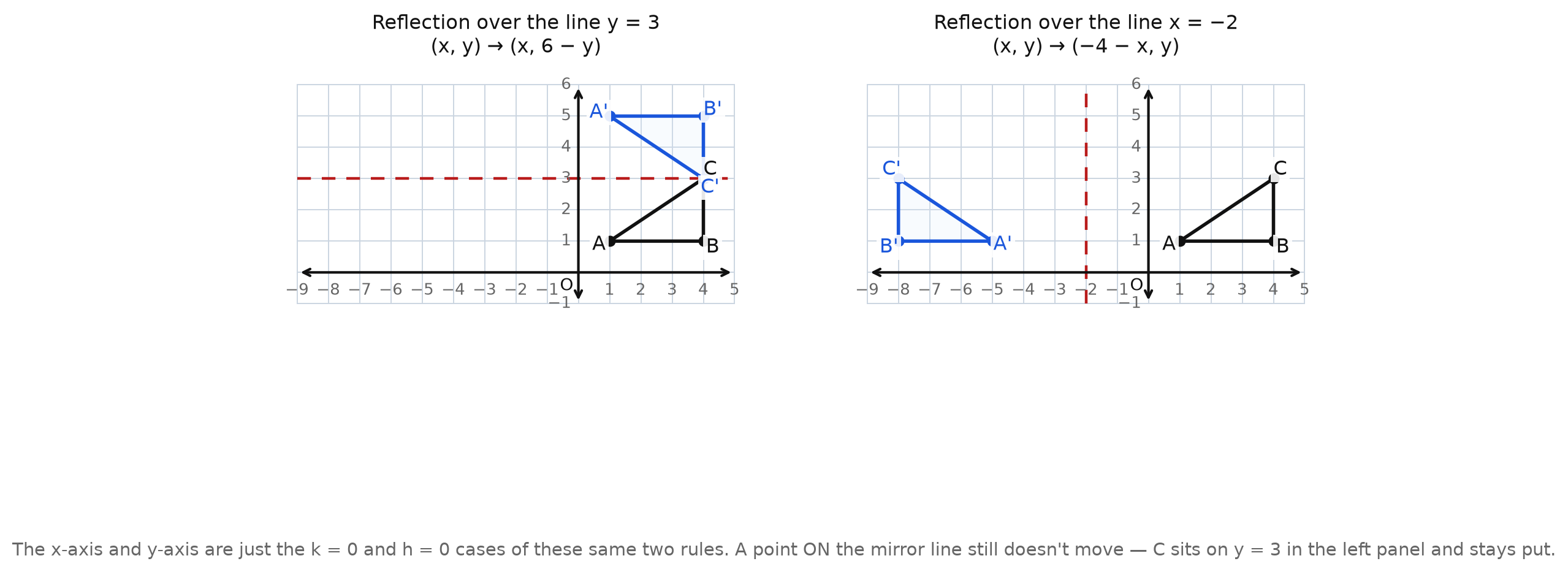
Two ways to keep this straight:
- The coordinate that names the line is the one that gets the new rule. A horizontal line's equation is " something," and it is the -coordinate that changes; a vertical line's equation is " something," and it is the -coordinate that changes.
- Check the special case. Setting in the horizontal rule gives — exactly the -axis rule from Lesson 3.3. Setting in the vertical rule gives the -axis rule. The two lessons are not two different ideas; Lesson 3.3 was the / special case of this one all along.
- A point on the mirror line still does not move. In the figure, sits exactly on , and its image lands right on top of it.
Dilating from any center
Lesson 3.4 dilated only from the origin. The general rule allows any center :
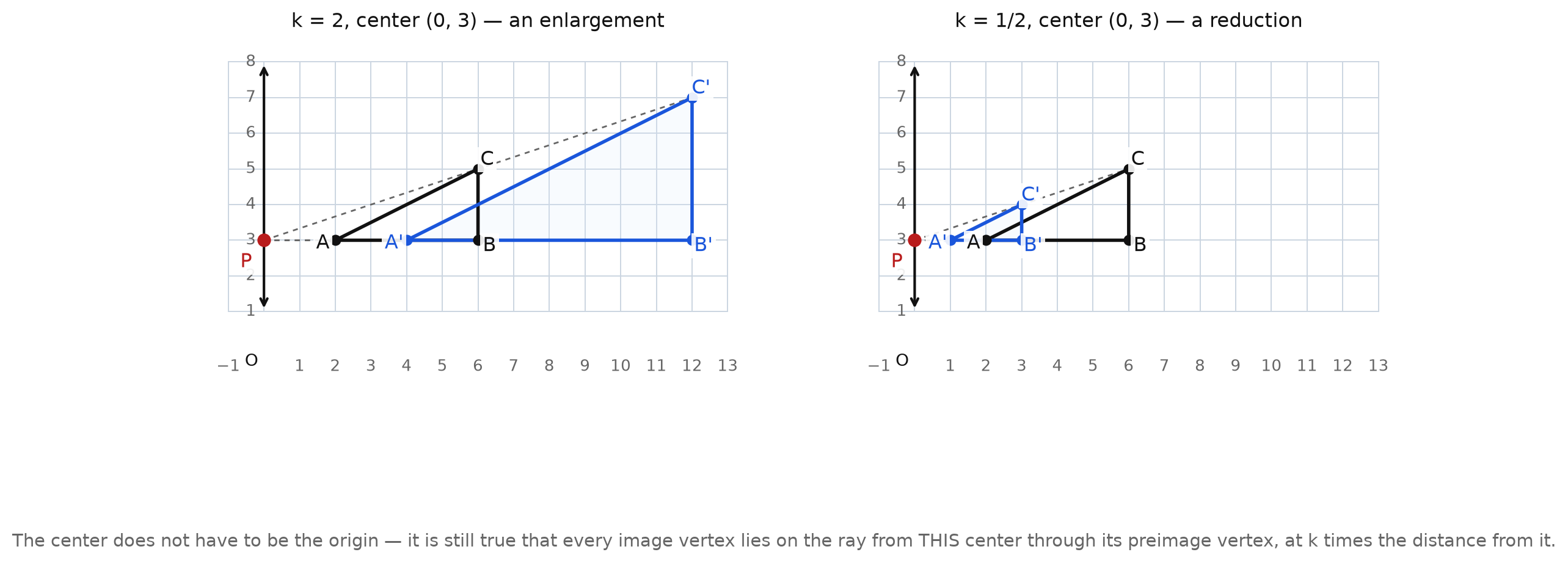
Read the rule as "the distance from the center, not from the origin, gets multiplied by ." Concretely: subtract the center's coordinates first (so the center sits at the origin, temporarily), multiply by , then add the center's coordinates back. Setting collapses this exactly to Lesson 3.4's — again, the earlier rule was the special case of this one, not a different rule.
Everything Lesson 3.4 found true about dilation from the origin is still true from any center: image vertices lie on the ray from the center through the matching preimage vertex, at times the distance from that center; angle measures are unchanged; every length is multiplied by .
The rotation
G.RLT.3d's list of rotations includes alongside , , and . A full turn brings every point back to exactly where it started:
This is the identity transformation — the do-nothing map. It is still worth naming explicitly, for two reasons: first, the standard lists it, so a problem is allowed to ask for it; second, it is a useful check on the pattern from Lesson 3.4 — a turn done four times in a row is a turn, and four applications of really do return to itself.
Worked examples
Example 1 — Reflecting over a horizontal line
Reflect over .
Answer: .
Example 2 — Reflecting over a vertical line
Reflect over .
Answer: .
Example 3 — Dilating from an off-origin center
Dilate from center by .
Answer: .
Example 4 — A reduction from an off-origin center
Dilate from center by .
Answer: .
Example 5 — The full turn
Rotate by about the origin.
Answer: — unchanged. A full turn is the identity transformation.
Guided practice
- Use the general-reflections figure. Give the rule and the image for the reflection over .
- On that same figure, give the rule and the image for the reflection over .
- Why does point stay exactly where it is in the reflection?
- Use the any-center dilation figure. Identify the center, and give the image for .
- On that same figure, give the image for , using the same center.
- Explain why the -axis and -axis reflections from Lesson 3.3 are special cases of this lesson's general rule, rather than separate rules.
Independent practice
Reflect over .
Reflect over .
Reflect over .
Reflect over .
Reflect over .
Triangle , , is reflected over . Give the image coordinates.
Dilate from center by .
Dilate from center by .
Dilate from center by .
Rectangle , , , is dilated from center by . Give the image, and compare the perimeter of the image with the perimeter of the preimage.
A dilation from center maps to . Find .
Rotate by about the origin. Give the image, and explain why in one sentence.
Application. A design app reflects a pattern over the horizontal guideline to create a mirrored copy below it. A point of the pattern is at . Where does its mirror point land?
Error analysis. A student reflects over the line and writes , treating it like a reflection over the -axis. Identify the error and give the correct image.
Reasoning. Using the general rule , explain why reflecting over the -axis is exactly the case, rather than a rule that has to be memorized separately.
Exit ticket 3.6
- Reflect over .
- Dilate from center by .
Chapter 3 Review
Vocabulary. line of symmetry · point symmetry · preimage · image · transformation · translation · reflection · line of reflection · rotation · center of rotation · dilation · scale factor · rigid motion · orientation · composition
Review 1 (G.RLT.3 a, b). For each figure, give the number of lines of symmetry and state whether it has point symmetry: a square; a rhombus that is not a square; an isosceles trapezoid; a regular heptagon; a regular decagon; a parallelogram that is neither a rectangle nor a rhombus. Then state the two general rules you used for the regular polygons.
Review 2 (G.RLT.3d). has , , . Give the image coordinates under each transformation, one at a time from the original triangle:
- reflection over the -axis
- reflection over
- rotation counterclockwise about the origin
- rotation counterclockwise about the origin
- dilation from the origin with
Then say which of the six images are congruent to and which is only similar, and why.
Review 3 (G.RLT.3 c, d). A figure with vertices , , has image , , .
- Show that the image is congruent to the preimage by comparing two corresponding side lengths.
- Name a single transformation that produces it, and justify with a coordinate rule.
- Name a composition of two transformations that produces the same image, and state the order.
- Explain how you ruled out a reflection over one of the four named lines as a single-step answer.
Review 4 (G.RLT.3d). has , , .
- Reflect the triangle over . Give the image.
- Reflect the original triangle over . Give the image.
- Dilate the original triangle from center by . Give the image, and explain why does not move.
- Rotate the original triangle about the origin. Give the image without computing any coordinates, and explain why that shortcut is valid.
Standards coverage check — Chapter 3
| Knowledge and Skill | Where it is taught | Where it is practiced | Where it is applied in context |
|---|---|---|---|
| G.RLT.3a — locate, count, and draw lines of symmetry, including figures in context | 3.1 (definition, the -gon rule, the standard figure counts, the context designs) | 1–12, 15–22; 29–31 | 13, 14; Review 1 |
| G.RLT.3b — line symmetry, point symmetry, both, or neither | 3.2 (the four-way decision, the half-turn picture, the even/odd rule for regular polygons) | 23–34, 37–44 | 35, 36; Review 1 |
| G.RLT.3c — identify the transformation or combination from a preimage and image | 3.5 (the three questions, in order; compositions) | 90–98, 103–110 | 101, 102; Review 3 |
| G.RLT.3d — determine the image or preimage under the named transformations and combinations | 3.3 (translations; the four reflections; running a rule backwards); 3.4 (three rotations; dilations from the origin); 3.6 (general horizontal/vertical reflections; dilations from any center; the rotation) | 45–57, 60–79, 82–89; 99, 100; 111–128, 130, 131 | 58, 59, 80, 81; 129; Review 2, Review 3, Review 4 |
Supporting items: 16, 17, 32, 39, 40, 61, 62, 84, 85, 104, 105, and 131 are the reasoning items, several of which are the bridge to later chapters — item 85 is where similarity is first named, and item 105 previews that a composition of two reflections is itself a rigid motion. The error analyses target the recurring confusions: treating a parallelogram's diagonals as folds (15), assuming point symmetry follows from line symmetry or from regularity (37, 38), swapping without negating on a reflection (60), applying the rule when was asked (82), thinking a dilation scales angles (83), calling a reflection a rotation (103), and reflecting over a general vertical line as if it were the -axis (130).
Boundaries respected. No item asks for a rotation about a point other than the origin, which the standard excludes by limiting the center to the origin. Compositions are limited to two transformations. Lesson 3.6 closes the gap logged in earlier drafts of PHASE5-GEOMETRY-OUTLINE.md: reflections over a general horizontal or vertical line, dilations from a center other than the origin, and the rotation are now all taught and practiced, using the _geobase helpers' existing center argument (rotation, dilation) and one short addition to reflect (a general mirror line). The words congruent and similar are introduced here as consequences of the comparison table, but the criteria that prove them are Chapters 5 and 7.
Answer keys for every item in this chapter are in Appendix A.