Chapter 2 — Parallel Lines Cut by a Transversal
Standard: G.RLT.2 (a, b, c)
G.RLT.2 — verbatim. The student will analyze, prove, and justify the relationships of parallel lines cut by a transversal. Students will demonstrate the following Knowledge and Skills: a) Prove and justify angle pair relationships formed by two parallel lines and a transversal, including corresponding angles, alternate interior angles, alternate exterior angles, same-side (consecutive) interior angles, and same-side (consecutive) exterior angles. b) Prove two or more lines are parallel given angle measurements expressed numerically or algebraically. c) Solve problems, including those in context, by using the relationships between pairs of angles formed by the intersection of two parallel lines and a transversal.
By the end of this chapter you will be able to:
- Name all eight angles a transversal forms with two lines, and sort them into interior and exterior (G.RLT.2a)
- Identify each of the five named pairs — corresponding, alternate interior, alternate exterior, same-side interior, same-side exterior — and say whether the pair is congruent or supplementary (G.RLT.2a)
- Write a two-column proof of each relationship, starting from the corresponding-angles postulate (G.RLT.2a)
- Find every angle in a figure from one given measure, naming the relationship at each step (G.RLT.2c)
- Solve for a variable when angle measures are given algebraically, choosing between "set them equal" and "set the sum to " (G.RLT.2 b, c)
- Use the converses to prove two lines are parallel — or to prove they are not (G.RLT.2b)
- Apply all of it to a context where the parallel lines are curbs, rafters, or rows (G.RLT.2c)
Lessons: 2.1 The Transversal and Its Eight Angles · 2.2 Proving the Angle Pair Relationships · 2.3 Angle Chases, Numeric and Algebraic · 2.4 Proving Lines Are Parallel · 2.5 Parallel Lines in Context
Why this chapter matters. This is where Geometry starts proving things, and it is a good place to start because the figure is simple enough to hold in your head and the results are used everywhere afterwards. The angle sum of a triangle (Chapter 4) is proved by drawing a parallel line and using alternate interior angles. Parallelogram properties (Chapter 10) are proved by cutting the figure with a diagonal and using the same theorem. If you learn one thing here beyond the five pairs, learn the shape of a proof: a column of claims, each with a reason, ending at the thing you were asked to show.
Scope note. The standard names exactly five angle pairs, and this chapter teaches those five. Vertical angles and linear pairs come from Grade 8 and are used freely as reasons — they are not new here, but they are indispensable, because most of the five theorems are proved by combining a corresponding-angle step with a vertical-angle step. Perpendicular transversals appear only as the special case where every angle is .
Conventions this chapter fixes.
- Two parallel lines are written , and the marks on a figure that say so are matching arrowheads on each line.
- Angles are numbered through : at the upper line, and sit above it (left, then right) and and below it; at the lower line, through repeat the same pattern. Every figure in this chapter uses that numbering.
- Interior angles lie between the two lines (, , , ). Exterior angles lie outside them (, , , ).
- Congruent, not equal. ; . A proof line that mixes the two is incomplete.
- Every proof line has a claim and a reason. "Given" is a reason. "It looks like it" is not.
- Item numbering runs straight through the chapter, from 1 in Lesson 2.1 to 106 at the end of the review.
Lesson 2.1 — The Transversal and Its Eight Angles
The figure this whole chapter is about
A transversal is a line that crosses two or more other lines at distinct points. Two lines and a transversal make eight angles, and this chapter is about how those eight are related when the two lines are parallel.
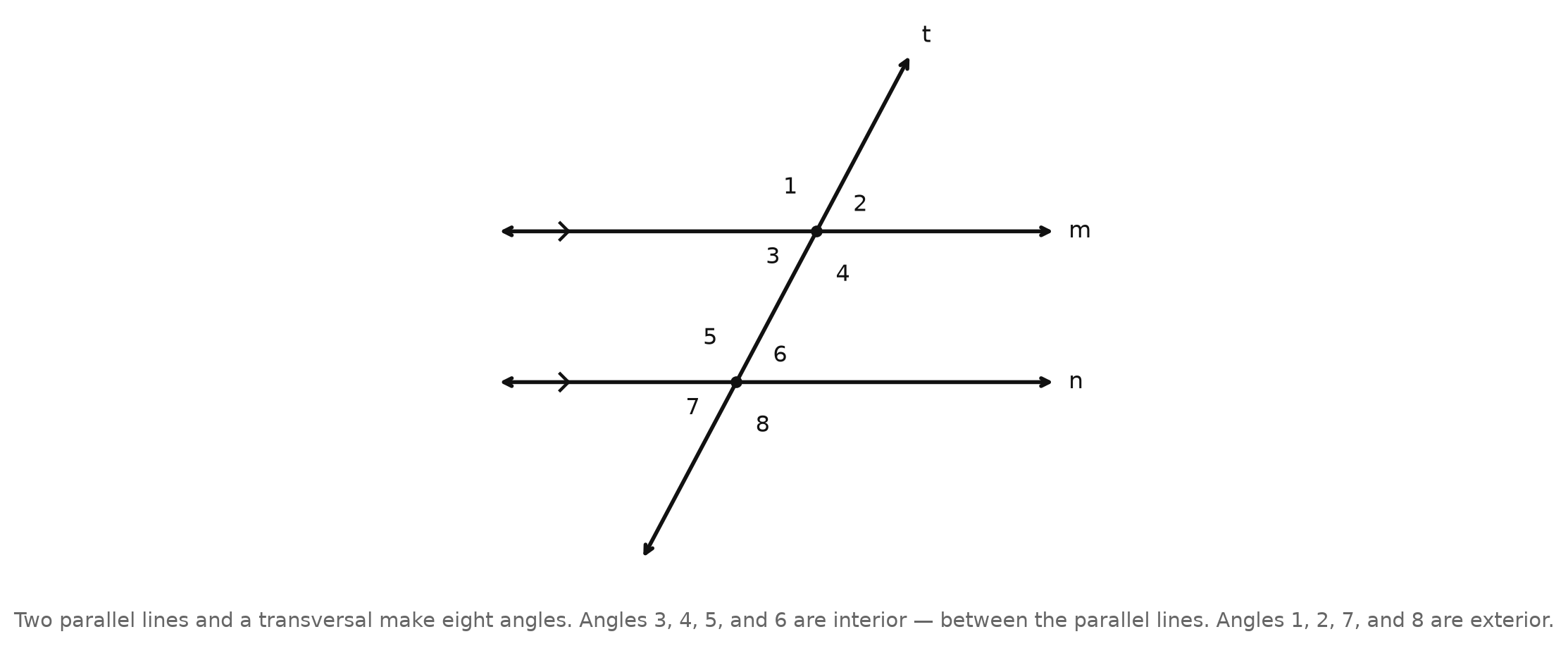
Two words sort the eight angles before anything else happens:
- Interior angles lie between the two parallel lines: , , , .
- Exterior angles lie outside them: , , , .
The transversal also splits the figure left and right. Take those two splits together — interior or exterior, same side or opposite sides — and every named pair in the standard falls out.
The five named pairs
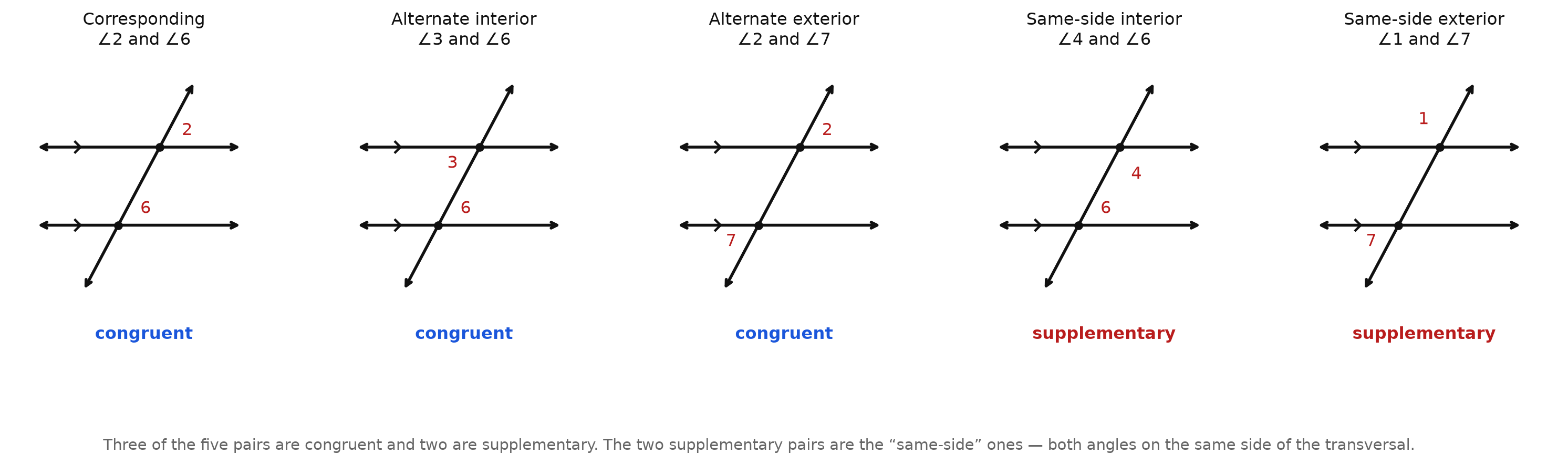
| Pair | What it means | Example | Relationship |
|---|---|---|---|
| Corresponding | matching positions at the two intersections | and | congruent |
| Alternate interior | interior, opposite sides of the transversal | and | congruent |
| Alternate exterior | exterior, opposite sides | and | congruent |
| Same-side interior | interior, same side | and | supplementary |
| Same-side exterior | exterior, same side | and | supplementary |
Three of the five are congruent and two are supplementary. The two supplementary ones are exactly the same-side pairs, and that is the pattern to memorize: alternate means congruent, same-side means supplementary. Every year students lose points by making a same-side pair equal, so it is worth saying out loud.
These relationships need the lines to be parallel. If and are not parallel, the eight angles still exist and still have names, but none of the five relationships holds. Lesson 2.4 uses exactly that fact in reverse.
Finding a pair from a name, and a name from a pair
Given "alternate exterior," you can locate the pair without memorizing a list. Exterior narrows it to , , , . Alternate means opposite sides of the transversal, and and are both on the left while and are both on the right. So the alternate exterior pairs are with , and with .
Going the other way, given and : both are interior, and both sit on the left of the transversal, so they are same-side interior — supplementary, not congruent.
Worked examples
Example 1 — Interior or exterior
Which of , , , are interior?
Answer: and . The other two lie outside the parallel lines.
Example 2 — Naming a pair
What is the relationship between and ?
Answer: Corresponding angles — each is the upper-left angle at its own intersection. They are congruent.
Example 3 — Naming a pair, second case
What is the relationship between and ?
Answer: Alternate interior angles. Both are interior, and they are on opposite sides of the transversal, so they are congruent.
Example 4 — Same side means supplementary
. Find .
Answer: and are same-side interior, so they are supplementary: .
Example 5 — Reading a pair backwards
Name every angle congruent to .
Answer: (vertical), (corresponding), and (alternate exterior). In a figure like this, the eight angles fall into just two sizes.
Guided practice
- Use the eight-angles figure. List the interior angles and the exterior angles.
- On that same figure, which angle is the upper-left angle at the lower intersection?
- Use the five-pairs figure. Name the pair type shown in each panel and say whether it is congruent or supplementary.
- Name the relationship between and .
- Name the relationship between and .
- Name the relationship between and , and say what that means about their measures.
Independent practice
- Classify each pair as corresponding, alternate interior, alternate exterior, same-side interior, or same-side exterior. a) and b) and c) and d) and e) and
- For each pair in item 7, say whether the angles are congruent or supplementary.
- Name both alternate interior pairs and both same-side interior pairs.
- Name both alternate exterior pairs and both same-side exterior pairs.
- . Find , , and , naming the relationship you used each time.
- List every angle congruent to .
- Application. Two rows of desks run parallel across a classroom and an aisle cuts diagonally across both. The aisle makes a angle with the first row on the upper-right. What angle does it make with the second row in the matching position, and which relationship says so?
- Reasoning. Explain why "same-side interior" angles cannot also be congruent unless both measure .
- Error analysis. A student says and are alternate interior angles because both are interior. Identify the error and name the pair correctly.
- If the transversal is perpendicular to both lines, what is the measure of all eight angles? Which of the five relationships still hold?
- Reasoning. Two lines are cut by a transversal and . What does that tell you about the lines?
- Draw and label your own transversal figure, then mark one pair of each of the five types.
Exit ticket 2.1
- Name the four interior angles.
- What is the relationship between and , and are they congruent or supplementary?
- . Find .
- State the pattern in one sentence: which named pairs are congruent, and which are supplementary?
Lesson 2.2 — Proving the Angle Pair Relationships
One postulate, then everything else
G.RLT.2a asks you to prove and justify the five relationships, not just use them. Proving them all from scratch is impossible — a proof has to start somewhere — so geometry starts with one assumed statement and derives the rest.
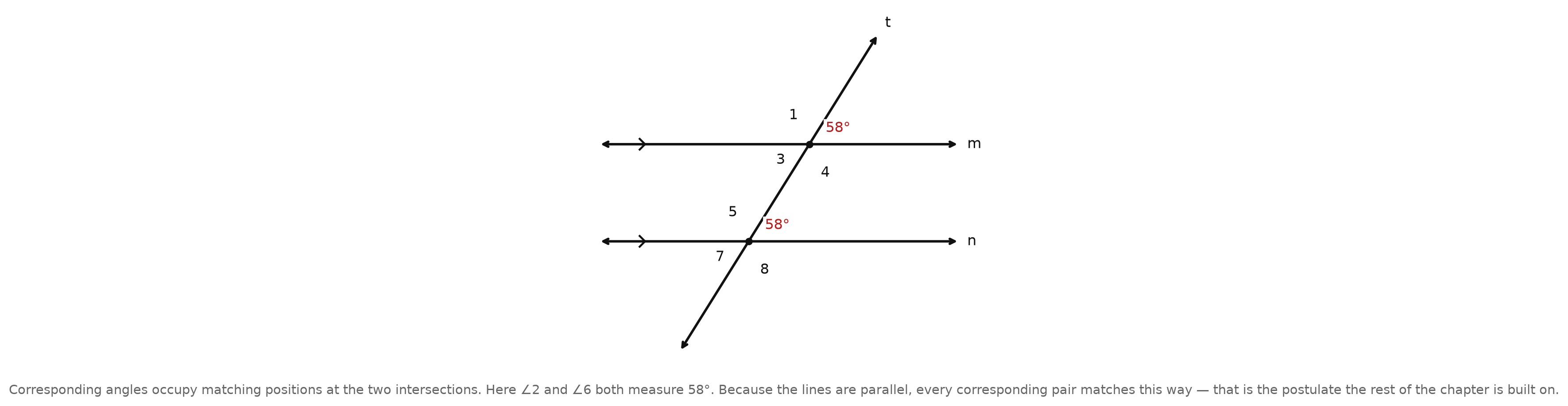
Corresponding Angles Postulate. If two parallel lines are cut by a transversal, then each pair of corresponding angles is congruent.
This is assumed, not proved. Everything else in the chapter is proved from it, together with two facts you already have from Grade 8: vertical angles are congruent, and a linear pair is supplementary.
What a two-column proof looks like
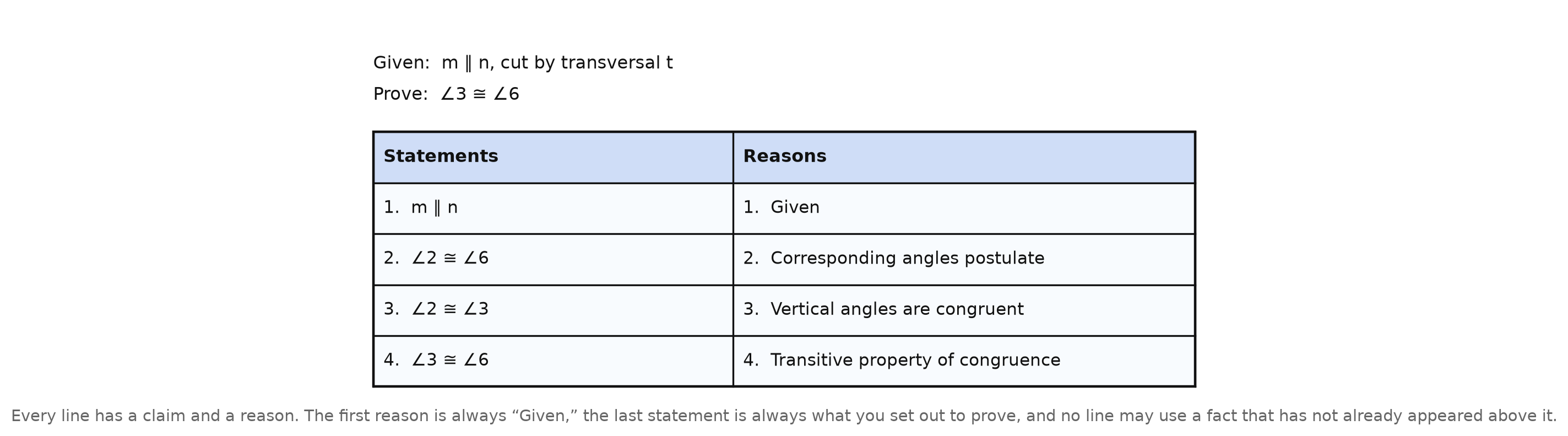
Three rules govern every proof in this book:
- The first reason is almost always "Given."
- The last statement is exactly what you were asked to prove — no more, no less.
- No line may use a fact that has not already appeared above it. That is what makes a proof checkable by someone who does not already believe the result.
Two-column is not the only legal format. A paragraph proof writes the same claims and reasons in sentences, and a flow proof arranges them in boxes with arrows. This book uses two-column while the habit is forming, because the second column makes a missing reason impossible to hide.
Alternate interior angles
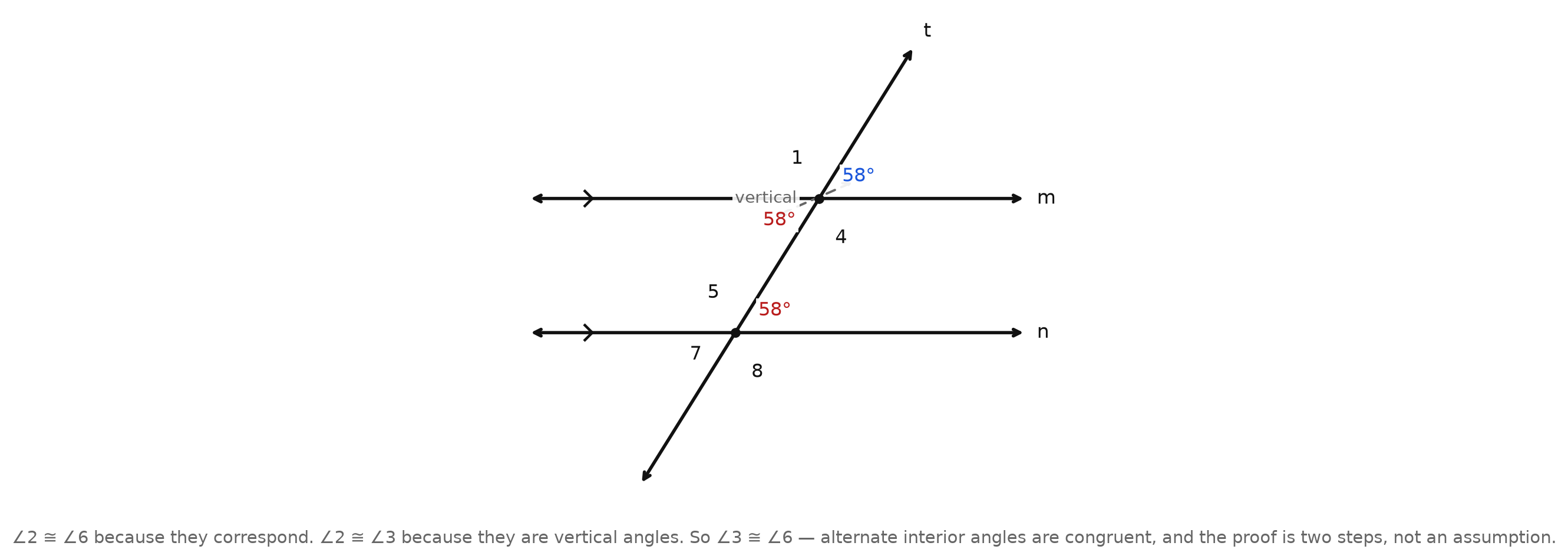
Alternate Interior Angles Theorem. If two parallel lines are cut by a transversal, then alternate interior angles are congruent.
Proof.
| Statements | Reasons |
|---|---|
| 1. | 1. Given |
| 2. | 2. Corresponding Angles Postulate |
| 3. | 3. Vertical angles are congruent |
| 4. | 4. Transitive Property of Congruence |
Two steps and a transitive property. The same two-move pattern — correspond, then pivot on a vertical pair — proves the alternate exterior theorem as well, using , , and .
Same-side interior angles come out supplementary
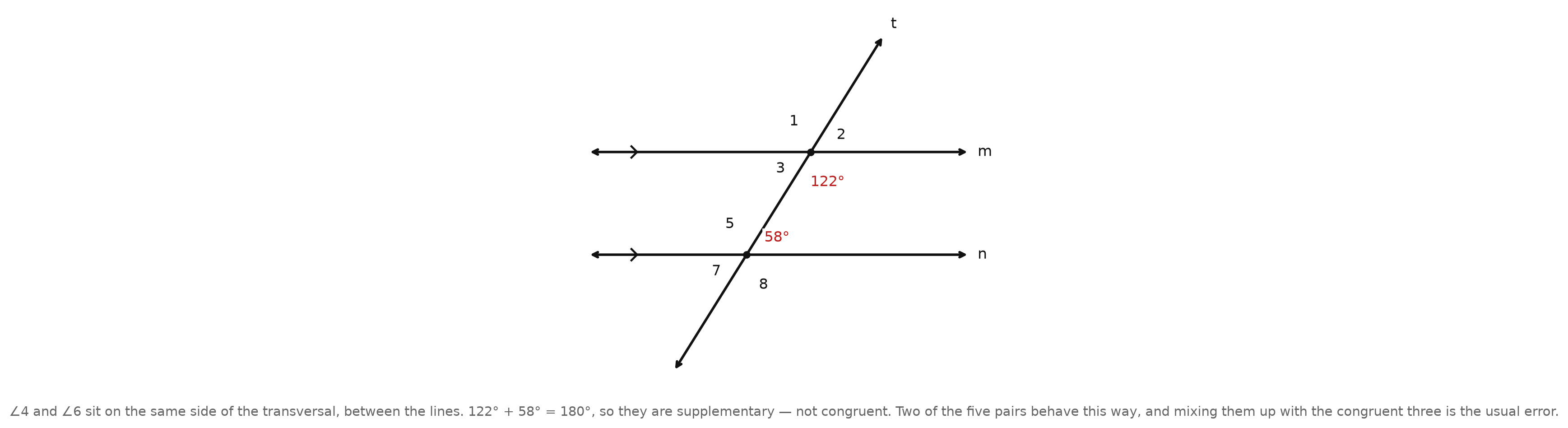
Same-Side Interior Angles Theorem. If two parallel lines are cut by a transversal, then same-side interior angles are supplementary.
Proof.
| Statements | Reasons |
|---|---|
| 1. | 1. Given |
| 2. | 2. Corresponding Angles Postulate |
| 3. | 3. Definition of congruent angles |
| 4. and form a linear pair | 4. Definition of a linear pair |
| 5. | 5. Linear Pair Postulate |
| 6. | 6. Substitution (step 3 into step 5) |
| 7. and are supplementary | 7. Definition of supplementary angles |
Notice where the "supplementary" comes from: not from the parallel lines directly, but from the linear pair. That is why two of the five relationships behave differently from the other three. A same-side pair is a congruent pair with one of its angles swapped for that angle's linear-pair partner.
Notice also that this proof switches from to at step 3 and back at step 7. That is deliberate and it is why the "congruent versus equal" convention exists: you cannot add congruences, but you can add measures.
Worked examples
Example 1 — Supplying a missing reason
In the alternate interior proof, what reason justifies ?
Answer: Vertical angles are congruent.
Example 2 — Supplying a missing statement
A proof reads: 1. (Given). 2. ? (Corresponding Angles Postulate). 3. (Transitive Property). What is statement 2?
Answer: — then by vertical angles gives step 3. (A complete proof needs that vertical-angle line as its own step.)
Example 3 — Proving alternate exterior
Prove given .
Answer:
| Statements | Reasons |
|---|---|
| 1. | 1. Given |
| 2. | 2. Corresponding Angles Postulate |
| 3. | 3. Vertical angles are congruent |
| 4. | 4. Transitive Property of Congruence |
Example 4 — Why a step is illegal
A student writes ", because they look equal." Why is that not a reason?
Answer: A drawing is not evidence — figures are not guaranteed to be to scale, and a proof must convince someone who has not seen the picture. The legal reason is the Alternate Interior Angles Theorem, or the two-step derivation of it.
Example 5 — Same-side exterior
Prove and are supplementary given .
Answer: (Corresponding Angles Postulate), so . and form a linear pair, so . Substituting gives , so the two are supplementary.
Guided practice
- Use the two-column proof figure. What is the "Given," and what is being proved?
- On that same figure, what reason justifies statement 4?
- State the Corresponding Angles Postulate in your own words.
- Use the alternate interior figure. Which two facts combine to give ?
- Use the same-side interior figure. Add the two marked measures. What does the sum tell you?
- Why does the same-side interior proof switch from to partway through?
Independent practice
- Complete the proof that (alternate interior), given . Use the two-column format.
- Complete the proof that (alternate exterior), given .
- Prove that and are supplementary, given .
- Prove that and are supplementary, given .
- Give the reason for each step. a) b) c)
- Error analysis. A proof's second line reads ", Reason: Corresponding Angles Postulate." Identify the error and correct the reason.
- Error analysis. A proof concludes "" from the Same-Side Interior Angles Theorem. What went wrong?
- Reasoning. Why must one of the five relationships be assumed as a postulate rather than proved?
- Reasoning. Rewrite the alternate interior proof as a paragraph proof.
- Application. A carpenter marks two parallel rafters and a diagonal brace. She measures the angle the brace makes with the first rafter as and predicts the alternate interior angle at the second rafter is also . Write the two-step justification she is relying on.
- Explain why "vertical angles are congruent" may be used as a reason in this chapter without proving it here.
- Write a two-column proof of your own for any one of the five relationships, choosing angles other than the ones used above.
Exit ticket 2.2
- Which relationship is assumed as a postulate?
- Give the two reasons that combine to prove the Alternate Interior Angles Theorem.
- Why is "the picture shows it" not a valid reason?
- Where does the "supplementary" in the same-side theorems come from?
Lesson 2.3 — Angle Chases, Numeric and Algebraic
Finding all eight from one
Give one angle measure in a parallel-lines figure, and every other angle follows.
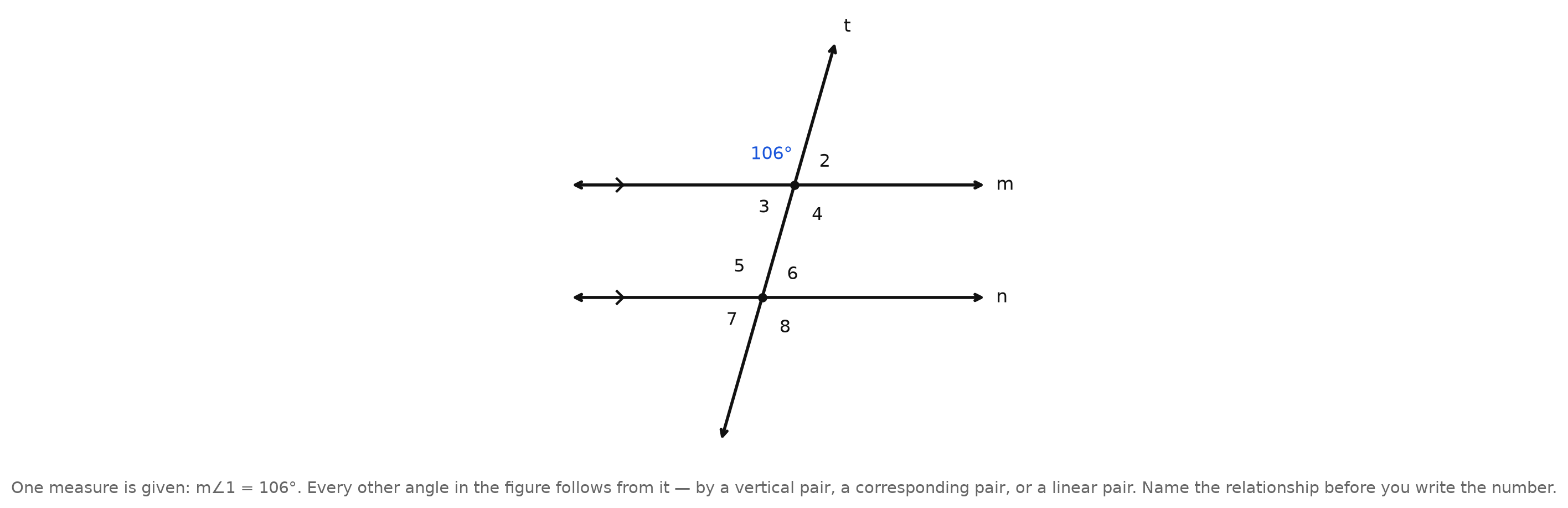
With , work outward and name the relationship at each step:
- — linear pair with .
- — vertical to (also a linear pair with ).
- — vertical to .
- — corresponding to .
- , , — the same three moves at the lower intersection.
Two things are worth noticing. First, only two distinct measures appear, and they are supplementary. That is always true of this figure. Second, there is more than one correct route to each angle; a good answer names one and does not pretend the others do not exist.
When the measures are algebraic
G.RLT.2b explicitly says angle measures may be given algebraically. The work is the same, with one decision added at the front.
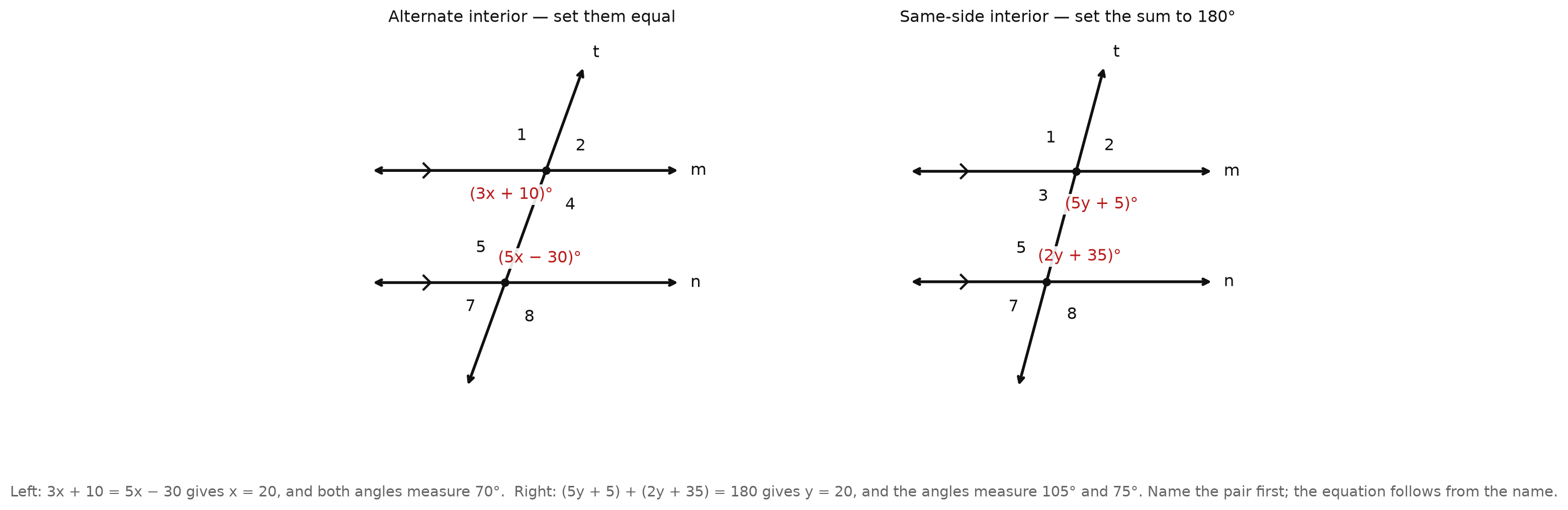
Left panel — a congruent pair. and are alternate interior, so they are equal:
Both angles measure . Checking the other expression gives — the check is not optional, because a sign slip produces two different values and that is the signal.
Right panel — a supplementary pair. and are same-side interior, so their measures sum to :
The angles measure and , and checks.
So the whole algebraic skill is one decision: name the pair, then choose the equation. Congruent pair, set them equal. Same-side pair, set the sum to . Picking the wrong equation is the error this figure exists to prevent.
Worked examples
Example 1 — A chase from one angle
. Find and name the relationship.
Answer: and are same-side interior, so .
Example 2 — Two routes, one answer
. Find two different ways.
Answer: as alternate exterior angles, so . Or: (corresponding), and (vertical), so .
Example 3 — Solving with equal expressions
Corresponding angles measure and . Find and the angle measure.
Answer: , so and . Each angle measures ; the check gives .
Example 4 — Solving with a sum
Same-side exterior angles measure and . Find .
Answer: , so and . The angles are and , which sum to .
Example 5 — Choosing the wrong equation on purpose
A student sets same-side interior angles and equal and gets . What went wrong, and what is the right answer?
Answer: Same-side pairs are supplementary, not congruent. The correct equation is , giving ; the angles are and .
Guided practice
- Use the numeric-chase figure. What is ?
- Find and name the relationship you used.
- Find and name the relationship.
- Find and name the relationship.
- Use the algebraic figure, left panel. Which pair type is shown, and what equation does it give?
- Use the algebraic figure, right panel. Which pair type is shown, and what equation does it give?
Independent practice
- . Find all seven remaining angles, naming a relationship for each.
- . Find , , and .
- Corresponding angles measure and . Find and the angle measure, and check.
- Alternate interior angles measure and . Find and the angle measure.
- Same-side interior angles measure and . Find and both angle measures.
- Same-side exterior angles measure and . Find and both measures.
- Alternate exterior angles measure and . Find , then find every other angle in the figure.
- Application. A ramp runs between two parallel handrails. The angle it makes with the lower rail on the upper-right is . Find the angle it makes with the upper rail in the same position, and the angle on the other side of the ramp at the upper rail.
- Application. Two parallel garden beds are crossed by a path. The same-side interior angles the path makes are and . Find and both angles.
- Error analysis. Given alternate interior angles and , a student writes . Name the error, solve correctly, and give both measures.
- Reasoning. In a parallel-lines figure only two distinct angle measures ever appear. Explain why, and say what those two measures always add to.
- Reasoning. If solving an algebraic problem gives an angle measure of , what does that tell you before you check your arithmetic?
Exit ticket 2.3
- . Find and name the relationship.
- Alternate interior angles measure and . Find .
- Same-side interior angles measure and . Find .
- State the one decision that determines whether you set two expressions equal or set their sum to .
Lesson 2.4 — Proving Lines Are Parallel
Every theorem read backwards
Lesson 2.2 assumed the lines were parallel and concluded something about angles. G.RLT.2b asks for the other direction: assume something about the angles and conclude the lines are parallel. Each of the five theorems has a converse, and all five converses are true.
Converses. If two lines are cut by a transversal and
- a pair of corresponding angles is congruent, or
- a pair of alternate interior angles is congruent, or
- a pair of alternate exterior angles is congruent, or
- a pair of same-side interior angles is supplementary, or
- a pair of same-side exterior angles is supplementary,
then the two lines are parallel.
Chapter 1 warned that a converse must be checked separately and is often false. Here all five happen to be true — which is exactly why the chapter says so explicitly instead of letting you assume it. These converses are theorems in their own right, and they are what turn the chapter's results into a test you can run on a figure.
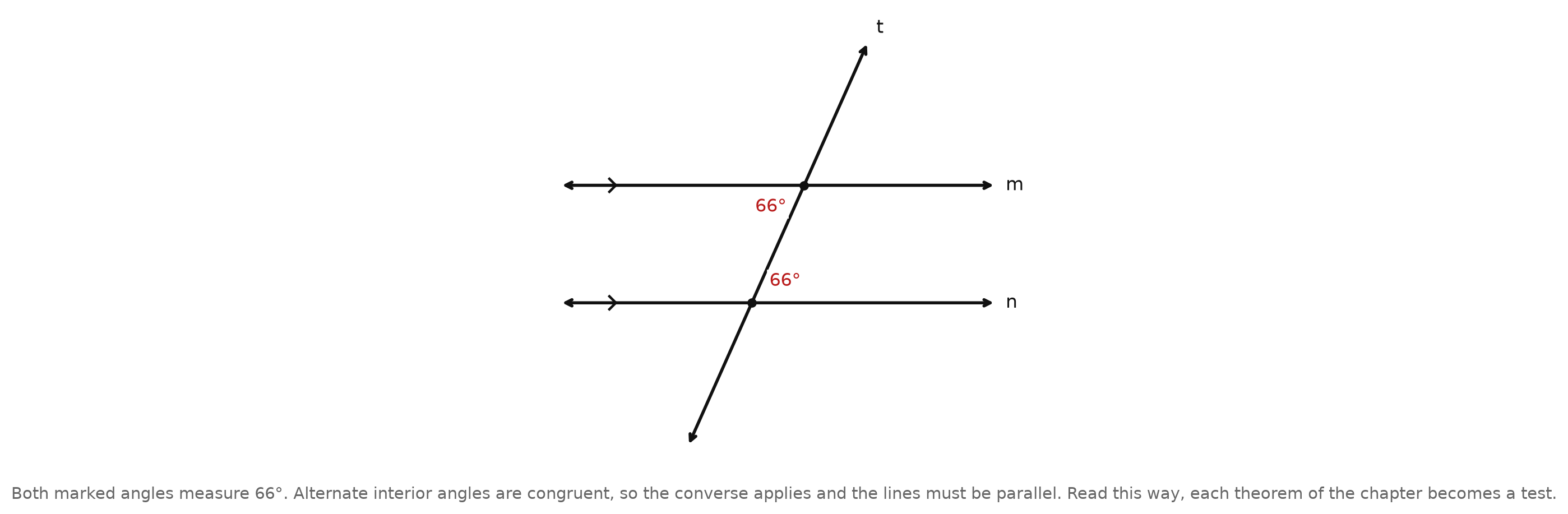
In this figure nothing says the lines are parallel — no arrowheads, no "given." But the two marked angles are alternate interior and congruent, so the converse applies and follows.
Proof.
| Statements | Reasons |
|---|---|
| 1. | 1. Given |
| 2. | 2. Vertical angles are congruent |
| 3. | 3. Transitive Property of Congruence |
| 4. | 4. Converse of the Corresponding Angles Postulate |
Proving lines are not parallel
The same test refuses as readily as it accepts.
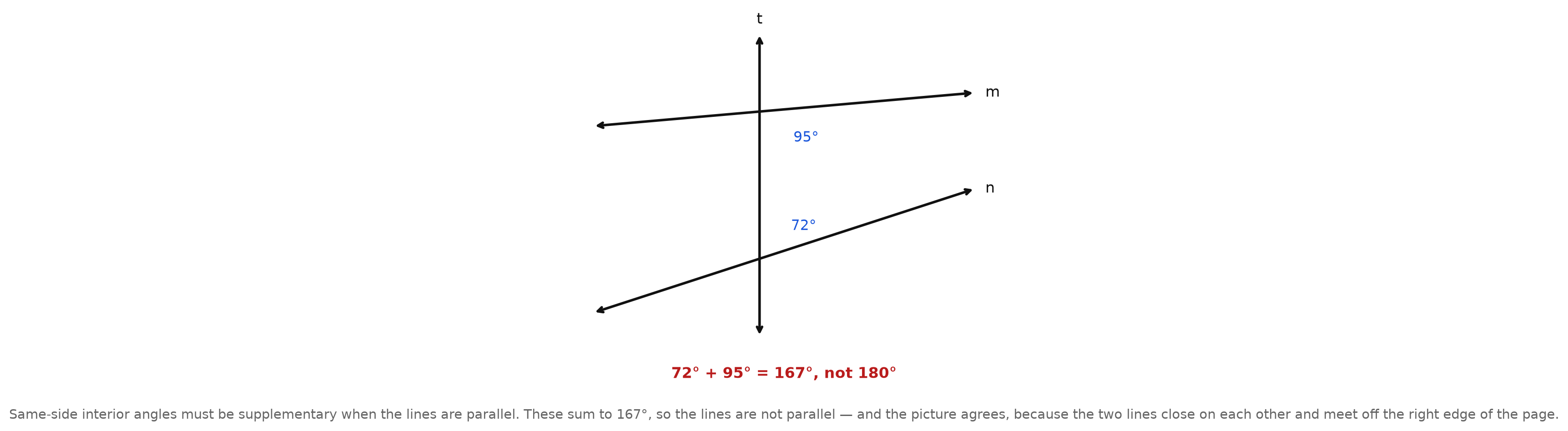
Same-side interior angles must be supplementary when lines are parallel. Here they sum to , so the lines cannot be parallel — and the drawing agrees, because the two lines close on each other and meet off the right edge of the page.
This is an indirect argument in miniature: assume the lines are parallel, derive that the angles must sum to , observe that they sum to , and reject the assumption. Chapter 5 formalizes that move as an indirect proof.
Which converse to cite
A figure hands you one pair of angles, so the pair you are given decides the converse you cite. Do not convert the pair into another pair first if you do not have to — it adds steps and each step is a chance to be wrong.
| You are given | Cite |
|---|---|
| congruent corresponding angles | Converse of the Corresponding Angles Postulate |
| congruent alternate interior angles | Converse of the Alternate Interior Angles Theorem |
| congruent alternate exterior angles | Converse of the Alternate Exterior Angles Theorem |
| supplementary same-side interior angles | Converse of the Same-Side Interior Angles Theorem |
| supplementary same-side exterior angles | Converse of the Same-Side Exterior Angles Theorem |
Worked examples
Example 1 — Reading a figure
and nothing else is known. Are the lines parallel?
Answer: Yes. Those are corresponding angles, and the converse of the Corresponding Angles Postulate applies.
Example 2 — A supplementary test
and . Are the lines parallel?
Answer: Yes. and are same-side interior and , so they are supplementary and the converse applies.
Example 3 — A test that fails
and . Are the lines parallel?
Answer: No. Those are alternate interior angles, and they are not congruent, so the lines are not parallel.
Example 4 — Solving for the value that makes lines parallel
Corresponding angles measure and . For what are the lines parallel?
Answer: Set them equal: , so . At both measure and the lines are parallel.
Example 5 — Solving with a supplementary condition
Same-side interior angles measure and . For what are the lines parallel?
Answer: , so and . The angles are and .
Guided practice
- Use the proving-parallel figure. Which pair is marked, and what are their measures?
- Which converse does that figure let you cite?
- In the two-column proof above, what reason justifies step 2?
- Use the not-parallel figure. What do the two marked angles sum to?
- Why does that sum show the lines are not parallel?
- State the converse of the Same-Side Exterior Angles Theorem.
Independent practice
- For each, decide whether the lines must be parallel and name the converse (or say why none applies). a) b) c) and d) and e)
- Write a two-column proof: given , prove .
- Write a two-column proof: given and are supplementary, prove .
- Corresponding angles measure and . For what are the lines parallel?
- Alternate exterior angles measure and . For what are the lines parallel?
- Same-side interior angles measure and . For what are the lines parallel?
- Application. A tile setter wants two grout lines parallel. A straightedge crosses them, making a angle with the first line and a angle with the second in the corresponding position. Is the work square? Cite the converse.
- Application. A second straightedge crosses two other grout lines, making same-side interior angles of and . Are those lines parallel? What would the second angle have to be?
- Error analysis. Given , a student concludes . Explain why that conclusion does not follow.
- Reasoning. Explain the difference between what Lesson 2.2 proves and what Lesson 2.4 proves, in terms of hypothesis and conclusion.
- Reasoning. All five converses in this chapter are true. Why is it still important that Chapter 1 said a converse must be checked separately?
- Draw a figure whose marked angles prove two lines are not parallel, and write one sentence justifying it.
Exit ticket 2.4
- . Are the lines parallel? Cite the converse.
- and . Are the lines parallel? Justify.
- Corresponding angles measure and . For what are the lines parallel?
- In one sentence, say how a theorem from Lesson 2.2 differs from its converse in Lesson 2.4.
Lesson 2.5 — Parallel Lines in Context
The theorem does not change; the names do
G.RLT.2c asks for problems "including those in context." A context problem is the same figure with different words on it.
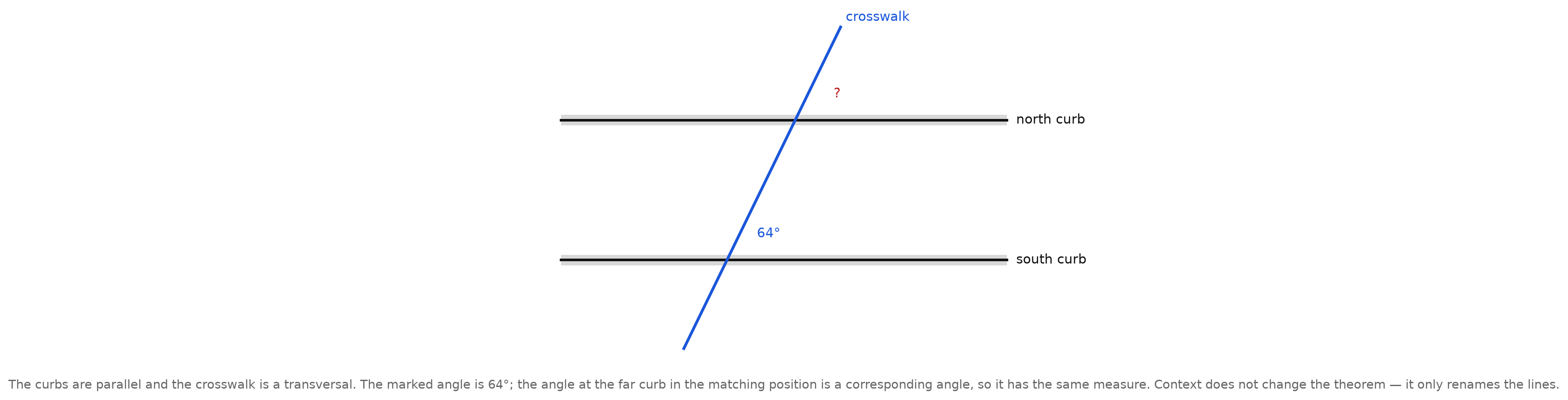
The curbs are the parallel lines. The crosswalk is the transversal. The marked angle is , and the angle at the north curb in the matching position is a corresponding angle, so it is too.
The work is identical to Lesson 2.3. What changes is that you have to do two things first:
- Identify which objects are the parallel lines, and say what makes them parallel — rails on a track, opposite edges of a road, courses of bricks, rows in a field, rafters cut to the same length.
- Identify the transversal, which is whatever crosses both.
Then name the pair and answer. A context answer should also carry its units or its meaning: ", the angle the crosswalk makes with the north curb on the east side."
When the context tells you the lines are parallel — and when it asks
Read carefully which of the two jobs a problem wants:
- "The rails are parallel. Find the angle." — This is G.RLT.2c. The parallelism is given; use a theorem.
- "Are the shelves parallel? The bracket makes these angles…" — This is G.RLT.2b. Parallelism is the conclusion; use a converse.
A construction context almost always asks the second question, because "is it square?" is what a builder actually needs to know.
Reasonableness
Two checks worth running on any answer in context:
- Two measures only. Every angle in the figure is one of two supplementary values. If your answer is a third number, something is wrong.
- Does the picture agree? An angle that reads as clearly acute in the drawing should not come out as . Figures in this book are drawn to scale unless they say otherwise, and a wild disagreement is a signal — not proof of an error, but a reason to check.
Worked examples
Example 1 — Naming the parts
On the crosswalk figure, what plays the role of the parallel lines, and what plays the role of the transversal?
Answer: The north and south curbs are the parallel lines; the crosswalk is the transversal.
Example 2 — A corresponding angle in context
The crosswalk makes a angle with the south curb on the east side. What is the angle it makes with the north curb on the east side?
Answer: , by the Corresponding Angles Postulate.
Example 3 — A supplementary pair in context
On the same figure, what is the angle between the crosswalk and the north curb on the west side, measured inside the roadway?
Answer: . That angle and the angle at the south curb are same-side interior angles.
Example 4 — Deciding parallelism in context
A bookshelf's two brackets are crossed by a diagonal support. The support makes a angle with the top bracket and a angle with the bottom bracket in the corresponding position. Are the brackets parallel?
Answer: No. Corresponding angles would have to be congruent, and . The shelf is off by .
Example 5 — Solving in context
Two parallel fence rails are crossed by a diagonal brace. The same-side interior angles measure and . Find and both angles.
Answer: , so and . The angles are and , which sum to .
Guided practice
- Use the crosswalk figure. Which lines are the parallel pair, and which is the transversal?
- What is the measure marked at the south curb?
- What is the measure of the angle marked "?", and which relationship gives it?
- Find the angle between the crosswalk and the north curb on the other side.
- If the crosswalk were repainted to meet the south curb at , what would the corresponding angle at the north curb be?
- Name one other real situation with two parallel lines and a transversal.
Independent practice
- Application. Two parallel train rails are crossed by a maintenance walkway. The walkway meets the near rail at . Find the angle it makes with the far rail in the corresponding position and the angle on the other side of the walkway at the far rail.
- Application. A ladder leans across two parallel rungs of scaffolding, making a angle with the lower rung. Find the same-side interior angle at the upper rung.
- Application. Rows of a parking lot are meant to be parallel. A curb cuts across, making a angle with the first row and a angle with the second in the same-side interior position. Are the rows parallel? Justify.
- Application. In the same lot, another curb makes same-side interior angles of and . Are those rows parallel? By how many degrees is the second row off?
- Application. Two parallel roof rafters are crossed by a collar tie. The alternate interior angles measure and . Find and the angle measure.
- Application. Two parallel lane lines are crossed by a merge lane. The same-side exterior angles measure and . Find and both measures.
- Reasoning. A problem says "the shelves are level." Does that make them parallel? Explain what assumption you are making.
- Error analysis. A student finds an angle of in the crosswalk figure and reports the corresponding angle at the north curb as . Identify the error.
- Reasoning. Explain how to tell whether a context problem is asking you to use a theorem or one of its converses.
- Write your own context problem with two parallel lines and a transversal, give one angle, and ask for two others.
Exit ticket 2.5
- In a context problem, what two things must you identify before naming an angle pair?
- Two parallel curbs are crossed by a path making a angle with one curb. Give the measures of all eight angles in the figure and name the relationship for two of them.
Chapter 2 Review
Vocabulary. transversal · interior angle · exterior angle · corresponding angles · alternate interior angles · alternate exterior angles · same-side (consecutive) interior angles · same-side (consecutive) exterior angles · vertical angles · linear pair · two-column proof · converse · supplementary · congruent
Part A — The five pairs (G.RLT.2a)
Items 7–12 and 19–22 practice this directly; the review adds the following.
Refer to the standard numbering: – at line , – at line .
Part B — Proofs (G.RLT.2a)
Items 29–33 and 41–44 practice this directly.
Part C — Angle chases and algebra (G.RLT.2 b, c)
Items 51–57, 63–65, and 76–78 practice this directly.
Part D — Cumulative review
The chapter review is a single sustained problem in each of the standard's three bullets, so that a review score points at a bullet rather than at a topic. Items 105 and 106 close Lesson 2.5; the three review items below close the chapter.
Review 1 (G.RLT.2a). In a figure with cut by transversal and :
- give the measures of all eight angles;
- name the pair type for with , for with , for with , for with , and for with , and state whether each pair is congruent or supplementary — those five are one of each named type;
- write a two-column proof that .
Review 2 (G.RLT.2b). Two lines are cut by a transversal so that one pair of same-side interior angles measures and .
- Find the value of that makes the lines parallel, and both angle measures.
- Write a two-column proof that the lines are parallel at that value.
- If instead , are the lines parallel? Justify with the measures.
Review 3 (G.RLT.2c). A pedestrian bridge has two parallel handrails crossed by a diagonal support. The support meets the lower rail at on the uphill side.
- Find the angle it makes with the upper rail in the corresponding position.
- Find the same-side interior angle at the upper rail.
- A second support is added, meeting the lower rail at and the upper rail at in the corresponding position. What does that tell you, and what would have to change for the rails to be parallel?
Standards coverage check — Chapter 2
| Knowledge and Skill | Where it is taught | Where it is practiced | Where it is applied in context |
|---|---|---|---|
| G.RLT.2a — prove and justify the five angle pair relationships | 2.1 (naming the eight angles and the five pairs); 2.2 (the postulate, the two-column format, and a proof of each theorem type) | 1–12, 14–20, 22; 23–37, 39–44 | 13, 38; Review 1 |
| G.RLT.2b — prove two or more lines are parallel from numeric or algebraic angle measures | 2.4 (the five converses, the accept case and the reject case) | 53–57, 60, 64, 65; 67–78, 81–88 | 79, 80, 97, 98; Review 2 |
| G.RLT.2c — solve problems, including in context, using the relationships | 2.3 (numeric and algebraic angle chases); 2.5 (naming the lines and the transversal in a situation) | 45–52, 61–63, 66 | 13, 38, 58, 59; 89–106; Review 3 |
Supporting items: 14, 17, 36, 37, 39, 61, 62, 82, 83, 101, and 103 are the reasoning items, several of which reach back to Chapter 1 — item 83 in particular asks why the converses being true here does not license assuming a converse elsewhere. The error analyses target the five recurring mistakes: calling a same-side pair congruent (15, 35, 60), citing the wrong theorem for the pair in front of you (34), concluding parallelism from a vertical pair that is true regardless (81), and reporting the supplement of the correct answer (102).
Boundaries respected. The five named pairs are the only pairs assessed. Vertical angles and linear pairs are used as reasons but are Grade 8 results, not chapter objectives. No item asks for a proof of the Corresponding Angles Postulate, which is assumed. Indirect proof is previewed by the not-parallel figure and named as such, but is not formally required until Chapter 5, where G.TR.2 asks for it.
Answer keys for every item in this chapter are in Appendix A.