Chapter 1 — Logic, Conditionals, and Venn Diagrams
Standard: G.RLT.1 (a, b, c, d)
G.RLT.1 — verbatim. The student will translate logic statements, identify conditional statements, and use and interpret Venn diagrams. Students will demonstrate the following Knowledge and Skills: a) Translate propositional statements and compound statements into symbolic form, including negation (~p, read "not p"), conjunction (p and q), disjunction (p or q), conditional (if p then q), and biconditional (p if and only if q), including statements representing geometric relationships. b) Identify and determine the validity of the converse, inverse, and contrapositive of a conditional statement, and recognize the connection between a biconditional statement and a true conditional statement with a true converse, including statements representing geometric relationships. c) Use Venn diagrams to represent set relationships, including union, intersection, subset, and negation. d) Interpret Venn diagrams, including those representing contextual situations.
By the end of this chapter you will be able to:
- Decide whether a sentence is a statement, and write its negation (G.RLT.1a)
- Translate English into symbolic form using , , , , and , and translate symbols back into English (G.RLT.1a)
- Identify the hypothesis and conclusion of a conditional, and decide when a conditional is true (G.RLT.1a, b)
- Write the converse, inverse, and contrapositive of a conditional and determine whether each is valid, using a counterexample when it is not (G.RLT.1b)
- Recognize a biconditional as a conditional and its converse both being true, and explain why that is how a definition is written (G.RLT.1b)
- Represent union, intersection, subset, and negation with Venn diagrams, and read counts and conclusions off a diagram, including one describing a real situation (G.RLT.1c, d)
Lessons: 1.1 Statements, Negation, and Compound Statements · 1.2 Conditional Statements · 1.3 Converse, Inverse, and Contrapositive · 1.4 Biconditionals and Definitions · 1.5 Venn Diagrams and Set Relationships
Why this chapter matters. Geometry is the first course where the answer is usually a claim about a figure, and a claim needs a reason. Every later chapter asks you to prove something — that two triangles are congruent, that a quadrilateral is a rhombus, that two lines are parallel — and every one of those proofs is built out of conditional statements chained together. This chapter is where you learn what those pieces are and how they behave. In particular you learn the single most-used fact in the whole course: a statement being true does not make its converse true. Most wrong answers in Geometry are a correct theorem run backwards.
Scope note. This chapter covers the five symbolic forms the standard names and no more. Truth tables appear here as a tool for deciding when a compound statement is true, not as an object you will be asked to build for its own sake. Venn diagram relationships are limited to the four the standard names — union, intersection, subset, and negation. Formal proof structure (two-column, paragraph, indirect) is introduced where it is used, starting in Chapter 2.
Conventions this chapter fixes.
- A statement is a sentence that is either true or false — not both, not neither. Letters , , and stand for statements.
- The five connectives are written (not ), ( and ), ( or ), (if , then ), and ( if and only if ).
- "Or" is inclusive. is true when is true, when is true, and when both are true. English sometimes means "one or the other but not both"; this book never does, and says "exactly one" when it means that.
- A counterexample is one case where the hypothesis holds and the conclusion fails. One is enough to make a statement false, and one is all you ever need.
- In a Venn diagram, the rectangle is the universe — everything under discussion. A region's count is the number of things in that region only, not in the whole circle, unless a problem says otherwise.
- A trapezoid in this book has exactly one pair of parallel sides, which is Virginia's definition. That is why trapezoids and parallelograms are drawn as separate regions.
- Item numbering runs straight through the chapter, from 1 in Lesson 1.1 to 112 at the end of the review. It does not restart at each lesson.
Lesson 1.1 — Statements, Negation, and Compound Statements
What counts as a statement
Logic does not work on every sentence. It works on statements — sentences that are either true or false.
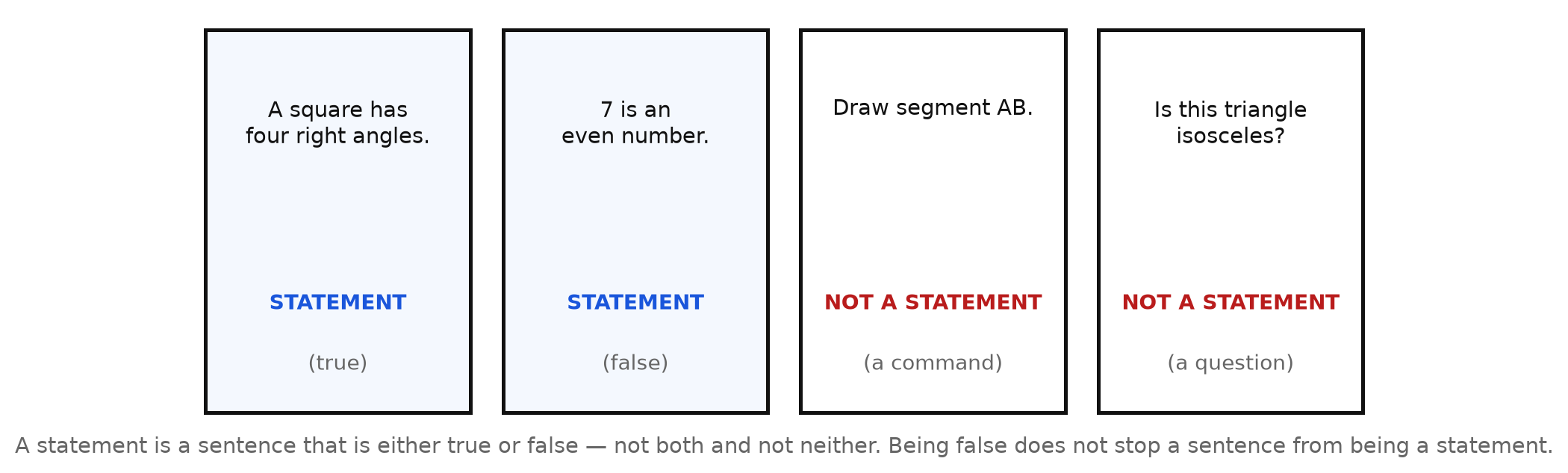
Look at the second card. " is an even number" is false, and it is still a statement — a perfectly good one. Being false is not a disqualification; being neither true nor false is. A command ("Draw segment ") and a question ("Is this triangle isosceles?") cannot be true or false, so logic has nothing to say about them.
A single statement is written with a letter:
- : A square has four right angles.
- : A square has four congruent sides.
Negation
The negation of a statement is written and read "not ." It says the opposite, and it always has the opposite truth value.
If : The angles are congruent, then : The angles are not congruent.
Two cautions, both of which cost points later:
- Negation is not "the other extreme." The negation of "" is "" — not "." Anything other than makes the negation true.
- Negating twice returns you to the start. says the same thing as .
Compound statements
Two statements can be joined into one. G.RLT.1a names five forms in all, and this is the reference for every one of them.
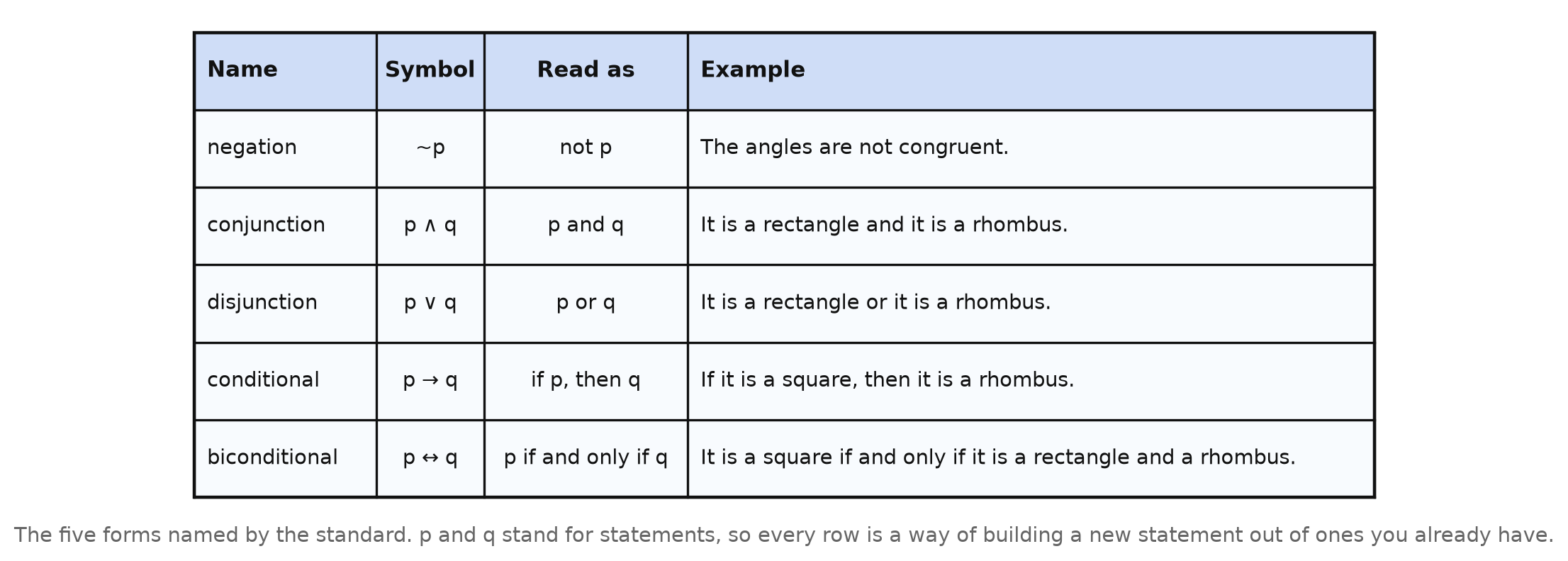
The two joined here in Lesson 1.1 are the conjunction and the disjunction:
- Conjunction , read " and ," claims that both parts are true.
- Disjunction , read " or ," claims that at least one part is true.
When is a compound statement true?
A truth table lists every combination of truth values the parts could have and records the result. Two variables give four rows, and the order used throughout this book is T-T, T-F, F-T, F-F.
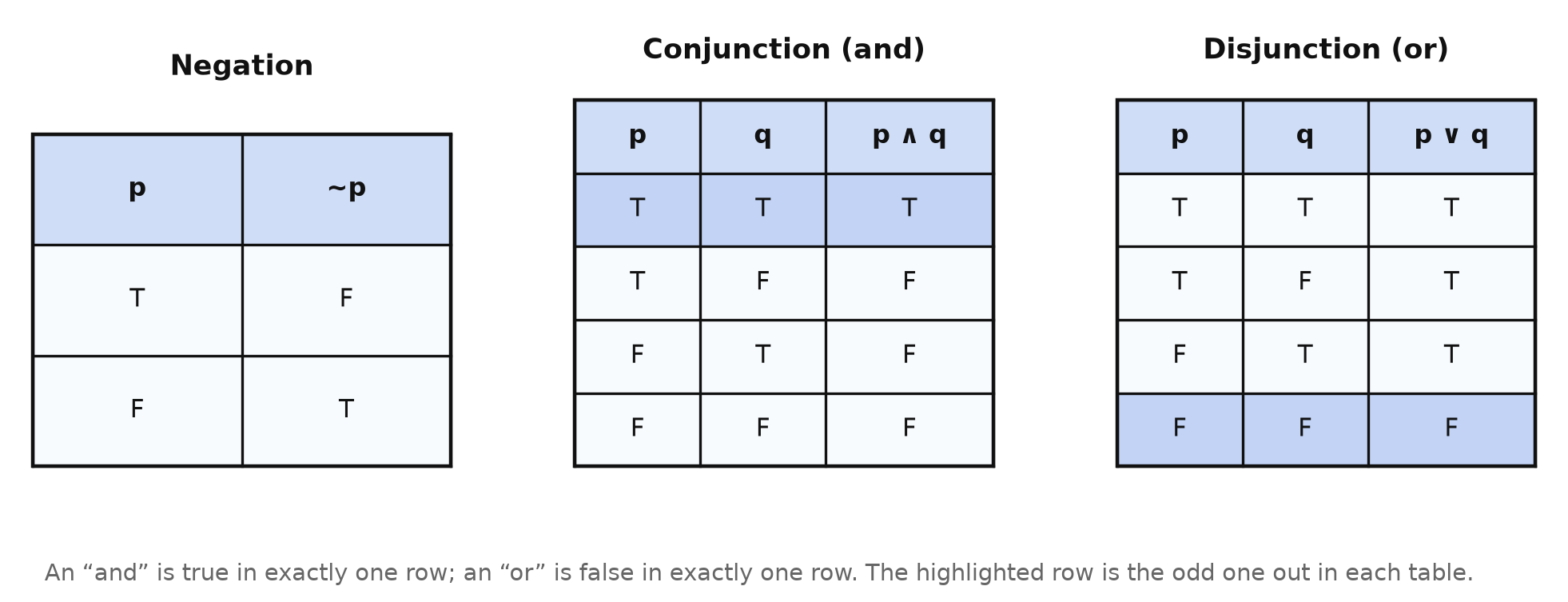
Read the highlighted rows and the pattern is easy to hold on to:
- An "and" is true in exactly one row — the one where both parts are true. Every other row makes it false.
- An "or" is false in exactly one row — the one where both parts are false. Every other row makes it true.
That last line is the inclusive "or" this book fixed in the conventions. The row where both are true makes true.
Translating both directions
The skill G.RLT.1a asks for runs both ways. From English to symbols:
" is isosceles and is not equilateral."
Let : is isosceles, and : is equilateral. The sentence is .
And from symbols back to English, with : the figure is a rectangle, : the figure is a rhombus:
becomes "The figure is a rectangle or the figure is a rhombus."
Worked examples
Example 1 — Statement or not
Which of these are statements? (i) All right angles are congruent. (ii) Bisect . (iii) .
Answer: (i) and (iii) are statements — (i) is true and (iii) is false. (ii) is a command, so it has no truth value.
Example 2 — Writing a negation
: . Write .
Answer: : — the segments are not congruent.
Example 3 — The negation trap
: . A student writes : . Correct them.
Answer: is . Any measure other than — including , , and — makes the negation true, so naming one particular other value is too narrow.
Example 4 — Translating a conjunction
Let : the quadrilateral has four congruent sides; : the quadrilateral has four right angles. Translate , and name the figure it describes.
Answer: "The quadrilateral has four congruent sides and four right angles." That is a square.
Example 5 — Deciding a truth value
With : A triangle has three sides (true) and : A triangle has four angles (false), find the truth value of and of .
Answer: is false — an "and" needs both. is true — an "or" needs only one, and supplies it.
Guided practice
- Which of the following are statements? For each statement, give its truth value. a) A pentagon has five sides. b) Construct the perpendicular bisector of . c) is a prime number. d) How many diagonals does a hexagon have?
- Use the reference figure. Name the symbol for each: negation, conjunction, disjunction, conditional, biconditional.
- : is acute. Write in words.
- : The lines are parallel. : The lines are coplanar. Translate into English.
- Use the truth-table figure. In which single row is a conjunction true? In which single row is a disjunction false?
- Let be true and be false. Give the truth value of , of , and of .
Independent practice
- Write the negation of each statement. a) is a right triangle. b) . c) The diagonals are not congruent.
- Let : the figure is a square; : the figure is a rectangle. Translate each into English. a) b) c) d)
- Translate each sentence into symbolic form using the and from item 8. a) The figure is a square and it is not a rectangle. b) The figure is neither a square nor a rectangle.
- Complete a truth table for .
- Complete a truth table for .
- Application. A gate opens when a badge is valid and the time is within business hours. On Saturday a guard uses a valid badge and the gate stays shut. Which part of the conjunction was false, and how do you know?
- Reasoning. Explain why " is an even number" is a statement even though it is false, while "Draw a circle" is not a statement even though it is a reasonable instruction.
- Error analysis. A student says the negation of "all rectangles are squares" is "no rectangles are squares." Explain why that is wrong and give the correct negation.
- Let be false and be false. Which of , , are true?
- Write a compound statement about a triangle that is true because of an "or" even though one of its parts is false.
- Application. A scholarship requires a GPA above or a varsity letter. Ana has a GPA and a varsity letter. Does she qualify? Which connective decided it?
- Reasoning. Explain why has the same truth value as in every row of a truth table.
Exit ticket 1.1
- Is "Is congruent to ?" a statement? Why or why not?
- Write the negation of "."
- is true, is false. Give the truth value of and of .
- In one sentence, say what makes an "and" statement false and what makes an "or" statement true.
Lesson 1.2 — Conditional Statements
The if-then form
A conditional statement has the form "if , then ," written . It is the workhorse of Geometry: every theorem, postulate, and property in this book can be rewritten in this shape.
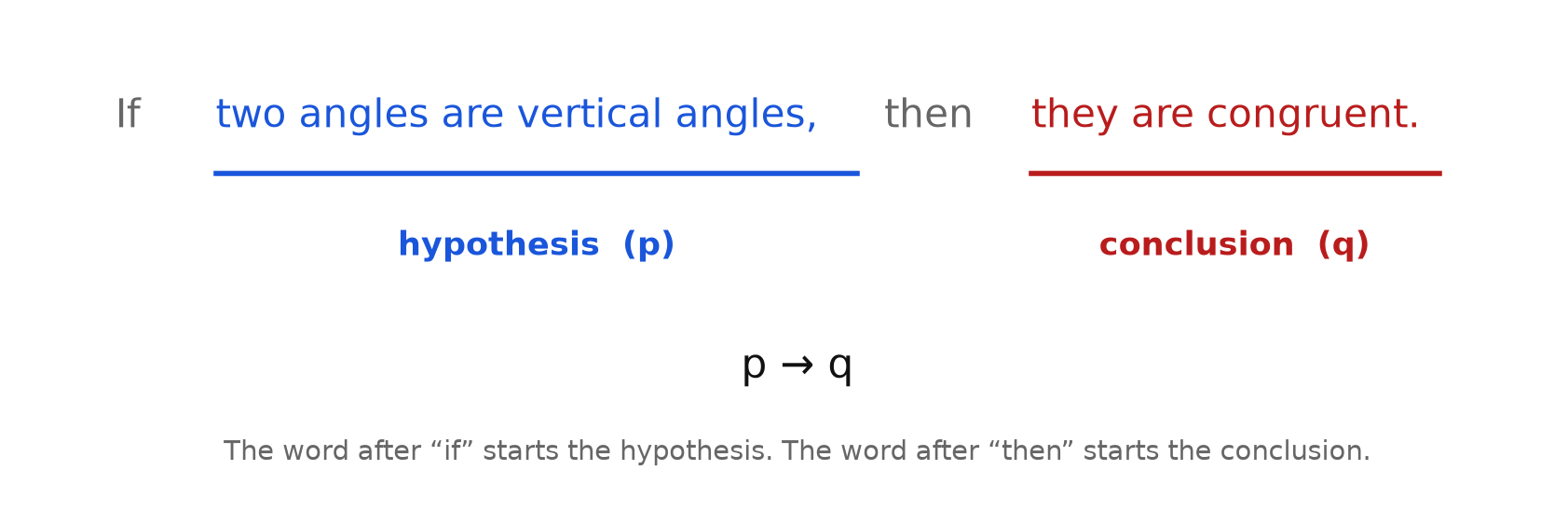
The part after if is the hypothesis. The part after then is the conclusion. The words "if" and "then" are not part of either one.
Not every conditional arrives wearing its if-then clothes. All three of these say the same thing:
- If a figure is a square, then it is a rectangle.
- Every square is a rectangle.
- A figure is a rectangle whenever it is a square.
Rewriting a sentence into if-then form before working with it is a habit worth building, because the hypothesis and conclusion are only obvious once they are separated.
When is a conditional true?
This is the part that surprises people, so the truth table is worth reading slowly.
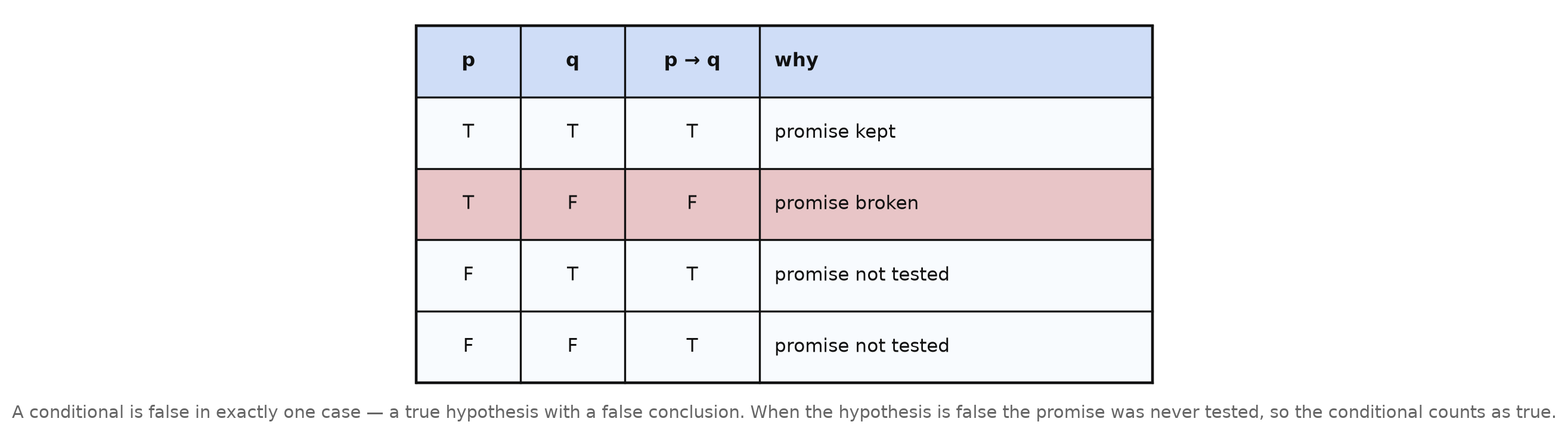
Think of as a promise: "if you meet the condition, I guarantee the result."
- Row 1 ( true, true): condition met, result delivered. Promise kept, so the conditional is true.
- Row 2 ( true, false): condition met, result not delivered. Promise broken — this is the one and only case where a conditional is false.
- Rows 3 and 4 ( false): the condition was never met, so the promise was never tested. Nothing broke it, so the conditional counts as true.
That gives the rule to carry through the whole course: a conditional is false only when a true hypothesis leads to a false conclusion.
Counterexamples
Row 2 is also the recipe for disproving a conditional. To show is false you need one case where is true and is false. That case is a counterexample.
"If a quadrilateral has four congruent sides, then it is a square" is false, and the counterexample is a rhombus that is not a square: four congruent sides (hypothesis true), not a square (conclusion false). One figure settles it. You do not need to find more, and finding a hundred squares that do satisfy the statement does not repair it.
Conditionals in geometry
Because a conditional is the shape of a theorem, translating a geometric fact into if-then form tells you exactly what you may assume and what you must show:
| Fact | If-then form | Hypothesis | Conclusion |
|---|---|---|---|
| All right angles are congruent. | If two angles are right angles, then they are congruent. | two angles are right angles | they are congruent |
| Vertical angles are congruent. | If two angles are vertical, then they are congruent. | two angles are vertical | they are congruent |
| A square is a rhombus. | If a figure is a square, then it is a rhombus. | it is a square | it is a rhombus |
In a proof, the hypothesis is what you are given, and the conclusion is what you are trying to reach.
Worked examples
Example 1 — Naming the parts
Identify the hypothesis and conclusion: "If two lines are perpendicular, then they form four right angles."
Answer: Hypothesis: two lines are perpendicular. Conclusion: they form four right angles.
Example 2 — Rewriting into if-then form
Rewrite "Every equilateral triangle is isosceles" as a conditional.
Answer: If a triangle is equilateral, then it is isosceles.
Example 3 — Deciding truth
Is "If , then " true? Is "If , then " true?
Answer: The first is true. The second is false; is a counterexample, because the hypothesis holds and the conclusion fails.
Example 4 — A conditional with a false hypothesis
Is "If a triangle has four sides, then " true or false?
Answer: True. No triangle has four sides, so the hypothesis is never satisfied and the promise is never tested. The conclusion being nonsense does not matter.
Example 5 — Producing a counterexample
Show that "If a quadrilateral has two pairs of congruent sides, then it is a parallelogram" is false.
Answer: A kite with sides arranged so the congruent sides are adjacent has two pairs of congruent sides but is not a parallelogram. That kite is the counterexample.
Guided practice
- Use the anatomy figure. Which part of the sentence is the hypothesis, and which is the conclusion?
- Identify the hypothesis and conclusion of "If a polygon has five sides, then it is a pentagon."
- Rewrite "All squares are rhombi" as a conditional.
- Rewrite "A number is divisible by whenever it is divisible by " as a conditional.
- Use the conditional truth table. In which row is false? State the row's truth values.
- Why are the two rows with a false hypothesis both true?
Independent practice
- Identify the hypothesis and conclusion of each. a) If two angles are complementary, then their measures add to . b) If , then . c) A figure is a polygon if it is a triangle.
- Rewrite each as a conditional in if-then form. a) Every rectangle is a parallelogram. b) Perpendicular lines form right angles. c) Two points determine exactly one line.
- Decide whether each conditional is true. If it is false, give a counterexample. a) If a figure is a rhombus, then it is a parallelogram. b) If a figure is a parallelogram, then it is a rhombus. c) If two angles are congruent, then they are vertical angles.
- Complete the truth table for from memory, then check it against the figure.
- is false and is true. What is the truth value of ?
- is true and is false. What is the truth value of ? Which row is that?
- Application. A store advertises: "If you spend $50, then you get free shipping." A customer spends $60 and is charged shipping. Was the store's promise broken? Which row of the truth table is that?
- Application. The same customer spends $30 and is charged shipping. Was the promise broken? Explain using the truth table.
- Error analysis. A student says "If a triangle has four sides, then it is a rectangle" must be false because triangles never have four sides. Explain why the conditional is actually true.
- Reasoning. Explain why finding twenty examples that fit a conditional does not prove it, but finding one counterexample disproves it.
- Write a conditional about angles that is true, and a conditional about angles that is false with its counterexample.
- Write "If it is a square, then it has four right angles" in symbolic form using and of your choosing, and state what and mean.
Exit ticket 1.2
- Identify the hypothesis and conclusion of "If a triangle is equiangular, then each angle measures ."
- State the one combination of truth values that makes a conditional false.
- Give a counterexample to "If a quadrilateral has four right angles, then it is a square."
- In one sentence, explain the "promise" way of remembering the conditional truth table.
Lesson 1.3 — Converse, Inverse, and Contrapositive
Three statements built from one
Given a conditional , three related conditionals can be built by swapping the parts, negating them, or both.
| Name | Form | Built by |
|---|---|---|
| Conditional | the original | |
| Converse | swapping hypothesis and conclusion | |
| Inverse | negating both | |
| Contrapositive | swapping and negating |
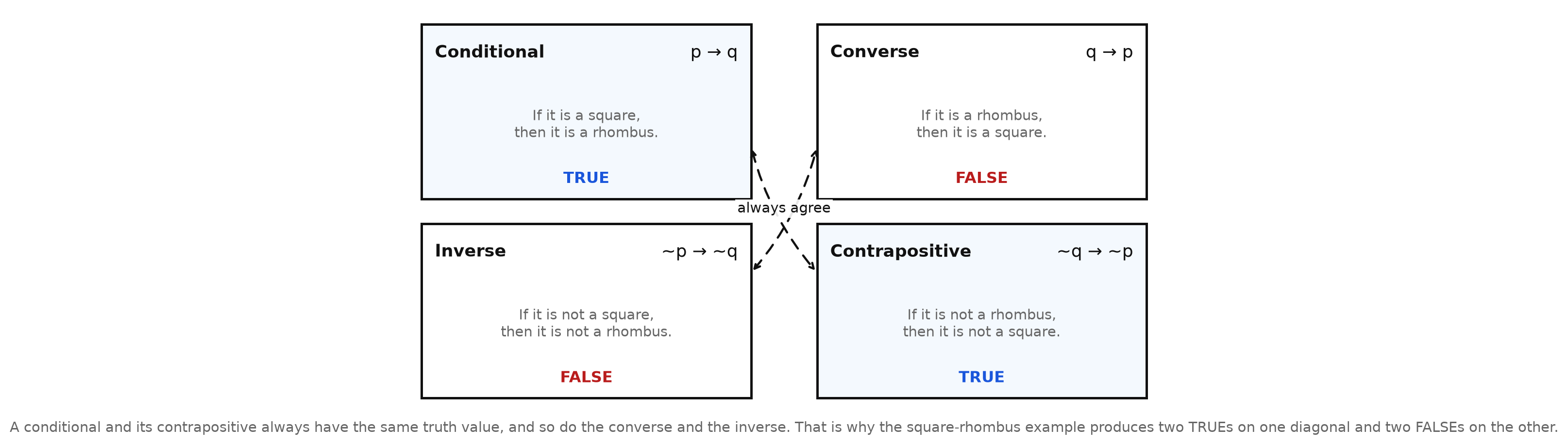
Read the truth values on the figure. The conditional and the contrapositive are both true. The converse and the inverse are both false. That is not a coincidence about squares and rhombi — it happens every time:
- A conditional and its contrapositive always have the same truth value. They are logically equivalent.
- A converse and an inverse always have the same truth value. They are logically equivalent to each other — and each is the contrapositive of the other.
So there are really only two questions to answer, not four. Decide whether the conditional is true and whether the converse is true; the contrapositive follows the conditional and the inverse follows the converse.
Why the contrapositive is useful
"If it is a square, then it is a rhombus" and "If it is not a rhombus, then it is not a square" carry exactly the same information. Sometimes one of the two is much easier to check, and you are allowed to check whichever you like. Chapter 5 turns that permission into a proof technique: an indirect proof assumes the negation of what it wants and derives a contradiction, which is the contrapositive doing the work.
Checking a converse takes a counterexample
The most common error in this course is assuming a converse comes free with the original. It does not.
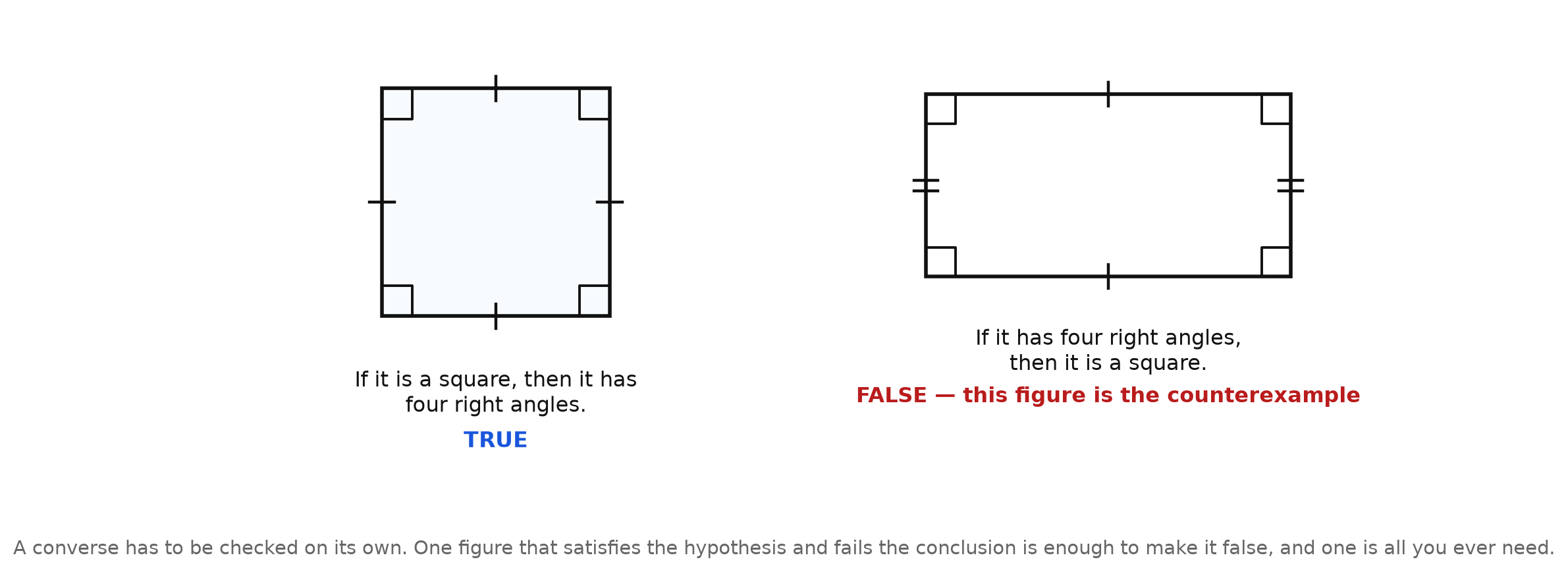
The left statement is true — every square really does have four right angles. Its converse asks something different and much stronger: that four right angles are enough to force a square. The rectangle on the right has four right angles and is not a square. One figure, and the converse is dead.
Worked examples
Example 1 — Writing all three
Given "If a figure is a square, then it is a rectangle," write the converse, inverse, and contrapositive.
Answer:
- Converse: If a figure is a rectangle, then it is a square.
- Inverse: If a figure is not a square, then it is not a rectangle.
- Contrapositive: If a figure is not a rectangle, then it is not a square.
Example 2 — Truth values of all four
Which of the four statements in Example 1 are true?
Answer: The conditional is true, so its contrapositive is true. The converse is false (a rectangle is a counterexample), so the inverse is false too.
Example 3 — Using equivalence to save work
"If two angles are vertical, then they are congruent" is true. What can you say about "If two angles are not congruent, then they are not vertical"?
Answer: That is the contrapositive, so it is true as well — with no separate check needed.
Example 4 — A converse that happens to be true
"If a triangle is equilateral, then it is equiangular." Is the converse true?
Answer: Yes. "If a triangle is equiangular, then it is equilateral" is also true. A converse can be true; it just is not guaranteed to be, and each has to be checked on its own.
Example 5 — Counterexample hunting
Give a counterexample to "If , then and are sides of the same triangle."
Answer: Two congruent segments drawn in two different, unrelated figures. The hypothesis holds and the conclusion fails.
Guided practice
- Use the four-conditionals figure. Copy the symbolic form of the converse, inverse, and contrapositive.
- On that same figure, which two statements are true? Which two are false?
- Which pairs are joined by the dashed arrows, and what does the label say about them?
- Given "If a polygon is a pentagon, then it has five sides," write the converse.
- Write the inverse of the same conditional.
- Write the contrapositive of the same conditional, and give its truth value without checking it separately. Say why you may do that.
Independent practice
- For "If two lines are perpendicular, then they intersect," write the converse, inverse, and contrapositive.
- Give the truth value of each of the four statements in item 51, with a counterexample where one is false.
- For "If a number is divisible by , then it is divisible by ," write all four related statements and give their truth values.
- Use the counterexample figure. Which statement does the rectangle disprove, and why is one figure enough?
- Application. A sign reads "If you are under inches tall, then you may not ride." A rider is inches tall and is turned away. Which of the four related statements did the operator apparently use, and is it equivalent to the sign?
- Application. A safety rule says "If the alarm sounds, then the door unlocks." The door is locked. What can you conclude, and which related statement did you use?
- Error analysis. A student writes the contrapositive of "If it rains, then the game is cancelled" as "If it does not rain, then the game is not cancelled." Name the error and give the correct contrapositive.
- Reasoning. Explain why a conditional and its converse can have different truth values, using a geometric example of your own.
- Write a true conditional whose converse is also true, and a true conditional whose converse is false.
- For "All squares are parallelograms," write the statement as a conditional, then write and evaluate its converse.
- Reasoning. The inverse of a statement is the contrapositive of its converse. Use that fact to explain why the inverse and converse always agree.
- A conditional is false. What do you immediately know about its contrapositive? About its converse?
Exit ticket 1.3
- Write the converse of "If a figure is a rhombus, then it is a parallelogram," and give its truth value.
- Which related statement is always logically equivalent to the original conditional?
- A conditional is true and its converse is false. Give the truth values of the inverse and the contrapositive.
- In one sentence, say what a counterexample has to do to disprove a conditional.
Lesson 1.4 — Biconditionals and Definitions
Two conditionals in one sentence
When a conditional and its converse are both true, the two can be combined into a single statement using the phrase if and only if. That statement is a biconditional, written .
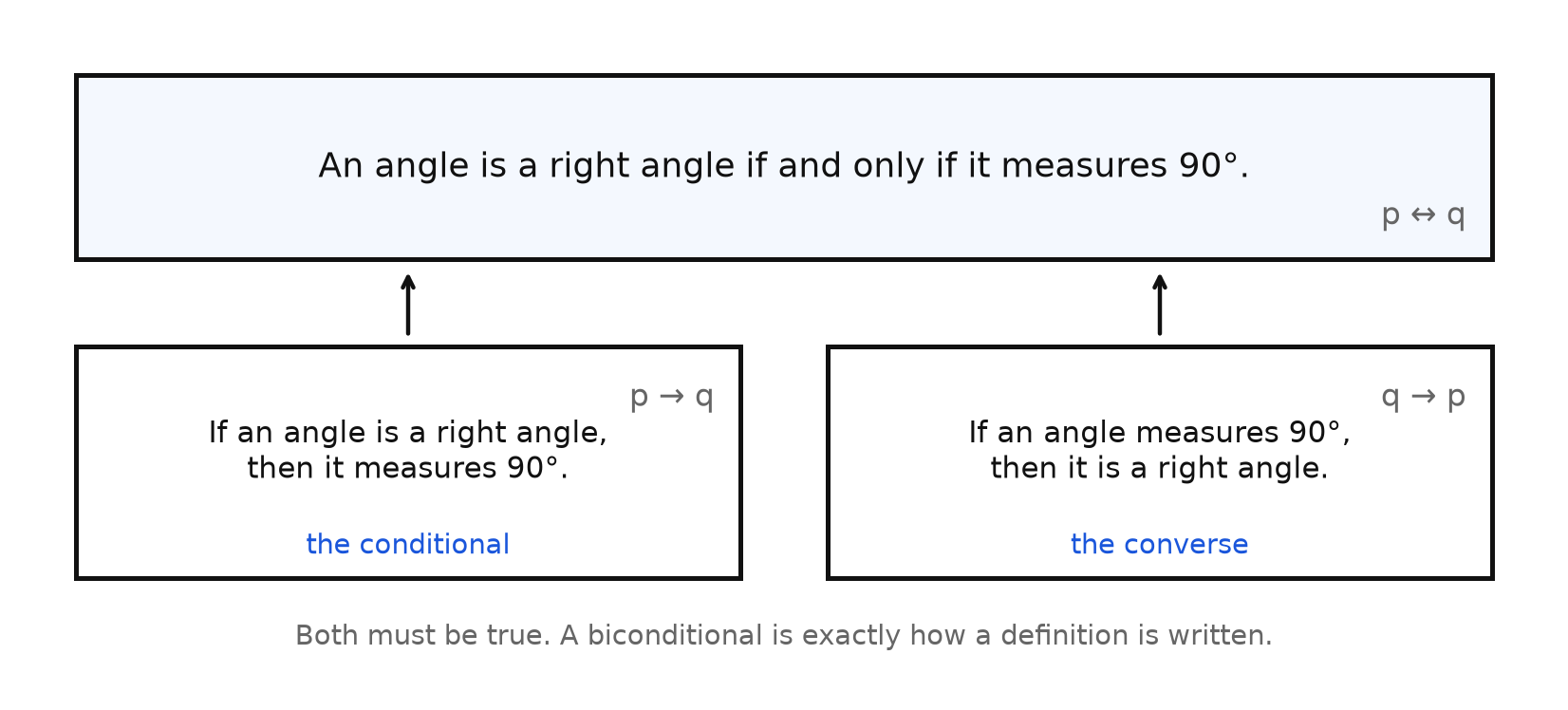
A biconditional is true exactly when its two halves are both true — which is the same as saying and always have the same truth value. If either half fails, the biconditional fails.
That is why you cannot write a biconditional out of just any true conditional. "If it is a square, then it is a rhombus" is true, but "It is a square if and only if it is a rhombus" is false, because the converse half is false.
Definitions are biconditionals
Here is the point of the lesson. Every definition in geometry is a biconditional, whether it is written with the phrase "if and only if" or not.
A definition reads: An isosceles triangle is a triangle with at least two congruent sides. Written out fully, it says both of these:
- If a triangle is isosceles, then it has at least two congruent sides.
- If a triangle has at least two congruent sides, then it is isosceles.
Both directions hold, and that is what separates a definition from a theorem. "Vertical angles are congruent" is a theorem — true forwards, false backwards, because congruent angles need not be vertical. "A right angle is an angle measuring " is a definition — true in both directions.
This distinction does real work in later chapters. When a proof reaches "the sides are all congruent," a definition lets you write "so it is a rhombus" immediately. A theorem never lets you run backwards like that.
Testing a proposed biconditional
To decide whether a biconditional is true, split it and check both halves.
| Proposed biconditional | Forward half | Backward half | Verdict |
|---|---|---|---|
| A figure is a square iff it has four right angles. | true | false (a rectangle) | false |
| A triangle is equilateral iff it is equiangular. | true | true | true |
| An angle is obtuse iff its measure is greater than . | true | false (a angle is obtuse, but a … ) | see below |
That last row deserves care. "Greater than " is not enough — a straight angle measures and is not obtuse. The correct definition is "greater than and less than ," and with that wording the biconditional is true. A definition that is too loose fails in exactly this way: the backward half breaks.
Worked examples
Example 1 — Splitting a biconditional
Write the two conditionals inside "Two angles are complementary if and only if their measures sum to ."
Answer: If two angles are complementary, then their measures sum to . If two angles' measures sum to , then they are complementary.
Example 2 — Deciding a biconditional
Is "A quadrilateral is a rectangle if and only if it has four right angles" true?
Answer: Yes. Both halves hold, so the biconditional is true — which is why "four right angles" works as the definition of a rectangle.
Example 3 — A biconditional that fails
Is "A quadrilateral is a rhombus if and only if it is a parallelogram" true?
Answer: No. Forward is true; backward is false, because a rectangle is a parallelogram and not a rhombus.
Example 4 — Building a biconditional from a pair
Both "If a triangle is equilateral, then it is isosceles" and its converse are proposed. Can you write a biconditional?
Answer: No. The converse is false — an isosceles triangle with sides is not equilateral — so the two cannot be combined.
Example 5 — Definition versus theorem
Classify each: (i) A midpoint divides a segment into two congruent segments. (ii) The base angles of an isosceles triangle are congruent.
Answer: (i) is a definition — a point that divides a segment into two congruent segments is the midpoint, so both directions hold. (ii) is a theorem — its converse happens to be true as well, but that is a separate theorem, proved separately in Chapter 5, not part of the meaning of "isosceles."
Guided practice
- Use the biconditional figure. Write the two conditionals it contains.
- Why must both halves be true for the biconditional to be true?
- Split "A polygon is a triangle if and only if it has exactly three sides" into two conditionals.
- Decide whether the biconditional in item 69 is true, and say how you checked.
- Is "A figure is a square if and only if it is a rhombus" true? Give the failing half.
- Rewrite the definition "A perpendicular bisector of a segment is a line that is perpendicular to the segment and passes through its midpoint" as a biconditional.
Independent practice
- Split each biconditional into two conditionals and decide whether the biconditional is true. a) An angle is acute if and only if its measure is less than and greater than . b) A quadrilateral is a parallelogram if and only if both pairs of opposite sides are parallel. c) A triangle is right if and only if it has a angle.
- Explain why "A number is even if and only if it is divisible by " is a definition rather than a theorem.
- Which of these can be written as a true biconditional? For those that cannot, name the failing half. a) A figure is a rectangle; it is a parallelogram with a right angle. b) A figure is a rhombus; it is a parallelogram. c) An angle is straight; it measures .
- Write a true biconditional about circles.
- Application. A club's rule reads "A member is in good standing if and only if dues are paid and two meetings were attended." Amir paid dues and attended one meeting. Is he in good standing? Which half decided it?
- Application. A lock's manual says "The light is green if and only if the door is secured." The light is red. What do you know about the door, and why does the biconditional let you say it?
- Error analysis. A student writes "A figure is a square if and only if it has four congruent sides." Give the counterexample that breaks it and repair the statement.
- Reasoning. Explain why "vertical angles are congruent" cannot be upgraded to a biconditional, but "right angles measure " can.
- Give a true conditional whose converse is false, and explain what that tells you about writing it with "if and only if."
- Reasoning. Why does a definition being a biconditional mean you may use it in either direction inside a proof, while a theorem may only be used forwards?
Exit ticket 1.4
- Write the two conditionals inside "Two segments are congruent if and only if they have equal lengths."
- Is "A figure is a parallelogram if and only if it is a rectangle" true? Justify.
- What is the difference between a definition and a theorem, in terms of biconditionals?
- Give one biconditional from geometry that you are confident is true.
Lesson 1.5 — Venn Diagrams and Set Relationships
Sets in a universe
A Venn diagram draws sets as regions inside a rectangle. The rectangle is the universe — everything under discussion. A point inside a circle belongs to that set; a point outside it does not.
G.RLT.1c names four relationships, and the first two are these.
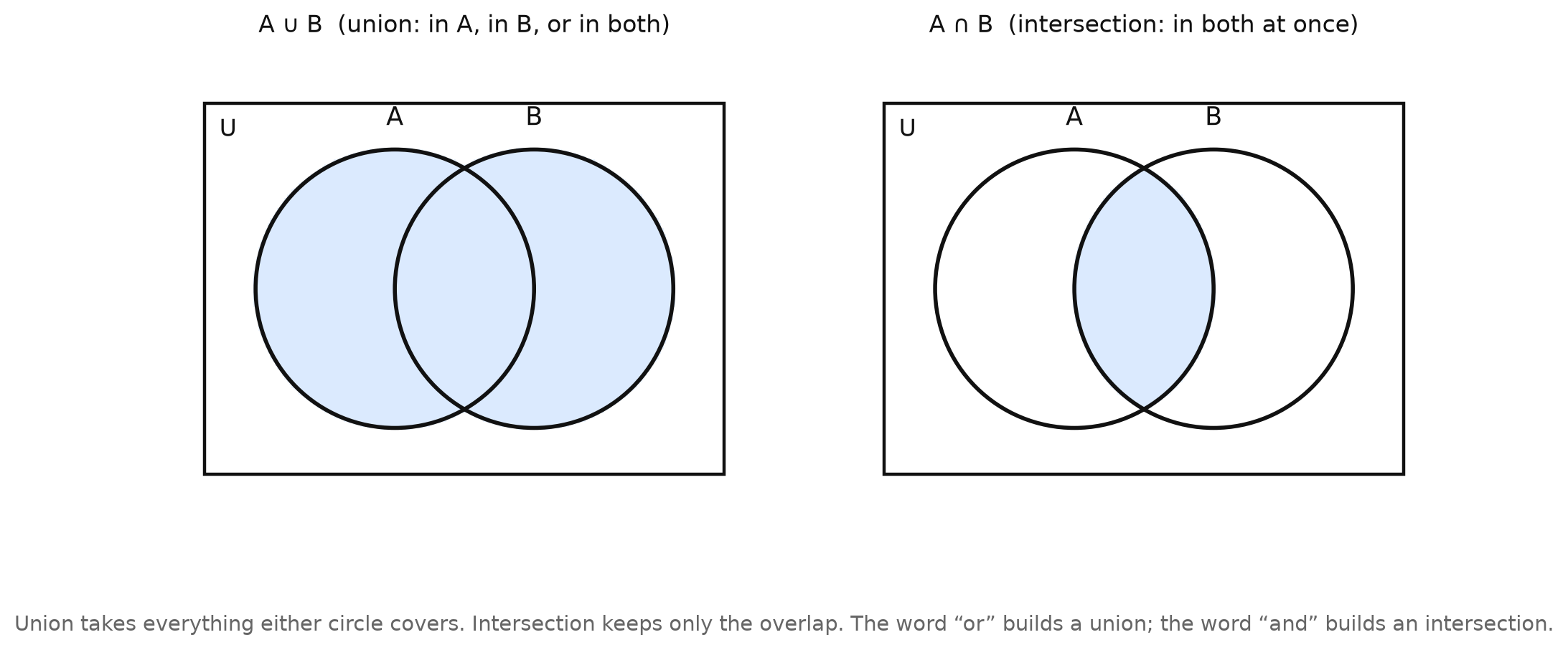
- The union is everything in , in , or in both. It is the picture of the word or.
- The intersection is only what is in both at once. It is the picture of the word and.
The connection back to Lesson 1.1 is exact: an element is in precisely when the statement "it is in or it is in " is true, and it is in precisely when "it is in and it is in " is true.
Subset and negation
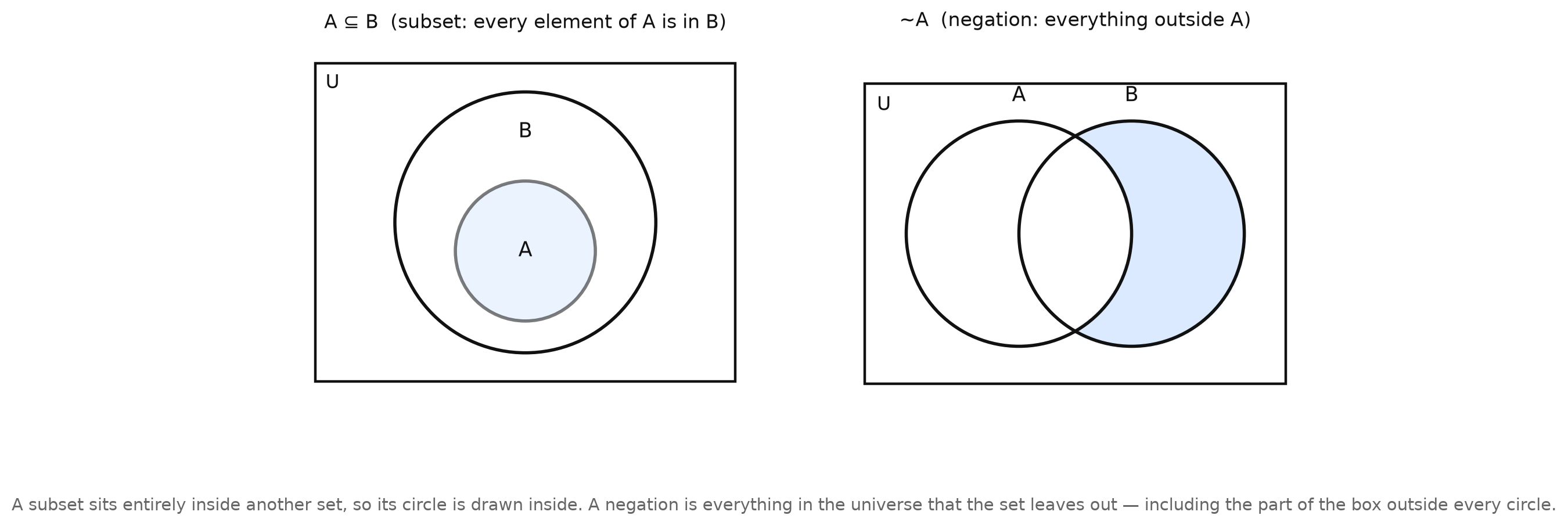
- is a subset of , written , when every element of is also in . The picture is one circle drawn entirely inside another.
- The negation of , written , is everything in the universe that is not in — and that includes the part of the rectangle outside every circle. Forgetting that outside region is the most common mistake in reading these diagrams.
Subset is a conditional drawn. "" says exactly "if is in , then is in ." The nesting picture and the if-then sentence are the same claim, and that is the bridge between the two halves of this chapter.
The quadrilateral family
The best geometric example of nesting is one you will spend Chapter 10 proving.
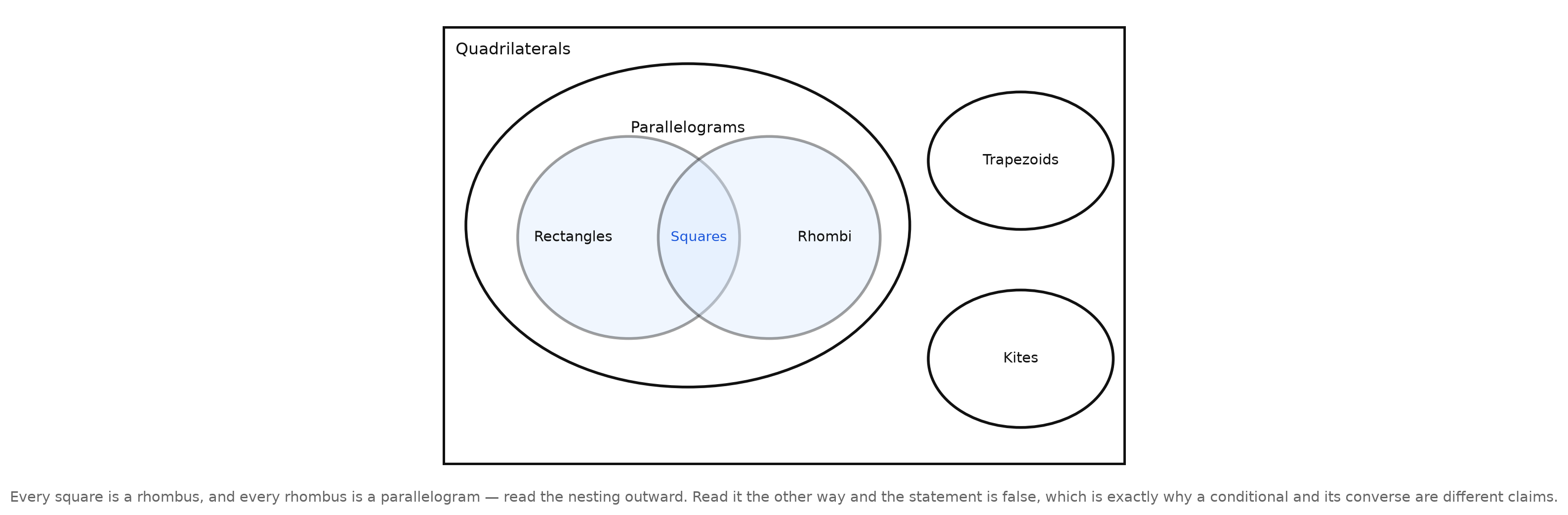
Read the nesting and true conditionals fall out of it:
- Squares sit inside Rhombi, so "if a figure is a square, then it is a rhombus" is true.
- Rhombi sit inside Parallelograms, so "if a figure is a rhombus, then it is a parallelogram" is true.
- Squares are the intersection of Rectangles and Rhombi — a square is exactly a figure that is both.
- Trapezoids are drawn apart from parallelograms, because in this book a trapezoid has exactly one pair of parallel sides.
Read the nesting backwards and the statements become false, which is the converse problem of Lesson 1.3 drawn as a picture. A rhombus need not be a square; the Rhombi oval is bigger than the Squares region.
Venn diagrams with counts
G.RLT.1d asks you to interpret diagrams, including ones describing real situations. Those come with numbers.
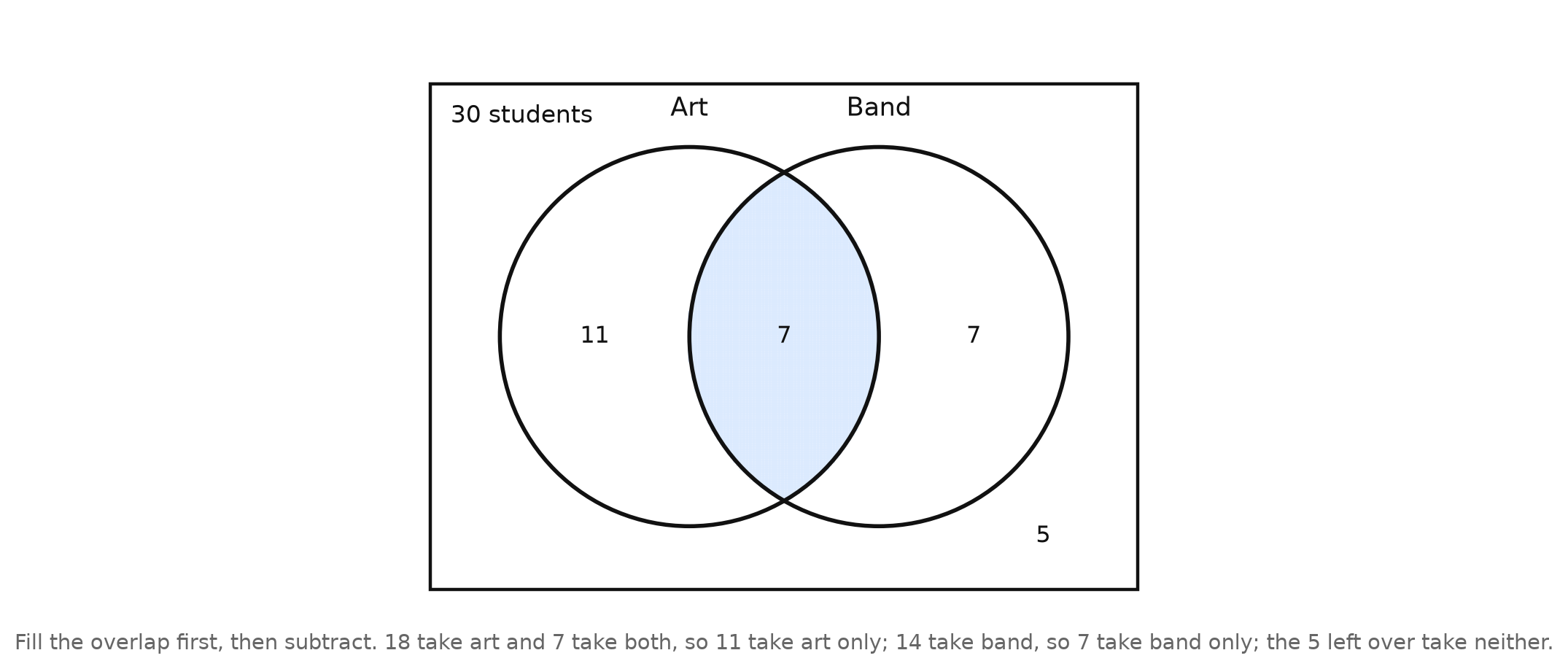
Thirty students were surveyed: take art, take band, and take both. The order of filling matters:
- Start in the middle. Put the "both" count, , in the overlap.
- Subtract outward. Art has altogether, and of them are already placed, so art-only is . Band-only is .
- The rest go outside. The three regions hold , so students take neither.
Now the diagram answers questions directly: students take at least one (that is the union), take both (the intersection), and take neither (the negation of the union). Notice that is bigger than — the in the overlap got counted twice. Filling the middle first is what prevents that.
Worked examples
Example 1 — Union or intersection
is the set of rectangles and is the set of rhombi. What is ?
Answer: The set of squares — the figures that are both.
Example 2 — Reading a subset
The quadrilateral figure shows Squares inside Rhombi. Write that as a conditional.
Answer: If a figure is a square, then it is a rhombus.
Example 3 — Negation includes the outside
In the survey diagram, how many students are in ?
Answer: — the band-only students plus the students in neither circle. The region outside both circles counts.
Example 4 — Filling a diagram
In a class of , play a sport and play an instrument; do both. Fill the four regions.
Answer: Both: . Sport only: . Instrument only: . Neither: .
Example 5 — A conclusion from the diagram
Using Example 4, how many play at least one of the two?
Answer: . That is the union, and it equals , subtracting the overlap that was counted twice.
Guided practice
- Use the union-and-intersection figure. Which region is shaded for ? Which for ?
- Which English word matches union, and which matches intersection?
- Use the subset-and-negation figure. Write the subset relationship shown as a conditional.
- In that same figure, name the two parts of the diagram that are shaded for .
- Use the quadrilateral figure. Name a set that Squares is a subset of.
- Use the survey figure. How many students take art only? How many take neither?
Independent practice
- Let triangles and right triangles. Which is a subset of which? Draw the diagram.
- Write each as a conditional statement. a) Rectangles Parallelograms b) Squares Rectangles
- Use the quadrilateral figure. Decide whether each is true, and cite the picture. a) Every rhombus is a parallelogram. b) Every parallelogram is a rhombus. c) Every square is a rectangle and a rhombus. d) Some trapezoids are parallelograms.
- In a group of people, own a dog, own a cat, and own both. Fill all four regions of a Venn diagram.
- Using item 96, how many own at least one pet? How many own neither?
- Using item 96, how many are in ?
- Application. Of students, took geometry, took art, and took neither. How many took both? (Fill the outside region first, then work in.)
- Application. A shop's inventory: bikes have a bell, have a basket, have both, and have neither. How many bikes are there in all?
- Error analysis. A student is told take art and take band with taking both, and writes in the art circle, in the overlap, and in the band circle. Identify the error and correct the diagram.
- Reasoning. Explain why equals rather than .
- Draw a Venn diagram showing that all squares are rectangles but not all rectangles are squares, and write the conditional and its false converse beneath it.
- Reasoning. Explain why "" and "if , then " say the same thing.
Exit ticket 1.5
- Shade on a two-circle diagram and say which English word it matches.
- In a universe of with in , how many are in ?
- Write "Rhombi Parallelograms" as a conditional and give its converse's truth value.
- Of students, play piano, play guitar, and play both. How many play neither?
Chapter 1 Review
Vocabulary. statement · negation · conjunction · disjunction · conditional · hypothesis · conclusion · counterexample · converse · inverse · contrapositive · logically equivalent · biconditional · definition · truth table · Venn diagram · universe · union · intersection · subset
Part A — Symbolic form (G.RLT.1a)
- Let : the figure is a rectangle; : the figure is a rhombus. Translate each. a) b) c) d) Then name the figure described by part (a).
- Write the negation of "," and complete a truth table for .
Part B — Conditionals and their relatives (G.RLT.1b)
- For "If a triangle is equilateral, then it is isosceles": a) identify the hypothesis and conclusion; b) write the converse, inverse, and contrapositive; c) give the truth value of all four, with a counterexample for each false one; d) explain why (c) required only two independent checks.
Part C — Biconditionals, Venn diagrams, and context (G.RLT.1 b, c, d)
- A survey of students found in chorus, in drama, and in both. a) Fill all four regions of a Venn diagram. b) How many are in chorus or drama? How many are in neither? c) Is "a student is in chorus if and only if the student is in drama" true for this group? Justify with the diagram. d) Write a true subset statement about this survey, or explain why none of the two sets is a subset of the other.
Standards coverage check — Chapter 1
| Knowledge and Skill | Where it is taught | Where it is practiced | Where it is applied in context |
|---|---|---|---|
| G.RLT.1a — translate propositional and compound statements into symbolic form: negation, conjunction, disjunction, conditional, biconditional, including geometric relationships | 1.1 (statements, negation, , , the five-form reference); 1.2 (conditional); 1.4 (biconditional) | 1–11, 15, 16, 18, 20–22; 23–34, 40, 42; 67–73, 83; 109, 110 | 12, 17; 35, 36; 77, 78 |
| G.RLT.1b — converse, inverse, contrapositive, their validity, and the biconditional as a true conditional with a true converse | 1.2 (counterexamples); 1.3 (all four related statements, equivalence); 1.4 (biconditional and definitions) | 31, 37–39, 43, 44; 45–54, 58–66; 74–76, 79–82, 84–86; 111 | 55, 56; 77, 78; 112c |
| G.RLT.1c — Venn diagrams for union, intersection, subset, and negation | 1.5 (all four relationships; the quadrilateral family) | 87–91, 93–95, 103, 104, 105–107 | 96–100; 112a, 112d |
| G.RLT.1d — interpret Venn diagrams, including contextual ones | 1.5 (survey diagram, fill-the-middle-first method) | 92, 98, 101, 102, 106, 108 | 96, 97, 99, 100; 112a–112d |
Supporting items: 13, 18, 38, 58, 61, 80, 82, 102, and 104 are the reasoning items that ask why a rule holds rather than applying it; 14, 37, 57, 79, and 101 are error analyses aimed at the five most common confusions in this chapter — over-negating ("not " read as ""), calling a conditional false because its hypothesis is impossible, negating without swapping when writing a contrapositive, writing a definition too loosely, and putting a circle's total in a Venn region instead of the region-only count.
Boundaries respected. Symbolic forms stop at the five G.RLT.1a names — no quantifiers, no truth tables with three variables, no formal proof of a logical equivalence. Venn diagram relationships stop at the four G.RLT.1c names. The quadrilateral family appears here as a set relationship to be read, not proved; the proofs are Chapter 10's job under G.PC.1. Formal two-column proof structure is introduced in Chapter 2, where parallel lines give it something to prove.
Answer keys for every item in this chapter are in Appendix A.