Chapter 10 — The Laws of Exponents
Standard: A.EO.3 (a, b)
A.EO.3 — verbatim. The student will derive and apply the laws of exponents. Students will demonstrate the following Knowledge and Skills: a) Derive the laws of exponents through explorations of patterns, to include products, quotients, and powers of bases. b) Simplify multivariable expressions and ratios of monomial expressions in which the exponents are integers, using the laws of exponents.
By the end of this chapter you will be able to:
- Derive the product law by writing out the factors and counting them, rather than by being told (A.EO.3a)
- Derive the quotient law by matching factors off in pairs (A.EO.3a)
- Show that is forced by a descending pattern and by reading one quotient two ways (A.EO.3a)
- Show that is forced by continuing that same pattern below zero (A.EO.3a)
- Derive the three laws for powers of bases — , , and — by counting groups of factors (A.EO.3a)
- Tell apart from , and say which symbol the exponent actually sits on (A.EO.3a)
- Simplify multivariable expressions with integer exponents, base by base, leaving no negative exponent in a final answer (A.EO.3b)
- Simplify ratios of monomial expressions with integer exponents, dividing coefficients and subtracting exponents (A.EO.3b)
- Use powers of ten to compare orders of magnitude in real quantities, and check a power on a calculator (A.EO.3b)
Lessons: 10.1 Powers and the Product Law · 10.2 The Quotient Law · 10.3 Zero and Negative Exponents · 10.4 Powers of Bases · 10.5 Multivariable Expressions and Ratios of Monomials
Why this chapter matters. An exponent is a counting device: records that five copies of are being multiplied. Every law in this chapter is therefore a fact about counting, and that is why none of them has to be memorized. If you can write out the factors, you can rebuild the law on the spot. That matters immediately — polynomial multiplication in Chapter 12 is the product law applied term by term, simplest radical form in Chapter 11 leans on powers of a product, and exponential models in Chapter 17 are built on the same whose behavior at and at negative you settle here. It also matters outside mathematics: populations, distances, file sizes, and the doubling of a dividing cell are all reported as powers, and comparing two of them is a subtraction of exponents.
Scope note. This chapter derives the laws of exponents and applies them to expressions. It stays inside integer exponents, because A.EO.3b says so: zero and negative exponents are in scope, and rational or fractional exponents are not. Radicals, and rational exponents limited to and , are A.EO.4 in Chapter 11. Adding, subtracting, and multiplying polynomials is A.EO.2 a and b in Chapter 12, factoring is A.EO.2c in Chapter 13, and dividing a polynomial by a monomial or a binomial is A.EO.2d in Chapter 14 — this chapter divides one monomial by another and stops there. Exponential functions , their graphs, their domains and ranges, and their transformations are A.F.2 e and f in Chapter 17; nothing here graphs a power or asks how it grows. No figure in this chapter is a graph of a function, on purpose.
Conventions this chapter fixes.
- In , the number is the base, the number is the exponent, and the whole expression is a power. Read as " to the th power."
- The exponent reaches only the symbol it sits on. In the exponent sits on the , so the expression is . In the parentheses make the base, so the expression is . In the exponent sits on the only; in it reaches both.
- . One copy of multiplied together is . An exponent of is almost never written, but it is always there, and reading as is what makes the product law work on it.
- Every quotient law carries a restriction. requires , because the denominator would otherwise be zero. So do and , both of which are derived from a quotient. This chapter states the restriction rather than hiding it, and is left undefined.
- A negative exponent is not a negative number. , a positive number less than one. The minus sign in the exponent says reciprocal, not opposite.
- Final answers use positive exponents, unless an item asks for something else. So is reported as , not as , even though the two are equal at every allowed value of .
- A monomial is a number, a variable, or a product of numbers and variables. A ratio of monomials is one monomial divided by another, and simplifying one is the whole content of Lesson 10.5.
- Item numbering runs straight through the chapter, from 1 in Lesson 10.1 to 126 at the end of the review. It does not restart at each lesson.
Calculator note. Algebra 1 has no no-calculator standards, and the Desmos Virginia calculator is available for the entire End-of-Course test. Use it here the way this volume uses it everywhere: to confirm a result you already produced. Entering and seeing is a good habit, because it is one keystroke and it catches the student who thought the answer would be or . What a calculator cannot do is simplify , since that has no numeric value until and are chosen — which is exactly why substituting a couple of values into both the original and your answer is the algebraic version of the same check. The powers worth knowing on sight are the powers of two up to and the powers of ten in both directions.
Lesson 10.1 — Powers and the Product Law
What an exponent counts
A power is shorthand for repeated multiplication:
The base is the thing being multiplied, and the exponent counts how many copies appear. That is the whole definition, and every law in this chapter is a consequence of it.
Two small readings follow immediately.
- . One copy of is . The exponent is almost never written down, but it is there, and remembering it is what lets you handle .
- The exponent is a count, not a multiplier. is not . At the first is and the second is .
Multiplying powers of the same base
Now multiply two powers of and do nothing clever — just write out both rows of factors and count them.
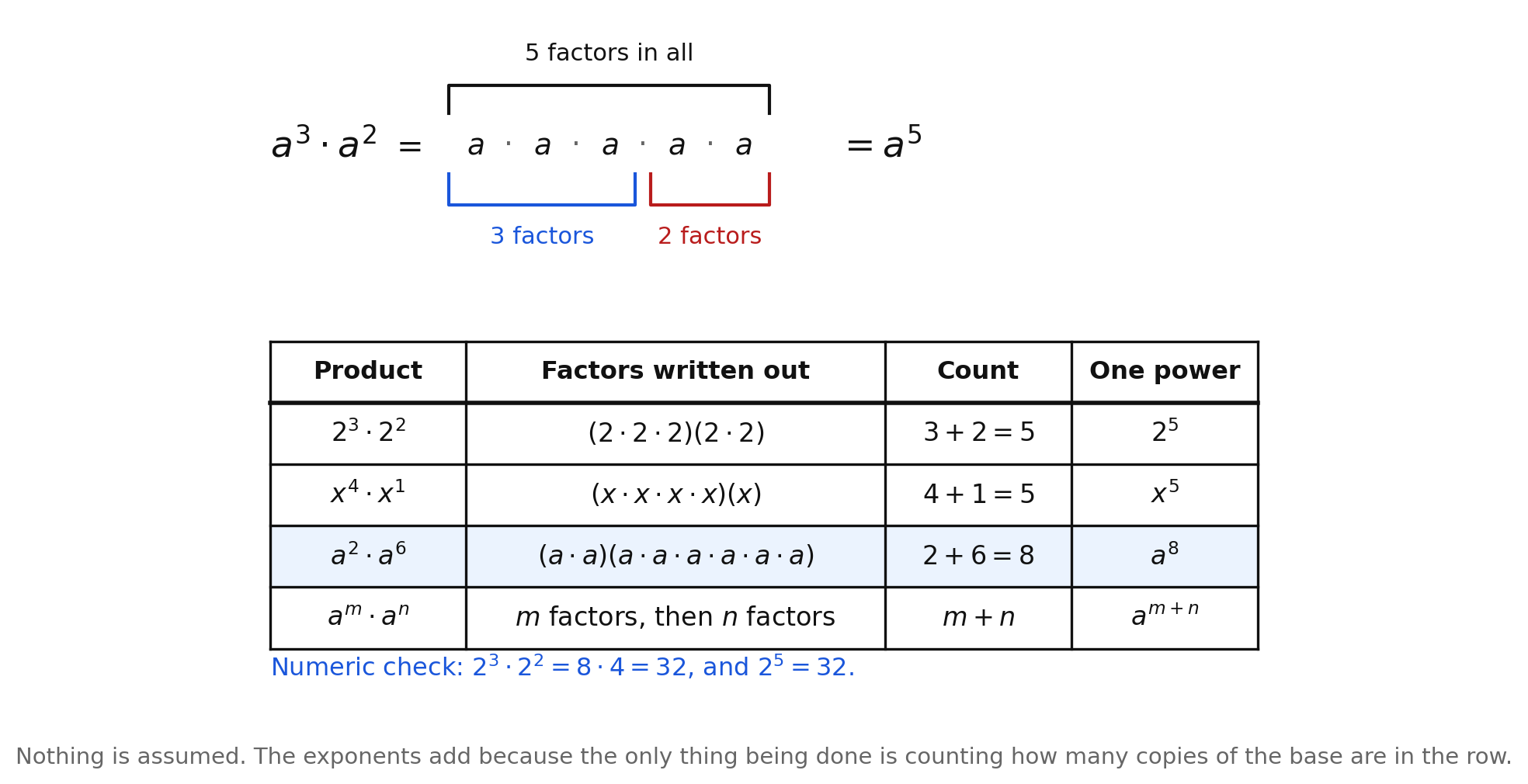
The figure writes as a single row of s. The blue brace covers 3 factors, the red brace covers 2 factors, and the black brace over the top covers 5 factors in all. So
Nothing was assumed. The exponents added because the only thing that happened was counting how many copies of the base were standing in the row.
The table underneath runs the same count on four more products. becomes , a count of , so — and the numeric check at the bottom of the figure confirms it: , and . The row shows the invisible exponent doing its job: is factors, so . The shaded row does , a count of , giving . The last row does the general case: factors, then factors, for a total of .
The product law. For any base and any exponents and ,
The bases must match
The law counts copies of one base. If the bases differ, there is nothing to count together.
There is no single power that this equals, because the expression is three copies of and four copies of , and those are different things being multiplied. Writing claims seven copies of , which would be seven s and seven s.
When several bases appear at once, sort them and handle each separately. That is what makes the law useful on multivariable expressions, which is what A.EO.3b asks for:
Coefficients are multiplied, not added
A coefficient is a number multiplying a power, and it plays no part in the counting of factors. It is simply multiplied.
The coefficients multiply because really is ; the exponents add because copies of followed by copies of really is copies. Two different operations, on two different parts of the term, both coming straight from what the notation means.
Here is the procedure in full.
- Match the bases. Group the powers that share a base; leave the rest alone.
- Multiply the coefficients, signs included.
- Add the exponents on each matched base, reading a bare variable as exponent .
- Write each base once, in a consistent order — alphabetical is the convention in this volume.
Where the minus sign lives
This is the classic error of the chapter, and it has nothing to do with the laws. It is a question about what the base is.
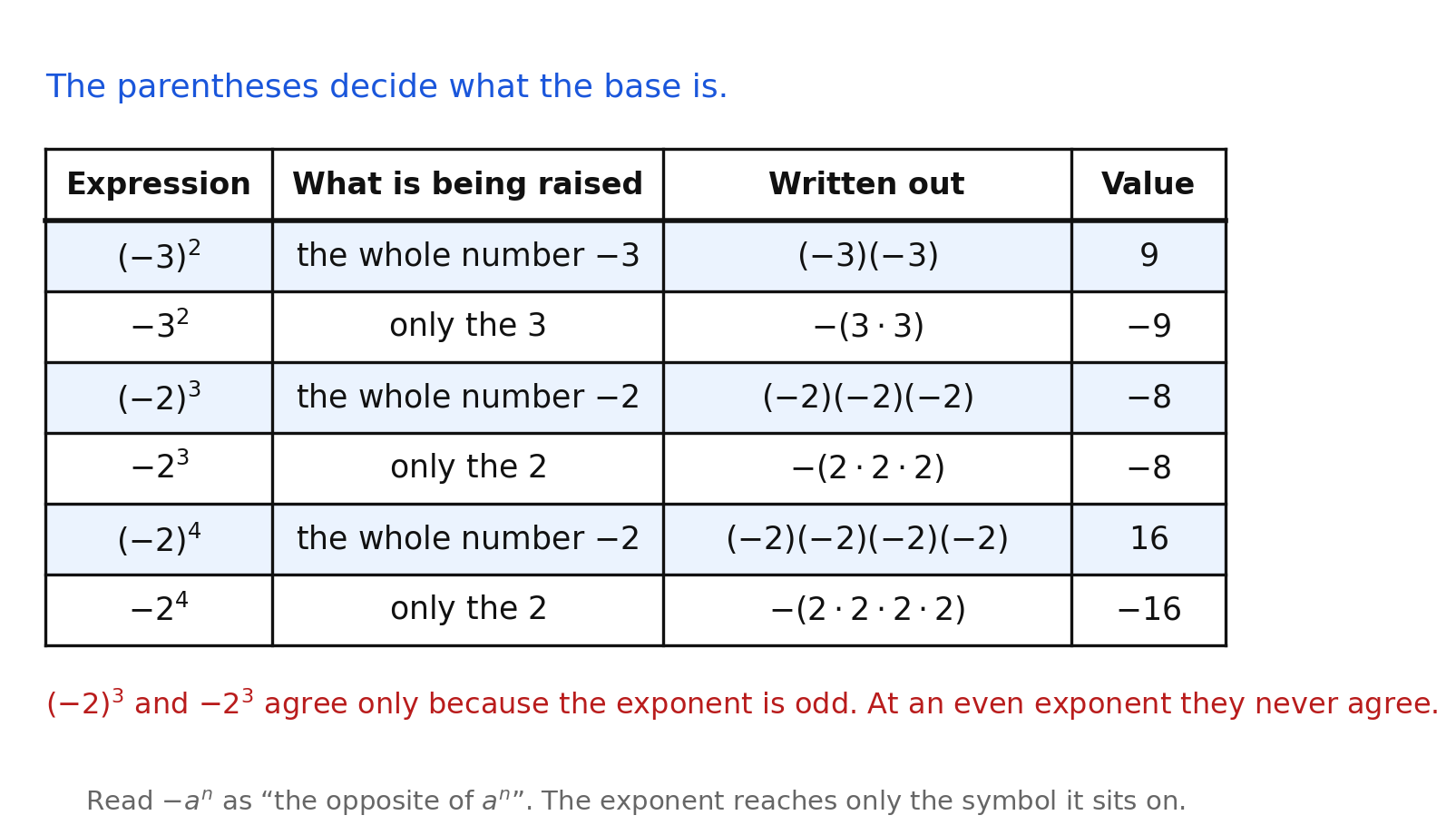
The parentheses decide what the base is. Read the table row by row:
| Expression | Base | Written out | Value |
|---|---|---|---|
| the whole number | |||
| only the | |||
| the whole number | |||
| only the | |||
| the whole number | |||
| only the |
Read as "the opposite of ." That single rewording settles every case, because it puts the exponent where it actually is and applies the minus sign afterward.
Notice the trap the figure names explicitly: and both equal , so they agree only because the exponent is odd. At an even exponent they never agree — while . A student who checks the rule once with an odd exponent will conclude the parentheses do not matter, and will be wrong every other time.
The same care applies with variables. In only the is squared; in the two minus signs multiply to a plus, giving .
Worked examples
Example 1 — One base
Write as a single power.
The bases match, so add the counts: .
Answer:
Example 2 — An invisible exponent
Write as a single power.
Read as . Then .
Answer:
Example 3 — A coefficient and a sign
Simplify .
Multiply the coefficients: . Add the exponents: .
Answer:
Example 4 — Two variables
Simplify .
Coefficients: . Base : . Base : .
Answer:
Example 5 — Which symbol has the exponent
Evaluate and .
In the first, the base is : . In the second, the base is and the minus sign is applied afterward: .
Answer: Both equal — but only because the exponent is odd. At an even exponent they differ: while .
Guided practice
- Use the product-law figure. Write as a row of factors, say what each of the three braces counts, and give the single power.
- In that same figure, read the shaded row. What are the factors of written out, what is the count, and what single power results?
- Using the figure, explain in one or two sentences why the exponents add. Your explanation should mention counting and should not use the word "rule."
- Write as a single power, then evaluate both the original and your answer to confirm they agree.
- Write as a single power.
- Use the figure comparing negative bases. Give the value of and the value of , and say in one sentence what makes them different.
Independent practice
- Write each as a single power. a) b) c) d)
- Simplify. a) b) c) d)
- Simplify each multivariable product. a) b) c) d)
- Reasoning. Explain why cannot be written as a single power. Say what would mean, and why that is a different expression.
- Evaluate all four: , , , . Then say what the four values together show about when the parentheses matter.
- Application. A backup archive holds files, and each file is exactly bytes. Write the total number of bytes as a single power of , then give it as an ordinary number, and name the law you used.
- Reasoning. Explain why , and then explain why the product law would fail on if you refused to read as .
- Error analysis. A student writes . Identify the error, give the correct answer, and show the count of factors that settles it.
- Error analysis. A student writes . Identify the error, give the correct value, and write the expression whose value really is .
- Find each missing exponent. a) b) c)
Exit ticket 10.1
- Write as a single power.
- Simplify .
- Evaluate and , and say which symbol carries the exponent in each.
- Explain why the product law requires the two bases to match. Use as your example.
Lesson 10.2 — The Quotient Law
Dividing powers of the same base
Multiplication built a row of factors; division takes them away in pairs. Again, write everything out and look.
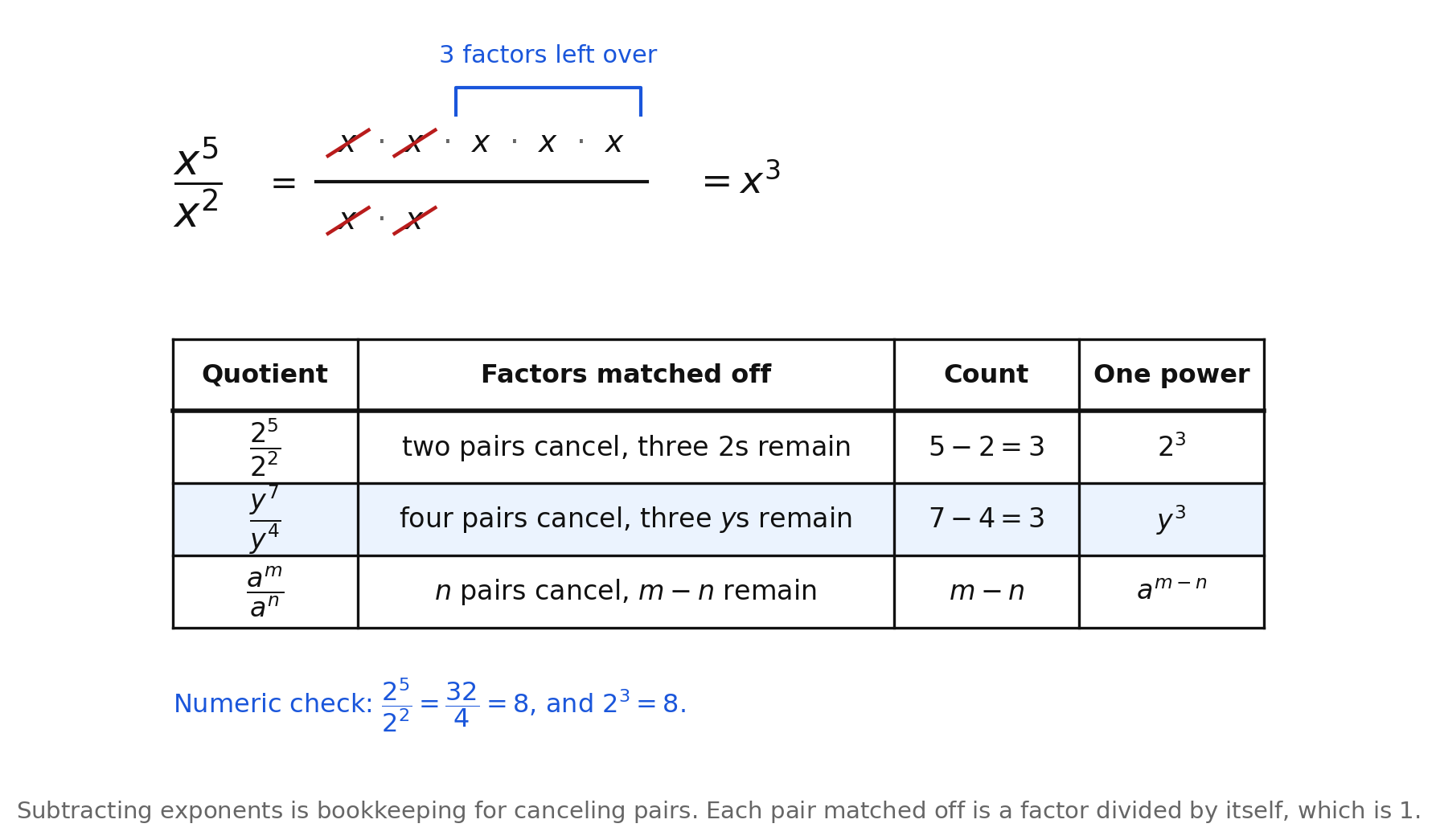
The figure writes with all seven factors visible: five s on top, two on the bottom. Each of the bottom s is struck through together with an above it, because a factor divided by itself is . Two pairs are matched off that way, and the brace labels what survives: 3 factors left over. So
The count is . Subtracting exponents is nothing more than bookkeeping for canceling pairs — the figure's own note says it: each pair matched off is a factor divided by itself, which is .
The table runs the same argument three more ways. For , two pairs cancel and three s remain, so and the answer is ; the numeric check at the bottom of the figure confirms it, since and . For , four pairs cancel and three s remain, so and the answer is . The last row states the general case: pairs cancel and factors remain.
The quotient law. For any base and any exponents and ,
Why
The restriction is not decoration. If , the denominator is , and names no number at all. So the law is a statement about every base except zero, and every consequence of the law — including the two derivations of the next lesson — inherits that same exception. State it when you state the law; it will matter in Lesson 10.3.
Coefficients divide
The coefficients of a ratio of monomials are divided, and the result is reported as a reduced fraction or a whole number, whichever it turns out to be.
The second one is worth pausing on. The coefficient fraction reduces to , and is the honest answer; there is no reason for it to come out whole. Nothing about the exponents changed because of it.
The full procedure for a ratio of monomials:
- Divide the coefficients, signs included, and reduce the fraction.
- Subtract exponents base by base, top exponent minus bottom exponent, in that order.
- Handle each base separately. A base that appears only on top, or only on the bottom, stays where it is.
- Record the restriction. Every variable that appears in the denominator is nonzero.
Several bases at once
This is exactly what A.EO.3b means by a ratio of monomial expressions, and the work is the same work done once per base.
Coefficients: . Base : . Base : , reading the bare as . Three independent subtractions, one for each base, and a division for the numbers out front.
Keep the order of the subtraction straight. It is always numerator exponent minus denominator exponent. Reversing it on one base out of three is the most common way an otherwise correct simplification goes wrong.
What happens when the exponents are equal, or upside down
So far every example had a larger exponent on top, so the leftover count was positive. Two other cases exist, and it is worth naming them now even though the next lesson is where they get settled.
- Equal exponents. In every factor pairs off, so nothing is left over and the count is .
- A larger exponent on the bottom. In the two top factors pair off, and three factors are left over on the bottom, so the count is .
Do not reach for a rule you have not derived. Just notice that the counting still works perfectly well, and that it is producing exponents of and of . Lesson 10.3 is about what those two exponents have to mean.
Worked examples
Example 1 — One base
Write as a single power.
Four pairs cancel, five factors remain: .
Answer: , for
Example 2 — A coefficient
Simplify .
Divide the coefficients: . Subtract the exponents: .
Answer:
Example 3 — A negative coefficient
Simplify .
Coefficients: . Exponents: .
Answer:
Example 4 — Two variables
Simplify .
Base : . Base : .
Answer:
Example 5 — A coefficient that stays a fraction
Simplify .
reduces to , and .
Answer:
Guided practice
- Use the quotient-law figure. Write with all its factors shown, say how many pairs are struck through, say how many factors are left over, and give the single power.
- In that same figure, read the shaded row. For , how many pairs cancel, how many s remain, and what single power results?
- Use the numeric check printed in that figure. Evaluate as a number, evaluate , and say what the agreement confirms.
- Write as a single power.
- Simplify .
- Explain why the quotient law must say . Say exactly what goes wrong at .
Independent practice
- Write each as a single power. a) b) c) d)
- Simplify. a) b) c) d)
- Simplify each ratio of monomials. a) b) c) d)
- Application. A stadium seats about people and a school auditorium seats about . Write the ratio of the two capacities as a power of ten, and say in one sentence how many times as many people the stadium holds.
- Application. A drive holds bytes and each backup image is bytes. Write the number of images that fit as a power of , then give it as an ordinary number.
- Reasoning. Explain why subtracting exponents does the same job as canceling matched pairs of factors. Use and say what each canceled pair is worth.
- Error analysis. A student writes . Identify what the student did to the exponents, give the correct answer, and check it by counting leftover factors.
- Error analysis. A student writes . Identify the error, and say which operation belongs to the coefficients and which belongs to the exponents.
- Find each missing exponent. a) b) c)
- Reasoning. In with , the leftover count is positive. Describe, in terms of leftover factors only, what happens when and what happens when . Do not use any law you have not yet derived.
Exit ticket 10.2
- Write as a single power.
- Simplify .
- Write as a single power of , then give its value as a number.
- Explain why every statement of the quotient law carries the restriction .
Lesson 10.3 — Zero and Negative Exponents
This is the heart of the chapter. The two facts in it — and — are the two that students most often file away as arbitrary conventions someone decided on. They are not. They are forced. Once the product and quotient laws are in place, no other values are available, and a student who reads one quotient two ways cannot escape the conclusion.
The pattern that runs down to zero
Start with powers of and walk down the exponents one step at a time.
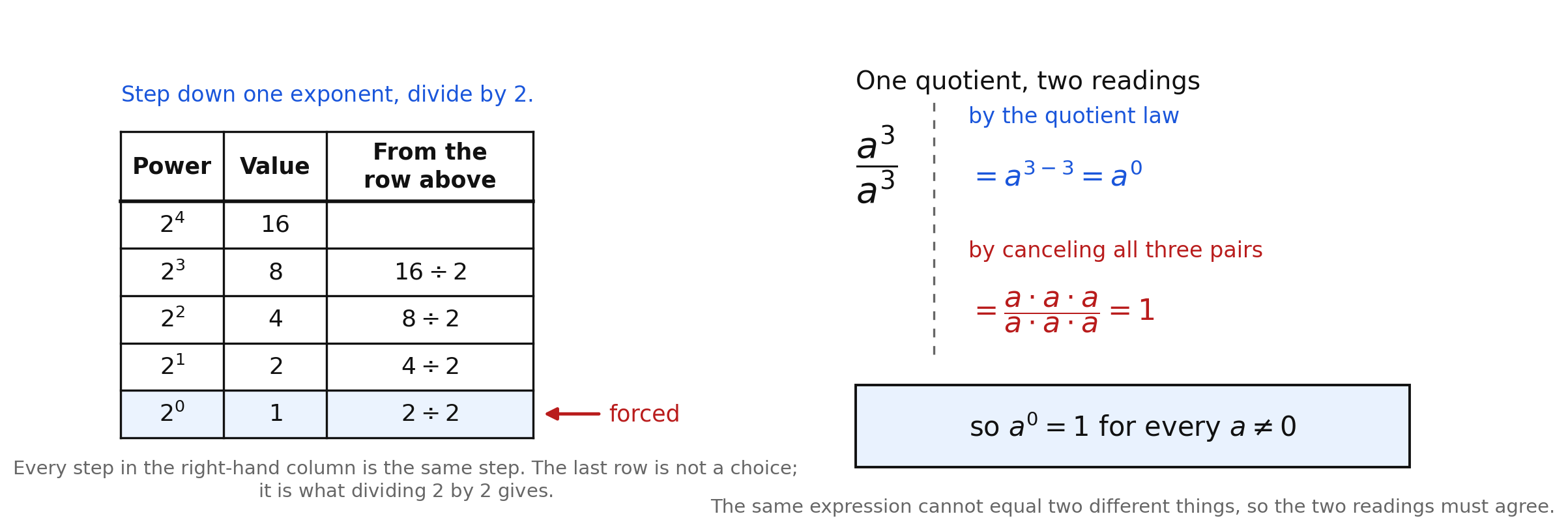
The left-hand table is the pattern. Read the right-hand column first, because it is the same instruction five times over:
| Power | Value | From the row above |
|---|---|---|
Step down one exponent, divide by . That is what dropping one factor of means, and it happens at every single step. The last row is shaded and the arrow beside it says forced, for a plain reason: if the rule for stepping down is "divide by ," then the value below is . Nobody chose that. Choosing anything else would mean the pattern broke on the very last step for no reason.
The same conclusion from one quotient read twice
The pattern makes overwhelmingly likely. The right-hand panel of the figure makes it unavoidable. Take a single expression, , and read it two ways.
- By the quotient law: .
- By canceling all three pairs: .
The same expression cannot equal two different things. Both readings are legitimate — the first uses a law derived in Lesson 10.2, the second uses only the fact that a factor over itself is — so the two answers must be the same number.
That is a derivation, not a convention. It is also exactly why the restriction rides along: the argument divides by , which is only allowed when .
Once you have it, is indifferent to what is. . . . And for every , because whatever number happens to be, it is being raised to the zero power.
The one base the derivation cannot reach is , and it is worth being honest about why rather than quietly skipping it.
Two patterns collide there. Looking along the exponents, for every nonzero , which suggests should be . Looking along the bases, for every positive — , , — which suggests should be . There is no reading that satisfies both, and the derivation above cannot break the tie, because it divided by and .
So is left undefined in this course. That is not a gap in the theory; it is the theory declining to invent an answer that no pattern forces.
A context whose zero row is a real moment
The zero exponent can feel like a technicality. Here is a situation where it is a plain fact about the world.
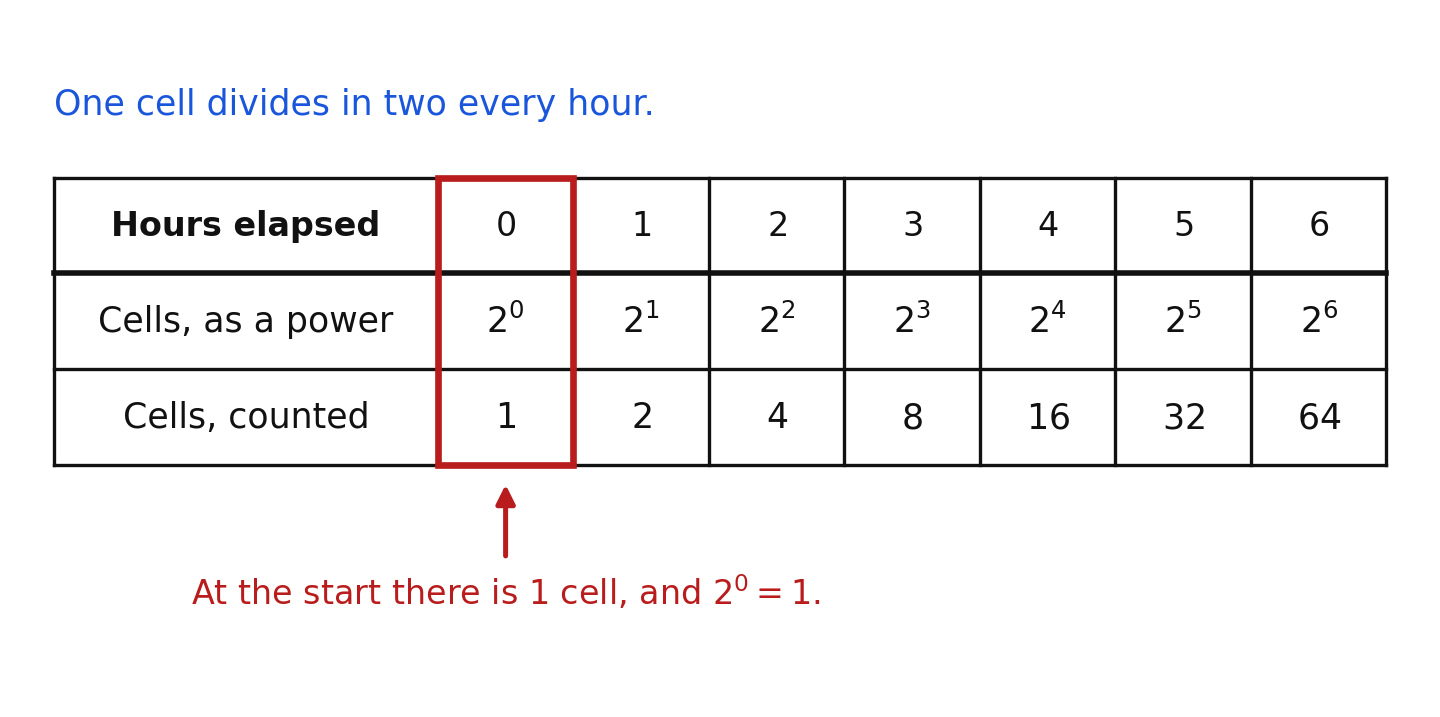
One cell divides in two every hour. After hours there are cells:
| Hours elapsed | |||||||
|---|---|---|---|---|---|---|---|
| Cells, as a power | |||||||
| Cells, counted |
The boxed column is hour — the moment the observation begins. There is one cell then, because nothing has divided yet. And the power in that column is . So is not a bookkeeping fiction; in this table it is a headcount. The zero exponent is what "before anything has happened yet" looks like when a quantity is written as a power.
(How this table behaves as a function — its domain, its graph, its rate of growth — is Chapter 17's subject. Here it is a column of arithmetic.)
Continuing the pattern below zero
Now do the obvious thing: keep walking down. The instruction has not changed.
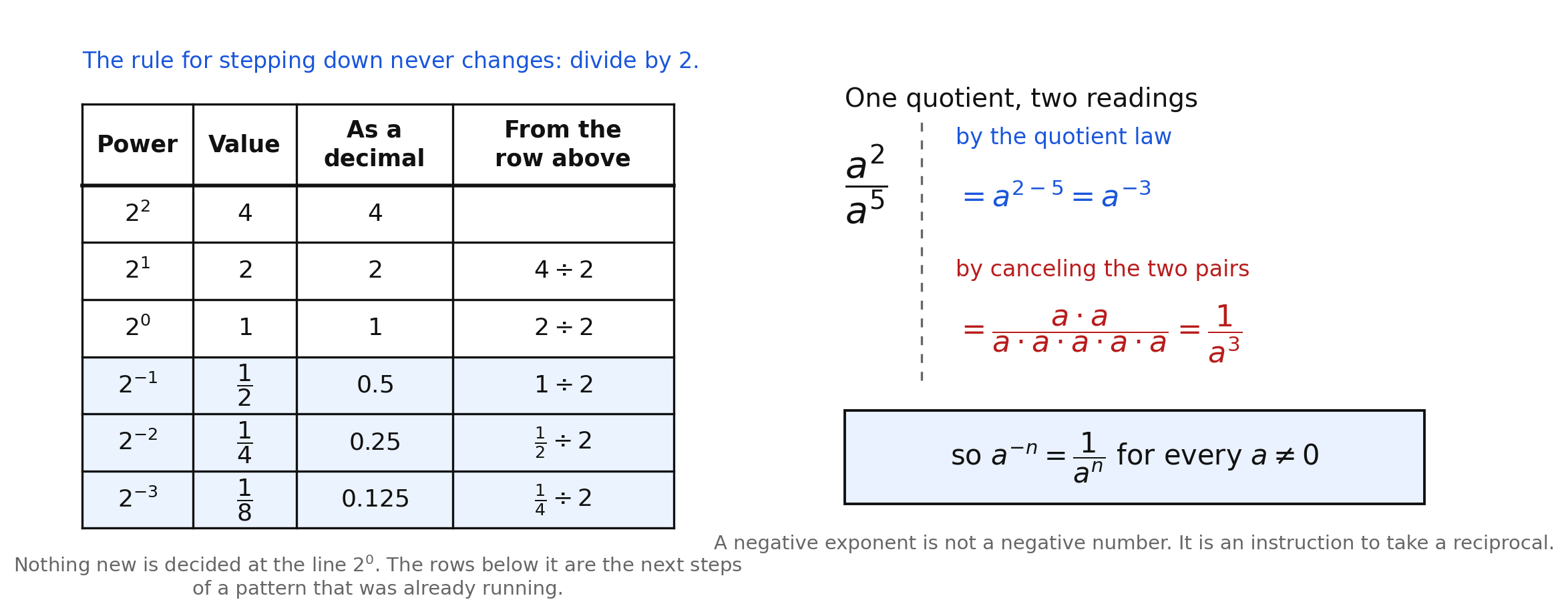
The left-hand table is the same column as before, extended:
| Power | Value | As a decimal | From the row above |
|---|---|---|---|
Look at the figure's own note: nothing new is decided at the line . The three shaded rows below it are the next steps of a pattern that was already running. Divide by and you get , so . Divide again and . Again and .
This is where the single most common misreading dies. A student expecting to be has to explain why the column suddenly stopped dividing by and started doing something else. There is no such explanation. A negative exponent is not a negative number. It is an instruction to take a reciprocal, and every value in the shaded rows is a positive number smaller than .
The decimal column is there to be checked. Enter on a calculator and it returns . That takes one keystroke and it is worth doing once, because seeing rather than or settles the matter in a way an argument sometimes does not.
And the same two-readings argument
The pattern strongly suggests the rule; one quotient read twice forces it. The right-hand panel takes .
- By the quotient law: .
- By canceling the two pairs: , since two factors on top match two on the bottom and three factors are left over below the bar.
One expression, two correct readings, so the answers agree.
Turn it over and the same statement reads : a negative exponent in a denominator moves up as a positive one. Both directions are the same fact, which is what "reciprocal" means.
Writing answers with positive exponents
The convention of this volume is that a final answer contains no negative exponent. Moving one is a matter of crossing the bar.
- A negative exponent in the numerator moves to the denominator and turns positive: .
- A negative exponent in the denominator moves to the numerator and turns positive: .
- Both at once: .
One caution, because it accounts for most of the errors here: only the base with the negative exponent moves. A coefficient stays where it is.
The exponent sits on the alone, exactly as in Lesson 10.1. Check it at : the correct form gives , while the wrong one gives , which is about . Not close.
Worked examples
Example 1 — Zero exponents
Evaluate , , and for .
Every nonzero base raised to the zero power is .
Answer: , , and
Example 2 — A negative exponent as a fraction
Evaluate .
.
Answer: , or on a calculator
Example 3 — A negative base and a negative exponent
Evaluate .
.
Answer: . The value is negative because the base is negative and the exponent is odd, not because the exponent is negative.
Example 4 — Combining laws
Simplify , and write the answer with a positive exponent.
The product law adds exponents whatever their signs: .
Answer:
Example 5 — Two bases, both moving
Simplify with positive exponents.
Base : . Base : . So the result is , and the moves down.
Answer:
Guided practice
- Use the descending-pattern figure for the zero exponent. List the five powers in the table with their values, and give the division in the right-hand column that produces each value from the row above.
- In that same figure, read the two-readings panel. What does the quotient law give for ? What does canceling all three pairs give? What must therefore be true, and why can it not be otherwise?
- Use the cell-division figure. Which column is boxed, what number of cells does it record, and what power of sits in it? Say in one sentence why that column is a real moment in the story rather than a technicality.
- Evaluate , , and for .
- Use the figure that continues the pattern below zero. Give the values of , , and as fractions and as decimals, and give the division that produces each from the row above.
- In that same figure, read the two-readings panel. What does the quotient law give for ? What does canceling the two pairs give? What law follows?
- Explain why both and carry the restriction , and say why is left undefined.
Independent practice
- Evaluate each exactly. a) b) c) d)
- Give each as a decimal, then confirm it on a calculator and say what you entered. a) b) c)
- Rewrite each with positive exponents only. a) b) c) d)
- Simplify, writing each answer with positive exponents. a) b) c) d)
- Simplify each multivariable expression with positive exponents. a) b) c) d)
- Reasoning. Explain why is and not . Then evaluate both at and report the two values, to show they are not the same expression.
- Application. Use the cell-division figure. Explain why the hour- column records cell, give the number of cells after hours, and give the number after hours as a power of and as an ordinary number.
- Application. A thumbnail image takes up megabytes of storage. Write that size as a fraction and as a decimal, and say how many thumbnails fit in one megabyte.
- Reasoning. Using the divide-by- column of the figure that continues the pattern below zero, explain why has to be and cannot be . Your explanation should say what would have to happen to the pattern for to be right.
- Reasoning. Explain why is forced rather than chosen. Use the two readings of , and say where the restriction enters the argument.
- Error analysis. A student says . Identify the two separate mistakes in that answer, give the correct value, and say what expression really does equal .
- Error analysis. A student says "because the exponent is zero." Identify the error, give the correct value, and name the quotient that forces it.
- Reasoning. Explain why is left undefined. Name the two patterns that disagree there, and say why the derivation of cannot settle the case .
Exit ticket 10.3
- Evaluate , , and .
- Rewrite with positive exponents.
- Simplify with positive exponents.
- Complete the column: , , , , . Then state in one sentence the single rule that produces every entry from the one above it.
- Explain in two sentences why is forced by the quotient law rather than chosen as a convention.
Lesson 10.4 — Powers of Bases
A.EO.3a names three things to derive from patterns: products, quotients, and powers of bases. The first two are done. This lesson does the third, and there are three of them: a power of a power, a power of a product, and a power of a quotient. All three come from counting, and none of them is new mathematics.
A power of a power counts groups
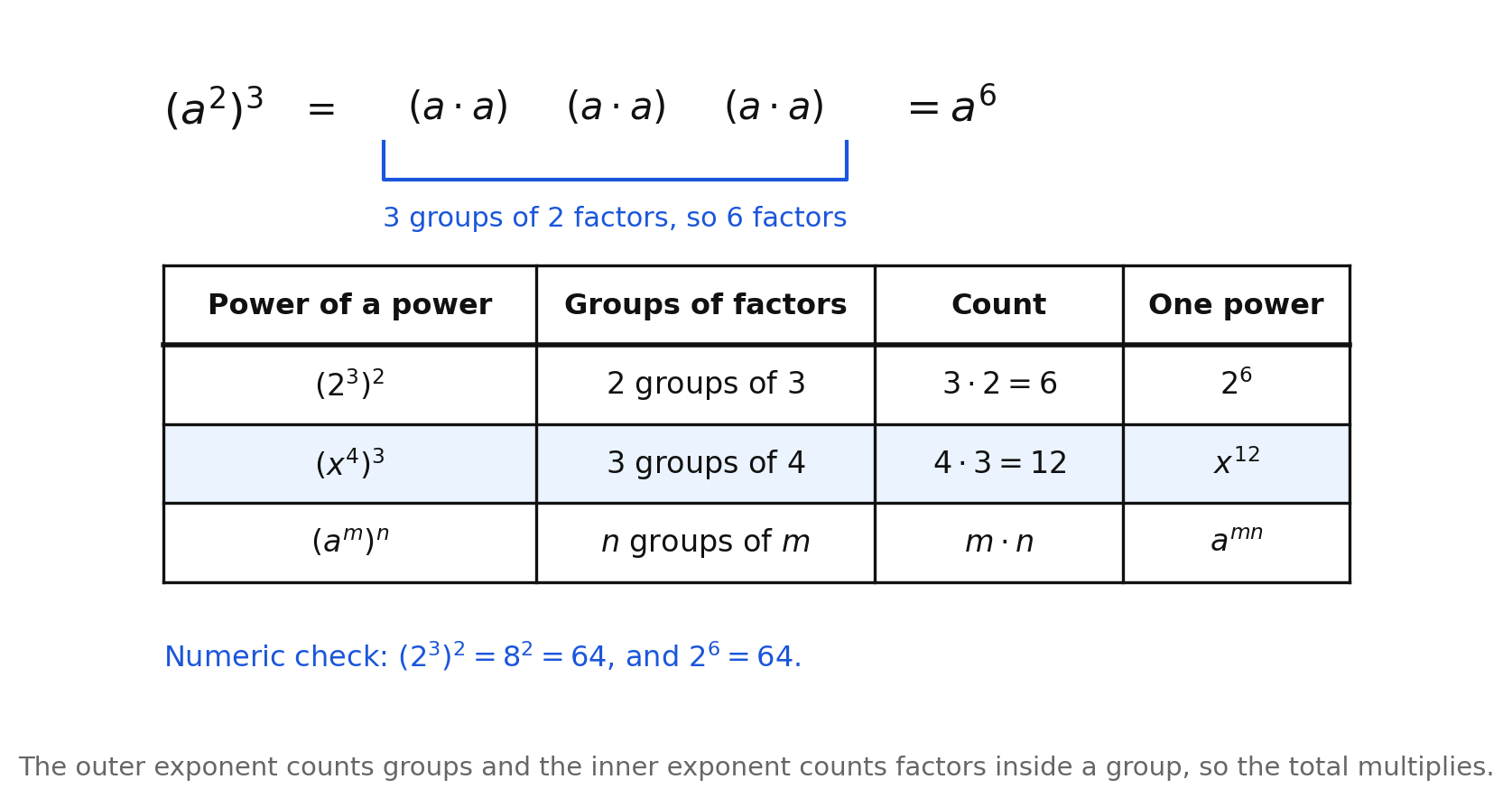
The figure writes out in full. The outer exponent says "three copies of the thing inside," and the thing inside is , which is two factors. So:
The brace labels the count exactly: 3 groups of 2 factors, so 6 factors. The outer exponent counts groups; the inner exponent counts factors inside a group; and the total number of factors is groups times factors per group. That is multiplication, not addition, because it is the same arithmetic as counting three rows of two chairs.
The table repeats the count. is groups of , so factors and the answer is — confirmed by the numeric check in the figure, since and . is groups of , so and the answer is . The general row: is groups of .
Power of a power.
This is the law most often confused with the product law, so it is worth holding the two side by side.
In the first, two rows of factors are laid end to end, so the counts add. In the second, one row of two is repeated three times, so the counts multiply. Different pictures, different arithmetic, and writing the factors out tells you which one you are looking at every time.
A power of a product, and a power of a quotient
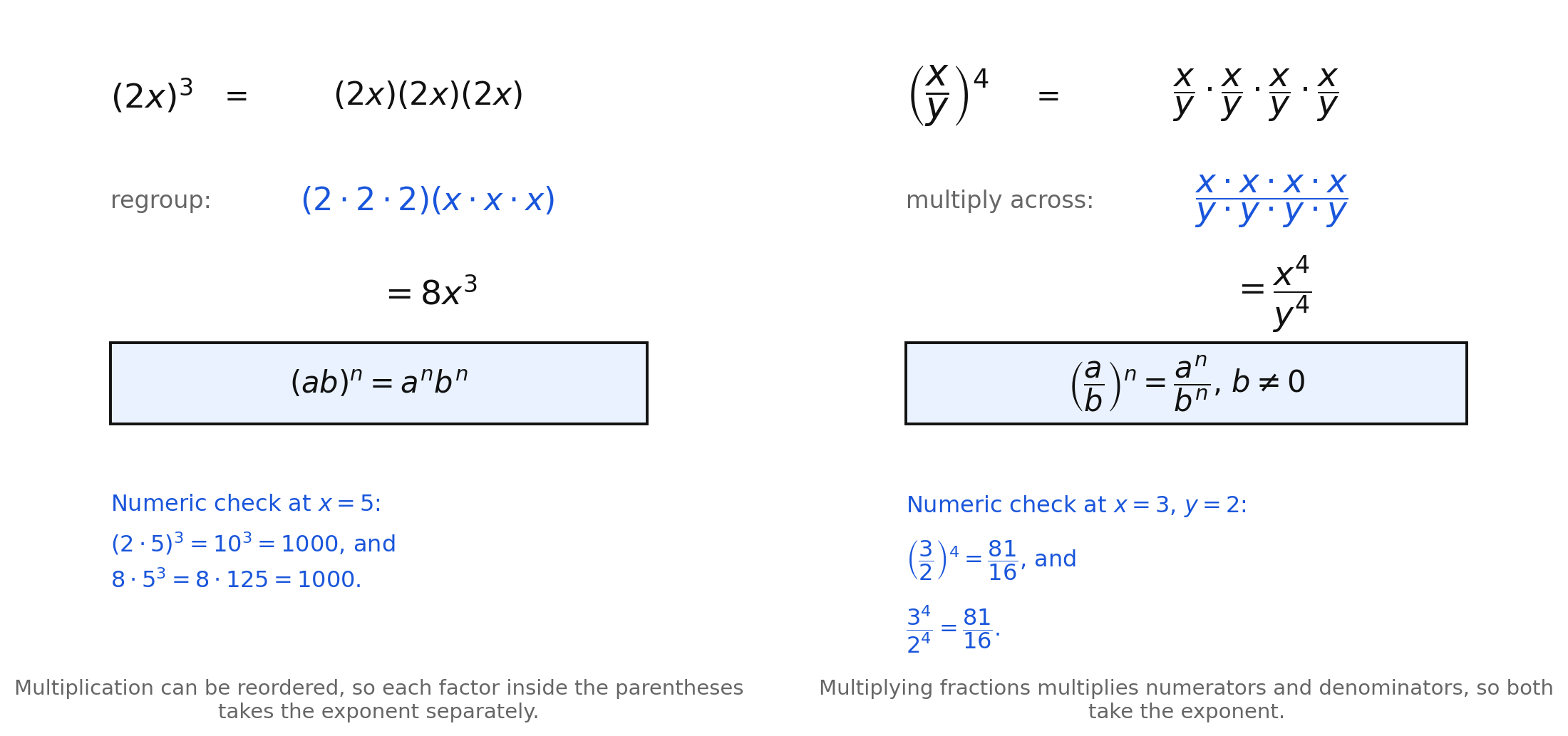
Both panels of the figure run the same three moves: write the repeated factors out, regroup them, read off the result.
Left panel — a power of a product.
The regrouping in the middle is the whole derivation, and it is allowed because multiplication can be reordered. Once the s are gathered and the s are gathered, each group is a power in its own right. So each factor inside the parentheses takes the exponent separately:
The figure checks it at : , and .
Right panel — a power of a quotient.
Multiplying fractions multiplies the numerators and multiplies the denominators, so both take the exponent:
The figure checks that one at , : , and . The restriction is there for the reason it is always there — a denominator of zero names nothing.
Everything inside, including the coefficient
The most frequent error in this lesson is leaving a coefficient behind. applies to numbers as much as to variables, because a coefficient is a factor like any other.
Check it at : the correct form gives and the wrong one gives . When several factors sit inside, every one of them takes the exponent, and the power-of-a-power law handles those that are already powers:
Signs follow the same rule they followed in Lesson 10.1 — the base is whatever is inside the parentheses:
The first is positive because the exponent is even; the second is negative because it is odd.
Here is the procedure.
- Distribute the outer exponent to every factor inside, the coefficient included.
- Multiply exponents wherever a power is being raised to a power.
- Raise the coefficient, and get its sign from whether the exponent is even or odd.
- Simplify the coefficient to a number, so is reported as .
Negative outer exponents
The outer exponent may itself be negative — A.EO.3b allows any integer — and nothing changes except that the answer needs its exponents made positive at the end.
Notice that the coefficient took the negative exponent too, so ended up in the denominator. And a negative exponent on a fraction simply flips it, which is worth seeing once:
One thing these laws do not do
is a statement about a product inside the parentheses. It says nothing about a sum, and the corresponding claim about sums is false.
At , , : the left side is , and the right side is . One counterexample is enough to retire a claim permanently. The reason is visible in the derivation: the regrouping step reordered factors, and there are no factors to reorder in . Chapter 12 works out what actually is.
Worked examples
Example 1 — A power of a power
Simplify .
Four groups of five factors: .
Answer:
Example 2 — A coefficient inside
Simplify .
Every factor takes the exponent: and .
Answer:
Example 3 — Several factors, one of them negative
Simplify .
; ; .
Answer:
Example 4 — A power of a quotient
Simplify .
Numerator: . Denominator: .
Answer: , for
Example 5 — A negative outer exponent
Simplify with positive exponents.
Every factor takes the : , and .
Answer:
Guided practice
- Use the power-of-a-power figure. Write as three groups of factors, say what the brace counts, and give the single power.
- In that same figure, read the shaded row. For , how many groups are there, how many factors are in each, and what single power results?
- Use the numeric check printed in that figure. Evaluate step by step, evaluate , and say what the agreement confirms.
- Use the left panel of the power-of-a-product figure. Write the three lines of the derivation of , then state the law the panel boxes.
- Use the right panel of that figure. Write the derivation of , state the law it boxes, and say why that law carries the restriction .
- Reasoning. Explain why multiplies the exponents while adds them. Give both answers, and describe the different picture of factors behind each.
Independent practice
- Simplify. a) b) c) d)
- Simplify. a) b) c) d)
- Simplify. a) b) c) d)
- Simplify, writing each answer with positive exponents. a) b) c) d)
- Application. A storage cube has edge length centimeters. Write its volume as a simplified monomial, and name the two laws you used.
- Application. One kilometer is meters. Write the number of square meters in one square kilometer as a power of ten, then as an ordinary number, and name the law you used.
- Reasoning. Explain why is true but is false. Give the counterexample at , , with both values, and say which step of the derivation fails for a sum.
- Error analysis. A student writes . Identify the error, give the correct answer, and evaluate both at to show they differ.
- Error analysis. A student writes . Identify which law the student used, give the correct answer, and say what the correct count of factors is.
- Find each missing exponent. a) b) c)
Exit ticket 10.4
- Simplify .
- Simplify .
- Simplify .
- Explain the difference between and . Give both answers and say what is being counted in each.
Lesson 10.5 — Multivariable Expressions and Ratios of Monomials
Every law is now derived. This lesson is A.EO.3b end to end: put the laws together on multivariable expressions and on ratios of monomial expressions, with integer exponents throughout.
Monomials, and what simplified means
A monomial is a number, a variable, or a product of numbers and variables — , , , and are all monomials. A ratio of monomials is one divided by another, such as .
An answer in this chapter is simplified when four things are true:
- Each base appears exactly once.
- Every exponent is positive.
- The coefficient is a single number, or a fraction in lowest terms.
- No power of a power is left uncleared.
So is simplified, and is the same quantity not yet finished.
The order of the work
When an expression has outer exponents, products, and a division all at once, doing them in the wrong order does not usually give a wrong answer — but it usually gives a much longer one. Work outward in.
- Clear every outer exponent first. Distribute it to each factor inside and multiply the inner exponents.
- Multiply within the numerator, and within the denominator, using the product law on each base.
- Divide the coefficients, and reduce that fraction.
- Subtract exponents base by base, numerator exponent minus denominator exponent.
- Move any negative exponent across the bar so the final answer has none.
Here is the whole schedule on one expression:
Step one cleared the outer exponent, and notice that the took it as well: , not . Step two had nothing to do. Step three divided by . Step four subtracted . Nothing was negative, so step five was free.
And one where step five is not free:
The base had the larger exponent underneath, so its leftover count was negative, and the ended up in the denominator where the leftover factors actually are. Both readings agree, which is exactly what Lesson 10.3 derived.
Negative exponents on both floors
When negative exponents appear in the original expression, do not try to clear them first. Subtract as usual and let the signs take care of themselves.
The base is the one to watch: , not . Subtracting a negative exponent adds. Getting that single step wrong is the most common error in the lesson, and it is worth writing the subtraction out with its parentheses every time until it is automatic.
Checking an answer without a graph
A simplified expression is supposed to equal the original at every allowed value of the variables. That gives a check that needs no new technique: pick convenient numbers, substitute them into both, and compare.
Take and try , :
- Original:
- Simplified:
They agree. Try a second pair, , : the original is and the simplified form is . Agreement at two well-chosen pairs is not a proof, but a disagreement at even one pair is a proof that something is wrong — which is what makes the check worth thirty seconds. Avoid alone, since to any power is and hides most exponent errors, and avoid , which the restrictions forbid anyway. This is the same discipline the calculator note asks for: produce the result algebraically, then confirm it numerically.
Powers of ten, and orders of magnitude
Powers of ten are where the laws of this chapter get used most often outside a mathematics class, because they are how people report quantities too large or too small to write out.
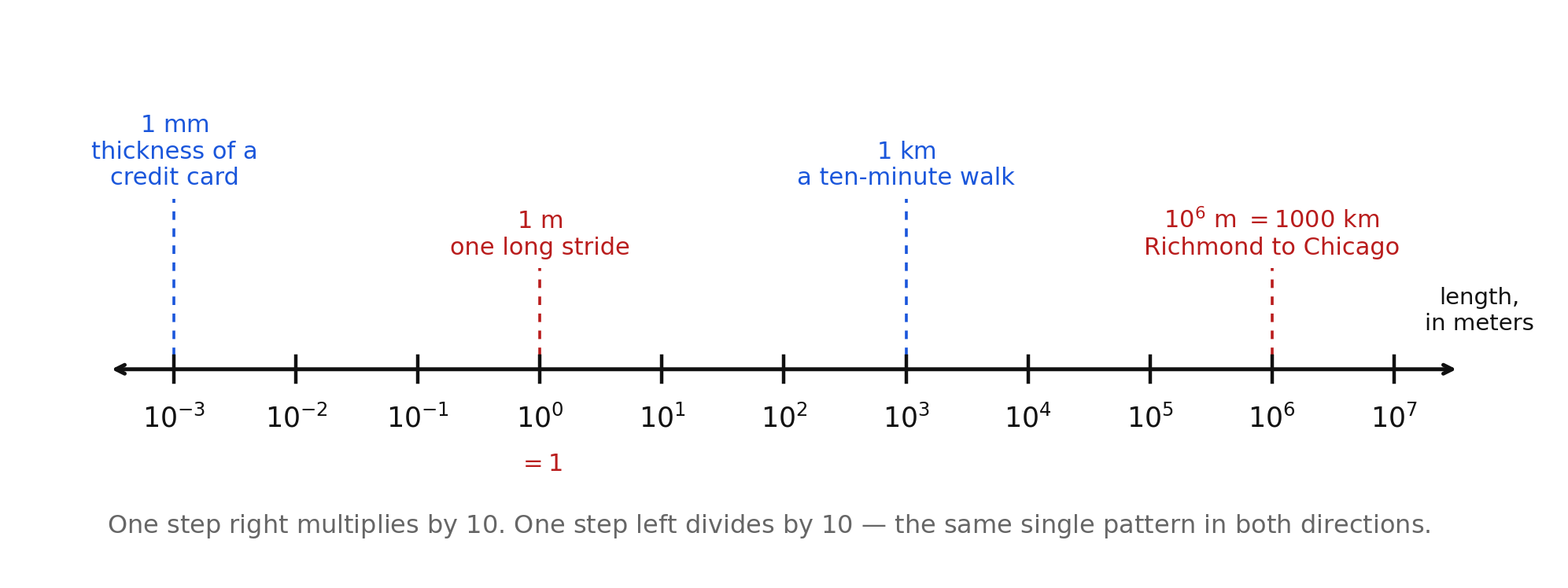
The scale measures length in meters. Every tick is one order of magnitude, and the figure's own note gives the pattern in one line: one step right multiplies by , one step left divides by — the same single pattern in both directions, which is the whole content of Lesson 10.3 drawn on a line. At the middle sits , marked : one meter, one long stride. To its left, is one millimeter, about the thickness of a credit card. To its right, is one kilometer, a ten-minute walk, and meters is kilometers, roughly Richmond to Chicago.
Comparing two of these is a subtraction of exponents, which is the quotient law doing ordinary work:
A kilometer is a million times as long as a millimeter. And from the credit card to Chicago:
nine orders of magnitude, a billion times. Both of those subtractions cross zero, so both depend on negative exponents meaning exactly what Lesson 10.3 forced them to mean.
Scientific notation puts this to work on numbers that are not round powers of ten. A number in scientific notation is written as a number between and times a power of ten, such as . Dividing two of them splits into two easy jobs — divide the front numbers, subtract the exponents:
The population of the United States is about ; a town of people is about times smaller. Reported that way, the comparison is one division and one subtraction, and the answer arrives with its order of magnitude already attached.
Keep the arithmetic honest in two ways. First, a quantity read off a scale like this one is an estimate — "about a millimeter," "roughly a thousand kilometers" — and an answer should not claim more precision than its inputs had. Second, check the front numbers separately from the exponents; a ratio like that comes out to exactly is a sign you set it up correctly, and one that comes out to or usually means a power of ten was misplaced.
Worked examples
Example 1 — A ratio of monomials in two variables
Simplify .
Coefficients: . Base : . Base : , so moves down.
Answer:
Example 2 — An outer exponent over a ratio
Simplify .
Simplify inside first: . Then cube it: .
Answer:
Example 3 — Outer exponents on both floors
Simplify .
Numerator: . Denominator: . Then and .
Answer:
Example 4 — Three variables and a negative exponent
Simplify .
Coefficients: . Base : . Base : . Base : , and , so disappears entirely.
Answer:
Example 5 — Scientific notation
Simplify and give the result in scientific notation.
Front numbers: . Powers of ten: .
Answer:
Guided practice
- Use the orders-of-magnitude figure. Say what one step to the right does to a value and what one step to the left does, and give the value marked at along with the everyday length labeled there.
- In that same figure, use the callouts for millimeter and kilometer. Write the ratio of the two lengths as a quotient of powers of ten, simplify it, and say in words how many times as long a kilometer is.
- Simplify with positive exponents.
- Simplify , and name the step of the procedure that has to come first.
- Simplify with positive exponents. Write out the subtraction on the base with its parentheses.
- What is a monomial? Say whether is one, and explain your answer.
Independent practice
- Simplify each ratio of monomials, with positive exponents. a) b) c) d)
- Simplify, with positive exponents. a) b) c) d)
- Simplify each three-variable expression, with positive exponents. a) b) c) d)
- Application. The population of the United States is about and the population of a small town is about . How many times as many people live in the country as in the town? Show the division of the front numbers and the subtraction of the exponents separately.
- Application. Use the orders-of-magnitude figure. A credit card is about meters thick, and Richmond to Chicago is about meters. Write the ratio as a quotient of powers of ten, simplify it, and say how many orders of magnitude separate the two lengths.
- Application. A video file is bytes and a photo is bytes. How many photos take up as much space as the one video? Give the answer in scientific notation and as an ordinary number.
- Reasoning. For , list the laws used at each step, in the order you use them, and give the simplified result.
- Reasoning. Explain why , , and are three names for the same quantity. Say which of the three this chapter reports as the final answer, and why.
- Error analysis. A student writes . Identify the error on the base , give the correct answer, and state the rule about the order of the subtraction.
- Error analysis. A student writes . Identify the error, give the correct answer, and write out the subtraction that settles it.
- Reasoning. Check the claim by substituting , into both, and then , into both. Report all four values. Then explain why agreement at two pairs is reassuring but not a proof, and why disagreement at one pair would be a proof of error.
Exit ticket 10.5
- Simplify with positive exponents.
- Simplify with positive exponents.
- Simplify and give the result in scientific notation.
- An expression is a ratio of monomials with an outer exponent over the whole fraction. Which step do you do first, and why does doing it first shorten the work?
Chapter 10 Review
Vocabulary. base · exponent · power · product law · quotient law · power of a power · power of a product · power of a quotient · zero exponent · negative exponent · reciprocal · coefficient · monomial · ratio of monomials · integer exponent · order of magnitude · scientific notation
A.EO.3 has two bullets that ask genuinely different things, so this review is organized to match. Part A is bullet a — the derivations from patterns, with the figures that carry them. Parts B and C are bullet b — multivariable expressions and ratios of monomial expressions. Part D applies both in context.
Part A — Deriving the laws from patterns
- Use the product-law figure. Say what each of the three braces over the row of factors counts, state the product law in symbols, and explain in one sentence why the exponents add rather than multiply.
- Use the quotient-law figure. Say what the strikethrough marks show and what each canceled pair is worth, then state the quotient law in symbols with its restriction.
- Use the figure whose left-hand table steps down to . Give all five powers with their values and the division that produces each. Then give the two readings of from the right-hand panel, and explain why is forced rather than chosen.
- Use the figure whose table continues below zero. Continue that same column two more rows, giving and as fractions and as decimals. Then state what a negative exponent instructs you to do, and explain why cannot be .
- Use the power-of-a-power figure. State the law in symbols, and explain why the outer and inner exponents multiply. Say what the outer exponent counts and what the inner exponent counts.
- Use the two-panel figure for powers of a product and of a quotient. State both laws in symbols with any restriction, and give the numeric check printed in each panel.
- Use the figure comparing negative bases. Give all six values in the table. Then state the rule for reading , and say exactly when and agree and when they cannot.
Part B — Multivariable expressions
- Simplify, with positive exponents. a) b) c) d)
- Rewrite each with positive exponents only. a) b) c) d)
- Evaluate exactly: , , , and . Say which two of the four differ only in where a minus sign sits, and what that difference does.
- Error analysis. A student writes . Identify the error, give the correct answer, and say which law the student applied to only part of the expression.
- Reasoning. Explain why is a positive number whenever is positive, even though the exponent is negative. Use as your example and give its exact value and its decimal form.
- Find each missing exponent. a) b) c)
Part C — Ratios of monomial expressions
- Simplify, with positive exponents. a) b) c) d)
- Simplify with positive exponents, and say what happened to the base and why.
- Reasoning. Verify that by substituting , into both, and then , into both. Report all four values, and say why is not an allowed test value.
- Reasoning. Describe the order in which you simplify a ratio of monomials that has an outer exponent over the whole fraction, and explain why every step of the work assumes that each variable in the denominator is not zero.
Part D — Mixed application
- Application. Use the orders-of-magnitude figure. Give the length in meters that marks and the everyday object labeled there. Then compute, as a power of ten, how many times as long kilometer is as millimeter, and how many times as long the Richmond-to-Chicago distance is as a credit card is thick. Say which law you used, and why the answer depends on negative exponents meaning a reciprocal.
- Application. Use the cell-division figure. Say how many cells there are at hour and what power of records it. Give the count at hour , and the count at hour as a power of and as an ordinary number. Then write as a power of and say what that number means about the two moments.
- Application. A drive holds bytes and each recording is bytes. How many recordings fit? Show the division of the front numbers and the subtraction of the exponents separately, give the answer in scientific notation and as an ordinary number, and say which law of this chapter did the work.
Standards coverage check — Chapter 10
A.EO.3a names three families of law and insists all of them be derived through explorations of patterns, so coverage of that bullet is broken out law by law, with the pattern that derives each one named explicitly.
| Knowledge and Skill | Law | The pattern that derives it | Where it is derived | Where it is practiced |
|---|---|---|---|---|
| A.EO.3a — derive the laws of exponents through explorations of patterns, to include products | a row of repeated factors, counted (Figure 1) | 10.1 | 1–5, 7–9, 12–14, 16–18; 107, 114 | |
| A.EO.3a — quotients | , | matched pairs struck off, leftovers counted (Figure 2) | 10.2 | 21–25, 27–29, 31–37, 39, 40; 108, 120 |
| A.EO.3a — quotients, continued | , | a column dividing by down to the zero row, and read two ways (Figures 3, 9) | 10.3 | 41–44, 47, 48a, 54, 57, 59, 60, 61, 64, 65; 109, 116, 120a |
| A.EO.3a — quotients, continued | , | the same column continued below zero, and read two ways (Figure 4) | 10.3 | 45, 46, 48–53, 55, 56, 58, 61–64; 110, 115, 118, 119 |
| A.EO.3a — powers of bases | groups of factors counted (Figure 5) | 10.4 | 66–68, 71, 72, 80, 81a, 82, 85; 111, 119b | |
| A.EO.3a — powers of bases | three repeated factors regrouped (Figure 6, left) | 10.4 | 69, 73, 76, 78, 79, 81b, 83; 112, 114c, 117 | |
| A.EO.3a — powers of bases | , | four fractions multiplied across (Figure 6, right) | 10.4 | 70, 74, 75c, 81c, 84; 112 |
| A.EO.3a — reading what the exponent sits on | versus | six expressions written out and valued (Figure 7) | 10.1 | 6, 11, 15, 19; 113, 116 |
| A.EO.3b — simplify multivariable expressions in which the exponents are integers | all laws together | — | 10.1, 10.3, 10.4, 10.5 | 9, 18, 29, 38, 52, 62, 63, 73c–d, 74, 75, 83, 84, 93, 94; 114, 115, 117, 119 |
| A.EO.3b — simplify ratios of monomial expressions, integer exponents | quotient law with coefficients and several bases | — | 10.2, 10.5 | 27–29, 35, 37, 38, 51b, 51d, 52b–c, 63, 88–90, 92–94, 103, 104; 120–123 |
Contexts. Orders of magnitude and scientific notation carry the applications: items 30, 77, 86, 87, 95, 96, 97, 105, 124, and 126 use powers of ten for populations, distances, areas, and file sizes, and items 12, 31, 54, 55, and 125 use powers of two for storage and for cell division. Calculator confirmation is asked for by name in item 49 and is invited throughout, consistent with Algebra 1 having no no-calculator standards.
Reasoning and error analysis. Items 3, 10, 13, 26, 32, 36, 40, 53, 56, 57, 60, 65, 71, 78, 91, 98, 99, 102, 106, 118, 122, and 123 ask for explanations rather than answers; the derivation items 57, 60, 65, 109, and 110 are the ones that carry the chapter's central claim, that and are forced by the quotient pattern rather than adopted by agreement. Items 14, 15, 33, 34, 58, 59, 79, 80, 100, 101, and 117 are error analyses aimed at the chapter's most common mistakes: multiplying exponents in a product, dividing them in a quotient, subtracting coefficients, reading a negative exponent as a negative number, leaving a coefficient outside an outer exponent, and reversing the order of an exponent subtraction.
Boundaries respected. Every exponent appearing anywhere in this chapter is an integer. No item uses a fractional or rational exponent, and no item uses a radical symbol; rational exponents limited to and , and radical expressions, are A.EO.4 in Chapter 11. No item adds, subtracts, or multiplies polynomials, and no divisor anywhere is a binomial — the divisions here are monomial by monomial only, so A.EO.2 is untouched and remains Chapters 12–14. No item graphs a power, evaluates a function of the form , or describes how a power grows as its exponent changes; exponential functions are A.F.2 e and f in Chapter 17. The restriction is stated with every law derived from a quotient, and is named as undefined rather than assigned a value.
Answer keys for every item in this chapter are in Appendix A.