Chapter 11 — Radical Expressions
Standard: A.EO.4 (a, b, c, d)
A.EO.4 — verbatim. The student will simplify and determine equivalent radical expressions involving square roots of whole numbers and cube roots of integers. Students will demonstrate the following Knowledge and Skills: a) Simplify and determine equivalent radical expressions involving the square root of a whole number in simplest form. b) Simplify and determine equivalent radical expressions involving the cube root of an integer. c) Add, subtract, and multiply radicals, limited to numeric square and cube root expressions. d) Generate equivalent numerical expressions and justify their equivalency for radicals using rational exponents, limited to rational exponents of and .
By the end of this chapter you will be able to:
- Read a square root as the non-negative number whose square is under the bar, and recognize the perfect squares of the whole numbers through on sight (A.EO.4a)
- Put a square root of a whole number into simplest form by pulling out the largest perfect-square factor (A.EO.4a)
- Locate an irrational square root between consecutive integers on a number line, and confirm a simplification with a decimal check (A.EO.4a)
- Read a cube root of an integer — positive or negative — as the unique real number whose cube is under the bar, and put it into simplest form by pulling out the largest perfect-cube factor (A.EO.4b)
- Add and subtract like radicals after simplifying, and multiply numeric radicals with the product property (A.EO.4c)
- Show, with one counterexample, that a root never splits a sum or a difference (A.EO.4c)
- Justify and from the product law of Chapter 10, and rewrite radicals and rational exponents both ways (A.EO.4d)
Lessons: 11.1 Square Roots and Simplest Form · 11.2 Estimating Square Roots · 11.3 Cube Roots · 11.4 Adding, Subtracting, and Multiplying Radicals · 11.5 Rational Exponents
Why this chapter matters. A radical is not a decoration. and are two names for one number, and the second name is the one you can place on a number line, combine with another radical, or compare to a decimal. The same number later appears as a root of a quadratic in Chapter 15, and writing it in simplest radical form is what A.EI.3 expects of an irrational solution. The bridge in Lesson 11.5 — that is forced to mean once the product law of Chapter 10 is required to keep working — is also the last piece of exponent language this volume needs before exponential functions in Chapter 17. Outside mathematics, lengths, areas, and measured quantities are constantly reported under a radical bar; simplifying the expression is how you make the number readable.
Scope note. This chapter is A.EO.4 a–d, and it stays inside the standard's own limits. Square roots are of whole numbers; cube roots are of integers, so negatives are allowed under a cube root and forbidden under a square root. Adding, subtracting, and multiplying are numeric only — no variable appears under a radical bar in any or item. Division of radicals and rationalizing a denominator are not in this chapter: A.EO.4 never asks for either, and A.EO.1b already told Chapter 1 to leave a radical in a denominator alone. Rational exponents appear only as and . The laws of exponents with integer exponents are A.EO.3 in Chapter 10 and are used here, not re-derived. Polynomial operations are A.EO.2 in Chapters 12–14. Solving equations that produce radicals is A.EI.3 in Chapter 15. No figure in this chapter is a graph of a function.
Conventions this chapter fixes.
- The principal square root , for a whole number , is the non-negative number whose square is . So , never . The equation has two solutions; the radical symbol names only one of them.
- A square root is in simplest form when its radicand has no perfect-square factor other than . The coefficient out front is irrelevant to the test — fails because still hides a .
- The cube root of an integer is the unique real number whose cube is , and it carries the sign of . So . Every integer has exactly one real cube root.
- A cube root is in simplest form when its radicand has no perfect-cube factor other than .
- Like radicals have the same index and the same radicand. Only like radicals combine under addition or subtraction, and only after each term is in simplest form.
- Roots split products, never sums: when and , and for all integers and , but .
- The rational exponents in this chapter are only and . For , . For every integer , . Both identities are forced by the product law of Chapter 10, not declared.
- Item numbering runs straight through the chapter, from in Lesson 11.1 to at the end of the review. It does not restart at each lesson.
Calculator note. Algebra 1 has no no-calculator standards, and the Desmos Virginia calculator is available for the entire End-of-Course test. Use it here the way this volume uses it everywhere: to confirm a result you already produced. Entering and and seeing the same decimal is the standing check of the chapter. Disagreement is proof of an error; agreement is strong evidence, not a substitute for the factor work. The decimals worth knowing on sight are , , and .
Lesson 11.1 — Square Roots and Simplest Form
What a square root asks for
A square root asks for the non-negative number whose square is under the bar.
The symbol never means . The equation has two solutions, and ; the radical names only the non-negative one. That single convention is what makes every later simplification unambiguous.
A whole number that is the square of a whole number is a perfect square. The ones you need on sight are few.
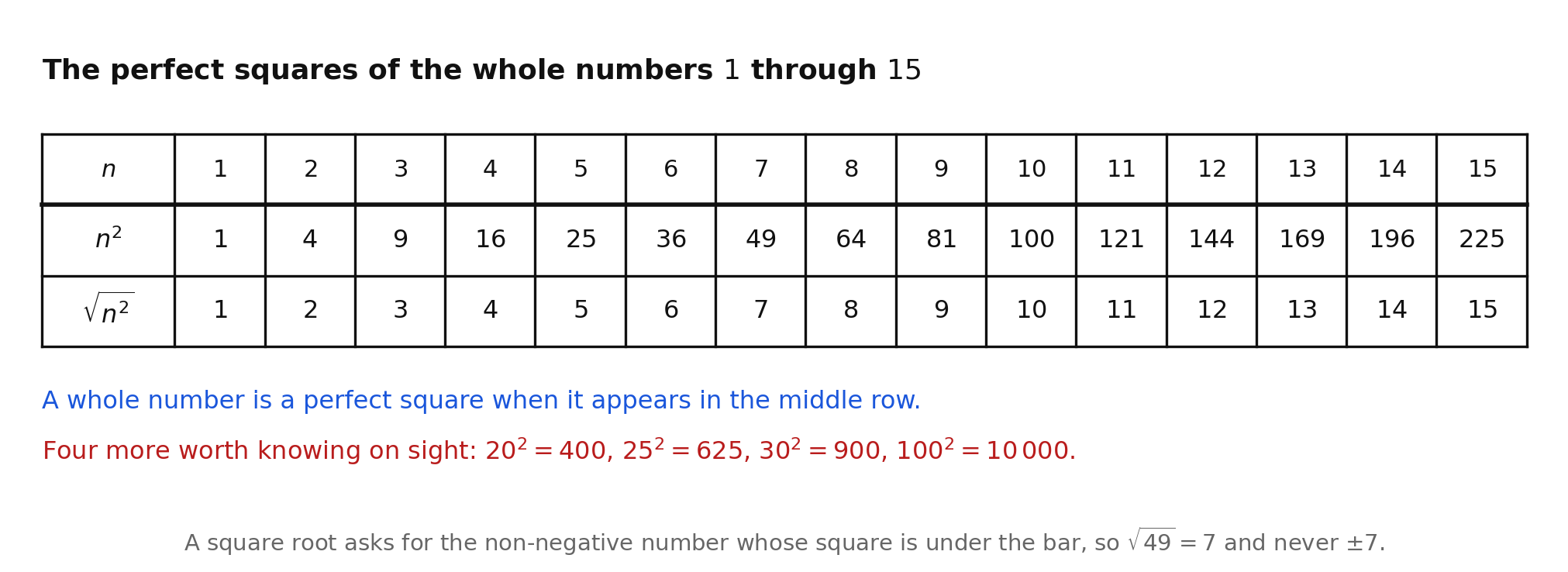
Read the middle row as a checklist: a whole number is a perfect square exactly when it appears there. So , , and are perfect squares, and , , and are not. The bottom row is the definition at work — for each whole number in the top row — and the gray note settles the sign once and for all.
Pulling out the largest perfect-square factor
When the radicand is not itself a perfect square, simplest form still asks you to pull out every perfect square that is hiding inside it. The clean way is to list the factor pairs and take the largest perfect-square factor.
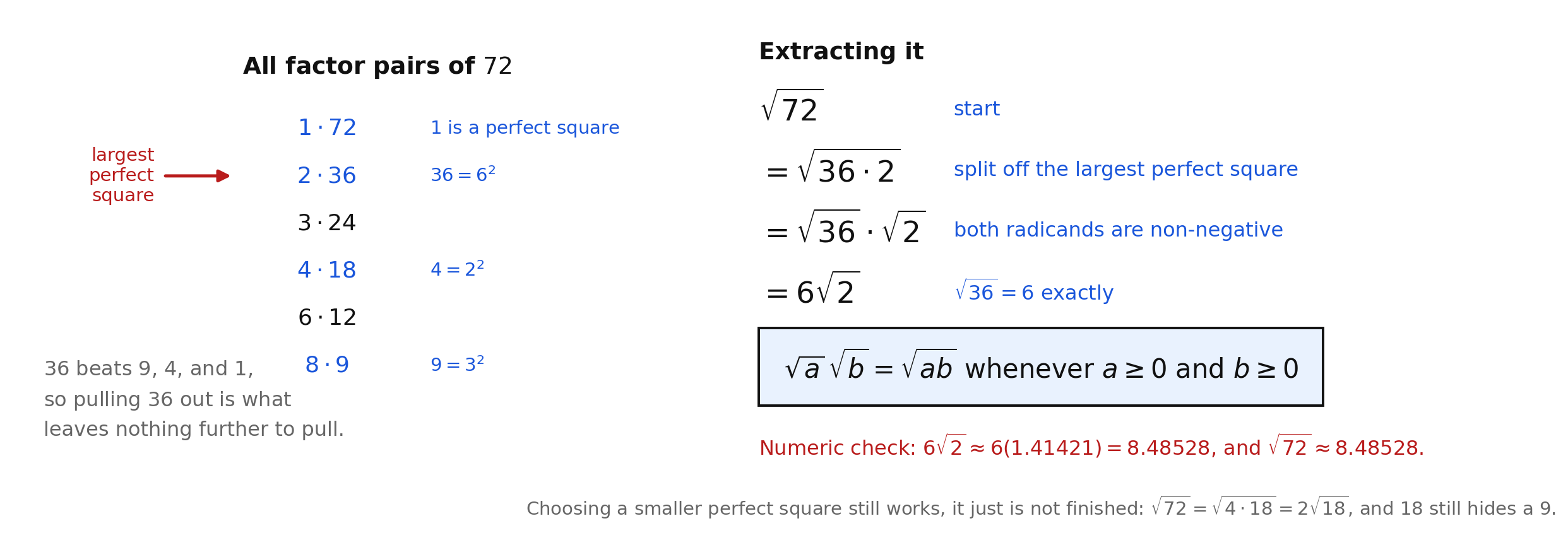
The figure does end to end.
- List every factor pair of .
- Mark the perfect squares among them: , , , and .
- Take the largest — here — and write .
- Split the product with (both factors non-negative), then evaluate the perfect square: .
The product property is not optional decoration. It is the only move that lets a perfect square come out from under the bar:
Product property of square roots. For whole numbers and ,
Choosing a smaller perfect square still works, but it is not finished. The figure's footer shows , and still hides a . Pulling the largest square the first time is what leaves nothing further to pull.
The test for simplest form
Simplest form is a test, not a judgment call. Ask one question of the radicand: does it still contain a perfect-square factor other than ?
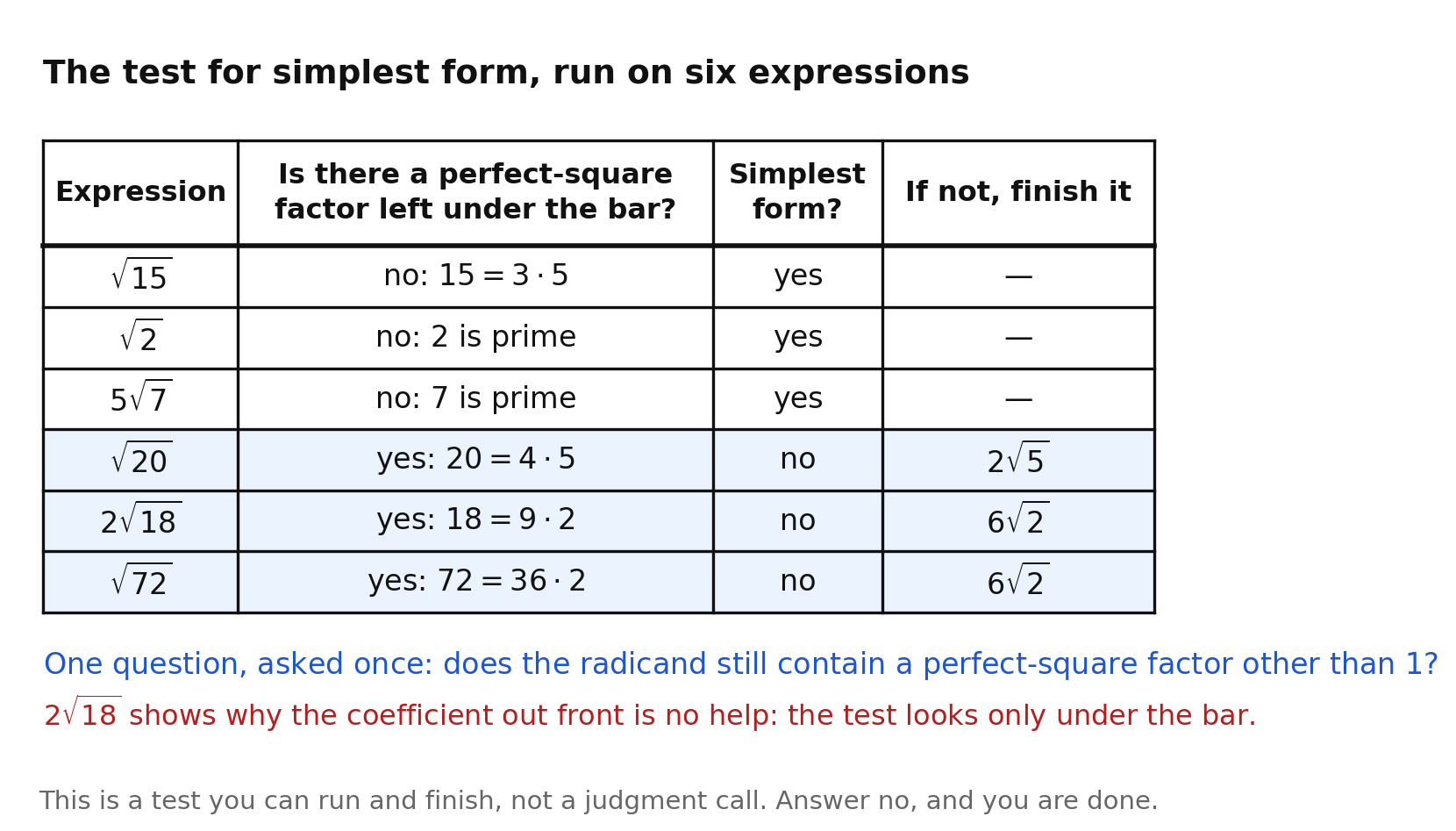
The three passing rows — , , and — have prime or square-free radicands. The three failing rows still hide a square under the bar, and the last column finishes them. The red note on is the trap of the lesson: the coefficient out front does nothing for the test. The test looks only under the bar.
Worked examples
Example 1 — A perfect square
Evaluate .
, and is non-negative, so .
Answer:
Example 2 — Largest perfect-square factor
Simplify .
Factor pairs of : , , . The perfect squares among them are and ; the largest is .
Answer:
Example 3 — An unfinished coefficient
Simplify .
The test looks under the bar: , and is a perfect square.
Answer:
Example 4 — A larger radicand
Simplify .
, and is the largest perfect-square factor.
Answer:
Example 5 — Running the checklist
Is in simplest form? If not, finish it.
, so a perfect square remains under the bar. Finish: .
Answer: No;
Guided practice
- Use the perfect-square reference table. Give for through , and say which row of the table a whole number must appear in to be called a perfect square.
- From that same figure, evaluate and , and explain in one sentence why neither answer is written with a .
- Use the factor-pair figure for . List every factor pair, mark the perfect squares, name the largest, and write the finished simplest form.
- In that same figure, read the footer. What unfinished answer do you get if you pull out instead of , and what perfect square is still hiding?
- Use the simplest-form checklist. For each of , , and , say whether it passes, and if not give the finished form from the figure.
- Explain why the coefficient in does not decide whether the expression is in simplest form. Say what the test looks at instead.
Independent practice
- Evaluate each perfect square root. a) b) c) d)
- Simplify each to simplest form. a) b) c) d)
- Simplify each. a) b) c) d)
- Simplify and .
- Reasoning. Explain why pulling the largest perfect-square factor matters. Use and compare the finished form with the unfinished form .
- Application. The diagonal of a square patio is feet. Write the length in simplest radical form.
- Error analysis. A student writes . Identify the error and give the correct simplest form.
- Error analysis. A student says is already simplest "because of the out front." Identify the error, run the checklist, and finish the expression.
- Decide whether each is in simplest form. If not, finish it. a) b) c) d)
- Find each missing factor so that the radicand split uses the largest perfect square. a) b)
Exit ticket 11.1
- Evaluate and .
- Simplify and .
- Is in simplest form? Is ? Finish whichever fails.
- Explain in two sentences what means, and why the answer is rather than .
Lesson 11.2 — Estimating Square Roots
Between consecutive integers
An irrational square root sits on the number line between two consecutive integers. The way to find which two is to sandwich the radicand between consecutive perfect squares.
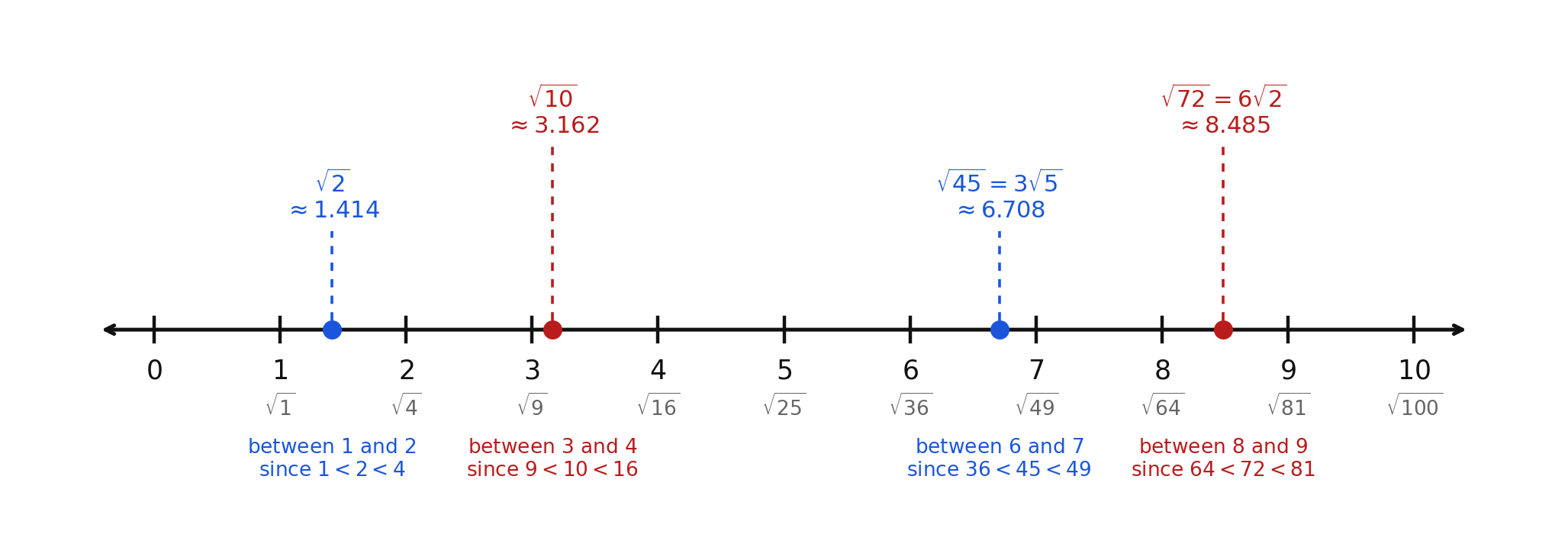
Read each placement from the inequalities under the line.
- , so , and
- , so , and
- , so ; simplifying first gives
- , so ; simplifying first gives
Simplifying does not move the point. and are the same number, so they occupy the same place on the line. What simplifying does is make the decimal estimate easier to check, because is three copies of a number you may already know.
Exact first, then about
This volume's standing habit is exact before approximate. A simplified radical is the exact answer; a decimal rounded to the nearest thousandth, labeled about, is a size check.
Both are correct reports of the same number. The radical form is what later chapters will keep; the decimal is how you confirm you have not botched the factor work.
Worked examples
Example 1 — Naming the integers
Between which two consecutive integers does lie?
, so .
Answer: between and
Example 2 — Simplify, then place
Simplify , then say between which two consecutive integers it lies, and give a decimal approximation to the nearest thousandth.
Since , it lies between and . As a decimal, .
Answer: ; between and ; about
Example 3 — Comparing without a calculator
Which is larger, or ?
and , so . (In simplest form, .)
Answer: is larger
Example 4 — A length in context
A ramp rises meters. Write the rise in simplest radical form and say between which two consecutive whole-number meters it falls.
. Since , the rise is between and meters. As a decimal, .
Answer: ; between and meters
Guided practice
- Use the number-line figure. For and , give the sandwich inequality from the figure and the decimal approximation printed above each point.
- In that same figure, read the two simplified points. Give the simplest form and the decimal for and for , and name the two integers each lies between.
- Explain why simplifying to does not change its position on the number line.
- Between which two consecutive integers does lie? Show the perfect-square sandwich.
- Simplify , then say between which two consecutive integers it lies.
- Which is larger, or ? Explain without a decimal, then confirm with a decimal approximation of the simplified form.
Independent practice
- For each radical, name the two consecutive integers it lies between. a) b) c) d)
- Simplify, then estimate to the nearest thousandth. a) b) c) d)
- Order from least to greatest: , , , .
- Application. A guy wire is feet long. Write the length in simplest radical form, say between which two whole-number feet it falls, and give a decimal to the nearest hundredth.
- Reasoning. Explain how the perfect-square row of the Lesson 11.1 reference table is exactly what you need in order to place between consecutive integers.
- Error analysis. A student says is between and "because is between and ." Identify the error and give the correct pair of integers.
- Compare without a calculator: is greater than, less than, or equal to ? Show the comparison with a perfect square.
- Simplify and place it between consecutive integers.
- A square has area square meters. Write the side length in simplest radical form and estimate it to the nearest tenth of a meter.
- Fill in the blanks. a) , with the radicand a whole number that is not a perfect square, and the radical in simplest form equal to b) Between which two consecutive integers does lie?
Exit ticket 11.2
- Between which two consecutive integers does lie?
- Simplify and estimate it to the nearest thousandth.
- Order from least to greatest: , , .
- Explain why and mark the same point on the number-line figure.
Lesson 11.3 — Cube Roots
Cubes in both signs
A cube root asks for the number whose cube is under the bar. Because an odd number of negative factors stays negative, every integer — positive or negative — has exactly one real cube root, and that root carries the sign of the integer.
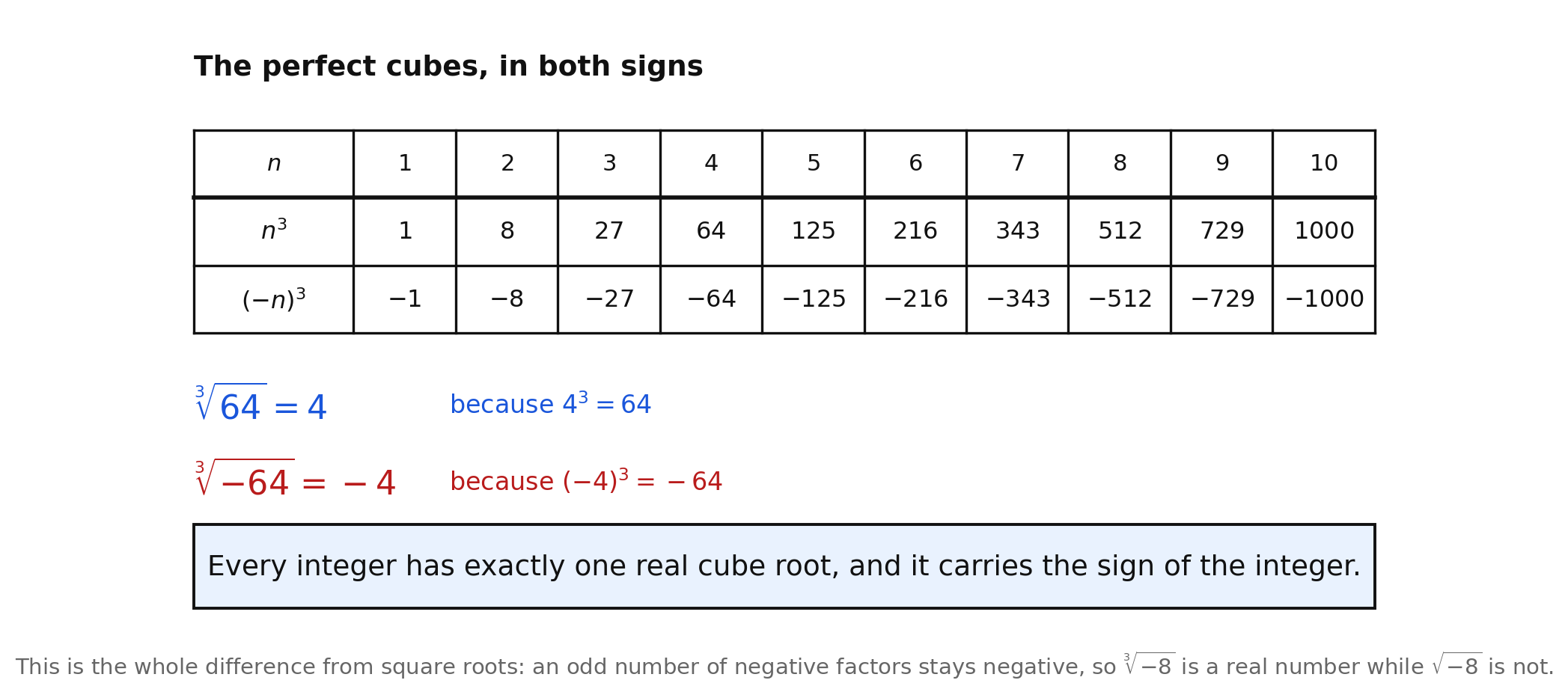
The middle row is the positive perfect cubes; the bottom row is the same cubes with the sign flipped. So because , and because . The gray footer is the whole difference from square roots: is a real number, while is not a real number at all.
Pulling out the largest perfect-cube factor
Simplifying a cube root is the same hunt as in Lesson 11.1, except the prey is a perfect cube.
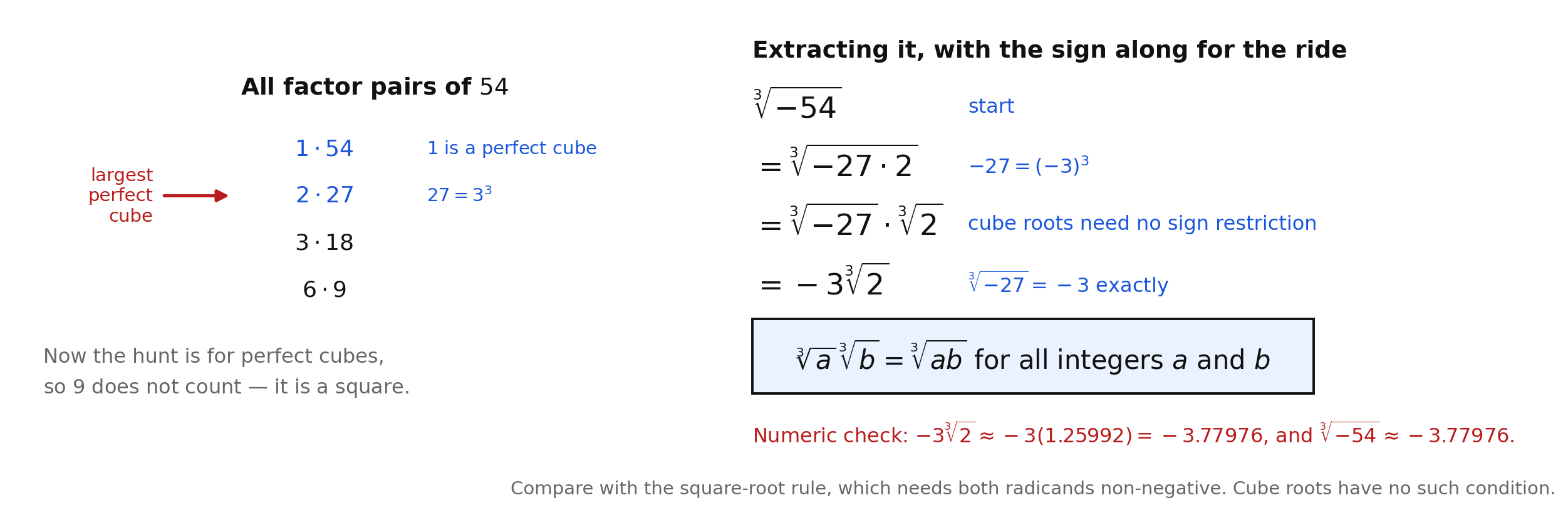
The figure does .
- List the factor pairs of : , , , .
- Mark the perfect cubes: and . (The square does not count.)
- Carry the sign with the perfect cube: .
- Split and evaluate: .
Product property of cube roots. For all integers and ,
There is no non-negativity restriction. That is the contrast the figure's footer names: square roots need both radicands non-negative, and cube roots do not.
Worked examples
Example 1 — A perfect cube
Evaluate and .
and .
Answer: ;
Example 2 — A positive cube root
Simplify .
and .
Answer:
Example 3 — A negative cube root
Simplify .
Answer:
Example 4 — An unfinished coefficient
Simplify .
, so .
Answer:
Example 5 — Why squares do not help
A student looking at wants to pull out because is a perfect square. Explain why that move is wrong, and finish the simplification correctly.
is not a perfect cube, so pulling it out does not evaluate to a whole number under a cube root. The largest perfect-cube factor of is : .
Answer:
Guided practice
- Use the perfect-cube reference table. Give and for through , and state the boxed claim from the figure in your own words.
- From that same figure, evaluate and , and explain why a cube root can be negative while a square root of a negative is not real.
- Use the factor-pair figure for . List the factor pairs of , mark the perfect cubes, and write the finished simplest form with the sign.
- In that same figure, read the note under the factor list. Why does not count as a factor you can pull out of a cube root?
- Simplify and .
- Explain why the cube-root product property needs no sign restriction, while the square-root product property does.
Independent practice
- Evaluate each. a) b) c) d)
- Simplify each to simplest form. a) b) c) d)
- Simplify each. a) b) c) d)
- Simplify and .
- Reasoning. Explain why is not a real number while is. Say what each symbol is asking for.
- Application. A storage cube has volume cubic feet. Write the edge length in simplest radical form.
- Error analysis. A student writes . Identify the sign error and give the correct simplest form from the figure.
- Error analysis. A student simplifies by writing . Identify the error and give the correct simplest form.
- Decide whether each is in simplest form. If not, finish it. a) b) c) d)
- Find each missing factor. a) b)
Exit ticket 11.3
- Evaluate and .
- Simplify and .
- Is in simplest form? Finish it if not.
- Explain why every integer has exactly one real cube root, and why that root carries the sign of the integer.
Lesson 11.4 — Adding, Subtracting, and Multiplying Radicals
Like radicals
Two radical terms are like when they have the same index and the same radicand. and are like; and are not; and are not. Addition and subtraction of radicals is combining like terms — and only after each term is in simplest form, because the piles are invisible until you simplify.
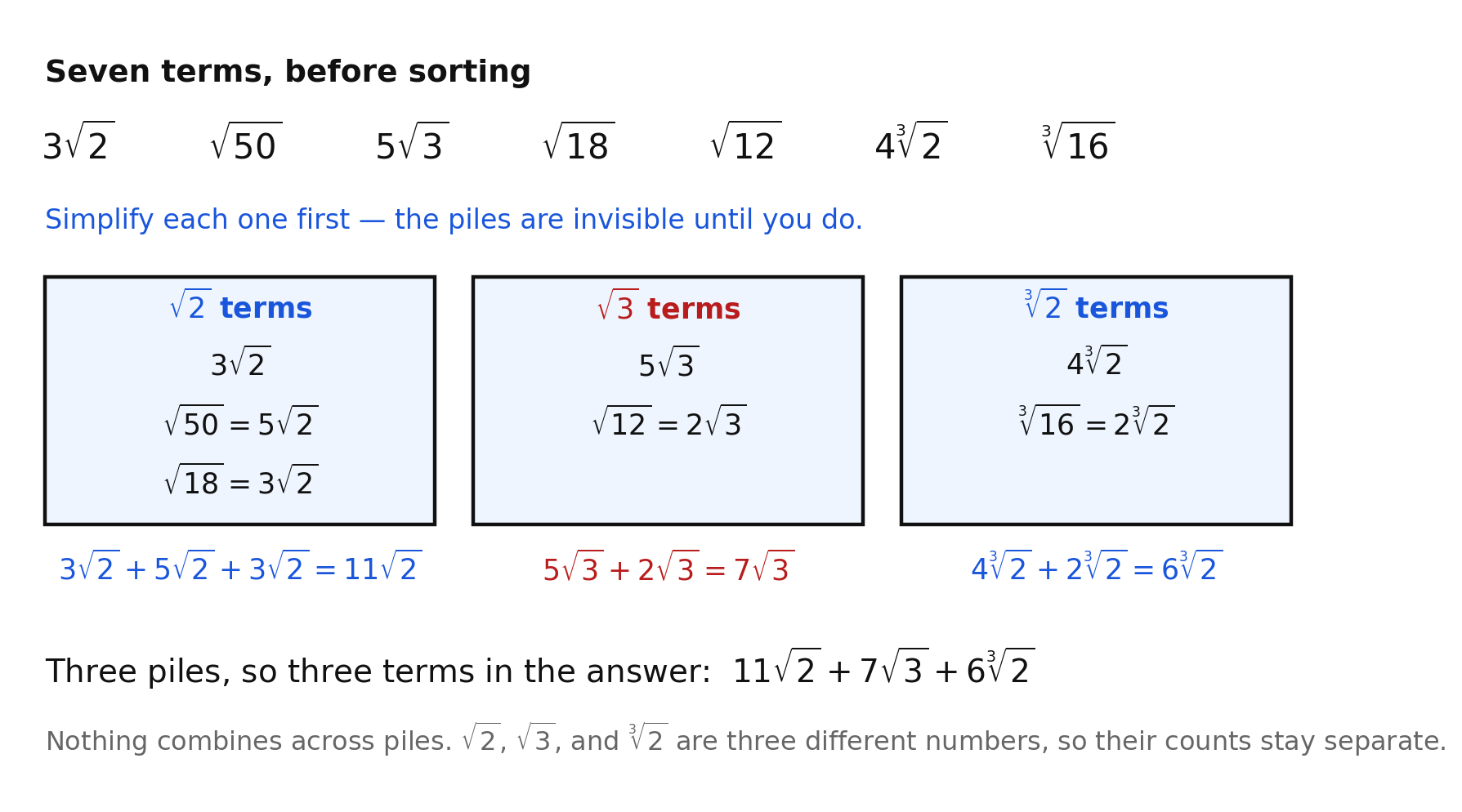
The figure starts with seven terms:
Simplify first — , , , — and three piles appear. Combine inside each pile:
Nothing combines across piles. , , and are three different numbers.
Multiplying radicals
Multiplication does not need like radicands. Multiply the coefficients, multiply the radicands with the product property, then simplify.
Cube roots work the same way, with no sign restriction:
Roots split products, never sums
The product property is easy to over-apply. One counterexample kills the false sum rule.
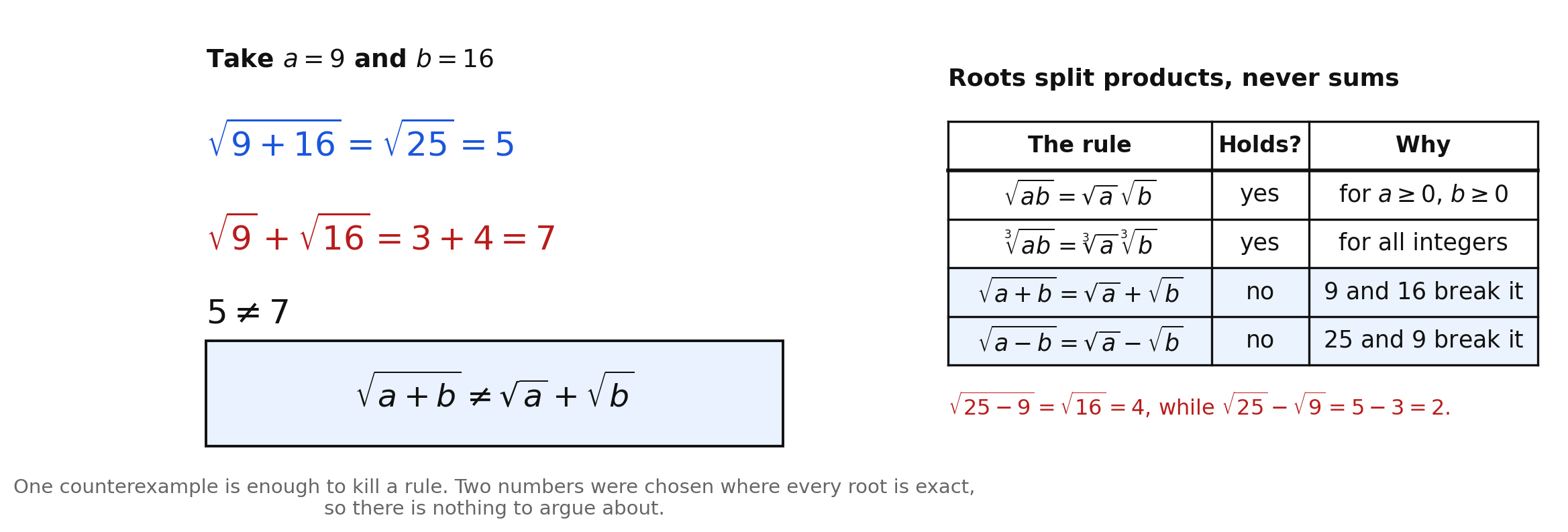
Take and :
Since ,
The same figure kills the difference rule with and : while . The table on the right keeps what does hold — the two product properties — and shades what does not.
Worked examples
Example 1 — Like square roots
Simplify .
All three terms are like: .
Answer:
Example 2 — Simplify, then add
Simplify .
and , so .
Answer:
Example 3 — Unlike after simplifying
Simplify .
and . The radicands differ, so the sum stays .
Answer:
Example 4 — A product
Simplify .
.
Answer:
Example 5 — Mixing indices in a sum
Use the sorting figure. Combine , and say why that pile does not combine with the pile.
, so . The index is , not , so these are not like .
Answer: ; different index
Guided practice
- Use the sorting figure. Simplify each of the seven terms, then give the three pile totals and the finished sum.
- In that same figure, explain why and cannot combine, even though the radicands look the same.
- Use the counterexample figure. Evaluate and , and state the inequality the figure concludes.
- From that same figure, give the subtraction counterexample with and , and say which two rows of the table are shaded as failing.
- Simplify .
- Simplify .
- Simplify .
- Simplify .
Independent practice
- Simplify. a) b) c) d)
- Simplify each sum or difference. Simplify radicals first when needed. a) b) c) d)
- Simplify. a) b) c) d)
- Simplify. a) b) c) d)
- Use the seven terms from the sorting figure. Write the finished simplified sum without looking at the pile totals, then check against the figure.
- Reasoning. Explain why becomes , while cannot be written as a single radical term.
- Application. Two consecutive fence panels measure feet and feet. Write each length in simplest form, then write an expression for how much longer the second is than the first, simplified.
- Error analysis. A student writes . Identify the false rule, give the correct value of , and name the figure that kills the rule.
- Error analysis. A student writes . Identify the error and give the correct simplified sum.
- Simplify .
- Simplify .
- Fill in the blanks. a) b) for ,
Exit ticket 11.4
- Simplify .
- Simplify .
- Simplify .
- Give one numeric counterexample showing , and state the product property that does hold for square roots.
Lesson 11.5 — Rational Exponents
Why has to mean
Chapter 10 derived by counting factors. That law does not care whether the exponents are integers. If a new exponent is going to be allowed at all, the old law must still hold:
So is a number that multiplies by itself to give . For , that number is exactly . Nothing was declared — the meaning is forced by insisting that the product law survive at the new exponent.
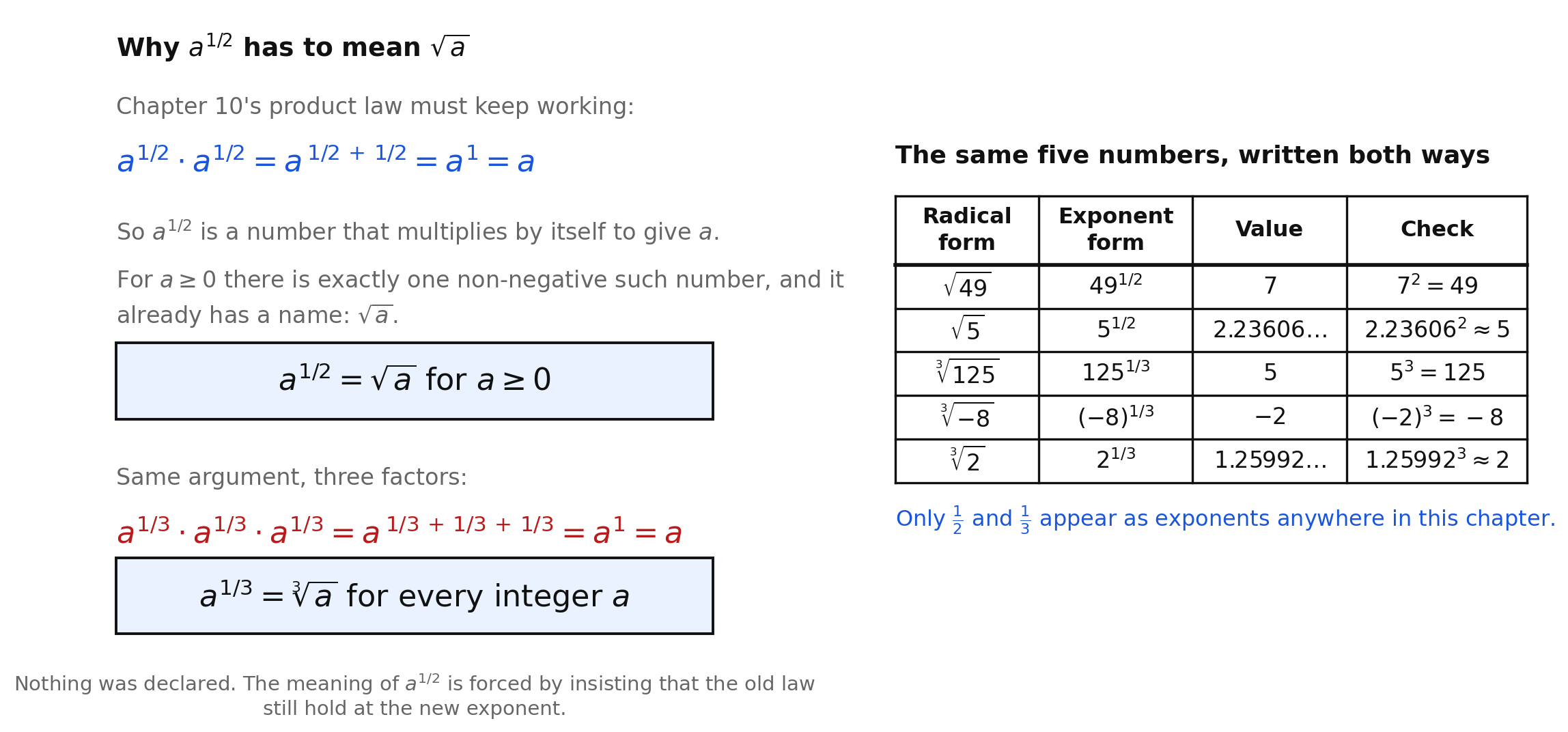
The same argument with three factors forces the cube-root identification:
so for every integer . The table on the right writes five numbers both ways — including — and the blue footer reminds you that only and appear as rational exponents anywhere in this chapter.
Rational exponents in this chapter.
Decimal checks as a habit
A decimal check does not prove a simplification, but a disagreement proves an error — and that is what you are hunting.
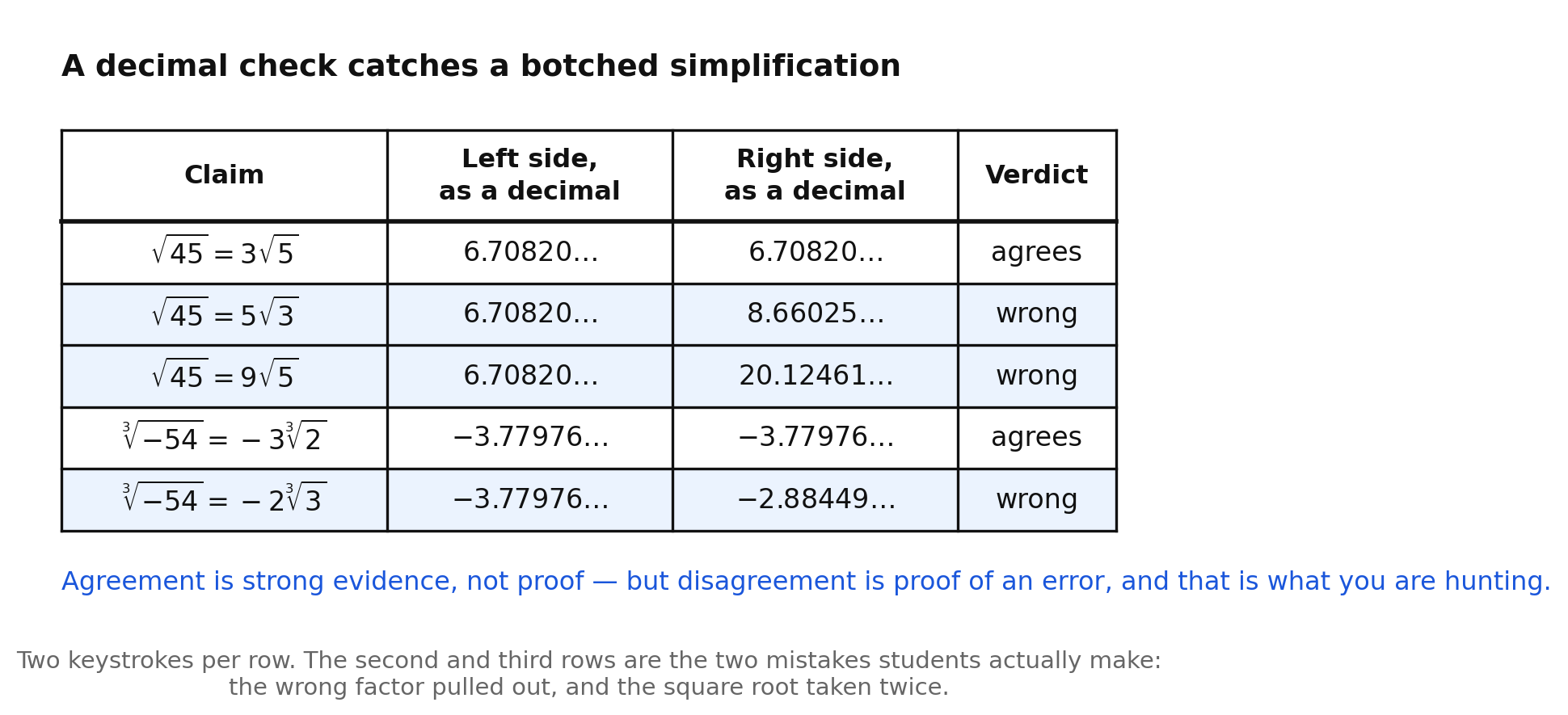
The first row confirms . The second and third rows catch the two mistakes students actually make on that problem: pulling the wrong factor () and taking the square root twice (). The last two rows do the same job for . Two keystrokes per row.
Practice tables
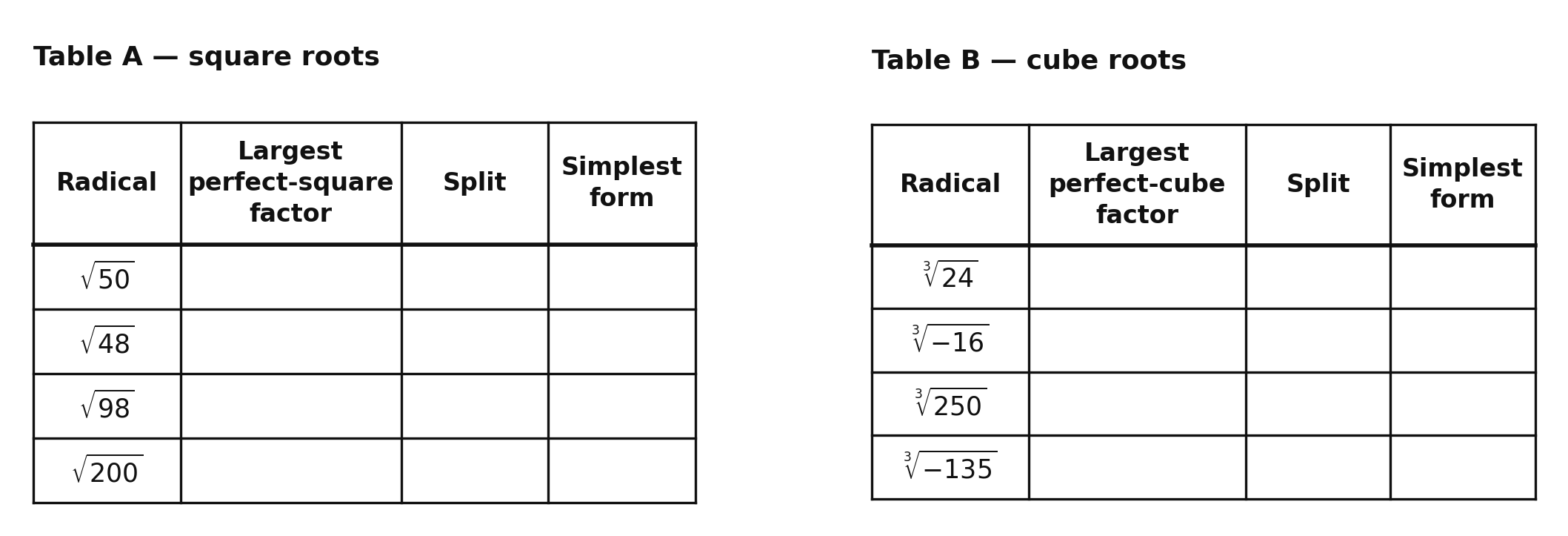
The blank practice tables collect the factor work of Lessons 11.1 and 11.3 in one place.
Worked examples
Example 1 — Forcing the square-root meaning
Show that must equal for , using the product law.
, so is a non-negative number whose square is . That is the definition of .
Answer:
Example 2 — Rewriting both ways
Rewrite and in the other form, and give each value.
. .
Answer: ;
Example 3 — A negative base with a cube root
Rewrite as a radical and evaluate.
.
Answer:
Example 4 — A decimal check
A student claims . Run the decimal check from the figure and give the verdict.
Left side: . Right side: . They disagree, so the claim is wrong. The correct simplification is .
Answer: wrong; correct is
Example 5 — Filling a practice row
Complete Table A's row for : largest perfect-square factor, split, and simplest form.
Largest perfect-square factor ; split ; simplest form .
Answer: ; ;
Guided practice
- Use the rational-exponent bridge figure. Write out the product-law argument that forces , and state the boxed conclusion with its restriction.
- In that same figure, write out the three-factor argument that forces , and say for which numbers it holds.
- From the five-row table in that figure, rewrite and in exponent form, and give the check printed for each.
- Use the decimal-check figure. For the claim , give both decimals and the verdict. Then do the same for .
- Explain in one or two sentences why disagreement on a decimal check is proof of an error, while agreement is only strong evidence.
- Use the blank practice tables. Fill every cell of Table A and Table B.
Independent practice
- Rewrite each radical in exponent form. a) b) c) d)
- Rewrite each exponential expression in radical form, then evaluate when the value is an integer. a) b) c) d)
- Rewrite and evaluate. a) b) c) d)
- Justify equivalency: show that , and say what that forces to be.
- Justify equivalency: show that , and give the value of .
- Run a decimal check on each claim and give a verdict. a) b) c)
- Reasoning. Explain why the meaning of is forced by the product law rather than chosen as a definition. Use the bridge figure's language.
- Application. A square garden has area square meters. Write the side length as a radical, as a rational exponent, and as a decimal to the nearest hundredth.
- Error analysis. A student writes . Identify the error, give the correct value, and say which law the student would have needed to keep intact.
- Error analysis. A student writes . Identify the two separate problems with that claim.
- Complete each equivalence. a) b)
- Fill Table B's row for from memory: largest perfect-cube factor, split, simplest form.
Exit ticket 11.5
- Rewrite and in exponent form, and evaluate both.
- Show the product-law argument that forces for .
- Run a decimal check on the claim and give the correct simplification.
- Rewrite as a radical and evaluate.
Chapter 11 Review
Vocabulary. square root · principal square root · perfect square · radicand · simplest form · perfect-square factor · cube root · perfect cube · perfect-cube factor · like radicals · product property · rational exponent
A.EO.4 has four bullets that ask genuinely different things, so this review is organized to match. Part A is bullet a — square roots in simplest form. Part B is bullet b — cube roots. Part C is bullet c — sums, differences, and products. Part D is bullet d — rational exponents and justified equivalency.
Part A — Square roots in simplest form
- Use the perfect-square reference table. Evaluate and , and name four perfect squares larger than that the figure says are worth knowing on sight.
- Use the factor-pair figure. Simplify by naming the largest perfect-square factor and writing every step to .
- Use the simplest-form checklist. For and , say why each fails and give the finished form.
- Simplify. a) b) c) d)
- Between which two consecutive integers does lie? Simplify and estimate to the nearest thousandth.
Part B — Cube roots
- Use the perfect-cube reference table. Evaluate and , and state why every integer has exactly one real cube root.
- Use the cube-root factor figure. Simplify , and say why is not an eligible factor to pull out.
- Simplify. a) b) c) d)
Part C — Sums, differences, and products
- Use the sorting figure. Give the finished simplified form of the seven-term sum.
- Simplify. a) b) c) d)
- Use the counterexample figure. Show that , and state the product property for square roots that does hold.
Part D — Rational exponents
- Use the bridge figure. Justify from the product law, and rewrite and as radicals with their values.
- Use the decimal-check figure. Give the verdict for and for , and name the two student mistakes the wrong rows catch.
- Application. A square plaza has area square meters. Write the side length in simplest radical form, as a rational exponent, and as a decimal to the nearest hundredth. Then write the perimeter using the simplified radical side.
Standards coverage check — Chapter 11
A.EO.4 names four bullets with sharp limits — whole-number square roots, integer cube roots, numeric-only and , and rational exponents only and — so coverage is broken out bullet by bullet.
| Knowledge and Skill | Focus | Where it is taught | Where it is practiced |
|---|---|---|---|
| A.EO.4a — simplify square roots of whole numbers in simplest form | perfect squares; largest perfect-square factor; simplest-form test | 11.1 (Figures 1, 2, 4) | 1–20; 107–110 |
| A.EO.4a — continued | locate between consecutive integers; exact then approximate | 11.2 (Figure 3) | 21–40; 111 |
| A.EO.4b — simplify cube roots of integers | perfect cubes in both signs; largest perfect-cube factor | 11.3 (Figures 5, 6) | 41–60; 112–114 |
| A.EO.4c — add, subtract, and multiply numeric radicals | like radicals after simplifying; products; roots never split sums | 11.4 (Figures 7, 8) | 61–84; 115–117 |
| A.EO.4d — equivalent forms with rational exponents and | product-law justification; rewrite both ways; decimal checks | 11.5 (Figures 9, 10, 11) | 85–106; 118–120 |
Contexts. Items 12, 30, 35, 52, 75, 98, and 120 put radicals into lengths, areas, and edges. Calculator confirmation is asked for by name in the decimal-check items 88, 96, 105, and 119, consistent with Algebra 1 having no no-calculator standards.
Reasoning and error analysis. Items 6, 11, 14, 20, 23, 31, 32, 40, 46, 51, 53, 54, 60, 62, 74, 76, 77, 89, 97, 99, 100, 104, and 117 ask for explanations or error diagnoses. The load-bearing justifications are items 85, 86, 94, 95, 104, and 118 — the product-law arguments that force and .
Boundaries respected. Every square-root radicand in this chapter is a whole number, and every cube-root radicand is an integer. No item adds, subtracts, or multiplies radicals that contain a variable under the bar. No item divides radicals or rationalizes a denominator — A.EO.4 does not ask for either, and Chapter 1 already left denominators alone under A.EO.1b. The only rational exponents that appear are and . Integer-exponent laws are used from Chapter 10 without being re-derived. No item solves an equation; irrational roots of quadratics are A.EI.3 in Chapter 15.
Answer keys for every item in this chapter are in Appendix A.