Chapter 12 — Adding, Subtracting, and Multiplying Polynomials
Standard: A.EO.2 (a, b)
A.EO.2 — verbatim. The student will perform operations on and factor polynomial expressions in one variable. Students will demonstrate the following Knowledge and Skills: a) Determine sums and differences of polynomial expressions in one variable, using a variety of strategies, including concrete objects and their related pictorial and symbolic models. b) Determine the product of polynomial expressions in one variable, using a variety of strategies, including concrete objects and their related pictorial and symbolic models, the application of the distributive property, and the use of area models. The factors should be limited to five or fewer terms.
By the end of this chapter you will be able to:
- Name the terms, coefficients, degree, leading coefficient, and constant term of a polynomial in one variable, and write it in standard form (A.EO.2a)
- Classify a polynomial as a monomial, binomial, or trinomial, and by its degree (A.EO.2a)
- Combine like terms, and say exactly which terms are allowed to combine and why (A.EO.2a)
- Add two or more polynomials with algebra tiles, with a vertical arrangement, and symbolically (A.EO.2a)
- Subtract polynomials by adding the opposite, using zero pairs on a tile mat to see why every sign of the second polynomial changes (A.EO.2a)
- Multiply a monomial by a polynomial with the distributive property and with an area model (A.EO.2b)
- Multiply two polynomials with an area model, with a tile rectangle, and symbolically, for factors of five or fewer terms (A.EO.2b)
- Move in both directions between tiles, area models, and symbols — read a polynomial off a picture, and build the picture from a polynomial (A.EO.2 a, b)
- Check any answer by evaluating the original expression and your simplified answer at the same input (A.EO.2 a, b)
Lessons: 12.1 Polynomials, Terms, and Standard Form · 12.2 Adding Polynomials · 12.3 Subtracting Polynomials · 12.4 Multiplying by a Monomial · 12.5 Multiplying Two Polynomials
Why this chapter matters. Almost every model you have met so far has been linear, and a line can only ever say "so much per unit, starting from here." A polynomial says more. The height of a thrown ball, the area of a rectangle whose sides are both growing, the revenue of a store that sells more when it charges less — none of these is linear, and all of them are polynomials. Before you can use such a model you have to be able to build one and simplify it, which is what this chapter is. It is also the chapter Chapter 13 runs backwards: once you can multiply and get , factoring is the question "which two binomials would have given me this?" Multiplication and factoring are the same picture read in opposite directions, and the pictures you build here are the ones you will read backwards there.
Scope note. This chapter adds, subtracts, and multiplies polynomials in one variable, which is A.EO.2 a and b. Every factor in a product here has five or fewer terms, as A.EO.2b requires. Factoring — including factoring by grouping and factoring a trinomial — is A.EO.2c, in Chapter 13; nothing here asks you to factor, though it is worth noticing throughout that multiplying and factoring undo each other. Dividing a polynomial by a monomial or a binomial is A.EO.2d and determining the equivalency of quadratic forms is A.EO.2e, both in Chapter 14. Solving a quadratic equation is A.EI.1, in Chapter 15, so no equation in this chapter has a solution to find — these are expressions, and simplifying one is the whole job. The laws of exponents are A.EO.3, in Chapter 10, and this chapter uses them constantly: every time you write you are applying the product law derived there.
Conventions this chapter fixes.
- A term is a piece of an expression joined to the others by or , and the sign in front belongs to the term. In the four terms are , , , and .
- A coefficient is the number multiplying the power in a term. The coefficient of is , and the coefficient of is ; the is there even when it is not written.
- The degree of a term is its exponent on the variable, and a constant has degree . The degree of a polynomial is the largest degree of any of its terms.
- Standard form writes the terms with the exponents descending: , not . The leading coefficient is the coefficient of the first term in standard form, and the constant term is the term with no variable.
- A polynomial with one term is a monomial, with two a binomial, with three a trinomial. With four or more it is just called a polynomial.
- A polynomial in one variable has whole-number exponents only. So and are not polynomials.
- Like terms have the same variable raised to the same exponent. Only like terms may be combined, and combining them never changes the exponent: , not .
- Algebra tiles are used as a concrete model throughout: a large square is , a long tile is , a small square is , and a white tile of any shape is the opposite of the shaded one. A shaded tile beside its white partner is a zero pair and is worth .
- Item numbering runs straight through the chapter, from 1 in Lesson 12.1 to 130 at the end of the review. It does not restart at each lesson.
Calculator note. Algebra 1 has no no-calculator standards, and the Desmos Virginia calculator is available for the entire End-of-Course test. Nothing in this chapter is calculator-free, and nothing in it is calculator-solvable either: a calculator cannot simplify , because that expression has no numeric value until is chosen. What a calculator is excellent for here is the check this chapter runs on everything: pick an input, evaluate the original expression, evaluate your simplified answer, and see whether the two numbers agree. Use two inputs, one positive and one negative — and are the standing pair in this chapter — because a single input can agree by accident. This check catches almost every dropped sign and almost every missing middle term, and it costs about twenty seconds.
Lesson 12.1 — Polynomials, Terms, and Standard Form
What a polynomial is
A polynomial in one variable is a sum of terms, each of which is a number times a whole-number power of that variable.
is a polynomial in . So are , and , and the lone number . What is not a polynomial is anything with the variable in a place a whole-number exponent cannot describe: has a negative exponent, and is the same offense written differently.
Every word this chapter needs is visible in one expression.
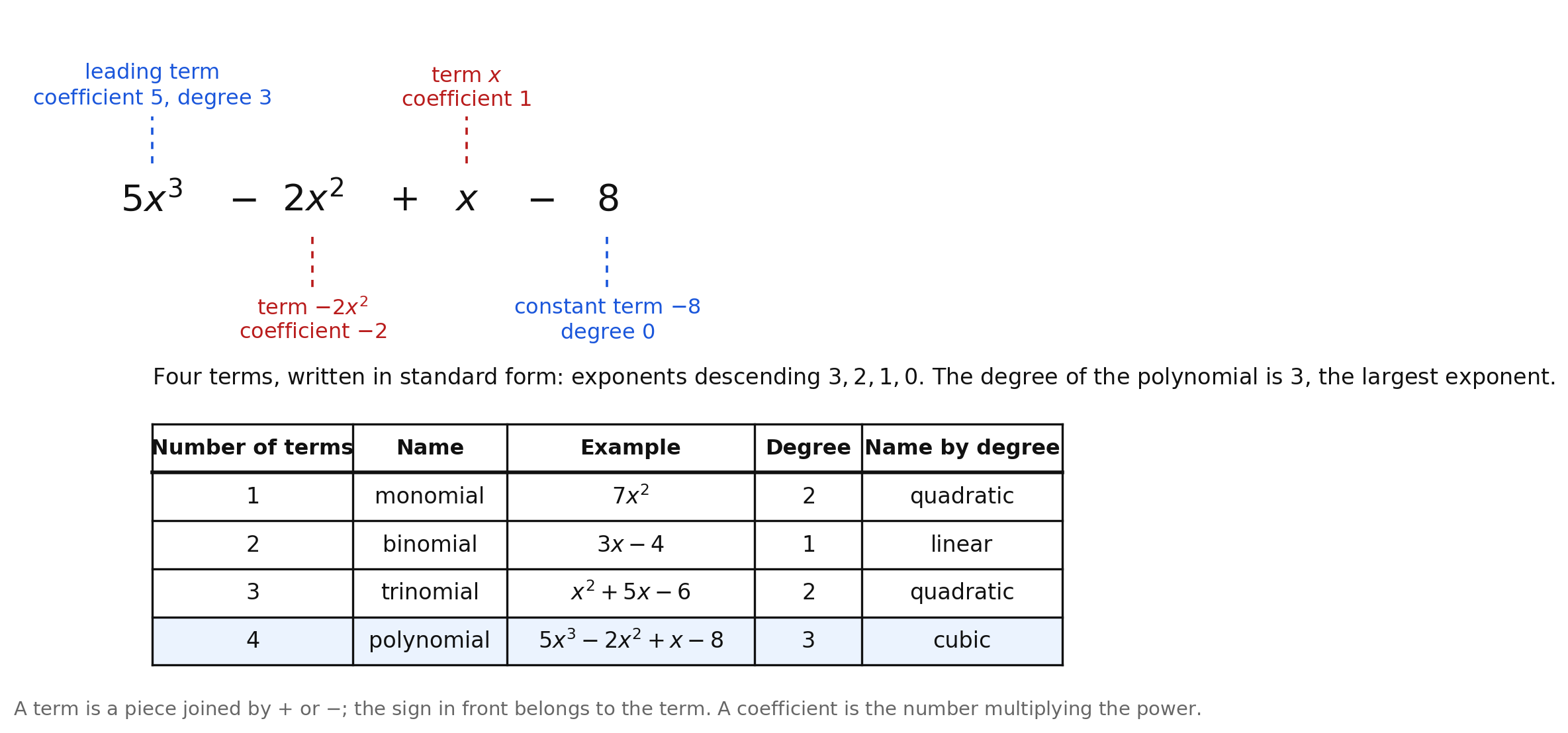
Read the figure one label at a time.
- Four terms. They are , , , and . The sign in front of a term belongs to it, so the second term is and not . Getting this right now is what makes subtraction survivable in Lesson 12.3.
- Coefficients , , , and . The third term is written , but it means , so its coefficient is .
- Degree , the largest exponent anywhere in the expression.
- Leading coefficient , the coefficient of the highest-degree term.
- Constant term . A constant has degree , because .
Standard form
Standard form writes the terms with the exponents descending. The same polynomial written is not wrong, but it hides its own degree and its own leading coefficient behind the reading order.
To put a polynomial in standard form:
- Identify the degree of each term.
- Write the term of largest degree first, then the next largest, down to the constant.
- Carry each sign with its term as you move it.
So becomes , and becomes — with leading coefficient , a sign that was easy to miss in the original order.
Two ways to classify
A polynomial gets a name from how many terms it has and another from its degree.
| Terms | Name | Example | Degree | Name by degree |
|---|---|---|---|---|
| monomial | constant | |||
| binomial | linear | |||
| trinomial | quadratic | |||
| or more | polynomial | cubic |
The two columns are independent. is a monomial and quadratic; is a binomial and linear.
Like terms
Like terms have the same variable raised to the same exponent. and are like terms. and are not, and neither are and .
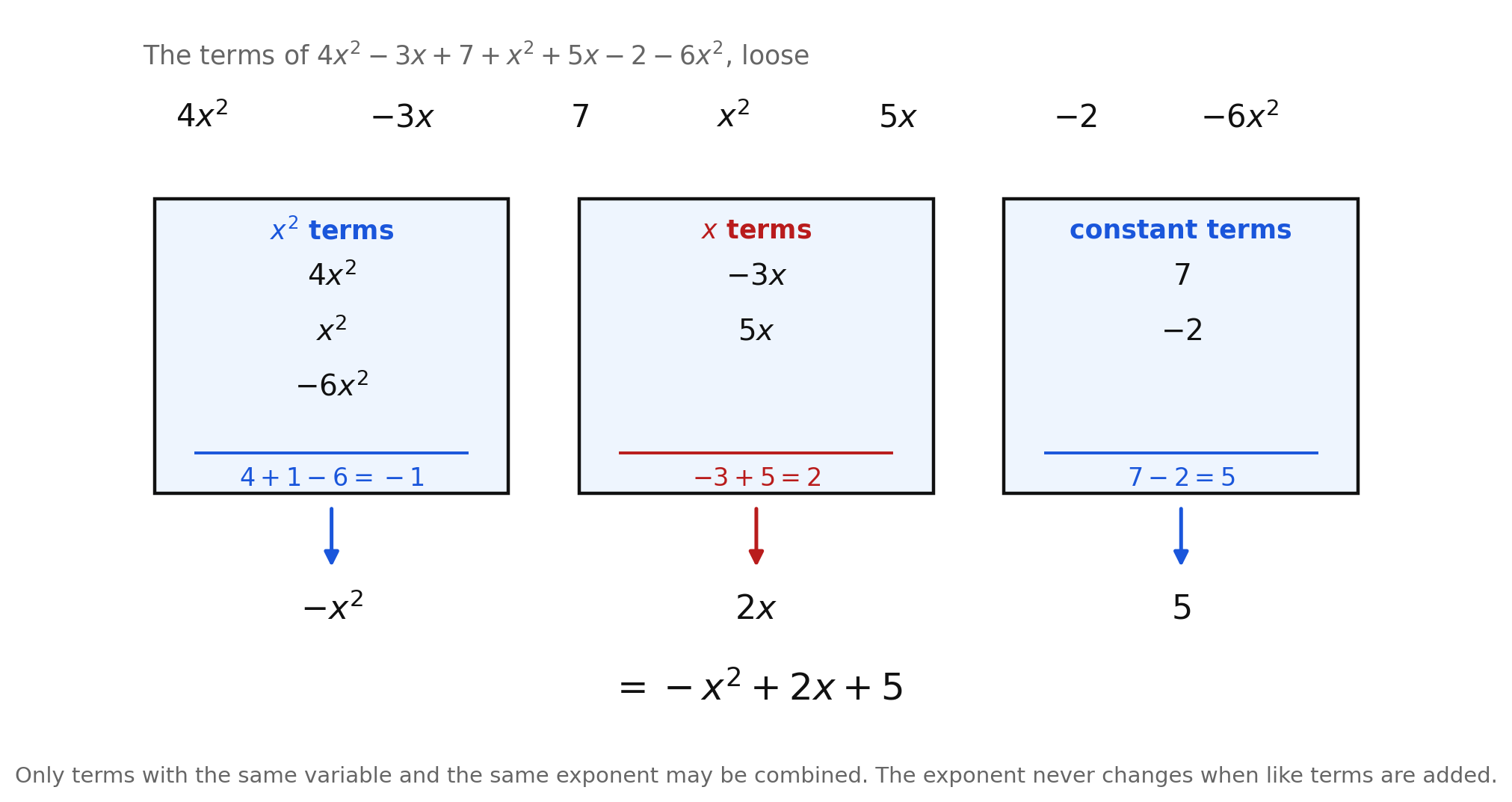
The figure sorts the terms of
into three piles and adds each pile.
- pile: , giving
- pile: , giving
- constant pile: , giving
Two things about that sort are worth saying out loud, because both come back in every later lesson.
- Only the coefficients are added. The exponent labels the pile; it is not part of the arithmetic. , never .
- Terms that land in different piles simply stay put. There is nothing to do to and but write them both down.
Why does this work at all? Because of the distributive property from Chapter 1: . Combining like terms is factoring the common power out, adding the numbers, and putting the power back.
Evaluating a polynomial
A polynomial is an expression, so it has a value once is chosen. Substitute and follow the order of operations, exactly as in Chapter 1.
For :
- At :
- At :
Notice and not : the exponent sits on the inside the parentheses, which is Chapter 10's caution about against . This skill is doing double duty in this chapter. It is worth having on its own, and it is the engine of the check every later lesson uses.
Worked examples
Example 1 — Naming the parts
Give the degree, the leading coefficient, and the constant term of .
The exponents present are and , and there is no constant written, so the constant term is .
Answer: Degree ; leading coefficient ; constant term .
Example 2 — Standard form
Write in standard form and say how many terms it has.
Order the exponents , carrying each sign.
Answer: , a four-term polynomial of degree .
Example 3 — Combining like terms
Simplify .
The terms give , and the terms give .
Answer:
Example 4 — Not a polynomial
Is a polynomial? Is ?
A polynomial requires whole-number exponents. Fractional coefficients are perfectly allowed; fractional or negative exponents are not.
Answer: is not a polynomial, because is not a whole number. is a polynomial, of degree with leading coefficient .
Example 5 — Evaluating
Evaluate at .
, and .
Answer:
Guided practice
- Use the anatomy figure. Name the four terms of and give the coefficient of each.
- In that same figure, give the degree of the polynomial, the leading coefficient, and the constant term.
- In that same figure, what does it mean to say the polynomial is written in standard form, and where in the expression do you see it?
- Use the table in that figure. Name a monomial, a binomial, and a trinomial from it, and give the degree of each.
- Use the like-terms figure. Which three terms went into the bin, and what did they combine to?
- In that same figure, explain why and were not put in the same bin.
Independent practice
- Give the degree, the leading coefficient, and the constant term of each. a) b) c) d)
- Write each in standard form and say how many terms it has. a) b) c) d)
- Classify each by its number of terms, then by its degree. a) b) c) d)
- Combine like terms. a) b) c) d)
- Use the like-terms figure. Combine and write the result in standard form.
- Reasoning. Explain why and cannot be combined, even though they have the same coefficient and the same variable. Refer to what the exponent is counting.
- Evaluate at and at .
- Application. A ball is thrown upward and its height in feet after seconds is . Give the degree, the leading coefficient, and the constant term, and say what the constant term means about the throw.
- Which of these is not a polynomial in one variable, and why? a) b) c) d)
- Error analysis. A student says the degree of is , "because the first term is ." Identify the error, write the polynomial in standard form, and give the correct degree.
- Give the coefficient of in each. a) b) c) d)
- Application. A shop's daily revenue is dollars when it charges dollars per item. Give the degree, the leading coefficient, and the constant term, and explain what the constant term says about charging nothing.
Exit ticket 12.1
- Write in standard form, and give its degree and leading coefficient.
- Combine like terms: .
- Classify by its number of terms and by its degree.
- Evaluate at .
Lesson 12.2 — Adding Polynomials
The concrete model: pushing two tile collections together
A.EO.2a asks for sums found with concrete objects and their related pictorial and symbolic models, so start concrete. Algebra tiles come in three shapes:
- a large square worth , whose sides are both
- a long tile worth , which is by
- a small square worth
A collection of tiles is a polynomial. Two large squares, three long tiles, and one small square is .
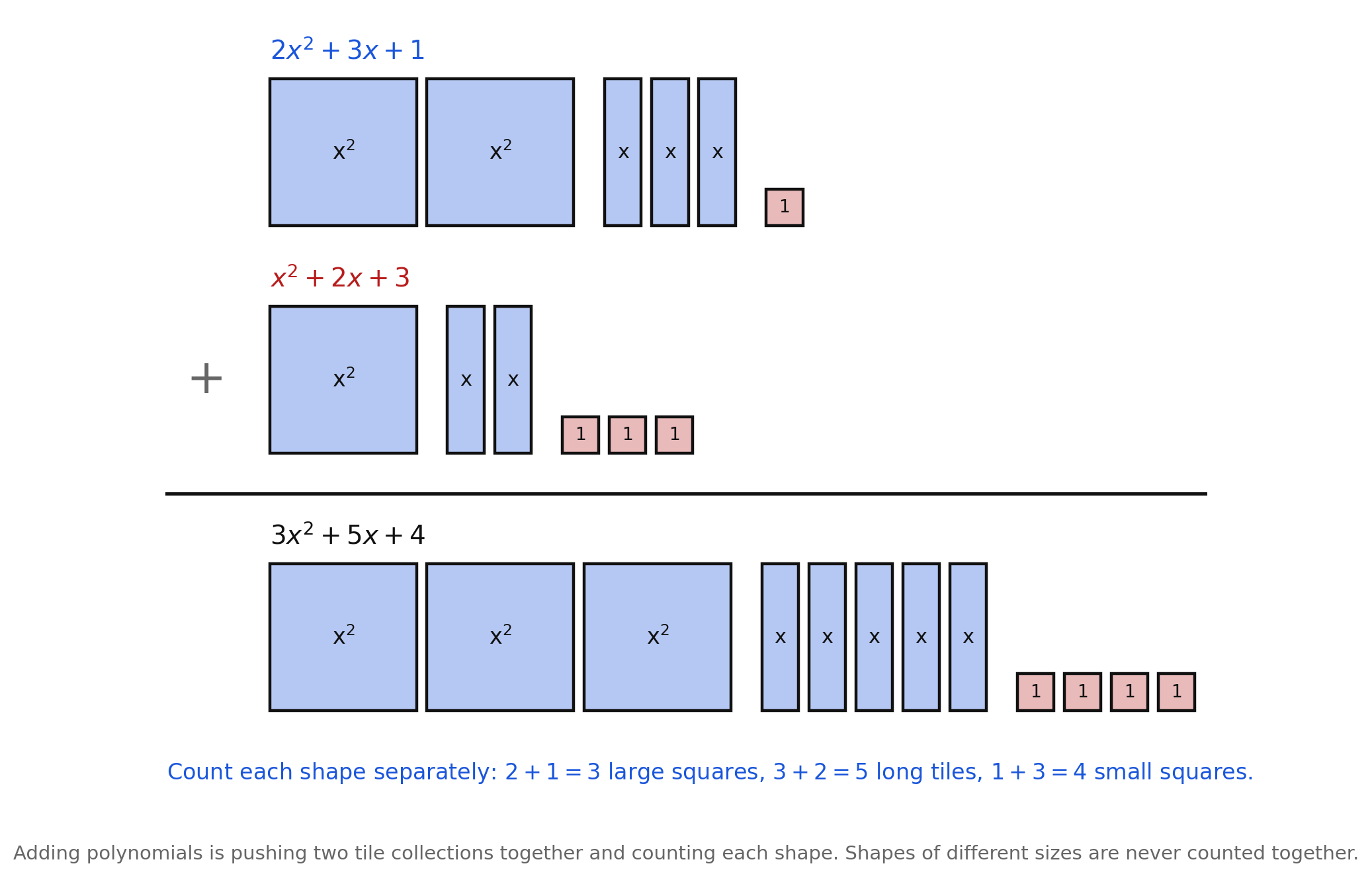
To add, push the two collections together and count each shape.
- Large squares:
- Long tiles:
- Small squares:
The picture makes one rule impossible to break. A long tile is not the same shape as a small square, so they never go in the same pile. That is what "only like terms combine" looks like when it is made out of cardboard, and it is why the exponent never changes: three large squares plus two large squares is five large squares, not five of something else.
Reading the model both ways
The model earns its keep only if you can travel in both directions.
- Picture to symbols. A collection of large square, long tiles, and small squares is .
- Symbols to picture. To build , take large squares, long tile, and small squares.
Practice both. The direction from symbols to picture is the one students skip and the one that shows whether the model is understood.
The symbolic method
Once the idea is secure, the tiles get slow. The symbolic version is: drop the parentheses and combine like terms.
- Drop the parentheses. Addition changes nothing inside them, which is exactly the point Lesson 12.3 will not be able to make.
- Group the like terms.
- Add the coefficients.
The vertical arrangement
For longer polynomials, stacking them with like terms in columns does the sorting for you. Leave a gap where a degree is missing, the way you leave a place value empty in ordinary addition.
Adding in columns looks like this.
| constant | ||||
|---|---|---|---|---|
| first | ||||
| second | ||||
| sum |
Reading down each column: , , the column has only , and the constant column has only . So the sum is .
The vertical arrangement and the horizontal one give the same answer, always. Use whichever keeps your columns honest.
Checking a sum
Evaluate the original sum and your answer at the same input. If the two numbers disagree, something is wrong; if they agree at two different inputs, you are almost certainly right.
Check at :
- Original:
- Answer: ✓
A sum can lose its degree
Two degree- polynomials can add to something of lower degree, if their leading coefficients are opposites:
Nothing is broken here. The pile happened to have and in it, which is zero large squares. Watch for it, and do not assume the answer must have the same degree as the pieces.
Worked examples
Example 1 — Two binomials
Add .
Drop the parentheses and combine: and .
Answer:
Example 2 — Two trinomials
Add .
for the terms, for the terms, for the constants.
Answer:
Example 3 — A missing degree
Add .
There is no term in either polynomial, so there is none in the sum.
Answer:
Example 4 — From tiles to symbols
A collection has large squares, long tiles, and small squares. A second has large square, long tiles, and small square. Write both polynomials and their sum.
Count each shape, then count each shape across both collections.
Answer: and ; the sum is .
Example 5 — In context
Store A's monthly profit is dollars and Store B's is dollars. Write the combined profit.
Add like terms: , , .
Answer: dollars
Guided practice
- Use the adding-with-tiles figure. Name the polynomial each of the two upper tile collections represents.
- In that same figure, how many of each shape are in the combined collection, and what polynomial is that?
- In that same figure, explain why the long tiles are never counted together with the small squares.
- Add .
- Describe the tiles you would lay out to build : how many of each shape?
- A tile collection has large square, long tiles, and small squares. Write the polynomial it represents.
Independent practice
- Add. a) b) c) d)
- Add using a vertical arrangement, showing the columns.
- Add .
- Add the three polynomials .
- Describe the tile picture for — how many of each shape in each collection and in the total — then write the sum.
- One collection has large squares, long tiles, and small squares; another has large square, long tiles, and small square. Write both polynomials and their sum.
- Application. Store A's monthly profit is dollars and Store B's is dollars. Write the combined profit in standard form.
- Application. A triangle has sides of length , , and . Write its perimeter in standard form.
- Reasoning. Explain how the sum of two degree- polynomials can have degree less than , and give an example of your own.
- Error analysis. A student writes . Identify the error and give the correct sum.
- Check your answer to 29b by evaluating both the original sum and your answer at . Show both numbers.
- Fill in the missing polynomial: .
Exit ticket 12.2
- Add .
- A tile collection has large squares, long tile, and small squares. Write the polynomial.
- Describe the tile picture for and write the sum.
- Check your answer to 41 by evaluating the original sum and your answer at .
Lesson 12.3 — Subtracting Polynomials
The zero pair
Subtraction with tiles needs one new object: a white tile, which is the opposite of the shaded tile of the same shape. A white long tile is ; a white small square is .
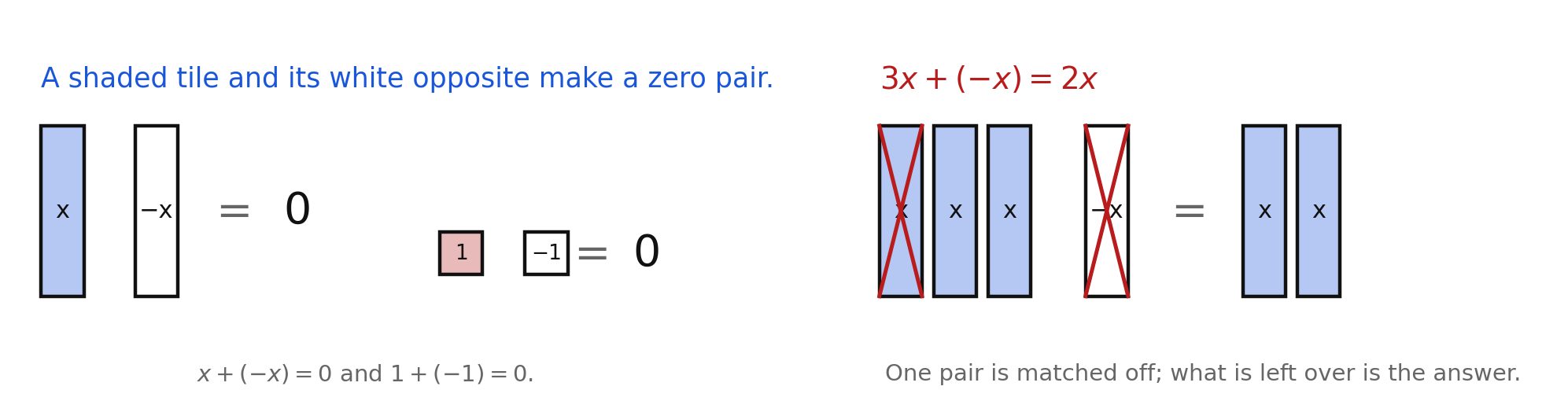
A shaded tile beside its white partner is a zero pair:
Two facts follow, and both get used constantly.
- A zero pair may always be removed from a collection without changing its value.
- A zero pair may always be added to a collection without changing its value.
The right-hand panel shows the first fact doing work: and together are four tiles, one pair of which cancels, leaving .
Subtracting is adding the opposite
The opposite of a polynomial is what you get by changing the sign of every term. The opposite of is . On the tile mat, taking the opposite means swapping every shaded tile for a white one of the same shape.
And then:
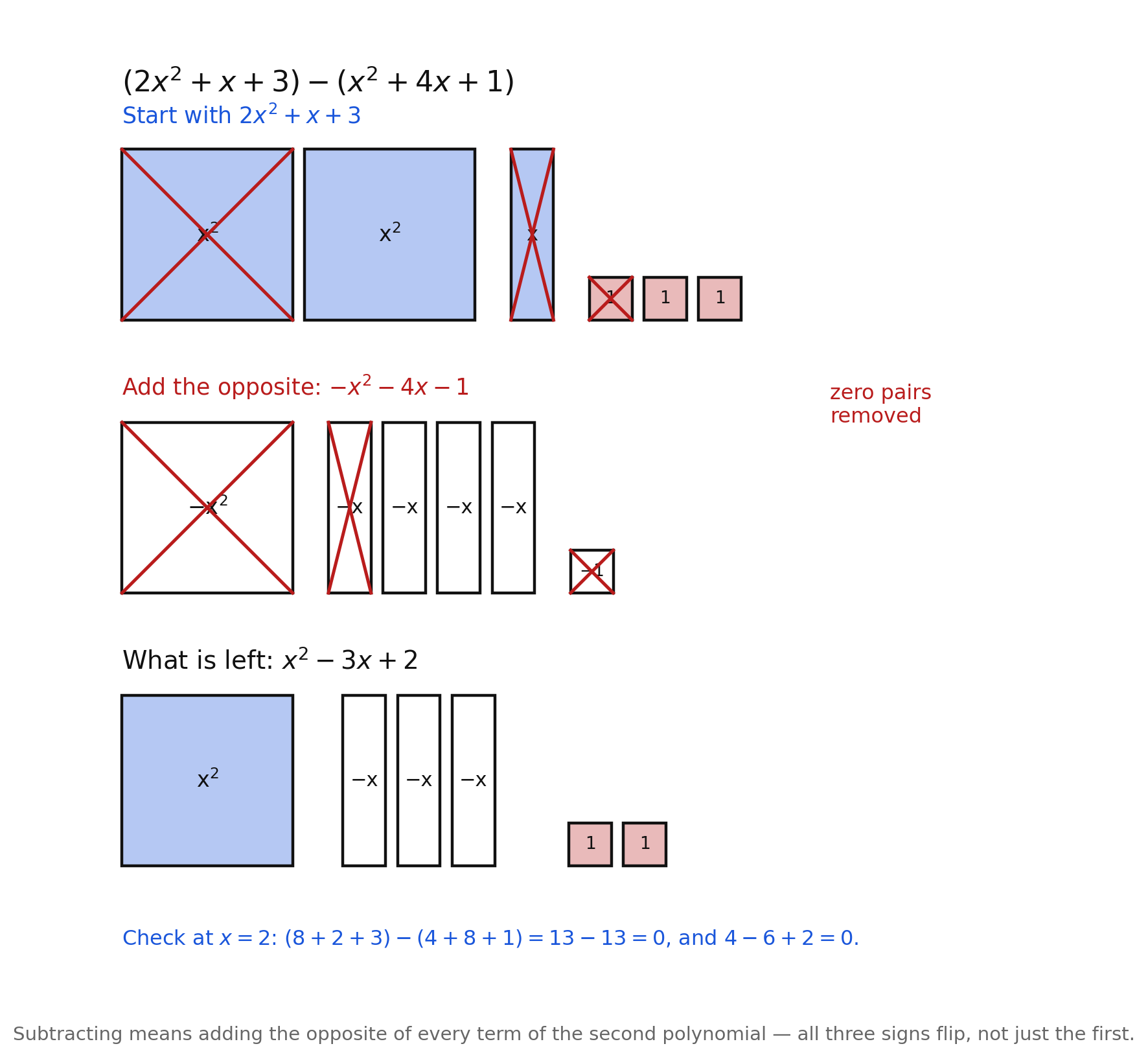
The figure carries out
in four moves.
- Lay out : two large squares, one long tile, three small squares.
- Add the opposite of the second polynomial: one white large square, four white long tiles, one white small square.
- Remove every zero pair. One large-square pair, one long-tile pair, and one small-square pair all cancel.
- Read what is left: one large square, three white long tiles, and two small squares.
Notice that the answer has a negative middle term even though every number in the problem was positive. The picture explains why without any appeal to a rule: there were only long tile to start and white ones came in, so four white tiles met one shaded one and three white ones survived.
The symbolic method, and the mistake it invites
Symbolically, subtracting is the same three steps:
- Change the subtraction to addition of the opposite.
- Change the sign of every term of the second polynomial.
- Combine like terms.
Step 2 is where this entire lesson lives, and the second half of it — every term — is where the errors are.
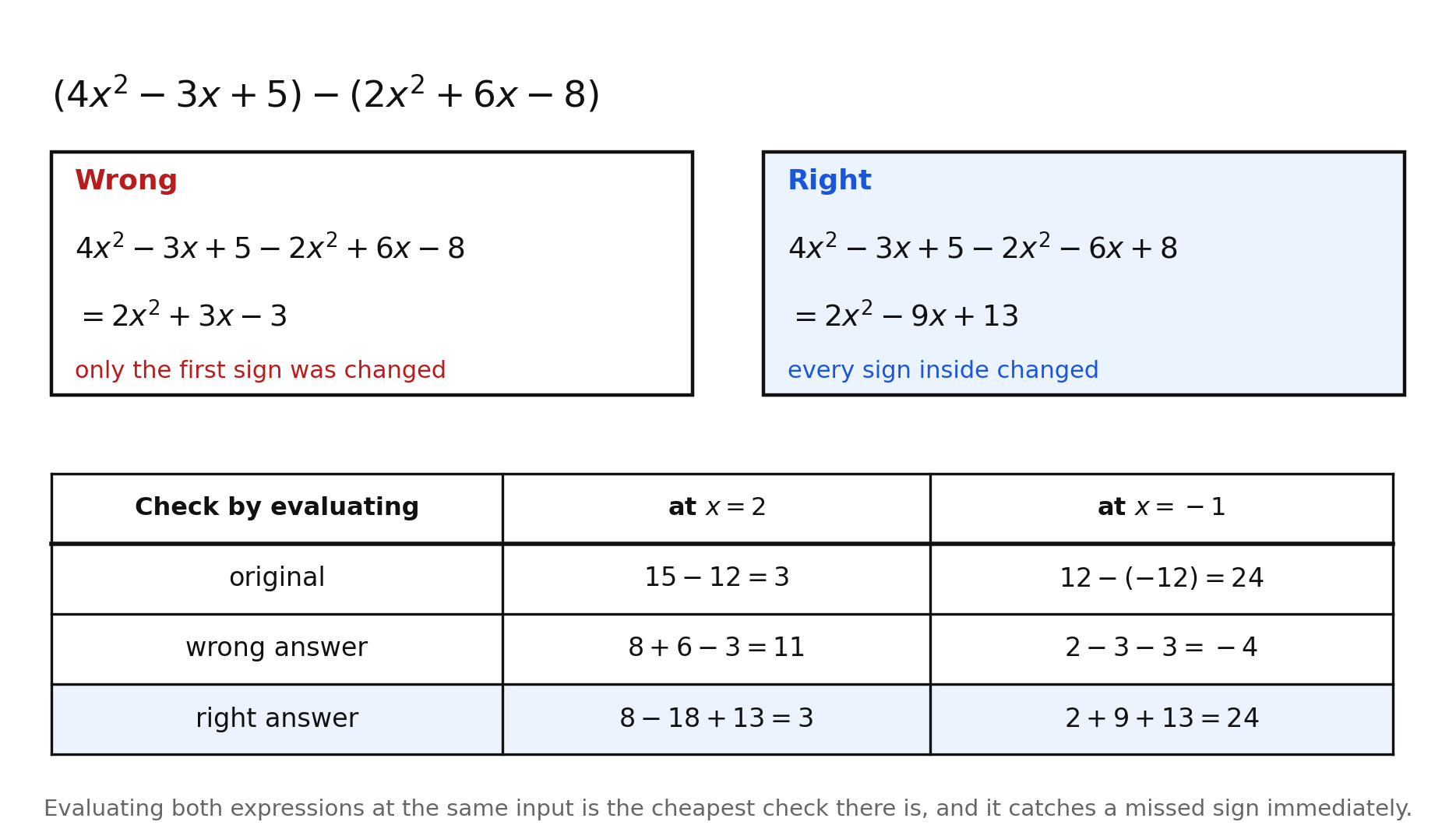
Consider .
- Wrong: . Only the first sign was changed. The and the were copied over untouched.
- Right: . All three signs changed.
The minus sign in front of a set of parentheses is a waiting to be distributed, and the distributive property reaches every term inside — the same rule you will use for multiplication in Lesson 12.4. Notice too that becomes : a term that was already negative becomes positive.
The check that catches this every time
The bottom of the figure is the habit worth building.
| Evaluated at | Original | Wrong answer | Right answer |
|---|---|---|---|
| ✓ | |||
| ✓ |
The wrong answer fails at both inputs, immediately and unmistakably. This costs two substitutions, and it is the single most valuable habit in the chapter. Use two inputs, one positive and one negative — a wrong answer can agree with the original at one unlucky input, but almost never at two.
The vertical arrangement for subtraction
Stacking works here too, provided you take the opposite before you stack. Rewriting
as
turns the problem into an addition, and additions are the ones that do not bite. Reading down the columns gives , that is, .
Worked examples
Example 1 — Two binomials
Subtract .
Add the opposite: .
Answer:
Example 2 — Both signs inside flip
Subtract .
Add the opposite: . The became .
Answer:
Example 3 — A degree disappears
Subtract .
Add the opposite: . The two terms are a zero pair.
Answer:
Example 4 — Writing an opposite
Write the opposite of .
Change the sign of every term, including the one that is already negative.
Answer:
Example 5 — In context
A shop's revenue is dollars and its cost is dollars. Write the profit .
.
Answer: dollars
Guided practice
- Use the zero-pairs figure. What is a zero pair, and why may one always be removed from a collection?
- In the right-hand panel of that figure, explain why by describing what happens to the tiles.
- Use the subtracting-with-tiles figure. What is the opposite of , and how does the figure show it?
- In that same figure, name every zero pair that was removed, and name the tiles that were left.
- Use the sign-distribution figure. What exactly did the student who got do wrong?
- In that same figure, explain how the row of the table at shows that is the right answer and is not.
Independent practice
- Write the opposite of each. a) b) c) d)
- Subtract. a) b) c) d)
- Subtract using a vertical arrangement, after rewriting it as an addition.
- Use the subtracting-with-tiles figure. Carry out symbolically, and confirm you get the polynomial the tiles left behind.
- Subtract .
- Application. A shop's revenue is dollars and its cost is dollars. Write the profit in standard form.
- Application. A pipe of length inches has a piece of length inches cut from it. Write the length that remains.
- Reasoning. Explain why subtracting a polynomial with more than one term is not the same as subtracting only its first term. Use to make the point, showing both the correct answer and what the careless answer would have been.
- Error analysis. A student computes . Identify the error and give the correct difference.
- Check your answer to 52b by evaluating the original difference and your answer at and at . Show all four numbers.
- Fill in the missing polynomial: .
- Describe the tile picture for : the starting tiles, the opposite tiles added, the zero pairs removed, and what is left. Then write the difference.
Exit ticket 12.3
- Subtract .
- Write the opposite of .
- Check your answer to 63 by evaluating the original difference and your answer at .
- Error analysis. A student says , "because the terms cancel and so do the fours." Identify the error and give the correct difference.
Lesson 12.4 — Multiplying by a Monomial
The distributive property, again
Multiplying a polynomial by a monomial is the distributive property from Chapter 1 with one extra ingredient: the product law of exponents from Chapter 10.
So . Multiply the coefficients; add the exponents. Adding the exponents here is not a slip of the "never change the exponent" rule from Lesson 12.1 — that rule was about combining like terms, and this is multiplying. Combining counts tiles of one shape; multiplying counts factors.
The pictorial model: an area model
A.EO.2b names area models by name. The area of a rectangle is its length times its width, so a rectangle cut into pieces is a picture of a product cut into pieces.
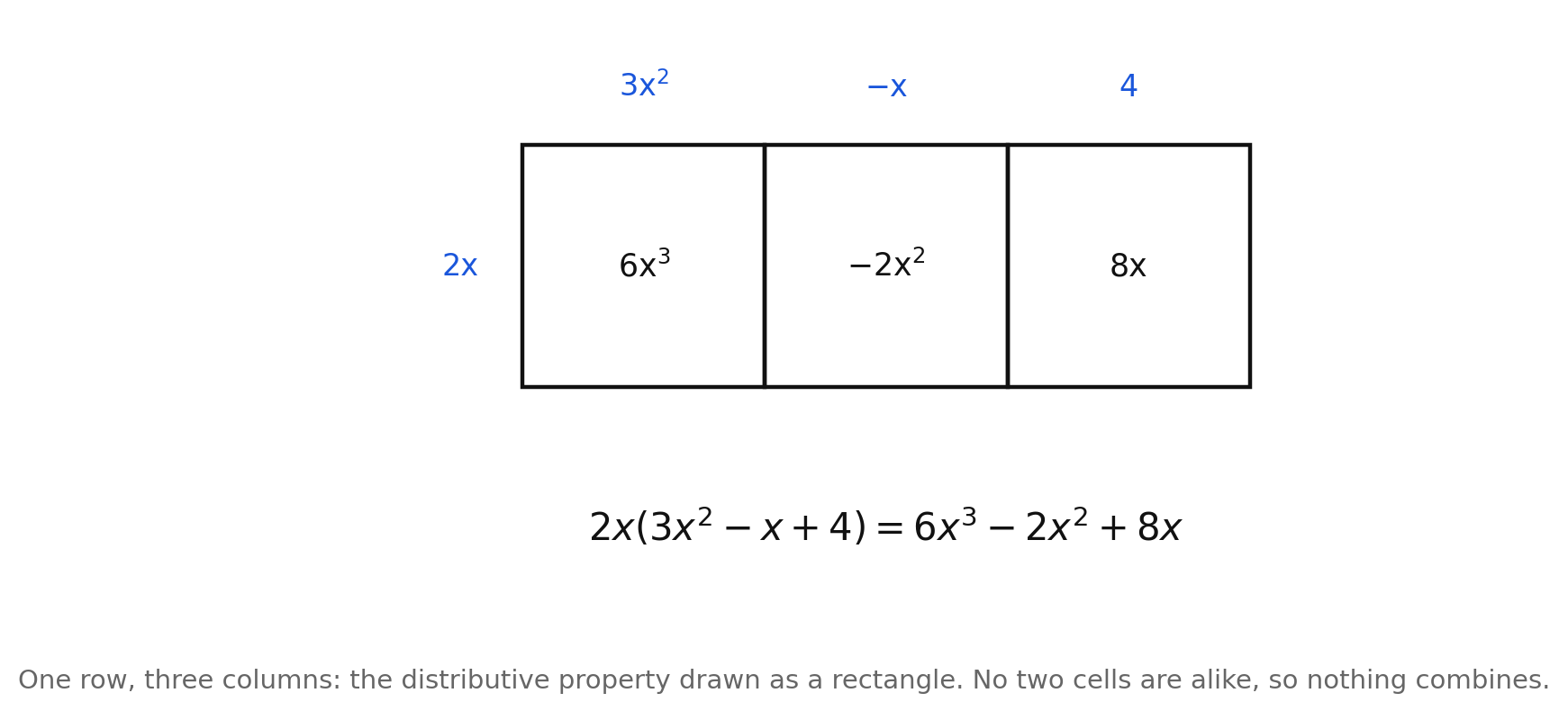
The figure computes .
- The single row is labeled — the monomial.
- The three columns are labeled , , and — the terms of the trinomial, each carrying its own sign.
- Each cell holds the product of its row label and its column label: , , and .
The three cells have three different degrees, so nothing combines — a one-row area model never produces like terms. The answer simply is the list of cells.
The model also makes the classic error visible. A student who writes has drawn a rectangle and then filled in only one of its cells. The picture refuses to leave a cell empty.
The procedure
- Multiply the monomial by each term of the polynomial, one at a time.
- Multiply the coefficients, signs included.
- Add the exponents on the variable.
- Write the result in standard form.
For :
Watch the signs of the middle products in particular: a negative monomial times a negative term is positive, and that plus sign is the one most often lost.
When there is something left to combine
If a problem has two distributions in it, like terms can appear after both are done.
- Distribute each product. . Note that the second distribution carries the leading minus sign into both of its terms — Lesson 12.3's rule, arriving again.
- Combine like terms.
Checking
The same check as always. For at :
- Original: and , so
- Answer: ✓
A note pointing forward
The degree of the product is the sum of the degrees: a degree- monomial times a degree- trinomial gave a degree- answer. That is the product law of exponents showing up at the level of whole polynomials, and it is a fast sanity check on any product you write.
Worked examples
Example 1 — A constant times a binomial
Multiply .
Distribute to both terms.
Answer:
Example 2 — A variable monomial
Multiply .
by the product law, and .
Answer:
Example 3 — A negative monomial
Multiply .
, and .
Answer:
Example 4 — A trinomial and a squared monomial
Multiply .
Multiply term by term, adding exponents each time.
Answer:
Example 5 — Two distributions, then combine
Simplify .
, and the two terms combine.
Answer:
Guided practice
- Use the monomial area-model figure. Name the label on the row, the three labels on the columns, and the three cells.
- In that same figure, which law of exponents turned and into , and what does that law say?
- In that same figure, explain why the three cells cannot be combined into fewer terms.
- Multiply .
- Describe the area model for — the row label, the column labels, and each cell — then give the product.
- Multiply .
Independent practice
- Multiply. a) b) c) d)
- Use the monomial area-model figure. Write out the three cells of and the product they give.
- Multiply .
- Simplify .
- Simplify .
- Application. A rectangle has width meters and length meters. Write its area in standard form.
- Application. A garden plot is meters wide and meters long. Write its area in standard form.
- Reasoning. Explain why the degree of a monomial times a trinomial equals the degree of the monomial plus the degree of the trinomial. Refer to the product law of exponents from Chapter 10.
- Error analysis. A student writes . Identify the error, say which cell of the area model was left empty, and give the correct product.
- Error analysis. A student writes . Identify the error and give the correct product, naming the law of exponents involved.
- Check your answer to 73c by evaluating the original product and your answer at . Show both numbers.
- An area model has one row labeled and three columns labeled , , and . Write each cell and the product the model computes.
Exit ticket 12.4
- Multiply .
- Describe the area model for and give the product.
- Simplify .
- Check your answer to 85 by evaluating the original product and your answer at .
Lesson 12.5 — Multiplying Two Polynomials
Building the product out of tiles
Start concrete once more. If a rectangle is tall and wide, its area is — and you can build that rectangle out of algebra tiles.
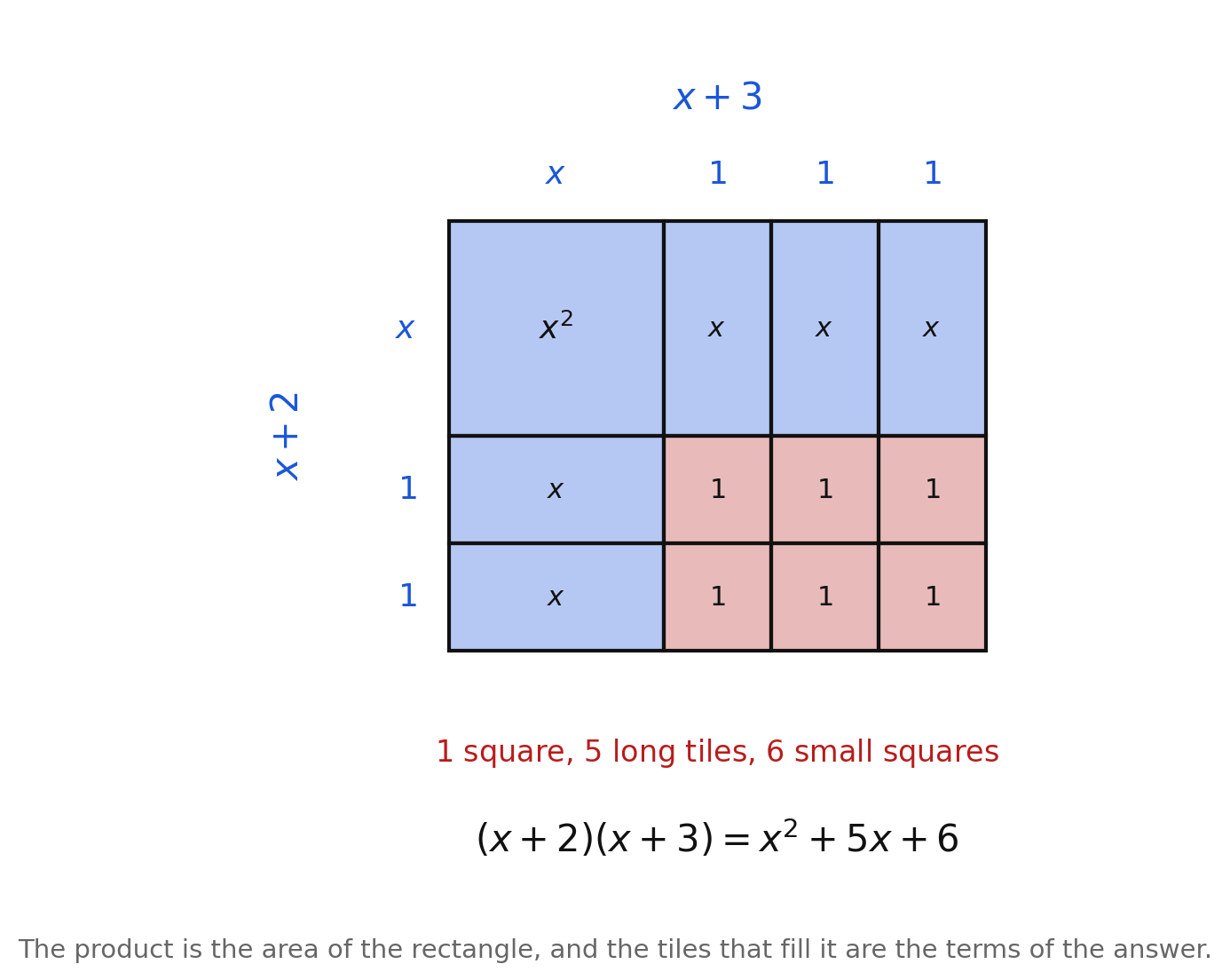
Look at what fills it.
- The -by- corner is one large square, .
- Along the top, by three times, and down the side, by twice: five long tiles, .
- The -by- corner is six small squares, .
The tiles are the terms. That is the whole idea, and it is why an area model works: the product is an area, and the terms of the answer are the pieces the area breaks into.
The pictorial model: an area model for two binomials
Drawing every tile gets tedious past small numbers, so replace the tiles by a grid with one row per term of the first factor and one column per term of the second.
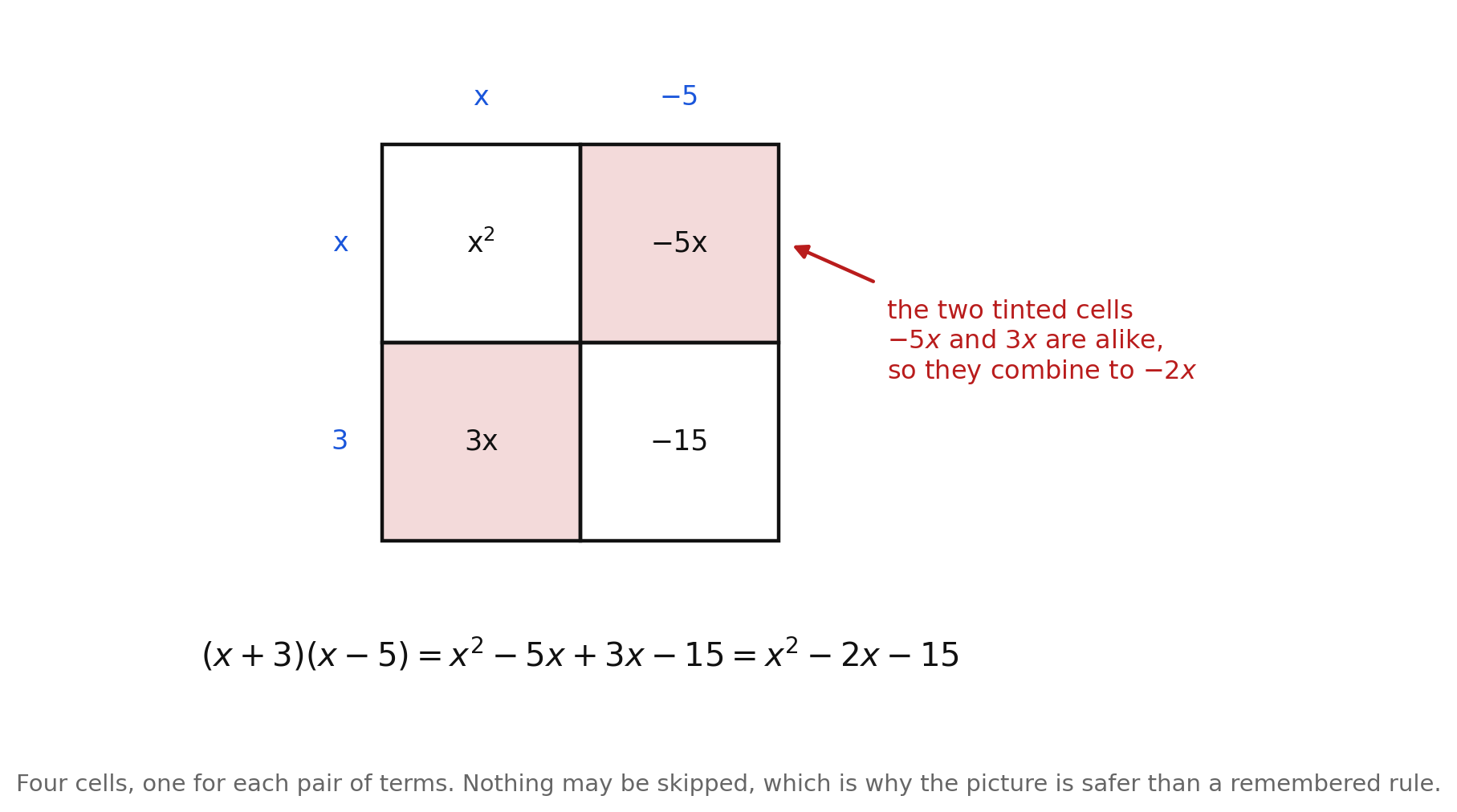
For :
Four cells, one for each pair of terms — and every cell must be filled. Adding them:
Two of the four cells, and , are like terms, so they combine to . That is the usual pattern for a binomial times a binomial: four cells collapse into three terms, because the two "middle" cells are always alike.
Three things the grid protects you from:
- Skipping a pair. A student who writes multiplied the first terms and the last terms and never drew the other two cells.
- Losing a sign. The column is labeled , not , so the cell arrives with its sign attached rather than being remembered later.
- Forgetting to combine. The picture shows the two middle cells sitting next to each other, which is a reminder that they are not finished.
Larger factors
The grid grows with the factors. A binomial times a trinomial is a grid — six cells.
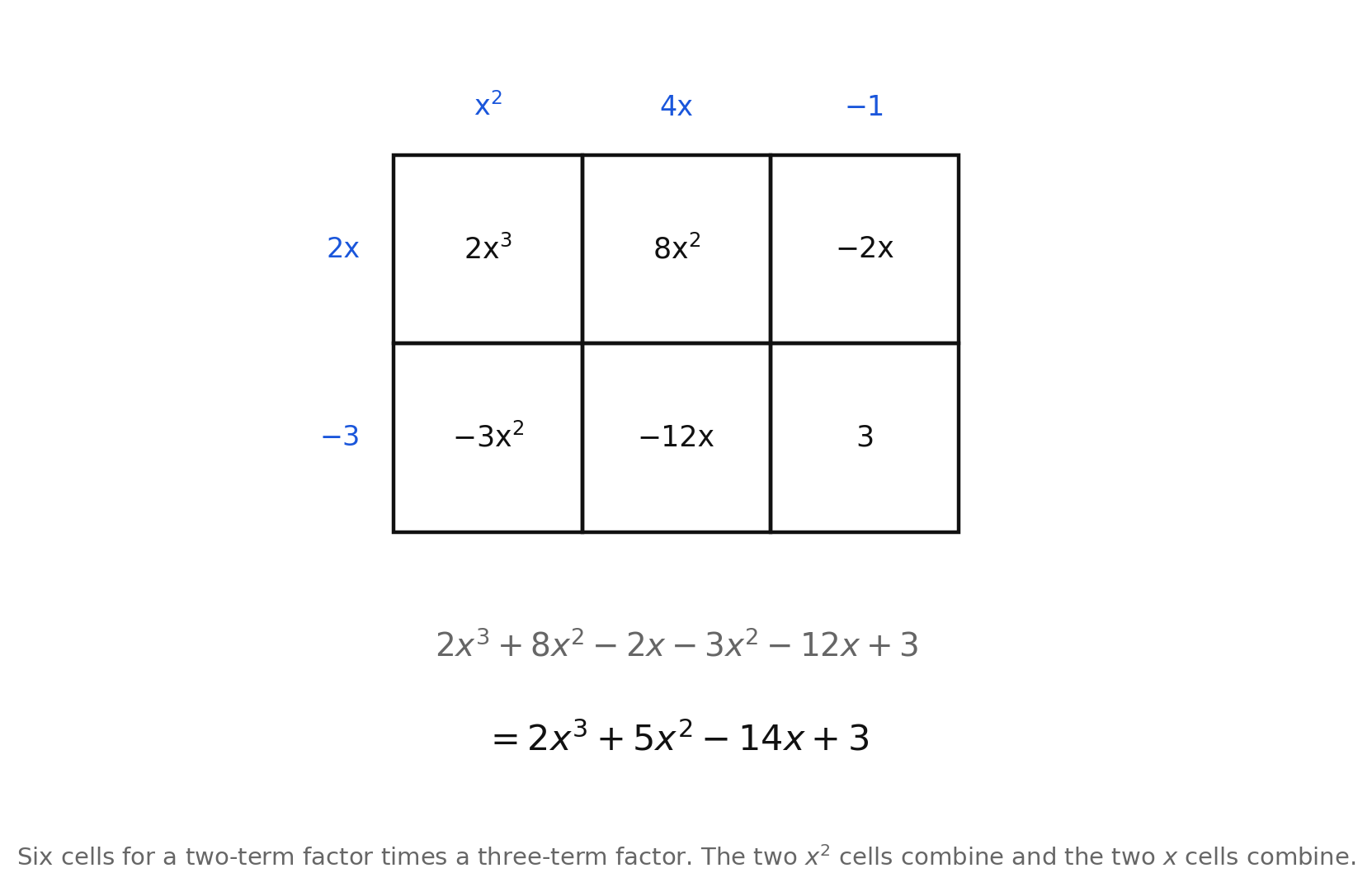
For :
Collect the six cells:
Two cells were terms and combined to ; two were terms and combined to .
A.EO.2b limits each factor to five or fewer terms, so the largest grid you will ever need is . Every grid in this chapter is far smaller than that.
The procedure, stated symbolically
You do not have to draw the grid once the habit is set. The rule it encodes is:
- Multiply every term of the first polynomial by every term of the second. For an -term factor and an -term factor that is exactly products — count them, because a missing product is the most common error.
- Carry each sign into its product.
- Combine like terms.
- Write the answer in standard form.
For , that is products:
Two products worth recognizing
Nothing new is needed for these; the grid handles them. But they show up often enough to be worth noticing.
- . The middle cells were opposites, so they cancelled.
- . Squaring a binomial means multiplying it by itself — it does not mean squaring each term, and is wrong by the entire middle term .
Area and perimeter in context
A rectangle whose sides are polynomials is the most natural home for all of this.
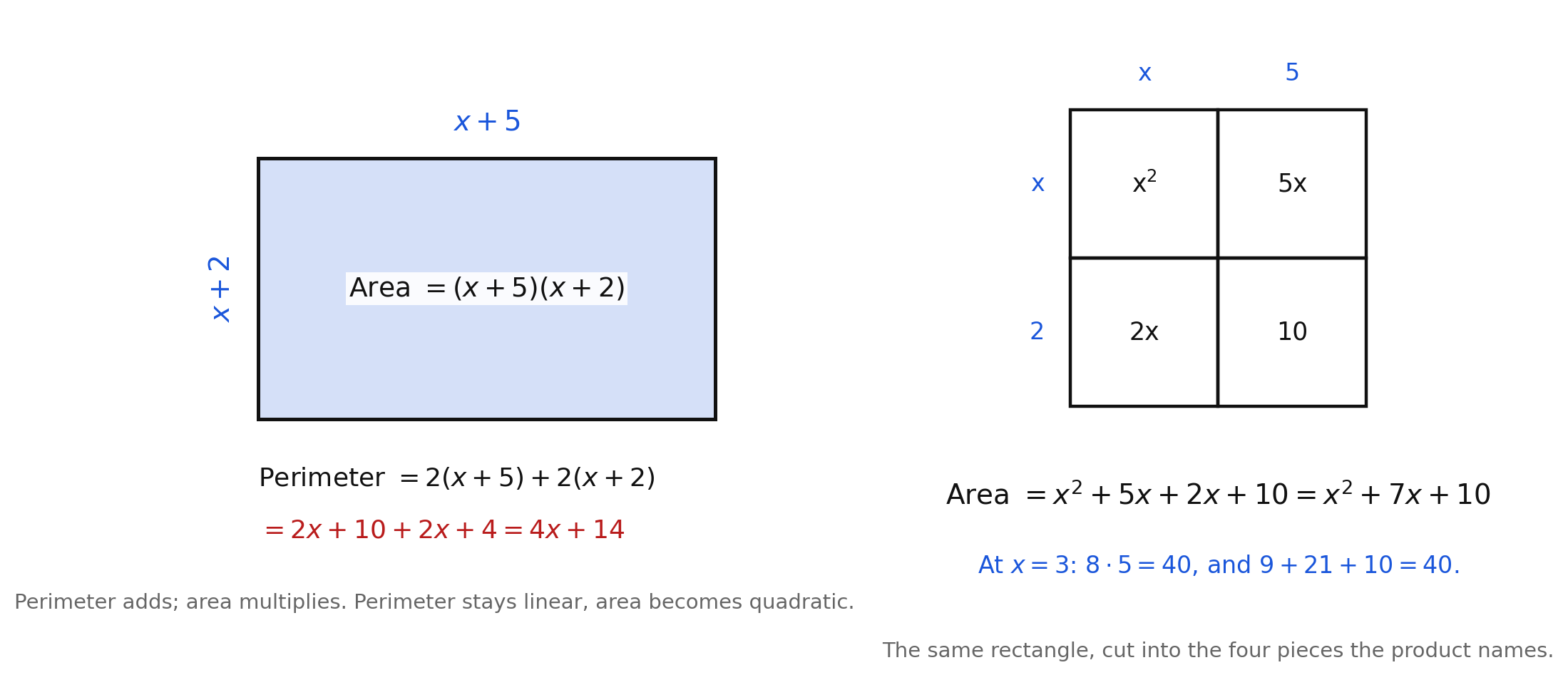
For a rectangle long and wide:
- Perimeter . Adding and distributing a constant, so the result stays linear.
- Area . Multiplying two linear expressions, so the result is quadratic.
Check at : the rectangle is by , with area , and ✓.
That contrast — perimeter adds and stays linear, area multiplies and becomes quadratic — is worth holding onto. It is the reason doubling the side of a square quadruples its area.
A forward glance
You now know that . Chapter 13 asks the question backwards: given , which two binomials multiply to give it? That is factoring, and every area model and tile rectangle you have drawn here is a picture you will be reading from the inside out. Multiplication and factoring are the same rectangle, approached from opposite sides.
Worked examples
Example 1 — Two binomials
Multiply .
Four cells: , , , . The middle two combine.
Answer:
Example 2 — A negative term
Multiply .
Cells: , , , . Then .
Answer:
Example 3 — Middle terms that cancel
Multiply .
Cells: , , , . The middle two are opposites.
Answer:
Example 4 — A binomial times a trinomial
Multiply .
Six products: .
Answer:
Example 5 — In context
A rectangular patio is feet long and feet wide. Write its area and its perimeter.
Area is a product; perimeter is a sum.
Answer: Area square feet; perimeter feet.
Guided practice
- Use the tile-rectangle figure. How many of each tile fill the rectangle, and what product do those tiles give?
- In that same figure, name the two side lengths of the rectangle, and explain why the tiles that fill it are the terms of the product.
- Use the two-by-two area-model figure. Name all four cells of and the product they give.
- In that same figure, which two cells combine, and why are those two alike while the other two are not?
- Use the two-by-three area-model figure. Name all six cells of and the product.
- Use the rectangle figure. Give the area and the perimeter of a rectangle by , and explain why one is quadratic and the other is linear.
Independent practice
- Multiply, using an area model and showing all four cells. a) b) c) d)
- Multiply. a) b) c) d)
- Multiply , showing all six products before you combine.
- Multiply .
- Multiply . How many products does the grid contain?
- Multiply by multiplying two of the factors first and then multiplying the result by the third.
- Describe the tile rectangle for — how many of each tile — and write the product.
- A rectangle of tiles has sides and and is filled by large square, long tiles, and small squares. Write the product this picture shows.
- Application. A rectangular patio is feet long and feet wide. Write its area and its perimeter, each in standard form.
- Application. Write the product of two consecutive integers and as a polynomial in standard form. Then write the product of the three consecutive integers , , and .
- Error analysis. A student writes . Identify the error, say which cells of the area model were never filled, and give the correct product.
- Check your answer to 95c by evaluating the original product and your answer at . Show both numbers.
Exit ticket 12.5
- Multiply .
- Multiply .
- Describe the area model for , naming all four cells, and give the product.
- Check your answer to 107 by evaluating the original product and your answer at .
Chapter 12 Review
Vocabulary. polynomial · term · coefficient · degree · standard form · leading coefficient · constant term · monomial · binomial · trinomial · like terms · algebra tile · zero pair · opposite of a polynomial · distributive property · area model
A.EO.2 a and b ask for two different operations described through three different models, so this review is organized by both. Part A is the vocabulary of bullet a, Part B is sums and differences, Part C is products, Part D asks for the concrete and pictorial models in both directions, and Part E puts all of it into context.
Part A — Vocabulary and standard form
- Write in standard form, and give its degree, leading coefficient, and constant term.
- Classify by its number of terms, and give its degree.
- Combine like terms: .
- Give the coefficient of in .
Part B — Sums and differences
- Add .
- Subtract .
- A tile collection has large squares, long tiles, and small square, and from it large square and long tiles are taken away. Write the subtraction, name the zero pairs that form, and give the result.
- Error analysis. A student writes . Identify the error and give the correct difference.
Part C — Products
- Multiply .
- Multiply .
- Multiply , showing all six products.
- Describe the area model for , naming all four cells, and give the product.
Part D — Models in both directions
- A tile collection has large square, long tiles, and small squares. Write the polynomial it represents, then describe the tiles you would lay out for its opposite.
- A tile rectangle has sides and . State how many of each tile fill it, and write the product.
- Describe the tile picture for : the starting tiles, the opposite tiles added, the zero pairs removed, and what is left. Then write the difference.
- An area model has rows labeled and and columns labeled , , and . Write all six cells, and give the product in standard form.
Part E — Mixed application
- Application. A rectangular garden is meters long and meters wide. Write its area and its perimeter in standard form, and say which one is quadratic and why.
- Application. A stand's revenue is dollars when it charges dollars, and its cost is dollars. Expand into standard form, then write the profit in standard form.
- Application. Write the product of the two integers and as a polynomial in standard form, then write the sum of their squares in standard form.
- Application. A rectangle is feet by feet, and a square of side feet is removed from one corner. Write the remaining area in standard form, then check your answer at by computing both the original area and your polynomial.
Standards coverage check — Chapter 12
Both bullets of A.EO.2 name concrete, pictorial, and symbolic models, so coverage of each bullet is broken out by model rather than by operation alone.
| Knowledge and Skill | Model | Where it is taught | Where it is practiced | Where it is used in context |
|---|---|---|---|---|
| A.EO.2a — determine sums and differences of polynomial expressions in one variable, using a variety of strategies, including concrete objects and their related pictorial and symbolic models | Vocabulary and like terms (the prerequisite) | 12.1 (term, coefficient, degree, standard form, leading coefficient, monomial/binomial/trinomial, like terms) | 1–22; 111–114 | 14, 18 |
| A.EO.2a | Concrete and pictorial — sums | 12.2 (tile collections pushed together; both directions between tiles and symbols) | 23, 24, 25, 27, 28, 33, 34, 42, 43; 123 | 35, 36 |
| A.EO.2a | Symbolic — sums | 12.2 (drop the parentheses and combine; the vertical arrangement) | 26, 29–32, 37–41, 44; 115 | 35, 36 |
| A.EO.2a | Concrete and pictorial — differences | 12.3 (zero pairs; adding the opposite on the tile mat) | 45–48, 54, 62; 117, 125 | — |
| A.EO.2a | Symbolic — differences | 12.3 (add the opposite; the sign reaches every term; the two-input check) | 49–53, 55, 58–61, 63–66; 116, 118 | 56, 57, 128 |
| A.EO.2b — determine the product of polynomial expressions in one variable, using a variety of strategies, including concrete objects and their related pictorial and symbolic models, the application of the distributive property, and the use of area models, with factors limited to five or fewer terms | The distributive property | 12.4 (monomial times polynomial, with the product law of exponents) | 70, 72, 73, 75–77, 80–83, 85, 87, 88; 119 | 78, 79 |
| A.EO.2b | Area models | 12.4 (one-row model); 12.5 (two-binomial and larger grids) | 67–69, 71, 74, 84, 86, 91–93, 95, 97–100, 105, 108, 109; 121, 122, 126 | 103, 127, 128 |
| A.EO.2b | Concrete objects | 12.5 (the tile rectangle, in both directions) | 89, 90, 101, 102; 124 | — |
| A.EO.2b | Symbolic products | 12.5 (every term times every term; counting the products) | 94, 96, 106, 107, 110; 120 | 104, 129, 130 |
Supporting items: 12, 37, 58, and 80 are reasoning prompts aimed at the four claims most often taken on faith — why unlike powers never combine, why a sum can lose its degree, why a subtraction reaches every term, and why degrees add under multiplication. Items 16, 38, 59, 66, 81, 82, 105, and 118 are error analyses aimed at the eight most common defects in this chapter. Items 39, 44, 60, 65, 83, 88, 106, 110, and 130 all run the evaluate-at-the-same-input check, at both a positive and a negative input where the sign risk is highest.
Boundaries respected. No item asks the student to factor a polynomial, to factor by grouping, or to factor a trinomial — that is A.EO.2c, in Chapter 13 — although 12.5 closes by naming factoring as the same picture read backwards. No item divides a polynomial by a monomial or a binomial, and none asks whether two quadratic forms are equivalent; those are A.EO.2 d and e, in Chapter 14. No item solves an equation: every item in this chapter simplifies an expression, because solving quadratics is A.EI.1 in Chapter 15. Every polynomial in the chapter is in one variable, and every factor in every product has five or fewer terms, the largest being the three-term factors of items 97, 98, 108, 121, and 126 and the two three-term factors of item 99. Exponents are whole numbers throughout, and the laws of exponents are applied but not re-derived, since that is A.EO.3 in Chapter 10.
Answer keys for every item in this chapter are in Appendix A.