Chapter 13 — Factoring Polynomials
Standard: A.EO.2 (c)
A.EO.2 — verbatim. The student will perform operations on and factor polynomial expressions in one variable. Students will demonstrate the following Knowledge and Skills: c) Factor completely first- and second-degree polynomials in one variable with integral coefficients. After factoring out the greatest common factor (GCF), leading coefficients should have no more than four factors.
By the end of this chapter you will be able to:
- Treat factoring as Chapter 12's multiplication run backwards — given the cells of an area model, recover the side lengths (A.EO.2c)
- Factor out the greatest common factor of a first- or second-degree polynomial, including a leading minus sign when the leading term is negative (A.EO.2c)
- Factor a trinomial by finding an integer factor pair of that sums to , and say prime over the integers when the search is exhausted (A.EO.2c)
- Factor a difference of squares (A.EO.2c)
- Recognize and write a perfect-square trinomial as (A.EO.2c)
- Factor with by splitting the middle term and grouping, within the leading-coefficient limit of A.EO.2c (A.EO.2c)
- Factor completely: pull the GCF first, then factor what remains, until no factor is still factorable (A.EO.2c)
- Choose a method from the shape of the polynomial — two, three, or four terms — and check by multiplying the factors back out (A.EO.2c)
Lessons: 13.1 Factoring as Multiplication Run Backwards · 13.2 The Greatest Common Factor · 13.3 Trinomials with Leading Coefficient 1 · 13.4 Difference of Squares · 13.5 Perfect Squares and Leading Coefficient Greater Than 1 · 13.6 Factoring Completely and Choosing a Method
Why this chapter matters. Chapter 12 taught you to build a rectangle from its sides: fills four cells that add to . This chapter starts from the filled cells and asks for the sides. That reverse question is what "factor" means, and it is not a new operation — it is the same area model, the same tile rectangle, and the same distributive property, read from the inside out. Every quadratic model you will meet later — a thrown ball, a revenue curve, an area that has to be rebuilt as a product of dimensions — begins as an expression you have to factor before you can use it. Factoring is also the door into Chapter 15: once , setting a product equal to zero becomes two linear equations. This chapter stays on the expression side of that door. Nothing here is an equation to solve.
Scope note. This chapter is A.EO.2c alone. Every polynomial is first- or second-degree, in one variable, with integral coefficients. After the GCF is removed, the remaining leading coefficient has no more than four factors — so may be , , , , , , , , , or , but not . Factor completely means: pull every GCF, then factor every remaining piece that still factors over the integers, until what is left is prime. Adding, subtracting, and multiplying polynomials were A.EO.2 a and b in Chapter 12; this chapter uses those products as the check on every factorization. Dividing a polynomial and writing equivalent quadratic forms are A.EO.2 d and e in Chapter 14. Solving a quadratic equation is A.EI.1 / A.EI.3 in Chapter 15, so no item here asks for a value of that makes an equation true — these are expressions to rewrite as products, not equations to solve.
Conventions this chapter fixes.
- Factoring rewrites a polynomial as a product of polynomials of lower degree (or of a monomial and a polynomial). The product of the factors must expand back to the original.
- Factor completely means every factor that still factors over the integers has been factored. is not complete; is.
- A polynomial is prime over the integers when it cannot be written as a product of two non-constant polynomials with integer coefficients. is prime; saying so is a complete answer, not a failure.
- The greatest common factor (GCF) of the terms is the largest monomial that divides every term. Factor it out first, every time.
- When the leading term is negative, factor out the minus sign with the GCF, so the remaining leading coefficient is positive.
- For , the search is for two integers whose product is and whose sum is . List the pairs systematically; if none work, the trinomial is prime.
- For with , split the middle term using a factor pair of that sums to , then group.
- Check every factorization by multiplying the factors back out — an area model or the distributive property — until the original expression reappears.
- Item numbering runs straight through the chapter, from 1 in Lesson 13.1 to 126 at the end of the review. It does not restart at each lesson.
Calculator note. Algebra 1 has no no-calculator standards, and the Desmos Virginia calculator is available for the entire End-of-Course test. Use it here the way Chapter 12 used it: to confirm. Expand your factors on paper, then evaluate the original polynomial and your factored form at the same two inputs — and are again the standing pair — and see whether the two numbers agree. A calculator cannot invent the factors of for you, because that is a search, not a computation. What it can do is catch a wrong pair in about ten seconds.
Lesson 13.1 — Factoring as Multiplication Run Backwards
The same rectangle, two directions
Chapter 12 filled an area model from the outside in. The sides were given; the cells were the products; adding the cells gave the polynomial.
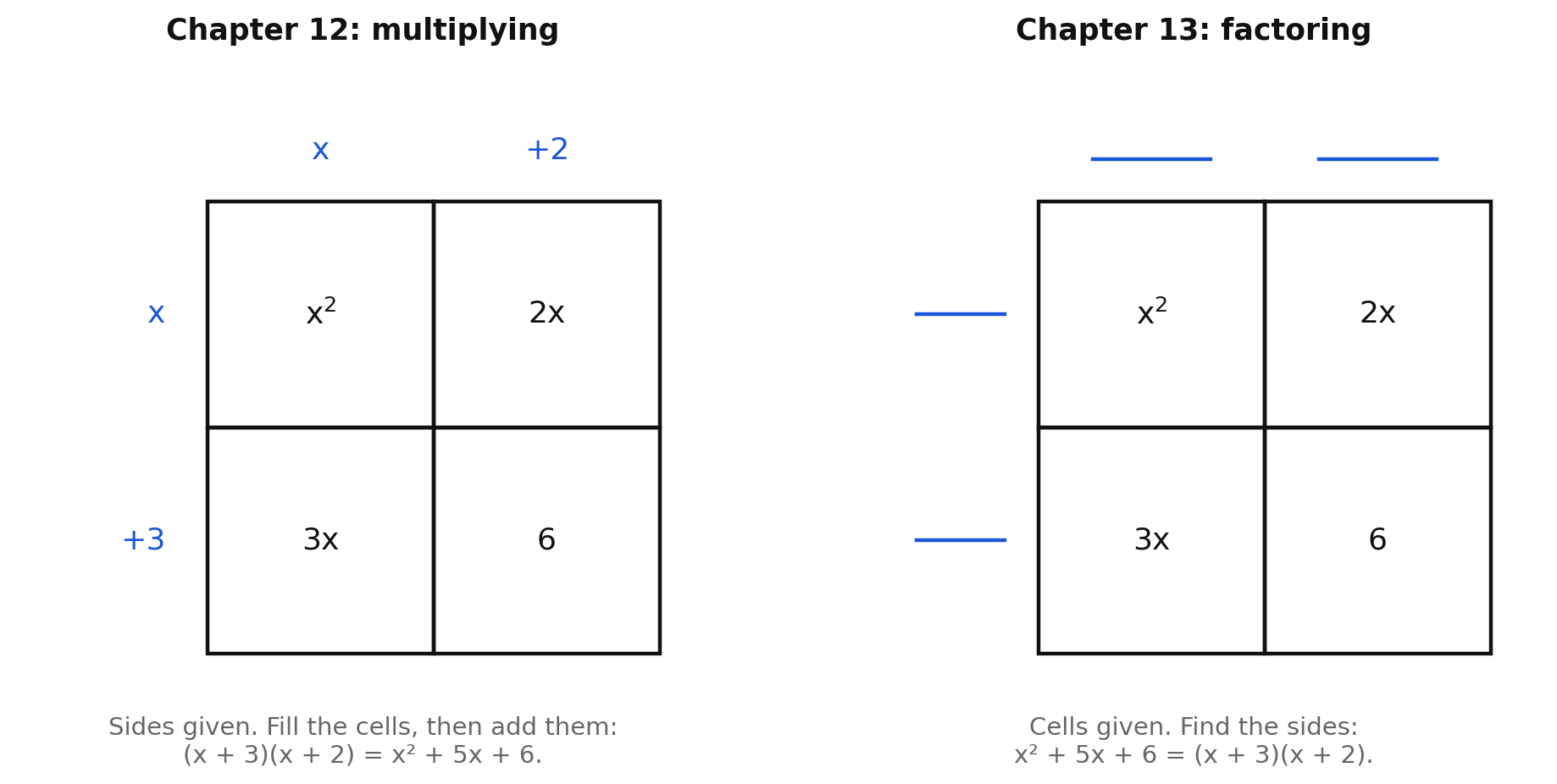
Read the figure left to right.
- Left panel — multiplying. Sides and across the top, and down the side. The four cells are , , , and , and they add to .
- Right panel — factoring. The same four cells are already filled. The four side slots are blank. Factoring is the question those blanks ask: which two binomials have this product?
So
is not a new fact. It is written in the other direction.
Reading an area model from the inside out
Here is the same idea with a different trinomial, drawn so that only the cells are given.
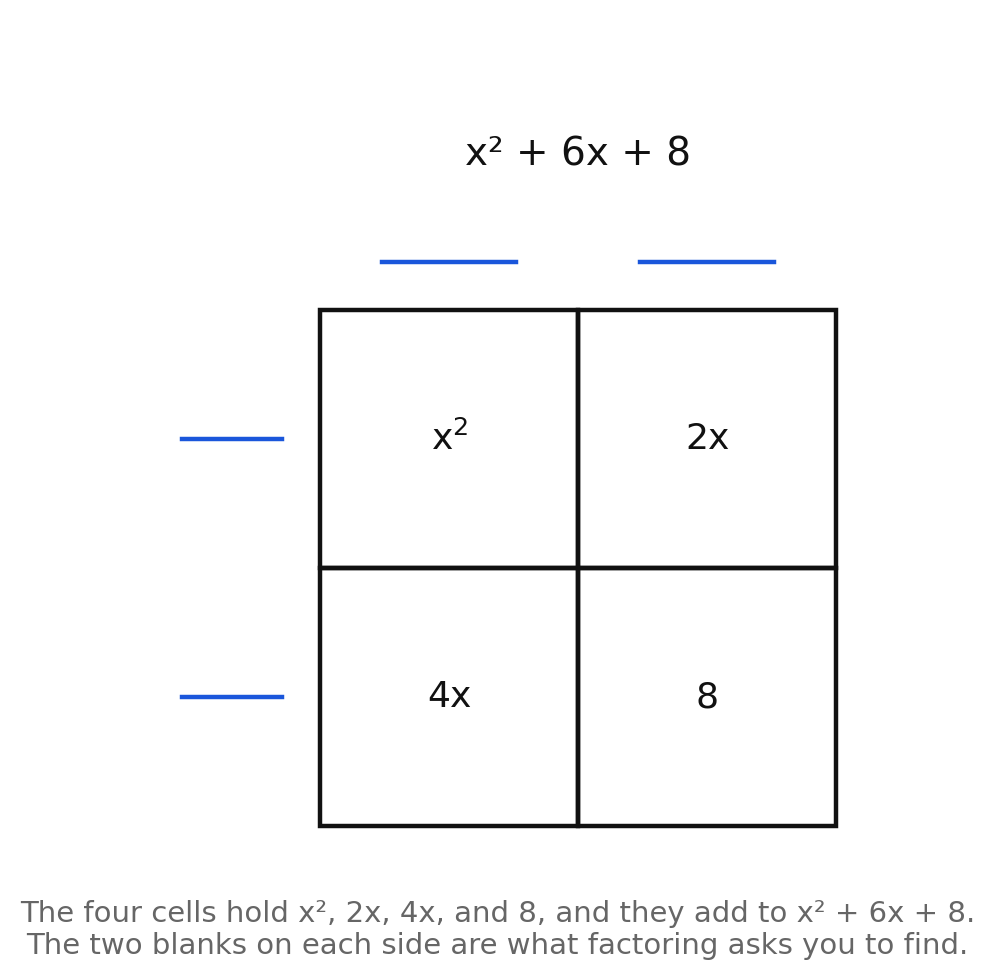
The four cells hold , , , and . They add to . The blanks on each side are what factoring asks you to find.
How do you fill them?
- The top-left cell is , so both the top-left side and the left-top side are (or and , but positive is the starting guess when every cell is positive).
- The bottom-right cell is , so the remaining two sides are a factor pair of .
- The off-diagonal cells must match: if the top-right side is , then the top-right cell forces the bottom-left side to be , and matches the bottom-left cell. The pair and also multiplies to .
Check by multiplying back: . The original expression reappears, so the factorization is correct.
What "factor" means in this chapter
To factor a polynomial is to rewrite it as a product. The factors are the side lengths of a rectangle whose area is the polynomial. Two requirements never go away:
- The product of the factors must expand to the original polynomial.
- In this chapter the factors have integer coefficients, and after any GCF is removed the remaining leading coefficient has at most four factors.
A factorization can be checked two ways, and both should become automatic.
- Multiply back with an area model or the distributive property.
- Evaluate the original and the factored form at the same input. At : , and . At : , and .
Worked examples
Example 1 — Reading the reverse figure
The right panel of the reverse figure has cells , , , and . Name the side lengths and write the factorization.
The top-left cell forces an on each adjacent side. The constant and the split force and .
Answer: , so .
Example 2 — Filling the blanks
The cells of an area model are , , , and . Find the sides.
Top-left gives sides and . The constant with middle split gives and .
Answer: , and .
Example 3 — Checking by multiplying back
A student claims . Check.
. The products match.
Answer: The claim is correct.
Example 4 — Checking by evaluating
Check at and at .
At : both sides equal . At : both sides equal .
Answer: Both inputs agree, so the factorization survives the check.
Example 5 — A product written backwards
Chapter 12 produced . Write the factorization that statement becomes.
Answer: .
Guided practice
- Use the reverse figure. On the multiplying side, what are the four cells of , and what polynomial do they sum to?
- In that same figure, on the factoring side, what is given and what is blank? Write the sentence the figure is asking you to complete.
- Use the run-backwards figure. Name the four cells and the polynomial they add to.
- In that same figure, explain how the cells and together produce the middle term .
- Fill the blank sides of that figure and write in factored form.
- Explain. Why is factoring not a new operation? Use the two panels of the reverse figure in your answer.
Independent practice
- An area model has cells , , , and . Write the polynomial, fill the sides, and give the factorization.
- An area model has cells , , , and . Write the factorization of the polynomial the cells form.
- Multiply , then write the same equality with the product on the left and the factors on the right.
- Multiply , then write the corresponding factorization.
- A student writes . Check by multiplying back. Is the student correct?
- Check by evaluating both sides at and at .
- Error analysis. A student sees cells , , , and and writes . Identify the error and give the correct factorization.
- Application. A rectangular garden has area square meters. Write two binomial expressions that could be its length and width.
- Reasoning. Explain why multiplying the factors back out is a complete check of a factorization, while evaluating at a single input is not.
Exit ticket 13.1
- Write as a product of two binomials.
- An area model has cells , , , and . Give the side lengths.
- Check your answer to 16 by multiplying the factors back out.
- Explain in one sentence what "factoring is multiplication run backwards" means for an area model.
Lesson 13.2 — The Greatest Common Factor
A shared side length
Before any special pattern, every factorization starts the same way: look for a greatest common factor. In an area model, a GCF is literally a shared side.
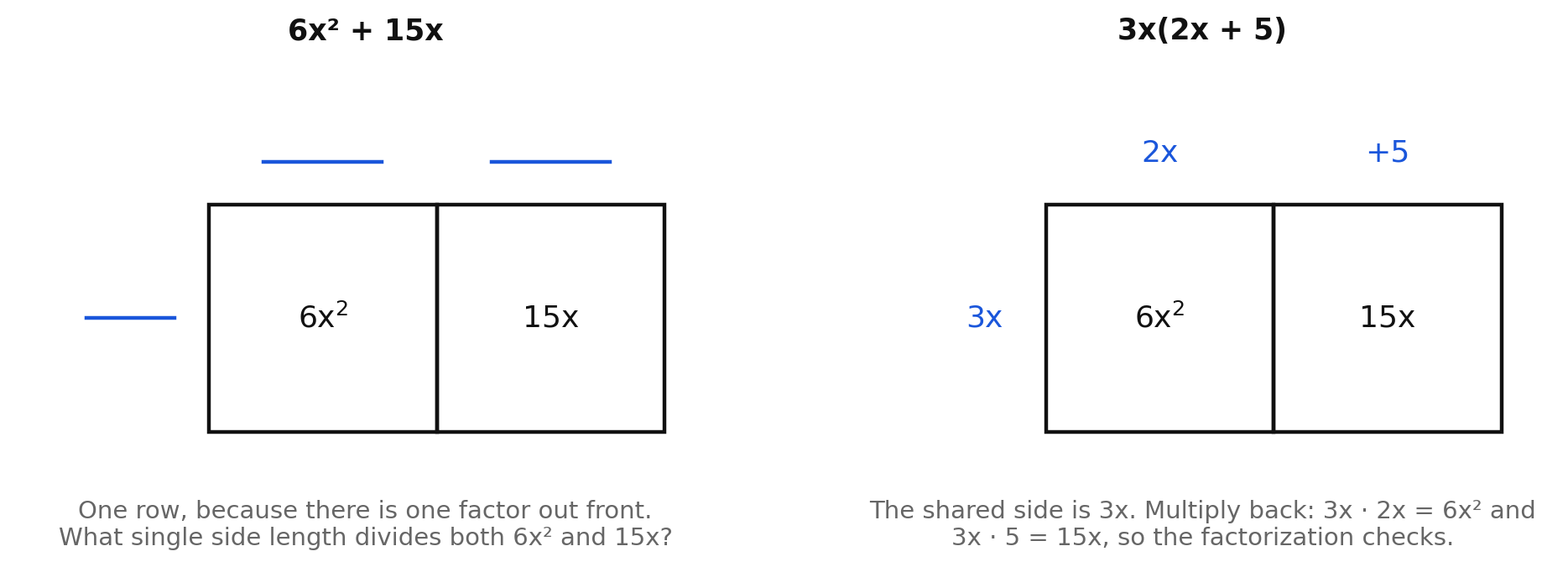
The left panel is one row because there is one factor out front. The question is: what single side length divides both and ?
- The coefficients and share a GCF of .
- The variable parts and share a GCF of .
- So the shared side is .
Dividing each cell by fills the top: and .
Multiply back: and . The factorization checks.
Finding the GCF of the terms
For a polynomial in one variable:
- GCF of the coefficients — the largest positive integer that divides every coefficient.
- GCF of the variable parts — the variable raised to the smallest exponent that appears.
- Multiply those two pieces. That monomial is the GCF of the terms.
Then write each term as and pull the GCF out front by the distributive property in reverse.
When the leading term is negative
If the leading term is negative, factor the minus sign out with the GCF so the remaining leading coefficient is positive.
Check: and . Both terms match. Writing is algebraically equal, but the convention in this chapter is a positive remaining leading coefficient.
Factoring out the GCF is not always the end
has pulled the GCF, but is still a difference of squares. The factorization is not yet complete. Lesson 13.4 will finish it. The rule for now: always pull the GCF first; then look at what remains.
Worked examples
Example 1 — Shared side
Factor using the shared-side figure.
The shared side is ; the remaining side lengths are and .
Answer:
Example 2 — Coefficients and a variable
Factor .
Coefficients: GCF of and is . Variables: GCF is .
Answer:
Example 3 — A constant GCF only
Factor .
Answer:
Example 4 — A leading minus sign
Factor .
Pull : .
Answer:
Example 5 — Check by multiplying
A student writes . Check.
and . Both match.
Answer: Correct.
Guided practice
- Use the GCF figure. On the left panel, why is there only one row of cells?
- In that same figure, what shared side divides both and ? Show the two divisions that fill the top labels.
- On the right panel of that figure, multiply back out and confirm you recover .
- Find the GCF of the terms of , then factor.
- Factor , taking the minus sign out with the GCF.
- Explain. Why does factoring out a GCF come before every other factoring method in this chapter?
Independent practice
- Factor. a) b) c) d)
- Factor. a) b) c) d)
- Factor, taking out a minus sign with the GCF when the leading term is negative. a) b) c) d)
- Factor . Then check by multiplying back.
- Factor . Is the remaining factor a monomial or a binomial?
- Error analysis. A student writes . Identify what was missed and give the complete GCF factorization.
- Application. The area of a rectangle is square feet. Factor the expression and name a possible length and width in terms of .
- Reasoning. Explain why is a correct GCF step but is not yet factored completely.
- Check by expanding, and say which original polynomial it came from.
Exit ticket 13.2
- Factor .
- Factor .
- Factor , and check by multiplying back.
- Explain what the shared side represents in the GCF area model.
Lesson 13.3 — Trinomials with Leading Coefficient 1
The factor-pair search
For a trinomial , the area-model sides are and , and the constant cell is while the middle cells add to . So the whole search collapses to one sentence:
Find two integers whose product is and whose sum is .
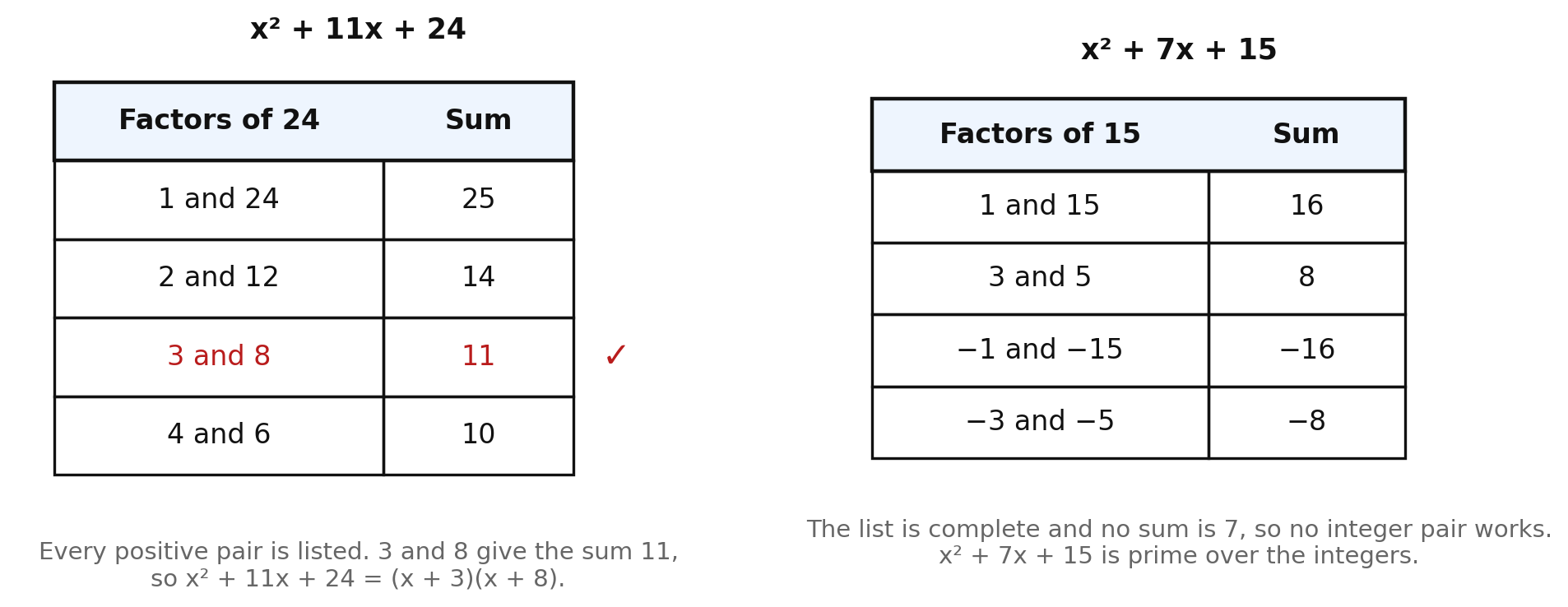
Read the left table completely. Every positive factor pair of is listed, and each sum is computed. The pair and is the only sum equal to , so
The right table is just as important. Every integer factor pair of is listed — positive and negative — and no sum is . That is not a failed search; it is a finished proof that
Signs of the pair
The signs of and are forced by and :
| Both factors | ||
|---|---|---|
| positive | positive | positive |
| positive | negative | negative |
| negative | positive | the one with larger absolute value is positive |
| negative | negative | the one with larger absolute value is negative |
So needs two negatives that multiply to and add to : and . And needs opposite signs that multiply to and add to : and .
When the tiles refuse to make a rectangle
The same conclusion — prime or not — has a concrete picture.
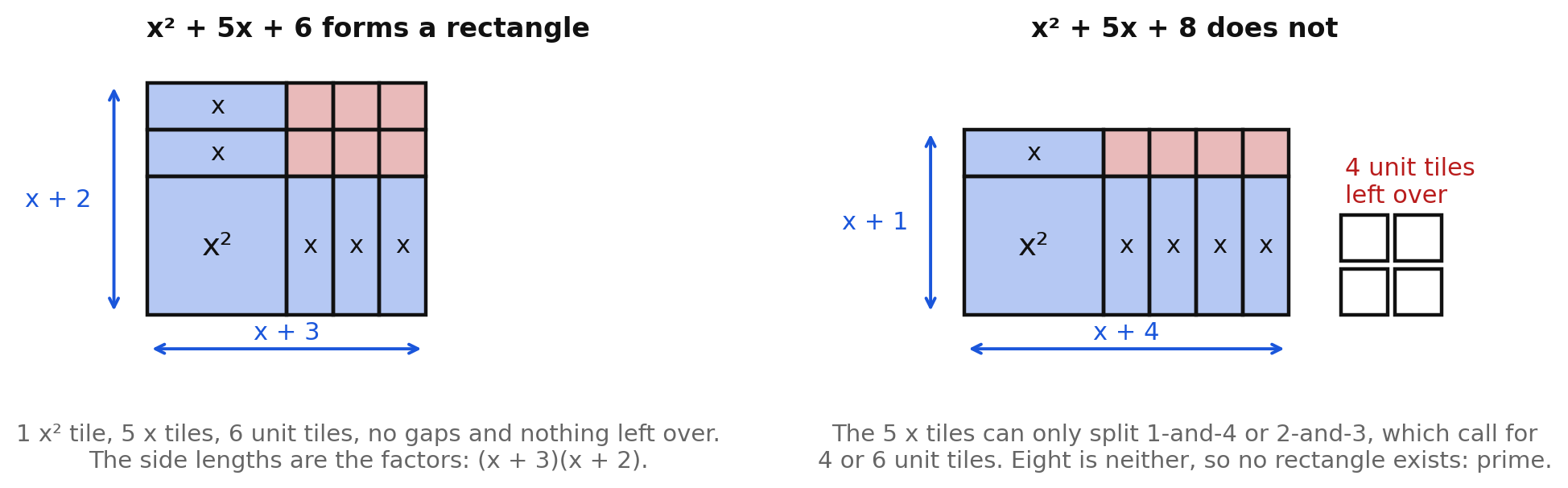
- Left. One tile, five tiles, and six unit tiles fill a rectangle with no gaps and nothing left over. The side lengths are the factors: .
- Right. The five tiles can only split as -and- or -and-, which call for or unit tiles. Eight is neither, so four unit tiles are left over. No rectangle exists: is prime.
Worked examples
Example 1 — A successful search
Factor using the factor-pair table.
The pair and sums to .
Answer:
Example 2 — A prime trinomial
Factor , or say why it does not factor.
Every pair of factors of is listed in the figure; no sum is .
Answer: Prime over the integers.
Example 3 — Two negatives
Factor .
Need product , sum : and .
Answer:
Example 4 — Opposite signs
Factor .
Need product , sum : and .
Answer:
Example 5 — Tiles
Do the tiles for form a rectangle? If so, name the sides.
Answer: Yes; sides and .
Guided practice
- Use the factor-pair figure. For , which row of the table is the match, and why?
- In that same figure, list the sums on the right table and explain why they prove is prime.
- Use the tile figure. How many of each tile fill the left rectangle, and what product do they show?
- In that same figure, why can not form a rectangle? Refer to the possible splits of the five tiles.
- Factor by listing factor pairs of and their sums.
- Factor .
Independent practice
- Factor. a) b) c) d)
- Factor. a) b) c) d)
- Factor. a) b) c) d)
- Decide whether each is factorable over the integers. If it is, factor it; if not, write prime. a) b) c) d)
- Factor and check by multiplying back.
- Build a factor-pair table for and factor it.
- Error analysis. A student factors as . Identify the error using product and sum, and give the correct factorization.
- Application. A rectangular patio has area square feet. Write its length and width as binomials in .
- Reasoning. Explain why listing every factor pair — including negative pairs when and could be negative — is what makes "prime" a conclusion rather than a guess.
- Check by expanding, and say which of the trinomials in this lesson it matches.
Exit ticket 13.3
- Factor .
- Factor .
- Is factorable over the integers? Justify with a factor-pair argument or a tile argument.
- Factor and check by multiplying back.
Lesson 13.4 — Difference of Squares
Cutting a square and rearranging
A difference of squares is a binomial of the form . It factors on sight:
The area picture that forces the identity is a large square with a smaller square removed, then rearranged.
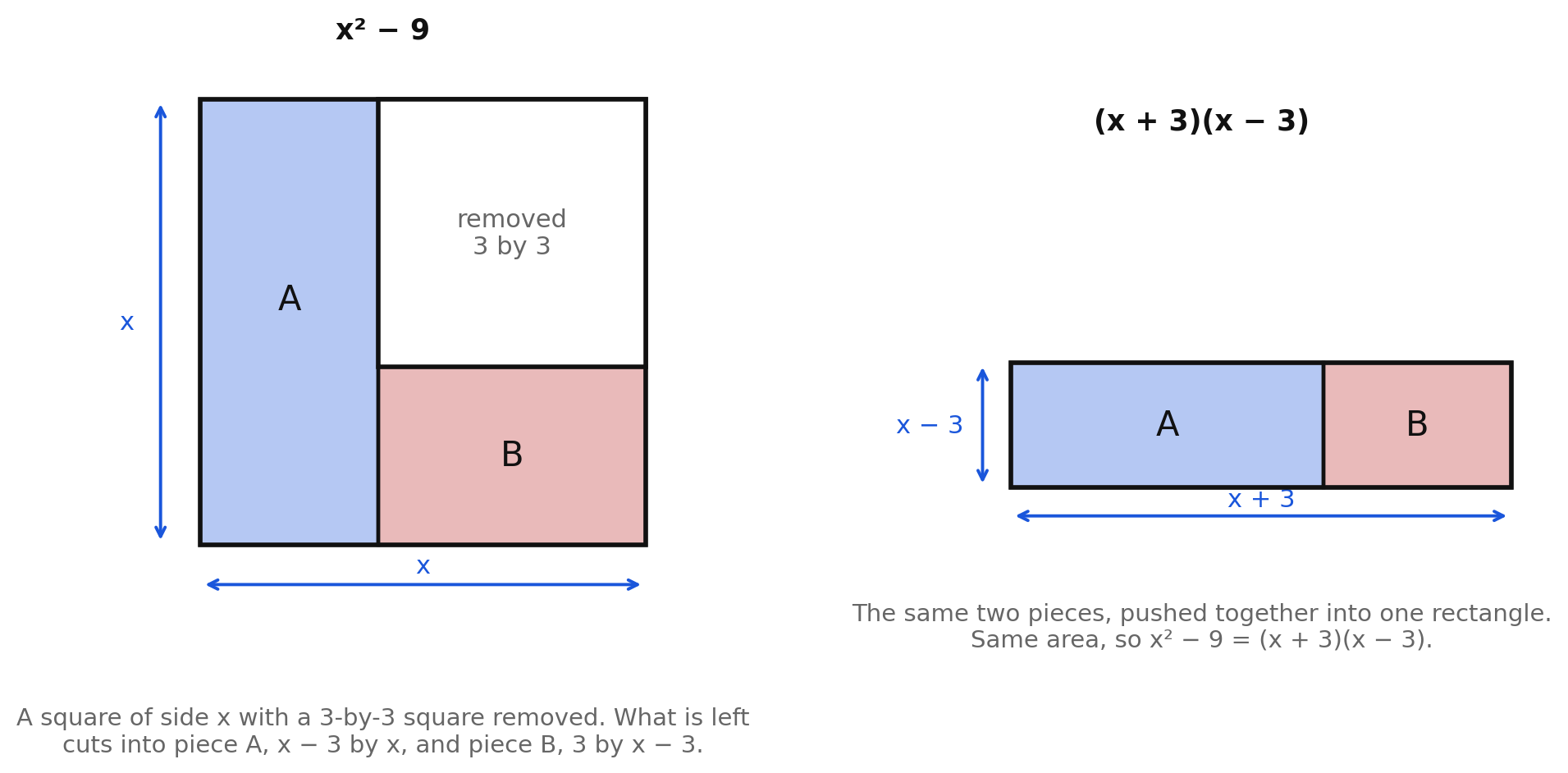
- Left. A square of side has a -by- square removed. The remaining L-shape cuts into piece A, by , and piece B, by .
- Right. The same two pieces push together into one rectangle of height and width .
Same area both ways, so
Recognizing the pattern
A binomial is a difference of squares when:
- It is a difference (a minus sign between the terms), not a sum.
- Each term is a perfect square — a square of an integer or of a monomial with integer coefficient.
| Expression | Factored | ||
|---|---|---|---|
A sum of squares does not factor over the integers. There is no integer pair whose product is and whose sum is .
GCF first, then the difference
Sometimes a GCF hides a difference of squares.
Stopping at leaves a factorable factor behind. Factoring completely requires the second step.
Worked examples
Example 1 — The area argument
Use the difference-of-squares figure to factor .
The rearranged rectangle has sides and .
Answer:
Example 2 — A larger constant
Factor .
Answer:
Example 3 — Squares on both sides
Factor .
Answer:
Example 4 — With a GCF
Factor completely.
.
Answer:
Example 5 — A sum is not the pattern
Does factor over the integers as a difference of squares?
Answer: No. It is a sum of squares, and it is prime over the integers.
Guided practice
- Use the difference-of-squares figure. What was removed from the large square, and what two pieces remain?
- In that same figure, what are the side lengths of the rearranged rectangle, and what identity do they prove?
- Factor by naming and .
- Factor .
- Factor completely.
- Explain. Why does not factor as a difference of squares?
Independent practice
- Factor. a) b) c) d)
- Factor. a) b) c) d)
- Factor completely. a) b) c) d)
- Which of these factor as a difference of squares? Factor those that do, and label the others prime or not a difference of squares. a) b) c) d)
- Factor and check by multiplying back.
- Error analysis. A student writes . Identify the error and give the correct factorization.
- Application. A square fountain of side feet sits in the corner of a square plaza of side feet. The remaining area is . Write that area as a product of two binomials.
- Reasoning. Explain why a difference of squares always factors into a sum times a difference, using the middle-term cancellation .
- Expand and say which item in this lesson it reverses.
Exit ticket 13.4
- Factor .
- Factor .
- Factor completely.
- Explain why is not a difference of squares.
Lesson 13.5 — Perfect Squares and Leading Coefficient Greater Than 1
A square area model
A perfect-square trinomial is the expansion of or :
In an area model the two side lengths come out equal, so the model is itself a square.
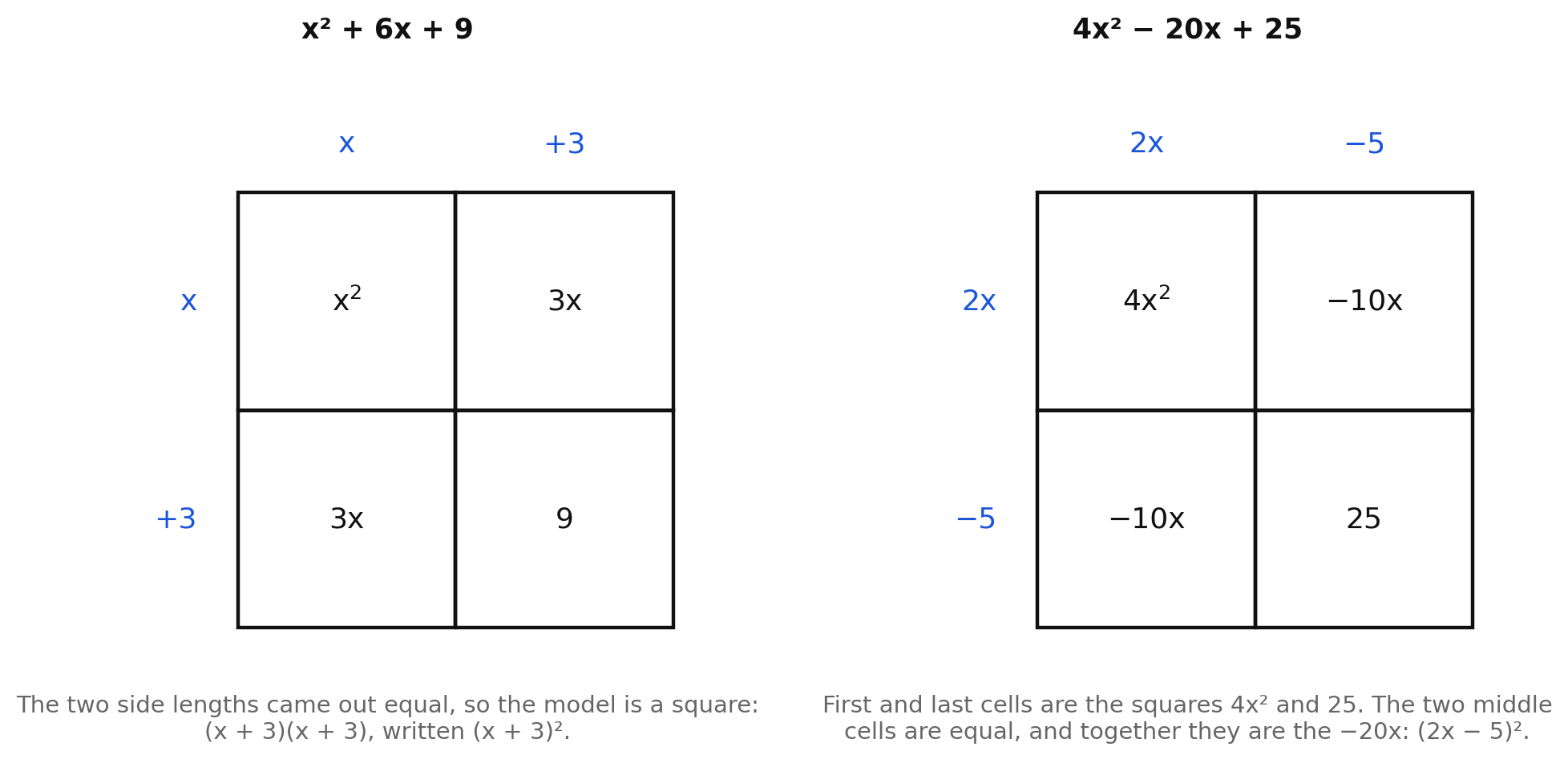
- Left. Cells , , , and . Both side lengths are , so .
- Right. Cells , , , and . Both side lengths are , so .
A quick test: the first and last terms are perfect squares, and the middle term is twice the product of their square roots (with the correct sign).
When the leading coefficient is greater than 1
For with , the factor-pair search targets the product instead of . The method is split the middle term, then group.
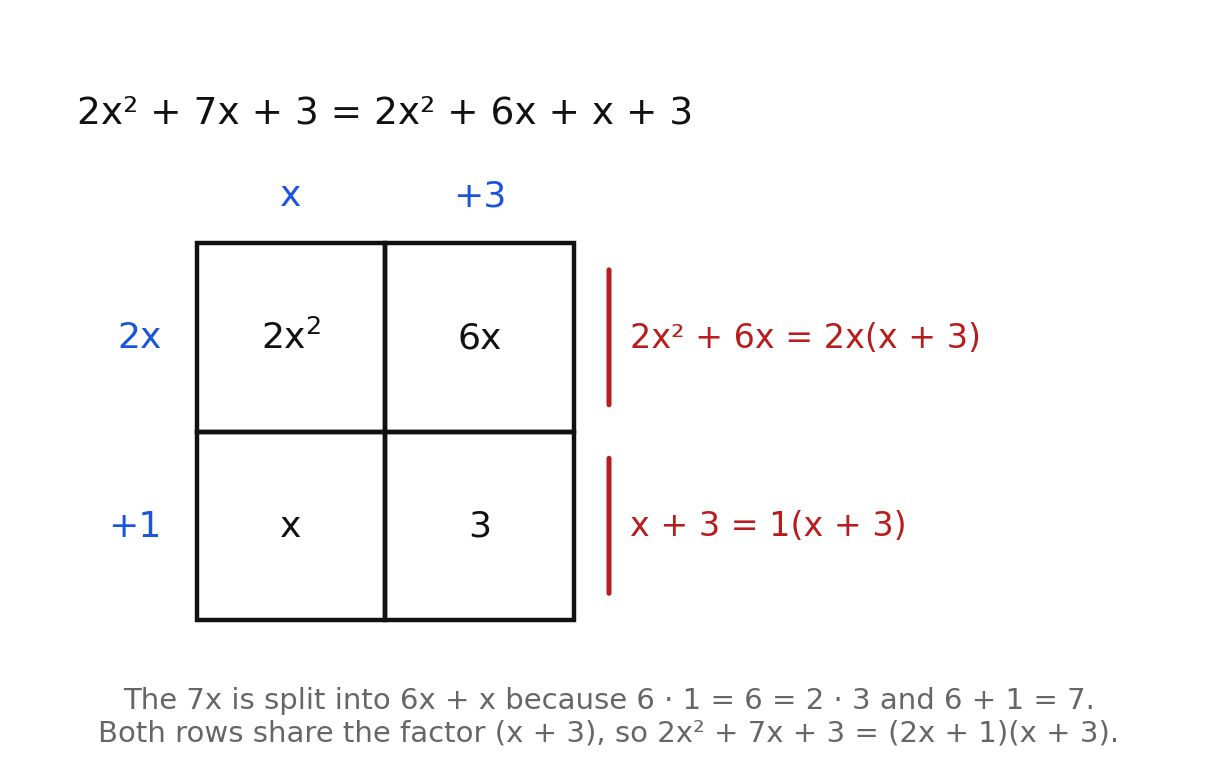
For :
- Compute .
- Find a factor pair of that sums to : and .
- Split: .
- Place the four terms in the area model. The rows share the binomial :
- Pull the common binomial: .
The figure's caption records why and were the right split: and .
Grouping without the picture
The same steps in symbols:
After the GCF is removed, has at most four factors in this chapter — so the search for a pair of stays small.
Worked examples
Example 1 — A perfect square
Factor .
First and last are squares; middle is .
Answer:
Example 2 — A square with
Factor .
Answer:
Example 3 — Split the middle
Factor by splitting.
Split as , then group.
Answer:
Example 4 — Another
Factor .
; pair and sums to . Split: .
Answer:
Example 5 — Opposite signs in the pair
Factor .
; pair and sums to . Split and group.
Answer:
Guided practice
- Use the perfect-square figure. Why are both side lengths on the left panel equal, and how is that written in exponential form?
- In that same figure, name the four cells on the right panel and explain how the two middle cells together make .
- Use the splitting figure. Why is rewritten as ?
- In that same figure, show that both rows share the factor , and write the factorization.
- Factor as a perfect square.
- Factor by splitting the middle term.
Independent practice
- Factor as a perfect square. a) b) c) d)
- Factor as a perfect square. a) b) c) d)
- Factor by splitting the middle term. a) b) c) d)
- Factor by splitting the middle term. a) b) c) d)
- Factor two ways: as a perfect square, and by splitting. Confirm the answers match.
- Error analysis. A student writes . Identify the missing middle term and give the correct expansion, then factor .
- Application. A square garden has area square meters. Write the side length as a binomial.
- Reasoning. Explain why the search for uses factor pairs of , not of alone.
- Group and write the factorization. (This is the split form of item 86a.)
- Factor and check by multiplying back.
Exit ticket 13.5
- Factor .
- Factor .
- Factor .
- Factor by splitting and grouping.
Lesson 13.6 — Factoring Completely and Choosing a Method
A decision flow
Every polynomial in this chapter yields to the same three-step habit.
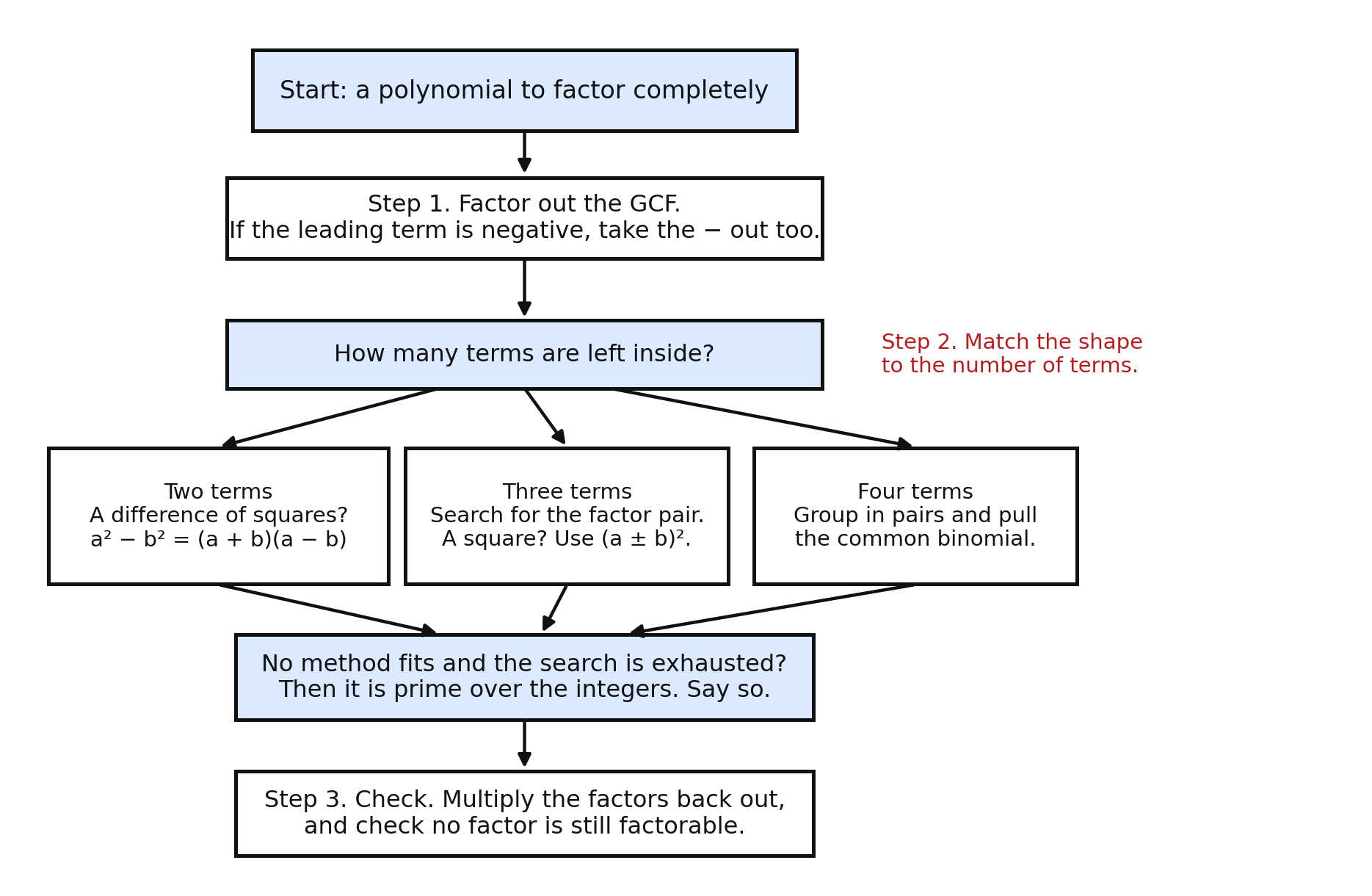
Read the flow top to bottom.
- Factor out the GCF. If the leading term is negative, take the minus out too.
- Match the shape to the number of terms left inside.
- Two terms. A difference of squares? Use .
- Three terms. Search for the factor pair. A perfect square? Use .
- Four terms. Group in pairs and pull the common binomial.
- Check. Multiply the factors back out, and check that no factor is still factorable.
If no method fits and the search is exhausted, the polynomial is prime over the integers. Saying so is the correct complete answer.
Factoring completely — worked through
Example A.
- Step 1: GCF , leaving .
- Step 2: two terms, difference of squares: .
- Step 3: . Multiply back: . No factor remains factorable.
Example B.
- Step 1: GCF , leaving .
- Step 2: three terms, perfect square: .
- Step 3: . Complete.
Example C.
- Step 1: GCF is .
- Step 2: three terms; the factor-pair search (Lesson 13.3) finds no pair.
- Conclusion: prime over the integers.
Staying on the expression side
Factoring rewrites an expression. It does not solve an equation. The sentence
says two expressions are equal for every . It does not ask which makes either side zero. That question is Chapter 15. Every item in this chapter stops at the product.
Worked examples
Example 1 — Following the flow
Factor completely, naming the step at each move.
GCF first: . Two terms inside: difference of squares: .
Answer:
Example 2 — GCF then a trinomial
Factor completely.
Answer:
Example 3 — Already a special form
Factor completely.
Answer:
Example 4 — Prime
Factor completely, or say it is prime.
Answer: Prime over the integers.
Example 5 — Four terms after a split
Factor completely.
No GCF other than . Three terms with : split and group to .
Answer:
Guided practice
- Use the method-flow figure. What is Step 1, and why does it come before matching the shape?
- In that same figure, what three branches does Step 2 offer, and what does each branch ask you to try?
- According to that figure, when is "prime over the integers" the correct final answer?
- Factor completely, naming which box of the flow you are in at each step.
- Factor completely.
- Explain. Why does the flow end with a multiply-back check rather than with the factored form alone?
Independent practice
- Factor completely. a) b) c) d)
- Factor completely. a) b) c) d)
- Factor completely, or write prime. a) b) c) d)
- For each expression, name the first method the flow recommends (after any GCF), then factor completely. a) b) c) d)
- Error analysis. A student factors as and stops. Identify what the flow's final check would catch, and give the complete factorization.
- Application. A rectangular banner has area square feet. Factor the area and name possible side lengths.
- Reasoning. A polynomial factors as . Explain how you can tell the original polynomial was without being told, and why that original was "factored completely" only after both the GCF and the difference of squares were used.
- Factor completely and check by evaluating the original and the factors at .
- Use the flow on . Factor completely, taking the minus with the GCF.
Exit ticket 13.6
- Factor completely.
- Factor completely.
- Factor completely, or write prime.
- Name the three Step-2 branches on the method-flow figure, and give one example polynomial for each branch.
Chapter 13 Review
Vocabulary. factor · factor completely · greatest common factor (GCF) · prime over the integers · factor pair · difference of squares · perfect-square trinomial · split the middle term · grouping · area model (run backwards)
A.EO.2c is a single bullet with several techniques inside it, so this review is organized by technique and then by the complete-factoring habit that ties them together.
Part A — Reverse of multiplying and GCF
- An area model has cells , , , and . Write the factorization of the polynomial those cells form.
- Factor .
- Factor .
- Explain why factoring is Chapter 12's multiplication read backwards, using an area model in your answer.
Part B — Leading coefficient 1 and primes
- Factor .
- Factor .
- Factor .
- Is factorable over the integers? Justify.
Part C — Special products and
- Factor .
- Factor .
- Factor .
- Factor .
Part D — Factoring completely and method choice
- Factor completely.
- Factor completely.
- For , name the method the flow recommends and give the factorization.
- Application. A rectangular courtyard has area square meters. Write its length and width as binomials, then check by multiplying back.
Standards coverage check — Chapter 13
A.EO.2c is one Knowledge and Skill with a fixed scope: first- and second-degree, one variable, integral coefficients, GCF first, leading coefficient afterward limited to at most four factors, and factor completely. Coverage is broken out by technique.
| Knowledge and Skill | Technique | Where it is taught | Where it is practiced | Where it is used in context |
|---|---|---|---|---|
| A.EO.2c — factor completely first- and second-degree polynomials in one variable with integral coefficients; after the GCF, leading coefficients have no more than four factors | Factoring as multiplication backwards | 13.1 (area model reverse; multiply-back and evaluate checks) | 1–19; 117, 120 | 14 |
| A.EO.2c | Greatest common factor | 13.2 (shared side; leading minus sign) | 20–38; 118, 119 | 32 |
| A.EO.2c | Trinomials with leading coefficient 1; primes | 13.3 (factor-pair search; tile rectangle versus prime) | 39–58; 121–124 | 52 |
| A.EO.2c | Difference of squares | 13.4 (cut-and-rearrange area; GCF then difference) | 59–77; 125 | 71 |
| A.EO.2c | Perfect-square trinomials; ; grouping | 13.5 (square area model; split middle term; group) | 78–97; 126–128 | 90 |
| A.EO.2c | Factor completely; method selection | 13.6 (decision flow; GCF then shape; prime as a finished answer) | 98–116; 129–132 | 109, 132 |
Supporting items: 6, 15, 25, 33, 53, 64, 72, 91, 103, 110, and 120 are reasoning prompts aimed at the claims most often taken on faith — that factoring is multiplication reversed, that GCF comes first, that "prime" is a conclusion from an exhausted search, that a sum of squares is not the difference pattern, that is the right product for , and that a multiply-back check is required. Items 13, 31, 51, 70, 89, and 108 are error analyses aimed at the most common defects: wrong factor pair, incomplete GCF, missing middle term of a square, and stopping before a remaining difference of squares is factored. Items 12, 18, 29, 49, 58, 69, 93, and 111 all run a multiply-back or evaluate-at-the-same-input check.
Boundaries respected. No item solves an equation or asks for a value of that makes a product zero — that is A.EI.1 / A.EI.3 in Chapter 15. Every item rewrites an expression as a product, or identifies a polynomial as prime. No item uses a polynomial of degree greater than , a polynomial in two variables, or a leading coefficient (after GCF) with more than four factors. No item divides a polynomial or asks whether two quadratic forms are equivalent; those are A.EO.2 d and e in Chapter 14. Multiplication appears only as the check on a factorization, which is A.EO.2b from Chapter 12 being used, not re-taught.
Answer keys for every item in this chapter are in Appendix A.